In search of my own poetic voice: A few thoughts about writing poetry with a link to my work at Poetry at Sangam

a shiver of unease
runs its course across
my shoulders, shudders
down a rocky spine
to dissipate
through fissures
in this sleeping
mountain
mine

Over the past couple of years I have, often in defiance, insisted on writing about the poetry I read. At the same time, my focus in reading poetry has shifted, taking in more contemporary poets, as well as experimental and translated works. But I know nothing about formal analysis, and even less about how one might set out to write a poem. But I’ve not let that stop me from attempting the odd poetic effort, even if I always feel like I’m writing into the dark. Stumbling into it sideways.

This month I have the honour of having several of my poems included with some truly fine poets and translators in the latest issue of Poetry at Sangam. My contribution includes a photo essay originally published at RIC Journal, a piece I wrote after I returned from central Australia. I’d gone to hike the Larapinta Trail and arrived with a brutal head cold brewing, so hiking was limited, but in that magnificent ancient land I sensed the presence of my mother in a dream for the first time after her death the year before. This piece recounts that experience.

My three new poems, all touch on authenticity, the body, and gender identity—pretty typical terrain for me, but one that I am beginning to feel may be best explored in a poetic realm as I move toward other subjects in essay form because, as I explain in my introduction:

Poetry, fractured prose, and fables have begun to play a greater role in my writing repertoire by offering a space for me to explore the raw, the visceral, the discordant elements of my being from a distance. It still arises from my own emotional journey, sometimes riding close to the arc of my narrative reality, but I can be abstract, ambiguous or disassociated from the speaker or the subject as much as I want or need to be. Many of my poetic efforts gestate over long periods of time, moving in and out of first person, falling apart and coming back together as need be. But in the end, it is all trial and error. I don’t really know anything about writing poetry at all.

My full introduction and links to my poems can be found here. And be sure to check out the rest of this wonderful issue at the same time.

With thanks to my dear friend, Priya Sarukkai Chabria.

Poetry as personal ad? Human Tetris by Vi Khi Nao and Ali Raz

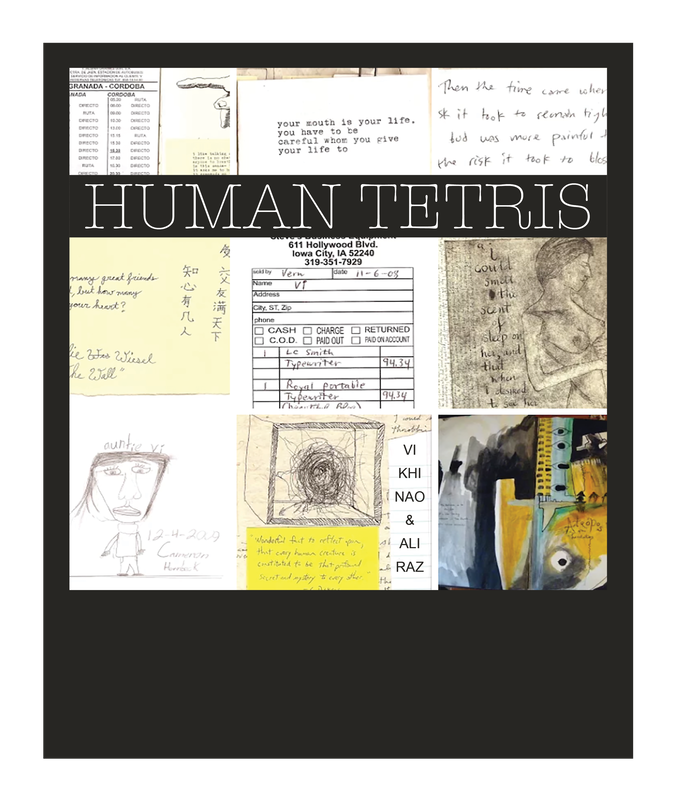
If dating in the era of online personals and dating sites intimidates you, especially if you lack the necessary surface appeal to ensure that your desired target will be inclined to swipe right, a space that will allow you to describe succinctly a lover with the exact shape to match your own twisted shape, you might wish a network like Human Tetris really existed. If you’re sexually squeamish, you might not. But in the way that old-fashioned newspaper-printed personals provided plenty of entertainment even if you were not on the hunt, shall we say, this playful poetic collaboration that boldly satirizes aberrant desire is great fun.

Within the pages of this game-shaped book with a stubbornly neck-twisting layout, unspoken (primarily) queer longings are given voice with a healthy measure of “no boundaries” internet exhibitionism. (I’ll tell you what I want, what I really really want—and exactly what I expect you to do to realize my exceptional expectations.) Gleefully playful or painfully doleful this uncensored imaginary/imaginative collaboration between the incomparable Vi Khi Nao and the amazing Ali Raz injects a double-barrelled dose of estrogen into the—to date—male dominated catalogue of one of the most promising innovative publishing projects to arise in the past few years, 11:11 Press.

This tag team creative duo has dreamed up a collection of sometimes delightful, sometimes disturbing personal ads suffused with the hopeful desperation of a world in which we are simultaneously more connected and more isolated than ever.

Be My Beehive, Be My Boner & Clyde:

I need someone sexy to blame
for all the great things
that are happening in my awesome life.
Or, you could be ugly & and this is how it will roll: Do you want vacation
days or do want my Sundays? Do you want happiness or do you want décor
What if I offer both?
I’m beautiful and I’m happy.
I need a soulmate who aren’t either.
@hitmebabyhitthisdamnbabyrightaway

ALABAMA (where else?)

Mutated pop-culture pleasures, kinky quirks, and a plethora of identities (which honestly should almost come with a glossary—subject to change without notice, of course) rise in these poetic pleas that run down, rather than across each page. But don’t fear. It’s not all unexpected terrain. There is @papabear, a beach-loving “30-something hardworking exec” seeking his cute and totally together beach bunny for some shared mind exploring and world expanding interaction. Would a collection of personals be complete without at least one of these missives of implied perfection?

Most, however, veer off the well-trod path:

Looking for My Panadol:

curl up with me like a leaf. be my wellness dog. i’m always sick (but don’t let that scare you!)

who isn’t sick in these days of anomie? indeed, if you are perennially well—I don’t trust you.
be sick with me, let’s be sick machines.
@stickfiguresex

Soeul, South Korea

Every poem exists as an integrated unit. The content of the romantic (or unromantic) call for companionship plays against the title, avatar name, and location; the elements of each poem bounce off each other like, well, the tiles in a game of Tetris. A complete picture depends on the interaction of all these pieces.

But where do I stand? I haven’t been on a date in forty years. Since that time, as a marriage ended, there was another relationship, one that started in the time honoured fashion—introduced by a mutual acquaintance  albeit at a distance. Today I’m as uncertain about my identity as a potential partner as I am about what that imagined “other” might look like. And if years of being single accomplishes anything, it raises your standards to the point that a forty-page questionnaire might just barely suffice to guide my search.

I could write an entire book of poems myself and just crack the surface. So maybe I’ll adapt this one (substituting the cheeseburger for something vegetarian and the bar for a coffee shop).

Partner Wanted for One Date:

It’s been raining all day where I am.
It’s romantic; the rain, cool wind, winter.
I want to go for a long drive with the top down.
We’d stop at a restaurant (your choice) and have a coffee and cheeseburger each.
Then we’d watch a movie (my choice). We cuddle a little. On the way back,
before I drop you home, we stop by a bar for a single drink each.
You pay for my drink, I pay for yours. I drive you home. We never see each other again.
@hamster

Detroit, MI

Ah well, Human Tetris is a quirky jaunt over what is, in the end, a familiar space—the longing for love, and the desire to be seen, validated, and known. Open this collection with a  confident queerness and find inspiration for your next conquest; peek between the covers with a history of unrequited love and perpetual unmatchablity and discover, amid the puns and pathos of passion-starved misfits, that you are not alone.

Human Tetris by Vi Khi Nao and Ali Raz is published by 11:11 Press.

Women in Translation Month 2019: Some off-the-radar reading suggestions and my own modest proposal

Each August is Women in Translation Month, a time set aside to promote women writers from around the world who write in languages other than English and, of course, encourage increased translation of these authors into other languages so that they may be more widely read.  This initiative, started by blogger Meytal Radzinski, is now in its sixth year.

My best ever effort to participate was during 2015, my first year as a blogger. Not only was this before writing critical reviews and editing commitments started to creep into my reading time, but I was also recovering from a cardiac arrest and could stretch out on the sofa and read without guilt. Doing much else was painful! Since then, each year I have made public or private commitments to toss a few extra appropriate titles on the TBR pile and, if lucky, read one or two.  I console myself by remembering that reading women in translation is something that naturally seems to occur throughout the year in the course of my normal reading. As so it should.

This year I have a few books earmarked for the month (fingers crossed), but I thought I would take a little time to suggest some titles that might not be so well known. They’re all taken from my own bookcases and most are (as of yet) unread.

I’ll start with those that I have in fact read and reviewed. First up, poetry:

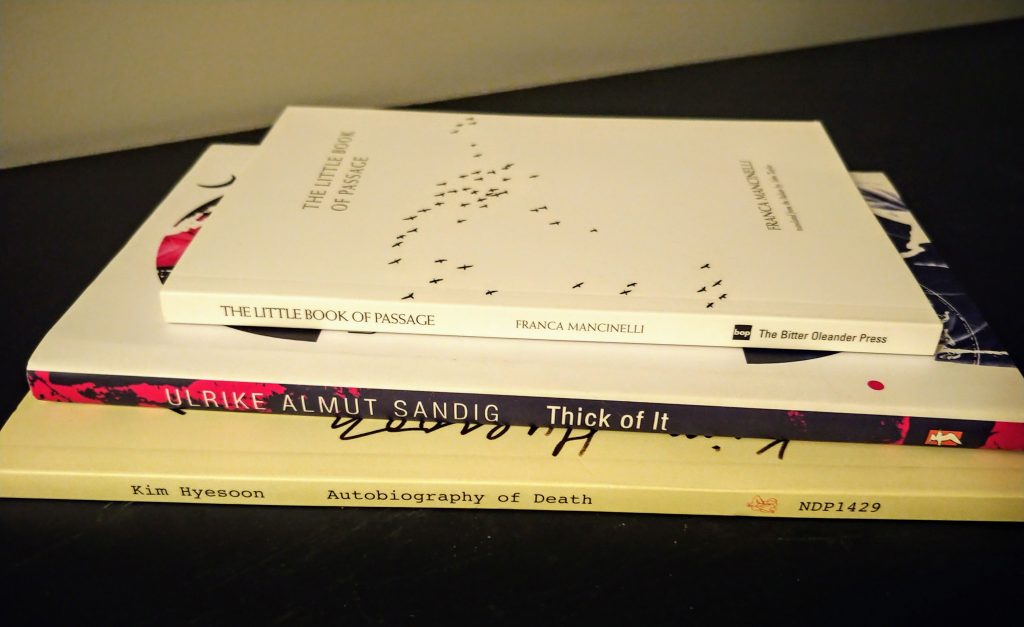
From the bottom up:
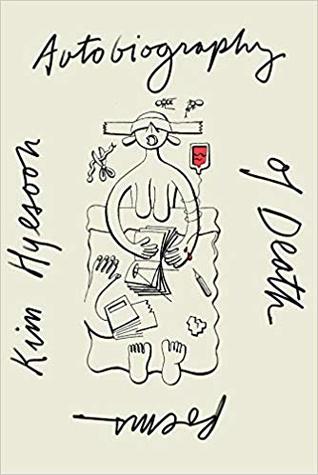
Korean poet Kim Hyesoon won the 2019 International Griffin  Poetry Prize for this book Autobiography of Death, a cycle of 49 poems and one longer piece inspired by national tragedies and personal experience. Her daughter’s distinctive illustrations accompany this powerful collection translated by Don Mee Choi.

Thick of It by German poet Ulrike Almut Sandig, translated by Karen Leeder, is a wonderful blend of the magical and the everyday. Fresh and alive.

Finally, Italian poet Franca Mancinelli’s The Little Book of Passage, translated by John Taylor, is a spare and delicate collection that invites rereading. Earlier this year she and I were able to meet and spend a few days together in Calcutta when my visit happened to overlap with a residency she was doing in the city—evidence that reading the world makes the world smaller in unimaginable ways!

*

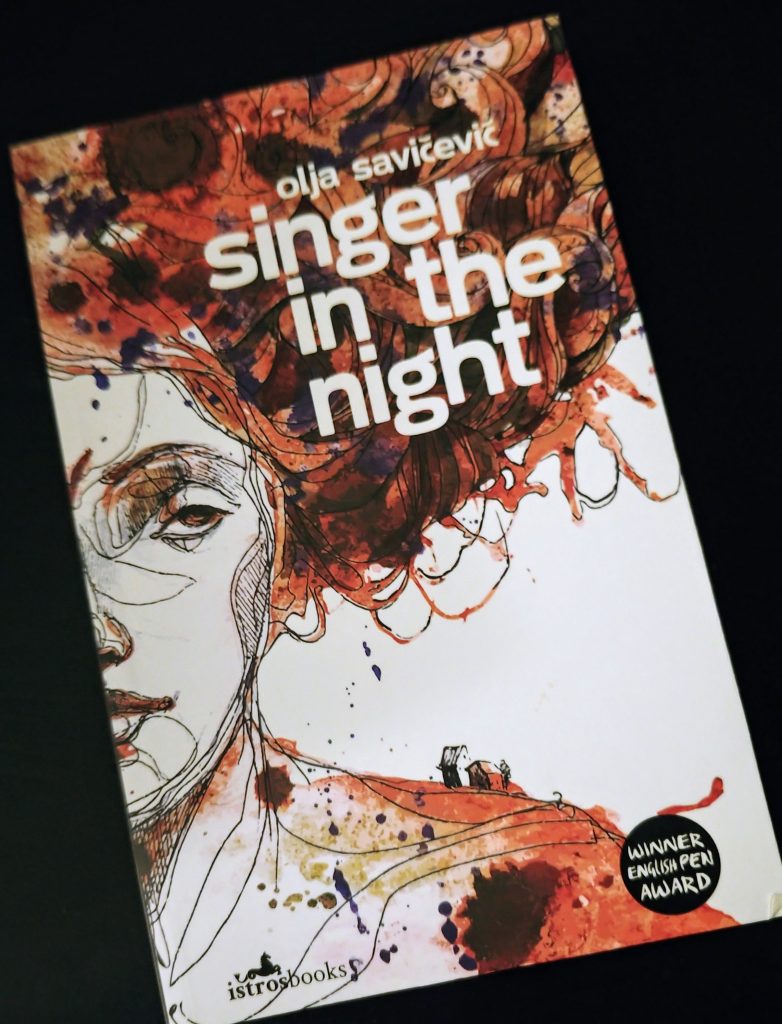
Second, I wanted to highlight a book I recently reviewed that I am afraid has not had the attention it deserves:

Croatian writer Olja Savičevič’s Singer in the Night features a wildly eccentric narrator and a highly inventive style to tell a story that paints a serious portrait of the world that her generation inherited after the break up of the former Yugoslavia. Translated by Celia Hawkesworth, this book is already available in the UK and well worth watching for when it comes out on October 1 in North America.

*

Third, I have an impressive stack of Seagull Books by female authors that I am ashamed to say I have not read yet (save for the poetry title tucked in here). The interesting thing for me about this selection is that although I did purchase many of these books, other titles arrived as unexpected—but very welcome—review copies by writers previously unknown to me.

Most of the above are German language writers; two, Michele Lesbre and Suzanne Dracius are French, the latter from Martinique. The review copy at the bottom of the stack is East German writer Brigitte Reimann’s diary I Have No Regrets.

*

Finally, I wanted to include a couple of translated titles by Indian women writers. Two vastly different offerings.

Translated by Kalpana Bardhan and published by feminist press Zubaan, Mahuldiha Days is a novel by Anita Agnihotri, one of West Bengal’s best known writers. She draws on the decades she spent in the Indian Administrative Service in this story of a young civil servant caught between her obligations to the tribal community she is working with and the state.  By sharp contrast, I Lalla, gives a fresh voice the poems of fourteenth century Kashmiri mystic poet, Lal Děd. A detailed introduction by translator Ranjit Hoskote provides a fascinating background to her life and the tradition to which she belonged, opening a world little known to most Western readers.

*

So, what are my best laid plans for this month? I would like to read one or two titles from my Seagull stack—not sure which—and I have a new Istros title Wild Woman by Marina Sur Puhlovski on my iPad in PDF format, but the following three books have been patiently waiting for August:

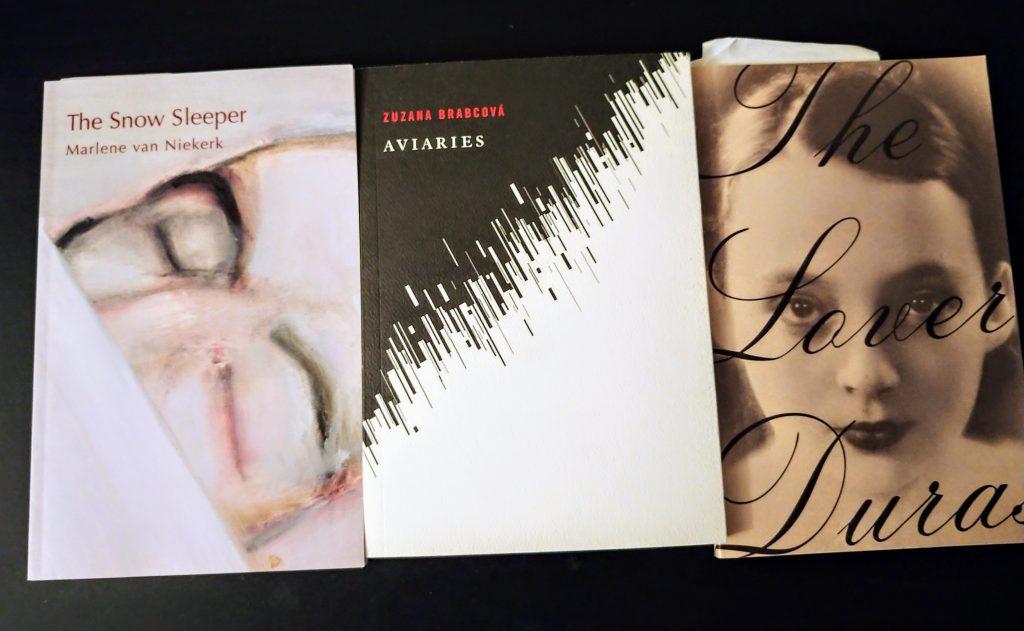
The Snow Sleeper by Marlene van Niekerk, translated from the Afrikaans by Marius Swart, is a recently released collection of short pieces, including “The Swan Whisperer” which was published as part of the Cahier Series.  I ordered it as soon as I heard of it—new van Niekerk is a rare and special treat.  Aviaries by Czech writer Zuzana Brabcova caught my attention when fellow readers and reviewers started talking about it so it’s another title I sought out when it was released here this spring. And last but not least, Marguerite Duras’ The Lover is a book I’ve been meaning to read for years now. Will I fit it in this August? Time will tell. And, of course, I reserve the right to change my plans altogether…

The nice thing about books is that, at least with the old fashioned solid form variety, they don’t vanish at month’s end if you don’t get to them. They will still be there on the shelf waiting no matter how much time I do or do not have to read amid all my other projects on my plate this August!

Are you afraid? In memoriam

In the last years, like a bird. Delicate, frail, angel wings slowly folding in embrace. Each time I saw her, after time away, the gentle shaking, the pale whitened hair startled me anew.

So tired. But still sharp.

Wise, but weary. Fragile, breakable, skin like frosted glass. Always able to ease, with a word, every worry I laid on her.

Three years ago today, my mother left us. Slipped away, ready to move on. Calm. Welcoming peaceful release from the simple struggle to breathe.

Gathered round her bed, we asked: Are you afraid?

No.

A thousand times, whispered:  I love you.

With a kiss to the forehead

I don’t know, for myself, the faith she held. Can’t quite imagine what it must have been like to feel assured she was leaving to join her parents, her sister, my sister, her God.

As she passed into to the night in one ICU, across town my father slept unknowing on another hospital ward. Eleven days later he would join her. Once he learned that she was gone, he no longer had the need to fight.

Perhaps he was afraid to be left behind.

Mourning aside, these past few days have been difficult.

My son confessed what I’d already suspected. After three months sober, he was drinking. Again.

Truth is the periods of sobriety have been but islands in a decade-long battle. Six or seven months total over the past nineteen.

His grandmother lived to see none of these passages of hope. She would have been heartened with every dry spell, distressed with every setback.

She worried about us all. As mothers do.

Her spirit lingers, but I miss hearing her voice.

From both sides now: A History of Clouds: 99 Meditations by Hans Magnus Enzensberger

There is a glow, a particular confidence that emanates from the poetry of German essayist and writer, Hans Mangus Enzensberger. It is manifested in his uncanny ability to take the smallest, even mundane, observations and transform them into poems that catch one unaware. I want to call it an earnestness, but it is more than that, it is the  capacity to reflect with equal humility and humour on both the simple and the profound  moments, an ability  that can only come with time and a long, full life. The second of the ninety-nine poems or meditations that comprise his collection, A History of Clouds, is an early example. “Sins of Omission” is a confession of sorts—a list of presumed shortcomings that begins with the aging narrator admitting to being absent, not hurrying over “when the need was greatest,” but closes with a wide range of “sins”:

Forgot to confess,
shied away
from improving the world,
never dropped out or in at the right time,
failed to take my pills
three times a day.

Yes, I abstained from
killing people. Yes,
I didn’t call.
For the time being I have even
refrained from dying.
Forgive me, if you can.

Or just let it be.

(trans. by Martin Chalmers)

From the outset then, the appeal of his clear uncomplicated verse and his gently sarcastic tone is clearly evident; making it easy to see why he is generally considered to be Germany’s most important living poet.

Born in Bavaria in 1929, Enzensberger’s poetry covers a vast range of subject matter, and he is also an editor, translator, and  a vital, often controversial, essayist. This collection was published in its original German in 2003, in the early years of a new century, when the poet was in his seventies. The opening section frequently touches on private moments and emotion, and includes some wonderful images of the simple intimacies of long-term relationships, of shared beds and lives—the wonder of a breath, a touch, proximity—while the second turns its attention to the lives of others, conjuring portraits that are historical, political or literary.  A particularly poignant piece is the haunting elegy to fellow countryman WG Sebald “Who touched us, / who seemed to have come from afar / to the sinister, unhomely homeland. / Little kept him here. / Nothing but the search for traces / with a divining rod of words / which twitched in his hand.” (From “For Max Sebald”, trans. by Martin Chalmers)

Enzensberger’s curiosity for the world, his far flung interests and experiences provide fertile backdrops for his wry commentaries on life. In later sections, he often appeals to science, philosophy and cosmology to illustrate an idea, making his poems them feel at once timely and out of time. One of my favourite pieces is the rather beautifully blunt “At Times” which begins:

When you meet someone
who is smarter or more stupid than you—
don’t make too much of it.
The ants and the gods,
believe me, feel just the same.

And goes on to remind us of our humble place in nature, insisting we are all relatively average in the grand scheme of things, insisting that is good, because:

Somewhere or other you’re always discovering
an even more radiant beauty,
someone even more worse off.
You’re mediocre,
luckily. Accept it!
Seven degrees centigrade more
or less on the thermometer—
and you would be beyond saving.

(trans. by Martin Chalmers)

Unassuming, but delightfully perceptive, it is possibly the single entry I return to more than any other. But this book is filled with many such everyday wisdoms. An appreciation of irony is, perhaps essential for the full impact of Enzensberger’s poetry, however, I have come, over the years, to believe such an appreciation is almost a basic life skill.

And then there are, of course, the clouds. In various of incarnations, clouds pass through many of these poems, often unexpected, but in the twelve-part title piece that closes out the collection, their presence is rendered more explicit:

Their wanderings high up
are quiet and inexorable.
Nothing bothers them.
Probably they believe
in resurrection, thoughtlessly
happy like me,
lying on my back and
watching them for a while.

(trans. by Esther Kinsky)

This meditation on clouds, or an “Archaeology of clouds—a science for the angels,” explores the wonder, the wanderings, and human response these meteorological phenomenon, cursed and loved for both their presence and their absence, one that is ultimately “A separate species, transient, but older than our kind.” A fitting end to a book that begins with the most essential and down-to earth aspects of life, and through ninety-nine short poems, reminds us that we are bound to this planet, and then leaves us, in the end, quite literally  hanging in the air.

A History of Clouds: 99 Meditations by Hans Magnus Enzensberger is translated by Martin Chalmers and Esther Kinsky, and published by Seagull Books.

Chanelling memories through verse: Edwardsville by Heart by Kólá Túbòsún

So memory returns
of the many demons from
which hope had sprung
that brought me here,
for which the journey
into this promise of a life
was some act of fleeing,
to which America
was both a saving grace
and distance a respite
in shawl and shield.

— from “Stepping Out: at Cougar Village”

When a Fulbright Scholarship brought a young Nigerian student to the American Midwest in 2009, the culture (not to mention climate) shock must have been considerable. But linguist and writer Kólá Túbòsún survived his first winter and returned to the University of Southern Illinois Edwardsville to complete graduate studies between 2010 and 2012. The town, as he advises in the Preface to his first collection of poetry, was a place which was, in the time he lived there, an open and tolerant community, welcoming to refugees and immigrants from distant shores. However, the scars of colonial expansion and the after-effects of slavery were not that far behind, and, now, with a mistrust of the other on the rise, one can only wonder how that mood is shifting. But that is not the immediate concern of Edwardsville by Heart. This book is one man’s poetic journey back through a particular period in place and time, mediated by memory.

Although Túbòsún does describe his process of composition in the introduction, in the reading I had the impression that the experiences he recounts in this memoir/travelogue were recorded during his time Stateside. The poems, which cover early encounters with a strange environment, visits to local historical sites, and tales of friends, lovers and mentors all have the feel of a diary, a recording of events as they happened. But in truth only one or two were actually composed in America although the idea of somehow capturing his time there did percolate. These poems were written over a six-week period in 2017, while the poet’s wife was away and he was at home chasing after their toddler.  At last the memories he had carried with him could be sorted, developed, and given voice.

There is a sense in which this collection speaks to a very specific place, experienced with an outsider’s eye, and a student’s youthful enthusiasm. The image of America that comes through is a remarkably positive one. Did Túbòsún arrive at a sweet point, or is this an effect of the nostalgia of youth? The poems of the first section, “The Visitor” capture a sense of wide-eyed openness to a new environment and, as the quote above suggests, to the freedom—romantic and academic—that distance from home affords. But as the poet recalls his first months in the US, and his first encounters with winter cold (recalling practicing with a freezer back home in Nigeria) he does not shy away from the reality of the racial profiling he encounters, accepting it with a disarmingly casual tone.

When his circle of experience widens to encompass cities like St. Louis (the first visit being a visit to a hospital ER as unlicensed driver transporting an injured friend) the tension and threats of violence become more of a concern. Friends warn him to avoid the city, but it is difficult to deny a peculiar pull:

But E.B.R. lived there,
I thought. Redmond the poet
shuttled poetry from here,
black as Ethiopian coffee beans,
to Lagos and Ìbàdàn
in my undergraduate days, with
a smile on his oak-hued face,
a deep crack in the velvet
voice in which his verses rolled
into colours that rhymed
with grace, Civil Rights lore
in quartets of memory.

—from “East St. Louis”

Moving through poems that recall his times in the classroom, at house parties, on road trips with friends, Túbòsún negotiates a balance between African and American classmates and friends and there is a sharp sense that being away from home is part of a necessary process of coming into an ability to understand and articulate his own language and identity. As a student of linguistics it is only natural that this otherness shapes and informs his academic experiences. This process colours the third section “Teacher, Student,” witnessed for instance in a poem like “Being Yorùbá”:

How do you teach a state of being?
You don’t. You teach instead tone,
do-re-mi like music on the tongue,
and greetings and norms; clothing,
and where caps bend on the head;
dance moves to restless beats that
skilled bàtá drummers replay
when you taunt them with
a semblance of competence.

Later, as his travels and adventures take him further from his temporary American home, he finds that his Nigerianness not only informs his encounters, but cannot be escaped. He is always a visitor.

Edwardsville by Heart is a quiet, reflective book. The fact that this collection was, for the most part, birthed through the filter of temporal and geographic distance, the clarity of the memories preserved and presented is remarkable. Rather than muted details or blurred recollections, we are offered an uncluttered vision—emotionally contained and all the more powerful as a consequence. Strongly grounded in place, time and experience, these poems do not shy away from the brewing politics and social dynamics at play in the part of the American Midwest where the poet found himself. But above all it is, as Túbòsún himself admits, his Edwardsville. And he freely opens it to us with this, his first book.

Edwardsville by Heart by Kólá Túbòsún is published by Wisdom’s Bottom Press. 

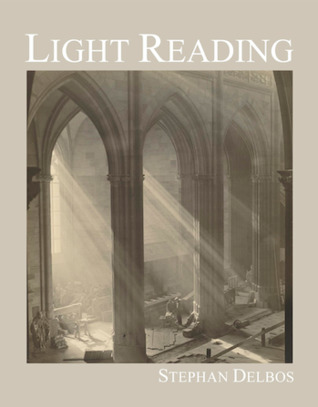
Opening space: Light Reading by Stephan Delbos

One of the pleasures of reading contemporary poetry is, for me, the varieties of experience allowed, and the ways each poet and each collection is unique. Most of the poets I read have come to my attention through social media, either via direct interaction, contact with translators, or as publications of publishers I trust. It is not that I don’t have time for classic poets, I have shelves full of poetry collections, but I’m most interested in calling attention, in my own modest way, to newer, short, single author volumes.

I came to know of Prague-based writer, Stephan Delbos several years ago when I read his co- translation of Czech surrealist poet Vítěslav Nezval’s The Absolute Gravedigger. But his first full-length collection, Light Reading is my first introduction to his own distinctive verse.

Delbos is a minimalist. Upon opening this handsomely presented volume, the first thing you notice is that placement is critical; words seem hang suspended in empty space. The word “light” in the title of the book and its first section, refers to both tone and openness. The poems are spare, often exceptionally so. One is simply a semi-colon, some a word or two, others a few scant stanzas, but in each instance, the words act in concert with a title set at the lower righthand corner of the page. It is the title that completes the image, renders the impact—offering insight, or humour, or both. Notes at the back of the book illuminate the sources of many of these pieces, adding another level of meaning. But to attempt reproduce any of these fleeting poems can be no more than an approximation given the limitations of  online space. Here are three:


.                                                                                 if only
.                                                                                 all life
.                                                                                 were so
.                                                                                 simple
                                                                               here
.                                                                                 hang
.                                                                                 your
                                                                               shells
                                                                               shadows
.                                                                                 shame


§.                                                                  §On Coatracks

*

.                                    impossibly

.                                                             yes


.                                                                                       §Luck

*

.                                                                              in tiny pieces
                                                                            tiny parts

.                                                                               i whose
.                                                                               bruises

.                                                                               broke pillows

.                                                                               sleep under
.                                                                               paper sheets


.                                                             §Fragments (Keepsake)

*

The poems of the second section, “Bagatelles for Typewriter,” take the form of poetic riffs on the French term meaning a “trifle,” typically associated with short musical compositions. Dedicated to a variety of figures—political, literary, philosophical, musical—paired with an instrument or two, these poems have the widest sweep, but the imagery is still spare, restrained, and carefully modulated. Here the poet pays tribute to Václav Havel, slips through the streets of Prague, and explores avenues filled with memories, sounds and language. These are the longest pieces in the collection, and yet few fill more than a single page and physical arrangement and space—or silence—is, as in the earlier section, an essential element, imbuing each composition with its own volume and rhythmic energy. Delbos, who has written plays about jazz trumpeter Chet Baker and Czech composer Bedřich Smetana, demonstrates an inherent musicality in these poetic bagatelles. Take, for example, the opening of “Bagatelle for Throat Singers, Baton & Player Piano”:

I am a terrible Buddhist
.                                                  my love you are a magnificent adversary
on the anniversary of
.                                                   our first nervous kiss on a sidewalk where
garbage cans held fish
                                                 -bones, failed ficuses, Orangina bottles,
our alcohol the pilot
                                                  light of love; this was supposed to be
about enlightenment,
.                                                    the impossible tightrope possibility.

The third and final part of Light Reading, “Arrangements,” consists of a series of ten sets of ten poetry prompts. The first of these begins:

      1. A poem in terza rima
      2. A poem of 18 lines
      3. A poem containing the phrase coin slot
      4. A poem rhyming beguile and tinfoil
      5. A poem with two mirrored meanings

while another (<V>) prescribes:

      1. A poem that cannot hear itself think
      2. A poem getting on my last nerve
      3. A poem huffing oxygen
      4. A poem title is the last line
      5. A poem with seven monorhymed lines
      6. A poem curing emphysema

In reading this collection I had the feeling that these poems, these condensed, precise evocations of the possibilities—and limitations of language—seemed to be coming into being on the page, speaking to ghosts, alluding to the unutterable, to the moment captured in the empty spaces. Unconfined, open-ended and illuminating, Light Reading is a work that leaves plenty of room for exploration. And enjoyment.

Light Reading by Stephan Delbos is published by Blaze Vox Books.

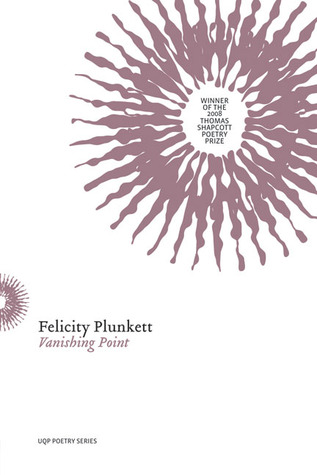
Distant and immediate intimacy in Felicity Plunkett’s Vanishing Point: A personal response

I want to say that the strength of Felicity Plunkett’s award winning debut collection, Vanishing Point, lies in the singular beauty of the images evoked. That sounds, perhaps, too, trite. I am, as I always confess when I set out to write about poetry, not a poet. And yet, that is what held my attention throughout the reading, even in the most unlikely moments. Many of the poems in Vanishing Point traverse the an unexpected terrain, drawing on the annals of history, science, medicine, and film production while others touch delicately on the familiar moments of life. However, all move with an intimacy that unsettles and reassures in one breath.

The collection opens with “Journey of the Dead Man”, a dreamlike vision that juxtaposes the words of the Hindu god Shiva invoked by Robert Oppenheimer in his remembrance of the first nuclear testing in the desert of New Mexico, with the Jewish notion of sitting shiva after death to offer a powerful poetic commentary on destruction and mourning—one that rises, in its closing passage, to a shattering conclusion:

Stand in the desert, your hands
open, the shards flaking away,
and call the name of Shiva.
Omega: let there be an end to it.
Death be not proud now I am become you.
Cover me with your furious limbs
and shatter me when our eyes engage.
Remember you are dust,
and unto dust shall you return.

This is a very assured collection; Plunkett’s verse weds a poised formality with a lyric passion and perceptivity that may well appeal to readers who are resistant to poetry. Her poems are accessible, but offer a curious mix of tenderness and tenacity. Recurring themes, grounded in embodied emotion and experience, provide a certain, if not always comforting,  continuity, while flakes, in many different forms and contexts—flakes of skin, flakes of snow, flakes of paint, the flaking away of a dream—form a unifying motif, one that speaks to the transient quality of desire, memory, life. Such transience, is often conveyed in familiar terms, such as in “Restraint,” which begins:

Soft now on their wooden clavicles
each of your frocks once knew its place.

The speaker goes on to call to mind memories of a mother’s loving dedication to the tasks of rural domestic life before returning to the dresses:

Now I run my hands through
mended cotton, starched linen
stiff skirts, blouses still holding a remembered body
and my touch awakens mothball mint and lavender—
those ghostly scents.

The reminiscence then moves on to the more ambivalent questions of life, with all its joys and disappointments, carried unspoken in the living, and now left to linger in the air.

Vanishing Point is very much a book of passages, of uncertain pasts and uneasy futures. Within this tapestry, birth and death, are closely wound threads explored most vividly in the closing section of the book—from the overview of the medical and philosophical understanding of female reproductive capacity, traced in the delightful “A Knitted History of the Uterus” to the fragmented processes of pregnancy, delivery, and the vulnerability of the body. The imagery, again, is often striking, as in “The Negative Cutter”, a multi-part piece which incorporates quotes from a text on film editing to expose the accepted performance of diagnosis, treatment, and grief:

DISCONTINUITY EDITING
Any alternative system of joining shots together using techniques unacceptable within continuity editing principles. Possibilities would include mismatching of temporal and spatial relations, violations of the axis of action, and concentration on graphic relationships.

Clowns rehearse outside the next caravan.
You crush words hard against your teeth.
They fly out of your mouth like shots
or you spit them, blooded and cutting,
fretted and strung with beads of shiny feeling.
You are drowning inside yourself, alone.
Anger jerks out of you, or unstopped crying that falls fluent
the way it does in dreams: salty, benedictory.
The skirt of your feelings, stuck in the car door,
flaps at passersby without your knowing.

This collection has a strong feminine awareness, but paired with a curiosity  and a measure of physical disengagement. The female bodied experience extends beyond the specific to the universal—inviting a distant and immediate intimacy. Or at least that is how I responded. Vanishing Point was published in 2009 and, a few years earlier, some of the material might have triggered a particular discomfort for me. But I come to it now as a transgender male reader and writer finally beginning to reclaim aspects of his female past  after nearly two decades of estrangement from a perceived reality incompatible with the coherent history of a man, including the birth of two children. Whether it is the benefit of sufficient remove or the growing need to be able to embrace a whole life lived, I don’t know, but it is fortuitous that I picked up this wise and wonderful book at this time.

Vanishing Point by Felicity Plunkett is published by University of Queensland Press.

Forty-nine days of the spirit: Autobiography of Death by Kim Hyesoon

The attempt to voice to the experience of reading Korean poet Kim Hyesoon’s Autobiography of Death echoes the challenge she found as the project began to take form for her. Death, as much as we may wish to avoid thinking about it, is a fundamental and natural part of life. But sometimes death arrives in unnecessary, violent, and horrifyingly tragic forms. Or simply when it is unexpected, or worse, unwarranted. The forty-nine poems that comprise the core of this work—one for each day during which the spirit wanders before re-entering the cycle of reincarnation—were written in response to those moments when Hyesoon felt the presence of death in some way. Although her intense reaction to the catastrophic collapse of a ferry carrying high school students bound for an island field trip—an event in which the crew escaped in lifeboats while the youth, ordered to their cabins, drowned—was a trigger, Korea’s recent history is rife with unjust deaths. How to reconcile all this? As an assembly of poems began to take form, she came to understand that her existence begins with death, not birth, and that we live our lives within the structure of death:

I thought to myself that I needed to sing to death, perform a rite for death, write death, then bid farewell to it. The way to send death away was to sing with my own death all the death in the sky and on the ground.

In essence, to sing to death, she had to allow her own death to take the poetic voice. To let it tell its story. How then are we to hear the songs gathered here? Quite simply, to read this book, is to listen.

As one might imagine, the language and imagery is not always easy to encounter.  Heartbreaking, often disturbing, death does not necessarily come gently, and the spirit does not effortlessly shed its fleshy anchor. Verses infused with sad and tender tones mix with horror-filled prose poems and gruesome nursery rhymes, while songs of mournful remembrance turn strange and surreal. To move through this post-death journey is an odd and deeply compelling experience. At moments it is even exquisite:

Like the failing frail twilight and
the rising frail dawn
certain light caves in, certain light soars and embraces

Something like the silvery alligator in your throat
Something like the silvery mosquito on your face

Something like the abrupt opening of the windows of the sea after waking
.                 up from a lifetime of sleep

You’ll see the mornings of the world all at once

– from “Naked Body” (Day Sixteen)

Death is a bodied, intensely physical presence in this sequence of poems. Visceral and graphic at times. Certain images reappear throughout including water, dolls, winged beings—birds, insects and angels—mothers and children, coffins and burial. The space between death and rebirth is an icy, wintery one. Hyesoon shifts and builds on this imagery as the body is slowly and, seemingly reluctantly shed, transforming and decaying as the spirit is increasingly cut off from the world. The poetic perspective invites an intimate engagement with death:

The shape of a woman appears in the mirror. Now you’ve become toeless feet. Now you’ve become fingerless hands. You’ve become a noseless, mouthless face. Your insides that are so far away yet close, the forest in your hair, light enters the rocky moon, and the sea wavers in your shoes. Birds fly up your sleeves and a horse weeps in your pants.

– from “A Face” (Day Forty-Three)

As the forty-nine day passage draws toward a close, faces lose their distinction. Death erases names and identities. “You” lose the ability to recognize yourself or your place in the world. But who exactly is this “you”? In the conversation with her long time translator, Korean-American poet Don Mee Choi, that closes out the book, Hyesoon explains that she could not call her own death “I”, thus her death became “you”, but not as in a simple second person narrative. It is an intrinsically poetic space, such that “you” was “not I or you or he/she.” She goes on to describe how she began to wonder if the narrator might be a sixth or seventh-person narrator, and the “you” who is being addressed is “my death”—“I” has been killed. This she insists, is in keeping with what she sees as the only way to ethically practice poetry, by practicing the death of “I”. Of course, in reading, “you” also feels like “my” or “our” death. At times, especially with the poems that have a sing-song or nursery rhyme feel, it is not unlikely that one might be inclined to want to sing along.

The collection ends with an extended poem “Face of Rhythm,” a piece born out of meditation during a period of pain and illness. Filled with an aching intensity, it is a fitting follow-up to the forty-nine day sequence of Death, a laborious rebirth, release from facelessness and  namelessness. But renewal is hard won, a slow hallucinatory passage through sickness:

That feeling of my soul getting yanked
I wonder where my soul hides when I’m sick
My heart feels as if it’s getting beat up
Is it because the restless ocean is clumping up?
My heart beats regardless of the pain
It beats spewing out red thread like a red spider
A sinkful of red thread gets submerged in water
My heart beats like a girl marathon runner who only had ramen to eat

Autobiography of Death is a collection that leaves one alternately drained and exhilarated. I find it hard to imagine anyone would emerge indifferent. Translator Don Mee Choi’s strong affection and sensitivity for  Kim Hyesoon’s poetry is invaluable, while the playfully strange illustrations by the her daughter Fi Jae Lee contribute to the power and magic of this new work from one of Korea’s most important poets.

Autobiography of Death is published by New Directions.

The poetry of grief: Loss Sings by James E. Montgomery

Grief and loss has its own language, one that cannot be forced, one that is found waiting when the mourner ready. That is the experience recounted in the 32nd addition to The Cahier Series, a collection of short meditations published by the Center for Writers & Translators at the American University of Paris in association with Sylph Editions. Each volume pairs an author and an illustrator or artist, and examines some aspect of the intersection of writing and translation, allowing a broad scope within which such ideas can be understood and explored. As such, each cahier opens a door to a different way of engaging the world.

James E. Montgomery’s Loss Sings is a deeply personal essay that owes its genesis to tragedy. On 24 August 2014, the distinguished Professor of Arabic’s seventeen-year-old son was struck by a car when walking with some friends in the city of Cambridge. He suffered what were described as “life-altering injuries.” The driver was uninsured. Suddenly his family’s world was forever altered as an entirely new set of realities, concerns, and anxieties came into play. The young man with a promising future now faced a life of serious physical disability, marked by increasing pain, decreased mobility, and the need for ongoing care. As surgery, rehabilitation, and the detailed record keeping required for legal purposes began to shape Montgomery’s life, he discovered an unexpected appreciation for a cycle of Arabic laments that had long left him unmoved and indifferent. In the early months after his son’s accident, a personal translation project involving these poems emerged. Three years later he recorded his reflections on his son’s injury and his thoughts on memory and the articulation of loss in a series of dated diary entries. Presented together with a selection of his newly translated verses, the present cahier was born.

The poems at the centre of this fascinating account, are the threnodies of the seventh-century Arabic poet Tumāḍir bint ‘Amr, known to posterity as al-Khansā, a woman who composed and sang hymns to the loss of her two brothers in battle—more than a hundred wailing odes that were memorized and passed on for two centuries before they were committed to writing. Although Montgomery had taught these well-known elegies for three decades, through significant losses and traumas of his own including a close proximity to the surreal horror of the attack on the World Trade Towers, he had found them repetitive and cliched. It took his son’s injury to unlock their power. As a parent with a seriously injured child, the rules of order were suddenly rewritten. He realized that his son’s need for assistance would increase as his own physical abilities declined, and when an unexpected potential health problem of his own arose, his concerns for the future intensified.

Memory is a strange place. It is unreliable, pliant, liable – mercifully so. It makes so many mistakes, gets so much wrong. An event like the one I am describing rips to shreds the veil of the commonplace and the mundane, and memory is charged with the task of remembering the future, of recalling the unusual; for such events reveal to us that the future is little more than a memory.

What unfolds over the course of less than forty pages is a multi-stranded meditation on grief, loss, and the relationship between trauma and memory. As Montgomery notes, the confusion that commonly strikes in the aftermath of trauma is a response to the confrontation of previously trusted memory with a “new reality, an unalterable experience.” He recognizes a close analogy in literary translation. In order for a translator to recreate a literary work in another language, decisions must be made about what can be left out as much as what one wishes to retain. With poetry in particular, he says, it may be the only means of transmitting what is irreducibly poetic, and as such, literary translation is “more akin to trauma than it is to memory.” As trauma leaves one at odds to make sense of the world, often bound to a silence that swallows up attempts to give voice to grief, the mourner is forced to navigate a “no-man’s land” between one remembered reality and a new one. Literary translation echoes this process, and through the act of translating al-Khansā’s poetry in particular, Montgomery is able to articulate his own experience of grief and loss through an understanding and appreciation of the very elements that once irked him in these classical Arabic laments.

We are all likely well aware of the kind of cliché, stock phrases, and time-worm comforts that are offered as a solace in times of loss. When faced with profound grief ourselves, there is often a sense that common statements fall short of the magnitude of our emotions. Yet we reach for them—in condolences, eulogies, obituaries. Or worse, for fear of sounding banal we say nothing. It takes the near loss of his son for Montgomery to finally feel the power of these clichés, in the personal and the poetic:

Experience, memory, artifice and art are confronted by the absence of comfort, and earlier versions of a poet’s selves are rehearsed and re-inscribed in memory – but the brute truth of the mundanity of death is the age-old cliché about clichés, namely that, like death, they are too true.

The seventh-century warrior society to which al-Khansā belonged was bound by intense devotion to the cult of the ancestor. Death in battle demanded both vengeance and epic memorial. The latter was the responsibility of women, and her sequence of Arabic keenings—songs of loss— are the most extensive, powerful and poetically inventive to have survived to the present. Her poems are defiant. She will allow no accommodation of her loss over time, her grief stands still, “(h)er doleful, disembodied voice, entombed forever in the inanimate sarcophagus of metre, rhyme, and language.”

Night is long, denies sleep.
.    I am crippled
by the news—
.    Ibn ‘Amr is dead.

I will cry my shock.
.    Why shouldn’t I?
Time is fickle,
.    Disaster shock.

Eyes, weep
.     for my dear brother!
Today, the world
.     feels my pain.

Montgomery’s reflections on his own experiences with loss and the parallels he sees in translation speak clearly to lived grief and trauma. The yearning, aching threnodies of al-Khansā woven throughout, call from the distant past with a pain and longing that is recognizable, real, especially for anyone who is, as I am, still caught in the lingering aftermath of a series of significant losses. But throughout my engagement with this book there was one thought that I could not shake, a possible understanding that the author himself is perhaps not fully aware of. He admits that he is not entirely certain why these ancient Arabic laments finally reached into him when they did.

I worked for years with the survivors of acquired brain injury and their families. I recall one family in particular whose son was injured in a single vehicle rollover in his late teens. His parents admitted at the intake, to a double sense of grief—for their son’s ever-altered future, and for their loss of an image of their own anticipated freedom on the cusp of their youngest child’s pending adult independence. Two futures and their attendant memories altered in an instant. Yet this kind of grief—the grief of survival—is not easily mediated. When the parents attempted to attend a grief support group in their community they were pushed away. “What do you have to grieve?” they were asked, “You still have your son.” There is no accepted ritual or memorial for this kind of loss. With each step through rehabilitation, fighting for funding, worrying about an undefined but infinitely more precarious future, a song of loss sung anew every day. It does not surprise me in the least that a sequence of laments that hold so fast to grief, repeating, reinforcing and seeking voice in the comfort of cliché would break through at this time in Montgomery’s life.

How fortunate that he was able to hear them and feel inclined to guide these verses across the distances of language and time to share with us. Paired with abstract illustrations in black and shades of grey by artist Alison Watt, this small volume speaks to the universality of loss and the longing to find expression through the stories, myths and poems we turn to in times of trauma.