Another year of roughghosts has passed, my blog is three years old

“be a ghost gum rising from the waterhole in each heart”
— Rico Craig

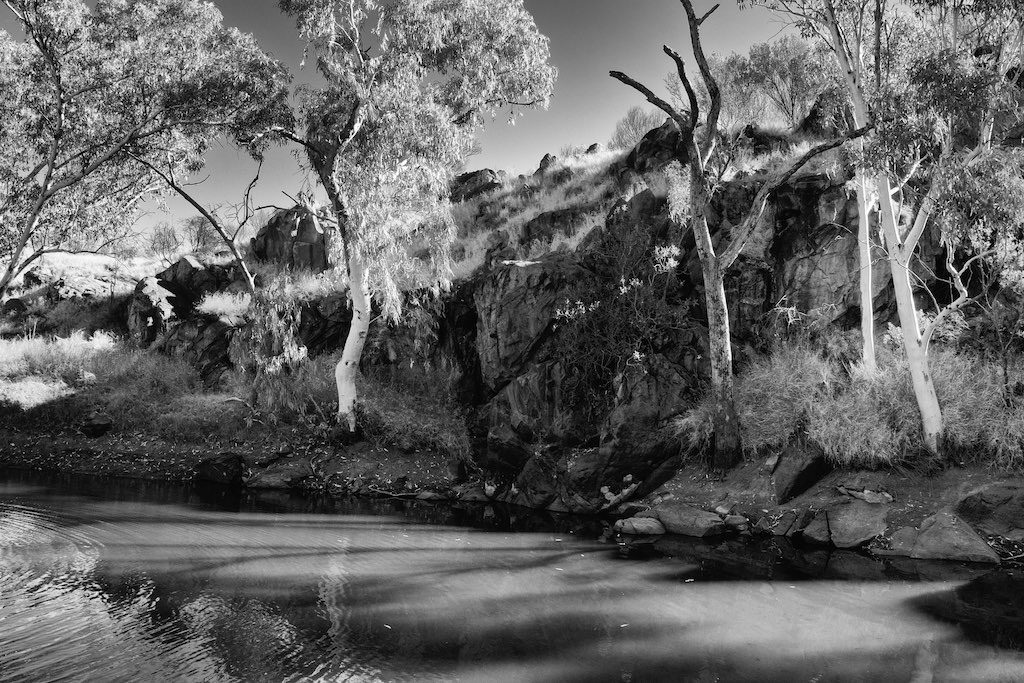
Birthday Waterhole, in the photo above, is perhaps the most stunning and isolated campsite we stayed at along the Larapinta Trail. The line, quoted from Rico Craig’s newly released collection Bone Ink, seems to me to capture so much of the past three weeks—from my own peculiar challenges with walking (or more often, not walking) the trail, through to lunch with the poem’s author on my final full day in Australia. But more about all of that later. The key word at the moment is birthday.

A few days ago, WordPress kindly reminded me that my blog is three years old.

The past three years have been marked by tremendous growth for myself as a writer, amidst loss, trauma, and great adventure. What continues to amaze me is the degree to which the internet, for all its shortcomings, is able to connect people across the miles. Over this past year, many of my casual blogging and Twitter contacts have grown to form a rewarding and productive creative environment that I value very deeply. But it is always a special treat to meet an online friend face to face.

My recent trip to Australia was instigated by an invitation from a fellow book blogger to join his annual “Larapinta Extreme Walk” in support of the NPY Women’s Council in the Northern Territory. Unfortunately, I arrived with what soon developed into a severe head cold that still lingers, tinged once again with jet lag, as I write this. I’m still processing my disappointment at not even being able to know how I might have managed the trail under healthier conditions, but the experience was incredible and invaluable nonetheless, and everyone was so friendly and supportive. I will write about it at greater length in a few weeks time and share more images of the incredible desert landscape.

After two weeks in central Australia I spent a few days in each Melbourne and Sydney. I met with five online contacts during that time, including a long-time friend from the Pentax Forum (a camera as obscure, relatively speaking, as my literary interests tend to be). Every single encounter was wonderful in its own way. Strangely, online banter clears away the space for good solid conversation of the sort one is often at loss to find in the communities we regularly exist in. Naturally, a strong common interest tends to set the course.

So today, as I look back on three years of blogging—and my subsequent forays into Twitter and to a lesser degree, Facebook—I am especially cognizant of how much warmer and richer my world has become. And not only have I been publishing my own original writing beyond this space, but when I suffered a series of losses last year with the deaths of my parents and a dear friend, the outreach of sympathy and support far exceeded anything I received in real life. Which is both heartwarming and sad when you think about it.

I won’t make any predictions or set any goals for roughghosts in the year to come. I don’t want to be reckless or foolhardy in my ambitions. This blog is, first and foremost, a forum where I can call attention to books I read, without necessarily indulging in the rigour I apply to critical reviews for publication elsewhere. It also provides a space to exercise my writing skills and toss out ideas or work through emotions that are troubling me. The beauty of a blog is that you can directly track the response and reaction to your work—you have a sense of the book reviews that draw readers and the musings that resonate with others. That feedback is vital. I imagine that this will remain the primary purpose of this project.

At the moment though, I have four books I’d like to write about here, and a review to prepare for Numéro Cinq. And after months of battling writer’s block, I find that words are starting to flow again, so I am hoping to carve out some time to write and work on ongoing projects of my own.

And that seems as good a way as any to celebrate three years of roughghosts.


* Image copyright Joseph Schreiber, 2017

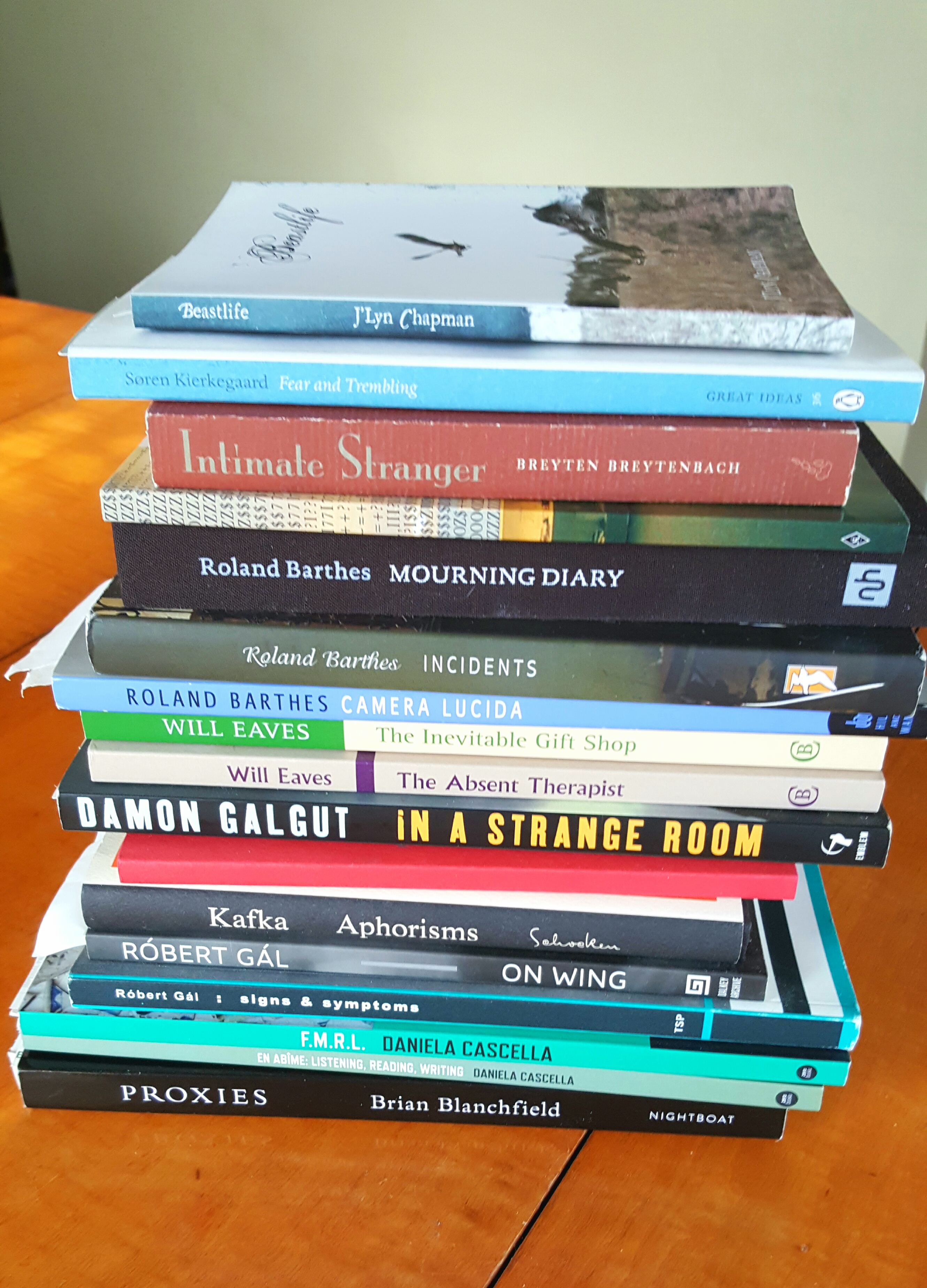
On my nightstand, a selection of current touchstones in lieu of a personal canon

I have been on Facebook long enough now that I have begun to get those sunny reminders of what I was up to one year ago. Yesterday I discovered that it has been a year since I published my first piece of personal creative writing. The essay, Your Body Will Betray You, remains pinned to my Twitter timeline and continues to generate conversation. Readers have found it informative, inspiring, and, in one important case, a ground for opening a conversation that had been unspoken in that person’s life. And that particular response made baring a piece of my soul like that worth it. A writer may write for him or herself, or to entertain or educate, but to speak to the very core of one reader who needed those words more than anything… that is a gift.

My most recent piece of writing to be published comes deep within the pages of the new issue of The Scofield 2.2: Conrad Aiken & Consciousness. This issue marks my first opportunity to edit the work of other writers—a tremendous honour and thrill, with deep thanks to Tyler Malone and Dustin Illingworth for their faith in me. Putting a publication of this size and scope together is an enormous task and my role is a modest one, but I am proud to be involved. My written contribution is even more modest. I wrote several hundred words about Damon Galgut’s In a Strange Room for the “On Our Nightstand” section (it’s on page 287 if you care to have a look, the issue can be downloaded for free and has a wealth of good reading). In this piece I talk about my evolving relationship to this book by one of my favourite writers. I turned to it as a possible avenue into the task of writing about one’s self—which, for me, after more than a decade of deeply closeted existence and a life lived in two genders, seemed terrifying and overwhelming.  Galgut’s attempt to record three distinct experiences in his own life was so spare, so translucent, that I could not begin to imagine taking an approach like that to my own. In the end he comes to believe that memory necessarily fictionalizes our “truths.” I am, at this point, closer to and yet less troubled by that conviction than I was three years ago when I started to understand that I needed to write. I go back to In A Strange Room often. As I say in my Scofield piece:

This book has become one of my touchstones, an elegant example of the way personal experience can be pared down to its essentials and explored through the lens of time and memory. It remains, for me, some of the most meditative and precise writing about what it means to be grounded, in one’s self and in relation to others; the allure of the road and the ambiguity of home; and most vividly, the way that all truth lived is, in essence, a fiction.

In other words, if I had a personal canon, which I would argue I don’t, this book would be on it. And I do keep it on the shelf inside my nightstand.

In the past few years, as writing has become more urgent, my reading has become more explicitly targeted. I am especially drawn to smaller, quirky, experimental works and, in many cases, books by people I have been fortunate enough to come to know—writers who have become part of a virtual network people who inspire me and suffer my creative ideas. The majority of those books are literally on (or technically inside) my nightstand. In lieu of a personal canon, here are the books that are currently fueling my literary scribbling. (Links to reviews, if applicable)

Beastlife by J’Lyn Chapman — I am always on the lookout for unique approaches to the personal essay. I have a large selection of books waiting to be read, but this little meditation on life, death and taxidermy is a treat.

Fear and Trembling  by Søren Kiekegaard — Well, just because.

Intimate Stranger by Breyten Breytenbach — This is a collection of essays and poems to a young poet. I ordered it when I came back from South Africa; it arrived when I was in the hospital recovering from cardiac arrest. I’ve mentioned and quoted from this book several times, but the post I’ve linked was written shortly after  I returned from the hospital. It addresses one of the key concerns—loss of a memory—that I am taking with me into the outback this month.  Reconciling one’s own near death is no small matter. I carry it deeply and have not yet found a way to write it out.

Thy Decay Thou Seest by Thy Desire by John Trefry — This little caprice or, as we’re advised, “Meditations for Sedentary Labourers,” is so delightfully eclectic that I found in it inspiration for an experimental project that, in contrast to the deeply personal work I write, will allow me to distance myself from the salvaging of the language I use and, depending on the constraints I set, some of the construction. I am proud to count John among the writer friends the internet has afforded.

Roland Barthes: Mourning Diary, Camera Lucida, and Incidents Three works that intersect for me, at a personal and literary level at this moment. Incidents, may well be one of my very favourite Seagull Books as well.

Will Eaves: The Absent Therapist and The Inevitable Gift Shop. Experimental, insightful, and devoid of pretension. Fragmentary works fascinate me. It seems to be a bit of popular device lately, but in my mind, these books—one fiction, the other essay/memoir—work very well. Eaves has a presence that is immediate and personal, he is good company.

In a Strange Room by Damon Galgut (see above)

The Surrender by Scott Esposito — This is one of those books I watched and waited for. I am cautious about trans themed writing but I knew this one would be different. This book holds infinitely more for me than I included in my review. My reading of this book coincided with the release of my own Minor Literature[s] essay, and the beginning of a valued friendship.

Aphorisms by Franz Kafka. Yes, I also love The Castle — one of the few books I own in multiple translations, but this is the Kafka I need to have close at hand at the moment.

Róbert Gál: Signs & Symptoms and On Wing — When I was first looking for a way to begin to write about my life and experiences, I was looking to fiction. But in defiance of conventional narrative form, I wanted current, accessible, experimental models. I read In A Strange Room and The Absent Therapist in late 2014 but it was almost a year later when I picked up On Wing. It remains a book that I read all the time, it has impacted my thinking in ways I cannot describe (because we ideally absorb and filter the work that drives and inspires our own—it should not be obvious in the final product) and Róbert was one of the first writers to suggest I should write a book. I don’t know where that book is, but it is no accident that a quote from On Wing opens Your Body Will Betray You.

Daniela Cascella: En Abîme and F.M.R.L. It may not be evident, but getting to know Daniela and her work has revolutionized the way I engage with language. Her enthusiastic approach to reading, listening and hearing work into being is wonderful. I find I am so much more attuned to sound when I read now. Maybe it will come through in my own writing one day.

Proxies by Brian Blanchfield. Again, this is another work that asks questions and contains ideas that are important to me. Essays that make me think about writing essays are my favourite kind.

If there was enough room, W.G. Sebald’s The Emigrants and Austerlitz would also count as work of current relevance. (They would probably be in that non-existent canon too, if I had one.)

Multi-lane manifesto: Expressway by Sina Queyras

My hometown does not do expressways very well. In places where it would be obvious to have them, we are late to the game. And each one is a crap shoot, even if you know it well. The first time you have to exit and cross three lanes of traffic in very short order, your head swivelled 180 degrees, just to travel from the expressway to the road you were trying to access you have to wonder: did anyone try this out before they opened it to the public?

When I was still in university I had a summer job where I sat in a building the size of an outhouse, just off the Trans-Canada highway and tourists, just entering the city limits, could pull over and ask for directions. This was long before the era of google maps, GPS, even cell phones. We’re talking printed maps and a highlighter pen. I did my best to give instructions but, to be honest, there was—and still is—so little consistency I was often at a loss to say more than: Watch for the signs. I developed a theory that year that I still hold to. I reasoned that every civil engineering student at risk of a failing grade was given a chance to redeem themselves by designing a single interchange along one of the major thoroughfares. And that’s why no two are alike and some simply defy the imagination.

Canadian poet Sina Queyras completed her 2009 collection Expressways while here at the University of Calgary on a residency. I’m curious as to whether our ad hoc roadway system coloured this poetic critique of the social and ecological impact of the spreading network of asphalt arteries and veins that criss-cross our nations.  Her poems speak to the memory of a romanticized landscape of the past on a collision course with an increasingly isolated, technologically driven future. The opening piece “Solitary” sets the tone, with the call to consider what is a risk with the continued push to interconnect places, at the cost of connection to the land and to one another. The final stanzas read:

Wagon train, trail of tears, what aggregate composition,
What filleted history, what strata, what subplates,
What tectonic metaphor, what recoil, what never

Having to deal with the revulsion of self, only
The joy of forward, the joy of onward, then endless fuel:
The circles, the ramps, the fast lanes, the clover leaf,

Perspective of elevation, the royalty of those views,
The Schuylkill, the Hudson, the Niagara, the skylines,
The people in their houses, passing women, men

Dressing, men unearthing, smoke pluming, what
Future? What the apple tree remembered? Not
Even the sound of fruit. If a body is no longer a body,

Where is memory? If a text is no longer a text,
Where is body? If a city is no longer a city, what road?
If future no longer has future, where does it look?

She snaps her cellphone closed: no one. Alone.
The century is elsewhere. She turns her back.
Swallows her words. She will do anything for home.

As ever, I am not an effective critic of poetry. I like it, I read it. Sometimes, but entirely by accident, I write it. But I do know when poet’s work works for me. This collection is a strong, cohesive, and passionate manifesto evoking the poem as a means to challenge the ethics of the expressway—in its concrete and abstract context. A call to recognize what is at stake:

This poem resembles urban sprawl. This poem resembles the freedom to charge a fee. The fee occurs in the gaps. It is an event. It is not without precedent. It is a moment in which you pay money. It is a tribute to freedom of choice.
(from “Acceptable Dissociations”)

At times Queyras echoes of the Romantic poets, even borrows their words. The text of Dorothy Wordsworth’s Grasmere Journals provides the material for “Lines Written Many Miles from Grasmere” which, falling mid-way through the collection, casts a pastoral mood, a look back to the dream of a simpler time, closer to nature. But it is an ideal. The Industrial Revolution was, by 1800, set the groundwork for the technological and economic developments that would ultimately allow for the building of major roadways, and the vehicles to fill them. Other pieces are firmly bound to the present, most notably “Crash” which is assembled from fragments salvaged from google searches. Others stare directly at the future—here darkly, there with a vision of reclamation.

Expressway works as a rhythmic, lyrical cautionary tale. A call to undo harm. But, roads seem to be growing wider, interchanges multiplying. Especially here in North America where spaces are wide and the car is still king. That is, Queyras argues no reason not to strain to hear above the din of the traffic.

I am weary. I walk and walk and meanwhile the expressway hums . . .

What for weary? We all hum.

I am weary. I have so little hope.

Weary, maybe. But, no hope? For that there is never an appropriate time.

Sina Queyras lives in Montreal. Last fall I had the opportunity to hear her read from her latest work. This reflection/review was written in recognition of National Poetry Month in Canada and the US.

Expressway is published by Coach House Books.

Looking ahead to adventure, challenge, and healing

As I write this, it is mid-afternoon on Saturday, April 15, and it’s +3C with light snow. I am truly quite finished with this endless, last gasp of winter. In one month’s time I will be in Australia (where it will already be the 16th and, if all goes well, the “extreme walk” into the outback I have traveled to take part in will be well under way). I am excited and a little nervous about the challenge ahead, but above all I am looking forward to being “off the grid” for the better part of two weeks with plenty of time to process some of the internal baggage I’ve been carrying as I undertake this long and demanding journey into a landscape I never imagined I would have the opportunity to experience.

Some of my regular readers may know that two years ago, following a trip to South Africa, I nearly lost my life. I should have known better, but I was sorely ill-prepared for the effects of extended travel on planes and buses. I did everything wrong and failed to recognize the warning signs of impending danger. After surviving this critical event, I found myself afraid of risking extensive physical activity, even after receiving a clean bill of health on all counts. This is, I learned, a not uncommon, if misguided, response.

One of my first longer training sessions.
Better weather earlier this week. Did not last.

Naturally, I ended up hopelessly out of shape. In pushing myself into an enthusiastic training regime earlier this year, I soon found myself with an inflamed bursa and torn meniscus on my right knee. Cue the physiotherapist. My knee has responded very well—I am walking without pain for the first time in months and now, if only the weather would cooperate just a little, I will be as good to go as I am likely to be.

Which will hopefully be good enough.

This little venture is a mere 223 km/11 day hike over mountain ranges. What could possibly go wrong? (Don’t answer that!) If you are interested, I invite you to check out the site—the Larapinta Extreme Walk is a fundraising event created by fellow book blogger Tony Messenger (Messenger’s Booker) in support of a vital Aboriginal women’s initiative. Donations can be made if desired; every little bit helps.

Where I’m heading to. From: http://www.larapintaextremewalk.com.au/

As much as I am looking forward to this experience as an opportunity to reflect, grieve, journal and, with luck, open up the writer’s block that has dogged me these past few months, I am also very excited to have the opportunity for some serious bookish conversation along the way. And before I head home I will have a few days each in Melbourne and Sydney, where I already have tentative plans to catch up with other readers and literary-minded folk, as well as an online photography friend I have known for years but never met.

So wish me well as I continue to train, and as I get the reading, reviews, and writing I’m presently committed to completed in advance of my trip.

Looking back in anger: A personal reflection on World Bipolar Day

You might as well haul up
This wave’s green peak on wire
To prevent fall, or anchor the fluent air
In quartz, as crack your skull to keep
These two most perishable lovers from the touch
That will kindle angels’ envy, scorch and drop
Their fond hearts charred as any match.

Seek no stony camera-eye to fix
The passing dazzle of each face
In black and white, or put on ice
Mouth’s instant flare for future looks;
Stars shoot their petals, and suns run to seed,
However you may sweat to hold such darling wrecks
Hived like honey in your head.

—from Sylvia Plath, “Epitaph for Flower and Fire”

I have known mania, and the imagery in this poem sparks with an intensity that excites and disturbs. When I encounter the words of one of the many poets known (or thought) to share (or have shared) the same affliction, I often find an undercurrent that causes me to flinch for just a second. Not that it diminishes the beauty or power of their words in any way—it is rather an echo in the dark, a faint recognition flashing by.

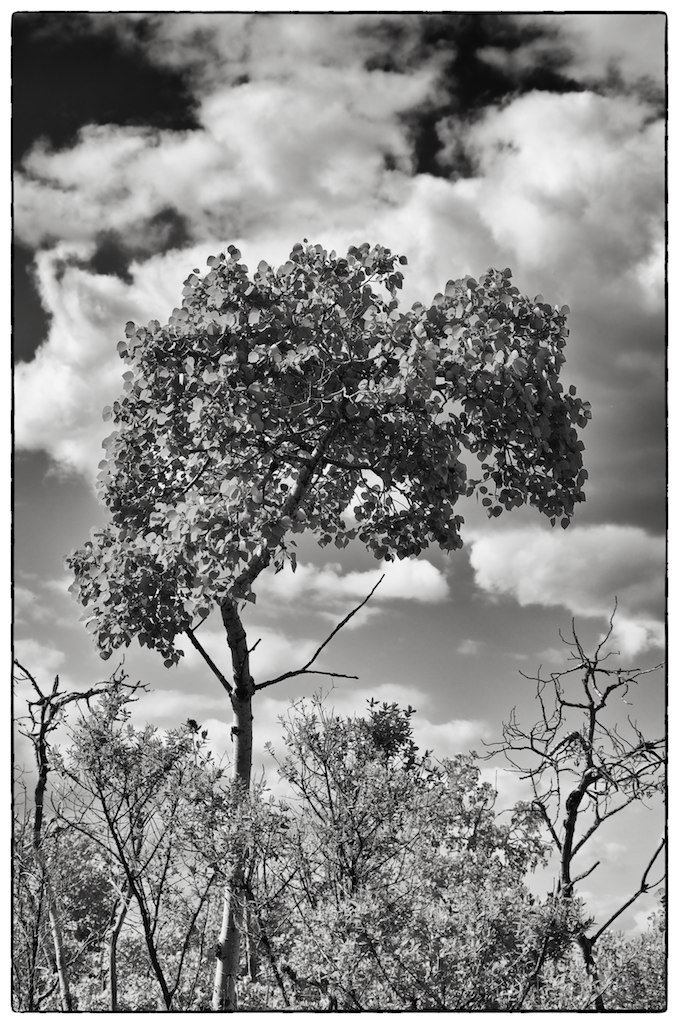
Image copyright Joseph Schreiber, 2012

It is World Bipolar Day, and this is the first time I have stopped to recognize the fact. I have spoken in, and around, my own bipolar diagnosis, but I have never addressed it formally in my writing. Even now I find myself uncomfortable discussing it. On the one hand, I am fortunate. I respond well to medication. I am, to use that distasteful term, “high-functioning.” But I do harbor a deep anger toward this condition that was part of my life many years before I finally careened through a brutal month of manic psychosis and found myself committed, and ultimately diagnosed, at the age of 36. I was, in classic bipolar fashion, the last person to suspect that I had a mental illness. Even though I, and those around me, knew something was terribly wrong, the stigma and lack of understanding around mood disorders—not to mention the radically impaired insight the sufferer has when they are ill—stands as a barrier to timely intervention. And then there is the matter of actually accessing care. One almost has to crash completely—by which time it can be too late.

Between my first manic episode in 1997 and the second in 2014, I experienced more than sixteen years of stability. I transitioned, became a single male parent, built a career out of nothing, and eventually became the Program Manager at an agency dedicated to working with survivors of acquired brain injury. I loved my job. Looking back, I can now see how the last few years of that period were marked by an increasing tendency toward hypomania. With my psychiatrist’s support I cut my medication back. And then things started to fall apart at work—things beyond my control, but it fell to me to try to pull things together. Then I started to fall apart at work, until I spiraled into full blown mania. Not psychotic, but it matters little. The damage was done.

The agency I worked for, dedicated as they are to supporting clients with disabilities including co-morbid mental illnesses, treated me with distrust bordering on contempt. My only contact with them has been conducted through a workplace advocate and my insurance worker. When return to work was discussed they refused to consider any possibility that I could work there again. Almost three years later with long term disability finally at an end, they still have my personal belongings.

Nine years of employment and dedication to that job now stand as a gaping hole in my life—a life already filled with gaping holes. And that is one of the reasons I hesitate to talk about mental illness (although I have never hidden my diagnosis). What can I say? Bipolar is not my identity any more than transgender is. Both fuck up your life. Leave wounds that do not heal. Find you fumbling through mid-life with little to show for your years but a lot of things you can’t talk about. And periods of time you cannot even remember.

So this is why I find it hard to write about my experience with mental illness. There was a time, following my diagnosis, that I devoured everything I could find, just as, a year later I hunted for books on gender identity. Two pieces of a puzzle I had inhabited—the periodic mood swings and the persistent, life-long feeling that I was not the female person everyone else knew me to be—had finally fallen into place. I had two, if you wish to be specific, explanations that come neatly labelled and defined within the covers of the DSM. It was, for a while, a source of relief.

Today I rarely read any literature that deals with mental illness or gender. But I am aware, more than ever, of being doubly stigmatized. And, most painfully, within the spaces where you would expect acceptance—in the human services profession and within the queer community. Thus the anger.

And what is this anger? Grief. The deep griefs I carry, layered now with more recent bereavements. It has become, for me, an existential bitterness that plagues me, an inauthenticity that defines the way I intersect with the world.

The legacy of mental illness is this: after diagnosis I was advised not to dwell on the disease, not to talk to others with bipolar; I was not deemed “sick” enough to warrant outpatient support or psychiatric follow up. I was left, like so many others, to flounder in the dark. It would take seventeen years and a spectacular career-destroying crash before I was able to access proper psychiatric and psychological support. I am still lucky. I am stabilized. And the forced detour into what may become an early semi-retirement has afforded me a space to write.

Now I need to find a way to write my way through this weight of grief. And begin to heal.

I’ll leave the last word to Sylvia Plath, with the final (fifth) stanza of the poem quoted above:

Dawn snuffs out star’s spent wick,
Even as love’s dear fools cry evergreen,
And a languor of wax congeals the vein
No matter how fiercely lit; staunch contracts break
And recoil in the altering light: the radiant limb
Blows ash in each lover’s eye; the ardent look
Blackens flesh to bone and devours them.

—You can find out more about the International Bipolar Foundation here, and a prose poem I wrote to honour a dear friend who lost her desperate and brave battle to bipolar last year can be found here.

For World Poetry Day, excerpts from a few books on my bedside table

In honour of World Poetry Day (which at the moment, in my time zone, is still happening), I thought I would take a moment to look at some of the poetry currently on my bedside table. I sometimes write about the poetry I read, but do not feel equipped to formally review it. That doesn’t keep me from enjoying it, of course.

I read a lot of poetry in translation. It can, perhaps, be a challenge to capture the spirit of a poem in another language, but that’s not a reason to deny its worth. Poetry opens up worlds of experience in a way prose typically cannot. And when competing (or rather, complementary) translations emerge, I like to think of that as an opportunity to re-experience a piece of literature reflected through a somewhat different prism.

I have a fondness for collections, complete or selected, that allow me to sample a poet’s work across their career, and delight in the magic of opening a book randomly, finding words that strike home. The following pieces are taken from the works I have been spending time with lately:

Water binds me to your name.
Nothings is left of me except you.
Nothing is left of you except me—
a stranger caressing the thighs of a stranger.
O stranger, what will we do with what is left
of the stillness and the brief sleep between two myths?
Nothing carries us: neither path nor home.
Was this the same path from the beginning?
Or did our dreams find a Mongolian horse on a hill
and exchange us for him?
What shall we do?
What shall we do without exile?

—Mahmoud Darwish, from “Who Am I, without Exile?”, translated from Arabic by Sinan Antoon, collected in Unfortunately, it was Paradise: Selected Poems (University of California Press)

* * *

I’m a Child of this Century

I’m a child of this dreary century
a child who never grew up
Doubts that set my tongue on fire
burned my wings
I learned to walk
then I unlearned it
I grew weary of oases
and camels eager for ruins
My head turned to the East
I lie in the middle of the road
And wait for the caravan of the mad

—Abdellatif Laâbi, from Beyond the Barbed Wire: Selected Poems, translated from French by André Naffi-Sahely (Caranet Press)

* * *

Every day wakes up to some abuse
in my monologue is
embedded the legend of my sorrow,
with thousand year-old grief
I prevailed over my dirty life,
but not over the rationality of the winter cold . . .

In taprooms you rip off
the tattered shreds of your tragedy,
no forest, no merit, no archangel . . .

Above your poetry a swarm of birds mows
mows and mows a life imploring . . .
nothing for anyone
in the proximity of this dream,
nothing for worldly lovers . . .

Fruit of rottenness,
a wicked sun . . .
Temple ruins, broken pieces gathering
on the rediscovered shore . . .
in gloomy courtyards books opening . . .
Verses on abandoned walls . . .

. . . not the perfect one,
not the dead man, who drove you into the cities . . .
Trust in your song.
You plough the earth with your fragments,
cold begot you . . .
You, left behind by your creators . . .

—Thomas Bernhard, from Collected Poems, translated from German by James Reidel (forthcoming from Seagull Books)

Thoughts on writing about Witness by Robert Rient for Minor Literature[s]

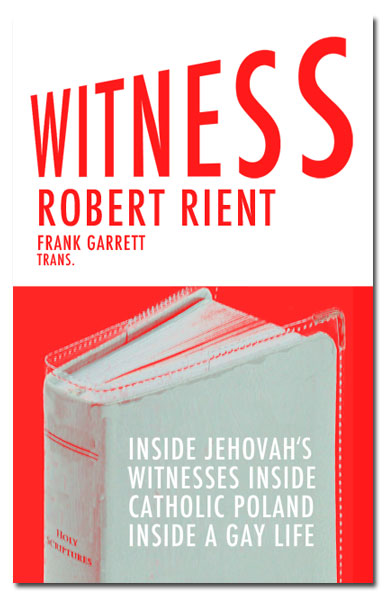
For all its sins, Twitter is still a terrific way to connect with readers, writers, translators and small publishers and, in the process, hear about books you might otherwise miss. Witness by Polish writer and psychologist, Robert Rient, is a case in point. I came to know of it by way of the translator, Frank Garrett, and was immediately intrigued by this story of a man who grew up gay and Jehovah’s Witness in Catholic Poland. I ordered the book and, as soon as it arrived, I had a quick look and immediately knew it was the type of book for which I would want to pitch a critical review.

I am intrigued by original approaches to memoir writing, that is, rrient-witnessintentional writing about ones’ own experience. In Witness, the story is carried by Luke, the writer’s younger self—the boy and young man torn between his faith community and his sexuality—and Robert, the grown man who marks his break with his past and his rebirth as a whole person, true to himself, by taking a new name and identity. Woven through these two narratives is a fascinating look inside the Jehovah’s Witness church. As someone with a dual identity history, albeit different in nature, I found a lot to admire in the telling of this story, as well as in Robert’s honesty and the powerful transformation he chooses to make to mark his move forward into a new authentic life.
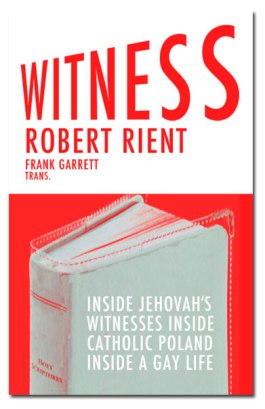
My review is now live at Minor Literature[s]. Thank you to Tomoé Hill for entertaining my contribution.

Minor Literature[s] has been repairing its archive so I have reproduced my review here:

Witness by Robert Rient (trans. Frank Garrett)—Joseph Schreiber

Not yet fourteen years old, Luke Zamilski is waiting his turn to climb into a garden swimming pool set up in the middle of a large stadium. Thousands of people fill the stands. He has endured months of interrogation by the elders of his church congregation. He has memorized the precepts of his faith and the Biblical justification and ammunition afforded each one. He is ready. With his baptism, Satan will come to know of his existence, but Luke is eager and enthusiastic because he also knows that, on this day, he will be granted a clean slate. With this expurgation, he trusts that Jehovah will remove the thorn that has been working its way into his flesh through these early years of puberty.

Or maybe not.

Luke’s story begins with the dramatic retelling of a fire that destroys his family home when he is just shy of his fourth birthday. As part of the small Jehovah’s Witness community in Poland, the aid and support of fellow church members is immediate, as is the curiosity and derision of their Catholic neighbours. When the family is eventually settled into a new house, Luke is given a used briefcase in which he is to store his important papers should he ever need to escape a similar circumstance in the future. That same case will also go on to hold his precious diaries, his poetry, and eventually, he tells us, his porno mags, letters, newspapers and more. A place to contain both his documented and his hidden life. Thus, this event sets the stage for the account of a life that is destined to be doubly isolated. He is cut off from the normal social activities and celebrations of his peers by his “feline faith”, and then, as he struggles with his sexuality, he risks being denounced by his church community for falling prey to a sin thought to be worse than murder.

Witness, by Polish psychologist and writer Robert Rient, is at once an original and engaging chronicle about growing up gay, and a disturbing look deep into the manipulative and damaging environment of a religious organization that shares many similarities with other fundamentalist Christian churches, and yet is its own strange entity. However, this is not a case study or a psychological essay. It is, rather, an autobiography in three voices.

Luke carries the immediate and emotional core of the narrative. He agonizes over his inability to refrain from masturbating, and the curse of the ‘thorn’ he carries. He begs to be relieved of his affliction and prays for the imminent arrival of Armageddon, for release from worldly temptation and the corruption of Satan. He throws himself into the church, preaching and witnessing, and yet he is also drawn to the arts, to writing and drama, and eventually chooses to study in the city of Poznan after graduation from high school. There he will vacillate wildly between fanatical commitment to his faith, a desire to succeed in his studies, and a dangerous entanglement with drugs, alcohol and self-harm. Guilt and shame dog him, throughout his youth and on into early adulthood, intensified by the very real threat of disfellowship from the church, and rejection by those he knows and loves. His desperation becomes intense. At the age of sixteen, for instance, he makes the very Biblical pledge to cut off his offending appendage:

I take a knife from the kitchen. I go upstairs to the second story. I enter the bathroom, turn on the light. I drop my pants to the floor, pull down my underwear. I apply the knife to the base of my penis. Wait. I’m scared of the pain, that I’ll bleed to death. I gently drag it across the skin. It stings. It leaves a red line on the flesh. I won’t do it. I’m too weak even for that.

His first confidant is Robert, whom he ‘meets’ at the age of eleven. Somewhere between an alter-ego and an imaginary friend, Luke first summons Robert ‘out of nothing,’ a new identity to step in when the waters become too rough, someone to pick up the pen and write in his journal the thoughts and feelings that he dare not own. Robert carries the second narrative voice, looking back from the present with a certain, almost clinical, detachment at his troubled younger self, providing a grounded counter perspective. His measured tone speaks to his own hard-won peace, but a fondness and affection seep through, along with an abiding sense of loss. Although his parents will ultimately stand by him, and his older brother who also leaves the faith, the rejection of the friends and relatives who stay behind is cold, harsh and unforgiving. The cost is very real.

The third narrative, “Witnesses,” details the inner machinations of the Jehovah’s Witness enterprise—bringing to light textual materials, facts and figures, and unwrapping many of the arcane and disturbing beliefs promulgated within their organization. What is revealed is a misogynistic, sexually repressed, hierarchical system that denies celebration of holidays and birthdays, but permits limited alcohol and abortions (Armageddon is ever imminent after all), and encourages the physical discipline of children as a sign of affection. The church is widely spread across the globe and supported by vast quantities of written materials, most recognizably The Watchtower and Awake!, which are translated into a multitude of languages and distributed by members who are required to spend long hours knocking on doors and standing on street corners.

What we have then, is a memoir presented as an uncanny collaboration between the author, Robert, and Luke, the boy and young man he used to be, along with an exposé of the secretive church ‘they’ were born into. As an affectation, it would risk sounding overly theatrical, but this approach allows a much deeper, more genuine narrative to develop. In Luke’s account, supported by frequent excerpts from his diary, we hear of his youthful enthusiasm for his faith, his anguished attempts to fight his homosexuality, and his pull toward all the temptations and possibilities of a ‘worldly’ existence. By contrast, Robert’s perspective sounds at once insightful and limited. He wants to fill in the gaps, seek out the views of Luke’s former friends, and try to analyze, interpret and defend his fate. He knows how the story will end. In describing his first encounter with Luke, Robert says:

I suppose we already knew that we would meet again and that I would have to live. That he had to die. I didn’t kill him. But had he not died, I wouldn’t have been. Everything that happened to him, every torment, was convenient for me. His weakness and self-loathing were my justification and my provocation. Besides, he wanted to die. He talked about it again and again. I have evidence. I am the witness regarding this matter.

As the narrative alternates between the three voices, the mood shifts. The Witness sections are delivered with neutral authority. At times Luke’s actions are used to illustrate a point, and occasionally the reader is addressed directly, as, for example, in: ‘There exists an informal list of banned books which includes the one you’re reading.’ Both Luke and Robert speak in the first person, and refer to each other as ‘he.’ At times, when appropriate, first person plural is also employed. Luke longs for the comfort of his alternate identity most when he feels isolated and depressed, leaving Robert effectively sidelined, observing from a distance much of the time—a tone that comes through clearly in his sections, setting them apart from Luke’s. As Luke battles addiction, the loss of self-esteem, and suicidal thoughts, one can sense a growing friction between the two voices, as if Robert is slowly coming into sharper focus within their dual existence.

At the end of this powerful account of transformation and rebirth, Robert Rient emerges from the restraints of a religion that rejects his very being, and comes, over time, to accept and love himself as he is. It is his conscious disassociation that provides protection and allows him, with the support of friends and his academic training in psychology, to survive the very tumultuous break with his faith. Once the internal division is no longer required, he sheds his name and identity, along with his past, to claim a new wholeness. And in telling his story in this way, with equal respect for his past and present lives, Rient is able to capture a conflicted, painful journey with a fresh authenticity that reaches beyond the specifics to touch the universality of the experience of striving to be true to one’s self.

It is of note that Frank Garrett’s translation effectively captures the shifting tenor of the narrative, something which is essential to the success of this multilayered approach. He also includes a guide to assist with the pronunciation of the Polish names in the text, and in his afterword, he details the choices that were made with respect to language, and the challenges of accessing the original resources required to render this unique memoir into English.

On being lonely, and attempting to write my way out: A brief reflection

Words are lumpy, awkward, and unwieldy these days. Frozen, they neither form nor flow. I would like to blame it on the times, the weather—anything but this emptiness I can’t shake.

I used to say: I’m a loner, but I’m never lonely.

These days I’m lonely, even when I am not alone.

8460394828_a318b259c7_bI am reluctant to write about this. I can remember listening to others complain about being lonely—even when their lives were filled with activities and people—and wonder how they could talk that way. More critically, I blamed them. It must be something in them, I reasoned, a bitterness or despondency that drives others away.

And now that person is me.

I understand the sense of alienation—and the way it can so easily be reflected in a coldness borne of anger and pain. Loneliness engenders a void that fills the space between the self and others. A space that grows and pushes the lonely person farther away.

I’ve been reading about loneliness of late. In an essay published on Aeon last July, Cody Delistraty argues that for all its pain, loneliness can build character. It can be a positive experience.

Assuming one emerges, that is.

Depression, cognitive damage, and suicide are very real risks for those for whom loneliness becomes chronic. Delistraty’s thesis is self-serving. He goes to Paris seeking a period of solitude and finds himself irritated by a lonely woman who desperately craves someone to talk to. Choosing to isolate one’s self for a period of time—to recharge, to create, to write—is a deliberate, and hopefully productive, act. In The Lonely City, for example, Olivia Laing chronicles her experience being alone in New York City. I read it last year and related to her observations, but at that time I was still grounded by two important people in my life. One year later, both of them are gone.

And loneliness is very hard to bear.

As a loner, I was always careful to balance my tendency to isolate against work that was people focused. When I unexpectedly had to leave my workplace several years ago, I instantly became aware of the void that had developed over years of living closeted, as a man with no past. Unable to work, I sought to find a community where I could be out, be myself, but that seems to be a space that exists most authentically only when I write. In my experience, the LGBT “community”—at least in my age range, in my city—is not as supportive of diversity as one might imagine.

So if it is in writing that I find the freedom to be myself, how to exist beyond the page? Alone?

I will have to find a way to write through, above and beyond this loneliness, I suppose.

And find out where it takes me.

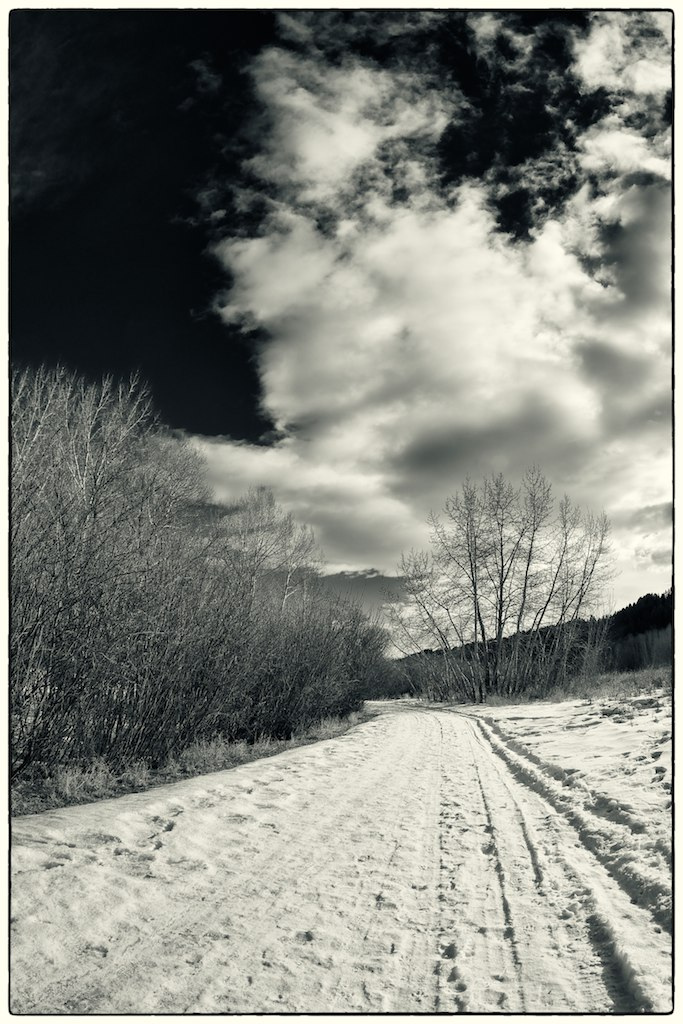
*Photograph by Joseph Schreiber, copyright 2013

Reading and writing my way through uncertain times

These are anxious times. It is easy, if you think too much, to wonder about the value of putting pen to paper with an atmosphere of doubt lingering so heavily in the air. But then, if you think a little further, wavering gives way to urgency. Reading and writing become acts of resistance, distraction, and revitalization. Or, that is what I remind myself.

I don’t want to venture too far into politics, but it would be naïve to pretend that we are not facing an unpredictable future. This uneasiness has been heightened for me over the past few weeks by an unproductive job search and increasing concern about my financial security as I’ve watched my cash buffer dwindle. The truth is though, with a will awaiting grant of probate, I stand to eventually find myself in a much better financial position than I had ever could have imagined. It doesn’t mean I won’t have to secure some outside income, hopefully some of that ultimately coming from writing related services, but I do dare to dream of finally having more freedom after years of struggling with identity, mental illness, and the challenges of a state of single parenthood that has extended far beyond my expectations.

2015-08-09 17.37.38So, world affairs aside, what right do I have to be anxious and insecure about writing? I suppose it’s enough that I am human, but I am also plagued by the unshakable feeling that I’m an impostor. All my life, the only thing I ever really wanted to be was a writer. And no matter how difficult writing is (and always has been), I still feel deliriously guilty to have been afforded, over the past two years of stress leave, the time and space to connect with writers, readers, translators, and publishers. It is a gift I am not ready to give up, rather I want to mould a life that will allow me to continue to read, write, edit, and grow.

And yet, every time I sit down with a pen and paper, or open a blank Word document the same fear that I will never write another solid review or creative essay sets in. Impostor.

I have two longer term projects—an extended personal essay/memoir and a constraint-driven experimental piece—in the early formative stages. Consequently, much of my present reading is directed towards exploring the ways ideas can be developed and stories can be told.  But every now and again I come up against a work that triggers my insecurity.

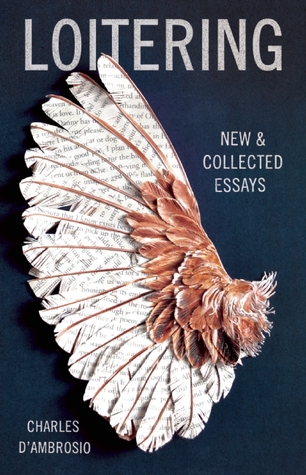
loiteringCase in point: I am slowly making my way through Loitering by American essayist and short story writer, Charles D’Ambrosio, and after each essay I feel temporarily overwhelmed. I can easily see why the friend who kindly sent me this book speaks of it so highly. Rather than attempting to review the entire collection at once, I want to pull out and look at some of the individual pieces along the way. They are that good.

First of all, D’Ambrosio notes in his Preface that, for him, the right to doubt is essential to the successful personal essay. “Loitering,” the title piece, is a perfect illustration of how and why this works. The setting: The middle of the night, outside a residential complex in the Belltown district of Seattle. Yellow police tape cordons off several blocks, while a large contingent of policemen and a cluster of journalists and TV news reporters wait in the rain. D’Ambrosio arrives at the scene around 2:00 AM, drawn by the reports of domestic violence and a possible hostage taking. With a Hollywood-tinged sarcastic romanticism, he imagines the scenario:

This guy—the Bad Guy—apparently thought he was just going to drink a few beers and bounce his girlfriend against the walls and go to sleep, but instead of a little quiet and intimate abuse before bed he’s now got major civic apparatus marshaling for a siege outside his window. No sleep for him tonight, and no more secrets, either, not at this unholy intersection of anomie and big-time news.

The clichés he arrived with quickly fall away as he joins the vigil. Quite frankly he is in rough shape himself. One of the key drawing cards for D’Ambrosio on this night is simple lack of human contact. A recent fishing trip has left him with severe atopic dermatitis due to contact with neoprene and he’s just spent a week isolated at home—his fingers, neck, feet, and legs swollen and covered with weeping sores.  Medication and the constant tingling sensation prevents him from sleeping, crackheads have stolen his duffle bag from his truck leaving him without a belt or a raincoat and now, armed with file cards and a pen lest he find a story, he is standing in the dark, soaking wet with his pants falling down. Nothing like setting a memorable scene.

As the night wears on he spots a man, angry, looking a reporter, someone to listen to his story. He makes his way through the crowd of journalists but no one wants to hear him out—a wretched resident displaced by the hostilities unfolding in his building, he is not on their agenda:

He’s now caught in between, trapped in some place I recognize as life itself. It’s obvious he hasn’t been sober in hours and maybe years. If it could be said that these big-deal journalists have control of the story… then this guy is the anti-journalist, because in his case the story is steering him, shoving him around and blowing him willy-nilly down the street. The truth is just fucking with him and he’s suffering narrative problems. He began the night with no intention of standing in this rain, and his exposure to it is pitiful. As he moves unheeded like the Ancient Mariner through the journalists I feel a certain brotherly sympathy for him, and I’m enamoured of his utter lack of dignity.

Our hapless would-be reporter knows the man will be back and knows that he alone will listen to him. And so he meets Dennis, a vet, and his friend Tom, a Native American man. Through them he will learn more, in so much as anyone knows anything about the armed man holed up inside in one of the sparse low-income units, and the story, through the eyes and words of this most astute and sensitive observer becomes one of the tragedy of the poor and dispossessed rather than a dramatic shootout and fodder for the six o’clock news. After years of working in human services, the tableau D’Ambrosio paints of the evacuated residents relocated to a city bus to wait out the proceedings rings true—a scene that could easily be played out in my city, or any other North American centre for that matter:

Inside this bus what you see is pretty much a jackpot of social and psychic collapse, a demographic of bad news. Everybody in there’s fucked up in some heavy way, dragged out of history by alcohol, drugs, mental illness, physical decrepitude, crime, old age, poverty, whatever. Riding this bus in your dreams would give you the heebie-jeebies big-time. There are maybe ten or fifteen people on the bus but between them if you counted you’d probably come up with only sixty teeth. In addition to dental trouble, there are people leaning on canes, people twitching and barefoot with yellow toenails curled like talons, gray-skinned people shivering in gauzy nightgowns, others who just tremble and stare. They’ve been ripped out of their bedrooms and are dressed mostly in nightwear, which is something to see—not because I have any fashion ideas or big thesis about nighties and pj’s, but rather because, this surreal dawn, the harsh, isolated privacy of these people is literally being paraded in public. The falling rain, the bus going nowhere, the wrecked up passengers dressed for sleep, the man with the gun—these are the wild and disparate components of a dream, and I haven’t slept, and it’s just weird.

This passage, in fact the entire essay, left me breathless. This is not beautiful. It is raw, honest and real. In telling the story D’Ambrosio allows himself to be vulnerable and despite flashes of humour, one senses he is defeated by the sheer sadness of the whole affair. The reporters will head off to other stories, but he will be left on hold, filled with doubt, open to questions. Upon first reading I felt a sense of writerly inadequacy descend on me; returning to write about it and copy out significant passages I feel re-invigorated, inspired even.

I don’t know when this essay was originally published but it doesn’t matter. It contains a certain urban timelessness that stretches back through the twentieth century, yet is especially relevant today, with the pending threats to affordable healthcare and Medicaid in the US under the new administration. And so, I’m back where I’m started… uncertain times…

Loitering by Charles D’Ambrosio is published by Tin House Books.

Looking ahead to 2017: Finding light in the darkness

It may be a reflection of the year we have just endured as a global community, or the uncertain variables that cause 2017 to look like such a grey zone, but many people I know seem to be afraid to make any resolutions or commitments moving forward. A month or so ago, when I was still buried under a black cloud of grief and depression, I could not even imagine the utility of existing into the new year. I was in a peculiar space. I was receiving enthusiastic feedback for my work as a writer and critic—even selling a few pieces—but I felt empty and hollow inside. I could stand back and observe my malaise, but I could not bring myself to find an essential light to believe in.

Then, as suddenly as it had settled in, the darkness lifted. My parents are still dead, my friend is still gone, and I have not yet found a job. However, the stubborn, stupid optimism I always cherished as part of my character has returned. Wiser and soberer perhaps, and not at all naïve about the very real threats that the coming year holds. But with good books and the comradery of the many people I have come to know and respect, at home and afar, over the past couple of years, I resolve to try to read and write and photograph my way through 2017, come what may.

31760687801_ea5acb48c8_b

I have been making piles around the house lately and considered photographing them but have decided against being that committed in a public way. Suffice to say there is a healthy stack of fiction including a fair number of recent releases or purchases to which I am adding other titles I feel most guilty about ignoring to date. I have also been reading a good deal of poetry lately, new and classic, so I keep those handy. And then there is a growing collection of essays and memoirs which reflects my own interest, as a writer, in the variety of ways that personal experience or observation can be addressed. As much as I flirt with ideas of writing fiction, I seem to fall back into essay, at least as a starting point. If I end up taking a piece in the direction of storytelling or prose poetry, all the better, but the process has to be dynamic. I am learning to let my writing follow its own course as much as my reading does.

And this leads me to what might be thought of as my resolutions:

Reading: Some surprises surfaced when I added up my completed reads from 2016. I discovered that I read more German literature, than I had expected—11 titles, not including some Sebald that I am presently dissecting or the Kafka that I am always reading. I read 12 English language works (more actually, I have several essay collections and other books in process) and 8 translated from French. As for the balance of the translated literature I read, Spanish, Catalan and Portuguese accounted for a total of 10 books with many more waiting, while I read three Slovene, two Czech, and one each from Dutch, Korean, Arabic, Bosnian, Italian, Icelandic, Hebrew, and Polish.

Contrary to my previous pattern, I only read one South African, title though I added more and still have an embarrassing number of books crammed on to my bookcase. I had also intended to read more Arabic and North African lit and, again, failed. There are also a few key independent publishers I did not read from this year. So, all of these considerations will, if nothing else, be reflected in the piles I build. As to what I read—well, I’ll see…

Writing: I want to continue writing critical reviews but I am being very selective. Looking ahead I am especially excited about writing about new releases from Can Xue and Fleur Jaeggy for Numéro Cinq, while I also have a couple of other interesting reviews booked or underway. I continually debate the value of critical writing (this month the “Top of the Page “at Numéro Cinq features seven reviews—including one of my own—that I selected to highlight some books and reviews that impressed and inspired me). So often critics seem to be held in disdain and yet to write about a book sensitively and intelligently is challenging and creative—but it can be draining. Nonetheless, I have learned so much from the writing and from being edited, all of which has helped make me a better writer. Now that I am also involved with The Scofield as an editor I have further opportunities to continue to grow and contribute to the vital community of online literary magazines.

On the other hand, I am hoping to shift the focus of my blog a little, away from attempting to “review” books that I read (unless it seems appropriate). Rather I would like adopt a more personal reflection on the reading experience—try to pinpoint why the writing works, what ideas are generated, or simply celebrate reading for reading’s sake. I don’t ever want to feel obligated to write about everything I read, but at the same time I am increasingly reading books written by writers who are becoming friends and mentors. I want to be able to write about this work, in an informal, yet valuable way.

Finally, with what I call my “creative work,” I have several projects in mind or in process. One is an experimental, constraint-based project in honour of my father which may or may not lead to anything of interest to others. Otherwise, as much as I thought I was done with writing about the body, it seems that there is still a lot of unfinished business or baggage. It is inextricable from either my interest in being and authenticity, or my now expanded and complicated grief work. I am fortunate to have been approached by several online journals/sites that have invited my contributions and I am very excited about being able explore some ideas in smaller creative spaces to see where they take me. At the same time, I have a few other topics that I want, or even need to examine within, shall we say, a more conventional personal essay format.

Photography: After a long hiatus, I am inspired and eager to return to photography. A dear friend has kindly suggested —insisted— that I should incorporate more images into my writing. This possibility excites me and offers not only a direction for myself as a photographer, but also provides an opportunity to repurpose older shots, cropping and radically reprocessing images that were average and turning them into an integral part of a larger project.

So, even though it is impossible to know what the new year holds, I want to aim to face 2017 ready to build on what I have learned over the last two years which have held, for me, some of the most difficult and most rewarding moments of my life. It is really the only way I can think of to navigate what is bound to be a most interesting and surreal time.