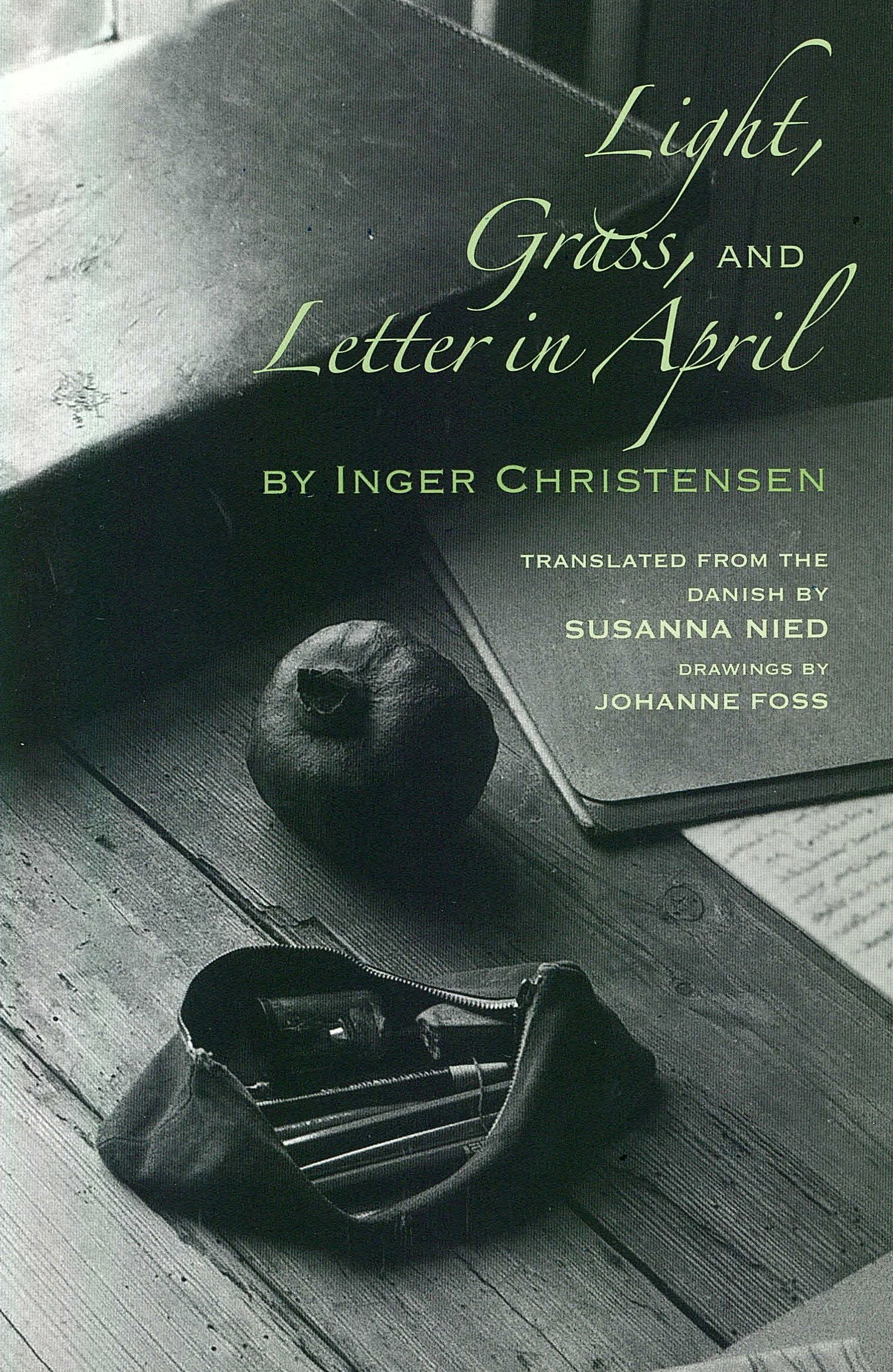
In this violent solitude: Light, Grass, and Letter in April by Inger Christensen

But do not grieve for me
do not grieve for your lonely
to and fro
My hour has rusted
My poem has left
your beaten track
Do not grieve My young poem
is more deeply kissed by life
Deathly it creeps
over under through me
Poetry is murdered hope.

(from “In the wild loneliness of the mountains” / Light)

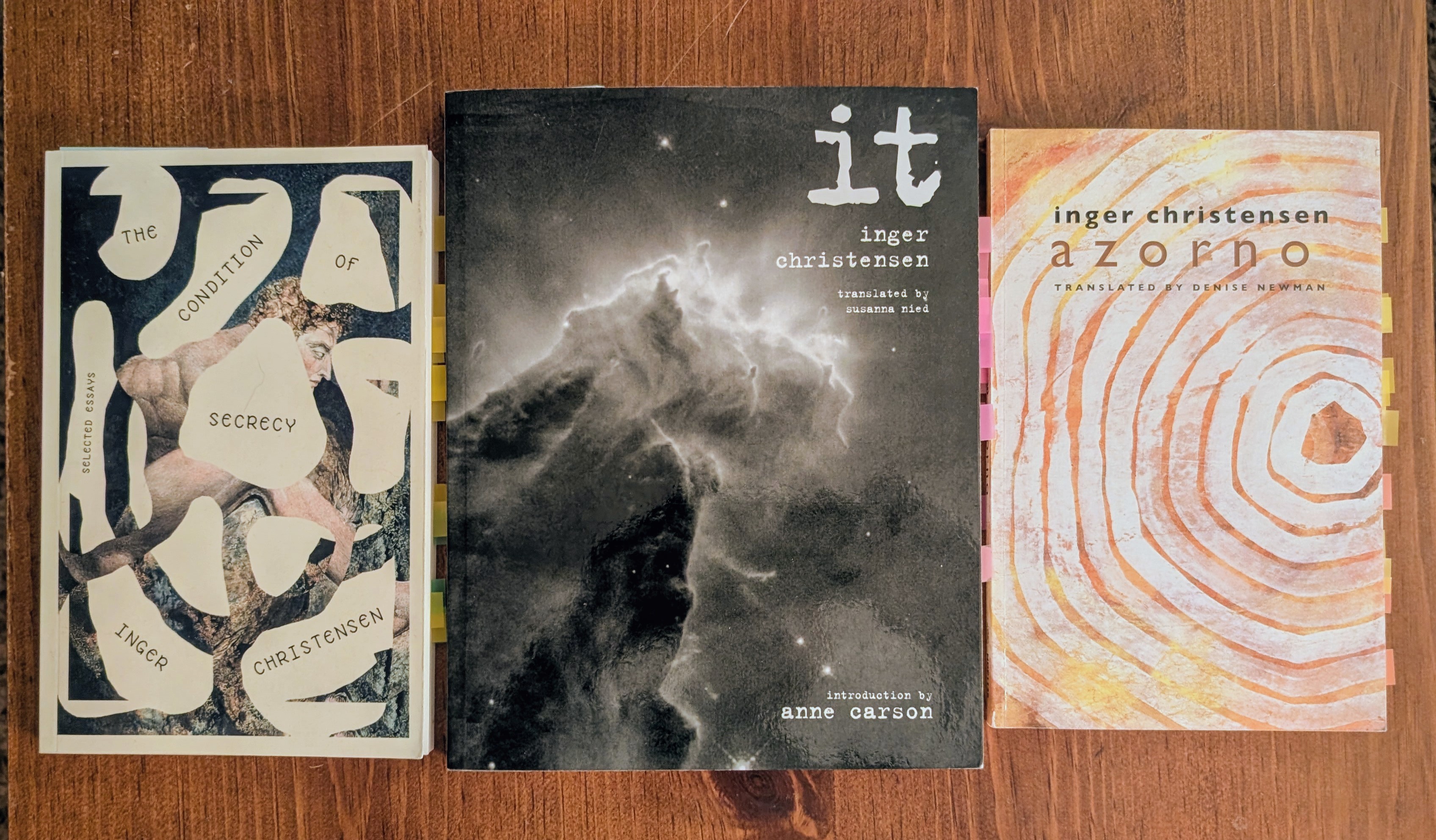
Having read most of the poetry of Inger Christensen (1935-2009) that is available in English translation, to return now to her earliest published collections, Light (1962) and Grass (1963) is somewhat like experiencing the formative spirit of a writer who will soon make her mark as an original and experimental literary force. And yet, it is clear in these poems composed in her mid-twenties, that she is already exploring the themes and perspectives that will define her most ambitious—and most popular—poetic works. This is perhaps to be expected because only six years separate the publication of Grass from the release of her monumental 200-plus page book-length cosmic poem Det in 1969 (“It” in English translation, 2006).

The present volume contains her first two collections, along with her fourth, A Letter in April (1979), a collaborative project that followed ten years after Det. Light and Grass being only one year apart, share much in common and reflect the time in which they were written. Yet as translator Susanna Nied (who has translated all of Christensen’s poetry and is thus well acquainted with her oeuvre) says regarding these two books:

Her lifelong themes are already evident: boundaries between self and other, between human beings and the world; our longing and struggle for direct connection beyond boundaries; the roles of language and writing as mediators of that connection; the distances between words and the phenomena that they stand for.

Images drawn from nature, domestic settings, and corporeal existence feature throughout these poems, with a strong sense of the landscape, the seasons, and the musicality of her homeland. Many of the pieces in both volumes tend to be shorter and lighter in form, though the not necessarily in content, but notably, the final poem in Grass, the sequence “Meeting,” is longer , closer to prose poetry, and seems to presage  sections that will later emerge in Det/It.

The unknown is the unknown and gold is gold I’ve heard, one
.      winter the birds froze fast to the ice without the strength
     to scream, that’s how little we can do for words with words
the books press close to one another and hold themselves up,
.      backs to the living room, our buttoned-up words huddle
.      on the shelf, the queue-culture of centuries, inexorably
.      built up word by word, for who doesn’t know that the
.      word creates order

(from “Meeting: V” / Grass)

The third work collected in this volume, Letter in April, seems quite different in tone, quieter and more intimately focused. It arose as the result of a collaboration with graphic artist Johanne Foss who began with a series charcoal-on-parchment drawings based on Etruscan artworks. Christensen and Foss had known each other for a number of years and both had spent time at an artists’ residence in Italy and explored Etruscan ruins. Taken by Foss’s drawings, Christensen chose some and began writing responses to her images. These responses began as prose pieces, but she ended up discarding them and beginning again in poetry. Their project developed over two years as they worked together during the summer months while their children played. Several themes emerge in this work including parenthood, wonder, nature, and the account of a woman who travels to a foreign country with a child inspired by a trip Christensen took to France with her young son as part of her writing process.

Unpacking our belongings,
some jewelry
a few playthings
paper,
the necessities
arranged within
the world
for a while.
And while you draw,
mapping out
whole continents
between the bed
and the table,
the labyrinth turns,
hanging suspended,
and the thread
that never leads out
is, for a moment,
outside.

(Section I,  º )

However, more than a series of poems and drawings, Letter in April follows a complex yet unassuming structure. Each of the seven sections contains five segments marked by a sequence of small circles in varying order. For example, Section I follows the pattern: º º º º º, º º º º, º, º º, º º º .  Section II begins with º º º , and likewise each section begins with the same marking as the final segment of the one preceding. These markings link poetic segments with shared motifs, allowing  the entire work to either be read straight through, or by following the each pattern individually (i.e. I º, II  º, III  º, IV  º, and so on).  This flexibility reflects Christensen’s musical and mathematical instincts,  which are also apparent in the arrangement of elements of Det/It, but will be given full reign in her wonderful numerically and alphabetically framed poem Alphabet (1981).

Light, Grass, and Letter in April is a rich compilation of poetry that offers insight into Christensen’s development as a poet from the mid-twentieth century inspired modernism of her earliest work, through to a collaboration (unique in her oeuvre) that incorporates visual and dynamic elements. It is essential for those who already know and love her poetry, but can also serve as an introduction for those who have yet to encounter her masterworks.

So here we sit
in this violent solitude,
where bulbs work
underground,
and we wait.
Around noon
when the mountain rain stops,
a bird stands
on a stone.
Around evening
when the heart stands empty,
a woman stands
in the road.

(from IV  º º º º º)

Light, Grass, and Letter in April by Inger Christensen, is translated from the Danish by Susanna Nied, with Drawings by Johanne Foss. It is published by New Directions.

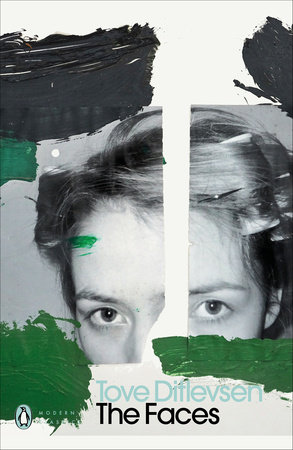
Slippery features, mocking voices: The Faces by Tove Ditlevsen

She put on her bathrobe and sat down at the dressing table, making as little noise as possible. In the mirror her face seemed to her tired and used, like an old glove. Her mouth was set in brackets by two faint, sketchy lines that stopped a little before the slope of her chin, as if the unknown artist had been called away in the middle of his work. Her eyes had that same open, sincere expression as in children who are telling a lie. Three delicate wrinkles lay like a pearl necklace around her neck, and they would dig deeper day by day. Would this face last out her time, this face that bore traces of so many things the world must know nothing about? Did it turn toward her with hostility whenever she wasn’t looking? And what would be underneath, when it fell apart one fine day?

Lise Mundus has an acute awareness of faces, her own and those of others—what they hold, what they hide, what they give away. And it seems to becoming more of an obsession. Not only has the sudden fame that accompanied her publication of a popular adult novel after years of writing children’s books pushed her face out into public view, but of late she has begun to question the motives of those around her. She already knows her husband is wildly unfaithful, she fears that she is losing touch with her children, and she resents the presence in her household of Gitte, the young housekeeper who looks after everything. And everyone. Haunted by crippling writer’s block, increasingly feeling isolated and alone, she begins to overhear hushed conversations rising through the plumbing and from behind closed doors. Her husband Gert has just suffered the loss of his mistress to suicide, and now, Lise is certain, he and Gitte are conspiring to push her to that same end.

The Faces, first published in 1968 by celebrated Danish writer Tove Ditlevsen, is a sharp, tight portrait of a woman’s spiralling descent into an episode of paranoid psychosis , her hospitalization, and subsequent recovery. Ditlevsen’s personal life was marked by domestic upheaval, addiction, and multiple psychiatric admissions, and she is clearly drawing on lived experience here, but she is doing so with poetic clarity and remarkable insight to impart a sense of what it is like to be unable to distinguish reality from hallucination and yet feel like one has full control of one’s sense, no matter how strange the experiences.  However, this is neither memoir nor autofiction. Rather, it is, even through its protagonist’s darkest moments of anxiety and confusion, a story told with great warmth, compassion, and even humour.

At first, there is nothing funny about the fragile state Lise is in as we first meet her. She is haunted by memories, appearances, and even the very rooms she occupies. No matter how she tries to hide her concerns, she believes that others are out to exploit her weaknesses—even her best friend Nadia, a psychologist who drops by to visit and strongly suggests that she stay away from the sleeping pills Gitte provides and call her psychiatrist instead. Lise wants to trust her friend, but what she detects in the faces around her and hears whispered behind her back is getting the better of her. She ends up doing the opposite. Convinced that Gert really does want her out of the way, she downs the entire bottle of pills (and immediately calls her psychiatrist to tell him she doesn’t want to die). She wakes up days later, in the toxic trauma centre.

Once she is medically stabilized, Lise is taken to the psychiatric hospital. By this time she is in a state of full-blown psychosis. Voices speak to her from speakers embedded in her pillow and from behind grates in the room to which she has been confined, strapped to the bed, after she failed to settle on the open ward. This room, which is actually a bathroom, becomes her safe space. She can hide here, protected by the voices that alternately attack her and warn her against the nurses and psychiatrist who are all part of their scheme to destroy her. It’s easy for her to believe the danger, she can read in their false faces. Convinced she is being poisoned, she refuses to eat and resists medication.

As the anti-psychotics begin to take effect, Lise starts to accept and embrace her insanity, no longer terrified, but now increasingly alert and wise to the subterfuge that surrounds her. At least, that’s what she thinks. Convinced, for instance, that a nurse has painted her face to look like someone from her past, Lise reasons that she “did it to confuse her and break down her resistance, but [she] saw right through such childish tricks with her healthy, clear sense of judgement.” And certain illusions are especially resistant, no matter how often (and patiently) she is corrected. She continually sees the male nurse named Petersen as her husband, even when the solidity of own perception starts to slip:

‘That’s right,’ said Gert, satisfied. ‘You’re starting to behave quite sensibly.’ His face was suddenly blurred, the way it looks when you’ve forgotten to wind the film and you’ve taken two pictures on top of each other.

‘You have two faces,’ she said, astonished. ‘That’s not allowed. You can only wear one face at a time.’

If the voices and hallucinations that have fueled her paranoia prompted a most desperate, potentially life-threatening action, their gradual retreat into the hard, tactile environment of the hospital ward leaves her fearing that she will be abandoned. Understanding that the manifestations of psychosis is rooted in one’s own disordered thoughts is unsettling, and for a time Lise actively resists the idea that she is moving toward returning home.

As a reader who has experienced an episode of manic psychosis and hospitalization (albeit under very different circumstances), I am always impressed when an author can capture the salient aspects of  mental illness—the internal reorientation of reality, the distortion of time— so clearly without sacrificing the literary and poetic qualities that contribute to a good story. Drawing on lived experience is not, in itself sufficient, Ditlevsen achieves this balance through point of view and by keeping her narrative short and focused.

When The Faces opens, Lise is already beset by suspicions and hallucinations, so we come to know her, and those around her, entirely through her increasing warped perceptions. With a tight third person perspective—ideal for conveying madness—there is no ground zero. At first, it’s difficult to tell whether there is a justification for her fears; it does look like there may be some gaslighting going on. Even when she swallows the handful of pills it’s not clear if she has been pushed to the limit by outside forces. Yet, once she’s committed to the psychiatric hospital where she wages her daily struggle against the voices that taunt her and her belief that she is the victim of a grand conspiracy, the extent of her illness becomes apparent. We can “hear” the outside voices of the nurses, doctors and other patients, in concert with what she thinks she hears. Now we have to listen and hope that she will slowly emerge from her psychotic state. The actual state of affairs at home, the “real” nature of her reality so to speak, won’t be revealed until she is finally ready to be released.

The Faces by Tove Ditlevsen is translated from the Danish by Tiina Nunnally and published by Penguin Books. (Also published by Picador)

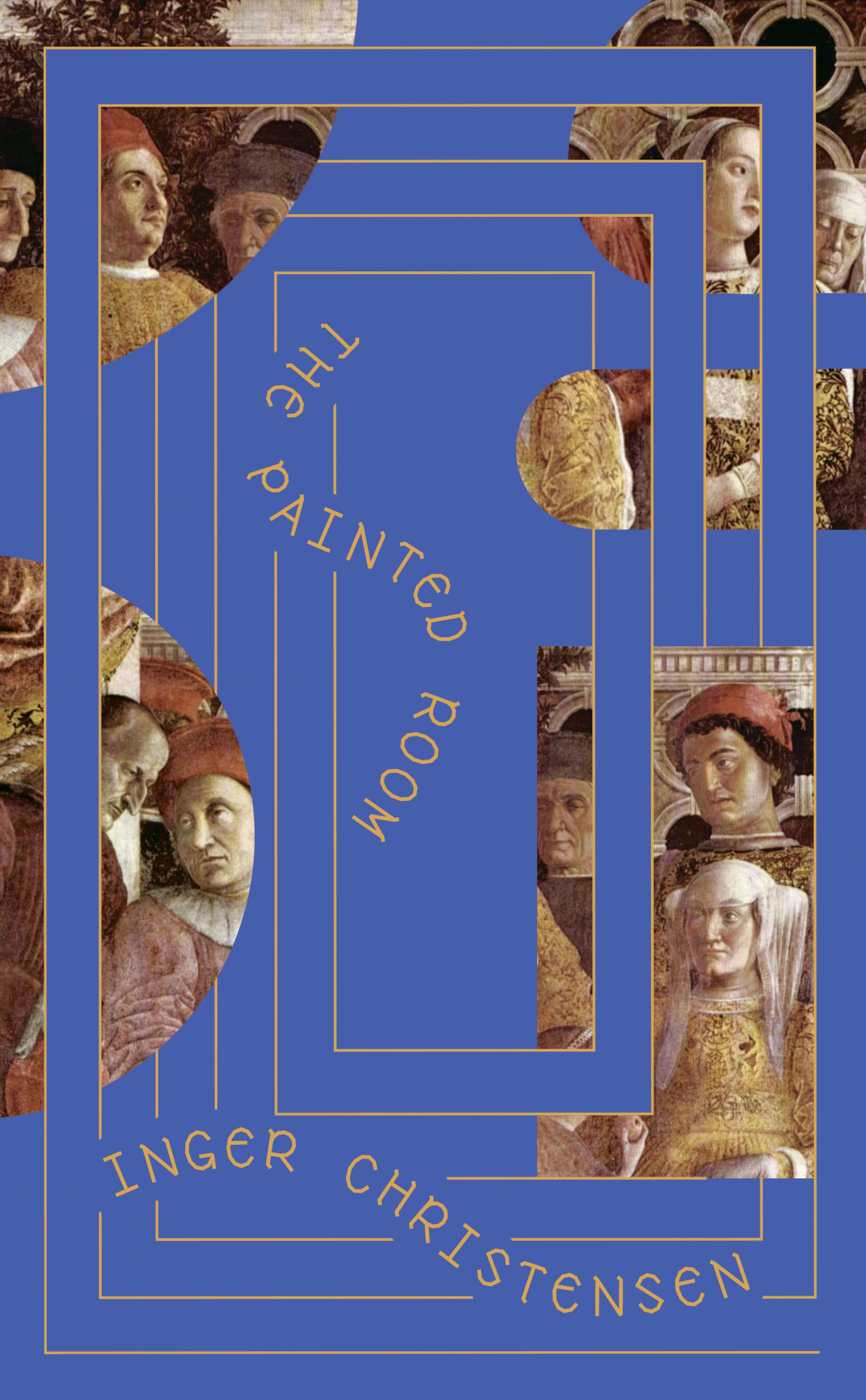
Of ghosts and angels: The Painted Room by Inger Christensen

Recently re-issued by New Directions, Denise Newman’s translation of Inger Christensen’s 1976 novella The Painted Room might at first appear to be somewhat more conventional than the Danish poet’s experimental prose works like Azorno or Natalja’s Stories. That would, of course, be a premature assessment. Subtitled A Tale of Mantua, this slender three-part volume is set in, and revolves around, the court of Ludovico Gonzaga III and the painting of the famous Bridal Chamber by Andrea Mantegna in the mid-1400s, but it is more than a simple piece of historical fiction. By turns witty, magical, and wise, The Painted Room offers a pointed commentary on art and immortality, power and passion.

As Italy gradually splintered following the fall of the Roman Empire, it evolved into a patchwork of independent territories over which powerful families battled for control until, by the fifteenth century it was common for each of these regions to be held under the autocratic control of single princes. Mantua in northern Italy, ruled by the Gonzaga’s from 1328 to 1707, was not only a tyrannical, war-focused principality, but, as its ruling family sought to elevate its social status through patronage of the arts, architecture, and music, it would become an important cultural centre in the early years of the Renaissance.  In 1459, acclaimed artist Andrea Mantegna (1431-1506), noted for his striking compositions and innovative studies of perspective,  agreed to enter into the service of Ludovico, the Marquis of Mantua, and the following year he was appointed court painter—a position he would hold for over forty years. His masterpiece would be completed there, the Camera degli Sposi or The Bridal Chamber in the ducal palace, a room decorated with realistic architectural details, frescoes featuring interrelated narratives  and a spectacular illusionary ceiling that appears to be a concave structure with an oculus open to the sky. The painting of this room and its images, offer the inspiration for Christensen’s novel, but the story she weaves extends far beyond these four walls.

The first part, “The Diaries of Marsilio Andraesi: a selection” proports to be outtakes from the personal journal of Ludovico’s devoted secretary, pictured to the far left of the Bridal Chamber’s “court scene” fresco which features members of the Gonzaga family and their attendants. Here Andraesi is leaning in to listen to the prince who has turned to speak to him. From the secretary’s personal account, which begins in March of 1454, we get an unvarnished, if rather biased and often catty, record of events leading up to Mantegna’s arrival at Mantua through to his death in 1506. Andraesi is not impressed with his master’s persistent efforts to woo the celebrated artist and the reason for his resistance is unlikely. It seems that the painter’s wife, Nicolosia Bellini (of the Venetian artistic dynasty), was once his secret love, now forever lost. So he focuses his attention on rumours he’s heard of Mantegna’s reputation as a troublemaker trained in “arrogance, brutality, and the hunt for novelty.” He feels the prince’s idolatry will only lead to shame. But, of course, the offer is accepted and the secretary’s would-be romantic rival arrives, at first on his own, but soon followed by his family:

Today I finally caught a glimpse of Nicolosia. I became deathly pale and could barely move. My brain turned completely white and my heart so drained of blood that it could hardly beat; I froze. An angel in the fire of earthly feelings.
(17th of August, 1460)

Bitterness and jealously continue to colour Andraesi’s reports, especially as progress on decorating the palace room is slow, and his secret confrontations with Nicolosia intensify. Then, when Mantegna’s wife suddenly dies (at least in this version of reality), the relationship between the two men gradually begins to shift toward what will eventually become one of friendship and respect. In the meantime, Mantegna’s young children are devastated by the loss of their mother but comforted by their father’s inclusion of her likeness in his art. After all, in art, the dead live on. When the frescoes are finally completed in 1474, guests are welcomed for a dedication event in what Ludovico calls “The Painted Room,” but which the children have christened the “Ghost Room.” In his reflections on the occasion, Andraesi calls attention to the uncomfortable dynamic that exists between art and immortality:

There is more life in the paintings than in all of these lively and rapturous spectators who simply put on airs because they are afraid of the pictures’ soul which is their own. The pictures are like all great ghosts in Art who calmly and tirelessly wait for their living models to die. All those who have had the chance on this occasion to look at themselves in the light of Art’s exegesis have consequently entered  into a relationship with Death; and they must each conduct  their negotiations with him day by day over the time and place and manner of their dying, and about their measure of anxiety.

In the second part, Christensen’s narrative adopts an even more fantastic examination of life at court and its connections to the broader world. However, immortality continues to be a central theme, not explicitly through art but through children, legitimate or otherwise. Attention turns to the dwarf depicted in the “court scene,” a member of the prince’s entourage, re-imagined as Ludovico’s daughter and given the name Nana (Italian for dwarf). When we meet her she is distraught about her unfortunate fate, imagining that her diminutive height will deny her an opportunity to love and marry. The gardener steps in and arranges for her to marry his beautiful son Piero once they are both old enough.

Nana’s story adds an added dimension to the events recounted in the first part. On the day of her wedding three unknown women appear; no one is certain who they are but coincidentally Mantenga has captured their likenesses among the figures who are seen leaning over the balustrade that surrounds the oculus painted on the ceiling of the so-called Ghost Room. To Nana, they are clearly angels. They tell her that Piero is actually the son of Pope Pius II, and leave her what she calls “The Angel’s Book,” a volume that is in fact the popular erotic novel written by the Pope before his call to the priesthood, when he was known y his birth name, Aeneas Silvius Piccolomini. The Tale of Two Lovers tells of the tragic affair of Euryalus, one of the men waiting on a nobleman and Lucretia, the wife of a wealthy man. Their love is expressed through a series of letters until they are finally able to meet in bed. Variations on the theme of this tale are echoed and played upon as The Painted Room unfolds, along with the revelation of other surprising entanglements.

The final, dreamlike part of The Painted Room takes the form of a “how I spent my summer holidays” school assignment written by Bernadino, the then ten year-old son of Mantega. He details his role in assisting his father in his work on his masterpiece, describing much of the process involved in laying the foundation, and mixing and applying the paints. But then he realizes that he is expected to record some kind of trip or adventure when in truth he has gone nowhere. So taking inspiration from his younger sister, he imagines himself entering the background of one of his father’s paintings and meeting an aged Greco-Roman hero who has forgotten who he is. Yet another glance at the question of immortality through the daydreams of a child facilitated by the magic of art.

Inger Christensen’s fiction—and her poetry for that matter—tends to work with layers, variations, and cross-referenced themes. Her foray into the world of fifteenth century Italian court life is filled with art, intrigue, infidelity, and murder, blending fact and fantasy to create an informative, entertaining, and intelligent tale. And, like any one of Mantegna’s famous paintings, repeated visits and closer inspection promises to offer ever more detail and connections.

The Painted Room by Inger Christensen is translated from the Danish by Denise Newman and published by New Directions.

“There is something about only being able to get lost when you’re not thinking about it”: Natalja’s Stories by Inger Christensen

—There was once a woman who travelled all the way from Crimea to Denmark so that she could bury her mother.

This woman, Natalja, was born in Russia to a Danish woman who had been abducted by a Russian silk trader, and when the Revolution broke out she and her mother were forced to flee the country. Along the way, her mother became sick and died of dysentery, so Natalja gathered some ashes from the mass funeral pyre, placing them into the Chinese crock they’d been carrying, and made her way to Copenhagen. This story, told and retold, each time with a new angle or embellishment, is passed onto the woman’s granddaughter, also named Natalja, who then tells and retells variations on the themes in her grandmother’s stories letting them veer off in wild, often outlandish ways. Gathered together these stories comprise Inger Christensen’s strange, little shape-shifting novella, Natalja’s Stories, originally published in Danish in 1988, and now available from New Directions in Denise Newman’s English translation.

Reading like interlinked or echoing stories, each of the seven chapters of this book is narrated by a woman named Natalja—presumably the granddaughter of the Russian-born Natalja described above—but who is she really? A Danish woman living in Paris, a French woman who assumes Natalja’s identity, or a writer writing her own or someone else’s stories? Or all of the above. As with Christensen’s intricately layered novella Azorno, meanings are fluid, shifting even as the same images, events, and characters (or to put it simply, the same phrases, sentences, passages) reappear in ever changing forms and contexts.

The book opens with “Natalja’s story about destiny” which details her grandmother’s account of how she came to be born in Russia and the circumstances that brought her to Copenhagen. Each one of the stories that follow can be understood as variations on this theme of destiny—being caught in it, escaping it, or reshaping it.  Even the very act of telling a story seems to have its own force of will as our narrator muses in the opening of “Natalja’s story about liquor”:

There was once a cat named Mirage. That’s more or less how I thought I would begin my story. Now of course you can say it’s already begun as I thought it would—there once was a cat named Mirage and so on—whatever I come up with now doesn’t matter because it would be just one of countless but similar false beginnings. And if it had been a true beginning I would not have noticed it, would not have mistrusted it. I would not have ceased its development and so on.

But why hide the fact that only Mirage the cat holds the picture of this story and thereby knows its correct imperceptible beginning, while I am obliged to pick and choose between random sentences that say nothing to me because I’m unable to see where in the story they belong?

As reality and identities shift, revolving around repeating characters, scenes, and motifs, the stories that emerge are by turns amusing, absurd, intriguing. There are murders, mysteries, and even a man so dangerously irresistible that he may have been not only the younger Natalja’s love, but also the lover of her mother and her grandmother.  Our narrator, in her varying incarnations, seems to be inclined to allow herself to fall into unlikely situations, only realizing later that the power to reinvent herself, to become someone else, belongs to her. But it doesn’t exactly resolve how she fits into the overall narrative—if there even is one.

Composed as part of a seven-writer project modeled after Boccaccio’s Decameron, Natalja’s Stories explores a theme common throughout Christensen’s poetry and prose: the way language creates and shapes meaning. As such, the experience of reading her fiction can be akin to wandering through a maze or a hall or mirrors (or both). The inclination may be to try to dissect it logically, but in this case there may be multiple logical intersections at play.  It’s perhaps best to let go and enjoy getting lost in a world where realities continually change and simply marvel at the  connections that arise when you least expect them.

Natalja’s Stories: A Novel by Inger Christensen is translated from the Danish by Denise Newman and published by New Directions.

Elegy on the wing: Butterfly Valley by Inger Christensen

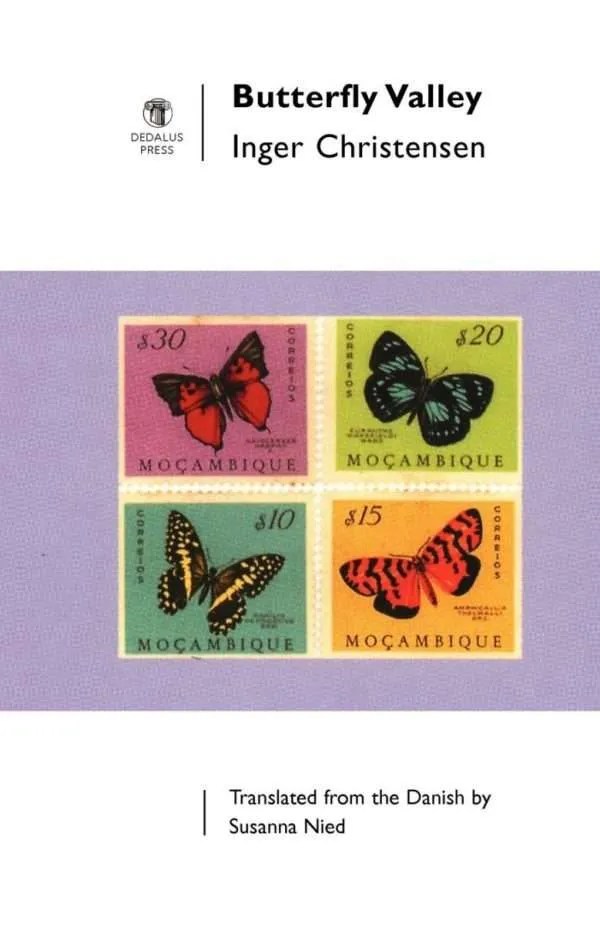
Since reading The Condition of Secrecy, a collection of essays by Danish poet and writer Inger Christensen (1935–2009) In January, I have set out to read one of her works each month until I run out of available volumes. This past month was largely absorbed by working for and worrying about the Canadian Federal election which has just passed, so my reading was scattered at best, and most suited to poetry and short fiction. I am squeezing this brief reflection on this single-poem volume, Butterfly Valley, as National Poetry Month draws to a close. Note that this is a dual-language edition, whereas the US edition from New Directions entitled Butterfly Valley: A Requiem contains this same translation by Susanna Nied, Christensen’s longtime poetry translator, along with three other medium-length poems, but does not include the original Danish. I intend to get that book eventually, however I would suggest that having the original and the translation face-to-face allows a reader to appreciate the complexity of Christensen’s achievement as it is possible to gain a sense of the musicality and rhyme structure present in the Danish, even though it would be unsatisfactory to attempt to reproduce that fully in the English.

“Butterfly Valley” is a fifteen part sequence of sonnets, the first fourteen linked by first and last lines which are then gathered form the final powerful poem. Christensen was a lover of form, structure, and imagery drawn from science and nature. Musicality was also very important. These qualities all come into play with this sequence which features the fourteen lines of the sonnet presented as two quatrains and two tercets with the rhyming pattern: ABAB CDCD EFE GFG (several follow ABBA CDDC in the first two stanzas). The poems are linked by repetition—through the first fourteen sonnets, the last line of each sonnet becomes the first line of the following one. VI, for example, closes with:

Here gooseberry and blackthorn bushes grow;
whichever words you eat, they make
your life butterfly-easy to recall.

Perhaps I will cocoon myself and stare
at the white Harlequin’s sleights of hand,
delusion for the universe’s fool.

And VII begins:

Delusion for the universe’s fool
is the belief that other worlds exist
that there are gods who bellow and roar
and call us random tosses of the dice

The fifteenth sonnet is composed of all of these repeated first/last lines, in order, with the typical rhyming pattern maintained. Each individual sonnet is thus crafted with an eye (and ear) to the finale.

Within this sequence, a host of colourful butterflies rise and fall through the Brajcino Valley’s noon-hot air. Christensen, who believes that poems are composed of words, first and foremost, employs butterfly-related imagery and the names and colours of different species, directly and metaphorically, along with a mythologically-tinged sensibility. But her themes are the very human, even existential, reflections on life and death, love and loss, art and nature.

When with their image-language, butterflies
can use dishonesty and so survive,
then why should I be any less wise,

if it will soothe my terror of the void
to characterise butterflies as souls
and summer visions of vanished dead. (X)

As ever, Inger Christensen’s poetry is an intricate and articulate celebration of language, meaning and life itself. This slender volume highlights these qualities well.

Butterfly Valley by Inger Christensen is translated by Susanna Nied and published in a bilingual edition by Dedalus Press.

“somewhere I am suddenly born”: alphabet by Inger Christensen

I write like the wind
that writes with clouds’
tranquil script

or quickly across the sky
in vanishing strokes
as if with swallows

I write like wind
that writes in water
with stylized monotony

or roll with heavy
alphabet of waves
their threads of foam

(from “alphabets exist”)

In her essay “It’s All Words” (included in the collection The Condition of Secrecy), Danish poet Inger Christensen offers a very simple, yet possibly unexpected, statement about the nature of poetry:

But poems aren’t made out of experiences, or out of thoughts, ideas, or musings about anything. Poems are made out of words.

It’s through our listening to the words, to their rhythms and timbres, the entirety of their music, that the meanings in them can be set free.

This particular essay happens to be about her stunning work, alphabet, a book-length sequence of poems in which each piece builds on, remixes, revisits, and expands upon what has come before. It is project that began as process of collecting words and, as she was foraging through the dictionary, she happened upon what would become her form: the Fibonacci sequence.

The concept was introduced to the western world by the medieval Italian mathematician Leonardo of Pisa (later referred to as Fibonacci by 19th century scientists) in his Book of the Abacus in 1202, although the calculation originated with Indian poetics and mathematics as far back as 200 BC. This sequence in which each successive number is the sum of the two preceding it (0,1,1, 2, 3, 5, 8,13, 21, 44, 65, etc) describes an exponentially increasing mathematical pattern that often occurs in nature as in the spiral growth seen in certain plants.

By combining this formula, or “wordless universal poem of numbers,” with the human-made alphabet, Christensen conceived of a structure (or implied form) for an unfinished sequence of poems. A framework upon which she could weave “a kind of spell”:

A prayer that apricots, doves, melons, and so on could continue to exist in the world. And at the same time, a prayer that atom bombs, hydrogen bombs, dioxin, and so on could disappear.

And herein lies the special charm of alphabet. Fourteen chapters, running from [a] to [n], each containing a single poem or series of poems that total a corresponding number of lines from 1 to 740.

The first poem simply reads: “apricot trees exist, apricot trees exist,” the second: “bracken exists; and blackberries, blackberries; / bromine exists; and hydrogen, hydrogen” and so the essential pattern is set, introducing the existential aspect of the everyday matter around us—that which is good and beautiful, that which is toxic, and an element that can either be vital to life or destructive. As the poems become longer and more complex, these early images reappear and the alphabetic aspects are more or less evident. As each chapter expands there is, as in life, an increasing and startling diversity and variety to be found.

life, the air we inhale exists
a lightness in it all, a likeness in it all,
an equation, an open and transferable expression
in it all, and as tree after tree foams up in
early summer, a passion, a passion in it all,
as if in the air’s play with elm keys falling
like mama there existed a simply sketched design,
simple as happiness having plenty of food
and unhappiness none, simple as longing
having plenty of options and suffering none,
simple as the holy lotus is simple
because it is edible, a design as simple as laughter
sketching your face in the air

(“life”)

Christensen is a poet who delights in form, but prefers to set her own rules. Each poem has its own structure, but the use of repetition and recurring motifs contributes to the overall hymn-like quality of this work. She celebrates the beauty of everyday moments, delights in magic of the natural world and, as in her essays, shows an acute concern for the legacy of the atomic bomb and the nuclear fears of the Cold War (this book was first published in Danish in 1981). Her vision moves back and forth between these poles of existence threading words into verse.

Translator Susanna Nied had translated several of Christensen’s volumes of poetry before alphabet was even written (including her masterpiece It), so when this book was published in Danish, the poet sent her a copy. In an interview in Circumference, she describes how she sat down to read it as soon as it arrived. She read straight through and began to translate almost immediately without telling Christensen.

I did eventually show that preliminary alphabet translation to Inger, who pronounced it flot (high praise) and went over it with me, asking excellent questions, musing and reminiscing about how she had written the poems. We had a long tussle over whether the key verb should be “exist/exists” or “is there/are there.” Inger ultimately won, thank goodness, though it took me several months to capitulate. As we worked together during the six weeks I spent in Copenhagen, I recognized the content of alphabet in Inger’s daily life and in her memories. I recognized its cadences and phrases in her speech. Again, invaluable.

She goes on to describe working on the translation for years and, even once it was published she was still thinking of ways it could be improved. Nonetheless, the long working relationship between poet and translator is reflected in the care with which Nied realized the many intertwined and contrasting elements in this unique and engaging work.

I would like to imagine that this is an experimental poem (or sequence of poems) that is not only original, but accessible to those who might fear poetry. Meaning can be found, or revealed to a reader, in a very natural and yet personal manner. Sometimes the defining letter has a major role, other times less so. Her poems take off and move in unexpected directions before returning to call up familiar images in new ways. It’s a truly wonderful work and a fantastic, award-winning translation.

alphabet by Inger Christensen is translated from the Danish by Susanna Nied and published by New Directions.

An inexhaustible landscape of words: The Condition of Secrecy by Inger Christensen

Writing poems is just as much a mysterious miracle. Not that there’s anything mystical or ceremonial about it. Or anything religious. It’s a neutral miracle, so to speak, granted in advance, because in the process of writing we need to use language in its whole, indissoluble connection with reality. It’s that connection with reality that’s a mysterious miracle. And that’s what poetry has to enter into.

It is clear from the essays collected in The Condition of Secrecy, that Danish poet, novelist, and essayist Inger Christensen (1935–2009) was not only in love with words, but that she understood language—and the way we seek to give meaning to the world—as part of the dynamic process of nature. For those who are already familiar with the experimental writer’s poetry and fiction, this collection offers insight into her view of the world, which was heavily influenced by a lifelong interest in science, mathematics, and linguistic theory, and the questions she was inclined to ask about her own engagement with language. For those who are new to her work, myself included, her philosophical musings and poetic investigations are no less interesting, and may well serve as an invitation to explore her work further—and fortunately there is a good selection currently available in English translation with more forthcoming this year.

What is most immediate in this compilation of essays, originally published across four decades, from the 1960s through the 1990s, and arranged intentionally rather than chronologically, is the sheer force of Christensen’s intellectual curiosity. At its most basic, it is a book about writing and meaning, but a book by an original inventive poet trained in German, mathematics, and medicine, who read six modern and two ancient languages. And, as a child of the Second World War, social and political concerns are never far from her mind. The Cold War and the fear of nuclear annihilation casts a clear shadow on a number of pieces. So, although this volume only numbers 138 pages, Christensen encourages her reader’s close engagement with ideas as she herself works her way through her own questions about the world and the way we find meaning in it through language.

Words are, of course, essential and she has a wonderful way of employing them. Her opening sentences are often quite special. “Interplay,” an essay about coming to understand time and one’s place in history as a child in Denmark at the end of World War II, begins:

When I was nine years old, the world, too, was nine years old. At least, there was no difference between us, no opposition, no distance. We just tumbled around from sunrise to sunset, body and earth as alike as two pennies.

Another piece, one of several more explicitly about words, meaning, and form, especially in the art of poetry, “Silk, the Universe, Language, the Heart,” opens:

Silk is a noun. All nouns are very lonely. They’re like crystals, each enclosing its own little piece of our knowledge about the world.

This playful essay, in conversation with the Ars Poetica or Wen Fu of Chinese poet Lu Chi (261–303 AD), examines the personalities of nouns, adjectives, adverbs, and verbs, along with the ever important prepositions that hold them in relation to one another.

Another essay that explores the interconnectedness of words, meaning, and writing poems, “It’s All Words,” moves from an analysis of what it means to say: “The word creates what it names” with all its Biblical overtones, through an existential (and anthropological) notion of naming the world into existence, to try to answer the question of why poetry is not a common practice when it requires no special tools beyond a paper and pen.

As it is right now, when the world has existed for so long, words come from everywhere, and they’re never there for the first time. Not only that. Although there may not be an infinite number of them, nor an infinite number of combinations, nevertheless there is an inexhaustible landscape of words, there are more than any one individual could manage to travel through. This is where it ends and where it begins, if a person is going to write poems: in the imagined concept of this mysterious landscape. For poems are created exclusively from words.

What makes this piece especially intriguing is that it leads into a discussion of the creation of one Christensen’s most inventive book-length poems, Alphabet. She began collecting words and then, in her gathering, she happened to come across Fibonacci numbers, a formula of increasing numbers that describe a pattern present in the growth principles of many plants. By employing this structure, she had a framework upon which her poem could eventually grow and bloom.

Most of the essays in this volume are short, some are only a few pages long, but midway through, the longest piece, coming in just shy of 30 pages, marks a turn of focus to more philosophical and political themes—not without abandoning talk of writing poetry and fiction, mind you. “The Regulating Effect of Chance” is an extended discussion of the role that chance plays in the world—fundamental, as she sees it, in accord with Jacques Monod’s Chance & Necessity—and in our experience of the world, our tendency to assign a notion of fate or destiny, and our understanding of art, creativity, imagination and much more. The later essays turn their attention to subjects such as the nature of truth, the depiction of night and, in a futuristic and somewhat fatalistic effort, “Snow,” the idea of the inevitability of nuclear winter.

This collection is one that I have owned for a number of years, without any previous experience of Christensen’s poetry or prose. Several times I pulled it from the shelf, but it did not seem that the time was right. Now I am especially keen to read her poetry. There are four volumes available in English, all translated, like The Condition of Secrecy, by Susanna Nied who enjoyed a close collaborative relationship with Christensen when working on her poetry. So, all things in good time; the words will be waiting.

The Condition of Secrecy: Selected Essays by Inger Christensen is translated from the Danish by Susanna Nied and published by New Directions.

Reading Women in Translation: Looking back over the past twelve months

For myself at least, as Women in Translation Month rolls around each August, there is, along with the intention to focus all or part of my reading to this project, a curiosity to look back and see just how many female authors in translation I’ve read since the previous year’s edition. I’ve just gone through my archives and am pleasantly surprised to find twenty titles, the majority read in 2022. Within this number are several authors I’ve read and loved before and a number of new favourites that have inspired me to seek out more of their work.

First among these is Lebanese-French writer Vénus Khoury-Ghata, whose The Last Days of Mandelstam (translated by Teresa Lavender Fagan) so thrilled me with its precision and economy that I bought another of her novellas and a collection of poetry, Alphabet of Sand (translated by Marilyn Hacker). I’ve just learned that another of her Russian poet inspired novels, Marina Tsvetaeva: To Die in Yelabuga, will be released by Seagull Books this fall. I can’t wait!


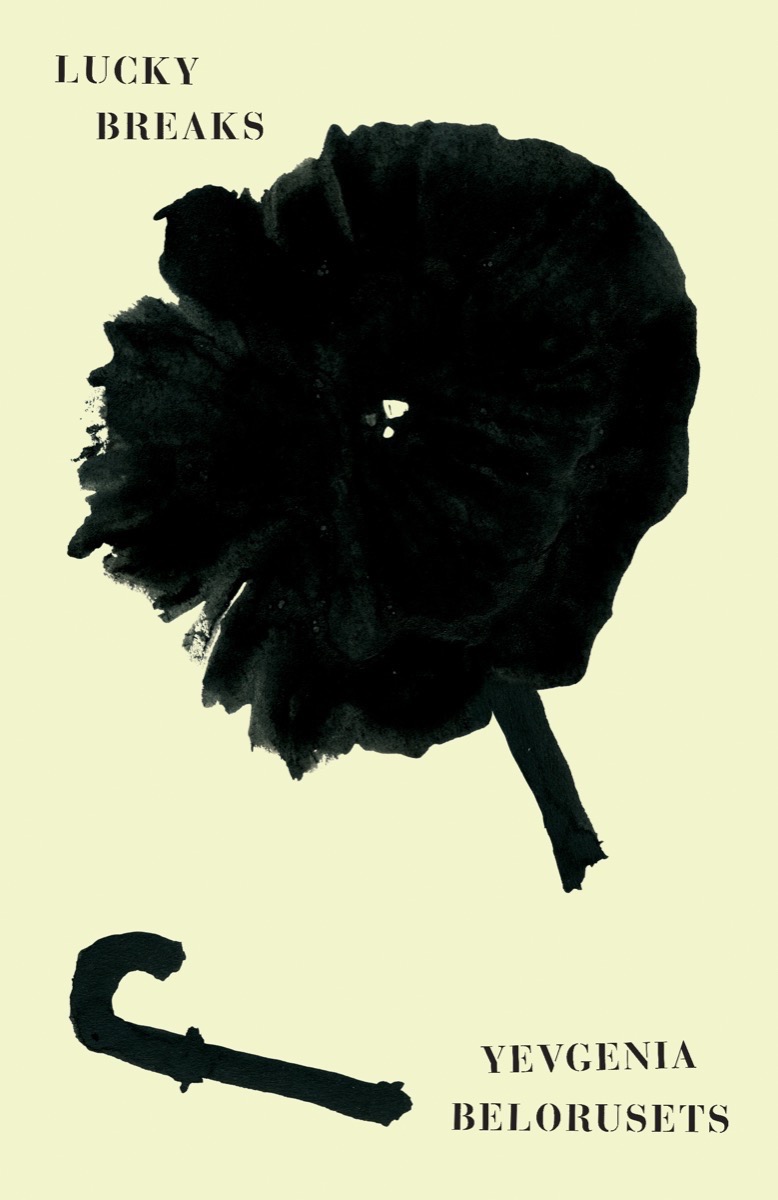
The advent of the war in Ukraine instantly drew my attention to a tiny book I had received from isolarii books. The name Yevgenia Belorusets became suddenly and tragically familiar as her daily diary entries from Kiev were published online. I read that small volume, Modern Animals (translated by Bela Shayevich), drawn from interviews with people she met in the Donbas region and as soon as it became available I bought and read her story collection Lucky Breaks (translated by Eugene Ostashevsky). Although both of these books reflect the impact of war in the east of the country, they could not be read without the context of the full scale invasion underway and still ongoing in her homeland.

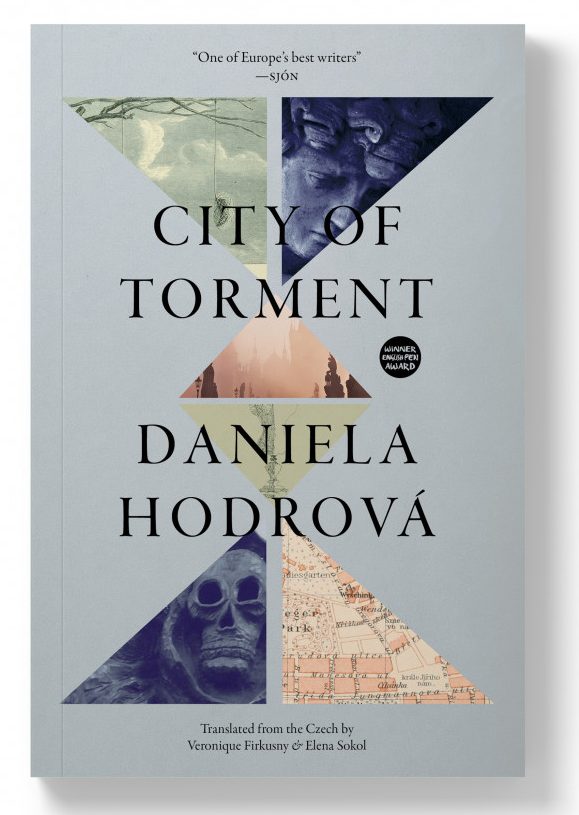
Another author I encountered for the first time that inspired me to read more of her work was Czech writer Daniela Hodrová whose monumental City of Torment (translated by Elena Sokol and others) is likely the most profoundly challenging work I’ve read in along time. Upon finishing this trilogy I turned to her Prague, I See A City… (translated by David Short and reviewed with the above) which I happened to have buried on my kindle. A perfect, possibly even necessary, companion.

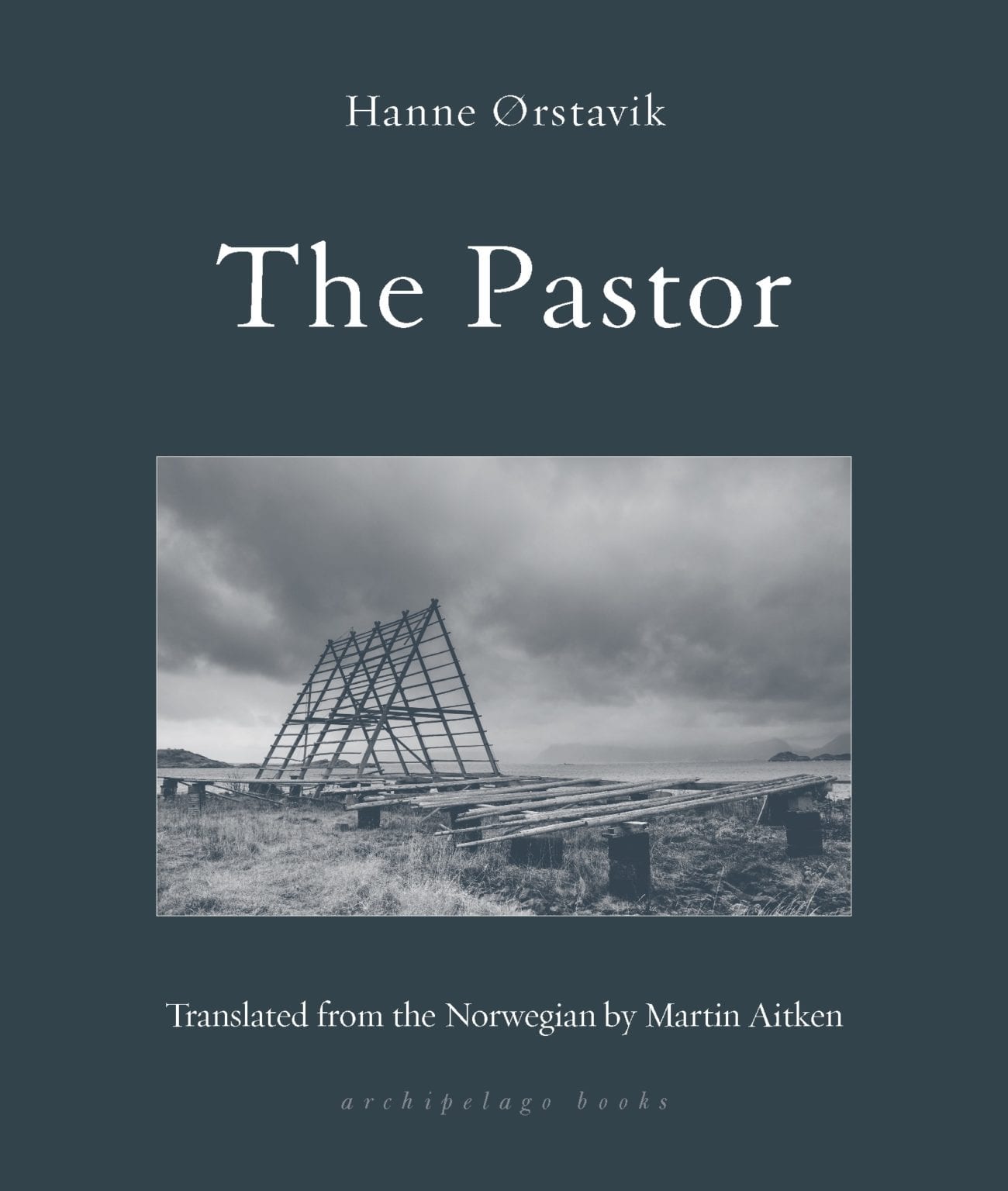
My personal Norwegian project introduced me to Hanne Örstavik, whom I had always meant to read. I loved her slow moving introspective novel, The Pastor (translated by Martin Aitken) and have since bought, but not read, her acclaimed novella, Love. However, lined up to read this month, I have her forthcoming release in translation, Ti Amo, a much more recent work based on her experience caring for her husband as he was dying of cancer. The only other female author I brought into this project was Ingvild H. Rishøi whose collection Winter Stories (translated by Diane Oatley) was a pure delight. I have been making note of other female Norwegian writers to fill in this imbalance in the future.

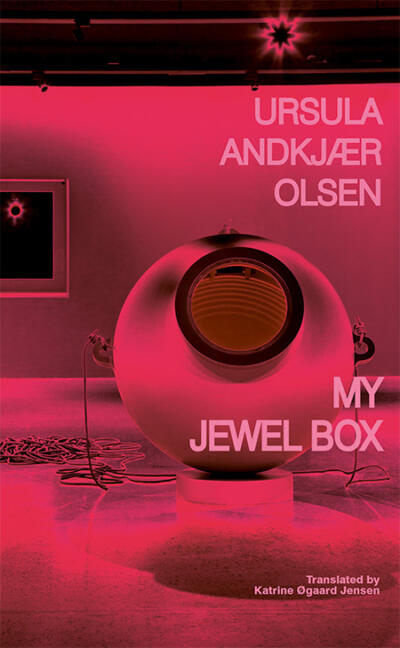
The past year also brought new work by two of my favourite poets: a book of prose pieces by Italian poet Franca Mancinelli, The Butterfly Cemetery (translated by John Taylor), and the conclusion to Danish poet Ursula Andkjær Olsen’s epic experimental trilogy, My Jewel Box (translated by Katrine Øgaard Jensen). In May I had the honour of speaking with Olsen and Jensen over Zoom for a special event—it was a fantastic opportunity I won’t soon forget. I also became acquainted with a new-to-me Austrian poet, Maja Haderlap, through her excellent collection distant transit (translated by Tess Lewis) and have since added her novel Angel of Oblivion to my shelves.

Among the many other wonderful women in translation I read over the past year, Geetanjali Shree’s International Booker winning Tomb of Sand (translated by Daisy Rockwell) needs no introduction—it is an exuberant, intelligent and wildly entertaining read. On an entirely different note, Rachel Careau’s brilliant new translation of Colette’s classic Cheri and the End of Cheri completely surprised me. I had no idea what a sharp and observant writer she was, in fact I didn’t know much about her at all and I discovered that she was quite the exceptional woman. Changing direction again, In the Eye of the Wild, French anthropologist Nastassja Martin’s account of her terrifying encounter with a bear in a remote region of Siberia (translated by Sophie R. Lewis) approaches the experience in an unexpected manner that I really appreciated.

Keeping with nonfiction for a moment, Grieving: Dispatches from a Wounded Country by Cristina Rivera Garza (translated by Sarah Booker), a collection of essays about contemporary Mexico, was a difficult, necessary read. Annmarie Schwarzenbach’s account of her overland journey to Afghanistan with Ella Maillart in 1939, All the Roads Are Open (translated by Isabel Fargo Cole) was another book I had long wanted to read that did not disappoint but which carries much more weight given the more recent history of that region. Finally, My Life in Trans Activism by A. Revathi (translated from Tamil dictation by Nandini Murali) offers vital insight into the lives of hijra and trans women and trans men in India from a widely respected activist. Tilted Axis in the UK will be releasing this book to an international audience later this year.

Rounding out the year, were three fine novels. First, I after owning it for years, I finally read Seeing Red by Chilean writer Lina Meruane (translated by Megan McDowell) and was very impressed. Last, but by no means least, I read two new releases from Istros Books who have an excellent selection of women writers in their catalogue. Special Needs by Lada Vukić (translated from the Croatian by Christina Pribichevich-Zorić) captures the slightly magical voice of child narrator with an undisclosed disability in a remarkably effective way, while Canzone di Guerra by the inimitable Daša Drndić (translated from the Croatian by Celia Hawkesworth) offers a fictionalized account of her years in Canada as a young single mother that was most enlightening for this Canadian reader.

I have, at this point, seven books selected for this year’s Women in Translation Month (#WITMonth) and we’ll see how I manage—and now I also have a goal to exceed for the eleven months before August 2023! I would, by the way, recommend any of the titles listed above if you are looking for something to read this month.

I am the hard one: Outgoing Vessel by Ursula Andkjær Olsen

destructive is my normal state (37)

Danish poet Ursula Andkjær Olsen is a singular force of poetic vision. Intense, strident, futuristic. Outgoing Vessel, newly released from Action Books, is the follow up to her award-winning Third-Millennium Heart, a powerful reading experience I loved so much that I responded in verse with an experimental review published here (open the PDF to read). Translator Katrine Ogaard Jensen is on board again for this new journey and, as with her previous work, Outgoing Vessel unfolds over a sequence of poetic movements to form a 193-page, book-length poem that is both epic and operatic in scope. I was not surprised to learn that Olsen is also a librettist. As with her earlier project, the “singer” here is an enigmatic narrative force—perhaps the same one, I don’t know, though I hear a companion rather than a continuation myself.

no one except me can hate feelings
anyone else who claims to hate feelings:
let it be known how they still succumb to them
anyone else who claims to hate feelings:
let it be known how they, in weak moments
open up to them and

and become soft with longing

among all time’s winners
i am the hardest (8)

The early suites of Outgoing Vessel seem charged with negative energy, often erupting in harsh declarations of hatred that begin with the self and extend outward.  The voice is hard, constrained. Darkness and destruction are evoked frequently. Yet the motion is self-driven, Olsen owns her language, and the direction she is moving toward (and expecting others to align with) is not symbolic, but it is futuristic. She seems to be intent on encasing her darker, grieving being, containing it inside a container—described as an orb:

which I will send off as the outgoing
vessel that it is
after which the new human can arrive in its

incoming (48)

Third-Millennium Heart built on a tension between the clinical and the organic, pregnant with promise, anger and grief, rupturing ultimately into a powerful post-human feminist vision—one which gives birth to the possibility of a cyborg-like hive-heart existence. Heart’s speaker devoured and contained. Vessel’s is more isolated, inward focused and philosophical. Pain, grief, and an existential disconnection drive her rhythmic reasoning as she moves toward the foundation of a technological ontology, a science fiction solution, and a re-imagining of a new human beingness.

we must assume there is an original alienation:
first the estrangement, a person, a stranger to themselves
stranger to others, the person exists deep inside their
distant interior, without knowing, they must escape to the
surface, from inside, to become human (108)

The futuristic tone becomes more prevalent as the sequence progresses, propelled in no small part by the “technoscientic” poems that close each section of the work. As translator Katrine Øgaard Jensen explains in her note, Olsen “created these poems by piecing together lines from each suite, running the text through multiple languages in Google Translate, translating it back into Danish via Google Translate” then, from the resulting document, the final piece was created employing a cut-up method. This mechanical process allows for a new tone, energy and uncertainty to enter the cycle (not mention an added challenge for the translator to meet in a satisfactory measure):

human nature
in the coffin, a
relic, collection of Bones and Hair
encapsulated and stored in
a humane vacuum

this is
the refuge (94)

The strange brutality of Olsen’s poetry, the slogan-like chants, and the tightly-honed anger can be off-putting, but as with Third Millennium Heart, I find it oddly therapeutic. Anger in its shades and intensities can be a positive force—it is the healing movement of the cycle of grief, it pushes you forward, up and out of the sandpit of sadness that follows loss, trauma, heartache. It sounds counter-intuitive but I saw it many times working with survivors of acquired brain injury. Yet it is hard to allow it in oneself, for fear it will erupt in uncontrollable ways. Through the course of Outgoing Vessel we witness the speaker’s emergence as a voice of concern, intent on invalidating loneliness—through her outgoing/incoming vessel she comes to a radicalizing understanding of empathy and experience.

Olsen is a poet who, as her translator Jensen freely admits, cannot be neatly and directly rendered into English—her work is highly inventive, rife with cultural references, puns, neologisms, and experiments with language. Rather than attempting to produce an exact copy, Jensen aims to stay true to the “spirit of the work,” allowing it to find its own form in translation. This is, it turns out, an ideal approach for a poet who sees her own  work as a “translation of an idea”. As such, she is simply the first translator and Jensen is the second. The result is a sequence of poems that carries its own fresh energy. Tight. Terse. Tender. And ultimately affirming in its futuristic vision.

Outgoing Vessel by Ursula Andkjær Olsen is translated by Katrine Øgaard Jensen. It features stark, spare photographic works by Sophia Kalkau and is published by Action Books.

The Endless Summer by Madame Nielsen

The following review was originally published in the Spring 2018 edition of The Quarterly Conversation which is no longer accessible.

The Endless Summer by Madame Nielsen, translated by Gaye Kynoch. Open Letter Books.

I remember the year I became an adult. I was twenty-four. I had completed one degree, married, and moved across the country to continue my education. After rent, bus fare, and the student loans we’d secured, we were left with $10 a week for food and barely enough to keep the huge empty front room of our apartment heated through the frigid Ottawa winter. So we turned the registers off and retreated to the bedroom. Homesick, we missed our friends and families. By the end of the term we both recognized that something had been irrevocably altered; an intangible light had been extinguished. This was real life. We had grown up. Our own “endless summer,” that fragile Garden of Eden, was over.

“It is not the bite in the apple that makes the Fall. It is the idea of a life after this one-and-only now.”

Perhaps it is something you only notice once it’s gone; the last traces of a moment when you still believed in the possible, caught up in a lingering nostalgia for a time before the burden of responsibility took its toll. If only one could go back and recreate the mythical intensity of the past, eulogize the lost magic, just like the old woman whose most unusual story lies at the heart enchanting novel, The Endless Summer, by the equally enchanting Madame Nielsen.

The Danish transgender performance artist, has, over the course of her career, presented, masqueraded, invented, and re-invented herself many times, even having her birth-identified self, Claus Beck-Nielsen, declared dead along the way. (He was ultimately revived when the lack of any identity altogether proved too difficult to sustain.) The multi-facetted Madame Nielsen is a novelist, poet, artist, performer, stage director, composer, and singer. With The Endless Summer, newly released from Open Letter Books in a translation by Gaye Kynoch, Nielsen weaves a tale that sidesteps the common expectations of narrative progress and character development. Rather, an odd cast of characters is choreographed through a shifting, dreamlike landscape openly reminiscent of David Lynch, complete with digressions into side stories, tales from the past, and glances into the future. The stories are continually being started, interrupted, and resumed again. The influence of Proust and other French novelists is evident, but Nielsen’s wistful narrator, who will ultimately become an actor, demonstrates a strong theatrical sensibility throughout.

The novel opens with a simple statement, the oddly incomplete sentence: “The young boy, who is perhaps a girl, but does not know it yet.” This phrase will be echoed, with slightly different shades, gradation, and detail, throughout the text. Likewise, the other main characters’ defining characteristics or curious features will be continually evoked, elaborated, and elegized as the tale unwinds. This is, as the subtitle advises, a requiem. A deep melancholy is never far from the surface. But first there is the summer, the “endless summer” a nebulous state of being which exists outside of time, a world unto itself “where time and light stand still and the dust rotates and no one does anything, nothing other than living as if they were in a different era and a completely different location.”

The young boy, who is in fact in his late teens, but so slender, delicate, and shy, falls into this other world after meeting a girl, an ebullient, full-figured, dark-haired girl. He becomes her lover and slips into her household, joining her two little brothers, her jealous, gun-loving stepfather, and her enigmatic mother in a little white farmhouse. The last, a dazzling, long-limbed Nordic beauty spends her days riding her beloved stallion through the surrounding fields. The boy and girl spend their days in bed, losing themselves in one another’s bodies. All the while other characters are introduced, ready to take their places in the drama that will eventually unfold, we are warned, to its necessarily tragic end.

The narrative advances through a series of scenes played out on this other plane of existence, a fairytale space without distinct boundaries. It is not clear when it begins, or when it is truly over. This extended moment of impossibility, or rather, all possibilities, draws others into its sphere of influence—young men on the cusp of adulthood, wayward artistic wanderers, and those going nowhere, like the perfectly handsome, utterly unambitious Lars, the daughter’s best friend. Other characters circle, like satellites, around the periphery of this space of suspended reality, and thus on the edges of the story, providing substantive props against the ephemeral timelessness of the “endless summer.” Aware that the cautious reader may be inclined to advance with incredulity, the narrator is quick to advise:

… if the story so far sounds like a dream, a glossy tale of the kind one occasionally—on holiday or a long-haul flight—allows oneself to lean back into and, as if it were sinful, a praline, vanish within for a brief moment, then it’s because life is a dream, a dream from which you never wake up, but which one day is nonetheless suddenly long since over, but you’re still here and can either use “the rest of your days” to forget and “get on with it” or on the other hand, like me, abandon what is and try to retrieve what was, even the tiniest little thing that has been lost, even what perhaps didn’t really exist but nonetheless belongs in the story, call it forth and tell it so it doesn’t vanish but on the contrary now at last becomes real and in a way more real than anything else.

At the nexus of this act of remembering is the almost otherworldly presence of the mother, a romantically idealized woman, cool, impenetrable, and independent, who casts a spell on all who fall within her orbit, including the Portuguese artist half her age who will become her lover. The slender young boy is clearly enthralled by her, by “the inscrutability and the light that makes it impossible” for him to ever be finished looking at her, “because as soon as he glances away for a moment he has a feeling that he has not yet seen her.” She can be thought of as the embodiment of womanhood to which he, the boy who might be a girl but doesn’t know it yet, is unconsciously drawn. His first sexual and gender explorations are deeply enmeshed with the softly rounded body and pleasure-loving spirit of the daughter, but it is the mother who holds him in awe.

The only character about whom we have no solid background, who falls into the “endless summer” with little more than a passing reference to a family that pretended they had money but in truth had none, is the narrator’s own past self, the slender young boy. The rest of the cast, even those who pass through peripherally, have a story, with dramatic beginnings and occasionally exceptional, but most often disappointing or tragic ends. Early on, when he is spending his days lost in bed with the girl, she entertains him with accounts of her childhood with her grandparents in Spain, her discovery of the truth of her real father’s identity, and the details of her stepfather’s inherited wealth and decline into possessive aggression. It is noted that she has lots of stories. He, on the other hand, has only those he creates.

So this story, this winding, dreamy, melancholic tale of the “endless summer” and everyone and everything it contained, where does it lie? In memory? In longing? Or in the romantic imagination of the “weird cobweb-flighty female being” that the young boy, who might be a girl but doesn’t know it yet, ultimately becomes?

The success of this unlikely, sprawling reverie with its expansive cast and uncertain timeline lies in the emotionally absorbing, reflective tone of the narrative. To read is to submit, to trust the voice. The repeated descriptive motifs are reassuring rather than affected. When new characters appear, instantly vivid portraits are created with the capture of curious details and ineffable traits and qualities:

And shortly after midnight, the two Portuguese arrive with their rucksacks, the one, the pen pal, actually not so dark at all, far from it, tall and strong and with golden curls, Peixe, he is called, “The Fish,” but where he comes from they call him “o Vikingo,” the other one is smaller but equally masculine, dark and mysterious, a little shy like a wild cat, the same soundless movements, an abrupt laughter cracking his face in a flash of light that has disappeared before you have seen who he is.

However, the illusory nature of the entire enterprise, this attempt to recreate the transcendent quality of the “endless summer,” is never denied. Little by little, disillusionment and disappointment dilutes and denudes the magic; characters begin to fall out of that other world, and back into this one. But the end of the “endless summer” is as mutable as its onset.

The transformation of the slender young boy into an old woman lost to her memories is never openly explored. It is an inevitability written into the texture of the account. Rarely does the narrator admit a first person pronoun. This is her (or his) story retold from the sidelines of his (or her) life—a life in which “none of the things he promises himself or dreams about will ever come to anything, while all the things he has never wished for or promised himself will happen and amount to all there has been.” As a reader who was, at one time, a girl who was a boy, but didn’t understand it, I registered a particular resonance with The Endless Summer. The experience of living and writing across a gendered expression creates a haunting sense of disconnect, an otherworldliness. But this poignant novel is much more. It is a requiem for the death of dreams, and a hymn to keeping the spirit alive in the exercise of living beyond the moment when you still believed.

“Earth to earth, ashes to ashes, dust to dust.”