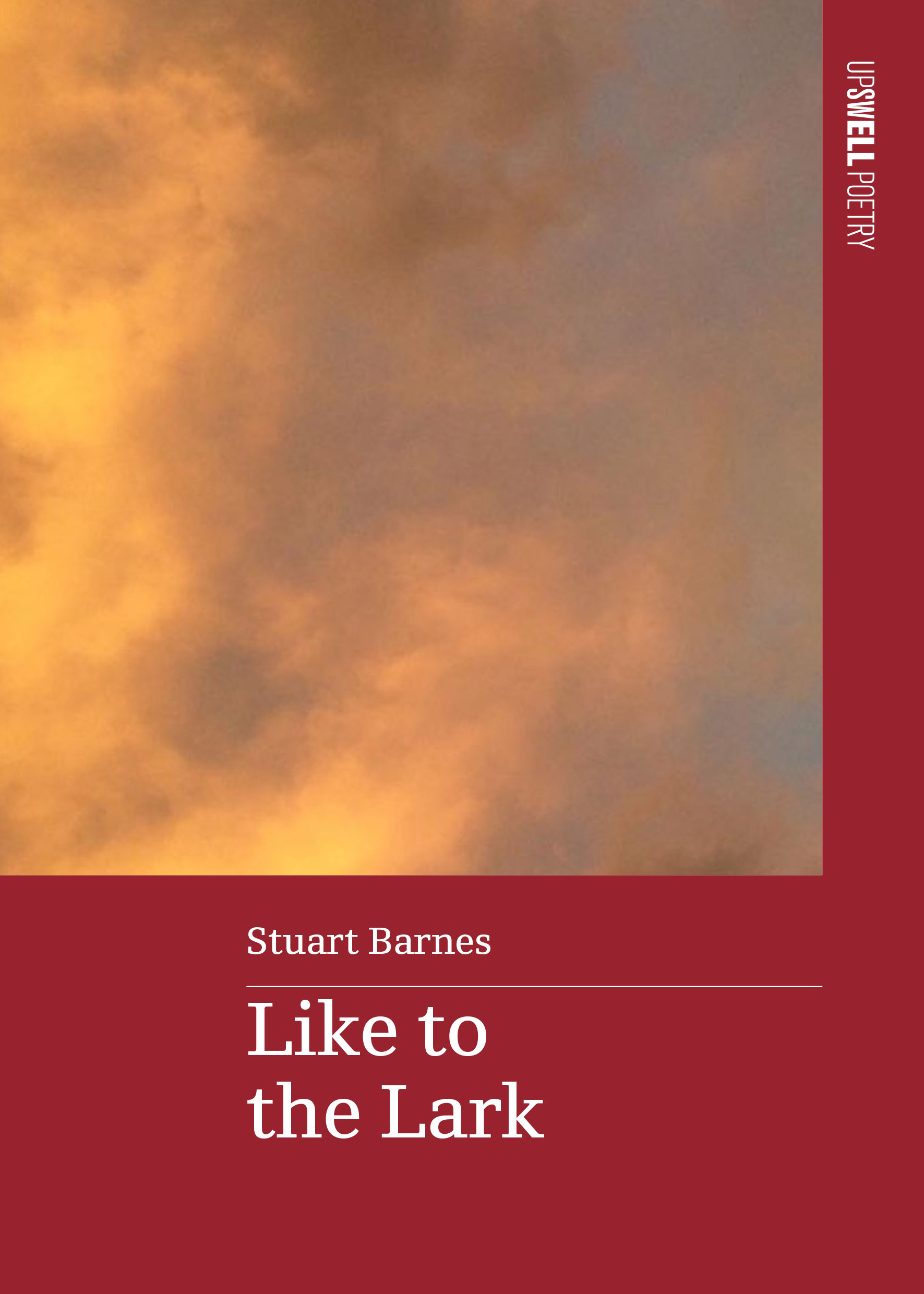
My laughter doesn’t go unvoiced: Like to the Lark by Stuart Barnes

It has been six years since I first read Australian poet Stuart Barnes’ debut poetry collection, Glasshouses. I don’t know how many times I have recommended the book in the meantime—whenever someone asks for suggestions of contemporary poets doing original work with form, or someone inspired by pop music, his is the first name that comes to mind. And now, with his second collection, Like to the Lark, he is continuing to expand the idea of form, exploring what it can do and where it can carry him. Ever open to queering the expectations of rhythm and rhyme, it is always exhilarating to engage with his poems—so much so, in fact, that one might not immediately appreciate just how much sorrow, grief and anger has led to the shaping of some of these words.

As with Glasshouses, Barnes is generous with notes acknowledging the poets, artists and resources with which he is in conversation in particular poems, but in this new collection he has also included a very informative section titled “Notes on Form” within which he talks about the forms he employs, including two of his own creation, and some of the relevant context and inspiration guiding his work. He opens by addressing what form means for him:

Like to the Lark’s working title was ‘Form & Function’, after Photek’s drum & bass record of the same name. Music and sound, form and transformation underpin the collection; its cornerstone is the sonnet (‘from Italian sonetto, “little song,” from Latin sonus “sound”’). ‘Form’, writes Felicity Plunkett, ‘is concerned with de- and re-arranging, working between what has gone and what is to come. It is about connection and generation.’ Form is Gwen Harwood’s ‘trellis’ and ‘fine pumpkins’. It is stave and symphony, wooden last and Ferragamo Rainbow Sandal, scaffold and Golden Gate Bridge. Every form flaunts its uniform, kaleidoscopic or otherwise.

Form, then, is not simply looking back to classic constructions. Even though Barnes’ first love and trusted space is the sonnet, he enthusiastically embraces both traditional and recent structural creations to erect the scaffolding within which he can seek to find expression.

Like to the Lark, which takes its name from Shakespeare’s “Sonnet 29,” opens and closes with ghazals that speak to the state of the world, in politics and nature. The poems in between often draw heavily on ecological imagery, but this is not imply that he believes poetry, especially in its formal variants, is necessarily bound to lofty romantic or natural themes. By contrast, he often delights in unlikely sources for his most traditional offerings. For example, he salvages material from consumer information for migraine and depression medication to craft sonnets (something he has done before) and engages in vigorous wordplay to create prose poems. Inspiration can be found in gritty pop culture motifs or a scroll through GRINDR. But such playful exercises mix with pieces that are, in turn, serious, bold, sentimental and vulnerable. As ever, the true power of Barnes’ poetry lies in the way form, subject matter and the influence of musicians and other poets intersect in his work.

Barnes has addressed life as a gay man and the reality of homophobia before, but Like to the Lark directly confronts issues that are not always welcome, even in queer poetry, such as the stigma of HIV/AIDS, grief and loss, and his personal experiences of rape. “Sestina: Rape” (which dispenses with the sestina’s traditional six end-words in favour of one word—rape—and words that are its true rhyme) is honest and angry: “No such thing as male rape / flared. No rape report, no rape / kit. When I spilt the pith of this rape / three sweethearts laughed in my face.” He admits that he bent the sestina’s strict six-word repetition pattern in an effort to try to desensitize himself to one especially painful word. It’s a practice he repeats with “Pain” and “Love” in a couple of other sestinas.

Given the intensity of emotion he wishes to express with respect to these difficult subjects, it is no surprise that the two original forms Barnes introduces in this collection, also appear in gay themed poems. The terse-set, a pun on the tercet, is composed of at least three tercets with a strict ABC rhyme, but each line is restricted to three syllables. The forced precision is playful but intense, ideal for the poems “Sketching Aids” and “Dinner with S. M. at Tandoori Den.” Both involve the same man, an ex-boyfriend, the first inspired by memories of their relationship in high school, the latter recounting a dinner years later, prior to his death from AIDS. The other new form, he calls a flashbang. This explosive, disorienting form appears in a poem called “Killing Bill or Whatever the Hell His Name Is (Battle Without Honour or Humanity),” that depicts the cruel reaction an HIV+ man receives from a lover. The first half erupts on the page (as best it can be reproduced here):

No one expected the second coming
out

—a burst rubber, a premature
BOOM!

PEP, you echoed. I’ll drive you to the local
clinic

first thing in the
morning.

His speechlessness a stun
grenade,

ignored calls
blast

mines. Minutes
later,

GRINDR’s miss-
iles.

Barnes writes that he was encouraged to invent new forms of his own through the experience of working with the duplex form created by American poet Jericho Brown. Described by Brown as “a ghazal that is also a sonnet that is also a blues poem,” the duplex seems a perfect fit for Barnes’ natural energies, allowing him plenty of room to riff on meanings and engage in punning and wordplay. Like to The Lark includes eight duplexes, with serious, fanciful and ecological themes. Four are voiced by native Australian plants such as Eremophila ‘Blue Horizon’ which opens:

I’ve always adored the deft desert,
its transformative blues and solitude.

I transform the bluesy solitude
of winter—I polish small gold trumpets

—gold tinted blue tongues polish off my trumpets
I raise my hands—lanceolate and blue.

New to the duplex myself, I really enjoyed these pieces. The other form that I particularly love in Barnes’ hands, is the terminal, an invention of Australian poet John Tranter that takes the end word of each line of a source poem to generate a new poetic creation. Here Barnes’ love for one of his key muses, Sylvia Plath, is reflected in two of his terminals. “The Pardoner” which borrows end-words and inspiration from her “The Jailer” is another poem addressing the poet’s experience with date rape, while the vivid “From the Morning” takes its end-words from Plath’s “The Swarm” and its title from a song by Nick Drake. Along with Plath and Drake, Barnes is, as usual, engaged in conversation with other poets including Shakespeare, Yeats, Auden and Gwen Harwood, and musicians including The Smiths, Kate Bush and, another important muse, The Cure’s Robert Smith.

The work of a mature and confident poet, Like to the Lark has me, as someone with little formal understanding of poetry, excited about the possibilities of—and less intimidated by—form. To the untrained reader and casual poet, it is easy to feel anxious about what makes a poem good, especially when caught between those who embrace and those disparage strict adherence to classical forms. But reading Stuart Barnes is proof that a poem can follow (or invent) rules without being unnecessarily opaque. Rather, poetry can be both fun and profound and, even better, inspire one to acquaint or reacquaint oneself with the inspirations that surface between (or at the end of) the lines.

Like to the Lark by Stuart Barnes is published by Upswell Publishing.

Farewell to 2023 with the annual list of favourite reads

In my small corner of the world, away from forest fires raging, earthquakes and wars continuing and erupting anew, I read some very good books. 2023 was, world events aside, a complicated year, which is to say, a very human one. Within my extended family there were life-changing diagnoses and surgeries, but all in all, we’ve been fortunate to access care within a health system buckling under the strain that is far from unique. And I finally returned to India for a visit, my first trip anywhere in four years, which was a much-needed opportunity to connect and re-connect with many friends, and even take a little time to explore on my own. But travel did cut into my reading, as one often imagines that with all that time spent flying and waiting for flights, books will be avidly consumed, but that’s not always the case. And then, when I returned home, just days after the events of October 7, a renewed politically motivated awareness started to influence my reading choices and appreciation, something that will no doubt continue into 2024. If one sets out, as I do, to read with a special interest in works and authors from outside my own experience, especially in translation, reading widely and intentionally should ideally be a guiding factor.

So what of 2023’s reading? I read just over 60 books, a number I’m satisfied with. I wrote reviews or responses to 48 of them. The majority of the books I chose not to review are books of poetry, in large part because I do not always feel confident that I can add something meaningful to the conversation about such works no matter how much I might enjoy them and return to them often. (Perhaps this year I can gather some of my favourite “unreviewed” collections into  a special post.) Nonetheless, for the purposes of this annual exercise, I selected 14 books  that I particularly enjoyed or wanted to call extra attention to.  It includes four nonfiction works, nine fiction and one poetry collection. Ten books are translated literature, while four are written English, although one of those is a book about translation.

Listed chronologically according to date read, I’ve divided my 2023 favourites into two categories—books I particularly enjoyed and, then,  my top five:

Journey to the South – Michal Ajvaz (Czechia) translated from the Czech by Andrew Oakland
This wild murder mystery/adventure that begins with a murder during a performance of a ballet based on Kant’s Critique of Pure Reason was my first introduction to Ajvaz’s idiosyncratic story with a story within a story narrative form. I definitely want to read more.

A Mountain to the North, A Lake to the South, Paths to the West, A River to the East
– László Krasznahorkai (Hungary) translated from the Hungarian by Ottilie Mulzet
The historical details that emerge in this dream-like journey in search of a mystical Buddhist monastery have lingered with me with all the misty beauty of the initial reading experience.

 Falling Hour – Geoffrey D. Morrison (Canada)
This strange and wonderful tale of a man trapped within an urban park is both smart and funny in just the right measure.

The Postman of Abruzzo – Vénus Khoury-Ghata (Lebanese-French) translated from the French by Teresa Lavender Fagan
As one of my favourite writers, it is difficult to imagine compiling a list like this without including Khoury-Ghata. This sharp, spare tale of a French woman who finds herself in a community of displaced Albanians in southern Italy in search of a connection with the work of her dead geneticist husband so that she may heal, is charming and profound.

All The Eyes That I Have Opened – Franca Mancinelli (Italy) translated from the Italian by John Taylor
Another favourite, a poet whose works always seems to speak directly to me, I would be hard pressed not to include her at year end, but this collection with its central image inspired by the eye-shaped scars on the trunks of trees continues to haunt me every day as I pass aspen trees on my walk.

river in an ocean: essays on translation – (Canada) Various authors, Nuzhat Abbas (ed)
The importance of this feminist decolonial project—a rich collection of essays on translation by writers with origins in the global South—was intensified by the changing world events that marked my reading, my review and every day since then. Vital and necessary.

A significant number of my favourite books of the year were read in the final months of the year, and hold political relevance for me by virtue of my desire to listen to the voices of those impacted by violence, occupation and genocide. The following three included:

Passage to the Plaza – Sahar Khalifeh (Palestine) translated from the Arabic by Sawad Hussain.
I have read a number of very powerful works by Palestinian writers and poets over the years. In search of more female voices I was drawn to this work by a new-to-me author who, fortunately, has been widely translated. Set, written and published during the First Intifada, this novel is the rarely told story of the impact of the events on women.

Tali Girls – Siamak Herawi (Afghanistan) translated by the Farsi by Sara Khalili
Based on true stories of girls and women in an isolated and impoverished region of Afghanistan under growing Taliban control and local corruption, this almost folkloric narrative is swift, devastating and, ultimately, hopeful.

Landbridge [life in fragments] – Y-Dang Troeung (Cambodian-Canadian)
Born in a Thai refugee camp just across the border from Cambodia, Troeung gathers memories, documents, photographs and artworks to tell the inspiring and difficult tale of her family’s survival against unspeakable horror, their lives as refugees in Canada, and her own personal journey to explore her own history in a world that, as we can see today, is reluctant to acknowledge genocide.

* * *

My top five reads of the year:

The Last Days of Terranova – Manuel Rivas (Spain) translated from the Galacian by Jacob Rogers
This was the first book I read in 2023 and I knew right away that it would be hard to beat.  Employing a narrative style that rewards the attentive reader, this is essentially the story of a family bookstore, the eccentric characters that pass through and their involvement in making banned literature available during the Franco years. I loved it.

The Book of Explanations– Tedi López Mills (Mexico) translated from the Spanish by Robin Meyers
As someone who has exclusively written and edited nonfiction, I am more often than not disheartened by the personal essays, book length or collected, that I try to read. This series essays exploring the nature of memory and identity blew me away. I don’t know if it was the innovative approach or the degree to which I related to the themes, but this is an excellent, innovative work.

The Geography of RebelsMaria Gabriela Llansol (Portugal) translated from the Portuguese by Audrey Young
This enigmatic work is simply a haunting and profound reading experience in which historical and imaginary figures interact in a world out of place and time, yet linked to faith, books and ideas. I can’t wait for her diaries to be released later this year.

AustralCarlos Fonseca (Costa Rica) translated from the Spanish by Megan McDowell
Another favourite author, Fonseca delights in intelligent, complex narratives that appear, on the surface, deceptively simple. Austral is perhaps his strongest work to date and, given that he is still a very young writer, I look forward to what may be yet to come.

We the Parasites – A.V. Marraccini (US)
As per what I said above about nonfiction, I approached this book with my usual essay wariness coupled by the fact that it was presented as a book about criticism. But everyone else is right, this is a singular piece of writing. Intelligent and completely original.

So, there you have it. As ever, many other excellent books from this year’s reading had to be left out but contributed, all the same, to a very satisfying literary year. This year I focused on Archipelago Books and will continue to read their publications with enthusiasm. I’ve found that looking at publishers rather than specific titles I hope to make my way through as each new year dawns is a good approach. To that end, I need to pay a little attention to some of the Dalkey Archive and NYRB books that I have been accumulating, among the many other works from worthy independent publishers that I do, and always will continue, to seek out. And, of course, all plans are subject to change, so I will commit to few.

Happy New Year. May there be peace in 2024.

And something went terribly wrong: Truth/Untruth by Mahasweta Devi

Arjun Chakravarty has everything under control. As a successful contractor, skilled in the necessary art of greasing the right palms, business is booming, and finally, after ten years of marriage he and his wife are expecting their first child. Kolkata in the 1980s is booming. A determined project of gentrification is underway; everywhere high-rise buildings are sprouting up, even in neighbourhoods long considered derelict and undesirable. Like Khidirpur, a well-known den of crime and smuggling. Denying the odds, towering housing societies boasting spacious flats equipped with all the latest appliances stand proud, like Barnamala where our unfortunate hero resides and the setting of Bengali writer Mahasweta Devi’s Truth/Untruth.

A self-named man, Arjun came into the world as Sanatan Pushilal. But Sanatan was a moniker unworthy of the man he wanted to be. Orphaned young and impoverished, his uncle found him student lodgings with a noted karibaj, an Ayurvedic practitioner, and this fortunate placement was his first step toward a new identity. That is:

How Sanatan became Arjun. And how, erasing the past, Arjun slowly rode the lift of high aspirations all the way to the twelfth floor of society . . . all that is but ancient history now.

With his old landlord long gone, only his son Keshtokali, likewise a karibaj, knows the truth about Arjun’s past. Fortunately, even his wife Kumkum, the daughter of a retired Supreme Court judge, has no interest in either Ayurveda or her prosperous husband’s history. Yes, Arjun-babu has it made. Until something goes terribly wrong.

You see, his wife, now eight months pregnant, has been staying with her parents where she can be pampered and protected while she awaits the arrival of their precious bundle—at thirty-five no one wants to see anything go awry. Thus, left to his own devices, Arjun-babu has been able to indulge his passion for Jamuna, the pretty young maid who comes by daily to clean the flat. Imagine his dismay, then, when she arrives to inform him that she is pregnant with his child. Something must be done, he must make the problem go away. Jamuna’s own husband left when he lost his job, but she still believes he will return. Arjun will arrange for a proper doctor to take care of the unwanted pregnancy, pay her off and hope she leaves, but before he can see his plans through, he comes home to find her dead on the bed in his guestroom.

He knows he didn’t kill her, but he can’t exactly go to the police. If he had killed her, well, that would be a different matter. For the right amount of money the police could take care of anything. But, if word gets out that she was found in his flat, his reputation, his business, his wonderful life—all would be ruined. Even a rumour of murder would do him in; after all she would hardly be the first “murdered” maid to be found in his building . . . Ah, but Jamuna also worked in two other adjacent flats, one belonging to an old man named Desai and his crazy wife, the other owned by a tobacco company and cared for by Mohsin, a local Muslim man. Maybe Arjun could shift the blame, simply by moving the body.

This farcical and fast-paced thriller unfolds over little more than forty-eight hours, and features a cast of vibrant characters from the silly Kumkum and her over-protective family, to a host of servants and building staff, to petty thugs and mysterious “bosses.” The complicated power dynamics between the established rich, the nouveau riche and the slum dwellers who provide necessary labour and services, legal and otherwise, for the residents of the new buildings is clearly exposed. However, we observe most of these people indirectly, as the narrative is driven almost exclusively by dialogue and by the internal monologues of the central male figures—the three men in the building who directly or indirectly employed Jamuna. By this approach, Devi is able to reveal the very different natures of each of these individuals, but her primary attention falls on Arjun who is the most incredibly hollow and self-centred creature, continually twisting his line of reasoning into pretzels to absolve himself of the slightest responsibility for anything that has happened. Jamuna might be dead, but he is the real victim as far as he is concerned—everyone else is to blame.

Arjun divides the blame up in his mind. The astrologer is to blame, he’d never once warned him that bad times lay ahead. Keshtokali is to blame, he gave him such a stimulant that his mind was always full of . . . and Jamuna, isn’t she to blame too? Why did she have such a body, such a way of walking and talking?

He is, by turns, irritating, hilarious and tragic.

Mahasweta Devi (1926–2016) was one of India’s most prominent writers and  social activists. If somewhat different in tone from much of her more openly political, feminist work, her dry humour and ability to highlight insincerity and hypocrisy is in full play in this dark satire. Her prose is rich with insider street slang and allusions to popular movies and songs of the day (necessary references are explained in the endnotes). She is assuming a certain familiarity with the time and place she’s writing from, but is not concerned about making her more genteel readers work to sort through the common language many of her characters employ. In her afterword, translator Anjum Katyal acknowledges the challenges involved in trying to capture the different registers of spoken language—critical in a narrative so dependent on dialogue—without falling into unacceptably “twee” English variants. She does give Jamuna and her close friends a coarser and cruder vocabulary which contrasts nicely with the sometimes overly-affected language that Kumkum and her family use in private settings. Arjun, being the most eccentric and erratic of the cast, is granted a range of emotional expression from the obsessive to the absurd.

A rollicking urban tale, terrifically fun to read, Truth/Untruth blurs the line between murder, mystery and crime novel but from beginning to end, amid the tension and comic mishaps, it remains a sharp piece of social commentary.

Truth/Untruth by Mahasweta Devi is translated from the Bengali by Anjum Katyal and published by Seagull Books.

Beautiful scavenger: We the Parasites by A. V. Marraccini

“I’m boringly good,” A. V. Marraccini confesses. “Except when I write critique, I guess.” I am also boringly good, even when I write critique—or so I thought before I read We the Parasites. Now, I’m not so sure.

What I will admit, off the top, is that I have been staring at this hot pink volume waiting patiently on one of my overcrowded bookshelves for the better part of this year. As someone who has written and edited critical essays without any of the prerequisite training many of my literary friends seem to have, I was afraid that a book about criticism would be thick with the names of all those critical theorists I have not read and likely never will, and page after page I would be smiling and nodding politely, off in the corner, with no idea what was going on. I needn’t have worried though; for the most part, none of those folk were invited to this party. However, I was still concerned that, given what I’d heard about this book, I might yet be stranded outside my comfort zone.

You see, Marraccini puts her cards on the table right at the beginning. After describing the mechanics of the relationship between the fig and the fig wasp that burrows deep into the fruit flesh in a somewhat haphazard partnership that enables the reproduction of both fruit and insect, she finds a distinct affinity, as a critic, with the latter:

The critical gaze is tearing apart, clawing into the soft, central flesh of the tree bud.

The critical gaze is also erotic; we want things, we are by a degree of separation pollinating figs with other figs by means of our wasp bodies, rubbing two novels together like children who make two dolls “have sex”, except that we’ll die inside the fruit and someone else will read it and eat it, rich with the juice of my corpse.

And although the wasp/fig process involves, to unequal ends, male and female wasps and figs, there is an element that is, for our parasitic critic, inherently queer and, thus:

Criticism, too, is queer in this way, generative outside the two-gendered model, outside the matrimonial light of day way of reproducing people, wasps, figs, or knowledge.

Okay, I think. I will need to be convinced. The idea of digging into a work appeals quite naturally. That is what I do when I write about a book, whether in a literary journal or, at least most of the time, here on this site. I inhabit the words of others in order to write, but try to stay out of my own way in my writing so that my reading experience seasons but does not obviously alter the flavour of someone else’s. And erotic? Well, that is not something that comes naturally to me, nor does queer even though I’m hard-pressed to know what I am if not queer. I have a fraught relationship with matters of sexuality and identity. It’s complicated. Yet, I am intrigued. And, as We the Parasites demonstrates, reading—or viewing, since Marraccini is an art historian—with the body can be a messy endeavour. But I’m getting ahead of myself.

Deciding to give this much-praised work the benefit of the doubt, I held my anxieties to the side, burrowed into the flesh of this curious text (I know, I know) and, my god, what an excellent read! (Please excuse the abandonment of all the niceties of proper critical reviewing and even accept an errant exclamation mark, because this book is one that invites you into the critic’s heart, mind and bed in a way that is completely, even joyously unexpected.) It is wise and funny and, best of all, it draws its references from the most unlikely places. My limited acquaintance with the stalwarts of the Western canon was no barrier to my enjoyment and, much to surprise, the two years of Classics that preceded my eventual academic journey through Biological Anthropology and Philosophy, was finally of some use. I not only have The Illiad (who doesn’t?), but I also could pull long untouched copies of Xenophon’s The Persian Expedition and Arrian’s Anabasis off my shelf and feel so clever. Not to worry, though, there’s always Google which you will need to see Twombly’s The Age of Alexander for this particular discussion, unless you have a photographic memory. But my point is, really, that you don’t need any special background to enjoy the musings that arise in this book; Marraccini writes with such enthusiasm, even about work that she views with some skepticism, that anything that is not offered within the text itself will have you happily popping online for a quick refresher.

The parasite analogy, if at first odd, sparks the author’s playful love of the dark and yet speaks with striking accuracy to the nature of the critic’s task—burrowing into and feeding off of the work of (mostly dead) writers and artists, to produce a reading or a response that brings light to the spaces darkened by time. However, if the wasp burrows into the fig, the tape worm finds it way into its animal or human host, consider the fish-louse that swims into the gills of its victim, severs the roots at the base of the tongue and eats away at the flesh until it becomes the tongue itself. This offers Marraccini an image, graphically detailed, that corresponds to the way that she has, when appropriate, stolen the tongue of Homer, or John Updike, or whomever. Strange? Maybe, but it aligns with the experience I’m often referring to when I say that I write about books to “open up” a potential reading (or readings). It’s even more relevant when one has the runway (that is, the venue and necessary word count) for an in-depth critical essay. If not stealing, we are perhaps echoing a voice, while our “I” self remains in the shadows.

In this extended essay in which the subject is criticism itself, Marracinni draws on a wide range of sources and images from classical history and mythology, to poetry, prose and, of course, art. Cy Twombly is her main man on that last front. One can move from Updike, to Centaurs, to Genet and Rilke, but it seems there’s a Twombly painting or series for almost every season and, in her explorations, she manages to carry us right down into the layers of crayon and paint. This affinity between artist and critic is so vividly rendered I wish I could have read this before my only direct encounter with his work at MOMA in San Francisco, but that would require bending time.

Our parasite, in inhabiting the works of the artists she consumes, also develops a strange relationship with the notions that arise out of that connection—a who-did-that-idea-come-fromness—that emerges in unlikely settings. Like dreams. Like when a nocturnal lecturer pontificating about the attributes of a strange painting-carpet he insists is a Twombly says No one wants queer art to be queer any more, Marraccini acknowledges, “to be clear, (that) is my brain saying that, and yet me in the dream is somehow intimidated by his prognostic authority” and she wakes up in a puddle of sweat. This is, for me, the kind of uncanny thing that only occurs when one is so deeply engaged with an idea or a book or an artwork or an artist, that the boundary between the ruminations of the sleeping self and the waking self is breeched. Blurred.

The question then is one of embodiment. Is the reader/viewer/critic inhabiting the work, or is it the other way round? Is this a risk of reading/viewing with the body? Marraccini writes about longing and desire, how they can be awoken or perhaps interfere with the engagement. Yet desire is not necessarily realized (at least not without breaking a law). And she does write about the body, her body, but typically in the most clinically frank way about the myriad way the body and its discontents can betray one. To be a parasite it one thing, to host one is something one would rather not entertain, thank you. Yet there are illnesses, physical and mental, that many of us live with and to pretend that they never mediate the way we read a poem of look at a piece of art would be an act of denial.

Finally, Marraccini is writing all of this against the backdrop of the early months of the pandemic, when London was eerily quiet and she could wander at will under the cover of darkness. (We are both naturally nocturnal creatures, it seems.) She captures the eerie otherness or suspended unknown of that period of time so well:

The whole world is so new now, there will surely be a spate of essays like this one, about The Before and After, or there will be no After and there will still be essays anyway.

I love this sentence. There surely was a spate of essays—as nonfiction editor for 3:AM Magazine, my inbox saw four or five new pandemic inspired essays arrive nearly every day. Meanwhile, a temporary medication change made it increasingly difficult for me to make my way through them as 2020 wore on, and by the end of the year I was no longer editing or entertaining the idea of pitching or writing any more essays myself. Whether there actually has been an After, as year four of Covid dawns, there are still essays, but I’m not writing them. However, reluctant queer, recalcitrant parasite that I am, perhaps I should be, duly inspired by this idiosyncratic, astute and undeniably queer essay. This is an original and very entertaining book.

We the Parasites by A. V. Marraccini is published by Sublunary Editions.

Our very lives are miracles: Landbridge [life in fragments] by Y-Dang Troeung

In attempting to review this book, I can think of no better place to begin than with the first passages of the author’s preface:

The intensity of these accounts, the imprint they leave on me, does not lessen with each telling.

A quarter of Cambodia’s population died during the genocide; the remaining three-quarters were physically and mentally debilitated.

US bombings, the Khmer Rouge genocide, toxic and carcinogenic exposure, incarceration, urban and rural divestment, deportation.

In this book, theory, fiction, and autobiography blur through allusive fragments. These fragments—a perforated language of cracks and breaks—seek to knit together, however imperfectly, the lifeworlds that inspire me to write here, on this page.

I was made aware of Landbridge by Y-Dang Troeung via an article by the author’s close friend, novelist Madeleine Thien. My knowledge of the details of the Cambodian genocide is limited; I was young at the time and I’m afraid that my historical understanding of the wars in Southeast Asia is more informed by Hollywood than the stories of survivors. However, the onset of war in Gaza inspired me to learn more about other genocides because, as Troeung says, Cambodia was not the first, nor will it be the last. And then there was the extra heartbreak of knowing that the author died of cancer (a legacy of the toxic and carcinogenic exposure she mentions above, in utero and during her first year of life) just months before this book was published.

But I was not prepared for the singular power of this work.

Through a series of fragments, interspersed with letters to her young son, Troeung writes about the experiences of her family—her parents and two older brothers—during Pol Pot time: years spent hiding, working in forced labour camps, starving and, finally, escaping to Thailand. She talks about coming to Canada at the age of one, growing up in a small town in Ontario, the complicated strangeness of life as a refugee, and her efforts to reconnect with her ancestral land and make some sense of the horror that unfolded there and, finally, the process of coming to terms with a terminal diagnosis. The story, or stories, she wishes to tell unfold in pieces, moving back and forth in time, generously illustrated with photgraphs, documents and art. She is raw and open about her own experiences, but sensitive to the respect that must be afforded to those that belong to others. Her voice is measured and thoughtful, but not without emotion. Her anger and pain is real. So is her innate optimism. This is more than a memoir—it is a personal journey shared.

Troeung’s unusual name, Y-Dang, honours international workers at the Khao-I-Dang refugee camp in Thailand who cared for her family after their dangerous trek through land mined jungles to reach the Cambodian border. After arriving in Canada as refugees, they were given new winter clothing and photographed meeting Prime Minister Pierre Trudeau. The final stage in their journey would take them to Goderich, Ontario—home of Alice Munro where volunteers helped them adjust to a their new home, learn English, and find jobs and schools. Having already survived so much, the newcomers were resourceful. Troeung describes waiting in the car on rainy nights while her family salvaged for earthworms in the local cemetery with cans tied to their ankles. They were part of an underground network of refugees who collected and sold worms to fishermen to use as bait. This additional income would help them save for their future. She reports that the family experienced both welcome and antagonism in their new hometown, but notes that distrust of foreigners has become worse over time. Refugees seem to be particular targets of late.

For the refugees themselves, however, there were challenges and contradictions others might not appreciate. Certain expectations colour the way one learns to integrate a tragic past with what, given luck and years of hard work, had ideally become a comfortable present. Refugees were expected to show happiness and gratitude for the privilege of a new lease on life, while their past experiences were subject to interpretations approved by others. There were things, Troeung found, that she was only allowed to speak about in a certain way such as “War in the abstract as if what happened to us was an abstract thing.” But this was not something that only occurred in her life and studies in Canada, it followed her back to her homeland as she discovered during the years she lived in Hong Kong and visited Cambodia regularly.

She writes about watching, in a courtroom near Phnom Penh, lawyers debate the ECCC’s 2014 verdict convicting Nuon Chea, second-in-command to Pol Pot and Khieu Samphan, Cambodia’s head of state during the Khmer Rouge, of crimes against humanity and genocide. The question is, of course, is genocide not defined as an act by one racial or religious group against another? If so, can Communism be considered under either category?

I’m beginning to lose hope in definitions, and perhaps in language itself. As the lawyers declare the importance of reserving certain words for some peoples and not others, I do not laugh or cry or shout. Instead, I marvel at what is happening before us in this country, at the machinations of an entire legal-humanitarian-academic industry, speaking for the millions of Cambodian people still left grieving with open wounds.

Throughout this book, the ongoing events in Syria form a point of reference and empathy for Troeung. She thinks about what the Syrians are going through often, with empathy and concern. Reading Landbridge  today, in late 2023, while the war in Gaza fills the news and genocide is a word that is being simultaneously denied and weaponized, one can only imagine how deeply she would be pained.

Landbridge does not pretend to be a formal historical exercise, complete with exhaustive details and dates, rather it is an intensely personal account that gathers together memories, pieces of lost information, and accounts of visits to museums and memorials, with records of significant stages in the slow reckoning that the horrors that unfolded Cambodia, like so many others in recent times, have received in public forums. It is a sad indictment. So many times the experiences of her family and her people during the war are devalued, or deemed to be of insignificant interest to Western audiences, while at other times her ability and her right to tell those stories is questioned against the expertise of dedicated Western scholars.

Subtitled, in brackets, life in fragments, Lifebridge is an extraordinary book, one that carries so much in its short, pensive passages. It is a search for understanding, of the self and of the history, traumas and challenges that shaped her parents’ and siblings’ lives and, in turn, her own life, for war does not end for those who survive, even when the bombs stop dropping and the killing fields are designated a historical site. Troeung recognizes so much of that fallout in her parents, aunts and uncles. And she carries it in her body as cancer spreads. But she is also fully aware of the strength and resilience her family has always shown. As she writes to her son, Kai:

Stories of the dead and suffering need not drop you in stillness. They can instead show us that our very lives are miracles, that every day since Pol Pot time has been a gift. Our family has always lived that way.

As the book nears a close, one can only marvel at the peace and resolve that seems to settle into her words, for this is also a love story—for her family, her husband and her child—one that achieves its fullest expression in the letters she writes to Kai, first to mark his earliest birthdays, then reaching into the future, as missives for the birthdays she is afraid she will not live to see. The wisdom, the composure and the unconditional love she offers the child he is and the man he may become are a precious gift that we, as readers, are privileged to share.

Lifebridge [life in fragments] by Y-Dang Troeung is published by Alchemy, an imprint of Knopf Canada, and in the UK by Penguin.

What is important is to love: The Worst Thing of All is the Light by José Luis Serrano

The worst thing of all is the light because it’s always the same, but we are not ever the same, and then that light reminds us of the others we were before, once, those others who did things that now we would not do, that we don’t admit to having done. In spring, the light of a clear, bright day, when the wind has left the air clean and pure, leads us to clearer days, days of youth, of holidays. Or that yellow light of autumn, also clean, sharp at the final hours of the afternoon.

Light, light, light. Such is the thread along which the thoughts of Edorta, a middle-aged man, run through the course of his free-flowing poetic reflections, a diary of sorts, addressed to, but not meant to be read by, his long-time friend Koldo. As he reaches for a way to understand and articulate his tangled and conflicted feelings, light serves as a mechanism of memory, sometimes consoling, at other times cruel. But Edorta’s musings are only half of The Worst Thing of All is the Light, an inventive, metafictional novel that sets an exploration of the boundaries between friendship and desire against a parallel examination of the relationship between imagination and reality.

Edorta and Koldo are the creations of Spanish writer José Luis Serrano, but within this double stranded novel, they are also the evolving characters taking shape in the mind of an “author” who is, presumably, a fictionalized representation of Serrano himself. In a series of journal entries, the author/narrator records the activities and conversations that mark each day of a vacation he and his husband are spending in Bilbao. His report, which details where they go, what they eat and what they talk about, is addressed to his husband directly, with the all familiarity two decades together has wrought. These dated entries, each illustrated with a scenic photograph, occur over the course of ten days in August of 2014 and appear to set up the proposed novel the author is planning to write: the story of a very close friendship—one that might even be described as love—between two heterosexual men. He’s not sure if he will be able to pull it off (his husband is even more skeptical) but he knows it will require an inventive approach, perhaps one that plays a fragmented diary of some kind against an author’s journal within which the potential narrative structure and details are formulated and debated. His husband plays the foil, devil’s advocate and, sometimes, the anxious spouse:

“But then, aren’t you going to write a normal novel?”

“I never write a normal novel. What’s more, I’ve always made it clear that I’m unable to tell a story, There will just be snippets, bits of what could have been the novel. Perhaps a diary by Edorta.”

“And these dialogues.”

“That’s right. Perhaps not these, but others I make up based on these.”

“And will I be myself? I’m worried about being myself in your novel, worried that you’ll put me in your novel.”

With chapters that alternate between the author’s journal and Edorta’s diary, the novel that exists is the one that the author is planning to write—the final project and a self-conscious analysis of that project in its formative state. This is where the metafictional game lies, where the boundary between literature and reality blurs and where questions about the “fictional” characters, their relationship, and the nature of love and attraction arise. As the author and his husband debate the possibility of platonic desire between men from the outside in so far as they can intellectualize beyond their own homosexuality, Edorta explores the matter from within, in trying to articulate the quality of his affection for Koldo while holding to an assumption of his own heterosexuality.

Edorta’s diary offerings are undated; each one is named after a song released by the Bristol-based UK independent Sarah Records(1987–1995), and opens with the artist name, catalog number, and a few lines of lyric. These sections resemble a form of stream of consciousness, admittedly composed in writing, but unfolding without clear direction or specific chronology as if Edorta is trying to sort out his feelings on the page. Consequently, allusions—to the light in particular—and scenes from the past are revisited repeatedly. Where he is writing from, temporally speaking, is intentionally vague, though he does often correct himself, pulling out of his revery to recall that adult life, relationships, and children have made the endless days of youth but a memory. Their occasions to actually be together are now few and time-constrained. His longing is palpable, his prose dense with fervid imagery:

Today I lug the grief of not being able to say the unsayable, fighting with the anguish of being and not wanting to be, of sinking into oblivion forever or of turning back, before even being, before myself, where there is not even oblivion. Life breaks loose from the poplars in tatters, and the branches, outlined in green-black shadows, shrink inward in their extinction of dying rapture, paralysed, surprised by the cold of November, overwhelmed in its frozen casket of gargoyles and waits.

The confluence of a grown man’s sense of loss with an adolescent ardor enhances the interrupted, unstructured memories and reflections that the novel’s “author” seems to want to capture with Edorta’s diary passages.

The two alternating streams form an intriguing novel that presents itself—openly—as a meditation on the nature of attraction, love, and memory within a discussion of the questions that arise in the process of formulating a story that a writer wishes to tell. But does it work as a cohesive whole? Certainly neither half of the equation—the author’s descriptive vacation diary or Edorta’s endless poetic entreaties to Koldo—would hold as a sufficiently interesting narrative on its own. Yet together they complicate one another, less to provide one complete story (even with the metafictional reshuffling of expectations that occurs as the novel nears a close) than to continually raise questions about the exercise of creating and inhabiting characters to flesh out a story that an author may or may not be able to realize. As such, much hinges on the idea of platonic love and the degree to which sexuality influences the way one conceives of and is able to realistically depict an attraction that differs from one’s own.

Are Edorta’s feelings for Koldo of a different order than anything his friend can ever return? On several occasions he tries to reassure himself that they are not. Certainly he recalls and cherishes moments of intimacy that seemed to have distressed and embarrassed Koldo. But he is unable to let go of the need to define and claim his love, whatever it may be, even if he would not be the first person, regardless of orientation, to be hopelessly attracted to someone who, shall we say, plays for “the other team.” Of course, as the author’s creation, one has to ask, who exactly—Edorta or his creator—is unable to accept that their affection for the other might just be of a different order? The author’s admitted obsession from the very beginning of the novel is: “What is important is to love whether or not it’s reciprocated.” However, if, at the end of the day, to love truly is enough is a question that may prove easier to ask than to answer.

The Worst Thing of All is the Light by José Luis Serrano is translated from the Spanish by Lawrence Schimel and published by Seagull Books as part of the Pride List.

Good news doesn’t come easy in this land of ours: Tali Girls – A Novel of Afghanistan by Siamak Herawi

The girls of Tali are beautiful. They have long hair, large almond shaped eyes, and skin the colour of wheat. They grow up learning to cook and sew. At seven, some are taught to embroider as well. They stitch and seam and sing together. And when they reach puberty, they fall in love with the sunburned boys who wear their skullcaps cocked to the side and play their reed flute as they scale the mountains shepherding goats and sheep and stealing young girl’s hearts.

Siamak Herawi’s Tali Girls opens with a disturbingly vivid account by his central character,  Kowsar, of one of her earliest memories. She offers it as an illustration of the condition that has plagued her for as long as she can remember. She is walking with her mother when a grizzled old man from her community comes up and kneels before her. He whispers, “Kowsar, I could eat you.” Before she can resist, the foul man has devoured her, leaving nothing but a pile of bones. When she comes to, in her mother’s arms, we realize she’s had a fainting spell complete with hallucination. Her family has been advised it’s epilepsy, but doctors are expensive and her family, like everyone else in her village, is poor. Once the harvest is complete, her father takes her into see a mullah in the nearby town. His appearance and manner is frightening to the child and, as he pronounces his call for the demon to leave her, waving his dagger in the air, she is lifted out of her body and watches as he slices her to pieces. Episodes marked by fever, convulsions and loss of consciousness will continue to strike Kowsar in moments of extreme distress, but the graphic visions that accompany these first two incidents stand as something else—a foreshadowing of the very real violence that lies ahead, especially for women, in a world where extremist fundamentalism is on the rise.

Set in Badghis Province in northwestern Afghanistan, Tali Girls is based on true stories and revolves around Kowsar and her friends Geesu and Simin, three young girls growing up in the village of Tali in the impoverished Jawad District. Although it is well into the first decade of the twenty-first century, the community is without electricity, plumbing or paved roads. The residents are farmers and shepherds. Conditions do not improve much over the course of this novel; in many ways they deteriorate greatly. But for three short years, the children of Tali will at least have the opportunity to go to school—if their families can spare their labour at home, that is. For Kowsar who demonstrates exceptional academic aptitude and a prodigious memory early on, her gifts could be her ticket out of a society in which women are married off young and typically spend their lives bound to the demands of home and husband. Unfortunately, her teacher’s effort to advocate for her in the provincial capital, does not succeed. Rather it turns the attentions of a powerful and hideously evil mullah to Kowsar and her little village, the first step in a series of events that will, over the years to come, have a devastating impact on the lives of the girls, their families and the peace of their little valley.

In clear, crisp prose with a tone that is almost folkloric, Herawi weaves a tale of rural life in contemporary Afghanistan that honours both the beauty of the landscape and the stark realities—internal and external—that have impacted the population over the years. For the poor farmers, conditions are harsh but it has long been a society designed by and for men, so often the only control they can exercise is over their wives and children. Women are restricted in their movement outside their homes and, in some communities, even inside their houses where they are not to be seen by any males who are not part of their immediate family. Without power or running water, traditional customs continue. Food and tea is prepared over fires, bread is baked in kilns and, when company is present, refreshments are left outside the doors of the rooms or guesthouses where men gather. Young, often prepubescent girls can be bartered for or purchased as brides for powerful mullahs and Talib leaders while the aging wives they have at home are pushed into increasingly subservient roles. And, if a woman’s fate was difficult before the Taliban’s presence expands, as they become a permanent fixture in Tali, taking over the schoolhouse and filling the fields with poppies, it becomes even more circumscribed. Excessive religious prohibitions are strictly enforced. But within this world, Herawi grants his female characters a strength and resilience that is not easily defeated, even in the face of unspeakable evil.

Kowsar, who is gifted, prone to fainting spells and a bit of a risk taker, is the primary first person voice in this multiple narrative in which, alternating with chapters told from a third person perspective, various characters pick up their own accounts as the action focuses on their particular experiences. Throughout, Kowsar is the voice of hope, however faint at times, in a story that is punctuated by moments of terrifying violence. The prose style is light, poetic and almost folkloric in tone, carrying a story that is at once a coming of age tale, a horror story, a love story and an adventure with action that moves across a mountainous landscape, from lush valleys to harsh deserts and back again. A decade and 380 pages pass swiftly, and it is best to say little in advance about what happens.

Through the dialogue and shifting narrative voice, Herawi has created an exhilarating novel with a relatively large cast of characters that we quickly come to care deeply about—or despise as the case may be. Some readers may feel that this is at the cost of depth and historical context, but much rests in the conversations between characters, as they share their hopes, dreams and fears. Mothers speak to their daughters and sons, with resignation, about the cards life has dealt them by virtue of their gender; Kowsar, who has had a wider access to books, expresses to Geesu how, the more she learns about the outside world, the more their own frightens her; a young man from a tribal community demonstrates an astute understanding of the current state of lawlessness in Badghis that has left the people caught between corrupt government officials and Taliban rebels:

“Back when the Taliban were first defeated and left, and a new government came into power, we though Afghanistan was finally safe and ready for progress. We though the Westerners who came with their money had freed us from living in limbo. But that sweet nectar soon turned into bitter poison. . . . It was all lies. Ignorant thieves left, cunning pillagers replaced them. And life here remains what it was. Every day, we have less security than the day before.”

Characters, scenes, and scenery propel this story forward. The result is a novel that is a vital portrait of simple people trapped by a shifting set of circumstances beyond their control.

Siamak Herawi is an Afghani writer born in Herat province who studied in Kabul and Moscow. After completing his masters in Russian language he returned to Afghanistan and started to work as a journalist. He then moved into politics, eventually taking on a diplomatic role at the Afghanistan Embassy in London. He resigned when Ashraf Ghani was elected in 2014 and presently lives in the UK. Tali Girls which was originally published in 2018, is his first work to become available in English.

Tali Girls: A Novel of Afghanistan by Siamak Herawi is translated from the Fasri by Sara Khalili and published by Archipelago Books.

The revolution isn’t a rocket but a river that flows and pours forth: Passage to the Plaza by Sahar Khalifeh

Each summer night in Nablus was just like the next: breezes pregnant with the scent of jasmine, dew and whiffs from the sewers. The municipality went to great pains: every morning the marketplace smelt like a freshly cut bouquet of the most fragrant flowers; however, by the time the afternoon rolled round—when the hustle and bustle had died down and the shops had closed and the rugs and carts had disappeared along with the cries of the hawkers—the city became a rubbish tip: crumpled papers, plastic bags, used tissues, piles of trampled fruit.

This is the setting of Sahar Khalifeh’s Passage to the Plaza. But Nablus is a city on edge. Originally published in 1990, this novel is not only set during the First Intifada (1978–1993), it was written and published in the middle of this period of upheaval marked by sustained Palestinian protests and rioting in Gaza and the West Bank. Born in Nablus in 1941, Khalifeh is one of the most prominent Palestinian women writers. As the fifth of eight daughters, she was well aware of the fate that awaited members of her sex but sought early refuge in reading and writing. Married off against her will, she endured a difficult thirteen year marriage in Amman, Jordan, during which she found it impossible to write. This changed in the aftermath of the Six-Day War in 1967—she not only published her first novels, but returned to school in her early thirties. Her work, which is centred around the lives of women, offers a wider female narrative than that often associated with resistance literature.

Passage to the Plaza, translated from the Arabic by Sawad Hussain, is a very immediate response to the circumstances of the Intifada through the intersection of the lives of three women and one man who come together in one unlikely location. There is Sitt Zakia, the midwife, an older woman who, by virtue of her chosen profession, is at once on the margins of society and yet central to the lives of the countless children she has brought into the world. She crosses class boundaries but, at the end of the day returns to the comfort of her hookah and her prayers. Her beloved nephew, Hussam, is a freedom fighter whose political indoctrination began young, inspired by his infatuation with a fashionable teacher. Samar, the baker’s daughter is a young woman with a university education and decent job. She is also an activist with a women’s movement. And, finally, Nuzha, living alone in a house rumoured to be a brothel, is the daughter of a woman who was accused of being a spy and publicly murdered. She is a true social outcast with a complicated past. When Hussam is wounded and finds himself at her door, her home becomes an unexpected sanctuary.

The three women in this novel represent different facets of the conditions women face in Palestinian society. Samar, a patriotic and hopeful twenty-six year-old, is conducting research into the impact of the Intifada on women’s lives and the answers her questions elicit from Sitt Zakia and Nuzha are telling. When asked how her life has changed, the midwife responds: “Honestly nothing much has changed for us except more worries. More worrying means more burning hearts. I pray for God to help us women!” She sees women out on the streets protesting, throwing stones and protecting the militants. But all of the old worries women have always carried still exist. Sitt Zakia’s own daughters are married and living in other countries and she hasn’t heard from them at all since the uprising began. Her more immediate worries involve her militant nephew who is on the run.

When Samar arrives at Nuzha’s house, survey in hand, her inquiries are greeted with anger and bitterness directed at Palestine, at the men who have let her down and at a community that has rejected her. Only one year older than Samar, her life has been impacted by a very different set of circumstances beyond her control. She is defiant and combative and slow to trust any kindness. Her greatest concern is for her younger brother Ahmed, a resistance fighter who is hiding somewhere outside the city; she longs for his return. While she shares her past with Samar, the wounded and feverish Hussam is in another room, listening from behind the door.

Hussam comes from a “family that was mediocrely rich, educated to a mediocre standard, mediocre in their claims to nobility and prestige.” His uncles went abroad and achieved success while his father took unethical advantage of their portions of the family land to present himself as a much richer man then he was. For Abu Azzam, his unconventional sister Zakia and rebel son were his sole sources of shame, not his own duplicity. For Hussam, his rebellion was fueled not only by his unrequited love for the beautiful and politically active Sahab, but reinforced by a series of arrests and periods of administrative detention—”a rite of passage for all young men”—that freed him from his boyish fears, ultimately pushing him toward the resistance. However, as the situation in Nablas deteriorates with an increased presence of Israeli soldiers, the imposition of curfews, establishment of checkpoints and construction of barriers, Hussam’s condition worsens, leaving him bedridden in Nuzha’s house, drifting in and out of consciousness. The female characters are the ones who must negotiate the challenges and dangers of the streets and the social expectations of their gender on their own.

As in all of Khalifeh’s work, women’s enslavement, lack of rights and fight for equality are important themes, but her female characters are complex, their motivations often at odds with one another. The pious Sitt Zakia, for example, despite her independence and estrangement from her brother, worries about protecting his reputation when her sister-in-law arrives begging for refuge from his cruelty. She sends Um Azzam back to her own house, insisting that it is where she belongs. Nuzha, abused by the men in her life, has been forced into a situation that causes her and her late mother to be despised by other women. She is rightly fed up with both sexes. Meanwhile, Samar, for all her ideological optimism, still dreams of love and a handsome husband to come home to her each night.

Khalifeh allows much of her story to unfold through interactions between her primary protagonists, occasionally punctuated with direct access to brief internal monologues that reveal emotions that often contrast with what is otherwise expressed or described. A natural tension builds by virtue of the complicated emotional responses the characters have to one another and to their own predicaments, but outside the particular house where most of the engagement takes place, action explodes in periodic episodes of violence—the women’s collaborative efforts to dismantle a barrier the soldiers have built, a beating Samar receives at home from one of her brothers, a deadly ambush—that raise the tension suddenly and intensely. This narrative style has an almost theatrical feel; the story moves quickly, shifting in unexpected directions. It is all reflective of Khalifeh’s in-the-moment manner of setting a story in motion amid critical historical events as they are happening rather than waiting for the dust to settle. If it creates a degree of uneasiness, if certain details are left unexplained, so be it. Through it all, the voice of the poet of resistance rings out, reminding us what is most critical:

Golden days like those of a birthday. In a revolution, one is born a hundred times and dies a thousand more. The revolution isn’t a rocket but a river that flows and pours forth. Sometimes foreign aid sinks, rain becomes scarce, the river goes through difficult times, drying up, seeming fine as a silk thread. Other times it breaks forth, like a turbulent volcano, sweeping away all in its path, deafening. Oh generous sky, oh angry earth, anger that, like a storm, chooses its hour. Then the cycle comes to an end and goes back to how it was: the river becomes an oscillating thread again, the revolution returns to reality, the boulder tumbles back to the bottom of the river and Sisyphus picks up his load once more.

Reading this book while Israel is waging war in Gaza offers a reminder that nothing is new. One is forced to remember this novel was published in 1990. There are lines uttered here, during the Intifada, that could just as easily appear on social media today. The desperate plea Nuzah utters toward the end of the book hits especially hard, some thirty-three years later: “Enough of God, Mohammed, Essa, Musa, Red Cross and the UN. No one sees or hears. Since when has the world thought of us as humans?”

Passage to the Plaza by Sahar Khalifeh is translated from the Arabic by Sawad Hussain and published by Seagull Books.

Fragments of Happiness: What is Saved by Aamer Hussein

I came rather late to the work of Pakistani British author Aamer Hussein, surreptitiously as I’ve said before, through an unsolicited essay I received when I was an editor for an online journal, from a writer who had also encountered him by chance when she found a copy of his collection Insomnia in a “decaying” bookstore. The essay impressed me so much that before I sent a letter of acceptance I had already ordered a copy of Insomnia for myself. This was, I knew, an author I needed to read:

Hussein’s stories display an audacious ability to synthesize complexities of social subjectivity; yet behind this complex surface lies a rich silence. His stories remain porous, marked by gaps and holes—a kind of silence which, rather than a lack, represents a positive capacity, Hussein’s most potent mode. What Aamer Hussein offers us is an invaluable model of resistance in literature: resistance that works through silence, through that which remains unsaid.[1]

Yet, if silence can be such an effective mechanism in a fictional context, would the same author approach autobiographical writing with greater detail or, dare we say, denseness? Not if you’re Aamer Hussein.

What is Saved, released earlier this year as part of the Red River Story Series, is a selection of “Life Stories and Other Tales” gathered, editor Sucharita Dutta-Asane tells us, from two earlier collections, Hermitage and Restless: Instead of an Autobiography. Among these short works are accounts drawn from Hussein’s childhood in Karachi, tales inspired by friends and family members, a variety of true and re-imagined truths set in London where he has lived since the age of fifteen and at various points in his long process of rebuilding his connection to the country of his birth. If the pieces gathered in What is Saved might in some sense speak, as the Urdu subtitle—Batori Hui Khushiyan—implies, to all happiness, anyone familiar with Hussein’s fiction knows that in his work happiness tends to be tinged with melancholy. In this collection, which deals so openly with longing, displacement, illness and mortality, a similar wistfulness again permeates the quiet hopefulness that buoys his prose.

Loosely, the early autobiographical and autofictional pieces highlight Hussein’s early years in Karachi, offering a portrait of the culture of the city in the 1960s. His life is enriched by his mother’s love of music, and a proximity to Urdu literary figures and even a film star who moves into his neighbourhood. These are followed by a selection of stories and fable-like pieces, some no more than a page in length, inspired by friends or family members or traditional tales. But the themes that become prominent through the balance of the collection include literary friendships, the Covid-19 lockdowns, the loss of loved ones, injury and, finally, life with a terminal cancer diagnosis. Whether he is reflecting on life’s rewards and realities directly or through the lens of fiction, birds, gardens, and flowers tend to create a greater sense of continuity than any particular place or time. He is ever a writer who captures the ambiguity of belonging—in a city, in a culture, or in relationship to others.

Two of my favourite pieces in What is Saved fall onto the memoir side of the fiction/nonfiction equation and address elements of the connection between language and identity. In the first, “Teacher,” the only essay in this volume originally composed in Urdu (translated by  Shahbano Alvi), Hussein recalls a man he called Shah sahab, the London based friend of his parents whose private tutelage helped him gain confidence in his mother tongue. With his tutor’s support, the teenaged Hussein was finally able to read, in the original Urdu, a book he’d first encountered in English translation, a text that had already had a profound impact on his understanding of the world he came from:

My eyes opened to the imagery of an intriguing past; the imposition of the British Raj  in the 19th century and the downfall of the Oudh culture of which I’d been only vaguely aware. Brought up in the Westernised circles of Karachi, I had been exposed for the most part to history books written by the Western historians.

Thus, halfway across the world from his homeland, he would become sufficiently proficient to study Urdu prose and poetry at university even if he would go on to dedicate himself to English literature, as a teacher and writer. In a later piece, he talks about returning to Urdu, as he begins to spend more time in Pakistan and learns to trust his ability to creatively express himself in the language.

The second essay, “Suyin: A Friendship,” remembers a teacher of a different kind—a literary mentor. Although her books are now out of print, I remember when Han Suyin’s novels were a popular item in the bookstores I worked at during my university years but I had no idea what had happened to her. In this piece, Hussein reflects on his friendship with the Chinese born author and doctor, nearly forty years his senior, who encouraged him to listen to the music of Urdu, a language she loved without understanding it. Her advice was wise. “Trapped between tongues like her, I did what she couldn’t,” he says, “I reclaimed another self in my forgotten tongue.” In thinking back on their profound and yet ultimately strained relationship—she influenced his career even if she could not remain the writer he wanted her to be—his own journey away from and back to both Pakistan and Urdu is mapped out. It was not a path without its own inherent contradictions, especially at the beginning:

Reclaiming Pakistan had made my fragile anchor slip away and my feet were sliding on slippery sand. My terms of belonging had changed: I was not whole. I wasn’t a Westerner of foreign origin. I was not someone who, to quote Suyin, happened to live abroad and went back for my roots: I was someone who had left behind a homeland and never found anything to replace the empty patch.

There is a restless running through many of the pieces in this collection that echoes Hussein’s movement back and forth between language and place. It finds him, or his fictional alter egos, feeling isolated and confined by the restrictions that a broken leg, pandemic lockdowns or the medical implications of disease impose, but remaining resistant and unwilling to fall into complacency. Between the lines, a vulnerability exists, as it does for any one of us, but Hussein has a way of writing, especially in the memoir/personal essay form, that carries his reader just to edge, revealing only what is needed, more concerned with what is felt and leaving silence to hold what cannot be answered.

What is Saved: Batori Hui Khushiyan (Life Stories and Other Tales) by Aamer Hussein is published by Red River Story.

[1] Ali Raz, “Silence as Resistence in Aamer Hussein’s Stories,” 3:AM Magazine, Published May 15, 2018. https://www.3ammagazine.com/3am/silence-as-resistance-in-aamer-husseins-stories/

In the footsteps of the man pretending to be me: Under Our Skin – A Journey by Joaquim Arena

The first large group of captured and enslaved Africans arrived in Lagos, a maritime town on the southern coast of Portugal on August 8, 1444. The shipment of 235 men, women, and children marked the establishment of the earliest slave market in Europe, and a segment of that initial African population would end up in Lisbon. A century later, Black Africans would not be an uncommon sight in the city, as colonial Portugal became a major player in the growing trans-Atlantic slave trade. A street scene painted in 1570 depicts a busy plaza in the capital in which half of the people pictured are Black, some socializing, others working, and in the middle of it all, a Black knight passes through on his horse. This image, and the conference where he first sees it, will serve as a catalyst for a journey that will take Cape Verdean-born writer and journalist Joaquim Arena into the Portuguese countryside following the family history of an older woman he befriends who is the descendant of a freed slave. Alongside this narrative, runs the author’s meditation on his own personal history in light of the death of his estranged stepfather.

The hybrid essay is a delicate balance—a common focus must lie at the root of seemingly disparate threads or it feels awkward and forced. With his first nonfiction effort, Under Our Skin: A Journey, originally published in Portuguese in 2017,  Arena manages to weave history, memoir, and travel writing, into an idiosyncratic and entertaining exploration of the early roots of the Black African diaspora in Europe. The thematic mix along with the inclusion of grainy black and white photos will remind some of Sebald (to whom he has been compared), but although both writers blend a personal story with historical and landscape writing, Arena’s story is not fictionalized and his literary style, if at times digressive, is generally more direct.

Under Our Skin opens with Arena’s first encounter with Leopoldina, a retired school teacher, at a conference on Lisbon’s history to which he, much to his surprise, has been invited to represent the ethnic minorities of the city—he, a man of mixed race born in Cape Verde and raised in Lisbon who had until recently been living back in his homeland. While discussing the painting described above, Chafariz d’El Rei, this striking older woman rises to speak,  seemingly with a particular sense of intimacy, of the Blacks, slaves and Moors who would have been living in Portugal in the sixteenth century. Several weeks later, Arena and Leopoldina happen to meet again on a train. They are both returning from an exhibit entitled Blacks at the Heart of the Empire and, as they talk, she confesses that since her retirement, research into the history and social conditions of Africans in Portugal has become a passion of hers. He’s inclined to wonder if this hobby has a personal meaning. Her response: “It’s in the blood.”

Since he is back in Lisbon, at least for the time being, Arena begins to visit Leopoldina on a regular basis, to help her out with occasional tasks and listen to her stories about her family which she can trace back to her great-great-great-grandmother Catarina, a slave in the first Count of Belmonte’s estate. She was apparently treated so badly that she took advantage of an opportunity to escape with a group of slaves who disappeared one morning early in the nineteenth century, making their way south across the Rio Sado valley to settle near the village of São Romão where they found farm work alongside poor white and Black families already in the area. Leopoldina, who would be born there a hundred years later, came to understand her bond to Catarina through the memories and accounts passed down by her female descendants and now she shares this history with her new, younger friend. However, when Leopoldina has a stroke, she asks Arena to go one step further. Unable to speak, she puts her thoughts down on paper, as strength allows, expressing regret that she cannot be buried in her village cemetery because it has been closed for years:

These words make me realize just how much of her life has been spent, that few joys remain for her, and she knows it. I think of her village as a corner of the universe and about time deferred, about permanence and eternity, about all the moments that contribute to a life. I feel an incredible longing for the Sado valley, a nostalgia for heaths, woodland, and rice fields I’ve never seen.

She starts writing again: “Will you go there for me . . .?”

Against Arena’s account of his friendship with Leopoldina, her family’s past and the journey it inspires, is the story of his own family history. Chapters numbered in alphabetical form tell the first story while the latter unfolds in unevenly alternating chapters designated with Roman numerals. Arena’s is a distinctly Cape Verdean story. It is also a search for identity. Born on the island of São Nicolau, to a local woman and a Portuguese temporary worker, Arena grew up with only an imagined picture of his birth father who left when he was two. Four years later he found himself bound for Lisbon, as part of a migration of Cape Verdeans drawn to the city in the early 1970s with the strange man his mother intends to marry. But as a child he initially greeted this new land with a sadness and longing for his island home while his new stepfather, a seaman, essentially remained a stranger who disappeared for months at a time. Now, after years living back in Cape Verde, Arena has returned to Lisbon to help settle his stepfather’s affairs. Can the city’s streets lead the middle-aged man to the boy he once was and, in the process, to himself?

These intertwined journeys, one through the landscapes, villages, and historical sites in an area south of Lisbon reaching, ultimately, all the way to the site of that fateful landing in 1444  and the other exploring the author’s own heritage, as a mixed race Cape Verdean, both include fascinating detours to include eccentric relatives and Black historical figures who started life as slaves, only to find themselves rising to positions of influence in European and Russian society—even if such transformations had their limitations. Arena’s journalistic skills are evident in his ability to transition between historical details and present day encounters. Although they do not explicitly play off one another, the two strands of his journey are necessarily connected, or rather, it seems as if he needs to trace Black African history in Portugal to complete a piece of himself that is missing, a piece that connects him back to a distant African homeland that generations of Cape Verdeans have sought to deny. Cape Verde was discovered and settled by the Portuguese to serve as a base for cross-Atlantic slave trade and, as a result, most of the local population are mixed race and were, historically, afforded a better education than other colonized populations in mainland Africa. This enabled them to play a more active role in the structures designed to exploit African peoples. Such a legacy can foster a complicated relationship—or rejection of a connection—with others of African origin.

Of course, following the stories of others, tracing their lives, and visiting the places they lived is one piece of a much larger puzzle. To understand himself, Arena will also have to come to terms with his own experiences growing up in Portugal and attempt to understand those closest to him, even the one man he feels most estranged from. The journey he will take extends far beyond the Lisbon city limits and reaches far back in time, and it’s conclusion is as rewarding and as nebulous as any historical/existential exploration can be. But it does make for a very rich reading experience.

Under Our Skin: A Journey by Joaquim Arena is translated from the Portuguese by Jethro Soutar, and published by Unnamed Press. It is Arena’s first work to appear in English.