Ever returning: Describing the Past by Ghassan Zaqtan

She is my loss and she knows this. She is my absence and knows this too.

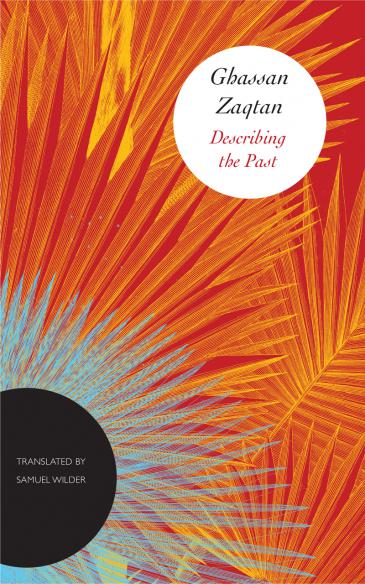
From the earliest passages, there is an abiding transience to the narrative flow of Ghassan Zaqtan’s novella, Describing the Past. The language is delicate, the imagery fragile and dream-like. The world his characters inhabit has an eerie timelessness. The past—immediate or distant—is tangible. Ghosts wander the streets, and memories are brought into being as ethereal images or objects that hold a vital presence in the room, breathe, come alive at night. We are among people who have been uprooted once and will be uprooted again; their dreams and recollections sustain them, give them something to hold on to.

ghassan_zaqtanZaqtan, a Palestinian poet, was born a refugee. In 1961, at the age of seven, his family was relocated (for the second time since 1948) from Beit Jala, in the West Bank, to the Karameh refugee camp across from Jericho, in the Jordan River Valley. But, as Fady Joudah indicates in his Foreword, the camp would be burned with the Israeli invasion in 1968. Zaqtan’s tale is set in this community, yet re-imagined and filtered through the chimerical memory of a place, like childhood itself, that no longer exists.

The narrative is carried by three separate voices—designated I, He, and She—each speaking in first person. The central narrator is nicknamed Christian (his mother was Christian, his father Muslim), and his friend, the other young man, is known as the Iraqi’s son after an uncle who identified himself as Iraqi due to his brief role helping the Iraqi Army at the end of the 1948 war, an experience he built into a sustaining myth that coloured his entire family’s identity. The young woman who holds their attention is, at the outset, married to an elderly man who takes her and her mother into his home. When he dies, she will marry the Iraqi’s son and bear him a child before he drowns, leaving her alone. As such, the outline of the plot is simple, much of it alluded to in the first chapter. However, the story is unwrapped slowly, moving back and forth in time, and relying on poetic imagery and the vagaries of memory to sketch out the spaces that exist between these three individuals.

And that is where the magic lies. In the opening section Christian inadvertently chances to see “her”, the young wife of the old man, naked in her room. He had come seeking some tea leaves for his mother and had not realized she was home. Transfixed by the sight of her body he watches her in hiding until she begins to sob and he runs away, terrified and exhilarated by what he has seen. Of course he must tell his friend, who beautifully describes the vividness of the account:

At first I didn’t believe it, it was not his voice. There was a strand of fantasy that glimmered in his words, some current of rash hunger and desire, of fear and fraud. Little by little, like dust growing slowly and insistently into heaps, she started to gather there in the voice toward the point of completion. She became clear and close. I saw her in his voice reclining nude and whole. Her knee flashed at a distance. At the centre of her figure a dark spot of light amassed, turning and breathing. I was there. I saw her in his voice with a clarity that did not exist for him; she was clearer and more complete in his voice than anything he had looked at and beheld.

The narrative glances forward and retreats in time. The voice of the Iraqi’s son who meets an early demise, disappears from the discourse about halfway through. But the dead are never gone. They are greeted in the street. They emerge from photographs. One has the sense of a world crowded with memories, individuals weighed down by what they have lost. The level, steadily-paced poetry of the language enhances this sensation. This novella, only 84 pages long, is best if savoured slowly, allowing the words to be absorbed.

As each of the narrators picks up the pieces of their own stories, the temporal distortion, shifting from chapter to chapter, can be disorienting. “Here” and “now” are terms without a fixed frame of reference. This is intensified because Christian, as the central narrator, rather than providing structure, is the most abstract and philosophical in his manner of being in the world. He is most sensitive to a past that extends beyond his experience. To ghosts. At one point his father had crept into forbidden territory in search of his village, only to find it in ruins, home now to a curtain of cacti and one remaining pomegranate tree. Stuffing his pockets with pomegranates he arrived home covered in juice, clutching one whole fruit:

He placed it on our only table, and the fruit stayed there. We were unable to wound it. We were afraid to cause it, or him, pain. It was in front of us—breathing and remembering—on that squat table, next the knife that my youngest sister had brought and about which we quickly forgot. It was impossible for us to go beyond that. The fruit was completely alive and necessary for him, his only means to make us believe him, to make us believe all those stories he had brought to us—of his house, his village and his land.

Our house, our village, our land.

There is a sense that the three young characters at the centre of Describing the Past are trapped, suspended in lives they cannot control. It is not clear how much time passes. Hopes and ambitions are fleeting when you face an uncertain future in a refugee camp—when the land you live on is shared with ghosts, haunted by memories, and liable to turn to dust without warning. Yet, circular, the dream-like narrative returns, in the end, to complete the fragmentary images that the set up by central narrator in the opening passages. The mood is gently haunting, beautiful and sad.

And it leaves you with chills.

Describing the Past by Ghassan Zaqtan is translated by Samuel Wilder and published by Seagull Books.

Of reality and imagination: To Begin at the Beginning by Javier Marías

In the opening paragraph of her “Postface” to Javier Marías’ recently released contribution to the Cahier Series, To Begin at the Beginning, famed translator Margaret Jull Costa confesses that every time she starts to work on a new Marías novel, she thinks: “I can’t do this.” His work, with its long, convoluted sentences, and its precise, but shifting, language lies ahead of her at the outset of each project, and until she gets back into the flow she feels a sense of anxiety. I must admit that similar sort of uncertainty faces me as a reader. I wonder, am I ready to commit to Marías again right now? Unfortunately, with a few efforts since I was first swept away by A Heart So White many years ago, the answer has been no, not now.

beginSo imagine my delight with this short, reflective essay about the art of taking the stuff of life—the truths and myths that arise from one’s own family history—and using, even re-using them, to tell stories, create literature. I found this Marías, talking about his family, and his approach to the art of writing, so wonderful to read that I’ve mentally added his trilogy to my list of books to read. And that is one of the absolute joys of the Cahier Series: the opportunity to meet, or meet again, a writer or translator, and spend a little time with them as they explore writing or translating, or the intersection of both, in unique and original ways.

Marías, the highly-respected Spanish novelist and translator, sets out in this piece to explain his desire to devote his energies to writing “inventions,” and why, even when he borrows elements from real life, so to speak, he is inclined to break them up, and blend them into his fictional characters and creations rather than putting them in, unaltered.

2017-01-15-02-12-11 He begins by trying to set himself apart from writers who make every effort to make their fictional offerings appear factual, and expresses his dismay whenever presented with the expression: Based on real events. His inevitable reaction? “I’m filled with a feeling of tedium and anticipatory boredom, of distrust and resistance, of suspicion and even scepticism,” he says, going on to be more exacting:

‘What is so strange and unbelievable, so extraordinarily random, arbitrary, and corny about this story that, even though it’s already happened in real life, they still want to tell me about it, even warning me that I have to believe it whether I like it or not, because this is how it was, this is what actually happened?’

2017-01-15-02-13-49Of course, in the essay that follows, he goes on to share aspects of his own family history, reaching back to his Cuban great-grandfather, pulling out some of the stories that have made their way into one or more of his novels. This abbreviated family history is fascinating in its own right (inadvertently causing one to think that any story “true” or otherwise can be magic in the hands of the right storyteller), but his discussion of his process of re-imagining and working people and incidents from the past into his fictions—and the decisions he has faced when handling elements of the real within the world of invention—is equally compelling.

2017-01-15-02-10-09Marías reports that, when he writes, he applies the same principle of knowledge that is at play in life. He does not know if what he writes at page five of a novel will prove to be a good idea at page 200 any more than we can know if what we do at age twenty will seem to have been wise from the vantage point of forty, and so on. In writing, one has the advantage of editing, adjusting events back and forth between earlier and later portions of the work, giving meaning to the capricious and superfluous, as required, so that “what had no meaning at the beginning does have meaning at the end.” Subject as it is to the unforeseeable variables that mould reality, he contends, life makes a very poor novelist. Imagination is a critical mediator—and one of the essential keys to literature— filtering the invented and the actual, rendering everything equal.

To Begin at the Beginning, the twenty-eighth addition to the Cahier Series, offers an opportunity to spend a little time in the company of a renowned novelist and his chief translator. Illustrated by the works of Cuban artist Wilfredo Lam, it will likely be appreciated by Marías’ committed readers. For those who have little or no experience with his novels, it serves as an ideal introduction, or, as in my case, an inspiration to read more.

The Cahier Series is a joint publication from the Center for Writers and Translators of the American University of Paris and Sylph Editions.

“Childhood is ancient”: Sweet Days of Discipline by Fleur Jaeggy

The bell rings, we get up. The bell rings again, we go to bed. We retire to our rooms; we saw life pass beneath our windows, observed it in books and on our walks, watched the seasons change. It was always a reflection, a reflection that seemed to freeze on our windowsills. And perhaps now we saw a tall marbly figure stand out before us: it is Frédérique passing through our lives and maybe we’d like to go back, but we don’t need anything, anymore. We imagined the world. What else can we imagine now if not our own deaths? The bell rings and it’s all over.

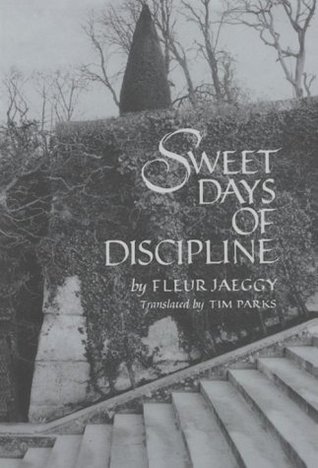
Switzerland, the Appenzell: the area where Robert Walser took his walks, including his final snowy outing, and the location of the boarding school where the narrator of Fleur Jaeggy’s hauntingly pristine first novel is living, at the age of fourteen. She regrets that they didn’t know of the writer’s existence at the time, but the perfection of his death, and the season, set the tone for the story that she is about to share—a chilling winter tone that persists even as the months and years pass and the harsh, spare beauty of Sweet Days of Discipline works its way right through to the bone.

sweetdaysThis novella is marked by a tightly controlled narrative voice. It is a tale of obsession. There is little action, it is the narrator’s emotional intensity that drives the story forward. Looking back on the years she spent in a series of boarding schools, from the age of eight to seventeen, she zeroes in on this one particular year, at the Bausler Institut, where Frédérique—beautiful, remote, and obedient—first entered her life. She sets out to conquer this newcomer who, only a few months older, has come from the outside with a certain detached worldliness that instantly sets her apart from the other girls.

The narrator, whose education is directed, long distance, by her mother in Brazil, is a seasoned veteran of boarding schools where, as she puts it, “a sort of senile childhood was protracted almost to insanity.” She knows the game, and how to play it, which she does with a healthy measure of cynicism:

Part of your education is learning how to thank with a smile. An awful smile. There is a mortuary look somehow to the faces of the boarders, a faint mortuary smell to even the youngest and most attractive girls. A double image, anatomical and antique. In the one the girl runs about and laughs, in the other she lies on a bed covered in a lace shroud. It’s her own skin has embroidered it.

She is, however, only an average student—a fact that does not trouble her at all. At one point she admits that all she remembers from her school years is Baudelaire. No surprise. She seems to have almost absorbed his dark poetic soul. Her narrative is liberally strewn with metaphorical references to graves, coffins, corpses, and death.

She befriends Frédérique, in good part because the others find the new girl too distant, and keep their distance in return. They take walks together, and she listens with sometimes exhausted attention, as Frédérique talks of literature, philosophy, and travel. Her own obsession borders, she supposes, on love. But it is a chaste, almost brittle affection.

Spring thawThere is a simmering violence that runs beneath the surface of the narrative. The narrator, long neglected by her own family, harbours a bitterness that colours her detailed, frequently nasty, appraisals of the appearance and idiosyncrasies of others—the headmistress and her husband, her German roommate, the little black girl, and more. When Micheline, a gregarious new student arrives, she suddenly turns her back on her precious Frédérique, more it seems, out of a sadistic streak than affection for the newcomer. She registers no remorse until Frédérique’s father dies, causing her to leave the school for good.

This novella is filled with conflicted, often dark, emotion. The tension lies not so much in what happens, as in the sombre frostiness of the prose. Frédérique, it turns out, is deeply troubled; however, the nameless narrator, is perhaps more unsettling and tragic. Either way, the result is a tale—captured so deftly in this translation by Tim Parks—of stark, poetic beauty:

I persevered in the pleasure of taking my sadness to the limit, the way one does with some practical joke. The pleasure of disappointment. It wasn’t new to me. I had been relishing it ever since I was eight years old, a boarder in my first, religious, school. And perhaps they were the best years, I thought. Those years of discipline. There was a kind of elation, faint but constant throughout all those days of discipline, the sweet days of discipline.

Fleur Jaeggy is an Italian speaking, Swiss-born writer. Sweet Days of Discipline is published by New Directions. Two newly translated works will be coming out, July 2017, from New Directions in North America and And Other Stories in the UK. (Sweet Days of Discipline is now available outside North America from And Other Stories)


Everything here is dead: Brothers by David Clerson

My first book of 2017 is not the cheeriest of novels, but all the same, it came as a very pleasant surprise. The story is a dark fable, decidedly not for children, but then, the fairy tales we remember from childhood were much bleaker, gruesome affairs in their original incarnations. So imagine, if you will, a scene taking place just off the edge of a canvas painted by Bruegel the Elder, where two deformed boys play on the shore of a wild sea, dreaming of escape to fantastic lands, and you will evoke the setting—and the mood—of Brothers by Quebecois writer David Clerson.

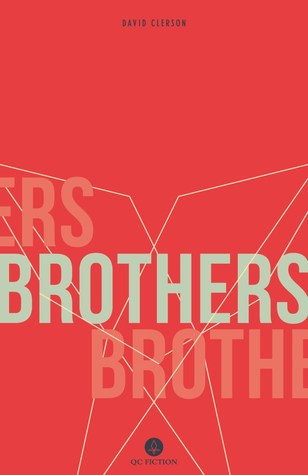
The third title to be released by QC Fiction, a new subscription-based imprint of Baraka Books, Brothers is quite possibly the Quebec publisher’s most daring and impressive offering to date (I reviewed the first release, Life in the Court of Matane for Numéro Cinq last July). This slender volume with the striking red cover—QC Fiction has chosen a most impressive graphic design for their books—cbrothersontains a world that overflows with mythological adventure, shocking violence, and nightmarish beauty.

Brothers plays with and twists themes pulled from myth and legend. The central character, “older brother” is born of the union between his aging mother and a wild dog. She does not want her son to face the world alone, so she cuts off his left arm and from that limb she fashions a “younger” brother who has two very short arms. The two disfigured boys spend their days running through the fields and marshes around their clapboard house, fishing off the pier, and scavenging oddities that the waves bring in.

One day the sea offers a wreck of a boat, another day a wooden puppet washes up. Together the brothers work to patch the boat as best they can, dreaming of the day that they cross the waters to distant lands populated with monstrous creatures in search of their “dog of a father.” When they find a drowned dog, they know that the time has finally come. With the older brother dressed in the animal’s tanned pelt, one of the puppet’s arms strapped to his shoulder in place of his missing limb, they set to sea, leaving their aging, desiccated mother behind. She has withdrawn from them so completely they doubt she will notice their absence.

The first days it took a long time to get away from the shore. Not by choice, but because the wind kept them there, or they didn’t know how to handle their sail, to make the boat go where they would have wanted. Instead, they followed the coast, in a direction they had never been, not toward the marshes and the neighbouring village, but out to where the coastline fell away steeply, with cliffs sliced by creeks and a multitude of shrieking birds soaring above.

The brothers are ill-prepared for their adventure. Illness levels the younger boy, storms rage, and ultimately, disaster strikes. The older brother eventually ends up alone, on a farm, chained to a doghouse. Yet he finds, for a time, a certain peace in this new existence, save for the torments dished out by the six pig-like children who also live there. He will even experience a mixture of love and lust with a grey dog—the daughter of a dog of a father—whose life has been much lonelier and harsher than his. But this respite does not last, and it does not end well.

If there is a moral here, it is that life is brutal—that goodness and evil are both instinctual survival mechanisms. The former is weak and the latter consumes. Redemption is elusive.

So why read it? The prose, beautifully translated by poet Katia Grubisic, is crystalline, spare, and unsentimental. The balance is just right… it holds you in awe. It is surreal, grotesque and beautiful in turn. The older brother is self-reflective. He notices his contentment, contemplates the stirring of love, and knows he is helpless against the escalation of murderous revenge. The cruelty he has experienced, the violence he has perpetrated, the guilt that haunts him, and the kindness he cannot accept leave their mark, shape him. He has existed at the intersection between beast and man—more whole and complete for the months he lives as a dog, as harsh and mean as they are—but in the end, in the absence of the brother who completed him—he can find comfort only in the company of a murder of crows. And it is insufficient.

This book is not, as I had feared, magic realism. This is not a human tale with a magic element—it is a magical tale with a human heart. Like a folktale for a post-apocalyptic future, Brothers, in all its grotesque surrealism, reflects a truth in which we recognize ourselves, with an equal measure of horror, sadness and shame.

Originally published in 2013 as Frères, this first novel won the Grand prix littéraire Archambault 2014.

Looking ahead to 2017: Finding light in the darkness

It may be a reflection of the year we have just endured as a global community, or the uncertain variables that cause 2017 to look like such a grey zone, but many people I know seem to be afraid to make any resolutions or commitments moving forward. A month or so ago, when I was still buried under a black cloud of grief and depression, I could not even imagine the utility of existing into the new year. I was in a peculiar space. I was receiving enthusiastic feedback for my work as a writer and critic—even selling a few pieces—but I felt empty and hollow inside. I could stand back and observe my malaise, but I could not bring myself to find an essential light to believe in.

Then, as suddenly as it had settled in, the darkness lifted. My parents are still dead, my friend is still gone, and I have not yet found a job. However, the stubborn, stupid optimism I always cherished as part of my character has returned. Wiser and soberer perhaps, and not at all naïve about the very real threats that the coming year holds. But with good books and the comradery of the many people I have come to know and respect, at home and afar, over the past couple of years, I resolve to try to read and write and photograph my way through 2017, come what may.

31760687801_ea5acb48c8_b

I have been making piles around the house lately and considered photographing them but have decided against being that committed in a public way. Suffice to say there is a healthy stack of fiction including a fair number of recent releases or purchases to which I am adding other titles I feel most guilty about ignoring to date. I have also been reading a good deal of poetry lately, new and classic, so I keep those handy. And then there is a growing collection of essays and memoirs which reflects my own interest, as a writer, in the variety of ways that personal experience or observation can be addressed. As much as I flirt with ideas of writing fiction, I seem to fall back into essay, at least as a starting point. If I end up taking a piece in the direction of storytelling or prose poetry, all the better, but the process has to be dynamic. I am learning to let my writing follow its own course as much as my reading does.

And this leads me to what might be thought of as my resolutions:

Reading: Some surprises surfaced when I added up my completed reads from 2016. I discovered that I read more German literature, than I had expected—11 titles, not including some Sebald that I am presently dissecting or the Kafka that I am always reading. I read 12 English language works (more actually, I have several essay collections and other books in process) and 8 translated from French. As for the balance of the translated literature I read, Spanish, Catalan and Portuguese accounted for a total of 10 books with many more waiting, while I read three Slovene, two Czech, and one each from Dutch, Korean, Arabic, Bosnian, Italian, Icelandic, Hebrew, and Polish.

Contrary to my previous pattern, I only read one South African, title though I added more and still have an embarrassing number of books crammed on to my bookcase. I had also intended to read more Arabic and North African lit and, again, failed. There are also a few key independent publishers I did not read from this year. So, all of these considerations will, if nothing else, be reflected in the piles I build. As to what I read—well, I’ll see…

Writing: I want to continue writing critical reviews but I am being very selective. Looking ahead I am especially excited about writing about new releases from Can Xue and Fleur Jaeggy for Numéro Cinq, while I also have a couple of other interesting reviews booked or underway. I continually debate the value of critical writing (this month the “Top of the Page “at Numéro Cinq features seven reviews—including one of my own—that I selected to highlight some books and reviews that impressed and inspired me). So often critics seem to be held in disdain and yet to write about a book sensitively and intelligently is challenging and creative—but it can be draining. Nonetheless, I have learned so much from the writing and from being edited, all of which has helped make me a better writer. Now that I am also involved with The Scofield as an editor I have further opportunities to continue to grow and contribute to the vital community of online literary magazines.

On the other hand, I am hoping to shift the focus of my blog a little, away from attempting to “review” books that I read (unless it seems appropriate). Rather I would like adopt a more personal reflection on the reading experience—try to pinpoint why the writing works, what ideas are generated, or simply celebrate reading for reading’s sake. I don’t ever want to feel obligated to write about everything I read, but at the same time I am increasingly reading books written by writers who are becoming friends and mentors. I want to be able to write about this work, in an informal, yet valuable way.

Finally, with what I call my “creative work,” I have several projects in mind or in process. One is an experimental, constraint-based project in honour of my father which may or may not lead to anything of interest to others. Otherwise, as much as I thought I was done with writing about the body, it seems that there is still a lot of unfinished business or baggage. It is inextricable from either my interest in being and authenticity, or my now expanded and complicated grief work. I am fortunate to have been approached by several online journals/sites that have invited my contributions and I am very excited about being able explore some ideas in smaller creative spaces to see where they take me. At the same time, I have a few other topics that I want, or even need to examine within, shall we say, a more conventional personal essay format.

Photography: After a long hiatus, I am inspired and eager to return to photography. A dear friend has kindly suggested —insisted— that I should incorporate more images into my writing. This possibility excites me and offers not only a direction for myself as a photographer, but also provides an opportunity to repurpose older shots, cropping and radically reprocessing images that were average and turning them into an integral part of a larger project.

So, even though it is impossible to know what the new year holds, I want to aim to face 2017 ready to build on what I have learned over the last two years which have held, for me, some of the most difficult and most rewarding moments of my life. It is really the only way I can think of to navigate what is bound to be a most interesting and surreal time.

The enigmatic fiction of Roger Lewinter: Story of Love in Solitude and The Attraction of Things

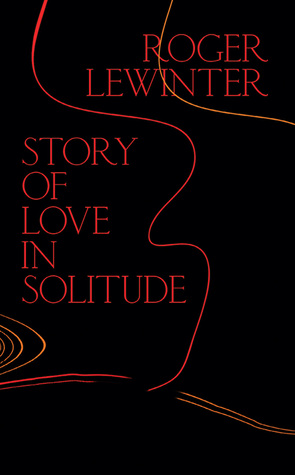
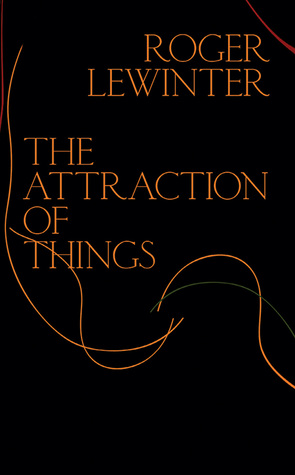
It is unusual to come to the end of a book and be completely at a loss as to how to write about the reading experience one has just had, and yet feel compelled to make some sort of attempt, however indirect or uncertain that might be. And that is exactly how I find myself now, having just finished Roger Lewinter’s novella The Attraction of Things. Together with Story of Love in Solitude, a very brief collection of three short stories, these two recent releases from New Directions (translated by Rachel Careau) serve as an English language introduction to the French writer and translator’s beguiling, meditative, and sometimes simply perplexing, fiction.

lovesolitudeThe latter volume, originally published in 1989, is one of the most unusual and strangely captivating books I read all year. The stories are focused and contained, reading almost like prose poetry, but they offer a taste of Lewinter’s idiosyncratic unspooling sentences that can wind around seemingly unrelated clauses before finding their way, from beginning to end, by such a circuitous route that one often feels inclined to retrace the pattern back to its source. It is an experience akin to untangling a long garden hose, or, more appropriately, following the designs of a richly decorated tapestry such as the Kashmir shawls that Lewinter’s narrator—whose writing and translating projects mirror the author’s so directly that the line between fiction and memoir appear to blur—obsesses over in the story “Passion” and throughout the course of the longer novella. Even attempting to write about Lewinter’s prose invites a tendency to add divertive notes, set off with dashes, not entirely unlike the style he employs.

See? Already it feels as if I am spinning my wheels. The reward though, especially in the shorter pieces, lies in the attention to detail and emotion, often of a detached or self-reflective nature, that is granted the events, objects or individuals with whom the narrator is engaged. The simplest story, the opening titular piece of Story of Love in Solitude, lasts for less than three pages and concerns the persistent presence of a spider. It captures so acutely the type of everyday irritation that quickly turns to a sense of loss when the routine is broken and an odd affection is realized after the fact.

athingsThe other two stories are more complex in the attractions and obsessions they entail and introduce characteristics that are present—and I want to say, more inclined to cause a measure of frustration—throughout the novella: Lewinter’s tendency to use explicit dates and translation projects to track time while he dismantles and reconstructs the chronological (in)consistencies in his stories—one which involves an epic battle against insect infestation and fate to save two camellias, and the other, which traces the protagonist’s drawn out and ultimately fruitless obsession with a young man he observes in the market. What makes these set-pieces work is the way that, for all his musing and meandering, Lewinter writes with an almost symphonic intensity, building tension into his narratives, and bringing each one to a charged conclusion. These small discursive journeys relate ordinary events that are oddly familiar, sensitive, and moving.

The same forces are at play in The Attraction of Things, which is the earlier of the two works, originally published in 1985, and, again, the overlap of characteristics between the narrator of the novella and, at the very least, the literary career of the author, create the sense that this is one voice, an alter-ego or fictionalized version of Lewinter himself. As he states, Attraction is:

…the story of a being who lets himself go toward what attracts him—beings, works, things—and who, through successive encounters, finds the way out of the labyrinth, to the heart, where passion strikes. This is the story of a letting go toward that passion.

The path that this being follows is one that appears to be characterized by an attempt to avoid deep emotional engagement with people by allowing objects—78 RPM records, Kashmir shawls, porcelain collectibles—to distract him. Against this pursuit of things, his mother and father become ill and eventually die, he allows a relationship with a woman to drift away, and lets a man take advantage of him. His passivity approaches denial of mortality, commitment, and sexuality. The flea market and the lure of things is a refuge. So too, is his work, which primarily involves immersing himself in the words of others.

Lewinter, the author and his narrator alike, has translated Karl Kraus, Elias Canetti, Robert Walser, and Rilke among others. But of special significance perhaps, is his deep association with the work of Georg Groddeck (1866-1934), the German physician widely regarded as a pioneer of psychosomatic medicine. If nothing else, this presents a possible context for understanding the manner in which the protagonist and his parents each face, and deal with, illness and physical ailments. There is a strong self-determination and stubbornness shared by the three family members that is, at the same time, a source of frustration to the son in his own distracted state. It is also interesting that Lewinter—separating him from his narrator is becoming redundant in this context—mentions writing about the connection between Bosch and Groddeck in an essay on paradise in psychoanalysis (Groddeck et Le Royaume millénaire de Jérôme Bosch—1974). Immediately this adds a new dimension to the obsession with Kashmir shawls—the colours and designs integrating cardinal points, black hearts, and angels—that runs throughout the novella and resurfaces in the later story “Passion.” To what extent are the textiles collected, cherished and hung on the walls an attempt to reflect a dream of paradise? But, most critically, when winding one’s way through the elliptical sentences that stretch on and on, often for a page or more, the narrator’s absorption with the work of a man who envied Freud’s discovery of psychoanalysis offers a way to “read” Lewinter’s distinct style of writing.

Any quotation from either book that captures a fragment of one of the gloriously nested sentences, would fail to do justice to the effect, or serve as a necessary sample for discussion, so permit me one longer, complete quote (by happy coincidence, this passage, which I selected as I was reading, happens to end a longer excerpt that was reproduced on Lit Hub):

The health of my father, since the previous September, had been deteriorating, the drugs having less and less control over the tremor that was now paralyzing him in spurts, disjointing his day with gaps to which, not wanting to hear of another hospitalization, he reconciled himself, and which I likewise trivialized; while, returning after the three months’ interruption occasioned by Antigone to Le chercheur, I finished the word-for-word translation in June, to find myself confronted with the difficulty unresolved, since I still didn’t know how to convey in French what showed through in the German, in my version rendering, as I was aware, only a state of amazement, not, in its magnetization, the torrent  of a life; and, the more I advanced, the more I was losing my way, when, on August 13, I had to have my father admitted, despite his refusal—“because you die there”—, to Thônex so that they could try, by gradually changing his medication, to stabilize his condition; but it was the balance found upon the death of my mother, three years earlier, that was undoubtedly slipping away.

Lewinter’s narrative clearly fits into the broad category of stream of consciousness writing. It is not as loosely unformed as some variations; the insertion of exact dates and concurrent writing and translation projects provides a structural formality and logic to the account. Not being well acquainted (yet) with the pioneers of the nouveau roman, I am not as well equipped as another reviewer (see John Trefry here) might be to draw refernces from that direction—my reading is necessarily instinctual and informed by the spaces where I related with particular poignancy to the larger story. The way the narrator’s mind wanders is reminiscent of the way we talk to ourselves and allows him to capture something somewhere between unarticulated thoughts and formal discourse. This is the private debate, the ongoing perseveration, the way we justify our obsessions with objects or people, our impatience with others—especially with those closest who invariably raise the most complex emotions—and any other shortcomings we care to catalogue and excuse as we structure our own internal narratives. As we articulate ourselves into being.

As the narrator’s equilibrium is slowly undone, that is, as his father’s deteriorating health challenges him to break down his own defenses, he is forced to finally open himself up and truly embrace the man he must admit he has never really understood. Father and son, mirrors in more ways than either wishes to recognize, are drawn, both resisting the pull, into a full acknowledgement of their affection for one another. And what is the first thing our narrator does to mark this breakthrough? He looks for an object to commemorate the occasion. There is constant interplay between emotional exhilaration and exhaustion that drives The Attraction of Things, at the level of the sentence and across the text as a whole, that to no small degree, contributes to the state in which a reader emerges at the end. In the span of 79 small pages one has experienced something at once fantastic and draining.

Not unlike a session on the analyst’s couch. And very much like the experience of trying to untangle and make sense of our own lives.

Lewinter is not going to be for everyone. If I was uncertain in the early chapters of Things after loving the smaller pieces in Story of Love, I became increasingly engaged as the father’s health deteriorated, in part because there were echoes of my own father’s decline and death over the first six months of this year. At times I almost had to laugh out loud at the older man’s stubborn resolve and refusal to give in to a weakening, crumbling body—my father was exactly the same. Now, having taken the time to write about this novella, I have come to respect and marvel at what it demonstrates about how an essentially ordinary, even mundane story can be told—no, orchestrated—and granted an operatic arc that creates an experience a reader will have a hard time shaking. There is a lot in this slender volume.

In the end, I am not certain I have articulated or elucidated anything especially profound about these two small books. To date, there is one more piece of fiction in Lewinter’s oeuvre and, as I understand it, Rachel Careau is still dedicated to translating his works. I know I will be watching for more.

Story of Love in Solitude and The Attraction of Things are published by New Directions. Each book is bilingual, with the complete French text following the English.

In good company: The Walk by Robert Walser

On Christmas Day, sixty years after Swiss writer, Robert Walser, took his fateful last winter stroll, I went for a walk through my neighbourhood. It was cold, -23C, but the low sun shone on a fresh 15 cm of snow, making it an ideal day for photographs. This being the first Christmas after the deaths of three of the people closest to me, it was a time of invigorated spirit and creativity mixed with sadness. Not entirely unlike the emotions recounted in the book I opened after returning home—Walser’s novella, The Walk.

walkNotably the first of Walser’s work to be translated into English, the path that led to the present edition of this book, a part of New Direction’s Pearl series, is interesting and informative. The original translation by Christopher Middleton was published 1955, and based on the 1917 stand-alone publication of The Walk. When the same piece was released as part of the 1920 collection, Seeland, the author had edited his first version—streamlining some sections, padding out others. With this in mind, translator Susan Bernofsky, applied Walser’s edits, only as necessary, to Middleton’s work. The resulting volume is a unique collaboration and, as Bernofsky notes in her introduction, the two versions offer fascinating insight into Walser’s “evolution as a writer.”

The narrator is a writer and a self-styled flâneur whose environment is not the bustling metropolis, but a semi-rural/semi-suburban setting featuring bucolic scenery and peopled with eccentric characters. The novella opens with our hero leaving the gloomy isolation of his daily confrontation with the empty page, to set off on a series of errands. He is in a jaunty, positive mood. It’s evident that being out on the street is where he feels most free, confident, and at ease.  Opinionated, observant, and self-conscious, the narrative that unfolds is marked by an excessive chattiness. Whether he is addressing the reader or someone he encounters, a certain manic energy drives the perambulator’s account:

In the water of a fountain a dog refreshes itself, in the blue air swallows twitter. One or two ladies in astonishingly short skirts and astoundingly high, snug, fine, elegant, dainty colored booties make themselves as conspicuous as anything else. Moreover two summer or straw hats catch my eye. The story about the straw hats is this: it is that in the bright, gentle air I suddenly see two enchanting hats; under the hats stand two fairly prosperous-looking gentlemen, who by means of a bold, elegant, courteous waving of hats seem to be bidding each other good morning, which is an occasion upon which the hats are evidently more important than their wearers and owners. The writer is nonetheless very humbly asked to be a bit careful to avoid jokes as well as other superfluousnesses. It is hoped that he understands this, once and for all.

This excessive attention to detail, and the tendency to address himself in the third person with slightly self-deprecating humour, creates a distinctively Walserian tone that would influence Bernhard and be so admired by Walter Benjamin and W.G. Sebald.

As he continues on his walk, Walser’s narrator, will stop into a bookshop and bakery, dine with a female friend, and attend to a variety of errands. He waxes lyrical, sometimes taking his praise well over the top when describing some of the houses, gardens, and natural settings he passes by, while he explodes with outrage at the slightest provocation. Inspired to impromptu speech-making, he bends over backward to flatter several women he encounters, and recites from memory a long-winded insulting diatribe to the unknown recipient of a letter he mails:

“He who works honestly, and devotedly exerts himself, is in the eyes of people like you, an outspoken ass. In this I do not err; for my little finger can tell me that I am right. I must dare to tell you to your face that you abuse your position because you know full well how many annoyances and tedious complications would be entailed if anyone were to rap your knuckles. In the grace and favor which you enjoy, ensconced in your privileged prescriptive position, you are still wide open to attack, for you feel without a doubt how insecure you are.”

In his outbursts, it becomes increasingly apparent that the writer/walker is channelling his own insecurities such as in the much-foreshadowed incident in which he angrily confronts a tailor whom he is determined to take for task for the fit of a suit—one it’s uncertain he either wants or, more likely, can afford. At his next stop, he proceeds to grovel before a tax official, explaining how his writerly profession does not provide a reliable income and he thus requires that he be taxed at the lowest feasible rate. When the taxman points out that he always seems to be out walking rather than plying his trade, the narrator launches into a detailed explanation of the critical importance of his daily excursions to the gathering and processing of the ideas that he will commit to paper when he returns to his dwelling:

“Walk,” was my answer, “I definitely must, to invigorate myself and to maintain contact with the living world, without perceiving which I could neither write the half of one more single word, nor produce a poem in verse or prose. Without walking, I would be dead, and would long since been forced to abandon my profession, which I love passionately.”

As the narrator reaches his destination, the end point of his outing where he will rest and reflect, all pomposity and bravado give way to the underlying sadness and loss that he carries with him. He walks then, not just for inspiration, but to try escape a gloom that is not confined to his room alone.

31036737474_a1cd68f48e_b

The Walk was the only one of Walser’s works to be published in English during his lifetime. Now, sixty years after his death, his many novels and short story collections continue to appear regularly in translation. For a man who spent so much of his life confined to mental health facilities, nearly forgotten, and who fell silently in the snow on a solitary walk, this particular novella, so lovingly tended by two of his best known translators, is a fitting honour to his memory.

Another winter solstice is upon us: 2016 – The year in review

Winter solstice. The longest night of the year.

Moving forward, the days grow steadily longer and, in less than two weeks, we will leave a dark, disturbing year behind us.

But it would be reckless to imagine that 2017 will be brighter. However, with luck, we can be forewarned, forearmed, and determined not to relax our guard. We can stand together against the rising tides of hatred, and remember what is truly at stake.

11229294674_e5844929df_z1

Since I started this blog two and a half years ago, winter solstice has become my annual check-in point. Last December, I reflected on the key elements of a year that began with a move to writing seriously about books and culminated with my first review for Numéro Cinq. Against that trajectory, I wrote about my trip to South Africa, and the pulmonary embolism and cardiac arrest that followed within a few weeks of my return. I imagined that the eventful year I had experienced would not likely, for better or worse, be exceeded this year.

Cue 2016.

This has been a year of heartache, anger, and dismay. Around the world and close to home. I watched the violence in Syria, the outcome of the Brexit vote, and the spectacle of the American election, among the other tragic and unexpected events that have unfolded. And as economic uncertainty and anxiety has grown in my own hometown—a city that lives and dies with the price of oil—the crime and homicide rate has risen sharply this year. It does not feel like the same community any more.

Then there is the lengthy roll call of the writers, artists, and performers who have left us. But to be honest, I cannot say that I have felt these losses as acutely as many others… I’ve been distracted by the immediate, personal losses that marked this year. My mother, my father, and one of my closest friends, all gone within the span of two months. And my grief—that most fundamental human emotion—is complicated, inarticulate, and wearing.

It will take time.

11592010455_89917d80e3_z1

But, 2016 has also been a time of amazing growth and opportunity for me as a writer. I don’t know how often I resolved, with the dawn of a new year that: This year I will write. Last December, with that first critical review under my belt, I could not have imagined that I would have, in addition to regular contributions to Numéro Cinq, published reviews at 3:AM, Minor Literature[s], The Quarterly Conversation, and The Rusty Toque. And I would not have dared to dream that I would see my essays and prose pieces published on line and in print, or that I would be invited to join the editorial team of The Scofield. As 2017 approaches, I have a handful of reviews scheduled and several prose projects underway. I’m also feeling inspired to return to photography after a lengthy hiatus, and to see how I can incorporate photos into my written work.

I have much to look forward to, in spite of, or rather, against the new darkness that threatens.

Art and literature are more important than ever at times like this.

So, this seems to be an appropriate time to look back over this year’s reading, and highlight the books that stand out for me.

I’ve read about 50 books to date, a little more than half of what I read in 2015. I don’t even want to hazard a guess as to how many books I bought, received as review copies, or brought home from the library. I feel, as usual, like I fell short of my intentions. However, I have to remember that I was writing, working on critical reviews, and dealing with considerable life stresses over the past twelve months.

More than ever before, I read like a writer this year. That is, I was especially attuned to voice, structure and approach to storytelling. Consequently, the books that made my year-end list tend to reflect this focus. Of course, any “best-of list” leaves out many excellent books. I’ve managed a baker’s dozen here, and it’s probably a reflection of the increased number of off-blog reviews I wrote that this year’s list is predominately composed of new releases. I was surprised to see that once I’d made my selection.

In reverse chronological order, my top reads of 2016 include the following:

Story of Love in Solitude by Roger Lewinter (France), translated by Rachel Careau
I will write about this collection of three short stories once I have completed The Attraction of Things. My verdict is still out on that title, but this tiny book is simply wonderful.

The Inevitable Gift Shop by Will Eaves (UK)
Fragmentary, cross genre writing that works fascinates me. Billed as a “memoir by other means”, it is Eaves’ unique tone that makes this blend of memoir, literary criticism, and poetry so compelling. His thoughtful reflections on reading and writing made this an ideal meditation to turn to after a year of reading critically and exploring my own literary voice.

gravediggerThe Absolute Gravedigger by Vítěslav Nezval (Czech Republic), translated by Stephan Delbos & Tereza Novická)
I have found myself turning to poetry more and more as the world seems increasingly unstable and, well, surreal. This newly translated collection of poetry by one of the best known Czech Surrealists should be essential reading at this time. Originally published in 1937, the darkness he could see on the horizon are all too familiar once again.

The Country Road by Regina Ullmann (Swiss), translated by Kurt Beals
I read this collection of short stories when I was in a very low mood. But in the spare, sombre prose of these tales I found a beauty that, rather than deepening my depression, brought strange comfort. Admired, in her lifetime, by the likes of Rilke, Mann, and Musil, Ullmann’s work is mostly forgotten today. This volume, released in English translation in 2015, is a rare treasure—one that I encountered at just the right moment.

panorama-coverPanorama by Dušan Šarotar (Slovenia), translated by Rawley Grau
For me, as a reader and a writer, one of the most important books I read this year is this literary meditation on migration, language, landscape, and loss. This novel finally broke through my own stubborn determination to hold to a sharp delineation between fiction and nonfiction, and has made me re-evaluate potential approaches to themes I wish to examine. What Šarotar achieves here with his own unique take on what might be deemed a “Sebaldian” approach, is the creation of an atmospheric, captivating, and intelligent work.

The Passion According to G.H. by Clarice Lispector (Brazil), translated by Idra Novey
Oh wow! In a way, I am glad I didn’t read Lispector before writing and publishing my essay “Your Body Will Betray You,” because she is exploring the process of coming into being so beautifully that I might not have been able to write at all after reading this. Employing an unconventional narrative, Lispector’s G.H. experiences a vivid, metaphysical crisis triggered by the sight of a cockroach. The result is a remarkable, thoroughly engaging read. I have at least three more of her books waiting for the new year.

Proxies by Brian Blanchfield (US)
I bought a number of essay collections this year and currently have several on the go. This collection impressed me not only for the way the essays were composed—written without consulting outside sources—but for some of the ideas explored, and for reinforcing the value and possibilities of the personal essay/memoir form. I also greatly appreciated his guiding caveat: Permitting Shame, Error and Guilt, Myself the Single Source.

SergioSergio Y. by Alexandre Vidal Porto (Brazil), translated by Alex Ladd
This book is significant and important for dealing with gender identity and transition in a sensitive and original way. I am, as a transgender person, critical of much of what passes as literary writing on this subject. This is a most impressive work with a startling and unique approach. As I noted in my review, Sergio Y. is novel that approaches the transgender experience from the inside and the outside, allowing for the comfort with names and pronouns to vary, over time and from person to person, reflecting the complexities of relationships that others, even loving family members, can have when an accepted and assumed identity is challenged. That is the book’s greatest strength.

surrThe Surrender by Scott Esposito (US)
This book was on my radar from the moment I first heard of it. Again, despite my typical gender related skepticism, I was drawn to this transgender-themed memoir/film critique/literary diary. I wanted to know how Scott would present his story—one that is not commonly heard. Although his journey is very different than mine, we share a certain sensibility. This is a brave and most wonderful book by a man who has long been one of my heroes. He has since become one of the many literary friends I have come to know and cherish this year.

Layout 1

Atlas of an Anxious Man by Christoph Ransmayr (Austria), translated by Simon Pare
This book was a total surprise when it arrived courtesy of the good people at Seagull Books. This most unusual travelogue, a series of brief “encounters” across the globe, contains some of the most stunning descriptive language I have ever read. Each episode begins with the words “I saw…” and ends with a wise, evocative observation. From the North Pole, to South America, from deep inside the mountains of New Zealand, to a parking lot in San Diego, this is a journey that will not be easily forgotten. Highly recommended.

Quiet Creature on the Corner by João Gilberto Noll (Brazil), translated by Adam Morris
My third Brazilian book on this list is this enigmatic novella that led to one of the most entertaining literary discussions of the year. What is it about? Well that is the challenge. I had to read it three times before I could begin to get a handle on it. The narrator, a young man who finds himself in a strange situation that is rapidly growing stranger, is, in his oddly passive tone, almost more disturbing than whatever might be happening. Opaque and surreal, this book gets under your skin.

The Crocodiles by Youssef Rakha (Egypt), translated by Robin Moger
This novel still holds fast in my memory although I read it back in February. It is, as I described it in my review, a prose poem of simmering power, unwinding across 405 numbered paragraphs, tracing a torturous path from the first stirrings of poetic assurance within a trio of young men in the 1990s to the doomed protests of the Arab Spring. It is a dark, intense exploration of youthful political idealism, that builds on repeated images, themes and refrains to create a compelling narrative force as it moves toward its stunning conclusion. Again, this is another work that is increasingly relevant in today’s world.

On-the-edgeOn the Edge by Rafael Chirbes (Spain), translated by Margaret Jull Costa
Finally, the very first book I read in 2016 is probably my favourite book of the year. I wrote about this novel at length for Numéro Cinq and I regret that it has not generated more discussion. In what is essentially an extended monologue with brief cameos from other characters, Chirbes creates a memorable, engaging, and tragic character in seventy-year-old Esteban, a man who has lost absolutely everything in the economic collapse of 2008.  Thoroughly human in his wisdom, his resolve, his shortcomings, and his despair; this is a powerful and important book that deals frankly with many of the critical issues—including migration, xenophobia, and economic decline—that are more vital than ever as we step into 2017.

Round and round: 33 Revolutions by Canek Sánchez Guevara

The unnamed protagonist of 33 Revolutions, a stark, relentless portrait of life in Castros’ Cuba, is a divorced, black man—a misfit who chafes against the collective tedium of his existence until he is forced to decide, like so many before him, what, if anything, holds him to his wretched island nation. The revolutionary bloom is long off the Communist rose that once held his hopes and enthusiasm. With weary resignation, he shuffles off to his ministry job day after day, enjoying the few privileges afforded by the little bit of extra money sent to him from his mother overseas, but it is a hollow existence:

Duty and desire. Angrily, he bangs out his dilemma on the typewriter until the paper is perforated with periods and commas. His desire is to be alone in his office, in this city, in this country, and never to be disturbed. Monotony is expressed in a thousand ways and acquires various signs. Work, radio, new bulletins, meals, free time: I live in a scratched record, he thinks, and every day it gets a bit more scratched. Repetition puts you to sleep, and that sleepiness is also repeated; sometimes the needle jumps, a crackling is heard, the rhythm changes, then it sticks again. It always sticks again.

33Threaded through the thirty-three brief chapters of this slender novella, are two repeated refrains: the scratched record and the suffocating tropical heat. This imagery is employed so incessantly that it begins to wear a groove that could, in a longer or less deftly handled work, easily become irritating. Instead, the sheer beauty of the language lends the repetition a peculiar freshness. And that is exactly the intention. Tedium and repetition can be borne, can even seem bearable. Until one day it isn’t, and then all bets are off.

The author of 33 Revolutions, Canek Sánchez Guevara, inherited a proud and defiant spirit  from his grandfather, the famous Marxist revolutionary who fought alongside Fidel Castro. At the age of 22, he rejected the dictatorial politics of his homeland, and left for Mexico where he became a writer, graphic designer, and heavy metal guitarist. He was dedicated to writing and speaking out against Cuba’s single party system and its attendant human rights abuses until he died unexpectedly in 2015, at the age of 40. This hypnotically engaging novel allows his voice to continue on.

With a sense of absurdity that Kafka would appreciate, Sánchez Guevara creates, in his hero, a man who is aware that he stands at odds with the world around him. He finds refuge in books and an incongruous fondness for avant-garde music. He is aware that his life is paradoxical, verging on metaphysical weirdness that is both a blessing and a curse. And this painful self-knowledge does nothing to protect him from the monotony that curses his days or the vivid nightmares that haunt his sleep. He understands his reality all too well:

He looks down at the sea again and drinks straight from the bottle. Behind him, the dirty, beautiful, broken city; in front of him the abyss that suggests defeat…. We win by isolating ourselves, and in isolating ourselves we are defeated, he thinks. The wall is the sea, the screen that protects us and locks us in. There are no borders; those waters are a bulwark and a stockade, a trench and a moat, a barricade and a fence. We resist through isolation. We survive through repetition.

As this ceaseless repetition begins to weaken him, our protagonist’s disaffection grows. An undercurrent of protest starts to build within him, fueled by the oppressive heat and boredom. He had long managed to hold his distance, to stand apart from both the street corner reactionaries and the huddled gossips distorting what the rumours passed down to the masses—but this continual buffering against the insidious mechanisms of state control, starts to wear him down like, well, the needle on a scratched record.

The heat is criminal—it melts neurons, incites to violence, multiplies fertility tenfold. There isn’t a beer for miles around (or water, or a barley drink, or anything that can be bought with national currency). Nothing belongs to me, he thinks. And what about me, do I belong to anything? (The scratched record plays insistently.)

His rebellion starts passively, opting out and feigning sick, but in that act the course is turned.

He finds himself drawn to the shore. His experiences, not only of the city around him but the uncertain and desperate promise that waits beyond the waves, is mediated through the lens of his camera. The frame of the viewfinder becomes his means of contextualizing himself in the world and a focuses his hopes for a possible future elsewhere. Everyone seems to be leaving—his doctor, an old friend from school, groups of kids clinging to rafts of questionable seaworthiness. The camera with its ability to play with depth of field, becomes his tool in an attempt to tell an alternate story, take control of and document his own fate.

This brief novella hits hard. Harder perhaps in the light of Fidel Castro’s recent passing, and in the desperation of migrants risking the seas for a better life elsewhere. The anguish that comes through personal and powerful, and it is more important than ever that we stop for a moment to listen.

33 Revolutions, by Canek Sánchez Guevara is translated  by Howard Curtis and published by Europa Editions.

A modern day folktale: Baloney by Maxime Raymond Bock—my Rusty Toque review

baloneyOne of my favourite books of 2015 was Atavisms, a collection of short stories by Quebec writer, Maxime Raymond Bock. I was especially impressed by his ability to employ a wide range of styles and genres, from historical to speculative fiction, in a multi-faceted exploration of Québécois history, society, and identity. His newest release, Baloney,—now available from Coach House Books and translated, like Atavisms, by Pablo Strauss—offers further evidence of Bock’s versatility. This novella evokes the spirit of a traditional folktale, with its tragic-comic hero whose larger-than-life adventures are immortalized by a disillusioned young writer drawn to the aging, eccentric would-be poet. By turns funny, sad, and wise, this simple story is surprisingly moving and thoughtful, and stands as yet another fine example of a new generation of Quebec writers who deserve to be more widely read in English-speaking Canada and beyond.

My review of  Baloney can be found in the current issue of The Rusty Toque—my first contribution to this fine Canadian online literary and arts journal.