Life keeps writing my story for me: A personal reflection on my mother’s birthday

May 2, 2022. My mother would have been eighty-eight today. This week just passed, between my father’s birthday on April 26 and today, is always the time when I think most of my parents. When they feel closest to me, like stars circling the planet. When their memories haunt me. This summer, they will have both been gone six years. But this past week has been a whirlwind of emotion in its own right and I’m afraid the time I wanted to set aside to be with them has evaporated.

Which has led me to think about what family means. About how much love and pain we can bear. And yet, what I can really say at this moment is guarded.

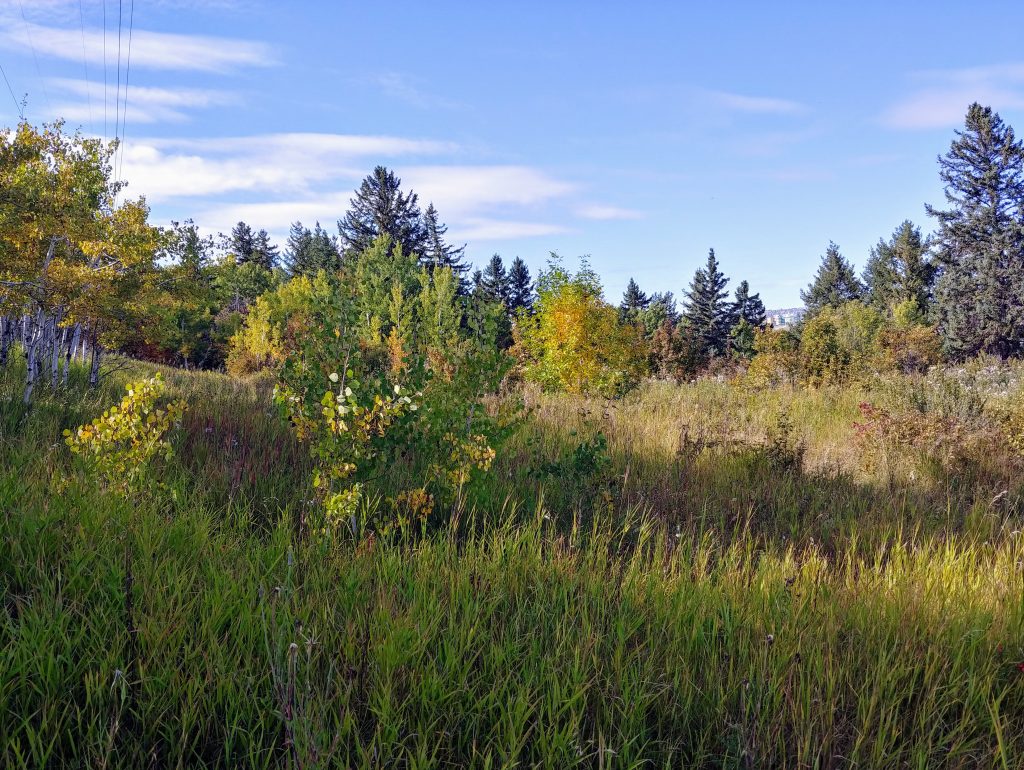
Same trail, same time, last year.

Last Sunday, April 24, I took a fall on a muddy, icy trail and fractured my left fibula above the ankle. At the time, I was still a treacherous distance from a point where I hoped medical attention might reach me and I knew from the screaming pain in my leg that I would never be able to walk all the way back up the hill to my home. Or, for that matter, drive my small standard transmission vehicle to the urgent care clinic to get it checked out. But I was still hoping on the idea of a “bad sprain,” so I called my son and asked him to come down with a trekking pole and I started to limp toward the access point.

I was inching my way down an incline thick with mud, clinging to a rope railing, when a young man came along. He was new to the city and new to the trail but he didn’t want to leave me alone. There was no place to sit without putting undue pressure on my injured leg so we waited until my son Thomas arrived and together the three of us continued down and then across a desperately slippery sheet of mud-covered ice. Soon a third helper arrived, one of the men I regularly meet and talk to on this path, and he provided extra support as we made our way up another hill and down a flight of rough steps to an open paved area. I called the emergency line and we tried to figure out how I might be reached. The normal access road is still impassable at this time of year, but a paramedic in an SUV was able to reach me on the bike trail and drive me out to where an ambulance was waiting.

Of course, there was still a long wait ahead, five hours at least, just to see a doctor at the clinic. With x-rays I had the verdict that leg was indeed broken. I was incredulous. I have some early bone loss and my diet and daily exercise have been focused on strengthening my body, but in the end it only took a rather classic fall to produce a common fracture. Common in athletes, I might add, if that is to make me feel better because I did not take up trail running until I was fifty-nine and never imagined myself even a casual “athlete.”

One week later, a little grief and depression has settled in along with the discomfort and agonizing difficulty of accomplishing absolutely anything on one leg and a pair of crutches. My injured leg can bear no weight at all for at least the rest of the month. I return to the orthopedic surgeon on June 1. I did rent a wheelchair for outings (assuming someone is available to carry it down a flight of stairs from my second floor apartment while I cautiously and gracelessly make my way down on my bottom end. I am terrified of falling on the narrow, old staircase. Chances are that could spell my end.  And no cruise around the neighbourhood will replace my daily walks and runs on my beloved trail—especially as spring arrives in force.

In the meantime, I have my adult son close at hand to help out. But I’m afraid that the responsibility and fear heightened his anxiety to the point that he turned to even more alcohol than usual and we had some very difficult moments. That’s all I will say at this time, because it seems like a change may finally be on the horizon (or a bottom has been reached). It won’t be easy but I’m willing to provide as much emotional caregiving as I can along the way.

It is this situation, however, that brings me to what I really wanted to talk about. For years I have fussed with the idea of a “memoirish” project while, at the same time, memoir and autofiction has exploded into a genre of often very dubious quality with authors who seem to be able to drop boundaries and expose everything about themselves and those close to them without thinking twice. That holds no appeal to me. As a writer or as a reader. There are ideas I want to explore about living with mental illness, having a gender-different history and parenting a child with his own challenges. But my questions have always been more metaphysical than personal-detail-oriented, and I believe that my experiences, if interesting in themselves, are at once unique to me and in some sense universal to this messy business of living we all engage in. I am also aware that, even though both of my children are intrinsic to my story, they each have their own stories (or versions of my story) that I do not own.

How can one tell a “true,” yet necessarily subjective story that involves others closely and still respect their dignity and boundaries? There is a lot of anger, grief and joy in my story, like any other, but how can one write toward that emotion without exposing too much of one’s self or others? I know I keep waiting to move beyond all that before writing while knowing at the same time that writing is possibly the only way I will ever understand what I feel.

In recent years, I have published a few personal essays and poems in which I have sought to strike a chord between the raw and the abstract, but more recently I have been frozen. I only feel safe writing about the words of others. My own words about my life have remained strangely out of reach. However, of late, the desire to find them has returned.

So, on my mother’s birthday, with at least a month of down time ahead, as my son is making his own resolutions, I’m thinking it is perhaps time to open that work-in-progress file again. For my parents and my children and myself.

And maybe someone else will want to read it too.
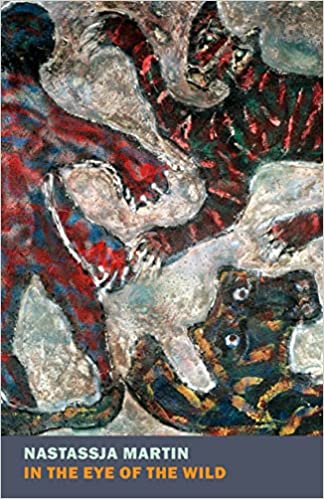
Suspended between human and animal: In the Eye of the Wild by Nastassja Martin

The sounds I hear are enhanced. I hear like a wild animal, I am that wild animal. I wonder for a moment whether the bear will come back to finish me off, or to be killed by me, or indeed for us both to die in a final embrace. But I already know, I sense, that this will not happen: he is far away now, he is stumbling through the high steppe, blood dripping down his pelt. As he is farther away and I look deeper into myself, we each regain our self-possession.

The opening passages of French anthropologist, Nastassja Martin’s In the Eye of the Wild are strangely surreal. She has just had a violent encounter with a bear on the Kamchatka Peninsula region of the Russian Far East, awaiting rescue. She is in a lucid state, numb, acutely aware. but her preternatural sense of connection with the animal who has wounded and disfigured her sets the tone for the account of physical and psycho/spiritual recovery that follows. Devoid of pathos, it is a tale of self-observation, ethnographic insight and the drive to understand what has happened—not from the angle of Western medical science, but from that of the Evens, the Indigenous people she had lived among and worked with in Siberia for four years.

Martin’s voice is most striking. Throughout her often quite horrific hospital ordeal, first in Russia and later in Paris, she does not hide her anger, frustration and physical agony. Her injuries are extensive, to her face and leg. Her jaw needs to be reconstructed—twice because the French doctors don’t trust the Russian work—and there are serious complications. Following a visit from the surgeon after a successful operation, she reflects on her body, her being, as an occupied territory under siege:

Recovering from this clash is not only an act of self-focused metamorphosis, it is a political act. My body has become a territory where Western surgeons parley with Siberian bears. Or rather, where they try to establish communication. The relationships being spun within the little country my body has become fragile, delicate. It’s a volcanic country, landslides can happen at any moment. Our work, hers and mine, and that of the indefinable thing the bear has left deep in my core, consists from now on of “maintaining the lines of communication.”

Existential questions drive the narrative—not why did I survive?—but a deeper examination into the intrinsic meaning of the experience. In this, dreams become essential to piecing together an understanding and acceptance of the relationship she has forged with the bear.

As soon as she is allowed, Martin retreats to the solitude of her mother’s home in Grenoble. Here she reads, speaks with her therapist on the phone, and tries to articulate the symbolism of what has occurred. She seeks precision in her choice of words—an attention that shines through in Sophie R. Lewis’ translation—but something deep has been destabilized that is not conforming to her intellectual instincts. She is not, as her therapist has advised, at peace. In truth she knows that she has not been inclined to seek to facilitate peace in her life or social interactions. “I have never known what to do with peacefulness or stability; serenity is not my strong suit,” she says. This self-evident prickliness, casts the narrative in a light not typically found in survival memoirs while her years spent among Indigenous communities, first Alaska and then Kamchatka, and her academic study of animism, have informed her encounter with the bear in a way another unfortunate hiker on a short excursion into the mountains would likely not. There is a notion of destiny and an element of suspension at the threshold of human and animal that cannot be explained by the park warden or naturalist. The anthropologist can only begin to heal by returning to the wild.

Her mother is decidedly unenthusiastic when she announces that she must go back to Russia. Barely recovered physically from her multiple surgeries, she is determined to leave. So, only a few months after the original incident, Nastassja Martin is again deep in the forests of Kamchatka, staying in a small cabin with Daria and her son Ivan who have become like family over the years, and other relatives that come by. It is the middle of winter; she joins in the necessary tasks and activities of the day, fetching water, setting traps, and gathering the wisdom and answers she needs to finally begin to process the journeys—internal and external—she and the bear have taken since their paths first crossed.

In the Eye of the Wild is an account that captures the way that the intellectual and the emotional can be at odds in the attempt to put meaning to a major trauma or loss. Martin is, by turns, angry, philosophical, and numb. The ethnographic has suddenly become profoundly personal and no amount of book knowledge can resolve it. The boundary has been blurred. This fuels her relentless determination to face down, if not the bear itself, the dreams he has bequeathed her. The result is an inspiring account that demonstrates an abiding respect for both the animal and the only people she knows can truly help her understand not what happened, but why.

In the Eye of the Wild by Nastassja Martin is translated by Sophie R. Lewis and published by New York Review of Books.

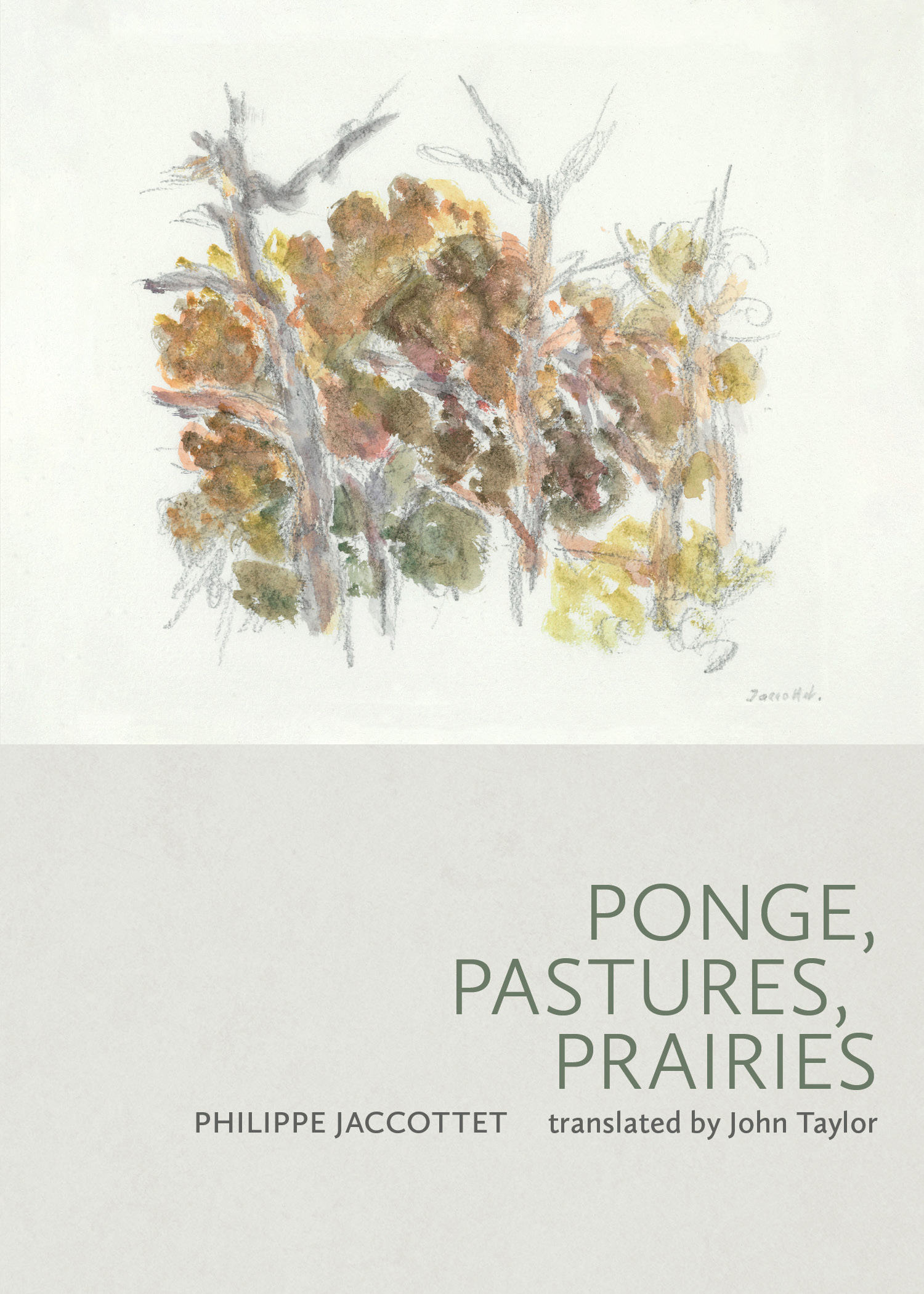
Each to his own “green truth”: Ponge, Pastures, Prairies by Philippe Jaccottet

Ponge, Pastures, Prairies is more than a simple tribute to French poet and essayist Francis Ponge by fellow poet Philippe Jaccottet, it is a deeper examination of the way creative influences sift through a writer’s own process of literary development. The two men first met in 1946, when the latter was barely twenty years-old and, as Jaccottet recounts, he imagines that, though he said nothing, the older man likely had his reservations about his youthful lyric enthusiasms. Nonetheless, a friendship between them would form and continue for over forty years. When Ponge died in 1988 at the age of 89, Jaccottet was among the mourners at his funeral in a rustic graveyard in Nîmes. It is with his reflections that day—a piece intended to stand alone—that this small, special book has its origin.

The funeral was a modest affair on a bright summer day, but it was not one without qualities that seem to Jaccottet oddly fitting for his friend. The pastor arrived quietly by bicycle and chose to recite the 23rd Psalm beside the family vault, “because the deceased was a poet.” King David’s ode to his heavenly shepherd and “green pastures” was followed by a simple reading of Ponge’s “The Meadow” by actor Christian Rist:

“Carried away suddenly by a sort of peaceful enthusiasm / In favor of a truth, today, which is green. . .” This kind of albeit distorted echo, over some thirty centuries, was thus perhaps even stranger and more striking than the rest (the vast, noble, abandoned cemetery and this burial, as if for an unknown person, of a writer so legitimately famous).

This juxtaposition sets the scene for Jaccottet’s homage to Ponge—a poet whose domain was the minute examination of the everyday—calling attention to his commitment to a “green truth” and the remarkable vigour with which he defended it. A sketch of a strong character, given to both “excessive intolerance” and “most generous enthusiasms” emerges, composed in the emotion of the moment of loss. It is not surprising, then, that despite the many formal arguments he had offered in praise of his friend over the years, Jaccottet felt a personal need to articulate what essentially separated him from Ponge’s work. So he started to write a follow up.

However, the expansion of this text into its final form was not an immediate or obvious project. In his Postface, written in 2013 when he was preparing for the original French publication, Jaccottet admits that he was not inclined to work his sentiments through to a natural end. Others encouraged him to think otherwise, but still he delayed, out of laziness or, perhaps, out of fear that entertaining his reservations might be disrespectful to a man he had continued to admire and think of with great affection. But this recognition of the complex interplay of influence and divergence, explored with a perspective stretching over more than two decades lends depth to this slender volume.

Jaccottet begins with a consideration of two of Ponges’ heroes: François de Malherbe (1555-1628), the French poet and critic who insisted on strict form, restraint and purity of expression, and composer Jean-Philippe Rameau (1683-1764) whom Ponge proclaimed as the artist who interested him more than any other with a style “of the kind that awakens: male, energetic, and  ardent.” If these men spoke to the inspiration that charged his friend, Jaccottet takes care to look at how his own response and tendencies diverge. As he moves on to discuss the way their approaches to writing start from contrasting points of view or ways of looking—one precise and object-oriented, the other lyrical trial-and error experimentation open to the “fleeting impression.” However, even if the origin and ends differ, he can acknowledge that his thinking on questions, such as the “enigma of purity” has been influenced by Ponge’s concern with that which is “pure” or “true.” One’s questing can be furthered, after all, in discourse with those whose creative inclinations deviate from one’s own. And throughout this text, Jaccottet is careful to reiterate his respect and fondness for Ponge, a feeling that he is assured in reviewing the volume of correspondence they exchanged over the years, was returned.

Ponge, Pastures, Prairies offers a tribute and a uniquely honest, yet sensitive critique. Jaccottet writes very thoughtfully, entertaining ideas about poetry, death, and the particular dynamics of the relationship between himself and Ponge in a manner that does not require a deep familiarity with the work of either man. In this regard, the extensive footnotes, based on Jaccottet’s own but expanded by translator John Taylor, are helpful and informative. I will confess that I have acquired more than a few volumes of Jaccottet’s work over the years, but until this time I’ve not seriously engaged with any, feeling, perhaps, a little intimidated or uncertain where to start. This book has ignited my interest and opened the door or, as Jacottet might say, a crack in that wall.

Ponge, Pastures, Prairies by Philippe Jaccottet is translated by John Taylor and published by Black Square Editions.

Towers rise, towers fall: Sandfuture by Justin Beal

The World Trade Center must have been climbing its way toward the heavens when I first visited New York City, my mother’s hometown, in 1969. However, at the age of nine, the tall building that caught my fancy was the Empire State. It made no impression on me that its record height was soon to be overshadowed—I best remember the imposing measures taken to keep visitors from plunging to their deaths from the observation deck. Being terrified of heights I was struck by the twin existential shock and thrill that such a risk could even be a concern. Somehow, it’s a strange, small comfort to know that Minoru Yamasaki, the Japanese-American architect who designed the World Trade Center shared the same fear, allowing his own sense of comfort to influence his proposal for narrower, deep-set windows on his famed—and infamous—creation. Although he would be convinced to open up the view in several ways, the Twin Towers sealed his reputation for better and worse, because even though he did not live to witness the events of 9/11, his life and career cannot be abstracted from the dramatic destruction of not one, but two, fated architectural projects.

Until now. A sensitive, humane account of Yamasaki’s life and work lies at the core of Sandfuture, an ambitious work of literary nonfiction by artist and writer Justin Beal recently released from MIT Press. Not explicitly a biography nor a treatise on the collapse of architectural modernism (literally or figuratively), it is rather a far-ranging, inventive hybrid essay. Woven around the central biographical narrative is a fascinating stream of memoir, architectural history, and reflection on the myriad ways bodies, buildings and cities mirror one another in sickness and health. Beal draws on his own experience as an artist and as a student and admirer of architecture, and as a partner and a new parent, but he never gets in the way or loses the key focus of the interconnected ideas he wants to pull together.

Throughout Sandfuture it becomes clear that in so many things in life and art, fate and design are inextricably bound. On the morning of September 11, 2001, Justin Beal happened to be sharing an apartment with a couple of friends just a few blocks from the World Trade Center, so he was personally caught up in the rush and panic that followed the collapse of the two buildings. That event, because we all know it so well, looms in the background, a ghost of future tragedy that haunts Yamasaki’s entire life and career and beyond, but the event itself plays a peripheral role in this book. There are many other forces and factors at play when disaster strikes. In fact, Beal had recently relocated to Manhattan from Los Angeles on October 29, 2012 when Hurricane Sandy hit the eastern seaboard hard and that natural disaster is where his account begins with a vivid depiction of the force of water pushing down on the lower lying areas of New York, bringing destruction and flooding and exposing the socioeconomic distinctions that drive urban development and decline. Meanwhile, closer to home, countless pieces of artwork stored beneath the gallery his girlfriend co-owns are damaged beyond recognition. In the drama of this opening section, some of the key threads that will loop through so much of the material to follow make their first appearance.

Minoru Yamasaki was born in Seattle on December 1, 1912, the son of Japanese immigrants. Inspired to pursue architecture by a visit from an uncle, he entered University in 1929—just before the Stock Market Crash, an event that forced him to earn money for his tuition by working in Alaskan salmon canneries over the following summers. It was an experience that helped forge his personal mythology yet it also signals a trajectory marked by unfortunate timing. He arrived in New York in 1934 with $40 to his name, just as the Great Depression was taking hold. But the city gave him his start, and over the next decade he gained valuable experience, made important connections, and met his first wife.

In 1945, he was recruited to join a firm in Detroit. The city would become his long-time base, but when he first arrived racist sentiments fueled by the war kept him from buying a house in a desired neighbourhood. Curiously, more significant racial tensions would become synonymous with the legacy of his first major project in his new position—the design of a landmark public housing project in St. Louis named Pruitt-Ioge. The goal was ambitious: replace densely-packed slums with a massive complex comprised of thirty-three buildings and almost three thousand apartments. Guided by a vision he hoped would foster community building, Yamasaki’s design incorporated a number of design features intended to encourage interaction, some of which would, over time, prove not only counterproductive but dangerous. The buildings deteriorated, crime rose, discontent escalated, and conditions fell into a state beyond repair. Finally, in the spring of 1972, the first explosions detonated on the now abandoned buildings were broadcast on live television. While the World Trade Center rose, Pruitt-Ioge was systematically reduced to rubble. As Beal demonstrates, the factors contributing the project’s failure are multifaceted beginning with strict cost-cutting measures from the outset, but in the public eye the architect would publicly and unfairly wear the blame.

The architect is so often imagined as hero, gracing the pages of novels or commanding the silver screen, projecting an impossible romantic ideal. He is also a figure who makes a regular appearance throughout the course of Sandfuture. Standing against it all, is the real, very human character of a man who casts a somewhat shadowy presence even in his own archives. Yet it is Yamasaki who gives this story its soul. He was an architect who challenged conventions with varying success, often hobbled by the constraints placed upon him by the confluences of forces and interests driving any major project. Drawing on influences from time spent in Japan, India, the Middle East, and elsewhere, he wanted to promote a movement away from modernism which he saw as overwhelmingly monotonous and lacking “delight.” He persisted, dedicated to his craft and vision, but the pressure took an early toll on his health. He drank heavily, married several times, eventually reuniting with his first wife, and waged a battle with ongoing stomach troubles—ulcers and, finally, cancer. He comes across as a conflicted figure, as prone to bouts of both despair and overconfidence as any other driven professional, lauded, then slipping out of favour, only to be awarded the most prestigious project on the planet. But as ever, so much rides on the final product. Each design is, in the end, a structure that has a life of its own—bound to a vicious cycle of critical reception, practical and public utility, repurposing, and ultimately neglect and decline by which point the architect has already moved on.

Author Justin Beal, as an artist with a deep fascination with architecture, brings a unique perspective to this multi-stranded biographical effort. Having studied the subject, he enters into his serious engagement with Yamasaki’s work and ideals burdened by an architectural education that was inclined to deride the architect’s value to the field. He has to relearn what he thinks he knows. As he scours library documents, architectural journals, news reports and, of course, the many buildings Yamasaki designed during his long career, the sense of a genuine desire to interact with and understand the difficult, maybe misunderstood man behind the designs never wanes.

So, if Yamasaki is the soul of Sandfuture, Beal is the heart. He, his partner, and his daughter are a measured presence, their adventures adding a novelistic quality to transitional passages that, if at first unclear, lend new, relevant dimensions as the work progresses. Prominent among these “memoirish” side threads is a recurring discussion of migraines. Beal’s girlfriend, Nina as she is named here, suffers from crippling migraine headaches. At one point she is even hospitalized. The exploration of this topic sets the foundation for discussions of the history of sanitariums, interconnected notions of bodies and buildings, Sontag’s Illness as Metaphor, and the concept of sick building syndrome. After all, whether one is constructing a house, a temple or a skyscraper, the mechanical is as essential as the organic. Or so it should be.

The construction of the World Trade Center is, of course, an essential feature in this book as it is in the career of its designer. Structural dilemmas and decisions are explained with just the right amount of detail and tension. Woven around this element are two other key architectural projects: Yamasaki’s Pruitt-Ioge, its televised fate foreshadowing that of the Twin Towers, and at the extreme opposite end of the residential income spectrum, 432 Park Avenue, the luxury condominium project towering over Central Park. This, rather than One World Trade Center is Beal’s post 9/11 counterpoint. This striking triangulation of structures is telling—none of these buildings is, or was, able to meet the reality of its intended (or desired) tenants. They reflect the motives of developers and urban planners, fueled by ego, money and ambition. They have all come up hard against practical, social and economic pressures, greater threats to any architectural project than gravity itself.

Sandfuture is one of those books that is so full of interesting ideas and information that, in the end, it is almost impossible to succinctly describe what it is about. With such projects there is always the temptation to throw in too many sidenotes, too many literary references, too much personal information. It’s a balancing act and yet somehow in this whirlwind it all manages to come together seamlessly. At one point my editorial instincts questioned the layout—one 250 page effort broken only by small section breaks—leading me to wonder if this hybrid effort was too ambitious to succeed, but that concern soon faded. Intelligent and entertaining, Beal maintains a tight pace throughout, turning in unexpected directions and connecting everything back to his main themes and to give his rather unfortunate hero his due.

Sandfuture by Justin Beal is published by MIT Press. It is a handsomely presented paperback featuring a centre section of black and white (and one colour) photographs and a detailed source note on materials used.

Memory is a record book of errors: The Town Slowly Empties by Manash Firaq Bhattacharjee

We take the everyday for granted. The history of the everyday, as Gandhi said, is never written. We don’t write the history of harmony. We write of history with a capital H. The history of strife. The history of the everyday is the history of a time that exists in the blurry lines between memory and forgetting. The days we remember are the days of events, personal, social or political.

It seems such a long time ago that the world slipped into lockdown as a strange, invisible threat began to spread causing illness and death. Where I am in Canada, our first lockdown was the strictest even if it was considerably less severe than in many places. Dramatic charts were hauled out, ominous predictions were made and the outside world suddenly seemed to become a dangerous place. Yet, the feared explosion of cases never materialized except in nursing homes and long term care. We slipped out of confinement into a summer of somewhat reduced freedoms but plenty of elbow room. The consensus: the lockdown was extreme and unnecessary. Of course, it’s impossible to convince a skeptic of the success of a measure by the absence of the thing you set out to prevent.

So we became our own control group. Winter brought a second wave and only when cases and deaths started to rise exponentially were some restrictions brought back. Protestors took to the streets to decry their loss of freedom in the name of an imaginary illness that, even if it existed, was primarily taking only the oldest and weakest among us. Nothing but the flu.

Now as Spring slowly settles in, we are into a third wave, fuelled by variants, striking a much younger cohort and rapidly expanding. The government is responding with weak-kneed measures—even less intense than the last round—figuring we will vaccinate our way out while ICU beds fill up with the sickest group of Covid patients yet. Yes, perhaps fewer of them will die. But anyone who arrives with a serious condition that would normally warrant an ICU bed will have to be weighed for worth, for likelihood of survival, against some young, otherwise healthy Covid patient presently gasping for breath. And people will die who would not have died otherwise. How serious are things? Today the case rate in my city was more than twice that of India.

India. A country that has come to mean a lot to me these past few years is presently on fire—metaphorically and factually. It is painful to watch, heartbreaking to think of. Here in the West, even when things are bad and resources are stretched beyond reason, illness and death is sanitized, hidden behind closed doors, underestimated, forgotten.

All of this is but a long, yet timely, introduction to my review of The Town Slowly Empties: On Life and Culture During Lockdown by Indian poet and writer Manash Firaq Bhattacharjee. This has proved a very difficult book to write about. In fact, as the present crisis in India began to escalate, I found it increasingly difficult to read. Not that it isn’t good. It is a most wonderful, personal engagement with the early weeks of the sudden, strict lockdown imposed on India last March. Exactly a year ago as I was reading. At first there was a definite sense of déjà vu, but soon the altered routines, unexpected observations, and thoughtful reflections began to feel, quaint, otherworldly, against the horrific backdrop of the second wave now battering the country. Yet, the current state of affairs should in no way undermine the merit of this chronicle of adjustment to the limitations and possibilities of mandated isolation. In truth, it makes it all the more relevant.

The Town Slowly Empties—the title comes from Albert Camus’ The Plague—unfolds as a series of journal entries beginning on Monday, March 23, just after a complete lockdown has been declared in Delhi. Within days the entire nation will follow suit with only four hours’ notice. The daily reflections continue until April 14, the end of the first phase of restrictions. Each day’s record is a melange of domestic activity, pandemic progress reporting, political and social contextualizing, philosophical musing, and the sifting of memories, all woven together with  literary references, film commentary and a passion for food. Lockdown life offers an uncanny blend of the exceptional and the ordinary. Something frightening is lurking close at hand, just outside the door where the streets have grown quiet, while inside time has expanded, leaving even more empty space to fill, more anxious thoughts to fill it, especially supercharged in those early days.

We have become watchmen, standing guard at ourselves, at our shadows. We terrorize ourselves with caution. We become extremely careful about what we touch, and if we touch, we immediately wash our hands with soap for at least twenty seconds. We are mindful of the merest hint of a sore throat, or rising temperature. We also have the time now to watch others, and not just the human species. We carry the virus in our heads, in our sleep, and some with intense paranoia, perhaps even in their dreams. Fear is our only mode of retaliation. We are brave, we fear bravely. We cannot laugh at ourselves. The absurdity of survival must be taken seriously.

For Bhattacharjee these extra hours afforded by lockdown are measured out in poetry, prose and film. A host of writers and filmmakers become his companions, offering illustrations, examples and inspiration as the days roll by. Along the way he calls upon TS Eliot, Rimbaud, Gabriel Garcia Marquez, Fernando Pessoa, Kafka, Agha Shahid Ali, Zbigniew Herbert, Abbas Kiarostami, Satyajit Ray and many others, engaging with their ideas and imagery. This is, then, far more than a record of news reports, readings and recipes, though there is a clear sense of the quotidian routine—waking late, securing provisions, morning tea, making lunch. Each day brings new circumstances, spectacles, and tragedies to process: face masks, Zoom meetings, lost lives translated into statistics, hungry migrant workers desperate to get home. The daily act of processing such experiences through writing opens avenues for the past to enter the stream of the present. Thus, this journal also becomes a memoir and a meditation on memory.

As the days pass into record and reflection, Bhattacharjee will recall moments of his childhood in Assam, his college years, his courtship with his partner, and his pathway to a love of cooking. But the memories he visits are as often collective as they are personal, of mutually shared experiences, or times captured in historical and literary record. For we live not only in our own pasts, but through the lives of others. Under the shadow of Covid-19, we look for meaning not only in pandemics and plagues, but also in disaster. One of the most interesting entries—and now eerily prescient given how the second wave is currently devastating India—moves through film and literature, from Chernobyl to Bhopal, tracing a landscape of disaster in the words of two writers formed in their wake—Svetlana Alexievich and poet Jayanta Mahapatra. Both chronicle the pain and destruction of scientific catastrophe as written on the body and the spirit. Both speak to the necessity of remembering. But how?

Science has no memory. Memory has no science. Science is an idea of progress without memory. Memory is a shelter. Memory looks for shelter. When a scientific experiment goes wrong, it affects nature. The sky, the sunlight, and even the silence turn toxic.

Covid-19 presents a complex interaction between nature, science and society. It is an event that has been anticipated for years, but the degree of disaster experienced reflects lack of planning and uneven response. Vaccines are welcome, if they can be produced and obtained, but the refusal of politicians and people to listen to the scientific advice they do not like—to wear masks, maintain distance, lockdown when needed—has led to unnecessary illness and loss of life around the world. What documentarian or poet will be the one to bring science and memory together to bear witness to this pandemic? For now, we can only meet the moment.

Today many people are starting to imagine a day when the pandemic finally recedes in the rear view mirror. Others are still fighting. Until the world is vaccinated, Covid will still be with us. It may always be with us. With this in mind, Bhattacharajee’s book is both uncomfortable and comfortably nostalgic. There was a sense of global unity to those early days. Yet there is much more within these pages. Reading The Town Slowly Empties is akin to spending time in the company of an intelligent, poetic friend—the sort of person who always has an interesting story to tell, a poem to quote, a book or movie to recommend. To that end, this friend has been sure to leave you, his reader, with a select bibliography, a filmography and extensive notes. You are not left empty handed.

The early months of the pandemic generated a flood of “Lockdown Diaries.” 3:AM, the magazine I was editing for last year, ran such a series as did many other venues.  A friend of mine in Bangalore dutifully maintained a daily record, with an eye to economics and social policy among other topics. He has picked up the thread again; at last count it was Day #415. Plague-themed literature also experienced a revival. For a while it seemed as if it was all too much. This warm and thoughtful work reminds me that there cannot be enough. Lest we forget. This experience will look different in a few years’ time, but already our world and our way of being in it has been altered in ways we could not have imagined when we first retreated into our homes in what sometimes feels like another lifetime.

The Town Slowly Empties: On Life and Culture During Lockdown by Manash Firaq Bhattacharjee, featuring a foreword by Sasha Dugdale, is published by Headpress.

Standing witness to the “ordinariness” of prejudice and violence: Unearthed by Yvette Greslé

I am, I confess, a sucker for a beautiful cover. I first encountered Yvette Greslé’s Unearthed on Instagram while I was in India last fall, looked it up, was intrigued, and ordered it as soon as I got home. Greslé is a London-based art historian and writer, born in South Africa, who spent her childhood in Seychelles, an archipelago nation in the Indian Ocean off the east coast of Africa, before being sent to boarding school in Johannesburg as a teenager. Moving between time and place, she explores the “ordinariness of the colonial order,” and the ongoing normalization, the very mundanity, of racism, intolerance, and violence. She stands witness, ever conscious of the advantages afforded her as white. And of the complicity she bears.

Greslé is, as she describes herself, a sensitive child. She is aware of ghosts. Her dreams are suffused with quiet symbolism. Her mother tells her she is a hypochondriac. It is not good to be too sensitive. Yet, it is this sensitivity, a certain pensiveness, that makes Unearthed such a compelling and thought-provoking read. Spare and elegiac, this short work occupies a liminal space between memoir and social discourse. As the author draws on personal experience and a wide selection of readings to trouble uncomfortable questions of privilege and prejudice, she offers an unflinchingly honest assessment of the society that formed her.

Memories layered on memories create an essay that is beautiful, painful, and wise.

The early island years have a magical tropical glow—white sand beaches, cinnamon, bananas and pineapples—but with distinctly colonial manners, and a sharp divide between the French and English residents and the Creole population. Greslé’s father was born in Seychelles , a descendant of French settlers. He had moved back from Johannesburg with his South African wife and young family in 1974, only two years before the country achieved independence from Britain, which led, by the late seventies, to a period of great political unrest. This in turn heightened tensions at home that the author, still a child, finds herself caught in:

My mother wanted to leave the island but my father wanted to stay. Sometimes, in the middle of the night, crockery would fly around the house and I would hear my parents shouting. My father couldn’t let go of the land and when he asked me if I wanted to leave the island, I shook my head and said no and this ‘no’ was without ambiguity. From childhood, I was conscious of an emotional bond to my home on the mountain and the land that surrounded it and, as I grew older, I was conscious of not wanting to give it up. Now I can see that my identity and sense of self were wound up in my father’s name and the possession of this land. It was only later that I would come to fully grasp and develop a language for what was truly at stake and for whom. I would come to see how I was positioned within a history embedded in a racial violence and white entitlement.

In 1984, Greslé will be sent to boarding school in Johannesburg and her experiences in South Africa, through her teens and into her adult years would deepen her understanding of, as she puts it, “the logic of white supremacy” and the “human capacity for brutality.” It is not a pretty picture, nor is the violence always obvious—it can be inflicted on the soul as readily as the body. At times, Greslé herself will experience othering, at times when her own ethnic origin is questioned, or just because a capacity to scapegoat exists even within groups that are otherwise (presumably) alike.

This is a memoir that, more than tracing the events of a life lived, traces an evolution of thought. It simmers with controlled emotional tension, and while moving back and forth in time, a frequent use of the present tense creates a sense of immediacy. Greslé shares moments of pain and loss without self-pity or sentimentality. Her reading and her experiences in post-Apartheid South Africa and, currently, in London, reinforce her impatience with the insistence that we have moved beyond the divisions of old—that they are of another era, or rendered no more severe than the disadvantages we each can catalog in our own lives. Or, if these intolerances still exist or may in some places be rising again, it has nothing to do with us as individuals. I’m not like that. Its time to move on.

But there is no line to be drawn between the past and the present. The past cannot simply be buried and forgotten about. The past lives on in the lives of the descendants of those who have suffered the kinds of things that don’t just go away, the kinds of things that inhabit bodies and memories. Racism, xenophobia and prejudice in all of their iterations are not simply historical artefacts, inanimate objects.

 This is one of the most deeply affecting essays I’ve encountered—an example of the way our own stories can be told to tell stories that are larger and more important than we are. The kind of stories that are difficult but need to be told. It feels as if Greslé has wrung each sentence from her heart; toward the end she admits that she is restless, that these swirling memories and images, all the concerns unanswered, are taking an emotional toll. So many critical questions. So few answers. But this thoughtful meditation, this personal story, rich with passages from writers and thinkers and an accompanying reading list, and that’s a good a place to start as any.

Unearthed by Yvette Greslé is published by Copy Press. It is no. 13 in their Common Intellectual Series of 100-page paperbacks. Each title makes a proposition for living, thinking and enjoyment.

Too old to write? Indulging in a little writerly insecurity.

From time to time I’ll see a flurry of comments cross my social media pathways, complaining and commiserating about rejections and the frustration that comes from having one’s literary labours unappreciated routinely. I have also received a few rejections myself of course, but the more unfortunate reality is that I have rarely written and completed anything worth submitting unsolicited to any publication—and certainly nothing that would come close to resembling a manuscript to set loose in the world in search of a publisher. For critical work I always pitch first, but even then my rate of production has dwindled to exactly two reviews last year and one this year which has yet to see the light. Add a few small somewhat poetic efforts and a commissioned essay for a book that is supposed to come out sometime next year and that’s about the sum extent of my writing outside this space.

So, while I have submitted and pitched little, I have certainly written a lot of rejection letters since joining 3:AM Magazine almost two years ago. At certain times of the year, and this is one, I shudder every time Gmail pings on my iPad because the submissions and pitches roll in at a steady rate. I debate acceptances and agonize over rejections. I do enjoy editing, and I think I am a good and respectful editor, but because I edit for a publication that defines its own rules by essentially refusing to have any hard and fast guidelines, I have often opted to take on ambitious younger writers with what I think is a cool and original idea—maybe one they’d be hard pressed to sell elsewhere—even if it means that a lot of time may need to go into making that idea come to life. If I worked on a clock it would be reckless to allow accept such projects. But I’m not, so what is costing?

Quite honestly, I’m afraid it’s beginning to cost any pretensions to a writing life I my have ever entertained. I’ve never seen writing as a way to make a living, all the more power to those who need to, but at this point in my life it’s about trying to tell a story. My own.

However, I am beginning to wonder for whom and for what.

In early March I came home from a wonderful month in India with a notebook full of essay ideas. I felt I had turned an important corner in my own journey of self-acceptance. I carried a renewed sense of personal value. Within weeks a crisis erupted at 3:AM which was not only a very stressful lesson in the speed at which intolerance—in multiple directions—can spiral out of control and the damage it causes. I stayed on but with a greatly increased workload. Add to that, a difficult spring spiralling through grief, revisited traumas, family stress, and mental health challenges, and, at this point, all of those essay ideas sit exactly as I left them. Unexplored.

The one thing I am pleased with is this blog (or literary site as I call it when I want to sound serious). I’m not super prolific and my reading rate has been dismally slow, but I have written a couple of longer essayish meditations and, although I no longer review everything I read, I tend to treat the reviews a do write with more critical attention—equivalent to what I might seek to publish elsewhere. I am aware that I have a significant readership and that many of these reviews, especially if publishers pick them up and link to them, attract traffic and readership as well, if not better, than many lit sites. I am extraordinarily selective when I do accept a book for review and I feel no obligation to finish or write about a book that’s not working for me on some level—which is not to say one has to love a book to engage with it on a critical level, but there must be something of interest to talk about in a meaningful way. However, that’s another debate altogether. It’s my space, here I set the rules.

I can even engage in a little self-indulgent navel gazing like this when I need to.

Thing is, to go back to where I started, I not only see writers measuring their lives in accumulated rejections, I also see writers within my little network publishing. Books, maybe, which I don’t begrudge anyone, but also on literary sites and journals—and sometimes at a regular pace. Which leads me to think other writers have a collection of finished, or nearly finished, stories, essays, and poems sitting in file folders, virtual or otherwise, or being tossed to the vagaries of unpredictable editors like myself at all times. Or they write constantly.

This past June I started a daily writing practice with the encouragement of a dear friend and mentor, Naveen Kishore of Seagull Books. The first night I write a few prosaic words to myself about goals. The second night I emptied a couple of pages of anger and frustration until I nearly made myself physically ill. I’ve written about grief and loss, rehearsed a number of blog posts and essay fragments (like this one you are reading now), and at times I have used it as a journal to record my thoughts, activities, and goals. When all inspiration fails I have switched to the Devanagari keyboard and sputtered away in my rudimentary Hindi. I have revisited my entries several times, retracing my way through the accumulated pages, gathering words and ideas for use elsewhere; reminding myself how far I have travelled emotionally these past few months.

But still I am left with the questions: Why am I writing? Who am I writing for? What am I writing towards?

I can’t help but wonder if I am simply too old to start anything significant. Have I missed this train? Or rather is there just too much baggage now packed into nearly six decades and two gendered lives to unpack and make sense of? What if I do unpack it and find barely a story worth telling? Or worse, a story I cannot tell because I don’t know where it lies anymore. I am increasingly aware, as our world becomes ever more polarized on every axis—as we hunker down in our little glass houses with a pile of stones at the ready—that I look like a middle-aged white man (and I’ll admit it’s a handy façade on occasion) even if the actual truth of my being is so much more complicated and even ticks a few of the popular diversity boxes quite readily, should I want to define myself in such terms.  But, in the end, all the labels I could wear are simply part of complex real life lived.

Just like anyone else’s.

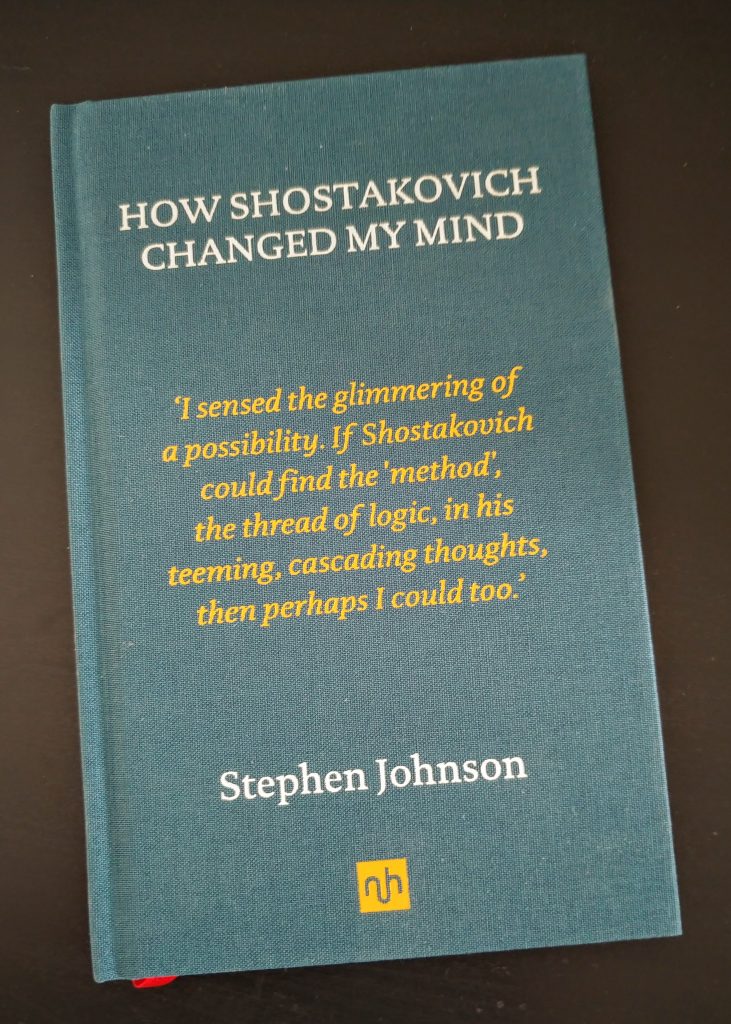
Ropes across the abyss: How Shostakovich Changed My Mind by Stephen Johnson

The opening pages of music broadcaster and composer Stephen Johnson’s How Shostakovich Changed My Mind detail what is clearly one of the most moving interview experiences of his career. He is in the St Petersburg apartment of Viktor Kozlov, one of the few surviving members of the orchestra that performed the triumphant debut of Shostakovich’s Seventh Symphony in 1942. He describes, with the clarinetist’s assistance,  how that performance was pulled together against all odds. Leningrad, as it was known at the time, was under siege, and Stalin not only wanted an opportunity to galvanize the beleaguered citizens, he wanted to send a message to Hitler who was waiting within earshot to celebrate victory. As an artist within a system that could turn against him in a heartbeat, the burden on Shostakovich to deliver a suitable masterpiece was immense. In the end, it was a rousing success. He managed to speak directly to the people’s emotions, and give them a reason to feel united in a time of war. The invigorated audience responded with an ovation reported to have lasted over an hour.

But here was something else too: that puzzling conundrum I had noted so often when pondering the appeal of Shostakovich’s music, but which now struck me with heightened force. In the Leningrad Symphony, Shostakovich had held a mirror up to horror, and reflected that horror back to those whom it had all but destroyed—and in response they had roared their approval, their delight, their gratitude to the composer for giving form to their feelings.

When Kozlov’s account of the event was complete, Johnson asked him a most formulaic question. He wanted to know how that same music made him feel when he heard it today, completely unprepared for the response. Both the elderly musician and his wife burst into tears—it was a question beyond any possible answer.

It is this ineffable power of music to reach into the deep emotional spaces in our lives where words often prove ineffectual, to give voice to that which we ourselves cannot express—especially in times of anxiety and distress—that becomes the very personal focus of this most fascinating book. Part musical biography, part memoir, part psychology and philosophy, this book-length essay draws its greatest strength from Johnson’s passionate affection for and deep connection to the music of Dimitri Shostakovich. His association with the composer’s repertoire reaches back to his own difficult adolescence when, ignorant of the world of rock ’n roll, he sought comfort in the Shostakovich’s thundering chords. Blessed with an acute musical memory, he was able to carry fully orchestrated movements in his mind in a manner he compares to a romantic teenage infatuation, during the times when his mercurial and unstable mother’s volatile behaviour made life otherwise unbearable. This uncanny musical aptitude serves him well as a writer. His ability to breathe life into complex orchestrated passages and open up the key elements at play in major works, is likely to inspire readers to download or stream the pieces under discussion, or pull dusty records or CDs from their shelves. It is not necessary to engage an aural experience in the reading, but it does tend to be difficult to resist the inclination to do so.

As one might imagine, given the unusual title, How Shostakovich Changed My Mind is an intimate account of the intersection of music with the personal drama, and trauma, of life lived. Johnson draws on literary, philosophical, neurological and psychological resources as he explores the connection between music and the brain, an area of growing interest and investigation, but he anchors his inquiry in the story of Shostakovich’s life and work during some of the most tumultuous events of the twentieth century—a thoroughly fascinating account in its own right—while tracing out his own particular relationship to this music and the role it played , not only in adolescence, but in his own adult challenges with bipolar disorder.

Shostakovich’s music can be wildly moody, shifting abruptly from lighthearted to savage to slow and achingly sombre. But it is not without structure. In listening carefully, Johnson became attuned, early on, to the thematic connections that he describes as ropes stretched across the composer’s own abyss, a bridge of sorts. It is a fundamentally important discovery for someone with a mood disorder—a condition I also understand too well:

As a bipolar sufferer, I know what it is to experience manic flight. At its worst it has been truly frightening, like a bad, drug-induced trip. Even when I’m not manic, I’m aware of how my conversation can go off on sudden tangents. Some of my friends have found it entertaining; others have found it bewildering, even alarming. It certainly alarmed my mother although she could be as dizzyingly tangential as anyone I’ve ever known. It was another aspect of my behaviour that provoked my father into panic-stricken attempts to close me down. I became seriously concerned about my own ‘intoxicating and leapfrogging’ thought processes—until, that is, I came to know Shostakovich’s Fourth Symphony. As I found Shostakovich’s connecting ropes and pulled them taut, it was though he personally was reassuring me. The exhilaration I felt was not dangerous; it was controlled, expertly rounded off by this extraordinary music.

If Shostakovich reached one troubled and alienated youth, it is not this particular music alone that holds the key. Johnson muses if he had been exposed to rock music he might well have found similar comforts and a peer group to share it with as well. But it matters not. The magic, if you like, lies in a link between music and listener, through a mechanism folded into the evolutionary structure of our brains. One that has the power to ease isolation, to unify, and to move both the individual and the crowd from “the ‘I’ to the ‘we’” as witnessed on that August night in Leningrad in 1942.

Moving deftly between the artistic, the scientific, and the autobiographical, this extended essay, never gets bogged down or off track. It makes no effort to be exhaustive, after all, at the core of the book is the relationship between the music of one very enigmatic Russian composer and the author whose life has been influenced, possibly even saved by it. Johnson’s own story unfolds like a well-crafted symphony itself, building through layers, in and out of the various streams of his narrative, to reach the point at which he was caught at the opposite end of the bipolar dance—in such an agonizing state of despair that suicide seemed the only way out. Again, he captures well the reaction of others to this side of the manic-depressive experience. In his darkened, unreliable state of mind, he came to believe that ending his life would not only ease what had somehow become an unbearable emotional pain, but would free up his wife Kate to get on with her life without the burden he felt he was invariably placing on her:

Depressives can be immensely frustrating for those who live with them. They tend to go around in the same anxious, obsessive circles endlessly; to the worried onlooker, it can seem that they actually don’t want to be helped; and they can be horribly irritable. For my part, I had still to learn that exasperation is more often a sign of love than its absence.

It was, ultimately, a fortuitous sequence of events that led him to his therapist’s office when he had intended to cancel; a lucky mistake that enabled an emotional breakthrough—or breakdown—that would turn the tide. However, Johnson can’t help but wonder if Shostakovich’s Eighth String Quartet had played even a small role on his road to recovery.

A year earlier, he had been given an assignment to prepare liner notes for a new recording of the popular Quartet, a task that had necessitated close engagement with a work composed when Shostakovich himself had been suicidal. He wonders if the writing and playing of the piece in which the composer famously places himself—or notes corresponding to his initials—as the central motif, had made him change his mind about killing himself, or whether it was simply the fact that a friend had intervened and removed the vial of sleeping pills he’d had on hand. And there’s the challenge: Music can do many things in times of emotional distress—reaching us in our darkened state with an image that is more accurate than the bleak self-portrait we cling to. However:

it cannot, in the broader sense, ‘see’ us. It can prepare us for the moment when we are seen; it can function as a life-raft in the most terrifying seas—for years, if necessary. But the moment of salvage needs a real living other, to see us and to know us, to signal to us that we are still worthy of rescue. Music could not do that for me, not quite—but it brought me very close.

How Shostakovich Changed My Mind is a rich account of the life and work of one of the most important composers of the twentieth century, a wide ranging discussion of the ability of music to provide expression and meaning in times of joy and sorrow, and, most importantly, a personal memoir of how music can serve as a means to navigate madness, especially in those times when, from inside, all one knows is that something is not right. This is a book for a wide audience, but for myself, as someone who also suffers from bipolar disorder, it has given me a lot to think about and reflect on looking back at my own relationship to music—and this illness—over the years.

How Shostakovich Changed My Mind by Stephen Johnson is published by Nottinghill Editions in the UK and distributed by NYRB in North America. Shostakovich: A Journey Into the Light, the 2011 BBC radio documentary that sets the groundwork for this book can be found online here.


The book that comes after the book is done: Appendix Project by Kate Zambreno

An odd thing happened when I was reading Kate Zambreno’s remarkable Book of Mutter, her fragmented meditation on grief and loss—a mix of memoir and literary and artistic criticism—that took her more than a decade to write. I sensed a strain in her relationship with her mother, reading it against my own circumstances. Of course there were huge differences between our lives and the ages at which we lost our mothers, but it seemed that even after such a long gestation period, her effort to work through her complicated emotions was still uncertain and unresolved. And, why not? Is grief ever really resolved?

Appendix Project, the unintentional follow up or companion piece to Book of Mutter, is a collection of lectures and essays composed during the year following the original book’s publication. It offers Zambreno a unique opportunity to continue a process that, to her surprise, was not put to rest with the final edits and release of a text she had already dedicated so much of her writing energy to. What more could be said? A lot it turns out. And the result is a more intimate, thoroughly engaging meditation on the impossibility of ever fully writing through grief, the limits of language, and the intensified emotional connection to her mother that she discovers through her own experience of motherhood. The entries gathered into Appendix Project trace the first year of Zambreno’s daughter’s life, and as such, her mother’s absence is filtered, re-imagined and given greater dimension through the presence of her child. In becoming a parent herself, her understanding of her mother as a mother has been altered.

What I never anticipated is how much being pregnant, and having a baby, would change the nature of time for me, and how that would interfere with the mourning of my mother, which I thought was finished, since the book I wrote about her was finished… My baby is almost four months old, but I feel she was just born, and that she’s been alive forever. I am 39 years old, but I have never felt more the past year like I was a child, have never felt more strongly the absence of being a daughter, of having a mother.

More haphazard, natural and organic than the book that proceeds it, this series of talks and reflections is not simply an addendum to Book of Mutter, or an alternative to reading from the book at public events, rather it grows over the course of its evolution into an intimate investigation into the act of remembering and attempting to put into words that which cannot be readily defined, confined, contained and released. There are many spaces where language is inadequate, where writing to process experience is not only irresistible but often  impossible. Drawing on—that is, thinking and writing through—the work of artists and writers like Barthes, W.G. Sebald, On Kawara, Anne Carson, Bhanu Kapil, Marguerite Duras, Louise Bourgeois, Peter Handke and many more, Zambreno is not just continuing to think and re-think her own work, she is opening up avenues of inquiry and contemplation for any intuitive reader or writer to follow to their own ends. To read Appendix Project is akin to listening to its author thinking aloud as she reads the works others, reflects on motherhood, and returns to reconsider the elements of Book of Mutter that, over its long journey to a finished form, were either abandoned or edited out.

During the course of preparing the pieces that come to comprise Appendix Project, Zambreno resists the idea that they will be published as a book, knowing at the same time that she is engaged in a project. Others suggest that she should just repeat her these lectures, considering the time it takes to put them together, but there is an important temporal element at play, an ongoingness that is essential:

It feels like a necessary act, at this point where I am as a writer, and also as a published author, to re-engage in a passionate way in the ephemeral and daily practice of the writer, a way of returning back to the semi-privacy of writing—the different forms this might take—the letter, the notebook, and the talk. A talk however, Barthes notes, is not quite a performance. A talk is an outline for writing and speaking, a means to prepare and vocalize one’s thoughts.

Herein lies the key, at least for me, to the success of this project.  As Zambreno sorts her thoughts out in the course of these lectures and essays, an attentive reader/writer can  find their own launching points to questions that they may be dealing with. Reading Book of Mutter set me off on long stretches of  writing in my notebook as passages I encountered facilitated unlikely connections I might not have made otherwise. It was often less what was said than the way something was said that caused me to think: how is that different for me? The fruits of my very idiosyncratic reading led to an understanding of my own queered relationship with my mother that I had never appreciated. I have since written about that in an essay posted here on my blog on Mother’s Day. My reading of Appendix Project, which I had little desire to rush, has likewise opened up further channels of exploration for my own writing—this time broader because the scope is broader—and some of this meandering has become key to another piece I have recently written for publication next year.

My point in bringing in my own reactions here, without fleshing out any of the details of the connections I made because they are relevant only to me, is by way of saying that this is not a book I can stand back from and review with the critical displacement required. Well I could, but that is not what excites me about this work. What makes this form of intelligent, personalized critical essay writing so powerful when it works (and it does not always work, especially when it slides into the overly self-indulgent and solipsistic) is that it can send readers (or listeners when presented as a lecture) to consider their own intersection with the topics discussed. Certainly grief and addressing the loss of a mother are central themes, but other losses—childhood, language, land, even sanity—can be subject to the same challenges of understanding and expression. My copy of Appendix Project is decorated in marginalia spinning off in a multitude of directions. And I have a stack of books Zambreno dips into—some old favourites, others yet unread—now sitting close at hand, not to mention a few more titles added to my wish list.

Finally, it’s worth asking whether familiarity with Book of Mutter will provide context for this collection of lectures and essays, and of course it won’t hurt, but this really more a book about everything that book (or perhaps any book) does not contain—what was removed, what was never there, what may never adequately be captured in any written text. They are really very different works, in form and intention. Book of Mutter, if unconventional, is still a highly structured  work of mourning that, in the end, left me feeling a little disconnected. Appendix Project fills in those gaps and much more. And as such it is an exceptionally original, intelligent, and generous work in its own right.

Appendix Project by Kate Zambreno is published by Semiotext(e).

Chanelling memories through verse: Edwardsville by Heart by Kólá Túbòsún

So memory returns
of the many demons from
which hope had sprung
that brought me here,
for which the journey
into this promise of a life
was some act of fleeing,
to which America
was both a saving grace
and distance a respite
in shawl and shield.

— from “Stepping Out: at Cougar Village”

When a Fulbright Scholarship brought a young Nigerian student to the American Midwest in 2009, the culture (not to mention climate) shock must have been considerable. But linguist and writer Kólá Túbòsún survived his first winter and returned to the University of Southern Illinois Edwardsville to complete graduate studies between 2010 and 2012. The town, as he advises in the Preface to his first collection of poetry, was a place which was, in the time he lived there, an open and tolerant community, welcoming to refugees and immigrants from distant shores. However, the scars of colonial expansion and the after-effects of slavery were not that far behind, and, now, with a mistrust of the other on the rise, one can only wonder how that mood is shifting. But that is not the immediate concern of Edwardsville by Heart. This book is one man’s poetic journey back through a particular period in place and time, mediated by memory.

Although Túbòsún does describe his process of composition in the introduction, in the reading I had the impression that the experiences he recounts in this memoir/travelogue were recorded during his time Stateside. The poems, which cover early encounters with a strange environment, visits to local historical sites, and tales of friends, lovers and mentors all have the feel of a diary, a recording of events as they happened. But in truth only one or two were actually composed in America although the idea of somehow capturing his time there did percolate. These poems were written over a six-week period in 2017, while the poet’s wife was away and he was at home chasing after their toddler.  At last the memories he had carried with him could be sorted, developed, and given voice.

There is a sense in which this collection speaks to a very specific place, experienced with an outsider’s eye, and a student’s youthful enthusiasm. The image of America that comes through is a remarkably positive one. Did Túbòsún arrive at a sweet point, or is this an effect of the nostalgia of youth? The poems of the first section, “The Visitor” capture a sense of wide-eyed openness to a new environment and, as the quote above suggests, to the freedom—romantic and academic—that distance from home affords. But as the poet recalls his first months in the US, and his first encounters with winter cold (recalling practicing with a freezer back home in Nigeria) he does not shy away from the reality of the racial profiling he encounters, accepting it with a disarmingly casual tone.

When his circle of experience widens to encompass cities like St. Louis (the first visit being a visit to a hospital ER as unlicensed driver transporting an injured friend) the tension and threats of violence become more of a concern. Friends warn him to avoid the city, but it is difficult to deny a peculiar pull:

But E.B.R. lived there,
I thought. Redmond the poet
shuttled poetry from here,
black as Ethiopian coffee beans,
to Lagos and Ìbàdàn
in my undergraduate days, with
a smile on his oak-hued face,
a deep crack in the velvet
voice in which his verses rolled
into colours that rhymed
with grace, Civil Rights lore
in quartets of memory.

—from “East St. Louis”

Moving through poems that recall his times in the classroom, at house parties, on road trips with friends, Túbòsún negotiates a balance between African and American classmates and friends and there is a sharp sense that being away from home is part of a necessary process of coming into an ability to understand and articulate his own language and identity. As a student of linguistics it is only natural that this otherness shapes and informs his academic experiences. This process colours the third section “Teacher, Student,” witnessed for instance in a poem like “Being Yorùbá”:

How do you teach a state of being?
You don’t. You teach instead tone,
do-re-mi like music on the tongue,
and greetings and norms; clothing,
and where caps bend on the head;
dance moves to restless beats that
skilled bàtá drummers replay
when you taunt them with
a semblance of competence.

Later, as his travels and adventures take him further from his temporary American home, he finds that his Nigerianness not only informs his encounters, but cannot be escaped. He is always a visitor.

Edwardsville by Heart is a quiet, reflective book. The fact that this collection was, for the most part, birthed through the filter of temporal and geographic distance, the clarity of the memories preserved and presented is remarkable. Rather than muted details or blurred recollections, we are offered an uncluttered vision—emotionally contained and all the more powerful as a consequence. Strongly grounded in place, time and experience, these poems do not shy away from the brewing politics and social dynamics at play in the part of the American Midwest where the poet found himself. But above all it is, as Túbòsún himself admits, his Edwardsville. And he freely opens it to us with this, his first book.

Edwardsville by Heart by Kólá Túbòsún is published by Wisdom’s Bottom Press.