A compilation of shadows: Ninth Building by Zou Jingzhi

From childhood till now, I’ve spoken many bold words. Publicly or in private, I’ve proclaimed the kind of person I wanted to be, though it never happened in the end. I feel like someone has somehow taken my place, leaving me to become the person I am now.

When I’m around too many people, I lose myself. In an unfamiliar city, among crowds of strangers, I keep having to stand still—not to ask directions, but to find myself. Even when I’ve done that, I’m still lonely, so I head back to my hotel and listen to the sound of rain.

These lines, drawn from the melancholy and poetic Introduction to Ninth Building by acclaimed Chinese writer, poet and playwright Zou Jingzhi, speak to a fragmented sense of self, a “compilation of shadows,” that has long accompanied him, appearing unbidden on the street or haunting quiet nights. This book, originally published in Chinese in 2010 and now available in Jeremy Tiang’s excellent English translation, is an attempt to give these shadows some of the depth, context and meaning distorted by the experience of growing up during the years of the Cultural Revolution. As Jingzhi says in an interview on the site of the 2023 International Booker Prize for which his book has been nominated:

 In the early 1990s, my childhood felt like it had been a gust of wind behind the trees. I used to spend my days being lost: What should I write? Whatever I wrote was wrong. It was impossible to get rid of my childhood back then. So I just wrote like that. I wrote for myself. I wrote to let go of my childhood.

Ninth Building is a cohesive work with a common narrator, but it is presented as a series of vignettes or very short stories, set between 1966 and 1977, arranged in a roughly but not strictly chronological order. Time, in its experiencing and remembering, has a somewhat fractured quality. After all, the Cultural Revolution was an unnatural period of disruption and upheaval and, as Jingzhi’s stories so clearly demonstrate, many hours of unstructured tedium. The first section “Ninth Building,” takes its name from the housing complex in Beijing where Zou is living with his family when the Revolution begins. He is about thirteen or fourteen at the time. The first story “Eight Days” is a diary format tale set in November 1966 that describes the eagerness and concern with which a group of boys set out to obtain Red Guard armbands. It is not clear that they understand just what they signify, only that they don’t want to be seen without one. Many of the pieces in this part demonstrate the haphazard way that the adolescents try to make sense the objectives of this movement sweeping the country, rejoicing in the death or humiliation of old women labelled part of the “landlord class,” unaware that many of their own families would soon be suspect. Yet amid the increasing levels of violence among their classmates and peers, there is a lot of idle time to be filled with a variety of friends and neighbours. Boredom had company.

There is a lot of humour in the first part of Ninth Building, some of it rather black, even disturbing, but much also reliant on the innocence of the protagonist and his young buddies (it is the 1960s after all). A wonderful early vignette (“Capturing the Spoon”) describes a night patrol during which the intrepid and enthusiastic guards observe, through a lighted window, a naked couple thrashing around in a bed. Alarmed, they rush to report this obvious, if strange, infraction, but the grown-ups from their compound’s “Attack with Words, Defend with Force” Unit are unmoved by this important information:

Nothing came of our waiting. We’d imagined they’d jump up immediately to stop whatever incorrect action was taking place. This was at the height of the Revolution, and the train we were on had switched to another track. What we’d seem didn’t fit the scenery on this route; red armbands and nakedness didn’t go together. The five of us had three flashlights between us, and for more than half a month now we’d stayed awake night after night, fully alert, wishing something would actually happen. Now something had, but the adults didn’t feel about it the same way we did.

The second and slightly longer part of Ninth Building, “Grains of Sand in the Wind,” opens in 1969 when is Zou sixteen and sent to the Great Northern Waste for “re-education through poverty.” He is one of the millions of “educated youth” sent to work in rural areas and learn from the peasant population. He will not return to the city until after the Revolution comes to an end in 1976. These are years filled with long days of back-breaking labour under harsh conditions, yet no more immune to extended periods of boredom than he knew in Beijing. But here the distractions, apart from the required performances of patriotic operas, were limited to gambling, drinking and practical jokes. Innocence is gone; the underlying tone is now one of resignation. Zou and his peers have come of age in a time when their lives and dreams of the future are suspended:

Youth is a concept whose meaning isn’t easy to grasp. You might as well try to wrap your mind around every era, every event. The word doesn’t really evoke any special memories for me. Perhaps I’ll have to wait till the age when every other sentence begins with “back then” before I truly understand it.

The vignettes set against the vast rural landscape are harsher, with more tragic elements. They are not devoid of humour or eccentric characters, but illness, injury and death feature regularly. Life is cheap. However, poetry and increasingly astute observations are woven into Jingzhi’s anecdotes and tales. As his narrator matures and grows more cynical, he also begins to recognize the seeds of his future as a writer that have been sown during these long years.

The Cultural Revolution was a period of great turmoil during which the power of radicalized youth was harnessed against the Communist Party hierarchy, but as illustrated by Ninth Building, the impact on many young people during this time was marked not by heroism or the glory of conflict, but by years of boredom, dislocation and numbly tedious labour. With its brisk pace and refusal to succumb to despair in spite of the countless temptations, this collection of brief vignettes makes for an entertaining and powerful read.

Ninth Building by Zou Jingzhi is translated from the Chinese by Jeremy Tiang and published by Open Letter in North America and Honford Star in the UK.
The melancholy wanderer: War, So Much War by Mercè Rodoreda

Fresh air streamed in through the window. When the dining-room clock struck three, I rose and left without even washing my face and, you might say, with only the clothes on my back. I had taken some fifty steps when something made me turn around and glance back at the house. The moonlight fell full on it. My father stood at the door watching me, holding me–still a little boy–in his arms. It was the first night that I roamed alone through streets outside my neighbourhood. I ran. Goodbye carnations, adéu!

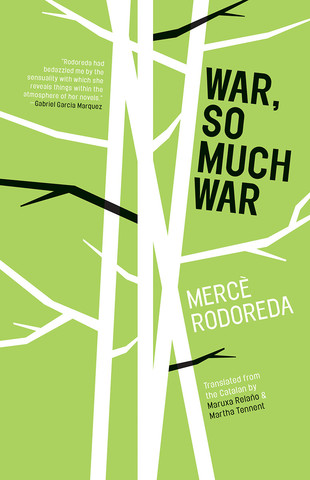
With this ghostly image of his deceased father holding his infant self, Adirà Guinart, the fifteen year-old narrator of Mercè Rodoreda’s poignant novel War, So Much War, turns his back on a fractious relationship with his mother and a life growing and selling carnations. He is seeking a life of adventure. Yet, as one must be careful what one wishes for, he is about embark on a journey that will leave him irrevocably changed, and sadly and wistfully mature for his age.

War_So_Much_War-front_largeAlthough the place and conflict is never explicitly named, it is assumed that the setting is Catalonia, the author’s homeland, during the Spanish Civil War. But in truth the exact details do not matter, this is a novel about the wide sweep of war beyond the front lines, about the damage, destruction and despair that works its way into the landscape, the villages and the lives of the people who are often hard pressed to explain who or why they are fighting. Yet, the bleakness is, in Rodoreda’s hands, filtered through a surrealist lens that renders it at once engaging, wise and profoundly sad.

Idealistic and bored, our young protagonist leaves home to join the war effort, but he is quickly disillusioned with the soldier’s life, and runs away again, falling into a life that suits his temperament, that of the wanderer. Unfolding over the course of a series of short episodic adventures he encounters an array of tragic comic characters–the bereaved, the abandoned and the eccentric–who share their wisdom, offer him lodging or seek his assistance. Classic folkloric elements are present, including a strange castle, an enigmatic young woman, an ugly old hag, a hermit with a tale of hard earned humility and a mysterious benefactor with a haunted mirror.

But War, So Much War is more than an allegory or a fairy tale, there is something profoundly serious and unsettling beneath the surface. The narrative, unadorned and seductive in tone, fuses sensuous evocations of natural beauty with brutal images of suffering and death. The ground is worked to plant crops in one place, only to be dug to bury piles of corpses in another. Our hero approaches each task without question, claiming resistance to the more tangible horrors of death; fearing instead the unseen,  phantasmagorical horrors that pursue him. But is there really a difference? In his world, reality blends with dreams, and the narrator treads a ground that gives away to as readily to natural beauty as to nightmare.

Even in romance, that line is readily crossed. Early on, Adirà falls in love with Eva, a free-spirited young woman. He is drawn to her most critically because she refuses to be held and restrained by anyone. As much as he admires that aspect of her character, a quality he also claims for himself, he begins to long for her as his journey moves, at least in spirit, toward home. Her ultimate fate is perhaps the most melodramatic, yet deeply tragic element of the entire tale.

The constant reminders of war–hunger, fear and confrontations with the stark face of human depravity–do not defeat Adirà, but their presence eventually closes in on him, working its way into his weary bones. At heart this pastoral novel is an existential coming-of-age story that leaves our hero enlightened but aged beyond his tender years. He is both a boy and an old soul at once. With so much disruption and young men lost to war, older men in particular seem drawn to his company. When a fisherman with who he has spent a couple of days invites him to stay on, become as a son to him, he explains:

My life is my own . . . A few months ago, I don’t know how many, I still had a pocket knife with a fork, spoon, corkscrew, and screwdriver that my father had given me, but I gave it away. And now the only thing I have is my own life. If I speak about it, it escapes, I lose it. He gave me a pat on the back, almost laughing as he did so. I know , I added, that all lives are more or less the same in the essentials. He thrust his head back and closed his eyes, leaving just a slit open to spy on whatever it was he wanted to see. Don’t make me laugh. What will you do, restlessly drifting from place to place? Do you want to end up sleeping on the street or in a church portico when you are an old man? I don’t care. I want to roam the world. Be from everywhere and nowhere.

For all its sadness, there is much wisdom in these pages. Rodoreda’s smooth, clean prose with its seamless flow between speakers without breaks or quotation marks, adds to the dreamlike, reflective feel of the narrative. For all the fairy tale elements that feature in Adirà’s wandering, the underlying current of his journey is marked by despair and hope. This is a novel that is not only timeless but, sadly, still very relevant today.

Mercè Rodoreda was born in Catalonia in 1908. Her native language, Catalan, was banned under Franco’s dictatorship, but she continued to write in the language throughout her career, even while living in exile following the Spanish Civil War. Today Catalan is spoken by only about nine million people and translations are critical to help keep the literature alive. Originally published in 1980, War, So Much War is translated by Maruxa Relaño and Martha Tennent, and published by Open Letter.

* War, So Much War has been shortlisted for the 2016 Best Translated Book Award.

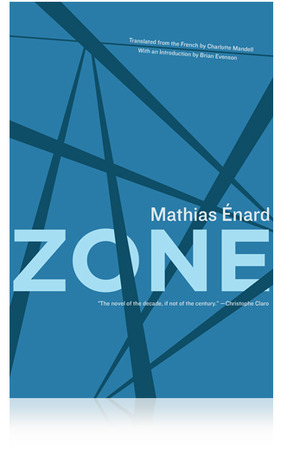
Collector of Corpses: Zone by Mathias Énard

Where to start with Zone by French author Mathias Énard?

“I climb into the trans-Italian express that must have been the zenith of progress and technology ten years ago for its doors were automatic and it went faster than 200 kilometers per hour in a straight line on a good day and today, a little closer to the end of the world, it’s just a train”

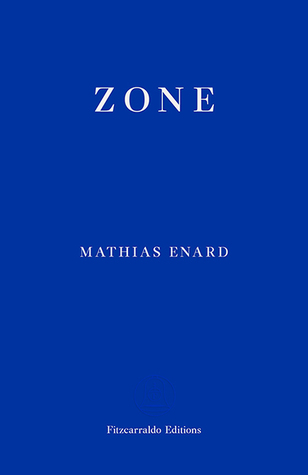
Imagine you are on a train bound from Milan to Rome, trapped inside the head of a French Intelligence Service agent, hung over and pumped up on amphetamines, who by reckless dalliance has missed his fight and is, as a result, having to make this critical trip by rail. Which gives him plenty of time to perseverate while he clutches a suitcase filled with documents graphically detailing war crimes, witnessed or reported to him during his time in the “Zone”, an area stretching from the Mediterranean to Central Europe. At the end of his journey he intends to sell the secrets he has collected, effectively resigning with a final act of treason, and disappear into a new existence with an identity assumed from a man long condemned to an asylum. And as the reader you are bound to the narrator, Francis Servain Mirković, for one breathless 517 page sentence.

zoneAs he streams forth a catalogue of brutal visions from his own memories, from history, art and literature, there is no respite. Even his love affairs are recounted with a desperate intensity. This not a book of bitter humour, it is a chronicle of horror, a memoir of regret. Francis is longing to be released from the burdens of his experiences, but that end is all very vague, growing even more so as he nears Rome. In the meantime, unable to sleep, to turn off his fevered brain, he is assaulted by grotesque images of his time on the battlefields of Bosnia with a Croatian militia unit. His lost comrades haunt him, his lost lovers loom large and through it all run threads of historical violence – decapitation is a particular obsession that he sees in, yet seemingly shares with, Caravaggio. Warriors of antiquity, martyred saints, Nazi war criminals all cast long shadows across the path of his racing thoughts. Violence is vividly described, and is often up close and personal.

This is not a leisurely read.

As a small concession to the reader, the single sentence is divided into chapters and periodically broken with segments of a novel about a female Palestinian fighter but there are times where one gets the distinct feeling that facts, and at times, streams of words words words are being employed as filler, as if anything less punishing than 500 pages would have been unthinkable. The risk however, is that the power of the images will be diluted, reduced to noise, numbing the reader, or worse, driving him or her away. Even the literary detours that turn toward Cervantes, Malcolm Lowry, William S. Burroughs, Jean Genet, James Joyce, Ezra Pound, Cavafy are typically delivered as measured portraits of ugliness and depravity.

If you have ever been in a room with someone who is in a manic state, you will know that they fill the space, suck up all of the available air. Such is the sensation of spending time in the presence of the narrator of Zone. Left to my own devices I am not sure I would have been inclined to open this book (sometimes size matters) or at least may well not have ventured past the first 150 pages or so. I may have disembarked at the next available station. And that would have been a shame.

Somewhere, two thirds of the way in maybe, the pressure begins to dissipate, perhaps as the drugs wear off, and the pace of the monologue eases, opening up space for more personal reflection and musing, more meaningful literary diversions and a sober assessment of his last serious love affair gone wrong. Even a little touch of humour. Mind you we are not exactly tripping through fields of daisies but the relentless deluge of decapitated heads, eviscerated corpses and raped women does ease to a slower flow of grisly images, as the full weary weight of the life Francis is longing to step away from settles in on him.

Zone 2

This novel, ably translated by Charlotte Mandell, was added to our IFFP Shadow Jury longlist when several members of the group argued that it had been sorely overlooked by the official jury. And it made the cut for our version of the shortlist. Given what I know now about the difference between the Independent Foreign Fiction Prize and the Best Translated Book Award, I feel that this is the type of book that more appropriately belongs to the latter. However in North America, Zone was released by Open Letter in 2011 (and, in fact, another Énard title was longlisted for the BTBA this year) whereas its eligiblity for the IFFP is based on the 2014 UK release from Fitzcarraldo Editions.

So what did I really think? My overwhelming first impression is that this book is one of style and literary merit but that at times it feels contrived. Perhaps, someday, when I look back I will think, yes, that was quite the experience. I may think back on Francis stepping forth at the end of his journey, reborn or perhaps beaten into the pavements of the Eternal City, with a sympathetic fondness of sorts.

I don’t know.