Each to his own “green truth”: Ponge, Pastures, Prairies by Philippe Jaccottet

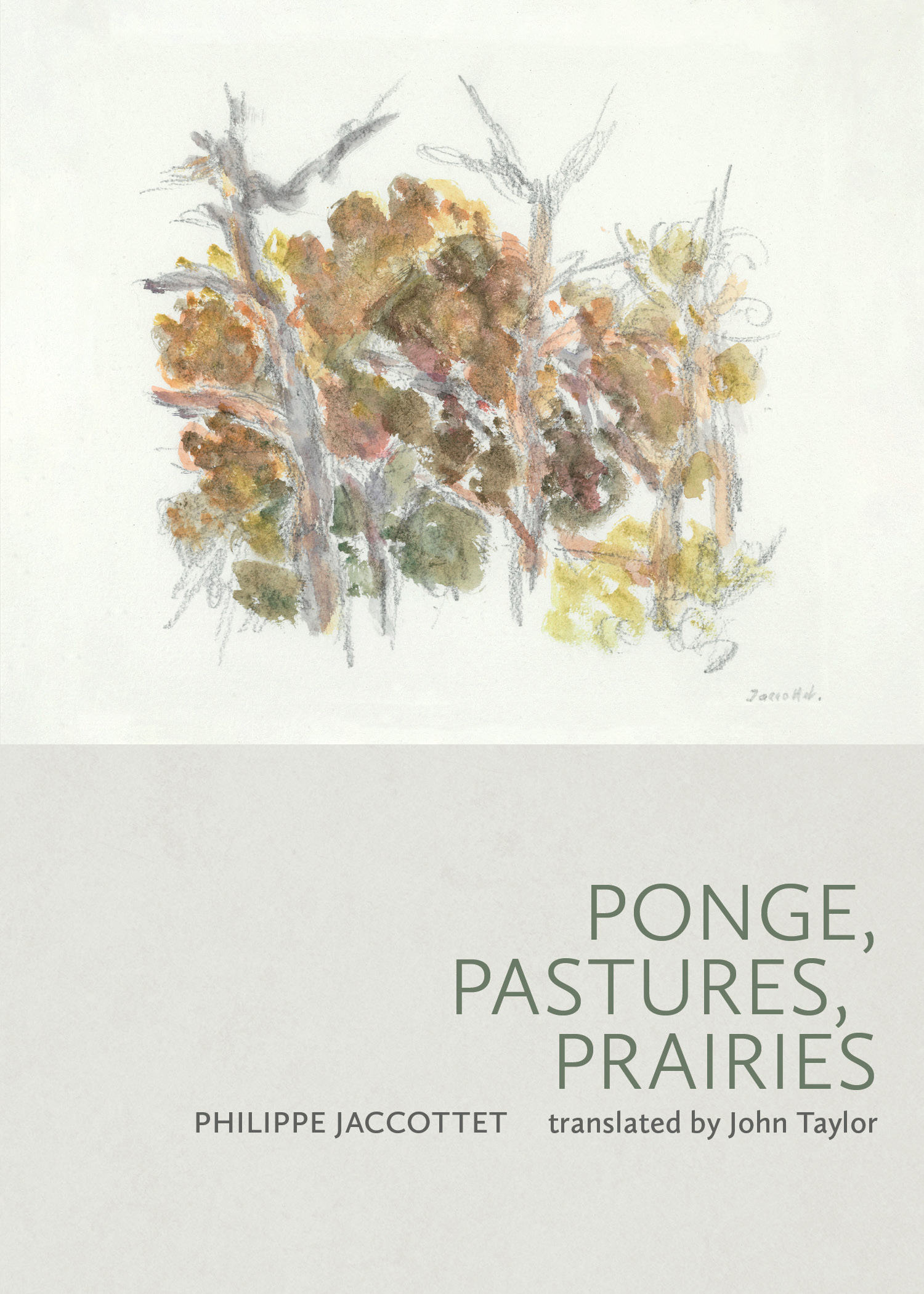
Ponge, Pastures, Prairies is more than a simple tribute to French poet and essayist Francis Ponge by fellow poet Philippe Jaccottet, it is a deeper examination of the way creative influences sift through a writer’s own process of literary development. The two men first met in 1946, when the latter was barely twenty years-old and, as Jaccottet recounts, he imagines that, though he said nothing, the older man likely had his reservations about his youthful lyric enthusiasms. Nonetheless, a friendship between them would form and continue for over forty years. When Ponge died in 1988 at the age of 89, Jaccottet was among the mourners at his funeral in a rustic graveyard in Nîmes. It is with his reflections that day—a piece intended to stand alone—that this small, special book has its origin.

The funeral was a modest affair on a bright summer day, but it was not one without qualities that seem to Jaccottet oddly fitting for his friend. The pastor arrived quietly by bicycle and chose to recite the 23rd Psalm beside the family vault, “because the deceased was a poet.” King David’s ode to his heavenly shepherd and “green pastures” was followed by a simple reading of Ponge’s “The Meadow” by actor Christian Rist:

“Carried away suddenly by a sort of peaceful enthusiasm / In favor of a truth, today, which is green. . .” This kind of albeit distorted echo, over some thirty centuries, was thus perhaps even stranger and more striking than the rest (the vast, noble, abandoned cemetery and this burial, as if for an unknown person, of a writer so legitimately famous).

This juxtaposition sets the scene for Jaccottet’s homage to Ponge—a poet whose domain was the minute examination of the everyday—calling attention to his commitment to a “green truth” and the remarkable vigour with which he defended it. A sketch of a strong character, given to both “excessive intolerance” and “most generous enthusiasms” emerges, composed in the emotion of the moment of loss. It is not surprising, then, that despite the many formal arguments he had offered in praise of his friend over the years, Jaccottet felt a personal need to articulate what essentially separated him from Ponge’s work. So he started to write a follow up.

However, the expansion of this text into its final form was not an immediate or obvious project. In his Postface, written in 2013 when he was preparing for the original French publication, Jaccottet admits that he was not inclined to work his sentiments through to a natural end. Others encouraged him to think otherwise, but still he delayed, out of laziness or, perhaps, out of fear that entertaining his reservations might be disrespectful to a man he had continued to admire and think of with great affection. But this recognition of the complex interplay of influence and divergence, explored with a perspective stretching over more than two decades lends depth to this slender volume.

Jaccottet begins with a consideration of two of Ponges’ heroes: François de Malherbe (1555-1628), the French poet and critic who insisted on strict form, restraint and purity of expression, and composer Jean-Philippe Rameau (1683-1764) whom Ponge proclaimed as the artist who interested him more than any other with a style “of the kind that awakens: male, energetic, and  ardent.” If these men spoke to the inspiration that charged his friend, Jaccottet takes care to look at how his own response and tendencies diverge. As he moves on to discuss the way their approaches to writing start from contrasting points of view or ways of looking—one precise and object-oriented, the other lyrical trial-and error experimentation open to the “fleeting impression.” However, even if the origin and ends differ, he can acknowledge that his thinking on questions, such as the “enigma of purity” has been influenced by Ponge’s concern with that which is “pure” or “true.” One’s questing can be furthered, after all, in discourse with those whose creative inclinations deviate from one’s own. And throughout this text, Jaccottet is careful to reiterate his respect and fondness for Ponge, a feeling that he is assured in reviewing the volume of correspondence they exchanged over the years, was returned.

Ponge, Pastures, Prairies offers a tribute and a uniquely honest, yet sensitive critique. Jaccottet writes very thoughtfully, entertaining ideas about poetry, death, and the particular dynamics of the relationship between himself and Ponge in a manner that does not require a deep familiarity with the work of either man. In this regard, the extensive footnotes, based on Jaccottet’s own but expanded by translator John Taylor, are helpful and informative. I will confess that I have acquired more than a few volumes of Jaccottet’s work over the years, but until this time I’ve not seriously engaged with any, feeling, perhaps, a little intimidated or uncertain where to start. This book has ignited my interest and opened the door or, as Jacottet might say, a crack in that wall.

Ponge, Pastures, Prairies by Philippe Jaccottet is translated by John Taylor and published by Black Square Editions.

Words are rocky tears: Alphabets of Sand by Vénus Khoury-Ghatta

Where do words come from?
from what rubbing of sounds are they born
on what flint do they light their wicks
what winds brought them into our mouths

Their past is the rustling of stifled silences
the trumpeting of molten elements
the grunting of stagnant waters

– from “Words”

My first encounter with Vénus Khoury-Ghata was with her novella, The Last Days of Mandelstam, a spare, poignant portrait of the Russian poet’s life and lonely death that I read several months ago. It left me keen to explore her poetry and prose further. I soon discovered that American poet and translator Marilyn Hacker has released translations of several collections of her poetry and one novella, so, uncertain where to begin, I opted for the evocatively titled Alphabets of Sand (2009) from UK publisher, Carcanet. A wise choice it turns out, because this collection draws on material from three of Hacker’s earlier US translations along with an insightful introduction.

If poets dwell in language, Khoury-Ghata exists in a world threaded with letters of alphabets scattered like sand in the wind or like stars cast against the blackness of the sky. Born in Beruit in 1937, into a French-speaking Maronite Christian family, the dual French and Arabic cultural and linguistic influences of her childhood animate her poetry and colour the world that she imagines—a place filled with magic and marred by misery. Although she has lived in Paris since 1972, much of her writing looks back to the country of her birth and its tragic history.

Alphabets of Sand gathers five poems or sequences and selections from a sixth. The title of this collection comes from the wonderful piece “Words” which plays with and celebrates language as a primal life form, born and nurtured in the soils of the continents of the earth, taking shape, searching for and finding tongues, mouths and speakers to breathe words into being. As such, language is a collaborative magic between nature and humankind:

Language at that time was a straight line reserved for birds
the letter ‘i’ was the cleft of a hummingbird
‘h’ a ladder with one rung necessary to replace a charred sun before nightfall
‘o’ a hole in the sole of the universe

Unlike the consonants with their rough garments
the vowels were naked
all the weaver’s art consisted of humouring them
in the evening they counted each other to make sure no one was missing
in the rocky countries men slept without dreaming

Khoury-Ghatta’s native Arabic and French speak to one another in the course of this sequence, their respective alphabets moving from left to right and right to left, but the Word she evokes, belongs to neither language but to all languages living and lost.

As translator Marilyn Hacker describes it: “Khoury-Ghatta’s work bridges the anti-lyrical surrealist tradition which has informed modern French poetry since Baudelaire, and the parabolic and communal narrative with its (we might say Homeric) repetitions of metaphors and semi-mythic tropes of poetry in Arabic.” She writes, as she herself puts it, “in Arabic through the French language.” The confluence of these traditions is especially evident in the poetry collected here. “The Darkened Ones,” for example, written during the 2006 war in Lebanon, adopts a communal voice of unfathomable depth—a chorus of women speaking to generations of the dead, displaced and disrupted—echoing the unanswered questions that accompany the sorrow and pain of senseless conflict.

An idiosyncratic personal mythology permeates the most powerful works here, a magical sense of place that pays tribute to a world where ghosts mingle with a shifting present. “The Seven Honeysuckle Sprigs of Wisdom” paints a portrait—by turns affectionate, coarse and funny—of the eccentric cast of characters who people a village where time is “in a hurry,” but the river “turns back toward its source.” The hairdresser, cemetery caretaker, beggar, shepherdess, prostitute, schoolmasters and others appear, alongside saints and spirits and a host of struggles and dreams.

However, it is the sequence of poems from “Early Childhood” that carry, for me, the most weight and shimmering energy. Central to these pieces, most of which are dedicated to individuals including the author’s sister, the writer May Ménassa, is an enigmatic mother figure:

I write Mother
and an old woman arises in the uncertainty of evening
slips into a wedding dress
stands on tiptoe on her windowsill
calls out to the hostile city
addresses the haughty tribe of streetlights
bares her chest to the clocks
shows them the precise site of her sorrow
disrobes gently for fear of creasing her wrinkles
and unsettling the air

My mother had her own way of undressing
as one would strip the medals from a disgraced general

The poems that comprise this sequence move from a familial to a wider universal sense of mother as teacher, keeper of wisdoms and memory. Language again features prominently, not simply as a alphabets deciphered in books, but as read in nature:

The books we browsed in came from the forest that watched us read
from the peeled bark’s shriek which continued under the pages’ skin
We read in the darkness of August
when the galaxy disposed of its excess stars
when, without  margins, night stretched itself out until night.

As presented, the lasting sensation that this collection leaves me with is one of the kindling of a connection with the roots of Khoury-Gatta’s poetic sensibility. Her love of language and her comfort with repeated metaphor—dead leaves, pebbles, wind, streetlights, stars, trees, alphabets—make sense within the context of her dual language, culturally rich upbringing. Again, I am left wanting to read more and know more. Now in her 80s, she has many honours and an extensive body of work to her name, most of which is yet to be translated into English. Nonetheless, I plan to explore more of what is out there in the new year.

Alphabets of Sand by Vénus Khoury-Ghatta is translated by Marilyn Hacker and published by Carcanet Press.

To fall with grace and compassion: A Net to Catch My Body in its Weaving by Katie Farris

I know people who shy away from poetry for fear that they will not know what it means, as if a prerequisite of appreciating poetry is an intimacy with style and form and an inexhaustible knowledge of that which came before lest an influence be mistaken or missed in the reading. So, here is a collection to assuage that fear, a small book that can be met by anyone. Paradoxically it is accessible precisely because it chronicles an experience, a reality, that we all fear—a diagnosis that so many of us have known, if not intimately, then in a friend or loved one.

In the miraculously titled A Net to Catch My Body in its Weaving, Katie Farris invites us to walk alongside her, as she ventures into hell, so that we can know, as she is determined to believe, that even in the midst of hell, there are things that are not hell. Her words, lines, poems, bruised against the flesh of living, become an offering, an answer to a terrifying uncertainty, a string of songs that speak to her journey, expose her joys, and catch her falling body in their shadows. Love poetry to a burning world.

Here’s a shot between
the eyes: Six days before
my thirty-seventh birthday,
a stranger called and said,
You have cancer. Unfortunately.
Then hung up the phone.
– from “Tell It Slant”

This slender chapbook is her response to the third stage breast cancer that is staking a claim on her body, tracing the shock of diagnosis, the invasion of surgery, the toll of treatment. Unflinching and honest, this collection of poems speaks with an awareness only illness can heighten.

For Farris the experience of cancer seems less of an inward looking process, but rather one of looking and extending outward, into the world. Which might, appear at first glance, counter-intuitive. She turns to her husband, wondering about the balance of intimacy and caregiving, if a “slow / sweet collapse into / oneness” has its limits, and yet discovering, to her surprise, that mid-chemotherapy she wants sex:

Philosexical, soft and
Gentle, a real
Straight fucking, rhymed
Or metrical—whatever
You’ve got, I’ll take it.
Just so long as we’re naked.

Poetry itself is also a comfort, a companion, as one might expect and, at this time, it is Emily Dickinson with whom she develops a special friendship, if you like. Echoes of her idiosyncratic spirit may be heard. “Emiloma: A Riddle & an Answer” playfully addresses Dickinson, alternately with questions directed to her own condition and treatment. The kind of questions that evade comforting responses:

Will you be
my death, Emily?
Today I placed
your collected poems
over my breast, my heart
knocking fast
on your front cover.

*

Will you be
my death, chemo?
The shell of my self
in the sphere of time
plucking, plucking
the wool of my hair
from its branches.

But, perhaps one of the most powerful elements in this collection, one that speaks to me in particular in relation to illness and healing, is her engagement with the natural world, with images of trees and birds. In front of the Atlanta Cancer Center she ponders whether we arose in imitation of trees, longing for roots and raising our arms like branches, while another poem contemplates the strangeness of survival, of standing “in the forest of being alive.” It is, however, in the closing poem, “What Would Root” that she finally gives herself to that forest, a reconnecting with a vivid, corporeal recognition of being one with nature—the water, the soil, the roots and branches—however tenuous or complete the journey is. In just 37 pages, this chapbook, is evidence that when the world is falling apart, writing love poetry may just be the best defense.

A Net to Catch My Body in its Weaving by Katie Farris is the winner of the 2021 Chad Walsh Chapbook Prize and published by Beloit Poetry Journal.

My heart struggles for voice: Sing of Life – Revisioning Tagore’s Gitanjali by Priya Sarukkai Chabria

Around the world, many so-called literary classics are worked into educational curricula long before most students have the depth of life experience to fully appreciate them. How often have we heard (or said) I was put off this author or that work because we were forced to read it in school? But years later a revisit can open new doors, allow new light to enter. Even a piece of literature remembered as well received when one is young, will be met  with entirely new eyes decades later. Living informs the reading, alters the experience.

For countless students growing up in India, Rabindranath Tagore is one of those authors who might well be met with a mix of youthful admiration and obligation. I could not help but smile, then, when I read Priya Sarukkai Chabria’s account of her unexpected reunion with Tagore’s classic Gitanjali (Song Offering) when her husband picked it up off a bookshelf in a café in the village of Bir in the northern Indian state of Himachal Pradesh. Before long, as she describes it, the small book was “spreadeagled” between the two of them on the table. With the Himalayas rising in the distance, she felt the words rise off the page and enter into her mind. Now, I must admit that I do know Priya and her husband, and that privilege that makes this image that much more endearing—the vision of a shared rediscovery, that will, in time, lead to the very text I now hold in my hands, her thoughtful and spirited new book Sing of Life: Revisioning Tagore’s Gitanjali.

The original text, subtitled A Collection of Prose Translations Made by the Author from the Original Bengali with an Introduction by W.B.Yeats, was first published in 1913. It is comprised of 103 short pieces adapted from a longer version originally composed in verse. The Indian poet, writer, composer, painter and social reformer is, as are many great figures, a complex and cherished individual. In her Introduction, Chabria provides a succinct overview of his political/historical context, offering a key to understanding his philosophical and artistic importance before examining some of the key poetic and spiritual features that come through, for her, in Gitanjali:

To my mind, Tagore is a modernist bhakti/devotional poet. Cosmic harmonies ring through the love that souses this collection, at once familiar and mysterious as the changing lines on one’s palm. A blessed geography of space is summoned from within the body’s cells and outside, and in every time, whether recollected, in the present, or yet to come.

There is an inherent intimacy and longing in these prose poems combined with imagery and voicing—including an “osmosis of gendering”—that draws on a long tradition of Indian devotional love poetry. To someone unfamiliar with the genre such as myself, it feels exotic and mysterious. Are they to be understood as love songs or prayers? To whom are we listening? My own modest Dover edition copy of Gitanjali, read rather haphazardly without guidance, could hardly be said to have put me on familiar terms with its magic. However, in moving between the haunting revisions and the original songs, I found myself drawn into a sort of conversation of echoes, bridging a century, through which I was free to discover the songs that most clearly and personally spoke to me.

Enter my heart unbidden
even unknown to me

The steps I heard
in my room are

the same that echo
from star to star (from #43, Sing of Life)

It is clear from the Introduction that although the desire to engage, notebook in hand, was an almost immediate response to her chance reencounter with a classic, this was not a project entered into lightly. Chabria details her approach, her reasoning and her own reassurance that Tagore would not have been at odds with her intention and her desire to reimagine his poems, to pull the essence to the surface while remaining faithful to the intent, beauty and spirit of each piece. Her touch is spare, delicate. Key images and phrases are held, perhaps moved, gently rearranged or opened up, inviting space and silence into the telling. Tagore’s appeal to the Beloved, his lord, through his speakers—male, female, young, old—is an intimate one. They are filled with longing, gratitude, grief, peace. The energy and imagery is allowed to breathe fully in the revised imaginings, but they are not altered or lost. It is a remarkable feat.

To offer a taste, #39 reads:

When the heart is hard
come with a shower

When grace is lost
come with song

When work raises its din
come with peace

When my heart crouches
come with light & thunder

– –

lord

of silence

break

open

the door

For point of reference, the first two lines of the original prose version reads: WHEN the heart is hard and parched up, come upon me with a shower of mercy. / When grace is lost from life, come with burst of song.

Chabria notes that she was first encouraged to publish an excerpt as an erasure poem, but she felt that particular form did not apply “for mine is a tribute.” Great poems, she says, often serve as a spark or inspiration for another poet. She was not attempting to update Tagore either, for the original meditations still contain their fire for her and for us, as anyone turning to the text reproduced in the back of this book can instantly see and feel for themselves. The rhythms, images and moods shift throughout the course of Tagore’s Gitanjali, moving through joy and shame, anticipation and longing, darkness and light. As the sequence nears its close, an awareness of death holds more and more of the poet’s attention. In the revisioned songs of Sing of Life, images and phrases are distilled, sometimes reorganized, and visually spread across the page (each poem contains two sections, with the first sentences offered in verse form and the final sentence strung out across several lines). One senses that Chabria has listened closely, carefully, so her responses may honour the elements that seem most essential, highlighting their beauty and emotional depth.

Ever the mark of rewarding read, my copy of Priya’s latest book is now decorated with notes and sprouting coloured tabs. As a friend, her voice accompanied through my reading (and I resisted watching one of the readings or interviews she has recorded—many available on YouTube) before gathering my thoughts here. I have never known her to engage with any subject, be it over coffee or in the pages of her own books, without a passionate and heartfelt intensity (Yeats was wrong in this regard, by the way, sometimes the best are filled with a passionate intensity). With Sing of Life, this singular energy again comes through, pulling the reader into a double-stranded engagement with Tagore’s classic work. As today’s poet invites you in to her own essential revisioning of these rich prose pieces, be it for the first or the fiftieth time, where the encounter takes you—perhaps back to the original and forward again, or on some other tangent altogether—is your journey.

Sing of Life: Revisioning Tagore’s Gitanjali by Priya Sarukkai Chabria is published by Context, an imprint of Westland Publications in India, and widely available internationally.

Every revolution is a child grown before fire: Lost, Hurt, or in Transit Beautiful by Rohan Chhetri

      For so long I felt he was dead
or so alive I couldn’t bring myself to imagine
his ruined light, & yet there he was, grinning,
the old boy so far inside him, just looking
into his face was a vertiginous drop down
the cool dark of an abandoned well, & him
a thin shade at the bottom among the bones.

                              – from “Sebastian”

Consider the title: Lost, Hurt, or in Transit Beautiful. The conjunction, or, carries the weight of invitation. And there is much stunning beauty to be found in the work of Nepali-Indian poet Rohan Chhetri, but also a heavy burden of loss and intolerable pain—often shocking in its sudden depiction or in its lingering aural presence. Intensity of images rooted primarily in the foothills of the eastern Himalaya runs up against layers of emotion barely articulated within tapestries that honour Western lyrical traditions. In awarding the original manuscript the prestigious Kundiman Prize, the Judges Citation recognizes that “Chhetri dramatizes and resists the ways language, and its implicit logic, limit what is possible within our most solitary reflections, defining even those ‘vague dreams’ that in the end we greet alone.”

Now this might seem an intimidating brief with which to open this commentary, but for a reader, no matter if their connection to poetry is casual or confident, there is a certain comfort with familiar forms, say an ode or a sonnet, that makes the turns and twists the themes take that much more striking. In conversation with his editor Kristina Marie Darling, Chhetri is asked about his approach and the value of encouraging this dialogue between inherited literary form and modern, experimental techniques. In his response he suggests that:

“my poetic impulse is a baroque one which is well suited to the syncretic, non-linear, anti-neocolonial poetics that can accommodate politics and revolution from the margins, the fabular, folk horror and mythology, the motif of katabatic descent, the marriage of the classical and the local etc. — all of this prismed through the multiple poetic traditions I write out of as a Nepali-Indian Anglophone writer.”

In this one, full-bodied sentence, the poet offers a clear sense of the mood permeating his work and the atmosphere that envelopes the reader travelling through it. His central point of reference is a borderland where many forces meet—literary, historical, lyrical—crossing lines, echoing long standing struggles over land, language and cultural autonomy. It exists on many levels, in the reality, in the imagining and in the documenting. When I look back across the poems in this slim volume I am reminded anew how grim they are, and yet what I remember is a certain beauty, a bone-deep fundamentalness of being. That is, I suppose, why the myths and fairy tales that enchant us also carry so much darkness and shadow.

Sorrow, absence, and death are never far from the surface in Lost, Hurt, or in Transit Beautiful. There is a strong sense of ancestral connection to the poet’s Nepali-Indian background, but the lyric voice is not personal until later, enhancing the mythological, even epic, quality of the poems. Time and again hints of smothered brutality give way to moments of unflinching violence—a violence that arises by both natural force and human design. It is a part of the philosophical/literary exercise at hand, but one that is rooted in historical, political and ethnic conflict. As Chhetri explains, in this book:

there is always that implicit tension between language and violence but it also plays out more overtly in a poem like “Lamentation for a Failed Revolution”, which recounts the events of the last iteration of the Gorkhaland Movement in 2017, a hundred-year-old movement demanding self-determination and a separate Indian state for the Nepali-speaking population in West Bengal.

Revolutions—as an extended legacy gifted from generation to generation—run through this collection. The stories of grandparents, parents, and children find expression as choral and individual voices rising in lament. Some losses are intimate and cumulative, others vivid and abrupt:

Another afternoon            a fifteen-year-old boy
Hear the bullet              thud to breast like second heart
pain’s rubbery percussion             the way he looked up
mouth a shucked-oyster wobble                   Alive
in the elongating horror

                          – from “Lamentation for a Failed Revolution”

In such moments, the dynamic relationship between language and violence is realized with such a sensitive touch—just the right phrase, spacing, word—that the impact is simultaneously personal and political. The broader implications of such moments of barbarity ripple out far beyond any border-straddling community, across state, national and international lines, to be echoed afresh in the ongoing conversation between form, content and technique.

As one would expect, the poems that comprise this collection draw much of their energy and atmosphere from rural imagery featuring forests, rivers and a frequent appearance of deer (causing me to think of Trakl for his fondness for the same motif). However, especially in the latter sections as a lyrical “I” begins to appear, the speaker finds himself in New Delhi and Los Angeles. Yet, as in earlier pieces, the environment is reflected from an array of unexpected angles. Set in LA, “The Intelligence of Hunger” finds the poet who was once able to sleep through earthquakes, gunfire and rampaging elephants, newly alive to noise and a fresh urban reality, hot and dry with fires burning in the hills:

Where I live now every sound I make is a half-note
of loss. The bare mountain withstands, drought-
ridden, the Pacific breaking froth at its feet.
The wind rasps through the chaparral & I think
of the fire followers waiting in their late style
of hunger. The giant coreopsis that will bloom
for three bright weeks in April. I wanted to write
about these. If not love. Wildflowers, not grief.

Yet in this landscape so distant from home, his pen still turns to grief, as the end closes in on a sharp imagination of agony and sacrifice. A mood that crosses miles in an instant.

It is difficult to emerge from this stunning collection unmoved. The language and the intensity of imagery speak to something very primal, human and strangely comforting. I find myself returning over and over again to marvel at how the concert of words plays out on each page. Strongly recommended.

Lost, Hurt, or in Transit Beautiful, the third collection by Rohan Chhetri, is published by Tupelo Press in the US and Harper Collins in India with a UK edition coming from Platypus Press in 2022.

As long as I live in poetry: Acrobat by Nabaneeta Dev Sen

Just one more page left
one more paragraph, one more sentence—
give me one more word, dear nurse,
just one more day.
.        – from “The Lamp”

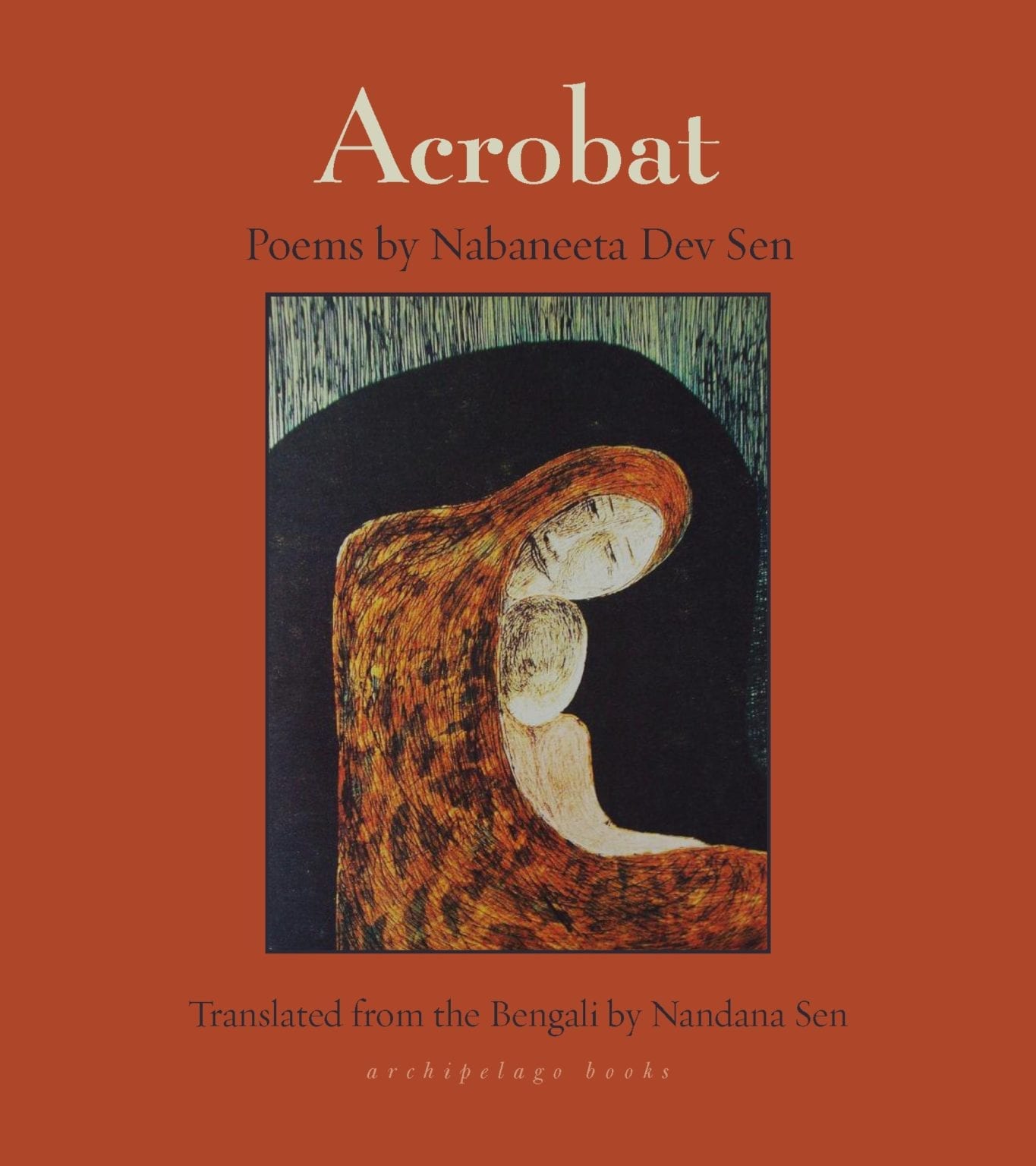
Nabaneeta Dev Sen (1938-2019) the much loved and highly respected Bengali author, scholar and feminist was a versatile and prolific writer whose extensive bibliography includes fiction, essays, children’s literature, travelogues, political columns and more. However, throughout her life she identified herself as a poet, first and foremost. As the daughter of two acclaimed poets, she began writing poems when she was a young child. In her comprehensive Introduction to the present collection, her daughter Nandana Dev Sen—not a poet herself, but a writer, actor and activist—reflects on the way poetry served as a vital and constant companion, one that was not always easy to satisfy. As Nandana records, in her mother’s own words:

“Poetry is like war,” she wrote. “A war with oneself. Finally, only when there is victory and peace, poetry follows. Poetry has to be earned.”

This sentiment can be felt in the clarity and precision that marks her work.

Acrobat presents a selection of poems that span Dev Sen’s career from the late 1950s through to 2019. It is very much a labour of love between a mother, the poet, and a daughter, the translator. Although she would not live to see the final publication, Nabaneeta Dev Sen was very excited about this book which would be her very first major release from a western publisher. She was gravely ill but undaunted when the project began and while translations of some of her poems already existed, she desired newer versions. A modest list of poems was compiled, but that was as far as mother and daughter could go together. Nandana translated those pieces and many more over the following months, gathering them together with a number of poems her mother had translated herself, a few that she had written in English, and one translated by her sister, Antara Dev Sen. Her Introduction includes a biography, personal in tone, and a discussion of the challenges of translating poetry and the considerations she followed when bringing her mother’s Bengali into English.

When presenting work drawn across a period of six decades, there is a common tendency to allow the date of publication to dictate the order. In Acrobat, however, the poetry of Nabaneeta Dev Sen is sorted along thematic lines. The book is divided into five sections, each named for a phrase pulled from one of the poems within it. A chronology is included at the back so one can, as I did, check to see the decade a particular poem belongs to. Such an organic approach makes for a wonderful reading experience, allowing one to appreciate the way the poet’s work visits and revisits similar subjects over the span of her life, with styles and perspectives shifting over time and place. Dev Sen married young and spent her twenties and early thirties living in the US and UK where her academic work eventually drew her away from poetry for a while. In 1974, when her marriage to economist Amartya Sen began to falter, she returned home to Kolkata. As a newly single mother with two daughters amid the scandal of divorce, poetry took on a new importance as a personal space in which to explore her pain, her identity, and her place in the world. In contrast to her scholarly writing which was primarily in English, for almost all of her creative work, she made the “political” decision to write in Bangla—not only a reflection of her feminist values and her language activism but as a voice for deeper emotional exploration and observation.

Nabaneeta Dev Sen’s poetry, to my reading, is distinguished by an alertness to the moment in all its strangeness and wonder. She is attuned to the anxieties and the triumphs of life, distilling key elements into vivid images. This is beautifully illustrated in an early poem, “The Great Fair” that appears in the first section which revolves around the notion of time. The speaker is waiting with a cup of saved coins for an adult who has promised to return to take her to the Great Fair. She lists wonderous toys and treasures she expects to be able to buy, but:

As I waited on my steps
My limbs grew long
My list blew away in the wind
My cup of change became a trunk of gold.

There is nothing left for me to buy
From your Great Fair anymore.

I am going to get up from my steps now

There is a remarkable sadness and defiance in the voice of the speaker; that complicated mix of emotion that comes with growing up, letting go of, or seeing through, the illusions of childhood.

As a passionate advocate for the preservation of Indian tongues, a translator and a promoter of the voices of women, it is not surprising that poetry, words and language, frequently appear as subjects in Dev Sen’s poems. She approaches the theme with humour, with elegance and with pain. “The Year’s First Poem,” for example, begins:

Pretending
as if nothing at all has happened,
picking up the heart
from the sand, dusting it clean
pushing it back inside my blouse
secretly, the first year’s poem gets written.

Other themes that resurface include identity, relationships with others, and a search for deeper truths in life. These are, of course, not unique as poetic topics. It is the distinctive voice, the vulnerability and the openness that combine to make the poems in this collection so strong. But, more than that,  Nandana Dev Sen’s translations and her loving curation of this volume—which opens with an Introduction that is both biography and translator’s note and closes with an open letter to her mother—makes Acrobat at once a beautiful memorial that honours Nabaneeta Dev Sen’s life and spirit and a vital introduction to her poetry for English-speaking readers.

Acrobat by Nabaneeta Dev Sen is translated by Nandana Dev Sen and published by Archipelago Books.

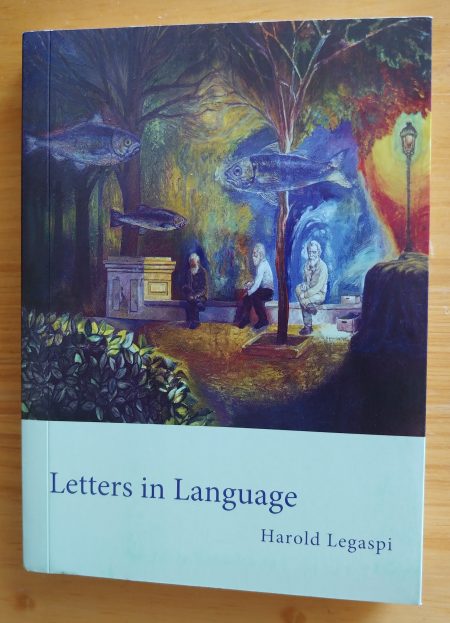
Troubling the alphabet: Letters in Language by Harold Legaspi

What can a language reveal? What can it obscure? If your memories were birthed in one culture, can they be retrieved elsewhere? What is gained and what is lost when you migrate from one land to another, from one language to another? How does this shift affect the spelling and the telling of a life?

Wittgenstein’s aphorism: ‘The limits of my language mean the limits of my world’ is false; there were thoughts that lacked words. We doused ourselves in neologisms. Dorothy repeating ‘there’s no place like home.’ A memory burn: the first time I saw a man kissing another man. (from Chapter 9)

The thirty-nine part prose poem that comprises Australian poet Harold Legaspi’s pocket-sized volume Letters in Language seem to dance around these questions, indirectly entertain them. Flirt and tease. Lean in closely. Look away. Catching, again and again, his own reflection.

Drawing inspiration from American Language poet Lyn Hejinian’s My Life, Legaspi has entered into his own experimental autobiography. Hejinian’s ground-breaking work, as published in 1980,  featured thirty-seven non-narrative prose poems, each thirty-seven sentences long—one for each year of her life at the time of writing. A second edition, revisited the project, growing with the poet, to forty-five pieces of forty-five sentences each. These sentences refuse direct connection to one another, defying the sequential illusion of conventional life writing. How do we remember ourselves? In fragments and moments, yet somehow, through the translation into language, patterns  and a sense of wholeness emerges. But is it real?

To read My Life is to let the words, the sentences, flow over you. There is a continuity of voice, and of the nature of images that interconnect when memories arise—details of a childhood for example may include activities, rooms, sounds, objects, and observations from a mature vantage point—but the intentional corralling of these images into narrative form distorts the truths it endeavours to preserve. The reader is invited, not to interpret and decode, but to respond from their own experiences of life.

Letters in Language mines a similar domain—life lived—but within the context of a Filipino family, a displaced culture, and multifaceted  questions of identity. I don’t know the author’s age at time of writing, but he does not hold to constraints of length. Legaspi’s language is playful, sentences often clipped and short, with images drawn from pop culture, even current realities like Covid-19 tossed in. The lines tumble over one another, appear connected for a stretch and then not, punctuated with aphorisms, self-reflection, rhetorical questions. The sentences have a transitory relation to one another, as if meaning is, at any single moment incidental and yet sensible. Not unlike the way the fragments and pieces of our own lives are shuffled and reordered each time we pull a memory card from the deck. New contexts constantly reshape who we think we are, refashion our ever-fluctuating histories.

Ever present amid the poems that fill these pages is the author’s lola—his memories of his grandmother fuel his own. The opening sentence reads: “My lola swept autumn leaves with walis tiniting, burned them in a can, wearing her grand billowy housedress.” Walis tingting is a Tagalog word for a broom constructed of coconut midribs. It sweeps its way through Filipino households. Likewise, the expression sweeps its way through these poems—a recurring image or an action that seems to signify the way we sweep through our memories, sweeping some to the forefront, others under the rug.

I who thirsted for knowledge. My niche unknown. Underneath the black economy. Where dry spells quelled my dysphoria. Fixed under the shade of a Bodhi tree. Away from air-conditioned air. Reborn. Conquered. A tangential awakening. Slid straight through, vagina dentata. The tip of my bayonet inched in her spine. Folk tales whispered, they got rid of me efficiently, like a baby out with the dingo. My mother, no shrinking violet. Did what was necessary. To cover up the blame. Walis tingting. As for the men, whose words were carefully chosen—passed on their phobias. My uncles. After thirty-nine years of solitude. Raised me like their own. Classed as a freak, unable to procreate like their sons and daughters (from Chapter 26)

So who is the “I” who lurks in this extended prose poem? A poet who exposes himself through his passions—emotional, intellectual, sexual and spiritual—played out against a formative soundtrack of music, films and books; bound by friends and lovers, and framed within a multigenerational Filipino family. Letters in Language never drifts far from the unresolved reality of the migrant existence, from the feeling of being defined by and yet disconnected from a land that is now somehow alien. After his grandmother, his unaltered link to the Philippines, has passed, Legaspi becomes aware of a kind of anchorlessness. One that rests in language, between a present language that cannot contain the loss, and an ancestral one not comfortably in hand: “Where English was an oblique mirror to my alter ego. I found myself faint with anxiety, a fictional object my truth. A truth with no original, veiled, forsaking to journey where it all began.”  The need to acknowledge this fundamental lack of grounding is then reflected in the closing sections of this text. Chapters 34 to 37 are composed almost entirely in Tagalog, a shift accompanied by translated versions. Thus, of all the questions of identity that surface and resurface throughout this poem, it is the poet’s own bilingual identity that troubles the deepest waters. Casting uncertainty on what has come before. What, if anything, has remained unarticulatable? Lyn Hejinian’s original autobiographical project is essentially unfinished, with material appended over time. Like life. What of Letters? That is not a question to anticipate in advance. Like life.

Letters in Language by Harold Legaspi is published by flying island books, ASM, and Cerberus Press.

I am the hard one: Outgoing Vessel by Ursula Andkjær Olsen

destructive is my normal state (37)

Danish poet Ursula Andkjær Olsen is a singular force of poetic vision. Intense, strident, futuristic. Outgoing Vessel, newly released from Action Books, is the follow up to her award-winning Third-Millennium Heart, a powerful reading experience I loved so much that I responded in verse with an experimental review published here (open the PDF to read). Translator Katrine Ogaard Jensen is on board again for this new journey and, as with her previous work, Outgoing Vessel unfolds over a sequence of poetic movements to form a 193-page, book-length poem that is both epic and operatic in scope. I was not surprised to learn that Olsen is also a librettist. As with her earlier project, the “singer” here is an enigmatic narrative force—perhaps the same one, I don’t know, though I hear a companion rather than a continuation myself.

no one except me can hate feelings
anyone else who claims to hate feelings:
let it be known how they still succumb to them
anyone else who claims to hate feelings:
let it be known how they, in weak moments
open up to them and

and become soft with longing

among all time’s winners
i am the hardest (8)

The early suites of Outgoing Vessel seem charged with negative energy, often erupting in harsh declarations of hatred that begin with the self and extend outward.  The voice is hard, constrained. Darkness and destruction are evoked frequently. Yet the motion is self-driven, Olsen owns her language, and the direction she is moving toward (and expecting others to align with) is not symbolic, but it is futuristic. She seems to be intent on encasing her darker, grieving being, containing it inside a container—described as an orb:

which I will send off as the outgoing
vessel that it is
after which the new human can arrive in its

incoming (48)

Third-Millennium Heart built on a tension between the clinical and the organic, pregnant with promise, anger and grief, rupturing ultimately into a powerful post-human feminist vision—one which gives birth to the possibility of a cyborg-like hive-heart existence. Heart’s speaker devoured and contained. Vessel’s is more isolated, inward focused and philosophical. Pain, grief, and an existential disconnection drive her rhythmic reasoning as she moves toward the foundation of a technological ontology, a science fiction solution, and a re-imagining of a new human beingness.

we must assume there is an original alienation:
first the estrangement, a person, a stranger to themselves
stranger to others, the person exists deep inside their
distant interior, without knowing, they must escape to the
surface, from inside, to become human (108)

The futuristic tone becomes more prevalent as the sequence progresses, propelled in no small part by the “technoscientic” poems that close each section of the work. As translator Katrine Øgaard Jensen explains in her note, Olsen “created these poems by piecing together lines from each suite, running the text through multiple languages in Google Translate, translating it back into Danish via Google Translate” then, from the resulting document, the final piece was created employing a cut-up method. This mechanical process allows for a new tone, energy and uncertainty to enter the cycle (not mention an added challenge for the translator to meet in a satisfactory measure):

human nature
in the coffin, a
relic, collection of Bones and Hair
encapsulated and stored in
a humane vacuum

this is
the refuge (94)

The strange brutality of Olsen’s poetry, the slogan-like chants, and the tightly-honed anger can be off-putting, but as with Third Millennium Heart, I find it oddly therapeutic. Anger in its shades and intensities can be a positive force—it is the healing movement of the cycle of grief, it pushes you forward, up and out of the sandpit of sadness that follows loss, trauma, heartache. It sounds counter-intuitive but I saw it many times working with survivors of acquired brain injury. Yet it is hard to allow it in oneself, for fear it will erupt in uncontrollable ways. Through the course of Outgoing Vessel we witness the speaker’s emergence as a voice of concern, intent on invalidating loneliness—through her outgoing/incoming vessel she comes to a radicalizing understanding of empathy and experience.

Olsen is a poet who, as her translator Jensen freely admits, cannot be neatly and directly rendered into English—her work is highly inventive, rife with cultural references, puns, neologisms, and experiments with language. Rather than attempting to produce an exact copy, Jensen aims to stay true to the “spirit of the work,” allowing it to find its own form in translation. This is, it turns out, an ideal approach for a poet who sees her own  work as a “translation of an idea”. As such, she is simply the first translator and Jensen is the second. The result is a sequence of poems that carries its own fresh energy. Tight. Terse. Tender. And ultimately affirming in its futuristic vision.

Outgoing Vessel by Ursula Andkjær Olsen is translated by Katrine Øgaard Jensen. It features stark, spare photographic works by Sophia Kalkau and is published by Action Books.

What have we done to our planet? Open Your Eyes: An Anthology on Climate Change by Vinita Agrawal (ed)

The green recedes like a hairline,
blue, blue is our future. And the rains
come like an ominous doorbell. And the fire
comes like a lion devouring, and the earth’s despaired-rumble
in her belly. Under muted breath, Hindus mutter pralaya,
a continent slips through an orifice,
glaciers slide innocently into the sea like a friendly
handshake, and we leave the seventh cause of
climate change nameless.

– Usha Akella, “Adam Walking Backward”

It is either coincidental or inevitable that I started reading Open Your Eyes: An Anthology on Climate Change on the same day the collapse of a Himalayan glacier and subsequent deadly flooding in Uttarakhand, India, made international news. I finished it to reports of the exceptional winter weather and power outages that left many Texans dead. Accounts of disappearing sea ice, habitat loss, raging fires, too much or too little moisture, extended tropical storm seasons and more have become a constant soundtrack, humming along beneath the chorus of a global pandemic, too insistent to ignore. Of course, countless industries and governments are doing their best to do just that, thus the importance of responses from a multitude of disciplines, including art and literature.

Open Your Eyes is one such effort. Edited by poet Vinita Agrawal and published in India, this attractive volume gathers poetic and prose reflections from a wide range of writers, from India and from around the world including Ranjit Hoskote, Ruth Padel, Abhay K, Anjali Purohit, Arundhathi Subramaniam, Ayaz Rasool Nazki, Barnali Ray Shukla, Esther Vincent Xueming, Indira Chandrasekhar, Kiriti Sengupta, Longbir Terang, Nabina Das, Priya Sarukkai Chabria, Sophia Naz and many, many more. For a concern so commonly associated with young western activists, this anthology offers a broader, more diverse response to the threats facing our planet, something that is by no means the province of the young. The oldest contributor here is ninety-two year-old Jayanta Mahapatra who offers a new poem, the mournful “I Am Today,” to the project. He joins sixty-two others raising their voices to call attention to the reality and risks of climate change.

It is November.
You know it from the susurration of light –
unclotted light, its guest-like tone
On my nephew’s face
the light is like a muscle,
quickening as he pedals.
The sweat still a secret –
armpits fold of private skin.

He’s seven,
as old as the ancient duration of exile.
The world’s grown warmer since his birth.
That is all I’m able to say
when he points to graffiti on the way –
‘What is Global Warming?’

– Sumana Roy, “’Global Warming’”

Concern about the health of our planet and its inhabitants is hardly new. When I was growing up in Canada, during the 1960s and 70s and on into my university years, we fretted about overpopulation and starvation, pollution, acid rain and holes in the ozone. Today, as manmade threats to the earth are increasingly urgent, governments such as the provincial one I live under are almost hostile to the notion of “Global Warming” as if it is a notion dreamed up yesterday by nefarious enemies of Capitalism and the Economy. It’s not that simple.

Given the theme of this anthology, it is hardly surprising that natural imagery runs a strong course through many of the poems and stories that comprise this book—birds and insects, rivers and forests, floods and drought, violent storms and heavy silence. The gathered offerings are strong; these themes are explored with fresh energy, rarely slipping toward the cliched or the overly sentimental. Sorrow crossed with anger tends to be the driving force; an inclination to preach gives way to the power of the image. In Rohan Chhetri’s “Fish Cross the River in the Rain” for instance, the speaker and his father go down to a river where electrofishing is being practiced:

To stand on the wave-nipped bank as shoal
after stunned shoal heave their nets. The fish
wake older, dreaming brief new lives huddled
in a foreign prison gasping at each other’s
gills blinded like a sack of mirrors.

The poets and writers contributing their work to Open Your Eyes bring, along with love of language, a lived wisdom that informs their varied approaches to the theme. Theirs is a passionate and often surprising engagement with the crisis at hand—a willingness to engage with the past, speak to the present and envision the all-too-likely future, as Sudeep Sen illustrates in his striking “Disembodied” which opens:

My body carved from abandoned bricks of a ruined temple
.                                      from minaret shards of an old mosque
.           from slate-remnants of a medieval church apse,
                          from soil tilled by my ancestors.

My bones don’t fit together correctly       as they should—
the searing ultra-violet light from Aurora Borealis
.                            patches and etch-corrects my orientation—
magnetic pulses prove potent.


My flesh sculpted from fruits of the tropics,
.                                                        blood from coconut water,
skin coloured by the brown bark of Indian teak.

My lungs fuelled by Delhi’s insidious toxic air
.                         echo asthmatic, a new vinyl dub-remix.

His poem ends with a portrait of an ominous near future, or nearly present. The prose pieces which close out the book take, for the most part, a more explicit glance into a possible world to come, employing elements magic and speculative fiction to imagine more anxious allegories of what could lie ahead. Open Your Eyes is an important contribution to the growing literature addressing the reality of climate change, yet one has to ask, is a project like this a call to arms, or evidence that, in the wilderness, a chorus of voices were shouting even if we refused to listen? I know what it should be.

Walking along the beach in Kochi with a friend we watched dogs searching among the refuse, trash and plastic washed upon the shore.

*

Open Your Eyes: An Anthology on Climate Change is edited by Vinita Agrawal and published by Hawakal Publishers. I will confess that I ordered this book (which appears to be readily available outside India) because a number of my friends have work included within its pages, but that, in the end, turned out to be a welcome door to discovering many writers I might not have encountered otherwise.

The only word I know for ‘gone forever’ is ‘today’: Porcelain by Durs Grünbein

In the winter when cupola and dome are white with snow,
the ravaged city fills my soul with shame, simply shame.
Rubens, Rembrandt, Raphael—then nothing more to show…
Your downfall is the stuff of trashy melodrama.
How long ago was that? Don’t ask me, I can’t say.
The only word I know for ‘gone forever’ is ‘today’. (8)

The German city of Dresden, once known as Florence on the Elba, was long renowned for its Baroque architecture and pleasant climate. The Allied air raids that began on February 13, 1945 rapidly reduced this jewel to an eerie landscape of hollow structural supports rising out of a sea of rubble. 25,000 souls were lost in the firestorm and it would take decades to clean up and restore the damaged structures.

Buildings can be rebuilt, but the legacy of the bombing of Dresden is complex. The action was met with controversy among Allied forces, the losses exaggerated for effect by the Nazis, and the destruction doubly symbolic—first of German suffering in the war, second of lingering guilt. So, there is no one black-and-white way to understand this event, a reality that German poet Durs Grünbein explores in his book-length cycle, Porcelain: Poem on the Downfall of My City. What began in 1992 as an annual ritual to mark the anniversary of the bombing, would eventually be published in 2005 as a sequence of forty-nine ten-line poems, rhymed and classical in form. Now, seventy-five years after the fateful air raids, the first English edition has been released with extensive notes, extra images and an additional, newly composed poem, translated and introduced by Karen Leeder.

Born in Dresden in 1962, Grünbein grew up amid the physical and psychological ruins of his hometown, surrounded by the historical and symbolic weight it carried, but without claim to any direct experience of the devastation. This temporal and emotional distance colours his poetic reflections while offering a double-edged sword to his critics—he was accused of both daring to intrude on the suffering of others and failing to do justice to the true horrors the city endured. In anticipation of this, the opening lines of the first poem in his sequence read:

Why complain, Johnny-come-lately? Dresden was long gone
when your little light first appeared on the scene.
Moist eyes are not the same as grey hair, son. (1)

Right away he is giving space to his would-be detractors and the lines that follow set the tone for what will not be a straightforward elegiac exercise.

As Grünbein strives to make sense of the bombing of Dresden—poem by poem, across the span of more than a decade—he allows multiple voices, angles and perspectives to appear, shifting moods and tones to rise and fall. However, his concern with the role of the poet as “a keeper and creator of memories” remains his central focus. For too long, mourning for the shattered city had been coloured by the motivations of political interests—Porcelain can be seen as an effort to challenge and release that grief.

Fragmented and lyrical, the work is infused with historical figures and references. The city’s character is often evoked, sometimes personified, sometimes in imagined vignettes, while the fine porcelain for which Dresden is famous is a recurring motif—intact and shattered.

Swans adorned the dinner service made for Count von Brühl—
flawless just like them you were: proud, curvaceous pin-up girl.
But it almost struck you dumb with shock when the fish,
the shells and dolphins shattered into smithereens,
sinking into the depths where no word could reach.
Who would hide munitions in porcelain tureens? (45)

Grünbein also draws on his literary forbears throughout these poetic illuminations, but by far his closest companion is Paul Celan. The ghost of the Holocaust poet haunts this cycle, directly and indirectly.

The forty-nine (plus one) poems that comprise Porcelain explore the complex layers of loss, meaning and memory and together form a rich meditation on war, destruction and the question of who owns suffering. It is not a dirge but a human reckoning. The presentation of this anniversary edition is both handsome and sombre, while Karen Leeder’s translation gives the poetry an immediate, grounded feel and the detailed glossary and notes provide context, as required, to enhance the reading experience.

Porcelain: Poem on the Downfall of My City by Durs Grünbein is translated by Karen Leeder and published by Seagull Books.