Snakes and ladders: Traces of Boots on Tongue and Other Stories by Rajkamal Chaudhary

There is a deep darkness in all directions, and we are sitting on the naked floor, awaiting light. When will the light come? Dipu unwraps the sheet from her body and lays it on the ground. She feels along the wall and keeps the bottle and the glass in a corner. Then asks—Who else is here? Chandravati, are you here? Nothing is visible in the dark. Not even one’s limbs. And in this darkness, Dipu’s voice shimmers like a white silver sword—Why don’t you say something? The sounds from here can’t be heard upstairs. And by now the owner must have paid off the police. Now why are you scared? Why not say something? Who else is here?

(from “Some People in a Burning House”)

A police raid has sent an assortment of women and their customers—a salesman, a student, an engineer, an old man—to the cold, bare basement of a brothel. By matchlight they try to sort out their situation. And then they realize, it’s not a raid but a fire. The building is aflame and no one knows what might be happening upstairs.

Welcome to the world of Rajkamal Chaudhary. This world is one that is in transition. The mid-twentieth century is a time of upheaval. The aftermath of World War Two sees the Cold War, and various conflicts and revolutions on the rise. In India, the newly independent nation is trying to define itself after the end of British colonial rule. Following a long struggle for freedom and the disruption of Partition, there is displacement, dissolution, and wide-spread poverty. The future looks less certain and less rosy than that which might have been imagined. Chaudhary, as perhaps the first avant-garde Hindi-language writer, drew inspiration directly from this unstable period, and, eschewing the moralistic literary traditions, painted a vivid, often vulgar, portrait of his time.

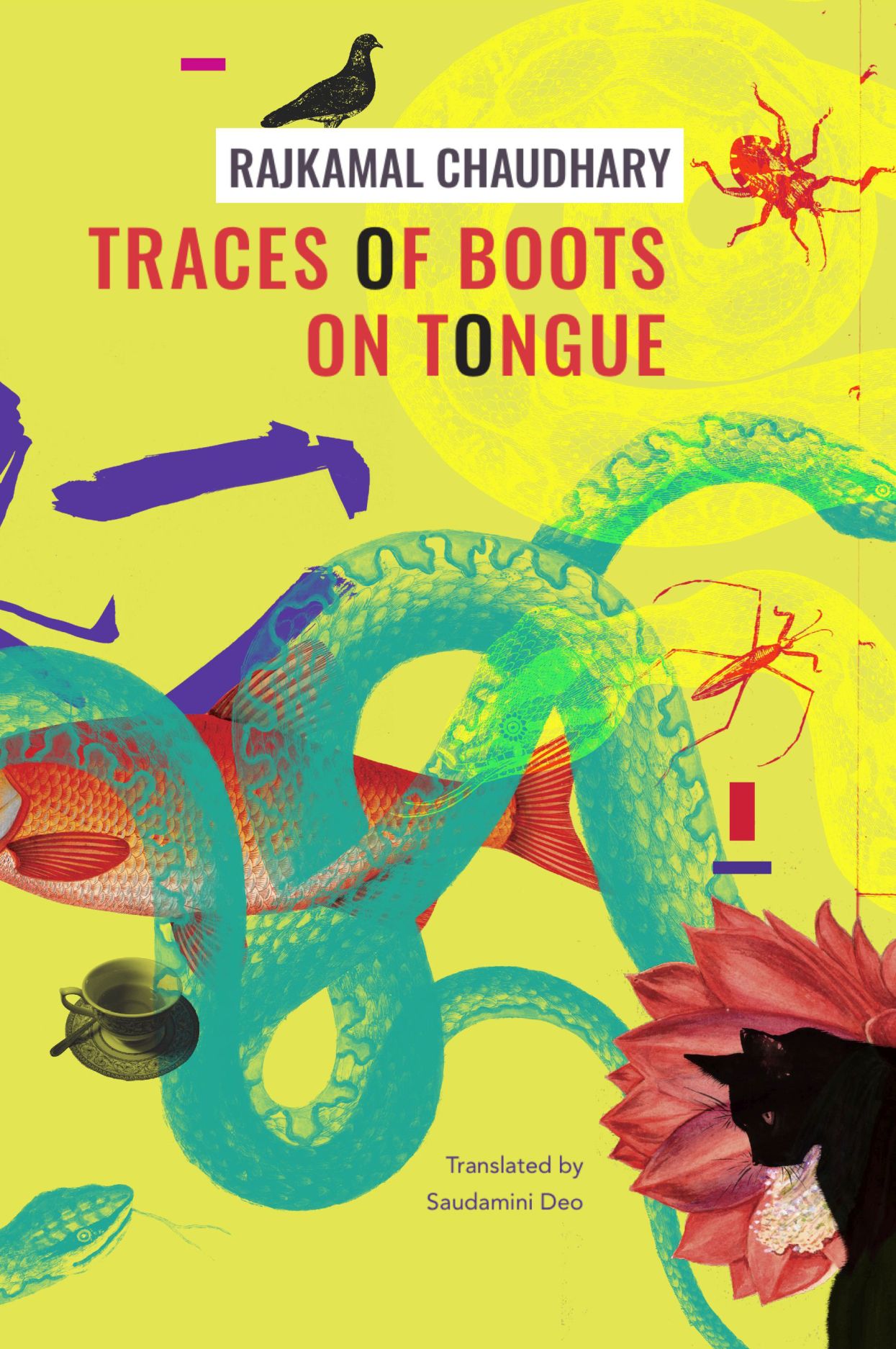
Born in northern Bihar in 1929, Chaudhary had strict religious upbringing, but his childhood was marked by the death of his mother when he was young, and his father’s subsequent remarriage to woman close to his own age. After high school he moved to Patna to attend college where he eventually graduated with a degree in Commerce, but by then he was already drawn to literary pursuits. His earliest works, poetry and prose, were published in Maithili, but Hindi soon proved a more productive and lucrative language. Much of his Hindi work was produced during the six years he lived in Calcutta in the late fifties and early sixties where he also came into contact with the young avant-garde poets of the Hungryalist movement. When he died in 1967, at the age of thirty-seven, he had written eleven novels, seven short story collections and hundreds of poems in Hindi and Maithili. Twelve of his Hindi stories are gathered in the collection Traces of Boots on Tongue, published last year by Seagull Books. In her Introduction, translator Saudamini Deo writes of his idiosyncratic style:

The stories in this collection are montages, flashes, almost documentary-like glimpses of the past that no longer feels like the past. Much like the novelle vague cinema that broke down boundaries between realty and fiction, Chaudhary’s stories seem to reject the characteristic formality of earlier Hindi literature and embrace a newer, more modern cadence of a world where there is no longer either god or morality, not even the desire for it. He is a writer writing not in a closed room but on the streets, in plein-air.

These stories are populated with unsettled individuals from all social classes, disillusioned artists and writers, unhappy husbands and wives, angry widows and widowers, lost madmen and madwomen. And a curious abundance of snakes, real and allegorical. As a man whose adult life was characterized by complicated relationships with women—two marriages and multiple affairs—Chaudhary tackled sex and sexuality with an openness that was unconventional for his times, to say the least. Some of that is reflected in the selections here, such as “Sisters-in-law” in which one of two women, widowed young, who support themselves servicing their local community’s healthy supply of “rascals,” has an disturbing experience. In another story, a boy befriends an effeminate classmate and finds himself in the terrifying clutches of his sexually aggressive mother.

Anger, bitterness, and anxiety fuel many of his characters and their interactions. Others are lost and confused, often struggling with reality, be it due to illness or intoxication. In “Veni Sanhar,” a young second wife and new mother, recently recovered from typhoid, suffers from periodic hallucinations. While her older husband attends to his business indoors, the servant and her stepson try to look after her and the baby. “Warriors Don’t Worry About the Right Time,” revolves around a man who insists he sees his dead wife coming to the well. His is a refusal to accept the truth, a refusal to move on:

Uncle spends his time on the veranda, and in the evening, after drinking bhang, reflects on what has and has not happened. There is no worry about the present. There is no hope or wish to turn or shape the present to one’s will. Stories and tales about what has passed please the mind. What has passed was better, appropriate, preferable. And, by thinking about what has not passed, the present remains forgotten and lost.

Some of Chaudhary’s stories are gritty, others melancholy. The shorter tales are more likely to have more internal coherence, but the longer, more intricate ones tend to unfold slowly through film-like scenes and vignettes. What is happening is not always immediately clear, and the endings hang in the air. One of the most intricate stories, “Like a Wall of Glass,” features a commercial artist, Kapoor, who wishes to transcend the constraints of money and produce a true work of art. He has his heart set on painting the wife of a well-known folk-art specialist—a man intent on preserving the past glories of Indian culture—but his inspiration personal is the abstract modernist Henry Moore. Yet, he realizes the absurdity of his ambitions:

Art! Culture! Creation! Expression! Beauty! How pointless and futile these words have become! But then, what possesses meaning after all? Money? An evening with a woman? Falling ill? Going mad? Committing suicide after writing a letter to friends? What is truth? What is sin? What is man himself? Morality? The point of life? The point of creation? What is man himself? Why doesn’t he die? Then, again, Kapoor starts smiling at the emptiness of his questions.

The anxious artist swings from confidence to disappointment and back as he pursues his goal. But even producing a brilliant painting, an ideal work of art, cannot achieve whatever he thinks he might be aiming for.

Chaudhary’s particular vivid, if often uncomfortable, portrayal of mid-twentieth century India in flux had trouble finding an audience outside of the literary journals of his day as it was deemed too indecent and immoral for the literary mainstream. Now that a selection of his stories is finally available in English, his work may well surprise and appeal to contemporary readers comfortable with more unconventional or less structured narratives. His characters and the situations in which they find themselves are troubled with unanswered questions that are still valid in our own volatile world. But understand that his stories, like life itself, offer no easy solutions.

Traces of Boots on Tongue and Other Stories by Rajkamal Chaudhary is translated from the Hindi by Saudamini Deo and published by Seagull Books.

Am I really me? Barcode: Fifteen Stories by Krisztina Tóth

When one speaks of a short story collection as “loosely linked” there is often the implication that some kind of continuous theme, or even set of characters, connecting the individual pieces to a greater or lesser extent. Krisztina Tóth’s debut collection, Barcode, originally published in Hungary in 2006, is a little different in this respect. The narrators or protagonists are all Hungarian, and timewise, their settings are in keeping with the age of the author who was born in 1970, but, even if some stories may contain possible biographical elements, the voices and circumstances do not suggest that all, or even any of the fifteen feature the same character. Rather, what connects the stories of these girls and women is a motif—all contain reference to a “line” or “lines” of some kind as noted in the story’s subtitle. We find borderlines, blood lines, grid lines, baseline, the line’s busy, and so on. It is a interesting way of providing continuity to a varied collection of tales. In fact, in her introduction, Tímea Turi tells us that the first element of the Hungarian word for “barcode” translates as “line.” Thus, each piece has something to say about the lines that define, restrict, or even scar us.

One can also say that the collection of stories in Barcode cross the “line” marking the end of Communism in Eastern Europe and its replacement with democratically elected governments— a line that corresponds with, as it would for Tóth herself, the end of adolescence and the beginning of early adulthood. The harbinger of that transition in Hungary is observed in “Outline Map (Life Line)” as a young university student on a fateful visit to a summer cottage with her first boyfriend remarks:

It was 32 degrees; we slathered each other with suntan lotion as we watched the TV. The General Secretary of the Hungarian Socialist Workers’ Party János Kádár has died. Actually, I felt rather sorry for him. Sorry that I would no longer be hearing his name in the news bulletins, sorry that the landscape of our childhood would soon disappear, that the crêperie shack on Kálvin Square had been demolished and that entire blocks of houses were disappearing, that the streets twisted and turned in odd directions, that in the sequence of events some kind of curious, unbridgeable gap was being created.

The stories set in childhood reflect Hungary of the 1970s and 80s—contaminated housing estates, a military style summer camp, an idealized fascination with “the West”—whereas the stories with adult protagonists deal with the demands of career, relationships, and motherhood, sometimes even venturing beyond Hungary, to Japan and Paris, for instance, where, if anything, the characters’ Hungarian identities are even more evident in contrast to their foreign surroundings.

The majority of the stories in Barcode are first person monologues with unnamed narrators, who have strong, distinctive voices. They are often seeking to understand and define themselves within their families, their romantic relationships (and infatuations) and within their communities. They may be speaking to immediate events or looking back at their younger, more naïve selves, sometimes with considerable insight. In one of my favourite stories, “The Pencil Case (Guidelines),” a girl recounts her primary school experiences at a time when “the colour both of our gowns and our copy books was indigo.” The narrative cleverly captures a shift in self awareness that occurs when she is wrongly accused of tripping a classmate, but allows herself to take the blame—in her retelling there is suddenly both an “I” and a “she” who becomes separated from her own name and identity and remains that way:

Later, too, the body belonging to the name continued to say nothing, responding with an obstinate silence and a blank, unflinching stare to the teacher’s interrogation, and as for the name, she began to hear it as casually and forgetfully as her cardigan and  the PE kit she invariably left behind somewhere or other. She became an actor in that weird film witnessed in the schoolyard, which the I had seen and in which she had been found guilty and which from this day on I, the name, had consistently to bear through all the indigo days that followed.

Her circumstances so clearly reflect the way many a shy child manages to navigate a system—grade school—in which they are out of place and unable to speak for themselves.

Although the stories are not organized in a strictly chronological fashion in this volume, they generally move from childhood through adolescence to adulthood, the latter stories tending to feature the more mature protagonists. Here strained romances, pregnancy, miscarriage, and self-image  take the place of childhood joys and fears. As in “What’s this Mark Here? (Bikini Line),” where a woman traces the history of her relationship to her body from her first bathing suit through to childbirth via caesarean section. The pictures she draws along the way are vivid:

My first swimsuit isn’t a swimsuit. It’s a pair of trunks. At that age there’s no big difference between boys and girls: it’s just chubby, flat-footed kids’ bodies running about on the sands. The sun shines. I’m crouched down by a wooden tub, blinking into the camera. It must have been lovely in the hot sand. I show the photo to my son. Mum, he says, that isn’t you, that’s a little girl. Indeed: am I really me? In the background a fleshy female leg in slippers consisting of two blue crossed strips of rubber: beach slippers. The legs belong to my grandmother, who would soon take a step or two into the water, pulling a rubber dinghy. We are sailing.

Fifteen stories, fifteen girls and women, each growing up and finding their way. Tóth’s poetic background (she was a well-established poet when this book first came out) serves her well as she crafts memorable portraits of female life in Hungary and beyond. More than a decade and a half after first publication, they speak to timeless aspects of female experience. And, no review would be complete without mentioning the striking presentation of this volume with barcode-like like lines across the top and bottom of each page and unique designs setting off each tale.

Barcode: Fifteen Stories by Krisztina Tóth is translated from the Hungarian by Peter Sherwood and published by Jantar Publishing.

Casting light on a fading world: For Now, It Is Night by Hari Krishna Kaul

It was so cold! I felt as if I were sleeping on ice. It was a large room and there were three of us in it. The windows were shut but they were without panes. Outside, it was raining heavily and the strong winds from the Pir Panjal came in gusts. The wind, this biting cold of Banihal, blew strongly through the room of the tourist hostel. Despite being indoors, it was as if we were sleeping outside.

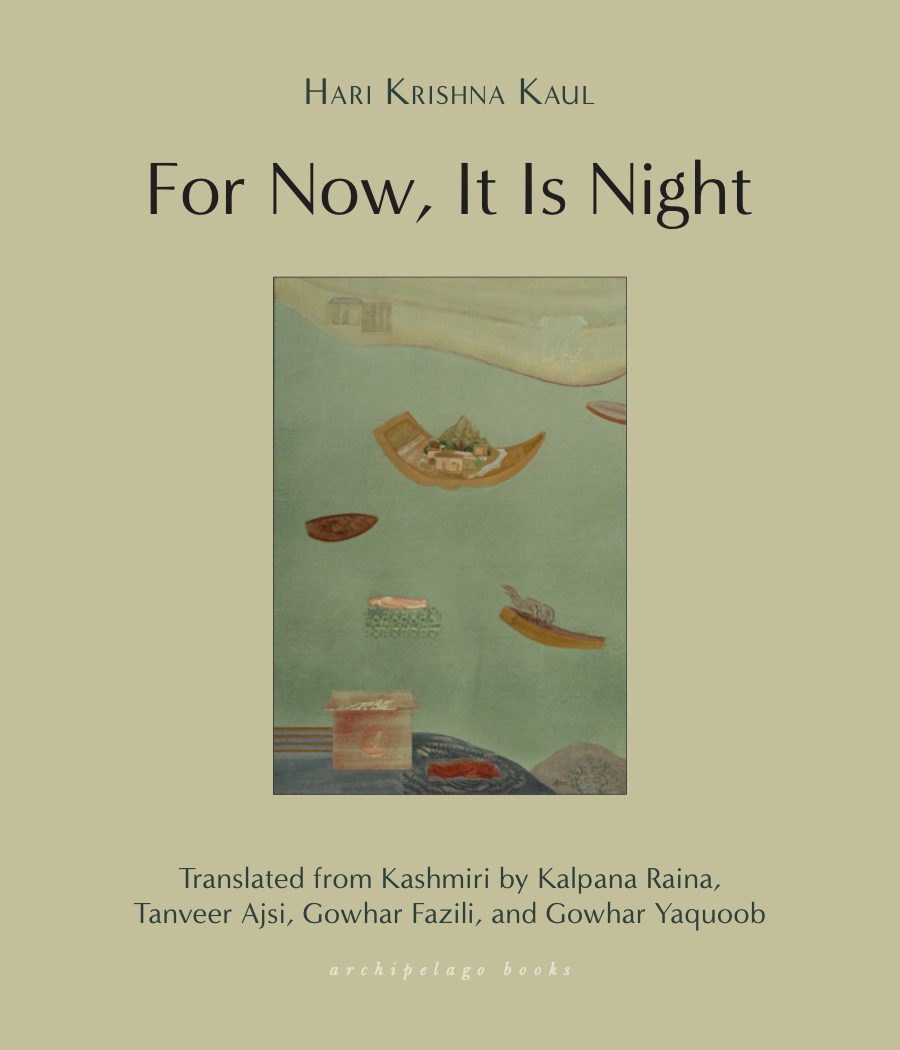
Thus opens the title story of For Now, It Is Night, a collection of short stories drawn from across the career of Kashmiri writer Hari Krishna Kaul. In less than six pages, this tale of three travellers, strangers before they find themselves sharing a room on a stormy night after their bus driver decided it was too late and, perhaps, too dangerous to attempt to cross the Banipal Pass of the Pir Panjal range of the lower Himalya. One man is decidedly unhappy with the delay, the other almost mystically inured to the biting cold, while the restless protagonist finds himself questioning reality as the night drags on. It is a simple story that deftly conveys the cold, the discomfort, and the loneliness of three stranded souls unable to find even the slightest comfort in one another’s company. It is the perfect distillation of Kaul’s ability to capture the complicated dynamics that bind and divide individuals, on both an intimate and a wider community level.

Born in Kashmir in 1934, Kaul spent most of his life in his homeland where he taught Hindi literature until 1990, when he was forced to join the exodus of Hindu Kashmiris from the region. He settled in Delhi where he lived, in exile, until his death in 2009. His work captures the details of Hindu Kashmiri life in old-town Srinagar during the last decades of the twentieth century, as well as the shifting socio-political tensions of the time. Over his lifetime, he published short stories, a novel and many plays for radio and television. For Now, It Is Night draws from all of his story collections, the first two published in 1972 and 1985, respectively and the latter published in 1996 and 2001, following his relocation to Delhi. However, what makes this selection of his work especially valuable and unique, lies in the combined effort of a team of translators.

As his niece, Kalpana Raina, describes in her Introduction, she had long heard of her uncle’s importance in modern Kashmiri literature, but until she had her father read some his stories to her—she could speak the language but not read it—she did not appreciate his eye for detail or empathy for his characters, their settings and their predicaments:

This was the world he had grown up in and his ambivalent relationship with it is quite clear in the forewords he wrote to his four collections of short stories. The are no grand themes in Kaul’s work, but an exploration and ultimately an acceptance of human limitations. He used his personal experiences to explore universal themes of isolation, individual and collective alienation, and the shifting circumstances of a community that went on to experience a significant loss of homeland, culture, and ultimately language.

Raina hoped that fresh new translations of her uncle’s stories might bring renewed attention to his work, and to that end, she recruited three young scholars and writers who could read Kashmiri and the Nastaliq script to collaborate with her on this project. They encountered unexpected challenges, first tracking down original manuscripts which were often not in the best condition, and then later with the more recent political upheavals in Kashmir and the pandemic. Despite the roadblocks, the final product is the result of a close engagement between four translators, “all native Kashmiri speakers, but representing a diversity of gender, age, experiences, and religious identity,” each bringing an important perspective and background.

The stories gathered in For Now, It Is Night, vary from domestic dramas, to surreal fables, to explorations of the uneasy relationships between Hindus and Muslims and between those of differing social standing. The narrators and protagonists often reveal much through their bluster and denial than what they openly admit to. In the opening story, “Sunshine,” for instance, the only one with a strong female character at its centre, Poshkuj arrives in Delhi to stay with younger son and his wife, certain that she has finally entered warmth and civilization. She has nothing good to say about her other son and “that fishwife,” but her bitter asides also reveal that she is put out and disturbed by her young daughter-in-law’s open-mindedness and rejection of Kashmiri social niceties. She is unable to comprehend the size of the city, its strangely quiet neighbourhoods, or the shocking mention of “Pakistan.” In fact the only thing she fully embraces is the sunshine, the glorious sunshine:

One could die for this sunshine. This is truly the only worthwhile thing in Delhi. She raised her sari slightly and scratched her right leg. She looked at her chapped skin and cursed the cold of Kashmir that was so hard on one’s hands and feet. Reflecting on the weather, she remembered her grandson, Bittĕ. Poor boy! How miserable he is, with his chilblains. How many times I told that monster mother of his that her son’s feet needed attention. Make sure he wears socks and fur-lined shoes, I said. But would that woman listen to me? Of course, fur-lined shoes are expensive and Gasha barely manages to get by. He doesn’t even have an overcoat for himself and shivers in the cold. She sighed. It’s all a matter of one’s fate.

The eighteen stories that comprise this collection demonstrate Kaul’s ability to craft a moving tale with vivid characters, caught up in events or circumstances that continually surprise and engage his reader. Some fall on the side of the fantastic like “Tomorrow—A Never-Ending Story” about two school boys who shirk their commitment to learning their times tables with such determination that they end up trapped in time, endlessly repeating Class IV while the rest of their classmates and peers grow up and move on with their lives, or “The Tongue and the Egg,” a bizarre fable in which two officers are charged with facilitating the collection of six million eggs, searching and even torturing or killing those thought to be hiding eggs, all for a bizarre purpose. Others begin on an eccentric note before taking a sharp emotional turn, such as “The Mourners” wherein two whimsically named young men, Tarzan and Doctor are called to assist with the funeral rites of their friend Pedro whose mother has just died. The subtle dynamics that bind fathers and sons, husbands and wives, and grandmothers and grandsons are teased out in stories that, more often than not, speak to the loneliness and isolation within families, heightened when distance pulls generations apart.

Kalpana Raina tells us that the selection of the stories in this collection was made with input from a small group of Kaul’s contemporaries and some younger students. The stories were then recorded in an effort to engage members of her family and the extended diaspora who could not read the script. That, together with the involvement of four translators, two of whom have contributed additional Notes, gives this volume a range and depth that truly honours Kaul’s contribution to Kashmiri literature and makes it accessible to a new generation of English language readers.

For Now, It Is Night by Hari Krishna Kaul is translated from the Kashmiri by Kalpana Raina, Tanveer Ajsi, Gowhar Fazili, and Gowhar Yaqoob, and published by Archipelago Books.

Only in a poem can you bring back the dead: My Rivers by Faruk Šehić

On a windy August day, a poet walks a stretch of the French Atlantic shore. It’s Liberation Day and his thoughts turn to foreign troops landing on these beaches, in two World Wars, but he thinks especially of the frightened young American marines bound for Normandy:

Such men I would like to lead
into the ultimate battle, into the resurrection
of green grass beneath clear skies
without the salvos of heavy naval guns
without the screech of aeroplanes
or the confusion of anti-aircraft fire
without those shadowy submarines
like long Antarctic whales
seen from high flying planes
Fragile dandelion parachutes
would be all that would fall

This passage, from the long poem “Liberation Day” that opens Faruk Šehić’s four-part poetic cycle My Rivers, is more than one man’s musing on distant wars—Šehić has a much more immediate and lingering association with combat and its aftermath. He was born in Behić in 1970, and when war was declared in the newly independent Bosnia and Herzegovina in 1992, the then twenty-two year-old veterinary medicine student left his studies and volunteered for the army. He would end up leading a 130-man unit, an experience that has informed his novels and short stories, but in this collection of poetry Šehić turns his attention to the post-war condition, to the scars that don’t heal and the remembrances that are always incomplete.

The first two sections, “The Loire” and “The Spree,” find the poet/speaker in France and Germany. He seems to be looking to find—or perhaps lose—himself in the winds and the waves, in mythology and history, on the streets of Paris or Berlin, and in the arms of lovers. In France, Šehić often appeals to nature and to a larger cosmic sense of eternity, while in Berlin the mood is more claustrophobic and ultimately disheartening. He cannot find the escape he seeks, so his wandering takes him back home to Sarajevo, where the bones and ghosts of the dead cannot rest, where the long shadow of war is hard to avoid and must be confronted.

It is in the third part of My Rivers, “The Drina,” that any attempts at distraction or escape fall away. A sharp bitterness can no longer be hidden, as the poet admits that the bloody histories lurking within cannot be washed away by clinging to “literary reminiscences / with which  I stubbornly defend myself / with which we all stubbornly defend ourselves / from a non-metaphorical Bosnia / which gently murders us.” Gently murders us. The poems in this and the final section, “Beyond the Rivers,” are stark and powerful, shot through with flashes of anger and grief as the Šehić tries to find some understanding and relief from the burden he carries as a former soldier and survivor of war and genocide. Speaking for himself and his people, he recognizes the crippling human cost of conflict and dehumanization, but wonders how it can and should be remembered as evidence, even of a relatively recent past, seems to disappear under the façade of a return to “normal.” In several pieces he turns to the example of Buchenwald, questioning if it is even possible to honour the voices of the dead:

But yet again, nothing happens
The grass is worldly indifference
combed over their eyes
like holy green hair
A victim is a victim
with no language, forever
dead, the same body killed several times
with heavy machines, heavy
oblivion in primary, secondary, tertiary
mass graves and a dayless abyss

– from “A Glass Marble from Potočari”

Šehić’s verse is unadorned and direct. His message is not obtuse. In fact, in one piece, he openly questions the value of poetry and metaphor altogether. A weariness and despair is sometimes evident, as is a hope that in nature a certain redemption may be achieved, but the most powerful poems in this collection are fueled by honesty and anger. And, of course, it is impossible to read this work at this moment in time, when we are watching as the value of “Never Again” is once again being eroded, without remembering the many times that promise has been forsaken in the nearly eighty years since it was first proclaimed. 1995, as Šehić well knows, saw one of those incidents of genocide.

When I first went to Srebrenica
piercing  air thick as gelatine
I walked through a town that had moved
underground, with more stray dogs than people
on the streets, everything I saw
transformed into something else
A house here is not like other houses, here
the landlord is Death

This poem, “A Walk through Srebrenica,” chronicles the speaker’s encounters with a place silenced under the burden of history, yet offering some hope that it will not be forgotten:

The weight of my body carried here was a punishment
Yes, guilt is the air we exhale
No poem about Srebrenica will ever end, infinite
sadness is its subterranean hum
The heritage of our souls

First published in 2014 as Moje Rijeke, this is a profoundly moving and, so it would appear, timely collection. My Rivers by Faruk Šehić is translated from the Bosnian by S.D. Curtis and published by Istros Books.

Behind the lens and beyond the darkroom: The End by Attila Bartis

When I take stock of my life, I see no reason to launch into some big family history. I haven’t got what it takes, nor do I have the means. I can’t very well ask Mother and I can’t ask Father, and as for my grandparents, I never knew them. Besides, the story of my family is nothing out of the ordinary. One might even say that along with all its uniqueness, it could just as easily serve as the prototype of the history of the Hungarian family. Or even the history of a Middle-European, middle-class, non-Jewish family. Though, come to think of it, they are pretty similar to Jewish histories. Discounting, of course, what cannot be discounted.

The End, the latest novel by Hungarian writer Attila Bartis to be released in English translation, begins, as its title implies, at the end. We meet András Szabad, aged fifty-two, enroute to the airport to catch a flight to Stockholm for a medical examination. He tells us he is a photographer, very well-known in fact, but admits he has not touched his camera in two years, ever since a woman named Éva died. And, for some reason, he feels it is important to let us know, off the top, that he does not believe in God. He lacks faith. But his feelings about God or not-God seem less than certain. Questions remain. To that end, a friend has suggested that he get his life down on paper as a means of resolving this unfinished business, whatever it might be.

As a photographer, someone who frames the world as he sees it through pictures, moments preserved and observed with a certain distance—a practice he first engaged in as a child, observing a woman through a window from a gap in a fence, long before he ever held a camera—András approaches this project as one might lay out a series snapshots, each catching an image or memory from his past. He begins in the fall of 1960 when he and his father arrive in Budapest, following his mother’s sudden death and his father’s release from prison after serving three years for alleged anti-government activities. They take up residence in a small apartment, awkwardly sharing the space, continuing the same pattern of father-son avoidance passed down through four generations, each man sharing exactly the same name: András Szabad. The youngest András is seventeen when he moves to the city, a transition that marks an abrupt end to his childhood. But it is on his first Christmas there that he receives his first camera, his father’s Zorki, and that changes everything.

András chronicles his experiences finding his way around Pest, his father’s trouble finding work and meeting the young man, Kornél, who will become his life-long friend, sounding board and often frustrated better angel. He describes growing up in the rural town of Mélyvár, his beloved mother, and the difficult, lonely years of his father’s imprisonment when even a friendly neighbour could secretly be an informer. Now settled in Budapest, he drops out of school after an affair with his Hungarian teacher, listens in as his father is visited by his former collaborators, and befriends the eccentric countess, now reduced to a simpler life, who lives in apartment under the back stairs of his building with her elderly lady-in-waiting. There is no shortage of interesting characters peopling András’ otherwise ordinary world. On a larger stage, he is rather obsessed with Yuri Gagarin, the first human in space who reported that he saw no God up there, and feels defined by the seemingly endless reign of Communist leader, János Kádár. And then, there are the women.

His affairs with women are typically sexually intense and strange. He seems attracted to hopelessly inappropriate women—his high school teacher, an older woman he meets at the pool, and, of course, Éva, the concert pianist who András first sees, in the park, making out with her ex-husband, but looking directly at him over the man’s shoulder. Their torrid, yet dysfunctional, relationship lasts seven years, but she always holds him at arm’s length, across a space he can never breach. Most of his lovers end up before the lens of his camera, Éva included, as do many of the female customers he encounters once he begins taking photo ID pictures for a living. The camera—the Zorki now replaced with a Leica—becomes, for András, both an invitation to women and a shield to protect himself against them.

The strength of this nearly 600-page novel rests on the sometimes uncertain, often funny, well-paced narrative. The short, focused chapters titled in parentheses by a single feature—the punctum in Barthes’ terms—gradually unveil a portrait of a vulnerable, often stubborn, flawed man who is not sure where he stands in the world, even after achieving enviable fame. What he wants the most, Éva’s love, is the one thing that eludes his grasp, even if it is she who, after she has left him and Hungary altogether, mounts his first exhibition using “stolen” negatives. He professes an unwavering allegiance to the truth, at least as he sees it, with the wisdom, on occasion, to refrain from saying what he is thinking. And the smooth integration of dialogue—much of András’ account could be described as “verbal snapshots”—advances the flow of memories and reveals more about his nature, and that of those around him, than a more ego-driven fifty-two year-old would ever dare disclose in a formal written exercise.

For instance, when his father dies and he needs more than the part-time overnight job he has had at a print shop, András presents himself to József Reisz, the ID photographer who will teach him more about taking pictures than anyone else, and explains that he needs a job. Even though Reisz is not looking for an assistant, he is hired. The older man is a crusty, no-nonsense character with an uncanny attention to detail when it comes to people and to photography. When András serves his first client, he is fumbling with the unfamiliar folding bellows camera and, as he pushes the shutter release cable, Reisz calls out from the lab. Plate!

I pulled out the plate, I took the two required pictures, and wrote out the receipt. I was drenched in sweat. Soon as the man left, Reisz came out.

Thank you, I said.

You’ll get the hang of it, he said.

I’d have never thought that taking an ID photo was hell.

You’ll get the hang of it no time.

How did you know in there that I forgot to pull out the plate?

From the sound. There was no twang, and the shutter clicked.

You hear that from in there?

Yes. And at such times, don’t advance the film. Or if you’ve advanced it, take another picture of the client, so you’ll end up with a pair. As it is, you’ve got an empty frame now.

Fine. In the future, I’ll do that I said.

And don’t ask what the picture is for. It’s none of our business. If the client wants to tell us, he’ll tell us. If not, not.

Fine. But he looked like a lizard. He didn’t blink. Not once. He’s some sort of hunter.

He’s not a hunter.

He said he needed it for a license to carry arms.

He’s not a hunter. He’s a member of the Worker’s Militia. Hunters never stop talking.

The restrictions and ever-present threats and uncertainties of life in Communist Hungary, especially in the light of his father’s entanglements, shadow András from his early years, right through to middle age. Yet, many pieces of his life fit together seemingly by chance rather than by desire or design. He is strangely lacking in direction, even after he begins to have gallery showings. Left to his own devices, he might have been content taking ID photos or photographing the women who happened to cross his path indefinitely, enlarging some images leaving others untouched. But, flawed and frustrating as he may be, he is wonderful at isolating and narrating distinct moments of his life, slowly making his way to the memories and fears that he is continually trying to avoid. And what is life anyhow, but a series of negatives, some developed and returned to endlessly, others lying dormant until retrieved from the mists of time by accident or circumstance?

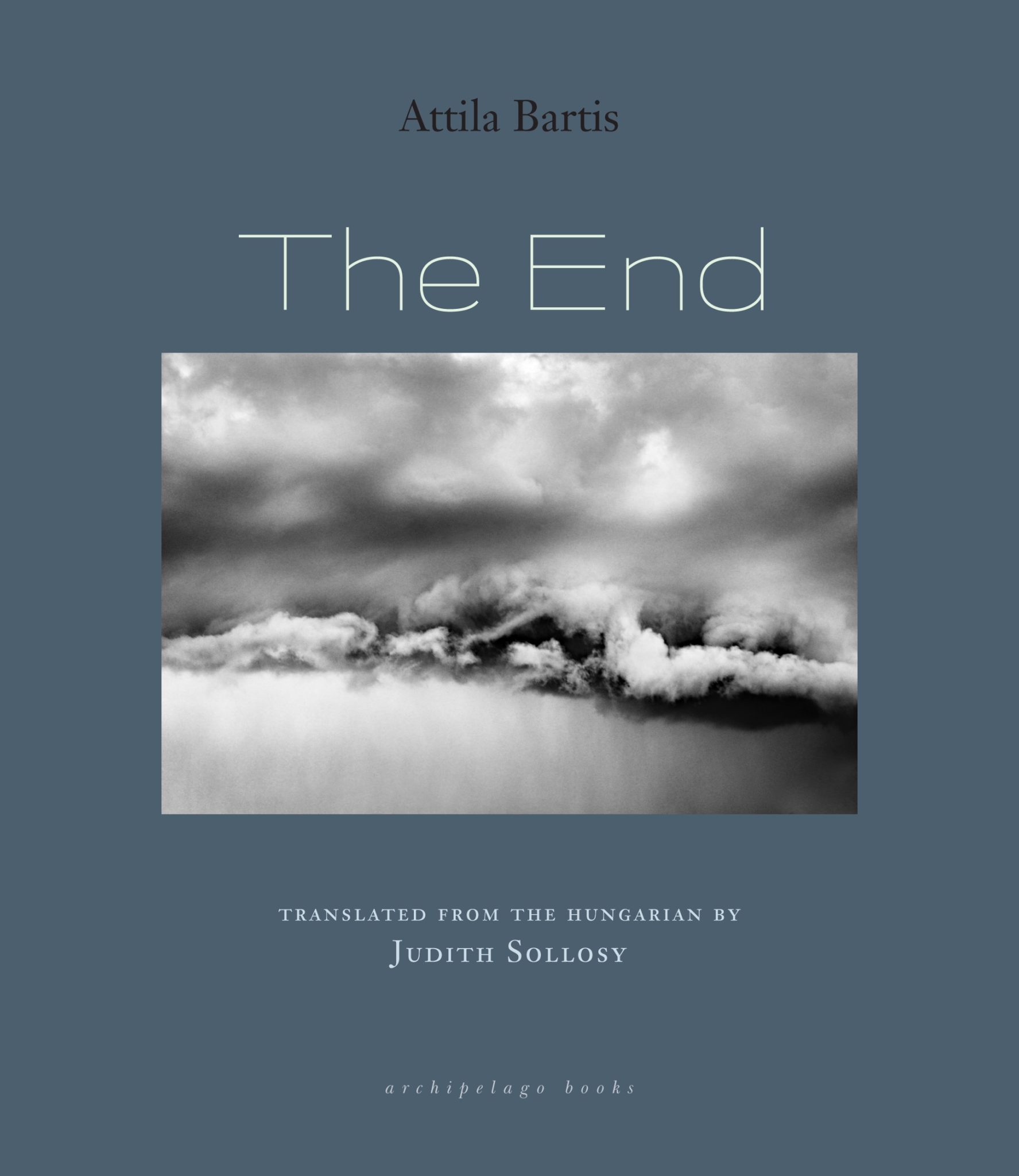
The End by Attila Bartis is translated from the Hungarian by Judith Sollosy and published by Archipelago Books.

The wisdom of madness: The Blue Light by Hussein Barghouthi

Blue is a colour with multiple manifestations and meanings in various contexts and traditions—the light of the sinful self for the Sufis, the colour of creative energy in Tibetan Buddhism, the destructive enemy of the God of Wisdom for Zoroastrian Persians. Blue is also said to be an antidote to sexual excitation and it is said to calm the nerves. That may explain some of the hold that the colour has on Hussein, the narrator of The Blue Light and a man beset by questions about his own sanity, but the roots of his attraction run much deeper:

For me, blue is the color of estrangement, the unknown, and of the childhood sky. And there is, also, blueness to all my ill wishes. When I learned to play the piano, I composed a short magical piece, played it for a while, day after day, without knowing the secret of my love for it, until one day I read a book by a Black musician who claimed that each note has a specific color to it. And each composition, too. One of Mozart’s sonatas arouses in the listener green or blue or . . . anyway, I looked around for the color of that magical note of mine and was astonished to find that it was blue.

This posthumously published novel by Palestinian poet, writer and essayist, Hussein Barghouthi (1954 – 2002) walks along that troubled path between fiction and autobiography, arriving at what might best be described as a memoir with hallucinations. It is a delirious account of a man desperate to make sense of himself and his unusual way of thinking. Or, as Mahmoud Darwish says, on the blurb on the back cover: “[a] peculiar mix of confession and contemplation, hallucination and mythology, reality and the unrevealed. A mix of personal stories and mystic leaps, of madness that claims wisdom, and wisdom that only madness can transubstantiate.”

The Blue Light is inspired by Barghouthi’s time in Seattle, Washington where he pursued graduate studies in Comparative Literature in the late 1980s and early 1990s. As someone who had long felt different from others, he finds himself, in this foreign land, frequenting three establishments—Grand Illusion Cinema, Last Exit Café and Blue Moon Tavern—attracted by their names and by the company of the mad, eccentric and disenfranchised characters he finds there:

Strange how a place seems like a ruse, sometimes. I found myself wandering these three joints looking for myself, not among books, I was sick of books, but among the shady and the crazy, the homosexuals and the punks, where maps are clearer, more precise, and more exciting, or where at least I, as one of them, didn’t have to talk to anyone. For a whole nine months I talked to no one. I knew no one.

Terrified of madness and hiding his fears beneath a mask of sanity, Hussein does begin to engage with some of the offbeat, often homeless, regulars and even falls, briefly and cynically, into the bizarre world of the Church of Dianetics, but his search for his real identity changes course dramatically when he meets Bari, a Turkish-American Sufi from Konya. Introduced through a mutual friend, he is dynamic and given to loud laughter, strange stories and odd mannerisms. From their first encounter, Bari’s intensity and sea deep voice, “free as a roar,” reminds Hussein of an early experience of  his near drowning that birthed a recurring dream of being chased by a giant wave from a beach in Beruit to his childhood mountains in Ramallah. Among other memories, the Sufi’s laughter woke up the sea.

But Bari is elusive. He responds indifferently to Hussein’s questions and speaks little about his past. The two men often play chess at Last Exit Café, an environment where most of the patrons are mentally ill and he is thought to be just another “space case.” Yet Hussein becomes convinced that his madness “was something more than the usual madness.” He is drawn into Bari’s world even if, or perhaps because, it seems inaccessible. The secret he thinks is one of language, reasoning that: “Words meant something entirely different for him than they did for me.” So, he dedicates himself to deciphering Bari’s meanings and falls into a strange project to create a dictionary. For example, one day Hussein is confronted by the Sufi who says: “Man, your blue bird came to me last night. Stop him.” Caught off guard, Hussein fashions a response that appears to satisfy him, but the question remains—what does blue mean to Bari? What about his odd chants and expressions?

After much reading and exploration, an endeavour tinged with as much madness as those of anyone else around him, Hussein discovers what he believes is a key, a phrase he’d heard from the Sufi before. Waiting until the right moment presents itself at the end of a chess game he exclaims: “Return the blue light naked to its house.” The arrow strikes its target. Bari demands to know what he wants. Hussein holds his own, and in response confesses that he is afraid of losing his mind. The door is opened, Bari invites him in.

Thus begins a closer relationship. One damaged soul to another, Hussein seeks answers from the enigmatic, often volatile, Turkish American through what unfolds very much like a game of riddles that forces Hussein into a closer examination of his own past and a dissection of the history of his own fear of madness. Memory, mythology and cultural heritage merge as he engages with and responds to Bari’s mystic pronouncements. His Palestinian identity and experiences living under occupation have only heightened the estrangement and alienation he cannot escape, no matter where he has lived. In Seattle, this Sufi who proudly claims to belong nowhere, may finally trigger Hussein to loosen the tangled threads of thoughts threatening the clarity of his mind. Consider an early discussion about physical bodies and the mental bodies—spirits—that can visit one over great distance, during life or after death. This reminds Hussein of the culture of the dead in Palestine where death is so readily at hand. The ghosts or mental bodies of the dead are frequent household guests:

These spirits visit me long after their bones had turned to eyeliner dust in a land where the dead dominate the living, the past governs the future. That’s the authority of memory in a region whose depth is measured not by centuries but by millennia. Memory is a dangerous thing, a laboratory of ghosts. Didn’t Ishtar, a few thousand years ago, in the epic of Gilgamesh, didn’t she threaten to “open the gates to the underworld” and let the dead share their meals with the living? We can’t live with this kind of deep memory and can’t live without memory either, so what’s the solution?

The community of outcasts and assorted spiritual personalities, Bari included, that Barghouthi brings to life in The Blue Light, a rich, sometimes wild, creation of fiction and memoir, is a brilliant backdrop against which he, through his narrator, is able to navigate a personal crisis of identity within the cultural and historical crisises of his people. In a foreign country, with a foreign language, and a sage with a vocabulary of mysterious provocations and commands, he inches toward self-understanding. Along the way, there’s a plenitude of wisdom and insight for anyone travelling alongside him.

The Blue Light by Hussein Barghouthi is translated from the Arabic by Fady Joudah and published by Seagull Books.

Even the birds have gone away: Nostalgia Doesn’t Flow Away Like Riverwater by Irma Pineda

A drop of salt on paper
is silence killing us
Where have your footsteps taken you?
In what corner of the world
.                                  do they hear your laughter?
What shard of earth drinks your tears?

– from “A drop of salt on paper”

****

I traveled the path from the south
my feet blistered with memories
so tired from dragging
all my people’s dreams

– from “I travelled the path from the south”

The migration conversation, in various formulations, is occurring in countries and communities around the globe. Migrant workers are needed to do jobs no one else wants, but the migrants themselves are viewed with suspicion and worse; foreign students and the higher tuitions they can be charged are courted, but when they arrive they are blamed for housing shortages; and refugees fleeing war, famine and persecution—well, nobody really wants them at all it seems. But what about those who see no other option for themselves and their families than to seek opportunities abroad even if it means facing precarious, illegal conditions, torn from the land that they love, fueled by the hope that they will someday be able to go home again? And what about those who stay behind, holding onto tradition, waiting for the absent worker to return?

Nostalgia Doesn’t Flow Away Like Riverwater, a three-part sequence of poems by Indigenous Latin American poet Irma Pineda, breathes life into the painful situation in which many people in her own hometown of Juchitán, Oaxaca, have found themselves over the years. Pineda publishes her poems bilingually, in Didxazá, the language of the Binnizá (Isthmus Zapotec) people, and Spanish. She describes these two versions as “mirror poems.” In this collection, translator Wendy Call who has been translating Pineda’s work for many years, draws from both languages, with the close support of the poet herself, to create English translations. As she describes in her introductory essay, there are certain features of English that are closer to Didxazá than Spanish is, allowing her to reflect some qualities that cannot be maintained between the two original versions. The result is a simmering trilingual collection that offers even an unilingual Anglophone reader the opportunity explore and compare the very different appearance and tones of the poems as they appear in the three languages.

The poems in Nostalgia Doesn’t Flow Away Like River Water are divided into three sections of twelve poems each. They are “persona poems,” carrying the voices of two fictional characters from the poet’s hometown of Juchitán—one who has travelled north to the United States looking for work as an undocumented labourer, and their partner who has stayed behind. The poems speak to the impact of ecological pressures, climate change and pollution on the local fishing industry, as a main driver of migrants, men and youth, out of the community, leaving those who stay to try to hold on to their traditions for future generations and for those they hope might return. As Pineda explained to Call, “I create poetry as a way to keep collective memory of my culture alive and to reflect on what is happening to our culture. When I say ‘our culture,’ of course I’m also referring to the earth and the sea.” The river, the sea and the soil all feature in these poems, as do references to Isthmus Zapotec legends and stories.

The first part of this work, MY HEART IN TWO / Chupa ladzidua’ / Dos mi corazon, chronicles the migrating partner’s decision to leave. The reluctance to leave and sadness of those who must let a loved one go is palpable. The inevitability of homesickness is understood from the first poem onward:

Pack your suitcase well
leave the pain here
.                I will take good care of it
leave the nostalgia
.                so it won’t make you sick once you are there

– from “The Suitcase”

At the same time, the uncertainty of the fate that lies ahead of the departing partner weighs heavily:

Doubt wounds me
not knowing which rocks
I must stumble over
not knowing which paths lead
to my destiny
no way to stare
my future in the face

– from “Doubt”

The closing poems of the first section see the migrant departing before daybreak to make it easier on themselves and those who must stay behind. Part II, ON THE PATH / Lu neza / Sobre el camino chronicles the journey north while the character remaining behind speaks of the forces that have led so many to leave and the changed face of the village:

Where did its lifeblood go?
Did its unbearable silence scare away
the dogs?
There are no children in the street,
not even the robbers prowling the roofs
Even the birds have gone away…

– from “The houses of your village have eyes”

In the pieces in this central sequence the sense of absence and distance becomes increasingly evident. Far away from all they have known and loved, the feeling of homelessness and alienation settles on the migrant:

I don’t know which hurts us more
the misfortunes we left behind
or those we find here
becoming invisible
no one looks into my black eyes
no one hears the songs on my tongue
is my brown skin transparent?

– from “Many full moons have passed”

If the second part is transitional in relationship to place and form—somewhat direct and contained—the third, THE DAY WILL COME / Zedandá tí dxi / Un dia llegará, is intense in emotion and energy, similar to the first but more so. The longing is more desperate, tears flow freely, at home and abroad, and the migrant worries that if they are ever able to return will they be forever ruined by their experience in the north. Yet, for the partner waiting back home in southern Mexico, there is no question that welcome awaits no matter the circumstances. Nostalgia is a force pulling on both sides, a desire to be together where they belong is strong:

             You will return to me
lugging your heavy bags
in clothes woven of pain
and words carried from the other side
You will return with strange rhythms
unrecognizable thoughts
I won’t hold fear in my hands
but rather my heart’s song

– from “The days won’t end”

Nostalgia Doesn’t Flow Away Like Riverwater is a very special collection that lays bare the painful decisions that migrants face and the risks they take to provide a better future for their families, while exposing the sacrifices made by those who stay behind. By publishing her poetry in her native tongue, Didxazá, and in Spanish, Pineda is not only writing of and for the Binnizá (Isthmus Zapotec) people, but inviting others to hear their stories. Now with this trilingual edition, English language readers have the ability to appreciate this vital poetic conversation at a time when we need to be listening to the voices of others more than ever.

Nostalgia Doesn’t Flow Away Like Riverwater / Xilase qui rié di’ sicasi rié nisa guiigu’ / La nostalgia no se marcha como el agua de los ríos by Irma Pineda in Didxazá (Isthmus Zapotec) and Spanish with English translations by Wendy Call is published by Deep Vellum & Phoneme Media.

Journey into the distant past: Newton’s Brain by Jakub Arbes

G. Wells’ first novel The Time Machine, published in 1895, has long been considered not only one of the earliest works of science fiction, but the popularizer of the notion of time travel. It was a concept Wells had explored in short fiction some seven years earlier, but in 1877, a full eighteen years before his landmark novel was released, a Czech writer and intellectual named Jakub Arbes (1840–1914) had already depicted a machine designed to peer into times distant in Newton’s Brain, a very short novel the author described as a “romanetto.” Now, as part of their new Historical Science Fiction series, Jantar Publishing has issued this underappreciated text in a new translation by David Short, complete with a fascinating introduction by Peter Zusi (as a note of interest, the earlier 1892 translation by Josef Jiří Král is available from Sublunary Editions).

As Zusi indicates in his introduction, time travel narratives were rather popular in eighteenth and nineteenth century literature, but ghosts and supernatural influences were typically called upon to explain a protagonist’s encounter with past or future events. The time machine, by contrast, depends on scientific reasoning to lend a degree of credibility to the premise that one might disrupt normal chronological progress. For Arbes, Zusi suggests a very likely inspiration for the particular idea of time travel that underpins his story. In 1846, a small pamphlet called The Stars and the Earth; Or, Thoughts Upon Space, Time and Eternity was published in London and became a sensation. The work, attributed to Felix Eberty (1812–1884), a Berlin-born lawyer, author and amateur astronomer, is thought to have influenced Kafka and Einstein. It seems quite possible Arbes would have read it as well. Eberty takes the already accepted notion that the light we see from faraway stars has travelled a long distance so to look into the night sky is to look into the past, and argues that if one could travel sufficiently far from the earth, it would be possible to view our planet’s past, including all of human history. Arbes presents a similar notion, one that, for both men, assumes the ability to travel faster than the speed of light and the existence of a device powerful enough to permit the observation of small details over vast distances. Charming to today’s reader perhaps, but not implausible to nineteenth century audiences. And, Zusi points out that although Arbes takes more literary license in his work, he is actually more aligned a modern scientific perspective than Eberty whose goal was a greater understanding of God’s omniscience and thus limited to a Biblical timescale. Arbes’ universe is 30 million years old and, at least in this book, his view of human nature and progress rejects all mythological constructs.  However, specific scientific considerations aside, the primary stylistic influence on the tale that unfolds in Newton’s Brain lies in the gothic mystery and macabre spirit of Edgar Allen Poe.

The narrator invites his reader to the “whimsical” tale he plans to tell from the allegorical graveside of a man whom he insists would have welcomed release from the sorrow and distress that troubles the human soul—a man who would not have wanted to be mourned:

The man of whom I speak was my friend from earliest childhood, and he died – or more properly fell – at the Battle of Sadowa as an officer in the Prince Constantine infantry regiment. His skull had been split in two by a Prussian pallasch…

This friend was the handsome son of the head gardener for the wealthy Kinsky family in Prague, while he, the narrator, was, by comparison, poorer and “hideous,” but the two young men had been close since boyhood. Both exhibited a lively enthusiasm for exploration and debate when they were young, and eventually they were each drawn to the sciences. However, being the plainer of the two, the narrator “leaned towards dreary, tedious and rarely amusing mathematics,” while his dashing companion pursued the more exciting natural sciences. Yet, his friend not only studied physics, chemistry, and mechanics, he collected and poured through volumes of arcane and obscure philosophical works as well—all with one singular objective: to master the art of illusion. He is, in fact, so obsessed that his formal studies suffer, a circumstance that ultimately causes his family, who know nothing of his passion for magic, to insist he enlist in the army.

Before leaving to join his regiment, the newly enlisted soldier collected all of the books and equipment he had purchased over the years and stored in the narrator’s room and had it carried away. Soon he is called into active service and their once inseparable friendship falls victim to the distance of time and space. Several years pass before the narrator hears from his friend again. Two letters arrive, the second containing an odd request to be fulfilled should he die. If his wishes are followed, his friend writes, they will see one another one more time.

Soon after, war is declared between Prussia and Austria. The next notice to reach the narrator is a letter from the parish priest in the town of Nechanitz, to inform him that a critically injured, unidentified young man has been brought in to his care. A letter found in the soldier’s uniform bearing our protagonist’s address was the only means by which they could track down his identity.  The narrator travels to the town, recognizes his friend and is there to witness his burial. He returns to Prague devastated by the loss. In his grief, he resumes his once abandoned studies, now focusing his attention on applied mathematics and astronomy. But, of course, this is not the end of the story.

One night, the narrator’s friend appears at his door:

Without uttering a word, my friend stood there, motionless, while I was unable to tear my gaze from him.

His face was deathly pale, but his clear, blue eyes radiated life and a light, amiable smile played upon his lips.

“Good evening,” he said after a while and took several steps forward.

Catching the clink of a sabre I registered that he was wearing an officer’s uniform.

His friend insists that he escaped death, that the fallen soldier was another man altogether, and now, that very evening, he is hosting an event at the Kinsky chateau to which all of their friends have been invited. He must hurry back but invites the narrator to come as soon as he is able.

The evening at the chateau is strange, marked by elaborate illusions, the incredible assertion by returned or seemingly resurrected soldier that he has procured the brain of Isaac Newton and had it installed in his own skull, and a long speech to a room filled with officials, academics and theologians in which he systematically critiques modern society and tears apart the so-called advances of human knowledge and technology. Finally, he reveals the existence of a driver, realized with the assistance of the wisdom contained in Newton’s grey matter, that will allow him to travel back in time to observe selected moments from human history. Is this perhaps the greatest invention ever, or the most sophisticated deception?

Arbes’ narrative is moody and atmospheric, his narrator alert to his own emotional and psychological state. As he tells his tale, there is much room for speculation woven in the account. Cleverly, Arbes makes his time machine inventor a young man with an eccentric enthusiasm for magic, sleight-of-hand and a vast range of scientific and philosophical knowledge, practical and arcane alike. This allows for possible interpretations, closing none entirely. It is also an often biting commentary on religion, politics, education and, in particular, man’s capacity for violence. The Time Machine may be better known today, but while Newton’s Brain’s inventive hero sets his sights back to the very origins of human community and Well’s time traveller takes a journey into the incredibly far flung future manifestations of humanity, both men were skeptical about the promises of technology and the evolutionary potential of humankind.

Newton’s Brain by Jakub Arbes is translated from the Czech by David Short with an introduction by Peter Zusi. This attractively illustrated and generously annotated edition is published by Jantar Publishing. It is available in the UK now and will be out in North America next month.

Farewell to 2023 with the annual list of favourite reads

In my small corner of the world, away from forest fires raging, earthquakes and wars continuing and erupting anew, I read some very good books. 2023 was, world events aside, a complicated year, which is to say, a very human one. Within my extended family there were life-changing diagnoses and surgeries, but all in all, we’ve been fortunate to access care within a health system buckling under the strain that is far from unique. And I finally returned to India for a visit, my first trip anywhere in four years, which was a much-needed opportunity to connect and re-connect with many friends, and even take a little time to explore on my own. But travel did cut into my reading, as one often imagines that with all that time spent flying and waiting for flights, books will be avidly consumed, but that’s not always the case. And then, when I returned home, just days after the events of October 7, a renewed politically motivated awareness started to influence my reading choices and appreciation, something that will no doubt continue into 2024. If one sets out, as I do, to read with a special interest in works and authors from outside my own experience, especially in translation, reading widely and intentionally should ideally be a guiding factor.

So what of 2023’s reading? I read just over 60 books, a number I’m satisfied with. I wrote reviews or responses to 48 of them. The majority of the books I chose not to review are books of poetry, in large part because I do not always feel confident that I can add something meaningful to the conversation about such works no matter how much I might enjoy them and return to them often. (Perhaps this year I can gather some of my favourite “unreviewed” collections into  a special post.) Nonetheless, for the purposes of this annual exercise, I selected 14 books  that I particularly enjoyed or wanted to call extra attention to.  It includes four nonfiction works, nine fiction and one poetry collection. Ten books are translated literature, while four are written English, although one of those is a book about translation.

Listed chronologically according to date read, I’ve divided my 2023 favourites into two categories—books I particularly enjoyed and, then,  my top five:

Journey to the South – Michal Ajvaz (Czechia) translated from the Czech by Andrew Oakland
This wild murder mystery/adventure that begins with a murder during a performance of a ballet based on Kant’s Critique of Pure Reason was my first introduction to Ajvaz’s idiosyncratic story with a story within a story narrative form. I definitely want to read more.

A Mountain to the North, A Lake to the South, Paths to the West, A River to the East
– László Krasznahorkai (Hungary) translated from the Hungarian by Ottilie Mulzet
The historical details that emerge in this dream-like journey in search of a mystical Buddhist monastery have lingered with me with all the misty beauty of the initial reading experience.

 Falling Hour – Geoffrey D. Morrison (Canada)
This strange and wonderful tale of a man trapped within an urban park is both smart and funny in just the right measure.

The Postman of Abruzzo – Vénus Khoury-Ghata (Lebanese-French) translated from the French by Teresa Lavender Fagan
As one of my favourite writers, it is difficult to imagine compiling a list like this without including Khoury-Ghata. This sharp, spare tale of a French woman who finds herself in a community of displaced Albanians in southern Italy in search of a connection with the work of her dead geneticist husband so that she may heal, is charming and profound.

All The Eyes That I Have Opened – Franca Mancinelli (Italy) translated from the Italian by John Taylor
Another favourite, a poet whose works always seems to speak directly to me, I would be hard pressed not to include her at year end, but this collection with its central image inspired by the eye-shaped scars on the trunks of trees continues to haunt me every day as I pass aspen trees on my walk.

river in an ocean: essays on translation – (Canada) Various authors, Nuzhat Abbas (ed)
The importance of this feminist decolonial project—a rich collection of essays on translation by writers with origins in the global South—was intensified by the changing world events that marked my reading, my review and every day since then. Vital and necessary.

A significant number of my favourite books of the year were read in the final months of the year, and hold political relevance for me by virtue of my desire to listen to the voices of those impacted by violence, occupation and genocide. The following three included:

Passage to the Plaza – Sahar Khalifeh (Palestine) translated from the Arabic by Sawad Hussain.
I have read a number of very powerful works by Palestinian writers and poets over the years. In search of more female voices I was drawn to this work by a new-to-me author who, fortunately, has been widely translated. Set, written and published during the First Intifada, this novel is the rarely told story of the impact of the events on women.

Tali Girls – Siamak Herawi (Afghanistan) translated by the Farsi by Sara Khalili
Based on true stories of girls and women in an isolated and impoverished region of Afghanistan under growing Taliban control and local corruption, this almost folkloric narrative is swift, devastating and, ultimately, hopeful.

Landbridge [life in fragments] – Y-Dang Troeung (Cambodian-Canadian)
Born in a Thai refugee camp just across the border from Cambodia, Troeung gathers memories, documents, photographs and artworks to tell the inspiring and difficult tale of her family’s survival against unspeakable horror, their lives as refugees in Canada, and her own personal journey to explore her own history in a world that, as we can see today, is reluctant to acknowledge genocide.

* * *

My top five reads of the year:

The Last Days of Terranova – Manuel Rivas (Spain) translated from the Galacian by Jacob Rogers
This was the first book I read in 2023 and I knew right away that it would be hard to beat.  Employing a narrative style that rewards the attentive reader, this is essentially the story of a family bookstore, the eccentric characters that pass through and their involvement in making banned literature available during the Franco years. I loved it.

The Book of Explanations– Tedi López Mills (Mexico) translated from the Spanish by Robin Meyers
As someone who has exclusively written and edited nonfiction, I am more often than not disheartened by the personal essays, book length or collected, that I try to read. This series essays exploring the nature of memory and identity blew me away. I don’t know if it was the innovative approach or the degree to which I related to the themes, but this is an excellent, innovative work.

The Geography of RebelsMaria Gabriela Llansol (Portugal) translated from the Portuguese by Audrey Young
This enigmatic work is simply a haunting and profound reading experience in which historical and imaginary figures interact in a world out of place and time, yet linked to faith, books and ideas. I can’t wait for her diaries to be released later this year.

AustralCarlos Fonseca (Costa Rica) translated from the Spanish by Megan McDowell
Another favourite author, Fonseca delights in intelligent, complex narratives that appear, on the surface, deceptively simple. Austral is perhaps his strongest work to date and, given that he is still a very young writer, I look forward to what may be yet to come.

We the Parasites – A.V. Marraccini (US)
As per what I said above about nonfiction, I approached this book with my usual essay wariness coupled by the fact that it was presented as a book about criticism. But everyone else is right, this is a singular piece of writing. Intelligent and completely original.

So, there you have it. As ever, many other excellent books from this year’s reading had to be left out but contributed, all the same, to a very satisfying literary year. This year I focused on Archipelago Books and will continue to read their publications with enthusiasm. I’ve found that looking at publishers rather than specific titles I hope to make my way through as each new year dawns is a good approach. To that end, I need to pay a little attention to some of the Dalkey Archive and NYRB books that I have been accumulating, among the many other works from worthy independent publishers that I do, and always will continue, to seek out. And, of course, all plans are subject to change, so I will commit to few.

Happy New Year. May there be peace in 2024.

And something went terribly wrong: Truth/Untruth by Mahasweta Devi

Arjun Chakravarty has everything under control. As a successful contractor, skilled in the necessary art of greasing the right palms, business is booming, and finally, after ten years of marriage he and his wife are expecting their first child. Kolkata in the 1980s is booming. A determined project of gentrification is underway; everywhere high-rise buildings are sprouting up, even in neighbourhoods long considered derelict and undesirable. Like Khidirpur, a well-known den of crime and smuggling. Denying the odds, towering housing societies boasting spacious flats equipped with all the latest appliances stand proud, like Barnamala where our unfortunate hero resides and the setting of Bengali writer Mahasweta Devi’s Truth/Untruth.

A self-named man, Arjun came into the world as Sanatan Pushilal. But Sanatan was a moniker unworthy of the man he wanted to be. Orphaned young and impoverished, his uncle found him student lodgings with a noted karibaj, an Ayurvedic practitioner, and this fortunate placement was his first step toward a new identity. That is:

How Sanatan became Arjun. And how, erasing the past, Arjun slowly rode the lift of high aspirations all the way to the twelfth floor of society . . . all that is but ancient history now.

With his old landlord long gone, only his son Keshtokali, likewise a karibaj, knows the truth about Arjun’s past. Fortunately, even his wife Kumkum, the daughter of a retired Supreme Court judge, has no interest in either Ayurveda or her prosperous husband’s history. Yes, Arjun-babu has it made. Until something goes terribly wrong.

You see, his wife, now eight months pregnant, has been staying with her parents where she can be pampered and protected while she awaits the arrival of their precious bundle—at thirty-five no one wants to see anything go awry. Thus, left to his own devices, Arjun-babu has been able to indulge his passion for Jamuna, the pretty young maid who comes by daily to clean the flat. Imagine his dismay, then, when she arrives to inform him that she is pregnant with his child. Something must be done, he must make the problem go away. Jamuna’s own husband left when he lost his job, but she still believes he will return. Arjun will arrange for a proper doctor to take care of the unwanted pregnancy, pay her off and hope she leaves, but before he can see his plans through, he comes home to find her dead on the bed in his guestroom.

He knows he didn’t kill her, but he can’t exactly go to the police. If he had killed her, well, that would be a different matter. For the right amount of money the police could take care of anything. But, if word gets out that she was found in his flat, his reputation, his business, his wonderful life—all would be ruined. Even a rumour of murder would do him in; after all she would hardly be the first “murdered” maid to be found in his building . . . Ah, but Jamuna also worked in two other adjacent flats, one belonging to an old man named Desai and his crazy wife, the other owned by a tobacco company and cared for by Mohsin, a local Muslim man. Maybe Arjun could shift the blame, simply by moving the body.

This farcical and fast-paced thriller unfolds over little more than forty-eight hours, and features a cast of vibrant characters from the silly Kumkum and her over-protective family, to a host of servants and building staff, to petty thugs and mysterious “bosses.” The complicated power dynamics between the established rich, the nouveau riche and the slum dwellers who provide necessary labour and services, legal and otherwise, for the residents of the new buildings is clearly exposed. However, we observe most of these people indirectly, as the narrative is driven almost exclusively by dialogue and by the internal monologues of the central male figures—the three men in the building who directly or indirectly employed Jamuna. By this approach, Devi is able to reveal the very different natures of each of these individuals, but her primary attention falls on Arjun who is the most incredibly hollow and self-centred creature, continually twisting his line of reasoning into pretzels to absolve himself of the slightest responsibility for anything that has happened. Jamuna might be dead, but he is the real victim as far as he is concerned—everyone else is to blame.

Arjun divides the blame up in his mind. The astrologer is to blame, he’d never once warned him that bad times lay ahead. Keshtokali is to blame, he gave him such a stimulant that his mind was always full of . . . and Jamuna, isn’t she to blame too? Why did she have such a body, such a way of walking and talking?

He is, by turns, irritating, hilarious and tragic.

Mahasweta Devi (1926–2016) was one of India’s most prominent writers and  social activists. If somewhat different in tone from much of her more openly political, feminist work, her dry humour and ability to highlight insincerity and hypocrisy is in full play in this dark satire. Her prose is rich with insider street slang and allusions to popular movies and songs of the day (necessary references are explained in the endnotes). She is assuming a certain familiarity with the time and place she’s writing from, but is not concerned about making her more genteel readers work to sort through the common language many of her characters employ. In her afterword, translator Anjum Katyal acknowledges the challenges involved in trying to capture the different registers of spoken language—critical in a narrative so dependent on dialogue—without falling into unacceptably “twee” English variants. She does give Jamuna and her close friends a coarser and cruder vocabulary which contrasts nicely with the sometimes overly-affected language that Kumkum and her family use in private settings. Arjun, being the most eccentric and erratic of the cast, is granted a range of emotional expression from the obsessive to the absurd.

A rollicking urban tale, terrifically fun to read, Truth/Untruth blurs the line between murder, mystery and crime novel but from beginning to end, amid the tension and comic mishaps, it remains a sharp piece of social commentary.

Truth/Untruth by Mahasweta Devi is translated from the Bengali by Anjum Katyal and published by Seagull Books.