Some thoughts about living with mental illness and a few books that, in my experience, address the matter well

May is Mental Health Awareness Month, at least in Canada and the US, and this morning I awoke to find an essay in my inbox titled “The Last Great Stigma” by Pernille Yilmam. This Aeon article addresses the workplace discrimination that workers with mental illness experience  claiming that it “would be unthinkable for other health issues,” and asking if it can change. As the piece demonstrates, this issue is widespread and can take many forms. The author explores ways in which misconceptions and concerns might be addressed. For me it is far too late. Next year I will have been out of the workplace for ten years—more than ten years earlier than I ever anticipated—because even if you are open about your diagnosis, a serious breakdown on the job (no matter if dysfunction at the job itself was a significant factor) is something your career might never recover from.

I’ve been thinking about this a lot lately. And about how mental illness has shaped my life—as someone with bipolar, as the parent of an adult child living with serious anxiety and addiction, and as a former professional in the disability and mental health field. Yet, like so much in my many decades on this planet, I still don’t know how to make sense of it all. When I was first diagnosed back in my thirties I read all kinds of books about my condition (against the advice of the psychiatrist I saw just once after discharge who told me not to read anything or go to any support groups), but after a while I moved beyond books. Life was busy. I had two children and, before long, I was a single parent facing major personal changes. By the time I finally sought out peer support, I attended one group and by the next month I was co-facilitating! I ended up finding most of my real support through volunteering and in my professional positions.

Then it was suddenly over. With no closure. The subsequent years have been marked by great trauma, loss, and unexpected adventures. Also, lots of reading and, here and there, a little writing. But, truth be told, mental illness can be very isolating. It skews one’s ability to gauge social interaction—Did I say too much? Too little? Why am I so nervous?—and often makes it seem easier to avoid meeting up with others or trying to cultivate friendships. Alone is safer. And the longer one’s life becomes, the more entangled the varied threads that make us who we are become, and the more difficult it is to trace back through years and attempt to untie knots that have formed and reconnect fibres that have fallen loose along the way.

My first major episode of mania occurred in my mid-thirties. It was not disconnected from other things happening in my life at the time, so it crept up on me, gradually intensifying existing tensions and distorting my sense of reality. I was, by the time I was admitted to hospital, in full-blown psychosis. Oddly, I sensed that what I was experiencing was psychological in nature, but in true manic-depressive style I figured I could ride it out. And, of course, those around you also sense something is wrong but don’t know what to do. From the inside, your thought processes are so accelerated and obsessive that perspective is lost; it becomes a matter of survival and it can get ugly. When it’s over, some say that a kind of amnesia clears your memory, but that’s not exactly true. You are left with fragments, some very vivid, a great deal of shame, and no way of knowing how others saw you when you were at your very worst.

It’s a difficult thing to articulate, but this where we come to books. More than any fictionalized account of madness and psychosis, Hospital by Bengali-Australian writer Sanya Rushdi (translated by Arunava Sinha) manages to recount the experience of psychosis from the inside with a remarkable sense of self-awareness, arising, I can only imagine, from the author’s own multiple experiences with the condition. This critically acclaimed novel captures the strange internal boundaries that the protagonist (also named Sanya) tries to negotiate in a manner that resonated with me. As I noted in my review:

Sanya’s narrative is restrained and oddly lacking in affect, even when she describes her tears and outbursts. She is continually trying to observe herself and logically reason her way through whatever arises. However, her reasoning is often disjointed and confused. She is constantly seeking symbols of significance, spends a lot of time trying to figure out the secrets behind the thoughts and actions of others, questions why certain song lyrics keep coming to mind, and fitfully attempts to draw strength from her faith.

I recognize this well. The thing is, whether one is manic or depressed, psychotic or not, the tendency is to assume that whatever is happening to you is you, not a physical illness that is directly affecting your mood and your perceptions of the world.

When it comes to poetry, it is well-known that many famous poets have, over the years, struggled with mental illness, often writing from within the depths of madness and, sadly, frequently ending their own lives. I am drawn to such poetry but admit to finding much of it painfully difficult to read. Too close, too unfiltered at times, it must be read slowly. And then there is the genius of madness question that comforts some of us and angers others, but in the interest of understanding mental illness I wanted to call attention to a poetry collection I read several years ago that I think of often.
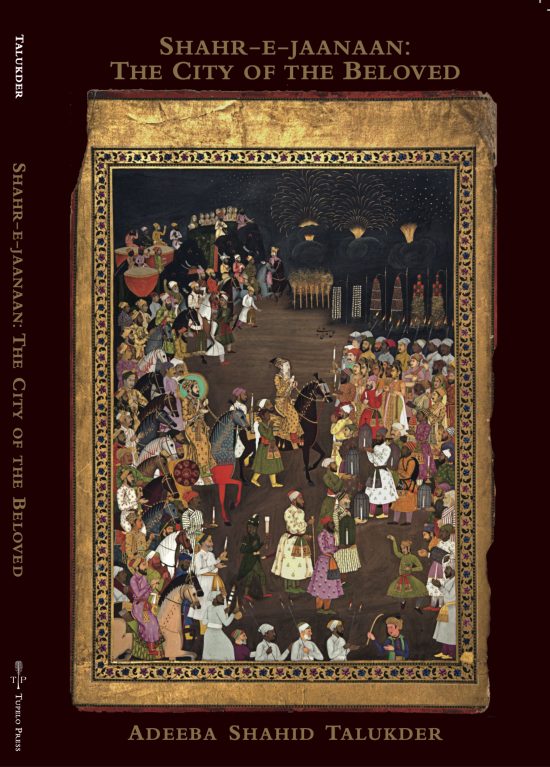
Shahr-E-Jaanaan: The City of the Beloved by Pakistani-American poet, translator and ghazal singer Adeeba Shahid Talukder was a book that came to my attention in the early months of the pandemic, a background that coloured my reading. I was intrigued by this young woman who draws inspiration from the greats of Persian and Urdu poetry and the late Kashmiri-American poet Agha Shahid Ali to explore traditional and contemporary themes alike, from the conflicts between an American raised daughter and her immigrant family to the poignant drama of Laila and Manjoon. Yet, in spite of a clear reference to a hospital in an earlier poem, it was not until I hit the title sequence, that I began to sense something more might be at play. In my review I report that the sequence begins:

At December’s end Benazir died
in a suicide attack.

.                              Men burned

tires, cars, banks,
petrol pumps and factories

Perhaps in grief.

The nights in New York
were clear, cold

and I read Faiz
in a way I never would

again. In Washington Square,
the benches were empty.

What follows is a harrowing account of the speaker’s descent into madness, accompanied in her mania, by God and her poetic saints, culminating eventually in hospitalization and echoing back to the poem I quoted above. It’s devastating, horrifying and strangely familiar, but on my first encounter I did not recognize it for what it really is.

Although I was unaware of Talukder’s own bipolar history when I first read her collection, I did have the feeling that she knew an experience I had also had. An interview with the poet confirmed it, along with her desire to address some of the misunderstanding and stigma she has faced. My response to learning this and a link to said interview can be found in my review of this excellent collection.
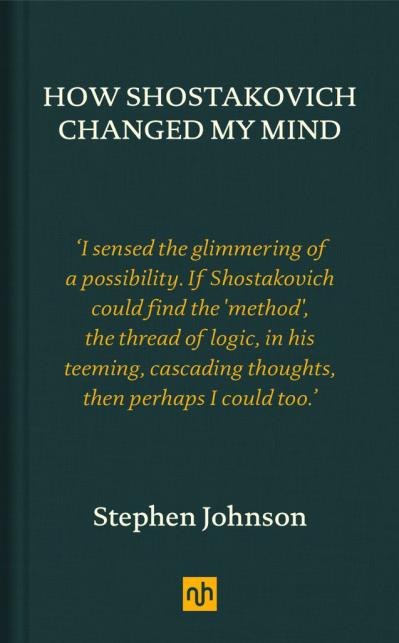
Finally, when it comes to mental health memoirs I am perhaps even more cautious than I am about fictional or poetic works. However, within Stephen Johnson’s How Shostakovich Changed My Mind, I found moments that spoke to me so clearly in relation to my own experience of mental illness before and in the long years following diagnosis. That is possibly because it is not your standard mental illness memoir. A blend of musical biography, memoir, psychology and philosophy, this fascinating book-length essay draws its greatest strength from the author’s passionate affection for and deep connection to the music of Dimitri Shostakovich. As I note in my review:

As one might imagine, given the unusual title, How Shostakovich Changed My Mind is an intimate account of the intersection of music with the personal drama, and trauma, of life lived. Johnson draws on literary, philosophical, neurological and psychological resources as he explores the connection between music and the brain, an area of growing interest and investigation, but he anchors his inquiry in the story of Shostakovich’s life and work during some of the most tumultuous events of the twentieth century—a thoroughly fascinating account in its own right—while tracing out his own particular relationship to this music and the role it played, not only in adolescence, but in his own adult challenges with bipolar disorder.

As such, Johnson’s work is not only a powerful exploration of the ability of music to provide expression and meaning in times of joy and sorrow, but a moving personal memoir of how music can serve as a means to navigate madness, especially in those times when, from inside, all one knows is that something is not right, even if one does not know why.

So, three books for Mental Health Awareness Month, or any time, because it is important to continue to work towards increasing understanding and reducing stigma around mental illness year round—and around the world.

Hospital by Sanya Rushdi is translated from the Bengali by Arunava Sinha and published by Giramondo in Australia and Seagull Books everywhere else.

Shahr-E-Jaanaan: The City of the Beloved by Adeeba Shahid Talukder is published by Tupelo Press.

How Shostakovich Changed My Mind by Stephen Johnson is published by Nottinghill Editions in the UK and distributed by NYRB in North America.
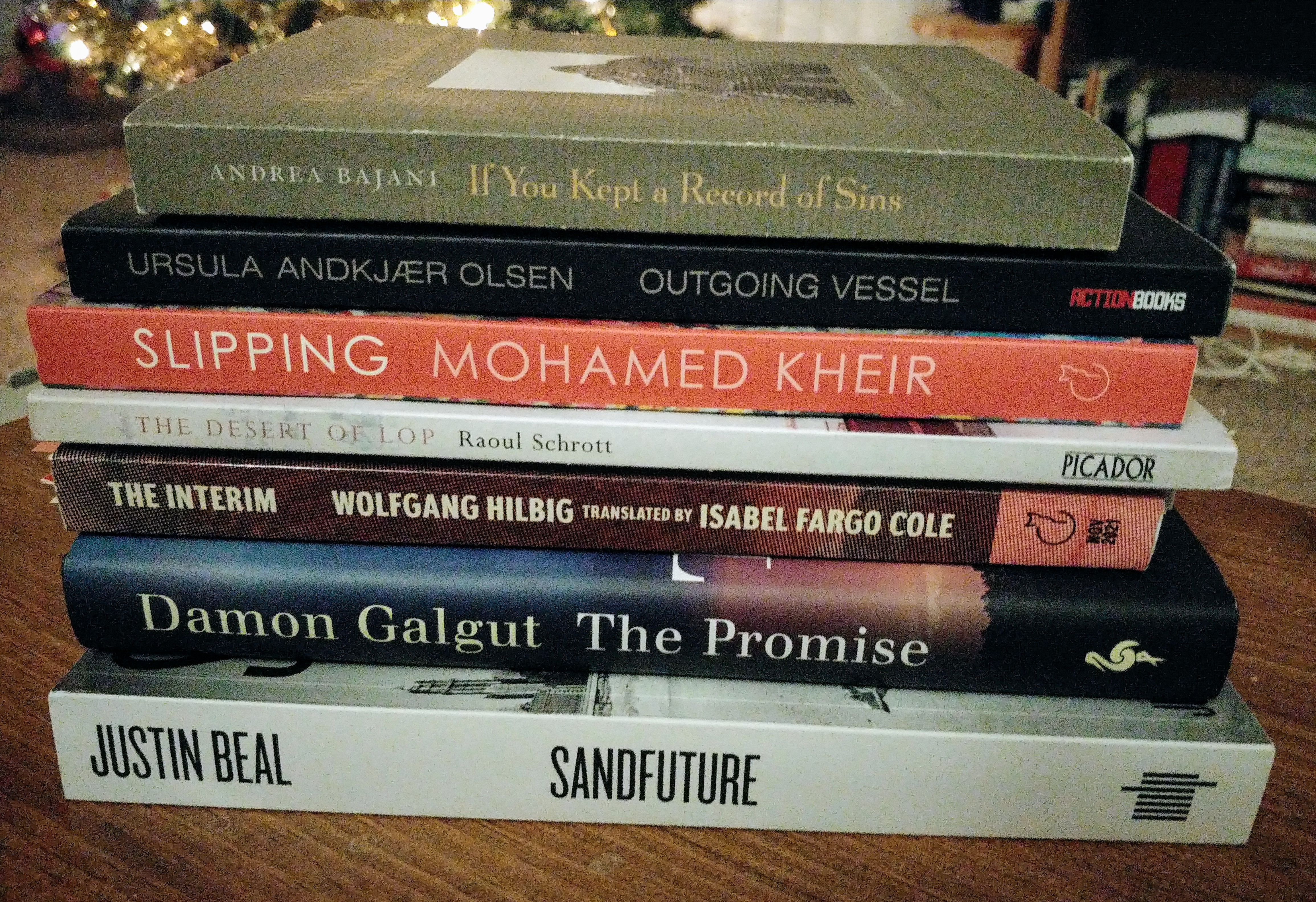
Saying farewell to 2021 with some of the books I loved and best wishes for the future

If 2020 was the year that my ability to read and write felt the numbing impact of a medicated mind, 2021 was the year I had to decide what was really important. My mind is still medicated, but with a drug that does not leave me mentally spongy like the one that I lived on for more than a year. There are pros and cons with any maintenance drug, but I realized that, all things considered, I was better off with the devil I know than the one that was pulling me under. So, by mid-September I began to feel a welcoming release from the haze I’d been struggling against and it became easier to engage fully with literature once again. My reading never stopped, of course, it only slowed, and as I gather my thoughts on my favourite books of 2021, I can see that half of the works I remember most fondly were read in the first two-thirds of the year. But I will admit that every review I wrote during that time was painful, as if pulling my own words together to talk about the words of others was a huge task. In the end, reading only feels like a complete activity if I can articulate a response to each book, regardless of whether it comes out in a “review” of some sort. It is only now that my capacity to read has been restored do I realize how truly impaired it was.

With 2021 and all its global and personal challenges slipping into the rear view mirror, I wanted to take a moment to consider my favourites of the books I read this year. I skipped this readerly ritual last year and, as ever, I am troubled by the fact that each such list necessarily leaves out so many excellent works because, quite honestly, if I am not enjoying a book I rarely feel inclined to finish it, let alone write about it here. So with that in mind, but sticking to a strict ten titles, here’s my contribution to the discussion.

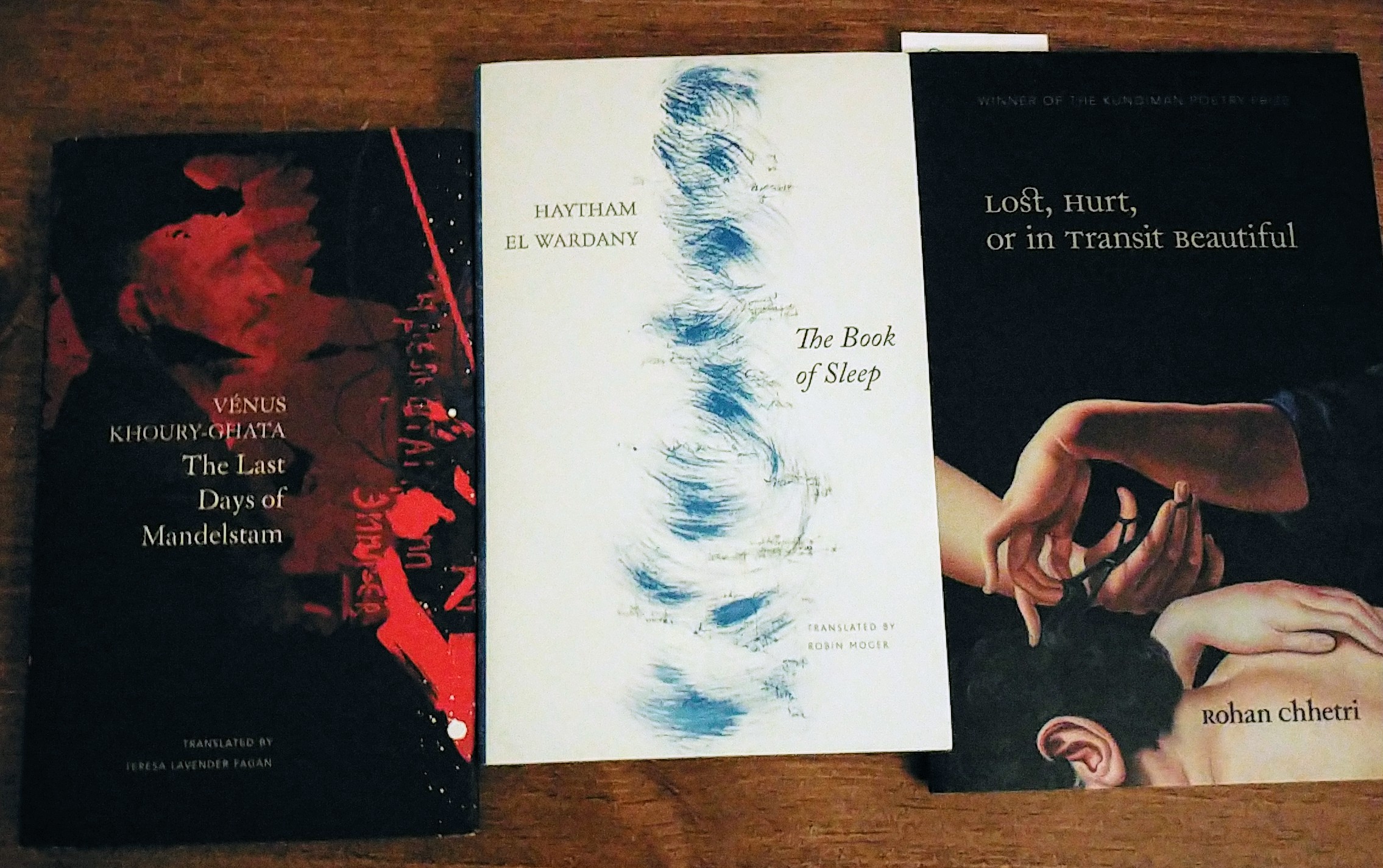
First, my top three. One will be no surprise to anyone who follows my blog: The Last Days of Mandelstam by Vénus Khoury-Ghatta (tr. by Teresa Lavendar-Fagan). Probably the last book I read before transitioning off the troublesome medication, this imagining of the final moments of Osip Mandelstam against a tight, poetic flight back through his life thrilled me with its confident sense that sometimes less truly is more. In the reading I would regularly stop to think: How did she say so much with so few words? This is the work of an accomplished, mature writer. Apart from singing this book’s praises at every opportunity on Twitter, I spoke about it about on this video and recommended it in the December issue of The Bangalore Review.

The Book of Sleep by Haytham El Wardany (tr. by Robin Moger) is one of those books that defies classification—standing somewhere between fiction and nonfiction, it can best be considered an imaginative meditation on sleep and the sleeper that leans toward the philosophical in its grounding, but is unbound in its scope. Thoughtful, intelligent, inspiring.

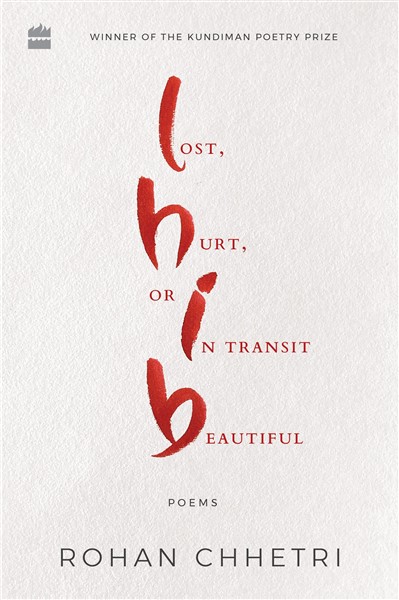
Finally, I read some amazing poetry this year and as usual I found my limited formal understanding of the literary form a barrier to confident articulation of a response, but with Lost, Hurt, and in Transit Beautiful by Nepali-Indian Anglophone poet, Rohan Chhetri, I just wanted to scream READ THIS BOOK! It has disappointed me to see that this collection seems to have been under-appreciated in its US release (it was published simultaneously in India) because it is not only accessible, but gorgeous, and shockingly violent. Stunning.

The balance of my top ten (in the order that stacked best for the sake of a photograph) are:

If You Kept a Record of Sins by Andrea Bajani (tr. by Elizabeth Harris), is the story of a young Italian man who travels to Romania to attend to the affairs of his deceased mother from whom he has been long estranged. It presents a simmering, spare narrative—the kind of read that I responded to especially well with reduced focus and concentration—that resists the need for any tight resolution.

Outgoing Vessel by experimental Danish poet Ursula Andkjær Olsen (tr. Katrine Ogaard Jensen) is perhaps a little more brittle and restrained than Third-Millenium Heart but once again her work takes you on an operatic post-human, yet humane, adventure. Excellent.

Slipping by Mohamed Kheir (tr. by Robin Moger) offers a different kind of adventure into an otherworldly Egypt that is very much informed by a fragmented post-Arab Spring reality. Hard to follow at first, yet fun to read, with much uncertain resolution.

The Desert of Lop by Raoul Schrott (tr. by Karen Leeder). I had been saving this dreamy little volume, knowing that little of this Austrian poet’s work is available in English. The tale of one man’s relationships with three women, it is also a meditation on deserts and the search for home. Exactly the kind of undefinable book I treasure.

Wolfgang Hilbig’s The Interim (tr. by Isabel Fargo Cole) was an unexpected surprise. I’ve read almost all of his work available in translation, and was a little apprehensive about this novel, knowing that he is perhaps at his best in his meandering, surreal shorter works. But this much more conventional narrative featuring another iteration of the classic Hilbig protagonist felt somehow closer to the man himself—a hard drinking, socially awkward, reluctant literary “star” who cannot find a home on either side of the Wall.

With The Promise, South African writer Damon Galgut has finally won the Booker Prize after three nominations and somehow I fear that certain readers might eschew this book because he won this prize (yes we literary folk are a fickle lot). I have long been a fan, and although this book will never replace some of his smaller, quieter efforts in my heart, The Promise is a sweeping portrait of four decades of South African history through the lens of a mischievous high modernist narrator who is by turns, funny, caustic and clever.

And last, but not least, I was offered an opportunity to read a couple of fascinating MIT Press titles by virtue of ending up on a publicist list, and without that I would never have stumbled across Sandfuture by Justin Beal. This is one of those unlikely hybrid essays—a biography of Minoru Yamasaki, the Japanese-American architect who designed the World Trade Centre that is also a reflection on art, illness, urban planning and more—and it works remarkably well. I had so much fun reading and writing about this book that I can only hope that it comes to the attention of the audience it deserves.

For the New Year, I have no specific reading intentions, aside from a small winter project to read some Norwegian literature—no particular reason, I just have a few things piling up and it seems a suitable goal for the cold, dark  months ahead. I’m also hoping to ease back into writing again after a dry spell. Ideas are starting to trickle to the surface, I’ll see if they lead me anywhere. And otherwise I will probably continue my idiosyncratic literary meanderings and savour the ability to read at a faster, yet deeper pace than I was at this time last year.

Oh yeah, and if travel feels feasible again, I hope I might be able to pack my bags and catch up with distant friends by the time this old earth makes its way around the sun once more.  May you be warm, well, and have plenty of light to read by.

Image copyright Joseph Schreiber

Every revolution is a child grown before fire: Lost, Hurt, or in Transit Beautiful by Rohan Chhetri

      For so long I felt he was dead
or so alive I couldn’t bring myself to imagine
his ruined light, & yet there he was, grinning,
the old boy so far inside him, just looking
into his face was a vertiginous drop down
the cool dark of an abandoned well, & him
a thin shade at the bottom among the bones.

                              – from “Sebastian”

Consider the title: Lost, Hurt, or in Transit Beautiful. The conjunction, or, carries the weight of invitation. And there is much stunning beauty to be found in the work of Nepali-Indian poet Rohan Chhetri, but also a heavy burden of loss and intolerable pain—often shocking in its sudden depiction or in its lingering aural presence. Intensity of images rooted primarily in the foothills of the eastern Himalaya runs up against layers of emotion barely articulated within tapestries that honour Western lyrical traditions. In awarding the original manuscript the prestigious Kundiman Prize, the Judges Citation recognizes that “Chhetri dramatizes and resists the ways language, and its implicit logic, limit what is possible within our most solitary reflections, defining even those ‘vague dreams’ that in the end we greet alone.”

Now this might seem an intimidating brief with which to open this commentary, but for a reader, no matter if their connection to poetry is casual or confident, there is a certain comfort with familiar forms, say an ode or a sonnet, that makes the turns and twists the themes take that much more striking. In conversation with his editor Kristina Marie Darling, Chhetri is asked about his approach and the value of encouraging this dialogue between inherited literary form and modern, experimental techniques. In his response he suggests that:

“my poetic impulse is a baroque one which is well suited to the syncretic, non-linear, anti-neocolonial poetics that can accommodate politics and revolution from the margins, the fabular, folk horror and mythology, the motif of katabatic descent, the marriage of the classical and the local etc. — all of this prismed through the multiple poetic traditions I write out of as a Nepali-Indian Anglophone writer.”

In this one, full-bodied sentence, the poet offers a clear sense of the mood permeating his work and the atmosphere that envelopes the reader travelling through it. His central point of reference is a borderland where many forces meet—literary, historical, lyrical—crossing lines, echoing long standing struggles over land, language and cultural autonomy. It exists on many levels, in the reality, in the imagining and in the documenting. When I look back across the poems in this slim volume I am reminded anew how grim they are, and yet what I remember is a certain beauty, a bone-deep fundamentalness of being. That is, I suppose, why the myths and fairy tales that enchant us also carry so much darkness and shadow.

Sorrow, absence, and death are never far from the surface in Lost, Hurt, or in Transit Beautiful. There is a strong sense of ancestral connection to the poet’s Nepali-Indian background, but the lyric voice is not personal until later, enhancing the mythological, even epic, quality of the poems. Time and again hints of smothered brutality give way to moments of unflinching violence—a violence that arises by both natural force and human design. It is a part of the philosophical/literary exercise at hand, but one that is rooted in historical, political and ethnic conflict. As Chhetri explains, in this book:

there is always that implicit tension between language and violence but it also plays out more overtly in a poem like “Lamentation for a Failed Revolution”, which recounts the events of the last iteration of the Gorkhaland Movement in 2017, a hundred-year-old movement demanding self-determination and a separate Indian state for the Nepali-speaking population in West Bengal.

Revolutions—as an extended legacy gifted from generation to generation—run through this collection. The stories of grandparents, parents, and children find expression as choral and individual voices rising in lament. Some losses are intimate and cumulative, others vivid and abrupt:

Another afternoon            a fifteen-year-old boy
Hear the bullet              thud to breast like second heart
pain’s rubbery percussion             the way he looked up
mouth a shucked-oyster wobble                   Alive
in the elongating horror

                          – from “Lamentation for a Failed Revolution”

In such moments, the dynamic relationship between language and violence is realized with such a sensitive touch—just the right phrase, spacing, word—that the impact is simultaneously personal and political. The broader implications of such moments of barbarity ripple out far beyond any border-straddling community, across state, national and international lines, to be echoed afresh in the ongoing conversation between form, content and technique.

As one would expect, the poems that comprise this collection draw much of their energy and atmosphere from rural imagery featuring forests, rivers and a frequent appearance of deer (causing me to think of Trakl for his fondness for the same motif). However, especially in the latter sections as a lyrical “I” begins to appear, the speaker finds himself in New Delhi and Los Angeles. Yet, as in earlier pieces, the environment is reflected from an array of unexpected angles. Set in LA, “The Intelligence of Hunger” finds the poet who was once able to sleep through earthquakes, gunfire and rampaging elephants, newly alive to noise and a fresh urban reality, hot and dry with fires burning in the hills:

Where I live now every sound I make is a half-note
of loss. The bare mountain withstands, drought-
ridden, the Pacific breaking froth at its feet.
The wind rasps through the chaparral & I think
of the fire followers waiting in their late style
of hunger. The giant coreopsis that will bloom
for three bright weeks in April. I wanted to write
about these. If not love. Wildflowers, not grief.

Yet in this landscape so distant from home, his pen still turns to grief, as the end closes in on a sharp imagination of agony and sacrifice. A mood that crosses miles in an instant.

It is difficult to emerge from this stunning collection unmoved. The language and the intensity of imagery speak to something very primal, human and strangely comforting. I find myself returning over and over again to marvel at how the concert of words plays out on each page. Strongly recommended.

Lost, Hurt, or in Transit Beautiful, the third collection by Rohan Chhetri, is published by Tupelo Press in the US and Harper Collins in India with a UK edition coming from Platypus Press in 2022.

A timeless immediacy: Shahr-E-Jaanaan: The City of the Beloved by Adeeba Shahid Talukder

At this moment, as the world grapples with a rapidly spreading virus, two contradictory impulses can be observed: borders are being reinforced around nations in the interest of isolation from without and within, while simultaneously, we are observing unprecedented international scientific collaboration. On the ground level, class differences and prejudices can be augmented and yet, to defeat COVID-19, it will be necessary to rise above them.

On the individual level, to get through the difficult months ahead, those who find their regular lives upended are looking to find ways to occupy, distract and comfort themselves. That is, however, not always easy. If some avid readers are finding themselves struggling to settle into a novel or a work of nonfiction, that’s where poetry can offer respite.

But how are we to read poetry in a time of disruption, uncertainty, and exceptional circumstances? Do we look to contemporary voices, or to those from the past—classical themed works that have echoed down the years, the centuries, speaking to love and loss, peace and war, and everything in between?  Shahr-E-Jaanaan: The City of the Beloved, the new collection by Pakistani-American poet, translator and ghazal singer Adeeba Shahid Talukder, offers, in its own unique way, a blend of both. This collection, reaches across vast distances to call on traditional tales, and iconic Persian and Urdu poetry, and bring it home and into the present day, into the lived reality of a young Muslim American woman’s experience of life in New York City.

New York City. When Talukder composed these poems, and when I first read them, who could have known that before I would write my reflections on this book, NYC would have become the epicentre of a global pandemic? In some ways the altered circumstances imbue certain pieces with a new aura; in other ways, nothing changes at all because so many of these poems deal with those elements of growing up and coming into one’s own that are at once smaller and greater than any global catastrophe.

In her Preface, Talduker acknowledges her influences, a litany of prominent Persian and Urdu poets who have formed and informed the way she views the world. They include Mirza Ghalib, Mir Taqi Mir, Faiz Ahmed Faiz, Allama Iqbal, Mirza Sauda, Noon Meem Rashid, Ibn-e-Insha, Agha Shahid Ali and more. Her intimate knowledge of the literary traditions and poetic forms is evident and effortless, but her objective is broader. She seeks:

to defend and decolonize this universe—its beauty, its grandeur, its intellectual feats. At the same time, I defy the patriarchy of it, the patriarchy with which so much of literature is cursed.

That is an admirable objective—to honour and challenge a world so thoroughly dominated by the male voice. And yet it is that strong modern feminine presence that makes this collection so powerful.

Written over the span of a decade, there is an ongoing theme, developed throughout the course of Shar-E-Jaanaan, of a young woman’s experience navigating the dynamics of her immigrant family and their expectations, coping with questions of identity and self-esteem, exploring sexual independence and romance, and, finally, falling in love with a white, non-Muslim man. While grounded, or often returning, to an urban American setting, she effortlessly draws on the beauty, passion and tragedy of classical imagery and legends, passed down in Persian and Urdu poetry, often writing in response to specific lines or images from the ghazals of Faiz, Ghalib and others. However, rather than being restrained by her benefactors, she is buoyed by their legacy. The result is a work of remarkable elegance.

The first poem “When in the dark / my mind brightened” opens with a stark confession that sets the tone for the collection that will follow:

I realized I could no longer
wait to be beautiful. Thus, I pushed
bangles upon bangles
onto my wrist, rubbing
my hands raw with metal
and glass.

Each time a bangle broke, I watched
the blood at my veins
with a grim face,
feeling more like a woman.

It ends with the speaker’s mother, facing her maturing, possibly troubled, daughter with terror. The first section, “The Wine Cup” returns to the tension between mother and daughter through a sequence clearly set in Manhattan that closes with a classic maternal concern: You’re getting older, and there are such few boys.

Traditional elements, and poetic influences become more evident from the second section on. Her notes at the end of the book introduce the stories from which she draws inspiration and acknowledge the poetic lines woven into, or referenced, where relevant, so familiarity with Urdu literature is not necessary, but some background would certainly further enrich the experience. She calls on several epic themes, with the seventh-century Arab legend of the ill-fated lovers Laila and Qays notably surfacing in a number of pieces. In this tale, when Qays, a poet, is forbidden to marry his beloved beauty, he takes to running through the streets calling her name and composing love poems. His erratic behaviour earns him the nickname Manjoon, or madman, and he is forced into exile.

Other poems incorporate lines, or images drawn from one or another of her literary touchstones. In the light of the current state of the world, “If It Were (after Ghalib)” seem especially poignant now that I return to it:

The hospital sheets cover my face. No one sees. My eyes are closed, my
hands spread like a hem. The walls white like jasmines.

I sing: I would die happily, if it were once.

The patients’ quarters are hushed but I can hear his breathing, the
way he smiles into my neck and ear. In each room, his bulk rises
and falls beneath the thin blankets. In each room, his face in the blue
light. I scream and scream.

His arrow was half-drawn. The liver aches, anticipating its touch.

The scale cannot measure my weight. I am a goddess; the sickle moon
and East River are mine to feed. I shred all the roses, let the torn petals
fall all over the tiles.

The true context of this poem will later come clear in the titular sequence, “Shahr-E-Jaanaan: The City of the Beloved”, the centrepiece of the book . It opens with a reference to the events that followed the assassination of Pakistani Prime Minister, Benazir Bhutto, on December 27, 2007 and its very personal impact, halfway across the world:

At December’s end Benazir died
in a suicide attack.

                             Men burned

tires, cars, banks,
petrol pumps and factories

Perhaps in grief.

The nights in New York
were clear, cold

and I read Faiz
in a way I never would

again. In Washington Square,
the benches were empty.

What follows is a harrowing account of the speaker’s descent into madness, accompanied in her mania, by God and her poetic saints, culminating eventually in hospitalization and echoing back to the poem I quoted above. It’s devastating, horrifying and strangely familiar, but on my first encounter I did not recognize it for what it really is.

Talukder’s poetry frequently captures the dramatic sweep from ecstasy to despair, an element I read as an attraction to the  heightened intensity of desperate romance, loss, madness, and suicide (real or threatened) that features in so many traditional Asian legends. I could not help, for instance to note how often reference to the story of Laila and Manjoon appears. But until I read an interview with the poet, I was unaware of her own personal bipolar history and her desire, through her writing, to break down some of the misunderstanding and stigma she has faced. Looking back, that explains some of the unspoken level of attraction I felt to these elements in my initial reading, for I, too, am bipolar—this kind of emotional instability is more than poetic for me, it is real. I’ve known madness and hospitalization myself.

This is a collection that came to me, unexpected, through a publisher’s inquiry. The appeal was, first and foremost, to the language and the poet’s connection to Persian and Urdu literature, something my travels and connections in India have started to bring to my attention. The true beauty here, though, lies in the fluid crossing of borders—of language, nation, era and gender—not as an act of re-imagining or re-purposing, but a full-bodied act of translating a rich literary heritage into something new, vital. In this respect, among the illustrious Urdu forebearers of this young Pakistani-American woman, the late Kashmiri-American poet Agha Shahid Ali holds special relevance. His body of work spoke to both sides of his life and identity, to both of the homes he knew, but he was able to address that space where the two meet—the hyphen.

The maturity and diversity displayed in Shahr-E-Jaanaan is impressive, a testament to the many years over which it came into being (her first book, What is Not Beautiful was also written and released during this period). In our rapidly evolving new world, Adeeba Shahid Talukder is a poet, and performer, to watch.

Shahr-E-Jaanaan: The City of the Beloved is published by Tupelo Press.