
“Not writing is always a relief and sometimes a pleasure. Writing about what cannot be written, by contrast, is the devil’s own job. Yet words on a page make all things possible.”
Central to this collection of brief odes to the fictional inspirations that once planted, failed to germinate, refused to take root and grow, or died off before even hitting the soil; is one full and essentially complete story – the magical titular “The Loss Library”. Surrounding this tale, to either side on the book shelf of South African author Ivan Vladislavić’s imagination lie a selection of meditations on the curious nature of the creative process and the many ways that an intriguing idea can lose its way on the path to realization, finding itself shelved in the place of the might-have-been, filed away in a writer’s own personal loss library. Looking back at the notes and outlines he explored during the late 1980’s and early 1990’s, the unsettling years of transition from apartheid to a democratic state, Vladislavić notes that his inspirations tended to arise from documentary sources – the past perhaps seeming more sound than the bloody history being made on the streets of his country at the time. Moving forward, within the scope of the “case studies” selected for this book, the pieces and fragments he gathers turn to dictionaries, reference materials and the “means to read and write – or not read and not write – books.”
 But let us begin in the middle, at “The Loss Library”. With a clear nod to Borges, the master of the library of the imagination, a young man arrives at a most unusual archive, a repository of the all of the unfinished works, possible and impossible of all the writers who have ever lived. He is greeted by an attractive librarian. Fit and tanned she is the antitheses of what he expects. As she guides him into the library she first steps into slippers and advises him to do the same. They literally glide across the polished floors of the rooms and corridors as she directs his personal tour of the premises. The first room contains a single glassed in cabinet containing the books that would have been written had their would-be authors not chanced to die young:
“‘Arranged alphabetically and classified by cause of death.’ A wave of her slender hand. ‘Accidental death. Booze, of course. Disease – those old standbys, consumption and syphilis, and the new one, AIDS, a growing collection. Duels – little sign of growth there. Motor accidents. Murder. Suicide. A disproportionate number of Russians and Japanese, as you’d expect, and quite a few of your countrymen and women too.’”
As our protagonist leans in for a closer look, he can recognize no words on the spines. He tells the librarian he is looking for Bruno Schulz. Filed down with the war dead, six little volumes are found but he is not allowed to see them… after all, opening such a book could have consequences in all the others, in essence I suppose, the way fiddling with the future given access to a time machine might. In this library of potential works, one can’t risk having people “talk them into being.”
 Together they encounter a room filled with books that remain unwritten because their authors lost faith in them, and he is shown a collection of the books that lost their way or were talked out of existence before they had a chance to be realized. They pass through a room containing books that were destroyed, stop at a shelf of books that comes into being by evocation of the proper author’s name (any guesses?) and, finally, enter a room of floating, ghostly, ethereal books – those that presented themselves to their would-be writers in dreams. In the end, is this excursion through the Loss Library a fantasy, the beginning of book that the young man himself will write into being, or another story that might have been, relegated to the back of a notebook, the bottom of a drawer or, in this day and age, lost somewhere on a hard drive?
Returning now to the startling opening essay, Vladislavić describes his attraction to the famous photograph of Robert Walser lying dead in the snow on Christmas Day, 1956, and reflects upon the way that the isolated image fueled his imagination before had even read any of Walser’s work. He contemplates writing a story about the writer’s last days, about that fateful final walk, the curious absence of footsteps or bystanders around the body, the precision the photographer must have employed to capture this solemn record, and with particular fascination, the dead man’s hat lying in the snow. However, before he sits down to write, Vladislavić engages in a little research and finds another photograph, taken from a different angle. From this vantage point he can now see many footprints in the snow, two men off to the side, and realizes that even the hat has fallen differently than he imagined. The curious, romantic and uncomfortable questions – the necessary elements of the creative process – are shattered.
As he continues to rifle through the pages of his notebooks, Vladislavić explores a variety of mislaid ventures, the inspiration or ideas behind them and the reasons they fell off the rails or, perhaps, only flickered for a moment or two. “Gross”, an intended venture into the land of the OuLiPo in which he set for himself a series mathematical constraints within which he would construct a novel, proves unsuccessful. Along the way, the character he was creating to take centre stage, morphed into someone else who would, ultimately wander off to join the cast of another novel,The Restless Supermarket, but more critically, he found himself completely overwhelmed by the prospect of the challenge he had set and decided that this type of approach was best left to Perec, et al.
In a later example, he describes his fascination with an unassuming sign on the side of a building in his Johannesburg neighbourhood that simply reads “Gravity Addict” with a phone number. He begins to wonder what a gravity addict is and how that might be imagined in a story. He thinks about the post 9/11 performance artist in Don Delillo’s The Falling Man, contemplates the structural format of that novel, and eventually imagines a woman, an aspiring writer, sitting on her sofa watching endless episodes of old cartoons – the ones where characters repeatedly chase each other off the edge of cliffs – and then, when one day the innocuous meaning behind the mysterious appellation “gravity artist” is revealed to him, his interest in the story instantly dissolves and he can go no further.
Finally, in light of the recent re-release of Vladislavić’s first novel, The Folly, the story “The Acrobats” special attention. In this outline for a story we see a man in a library reading a book. At some point he closes that book and retrieves a copy of Tristram Shandy from the stacks. He seeks out a particular passage which in turn, is a lengthy quotation from Gragntua and Pantagruel by Rabelais, so he stops and wanders off to fetch that text and goes on to read from the original, or rather a translation of the original, the same quoted passage describing the wild acrobatic exploits of Gymnaste, performed on horseback, as he faces down an enemy combatant. As such, Vladislavić envisions a post-modern inversion of a book within a book within a book, the initial level being, of course, at once the book that both the man and his reader are reading. However, the idea is set aside, in part due to the complication of modern versus contemporary translations of the nested passages.
Several years later, in the writing of The Folly, Vladislavić sees his character Nieuwenhuizen, the eccentric stranger who arrives out of nowhere to take ownership of and build a house on a vacant lot, as a direct descendant of Gymnaste. As he marks out the foundation of the ephemeral house that he will ultimately construct out of imagination and thin air, Nieuwenhuizen engages in his own acrobatic measurements, leaping, somersaulting, and throwing himself around the lot. Could the earlier story now be revived, with The Folly as the third book in the line, he wonders, could he develop the idea that his “ostensibly post-modern novel stood in a pre-modern tradition”? Ah, but for the paradox that his outline for “The Acrobats” was written three to four years before The Folly, how could a story refer to a book that had yet to be written?
Yet Vladislavić was, it would seem, not quite done with his potential story. Several years later he encountered the 18th century French writer, Diderot, who was a contemporary of and acquainted with Laurence Sterne. Although the publication of Rameau’s Nephew would arise through a circuitous route, there was an indication apparently, that Diderot’s initial sketches for the eccentric, rambling character who engages the narrator of his novel could have roughly coincided with the publication of Tristram Shandy. Now he wants to fictionally trace the lineage of Nieuwenhuizen from Sterne via Rameau… except for a new paradox that arises. The Folly was written before his discovery of Rameau’s Nephew. How could his own novel be influenced by a work he had not read?
In his note at the end of this account of the stubborn death of a story idea, Vladislavić can look back and recognize that, as a young writer, he demonstrated too great a concern with precedent. Wiser now, he remarks:
“Every writer belongs to one bastard bloodline or another, and laying claim to one can be a liberating lesson in perspective. But standing on the shoulders of giants is a skill that comes from long practice. When you start out, you are more likely to get under their feet. Don’t be surprised if the giants – or their legitimate progeny – come stomping after you in the playground: ‘We walk straight so you better get out of the way!’”
And herein lies the true gift of this slender collection of artistic musings,and inspirational dead ends – the insertion throughout of the author’s updated reflections on his varied false starts. There is no writer or would-be writer who does not have an accumulated hoard of ideas, outlines and abandoned projects. If they don’t, one ought to be suspicious.
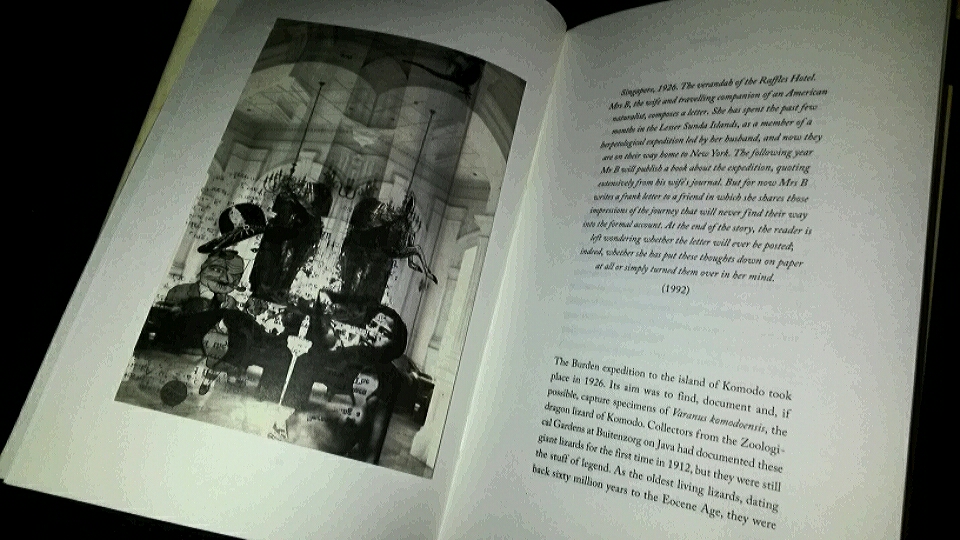
Wandering through The Loss Library and Other Unfinished Stories is a rare privilege to spend time in the company of a thoughtful, gifted writer who truly appears to be without pretensions. This journey, contained within the covers of a finely crafted hardcover from the singular Seagull Books and accompanied by the original collages of Sunandini Banerjee, is a wonderful way to spend an afternoon, and treasure to return to time and again. After all, there may well be, within these pages, the inspirational seeds of other stories just waiting for the right gardener to plant them and bring them to fruition.












 roughghosts