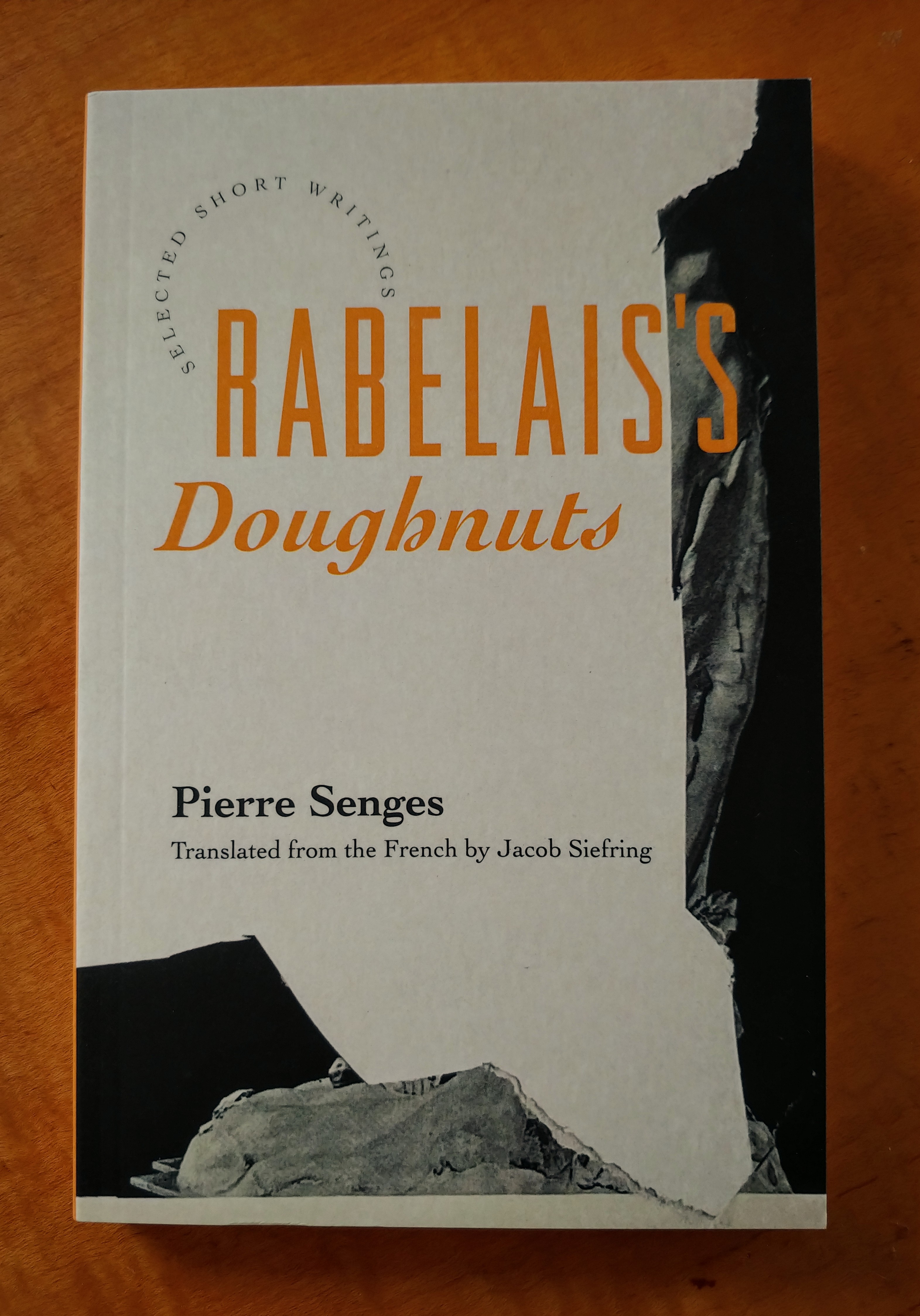
Seven (slightly vain) exercises in style: Rabelais’s Doughnuts by Pierre Senges

French writer and playwright, Pierre Senges, is a most subtle conjuror who casts a sidelong glance and exercises a sharp pencil to bring literary, historical, and contemporary notions together in unexpected intermixtures of fact, fiction and philosophy. An erudite alchemist, he spins extravagant, satirical, richly intertextual essays and imaginings that exploit that hallowed ground between the actual, the probable and the impossible. He may be dancing in the footsteps of Borges and Calvino, but Senges is the choreographer of his own inimitable style.

I have read and reviewed several of Senges’ works—the brilliant The Major Refutation, a conspiracy theory for the ages, the collaborative Geometry of Dust, and the chapbook Falstaff: Apotheosis—but on the menu today is an assortment of his idiosyncratic musings, half a dozen plus one tasty treats gathered together for the first time as Rabelais’s Doughnuts. Translated, like the other works, by Jacob Siefring, a veritable Senges evangelist, this slender volume is published by Seattle-based Sublunary Editions, their third contribution to the mission to bring more of the prolific French writer’s oeuvre into English. Six of the seven titles included in Rabelais’s Doughnuts were previously published in a variety of online and print journals over the past decade, but Siefring’s translations have been revised for this collection.
It tends to be difficult to succinctly summarize a Senges story/essay without tripping over one’s words. The most straightforward pieces here are two that involve Michelangelo’s famed painting Last Judgement. The first, “Last Judgment (detail),” is one of my favourites, revolving around a real person and situation that I was unaware of and would have thought to be entirely fanciful were it not for our friend Google. (One of the great joys of reading a writer like Senges is that he inspires a reader to look up an individual or a circumstance to find out what he is referencing—for those more cultured than myself that might be unnecessary, for those to impatient to seek out the subtext it could be frustrating, but in my mind it is a bonus.) This first Michelangelo piece considers the fate of Daniele Ricciarelli (called Daniele da Volterra or “il Braghettone”) who was commissioned to add tasteful coverings to several of the unsuitably exposed figures in the great artist’s masterpiece. With a certain empathy, Senges considers the task, the betrayal of his master, to which Daniele Da Volterra is committed:

When he draws, he draws, when he paints, he paints: depending on the point of view, the veils of the Braghettone benefit from his skill as the author of a Descent from the Cross, which has since become famous (famous as a reference, not as a celebrity). Or rather, it’s quite the opposite, one hundred and fifty veils fastened like so many pairs of underwear on the men and women of Judgement Day, all stretching towards their salvation or damnation, and disregarding as they would disregard a prune a nakedness that is more or less suited to the gravity of the occasion, one hundred and fifty veils are a valuable exercise for a painter.

The other Michelangelo related piece, “Measure of All Things,” imagines its way into the mind of the influential and critical writer Pierre Aretino who wrote an open letter to the artist offering his opinion on The Last Judgment.

Other works sing the dubious praises of the six hundred page novel, riff on one of Heinrich von Kleist’s prescient anecdotes about possible long distance communication, dragging it piecemeal into our modern world of the internet and Amazon, muse about writing exercises, and take on the character of a counterfeiter baring his sorry soul, such as it is, to a client. Figures from history and literature appear throughout, sometimes even providing a framework for Senges’ wide-ranging reflections. “Many Ways to Stuff a Watermelon” is a perfect example. He wanders through the libraries of a host of real and fictional characters, from the scant collections Russian writer Sigizmund Krzhizhanovsky granted his impoverished characters, to the actual library an aging Giacomo Casanova found refuge in, this tribute to libraries great and small will resonate with anyone who collects more books than they can ever hope to live long enough to read. In this, one English writer’s despair at the incalculable extent of available material speaks volumes (so to speak):

The reader’s tininess signifies the brevity of our lives: it follows that the impossibility of reading everything takes the measure of our mortality, provoking frustration and vertigo at the same time—to Thomas De Quincey, in any case, one hundred thousand forever unknown volumes brought forth tears which he compared to those of Xerxes countenancing the death of his soldiers: not some “fanciful case of misery”, but “as real a case of suffering as ever can have existed.”

Senges’ elaborate language and dry wit allow him to take a small idea and expand it into an intelligent, extravagant exercise, one that takes chances but always steers close to the truth, or a truth, digging freely into the past to make astute observations about the here and now. If you are new to his work (or well acquainted), this short collection is a an ideal way to meet (or spend more time with) this witty, intelligent writer.

Rabelais’s Doughnuts by Pierre Senges is translated from the French by Jacob Siefring and published by Sublunary Editions.

And now for something completely different: the adventures of char, vol #1 by Whiskey Radish

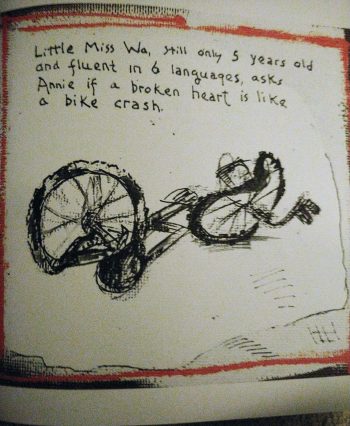
I have, for a number of years now, been an ardent admirer of Whiskey Radish, the enthusiastic, energetic creator of a world like no other—one peopled with an inexhaustible cast of characters whose adventures unfold in single-sentence illustrated frames. These moments sometimes stand alone, sometimes riff off one another with a free form jazz vibe. Her distinctive sketches have been a regular presence online and off—illustrating articles, decorating freely gifted postcards, stickers and other treats, and gathered together in books created and often sold for a song. Now, for the first time, a selection of Ms. Radish’s images have been collected in a fabulous full-colour book published by Ice Floe Press. The adventures of char, vol #1 is a labour of love. It is a treasure for existing fans and a welcome introduction for those who have not yet met the cheerful madness of Whiskey Radish.

Behind the playful moniker is an artist, writer and jazz lover who lives near Boston. A wife and mother of three who teaches private art classes to teenagers, the core stimulus of her art rests in the daily practice of producing a daily “sortie” or burst of thought. Illustrated with her boisterous ink drawings, each thought becomes a story in itself. The images in this volume are drawn from around 300 “sorties” made between October of 2020 and July of 2021. Robert Frede Krenter, the publisher of Ice Floe Press, selected and ordered the images with their descriptive wisdoms and observations to titled create mini-adventues. The result is a collaborative visual poetry.

Whiskey Radish’s primary template is black ink on white, a blend of blotchy exuberance and startlingly fine detail, but in this collection colour is invited to join the party, often adding texture, density and a remarkable range and variety to the images. The creative process and the method of assembly heightens the variability. Some of Whiskey’s familiar characters—Char, Slimbo the Rocket Dog, You and the King—are joined by other wise, wistful and magical personas and even, for a change of pace, a selection of drawings of plants.

I first read this book in PDF—full disclosure, I was asked to provide a blurb—a format that enforces a linear reading. But, now that I have a paper copy, it is just as delightful, if not more fun, to just open it up and slip in and out of the short segments moving forward and back. During a month in which a broken leg has me tethered to home as outside spring is bursting with green leaves and blossoms, and so much news has been shrouded in darkness, it has been wonderful to have a book so full of life close at hand.

The adventures of char, vol #1 by Whiskey Radish is published by Ice Floe Press.

No promised lands: Canzone di Guerra by Daša Drndić

Each time I come back to Croatia, I see that it is not the Croatia I left, that I am not the person who left. Today, every lengthy departure from Croatia promises a still more difficult return, an ever more remote chance of establishing a firm, tenuously secure basis for living. Today, when I leave, I no longer know who I will find alive when I come back.

Croatian writer Daša Drndić was singular literary force, able to deftly weave facts—often gathered and presented in an unapologetic, even confrontational manner—with fiction to create compulsively readable, powerful works. Her novels incorporate lists, historical details, interview excerpts, documentary asides and lengthy footnotes into a character-driven story to achieve more than what either fiction or nonfiction could do alone. In Canzone di Guerra, recently released in English translation from Istros Books, we see an early form of this distinctive approach to storytelling, deeply political yet strikingly novelistic, echoing the author’s own experience in Toronto, Canada, as a single mother escaping conflict as the former Yugoslavia was falling apart in the early 1990s. Given this context, this work also stands as an increasingly relevant portrait of the immigrant experience—one in which my own country does not come out too well.

Originally published in 1998, Canzone di Guerra’s opening chapters zero in immediately on the narrator’s decision to leave Croatia and the varied circumstances immigrants and refugees face in Canada after the collapse of “Socialist Yugoslavia.” Framed by short digressions about the origin and fate of certain varieties of pigs—parables of culture, dislocation and loss—Drndić quickly shatters idealistic illusions and hints at the embedded inequalities and ethnic divisions that her superficially homogenous community carries with it to new shores. Imagined, in part, as the transcript of a radio documentary we hear the voices of an array of characters struggling to find work, dismayed at the lack of recognition for their professional credentials, and coping with loneliness and alienation:

Here we sleep peacefully, there’s no shelling, but we’re waging a different war. A war in the soul, a war in the head. Why did we come? We thought Canada was a country of great possibilities. I don’t know why no one told us the truth.

Beneath the dialogue, footnotes discuss the disappearance of trees in Sarajevo parks, coping strategies for stretching food or resources, even quote George Orwell. Throughout the text, such notes offer the opportunity for a multilayered discourse. There is always more going on beneath the surface.

Of the migrants, seeking a better life, some will thrive, some will not. The narrator, Tea Radan (“my name in this story” as she later says), has her young daughter Sara, to consider. She has to hope for the best. But what is she really hoping for? That is, at best, uncertain. Prior to moving to Canada, Tea and Sara had lived in Belgrade before moving to Rijeka in her native Croatia. Her sister lives in Slovenia, her brother is restless but goes nowhere. Those she knows want to leave but most don’t get far. However, the distance that her ability to migrate affords her seems to focus her attention back on her family, her parents and grandparents, and their actions and political associations during and after the Second World War. Her grandfather’s letters and mother’s diary entries help flesh out the story, but questions remain unresolved.

A romance with a fellow Croatian immigrant sets her off on an extensive, obsessive search through archives and records available in Canadian libraries, triggered by the notion that his family’s circumstances may have been connected to her own, most particularly to a betrayal of her mother during the war. It is not a healthy basis for a relationship, but it spurs a journey that leads Tea from one rabbit hole to another, as she delves into the history of Croatian communist and fascist movements, through the treatments of Jews in Canada, to tragic accounts of the concentration camps Theresienstadt near Prague and Jasenovac in Croatia. It is a gut-wrenching whirlwind tour, one that invites readers to slip down their own rabbit holes. Yet the intensity of her investigations, only trigger more questions:

The more I read, the less I knew. No one was entirely innocent, no one was entirely guilty: not the cardinals, nor the bishops, nor the popes, nor the churches, nor the Vatican. Nor the communists. As for the Ustasha ‘truths’, I read them too, but I didn’t believe them. They all had their version of history. Those who survived. The CIA had its truth as well. America and Great Britain their own.

Uncomfortably, for a Canadian reader, Drdnić, through her narrator, is unsparing in her critique of Canada’s failure to deal with a number of high profile war criminals who found their way here—something I was not unaware of but was chastened to review it all again.

This novel is, nonetheless, more than a vehicle to delve into past darkness. It is charged with a certain humour and warmth as Tea and her daughter navigate life in a new country. It is not easy. Along with other migrants they are forced to seek social supports, take degrading work under the table, and scour second hand shops for clothing and shoes. It sounds bleak, but Tea’s defiance and Sara’s spirit carry them through the endless bureaucratic mazes of the modern capitalist state.

Entertaining, intelligent and disturbing, to read Canzone di Guerra today, thirty years after the time when it was set, is enlightening. Immigrants still face the same frustrations finding support, resources, and work that recognizes their training. Yet, as refugees from the war in Ukraine flow into Canada and many other countries—often moving ahead of those waiting in line much longer—it is clear that all refugees and immigrants are not treated equally. The migrants arriving from the collapsing Yugoslavia note at one point that they are invisible compared to other more “obvious” newcomers. But visibility is not an asset, as long-time Canadians from visible minorities can attest. Racism and xenophobia has grown even more over the past few decades, buoyed by the same kind of nationalist sentiments that played such a key role in World War II and the Balkan Wars alike.   Daša Drndić’s work remains, as ever, clear-eyed, critical and timely.

Canzone di Guerra by Daša Drndić is translated from the Croatian by Celia Hawkesworth and published by Istros Books.

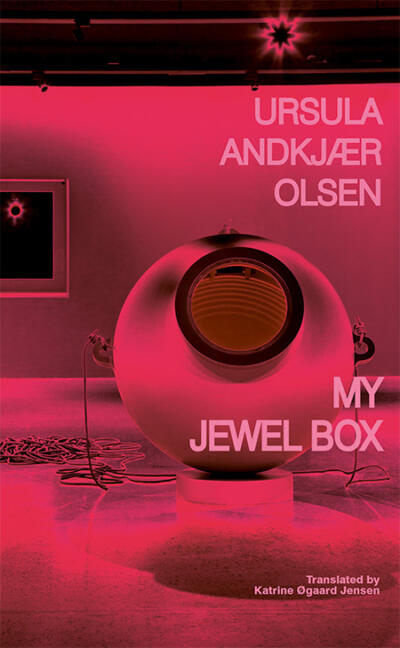
i am so pure and lonely: My Jewel Box by Ursula Andkjær Olsen

infinite energy borrowed from the future
founded everything
out of nothing

like debt  (45)

It has been four years since my first encounter with the work of Danish experimental poet Ursula Andkjær Olsen through her book-length poem Third-Millennium Heart. I was, at the time, grieving the death of my mother a year and a half earlier, and in a process of coming to understand the nature of the particular absence her loss had left in my own sense of identity.

Dramatic and intense, the poem follows an expectant mother-figure like no other, her language pulsing like blood through arteries and veins, her vision pushing beyond patriarchal capitalist dynamics toward a new conception of the body and the kind of life it can nurture and contain.

As I described it in a blog post, “we are held captive by a demanding chimeric voice, witnesses to the realization of a possible future reality which, not unlike the mechanistic hive-mind typically associated with cyborg imagery, envisions a hive-heart existence.” I was so swept up in the flow of this epic, inventively translated by Katrine Øgaard Jensen, that I was moved to create an experimental poetic response of my own which was published at Minor Literature[s]. (The PDF is reproduced here.)

Last year, a follow-up volume, Outgoing Vessel was released in translation. Reading, perhaps, more like a companion piece, rather than a continuation, the enigmatic speaker here is a more isolated, inward focused figure. Through an atmosphere heavy with grief, anger, pain and existential disconnect, her rhythmic chants progress toward the articulation of a radicalized technological ontology. Now, in the place of a new life/lives, the poet talks of an orb, an indestructible object that she carries within her body—a planet of her own that ultimately figures in a re-imagining of a new human beingness. The tone, often harsh and seemingly unforgiving, ultimately leads to an affirming vision, even more boldly futuristic than that of the preceding cycle.

Now, a third work—My Jewel Box—has arrived, bringing with it another striking shift and a remarkable sense of closure. That is, at least in my experience, the three volumes form an echoing, interconnected epic, with a grand operatic arc, one in which the speaker/singer evolves through different ways of seeing and understanding herself—in society, in the universe, and finally as vital link in the ongoing chain of life. She returns to earth, one might say, but as an ever-dynamic force, she bends earth (along with air, water and fire) to her own imagination. The connection with Third-Millennium Heart is possibly the most obvious, but in the move from a gestational to a generational reality, I would suggest that the strongly internalized, starkly solitary exploration of Outgoing Vessel can be read as a necessary recalibration of the individual self in contrast to the communal self that is governed and influenced by our interpersonal and transactional relationships with others. Now, the self is redefining herself once again.

interrupt me in my work

i sat there and

i’m in the deep laboratory
connecting myself to
the unrest, how it feels
it has a pronounced gravity
soft, possibly smooth, and heavy
it calms the body, even though
it isn’t still

is it my child, is it my mother
is it myself

is it alive

an incredible labor (18)

Like its predecessors, My Jewel Box is comprised of a series of poetic sequences that together form a single, book-length poem. Photographic artworks by Sophia Kalkau mark each section, the continuation of creative partnership that has enhanced the entire trilogy. Olsen employs reiteration, chant-like passages, shifts in tense and intention, neologisms and a distinct sonic intensity to propel her poetry forward. Motifs and themes from the earlier works also reappear, drawing on threads that run throughout the trilogy. In Danish, she is lauded for her daring use of language, so, as ever, the trust and chemistry that exists between poet and translator is critical. Olsen sees herself as the first translator of the ideas, and Jensen as the second, granted the freedom to work with the language to capture the inventiveness and spirit of the original. The result is a collaboration that is very special.

My Jewel Box opens with a surreal poem that involves the speaker’s sister and their mother’s body. Her parents and her child will also appear later in the longer poems that close out each sequence, hinting at a somewhat more intimate tone than admitted in the previous works. We catch a glimpse of the dynamic central figure as daughter, sister and mother. Nonetheless, the poetry resounds with bold statements, sharp contrasts—love/hate, pleasure/pain, blame/guilt/innocence, supply/demand—and harsh indictments, but the tone is somehow wiser; the debt ratios and mechanisms of balance are changing. What has been borrowed must be repaid. And the payment will be realized in a new understanding of the relationship between the body and the material world. It will be emotionally and physically painful.

to keep the spirit inside
force it to stay inside the body
despite physical discomfort
despite almost endless physical discomfort

i place the body inside the world
and breathe in
i place the world inside the body
and breathe out
that is what i do
i am

griefbody
ragebody
joybody
lovebody

i identify with everything, with
(fire, water, earth, air)  (131)

The preparation occurs at all levels of the body, from the cellular to the surface and beyond—fleshy and metallic imagery are interwoven leading, ultimately, to what is the beating heart of this poetic epic, the longest sequence, named, like the book, “My Jewel Box.” Here we move into a quieter, more organic, melancholy space, one that increasingly embraces a connection to the natural world, as the speaker enters a new phase of life—the post-fertile. This menopausal suite is, in its early movements, charged with loneliness and loss. Rivers of sweat run, the uterus is reimagined as a container for what? Air? Water? The blood now bled out is invisible.

i am a mother
who does not turn anyone into siblings
who will not be turning anyone into siblings  (183)

Yet, as before, Olsen’s poetic vision is fundamentally life-affirming and, as her speaker begins to come to a fresh appreciation of her newly defined integration with the material world, her language explodes with the most vivid array of colours painted onto a tapestry of stars, gardens and forests. In contrast with the limited palettes of Third-Millennium Heart and Outgoing Vessel, it is blinding and exhilarating. The sadness lingers, the transition is pained, but possibilities are awoken, to be reclaimed as the work draws to a close at the end of the final sequence.

The power of Ursula Andkjær Olsen’s trilogy lies, for me, in her ability to move from the restrictive to the expansive, the biological to the cosmic, and back again. Her enigmatic speaker seems to be seeking a grounding in a vast universe, either pulling it all inside herself or holding herself close against its emptiness. At last, with My Jewel Box, there is a sense that she has reached a more solid footing, at once tentative and secure, a place where she belongs, somewhere between eternity and eternity.

Or, perhaps, that might just be my own translation of my experience of reading this trilogy.

My Jewel Box by Ursula Andkjær Olsen is translated by Katrine Øgaard Jensen and published by Action Books.

Note: I will be in conversation with the poet and her translator on Sunday, May 15, 2022 at 1:00 pm CST. If interested, you can register to attend this virtual event at Brazos Bookstore.

“a translation of myself”: distant transit by Maja Haderlap

is there a zone of darkness between all languages,
a black river that swallows words
and stories and transforms them?
here sentences must disrobe,
begin to roam, learn to swim,
not lose the memory that nests in
their bodies, a secret nucleus.

(from “translation”)

Maja Haderlap was born Carinthia, the southern-most province of Austria, into the Slovenian-speaking minority community that served in the resistance against the Nazis during the Second World War. As a result, they suffered repression during the war and ongoing persecution in the decades that followed. Haderlap was raised in this hostile borderland environment and educated in both Slovenian and German, two languages burdened with conflicting histories and dynamics in the region. She first established herself as a poet with several Slovenian-language collections before releasing, at the age of fifty, her acclaimed German-language novel, Angel of Oblivion. According to her translator, Tess Lewis, her decision to write about her family and community history in German, was controversial, but guided by a desire to reach as wide an audience as possible with a story that was largely ignored or unknown. Now, with distant transit, she has returned to poetry, but, for the first time, through the medium of her second language.

The fact that these poems were composed and published in German adds an extra layer to the themes Haderlap explores. Language and the translation of identity and self-understanding inform the poet’s reflections on home, relationships, and belonging—experiences grounded in her Slovenian culture and heritage, but examined through German and all that that language has afforded her beyond her rural roots. The tension between the two forms of expression comes through in Lewis’ perceptive translation, heightening the emotional impact of this work.

Haderlap’s poetic diction and simple, lowercase form, reward careful engagement. I found that the style encourages a close reading to follow the rhythm and the division of thoughts or sentences. Her imagery is rich, inspired by the natural beauty of her native countryside, yet filled with longing and questioning. Language is an ever present element—what does it contain, preserve and lose as one grows and moves between vocabularies and grammars? And what does it mean to be at home in any one place or community?

                                 language opens
rotted doors, thrusts the dusty boards
from their brackets, reveals the buried stone.
it flies at my face like a flock of startled
swallows, confronts me as the smell of mold,
drops from the jagged armor and
hulls of kids’ stuff like silt shed from all that was.
as soon as its bird heart beats calmly,
it shows its skin, appears unscathed and
hardly used. keep me safe, language,
wall me off against time.

(from “home”)

This collection is steeped in the landscape and mythologies of Haderlap’s Slovenian youth, carrying that foundation into adulthood in an evolving relationship with language—hoping and trusting words to carry memories forth into another time and tongue. It is an uncertain faith. Yet her poetry so vividly captures the possibilities and limitations of translation, that I would suggest that one does not need to likewise live between two languages to recognize the nature of the dilemma. Any one of us who trusts our own memories, emotions and experiences to the vagaries of words—even if in our sole language—worries those same words onto the page. The writer is always recognizing the permeability of the borders and boundaries within their own experiences, translating and transcribing themselves into being, seeking to find preservation and refuge in words. Haderlap speaks to this so acutely.

the shore path is now built up, shifted,
torn out of the meadow and discarded.
i, too, have emerged repeatedly
as a translation of myself,
transferred and rewritten
i appear in a new transcription
although in similar form.

(from “on the shore path in the evening light”)

The poems that comprise distant transit speak to a personal political reality in intimate, yet recognizable terms, echoing the transitions we all experience as we grow into adulthood, away from home and search to find ourselves in the world. More specifically and powerfully though, Haderlap animates the mystery, power and baggage that a language can carry with it, how words and sentences are laden with implications for understanding the past and the present, to articulate one’s identity as an individual torn between two tongues.

distant transit by Maja Haderlap is translated from the German by Tess Lewis and published by Archipelago Books.

Life keeps writing my story for me: A personal reflection on my mother’s birthday

May 2, 2022. My mother would have been eighty-eight today. This week just passed, between my father’s birthday on April 26 and today, is always the time when I think most of my parents. When they feel closest to me, like stars circling the planet. When their memories haunt me. This summer, they will have both been gone six years. But this past week has been a whirlwind of emotion in its own right and I’m afraid the time I wanted to set aside to be with them has evaporated.

Which has led me to think about what family means. About how much love and pain we can bear. And yet, what I can really say at this moment is guarded.

Same trail, same time, last year.

Last Sunday, April 24, I took a fall on a muddy, icy trail and fractured my left fibula above the ankle. At the time, I was still a treacherous distance from a point where I hoped medical attention might reach me and I knew from the screaming pain in my leg that I would never be able to walk all the way back up the hill to my home. Or, for that matter, drive my small standard transmission vehicle to the urgent care clinic to get it checked out. But I was still hoping on the idea of a “bad sprain,” so I called my son and asked him to come down with a trekking pole and I started to limp toward the access point.

I was inching my way down an incline thick with mud, clinging to a rope railing, when a young man came along. He was new to the city and new to the trail but he didn’t want to leave me alone. There was no place to sit without putting undue pressure on my injured leg so we waited until my son Thomas arrived and together the three of us continued down and then across a desperately slippery sheet of mud-covered ice. Soon a third helper arrived, one of the men I regularly meet and talk to on this path, and he provided extra support as we made our way up another hill and down a flight of rough steps to an open paved area. I called the emergency line and we tried to figure out how I might be reached. The normal access road is still impassable at this time of year, but a paramedic in an SUV was able to reach me on the bike trail and drive me out to where an ambulance was waiting.

Of course, there was still a long wait ahead, five hours at least, just to see a doctor at the clinic. With x-rays I had the verdict that leg was indeed broken. I was incredulous. I have some early bone loss and my diet and daily exercise have been focused on strengthening my body, but in the end it only took a rather classic fall to produce a common fracture. Common in athletes, I might add, if that is to make me feel better because I did not take up trail running until I was fifty-nine and never imagined myself even a casual “athlete.”

One week later, a little grief and depression has settled in along with the discomfort and agonizing difficulty of accomplishing absolutely anything on one leg and a pair of crutches. My injured leg can bear no weight at all for at least the rest of the month. I return to the orthopedic surgeon on June 1. I did rent a wheelchair for outings (assuming someone is available to carry it down a flight of stairs from my second floor apartment while I cautiously and gracelessly make my way down on my bottom end. I am terrified of falling on the narrow, old staircase. Chances are that could spell my end.  And no cruise around the neighbourhood will replace my daily walks and runs on my beloved trail—especially as spring arrives in force.

In the meantime, I have my adult son close at hand to help out. But I’m afraid that the responsibility and fear heightened his anxiety to the point that he turned to even more alcohol than usual and we had some very difficult moments. That’s all I will say at this time, because it seems like a change may finally be on the horizon (or a bottom has been reached). It won’t be easy but I’m willing to provide as much emotional caregiving as I can along the way.

It is this situation, however, that brings me to what I really wanted to talk about. For years I have fussed with the idea of a “memoirish” project while, at the same time, memoir and autofiction has exploded into a genre of often very dubious quality with authors who seem to be able to drop boundaries and expose everything about themselves and those close to them without thinking twice. That holds no appeal to me. As a writer or as a reader. There are ideas I want to explore about living with mental illness, having a gender-different history and parenting a child with his own challenges. But my questions have always been more metaphysical than personal-detail-oriented, and I believe that my experiences, if interesting in themselves, are at once unique to me and in some sense universal to this messy business of living we all engage in. I am also aware that, even though both of my children are intrinsic to my story, they each have their own stories (or versions of my story) that I do not own.

How can one tell a “true,” yet necessarily subjective story that involves others closely and still respect their dignity and boundaries? There is a lot of anger, grief and joy in my story, like any other, but how can one write toward that emotion without exposing too much of one’s self or others? I know I keep waiting to move beyond all that before writing while knowing at the same time that writing is possibly the only way I will ever understand what I feel.

In recent years, I have published a few personal essays and poems in which I have sought to strike a chord between the raw and the abstract, but more recently I have been frozen. I only feel safe writing about the words of others. My own words about my life have remained strangely out of reach. However, of late, the desire to find them has returned.

So, on my mother’s birthday, with at least a month of down time ahead, as my son is making his own resolutions, I’m thinking it is perhaps time to open that work-in-progress file again. For my parents and my children and myself.

And maybe someone else will want to read it too.