The first month of 2016 has almost slipped away and I am feeling overloaded. Too many stressors have collided to take a curious toll on my ability to read and blog. My reading continues to be fractured. Books are not the same refuge they were a few months ago. Not that they don’t keep arriving (or rather following me home) and haunting me as the stacks pile up, staring at me, daring me to read faster. But my reading is slow, and the books I had expected to venture into by month’s end have not yet been cracked.
And then there is life, the one that doesn’t exist in books, the one that can’t be shelved or put aside for a later date or, as much as I would love it sometimes, be tossed into a pile to go out to the next charity sale. It is hardly a surprise. Over the past month I have had to face some extraordinary challenges on the home front – some new, some long standing, and others simply arising from the financial reality of owning a car and a house, both of which are well past their prime. Some matters have been resolved – one mechanic and two plumbers later – I just have to figure out how to pay for them; others are less concrete, more emotionally corrosive and resolution is not in sight. If another well meaning person says, “This too shall pass,” my reaction may be less than generous.
Copyright JM Schreiber, 2013 The last time I had a month with two separate plumbing calls I took this shot to celebrate the joy of a clear drain that had been blocked for more than four weeks.
Through it all I have been reading but by some weird twist of logic my attention has been drawn toward much more intensive review projects. Blogging is fine but for each review I write I spend 4-6 hours, so when I encounter an ambitious, complex, postmodern novel like Klaus Hoffer’s Among the Bieresch, forthcoming from Seagull Books; I can’t resist the desire to read into the varied subtextual materials, especially the works that I don’t know well and – with luck – explore the novel in a space with greater critical elbow room and a much wider audience than my blog commands. There’s a voice in my head that says “Are you out of your mind?” and, maybe I am but, at this moment, I seem to be most comfortable burying myself in demanding critical projects, losing myself I suppose. At the same time, I am also spending more time on my own writing: a personal essay I hope to enter in a contest and a piece of experimental prose.
Tell me then, what is with this book blogging pressure I feel? It’s not a numbers game. No one is going to disown me if I don’t read and review two books a week. Reading and writing about books is supposed to be fun. And, heaven knows, the spaces I that want to write for, on or off my blog, are literary acts of love and, as such, there’s typically no money involved.
So blog posts may be slower for a while. I am reading. I am writing. And I am dealing with all the messy business of living.
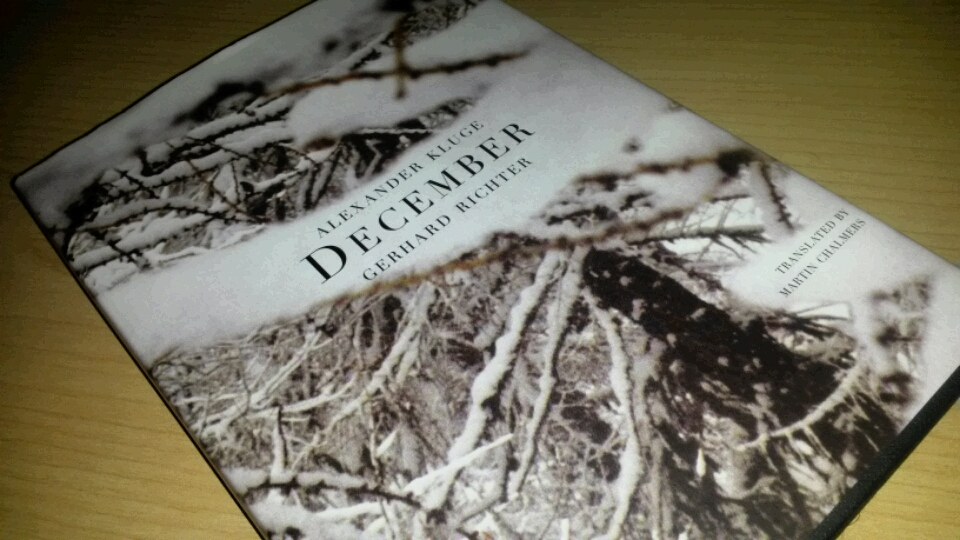
So, my first post of 2016 is a look at the last book I read in 2015. In truth I read it throughout the last month of the year, although not a little each day as intended, my father’s illness has interfered with all of my best laid reading plans of late. However I could not allow the year to draw to a close without finishing this book of calendar stories marking a passage through the month of December in the unique and inimitable style of Alexander Kluge, complemented by the haunting wintery forest scenes captured by Gerhard Richter.
This slim, elegant volume is my first encounter with the work of the German writer and film maker Alexander Kluge. The 39 stories, many less than a page long, are presented in a straightforward manner with a humour so subtle and wry that it simmers below the surface, blurring the perceptual line between history and speculation. Kluge offers a chronicle of an alternate reality so close to our own that it can catch you off guard. A flimic sensibility permeates each entry.
December is divided into two sections. The first part contains a series of dated entries, one story, or a cluster of stories, for each day. The years assigned to the dates vary. Many of the scenarios are set in or around the years of the Second World War. Others tend to be placed in the latter part of the first decade of the twenty-first century. But there are forays far back into prehistory and looking off to a distant future. Characters wander in and out from historical factual reality, war themes of conflict and destruction recur, as do images drawn from concerns about climate change and the fallout from the economic collapse of 2008. The ageless question of the nature of good and evil is a prevalent theme – “evil proves to be good displaced or straying in time” – as is the measure of the passage of time itself, whether measured on a global scale or at a much more personal, intimate level:
“The uncertainty, above all the lack of influence on whether and when someone will be struck down by the war, makes the soul bold. There is nothing to be lost any more.
So, after an air raid in 1944, which went on for hours, Gerda F. did not save herself up any longer. No thought of waiting for one of the returning warriors, whom she still knew and who would ask for her hand. She didn’t want to get to know any better those left behind in the armament factories of the place. All were looking for closeness. She took a man who was passing through town up to her room. They never saw each other again. There was nothing about it that she regretted.”
The second, shorter section is titled “Calendars are Conservative”. They form a series of reflections on the way time – days, months and years – are recorded, calculated, and, as in certain situations such as during the height of the French Revolution, manipulated and distorted. The revolutions of the earth on its axis and the passage of the planet around the sun may be measurable with relative consistency, but that has not kept humankind from trying to understand, articulate and contain the progress of time, again in both the macro, political sphere and in the individual philosophical context:
“What manifests itself in my story, the story of a living person, is not COMPLETED PAST (what was, because it no longer is), also not the prefect tense of what has been in what I am but instead the OTHER of what I shall have been for what I am in the process of becoming.”
To spend a month, dipping in and out of the stories, anecdotes, and reflections Kluge has assembled to mark the end of the year is a treat. Although the images are often sombre, the atmosphere is contemplative. Gerhard Richter’s accompanying photographs enhance the measured tone. If you have ever experienced a day of heavy and unexpected snowfall, those days in the Northern Hemisphere that can bring all but the most essential services to a halt, granting a welcome reprieve from school or work for many; you will know how time can slow to a leisurely pace while the thick blanket of white muffles the day to day noise of the city. That is the sensation captured in the muted monochrome images of snow laden branches in silenced forests. This is the December we hope for but, caught up with the demands of year end and pressures of the holidays, frequently fail to achieve. A time to contemplate the past, for better or worse, speculate about the future and pull another calendar year to a close.
Translated from German by Martin Chalmers, December is published with the expected fine attention to detail by Seagull Books.
“Sun, autumnal, thin and shy,
And the fruit falls from the trees.
Stillness dwells within its blue rooms
During a long afternoon.”
– from “Whispered during the Afternoon”, Georg Trakl, translation by James Reidel
Many years ago when I was in school, poetry, in so far as we were introduced to it, was almost exclusively the works of English language poets. In high school I fell under the spell of the English Romantic writers and that was the beginning. Over the years though, I would be inclined to think that most of the poets I have become obsessed with wrote in English, that is, until I began to read more translated fiction. With that my attention shifted, or to be more precise, my horizons became broader.
This year, a German book enthusiast I have come to know through the “internet of book discussions”, the corner of the web I inhabit, introduced me to Austrian poet Georg Trakl. Somehow he had escaped my attention before. Of course, when you come to read poetry in translation, the question of the translation itself becomes critical. Typically, when more than one translation of a poet’s work exists I try to access and compare a few. But when Seagull Books released the first installment of a three part series of Trakl’s poetry, I did not hesitate to order a copy, sight unseen.
Poems: Book One of Our Trakl is a new translation, by American poet and translator James Reidel, of the poet’s first collection, simply titled Poems (Gedichte), which was originally published in 1913. In his note at the opening of this volume, Reidel recounts that he has endeavoured to preserve the same concentrated mania that marks the works of the 19th century poets Trakl would have read: Baudelaire, Rimbaud, Verlaine, Hölderlin and Poe. He says:
“I want to actually channel Trakl, his craft (with its implicit painterliness) and work ethic, to have him, so to speak, absorbed in the right dosages he – as a poet, pharmacist and addict – intended.”
Reidel does go on to add that to emulate Trakl’s delivery in English, the rhyme scheme of the original poems is often necessarily sacrificed, but the contortions required to retain rhyme can trivialize a poet’s spirit and tone.
In an essay in the online poetry journal Mudlark, Reidel expands on his Trakl translation project. He provides an overview of Trakl’s short and tragic life, as well a discussion of his approach to the translation, and a selection of his translations presented with the original German. A poet himself, Reidel brings a sensitivity and insight to his reading and approach that I, as reader, value:
“I have found that when you read Trakl in the original German, you get a snapshot of what is there. When you go back, you get another view. It may be sharper or less so, and with the feeling that it is intentionally less so. This can be frustrating for those who speak and think in English, that lawyer of languages. There is no fixed point to reading him or rendering him. This makes any book of translations simply a collection of snapshots of a particular reading at any point in time. Another way of rendering/reading a Trakl poem is through the barrel of a kaleidoscope, where one can only fix on a view when one stops or when the glass bits sometimes jam. I do this.”
Born in 1887, into a prosperous Salzburg family, Trakl was a precocious child, creative and intelligent – by his early teens he was experimenting with lyric verse that showed great promise. He could, however, be withdrawn and prone to depression. He was exceptionally close to his sister Margarete (Grete), a musical prodigy with whom he is thought to have engaged in an incestuous relationship. He began publishing poems in 1908, in Vienna where he had gone to study pharmacology, a tempting profession for one who already had a tendency towards addiction. As a budding poet, he enjoyed early success and mentorship during the following years, ultimately attracting the discreet patronage of Ludwig Wittgenstein. But the outbreak of war forced him into military service. Relying on his training as a pharmacist he hoped to avoid direct combat, but the trauma of trying to attend to desperately wounded troops without adequate supplies would drive him to attempt suicide. He was sent to a military hospital in Kraków for observation, but suffered a relapse and was found dead of a cocaine overdose on November 3, 1914. He was 27 years old.
Patterns of Decay , Copyright JM Schreiber, 2011
This first volume of Trackl’s poetry, beautifully bound and presented by Seagull books, readily lends itself to an immersive reading from beginning to end. The autumnal themes that feature so strongly make it an even more evocative read for someone like myself at this time – that is, in November in the northern hemisphere – but autumn is rendered almost metaphorical in his verses. Nature figures in his work, rendered through rural and religious imagery; however nature, for Trakl, is one which couches death and decay as an intrinsic element of its stark beauty and haunting appeal:
In the evening, when the bells toll of peace,
I follow the birds in their glorious flights,
Long multitudes, like pious trains of pilgrims,
Disappearing into autumn’s clear breadths.
Wandering through the twilight-filled garden
I dream following their brighter destinies
And feel the sundials barely move any more.
So I follow their journeys above the clouds.
There a blast of decay makes me start to tremble.
The blackbird laments in the leafless branches.
The red vine totters on rusting trellises.
While like a dance of death of pale children
Around the dark weathered rim of the fountain
The blue asters toss shivering in the wind.
– “Decay”
These are quiet, brooding poems that show a clear obsession with decline. They speak to a young poet struggling to capture the gloom in his own soul, consequently the poems have a very immediate and personal feel. Are they depressing? As someone who has had his own lifelong challenges with mood dysregulation, I find his words oddly comforting. I am not equipped to offer a critique of poetry, I am afraid I can, in this case, only speak to what I feel. And I don’t believe I am alone in registering a profound personal response to Trackl’s poetry. In his short life he produced a small, but vital, body of work that would have an important influence on other German language poets including Paul Celan, Thomas Bernhard and Peter Handke; and draw the ongoing interest of poets, translators and readers outside of German speaking countries that continues to this day, just over one hundred years after his death.
For my part, I can only eagerly look forward to the upcoming additions to Our Trakl.
I have resisted the act of writing my self. Writing about myself. The conceit of imagining that my own experiences hold a value, interest or point of connection for others. I wanted to tell stories, inventions, creations that were removed from the inexorable ordinariness of my own life.
I am not sure I have that gift. I fear that all the stories I have that are worth telling are real. Not true stories. I do not believe there is an objective truth to the stories we tell ourselves or others. But they are real.
For many years I worked as a storyteller. Not in the conventional sense of the word. I worked with survivors of acquired brain injury and their families. Whether I was meeting with clients, advocating with professionals or leading support groups stories were my medium. I had hundreds of stories, I had a facility for remembering the broad details of the experiences of our clients and their families. Tales of courage, tales of horror, tales of the ordinary and the everyday. I was able to pull out an example whenever I required one to offer warning, hope, validation. And I was able to do so without revealing identifying details.
As always I was the master of ambiguity. After all that was how I engaged with the world myself. But what is essential in a professional capacity is crippling in a personal sphere.
I have touched at the edges of my own stories, in so far as I am learning to articulate them, in this space from time to time. And I am beginning to wonder whether it is a folly for me to assume that I have the capacity to make up stories, to entertain with carefully constructed lies.
Or if this mess of a life that has piled up in front of me like heavy wet snow against a plow has to be cleared, examined, transformed into words on a page before I can even begin to figure out if there might be something here that someone else might want to read.
In the coming days I will officially be two months out from the night a blood clot very nearly took my life. My chest still feels tight, bruised and cracked ribs are slow to heal completely, but I can finally get out and walk with comfort – something that was still impossible a few weeks ago. Rat poison is my friend.
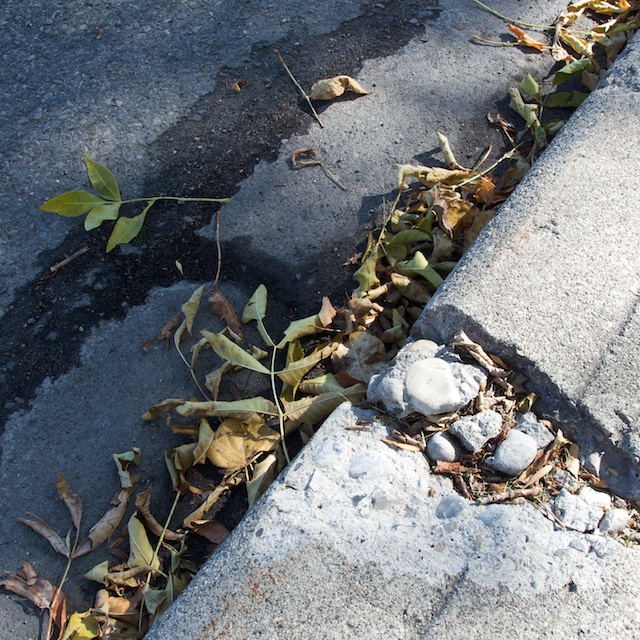
I took my camera out into the neighbourhood this afternoon. The foliage is turning colour, the sky is crystal blue, yet I found my attention turning to the cracks in the road, the fallen leaves in the gutters. I photographed the little things that caught my eye and tried not to think too much.
It is rare that I indulge in sharing a significant quotation simply because it speaks to the space in which I find myself but I keep returning to these words from Intimate Stranger by Breyten Breytenbach (Archipelago Books, 2009).
“Writing is fishing for memory in time. Viscous. Time black. Sometimes you see it flitting just below the surface – memory – miming time. Memory takes on the blackness of time. Memory will be time surfacing. Use word as bait. Beat the water. Beat the weird beat of baited words. Bloated. Wounds. The bleeding words like wounded boats on a black sea. Let the fleet wash up. The coast is the beginning of the sea’s wisdom. It comes with the territory.
Words have their own territory, they return home as in a song. The fish only discovers the water once it is removed from it. This land is a memotory.
But not peaceful. Memory as trigger for territory and tongue. The mind is full of bloody pieces staked out by tongue. Is there room enough? Memory killing memory.”
This book, a selection of meditations on reading and writing, was waiting for me when I returned home from the hospital just 10 days ago. I have been keeping it close and dipping in and out of it. Breytenbach is a South African poet, writer and painter but his life, his work, his vision is borderless. In this collection he offers practical advice, shares poems and reflections on the power of the word, drawing on his own experiences as well as the wisdom of a legacy of gifted writers.
Memory is the foundation of writing. One draws on experience when putting pen to paper – poetry, fiction, memoir alike. And it is memory that is weighing me down, threatening to drag me beneath the surface; a memory that haunts and obsesses me because although it involves me, I will never access it.
I have lost a space in time. Like a bruise it bleeds beyond the boundary of the injury, reaching backward and forward from the instant a clot in my lung threatened to stop my heart. Days are absolutely gone, the day or two before the incident, the day or so in ICU and the first days after waking. But I can’t let the blackness go. I cannot let it wash out to sea. I want to hold the moments, hours, days in my hands but I cannot. They do not belong to me. They are about me. They will never be mine.
I have read my discharge summary until I know it inside out. I have pestered my anxious son with questions. What was it like to find me in distress? How did you get to the hospital? How did you feel? Stupid questions. I am struck with shocked disquiet to realize that my family did not know if I would survive.
If I had not survived the blackness would be complete. Viscous. Time black. Inanimate from my perspective. My own memories lost. The sole distorted possession of those who knew me, no longer mine.
Sands are shifting. I have some fishing to attend to before the next high tide.
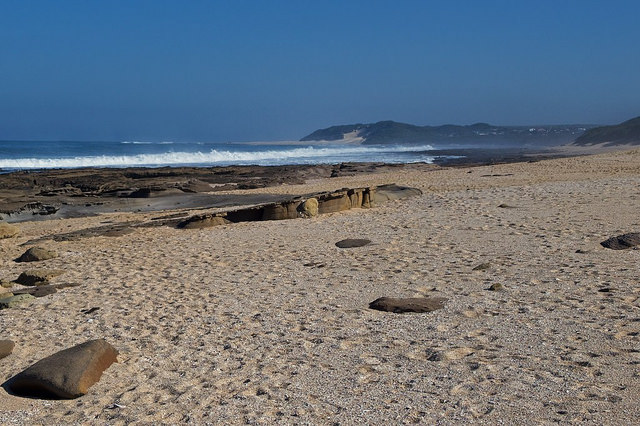
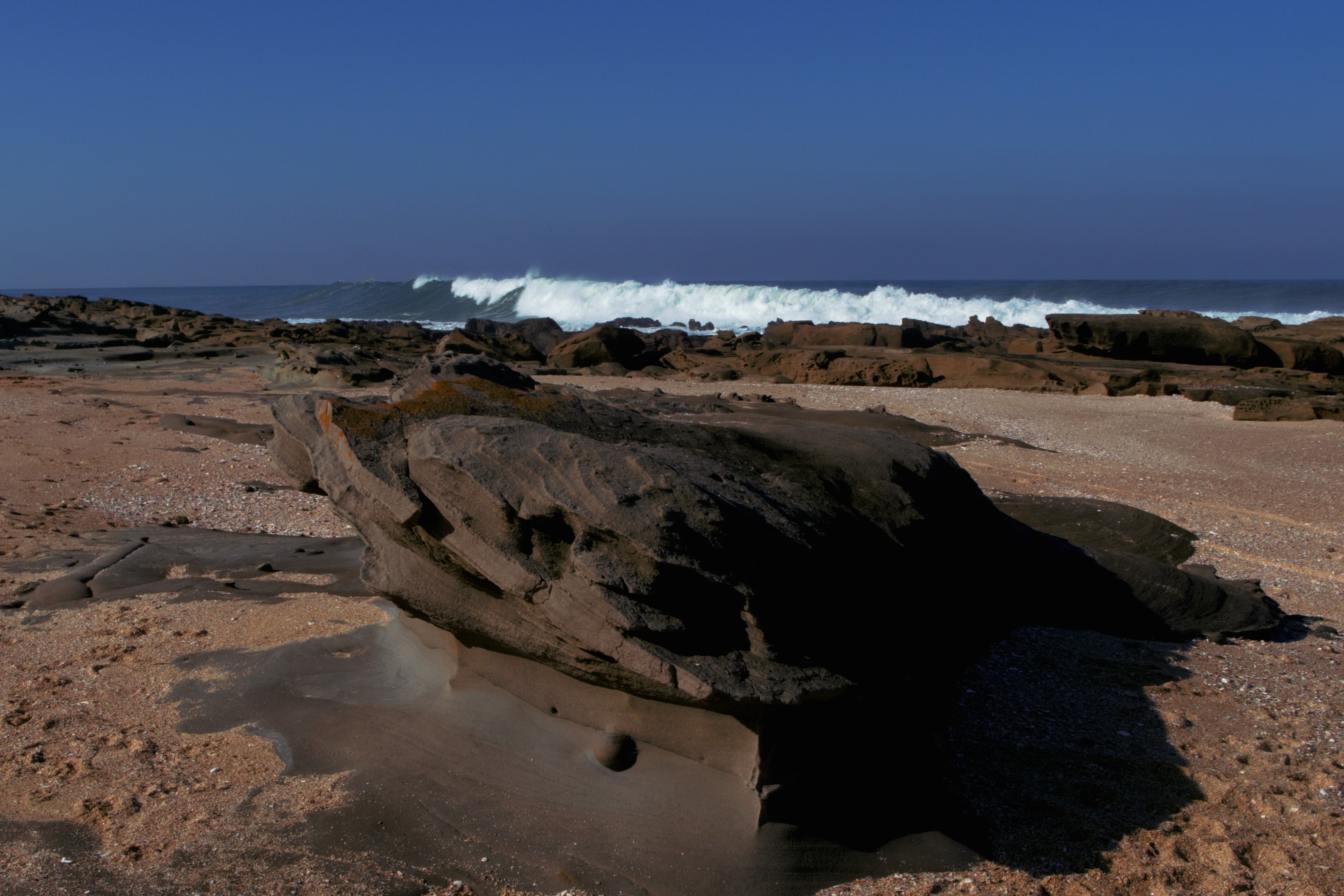
Indian Ocean, Eastern Cape, South Africa Copyright JM Schreiber 2015
It is coming up on two weeks now since I left South Africa. I was missing the country before I left; I am missing it now. When I passed though customs at the airport the official who stamped my Canadian passport sighed and shook his head. “Everyone is going to Canada these days,” he said. What could I say? Only that morning I had only read a newspaper article about young South African families eager to find a new home abroad – the US, Australia, Canada.
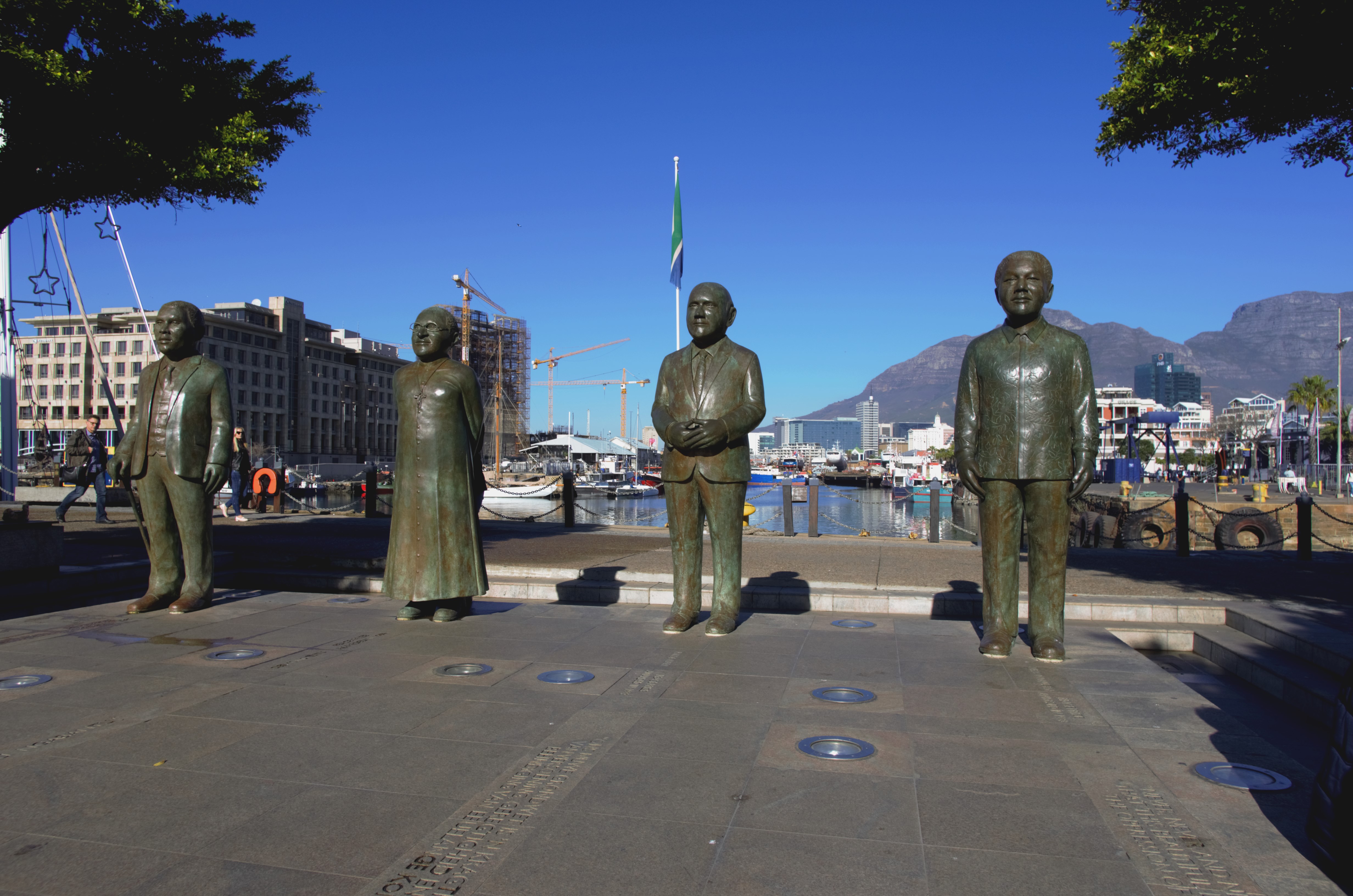
I suppose if I was raising young children in a city where so many single family dwellings have the appearance of bunkers with high walls, spiked gates and coiled razor wire, I too would be looking to distant shores. Over the course of my limited stay in Cape Town I regularly walked between my B&B in Sea Point and the downtown core. The occasional house perched on the slopes of Signal Hill without such enclosures was a source of fascination. What manner of brave or reckless soul lives here?
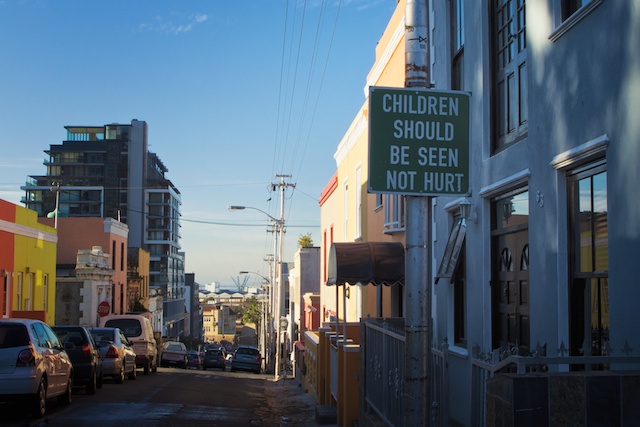
A sign on a narrow cobblestone street In the Bo Kaap district of Cape Town – Copyright JM Schreiber
I can’t say that I felt uncomfortable as I wondered the streets or rode the buses. I did quickly learn to make prudent choices, especially after a couple of unnerving encounters set me off my guard. My bad. I don’t make the same mistake twice. Aside from a night out with a friend in Green Point, my stay in the city was quiet, skirting most of the major tourist sites, sticking to bookstores, museums, galleries. Despite the cool weather tourists flocked to the Waterfront and Table Mountain but no one chanced more than a passing glance while I sat mesmerized by the full 30 minutes of William Kentridge’s installation TheRefusal of Time at the South African National Gallery. I seemed to find hollow pockets in the city, safe but open empty spaces. And it felt right. I had come to South Africa, after all, to find myself.
What I found surprised me and is only beginning to take form in my thinking now that I am back home. My interest in South Africa is a curious blend of sociological, historical and literary factors but it has always been mutable and undefined. It just is. It stretches back to the early 1980s when I first encountered South African ex-pats while I was at university, continued forward, from the outside, as the world watched the steady and difficult move to independence. Being able to visit the country and, for the most part, simply talk to people and observe has marked the beginning of a process of reconciliation for myself – on a deeply personal level on the one hand, on a socio-political level on the other.
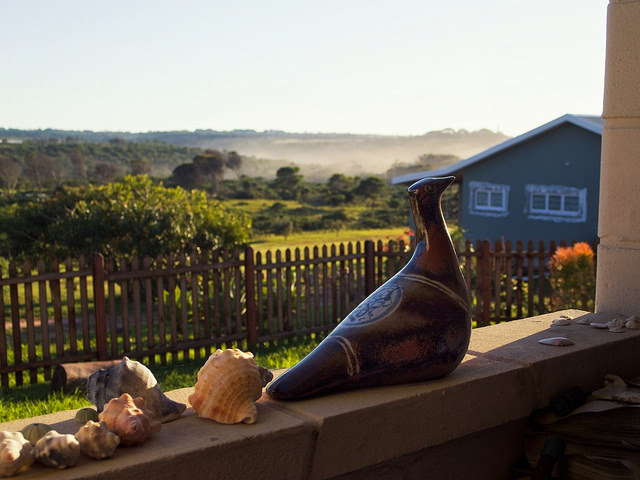
Eastern Cape morning – Copyright JM Schreiber
With respect to the former I will simply say that my decision to actually visit South Africa this year was sudden and born of the intense loneliness that sweeps over me regularly. One day when that wave crashed upon me I stopped and realized that the one person in the world that I really needed and wanted to talk to, the sole person who could understand the strange mixture of illness and queerness that I have been struggling to sort out lately, lives across the globe – in South Africa, Eastern Cape province. And, with some money I had needed to access that was not worth reinvesting at today’s interest rates I had enough to get there. So I went.
Arriving at my friend’s home in a small village perched on the edge of the Indian Ocean, I was stunned by the beauty of the unfolding landscape, green flecked with the orange of aloe in bloom, the wide open blue skies, and the crystal brilliance of the waves crashing upon rocky shores. I was at peace. I felt grounded. I felt I had come home to somewhere I had never been. My friend and I settled into a comfortable routine as if we had known each other forever. Although at ease in silence, we never ran short of things to talk about. When it came time for me to prepare to head back to Cape Town, her dog worried after me as I packed my bags in the same way that my own cats had fretted over my suitcases back in Calgary. In a little over a week I had been accepted as family.
Indian Ocean, Eastern Cape – Copyright JM Schreiber
Oddly I never felt lonely in South Africa, even though I spent much of my time alone. Strange that that feeling oppresses me in the city that I have lived in or near for most of my life, or this country where I have lived for over five decades. At one time I was immensely proud to be a Canadian but I feel increasingly discouraged and estranged from this land. Oh, of course, it has its beauty and, compared to so much of the world, its benefits are innumerable. But there are concerns, inequities, a steady erosion of freedoms, unresolved historical debts to our First Nations and now a rapidly declining economy against a growing racism and xenophobia to think about.
While I was in South Africa, whenever anyone would ask me where I was from, eyes would light up and I would be met with statements like: “Ah Canada, that’s like the perfect country, isn’t it?” Perhaps I am less than patriotic (which is in itself a rather Canadian thing to be), but I felt it was worth engaging people in honest discussions. After all in early June the final report of our very own Truth and Reconciliation Commission was released. For over 100 years First Nations, Métis and Inuit children were routinely removed from their homes and placed in Residential Schools. The cumulative impact of the abuses, trauma and cultural disintegration has been significant and devastating for Aboriginal communities. If I wanted to engage in conversations about colonial legacies it is not to compare or absolve anyone. But no country is perfect. The question for a citizen is, what am I willing to speak to? I can only speak to my experience in Canada and listen to South Africans. Which is a good start.
Sunset over the Atlantic, Cape Town – Copyright JM Schreiber
But not even two weeks home and I feel shiftlessness starting to seep in again. On the positive, I returned to the promise that some healthy changes may be emerging in the life of my troubled son, opportunities that might not have arisen had I not put a continent and hemisphere between us. And on my last full day in Cape Town I sat in the Company’s Gardens and finally began to write in earnest in the notebook I had been scribbling in throughout my visit. That has continued. Yet I am aching for that indefinable other that drew me to South Africa in the first place… the landscape, the people, my friend, the oceans.
Yes, the oceans. Landlocked here in a vast country that spans 5½ time zones, it really is little wonder I feel so alone.
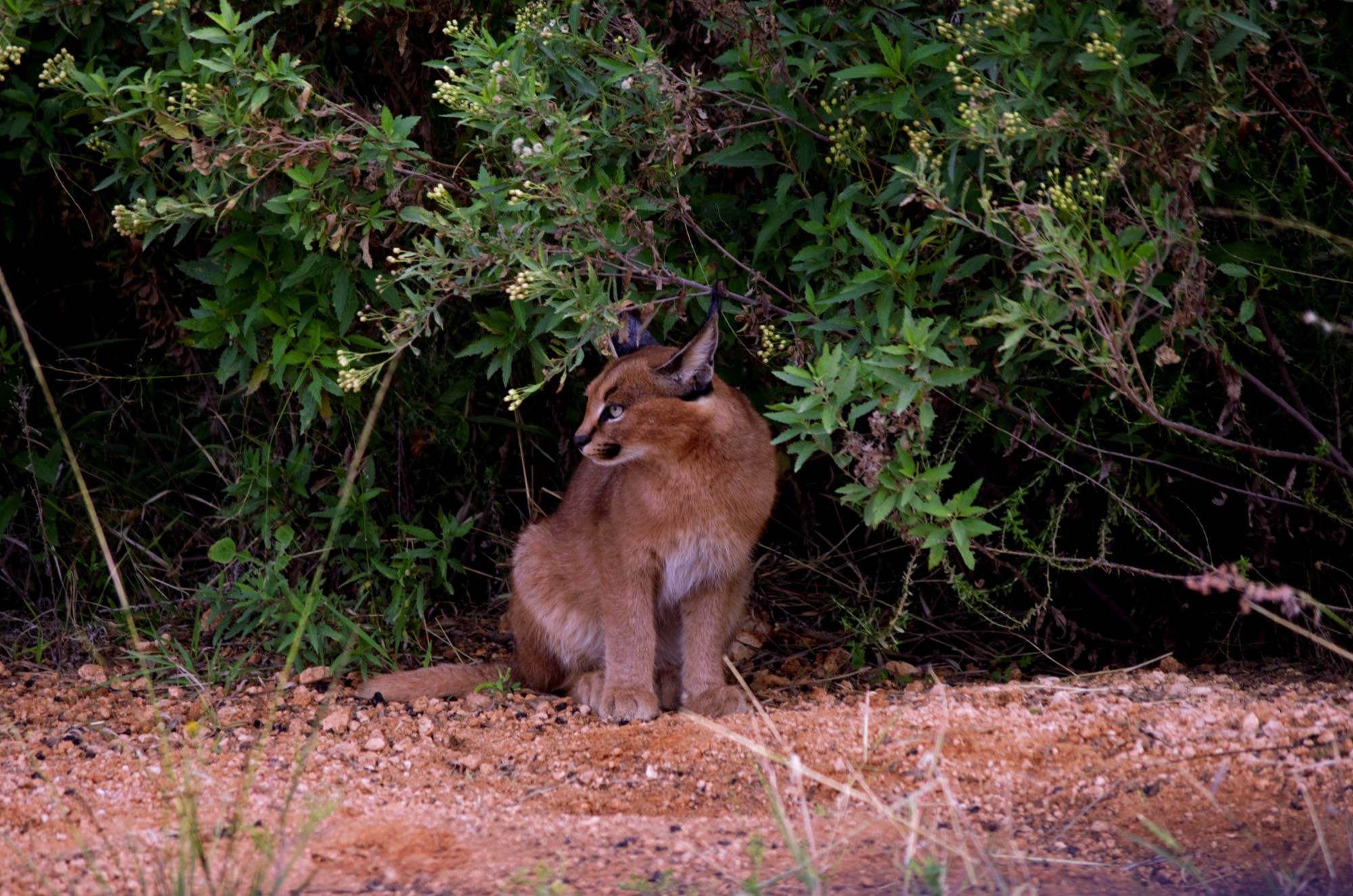
I have been in South Africa for just over a week now. It’s been an amazing opportunity to meet people and observe the country on its own terms. The closest I have had to a typical tourist experience has been our day trip to Addo Elephant Park. Nothing quite prepares you, on your first visit, for the sight of these huge majestic beasts looming ahead on the road, appearing out of the bushes. And there is so much more to see than elephants. We were stoked to encounter two young rooikatte along the roadside. These lynx are a rare sight at the best of times and we were able to sit and watch them for 15 minutes.
RooikatElephant – Addo Elephant Park, South Africa
The value of taking time to relax, soak in the countryside, meet fascinating individuals and spend quality time with my friend has been exactly the medicine I needed. In a few days I will make my way back to Cape Town for the much more urban, cosmopolitan side of my stay which will, in its way, be quiet and introspective. Cities can be good for being alone too.
Old sheepEastern Cape farm garden
My endeavour to gather more South African literature to bring home is going well. So far I have collected a stack of second hand books from a little shop in East London here in the Eastern Cape and have another stack waiting for me back in Cape Town. I have been digging through my friend’s bookcase for titles to look for here or back home and last night I was thrilled when my favourite author, Damon Galgut, won the Sunday Times Literary Award for South African fiction for his novel Arctic Summer. So, a fine literary excursion to date.
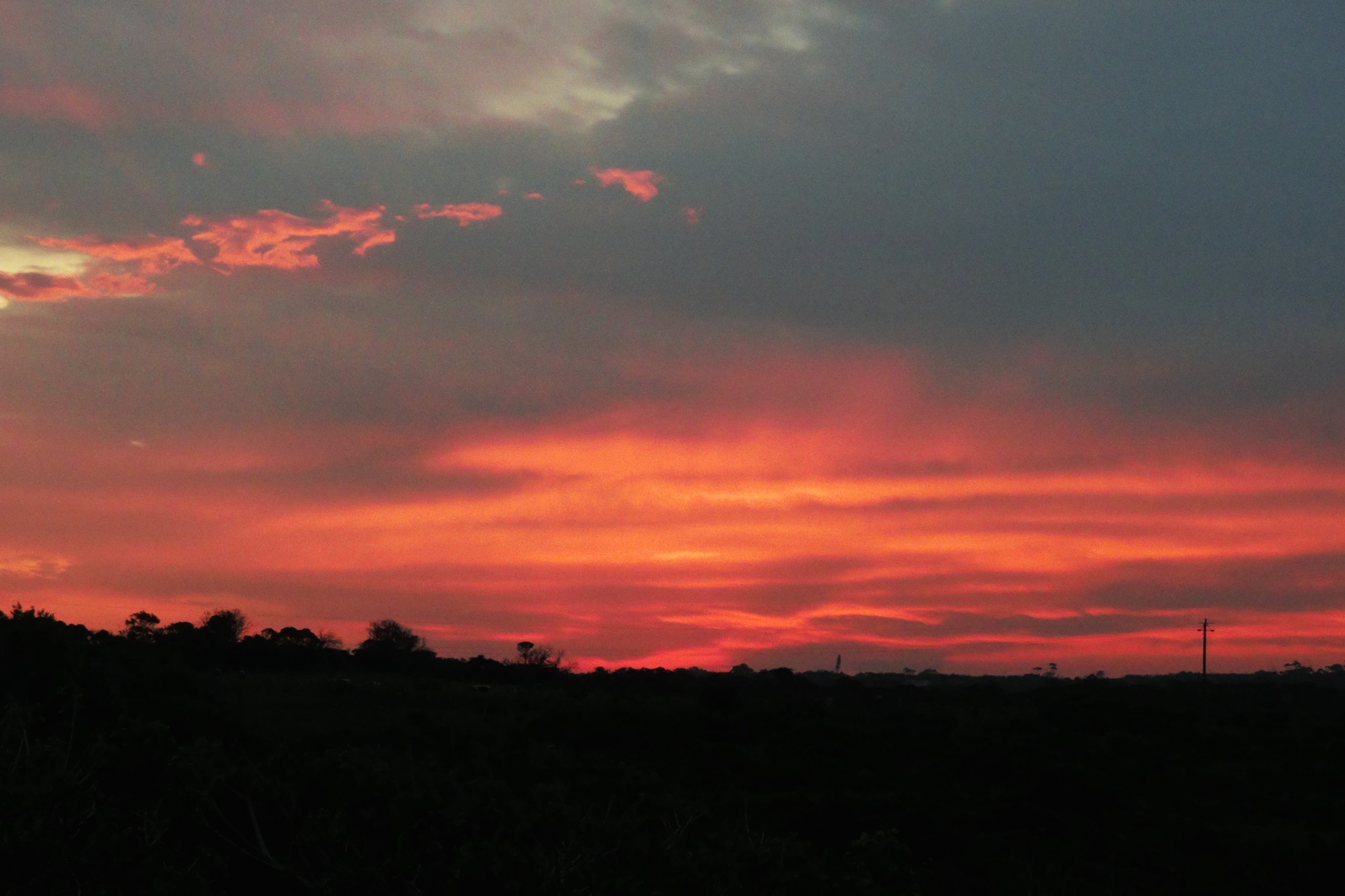
South African sunset – All photos copyright JM Schreiber
Otherwise it has been a relief to step back from my normally heavy engagement with news and social media. I did read with dismay about the terrorist attacks in France and Tunisia. I was relieved that my American LGBT brothers and sisters have achieved a long overdue milestone. But I came to South Africa in large part to put as much distance between myself and my life at home as possible for a few weeks and, for now, watching waves crash on the shore or sitting on the stoep and watching the sky burst with colour in the evening or listening to Breyten Breytenbach reciting poetry in Afrikaans is therapy of the best kind.
Over the past year I have embarked on a journey that began, unexpectedly, with the recognition that I had allowed pressures at my job to consume me, to drive me to the very brink of a complete breakdown. It was summer solstice when I removed myself from the office, imagining at the time that I would soon be back and on track. I had no idea how sick I was and no real appreciation of how much I had sacrificed to work and children. Now, with work in tatters and children grown I wondered if I had really lived the full and rewarding life I imagined that I had. Finding myself (again) in mid-life has been difficult, dark and lonely – a task I felt ill prepared to take on.
But it has been the very best thing that could have happened.
From a very low point last December, winter solstice, my life has started to change in very real and important ways. A wonderful therapist and proper medical support have been crucial, while finding a supportive community has helped me start to move out into the world in an honest and authentic way. But, much to my surprise, blogging has opened up the world in a way I had not anticipated. I began with no clear objective, fueled with manic energy, spiraled into a little anxiety driven meandering as my world fell apart and solidified this year into a basically book focused blog.
Along the way I made a friend who has become a ballast for me – a touchstone, someone who understands the experience of navigating the storms of bipolar disorder because she rides them herself. Someone who is also queer. And an avid reader.
However, getting together for coffee required a little planning. I live in western Canada, she lives in South Africa. And so I marked this past solstice, trading summer for winter, in Cape Town. Then I boarded a bus for the Eastern Cape province where I am now. I have long had an interest in South Africa, with the literature and history of this complicated and important place. The dust has not settled here.
My friend has given me a gift I will not soon forget. Our friendship has opened a space for us to explore our own personal journeys and to talk about our respective countries – to compare the differences and the similarities.
And I am also guaranteed to arrive home with books.
“How can I say what these fragments mean to me? The awkward truths of my life take shape in their negative spaces. In the lengthening shadows of the official histories, looming like triumphal arches over every small messy life, these scraps saved from the onrush of the ordinary are the last signs I can bring myself to consult.”
When we first meet him, Neville Lister, the narrator of Double Negative, is a disaffected young man, uncertain and aimless in a fractured and troubled environment – apartheid South Africa. It is the early 1980s and he cannot quite find his footing, either in academic study, the political protestations of his friends, or the mixed allegiances of his parents’ generation. The stakes are high, but his ambivalence is a luxury well known to middle class youth. Being close in age to Neville and his creator, South African author Ivan Vladislavić, I could not help but chuckle at his repeated references to “Beerhunter”, (a party game we Canadians lay claim to, by the way) or recognize the insidiousness with which The Eagles’ Hotel California album seems to define our lives even if we never owned a copy of that recording. However, unlike our most reluctant hero, I did not have political unrest or the real threat of conscription bearing down on me.
Double Negative traces Neville’s evolution from long-haired, pipe smoking dropout to middle-aged late blooming artist, framed against the shifting political, cultural and socioeconomic backdrop of Johannesburg. In the first section, “Available Light”, his father arranges a meeting with a famed local photographer, Saul Auerbach, in the hopes that the encounter might inspire his son to reach beyond his current employment assisting a man who spray paints lines on roadways. As Neville tags along, Auerbach and a journalist friend devise a game that will direct their photographic pursuit for the day. Standing on a hillside with a panoramic view of the city below, each man choses a roof top. They manage to visit two of the three selected homes where Auerbach charms his way in, and coaxes photographs out of the inhabitants – a poor black woman with her two surviving triplets living in a backyard shack and a white woman in a lounge suffocated with furniture and curios. But before they visit Neville’s choice, the photographer’s energy and his necessary light have faded and they head home.
When our narrator picks up the thread of his story in the second section, “Dead Letters”, he has been in London for ten years and the first free elections have just been held in South Africa. Swept up in a wave of nostalgic homesickness he flies home. By this time he is also making a living behind the lens, but as a commercial photographer. He returns to a city already morphing under new dynamics, post apartheid – street names changing, houses and entire city blocks replaced. Cities are, at the best of times, constantly re-inventing themselves, shedding their skins. The effects are more profound under the pressures that have been released and confronted in places like Johannesburg, where, by the time we catch up with Neville again for the final installment “Small Talk”, he has taken to photographing the ubiquitous walls that have arisen to close off and protect the city’s inhabitants from each other.
Upon his return to South Africa, he had experimented with trying to enter a home to photograph the resident, drawn, of course, to the house he had first chosen so many years earlier. The experience almost swallows him whole but does, in turn, offer the direction that will inform his own artistic photographic ventures. He no longer wants to see what lies behind the walls that have been erected. He draws the resident out but refuses to enter. It is now 2009 and our hero is being subjected to an interview by an eager, self-promoting young reporter and blogger who intersperses her blog posts with a litany of handy household tips that would make Oprah proud. She is of a entirely new breed, neither weighed down by nor fully appreciative of the reality of her nation’s history. By contrast, Neville Lister occupies the transitional space. As photography has moved from film to digital, a medium with remarkable capacity for storage and the editing and altering of images, so is his country altering and editing its own collective memories.
More than anything, this is a story that unfolds as a series of images, captured with Vladislavić’s poetic eye for detail. He translates scenes, the photographic and the interpersonal, with a language so effortlessly descriptive that I often stopped to re-read a paragraph for the sheer pleasure. Neville describes “gumption” as a “word that stuck to the roof of your mouth like peanut butter”. A character “moulted” his jacket. In navigating the city he talks of following “the simple arguments of avenues and squares”.
This ability to transform language into imagery is nowhere more apparent than in his descriptions of the scenes, immortalized by the lens of the camera under the direction of the photographer. One of the photographs resulting from the initial outing with Saul Auerbach is described in vivid detail:
“Mrs Ditton sat in the armchair beside the fireplace. The coffee table had been dragged away – there is no trace of it in the photograph – to expose the floorboards and a corner of the rug. Looming on the left is the largest of the cabinets, so imposing you would say it belongs in a department store. The chair has wooden arms with ledges for tea cups and on each side of these lies a pie-crust of crochet work and a coaster. The chair sprawls with its arms open wide and its fists clenched, and she wallows in its lap.”
I imagine that anyone with an SLR camera and a tripod has experimented with long exposures and the creation of ghost images. It seems to be a rite of passage. Double Negative is, in many respects, a book of ghosts. Visiting with the woman living in the house he had selected so many years earlier, Neville feels weighed down by the voices swirling around her lounge. In referring to the annotated cookbook passed down from his mother, he reflects that the food “tastes better when the ghosts adjust the seasonings.” And ghosts haunt a collection of dead letters that come into his possession and, it seems, may be destined to lead him into his next “artistic” endeavour. If growing older is a process of acknowledging and coming to terms with the ghosts we carry, our narrator is older and wiser but still working away to make sense of it all by the end of this book.
And so is his country.
Note: Originally published in South Africa in 2011, Double Negative was released to an international audience in 2013 (with an introduction by Teju Cole) through the amazing publisher And Other Stories. Supported by their unique subscription model, this release was followed by the publication of an earlier title, The Restless Supermarket in 2014, and his upcoming collection of stories, 101 Detectives, will be released this year. Ivan Vladslavić was recently named one of three recipients of the 2015 Windham Campbell Prize for fiction along with Teju Cole and Helon Habila.
Granted midwinter in my part of the world is not the best place to find colour in nature. Branches are bare, grass is bunched and brown, snow is patchy and grey. But when I look back over the past year I can see how difficult it has been for me to register any enthusiasm to take my camera out. I walk a lot but I seem to want to stay in my head, maintain a fast pace, measure the rhythm of my boots against the ground. I circle the neighbourhood, walk with purpose on errands, but avoid the pathways and parks I have documented season after season these past few years.
Photography was a diversion, a relaxation and an isolated activity against a busy life at work and home. I would wander forest trails, across grassland parks or along the edges of rivers and lakes, framing and reframing the view and listening to recorded podcasts – discussions about books, philosophy, current events. It was a meandering, escapist pursuit. If I look back I have to wonder what I was escaping and where I had lost the capacity to dream.
Madness, mental illness if you prefer that term, brings back the capacity to dream because all the parameters are changed. For me it has brought words to the foreground but pushed the pictures to the background. Walking has become a means to expel restless energy, drive out the demons of anxiety and despair that keep reaching in. If I want to drown out the city noises I listen to music, the words in my head are my own.
Without being able to return to work at this time, I do feel a certain loneliness. But when I reflect on the years I devoted to a job that I believed validated and defined me, I realize that I was never more isolated than when I was working. Invisibility and an unwillingness to call attention to myself was not a measure of my successful transition. It was denial. To hide the fact that my past contained realities inconsistent with the man everyone knew, I believed I could not afford to allow anyone to get close. I captured colour in the outside world but painted myself with the blandest palatte possible.
A manic episode and all of the reckless behaviour and poor judgment it entails has left me with a professional legacy that I may never be able to salvage. I don’t even know if I want it back. Reclaiming my identity, being comfortable with my own history of sex and gender is a work in progress but I have to trust that it might lead me to a better more authentic place. It might even bring some colour back into my life.