“I never forgot. Everything is there. All I have to do is close my eyes.”: The Emperor by Mackenzy Orcel

I asked for none of this. I was waiting for the bus. I was waiting forever. I think I’ve been waiting since I was born. I sat on the floor for hours, fighting the urge to sleep. Looking beyond the clouds of dust that covered the horizon. The days went by, one looking just like the other. The bus wouldn’t come.

In an apartment in Port-au-Prince, Haiti, a man is waiting. He knows that eventually the police will find him. He has made no effort to hide. In fact, the crime he has just committed leaves him with an eerie sense of satisfaction. He has no regrets and is ready to serve whatever sentence he receives. He has known far worse confinement in his life, he is certain. Even freedom, such it was, offered a different form of slavery and only one brief respite of joy. As he awaits the inevitable, he revisits the events that have led him to this point, beginning as far back as he can clearly remember. The Emperor by Haitian writer Mackenzy Orcel is his story—fractured, pain-filled, and proud.

Our unnamed narrator does not know exactly how he came to be abandoned as a child, left alone by the roadside, but he does know that at some point he was swept up and taken into a rural community, or lakou, where a false vodou prophet—the Emperor—holds sway over a flock of worshippers, his sheep, who like slaves, work his fields and tend to his every need and desire. He demands absolute devotion, and punishes anyone who fails to fall into line. The narrator grows up in this unforgiving environment, identified by a number rather than a name, but he is not alone. He is  guided by the wisdom of a blind old man known as the Very Old Sheep, dedicated to the true traditions of voodoo, and aware of the risk of pretenders, and by his own internal compass,  a motivating force he refers to  as the Voice Within. Together they keep him from losing himself amid the brain-washed, weakened souls who surround the supposed holy man or seek his intervention with the divine:

Only the Emperor is granted the power of the word. To mould them to the shape of heart, his anger or his madness. What words capable of cauterizing wounds are not also accused of being lost or eternal? Yours were difficult to grasp. They reminded us of fond memories of the gods. Their goal was to intercede in our favour. To save us. To destroy us. To bring truth, morality and the past to an end. To transform others into obedient machines. A widespread and lucrative venture. You made a fortune off the penniless and their spoilt crumbs, their ill-gotten gains. You recreated an ancient formula.

Despite the very specific cruelties he dispensed upon his young sheep, it is the Emperor who inadvertently paves the way to his release from the lakou by forcing him to play a drum for the ritual dances. In drumming he finds expression, communication, that reaches others without words. He is punished for his disobedience, but is unable to conform. This ultimately leads to his expulsion from the community and, this time, the bus does come and carries him away to the city. He arrives in Port-au-Prince with no name, no education, and only a little cash he’d spirited away. Here he faces a new kind of brutality, but his past has prepared him for “its tyranny, its inhumanity.” He survives. He finds a job delivering newspapers, one of a crew of downcast men, working for a dishonest boss, but at least he is no longer captive. He is free. Until he falls in love.

With clean, clipped prose, finely translated by Nathan H. Dize, The Emperor is a  contemporary fable with gritty, violent undertones. The narrator’s fragmented monologue, largely addressed directly to the Emperor, moves back and forth in time, from the room where is waiting for that knock, knock, knock on his door, into his past, from his early experiences in the countryside to his hardscrabble life in the city, and, finally, to his criminal act. But it is not a strictly chronological account, nor is it always clear or consistent. It is uncertain how old he is; he seems to be both prematurely aged and preternaturally wise. Details from his time under the Emperor’s control continue to emerge throughout, a function in part of him being his primary audience. Yet, some of what he claims seems strange—there is a sense that he himself does not have as firm a grip on things as he thinks when he claims: “I never forgot. Everything is there. All I have to do is close my eyes.” One senses that he has never truly been free, the anger always simmering at or just below the surface of his narrative betrays him. And now he is waiting to surrender his liberty to the police, calm and unrepentant—he even has the evidence to prove his guilt sitting neatly beside him—but, perhaps, in a strange way, he is finally exercising his freedom by giving it up.

The Emperor by Mackenzy Orcel is translated from the French by Nathan H. Dize and published by Seagull Books.

I who dreamed of Africas: The Harmattan Winds by Sylvain Trudel

As for me, I didn’t exist until I was six months old, because up to then no one wanted to be bothered with such a case. Just my luck, I was not an official being, since there was no trace in the records of my coming into the world. Born by the side of the road like a natural disaster incarnate, I had not known the holy oil of baptism, and no one thought to scrawl my name on a government document or anything resembling it, nor even to take an ink print of my tiny foot for a hospital data sheet, even if it was as cute as a tiny goblet. In short, no one dared to believe in me even if I was born bottoms up, like everyone else.

Such is the misfortune of Hugues, abandoned in a shopping cart in a bog of bulrushes by the side of the road, only to be rescued and adopted by Céline Francoeur and her new husband Claude, granting them an instant family, or as he describes it, “they could have all of that indescribable joy, minus nausea or miscarriages, as long as no one went to claim me from the lost property counter.” Despite his unfamiliar appearance, his crossed, slightly almond-shaped eyes, it is not until he overhears his “adaptive” parents arguing over whether he should be told the truth, that the reality of Hugues’ origin story becomes known to him, forever shifting his perspective. Céline and Claude become his semi-parents, his brother and sister his semi-siblings, and his entire existence, in his heart, is rendered incomplete.

The Harmattan Winds, by French-Canadian writer Sylvain Trudel, originally published in French in 1986, is the dramatic, youthful account of a boy who does not know where he really comes from. However, there are two unlikely companions who give meaning and purpose to what might have otherwise been a lonely life in an isolated town in 1970s Quebec. One is a well-worn  collection of poetry by the fictional Gustave Désuet, a flea market find that Hugues carries with him everywhere, reading from it like a guidebook, memorizing the florid and overwrought verses which he admits he doesn’t always understand. He turns to it for comfort and enlightenment—and one also suspects much of his exuberant sense of drama, tragedy and romance are inspired by the poet’s example, even if his misunderstandings and misspelling lend his often enigmatic narrative an internal logic entirely its own. Hugues believes that Désuet, long dead by his own hand (and a rope), helped him to live his life.

He was sort of a paper tiger who one day took up his pen as you would arm to do evil, and poison dripped from his nib. A real viper, that tiger. He said that we, the rich of America and Europe, we’re living in the Accident, curled up in our accidental countries, and the Bible’s Apocalypse is a great idiocy because it has already begun and no one sees it, it’s ongoing right under our eyes that choose to run and hide behind their lids, but it’s there, and, in fact it’s us, yes, the Apocalypse,  it’s ourselves, we are the cataclysm of the poor, seeing that we kill them with one hand hidden behind our backs in the convenient darkness of our heads, so as to stay rich at their expense.

This accidental (that is, occidental) guilt inspired in our hero by his beloved poet, no doubt prepares him to embrace the second companion who suddenly comes into his life. When Habéké, an Ethiopian boy orphaned by famine and adopted by a couple from Montreal, arrives in town, Hugues is naturally drawn to him. They are the same age, and both are potential social outcasts amid the vagaries of early adolescence and the latent racism of the local community, but even though Habéké has already learned the essentials of his new life—to speak French, sing O Canada, and ride a bicycle—he carries within him the dark mysteries of a world beyond the Accident. An irresistible attraction.

I remember that I loved talking with him about Africa, and that is why I know some things today, for example that Africa is a stew of languages and that Habéké’s is full of burgeoning vowels or that in Africa men’s problems, due to their galloping demography, are both acute and grave, high-pitched and low, therefore circumflex, making Africa a kind of quotient, for it is, according to Habéké, the product of divisions between peoples, and over there that’s all there is, peoples. . . . There exist, however, little hooded hats made of soft rubber to rein in the ardor of the peoples, not well attuned to the circumflex dilemmas of Muslims or animists. And then those rubbers look like the moltings of snakes or little caimans, and I’m wondering what a man of this ilk would do with such a device, he who revers the companionship of sacred pythons and crocodiles.

But there is more. Habéké’s exotic wisdom, along with his distinctive appearance, set him apart from the world in which fate had landed him so far from his native land, and in this Hugues finds an echo of his own mysterious dislocatedness.  He sees in him a brother in arms and confesses his own truth: “I told him about my calamity in the bulrushes, my botched birth, my lost invoice, my semi-family, my other man’s eyes, and all and all.” An unbreakable bond is formed—one that sees them through all manner of adventure, outrageous schemes, and some incredibly close calls.

With the spirit of a fairy tale, yet at the same time grounded in small town Quebec (or Canada generally) in an age before video games, computers or many available television channels, this novella surges with energy. Hugues’ willingness to follow Habéké’s increasing desire to connect with his traditional heritage, arising from myth as much as memory, and bound to their mutual desire to escape, not only lands them in more than a few risky situations, but also ends up threatening the safety of two teenage girls they befriend.

Youthful narrators can be hit or miss, but the magic of this coming of age tale rests firmly on the imagination, determination, and entirely idiosyncratic worldview of Hugues and Habéké. The endless forests, rivers, and railway lines that surround them become the African landscape they dream of exploring, and the island of exile they imagine escaping to to live out their naïve utopian dreams. Fast paced and original, it is wonderful to finally have access to The Harmattan Winds in Donald Winkler’s lively English translation.

The Harmattan Winds by Sylvain Trudel is translated from the French by Donald Winkler and published by Archipelago Books.

Staying too literal is a dead end: Nevermore by Cécile Wajsbrot

It is the beginning of time. There was a before, of course, there was day, but everything begins, begins again at night. Genesis. The beginning of time. “Time Passes,” the second part of To the Lighthouse, can be read as a separate work, a text we can approach as we would an island from which, to be sure, the contours of the shoreline, of the mainland can be seen—but the only thing that counts is the exploration of the island. A creation story. Dividing light from darkness.

Only twenty pages long, the “Time Passes” section of Virginia Woolf’s novel is a bridge or passageway between the first and third, marking the passing of ten years during which a summer house on the coast of the Isle of Skye stands bereft of the human life that once filled it. It is empty, and yet it is not. The forces of nature observe, occupy, and lay claim to the house, its contents, and the grounds. Elsewhere war rages and several characters from the first section, including the central figure, Mrs. Ramsay, meet unfortunate fates, noted in brief, bracketed asides along the way. It is not until the end of this interlude that human life begins to reappear on the scene.

This poetic evocation of time and abandonment flows through Cécile Wajsbrot’s contemplative Nevermore, not unlike the Elbe to which her narrator returns regularly during her sojourn in Dresden. This intriguing, intelligent novel, follows an unnamed translator who has come to the German city to work on a translation of “Time Passes” from English into French. She is grieving the recent loss of a close friend and hopes that both the project and the unfamiliar location far from her home in Paris will help her heal:

I’m elsewhere, in another city, another country. The language of my internal thoughts is not the one spoken here. Are we ultimately impenetrable? Will I never know the internal life playing out here? Will I pass like a silhouette, a shade, without knowing anyone?

As someone who has valued her independence, her “untethered life” of freedom, she is seeking a temporary refuge within which she can disappear while she immerses herself in her work. Thus, “Time Passes” not only offers her purpose and direction, but exists as an incantatory exploration of the imperfect art of ferrying a piece of literature from one language to another. As she makes her way through phrases and passages that seem to echo the sense of absence that haunts her, she trials variations and fumbles with sound and meaning, attempting to sketch out a first draft.

However, the ongoing translation is but one thread in this wide ranging narrative. It is interwoven with historical, political, and artistic streams. Regular “Interludes” trace the history of the High Line in Manhattan, from its earliest days as an elevated freight rail line built to transport goods arriving at the Hudson River port and service the warehouses, factories, and slaughterhouses in the surrounding area. In use from 1934 through to 1980, the tracks lay abandoned and open to the ravages  of time and the elements until they were turned into an elevated park and promenade above the noise of the city nearly three decades later. As she repeatedly returns to this evolving space, she is interested in exploring the shifting economic, artistic and human forces that shape the environments we live in. Nothing is static.

Indeed, change is often catastrophic. Another theme that regularly resurfaces is the 1986 disaster at the Chernobyl nuclear reactor near Pripyat, Ukraine. The town was evacuated and a new community was built just outside the so-called Exclusion Zone. But as scientists, and eventually film crews and tourists returned to the abandoned town, they found that nature—flora and fauna—had continued to thrive and even take over some of the empty buildings and structures. The persistence of life in the absence of human care or interference, mirrors the scenes evoked by Woolf decades earlier in her depiction of the elements, insects and animal and plant life working its way into the empty house in “Time Passes.”

Then, of course, there is the very city in which the narrator has taken up temporary residence—Dresden. The history of its destruction and subsequent reconstruction is evidenced and memorialized everywhere. As a backdrop to the translation of a work that spans the Frist World War, a presence even if it is off-scene, so to speak, a city with such an indelible war-time history makes sense. The narrator takes long walks at night, following the river, thinking of death. At times, she seems to encounter some kind of presence and wonders if it is a ghost or a briefly animated memory of her friend. As the messages her family and friends back in Paris leave on her phone go unanswered, she even contemplates the possibility of extending her stay a little longer. She is seeking something even if she doesn’t know what.

There are also other important themes and elements that occupy our narrator’s thoughts in between her translation sessions at her laptop. Michael Powell’s 1937 film, The Edge of the World, for example, based on the evacuation of the Scottish archipelago of Saint Kilda, echoes the common image of abandonment while music, including compositions by Arvo Pärt, Debussy, Felix Mendelsohn and more, forms a sort of narrative soundtrack (all the sources and resources are included at the end). As someone who is, by virtue of her profession, attuned to the rhythms and musicality of language—a particular challenge with the text she is working on—it is not surprising that music should play such a fundamental, even transformative role in her immediate journey. This is, then a rich novel of ideas, one that incorporates its many varied digressions seamlessly into the progressive translation of Virginia Woolf’s “Time Passes” at its core.

But what about this activity so central to this work? How is the potential translation of an English text into French within a French novel realized in an English translation? As the narrator tests out possible variations for each passage she encounters, she often starts with a literal version, then troubles the grammatical and lexical limitations of a language that cannot always do what the source language can to reach some kind of structure that will later be fine-tuned. This often necessitates shifts and small sacrifices to capture not only the meaning, but the lightness, flow, and qualities of repetition in Woolf’s unconventional original. Again and again, we are offered insight into the processes a translator employs to bring a text to life. English translator Tess Lewis’s ingenious approach to this translation-within-a-translation makes these passages accessible to all readers regardless of prior knowledge of French. Each time Wajbrot’s narrator returns another sentence or two from “Time Passes,” Woolf’s text is presented in italics, while a third font (Helvetica Neue Light) is used for the possible French variations under consideration, translated into English (in the primary font) if necessary to highlight nuances between them. Meanwhile, Lewis cuts some of the more literal or less complicated translations to, as she says, sharpen focus on those alternatives that shed light on the process of translation. Of course, the translator-narrator is not only dealing with words, their sounds, lengths and order, but also questions of meaning and intention. Fortunately, with Woolf, there are manuscripts, different edits, letters, and diary sources that she can consult. As the narrator admits, the art of translation is not an exact science,.

This is, then, an ideal book for anyone interested in the process of translation—readers of translated literature, presumably—who enjoy wise, lyrical meditations on a wide range of unexpectedly interlinked subjects. But it is also the story of one woman’s coming to terms with loss and grief through deep engagement with a remarkable piece of literature. Perhaps the only way to truly heal.

Nevermore by Cécile Wajsbrot is translated from the French by Tess Lewis and pulished by Seagull Books.

I accept. I accept it all: Return to My Native Land by Aimé Césaire

At the end of the small hours delicately sprouting handles for the market: the West Indies, hungry, hail-marked with smallpox, blown to bits by alcohol, the West Indies shipwrecked in the mud of this bay, wickedly shipwrecked in the dust of this town.

At the end of the small hours: the last, deceiving sorry scab on the wound of the waters; the martyrs who refuse to bear witness, the fading flowers of blood scattered on the futile wind like the screeches of chattering parrots; an old life’s ingratiating smile, lips apart in deserted anguish, an old wretchedness decomposing in silence beneath the sun; an old silence broken by tepid pustules, the dreadful zero of our reason for living.

The image of his hometown that opens Martinician poet, playwright and politician Aimé Césaire’s Return to My Native Land, is brutal and unforgiving, a bleak portrait of destruction, despair, and disease. With its uncompromising vocabulary, relentless energy, and pointed repetition, a pulsating beat soon settles into the language. It will carry the reader—or listener, for these words beg to be heard—through to the end of this powerful and inspiring epic. Explored through the lens of surrealist poetry, this intensely personal journey to self-affirmation and biting deconstruction of the colonial condition became a rallying cry for the African diaspora. It is also one of the best known French poems of the twentieth century.

Césaire was born in 1913 in the town of Basse-Pointe, Martinique, the second eldest of six children. Although his family were of modest means, they moved to the capital, Fort-de-France, so he might be able to have a good education. It was a wise investment, as Aimé received a scholarship to the Lycée Louis le Grand in Paris. But the move to Europe was a sobering one as the young man came face to face with the fact that although he was a French citizen, the colour of his skin openly set him apart. It would serve as the beginning of an understanding of himself in relation to an African heritage and a legacy of slavery and colonial domination. With fellow students, Léopold Senghor from Senegal and Léon Damas from Guyana, he contributed to the development of the concept of “Negritude” or black consciousness, a revolt against colonial values that not only formed the foundation of an intellectual movement but shapes his celebrated poem.

Return to My Native Land (Cahier d’un retour au pays natal) first appeared in print in 1939, the year Césaire left France and moved back to Martinique with his wife and first child. Over the years it would undergo several revisions before the definitive French language version was published in 1956. The English edition reviewed here is a recent (2024) rerelease of the 1969 translation by John Berger and Anna Bostock, edited and introduced Jamaican writer and scholar Jason Allen-Paisant. In his introduction, Allen-Paisant writes of his personal history and connection to this work, noting that his appreciation grew slowly, ultimately bridging the seventy-seven years age difference between himself and Césaire:

In time, I became aware that this poem inspired movements of liberation and cultural assertion across Africa and its diaspora. But above all, Césaire’s poem was about my body. It was a sound in which my body was at home. This enchanting sonic power (its rhythms suggestive of the drum, of chanting, of ceremony) is hard to strip away. Still today, even now that I understand the meaning of nearly all its words, I connect with this poem through its sound.

Although Césaire found his poetic expression through surrealism, there is a broad narrative arc to Return to My Native Land. The early section speaks of the poverty and decay of his hometown, recalls childhood memories, and acknowledges the pull of Europe as means of escape. Leaving home is seen as the only way one can find oneself. It is to become part of a long history of dislocation:

To leave.
As there are hyena-men and panther-men,
so I shall be a Jew man
a Kaffir man
a Hindu-from-Calcutta-man
a man from Harlem-who-hasn’t-got-the-vote

Famine man, curse man, torture man, you may seize him any moment, beat him, kill him – yes, perfectly fine to kill him – accounting no one, having to offer an excuse to no one

The wandering man, homeless, trying to find a place and meaning , grows increasingly angry and bitter in a world in which his people are either hated, seen as wretched beasts, or loved as novelty and entertainment. At times the anger takes on a wider, universal tone:

Words? We are handling
quarters of the world, we are marrying
delirious continents, we are breaking down
steaming doors,
words, ah yes, words! but
words of fresh blood, words which are
tidal waves and erysipelas
malarias and lavas and bush-fires,
and burning flesh
and burning cities . . .

Know this well:
I never play except at the millennium
I never play except at the Great Fear

Accommodate yourself to me. I won’t
accommodate myself to you!

As much as this is a work that seems to sing off the page, it can be harsh and demanding. The language can be quite brutal and disarming, the images, often dark and visceral, as the poet confronts his own feelings of disgust, guilt, shame, and anger in his response to the world around him and the history that shaped it. But gradually he begins to find a strength and direction in himself and a vision of future he wants to see for his people. Self-acceptance does not lead to weakness but to defiance:

Make me rebellious against all vanity but docile
          to its genius
like the fist of our extended arm!
Make me the steward of its blood
make me the trustee of its rancour
make me a man of ending
make me a man of beginning
make me a man of harvesting
but also make me a man of sowing

The man who rises as the poem nears its close is one who accepts his biology but refuses to be defined by it. He is called and calls his people to rediscover and reclaim their humanity after centuries of dehumanization and trauma through a reimagined return to their African roots. That is the native land to which he has, in spirit, returned. In body, however, he will remain in the land of his birth and continue to explore these themes through his writing and plays, and put his passions into practice in political life. Aimé Césaire died in 2008 at the age of ninety-two, but Return to My Native Land, remains a critical call to action and profound anti-colonial statement that is now, eighty-five years after its first appearance and almost seventy years after the release of the definitive French edition, more important than ever.

Return to My Native Land by Aimé Césaire is translated from the French by John Berger and Anna Bostock, with an introduction by Jason Allen-Paisant, and published by Penguin Books.

“and every day / you elucidate a knot”: Of Desire and Decarceration by Charline Lambert

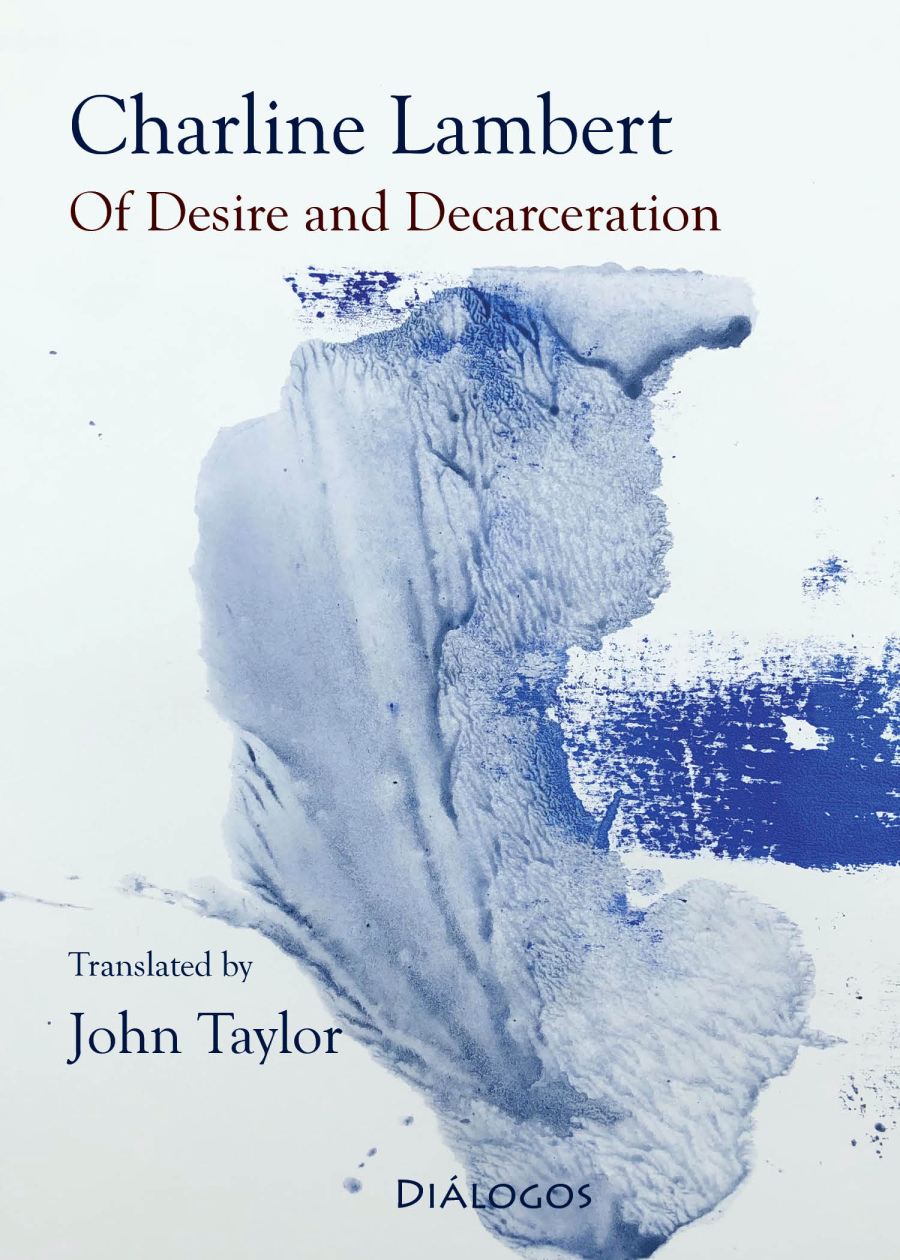
When a poet’s work first appears in translation, it is rarely more than a single volume or an edited selection. Even then, it can take decades for a prominent foreign language poet to be finally be translated and published in English. But for young Belgian-Francophone poet Charline Lambert (b. 1989), the situation is quite different—her first four books of poetry (originally published between 2016 and 2020) have recently been released in one single, dual-language volume titled Of Desire and Decarceration. As her translator, John Taylor, explains in his Introduction (an earlier version can be found online here):

The motivation for bringing forth this substantial corpus is that the four books respond to each other, grow out of each other. They are like stages—beginning with the evocations of bewitchment, temptation, restraint, and detention besetting Ulysses, Circe, and Penelope in the poet’s first book, Hemp and Ivy—of an ongoing quest to grasp the mysteries of desire and gain insight into its innermost relationship, not only with the body, but also with language.

Her work is vibrant, ecstatic, alive—rich with imagery drawn from mythology, philosophy, nature, science and physiology. As someone very familiar with Taylor as a translator and a poet, I can see why he was so immediately captivated by her emotionally and linguistically inventive poetry which he has brought into English with such care and attention.

To read Lambert’s first four books—each an extended sequence of verse and poetic prose pieces—in sequence is to experience the poet’s deepening exploration into questions of identity, where an embodied self-expression is examined at the minute, physiological level in concert with an expansive metaphysical self-realization within an external world of earth, wind and water. Although subject, voice, and form shift as one moves from volume to volume, her writing is typically spare, and the same essential human forces—desire, solitude, spirit, joy—are present, even if they may be the source (or the outcome) of struggle and pain, while her occasional use of uncommon, even esoteric, words reflects the limits and the potential of language to capture complex states of being—in the body, the mind, and the world. There is a tension in the interplay of all these elements that courses through her work, finding new expression with each successive book.

Her first book, Hemp and Ivy (Chanvre et Lierre), as noted above, reimagines Ulysses’ encounter with Circe and brings Penelope in to the drama. All three characters struggle with desire and temptation in their own ways. For Ulysses, bound to his mast, his desire and the lengths he must go to avoid a tragic fate is depicted with vivid intensity:

    A desire swarms, coming from even farther
than the esophagus, a desire rounder than the
navel, more burning than the urethra. A resonant
canalizing desire, which widens the dikes of the
arteries and erodes the epidermis. It will later
become a song, if it is not hemp.

.     Circe’s fate is a patient fate.

*

   Naked ivy on the mast, a column of climbing
vertebrae.
   In volutes of breath and nervous arabesques,
he hoists himself into the sky.
.    He unfurls his great back muscles of wing or
verve.

From this mythologically themed excursion, Lambert’s work turns towards a more abstracted poetic examination of the themes and questions that inspire her. Her second book, Dialyzing (Sous Dialyses) turns on her idiosyncratic approach to language. As Taylor indicates: “Lambert’s writing, which often appeals to scientific and medical terminology, also sets into motion a poetic and self-analyzing process of ‘dialysis.’” Akin to the medical functions and procedures associated with the term, her subject here is removing an element from her body—physical, emotional, or mental—examining, processing, purifying it through the act of writing and returning it to the embodied form in which she exists. “She is ‘dialyzing’,” hence the title as Taylor has chosen for his translation. This sequence of poems also begins to hint at the struggle to break down the boundaries between the body and the self, a theme that will be explored more directly in her next book.

Lambert’s poetry is perhaps at its most explicitly scientific here, witnessed in the incorporation of unexpected  natural and physiological terminology in striking ways as her subject explores the intricacies of her own desires in a manner that blurs or escapes the limitations of the physical form and merges with a natural environment:

.    At the edge of a cliff, potent dialysis, she
fights over the infinite with the ocean. But they
breathe at the same gill.

.    Their breath escapes, enters through a crack,
dashes to lose itself in the volutes of her pleura-
colored dress.

There is a breathless intensity to her verse that is especially evident in this sequence as her subject repeatedly loses, dissembles, and reconstructs herself in a windy, watery, earthy space:

    She unstitches each vertebra from her
spine, carries out the denuding of her neck, her
windpipe, her thighbone.
    Erects them into a new nudity of columns.
.     Anchors it in soil, and watches herself grow.

But in the end, she is enveloped once more.

With her third book, Decarceration (Désincarceration), Lambert seeks to redefine identity and existence beyond the prison of embodied existence. The idea of breaking free from an incarcerated state of being (incarnation) is openly explored now in succinct, precise verse, addressed to “You”—a movement, at least in the progressive reading experience, closer to the speaker’s own self. The fleshy matter of the body has a limit that can seem impossible to override, so the first step is to free the language you employ to define your being:

You are a countable solitude.

You are a light shattered
into beams.

You are
A barely recognized fire.

*

You want to decarcerate the language from you,
decar–

cerate these words from your plexus
and every day
you elucidate a knot.

The struggle to emerge is a tension between solitude and longing as a path to both self-identification and transcendence. It is critical to be free to form and shape yourself before being named, defined by a  body and a pronoun.

Before evaluating
the situation,

draw up an inhuman
report

*

Re-forming oneself as meander, winding
into the maze before
the accident,

before having to be called
something.

This poetic invocation is open and affirming, and can be understood in more than one sense. In his introduction, Taylor speaks of the many challenges he encountered in his attempt to preserve or replicate the distinct word choices, puns, and double entendres that Lambert revels in. I would suggest that, as a primarily but not entirely unilingual Anglophone reader, one’s appreciation of her poetry is not dimmed for the inevitable loss of some of the allusions and word play. As for her fondness for unfamiliar words and scientific terms, many are essentially the same in both the French and English versions, and my dictionary did see considerable use, something which only served to enhance my reading experience (and vocabulary).

Finally, with A Salvo (Une salve), Lambert’s fourth—and in this context, final—volume, her poetic quest reaches a certain degree of resolution, and an understanding of Taylor’s impulse to translate and present these works together as one becomes clear. Again the voice shifts, as the poet’s speaker adopts an imperative tone, addressing the sensual and physical experience in relation to a natural and cosmic reality. An intense, incantatory rhythm propels this relatively short sequence, with its recurring double-stranded refrain “Inhabit the night / Enter the sea.” This is established in the opening pages as a rejection of the soul crushing cage of darkness:

Never again sight, its eyes aborting the horizon,
   that rude roughness in the psalms of the hand
.    from which the song of the clouds is removed.

And an invitation to a kind of whole body rebirth in the water:

Washing oneself–while seeking a flesh in which
  to be, a skin to embody oneself in. A swim.
.   A lapse of time. A parturient’s dawn. Then,
  nothing will better express thickness than
  fraying and fleetingness.

The strength of A Salvo lies, not only in its sustained energy—as befits its title—and in Lambert’s own maturity as a poet, but, in the deep satisfaction that arises from reading it as the culmination of the existential quest that unites her first four books of poetry. What a joy it is to have them together in one volume.

Inhabit the night—and these crystals of being,
.   emaciated out of deterioration, become meteors.
Enter the sea—and what you have already
.   experienced, decimated into a thousand
.   scintillations, becomes a sparkling splinter.

Of Desire and Decarceration by Charline Lambert is translated from the French by John Taylor and published by Diálogos.


Looking back at a year of reading: 2024 edition

Each year when I review the list of books that I have read, I face the same challenge deciding what to include and what to leave out of a final accounting. As usual there are the books that I know, even as I am reading them, will be among my favourites for the year. Just as I know the ones I don’t like, the ones I won’t even mention or take the time to review. Basically, everything else that I have reviewed, was a good book.

This year, my count far exceeds a respectable “top ten” or “baker’s dozen” and there are some striking factors at play. One is that the ongoing  violence in Gaza has heightened my focus on Palestinian and Arabic language literature—long an area of interest and concern. Five of the Palestinian themed books I read made my year end list. As well, I have paired several titles, typically by the same author or otherwise connected, because the reading of one inspired and was enhanced by the reading of the other (not to mention that such pairings allow me to expand my list). Finally, as reflected by my top books, I read and loved more longer works of fiction this year than usual (for me). No 1000 page tomes yet, but perhaps I’m overcoming some of my long book anxiety.

And so on to the books.

Poetry:
I read far more poetry than I review, but this year I wanted to call attention to four titles.

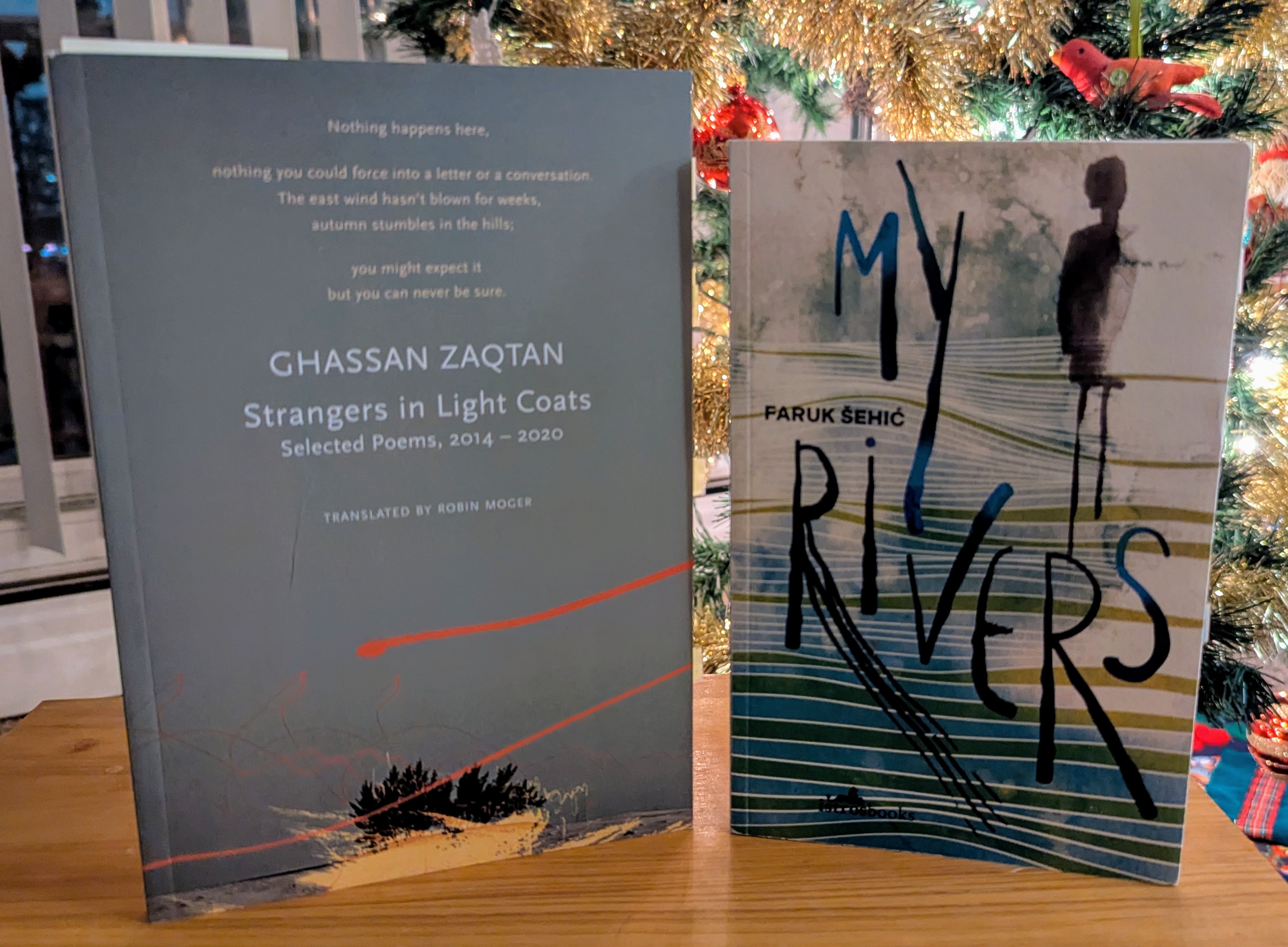
Strangers in Light Coatsevokes by Palestinian poet Ghassan Zaqtan (Arabic, translated by Robin Moger/Seagull Books) is, perhaps, a darker than his earlier collections. Comprised as it is, of poems from recent releases, it actively portrays a world shaped by the reality of decades of occupation and war.

My Rivers by Faruk Šehić (Bosnian, translated by S.D. Curtis/Istros Books) is a collection particularly powerful for its depiction of a legacy of wars in Bosnia/Herzegovina including the genocide in Srebrenica. His speakers carry the burden of history.

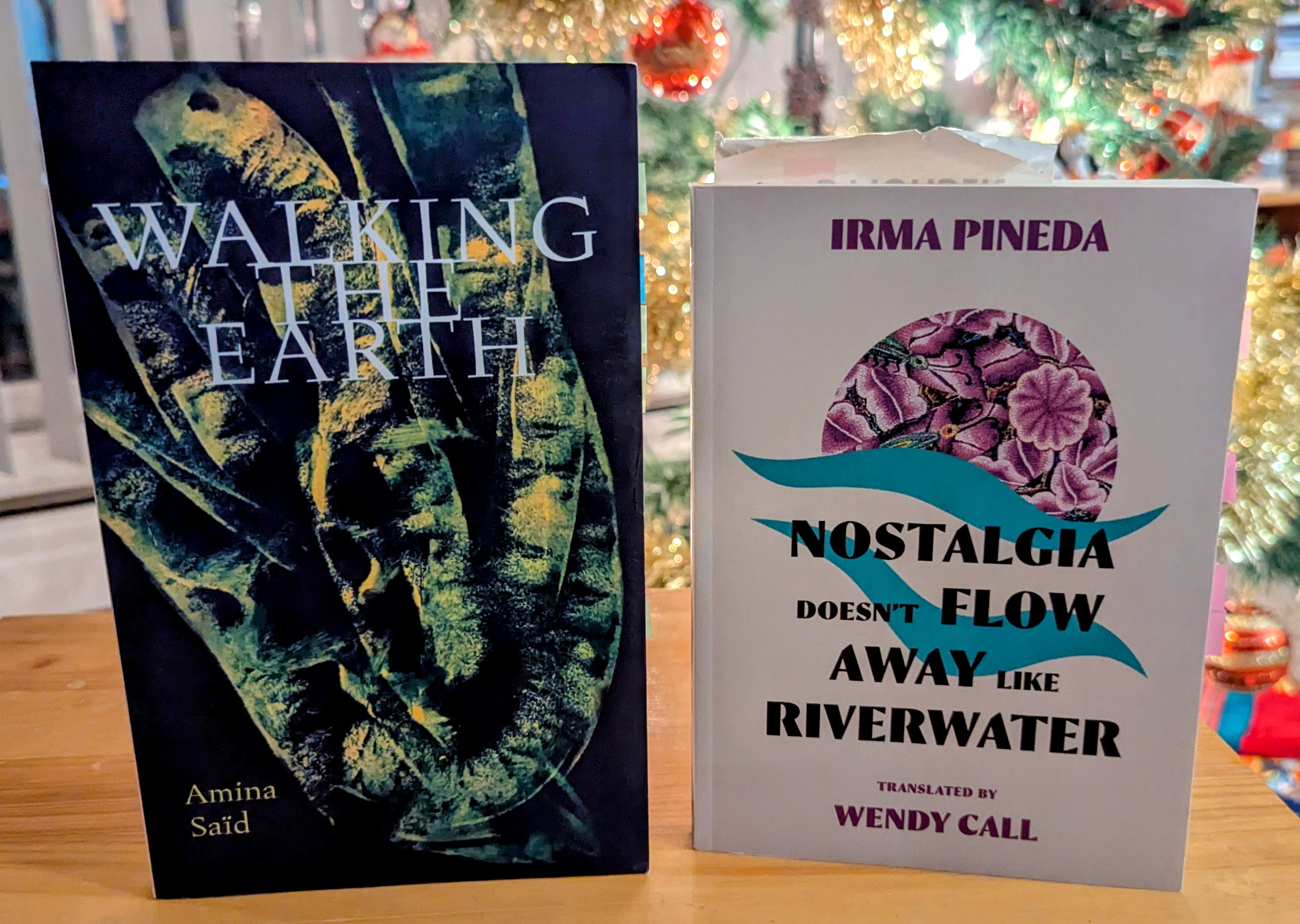
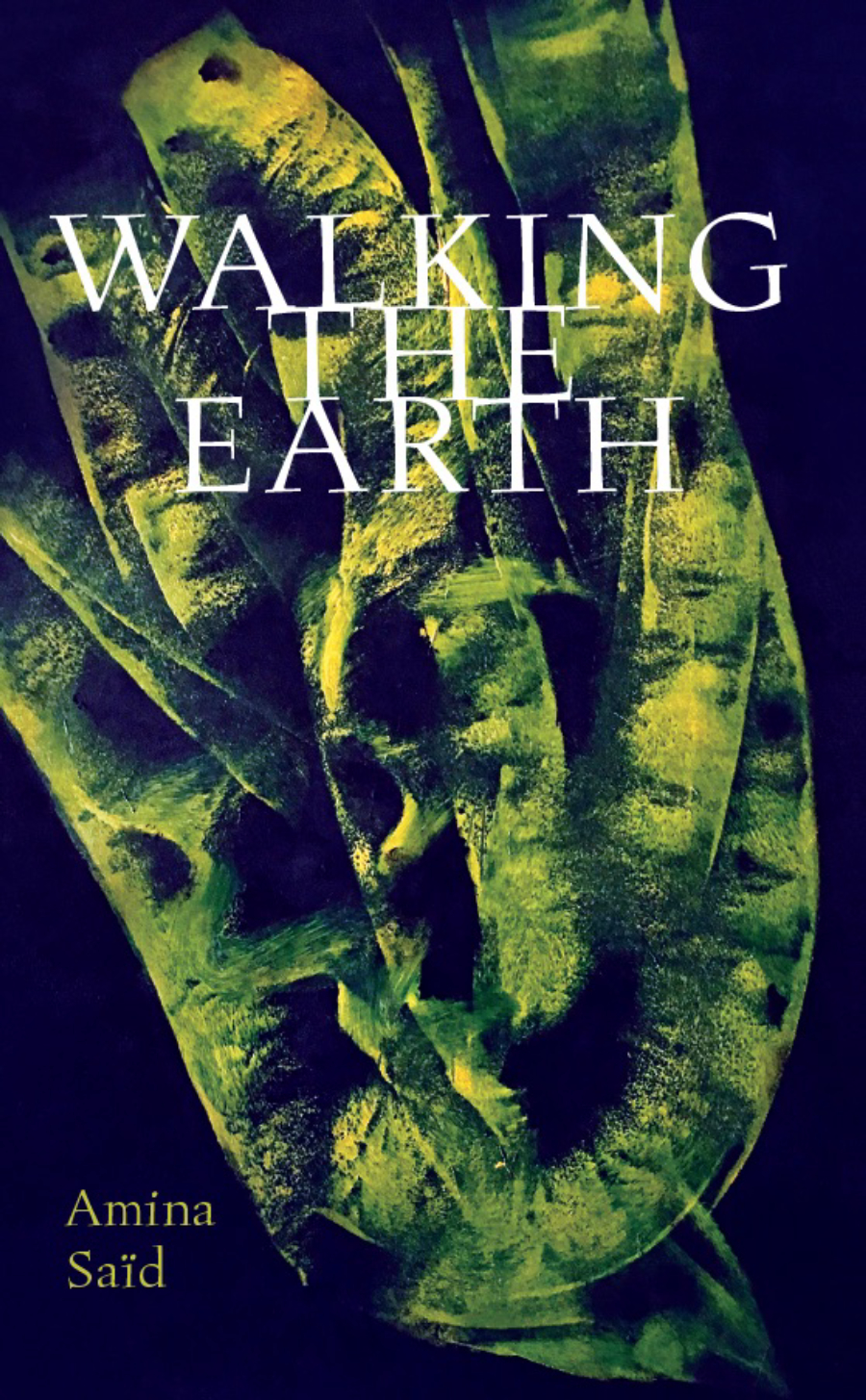
Walking the Earth by Tunisian-French poet Amina Saïd (French, translated by Peter Thompson/Contra Mundum) is such a haunting work of primal beauty that I can’t understand why more of her poetry has not been published in English. Perhaps that will change.

Nostalgia Doesn’t Flow Away Like Rainwater by Irma Pineda is one of a number of small Latin American poetry collection from poets and communities that have not been published in English before. This book, a trilingual collection in Didxazá (Isthmus Zapotec) and Spanish with English translations by Wendy Call (Deep Vellum & Phoneme Media) was particularly special.


Nonfiction:
This year, my favourites include a mix of memoir and essay and a couple of works that defy simple classification.

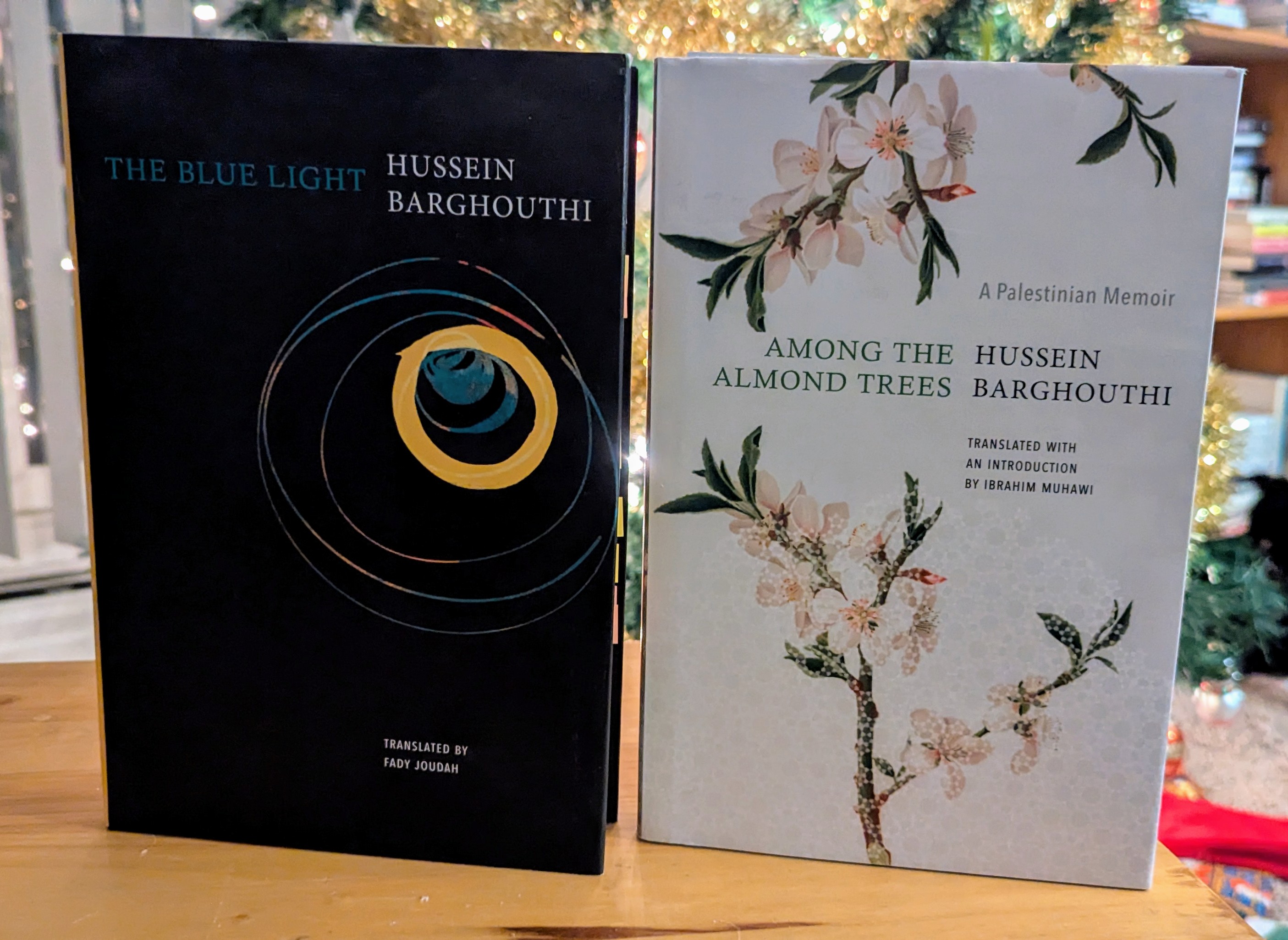
The Blue Light / Among the Almond Trees by Palestinian writer Hussein Barghouthi (Arabic, translated by Fady Joudah and Ibrahim Muhawi respectively/Seagull). Blue Light chronicles Barghouthi’s years in Seattle as a grad student and the eccentric circles he travelled in, whereas Among the Almond Trees is a much more sombre work written when he knew he was dying of cancer. The two books complement each other beautifully.

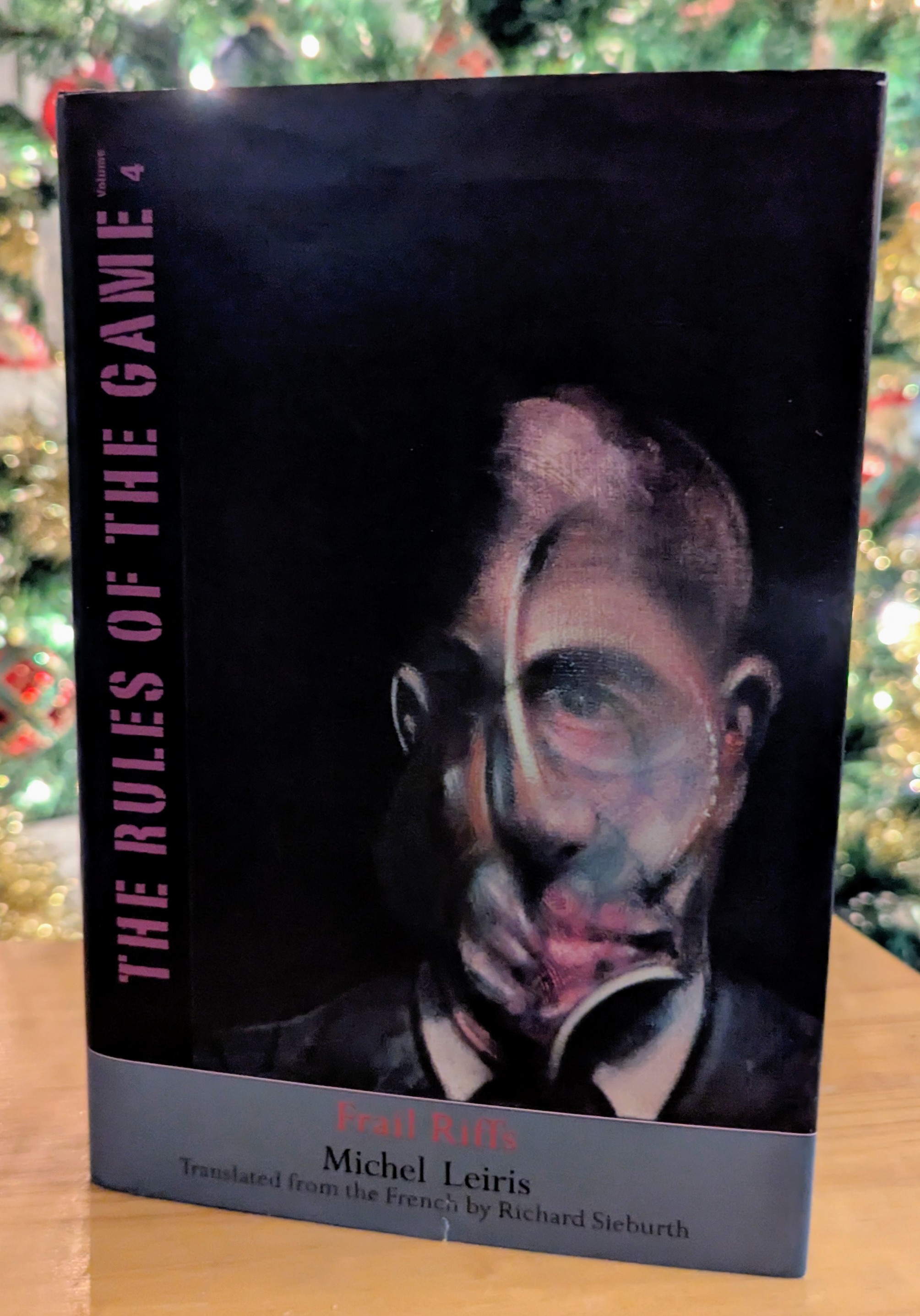
French intellectual, critic, ethnographer and autobiographical essayist Michel Leiris is a writer who means so much to me that the occasion of the release of Frail Riffs (Yale University), the fourth and final volume of his Rules of the Game in Richard Sieburth‘s translation, was not only an excuse to pitch a review but an invitation to revisit the earlier volumes. Definitely a highlight.

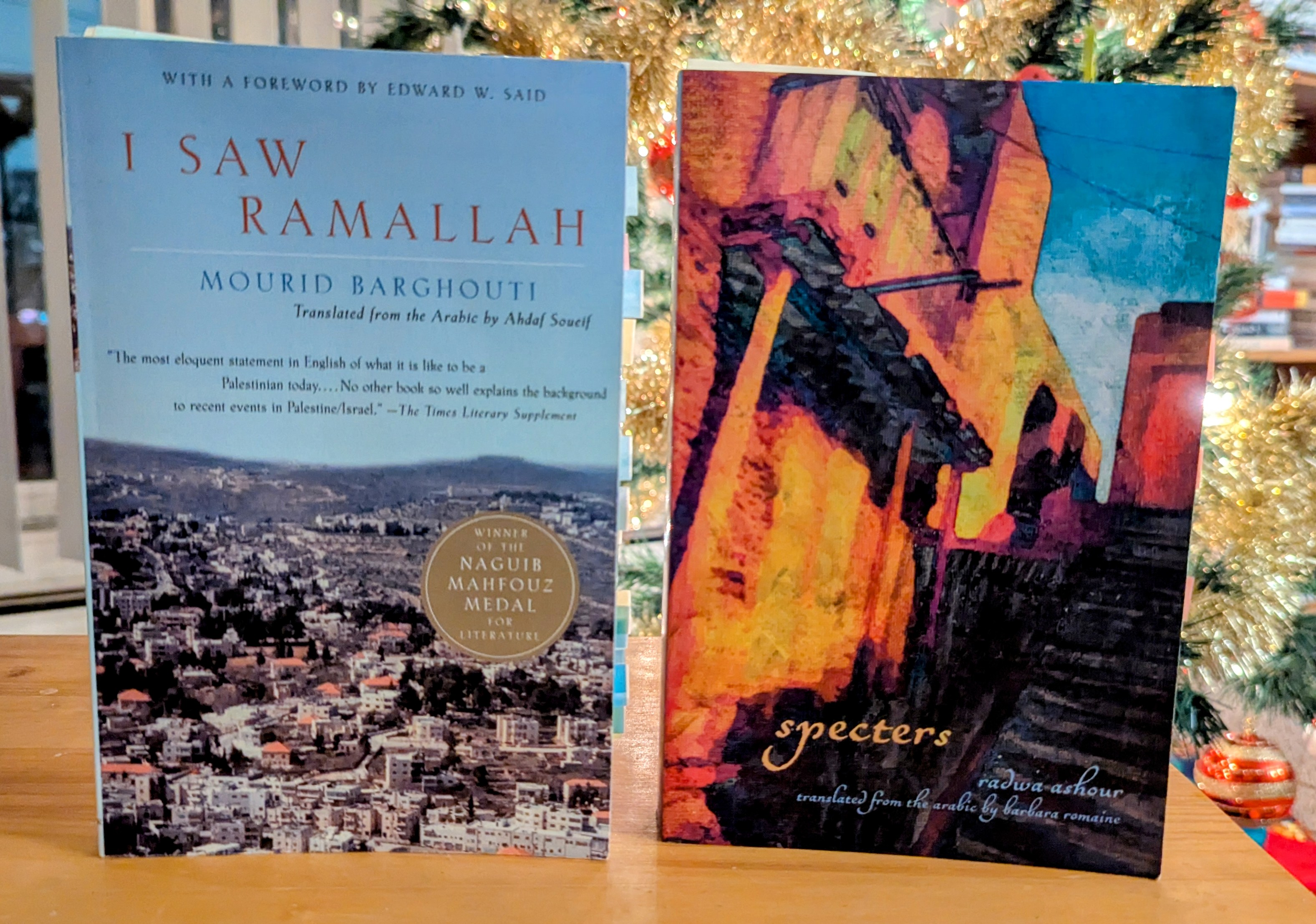
I Saw Ramallah by Mourid Barghouti (Palestinian/Arabic, translated by Ahdaf Soueif/Anchor Books) is a moving memoir detailing the author’s return to his homeland after thirty years of exile. Reading it reminded me that I had a copy of Scepters by his wife, Egyptian novelist Radwa Ashour (Arabic, translated by Barbara Romaine/Interlink Books). This ambitious work blends fiction, history, memoir, and metafiction and I absolutely loved it, but my decision to include it here, like this, rests on the memoir element which complements her husband’s in its account of the many years he was exiled from Egypt—a double exile for him—especially the years in which she travelled back and forth with their young son to visit him while he was living in Hungary.

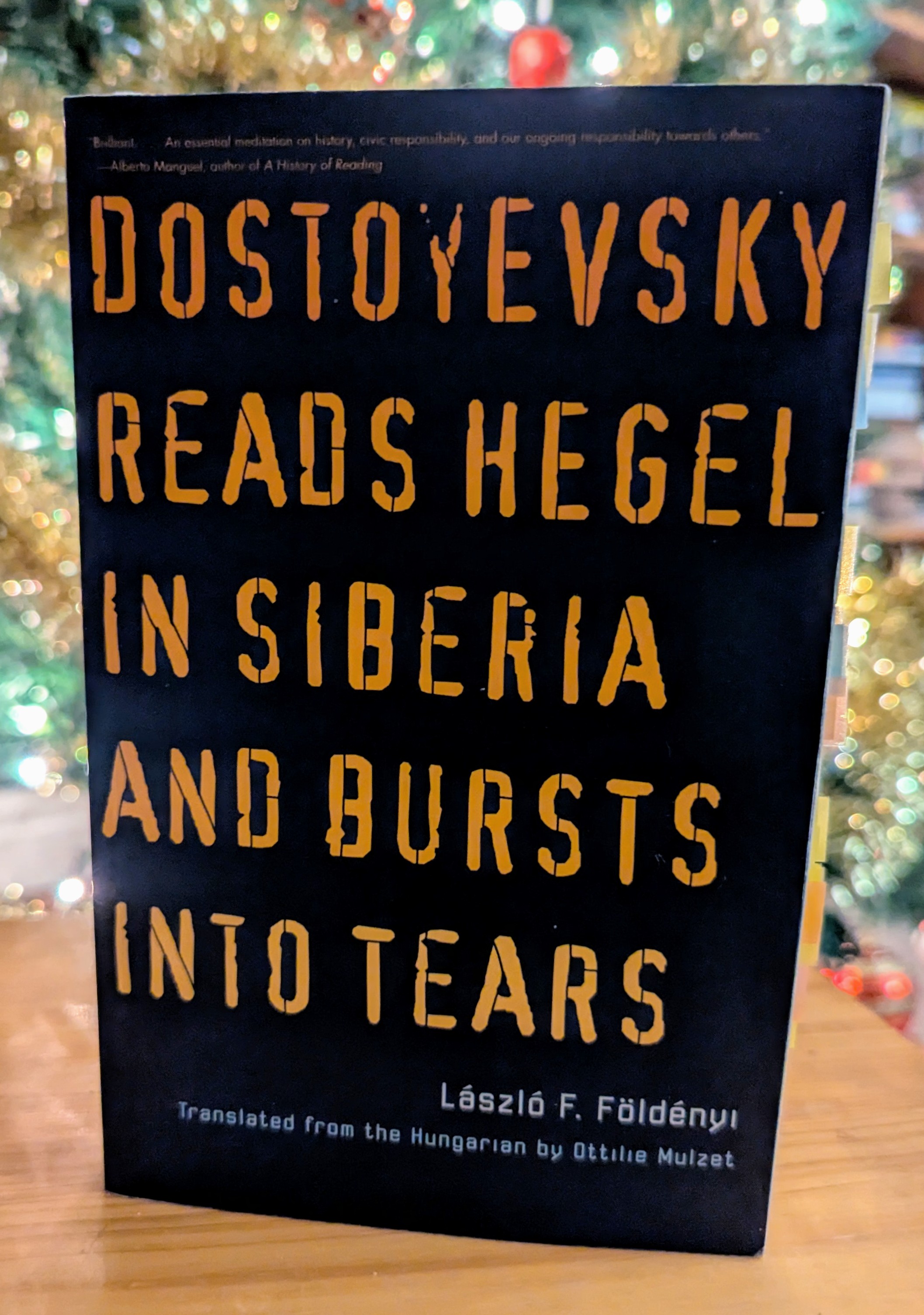
Candidate for the book with the best title, perhaps ever, Dostoyevsky Reads Hegel in Siberia and Bursts into Tears by Hungarian scholar  László Földényi (translated by Ottilie Mulzet/Yale University) was an endlessly fascinating collection of essays exploring the relationship between darkness and light (and similar dichotomies) through the ideas of a variety of writers, thinkers and artists.


Fiction:
As usual, fiction comprised the largest component of my reading and, as I’ve said, I read more relatively longer works than in the past. Normally I have a special fondness for the very spare novella and, of course, my list would not be complete without a few shorter works, including one more pair.

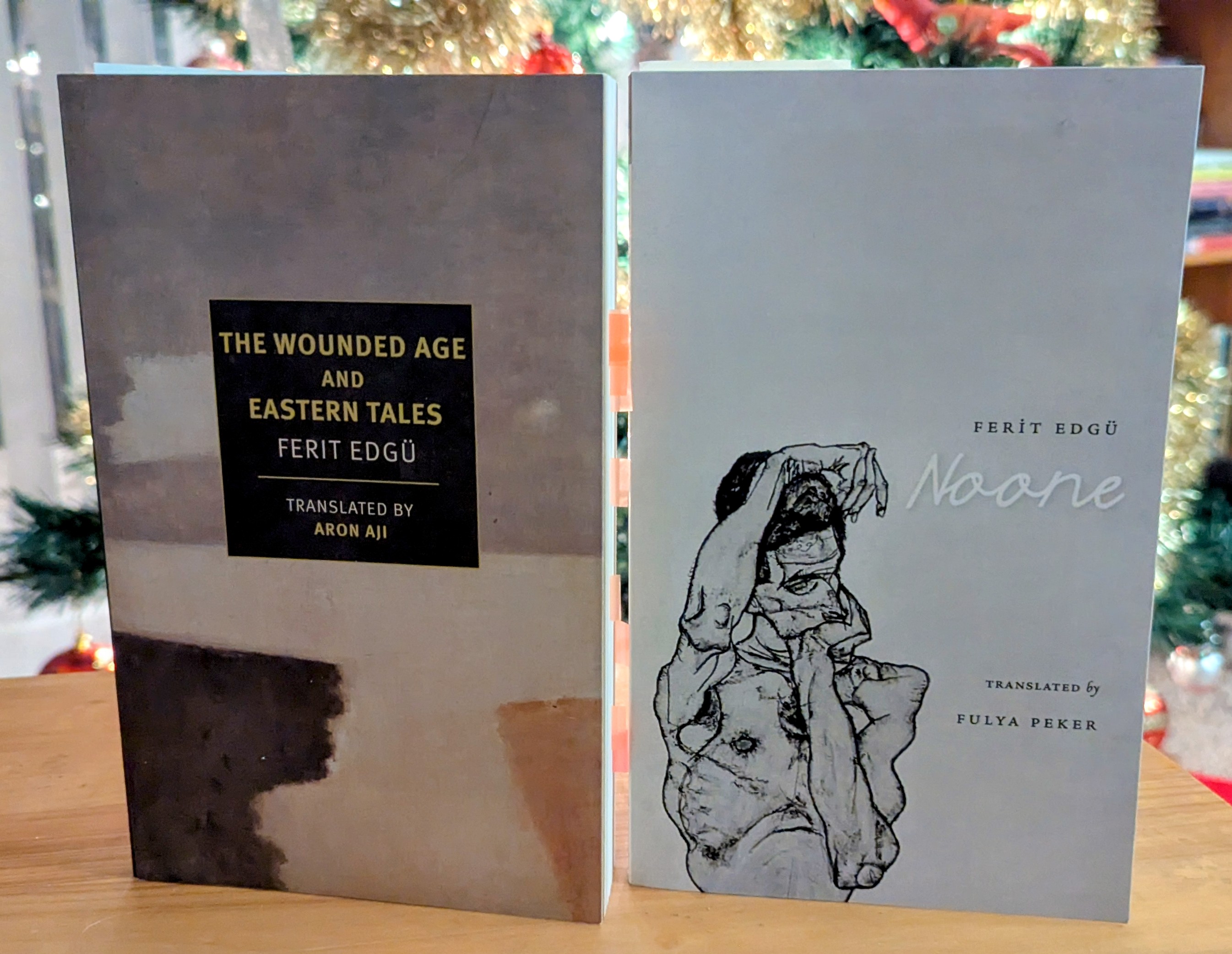
The Wounded Age and Eastern Tales  / Noone by Turkish writer Ferit Edgü—translated by Aron Aji (NYRB Classics) and Fulya Peker Cotra Mundum) respectively—who is sadly one of the writers we lost this year. His work, which draws on the time he spent teaching in the impoverished southeastern region of Turkey in lieu of military service, is filled with great compassion for the people of this troubled area. But his prose is stripped clean, bare, and remarkably powerful.

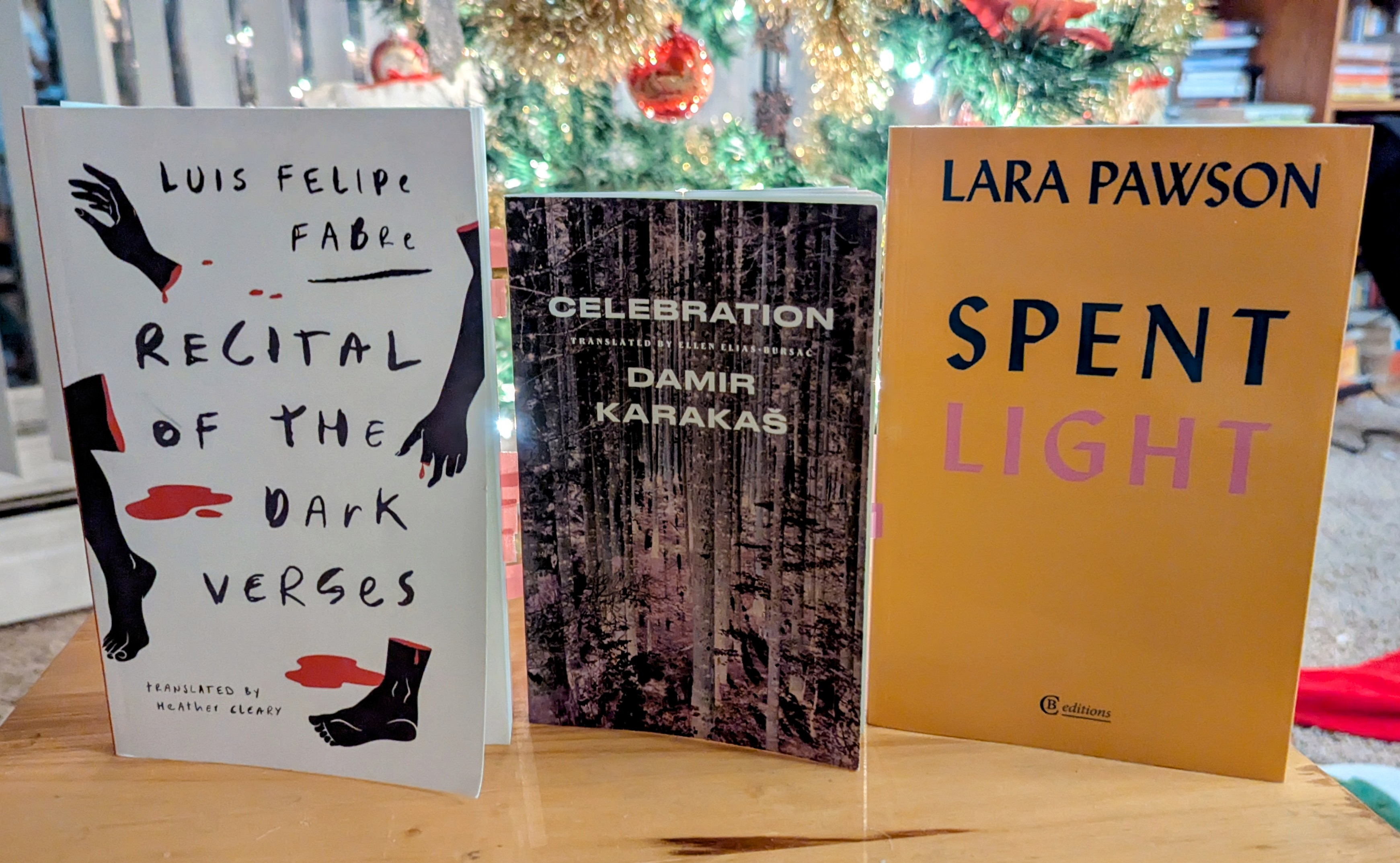
Recital of the Dark Verses by Luis Felipe Fabre (Mexico/Spanish, translated by Heather Cleary/Deep Vellum) is an award wining translation that seems to have garnered less attention than it deserves. This comic Golden Age road trip follows the misadventures of the body of John of the Cross on its clandestine voyage to Seville. Brilliant.

Celebration by Damir Karakaš (Croatian, translated by Ellen Elias-Bursać/ Two Lines Press) is an exceptionally spare, unsentimental novella about the historical forces that pulled the residents of Lika in central Croatia into World War II.

Spent Light by Lara Pawson (CB Editions) is a book I’d been anticipating since reading her This Is the Place to Be. Strange, at times disturbing, often hilarious and always thoughtful, this is one of those books that (thankfully) defies description.

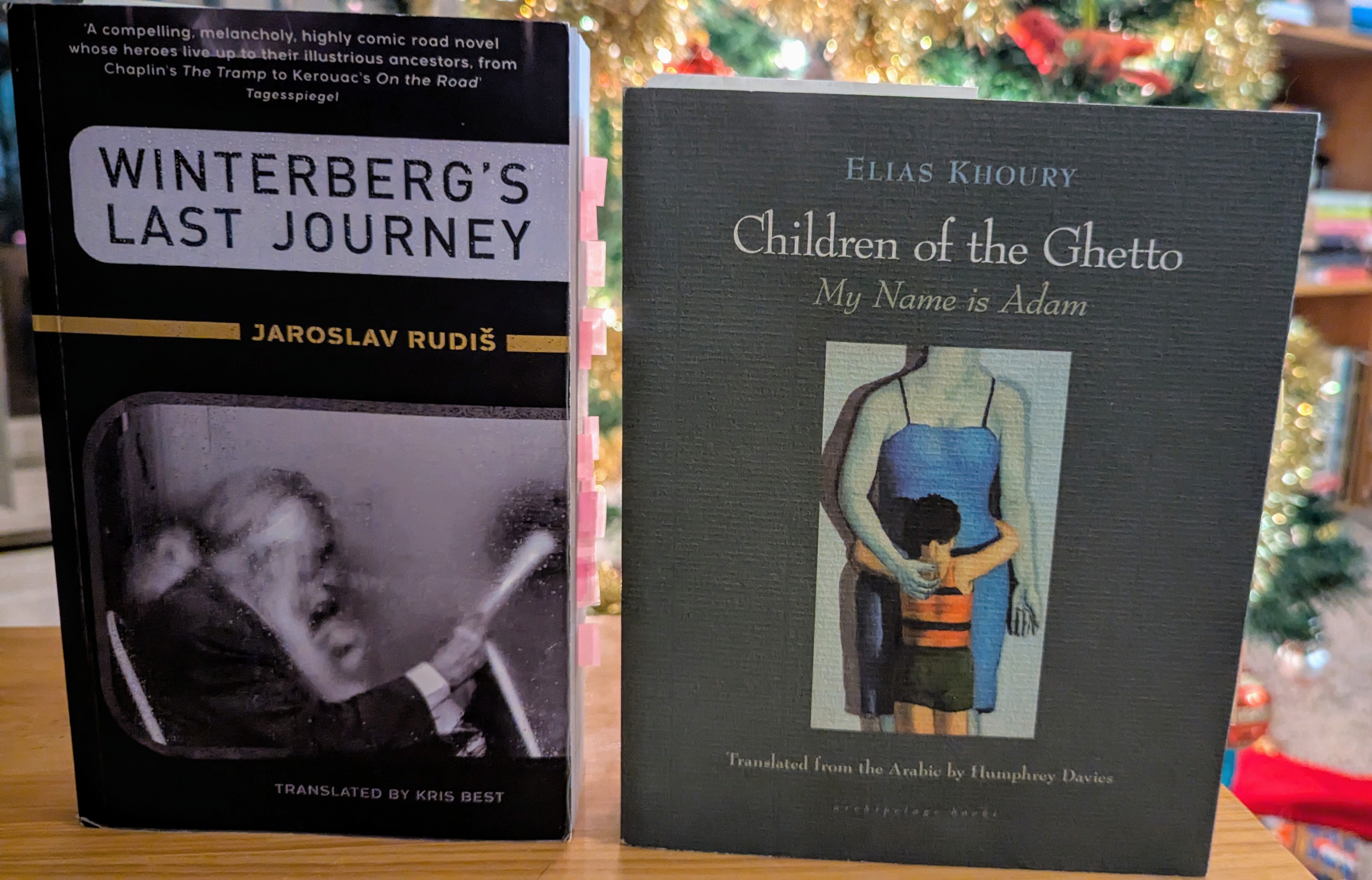
If Celebration is historical fiction at its most spare, Winterberg’s Last Journey by Czech writer Jaroslav Rudiš (German, translated by Kris Best/Jantar Publishing) is the exact opposite. Ambitious, eccentric, and filled with detail, it follows a 99 year-old man and his male nurse as they travel the railways with the aid of 1913 railway guide. What could possibly go wrong?

Children of the Ghetto I: My Name is Adam by Lebanese author Elias Khoury who also died this year (translated by Humphrey Davies/Archipelago Books) is the final Palestinian themed work on my list. This is a challenging and rewarding novel about a man born in the ghetto of Lydda during the Nakba that examines complex questions of identity.

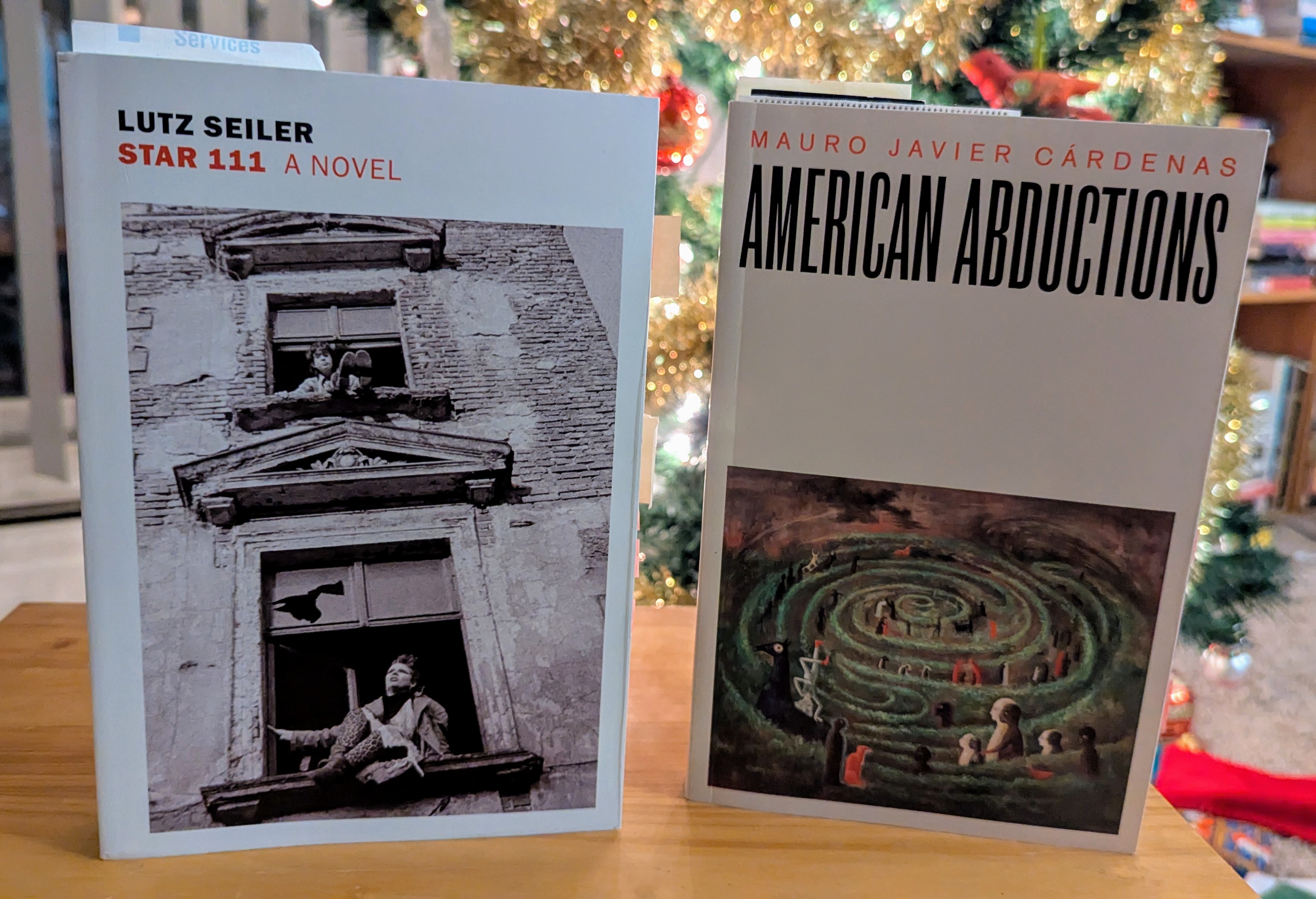
Star 111 by Lutz Seiler (German, translated by Tess Lewis/NYRB Imprints)is the autobiographically inspired story of a young East German would-be poet’s experiences among an eccentric group of idealists in Berlin in the immediate aftermath of the fall of the Wall. I was familiar with Seiler’s poetry before reading this, but I liked this novel so much that it lead me to follow up with his essays and the work of other poets important to him—the best kind of expanding reading experience.

Mauro Javier Cárdenas’ third novel American Abductions (Dalkey Archive) imagines the latest iteration of his hero Antonio in a future in which Latin American migrants are systematically sought out, separated from the children and deported. With a stream of single sentence chapters, he creates a tale that is both fun and uncomfortably too close for comfort. Quite an achievement!

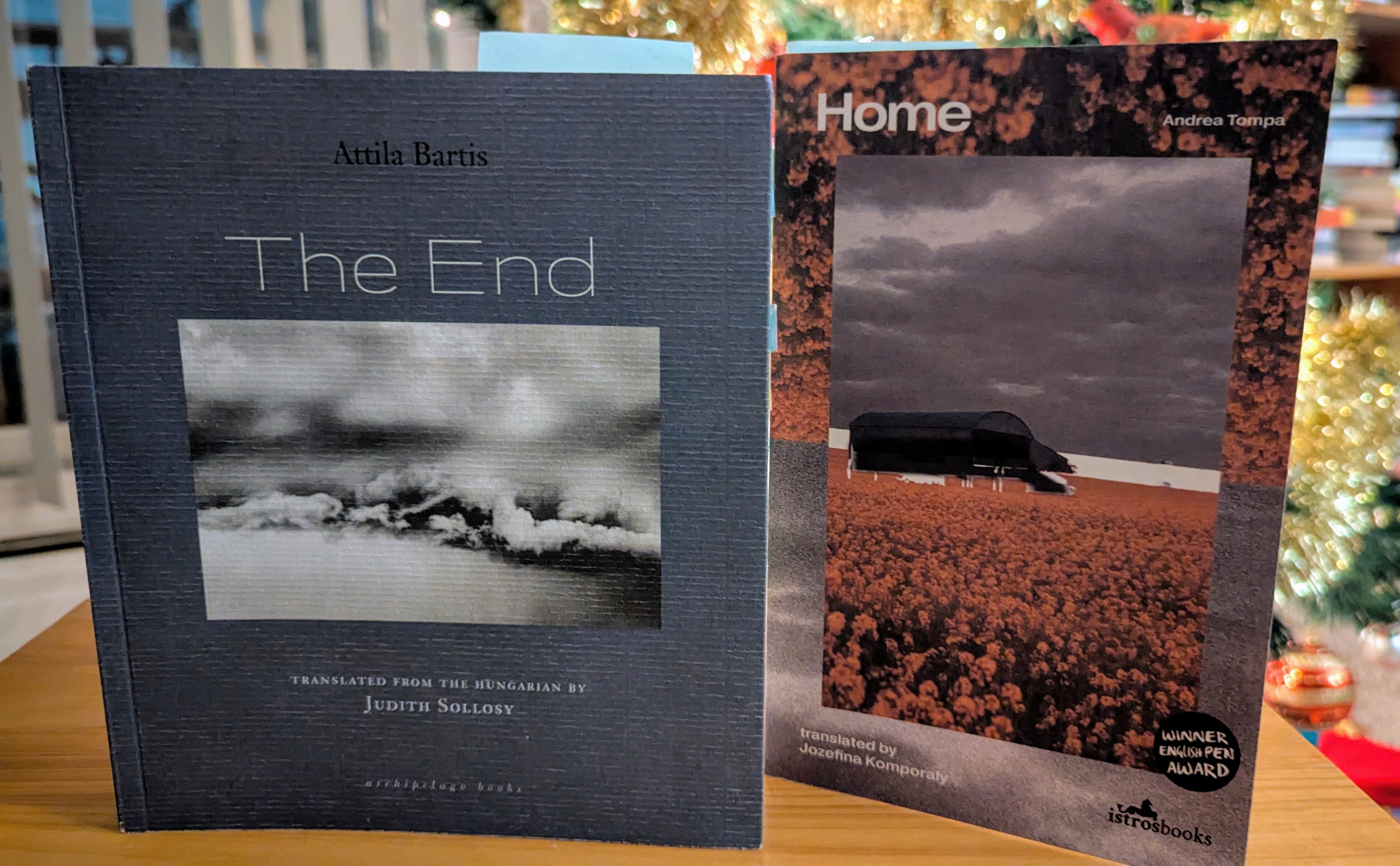
Last but not least, my two favourite books this year are Hungarian:

In The End by Attila Bartis (translated by Judith Sollosy/Archipelago Books), a fifty-two year old photographer looks back on his life—his successes and his failures. He reflects on his relationship with his mother, his move to Budapest with his father in the early 1960s following her death, life under Communism and the secrets held by those around him, and the role the camera played in his life. Presented in short chapters, like photographs in prose each with its “punctum,” the 600+ pages of this book just fly by.

Like Attila Bartis, Andrea Tompa also comes from the ethnically Hungarian community of Romania’s Transylvania region and now lives in Budapest. Her novel Home (translated by Jozefina Komporaly/Istros Books) follows a woman travelling to a school reunion, but it is much more. It is a novel about language, about what it means to belong, to have a home and a mother tongue. It’s probably not surprising that my two favourite novels involve protagonists in mid-life, looking at where they are and how they got there. As to why they’re both Hungarian—I suppose I’ll have to read more Hungarian literature in the new year to answer that.

So that is my 2024 wrap up. I’d like to think 2025 will be better than I fear it will, but at least I know there are countless good books to look forward to.

Happy New Year!

“in the nostalgia of a world / from before this world”:  Walking the Earth by Amina Saïd

all paths
lead to the same place
journey is illusion’s horseback

the world’s embers
blacken its wanton footstep

they burn
our anxious tongues

within its form
the poem seeks itself

Poems for wanderers, or the poem as a series of wandering, emergent forces, Walking the Earth by Amina Saïd hums with an intoxicating, primal energy that speaks to something fundamentally vital and human, in a sense that is too easily buried in the noise and chaos of our constantly plugged-in contemporary reality. Born in Tunisia in 1953, to a French mother and Tunisian father, Saïd was raised in both Arabic and French. At the age of sixteen she moved to Paris with her family where, when she entered university, she decided to study English literature so not to have to choose between her two native languages. Her poetic vision, however, draws on French and Arabic sources and the sunlit Mediterranean landscapes of her birthplace.

Today, Saïd can be considered, according to Hédi Abdel Jaouad, the author of the Preface present text, as the “most potent—and prolific—poetic voice in Tunisia today, if not in the whole of Francophone Africa.” Yet, until this point, no complete, single volume of her work has been made available in English. Now, thirty years after its original 1994 release, Walking the Earth (Marche sur la terre), in Peter Thompson’s translation, finally corrects this oversight.

This haunting sequence of poems, untitled and distinguished only occasionally by dedications, or by shifts in format or theme, has a hushed meditative quality reinforced by the poet’s spare, concise language, subdued and mystical tone, and the recurrence of common motifs. The world her speakers evoke is shaped by primordial elements in concert with journeys across a vast unformed terrain:

earth is this round dream

in its heart
stones fusing

their fire tongues
gouge the pathways of blood
where another fire burns

In her prefatory Note, Saïd writes that this, her seventh book, can be understood as a search for “place”—one that moves from the intimate to the universal—her own journey and that of many who pass through spaces “as much geographical as mental.” She is thinking of the displaced, those driven to move by war or disaster, but also the wanderer and traveller. Wandering is a theme of particular importance in Maghrebi (Northwest African) literature, and one that touches the poet, as someone who writes to hold an intermediary space between the Orient and the Occident, deeply:

My belonging to these two worlds both legitimizes the quest for place and generates a proliferation of doubles: shadows, voices, witnesses, angels, those who keep vigil. . .

This quest for place is born of a profound feeling of exile. Isn’t any creative person “exiled,” a nomad, an eternal wanderer seeking a place—a utopia, a place imaginary, impossible, dreamed of—which poetry can, with a sudden flaring, show in an unforeseeable image?

The quest that stretches across the pages of Walking the Earth is rich in mythological and archetypal images. The recurrence of specific motifs—light, darkness, stones, deserts, shorelines, blood, fire, tongues, voices, screams, silence—contributes to the cyclical feel of the work. Walking is an existential act while language and words are formative elements:

a voice recites
a voice despairs
the choir takes heart

a hand inscribes
ancient alphabets

the light awakens

As the sequence progresses, it becomes clear that the search for “place” is ultimately a search for meaning. The poem itself is the journey, even if the end is but another beginning. It is a path a reader can walk over and over again, and arrive at a different “place” each time.

the poem scents itself
with deepest night

I inscribe myself with sand and dust
in the nostalgia of a world
from before this world

I’m absent
from the mirror of the tribe

Walking the Earth by Amina Saïd is translated from the French by Peter Thompson with a Preface by Hédi Abdel Jaouad and published by Contra Mundum Press.

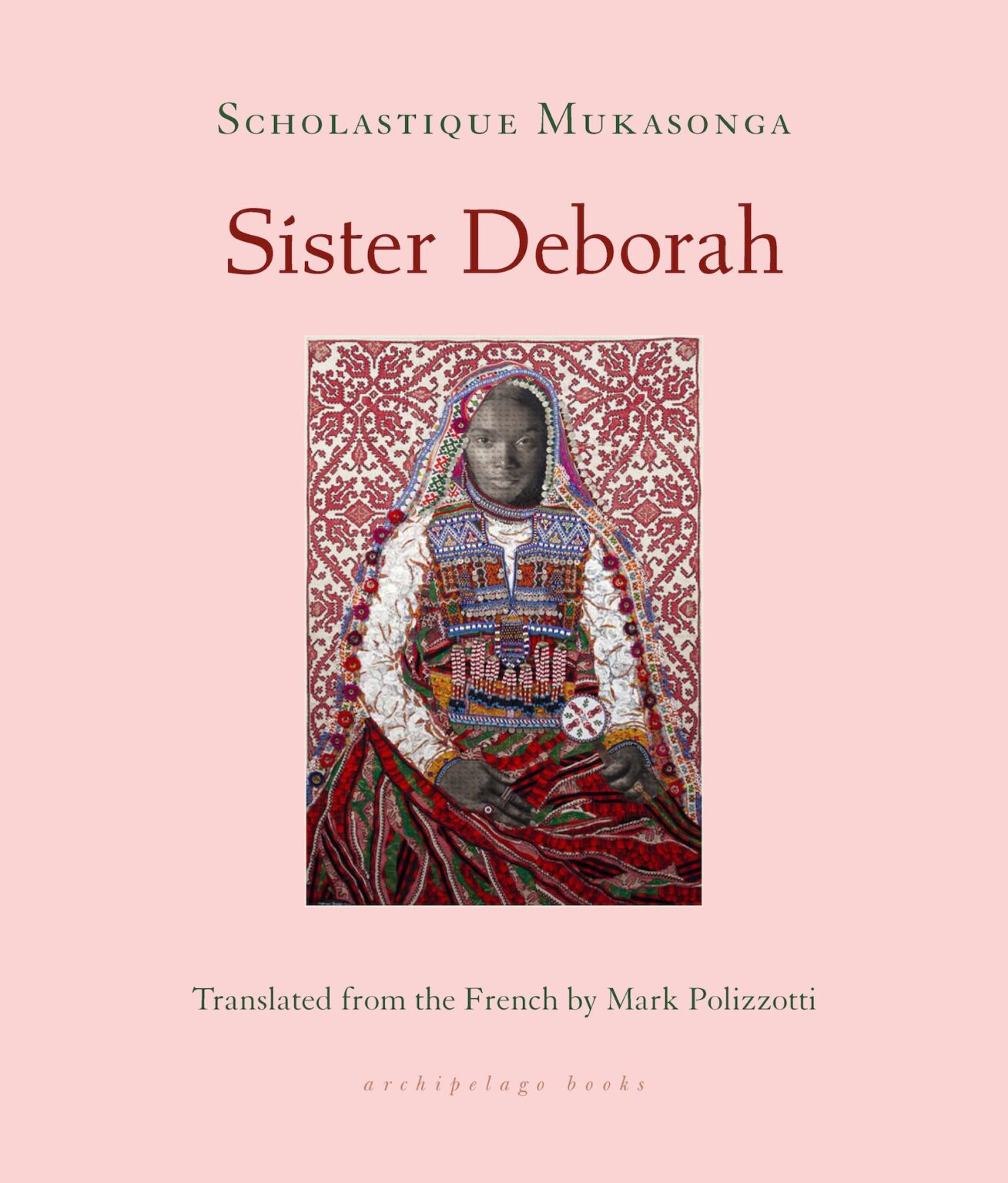
Who holds the truth? Sister Deborah by Scholastique Mukasonga

The latest work from Rwandan writer Scholastique Mukasonga, to be released in English translation, is a novella that takes us back to 1930s Rwanda when the small, landlocked east African country was under the administrative control of Belgian authorities and the religious influence of the Catholic church. With the arrival of a group of black American evangelists, life in a small community faces unprecedented challenges to both the externally enforced regulations and the traditional norms of social conduct. When the local chief grants them permission to establish their mission on a hillside long associated with pagan rituals of the past, rumours spread and curiosity is aroused by their seemingly strange services and the enigmatic prophetess who dances, babbles in strange tongues, and appears to have miraculous healing powers. Women, in particular, are drawn to her, while the village men tend to regard her and her odd companions with distrust.

Meanwhile, the narrator of this tale, Ikirezi, is a sickly young girl mysteriously prone to endless maladies. Suspicious of the white man’s medicine, her mother applies all of the home remedies she can think—all to no avail. Ikirezi’s illnesses only grow worse. There is, she decides, but one solution:

“Tomorrow we’ll go to see Sister Deborah, she’ll be able to cure you. Tomorrow we’ll go to Niyabikenke, to the mission of the black padri.” If my father noticed our travel preparations, he exploded in fury. “You are not going to that devil’s mission. I forbid it! Didn’t you hear what our real padri said about it? They’re sorcerers from a land called America, a country that might not even exist because it’s the land of the dead, the land of the damned. They have not been baptized with good holy water. And they are black—all the real padri are white. I forbid you to drag my daughter there and offer her to the demon hiding in the head and belly of that witch you call Deborah. You can go to the devil if you like but spare my daughter.”

Ikirezi, we will later learn, is not only strengthened physically and intellectually as result of her encounters with the foreign faith healer, but she goes on to study abroad and become an anthropologist. This accounts, perhaps, for the  tone of the of the extended first section of Sister Deborah which  often relies on varying details, reports, and speculation about what might or might not have happened, resembling at times a sort of gathering and integration of field data. The narrative extends beyond that of a child’s experience, describing the conditions surrounding the settlement of the American missionaries, the black pastor’s talk of the impending return of the Savior to this very location in the heart of Africa, and Sister Deborah’s particular appeal to the womenfolk, some of whom come to understand her to be implying that the Savior will likely be a black woman who will descend from the clouds bearing a special seed that will grow and flourish to feed their families without back breaking labour, thus releasing them from the constraints imposed on them by their husbands and economic traditions. Needless to say, the men of the community, the church, and the administrative powers are unsettled by the disruptions and feminine empowerment that arises in the wake of Sister Deborah’s influence. A series of events that lead to the expulsion of the Americans and the disappearance, or possible death of the prophetess are shrouded in confusion and conflicting accounts.

A brief second part considers the possible fate of Sister Deborah and allows Ikirezi to explain how she came to be a professor based in Washington, DC, dedicated to the study of her people but oddly aware of the hands of Sister Deborah somehow guiding her. She senses she has to follow a path laid out for her. Research leads her to a shantytown in Nairobi where she finds the faith healer, now known as Mama Nganga, and turns the narrative over to her. Now, the woman at the heart of this tale, has an opportunity to tell, on her own terms, the story of her life, reaching back into her own childhood in America and forward, through the formation of the missionary project, the long journey to Rwanda, her mystical awakening, and beyond the turmoil in Niyabikenke, to the life and identity she has created for herself in Kenya.

Her own spiritual evolution, as she describes it, was filled with mystery, even as she reflects on it years later. Early on, for example, when the  mission pastor suggests that the otherworldly sounds she makes when she falls into a trance may come from an African dialect, to be understood as a sign that all the black peoples will be liberated and saved from the coming  biblical Apocalypse, she has her private interpretation:

As for me, I was prey to a strange thought that I didn’t dare confess to Reverend Marcus. It seemed to me that the spirit speaking through my mouth was not the Holy Spirit of the pastors, who was always trailing behind the Father and Son. For one thing, it spoke neither Hebrew nor Greek nor Latin, but perhaps indeed, as Marcus believed, an African tongue. The spirit that had chosen me as medium could only be an African spirit, perhaps the spirit of the black woman who had visited me during my trance. I made prayers to her; I diverted toward her the worship that the pastor celebrated for the Savior. I preciously guarded that secret in the deepest recesses of my heart.

Sister Deborah Nganga’s account is ultimately one without clear resolution. Forces run through it that neither she nor the narrator, who also feels their presence, can fully articulate. Ikirezi’s later return to Nairobi to follow up on the fate of the former faith healer is again, like the opening section, guided by rumour, informants, and speculation. This is a book that continually asks questions about truth and memory, in the context of oral history, recorded biography, and academic research. There are no firm answers: Mukasonga allows uncertainty to linger in this story that explores the challenges and varying fates experienced by African women in times of shifting social and political conditions, yet keeps the spirit—or spirits—alive.

Sister Deborah by Scholastique Mukasonga is translated from the French by Mark Polizzotti and published by Archipelago Books.

Bound by a single image: Canoes by Maylis de Kerangal

I grab the neck of a dinosaur with long lashes and the hand of a small boy with dark-chocolate eyes, put them both in the car, half my body engulfed by the back seat, torso twisted, fingers straining to reach, and then fasten the seatbelt. I put a multicoloured backpack containing a lunch in a plastic box, a bag of chips, a bottle of water, a change of clothes, size 5T, on the seat beside them. Then I walk back around the car, keys bouncing against my palm, sit down behind the wheel, and start the car. First Tuesday in December, mid-1990s, it’s 8:30 a.m., bitterly cold, and blue is the colour of the sky.

This is the opening of the novella “Mustangs,” the centrepiece of Maylis de Kerangal’s collection Canoes. It’s a precise description of a routine series of actions, but then, in the French writer’s fiction, the seemingly ordinary moment can contain multitudes and what begins quiet and lowkey, can turn unexpectedly, toward an ending suspended in possibility. Her ability to balance emotional restraint against an exceptional eye for detail, and a fondness for sweeping sentences and paragraphs that frequently go on for pages, allow her to tell stories that are at once spare and revealing. She knows just where to turn her narrators’ attention as their stories unfold.

The pieces in this volume—seven short stories and one novella—are connected by a common theme and by a singular image. The theme is “voice.” From a story about a woman consciously trying to lower her voice to advance her career in broadcasting, to the tale of a father reluctant to remove his dead wife’s recorded greeting from the family answering machine, voices—changed, analyzed, unleashed, unexpected—feature directly or indirectly throughout. Translator Jessica Moore indicates in her Note that de Kerangal began working on this collection just as mask mandates “caused mouths to disappear,” something that also often altered sound and auditory comprehension, and may have contributed to this thematic link. But the distinct image or motif that recurs in each of these very different stories seems much more random and therefore a is little treat each time it makes an appearance. The “canoe” of the collection’s title only appears in any particular detail in one of the stories, otherwise it might be a pendant, a craft observed in the distance, or mentioned in some other passing context. A nice, fun touch.

As one might expect, the extended piece, “Mustang,” anchors the collection. The unnamed narrator is a French woman who is living with her husband and young son (whom she simply calls Kid) in Golden, Colorado. Sam is taking a course at the School of Mining where he is quickly adapting to American life and language, while she struggles to find her footing in this vast suburban community in the foothills of the Rockies. At first walking suffices, but the lack of the kind of integrated train and transit system of a European city soon leaves her frustrated, as does the lack of purpose and work to fill her now empty days. So her husband, who has actually arranged this short term foreign escape more for her sake than his own, suggests she learn to drive. He buys a used Mustang and she gets her license. Funny, bittersweet, and ultimately terrifying, this is wonderful story of a woman seeking to redefine herself after loss in a mythic Western landscape of cowboys and dinosaurs.

By contrast, each of the other much shorter stories are condensed, finely drawn episodes that reveal something, often unsettling, of their narrator’s life or engagement with others, yet leaving much unsaid or unresolved. One of the best, perhaps, is the final tale, “Arianspace.” The narrator is a ufologist—an investigator of UFO sightings. She has been sent to visit a ninety-two year-old woman living along among mostly abandoned homes in a rural area. From her earliest impressions, the researcher can tell that she facing someone special:

I had imagined her small and wizened, the wrinkled skin of an old fig, hair sparse, body brittle and slow, an apron tied around her waist and black peasant stockings, but she was something else: a tall, regal woman in jeans, a red T-shirt, and boots, and she was thin, long grey hair over her shoulder, cheekbones still high, and beneath ragged eyelids, eyes of a deep black – the kind of black that absorbs nearly all visible light, and which is found in bird of paradise feathers or on the belly of peacock spiders; altogether wizened, dry, and flaking, but conveying a great impression of physical strength and brutality.

Indeed, not only is Ariane a no nonsense woman with a firm commitment to the alien phenomena she observed, she has impressive evidence. . .

With short story collections, especially dedicated volumes like this as opposed to larger compilations, a test of success can lie in the degree to which each entry stands apart from the others. Even though some of these pieces have a very tight focus, the characters and narrative voices (all first person), are distinct, the settings varied, and in some instances I was left with this eerie feeling—a sense that I wanted to know where the characters went after the story closed, a what-happened-next sort of thing. That is for some readers a negative to the shorter forms, but especially with a writer like Maylis de Kerangal, who is unafraid to leave an open door, the extended possibilities only make the situations she depicts seem more real.

Canoes by Maylis de Kerangal is translated from the French by Jessica Moore and published in North America by Archipelago and MacLehose Press in the UK.

The secrets that define us: What I Know About You by Éric Chacour

Stories of queer love—hidden, unrequited, or impossible—tend to take on a special dimension when the temporal or cultural setting is one that outright forbids the expression of same sex attraction (and often even discourages public displays of opposite sex affection). A further challenge when bringing such a stories to life though, is the question of approach: can this tale be told in a manner that sets it apart from the burgeoning LGBTQ romance genre? Narrative is key, a metafictional twist perhaps, a less than reliable narrator, or an indirect angle through a spouse who never reveals what he or she knows. What I Know About You, by Québécois writer Éric Chacour, employs an inventive and surprisingly effective method to expose a story that spans forty years, from 1961 to 2001, and moves between Egypt and Montreal.

The novel opens in Cairo, or rather the narrative begins there, when the protagonist, Tarek Seidah, is twelve years old. He is out in the city with his father and his younger sister Nesrine. Their playful banter reveals that a certain order reigns. Even at this point, Tarek already senses that his life is set to follow an inevitable course laid out by fate and circumstance. As a member of a respected Levantine Christian family, there could be little debate. His father was doctor. He would be one too. In time he would marry and have a family, continue the family lineage, and the family practice.

It’s not hard to imagine that something or someone will threaten the ideal realization of this destiny, but what immediately sets this account apart is the perspective. It is a second person narrative, directed to Tarek, by a narrator whose identity will not be revealed until midway through the book, and at that point only to the reader, as the now-first person narration continues to be addressed to Tarek who has no idea it is even taking shape. It is a story—his own—that he wants to believe he has put far behind him.

As expected, Tarek does become a doctor and, by the age of twenty-five, he has taken over the family clinic after his father’s sudden death. The responsibilities to his legacy, his patients, and his mother weigh heavily, but he has his own project on the side that gives his life and career personal value away from home. He has established a weekly clinic in Cairo’s Mokattam slum area where he brings care attention to those who have little. It provides him with a great deal of satisfaction, but it also where Ali comes into his life.

By the time he meets the young man, Tarek is in his early thirties and has been married to Mira for less than a year. At first Ali approaches the doctor to ask if he will come see his mother who is ill but refuses to come to the clinic. These “house calls” soon become a regular practice, and, in time, Tarek invites Ali to come assist him on clinic days. For someone with little formal education, the boy is quick to learn and becomes a reliable assistant. As to how he earns money otherwise, Tarek does not ask, but there are insinuations that it is less than reputable employment. By the time he finds out, he has already started to become aware of his own feelings—attractions that defy the norms of age, sex and class. Their affair will threaten to destroy everything and everyone he cares for. His solution will be to escape, to emigrate to Canada, and leave his family behind. Even if it might have been possible to salvage his marriage:

What did you have to offer her in return? No real apology or explanation. A collection of monosyllables, I don’t knows and What can I says. You had long ago relinquished your duties as a husband. She wanted to know where you stood – as if the two of you were plotting geographical coordinates. Did you even know where you stood? Were there even answers to these questions? You observed her pain without trying to meet it halfway; your suffering and hers had grown so far apart they would never again meet. She didn’t mention Ali’s name, perhaps hoping you might broach the subject. The subject was never broached.

Once he is settled in Montreal, after retraining to meet Canadian standards, Tarek’s life continues with quiet dedication to medicine, alone and with little contact with his Egyptian past. Until it comes to confront him.

The second person narrative of the first section “You,” affords a certain spareness to the account of Tarek’s life in Cairo, events move swiftly and, at moments, possible details are surmised where the narrator does not dare to guess what might have done or felt. In fact, there is little direct insight into Tarek’s thoughts throughout the entire text. This is someone else’s version of the story, sometimes empathetic, sometimes tinged with bitterness. There’s also a peculiar sentimental note that slips in here and there, the echo of a piece of cliched wisdom perhaps. All of this will begin to make sense in the section, “Me,” wherein the narrator reveals their connection and motivation for the story they are telling. This is where the tension starts to build, as the long term implications of an attempt to bury the past are explored. Of course, given the clever way it unfolds, this is a book best not spoiled with too much advance detail.

Chacour was born in Montreal to parents who emigrated from Egypt, his family background likely allowing him to recreate the social and political mood of Cairo in the 60s, 70s and early 80s so seamlessly. This debut novel has won or was shortlisted for a large number of French language prizes, and now, in Pablo Strauss’s attentive English translation, it is again garnering attention. But, like many other queer novels that have ventured to entertain the possibilities for love when all the cards are stacked against it, a sadness and loneliness lingers.

What I Know About You by Éric Chacour is translated from the French by Pablo Strauss and published by Coach House Books.