Of misery and cauliflower: The Author and Me by Éric Chevillard

The tale that unfolds between the covers of The Author and Me by French writer Éric Chevillard is, to be honest, quite unlike anything I have ever read. In fact the tale, or rather tales and other sundry comments exist on two levels: in what might be considered the primary text and in an extensive series of footnotes, which at one point digress into a 40 page story called The Ant. And linking it all is the character’s (and possibly the author’s) explicit loathing for cauliflower gratin. And can the protagonist wax lyrical about his utter contempt for the cruciferous casserole? He can, and does. He also sings the praises of his most desired dish, trout amandine. It would be ridiculous – well perhaps it is ridiculous – if it was not so very funny.

AuthorOh wait, I can sense you backing away now and looking for a quick exit. Would it help if I add that you will also find murder and two shocking twists within these pages?

The book opens with a Foreword in which the author briefly discusses the way his past characters have been conflated with either real individuals or with himself. Questions of the nature of writing and an author’s responsibility for the beliefs and actions of his or her creations continue in the extensive, ongoing footnotes. Meanwhile, on ground level, shall we say, the main character, a middle aged man, collars a young woman sitting on the terrace of a café. With little preamble he launches into what may, or may not, be leading to the confession of a crime predicated on the indignity of being promised trout and being serve a dish of congealed cauliflower and cheese. He contrasts his views about the two dishes with passion:

“On the one hand, the vast openness of space, the loving moon, still more heavens beyond the heavens; on the other, a dull, leaden horizon, the collapsed roof, the flooded basement.

On the one hand, life in all its possibility, benign and, for a few moments – some ten mouthfuls – magnificent; on the other, the wretched gloom of day following endlessly upon day, a longing for death, death as rescue and release.”

As the character’s tale of woe continues, the footnotes run commentary on the author’s tendencies and predilections, muse on the relationship between the author and his character, the author and his reader, and the general nature of writers and their relationship to the world. As you might imagine, the lines between the actual author, M. Chevillard, who continually references his own prevous work, the (presumably) fictional author and the created character blur as the novel becomes increasingly bizarre.

Which all brings us back to this most reviled of vegetable dishes. How serious is the character’s diatribe? How much, against the footnote creator’s protestations, is ironic? Allegorical? To what is it a commentary on the state of literature? On the very state of civilization?

And when is cauliflower gratin simply cauliflower gratin?

For a taste of contemporary experimental absurdist French literature, tuck in your napkin, pray for trout but prepare for cauliflower. Created with finely seasoned humour by Éric Chevillard, carefully prepared and translated for your consumption by Jordan Stump and served up by Dalkey Archive Press, this is a novel that has to be experienced to be appreciated. It has definitely whet my appetite for tasting Chevillard’s earlier work.

This novel was shortlisted for the 2015 Best Translated Book Award.

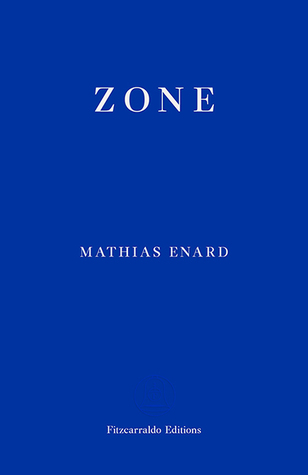
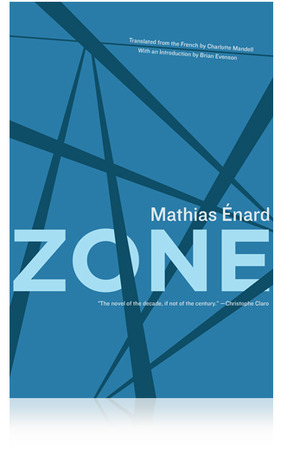
Collector of Corpses: Zone by Mathias Énard

Where to start with Zone by French author Mathias Énard?

“I climb into the trans-Italian express that must have been the zenith of progress and technology ten years ago for its doors were automatic and it went faster than 200 kilometers per hour in a straight line on a good day and today, a little closer to the end of the world, it’s just a train”

Imagine you are on a train bound from Milan to Rome, trapped inside the head of a French Intelligence Service agent, hung over and pumped up on amphetamines, who by reckless dalliance has missed his fight and is, as a result, having to make this critical trip by rail. Which gives him plenty of time to perseverate while he clutches a suitcase filled with documents graphically detailing war crimes, witnessed or reported to him during his time in the “Zone”, an area stretching from the Mediterranean to Central Europe. At the end of his journey he intends to sell the secrets he has collected, effectively resigning with a final act of treason, and disappear into a new existence with an identity assumed from a man long condemned to an asylum. And as the reader you are bound to the narrator, Francis Servain Mirković, for one breathless 517 page sentence.

zoneAs he streams forth a catalogue of brutal visions from his own memories, from history, art and literature, there is no respite. Even his love affairs are recounted with a desperate intensity. This not a book of bitter humour, it is a chronicle of horror, a memoir of regret. Francis is longing to be released from the burdens of his experiences, but that end is all very vague, growing even more so as he nears Rome. In the meantime, unable to sleep, to turn off his fevered brain, he is assaulted by grotesque images of his time on the battlefields of Bosnia with a Croatian militia unit. His lost comrades haunt him, his lost lovers loom large and through it all run threads of historical violence – decapitation is a particular obsession that he sees in, yet seemingly shares with, Caravaggio. Warriors of antiquity, martyred saints, Nazi war criminals all cast long shadows across the path of his racing thoughts. Violence is vividly described, and is often up close and personal.

This is not a leisurely read.

As a small concession to the reader, the single sentence is divided into chapters and periodically broken with segments of a novel about a female Palestinian fighter but there are times where one gets the distinct feeling that facts, and at times, streams of words words words are being employed as filler, as if anything less punishing than 500 pages would have been unthinkable. The risk however, is that the power of the images will be diluted, reduced to noise, numbing the reader, or worse, driving him or her away. Even the literary detours that turn toward Cervantes, Malcolm Lowry, William S. Burroughs, Jean Genet, James Joyce, Ezra Pound, Cavafy are typically delivered as measured portraits of ugliness and depravity.

If you have ever been in a room with someone who is in a manic state, you will know that they fill the space, suck up all of the available air. Such is the sensation of spending time in the presence of the narrator of Zone. Left to my own devices I am not sure I would have been inclined to open this book (sometimes size matters) or at least may well not have ventured past the first 150 pages or so. I may have disembarked at the next available station. And that would have been a shame.

Somewhere, two thirds of the way in maybe, the pressure begins to dissipate, perhaps as the drugs wear off, and the pace of the monologue eases, opening up space for more personal reflection and musing, more meaningful literary diversions and a sober assessment of his last serious love affair gone wrong. Even a little touch of humour. Mind you we are not exactly tripping through fields of daisies but the relentless deluge of decapitated heads, eviscerated corpses and raped women does ease to a slower flow of grisly images, as the full weary weight of the life Francis is longing to step away from settles in on him.

Zone 2

This novel, ably translated by Charlotte Mandell, was added to our IFFP Shadow Jury longlist when several members of the group argued that it had been sorely overlooked by the official jury. And it made the cut for our version of the shortlist. Given what I know now about the difference between the Independent Foreign Fiction Prize and the Best Translated Book Award, I feel that this is the type of book that more appropriately belongs to the latter. However in North America, Zone was released by Open Letter in 2011 (and, in fact, another Énard title was longlisted for the BTBA this year) whereas its eligiblity for the IFFP is based on the 2014 UK release from Fitzcarraldo Editions.

So what did I really think? My overwhelming first impression is that this book is one of style and literary merit but that at times it feels contrived. Perhaps, someday, when I look back I will think, yes, that was quite the experience. I may think back on Francis stepping forth at the end of his journey, reborn or perhaps beaten into the pavements of the Eternal City, with a sympathetic fondness of sorts.

I don’t know.

How do you see me, anyway? Sphinx by Anne Garréta

“What I was feeling for A*** needed its own embodiment; the pleasure I took in A***’s company demanded is own fulfillment. I wanted A***, it was true, and all my other desires, needs, and plans paled in comparison. Suddenly, the obsessive clamor for amorous possession took hold of me.
I was surprised to find myself desiring, painfully. In a sudden rush of vertigo, I was tantalized by the idea of contact with A***’s skin.”

What we have here is the impassioned confession of the unnamed narrator of Sphinx by Anne Garréta. A*** is the object of this sudden and intense desire. Neither are defined by sex or gender. This factor, acts as a constraint that places this French novel within the ranks of the works of the OuLiPo group of authors (though,written in 1986, it predates the author’s admission to this famed group). Yet in the end, Sphinx requires no such designation to work as a powerful literary, darkly existential meditation on memory, attraction and identity.

sphinxThe more I heard about this book, a new release from Deep Vellum Publishing, the more conflicted I felt about whether or not it was something I wanted to read. My reasons for that uncertainty are deep seated and will be discussed below, but let’s get one thing out of the way first… Sphinx is one stunning, dynamic and important novel. To finally have it available in English, and in a world in which the public understanding of sex and gender is evolving, serves as an invitation to approach this work as more than either a literary challenge in itself or a polemic of feminist/queer theory.

Oh, wait a minute. Is it a good story? One that stands on its own merits? At first blush, the set up sounds, and at points may even feel artificial, but that oddness passes quickly. The narrator is a young student of Catholic theology who is drifting without strong direction and, through a series of unusual, even disturbing, coincidences ends up working as a DJ at an after hours Paris nightclub. This serves as an introduction to a new world, an alternate reality that opens late at night, to unwind in the very early hours of the morning. Our narrator demonstrates a tangible ambivalence toward this radical change of lifestyle.

“I acquiesced to whatever presented itself without much arm-twisting, and I neither suffered from nor reveled in it: I was spared the exhaustion of searching and seizing. I was giving up a state of being that was in turn abandoning me and sliding into another that slowly, imperceptibly came to envelop me.”

In learning to navigate this world, an identity that may or may not be valid or true, is adopted to serve as a barrier, a means of mediating an alien environment. Within this identity a certain boundary, a sober vantage point is maintained until A***, an exotic dancer at a strip club, comes into the narrator’s life. At first their friendship is platonic, existing in a stylish public sphere. The narrator realizes it is not built on strong romantic or intellectual engagement. The attraction is one of opposites – race and personality – until sexual desire arises abruptly, throwing the narrator’s carefully constructed identity into a crisis which is heightened as A*** initially refuses to take their relationship to an intimate level.

When it is ultimately consummated, a highly charged sexual and romantic liaison develops, enduring several years marked by turns of passion, jealousy and domesticity. As might be anticipated in a union built on obsession rather than common interests, cracks and fissures begin to grow. This is heightened as the narrator seeks to revive abandoned theological pursuits, carving out time to focus on an essay, quite fittingly, on the apophatic tradition – the attempt to describe God only by negation. Later on, after the tragic end of this ill-fated love affair, the narrator will sink into a deeply existential rumination on love and loss. No sexual encounter, romance, intellectual or academic pursuit will fill the void left behind. A restless wandering overtakes our hero, driving a spiral into ever darker self exploration. Without the “other” as a frame of reference, it becomes increasingly evident that the self is isolated, disconnected.

“Had I confided more in A*** than in anybody else? What had I revealed? Had I unmasked myself? No, more likely I had exposed my own collapse, the ruin of the edifice I had so painfully constructed out of rhetoric and made to stand for an identity.”

At heart this is a novel of obsession, of memory, of mourning. The language is rich and sensual, with an intensity that is visceral and emotionally powerful. For that alone, Sphinx is a work worth attention.

But what about the matter of sex and gender?

I suppose it will come down to how important it is to have a fixed image of the protagonists in your mind as a reader and how fluid your conception of gender is in relation to sex and sexuality. Are they bound together, or three separate aspects of identity? For the majority of people, biological sex conforms to gender identity. They are experienced as one and the same. Sexuality hinges on the sex and gender of the persons to whom one is attracted. Transgender is an umbrella term for those for whom sex and gender do not fit exactly. The range of gender expressions, identities and bodies under that umbrella is wide and the intersection with sexuality can further complicate the issue. Queer theory aside, a novel like Sphinx opens up the potential for a completely free reading experience. One can choose gender, sex and sexuality as desired, play with alternatives in the reading, or re-encounter the work with repeatedly different contexts. Garréta has incorporated enough ambiguity to open up all possibilities. The decadence of club life is contrasted with the sober pursuits of the serious intellectual and blended with domestic engagement and the dynamics of extended family.

For a queer reader like myself it is a glorious opportunity, one I would have loved to encounter back in my isolated teenage years. Even into my 20’s and 30’s as I sought to make sense of a physically gendered space that felt fragile and ungrounded at its core, distorted and confused by my ostensible sexual orientation. Now in my 50’s, 15 years after transitioning, Sphinx speaks to me on yet another level. I can and have easily existed in the world as a gay transgender man without outing myself on either count unless I chose to (like I am at the moment). I am invisible not only online but in the real world. Yet the challenge arises in the building of close and honest relationships with others. I cannot talk about my past, my marriage, my subsequent affairs without resorting to a vagueness, to the construction of a gender neutral self-imposed witness protection program. If I am sexually attracted to someone an entirely different level of discussion is required. Coming out is a constant and continual process. Sometimes it is easier to retreat. And while English does not create as much difficulty for the moments in literature or life when genderlessness is preferred as French, a recent conversation with a young gay man from Mexico who is not out brought home to me the more profound challenges of a Spanish speaker who cannot even talk about a “partner” or “friend” without indicating gender!

I do not believe that the loneliness and ennui that seep into the narrator’s very marrow as Sphinx progresses are unique to queer experience. We all long for human contact and when you find yourself single when you had not expected to be alone, it becomes easy to imagine yourself undesirable, to berate yourself for not making the most of moments or opportunities that may be past, or seek fleeting satisfaction in meaningless encounters or distractions. However, the arrival of this novel at a moment when discussions and awareness of identity and sexuality have progressed well beyond where they were almost 30 years ago, is especially timely and exciting.

The anxiety with which I approached Sphinx was admittedly specific to my personal life history. I have been routinely disheartened by the way matters of sex and gender are presented in literature. I suspect that the author’s theoretical grounding would diverge from mine, but there is not, as I had feared, a perceivable political agenda that interfered in any way with my full enjoyment of this book. Thanks to a fellow blogger (Tony Malone) who challenged me in what was, in my time zone, a late night twitter conversation to give Sphinx a read – believe it or not it was his nod to Camus that sold me – I have become an enthusiastic supporter. I am writing this before I see his review but I am certain he will cover other angles.

Thank you to Deep Vellum for bringing this important work to an English language audience. Emma Ramadan’s translation is most wonderful. As she describes in her afterward, Garréta was forced to employ a great deal of ingenuity and creativity to avoid revealing the narrator’s gender. In English genderless narrators are not unique. A*** has to be presented with more care and less depth. But that is in keeping with the narrator’s own lack of understanding of A***. It all falls together beautifully with an intensity which is meditative, unsettling and, at times, deeply moving.