“Ask the light to be clement”: Portrait Tales by Jean Frémon

This book arrived unannounced. An author unfamiliar to me, but on the very first page ten previous titles are listed, complete with translator and publisher. Then, on the title page, a personalized salutation from the author himself and the explanation of how this lovely little book found its way to me—the name of the translator: John Taylor. Over the years, through John’s translations, I have come to know of a number of writers and poets who have quickly become indispensable additions to my library. And now, another.

Jean Frémon is French author who, in the words of the publisher of this volume, Les Fugitives, “has been contributing to a trans-genre tendency in contemporary French letters since 1969.” By day, he is the president of Galerie Lelong, by night a prolific writer of poetry, fiction and essays on art, or, quite often, work that blends all three forms. He has published over twenty books in France and the present text, Portrait Tales is a selection of narratives on portraiture originally published in his 2020 book Le miroir magique. His tales explore well-known and little-known works and artists alike, and demonstrate Frémon’s extensive knowledge and deep appreciation of art whether he is playfully fictionalizing his subject or examining artistic techniques or revealing the historical consequences faced by those who allowed their likenesses to be captured against religious or cultural mores.

These short narratives cover a wide range of subjects. He begins with Lucian Freud’s singular, and less than flattering, portrait of Queen Elizabeth II, travels back in time and across the world to close with a remembered conversation with Louise Bourgeois, the only artist to appear twice and someone he worked closely with as a gallerist. In between—although reading the pieces in order is not prescribed, freedom of movement as in an actual gallery is encouraged—we are invited to learn about an Indian ambassador who paid the ultimate price for allowing Élisabeth Vigée-Lebrun to paint his portrait in defiance of Koranic law and entertain a meditation on the legendary impossibility of rendering a likeness of a young Jewish prophet named Jesus.

We travel back to Imperial China and Japan, to trace changes to ideas and styles of portraiture and conventions about what can or cannot be captured.  Meanwhile in Europe, a number of factual or elaborated tales unfold. Frémon details, for example, the obsessiveness of Maurice Quentin de la Tour who worried his pastel portraits into being and the revenge of a young sculptor who becomes enamoured with the woman he is commissioned to portray.  One of the shortest and most charming essays, is a sketch of the life and remarkable art of seventeenth-century Italian painter Sofonisba Anguissola:

Having withdrawn to Palermo, Sofonisba continued to paint. There is a self-portrait of her at age seventy-five. She is sitting in an armchair, in a three-quarter profile, her arms on the armrests. A large white ruff surrounds her oval face, which she has not tried to make look younger; her cheeks are hollow, her lips thin and tight; two large folds surround her mouth; but the pose is dignified and her bearing is not without nobility.

Ever confident in her ability to capture life in her many noble subjects and in herself, Frémon closes his sketch with an account of her submission to another artist’s pencil, the young Van Dyk, when he visits her at the age of eighty-nine. Her only instruction to him: “Ask the light to be clement.” It almost feels like each of the artists, or artistic moments  Frémon considers here, is presented in a clement light. It is an intrinsic element of his tone.

Varied in spirit and style, every piece in this slim volume is a gem, enlightening and entertaining. As I was reading, I frequently found myself stopping to search the internet to find the portrait or artist in question, if such a record was available. That is a compliment, of course, not a criticism. A sign of a good book is, for me, one that sends a reader down the odd rabbit hole or two, expanding the experience of reading beyond the pages of the text.

Portrait Tales by Jean Frémon is translated from the French by John Taylor and published by Les Fugitives.

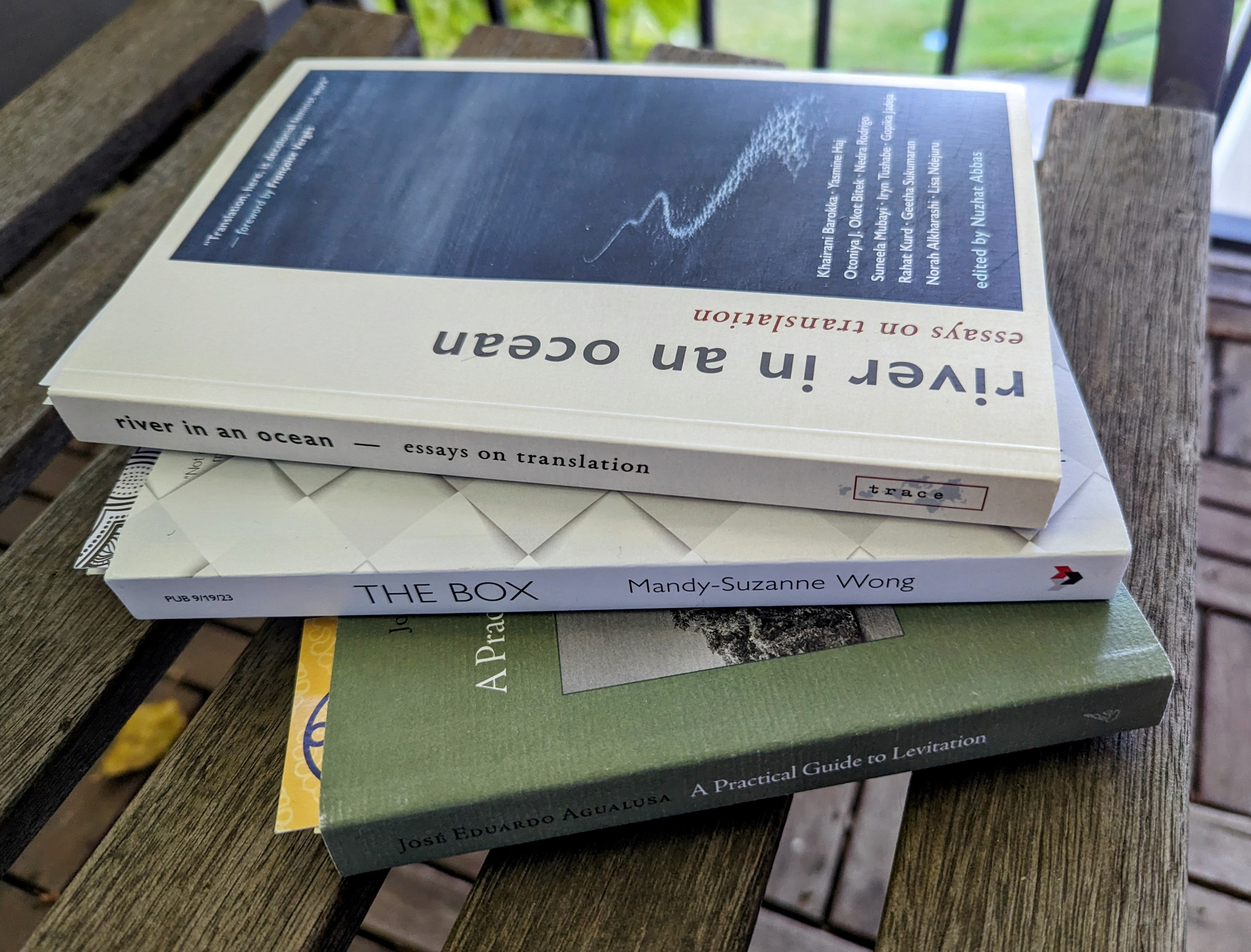
Women in Translation Month 2023: Some suggestions from the past year of reading

August. Another Women in Translation Month is upon us. I have already read my first contribution to the annual project with a review to come in a few days but, as usual, there will be a few non-women read and reviewed this month as well. Nonetheless, I hope to make a good showing.

Looking back over the reviews I posted since last year’s edition, I see that I have read less women in translation than I expected—less women over all, perhaps, but my reading has been governed a little more by review copies and release dates than usual, something which can be offer opportunities and present restrictions. However, I have read some excellent books since last August and if you are looking for suggestions, I have linked them here:

Eastbound by Maylis de Kerangal, translated by Jessica Moore (French)             — A spare, yet intense thriller. (Archipelago)

Balkan Bombshells: Contemporary Women’s Writing from Serbia and Montenegro, compiled and translated by Will Firth — A  surprisingly sharp, strong collection introducing many new voices. (Istros Books)

Grove by Esther Kinsky, translated by Caroline Schmidt (German) A novel born of grief and a healing sojourn in Italy by one of my favourite contemporary writers. (Fitzcarraldo /Transit Books)

Rombo by Esther Kinsky, translated by Caroline Schmidt (German) — Again Kinsky’s acute sensitivity to landscape writing frames this fictionalized account of a year of devastating earthquakes in northern Italy. (Fitzcarraldo/NYRB)

The Book of Explanations by Tedi López Mills, translated by Robin Myers (Mexico/Spanish) — A highly original collection of essays that I simply loved. (Deep Vellum)

Mothers and Truckers by Ivana Dobrakovová, translated by Julia and Peter Sherwood (Slovak) — Five stories, five difficult, complicated women you won’t easily forget. (Jantar Publishing)

The Geography of Rebels Trilogy by Maria Gabriela Llansol, translated by Audrey Young (Portugal) — A surreal, immersive tale of saints, heretics, philosophers, strong-willed women and what it means to write. Quite unlike anything I’ve ever read. (Deep Vellum)

Requiem for Ernst Jandl by Friederike Mayröcker, translated by Roslyn Theobald (German) — A collection of poems Mayröcker composed after her long time partner’s death, perhaps the best place to start with her idiosyncratic work. (Seagull Books)

Hospital by Sanya Rushdi, translated by Arunava Sinha (Australia/Bengali) — Rushdi, a Bangladeshi Australian writer draws on personal experience to capture the reality of psychosis with humour and grace. (Seagull Books/Giramondo)

Twilight of Torment I by Léonora Miano, translated by Gila Walker (Cameroon/French) — Over the course of one night, three women with a connection to a man who is absent, tell their stories of love and determination. (Seagull Books)

Marina Tsvetaeva: To Die in Yelabuga, by Vénus Khoury-Ghata, translated by  Teresa Lavender-Fagan (Lebanese French) — Another favourite author offers an intense, short fictional account of the life of the tragic Russian poet.

If you are looking for Women in Translation Month inspiration, I can recommend any one of these wonderful books.

Holding the fort: The Stronghold by Dino Buzzati

Fortezza Bastiani was neither imposing with its low walls nor beautiful in any way. Its towers and ramparts weren’t picturesque. Absolutely nothing alleviated its starkness or recalled the sweet things of life. Yet Drogo gazed at it, hypnotized as on the previous night from the base of the gorge. And an inexplicable ardor penetrated his heart.

As newly commissioned officer Giovani Drogo makes his way to the mysterious fortress on the mountainous northern border of his homeland, he is unable to imagine what lies ahead. When he chances upon Captain Ortiz who is heading in the same direction, he is surprised to hear that the older man has already spent eighteen years at the Fortezza, and speaks of it in less than glowing terms. And yet, as the structure finally comes into view, the young lieutenant is struck by a strange attraction. He also notices, in the captain’s face, a curious mix of joy and sadness. The complicated motion he observes on this day, is one he too will succumb to.

The Stronghold, the best known work by Italian journalist and writer Dino Buzzati (1906–1972), is a tragic tale of how easily youthful ambition and dreams of glory can be lost to the slow erosion of time. Travelling a fine line between the realistic and the fantastic, this novel is a slow, steady march toward an ending as inevitable as it is unexpectedly unkind. When Drogo first arrives, he quickly learns that Fortezza Bastiani’s glory days are long gone. Young soldiers tend to volunteer simply because two years at this bleak outpost count for four, effectively jumpstarting their military careers. But something’s wrong. Drogo did not volunteer, he was assigned. He argues that a mistake has been made, he requests a release from his commitment. His superior responds with apparent empathy, encouraging him to stay for a mere four months for appearances’ sake. Then something can be arranged, a visit to the fort’s doctor to receive a diagnosis that will assure his reassignment. Four months in, however, he will decide to stay. He will have fallen under the spell of the fortress, the towering mountain range that cradles it and its proximity to that vast unknown desert where an enemy may well lurk, preparing to strike. The possibility of glory is a powerful drug.

Through Drogo’s mind passed the memory of his city, an indistinct image—streets thunderous under the rain, plaster statues, dampness in barracks, dreary bells, faces weary and haggard, endless afternoons, attics dirty with dust.

Here, however, the vast mountain night was advancing, clouds in flight over the Fortezza, miraculous omens. From the north, from the invisible north behind the walls, Drogo felt that his own destiny was pressing.

Buzzati skillfully balances finely drawn scenes—Drogo’s first return to the city, the excitement and speculation when figures are perceived moving out of the distant mists of the frontier, or an ill-fated expedition to mark the boundary—against the passage of months and years and decades. An aching, sorrowful mood rests over the stark beauty of the harsh landscape that so captivates the men who dedicate their careers to this mostly forgotten frontier. And, as much as we know his fate is sealed, it is difficult not to feel for the young man with the confidence of a whole life ahead of him as he ultimately finds himself following the pattern of the other officers who spend their entire careers walking the halls and ramparts of the isolated fort, caught up in the swell of self-importance, routine, and vague purpose.

Originally published in 1940 as Il deserto dei Tartari, the novel was widely praised, relieving the doubts and insecurities that had dogged its author throughout the creative process. Although Buzzati was drawing on some of his own experiences covering conflict and inspired in part by his appreciation for Kafka’s The Castle, this work is not an explicitly political. The country is never named, nor is the neighboring land of desert. The enemy exists primarily in the minds of the soldiers. The questions it raises, the author suggests, about “hope and the life that passes fruitlessly” are existential in nature. Yet, when the first English translation by Stuart Hood appeared in 1952, the chosen title, The Tartar Steppe, encouraged readers to understand it in relation the Cold War and fear of the USSR. Meanwhile, in Italy, it would come to be seen as a critique of fascism. The novel’s openness to interpretation is indicative of its strength as a timeless and recognizable fable, one that can apply to both the personal and political.

This new translation by Lawrence Venuti—now with a title reflecting the original title the author wanted—attempts to allow for the historical interpretations without losing the humanist qualities earlier readers connected with. It also leaves intact some Italian greetings and terms, to situate the narrative in a particular culture and add a “political edge” in certain scenes. Otherwise, Venuti aims to adopt an English that would be accessible to a broad anglophone audience. His Afterword is quite illuminating, deepening an appreciation of Buzzati’s aims, this fine novel’s reception over the years and his approach to translation. It is one of two works by Buzzati recently added the New York Review of Books Classics catalogue.

The Stronghold by Dino Buzzati is translated from the Italian by Lawrence Venuti and published by NYRB Classics.

Remembering prewar Prague: House of the Nine Devils: Selected Bohemian Tales by Johannes Urzidil

This fine collection of stories by Prague native Johannes Urzidil, recently published in English translation by David Burnett, House of the Nine Devils, opens with—and takes its title from— a fantastic tale of a haunted house in the city’s Lesser Town that hides a dark mysterious past going back centuries. Although most of the stories that follow move away from this more explicitly gothic energy, they are filled with strange coincidences and unlikely adventures that lead their protagonists, all echoes of the author himself, into encounters that are coloured with the unique atmosphere of the capital of the Kingdom of Bohemia in the early twentieth century. As the narrator’s father story tells his son in the opening story:

“But this Prague, where you too were born, is an old city of magic. This is where the rabbis had their sorcerer’s apprentices and where the emperors kept their alchemists. Many things come together here — East and West, Jew and Christian, Czech and German, North and South — and where many essences converge, many wondrous, inconceivable things come to pass: things, words, characters and occurrences  that have never been seen before. It’s a breeding ground for spells and magic powers.”

And so it is. In the hands of a master storyteller, even a young boy can find himself encountering all kinds of unusual people and mysteries in this charmed city.

Johannes Urzidil (1896–1970) was the son of German nationalist and “passionate” railway official born in a rural part of western Bohemia, and a Jewish woman from Prague who died when he was just four years old. His father was a Catholic who never practiced his faith and believed in taking his son to various houses of worship to demonstrate that all religions were equal. Nonetheless, he insisted his boy practice Catholicism. His second wife, Johannes’ stepmother, was a staunch Czech nationalist, and their volatile marriage together Urzidil’s own fraught relationship with the woman he refers to as “ his step” adds much colour and humour to many of the stories collected here.

Urzidil published his first poems at age seventeen and began to associate with members of the so-called Prague Circle where he became friends with Kafka, Franz Werfel, Max Brod and others. In his Afterword, translator David Burnett, reports that he “had the honor of holding one of three funeral orations for Kafka in 1924, predicting his future fame.” Through the 1920s and early 30s, he worked as a translator and press attaché for the German Embassy while continuing to publish poetry, essays and criticism. He co-founded and managed the German Writers Union of Czechoslovakia until political tensions led to his resignation in 1933. By this time, despite his German background, his mother’s Jewish heritage and his marriage to the daughter of a rabbi, made it difficult for him to find work and, eventually, unsafe to remain in the city of his birth. He and his wife escaped in 1939, first to England, then to the US where they settled in New York City.

For Urzidil, fiction writing did not become a serious pursuit until later in life. His breakthrough work, The Last Beloved, a collection of autobiographical stories, was published in Munich in 1956 when he was sixty years-old.  His final decade of life, the 1960s, were very prolific. Of his seventy-odd stories, many blending elements of fiction, biography and essay, about a quarter were set in America, a handful in assorted European settings, but the majority of his best loved works take place in prewar Prague and Bohemia. It is from these stories across five German publications that the pieces in House of the Nine Devils are drawn. They are arranged in a roughly chronological order—by setting, not publication date—in an attempt to create a “more coherent whole” or a kind of fictional memoir, reflecting the degree to which Urzidil’s family and life experiences fed his writing.

Perhaps because he came to storytelling so late in life, Urzidil’s stories have the warmth and wry-humour of an older relative recounting tales of his youth, playing up the unexpected twists and turns. His narrators’ seemingly innocuous adventures—looking for a lost wallet, delivering messages, dropping in to visit with friends—put them in the paths of bored police officers late on New Year’s Eve, a fated opera singer, a suicidal railroad inspector, or a murderous fugitive. As he tells us in “The Last Tombola”:

People were always using me to drop things off. I was always running through streets and from floor to floor with notes, letters, and messages for other people. That’s pretty much my life. And whenever you have to drop something off, awful things always seem to happen.

This longer story begins with its young protagonist being charged to deliver a report to his father’s visiting superior with whom his family had dined the night before. He will soon learn that Herr Pernold has hung himself from his Grüss Gott suspenders, an event that sets off a richly complicated (and funny) tale of mystery, morality, concerns about renumeration, and ripe opportunities for humour at the boy’s step mother’s expense, something that first arises in the opening paragraph as the narrator notes that his delivery assignment will take him to The Imperial Hotel on Na Poříčí:

Na Poříčí is Czech for “on the riverbank,” which is fair enough for the Moldau flows nearby. Still, I had an instinctive aversion to this Prague street, its two chafing affricates reminding me of the sand-yellow paletot that hugged the hips of my stepmother around the time my father was courting her. I had witnessed this courtship and once heard her say, “It chafes me; I bought it on Na Poříčí.” “Good,” I remarked, because I felt this lady couldn’t be chafed enough. “Who asked you?” asked my father. “I asked me,” I answered. He was about to give me a royal smack in the face, which usually accompanied by the words, “When duty calls, feelings must be silent.” Yet this time he abstained from getting violent, not wanting to appear ungallant in front of the lady. He looked at me instead like Cronus before he ate his children.

This kind of sly, smart humour is one of the most wonderful features of Urzidil’s stories. And indicative of the relationship he, or rather his protagonist, has with his father with whom, for the cost of a slap in the face, he is allowed to voice what they both often think about his step’s moaning and complaining which only increase after the marriage. It is a recurring motif in many tales, one grounded in the author’s real life, as he reveals in the two, biographical essay-like pieces that round out the collection wherein he talks honestly about his beloved father and the difficult woman who became his second wife.

Prague in the first decade of the twentieth century is vividly evoked in so many of the tales in this collection, as are the social dynamics of the life of a lower middle-class family, the tensions that exist between Germans and Czechs, and the sense (at least to a young boy) that the Austro-Hungarian Empire is eternal. Then there are stories set during the First World War and, notably, “One Last Deed,” which depicts the dangerous environment in the city for men like Urzidil during Nazi occupation through an account that finds the protagonist taking refuge in the hovel of an eccentric former schoolmate.

The particular charm of Urzidil’s fiction lies in the warmth and charisma of his narrators, effortlessly spinning entertaining tales. Gathered together, the stories collected here do, as intended, read like a loose memoir recounted with a healthy measure of creative license. The boy, his railway official father, and his cantankerous stepmother provide the continuity. Like other natural story-tellers who regularly dip into the same well—perhaps a fictional community, or the life of a recurring alter ego—Urzidil has the ability to make each story feel fresh and unexpected. Hopefully more of his fiction will be translated in the future.

House of the Nine Devils: Selected Bohemian Tales by Johannes Urzidil is translated from the German by David Burnett and published in a handsome hardcover edition by Twisted Spoon Press.

 “. . . it doesn’t come easily, nor should it.” Own Sweet Time: A Diagnosis and Notes by Caroline Clark

. . . questions I’ll never get any further with the thing that I do. Auto fiction? Essay of the self. I need to do this in fits and starts. Straight to the desk after drop-off. I used to get up in the silence of 5 a.m., write, then go back to bed.

Major life events—the loss of a spouse or parent, serious injury, significant upheaval, illness—often inspire those already inclined to seek understanding through words to want to write about what they have experienced. Cancer, with all of the unknowns and the complex treatment options that come along with it, is a diagnosis as frightening as it is overwhelming. But how to tell the story? Writer and translator Caroline Clark’s Own Sweet Time: A Diagnosis and Notes breaks from the expected breast cancer memoir to offer a very different response to the reality of facing, and living with, the news no one wants to hear.

Her inventive approach to writing about her experience is one that is less about the entire journey, although we see many unvarnished moments, than it is about placing the diagnosis and treatment plans, and the heavily weighted silence that weighs over that first critical appointment with an oncologist against all the unspoken truths of the situation. With permission, Clark and her husband recorded this initial session which is reproduced verbatim, with all the attendant “um’s” and “mm-hm’s” on the right hand page throughout this small volume. On the facing page, individual words are picked up, prompting the author to respond with childhood memories, random thoughts, parenting challenges, and emotional reactions from the past and the post-treatment present. Scattered among these passages and fragments are questions about writing itself, especially in the face of such a life altering experience.

The diagnostic discussion is dense with information, the basics—drugs, treatment schedules, surgery, possible side effects—and, the most unnerving inquiries—what to tell the children, the probability of a full cure, the risk to her daughters in the future—those unknowns that fall somewhat outside the oncologist’s script, no matter how commonly they arise. The words that Clark picks up on are indicated with a faint ° that does not interfere with the reading of the transcript. Where those words take her is occasionally directly related to the context or phrasing of the source, but for the most part her notes have a free flow. They are also deeply personal.

Her notes touch on faith, the body, therapy. Some are passing observations. But two themes seem to take up more space on those open facing pages: memories that go back to an anxious childhood leading into an ongoing struggle with hair pulling (Trichotillomania), and reflections on parenting that lay open the stressful reality of going through such a physically and emotionally demanding process as the mother of two young girls:

. . . time I thumped my fist down hard with all my strength on the duvet next to her. It wasn’t the duvet but her stomach. She was winded. I was scared. Got her out of bed into mine. She tried to tell me it was okay. It wasn’t. Something had to change. Slowly after the cancer year, I realised it wasn’t her that needed changing, it was me. I needed to change. I needed to want to be there with her. How can you make yourself want something? You can’t. Your only hope is to find inner peace.

A disarming dissonance arises in the juxtaposition of the relatively ordered and clinical nature of the appointment against the myriad of thoughts those words trigger as Clark looks back on the most demanding and difficult time she has ever endured. What an oncologist can tell you about the journey will never begin to encompass the physical and mental challenges that lie ahead. For each individual the path is unique. But how to make sense of it all? Caroline Clark’s original, honest work is beautiful, heartbreaking and important.

. . . feel. That wide new space of truth-telling. Is this what writing is? Putting down the truth?

Own Sweet Time: A Diagnosis and Notes by Caroline Clark is published by CB Editions.

Grief-tinted memories: Reflections on Mother Muse Quintet by Naveen Kishore

The loss of a beloved parent inspires a tumult of emotion and weaves complex webs of images that fragment and coalesce over time. It is, I have learned, a living grief, something that ties us to our own past in ways that shift and change in a manner that cannot be mapped or predicted.

Today, as I gather my thoughts about the latest poetry collection by my friend Naveen Kishore, my own mother has been gone for exactly seven years. On July 9th, 2016, my daughter and I sat at her bedside waiting for my brothers to make it to the city. When they arrived, we knew her respirator would be removed and we would say good-bye. She had been plagued by an increasing frailty for many years, but had remained mentally sharp until her final month which was marked by a rapid decline. Meanwhile, in another local hospital, my father lay unconscious following a stroke and head-on collision and, within a few days, a similar, if more prolonged vigil would commence at his bedside. But on this day, what I remember most vividly is my daughter gently tickling her grandmother’s arms as she had once done for her when she was a little girl. Her presence was a comfort to myself and my mother that day.

Over the five sections of Mother Muse Quintet, Naveen Kishore, the highly respected publisher of Seagull Books, honours his own mother, moving through the varying shapes and forms that memories take, and the way they continue to embrace and comfort us as we ourselves age. It is both a tender, personal tribute and a gentle lesson about opening ourselves up to capture our own memories on the page.

The first part evokes a son’s tribute to a mother who offered security and continuity to a young child, filling him with the stories and songs of her own childhood and family history and now, as the fog closes in around her, looks to him for guidance and assurance.

Build me a self. She pleaded. A whole one? I asked. One
I can call my own. Self. Again. She said. I looked at her.
Swiftly. Almost surreptitiously. My gaze. First taking in the
dignity. The earnestness. Hers. And of the request. The
controlled undertone. Not quite panic. Yet. And trust. The
faith. That I could. And would. Help rebuild. Not just her
self. But also her sense of being. Hers. No room for doubt.

In verse and in measured prose, this sequence introduces us to Prem (her son always called her by her first name) as a young girl in Lahore, as a confident woman, and as someone drifting away from the familiarity of her own reflection. And to giving up her ashes “to the care of the river.” But that is only the beginning. As the progression through the following parts of this quintet demonstrate, grief, which may begin long before death, unfolds as an ebb and flow of memories that are sometimes fragmentary or fleeting, other times taking shape in the imagining of one’s earliest years. Time loses its chronological dominion over our hearts as the beloved parent’s presence takes on a new form. They are deeply missed, but somehow always close by.

This is what I draw from Mother Muse Quintet. There are poems that often call to mind very detailed circumstances, as in the piece that records the poet’s grandmother’s prolonged illness and death and the strain it placed on his mother as she cared for her mother-in-law. Those are the moments we experience, even assist with as children, that take on a new poignancy after we have become the caregiver in turn. There are other open poems, words scattered across the page that reflect the way that the memories that stay with us down the years often become moods, qualities of light, seasons and colours. What arises can be an emotion without specific image or form, but you know who it is.

endings
endings unending
night      how you grow pale

breathe into         this parting
punctuated
by urgency

I would if I could night              sing you awake
among the          birdcall
the         barking of dogs

Not all of this volume is completely new to me. I have been privileged to receive a passage or two, shared, in earlier form, when it seemed appropriate. I treasure these in my “grief folder,” created after my parents’ deaths. There is so much of the mother connection/memory in this collection that I recognize, that triggers my own equally personal response. The final poems imply that Naveen also wishes to inspire others to write—to record their own memories, so we too may hold our loved ones as ever present as daylight and pale moons, as that essence we are forever aware of, lingering.

Mother Muse Quintet by Naveen Kishore is published by Speaking Tiger.

“Things are always ever only about to happen”: Falling Hour by Geoffrey D. Morrison

We all know the Sebaldian trope—man/woman goes for a walk and thinks about “stuff.” In Canadian poet Geoffrey D. Morrison’s debut novel, Falling Hour, a man takes a picture frame to a park on a summer day, the outside world mysteriously recedes, and he spends the rest of the day thinking about “stuff”—or so it seems. Over the course of this oddly distended day, the narrator who introduces himself gradually as Hugh Dalgarno will reflect on, among other things, his life, his criticisms of Canadian political history and the audacity of colonial ventures in the Americas in general, his thoughts on literature, and a series of tales of less than illustrious (in his mind) historical figures, most of them Scotsmen as, for his sins, is he. Hugh is, by his own admission, an odd fellow, isolated and adrift within the murky reaches of his own existence:

The dark sea of myself existed in unclear relation to my brain and its brokenness: was my brain the sea, or a vessel on this sea, or the navigator in the cabin, or her instruments? Or was my brain the wind and rain and bitter crosscurrents that churned the sea’s surface like a fearsome avenging hand? I did not know then, in the park. Wherever it is I am now I continue not to know.

Did I mention that his brain is broken? It is, or was, or perhaps may still be, but he reminds us, his listener/reader/audience, of this fact on a regular basis.

The story begins with a rather mundane premise. Hugh has come to the park on a hot summer day to meet a stranger who has, through emails, agreed to purchase a picture frame that he found hanging off a fire hydrant. While he waits, his mind begins to wander and, when the stranger fails to materialize, he begins to wander as well, making his way across the eerily empty park, into the forest on one side and back again. As the hours stretch on, uncounted because his cellphone has died, Hugh becomes aware that he has seen or heard no signs of human or domestic animal life for hours; his only company are birds, insects and amphibians. He also comes to realize that he is unable to leave. He is, in essence trapped within the rectangular frame of a large park in a “suffering inland industrial town” in Ontario that he never directly names, but only barely disguises.

Hugh’s personal history is a curious one. He was born in Scotland but his parents, about whom he knows little, apparently struggled with addiction so, at the age of four, it is deemed best that he be shipped off to Canada to be raised on the west coast by his great aunt and uncle. Although they were in their sixties when he came into their lives, theirs is a loving home within which he is steeped in socialist values. Meanwhile, in the outside world, he is a bit of a outsider, not quite fitting in with his peers. That misfit nature seems to accompany him, to a greater or lesser degree, until, at the age of thirty-one, he finds himself lingering on in the city he moved to for grad school, a loner content to work from home, missing the seaside of his youth but unable or unwilling to return.

For someone so socially isolated with a brain he describes as “broken” without ever making it explicit whether that brokenness has a psychiatric basis of some sort, Hugh’s endlessly divergent account of his day in the park reveals a man with a wide range of interests, questions, doubts and opinions. He dissects the opening scene of the movie The Conversation, takes Keats to task for any number of shortcomings as expressed his letters, examines the impact of Calvinism on the Scottish working class and Methodism on Canadian history, and marvels at the unique appearance of the arbutus tree and the seductive call of the red-winged blackbird. His discourses fall in and out of rants, and branch off into fascinating historical asides that somehow link back to earlier themes and obsessions. He quotes poetry and song, and philosophizes about the nature of reality—a reality that becomes more slippery as the day goes on:

But without waiting to resolve the metaphysics, I passed under the door shape in the leaves anyway and out into the open space of the park. The forms and shapes I had passed on my way to the forest were present as before: the toilets, the benches, the baseball diamond. Only they weren’t those things now. They too were in some sense visible but not real.

The game of baseball had never been played. There were no games. There were arbitrary geometric dances across temporary lines in the sand. Nothing on earth was truly the name we called it by. Nothing. So I felt in that moment, and which second that passed, the workings of a certain familiar mind virus grew stronger inside of me. It often came to me after I reached the heights of an enthusiasm and my enthusiasm crested and I was left panting and ragged like a defeated army on a plain. Enthusiasm, that nineteenth-century word. The virus was a strange hypercorrection to enthusiasm, a dousing in the coldest and deepest waters of the inner sea the former flames of my broken belief.

Oh yes, Morrison is fashioning anew the mechanics of the man/woman-walking-and-thinking internal monologue by giving it to a mildly absurd narrator who is intelligent, sensitive, opinionated and somewhat paranoid. And one who is not entirely in control of his own story, even in the telling. We see this in the measure of uncertainty running through Hugh’s narrative—it’s a double stranded quality, one strand tied to the ongoing strangeness of the day he is describing, the other stemming from his attempts to place himself “wherever it is that I am now” against the “now” of the story unfolding in a past, be it near or far. He loses his place, retraces his steps, and acknowledges that he is holding off on particular subjects for a time, yet it’s unclear whether the digressions that arise belong to his thoughts on the day in question, or to his effort to reconstruct it, or a little of each. When he reaches a discussion of “stream of consciousness,” assuming his listener/reader has likely wondered why it has not already emerged, he details his attraction to and skepticism of the concept while the text itself takes on the form of chapter-long unbroken paragraphs until, several chapters later, a pattern of paragraph breaks resumes as Hugh once again attempts to step outside himself to assess his progress and circumstances. It is probably fair to view the entire novel as a “stream of self-consciousness” but, no matter how one wishes to imagine it, Hugh’s strange day in the park with an empty frame packs a wealth of interesting and entertaining  “stuff” into one rectangular space—this book, that is.

Falling Hour by Geoffrey D. Morrison is published by Coach House Books.

The ties that bind and confine: Mothers and Truckers by Ivana Dobrakovová

Meet Svetlana, Ivana, Olivia, Lara, and Veronika, the protagonists who carry the five stories that comprise Slovak writer Ivana Dobrakovová’s collection, Mothers and Truckers. They are each, to a greater or lesser extent, caught up in the tangled webs of memories, failures and desires that occupy their thoughts and drive their actions, often to potentially counterproductive ends. Memorable and intense, these stories pull the reader into the interior lives of five very different, complicated, and not always likeable, women trying to navigate the expectations of family and society for better or worse.

Born in Bratislava in 1982, Dobrakovová studied English and French translation at Comenius University before moving to Italy where she works as a freelance translator of Italian into Slovak, notably of Elena Ferrante’s Neapolitan novels. The present collection, her third, was awarded the 2019 EU Prize for Literature and is her second work to be made available in English (following her novel, Bellevue which was, like this,  also published by Jantar in Julia and Peter Sherwood’s translation). Her stories here tend to be on the longer side—two are about 50 pages in length and one is almost 70—and clear or suggested mental instability is a common theme, one that reflects, she says, an interest arising from the fact that her husband and sister are both psychiatrists. It is a quality that lends the three central, longer stories a particular claustrophobic, compelling power.

“Ivana,” the near-novella length piece, offers the most explicit portrayal of the impact of serious mental illness with its tragic and endearing narrator, a thirty-one year old woman who lives with her mother. Ivana, in a sometimes disjointed and exuberant narrative, recounts her childhood love of horses and the long hours she spent at the stables to the cost of her education, all the while hinting at the horrifying trauma that marked the sharp shift in her personal destiny. In the meantime, she has met R., a journalist and local celebrity, through the one friend who has not long since abandoned her. This has given her a renewed interest in life, even if she risks threatening peace with her overbearing mother, this budding relationship largely bound to fantasy, and her own mental stability which is being carefully contained:

It’s taken my psychiatrist in Tehelná Street years to fine-tune my medication, to find the right level between my mood swings and make sure I was neither too subdued and slowed down or too hyper and upbeat, that I was under control, hers, Mum’s, my own, that I didn’t get so high that I would have to be dragged down to earth, or get so low that I would need to be helped back onto my enfeebled legs, in a word, so that I would be myself again, albeit within some sensible, clearly defined limits, myself but not too much myself.

Ivana has a wonderful sense of self-deprecating humour and, although she is pretending to be working on a novel and hiding the truth of her circumstances from R., she demonstrates a canny ability to vividly unfold what is ultimately a very painful story.

Olivia’s eponymous tale, the first of two stories set in Turin, presents a conflicted narrator obsessed with the news story of a teacher who was seduced by a young student to very unfortunate ends. She is also a teacher, albeit it one who was married and, in her own estimation, still attractive for her age. Surely she would not be so gullible. As her monologue proceeds, she reveals herself to be lonely, bitter and excessively paranoid about germs. As she tries to justify the situation in which she has found herself at the age of thirty-nine, she cannot quite accept the part she has played in her own life. And she prides herself in the fact that, unlike Gloria, the victim in the news reports, she is not living with—heaven forbid—her parents. Like all of the protagonists in Mothers and Truckers, relationships with parents, especially mothers, are fraught. Even though she has long been out of the house, Olivia’s mother still manages to intrude on her life almost daily, by phone, WhatsApp, Facebook, more so now that she is once again “single.”

Because my mother, by contrast, is present. Far too present, in fact. The usual story. She compensates. My mother spreads like mildew around the window. She devours everything that happens to find itself in her way. Overpowers it, supresses it. She’s everywhere. When I’m with her, it’s as if she was twice my size, with me being just a kind of external appendage  to her body that has never managed to cut itself off.

The third longer story, “Lara,” is also set in Turin, but her mother is dead and sorely missed. One has to wonder if her presence might have mediated what this unhappy, brutally self-centred mother of two has become. Lara’s internal monologue is perhaps the most exhausting and disturbing. She’s a complicated, damaged woman who questions her own mental functioning, but seems powerless to stop the very dangerous path she is on.

Together, the three central stories in the collection confirm Dobrakovová’s ability to inhabit distinct, multifaceted women caught in complicated predicaments that offer no easy resolution. The intensity of their internal monologues is fueled by a fluctuating style and form. At times, thoughts unwind in long sentences, strung together with commas while other passages feature short, staccato sentences. She also relies on a strong sense of space, her characters traverse the environments in which they live, in memory or in real time, in Slovakia or Turin, places she knows well. By contrast, “Father,” the opening story is a somewhat simpler tale of a man who largely neglects his family in pursuit of impossible, if relatively humble, dreams until alcohol and madness take a toll, but the final tale, “Veronika,” the only third person narrative, paints the portrait of a student who is embarking on a path that is bound to become difficult, even threatening, as she loses herself in chat room flirtations on the pretext of improving her French. As a whole, this volume is an immersive and intense reading experience.

Mothers and Truckers by Ivana Dobrakovová is translated from the Slovak by Julia and Peter Sherwood and published by Jantar Publishing.

Pride Month reading 2023—None of the Above: Reflections on Life Beyond the Binary by Travis Alabanza

I have long been ambivalent about Pride, but the rising waves of anti-LGBTQ, and especially anti-trans, sentiment seen over the past few years has made me very concerned. As a transgender individual who is white and fits visibly into the accepted gender binary, I have been able to stand in the shadows for a long time. For more than two decades. In fact, when I was a single parent supporting two children in a world without any legal protections on the grounds of gender identity, keeping my gendered history hidden was essential. On the occasions that I dared to out myself to a co-worker, job loss invariably followed. But, for the most part, especially outside of the LGBTQ world, I have encountered very few problems because I am older and exceptionally ordinary in my presentation. I pass so well that often I am not heard or believed when I try to tell someone that I am transgender.

For British writer and performer Travis Alabanza, on the other hand, none of the above applies. So when I heard about their Jhalak Prize-winning book None of the Above: Reflections on a Life Beyond the Binary, I knew I’d found my perfect read for this year’s Pride Month. And, even though our ages, lives and experiences differ greatly, I related more closely to many of the ideas they explore in this thoughtful and articulate examination of what it means to exist as an openly gender non-conforming person of colour in a world that is bound to the binary, than in most of the more “conventional” trans-themed books I’ve read. This is a bold and honest work that rides on a shifting current of hurt, uncertainty and self-affirmation against an unspoken pressure for trans identified people to be determined, self-assured, and often stubbornly binary in a world that increasingly strives to deny our validity. There is little room for doubt, less for admitting how exhausting it can be.

In our journey to ‘own our gender’, is it ever really our own? Or does it rely on us conditioning those around us to act and be a certain way too?

None of the Above is neither a typical memoir, nor an explicit defense/explanation of non-binary identity. It is, rather, something in between—a personal account structured around seven statements that have had a particular impact on Alabanza, as a youth and as a public figure, exploring their identity, sexuality and gendered expression. As they dissect these statements, there is a persistent question of how long an obviously gender-defiant presentation can be maintained before it simply becomes easier to move toward a more “acceptable” or “proper” presentation of transness. Of course, given the ongoing escalation of hostility directed at trans women, it’s not clear that such a progression toward hormones and surgery would be easier.

With chapter titles such as “So, When Did You Know?”, “But I Mean, Proper Trans”  and “This Ain’t A Thing We Do Around Here, Son,” Alabanza talks about growing up poor in a council project, their first joyful expressions of femininity, and their development of a successful career as a performer and theatre maker. The questions and comments they encounter come from curious, well-meaning friends, neighbours, fellow performers and critical journalists. Yet, in exploring their reactions and possible responses to these statements that weigh so heavily, there is a willingness to open up their experiences to concerns that intersect with those of others who may be white and/or cisgender. After all, the rigid strictures associated with the gender binary impact people who are not trans in many ways even if they also drive transphobic attitudes. The same gender binary can force trans people to consider medicalization as the measure of “true” transness and look at the openly queer and non-binary as troublesome distractions. For trans people of colour all of these contradictory forces are heightened.

Often what is projected onto those who are visibly gender non-conforming and non-binary, is that our existing, and claiming transness, will ruin it for those wanting (and deserving) a quieter life. Gender non-conformity and being outside of the gender binary cannot be seen as quiet: it is seen as purposefully choosing to cause trouble. To those so wanting a life of peace, others’ disruption can feel like a threat to that fought-for sanctuary.

This is a book that strives to come to terms with the feeling of being at odds with the gender one is assigned at birth, but not feeling comfortable identifying as a man or woman. It’s not a new phenomenon—I have friends who have identified as “gender neutral” for decades. What has changed, for better and for worse, is a wider public forum for people to see and be seen defying or transcending gender. I am grateful I transitioned before the advent of social media, but without the internet I would have had no community. Likewise, without the fabulous gender-bending musicians of the 1970s, I would not have survived my teens. As it was, I was thirty-eight before I finally had an understanding of the differentness I’d always known. But, even though my ultimate path was quieter and more conventional (to a point), my strongest connections have always been with those who stand at the intersection of masculine and feminine. So, for me, there was much food for thought in None of the Above that is beyond the scope of this brief reflection/review. Perhaps it will emerge elsewhere. Meanwhile, I will say that, for readers inside and outside the trans community, this is a very valuable and entertaining read (though one that might anger some on both sides).

None of the Above: Reflections on Life Beyond the Binary by Travis Alabanza is published by Canongate in the UK and will be published by The Feminist Press in the US in October.

“I have ghosts inside my head”: The Enlightenment of Katzuo Nakamatsu by Augusto Higa Oshiro

The feverish paragraph that extends across the first six pages of Augusto Higa Oshiro’s The Enlightenment of Katzuo Nakamatsu opens rather innocuously, with the titular character walking through the Parque de la Exposición in Lima, Peru on a pleasant afternoon. Suddenly the restrained and mild-mannered professor experiences a terrifying break with reality:

In the eternity of the instant, in a manner of speaking, the green of the afternoon flickered out, the park’s babbling was erased, as if the world had taken flight, the pebbled paths disappeared, no serene gardens, or laughing families, or murmuring young couples, or ponds full of fish: the only thing in the air now was the sakura tree, its branches and its luminous flowers. And in that fragment of afternoon, from that imperturbable beauty, Nakamatsu noticed, sprang a death drive, a vicious feeling, like the sakura were transmitting extinction, a shattering destruction.

The ominous atmosphere that descends on him triggers a panic attack that sends him raving through the streets of the city. Or perhaps he’s dreaming, it doesn’t matter, for his nightmare is only just beginning.

Not long after this first premonition of death, Nakamatsu finds that he has been forced to retire from his position at the university due to his age. He is fifty-eight. This leaves him with empty hours to fill as his anxieties and paranoia continue to grow. He returns to working on a novel based on the life of a friend of his father’s, Etsuko Untén, traces an endless network of named streets and alleys, and visits the cemetery where he pauses at the graves of his mother, father and his long dead wife. Self-exiled from his siblings and fellow members of the Japanese-Peruvian community, he seems to be engaged in a battle with his own Asian identity. Throughout his long days, he continually seeks to clear his mind of thoughts, exercise discipline over his imagination. When he doesn’t wish to go out, or watch TV, he crochets squares for a blanket that will never be finished, losing himself in the rhythms of the task. But hallucinations find him all the same.

They arrive as the sounds of birdsong and nature emanating from his bedroom. When he goes to investigate he finds himself surrounded by a chorus of song and babbling water so impossibly realistic that he is momentarily swept away:

It might have been a brief second, five minutes perhaps; in reality Nakamatsu, surprised, withdrawn into himself, couldn’t pinpoint exactly how long the happening lasted, the miracle occurred again and again over the next two weeks, intermittently, whether in the morning, in the afternoon, or at any hour of the night, and every time he was left astonished by that sensation of unusual beauty.

But astonishment eventually turns into uncertainty, and Nakamatsu begins to doubt his sanity. Soon he is back out seeking escape on the streets. At night he is troubled by horrific dreams, and as they intensify he grows increasingly despondent. And estranged. He purchases a felt hat, long coat and walking cane, affecting the 1940s style of both his father’s friend Utsén and his favourite poet, Martín Adán who had waged his own battles with alcohol and madness. Under this new guise, Nakamatsu’s wanderings become nocturnal and more torturous. He takes to hanging out in the dark corners of the city where prostitutes, addicts and homosexuals gather, always watching from the sidelines, engulfed by his own darkness, ever struggling to find a point of stillness.

This hypnotic novella moves with a steady, tumbling pace, intensifying as it traces the protagonist’s descent into madness. There is, at first, an odd uncertainty to the narrative, a speculative quality, that is explained when the narrator is revealed as a colleague of Nakamatsu’s who has taken upon himself to prepare this report. Because he is not exactly a friend, his account carries a slight tone of cynicism that only serves to heighten the crumbling state, mentally and physically, of a man who has long cut himself off from a natural support system, pursued and driven mad by the strangled ghosts of his father’s generation—the Japanese labourers who found themselves stranded in a distant hostile land where many managed to build lives and futures, but some never managed to adapt.

Born and raised in the working class centre of Lima in 1946, Higa Oshiro was the son of immigrants from Okinawa. His early writing was inspired by the neighbourhood in which he grew up, but after spending a year and a half doing factory work in Japan, he began to explore the experiences of the Japanese-Peruvian community, aliens in their New World home yet alienated from their ancestral land. The Enlightenment of Katzuo Nakamatsu, originally published in 2008, belongs to this latter period of his career and represents his first publication in English translation. Sadly, Higa Oshiro died on April 28, 2023, just two month shy of its May 30th release. Translator Jennifer Shyue’s Afterword describes her 2019 meeting with the author and his warm support and generosity so hopefully we can look forward to further translations of his work.

The Enlightenment of Katzuo Nakamatsu by Augusto Higa Oshiro is translated from the Spanish by Jennifer Shyue and published by Archipelago Books.