
A dream beyond sorrows: A personal reflection

One year ago I read and wrote a review of Peter Handke’s brief meditation on the life and death of his mother, A Sorrow Beyond Dreams. With my birthday several days behind me and Canadian Thanksgiving coming next weekend, it seemed to me an appropriate moment to stop and take stock of the past twelve months.

8040751642_2c979863e1_zIt has been time of growth and a time of grief. Neither are quantifiable experiences, neither can be parcelled off, measured and checked like the items on a to-do list. Growth, like grief, can only be appreciated in retrospect and, perhaps most critically, as experiences that are bound together in the business of living, of being in the world.

Moving back a year, my simple Handke review led to a Twitter encounter with Douglas Glover, the mastermind and driving force behind the online magazine Numéro Cinq, who invited me to try my hand at writing a review for the magazine and, cliché as it sounds, that changed everything.

Since my “debut” if you like, I have become a regular contributor at NC, and have gone on to write book reviews for a number of other sites and online publications. I confess that I still struggle with a little of an impostor syndrome, ever worried that a lack of formal training in literature or creative writing will catch me up—out me as a pretender.

So far, so good.

Writing, or rather, the courage to put my own creative or critical writing “out there” for others to read, is something I could not have imagined doing until fairly recently. The response has been very encouraging; and the growing friendships and respectful connections with other readers and writers has far exceeded my modest expectations. I am ever excited by the works, ideas and reading suggestions of others. The community afforded by online connections is invaluable.

But moments of isolation and loneliness persist, feeding waves of existential anger and grief.

Five months ago I published my first piece of essay/memoir writing. It is honest and raw—the product of more than a year of worrying words onto the pages of notebooks. Some of my anger and grief is channeled through this essay, and there is a relief in having released this fragment of my truth.

Within two months, though, I would begin to know an entirely new grief.

In July, in the span of less than two weeks, both of my parents died. The circumstances that swept them from us were not entirely unexpected, but the rapid intersection of the two events has left me numbed. And then, in early September I learned of the death, by suicide, of one of my closest friends. Hers was a fate, again not unexpected, but long feared and, in a strange and painful way, respected and understood.

8084371103_590f71e383_zWhich brings me full circle, to Handke’s essential, heartbreaking memoir. A novice to loss on the magnitude of that which has marked these past months, I imagined myself crafting a response of immediate grief, as Handke attempts. But I realize I am voiceless. At least for now. Articulating my grief will take time. At the moment I cannot even sort it out inside.

So with Thanksgiving coming, I am thankful for outlets for writing, new friends who support and inspire, books, words and, yes, even grief.

And for the opportunity to continue to grow.

That is my dream for the year ahead.

Writing to make sense of loss: Stammered Songbook by Erwin Mortier & further thoughts

As a man watches his mother, once so vital and full of life and charm, steadily losing her grasp on the spoken word – fumbling, scratching at the air for the names of people, places, and things – what can he do maintain the fragile flow of words? As uncertain laughter and tears of frustration become the increasingly fragile threads holding a woman, just 65 years-old, to the web of anxious family members spreading out around her – her husband, daughters, sons and grandchildren – is there any way to make sense of the inexorable dissolution of this person who is disappearing, fading, before their eyes? If the man in question is Flemish author Erwin Mortier, the only way to find comfort is to write:

“I realize that I only write to hear sentences dancing without interruption through my head. To make rhythm, acceleration, rallentando, to make pauses sing. Just to be able to hang from the dashes – the trapezes of syntax – weightlessly for a moment from the roof beam of a sentence, I let the words loose.”
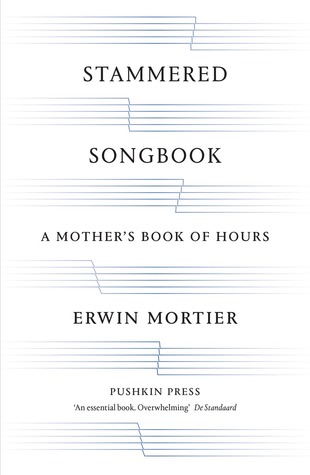
songbookMortier’s passionate, insightful record of his mother’s decent into the unforgiving spiral of fragmentation and decline that marks early onset dementia, is at once a loving memoir and a writer’s thoughtful reflection on the vital role that words play in his own ability to make sense of and cope with the most painful and difficult process of letting go or, as he puts it: “constantly saying goodbye to someone who is still there, yet not.” But the pages of Stammered Songbook: A Mother’s Book of Hours contain much more than a portrait of one woman’s steady regression from independent and vivacious to prematurely helpless, frightened, and lost; it offers an honest, sometimes brutal, account of the challenges of negotiating the surge of conflicting emotions that batter and buffer the individual and the family in mourning. He tracks her illness, from the earliest missteps through to the recognition, so painful for his father, that her needs can no longer be met by her loving husband, or by juggling responsibilities between her five children and their spouses. Even a large, closely knit family cannot provide the support and care she requires in the end – it is too difficult, too draining, and far too painful – especially when the person who once inhabited the emaciated frame of the body that remains has been slowly fretted away into the space of memories and dreams.

Mortier’s writing has frequently drawn comparisons to Proust; powerfully, and I would argue rightly, reinforced by his elegant, sprawling epic set in Flanders during the First World War, While the Gods Were Sleeping. Smaller, more immediate, and intensely personal, Stammered Songbook turns – as his mother in the present recedes into the distance – into a lyrical, poetic sketch of the woman as he remembers her, and a moving reflection on the complexity of our relationships with those we love. Yet as he captures his experiences and emotions, he is aware that, as a writer, it is essential that he is able to fine tune the words he employs so that he may strike the exact note. That is, he is not only writing about his mother, he is writing about the process of writing about his mother.

“Time does not unite us in oblivion but unravels us into memories. I only started writing properly, I suspect, when I began to realize that words are at their best when I can make them vibrate like minute compass needles in response to those elusive magnetic fields that constitute someone’s whole “being” – rather like iron filings form patterns on a sheet of paper under which a magnet is held. From the cloud that my mother is becoming and that in fact she already is, slivers of images will shoot out unexpectedly, strangely sharp – the way she laughed, the gesture with which she arranged a lock of hair behind her ear… And then we will say: yes, that’s how she was.”

Stammered Songbook is a lyrical farewell to a woman lost too young to a cruel relentless thief; but even more powerfully it is a personal meditation on death, mourning, memory, and the myriad emotions – sadness, confusion, anger – that confront those left behind. Yet in reading it I could not help but think about two other books that traverse similar grounds and have informed some of my own thoughts about the project that I am attempting to write into being, so to speak. Both are powerful works that approach difficult emotional experiences arising from the authors’ own lives, each from a different angle.

The first is a novel, This Is Paradise, by UK writer Will Eaves. Here the narrator begins back at a time before his own birth and moves through a childhood account of the unique dynamics that shape and define his family. Then, in the second part of the book, our protagonist is grown and his mother, now increasingly incapacitated by dementia, must be moved into a care facility. The account of the complicated emotions and tensions that pull at the family throughout the painful process of watching their loved one die – especially in the grips of such an unforgiving, emotionally paralyzing disease – was so striking that I kept thinking: There is an authenticity beyond careful research here. And, sure enough, after finishing the book I found an personal essay Eaves wrote for The Guardian chronicling his mother’s battle with Alzheimer’s. Clearly, much of his own experiences were embedded in the novel, but he chose to approach the subject mediated through the curtain of fiction – whether for distance, freedom or stylistic comfort, it doesn’t matter – it works beautifully.

The other book is a memoir, this time a son’s effort to honour his mother in the light of her suicide at the age of 51: Peter Handke’s A Sorrow Beyond Dreams. On the surface it might appear that suicide is the polar opposite of dementia in that it is sudden, but the impact is no less devastating because it raises questions, so often unanswerable, that linger long after death and complicate the mourning process. Like Mortier, Handke is deeply conscious of the importance of writing and the efficacy of adequately capturing a life by spilling words onto a page. However, rather than placing himself at the heart of the memories he is trying to capture, he attempts to step back and maintain an intentional emotional distance. He wants to see his mother, in part, as an exemplar of the rural Austrian women of her generation; to place her life in a broader context to make sense of the very intimate act of her decision to take her own life. And the result is a spare, elegant meditation; but in the end, he cannot help but break the wall between his accounting – which was written within two months of her death – and his own emotions which are still very raw.

These three books do seem to me to fit together, to form a triangle at the centre of which is the attempt, by a writer, to capture the essence of his relationship with his mother, in life and in death. What is of specific interest to me is not the exact nature of the subject at the centre, rather it is the question of the best way to approach writing about a deeply personal experience drawn from one’s own life – memoir from within, memoir with a degree of distance, or memoir turned into fiction. It seems to me that each can be powerful and effective, the challenge, I suppose, is to find out what works best for the writer and his or her circumstances, that is, to find the intersection where the story comes alive.

Stammered Songbook by Erwin Mortier is translated from the Dutch by Paul Vincent and published by Pushkin Press.

The art of distilling a life lived: A Sorrow Beyond Dreams by Peter Handke

“My mother has been dead for almost seven weeks; I had better get to work before the need to write about her, which I felt so strongly at her funeral, dies away and I fall back into the dull speechlessness with which I reacted to the news of her suicide.”

With this simply stated aspiration, Austrian writer and dramatist Peter Handke set out to capture the essence of his mother’s life and chronicle the painful spiral that swept her into a darkness which would lead her to take her own life at the age of 51. Written over two winter months in 1972, the result is a slight volume, 69 pages, that can be read in afternoon. But length can be deceiving. Tracing out a life that spanned the rise of the Nazis, the Second World War, and the austerity and suffering that followed,  A Sorrow Beyond Dreams is a spare and elegant memoir from which the reader emerges drained and aching alongside its author.

sorrowFrom the outset he admits that he is seeking an element of closure in the act of putting words to paper, but he wishes to avoid an overly sentimental account, concerned that he risks turning his mother, a real person, into a “character.” He intentionally adopts a more distanced perspective. He does not refer to her by name, and when he recounts the events of his early years he is “the child” or one of “the children”. He employs capital letters for emphasis (“she was a woman who had been ABROAD”). But there is another motive as well. He sees in her life an illustration of the social restraints that defined and limited the lives of so many women from poor rural communities such as the small Austrian village where she began and ended her life. As such he wishes to present her life story as one that is at once personal and exemplary.

The portrait he paints of his mother is one of a spirited young woman, who was denied her pleas to be allowed to continue her studies, for an education beyond the basics was not to be squandered on girls or women. So she ran away to the city to study cooking – not exactly an academic pursuit, but again the only option open for her. She thrived in her new environment: a world of new friendships, fashions, opportunity, and the heady comraderie that accompanied the rise of National Socialism.

The outbreak of war only added to the excitement as young soldiers, away from home and lonely, flooded into the city. She met and fell in love with a married man. Before long she was pregnant, but by the time her son Peter was born she had married another man. Her first romance would remain her only true experience of romantic love; what she had with her husband was a disappointing, often hostile, and very lonely existence. After the war the young family spent a few years in Berlin, living amidst the rubble. A second child is born there. (Over the years she will have two more children and secretly abort three others with knitting needles.) In 1948 they flee Germany and return to Austria, where she finds herself back in her family home, trapped again in a restricted environment, her life once more defined by the Catholic shame and guilt of village life.

Economic conditions at this time were harsh and her husband’s drinking and difficulty holding employment did not help. She responded with the only strategy available: “pure scrimping; you curtailed your needs to the point where they became vices, and then you curtailed them some more.” Necessities would be wrapped up and handed out at Christmas. As Handke recalls, “I was sincerely grateful for the most indispensable school materials and spread them out beside my bed like presents.” Yet she did not look to the possibility that life might hold more for her than housework and continually making the rounds required to keep her drunkard husband employed, creditors from the door and paperwork up to date just to assure access to the most basic benefits.

Finally, as modern appliances started to appear in her house, freeing up a little precious time, Handke’s mother took to reading. Not just the newspapers, but books he brought home from university: Fallada, Dostoyevsky, Faulkner and more. She took everything she read very personally as if each book was a commentary on her life. But by doing so she began to find the words to express herself and put voice to her experiences. As she gradually emerged from her shell, her son finally began to learn about her. However they did not give her a vision of hope for her own future, they spoke only to a past:

“Literature didn’t teach her to start thinking of herself but it showed her it was too late for that. She COULD HAVE made something of herself. Now, at the most, she gave SOME thought to herself, and now and then after shopping she would treat herself to a cup of coffee at the tavern and worry a LITTLE LESS about what people might think.”

For a while she become more engaged in the community, showed more compassion to her husband, and things might have improved but the disappointments of home life still seemed to defeat her. She began to have headaches. She started to withdraw from community life. Her spirit sagged and no one could tell her what was wrong until a neurologist in the city identified her condition as a “nervous breakdown”. With the comfort of having an explanation and medication to ease the pain, she eventually improved. There would be a respite. But in the end despair returned. In November of 1971, she wrote farewell letters to her each member of her family. Then one evening after dinner with her daughter and an evening watching TV with her youngest son, she took all of her sleeping pills and all of her antidepressants and laid down on her bed to welcome that final rest.

If Handke had imagined that in writing this account of his mother’s life he would be able to achieve some peace himself, he discovers, in the end, that that is not the case. The story continues to preoccupy him, to haunt him. Facing memories head on is an act of confronting horror but it does not ease it. The horror arises from the persistent attempt to reflect a truth. He admits that at times he longed to be able to lose himself in a fiction, to be able to tell lies for a while, write a play instead. No longer able to stay out of the frame, he closes the book with a collection of images, remembrances, and brief personal confessions.

A Sorrow Beyond Dreams is, as its subtitle indicates, a “Life Story” told with simplicity and honesty. As Handke reflects in an extended parenthetical aside almost halfway through the book, he wanted to pare his mother’s story down, to present her life with a focused clarity. He sees, in the type of project in which he is engaged, two particular challenges:

“These two dangers – the danger of merely telling what happened and the danger of a human individual becoming painlessly submerged in poetic sentences – have slowed down my writing, because in every sentence I am afraid of losing my balance. This is true of every literary effort, but especially in this case, where the facts are so overwhelming that there is hardly anything to think out.”

The result he achieves is a memoir stripped to its essentials, but delivered with stark, beautiful prose. His love comes through in every phrase as he recounts his mother’s story, and the emotions that arise as he sees her through the final rituals of her shortened life are real, complicated and raw.

*A Sorrow Beyond Dreams, translated by Ralph Manheim with an Introduction by Jeffrey Eugenides is published by Farrar, Straus and Giroux.