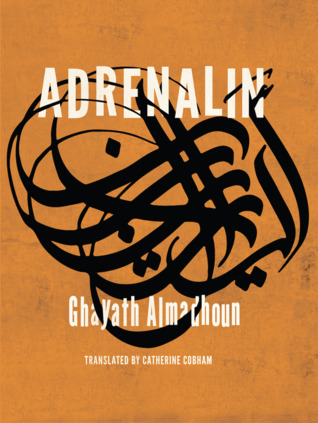
“The city is bigger than a poet’s heart and smaller than his poem”: Adrenalin by Ghayath Almadhoun

We who are strewn about in fragments, whose flesh flies through the air like raindrops, offer our profound apologies to everyone in this civilized world, men, women and children, because we have unintentionally appeared in their peaceful homes without asking permission. We apologize for stamping our severed body parts into their snow-white memory, because we have violated the image of the normal, whole human being in their eyes, because we have the impertinence to leap suddenly on to news bulletins and the pages of the internet and the press, naked except for our blood and charred remains.

—from “We”

There is an eerie and uncomfortable synchronicity in coming to Ghayath Almadhoun’s Adrenalin while, on the TV, a reporter stands against the skeletal structures of the besieged Yarmouk Camp in Damascus, once home to 160,000 Palestinian refugees, now a ghostly battleground where Syrian government forces are closing in on the last remaining Islamic State fighters in the capital region. That is because this devastated neighbourhood is also the birthplace of the Stockholm-based, Palestinian poet whose first collection to be published in English is one of the titles long listed for the 2018 Best Translated Book Award. From a part of the world that has been producing poetic visionaries for more than a millennium, Almadhoun offers a powerful twenty-first century testament that reinvents earlier forms and imagery to create a vivid, contemporary lament for the futility of war and the costs it extracts.

I was going toward death when the fighters stopped me. They searched me and found my heart on me. It was a long time since they had seen a heart with its owner. One of them shouted ‘He’s still alive,’ and they decide to condemn me to life.

—from “Schizophrenia”

His is a poetry about dying or not dying or being dead already too many times to count. About that which death can neither ennoble, nor ensure. In history, in the recent past, and in the ever present. In the world he conjures up, massacre and Damascus are personified, grief and angst are objects that can be purchased, new or second hand, and “suicided” is a verb. Employing a mix of prose poetry and free verse, the images he draws are coloured with unexpected juxtapositions and observations. It is a poetic reality at once modern and ancient, speaking to displacement as does the poetry of an earlier generation of Palestinian poets, but bound with the more recent flow of  refugees who have fled the Middle East and North Africa seeking new lives in Europe.

He is among those refugees, whether he fled or was lured away by love, the place he left behind lies in ruins. Yet, he is aware that the safe quiet space he has found in Stockholm confers upon him a privileged perspective and particular responsibility to be a voice for those people and places who have been rendered mute by conflict. And that elegy extends beyond Damascus, and yet is ever beholden to her—at once his mother and his first lover—and to his Palestinian identity. Take, for example, “Schizophrenia” a poem written following a visit to Ypres on the 100th anniversary of the first chemical weapons attack. Among the visitors to the reconstructed city he notes the contradictions and the burdens his presence represents:

I am the Palestinian-Syrian-Swedish refugee, wearing Levi’s jeans invented by a Jewish immigrant from Germany in San Francisco, filling my camera with pictures like a Russian peasant woman filling a bucket with milk from under her cows, nodding my head like someone absorbing a lesson, the lesson of war: I am the Palestinian distributed over many massacres, standing here naked, trying to wear my poem in the hope that it will hide my wounds, confusedly gathering pieces of me from here and there in order to become a witness.

As this series of poems and collected facts will go onto illustrate, the gas attacks of one hundred years ago, the recent sarin attacks on Damascus, and all of the wartime deaths  rendered by chemical means in between have taught us nothing. Nothing at all.

Almadhoun’s poetry is a potent blend of defiance, passion and melancholic nostalgia. It is a heady mix that produces work of raw beauty. Throughout this collection, his beloved birthplace is never far from his imagination, a bond evoked most intimately in “The City,” where Damascus is portrayed as a multifaceted female figure, timeless and complex:

She is the earliest cemetery, which people have celebrated as evidence that memories are real. I pass her, a stranger to myself, so she passes me without recognising my face. I distinguish her in the faces of strangers who have belonged to her, so she and I are briefly deluded into believing we are one. She is old like a fossil and I am new like the end of history, I hold on to her dress like a child and she holds on to my heart like a woman and we commit a poem, I the dreamer hunting down verse and she reality giving birth to children and not raising them. I the ephemeral and she the eternal, everlasting, I the fatalist stuffed with transcendental truths, she the heretical realist. There is no consolation for me, and no harm done to her, except that by chance we are lovers

The most striking quality of the poems that comprise Adrenalin is the urgency that comes through. These are fiercely intelligent political pieces that invite historical figures, philosophers and other poets into the conversation. Deeply rooted in the intertwined tragedies of recent Palestinian history and the Syrian civil war, it offers an urgent, compelling commentary presented in a style and manner that even those who tell themselves they don’t read poetry will find remarkably accessible and compelling.

Finally, if you would like an opportunity to experience Almadhoun’s poetry in the best way possible—hearing him read it himself—I strongly recommend this poetry video in which  he reads from “Details,” one of the most powerful pieces in the collection. Presented with Catherine Cobham’s piercing translation, against visual and musical accompaniment, this is the best endorsement for this book that I can think of.

Adrenalin by Ghayath Almadhoun is translated from the Arabic by Catherine Cobham and published by Action Books.

To have and to hold (or not): Passing Ceremony by Helen Weinzweig

I’ll admit it, I’d never heard of Canadian author Helen Weinzweig until I stumbled across her 1973 debut novel and, intrigued by its premise and its fragmentary form, decided that I had to bring it home. Before long, her name began to appear in my literary network with the American release of her second, and only other novel, Basic Black with Pearls from NYRB Classics last month, so I figured it was time to have a closer look at Passing Ceremony. The “Introduction and Memoir” by James Polk that opens the book had me wondering how her name had escaped me so long.

Polk, who was the editorial director at House of Anansi Press for many years, recalls how, in 1971, when the publishing house was still located in a less than glamourous part of Toronto, he received a large Birks jewelry box tied with a ribbon and addressed to “Editor.” Inside he found a stack of perfectly typed papers and a note instructing him to toss the pages in the air and arrange them as they fell. He could not quite imagine a market for such “chance” fiction in the current  Canadian literary marketplace, but as he scanned the fragments he soon found himself engrossed. It would become the first book he edited. (It was organized into and exists as a bound volume.) But if the initial packaging of the text surprised him, so did its author. Weinzweig, when she arrived to meet him, turned out to be a well-dressed woman, over fifty—“smart, wise, and funny” and well-read in everything from Beckett to Conrad, but harbouring a special affection for the French nouveau roman. She had, at this point, been publishing stories for several years, starting in 1967, when she was already fifty-two.

“One of the drawbacks of staring when you’re older is you know what good writing is, and you know you can’t do it,” she told the Globe in 1990. But she could do it. Everything she submitted to the magazines got published, in those mythic days when short stories had markets and commercial currency, though her age and gender bothered the critics. How could a nice Jewish housewife and mother seriously try writing, a man’s game, especially when she was so clearly over the hill?

Her style was startling and original, but sadly, after two novels and a collection of short stories, Weinzweig’s creative life would be cut short by either early onset dementia or a series of small strokes. Although she went on to live to the age of ninety-four, her short window of literary productivity makes her work that much more precious.

And so to Passing Ceremony.

What is played out through a series of fragments, is a most unusual wedding in the posh Rosedale neighbourhood of Toronto. The bride has a promiscuous past that no white dress will allow her to put behind her, and the groom is a closeted gay man abandoned by his lover. The estranged father of the bride arrives from Mexico with his young wife and baby, while his ex-wife is a sobbing puddle of shame throughout her daughter’s “big day.” The cast of assorted upper-class guests display an array of dysfunctional, often unpleasant, even suspect behaviours, thoughts, and obsessions. The reader swirls through the event, never quite catching enough to put all the pieces together, but gathering more than enough to know this is not a happy event.

The novel opens with a short monologue, the groom addressing his dead sister, admonishing her for missing, by her suicide, the act of sacrificial desperation that is about to unfold:

. . . if you could see me now: with this ring I thee wed and I will not fail you in sickness and in health as all the others did. Abandoned yet haunted by all of you, every night a nightmare of vanished faces. I take her, take thee, a small life, to have and to hold against my impossible longing.

Page after page, through a series of vignettes that range from  a short paragraph to a few pages in length, the reader eavesdrops on conversations, slips in and out of consciousnesses, and observes actions from a distance. Characters may or may not be identified. Perspective and style  shifts throughout. It is akin to being the proverbial fly-on-the-wall, and more. The assembled guests are generally an unpleasant, sometimes unsavoury, and occasionally tragic lot. If a wedding is, ideally, a celebration of love, this event—with a match as mutual means of escape at the centre—is more readily an evocation of the betrayal and failure of love. Yet there is also something so very human, and affecting, in the various confessions and mini-dramas being played out over the course of the evening:

How can I forgive you for what I will never know again. On your knees you promised. Those endless kisses. I was drugged like any addict. Enveloped in your languor. Aware of nothing but your whispers in the night. Now I’m thrust into the light and my eyes hurt from the glare. I do not wish your happiness. After all. It suits me to appear drunk.

The fragments that comprise this strangely engaging novel hint at the anger, humiliation, and false pride nursed by the assorted guests and family members present.

Helen Weinzweig, who was the wife of famed Canadian composer James Weinzweig, was no stranger to the well-heeled society she brings to life in her fiction. She captures the nuances of conversation—insinuations, veiled compliments and threats—in pitch-perfect tones:

—That’s the man, the doctor. His wife is supposed to die on the 30th.
—What’s today?
—The 18th.
—What if she doesn’t?
—Oh, but she will, he is a doctor.
—Suppose she rallies, they sometimes do, you know.
—Impossible—they say he treats his rats badly.
—Which one is his wife?
—The one with the sores.
—Did you know her when she was alive?
—Yes, she is a pretty little thing, rather pathetic, always begging you to like her.
—Beggars can’t be choosers.
—Doesn’t she know that?
—Apparently not, or she would have chosen life.

Much of what we hear or observe is deeply disturbing. Furtive confrontations suggest that more nefarious activities are at play. It is a dark satire in which the hapless couple at the centre—the fallen woman and her gay groom—are the most sympathetic, and unfortunate, of all the characters gathered for this unconventional and surreal passing ceremony. All that I know is that I am glad (and relieved) that I was able to attend vicariously.

Passing Ceremony by Helen Weinzweig is published by House of Anansi Press.

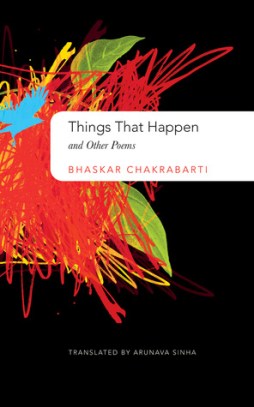
“All the world is made of poetry”: Things That Happened and Other Poems by Bhaskar Chakrabarti

Each of us is a bird of disbelief
Flapping our wings beneath the tired water
We shall be born, we shall be born, a new life
Tomorrow or the day after—maybe even this evening

—“The Window”

An important voice in the rise of modern Bengali poetry, Bhaskar Chakrabarti was so intimately bound to the streets, alleys, and rooms of Baranagar in northern Calcutta that he was, until recently, little known beyond West Bengal. Born in 1945, his life spanned an era of tremendous turmoil and change in India and in his native state, yet his poetry touches universals of experience that transcend time and place. To spend time with his verse is to feel that one is in the company of the man himself, in the urban spaces he inhabited.

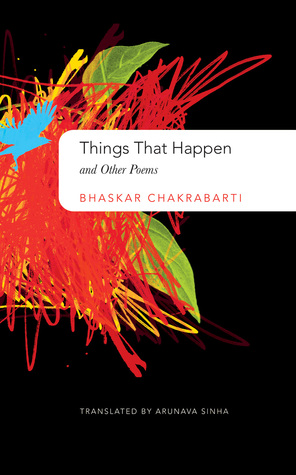
Things That Happen and Other Poems is the first cross-career selection of his poetry to be published in English. Translated by Arunava Sinha and published by Seagull Books, this volume offers the world an opportunity to become acquainted with this profound, melancholic poet. The recent inclusion of this title on the poetry longlist of the 2018 Best Translated Book Award will hopefully draw even more to discover his work.

Chakrabarti came to prominence in the late 1960s and 70s. It must have been, for him, a time of creative energy and excitement, as his nostalgia for these years, for lost friends and loves, resurfaces frequently in his later poems. However, it was also a period of political and economic upheaval. His earlier poetry often expresses a dramatic, angst-ridden intensity:

Night after night, for countless years, I’ve wanted to slice myself
open for self-examination
I have swallowed alcohol with ashes in it
I have gone up to fallen women to tell them, ‘I love you.’
Not all of this was a game.
My blood and sweat are mingled with black and white days,
brothers mine
I have forgotten nothing, none of it
The blows and the humiliation and the tears
Look—it’s so late tonight as well—still I cannot sleep.

—from “Brothers Mine (1/107)”

In his later poems a certain concern about the state of the world continue to re-emerge, in the form of anxieties about the what he observes in his community, and on the planet. His verse tackles the transformations of modern life, ventures into outer space, and frets within the confines of his room. But in general, as he struggles with his health following a cancer diagnosis, death becomes an ever more present companion, one he seems to entertain as much as he wishes it away and admonishes his audience to live well.

Cut off this thing that has bothered you all your life.

You are alive because of one simple reason, that you’re inhaling and exhaling. Keep this task up.

—from “Come, Let’s Talk of Some Things”

Along with this sense of mortality, a deep, abiding loneliness settles into his words, trails his footsteps, becomes the heart of his careworn song. The predominant mood of these poems is quiet, sad.

The one thing that is clearly evident  in all of Chakrabarti’s poetry is that he was a poet through to the very core of his being. It is the essence of his life’s work, all he ever wanted to do and he talks about his art with eloquence and passion. As he declares in the essay that opens this collection:

All the world is made of poetry. On some days the doors and windows within are flung open. All that I see and hear, all that I get a sudden smell of, turns to something new in a moment. My body feels light. I have had glimpses of the astonishing world of poetry, and I have been astounded every time. So many wilting conversations, fragrances, glances and dreams are happily tacked up on its walls.

How wonderful! He goes on to admit that his love of poetry never abandoned him, even if it did interfere with his ability to worry too much about employment or a steady job, likely to the dismay of some of those around him. And although he came of age in a time of upheaval, he is content to be a poet of the small, the simple, and the everyday. “I am a poetryist.” he writes, “I love ordinariness. Rejected, pedestrian conversations and scenes, days and nights left behind are all things that move me.”

True to this poetic spirit, many of his poems address the act of writing. He writes into silence and frustration with persistence:

I stay here in Baranagar, in Calcutta
Everyone here wants their fortune read
They want to know what life holds for them
They want to know when they’ll come into money

And I, an ancient ghost
Keep struggling with imagery, symbol and resonance
To hell with day before yesterday’s poems
All women with large breasts are better than them

Conjuring up thoughts about Panskura is better
Even writing four or five ordinary lines
About tender blades of grass is better

—from “Panskura”

Chakrabarti’s poetry is, on first encounter, simple. Calm, measured, pensive. His work is personal, mentioning places, addressing people directly, while speaking to emotions—attraction, loss, and loneliness—in tones that are intimate and human. But his poems invite the reader to fall into them, again and again. To read the verses aloud. And here is the junction where the magic of the translation comes into play. Without knowing the original language, vision and meaning must be trusted, but in listening to Chakrabarti reading from his work in Bengali, the cadences of his speech are clearly echoed in the way this poetry sounds and feels in the English.

And that is a remarkable achievement, and an endorsement for this evocative collection, this celebration of Calcutta in its uniqueness and its universality.

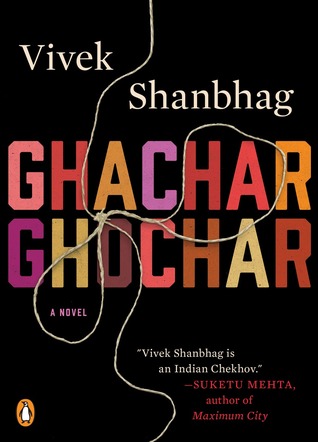
As it is in our house: Ghachar Ghochar by Vivek Shanbhag

The well-being of any household rests on selective acts of blindness and deafness.

India is a linguistically diverse country, with twenty-two scheduled languages, thirteen different scripts, and over 720 dialects. Yet when Western readers think of contemporary Indian literature, the work that most readily comes to mind  is typically written in English, whether by India-based or diasporic writers. Ghachar Ghochar by Vivek Shanbhag, which has garnered much attention over the past year, has been, for many English readers, their first introduction to a book originally written in the South Indian language, Kannada. As one of the long listed titles for the 2018 Best Translated Book Award (BTBA), even more readers will now have a good excuse to meet this established Indian author through this novel, his first work to be translated into English.

At first blush, Ghachar Ghochar seems an unassuming short novel—the story of a family whose financial circumstances take a turn for what should be the better, and the impact of their newfound fortune on their household dynamics. And so it is, but it is much more. Complicated undercurrents run through this tale, building to an ending with uncertain and disturbing implications. What makes it especially unsettling, and affecting, is the strangely passive, rationalization of the narrator. He practices a willful ignorance.

The novel, set in Bangalore, opens at our protagonists’ favourite haunt, Coffee House, with a description of Vincent, the attentive waiter and quiet confessor who tends to his customers’ need and listens to their woes with sensitive discretion. He is not an audience so much as a pretext for the unnamed narrator to unfold his account. Something is troubling the young man. But his concern is distracted. He seems to harbor a conflicted attitude toward women—lack of understanding even—that hints at but does not betray the depth of what we will eventually learn is the true nature of his anxiety.

What follows is a portrait of a joint family bound at all costs to the well-being of the bread-winner, a holdover from their earlier days when resources were limited and they learned to stick together, “walking like a single body across the tightrope of our circumstances.” However, that which once insured their survival in the face of financial distress, stands to destroy them once money is no longer a pressing concern. The story unfolds in terms of status, beginning in the present. The narrator who lives with his wife, his parents and his sister, and all are expected to defer to Chikappa, his father’s younger brother, the founder of the successful spice distribution company that has afforded the ascension of the family from a cramped, dirty house in a lower middle class area of the city to a smart, two-story dwelling across town. Although it is officially a family business, in practice there is little need for the other men to have more than perfunctory roles. The uncle manages it all and the family lets it be. Everyone except Anita, the narrator’s wife, who comes from a very different background and ethic.

Moving down through the family hierarchy, the narrative steps back in time to the years when the narrator’s father, his Appa, struggled to look after his family and put his brother through school on a modest salesman’s salary. Yet, even if money was ever in short supply, he placed great value on good honest, hard labour:

He was inordinately proud of being a salesman. “What do you think a salesman is . . .?” he’d boast, especially when launching into stories about his prowess—how, for instance, he’d managed to sell to a shop whose shelves were always brimming with tea. He polished his shoes every morning and put on an ironed shirt. He’d leave looking like an officer and return at night, wilted from the day’s sun, his clothes rumpled. One glance at his scuffed, dusty shoes was enough to betray the nature of his day’s work.

Everything changes when Appa is unexpectedly forced into early retirement. This is the impetuous his brother needs to act on a business scheme he has been contemplating and, although both brothers are co-owners, they soon find themselves ideologically at odds and as the spice firm takes off, Appa drops into the role of a silent partner, slipping into an increasingly defeated mood. His family worries about his sanity, but not for his sake so much as their concern about their right to his share of Sona Masala’s assets.

The narrator, who with his mother and sister all fall in place, more or less on level, below the two older men, makes much of the interdependence of his family, financially bound in poverty, emotionally bound in wealth. They are all at odds, in their own ways, with the world into which they have ascended almost overnight:

It’s true what they say—it’s not we who control the money, it’s the money that controls us. When there’s only a little, it behaves meekly; when it grows it becomes brash and has its way with us. Money had swept us up and flung us in the midst of a whirlwind.

The sister, Malati, has a particularly disastrous, short-lived marriage. Amma, the matriarch, tries to mediate between family members and maintain their honour against an outside community she no longer knows how to negotiate. Meanwhile, the narrator seems to lose any drive or motivation he may have once aspired to. He too is given a title in the family business, complete with an office and income, but soon realizes there is little for him to do. His uncle has everything under control and no one dares to question what that really means. He takes to lazing around in bed and frequenting Coffee House, showing little ambition, afraid or unwilling or perhaps unable to break away and create a future for himself. With the addition of Anita, his bride by arranged marriage, the precarious household harmony is set completely off balance. The daughter of a professor, she comes from a different background with different expectations and little inclination to suffer fools gladly. She also brings the book’s title, a nonsense expression unique to her family meaning “tangled beyond repair” that she shares with her husband on their wedding night. Yet, it is unclear whether he understands the full relevance of this image before it is too late.

Told with a carefully weighted tone and an economy of words, Ghachar Ghochar is a deceptively easy and enjoyable read. It is not until one nears the latter pages of the book that a creeping unease enters the narrative. The protagonist notices many troubling signs, but repeatedly neglects to act. It is unclear if he shares his father’s tendency to despondency or is simply too self-focused. The troubling factor is that this type of opting out, is not an uncommon response for young men when they cannot find their footing under shifting socio-economic conditions that they feel, rightly or wrongly, are beyond their control. In the Indian setting, the complications of family dynamics and expectations exacerbate the situation. And this, for me, is the real strength and tragedy of this slender volume. There are no easy answers, no heroes, no clear resolutions.

Too much like real life.

Ghachar Ghocharby Vivek Shanbhag is translated by Srinath Perur, and published by Penguin Books.

Echo has no compass: Footnotes in the Order of Disappearance by Fady Joudah

Echo has no compass: we trace each other’s dermatomes

No ecstasy without betrayal: not all who live in flames are saints

Great art needs no nation: in memory country size is one

Great nations need great art: soliloquy a mother tongue

— from “Footnotes to a Song”

It was not until I sat down to write this review—in so much as I yet feel myself capable of calling my scribbled thoughts about poetry a review—that I realized I’m following a piece about Ghassan Zaqtan’s latest novella, Where the Bird Disappeared, with a look at the latest collection of poetry by Fady Joudah, Footnotes in the Order of Disappearance. I came to Joudah first as a translator of Zaqtan’s poetry so I was not unaware of the concurrence. But I am typically reading at least two books of poetry and two books of prose at any given time, so the crossover is never so obviously bound, thus it is only now that I’ve become aware that the titles of both books include a form of the verb to disappear. A timely happenstance. However, although it is impossible to underestimate the importance Ghassan Zaqtan’s influence on an entire generation of Arab poets, Joudah included, the experience offered by the latter’s work is distinctly his own.

Fady Joudah is a Palestinian-American poet, translator and physician living in Houston, Texas. If I was conscious of the fact that he is a doctor, I don’t think it really registered or made its presence known in scattered poems I’ve encountered in the past. But his medical profession and scientific curiosity comes through in his work, along with a love of art, literature and nature. So does the legacy of war, destruction and conflict in the Middle East, and the varieties of experience of exile. His poetic territory is wide; his passage through it is intimate and acutely observed. As poet Mary Szybist contends in her praise for this “intensely vulnerable book,” Joudah is:

forging a lyric that works at the crosscurrents of reportage, myth, and dream where false imagined boundaries—of gender, nation, family—fray and unfold, and there are possibilities other than ‘to go mad among the mad / or go it alone’. . . (his) gifts for articulating the intersections of bewilderment, tenderness, rage, and grief are fully alive here.

The physician’s attention is very much evident in the early poems in Footnotes. “Progress Notes,” for instance, opens with the poet’s assessment of his own asymmetrical visage:

My left eye is smaller than my right,
my big mouth shows my nice teeth perfectly
aligned like Muslims in prayer.
My lips an accordion. Each sneeze
a facial thumbprint. One corner
of my mouth hangs downward when I want
to hold a guffaw hostage. Bell’s palsy perhaps
or what Mark Twain said about steamboat piloting
that a doctor’s unable to look upon the blush
in a young beauty’s face without thinking
it could be a fever, a malar rash,
a butterfly announcing a wolf.

before moving on to find a future echo in noted in one of the cadavers in his anatomy classroom:

But the colonel on table nineteen
with an accessory spleen had put a bullet through
his temple, a final prayer. Not in entry or exit
were there skull cracks to condemn the house
of death, no shattered glass in the brain,
only a smooth tunnel of deep violet that bloomed
in concentric circles. The weekends were lonely.
He had the most beautiful muscles
of all 32 bodies that were neatly arranged,
zipped up as if a mass grave had been disinterred.
Or when unzipped and facing the ceiling
had cloth over their eyes as if they’d just been executed.
Gray silver hair, chiseled countenance,
he was sixty-seven, a veteran of more than one war.
I had come across that which will end me, ex-
tend me, at least once, without knowing it.

Medical and medicinal imagery continues to resurface routinely throughout the collection, woven into both the political and the personal (which are never mutually exclusive here) infusing both with an intimate humanity:

The hour of the grackle, and a mother
not menopausal, solitary with endgame lung

tumor in a foreign country
and what makes one foreign:

she hasn’t seen her son for three or five
exilic or immigrant years,

citizen or national stints, a keyword
a thrombus dislodges

in heart or head
for infarction’s infraction

—from “The Hour of the Grackle”

Although much of Footnotes reflects the poet’s specific experience in America (“Palestine, Texas” is a telling, gently ironic send-up of the tendency of the same place names to occur so ubiquitously across the American landscape that they lose resonance with any original roots), his concerns reach far beyond national boundaries. This is rendered most explicitly in the central section of Footnotes, “Sagittal Views” which is the result of a collaboration between Joudah and his friend, Syrian Kurdish poet and translator, Golan Haji, who now lives in Paris. Drawing on their meetings, phone and email communications, all conducted in Arabic, Joudah translated and formed their words into chilling evocations of loss, sorrow, and resignation:

Over dinner we spoke of the game of recurrence dissolving into an old dog’s tail, loquacious desire far from the borders of the body, yet is the body’s. What’s inside and doesn’t come out to skin or what’s outside and doesn’t touch us. Victims, we told ourselves, will inherit the future one day, but souls will linger distant from redemption. Don’t follow the signage and keep your eyes on the phrase. News of the explosion will hang around. The hell of pictures on the web. Faces of the dead on Facebook will wait for your walk home. A woman who awakened your first lust when you were a kid was killed in the morning while talking to her sister on the phone. First a blast then stillness. You were late to dinner. You had lost your way to the restaurant. You couldn’t have known she had just died, and what you thought were Klee’s paintings in the gallery clawing your afternoon nerves was her calling your name one last time.

—from “After Wine”

Poetry, at its best, invites re-engagement. Demands it, even. I was so enamoured with the anatomy of Joudah’s wordplay that, on my first passage through Footnotes in the Order of Disappearance, I was so intrigued to see where his wonderings would lead that I did not linger as I might have on another initial journey. I read this book with an unexpected urgency. But as I returned to it with an eye to sorting out my responses, I encountered new depths, new heights of emotion. And at times in the seemingly simplest passages. For me, the prose poems—“Horses,” “An Algebra Come Home,” and “Alignment” to name a few—hold a particular power, but the entire collection is so strong, so varied, that there are boundless rewards to be found in the generosity of Fady Joudah’s pained and passionate poetics.

Footnotes in the Order of Disappearance is published by Milkweed Editions.

“No, you are better than me, Yahya”: Where the Bird Disappeared by Ghassan Zaqtan

He felt he was walking inside a book, stumbling inside stories that had circulated in these hills since his birth. Journeys and names kept repeating themselves in succession without end.

The enclosures were always building themselves in processes to which everything contributed. Everything gave birth to everything. Time, places, names, women, trees, men. He felt he was traversing the book, word by word.

Memory, for Palestinian poet and writer Ghassan Zaqtan, is a troubled quantity, shaken and shaped by the past, near and distant. His work is rooted in the land and the lives of his people, disrupted and dislodged by the forces of history. The losses cross generations. The tremors run deep.

His first work of prose to be translated into English, Describing the Past, was set in a refugee camp east of the River Jordan, a location based on the settlement where Zaqtan grew up after the Israeli invasion of 1948 forced his family out of their home village. The first part of a trilogy, this dream-like coming-of-age story is a tale of loss—the loss of childhood friend and of childhood innocence itself. The narrative, shared by three voices, has a gently circular flow. The young man at the centre, continually eludes to the future yet is sensitive to the ongoing presence of the past, to the ghosts that continue to have a tangible existence in the community.

With the second installment, Where the Bird Disappeared, Zaqtan takes a somewhat different approach, but one that is likewise weighted with lyrical beauty and sorrow. The narrative begins in the years just prior to the invasion and extends to the present day, while its echoes with the past go much farther back in history. Set in the Palestinian village of Zakariyya, the central character is a youth also named Zakariyya. He and his best friend, Yahya not only share their names with two prophets so strongly associated with the region—known to Christian tradition as Zechariah and his son, John the Baptist—but bear distant imitations of their personalities and fates. Other characters and images also shadow figures from the shared Biblical and Koranic traditions.

This novella adopts a narrative style with more of a mythic feel than Describing the Past. The tone is still dream-like, spare and poetic. However, the disruption and violence of the invasion is much more explicitly portrayed in this tale which unfolds in a series of short, intimate vignettes. As adolescents, Yahya is a restless spirit, given to wandering alone in the countryside around the village. Zakariyya is the more reflective of the two, intuitive and sensitive to place. Together with the other boys of their village, they have their own visions and dreams for the future. Until the military arrive.

With the sudden forced migration, as families flee into the hills, all of the young men are thrown into dangerous new roles. They are drawn back to their villages, to try to protect their homes against impossible odds. There are casualties, including Yahya who is captured, and shackled inside the citadel outside Zakariyya. His friends keep vigil for three days and nights until he is finally killed:

Yahya knew that they were listening to him from the cactus field. His voice was full of testimonial. The pain had stopped and the fear had stopped with it. Only the testimonials remained, running through his voice and pouring into the air. They gathered them in the cactus field.

Zakariyya’s own journey commences with the death of his friend. He sets off to find Sara, who had loved Yahya, drawn by his own attractions as much as the need to bring her the difficult news. Along the way, he takes refuge at the Monastery of Saint Saba carved into the mountain side overlooking the Kidron Valley, halfway between Old Jerusalem and the Dead Sea. His short stay is a time of mystical suspension and release from the burdens weighing him down. He is attuned to the presence of the thousands of monks who passed through the complex over the previous fifteen centuries:

Saints, and pious men at the edges of sainthood, rose up, their chanting lingered as the living met the dead in the vestibules and halls of the monastery, sharing bread from nightfall to dawn.

He listened to their talk and their steps, he distinguished between the weightless steps of the dead and the empty stammerings of language. He arrested the movement of his body and left the air entirely to them.

Gathering the peace afforded him by his time at Mar Saba, Zakariyya sets off again to find Sara. He joins a refugee camp where she also comes to settle with her family. But once he is in close proximity to her, he comes to realize that he cannot approach her, and that to preserve his memories of both Yahya and Sara as they were all once together, to hold on to what little he has of his own past, he must leave. He returns to pass the night at the monastery before continuing “down the falling road” to the Dead Sea.

Zakariyya will settle to work the salt mines, in a land yet again bound to the far-reaching named and remembered history within which he is half aware that he exists. As the years pass, and age bends his back, he finds himself haunted by the strange notion that he was born a father. It’s a sensation that increasingly troubles him. He does not understand it, knowing only that it is bound to a name and that it is becoming more oppressive, leading down a road carved through memory. A road that will ultimately lead him back to Zakariyya. The place. His home.

Rich with allusions, but never forced or heavy-handed, Ghassan Zaqtan weaves a delicately devastating fable that illustrates that the connection of the Palestinian people to their land is not simply geographical, political and economic, but bound through mystical and psychological ties that are enduring. And not easily severed.

Where the Bird Disappeared is translated from the Arabic by Samuel Wilder and published by Seagull Books. The final part of the trilogy will be published in Spring of 2019.

Being sneaky and queer within: Brink by Jill Jones

This past fall I had several precious opportunities to speak with the exceptional Caribbean-Canadian poet, NourbeSe Philip. On the first occasion, we were riding in the rear seat of a vehicle en route to the venue where she would be performing from her innovative masterwork Zong! I told her that I was taking some time to focus on writing, admitting that I was troubled that, at fifty-seven, I only just beginning to try to find self-expression and was having trouble sifting through a mess of accumulated personal experience. She smiled and said, “Oh you’re still young.” She went on to say that, as far as she was concerned, novels might be the sort of heavy-lifting suited to younger writers, but that poetry required a significant measure of life-lived perspective, adding that Thomas Hardy, after whom she named her son, didn’t write any poetry until he was finished with fiction.

I don’t write poetry, but I think that, at best, I aim to write somewhere in the intersection between poetry and prose. The more I focus on writing, and the older I get, the more I find myself turning to poetry with a new hunger and intention. I am drawn to both the experimental and the expressive elements afforded by the form. And although I’ve enjoyed and deeply admired so many of the works—primarily shorter contained collections— that I have encountered over the past year or so, something different happened with Brink, by Adelaide-based poet, Jill Jones.

Now I don’t want to speculate on age, with only an author’s photo to go by, but I did sense a degree of generational comfort in my engagement with her poetry. And by that I simply mean that I sensed I was in the presence of a poet who has come to understand, as I have, that questions are easier asked than answered, and that observations are often best left open-ended. This is where the ability to continue to marvel at life’s small wonders crosses weary wisdom and the understanding that words are at once necessary and inadequate. The poems in this collection, which range from the lyrical to the linguistic and experimentally playful, examine the emotions, images, and concerns that reflect an awareness of place and of the passage of time on an increasingly small planet.

In an interview with Tony Messenger, Jones admits that this book which had, at the time of their conversation, just been released, “covers a lot of ecopoetic territory, as the title Brink would suggest.” Natural elements—earthy textures, weeds, leaves, sky, clouds, birds, waters—are all recurring images. The fragile state of the world’s climate is a longstanding concern for her. But this collection is varied in practice and purport, “a big mix of detail and dislocation, images and word play, a lot of play, actually.” Indeed, these are poems that demand to be read, not just for the alliteration, and the slippery shifting of vowels, but for crunchy crispness of the language and the unlikely juxtapositions.

Shape-not-shape and
other shape
move with

wind, mind
argument between
ground, grass, leaf, cloud

barely words
for ephemeral world
beneath breath bones

                   — from “Arkaroola”

What a poet imagines into her own poetic explorations and what a reader meets there is complex and dynamic. In my personal encounter with this collection, I was drawn into the poems that spoke to me of the weight (or weightlessness) of words, and the longing for a language to express or make sense of, a pervasive restless disconnect. This is a sensation that is fundamental and primal, but coloured with the mixed blessings and illusions of modern interconnectedness:

I’m helpless against sky, shadow, gutter
clouds without formality, empty grey branches.
How to explain light on glass
and how not to do that
in this return after work’s decorum
another animal listening into the air.

Each evening practices its street repertoire.
Night blurs lines against my gate.
Tonight the moon is nearly naked.
Forgive me if I seem scrawled
with prefab thought rather than thinking.
I’ve brought no conclusions with me.

                            —from “Scrawl”

Sometimes writing is as much about being unable to write than it is about being able to tell stories, articulate experience or find self-expression. As words try to reach closer to the self, the more contrived or meaningless they tend to become. In my efforts, as an essay/memoirist (a preferred construct) I am fascinated and frustrated by the difficulty of finding a way to talk about a real and persistent experience for which I had no vocabulary until I was in my late thirties. In the meantime, an entire queer discourse has arisen over the past twenty years to parse the intricacies of gender non-conformity, to simultaneously celebrate and police self-definition, and yet it says little about my own queered experience. The words I am searching for remain elusive. My favourite piece in this entire collection, the one that I keep returning to repeatedly and that has earned this book a spot on the shelf inside my bedside table, speaks so clearly to my existential voicelessness. It is called, most fittingly, “Self and Nothingness” and I’m reproducing it here in full:

I’m running all over the world. I’m running
within sight of what might happen.
I’m running with a crazy kind of make-do.

The new plants waver in the cold evening.
It’s cooler than when I left these things, these ideas
in rooms. Is there a knack to it?

If I could shift my head without the world
shifting: It can’t be that hard to look up
into the trees. I know they’re there.

I’ve argued over silence.
I’ve collected nonsense.
I crave nothingness.
I know it doesn’t exist.
That it does.
I am a source of virtual violence.

What senses are, I’m not sure, or how many.
I smell strange but that could be
the way the air is.

The craft is the devil, disquiet a relief
jokes become bullet points, and my life
an account explained in columns.

Perhaps the essence has dissolved, become paler.
Whether to drink it, whether to pour it
whether to watch something else drink it.

Perhaps it’s all a set-up. It doesn’t matter
what it is. Everything in my mouth
cracks like a sweet.

I am a project as I scour the streets, for
what it’s worth, and I’m looking for ways
to write back the damage.

                    — Jill Jones, “Self and Nothingness”, from Brink

Looking for ways to write back the damage. Looking for ways to be. Mid-way through this collection I encountered a poem that, in the moment, spoke to me of conversation about a mutual sense of groundlessness that a faraway friend and I had shared.  I immediately had to photograph the page and send it to him. That is poetry that speaks.

In the end, Brink is, for me, a strange brew. It is blend of perceptive, sensual imagery; a confident exercise in word-crafting; an ode to a stressed climate; and, above all, wise counsel to: “Take better joy.”

Brink by Jill Jones is published by Five Islands Press.

No country for young men: Border Districts by Gerald Murnane

The reflective, circular “report” that occupies the narrator of Gerald Murnane’s latest, and if he can be believed, last, novel is presented as an account “of actual events and no sort of work of fiction.” This clarification, coming in the midst of an extended extrapolation of possible impossibilities, anticipates the skeptic:

As I understand the matter, a writer of fiction reports events that he or she considers imaginary. The reader of fiction considers, or pretends to consider, the events actual. This piece of writing is a report of actual events only, even though many of the reported events may seem to an undiscerning reader fictional.

Of course, in Murnane’s mental terrain the line between fiction and events actually experienced is a slippery one, but Border Districts reads like a meditation on a lifetime of traversing imaginary landscapes as a reader and writer famously adverse to physically travelling beyond the confines of his home state of Victoria, refracted through a playfully multi-toned meta-fictional prism. This is a novel about perception and memory, and the degree to which we can ever hope to grasp the contents of our own minds. More critically it’s about the way our experiences and our experiences of our experiences are inflated or telescoped with the passage of time.

The narrator of Border Districts has relocated from a capitol city to a small town near the state border, echoing a similar move made by Murnane a number of years ago. He has not entirely shunned the city, he makes several return trips to visit friends and family, but his stated goal in moving to this remote place is to spend his last years focusing on the images, emotions and words that have stayed with him over time, “guarding” his eyes, as he puts it, so that “I might be more alert to what appears at the edges of my range of vision.” Anticipating the essential, fragmentary quality of this mental inventory he embarks on a meticulous effort, paragraph by paragraph, to trace the connections from one recollection or set of recollections to another.

The result is a digressive internalized odyssey. Perspective shifts from first to third person for a time as the book-hungry boy approaches the remembering man. Uncertain boundaries exist between recalled events and the fiction writer (and reader)’s inclination to wander off on paths not taken, to imagine what might have been, sketch out potential storylines, flesh out characters that could have existed, and step out from the shadows of possible unlived trajectories to anticipate a meeting of minds on the open plains of a mental landscape. Idiosyncratic sideways cognitive processing is acknowledged, examined, and entertained. But the challenge with exploring the way our minds work is that we can never clear the workspace, step back from the stage. We are always in our own way.

There are a number of key motifs or pivot points to which the narrator returns as he attempts to maintain order and control of his own report. Lines of thought that keep circling back and merging. Readers familiar with Murnane will recognize the elements of the rural Australian landscape, the fondness for horse-racing, and a certain literary cynicism. Houses with return verandas hold a peculiar affection. But the key image that recurs is one of coloured glass—from the windows of the unassuming church in his adopted hometown, to observations about stained glass, to a treasured marble collection—and the difficulty of accurately perceiving the shade and details therein. Just like our memories, in our mental images, appearances are mutable. Light is the key because:

. . . a coloured pane better reveals itself to a viewer on its darker side, so to call it; that the colours and designs in glass windows are truly apparent only to an observer shut off from what most of us would consider true light—the light best able to do away with mystery and uncertainty. The paradox, if such it is, can be otherwise expressed: anyone observing the true appearance of a coloured window is unable, for the time being, to observe through the window any more than a falsification of the so-called everyday world.

Yet knowing this limitation does not diminish the narrator’s natural inclination to want to penetrate the opaque surface of the window, to truly see the nature of the glass itself. He even attempts to capture, on film, the coloured windows of a friend’s house. When he retrieves the processed images and brings them home, he realizes that the image-panes are less colourful than they were when he photographed them. Was this a function of his modest photographic skills or further evidence of the unreliability of memory? Perhaps. But the explanation he chooses to endorse, is that the qualities he perceives as lacking are not inherent to the glass, but rather unique to himself:

. . . what I missed when I looked at the photographic prints was the meaning that I had previously read into the glass. And if I could give credence to such an eccentric theory, then I might go further and assert that I saw in the glass part of the private spectrum that my eyes diffused from my own light as it travelled outwards: a refraction of my own essence, perhaps.

As he makes his way through a range of remembered images, experiences, and feelings, obscured with the patina of time, he is interested in what details he does recall. What he has forgotten, if it does not resurface on its own by association, is of no regard. He is keenly aware of his age and fascinated by the memories that have persisted, with a measure of intensity, for thirty, forty, sixty years. The narrator’s associations and meanderings are unique to him, but they reflect our own idiosyncratic mind loops—those layered networks of connections constructed through exposure to art, literature, landscape, life experience—which increase in depth but become more firmly attached to our specific pivot points or mental signposts, as we get older.

I have come to this book midway through my sixth decade (as frightening as that sounds), younger than Murnane and his alter-ego, but close enough. I come to it as a writer interested in capturing his perceived experience, rather than biographical detail, and inclined to believe that we only have the ability to know what we think we know, a through-the-coloured-glass perspective at best. Border Districts is an older writer’s reverie. It dips back to childhood and adolescence, marriage and parenthood, and spins off into realm of possible lives unlived. There is something to greet a reader at any point in life, but I wonder what my twenty-eight-year-old self might have found. What I do know is that this novel entertains the kind of questions about memory—about the feelings, colours, and images that linger ever “on the edges of my range of vision”—that occupy me more and more with each passing year.

 Border Districts by Gerald Murnane is published by Giramondo Publishing in Australia. It is now available in North America through Farrar, Straus and Giroux.

The truth has no ornaments: SS Proleterka by Fleur Jaeggy

You don’t tell the story of your own life, there’s no time. Life began the moment in which we got on board. The beginning is the Proleterka.

SS Proleterka was the last of Fleur Jaeggy’s currently available translated works that I had left to read and I did not want it to end. I used to think Sweet Days of Discipline was my favourite but this novel is far more subtle, real, and painful. And with none of the gothic overtones that creep into so much of her other work. A most dispassionate and restrained coming of age story, it is cold, calculated, yet charged with a deep, sorrowful beauty.

Central to this novella is the account of a cruise to Greece that the unnamed narrator and her father take when she is fifteen years old. It will turn out to be the last opportunity they have to get to know each other. Her parents separated when she was young, and she was deposited with her maternal grandmother, leaving her father effectively exiled from her life, forced to request time with his daughter—applications that were frequently denied or strictly curtailed. To have two weeks together over the Easter holidays is unprecedented, and precious, but unlikely to resolve the existing distance between parent and child. They are too much alike, too accustomed to emotional self-preservation. But, with almost surgical precision, Jaeggy’s crystalline prose exposes the currents of repressed affection that run deep beneath the surface of their relationship.

Our protagonist is looking back from mid-life, at her childhood and youth. She offers an unsentimental, clinical assessment of her own experiences, emotions, and interactions. It is a learned response to the world. Occasionally she speaks of “my father”, but most commonly she refers to him by his first name, Johannes. With respect to herself, she alternates between first person and third, talking of “Johannes’ daughter,” “she” or “the girl”—at times employing all three in the same paragraph. She is thus able to step back and place herself within the regard (or lack thereof) of others. Detachment is her means of coping.

As a young girl, she tells us, she lived with Orsola, her mistress or “the mother of my mother, of her who had been Johannes’ wife.” After her own parents’ divorce, her father’s parents who had moved south for the health of their other son, an invalid, lost the textile factory that had been in the family for generations. Johannes lost his inheritance and his wealth. For the narrator, her father’s family hold a tragic fascination. She does not know them beyond their photographic images. But then she hardly knows her father any better. It is her mother’s family who control her destiny, which will ultimately be boarding school. She is disposable and knows it early on. Still, she describes her “quasi-glacial” relationship with her maternal grandmother as the most intense she ever had, even if she is at a loss to know if she felt affection for the woman:

Orsola treats me like an adult. Like a peer. Obedience does not mean subordination. I close all the shutters. I do not open them in the mornings. A continuous closing. I close the day. Closing is order. It is a form of detachment. An ephemeral preparation for death. An exercise. It was entirely natural that that woman and the garden corresponded to the vision of a happy land. How much time did I still have at my disposal? The curtains at the window are fragile, almost dust. And she, the mistress, looks like a white plaster bust.

If her relationship with Orsola is formal and defined by expectation, her mother exists almost entirely in absentia. She is “Johannes’ wife.” By the time the protagonist is recounting her tale, she too is dead. Her daughter has only her jewels and her piano to remember her by. It is the Steinway, purchased in New York and carried across the ocean to Europe, that is the narrator’s closest connection to her mother. As an object resting in a specially prepared room, she endows it with personality, demonstrating an intimacy she could never find with the pianist who once played it:

You do not want me to touch your keys yet. My fingers are unfamiliar to you. That slight hint of carnality. But I am sitting beside you. I watch over you. In the first years I always kept the door closed. I wanted to be sure that no one came in. You alone, locked in. Now no longer. Now I allow you more freedom. And at the same time I allow myself more freedom too. I have become wiser. Before, if I felt resentment, it seeped into my veins, my eyes, my thoughts. An insomniac resentment.

Aboard the SS Proleterka, the connection between father and daughter is marked by a formality that neither can seem to breach. They have, she has told us, always been able to “perceive the exceedingly fine line between equilibrium and desperation.” By the time they are on this shared voyage, the daughter on the cusp of womanhood and the father aging quickly, they can no longer negotiate that line. The ship has been chartered by the Guild to which Johannes has belonged since he was a student. Having fallen into poverty, he is treated by his peers with a measure of pity. He is awkward, out of step. His daughter, meanwhile, is looking to test other waters while they are out to sea. As the voyage progresses, she engages in a number of rather abrupt sexual encounters with several of the officers. She is being used and she knows it, but she wants the experience. She likes and dislikes it at once. Having been raised by a family who could not show love, she seems unable to accept more than brute affection. Yet there is also the sense that she wants to evoke a reaction in Johannes, protective, angry, disappointed—anything—but if he registers her absences from their cabin he refuses to show it.

Day by day, their extended visit slips away. Trips ashore to visit ruins and others sites, exhaust Johannes and confuse his daughter. At Knossos, for example, his sadness weighs on her and distracts her:

I should pay attention to the woman’s explanations, says Johannes; I continue to look at her white gloves, the seams of her stockings. Her calves. “Höre, höre zu,” says Johannes, listen. I cannot catch her words. Only in my mind’s eye can I grasp what I see. The words are too much. And the light is extremely bright. The journey is important for Johannes. The journey to Greece, father and daughter. The last and first chance to be together. But we do not know this. Or perhaps he does.

There will be no magic breakthrough on this voyage, nor in any of the remaining visits the narrator makes to have dinner with her father in the hotel where he lives. There is an emotional stasis that defines their relationship and in a strange way it suits them. The narrator’s father will be long dead before she really confronts the importance of their bond. And even then it is stretched taut and unarticulated.

Perfectly paced and tightly controlled, the devastating power of SS Proleterka lies in the way Jaeggy manages to capture the complicated and unexpressed affection that underlie even the most strained parent-child relationships, while demonstrating the lengths to which a child who knows they have been disposed of will go to maintain a sense of identity. Self-preservation requires distance. If the narrator seems dispassionate at times, she is also resilient and real.

SS Proleterka is translated from the Italian by Alastair McEwen who maintains a remarkably clean, even tone throughout, seamlessly incorporating the German dialogue, and allowing the stark beauty of Jeaggy’s prose to shine. Highly recommended. Available from New Directions.

Some measure of an innovative response to Liberating the Canon: An Anthology of Innovative Literature

So I’m sitting here at looking at my copy of Liberating the Canon: An Anthology of Innovative Literature and feeling sick when I think about whether or not I can, or should, write about it. Which makes it sound like I did not enjoy the book. Or that it is not worth reading. I did. And it is.

But, can I talk about the way it also twists me up inside? That a book that I should connect with on a level beyond the written word leaves me wondering if there is a space for me? On the back cover (which on my copy is terribly warped after a fall on snow-covered ice landed me with a concussion) editor Isabel Waidner is quoted:

If there were a literary avant-garde that were relevant now, it would be what the queers and their allies are doing, at the intersections, across disciplines. This avant-garde would be inclusive, racially and culturally diverse, migrants galore, predominately but not exclusively working-class, transdisciplinary, (gender)queer and politically clued up (left).

I like the sound of this. But is this what the queers and their allies are doing? Possibly. I am the ineptest (gosh I didn’t even know “ineptest” was a word, but Word suggested it and I kind of like it) queer writer ever because, off the page, queer is the loneliest reality I’ve ever known, and the many queer writers included here seem to have lives in which their queerness is essential, not accidental. And that makes me feel as alienated as my real life adventures in queer spaces do. I’m awfully pasty white and ordinary, and although my mother’s family were, at one time, potato famine refugees from Ireland, and I was not born in the country where I live, I am a migrant on an axis other than the here-to-there displacement in space. The only true migration I have ever made—the one that I am always making—is the one from female to male.

And I am not even certain how to think about “working class.” If it’s about wage-labour, a blue- and pink- collar, and sometimes white collar existence, then for the exception of about one decade of my life, I’m your man. But I’ve always preferred to think of myself as under-employed, as if the status was temporary, collarless. Over-educated. Just barely keeping my head above poverty level. You know: What are you going to do with an arts degree? Or two? When things are good where I live, blue collar workers can haul in six-figure incomes. Classless, misfit, my work-life fits into no definable category.

At 57, I’m not even under-employed any more. I’m not employed at all. And too old to start over. (Which leads me to wonder, while we’re being all diverse and intersectional, where disability lies in this re-invigorated literary avant-garde.)

But, enough wound-nursing and equivocating. Back to the task at hand.

I do love the idea of literature that is innovative, experimental, and breaks boundaries especially in my arena, that of the essay/memoir. And, did I mention that nowhere in Isabel’s detailed and entertaining introduction (check it out, if you want, at 3:AM) does that over-used term “genre-bending” appear? The writing she invites the reader to envision, “itself must transgress the various structures through which the avant-garde literary canon has perpetuated itself and its exclusiveness.” Okay, now we’re talking. She goes on to say:

To reiterate, the writing needs to work across various systems of oppression (intersectionality), across formal distinction (prose and poetry, critical and creative, and the various genres), and across disciplines. Same goes for publishing, editing, reading, referencing and designing curricula. Change literature (or what is defined as such) and the discipline will diversify. Diversify the discipline and the literature itself will change. Liberating the canon depends on inclusion and formal innovation in equal measures. The two are interrelated.

And the question then becomes: Just how liberated is this canon? How much of a meaningful advancement have we made toward this ambitious goal by the selections gathered in this anthology?

Honestly, I am not so sure. (Maybe I am.)

I already tend to read a fair amount of innovative literature, and have admitted to a hunger for work that pushes the confines of literary style and form, so the more experimental pieces really, uh, turn me on. The contributions from Mojilsola Abedayo, Joanna Walsh, Isabel Waidner, Timothy Thornton, Mira Mattar, Nisha Ramayyar, Richard Brammer (cheating I skipped this having already the entire book from whence it came) and Nat Raha were, for me, standouts. The most explicitly trans pieces were my least favourite, pushing subject more than form, but as an idiosyncratic, fickle reader—a body dysmorphic, ex-gender dysphoric soul—I am looking for a transvant-garde that speaks to trans in a way that would make me say “HELL, YES.”

This canon still needs to be loosened a little further, I suppose. Or rather, the liberation is just starting.

This book could be considered a primer. An Anglophone primer. An anthology of primarily UK based writers with a few US contributors tossed in for good measure. How about round two? With a glance to Canada (where I am), Australia and New Zealand, South Africa, and desi (South Asian and diaspora) writers.

Ah, one can dream. But if this book can exist, anything is possible.

So, there you have it. I have written about Liberating the Canon without really writing about any of the varied pieces contained within. You’ll have to read it, if you dare. Or desire. Or are simply curious.

It’s worth the risk.

Liberating the Canon: An Anthology of Innovative Literature, edited by Isabel Waidner is available from your friends at Dostoyevsky Wannabe.  To be printed at your pleasure, and obtained through a distributor like that place that starts with A.