Inside the fragmenting mind: The Goalie’s Anxiety at the Penalty Kick by Peter Handke

‘Bloch got sleepy. He made a few tired gestures to make light of his sleepiness, but that made him even sleepier. Various things he said during the day came back to him; he tried to get rid of them by breathing out. Then he felt himself falling asleep; as before the end of a paragraph, he thought.’

One of the first things you need to know about Peter Handke’s The Goalie’s Anxiety at the Penalty Kick, is that here are no easy answers here. If you are inclined to believe that literature should purvey rational motivation, moral certainty, and a satisfying denouement, you might want to look elsewhere. This is a novel that dismantles everything that one expects a novel to be, but, because Handke engages in this process from within the mind of man whose own processes of perception and comprehension are unraveling, one can argue that for all its inherent strangeness, The Goalie’s Anxiety approaches a reality of experience that is startling.

goalieAfter all, how do we measure reality? The only measures we have are our thoughts and perceptions. Narrated with an almost clinical, documentary clarity from a limited third person perspective, the reader is presented with an opportunity to exist inside the mind of a dispassionate murderer and face the uncomfortable possibility that rational explanations for behaviour may not always exist–and that someone who may not be in their right mind can be disordered not only in their thinking, but in their emotional responses.

At the outset of the novel we meet Joseph Bloch, a construction worker who had formerly been a well-known soccer goalie. He arrives at work one day and interprets small insignificant signs from his coworkers to mean that he has lost his job and, taking the hint, he leaves. He goes to the movies, takes a hotel room and otherwise occupies himself with random activities. Strange moods and thoughts pass through his mind. One night he decides to wait for the cashier at the movie theatre to get off work and follows her home.

When he wakes after spending the night with her, he discovers, lying in bed with his eyes closed, that an odd inability to visualize things has come over him. He tries naming objects, then making up sentences about things, all in an effort to bring the images to mind. He becomes aware of the pressure of things, distressing when his eyes are open, magnified when they are closed. His thoughts and experiences are starting to fall out of synch with the world around him. As he spends time with the cashier, he notices his irritation increasing and then, with little provocation or self-reflection, he strangles the young woman.

An unearthly calm envelopes the narration as Bloch’s actions and thinking processes are recounted with a surreal, slow motion quality. Before long he leaves the city to head out to a small town where an ex-girlfriend runs a tavern. He shows no particular desire to hide from the authorities, but as he spends time in the town his thinking continues to fall apart. Talking and communicating begins to take on a disordered quality. Bloch starts analyzing and double checking his thoughts–the words and expressions that pass through his mind catch him up and he questions the meanings he attaches to the words of others, for example in this exchange with two cape-wearing (yes, cape wearing) bicycle policemen outside a closed pool where Bloch has found himself standing:

‘The policemen, who made the usual remarks, nevertheless seemed to mean something entirely different by them; at least they purposely mispronounced phrases like “got to remember” and “take off” as “goats you remember” and “take-off” and, just as purposely, let their tongues slide over others, saying “Whitewash?” instead of “why watch?” and “closed, or” instead of “close door”.’

Over time his interactions with others continue to grow increasingly surreal, at least from within Bloch’s increasingly distorted perceptions of the world. We are, after all, firmly ensconced in the head of a man whose emotional and cognitive functioning is unspooling. The story may be proceeding with detached and disconnected sequences, but the tightly controlled limited third person narrative is deeply affecting for the reader. We can only see the world as Bloch experiences it, but with just enough distance to watch the internal decline. We are told what he is doing and thinking, but everyone and everything he encounters is filtered through his distorted lens–he imagines that messages are being sent to him, even if he is not certain what they are trying to indicate, objects and events hold meaning. As his paranoia grows, his sense of prescience is also heightened and he observes that his thoughts seem to proceed the words or actions of others.

At the same time Bloch exhibits an enhanced awareness of the world in small, often insignificant details that impose themselves on his consciousness to the point that he is sometimes irritated by the sensory input and his own intrusive observations. His breakdown is skillfully orchestrated. Handke captures his hyper awareness in descriptive passages that reflect the odd acuity of his attention and his internal difficulties with his own fragmenting thoughts. At one point, as Bloch tries desperately to cling to individual words, images briefly replace the terms that have abandoned him. And although, like Camus’ Mersault to whom he is often compared, he never expresses any remorse for his violent act; as the police appear to be closing in on him, his thoughts betray more than he can or will admit to himself.

‘He took a second look: no, the light switches stayed light switches, and the garden chairs in the landscape behind the house stayed garden chairs.

He walked on because–
Did he have to give a reason for walking, so that–?

What did he have in mind when–? Did he have to justify the “when” by–? Did this go on until–? Had he reached the point where–?’

It is sometimes said that Handke’s protagonist stands as an allegory for the disintegration of modern man and society, but I could not help but recognize in Bloch a striking depiction of the internal irrational rationalizing of the psychotic mind. The supercharged sensitivity, the paranoia, and the ultimate inability to string together coherent thoughts all echo my own unfortunate experience with mania and the experiences of many of the schizophrenic clients I’ve worked with over the years.

As the book nears its conclusion, Bloch has a recurring memory that seems to indicate there is an incident that may have been a mitigating factor in the progress of mental decline that plays out in the novel. It is subtly drawn and reinforced with the closing scene, but even then, one would imagine there might well have been an inherent psychological weakness that was triggered by the event. The 1972 movie based on this novel which marked the first collaboration between Handke as screenwriter and director Wim Wenders is more explicit in this regard, but the film proceeds with effectively disconnected and disorienting scenes to maintain the surreal feel of the book.

The Goalie’s Anxiety at the Penalty Kick by Peter Handke is translated by Michael Roloff and published by Farrar, Straus and Giroux.

The unmaking of Man, the Maker: Homo Faber by Max Frisch

“We were leaving from La Guardia Airport New York, three hours late because of snow storms.”

Max Frisch’s 1957 novel Homo Faber begins with a matter of fact tone, an air of precision and efficiency. The narrator, Walter Faber, is a Swiss engineer traveling to Venezuela on behalf of UNESCO. Traveling is a way of life for him. But this trip, from the portentous delay on the runway onward, will mark the beginning of a systematic unraveling of a life bound to logic and technological certainty.

Faber’s account of his journey is spare and unromantic; he favours an exactness in his documentation, insisting that he is a practical, pragmatic man. He places, he tells us, no stock in “providence and fate”. Where others see chance, he relies on probability. Yet as a series of incidents appear to conspire against him, the laws and order of his heretofore measure of existence start to blur, to fall away in a stream of seemingly implausible circumstances. Even though he is obliged to admit that he has found himself caught in a flood of coincidences, he seems to hold to this as an excuse to absolve his part in the tragedy that ultimately unfolds. At least until that is no longer possible.

2016-03-09 18.31.00 During a brief stop over in Houston, Faber, feeling overwhelmingly ill and anxious, makes an attempt to miss his connection to Mexico City. He is located at the last moment and ushered aboard. Before long, the plane loses one and then two of its four engines and is forced to make an emergency landing in the desert where the passengers will remain for four days. During this time he will discover that his German seat mate is in fact the brother of his friend Joachim, a man he has not seen in 20 years. Even more surprising, he learns that this friend was, at one time married to Hanna, the woman he once loved.

This unexpected resurrection of ghosts from his past knocks Faber off balance but he still manages to describe the tedious and brutally hot days spent waiting for rescue in a manner so unaffected and matter-of-fact that some scenes take on an element of the absurd:

“Towards evening, just before dusk, the promised aircraft arrived, a sports plane; it circled around for a long time before it finally ventured to drop the parachute – three sacks and two boxes that had to be collected from a radius of three hundred yards – we were saved. CARTA BLANCA, CERVEZA MEXICANA, good beer, even Herbert, the German, had to admit as we stood around with our beer tins in the desert, a social gathering in brassières and underpants with another sunset, which I took on coloured film.”

Once they are finally on their way, Faber will opt to make a detour to seek out his friend and in the process learn of his unfortunate fate. After his intended stop in Venezuela he then returns home to New York where he finds that Ivy, his mistress, has ignored his attempt to break off their relationship. Dismayed at the prospect of a week in her company he makes the impulsive decision to travel to his next business engagement in Paris by ship, rather than plane. As the ship makes its way across the Atlantic he will meet and fall for the dynamic 20 year-old Sabeth, a young woman 30 years his junior. He has, he assures us repeatedly, no idea that she is his daughter.

“What difference does it make if I prove I had no idea, that I couldn’t possibly have known? I have destroyed the life of my child and I cannot make restitution. Why draw up a report? I wasn’t in love with the girl with the reddish ponytail, she attracted my attention, that was all, I couldn’t have suspected she was my own daughter, I didn’t even know I was a father. How does providence come into it? I wasn’t in love, on the contrary, she couldn’t have seemed more of a stranger once we got into conversation, and it was only through unlikely coincidence that we got into conversation at all, my daughter and I. We might just as well have passed one another by. What has providence to do with it? Everything might have turned out quite differently.”

Yet, from this point forward, he is on a collision course with a destiny of Oedipal and tragic dimensions.

With Walter Faber, Frisch has created a character who engenders empathy, in spite of the taboo circumstances in which he ultimately finds himself. He is defensive, he equivocates, and he expresses opinions that, especially to our more socially conscious ears, sound dated, racist, and chauvinistic. They are, of course, in keeping with a man of his times, especially one so inclined to black and white reasoning. However with respect to women, Frisch intentionally places very strong, independent women in his protagonist’s line of sight – and they are the women who hold the deepest attraction for him.

The prose is brilliantly tight and restrained. Repetition and rhythm combined with shifts forward and back in time create a remarkable tension. Faber, as a man making a report on these recent events in his life, a critical accounting as we learn at the end, hides from his narrative only that which is hidden to himself – the depth of his own personal, emotional engagement. The result is a book that resonates with the reader long after the final page is turned. As our hero realizes, far too late perhaps:

“To be eternal means to have existed.”

Originally published in English in 1959, Homo Faber: A Report by Max Frisch is translated by Michael Bullock.

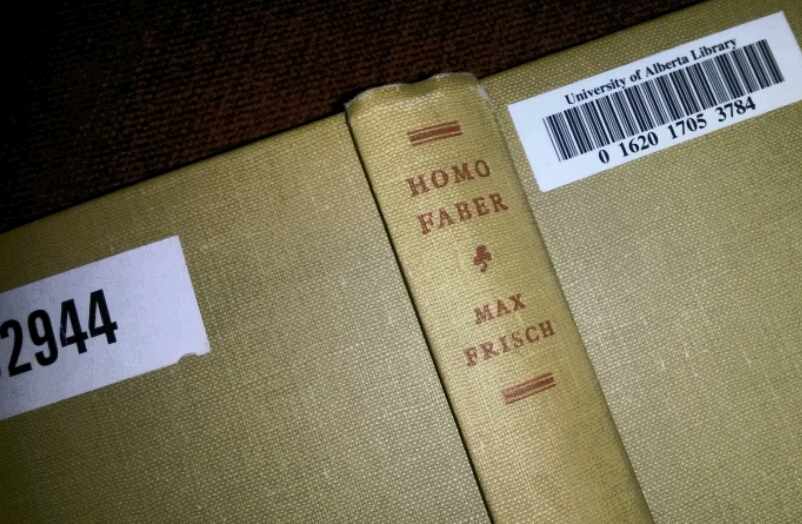
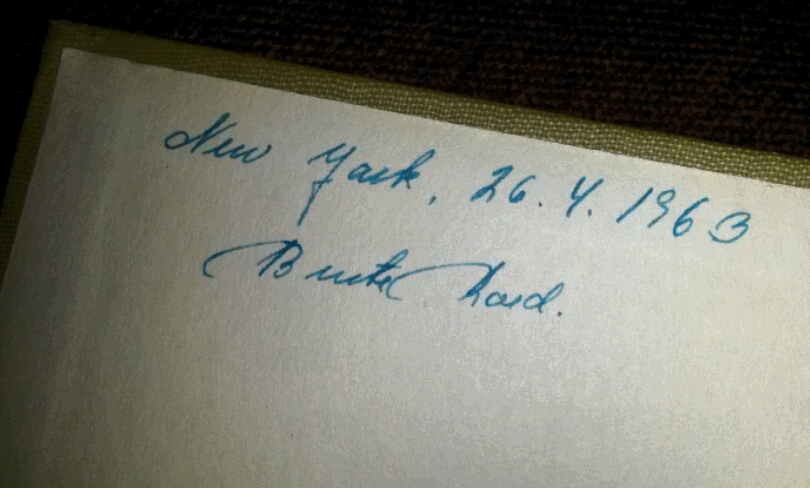
2016-03-09 18.29.26As a postscript, it’s worth noting that this book has no North American rights and, in Canada at least it is as rare as hen’s teeth. I ordered a copy from the UK in early February which has yet to arrive. The ante was upped when I was asked to provide a short “trailer” about this book for the upcoming Spring issue of The Scofield Magazine (Max Frisch & Identity). I ordered a second back up copy for $1, also still missing in action, and placed an inter-library loan request for one of the two copies held in this entire province. Apparently that route has an expected 5-6 week turn around, so getting desperate I finally had to have a librarian from the central branch coax the U of Alberta to find it on their shelves and courier it (at my expense) so I could read it and get my requested piece off by the end of last week.

Ah, but some day I will own two copies of this book! Good thing it’s a keeper.

Thoughts on Among the Bieresch by Klaus Hoffer

Sometimes, when I am reading a book that I know I will want to write about, my thoughts about the work at hand take form in the process of reading in a manner that will later inform and direct my review. Other times, the route from reading to writing is more circuitous. I tend to take copious notes, underline and engage with my books, but, having said that, there is always the risk of failing to see the forest for the trees (or more explicitly, failing to appreciate the text for the words). Then, when I sit down to write, no matter how much I may love the work at hand, I look back over my notebook and face too many words to sift through.

BiereschAmong the Bieresch, the long-standing German cult classic by Austrian writer Klaus Hoffer is a book that threatened to undermine me, as a reviewer, with its words – words that are supercharged with meaning and reference to a broadly expanding literary and socio-economic landscape. The beauty of this book is that it works on so many levels and now, with its recent release from Seagull Books, in an animated translation by Isabel Fargo Cole, an English language audience has the opportunity to meet and explore the singular world of the Bieresch.

My review of Among the Bieresch has been published by 3:AM Magazine. I am most grateful to Tristan Foster for his wise and patient editorial guidance as I floundered, at times, in my own words.

Meditation on a poetic meditation: To Duration by Peter Handke

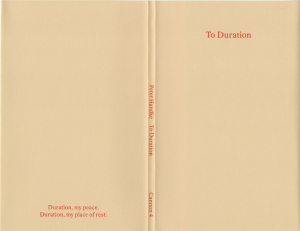
In a month during which reading proved to be a slow, at times disjointed enterprise, I feel it would be shortsighted to let January come to a close without calling attention to one of the simplest, most precious reading experiences I enjoyed over the past 31 days. It arrived, courtesy of the translator, on a morning when I was rushing out of the house on my way to an appointment across town. A slender, pocket sized volume, it proved perfect company for a busy day. Only 40 pages long I read it several times before the week was out. I am speaking of Peter Handke’s poetic meditation To Duration, translated from the German by Scott Abbott.

The author tells us in the opening stanza, that he has long wished to engage in the following personal quest, the exploration of a topic that he feels is best suited to the poetic medium. Perhaps it is only with a poem that language can circle around and come close to touching on a subject that is, by its very nature, difficult to pin down and describe. Words are almost too solid to capture an experience that dissolves as quickly as it arrives:

Time and again I have experienced duration,
in early spring at Fontaine Sainte-Marie,
in the night wind at the Porte d’Auteuil,
in the summer sun of the Karst,
on the way home before dawn after love.

This duration, what was it?
Was it an interval of time?
Something measurable? A certitude?
No duration was a feeling, the most fleeting of all feelings,
more swiftly past than the blink of an eye,
unpredictable, uncontrollable,
impalpable, immeasurable.

Duration, Handke tells us, is not fixed or prescribed; it cannot be scheduled or delayed. It can be approached, but it cannot be forced or guaranteed. I would wager that as our lives grow more stretched, weary, and fraught with the disillusion of time, duration becomes ever more elusive. I also wonder if, when we try to grasp at it through our memory of those moments when it seems we once met duration in passing, the more impossible it seems. And then, one day, when we are not expecting it, the feeling taps us on the shoulder, washes over us and moves on but leaves its trace, like frost on a bare branch or the hint of dew on the grass. One of the true gifts of this book, is that it inspires the reader to explore his or her own experience of duration. What is it for me,when is it, when was it, where? These are the questions that the reader is encouraged to meditate upon, as Handke reflects back upon his relationship with duration in his own life. His calm, measured, and sensitive introspection invites you to engage in the same.

At one point he talks about travel and journey as opportunities to open oneself to encounters with this feeling. There was a time when I was able to regularly visit certain parks and pathways in my hometown, typically with my camera in hand, focused on nature framed through the lens – a dried leaf here, a glimpse of a meandering stream there, the shifting pattern of clouds in the wide blue sky. At home, processing the files, I could almost revisit the moment – it was not the photograph that fixed the moment, in and of itself, it was rather an ability of the image to contain, for me alone, the experience of being in the moment. Is that duration? A variation on the theme? And why don’t I visit local parks as much as I used to?

In truth, I need a greater distance, at least right now.

23823656024_da6c196a78_b
Sea Point Promenade at sunset, July 2015 – Copyright JM Schreiber

Last summer I spent three weeks in South Africa. After a visit with a close friend in the Eastern Cape, I returned to Cape Town for a week on my own. I traveled on foot and by city bus, eschewing most of the tourist sites. I wanted to be in the city. I stayed in a small B&B in Sea Point and every day I walked the Promenade along the Atlantic. A popular pathway, no doubt, but there was, for me, an essential necessity to be close to the ocean. Sometimes I would stand at the salt-corroded railings and look out over the waves and find a deep peace at being so far from home and all of the complications left behind there. I could turn around and ground myself with the unmistakable landmarks of Signal Hill and Lion’s Head. It was the moment experienced and re-experienced each day that became the fulcrum of my stay in the city. No day was complete without it. If I lived in Cape Town I don’t think I could have touched duration like that, so intentionally. The measure of seven short days, coloured by an intention to be less a tourist than a presence in a city, not having to actually attempt to fit in like I do at home, I touched a peace of place I rarely experience. Travel can do that.

But physical travel,
the annual journeying and pilgrimages
for the jolt of duration,
the thrilling supplement,
is that really still necessary for me?

Handke acknowledges increasingly finding more instances of duration closer to home, even in his own garden. Restless as I am in my house and home, I likely frighten off duration, so fragile and fleeting a guest. Yet just the other night it caught me unaware. My elderly father, still seriously weakened and disoriented following his stroke, insisted on returning home from the hospital on Thursday against the recommendations of his doctors and the wishes of his family. I quickly gathered some clothing and personal items in one bag and tossed a handful of books from my priority pile into another and headed out the door for the two hour drive to the remote location where they live. That first evening, once my exhausted parents were safely tucked into bed, I sat in the delicious silence with my collection of books. I wasn’t actually expecting to have time to even start reading any of them – I just wanted to spend time with these relatively new acquisitions. Get to know them a little. Read a few pages. This unexpected moment, borne of a collision of unwelcome circumstances, opened the door to duration, inviting that unpredictable, immeasurable sensation, to wash over me, leaving a sense of contentment I hardly imagined I would encounter when I had headed for the highway only a few short hours earlier.

Perhaps then, if you watch for it, open yourself to it, maybe duration is not quite as elusive as it may seem.

scan-2


To Duration, Cannon Magazine No. 4, is published by The Last Books.

With infinite thanks to Scott Abbot.

Closing out the old year with December by Alexander Kluge and Gerhard Richter

So, my first post of 2016 is a look at the last book I read in 2015. In truth I read it throughout the last month of the year, although not a little each day as intended, my father’s illness has interfered with all of my best laid reading plans of late. However I could not allow the year to draw to a close without finishing this book of calendar stories marking a passage through the month of December in the unique and inimitable style of Alexander Kluge, complemented by the haunting wintery forest scenes captured by Gerhard Richter.

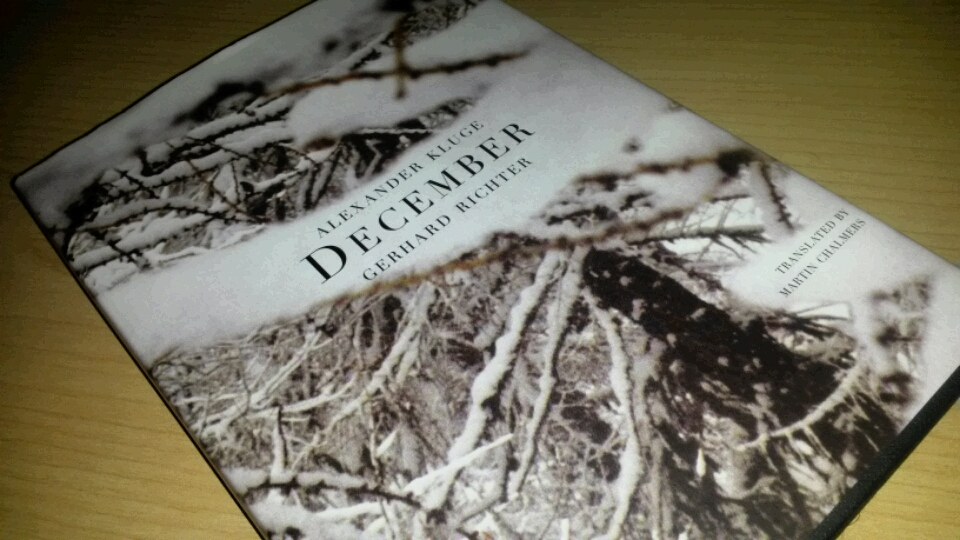
2016-01-01 17.29.52This slim, elegant volume is my first encounter with the work of the German writer and film maker Alexander Kluge. The 39 stories, many less than a page long, are presented in a straightforward manner with a humour so subtle and wry that it simmers below the surface, blurring the perceptual line between history and speculation. Kluge offers a chronicle of an alternate reality so close to our own that it can catch you off guard. A flimic sensibility permeates each entry.

December is divided into two sections. The first part contains a series of dated entries, one story, or a cluster of stories, for each day. The years assigned to the dates vary. Many of the scenarios are set in or around the years of the Second World War. Others tend to be placed in the latter part of the first decade of the twenty-first century. But there are forays far back into prehistory and looking off to a distant future. Characters wander in and out from historical factual reality, war themes of conflict and destruction recur, as do images drawn from concerns about climate change and the fallout from the economic collapse of 2008. The ageless question of the nature of good and evil is a prevalent theme – “evil proves to be good displaced or straying in time” – as is the measure of the passage of time itself, whether measured on a global scale or at a much more personal, intimate level:

“The uncertainty, above all the lack of influence on whether and when someone will be struck down by the war, makes the soul bold. There is nothing to be lost any more.

So, after an air raid in 1944, which went on for hours, Gerda F. did not save herself up any longer. No thought of waiting for one of the returning warriors, whom she still knew and who would ask for her hand. She  didn’t want to get to know any better those left behind in the armament factories of the place. All were looking for closeness. She took a man who was passing through town up to her room. They never saw each other again. There was nothing about it that she regretted.”

The second, shorter section is titled “Calendars are Conservative”. They form a series of reflections on the way time – days, months and years – are recorded, calculated, and, as in certain situations such as during the height of the French Revolution, manipulated and distorted. The revolutions of the earth on its axis and the passage of the planet around the sun may be measurable with relative consistency, but that has not kept humankind from trying to understand, articulate and contain the progress of time, again in both the macro, political sphere and in the individual philosophical context:

“What manifests itself in my story, the story of a living person, is not COMPLETED PAST (what was, because it no longer is), also not the prefect tense of what has been in what I am but instead the OTHER of what I shall have been for what I am in the process of becoming.”

2016-01-01 17.32.15To spend a month, dipping in and out of the stories, anecdotes, and reflections Kluge has assembled to mark the end of the year is a treat. Although the images are often sombre, the atmosphere is contemplative. Gerhard Richter’s accompanying photographs enhance the measured tone. If you have ever experienced a day of heavy and unexpected snowfall, those days in the Northern Hemisphere that can bring all but the most essential services to a halt, granting a welcome reprieve from school or work for many; you will know how time can slow to a leisurely pace while the thick blanket of white muffles the day to day noise of the city. That is the sensation captured in the muted monochrome images of snow laden branches in silenced forests. This is the December we hope for but, caught up with the demands of year end and pressures of the holidays, frequently fail to achieve. A time to contemplate the past, for better or worse, speculate about the future and pull another calendar year to a close.

Translated from German by Martin Chalmers, December is published with the expected fine attention to detail by Seagull Books.

In the era of the great ‘still’: The Room by Andreas Maier

“Venturing in there during the time of the stench would have been hell. I would have died of disgust. But I wasn’t scared of the room: given that setting a foot in there was completely inconceivable, its existence, so to speak, fell completely under the threshold of my perception. It was there, and yet at the same time it wasn’t.”

Set in the Wetterau, the fertile agricultural region north of Frankfurt, The Room by Andreas Maier marks the beginning of a proposed series of eleven memoir/novels exploring small town life in post war Germany. The reference point that launches this ambitious project is modest – the room that was once the private, darkened domain of the narrator’s uncle J. It may sound rather claustrophobic to begin with such a confined and specific space, but the spirit of this small novel as is expansive as the unfettered and innocent imagination of the simple minded anti-hero at its centre:

“This is the beginning that everything else stems from. The room, the house, the street, the towns, my life, my family, the Wetterau and everything else beyond it. My uncle, the only human being without guilt I have ever known. On his way into the real world, but with one foot still in paradise.”

As a consequence of a difficult forceps delivery, J would never shed the wonder and fleeting frustrations of a willful child as he grew into an adult. If it made him vulnerable, he didn’t notice. Incapable of feeling pain and always eager to fit in, he was unaware of the cruelty, physical and emotional, directed at him by his peers and by his own father. He lived in a world of fantasy – peopled with war heroes, mountain climbers, stone masons, crane operators, policemen, hunters. He loved to walk in the woods, could identify different birds, and seemed to have a special affinity for plants and animals.

RoomBut perhaps, more than anything, he was deeply attached to his brown VW Type 3 Variant and, quite remarkably, he had a drivers license. Driving, for J, was a huge production which he took very proudly and seriously. He was a simple man living in a simpler time, but at a moment when the world was poised to enter a new global reality. In his experience, J existed at a time when workers still routinely drank before work, on the job and, of course afterwards; when smoking three packs of cigarettes a day, though as deadly then as now, was not discouraged; and when no one commented if you scooped five teaspoons of sugar into your cup of coffee.

“My uncle didn’t live a healthy life, that’s for sure, but then again it wasn’t really the fashion to live healthily back then – you could pretty much choose the way you would die, and it was usually the way you had lived.”

The narrative around which the The Room is constructed, with many segues and asides, is the imagined description of a typical day in the life of J, at some point during the year of the moon landing, 1969. The narrator himself is only two years old at the time, so he does not pretend to remember anything that he sets out to recreate. Rather, he builds on what he has heard of his uncle’s life, filtered through his own childhood memories of a foul smelling man who frequently annoyed him or made him uncomfortable, and the adult understanding and compassion that, sadly, came too late.

J’s day begins early with a walk to the train station. From there he catches a train to Frankfurt where he works at the postal depot, a job his brother-in-law, a lawyer, had secured for him after his father’s death. What he thinks of his job and how he fits in there is not known. After work he is pictured considering the advances of a prostitute in the Red Light district near the Frankfurt Train Station. Does he enter the brothel or hurry home? His nephew sketches out varied scenarios but, in the end, he does not know what goes on in J’s mind.

“In my uncle, therefore, you could alternately see either the triumph of nature over the law or the triumph the law over nature. In reality, though, he was positioned between the two, and presumably at the complete mercy of both, and that’s why the former Frankfurt Kaiserstrasse district offered the best opportunity to get to the heart of the matter. Germany the land of secrets. My uncle, the man of secrets.”

Upon returning home, Uncle J disappears for a nap, and then emerges to a list of errands that his family has devised for him… refreshing the flowers on the graves in the family plot, picking up his sister, delivering his mother to the hairdresser’s. He tries to resist his mother’s insistence that he shower, or a least clean himself up, a task that he pays less and less attention to as he ages. In the end he complies, driven by his ultimate goal – the hope that he will later be able to spend a few hours at the Forsthaus Winterstein in the company of the hunters he so admires. Every step of this recreated day is measured out within the framework and idiosyncratic order that J appeared to impose on his own life, imagined from the inside, but ultimately unknowable.

The narrative tone of this inventive balance of fiction and memoir is reminiscent of the filling and emptying of a time capsule. The narrator places himself into the scenery, his two year-old, pre-language self as speculative as his uncle’s world and possible mindset. Maier extends and condenses time – bringing a mythical quality to a world in flux, blending the simple man’s worldview with the adult narrator’s knowledge of how his uncle’s life will continue to unfold, and the way that the Wetterau itself will be transformed over the four decades that come to pass between 1969 and the present moment when he sits, in his uncle’s former room, now converted to an office, to commit this tale to paper.

The Room, translated by Jamie Lee Searle, is available from Frisch & Co, a publisher of electronic books based in Berlin. The next two installments in Andreas Maier’s series, The House and The Street are due to be released in the the spring of 2016.

A look at two winter treasures from Seagull Books

It may not be winter by the calendar (yet), but here, where I sit, north of the 49th Parallel and west of the Rocky Mountains, it is a perfect wintery day. The snow has been falling, no too much to be fair, but the wind has been playing with it, sweeping it into drifts and coating the roads with ice. A good day for a good book.

2015-11-24 20.04.02

In recognition of the German Literature Month reading project that is drawing to a close this week (a growing list of over 120 reviews contributed by participating bloggers can be found here) I wanted to call attention to two very special books that not only feature German authors, but celebrate the book as a work of art. Both have winter themes and are published by Calcutta based Seagull Books.

Victor Halfwit: A Winter’s Tale by Thomas Bernhard is a short fable lavishly illustrated by Sunandini Banerjee. Listed in the Seagull catalog as “Children’s Literature”, I would suggest that this is, aside from being an opportunity to introduce a child to Bernhard early (and who would not want to do that?), a book to speak to the child inside. The story is essentially classic Bernhard. On a cold winter’s night, a physician crossing through the forest on his way to see a patient, stumbles, quite literally over a man lying in the snow. This man with the improbable name of Victor Halfwit is legless as the result of an accident and now, most unfortunately, his wooden legs have “snapped in the middle, as wooden legs do”, leaving him helpless and facing a miserable end. He had been on an ill-conceived attempt to win a bet with a miller who had wagered that he, Mr. Halfwit, would be unable to make his way from Traich to Föding, through the snowy forest, in just one hour, on his wooden legs. The faint chance of winning 800 schillings – the price of the finest pair Russian leather boots, something he had long desired – was too tempting, so Victor took the bet and nearly proved the miller right. Almost. But then, even a happy ending would not be without it’s bitter dark irony. This is Bernhard after all.

Taking a sentence or two at a time, this tale is presented in the company of rich, glorious collages. Drawing inspiration from famous artworks, medical illustrations, Indian imagery, playful designs and so much more, each page turned presents a new, original background to compliment the passage in quite unexpected and infinitely wonderful ways. I will confess that I ordered this book without paying much attention to the description. I knew it was Bernhard, I knew it was illustrated, but I was completely – and happily – caught off guard by this large, most gorgeous book when it arrived in the mail. I had expected something special, but honestly I had imagined something more modest. As a gift for a Bernhard fan or a lover of visual arts, or for yourself, let’s be honest, I would heartily recommend this book.

December is a take on the tradition of calendar stories that pairs 39 short texts by German writer, film director and critic, Alexander Kluge, with 39 haunting photographs of wintery forest scenes by Gerhard Richter. Included in this collection is a story for every day in December. Some are set during the war years, others in the 2000’s; some appear to have a straight forward historical tone, others seem more experimental in form. I can’t actually say because I intend to read this book throughout the month of December. Each entry is short, no more than a couple of pages at most. I bought this book with a gift card my daughter gave me for my birthday, thinking that it would be a welcome companion for the dark days – in a practical and an emotional sense – of December. Like many, I find it to be one of the most difficult times of the year and I look forward to exploring this work as the month unfolds.

Victor Halfwit: A Winter’s Tale and December are both translated from the German by Martin Chalmers and published by Seagull Books.

The dying gold of ruined stars – Poems: Book One of Our Trakl by Georg Trakl

“Sun, autumnal, thin and shy,
And the fruit falls from the trees.
Stillness dwells within its blue rooms
During a long afternoon.”

– from “Whispered during the Afternoon”, Georg Trakl, translation by James Reidel

Many years ago when I was in school, poetry, in so far as we were introduced to it, was almost exclusively the works of English language poets. In high school I fell under the spell of the English Romantic writers and that was the beginning. Over the years though, I would be inclined to think that most of the poets I have become obsessed with wrote in English, that is, until I began to read more translated fiction. With that my attention shifted, or to be more precise, my horizons became broader.

TraklThis year, a German book enthusiast I have come to know through the “internet of book discussions”, the corner of the web I inhabit, introduced me to Austrian poet Georg Trakl. Somehow he had escaped my attention before. Of course, when you come to read poetry in translation, the question of the translation itself becomes critical. Typically, when more than one translation of a poet’s work exists I try to access and compare a few. But when Seagull Books released the first installment of a three part series of Trakl’s poetry, I did not hesitate to order a copy, sight unseen.

Poems: Book One of Our Trakl is a new translation, by American poet and translator James Reidel, of the poet’s first collection, simply titled Poems (Gedichte), which was originally published in 1913. In his note at the opening of this volume, Reidel recounts that he has endeavoured to preserve the same concentrated mania that marks the works of the 19th century poets Trakl would have read: Baudelaire, Rimbaud, Verlaine, Hölderlin and Poe. He says:

“I want to actually channel Trakl, his craft (with its implicit painterliness) and work ethic, to have him, so to speak, absorbed in the right dosages he – as a poet, pharmacist and addict – intended.”

Reidel does go on to add that to emulate Trakl’s delivery in English, the rhyme scheme of the original poems is often necessarily sacrificed, but the contortions required to retain  rhyme can trivialize a poet’s spirit and tone.

In an essay in the online poetry journal Mudlark, Reidel expands on his Trakl translation project. He provides an overview of Trakl’s short and tragic life, as well a discussion of his approach to the translation, and a selection of his translations presented with the original German. A poet himself, Reidel brings a sensitivity and insight to his reading and approach that I, as reader, value:

“I have found that when you read Trakl in the original German, you get a snapshot of what is there. When you go back, you get another view. It may be sharper or less so, and with the feeling that it is intentionally less so. This can be frustrating for those who speak and think in English, that lawyer of languages. There is no fixed point to reading him or rendering him. This makes any book of translations simply a collection of snapshots of a particular reading at any point in time. Another way of rendering/reading a Trakl poem is through the barrel of a kaleidoscope, where one can only fix on a view when one stops or when the glass bits sometimes jam. I do this.”

Born in 1887, into a prosperous Salzburg family, Trakl was a precocious child, creative and intelligent – by his early teens he was experimenting with lyric verse that showed great promise. He could, however, be withdrawn and prone to depression. He was exceptionally close to his sister Margarete (Grete), a musical prodigy with whom he is thought to have engaged in an incestuous relationship. He began publishing poems in 1908, in Vienna where he had gone to study pharmacology, a tempting profession for one who already had a tendency towards addiction. As a budding poet, he enjoyed early success and mentorship during the following years, ultimately attracting the discreet patronage of Ludwig Wittgenstein. But the outbreak of war forced him into military service. Relying on his training as a pharmacist he hoped to avoid direct combat, but the trauma of trying to attend to desperately wounded troops without adequate supplies would drive him to attempt suicide. He was sent to a military hospital in Kraków for observation, but suffered a relapse and was found dead of a cocaine overdose on November 3, 1914. He was 27 years old.

                Patterns of Decay  (c) JM Schreiber, 2011
Patterns of Decay , Copyright JM Schreiber, 2011

This first volume of Trackl’s poetry, beautifully bound and presented by Seagull books, readily lends itself to an immersive reading from beginning to end. The autumnal themes that feature so strongly make it an even more evocative read for someone like myself at this time – that is, in November in the northern hemisphere – but autumn is rendered almost metaphorical in his verses. Nature figures in his work, rendered through rural and religious imagery; however nature, for Trakl, is one which couches death and decay as an intrinsic element of its stark beauty and haunting appeal:

In the evening, when the bells toll of peace,
I follow the birds in their glorious flights,
Long multitudes, like pious trains of pilgrims,
Disappearing into autumn’s clear breadths.

Wandering through the twilight-filled garden
I dream following their brighter destinies
And feel the sundials barely move any more.
So I follow their journeys above the clouds.

There a blast of decay makes me start to tremble.
The blackbird laments in the leafless branches.
The red vine totters on rusting trellises.

While like a dance of death of pale children
Around the dark weathered rim of the fountain
The blue asters toss shivering in the wind.

– “Decay”

These are quiet, brooding poems that show a clear obsession with decline. They speak to a young poet struggling to capture the gloom in his own soul, consequently the poems have a very immediate and personal feel. Are they depressing? As someone who has had his own lifelong challenges with mood dysregulation, I find his words oddly comforting. I am not equipped to offer a critique of poetry, I am afraid I can, in this case, only speak to what I feel. And I don’t believe I am alone in registering a profound personal response to Trackl’s poetry. In his short life he produced a small, but vital, body of work that would have an important influence on other German language poets including Paul Celan, Thomas Bernhard and Peter Handke; and draw the ongoing interest of poets, translators and readers outside of German speaking countries that continues to this day, just over one hundred years after his death.

For my part, I can only eagerly look forward to the upcoming additions to Our Trakl.

For all the restless souls: The Sleep of the Righteous by Wolfgang Hilbig

The landscape haunting the seven intermeshed stories that make up The Sleep of the Righteous by the late German writer Wolfgang Hilbig, is decidedly bleak. The fulcrum around which these stories pivots is an industrial town south of Leipzig – run down, defined by its drabness, perpetually unfinished, bordered by mine pits, the ruins of munitions factories, a lake, marshes,and, beyond that, the forest. Before and after reunification, this town remains a place in which time exists on another plane of reality, at least as far as the narrators – all varying shades of the same man with more than a passing resemblance to Hilbig himself – experience or remember it:

“Time persisted here in dogged immutability; the autumnal fog banks that merged beneath an earth-colored sky appeared unlikely to pass for decades to come. And more and more smoke seemed to spill from the sodden lowlands into the flat clouds, which, even in the afternoon, were nocturnal.”

sleepThis powerful collection is divided into two parts. The first part focuses on childhood, coming of age or, as it often seems, waiting to come of age, to “rise at last from the state of useless, unfinished, in-between beings”. Set in the years immediately following the Second World War, the town is a place where men are in short supply. The majority of the children are fatherless, their mothers widowed, and few babies are born. Consequently, relationships and social dynamics are skewed. In the opening story, “The Place of Storms”, the young narrator endeavours to negotiate the murky waters between the realm of the “little children” and that of the “older children”. Rumours that his grandfather has a gun boost his status and potential for crossing the divide, while the horrific swim trunks his mother knits him complete with suspenders are a decided barrier. All of the awkward anxiety of youth is played out in the grimy pools of the abandoned mine pits at the end of the street where children wile away the summer hours divorced from the world of the suffering, lamenting adults in their lives.

The stories in the second part are set in the 1990’s, after the Wall has come down. The protagonists are all now grown men, writers, who have long since moved away from this small town, but find that they are unable to stay away. Restless, they regularly return to encounter ghosts, to visit an aging mother, or to escape a disintegrating relationship. No matter how long they may have been away, they never really leave the place behind. But they return to a town that is dying, industries and businesses that have been abandoned, and memories that cannot be escaped. In the final, and longest story, “The Dark Man”, the unnamed narrator is an established author who encounters, on the darkened streets of his old hometown, a stranger who has pursed him and now reveals that he was the Stasi agent responsible for intercepting and reading the writer’s correspondence. He claims to have a collection of letters originally intended for our hero’s former lover, a woman who presently lies near death. The narrator is disturbed, but determined not to let this curious relic of the GDR get the better of him – he denies any suggestion that he and his enemy have anything in common. Yet when he gets back to his mother’s apartment, the man in the bathroom mirror bears a haunting resemblance to what he could manage to make out of the stranger in the dark.

The Sleep of the Righteous is one of those books where you may well be inclined to stop and reread a paragraph several times before moving on, not because it is opaque or dense, but because the language is so captivating; the flow and rhythms, like eddies in a stream of water, swirling, reversing, and moving forward again. The brief title story is a sadly lyrical meditation on the cycle of guilt and recrimination that binds and defines the relationship between a boy and his grandfather who, in a reorganization of sleeping arrangements, end up sharing a bed following the death of the grandmother – a demise that one of them might have inadvertently caused. It opens:

“The dark divests us of our qualities. — Though we breathe more greedily, struggling for life, for some fleeting substance from the darkness… it is the darkness that forms a mute block above us: intangible matter our breaths cannot lighten… it seems to burst apart at each answer from the old man, each lament of breath, yet sinks in again swiftly to weigh down still closer, in the cohesive calm of myriad tiny black, gyrating viruses. And we rest one whole long night in this block of black viruses, we rest from the toils of the day: from the everyday toil of circling each other, still and hostile.”

Night after night, grandfather and grandson twist and turn to a nocturnal chorus of queries and accusations, in this poetic evocation of the tensions that underlie the fictions that families maintain to make sense of the very ordinary tragedies that strike close to home.

In his introduction to this volume, Hungarian writer László Krasznahorkai, writes that in focusing on the mundane, the everyday life in East Germany, Hilbig manages to heighten the oppressiveness of that existence, rendering it all the more horrific as a consequence: “He wrote his astounding novels about a world in which only the weak, the sensitive, those incapable of bargaining and in no way heroic, can sense the chaos and the surrealism.” However, the measured, heavily weighted quality that hangs over the stories in The Sleep of the Righteousness, is bouyed by the sheer beauty of the prose and the quiet resilience with which the protagonists respond to the circumstances that history has gifted them. This could be a depressing read but somehow it is not.

Translator Isabel Fargo Cole, in a recent interview in World Literature Today, indicates that this collection is one of Hilbig’s most autobiographical works. His narrators tend to share the same basic features of his background – his grandfather emigrated from Poland, his father disappeared at Stalingrad, and he grew up with his mother in a household dominated by women. The town he mythologizes in his tales is modeled after the same one where he was born and grew up. Yet, it does not feel liked these are connected as part of a continuous narrative so much as each protagonist seems to have a similar launching point from which he proceeds to tell his story. There are overlaps and divergences along the way.

The Sleep of the Righteous is published by Two Lines Press. Along with his earlier novel,  I, which was also translated by Isabel Fargo Cole and released by Seagull Books this summer, English speaking readers finally have a chance to experience the sombre magic of Wolfgang Hilbig. And, hopefully, look forward to more.

Last letter from Petrópolis: Montaigne by Stefan Zweig

Over the course of his life, Stefan Zweig was a most prolific writer, known not only for his novels and plays, but also for a wide range of historical and literary biographies. He has been criticized as a lightweight by those who fail to appreciate his charms, but it is difficult to deny the passion for literature and lifelong learning that informed his work. With his biographical subjects he followed the topics and personalities that caught his attention and, perhaps as a consequence, he was drawn to write about those whose work and ideas he admired, as well as some of the figures who played darker roles in history.

motaigneThe last of the writers to captivate him, the subject of his final book, was Michel de Montaigne. Hitler’s rise to power in 1934 drove Zweig from his native Austria to England, but by 1940, with Europe torn apart by war, he crossed the Atlantic to New York City where he stayed briefly before moving even further to Petrópolis, a German community in Brazil. Here in the mountains north of Rio de Janeiro, far from the library he been forced to abandon in Vienna, he would uncover a dusty copy of Montaigne’s Essais in the cellar of his house. He made this fortuitous discovery in the autumn of 1941 and his delight in it would preoccupy the final months of his life. In February of 1942, Stefan Zweig and his wife were found dead in their home. It is not certain but, as much as Montaigne provided him the comfort of a kindred spirit speaking out across the centuries, he may have also inspired or reinforced his decision to end his own life.

Zweig opens his biography with a confession that when he first encountered Montaigne at the age of 20, he was filled with youthful idealism for the new century that was dawning. He could not imagine what relevance he might find in this “Frenchman already yellowed by time and lost in the riddles of his Latin quotations”. Ahead he could only envision the prospects of peace and progress. Rediscovering Montaigne 40 years later, he found immediate parallels between the violent upheaval of the years of the Reformation and the devastating collapse of 20th century glory into the brutal waves of intolerance and destruction sweeping Europe. Curiously, the age of 20 was also the age at which Montaigne himself decided to end his formal education on the conviction that by 20 the soul is formed and thus, beyond that point, the spirit will not be further enhanced. He would, of course, turn his attentions inward in his lifelong effort to understand that soul.

There is, in the course of this short biographical account, little that will be new to anyone acquainted with the general details of Montaigne’s life and writings. What is of more interest is what this essay reveals about Zweig’s mindset in the last winter of his life. This is very clearly a personal undertaking. Even though Zweig set about researching the social and political context in which Montaigne lived, the resulting work was never subjected to a judicious edit and, as it exists, it tends to be overly repetitive in some aspects, especially where Zweig’s enthusiasm runs high. He finds in Montaigne a friend, a wise counsel so desperately needed when his own despair at the state of the world is reaching an all time low and, as such, he is inclined to defend his friend against his critics even if his arguments tend to be based in emotion rather than reason. The only criticism he himself is willing to levy is with respect to his hero’s noted disregard for his children and the women in his life, and his desire to find refuge from their demands on his energies. Still, Montaigne’s withdrawal to his tower to contemplate the nature of the self – that is, the self that interests him most dearly: his own – is a choice that draws Zweig’s sympathy and support.

As a writer and a lifelong lover of literature and history, Zweig finds a like-minded ally in Montaigne. He admires the way that Montaigne engages with books. He reads without obligation or duty, choosing to discard books that are not working for him. As Zweig remarks:

“He is without doubt a serendipitous reader, an amateur reader, but there has never been, in his time or in any other, a finer or more perceptive reader. Concerning Montaigne’s judgement on books I am 100 per cent in accordance.”

Later he continues:

“The great lesson Montaigne receives from books is that reading, in its rich diversity, sharpens his faculty of judgement. It impels him to respond, to lend his own counsel. And this is why Montaigne tends to annotate his books, underlining passages and writing at the end the date on which he read them, or the impression that they made on him in that moment.”

It is hard to argue with this sentiment. Two lovers of books, passionate about reading are bound to feel instant kinship, even when reaching across time and space. For a man in exile, cut off from his intellectual community in Europe, it is not difficult to imagine that Zweig felt he had found a soul mate in Montaigne.

But then why was this bond, this example of a man so firmly dedicated to the question of how one should live, not sufficient to carry Zweig through his darkest hours? Montaigne is careful in his essays not to dictate how others should live. His focus is always turned inward. He shares what he finds and what he comes to believe he should strive for in living. Zweig draws up a list of the constraints that Montaigne expresses a desire to avoid including: vanity or pride, presumption, fear and hope, belief and superstition, ambition and avarice, fanatacism, and family and familiar surroundings. There is, however, one more:

“And one last freedom: in the face of death. Life hangs on the will of others, but death on our own will: ‘La plus volontaire mort c’est la plus belle.’”

That is, he insists, the most voluntary death is the most beautiful. If Zweig who was known to struggle with depression had already contemplated suicide (and according to the translator’s introduction he had expressed that sentiment before), one cannot help but wonder if he found some measure of validation in Montaigne’s writings.

This biography stands as an example of the deeply personal impact that literature can have on a reader. Zweig argues that there are writers who come to you, or come back to you, at the time when you are ready to hear them. This final work took precedence over any of this other writing projects in the months leading up to February 22, 1942, the day he and his wife each took an overdose of barbiturates and lay down together hand in hand. In a sense Montaigne exists as a final effort for a sensitive writer to make peace with a world that seemed to have spun off its axis. For that reason alone it is worth the read.

glm_v

Translated from the German by Will Stone, Montaigne by Stefan Zweig is a new released from Pushkin Books.