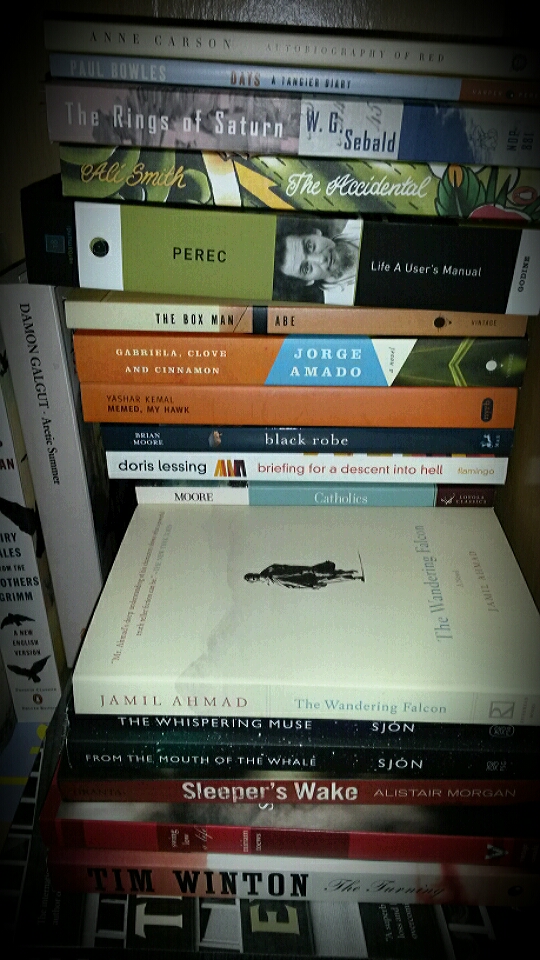
Might as well face it, I’m addicted to books…

Three weeks in South Africa and I have not blogged much, in large part due to the painfully useless little laptop I bought for the journey (sorry Windows I am in serious Mac withdrawal right now) combined with frequently slow or inconsistent wifi connections. Quite frankly I have not even read much save for a slim collection of Bosnian short stories I have been dragging around. But I have been observing, writing, journaling and taking photographs. There will be plenty of time for reading after I get back and a strict embargo on book buying for some time.

After all I have spent more than R3000 on books. Shame. Well it’s not as bad as it sounds, I spend a fair amount on books at home but not all in one shot and not with the need to transport them across the globe. I fell asleep last night mentally rearranging my bookshelves to welcome my new acquisitions home.

A selection of new titles (there are more,  confess). Trencherman, the Michiel Heyns, Tales of Metric System, Rusty Bell and The Violent Gestures of Life were all on top of my list when I arrived.
A selection of new titles (there are more, confess). Trencherman, the Michiel Heyns, Tales of Metric System, Rusty Bell and The Violent Gestures of Life were all on top of my list when I arrived.

As long as I can remember, bookshops have been a highlight of any vacation for me. Sometimes it was the chance to visit a larger centre or to access books not available at home. I mean honestly who goes to San Francisco without stopping in to City Lights? I suppose those people exist but I don’t want to know them.

This is the first vacation I have had in years, the farthest I have traveled and what I hope will be the first of many visits to South Africa. I have stubbornly had a predominately anti-tourist experience and it has suited me just fine.

But books, they were always high on my agenda. From a second hand shop in East London to The Book Lounge and Clarke’s here in Cape Town I have built piles, triaged, sorted and made my selections – sometimes price, sometime size and weight were factors. Books readily obtainable in paper format outside of South Africa were eliminated, aside from some impulse purchases. Suggestions from the friend I was staying with in the Eastern Cape, books featured on the site of a South African book blogger I follow, and advice arising from conversations with booksellers were all tossed into the mix.

A few of my second hand finds: I am looking forward to the memoir by the late Chris van Wyk and the Ettiene van Heerden on top is signed (but sadly the only one of his books I was able to locate in translation).

There are still, inevitably, titles I wanted but could not find. And some I had to leave behind.

Not one given to ostentatious displays of book porn, I am showing off some of my new friends. Wish me luck packing and dragging them all to the airport on city transit!

Desperate for a reaction: The Reactive by Masande Ntshanga

The opening lines of The Reactive, the debut novel by the young South African writer Masande Ntshanga, are startling:

“Ten years ago, I helped a handful of men take my little brother’s life. I wasn’t there when it happened, but I told Luthando where to find them.”

This fresh, matter of fact confessional tone marks the story that follows. Nathi (short for Lindanathi) was supposed to follow his half-brother to the Eastern Cape where they would both partake in rites of initiation, but he decides to stay behind. When Luthando dies due to complications, Nathi feels responsible. The memory of his brother, guilt and family obligation are themes that weigh heavily on the young protagonist as his tale unfolds.

23370655After his brother’s death, Nathi decides that he had best make something of himself. He enrols in university to study journalism but drops out and goes to technical college instead. He tells us that it “didn’t take much to go to school for free, in those days, or rather to trade on the pigment we were given to carry.” His tech degree lands him a job in a lab testing blood samples for HIV. In the process of testing for samples that are positive – reactive – he himself contracts the disease. He envisions himself as half-dead already. Set in 2003, with South Africa on the cusp of making anti-retroviral drugs freely available to all HIV+ individuals, Nathi sells his ARVs to others. Otherwise he drifts from job to job while spending much of his time sniffing industrial glue with Ruan and Cecilia, friends he meets at a counseling group.

In the background to all of this is a promise he made to his brother’s stepfather, his uncle Bhut’ Vuyo, a former mechanic fallen victim to alcohol and now living in Du Noon, a bleak settlement on the edge of Cape Town. Nathi had received refuge in Du Noon after disgracing his mother by dropping out of university. A text message reminding him of his commitment to his brother’s family some eight years after the fact, sets the story in motion. Nathi is drifting, he is taking risks. An encounter a with a curious masked stranger who engages the three young drug dealers in an illicit business deal may just be the motivation he needs.

In The Reactive Ntshanga paints an image of the new South Africa that is fresh and alarming. Nathi and his friends are all educated. They have or have had good jobs, apartments in Sea Point, but they are slowly losing motivation, sliding from one day to the next, grabbing taxis to parties with eccentric artists, going nowhere fast. In the end Nathi will have to decide for himself where his own loyalties lie.

This is a disturbing story, but one that is told with language that shimmers and an intensity that simmers just below the surface. Nathi’s voice is captivating, he and his world come alive. Cape Town provides an essential backdrop, as does the settlement where Bhut’ Vuyo lives in a shipping container. There are also important references to the Eastern Cape and King William’s Town, which it turns out, is the author’s home town.

Now none of this would be critical for the enjoyment of this book but, as a Canadian on his first visit to South Africa it is oddly serendipitous that I read this book on the bus, the same line that features briefly in the text in fact, on my way back to Cape Town from East London. I would likely have passed through King William’s Town with little notice in fact had I not traveled out to the Eastern Cape with a retired Xhosa man returning home to the town for a family funeral. We talked a lot through that 16 hour journey, about our countries, about life, about politics. For me, my experience of reading The Reactive will be bound to my trip and I look forward to watching Ntshanga’s career develop. He is already receiving a lot of well-deserved attention at home and abroad.

The Reactive is published by Umuzi and is available as an e-book, at least in Canada, likely elsewhere. A paper edition will be published in the US by Two Dollar Radio in 2016.

Further notes from South Africa: Wildlife and quiet times in the Eastern Cape

I have been in South Africa for just over a week now. It’s been an amazing opportunity to meet people and observe the country on its own terms. The closest I have had to a typical tourist experience has been our day trip to Addo Elephant Park. Nothing quite prepares you, on your first visit, for the sight of these huge majestic beasts looming ahead on the road, appearing out of the bushes. And there is so much more to see than elephants. We were stoked to encounter two young rooikatte along the roadside. These lynx are a rare sight at the best of times and we were able to sit and watch them for 15 minutes.

Rooikat
Rooikat
Addo Elephant Park
Elephant  – Addo Elephant Park, South Africa

The value of taking time to relax, soak in the countryside, meet fascinating individuals and spend quality time with my friend has been exactly the medicine I needed. In a few days I will make my way back to Cape Town for the much more urban, cosmopolitan side of my stay which will, in its way, be quiet and introspective. Cities can be good for being alone too.

Old sheep
Old sheep
Eastern Cape farm garden

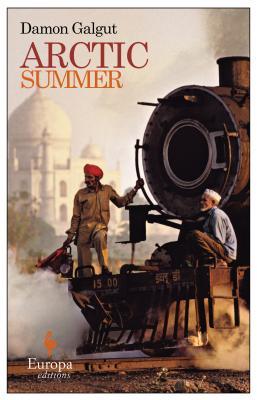
My endeavour to gather more South African literature to bring home is going well. So far I have collected a stack of second hand books from a little shop in East London here in the Eastern Cape and have another stack waiting for me back in Cape Town. I have been digging through my friend’s bookcase for titles to look for here or back home and last night I was thrilled when my favourite author, Damon Galgut, won the Sunday Times Literary Award for South African fiction for his novel Arctic Summer. So, a fine literary excursion to date.

South African sunset - All photos copyright JM Schreiber
South African sunset – All photos copyright JM Schreiber

Otherwise it has been a relief to step back from my normally heavy engagement with news and social media. I did read with dismay about the terrorist attacks in France and Tunisia. I was relieved that my American LGBT brothers and sisters have achieved a long overdue milestone. But I came to South Africa in large part to put as much distance between myself and my life at home as possible for a few weeks and, for now, watching waves crash on the shore or sitting on the stoep and watching the sky burst with colour in the evening or listening to Breyten Breytenbach reciting poetry in Afrikaans is therapy of the best kind.

Roughghosts is one year old today: Looking back and ahead

Today I received a notification from WordPress congratulating me on my first anniversary. Well happy anniversary to my alter ego roughghosts who was born on this day from a scarp of creative writing I uncovered in one of my endless unfinished notebooks. I never was very clever with user names; most of my aliases amount to little more than my initials and the first 5 letters of my last name.
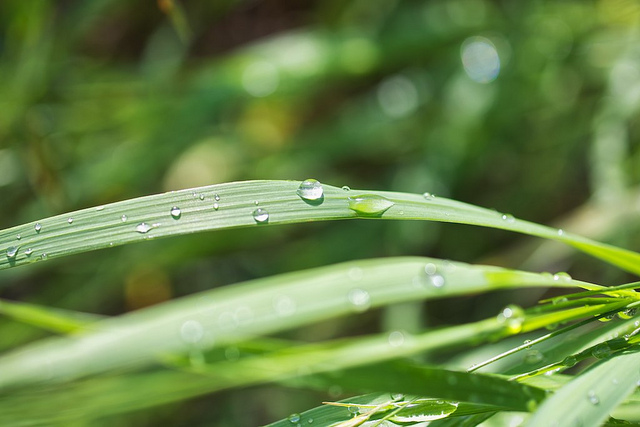
Copyright JM Schreiber, 2014

I have become quite fond of roughghosts. It suits me, more than I might have imagined, or at least been willing to admit on May 31st of last year. To be honest, I created this blog to engage with other WordPress blogs and, I don’t know, maybe reflect a little, and explore some creative writing. At the time, a little voice I the back of mind said this looks like a rather manic move. After all I was under a soul crushing amount of stress at my workplace, had a major fundraiser and annual report due, and had not slept for more than a few hours a night since the previous November. But I shrugged it off, forged ahead only to crash and shatter into a thousand pieces a few weeks later.

Today, I have managed to rebuild myself to a point. There is still a lot more glue, stitching and healing required. Mania has subsided to a simmering depression with doses of anxiety and a pill that I do not like but is presently necessary as a sleep aid. And roughghosts the blog has evolved from a space to moan about the shock of realizing that, yes, I still have a mood disorder and all the fallout that a major breakdown entails, to a book based blog with a strong focus on translated and international literature.

Over the past few months I became involved with a jury shadowing the International Foreign Fiction Prize (IFFP), a challenging and highly rewarding experience. It taught me to read faster – still no speed demon, I – and read more deeply with a specific goal to being able to rate and write a constructive review for each book. I have started scribbling in margins and filling notebooks when I read. As a reader and a writer this has been invaluable. The camaraderie of reading and discussing the books together was an added bonus, introducing me to a great group of book bloggers. My subsequent expansion of activity on twitter has further enhanced this community of readers, publishers, authors and translators.

Then, close on the heels of the IFFP came the Best Translated Book Award (BTBA) with a challenging and exciting longlist and a selection of small North American independent publishers to discover. Adding to this embarrassment of riches for lovers of translated literature was the conjunction of the biannual International Booker and the writers I want to explore from that list of finalists. And, on top of all this, my longstanding interest in South African literature will be further nourished by a trip to that county in a few weeks with a list of books I hope to obtain.

I am, I hope, reading my way back to wholeness. Preparing to write my way back into the world, or rather document my very real journey into the world in a full and honest way for the first time in more than half a century of living.

This past week’s awarding of the 2015 IFFP and BTBA prizes saw the celebration of female authors and translators. The IFFP honoured Jenny Erpenbeck and Susan Bernofsky for The End of Days, a decision that coincided with our shadow jury’s esteemed choice. This is a most important book with a timeless theme spanning the whole of the 20th century. About an hour later the 2015 BTBA was awarded to The Last Lover by Chinese author Can Xue and translator Annelise Finegan Wasmoen. I encountered this book as a longlisted IFFP title and simply fell in love with the surreal, dream-like tale. Notably, Can Xue was also named that same day with six other women and two men as finalists for the Neustadt International Prize for Literature. I’ve been decidedly excited by this celebration of female writers and for those who know me, that is a huge shift in my own approach to literature.

Back in late January I wrote a pot in response to a discussion on the Tips, Links and Suggestions blog of the Guardian which had caused me to reflect on the abysmal ratio of female to male authors in my reading and on my shelves. However, my more explicit focus on literature in translation is slowly beginning to shift that balance. Especially if one considers how many of the works I read, if written by men, were translated by women. And I am taking serious note – not only should I endeavour to read more female writers, I can easily fall under the spell of Can Xue, Anne Garréta, Marlene van Niekerk, Olja Svačević or Valeria Luiselli, just to name some of the authors that have really impressed me of late. And I am pleased to report that an increasing number of the books I am currently reading or planning to read feature female writers and/or translators.

Copyright JM Schreiber, 2014

So, on my first anniversary as a blogger, I look back over an ad hoc journal chronicling an ongoing passage from a terribly messed up state, struggling to make sense of a sudden shock to my self esteem, my confidence and my identity to a place where I have a strong real life community, solid mental health support and a creative environment where I am proud of the work that I publish in this space. Moving forward I hope to explore further writing opportunities, continue to recover and, with luck, make my way back into productive employment.

And keep reading a lot of terrific, exciting and challenging literature from around the world.

How do you see me, anyway? Sphinx by Anne Garréta

“What I was feeling for A*** needed its own embodiment; the pleasure I took in A***’s company demanded is own fulfillment. I wanted A***, it was true, and all my other desires, needs, and plans paled in comparison. Suddenly, the obsessive clamor for amorous possession took hold of me.
I was surprised to find myself desiring, painfully. In a sudden rush of vertigo, I was tantalized by the idea of contact with A***’s skin.”

What we have here is the impassioned confession of the unnamed narrator of Sphinx by Anne Garréta. A*** is the object of this sudden and intense desire. Neither are defined by sex or gender. This factor, acts as a constraint that places this French novel within the ranks of the works of the OuLiPo group of authors (though,written in 1986, it predates the author’s admission to this famed group). Yet in the end, Sphinx requires no such designation to work as a powerful literary, darkly existential meditation on memory, attraction and identity.

sphinxThe more I heard about this book, a new release from Deep Vellum Publishing, the more conflicted I felt about whether or not it was something I wanted to read. My reasons for that uncertainty are deep seated and will be discussed below, but let’s get one thing out of the way first… Sphinx is one stunning, dynamic and important novel. To finally have it available in English, and in a world in which the public understanding of sex and gender is evolving, serves as an invitation to approach this work as more than either a literary challenge in itself or a polemic of feminist/queer theory.

Oh, wait a minute. Is it a good story? One that stands on its own merits? At first blush, the set up sounds, and at points may even feel artificial, but that oddness passes quickly. The narrator is a young student of Catholic theology who is drifting without strong direction and, through a series of unusual, even disturbing, coincidences ends up working as a DJ at an after hours Paris nightclub. This serves as an introduction to a new world, an alternate reality that opens late at night, to unwind in the very early hours of the morning. Our narrator demonstrates a tangible ambivalence toward this radical change of lifestyle.

“I acquiesced to whatever presented itself without much arm-twisting, and I neither suffered from nor reveled in it: I was spared the exhaustion of searching and seizing. I was giving up a state of being that was in turn abandoning me and sliding into another that slowly, imperceptibly came to envelop me.”

In learning to navigate this world, an identity that may or may not be valid or true, is adopted to serve as a barrier, a means of mediating an alien environment. Within this identity a certain boundary, a sober vantage point is maintained until A***, an exotic dancer at a strip club, comes into the narrator’s life. At first their friendship is platonic, existing in a stylish public sphere. The narrator realizes it is not built on strong romantic or intellectual engagement. The attraction is one of opposites – race and personality – until sexual desire arises abruptly, throwing the narrator’s carefully constructed identity into a crisis which is heightened as A*** initially refuses to take their relationship to an intimate level.

When it is ultimately consummated, a highly charged sexual and romantic liaison develops, enduring several years marked by turns of passion, jealousy and domesticity. As might be anticipated in a union built on obsession rather than common interests, cracks and fissures begin to grow. This is heightened as the narrator seeks to revive abandoned theological pursuits, carving out time to focus on an essay, quite fittingly, on the apophatic tradition – the attempt to describe God only by negation. Later on, after the tragic end of this ill-fated love affair, the narrator will sink into a deeply existential rumination on love and loss. No sexual encounter, romance, intellectual or academic pursuit will fill the void left behind. A restless wandering overtakes our hero, driving a spiral into ever darker self exploration. Without the “other” as a frame of reference, it becomes increasingly evident that the self is isolated, disconnected.

“Had I confided more in A*** than in anybody else? What had I revealed? Had I unmasked myself? No, more likely I had exposed my own collapse, the ruin of the edifice I had so painfully constructed out of rhetoric and made to stand for an identity.”

At heart this is a novel of obsession, of memory, of mourning. The language is rich and sensual, with an intensity that is visceral and emotionally powerful. For that alone, Sphinx is a work worth attention.

But what about the matter of sex and gender?

I suppose it will come down to how important it is to have a fixed image of the protagonists in your mind as a reader and how fluid your conception of gender is in relation to sex and sexuality. Are they bound together, or three separate aspects of identity? For the majority of people, biological sex conforms to gender identity. They are experienced as one and the same. Sexuality hinges on the sex and gender of the persons to whom one is attracted. Transgender is an umbrella term for those for whom sex and gender do not fit exactly. The range of gender expressions, identities and bodies under that umbrella is wide and the intersection with sexuality can further complicate the issue. Queer theory aside, a novel like Sphinx opens up the potential for a completely free reading experience. One can choose gender, sex and sexuality as desired, play with alternatives in the reading, or re-encounter the work with repeatedly different contexts. Garréta has incorporated enough ambiguity to open up all possibilities. The decadence of club life is contrasted with the sober pursuits of the serious intellectual and blended with domestic engagement and the dynamics of extended family.

For a queer reader like myself it is a glorious opportunity, one I would have loved to encounter back in my isolated teenage years. Even into my 20’s and 30’s as I sought to make sense of a physically gendered space that felt fragile and ungrounded at its core, distorted and confused by my ostensible sexual orientation. Now in my 50’s, 15 years after transitioning, Sphinx speaks to me on yet another level. I can and have easily existed in the world as a gay transgender man without outing myself on either count unless I chose to (like I am at the moment). I am invisible not only online but in the real world. Yet the challenge arises in the building of close and honest relationships with others. I cannot talk about my past, my marriage, my subsequent affairs without resorting to a vagueness, to the construction of a gender neutral self-imposed witness protection program. If I am sexually attracted to someone an entirely different level of discussion is required. Coming out is a constant and continual process. Sometimes it is easier to retreat. And while English does not create as much difficulty for the moments in literature or life when genderlessness is preferred as French, a recent conversation with a young gay man from Mexico who is not out brought home to me the more profound challenges of a Spanish speaker who cannot even talk about a “partner” or “friend” without indicating gender!

I do not believe that the loneliness and ennui that seep into the narrator’s very marrow as Sphinx progresses are unique to queer experience. We all long for human contact and when you find yourself single when you had not expected to be alone, it becomes easy to imagine yourself undesirable, to berate yourself for not making the most of moments or opportunities that may be past, or seek fleeting satisfaction in meaningless encounters or distractions. However, the arrival of this novel at a moment when discussions and awareness of identity and sexuality have progressed well beyond where they were almost 30 years ago, is especially timely and exciting.

The anxiety with which I approached Sphinx was admittedly specific to my personal life history. I have been routinely disheartened by the way matters of sex and gender are presented in literature. I suspect that the author’s theoretical grounding would diverge from mine, but there is not, as I had feared, a perceivable political agenda that interfered in any way with my full enjoyment of this book. Thanks to a fellow blogger (Tony Malone) who challenged me in what was, in my time zone, a late night twitter conversation to give Sphinx a read – believe it or not it was his nod to Camus that sold me – I have become an enthusiastic supporter. I am writing this before I see his review but I am certain he will cover other angles.

Thank you to Deep Vellum for bringing this important work to an English language audience. Emma Ramadan’s translation is most wonderful. As she describes in her afterward, Garréta was forced to employ a great deal of ingenuity and creativity to avoid revealing the narrator’s gender. In English genderless narrators are not unique. A*** has to be presented with more care and less depth. But that is in keeping with the narrator’s own lack of understanding of A***. It all falls together beautifully with an intensity which is meditative, unsettling and, at times, deeply moving.

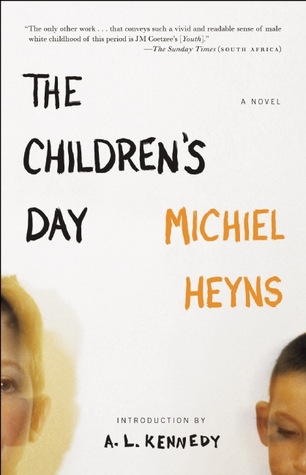
Coming of age in the 60’s: The Children’s Day by Michiel Heyns

Small town South Africa. The 1960’s. Rules govern social engagement. Black and white, Afrikaner and English, richer and poorer. Even in the smallest of towns a hierarchy of social stratification evolves and is reinforced with a blend of gossip and charity. And then there are those most ineffable mysteries of life: love, sex and death.

childrensSuch is the context of The Children’s Day by Michiel Heyns. At the heart of this Bildungsroman is Simon, a sensitive, intelligent boy charting his way through the machinations of childhood in the dusty environs of Verkeerdespruit. He is keenly aware that he is living in the heart of nowhere. But the books that are such a vital companion to this only child cannot even begin to answer the questions that his interactions with classmates and the curious behaviour of the adults around him continually raise. Simon is left with the impression that he is trying to put together a jigsaw puzzle without all the pieces.

The novel opens in the modest, relatively speaking, metropolis of Bloemfontein, where Simon, now 15, is attending Wesley College, a “second-rate” Methodist private school. The occasion of a tennis match between the boys of Wesley College and a nearby technical high school on a stifling hot December day in 1968 unspools a series of flashbacks that reach six years into the past and gradually move forward. Simon’s reflections are triggered by the unexpected, unwelcome appearance of a former classmate on the visiting school’s team – the awkward, epilectic Afrikaner Fanie van den Bergh.

From the time he first arrives in Verkeerdespruit, Fanie is a curiousity. His fits alarm his classmates and teachers, while his inarticulate, easy-going nature sets Simon off balance. He regards Fanie with a measure of contempt to which the latter appears oblivious. Yet  Fanie is a constant source of surprise. When Steve, in his tight jeans and white t-shirt, roars into town astride the magnificent Matchless G8 bringing a touch of heroic glamour to streets of the sleepy village, attracting the adoration of the boys,and the fluttering of female hearts, it is Fanie who disappears on the back of his bike. The fallout resulting from Steve’s arrival marks the advent of Simon’s awareness that the world is full of joys and dangers that the adults around him allude to with the most cryptic references. Frustratingly alert to the innuendos around him, Simon is delightfully naive as only a child of the pre-internet era can be. I remember it well myself. As Simon admits:

“Though I was probably quicker than my contemporaries at fitting together apparently unrelated observations, I was hampered in my deductions by an almost complete ignorance of sexual matters. I had arrived, for instance, at the conclusion that kissing was both a much sought-after pleasure for oneself and a much-ridiculed weakness in others, and that adults were too old for it and children too young.”

By observing the parade of adults that passes through his home town, Simon’s glimpses of the outside world become broader, if not necessarily clearer. A teacher who takes harsh discipline in the classroom a step too far is sent away, a pretty young girl he assumes is a special friend abandons him for the school jock, a woman with a shocking past appears and breaks the heart of one of his favourite teachers. And then there is Trevor with his dyed hair and pink shirts who shocks everyone by shaking up the life of the stuttering shy bachelor postmaster and his mother, briefly redesigning the beehived heads of the local women before being run out of town once speculations about the true nature of his friendship with the postmaster spread. Again Simon is perplexed, though it is Trevor who first implies that he sees in the boy a likely kindred spirit. The only outlet he has for the really “big” questions that trouble him are his Saturday afternoons at the local soda fountain with Betty “The Exchange”. The cynical, unfortunately chinless, telephone operator entertains Simon’s queries but confuses him as much as she informs him – children, after all, are only allowed so much enlightenment in this era.

It is Fanie who, in the end, stands to call attention to the missing puzzle piece that Simon has been holding in his hand all along.

I have an affection for strong coming of age/coming out stories. This is one. Sexually Simon is a slow learner, a boy who is less in touch with his body than the more viscerally grounded if intellectually dimmer Fanie. He over thinks the world even though he encounters more than one adult male who recognizes in him an inclination that he has, at an early age, no context for. Today with the ubiquity of queer conversation, imagery, access to internet, resources and young adult novels that explore queer themes, it may be hard to imagine how isolated a child could be growing up in earlier decades. Some claim this is an argument for censorship or against realistic sex education in the school system. But that is a spurious argument. One could still grow up LGBT in a vacuum. Or worse in denial. Many of us did.

I grew up in the 1960’s and 70’s in conservative rural Alberta. My parents, like Simon’s were liberal, but, like my peers, there were so many facts of life we did not understand and would not have dared to ask. Especially if there was any inclination that our own sense of self was off the norm. Long before one could retreat to the wisdom of Wikipedia, our resources were limited. I will never forget when the word “faggot” started to appear on our radar, probably as 10 or 11 year-olds. We would scurry to our dictionaries to find only “A bundle of sticks or an unpleasant woman”. Somehow we knew that couldn’t be right!

With The Children’s Day Heyns captures all of the curious confusion of growing up smart, bookish and not quite fitting in. And he does so with a warm, understated humour. Through his perceptive, yet naive, narrator the wonder and mystification, shame and humiliation of adolescence are evoked with remarkable resonance. Like many coming of age tales this was also a debut novel. But first published in 2002 when the author was in his late 50s, this novel also marked the debut of second career as a writer and translator – one that is still going strong – an inspiration to the rest of us in mid-life with writerly aspirations.

In praise of small publishers

In honour of World Book Day, I thought I would take a few moments to reflect on my growing obsession for small publishers. Once you start to turn your attention to non-mainstream literature, follow literary journals and publications online, or seek out works in translation; the world of independent publishers invariably opens up. As readers we live in a global world, and we engage in discussions with fellow readers spread far and wide, so it seems natural that you will hear about intriguing works that are not available wherever you happen to live. Sometimes, it’s simply a matter of time but years can separate releases in North America from those in the UK and Australia. Here in Canada we sometimes end up in between the two. Some small publishers do not yet have distribution on one side of the planet or the other, some may never manage it, but I would argue it is still worth trying to support independent publishers no matter where they are, whenever possible.

Why? Small publishers uncover challenging, interesting works, take chances, bring long ignored literature back into circulation, or into translation. Or both.

2015-04-23 13.08.58My two favourite books last year introduced me to two small publishers: CB Editions with Will Eaves’ The Absent Therapist and Istros Books with Selvedin Avdić’s Seven Terrors. Sadly both are publishers without North American distribution. That does not mean, of course that their books can’t be sourced, but the magic of a browsing reader happening to stumble across one of their titles on a bookstore shelf is lost. The joy of random discovery is denied.

After paying extra attention to the IFFP and BTBA longlists this year, I will now be watching out for titles from Pushkin, Open Letter, Deep Vellum, Archipelago among many others. Becoming more engaged as a book blogger and negotiating twitter has caused me to be distracted by some irresistible “shiny objects” – treasures like the stunning A Gothic Soul which arrived earlier this week, in a package covered in Czechoslovakian stamps, direct from Twisted Spoon Press. Oh yes, I could have downloaded it from Amazon for almost a third of what I paid but that would have been a pale substitute for what is truly a work of art and devotion from a small not-for-profit press.

2015-04-23 13.10.55And then there is And Other Stories. I don’t know how I was so late to the party but it was the release of The Alphabet of Birds by SJ Naudé in January that put them on my radar. Dovetailing nicely with my interest in South African literature, their publication of this brilliant debut of stories translated from Afrikaans as well as their ongoing release of works by Ivan Vladislavić was an obvious draw. But as soon as I learned about their grassroots funding of initial releases with subscription support and their engagement of readers in the process of exploring potential writers from around the world… well, I was sold. I subscribed right away. My only regret is that temporary financial uncertainty led me to opt for a 4-book rather than a 6-book subscription. A number of other publishers utilize subscriber support models so I hope in the future to extend my support further and wider.

Today my biggest thrill comes from walking into one of our local indie bookstores and finding a gem on the shelves. Of course I still end up placing special orders, through the same stores or from overseas. And, when there seems to be no option I order e-books but my preference for paper copies has grown after an initial blush of affection for the digital. I am even the sort of person who, having truly fallen in love with a book read electronically or borrowed from the library, just has to own a hard copy.

There must be diagnosis for this illness. But I don’t want to be cured.

Some reflections on my first experience with (shadow) jury duty

The official shortlist for the Independent Foreign Fiction Prize was announced within the last 24 hours or so. A few hours before that, the shadow jury that I am part of revealed its selection of its six book shortlist. How do they match up? Only on two points. With The End of Days by Jenny Erpenbeck (translated by Susan Bernofsky) and Haruki Murakami’s Colorless Tsukuru Tazaki and His Years of Pilgimage (translated by Philip Gabriel). Personally I am pleased with the first title but would not have chosen the latter for either list. But that is the way it goes. The experience of reading alongside 10 other bloggers has been challenging, exciting and a terrific insight into the joys and frustrations of shadow jury dury. That includes: finding terrific new books, dragging oneself through books that – without obligation – would have been abandoned at page 30, and watching some books you want to champion proceed while others fall by the wayside.

iffpAnd we are not done yet. A winner, the shadow version and the real one, will be announced on May 27. We will see if we agree. The longlists are as follows:

The Shadow IFFP Longlist (with links to my reviews):
Boodlines
Marcello Fois (tr. Silvester Mazarella)

Colorless Tsukuru Tazaki and His Years of Pilgrimage
Haruki Murakami (tr. Philip Gabriel)

The Dead Lake
Hamid Ismailov (tr. Andrew Bromfield)

The End of Days
Jenny Erpenbeck (tr. Susan Bernofsky)

The Ravens
Tomas Bannerhed (tr. Sarah Death)

Zone
Mathias Énard (tr. Charlotte Mandell)
Added by jury members who feel it was an oversight
(I have yet to complete and review)

The official list, in addition to the Murakami and the Erpenbeck titles, includes the following:

By Night the Mountain Burns
Juan Tomás Ávila Laurel (tr. Jethro Soutar)

F: A Novel
Daniel Kehlmann (tr. Carol Brown Janeway)

In the Beginning was the Sea
Tomas Gonzalez (tr. Frank Wynne)

While the Gods Were Sleeping
Erwin Mortier (tr. Paul Vincent)

I believe that our shadow jury has presented a solid shortlist, but I must confess that my favourite overall title, While the Gods Were Sleeping, did not fare well on the shadow poll so I am secretly happy to see it receive the attention of the official shortlisting. Likewise I am delighted to see And Other Stories, one of my favourite independent publishers, make the cut with their first ever longlisted title.

So what have I learned so far?

– There is a great community of online book bloggers and I have “met” so many avid  readers of translated fiction (and other literature too)
– The jury process is one of compromise and strongly divergent opinions between readers based on taste and inclination
– I have never read so many books in such a short time – I can do it – but it is a relief to have the pressure off a bit (I do not envy the Booker judges their task!)
– Twitter can suck up hours of your life, but again, is a great way to engage with readers around the world (and with authors and publishers too which is very cool)
– My TBR pile continues to grow astronomically the more that I blog about books and encounter fellow readers and amazing indie publishers

Looking to distant horizons: A few reflections on reading from afar

It is not entirely clear in my memory, but by this time last year, the stress of trying to hold myself together in the face of mounting pressures in what had become a deeply dysfunctional workplace, was taking a serious toll on my emotional and mental health. I have not been able to return to regular work since last June. I have struggled to gather the energy to attend to many of the regular household tasks that seem to pile up week after week. My cameras, once my faithful companions, have hardly been touched. The unbearable sameness of my city fails to inspire and seems to be closing in on me despite a remarkably mild winter. But one activity has remained undiminished and if anything has flourished with the extra time I have these days. I am talking about reading.

A fraction of my shelves, some read, most not (yet).

Most of the books I read take me elsewhere. As I turn my blog focus more and more toward literary themes, it is clear that I have a few idiosyncrasies. I have a definite interest in South African literature. This owes its genesis in part to my own experiences knowing a number of South Africans over the years, from watching the momentous changes that have taken place in the country during my adult years, and in the understanding that the new South Africa faces challenges that create a context for important discussions that we need to continue to keep open. Discussions we can all learn from in our increasingly global reality. The same holds true for another area with which I have an increasing literary interest – central and Eastern Europe. The political turmoil of the past century has provided ample inspiration for a wide range of exciting  literature, which, thanks to an increasing number of industrious small publishers, is catching the attention of English speaking audiences. Slowly but surely.

Of course, at the core of all great literature, classic and contemporary, is the essential quality of the human experience. We are born, we grow old, we fall in love, we lose those we love, we battle darkness, we face fear, we hope, we reach for those moments of joy. And the more I open myself to the stories of others from around the world, the less alone I feel.

But then there is this nagging guilt. As a Canadian, why don’t I read more Canadian writers? Well I do, but so many leave me unsatisfied and rarely reach my blog. And those I am especially fond of have tended to come from elsewhere; that is, they are Canadian with a hyphen and frequently write from that transitional perspective. I don’t think it was always that way. Maybe I have just been land bound too long. Maybe I crave the exotic just a little after all.

Well until I can travel, I will keep my bags packed, my options open and and a healthy pile of books standing by from near and far.

Addressing injustice with the pen: Reflections on Rumours of Rain by André Brink

Earlier this month I attended an inaugural PEN Canada event in my city. The purpose of bringing such discussions to locales throughout the country is to turn the discussion about censorship and freedom of expression inward where, against the outrages we see in other parts of the world, we risk falling into a false sense of complacency. The empty chair at this debate was reserved for Raif Badawi, the Saudi man sentenced to 10 years in prison and 1,000 lashes for the “outrageous” crime of blogging. His wife and children have been granted refugee status in Canada but the Canadian government is curiously reluctant to speak out. Why? I can’t help but wonder if their foot dragging around any international injustices that involve refugees or foreign born Canadians (the non-white ones, that is) reflects the persistent attitudes of the Conservative government’s core grass root supporters. Funny how soon we forget that all non-Aboriginal Canadians are immigrants in this colonial landscape if you go back far enough. The subjugation and treatment of our First Nations peoples is often seen as justifiable, built into our collective history. That is no excuse, but somehow racial concerns carry an entirely new intensity when the matter is much more black and white, so to speak.

Or when we see it elsewhere.

RainThe recent passing of South African novelist André Brink led me to a long overdue reading of one of his classic novels, Rumours of Rain, which dovetailed nicely with the issues that have been in my mind since attending the PEN event. Published in 1978 and addressed directly to the injustices of apartheid, the echoes of this, and his other controversial novels of this period, have long reverberations that continue to ring  close to the bone in this increasingly global new world.

The power of Rumours of Rain lies in the narrative voice. Martin Mynhardt, a successful Afrikaner businessman, has stolen a rare week of solitude in London to exercise his literary ambitions while attempting to exorcise any measure of guilt in the unfolding of a recent series of events that have torn apart the lives of some of the people who were once closest to him. Driven solely by his own over inflated sense of self worth and an endless internal cost-benefit analysis, Martin is a ruthlessly blind apologist for apartheid. He imagines himself sufficiently enlightened to know what is best for his country and his family. He focuses his attention on the events surrounding a weekend visit to the family farm with his son where his goal is to convince his mother to approve the sale of the land, an urgent deal to which he is already deeply committed. But nothing is simple. Violence not only intrudes on his visit to the farm, but back home in Johannesburg, a violent series of riots is about to erupt in Soweto.

In a long winded, self indulgent, but oddly engaging account, he chronicles his complicated relationships with his best friend, his wife, his son, and his mistress. He honestly feels personally affronted by the revolutionary political passions he is witness to, especially in his friend Bernard – after all, he does not want them to reflect badly on him.  But he is unable to acknowledge any responsibility for the role any of his own action or inaction may have played in the end results; he can justify every selfish choice he makes in marriage, love, sex, business and friendship. No matter the cost.

Yet, in committing his story to paper, Mynhardt inadvertently succeeds in giving an eloquent voice to the very views he claims to disdain. He manages this by including transcripts from Bernard’s trial for treason, his son’s bitter reflections on his recent experiences with the army in Angola and through passionate exchanges with Charlie Mofokong, an educated black South African and childhood friend of Bernard’s whom he reluctantly employs to assist him in managing his mine interests.

Throughout the novel two interwoven refrains recur: Martin’s grandfather’s favourite Biblical passage “And have not love”(1 Cor:13) and the anthemic Nkosi Sikelel’ iAfrika.

What we end up is with is the voice of a deeply flawed, myopic (literally and figuratively) anti-hero; not surprisingly one who must have made more than a few attentive readers shift uncomfortably in their armchairs. Literature is often at its most effective when it gives voice to the under dog, but in skillful hands, like Brink’s, turning the narrative over to the less sympathetic side of the equation can have a resounding impact. Especially when we feel a moment of empathy with a man we want to despise, catch a glimpse of him in ourselves.

Fittingly, a month that started with a local PEN event, has ended with Freedom to Read Week in Canada. The opportunity to honour an author who used his voice, together with many of his fellow writers, to raise a chorus to question and challenge apartheid, seems appropriate. Today the intrinsic messages against racism, classism and greed still need to be heard by a wide audience.