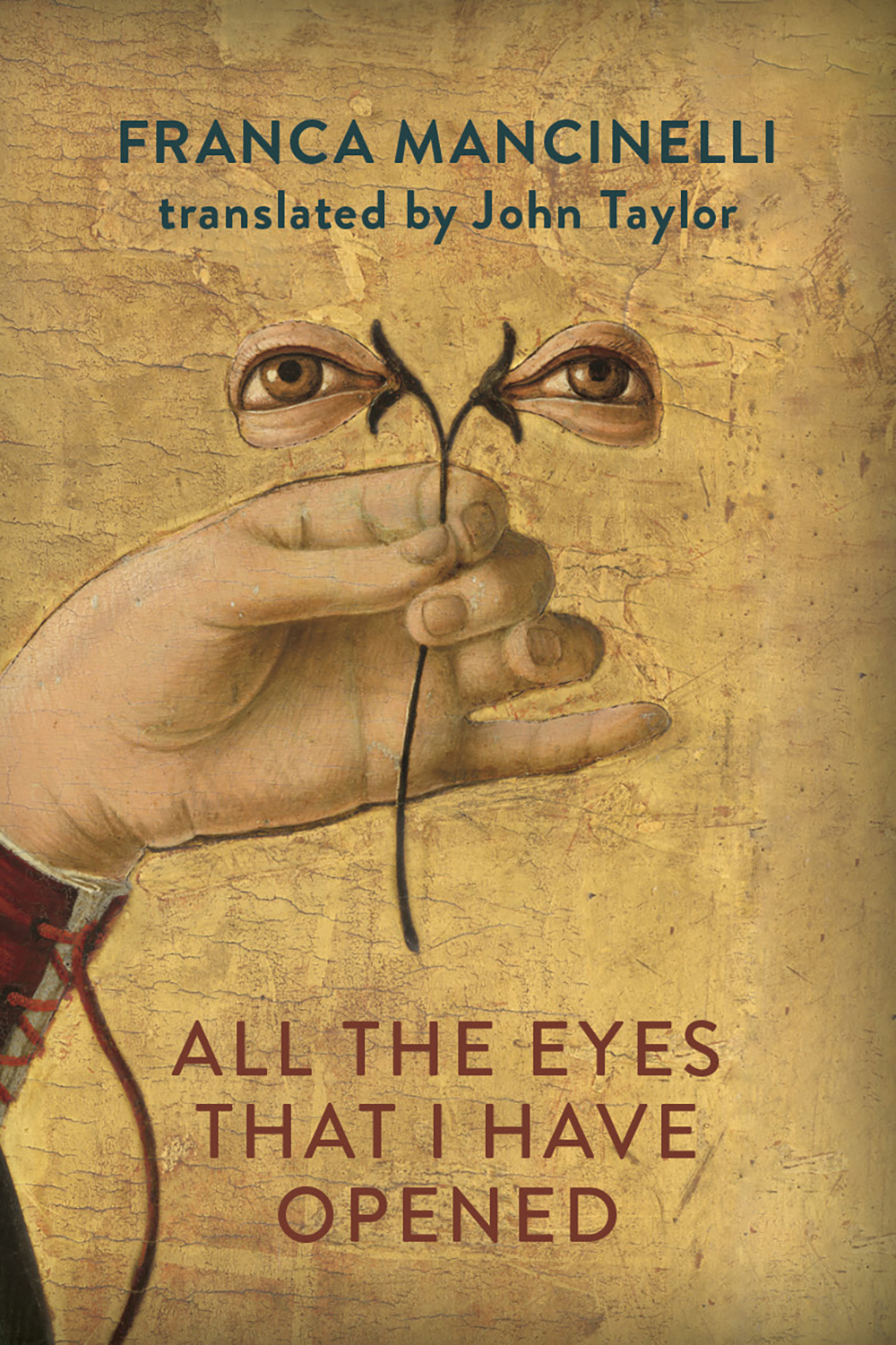
“I remain / in the baptism of this window.” All the Eyes that I Have Opened by Franca Mancinelli

from here ways parted
breathing was growing

in the collapse, something sweet
a hollow of time

all the eyes that I have opened
are the branches I have lost.

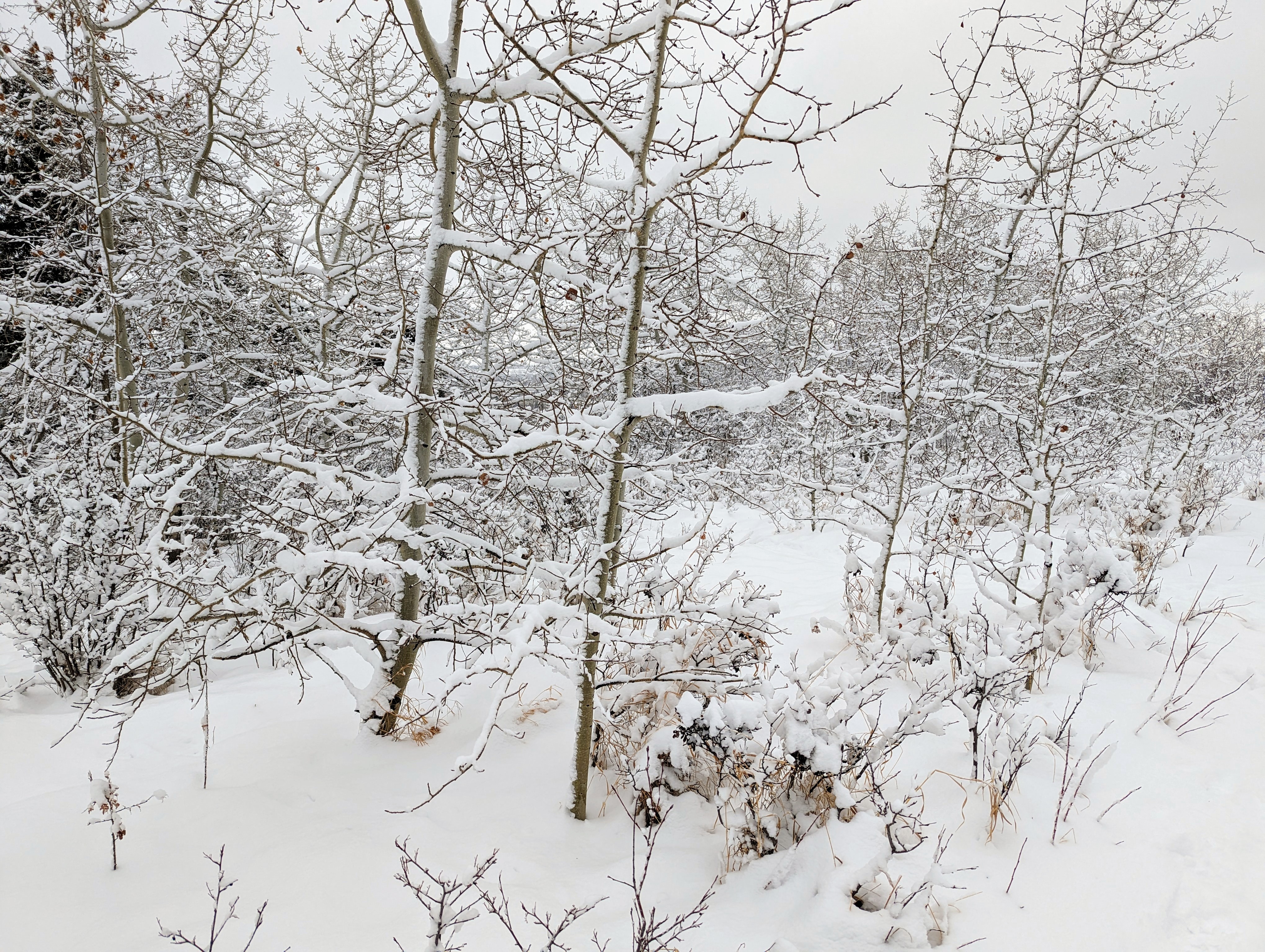
Ever since I started reading Italian poet Franca Mancinelli’s latest collection, recently released in a beautiful dual language edition, I have been haunted by the couplet from which the title was born—all the eyes that I have opened / are the branches I have lost. I have been more aware than ever of the eyes of the aspen meeting me on my daily walk, watching over me as in some sense I have always known them to, but now I was seeing my own journey reflected in their stare… the branches I have lost, and the growth that I have gained over the years.

I’ve always loved aspen, widespread as they are throughout North America. I found an adolescent refuge in the hidden depths of an expanse of aspen that spread across a wide, open field near my childhood home and, now, every day I look out at the clusters of aspen that mark the edges of the forest of Douglas firs I live above. Ever since I learned that they are typically colonial, that a growth of aspen are a single organism, I love them even more. An extended family in nature to balance my fragmented human one.

All the Eyes that I have Opened is a mature collection from a poet whose work I have read since her first English translation, The Little Book of Passage, arrived at my door courtesy of our mutual friend, her long-time translator John Taylor. A few months later, our paths would fortuitously crossed in Calcutta, so I can’t help but hear her voice when I read her words, even as her poetic voice continues to expand beyond the strictly personal to encompass an ever wider range of experiences and circumstances. The enigmatic title of this latest collection came to Mancinelli, as she explains in “An Act of Inner Self-Surgery,” a piece in her essay collection The Butterfly Cemetery, during a time of “inner devastation” when, walking through the woods she came upon a tree with a heavily scarred trunk. Despite many cuts and amputations the tree had healed and transformed itself, reaching ever upwards to the light:

I continued to walk with this voice that had been articulated in me, and one clear image: there are losses that you can weep over with all your tears, fight with every effort, yet they are necessary. We would give our life so that they won’t happen, yet they are guiding our sap toward the shape and the place that belongs to it.

This understanding is expressed most explicitly in an early sequence, “Master Trees,” which like many of the others in this book blends verse and prose poetry. The poet speaks of branches and pruning and seeing “the eyes of the trees,” of opening herself up “according to the light.” But growth is uneven:

the air was inert, traversed by trembling and quivering. It needed to withdraw, to set life aside, to push it towards areas where pockets of quietness opened. I thus grew in this maimed form. You can see in me how the nearby street burns.

Her ensuing engagement in the woods with the very bark of the trees is existential in nature. She emerges with her gaze freed. The following sequence, “All the Eyes that I Have Opened,” turns to experiences that have caused pain, abstracted in natural imagery that is often brutal yet from which new strength and determination seems to arise in the speaker. As ever, Mancinelli distills emotion, memory and experience into crystalline elements, moving from the intimate to the universal in rarely more than a handful of finely wrought lines. Drawing her metaphors from nature and the land, with eyes, sight, branches, darkness and light as recurring images throughout this book, she focuses her attention on a world—internal, external, and interpersonal—in which the dynamic tensions are always shifting, always in flux, and aims to capture its essence.

This collection, as Taylor points out in his introduction, sees an expansion of Mancinelli’s poetic universe, as she brings ancient and traditional sources into her work for the first time, including Saint Lucy (Lucia), the patron saint of the blind, often depicted with her eyes on a plate, whose own sight was restored by God. All the Eyes that I Have Opened also begins and ends with sequences in which the poet endeavours to give voice to the plight of migrants seeking a better life in Europe, meeting danger, cold, and closed borders along the way.

My body has an open texture from which hangs a thread. Someone at the other end, without even noticing, pulls it, and slowly I grow thin. The absence beckons me. I approach the spirits of the cold, that white wordless nucleus which governs this earth. I close my eyes as if pervaded by a flat colorless sea.  (from “Diary of Passage”)

These works stem from an interdisciplinary project she took part in which she and other artists traced a route through Croatia often used by refugees.

This is but a brief and rather personal response to this rich new collection. Every time I open it I find something else that catches my attention. I will be turning to it again and again, and thinking of these poems as I encounter the eyes of the aspen each day.

All the Eyes that I Have Opened by Franca Mancinelli is translated from the Italian by John Taylor and published by Black Square Editions.

Grief-tinted memories: Reflections on Mother Muse Quintet by Naveen Kishore

The loss of a beloved parent inspires a tumult of emotion and weaves complex webs of images that fragment and coalesce over time. It is, I have learned, a living grief, something that ties us to our own past in ways that shift and change in a manner that cannot be mapped or predicted.

Today, as I gather my thoughts about the latest poetry collection by my friend Naveen Kishore, my own mother has been gone for exactly seven years. On July 9th, 2016, my daughter and I sat at her bedside waiting for my brothers to make it to the city. When they arrived, we knew her respirator would be removed and we would say good-bye. She had been plagued by an increasing frailty for many years, but had remained mentally sharp until her final month which was marked by a rapid decline. Meanwhile, in another local hospital, my father lay unconscious following a stroke and head-on collision and, within a few days, a similar, if more prolonged vigil would commence at his bedside. But on this day, what I remember most vividly is my daughter gently tickling her grandmother’s arms as she had once done for her when she was a little girl. Her presence was a comfort to myself and my mother that day.

Over the five sections of Mother Muse Quintet, Naveen Kishore, the highly respected publisher of Seagull Books, honours his own mother, moving through the varying shapes and forms that memories take, and the way they continue to embrace and comfort us as we ourselves age. It is both a tender, personal tribute and a gentle lesson about opening ourselves up to capture our own memories on the page.

The first part evokes a son’s tribute to a mother who offered security and continuity to a young child, filling him with the stories and songs of her own childhood and family history and now, as the fog closes in around her, looks to him for guidance and assurance.

Build me a self. She pleaded. A whole one? I asked. One
I can call my own. Self. Again. She said. I looked at her.
Swiftly. Almost surreptitiously. My gaze. First taking in the
dignity. The earnestness. Hers. And of the request. The
controlled undertone. Not quite panic. Yet. And trust. The
faith. That I could. And would. Help rebuild. Not just her
self. But also her sense of being. Hers. No room for doubt.

In verse and in measured prose, this sequence introduces us to Prem (her son always called her by her first name) as a young girl in Lahore, as a confident woman, and as someone drifting away from the familiarity of her own reflection. And to giving up her ashes “to the care of the river.” But that is only the beginning. As the progression through the following parts of this quintet demonstrate, grief, which may begin long before death, unfolds as an ebb and flow of memories that are sometimes fragmentary or fleeting, other times taking shape in the imagining of one’s earliest years. Time loses its chronological dominion over our hearts as the beloved parent’s presence takes on a new form. They are deeply missed, but somehow always close by.

This is what I draw from Mother Muse Quintet. There are poems that often call to mind very detailed circumstances, as in the piece that records the poet’s grandmother’s prolonged illness and death and the strain it placed on his mother as she cared for her mother-in-law. Those are the moments we experience, even assist with as children, that take on a new poignancy after we have become the caregiver in turn. There are other open poems, words scattered across the page that reflect the way that the memories that stay with us down the years often become moods, qualities of light, seasons and colours. What arises can be an emotion without specific image or form, but you know who it is.

endings
endings unending
night      how you grow pale

breathe into         this parting
punctuated
by urgency

I would if I could night              sing you awake
among the          birdcall
the         barking of dogs

Not all of this volume is completely new to me. I have been privileged to receive a passage or two, shared, in earlier form, when it seemed appropriate. I treasure these in my “grief folder,” created after my parents’ deaths. There is so much of the mother connection/memory in this collection that I recognize, that triggers my own equally personal response. The final poems imply that Naveen also wishes to inspire others to write—to record their own memories, so we too may hold our loved ones as ever present as daylight and pale moons, as that essence we are forever aware of, lingering.

Mother Muse Quintet by Naveen Kishore is published by Speaking Tiger.

Pride Month reading 2023—None of the Above: Reflections on Life Beyond the Binary by Travis Alabanza

I have long been ambivalent about Pride, but the rising waves of anti-LGBTQ, and especially anti-trans, sentiment seen over the past few years has made me very concerned. As a transgender individual who is white and fits visibly into the accepted gender binary, I have been able to stand in the shadows for a long time. For more than two decades. In fact, when I was a single parent supporting two children in a world without any legal protections on the grounds of gender identity, keeping my gendered history hidden was essential. On the occasions that I dared to out myself to a co-worker, job loss invariably followed. But, for the most part, especially outside of the LGBTQ world, I have encountered very few problems because I am older and exceptionally ordinary in my presentation. I pass so well that often I am not heard or believed when I try to tell someone that I am transgender.

For British writer and performer Travis Alabanza, on the other hand, none of the above applies. So when I heard about their Jhalak Prize-winning book None of the Above: Reflections on a Life Beyond the Binary, I knew I’d found my perfect read for this year’s Pride Month. And, even though our ages, lives and experiences differ greatly, I related more closely to many of the ideas they explore in this thoughtful and articulate examination of what it means to exist as an openly gender non-conforming person of colour in a world that is bound to the binary, than in most of the more “conventional” trans-themed books I’ve read. This is a bold and honest work that rides on a shifting current of hurt, uncertainty and self-affirmation against an unspoken pressure for trans identified people to be determined, self-assured, and often stubbornly binary in a world that increasingly strives to deny our validity. There is little room for doubt, less for admitting how exhausting it can be.

In our journey to ‘own our gender’, is it ever really our own? Or does it rely on us conditioning those around us to act and be a certain way too?

None of the Above is neither a typical memoir, nor an explicit defense/explanation of non-binary identity. It is, rather, something in between—a personal account structured around seven statements that have had a particular impact on Alabanza, as a youth and as a public figure, exploring their identity, sexuality and gendered expression. As they dissect these statements, there is a persistent question of how long an obviously gender-defiant presentation can be maintained before it simply becomes easier to move toward a more “acceptable” or “proper” presentation of transness. Of course, given the ongoing escalation of hostility directed at trans women, it’s not clear that such a progression toward hormones and surgery would be easier.

With chapter titles such as “So, When Did You Know?”, “But I Mean, Proper Trans”  and “This Ain’t A Thing We Do Around Here, Son,” Alabanza talks about growing up poor in a council project, their first joyful expressions of femininity, and their development of a successful career as a performer and theatre maker. The questions and comments they encounter come from curious, well-meaning friends, neighbours, fellow performers and critical journalists. Yet, in exploring their reactions and possible responses to these statements that weigh so heavily, there is a willingness to open up their experiences to concerns that intersect with those of others who may be white and/or cisgender. After all, the rigid strictures associated with the gender binary impact people who are not trans in many ways even if they also drive transphobic attitudes. The same gender binary can force trans people to consider medicalization as the measure of “true” transness and look at the openly queer and non-binary as troublesome distractions. For trans people of colour all of these contradictory forces are heightened.

Often what is projected onto those who are visibly gender non-conforming and non-binary, is that our existing, and claiming transness, will ruin it for those wanting (and deserving) a quieter life. Gender non-conformity and being outside of the gender binary cannot be seen as quiet: it is seen as purposefully choosing to cause trouble. To those so wanting a life of peace, others’ disruption can feel like a threat to that fought-for sanctuary.

This is a book that strives to come to terms with the feeling of being at odds with the gender one is assigned at birth, but not feeling comfortable identifying as a man or woman. It’s not a new phenomenon—I have friends who have identified as “gender neutral” for decades. What has changed, for better and for worse, is a wider public forum for people to see and be seen defying or transcending gender. I am grateful I transitioned before the advent of social media, but without the internet I would have had no community. Likewise, without the fabulous gender-bending musicians of the 1970s, I would not have survived my teens. As it was, I was thirty-eight before I finally had an understanding of the differentness I’d always known. But, even though my ultimate path was quieter and more conventional (to a point), my strongest connections have always been with those who stand at the intersection of masculine and feminine. So, for me, there was much food for thought in None of the Above that is beyond the scope of this brief reflection/review. Perhaps it will emerge elsewhere. Meanwhile, I will say that, for readers inside and outside the trans community, this is a very valuable and entertaining read (though one that might anger some on both sides).

None of the Above: Reflections on Life Beyond the Binary by Travis Alabanza is published by Canongate in the UK and will be published by The Feminist Press in the US in October.

Roughghosts is nine years old today

It seems I skipped the annual anniversary post last year, but since I’m not writing the review I should be working on, I thought I’d stop and acknowledge this small achievement and thank everyone who has stopped by this literary space since I first recklessly launched it while I was unknowingly spiraling into a manic crisis that would ultimately end my career back in 2014. If nothing else, it has provided me a place to talk about books and writing, and make the acquaintance of many wonderful readers, writers, translators and publishers around the world. Roughghosts would be nothing without the company of others who also cherish literature.

In its early days, my blog was filled with much of my frustration about chronic mental illness and the stigma that has never been overcome. The subject still arises here on occasion but many of angriest posts have been made private. I try to stick to books, sometimes the subject of writing, and only when I am really down, do I open up a little more. (Of course, those are the posts that tend to get the strongest immediate response—always supportive—but I try not to complain about the world too often.)

The past year has been pretty smooth, if quiet. I have stayed close to home, tracing the same beloved trails and trying, with some difficulty, to regain the level of fitness I had prior to breaking my leg last year. I am, I suppose, at the age when it takes longer to get back to where I used to be. The weather—prolonged cold through the winter and unexpected heat early in May—has been one factor, but a new respect for caution has slowed me down a little. I rarely go out without my trekking poles and (wisely) take fewer risks than I once did. I’m also looking forward to travelling for the first time since 2019, hoping to return to India in September.

As I look back over the last twelve months, I’m pleased with the number and quality of the reviews I’ve published. I’m a slow reader and a slow writer and, aside from a post like this, I rarely ever compose online—every piece is typically written over several days on a Word document and uploaded to WordPress. For now this is still a satisfying activity for me; I have yet to feel a strong desire to pitch essays or reviews for publication elsewhere. To be honest, I do like being able to track the amount of attention my reviews get, at publication and over time. It’s a window into the varying interest certain books generate. And because this is my blog, I am not tied to reading only new releases. That is, I believe, the true beauty of the book blog, or when I’m being fancy, “literary site.” Over the past year, for example, my most popular post—over 4500 views since last September—is a review of Mahsweta Devi’s classic Mother of 1084. I can only assume it has been on the school curriculum in India (and wonder how many suspiciously similar reports teachers have received).

I have no special objectives for the next year of roughghosts. I read and write about books for myself first and foremost—that is, as an exercise in both reading and writing—and I am ever grateful for everyone who has stopped by (even those who, judging by their bizarre search terms, must have been sorely disappointed by what they found). Here’s to another year of great books and excellent company!

One day you will meet yourself returning: Embark by Sean O’Brien

In these days of howling sunshine
when in the grove the aspens fret and pull
like maddened horses now silver now grey
in the curdling light, when the leaves of the cherry
are first all hands and then all birds
that point the way they cannot travel with you,
what then is to be done?

– from “Poem in German”

Every time I sit down to write about a book of poems, I am confronted with a wave of insecurity. Is it possible to write about poetry without the requisite vocabulary and knowledge to adequately assess the collection at hand? I have long argued that “ordinary” readers should be encouraged to read and engage with poetry, free from concerns about doing it “right.” After all, what does it mean to be “right” in one’s reading of any piece of literature? Even in the course of a single lifetime we never come to the same work in the same way, or as the same person. And yet, I am increasingly inclined to read poetry without any thought to whether I will or will not write about it because sometimes, no matter how much I enjoy a collection, I can find myself hopelessly at a loss when it comes to imagining how I might express my feelings.

Embark is the eleventh collection from well-known—albeit previously unknown to me—British poet Sean O’Brien. I ordered this book inspired by a couple of selections shared by someone on Twitter which is, I confess, one of my primary resources for finding poetry. Something about the pensive, gloomy tone of O’Brien’s poems caught my attention. Now, having read and reread this slender volume, I wanted to reflect on what strikes me in his work.

O’Brien’s publisher describes him as “‘Auden’s true inheritor,’ and one of our wisest poetic chronographers” and this, for a start, signals a return, for me, to a manner of poetry that has commanded less of my attention in recent years as I’ve read more inventive contemporary poetry and more in translation. I almost feel embarrassed to confess that his attention to metrical form, occasionally rhyming, and his use of popular or colloquial language, with a strong sense of place, feel familiar and welcome. His use of historical, literary and cultural references fall within a comfortable realm, at least in my reading. I was not left wondering what obscure references I might be missing.

Though poems should not mean but be,
all information tends to entropy:
What was the Word is emptied of itself

and speechless water rises through the stacks,
engulfing like a continental shelf,
implacable as death or income tax.

– from “Waterworks”

Of course, one of my key points of reference is simply one of age. O’Brien just turned seventy and, even if I’m eight years younger, the perspective that comes with living, looking back over the decades, colours the concerns, moods and tones that I recognize in his poetry. The ghosts of old towns, the crumbling decay and industrial detritus traced in the soil, water and stones, and the shadows of memory surface that again and again. His landscapes are charged with life, but his verses reflect an awareness of mortality and the absences that increasingly haunt us over time. This is the work of a mature poet, in age and in his confidence with language. But it is also very much of the present—climate change, disturbing political trends and the reality of the pandemic are all apparent here.

Rain is falling on the metal tables
piled with chairs, and gleaming
as it floods the blue brick gutters,

perfect and anonymous and beautiful.
Be careful what you wish for now
the very air has somewhere else to be.

The city has a headache
but it dare not speak its name –
the bitter patience that till yesterday

we learned from middle age –
and now the plague is blown
as lightly as a kiss across the street.

– from “A Last Turn”

There is a pensive, even bleak quality to many of these poems, but his imagery, his turn of phrase catches me in the moment, causes me to pause. But then there is this hint of guilt I feel when reading poems in English. As much as I love and believe in the importance of reading poetry in translation, aware of the challenges and decisions involved in translating verse (and O’Brien himself is a translator, having translated the poems of Kazakh national poet Abai Kunanbayuli), there is a special joy that comes from reading poetry in my native language that, oddly, I might never have considered before I became so passionate about reading in translation. Of course, O’Brien’s poems have also been widely translated into other languages, but all I can say for now is that I am glad I took a chance on this fine collection.

Embark by Sean O’Brien is published by Picador Poetry.

Reading highlights of 2022: A baker’s dozen and then some…

It seems to me that last year I resisted the annual “best of” round-up right through December and then opened the new year with a post about some of my favourite reads of 2021 anyhow. This year I will give in, look back at some of my favourite reading experiences out of a year in which I had a wealth to choose from and aim to get some kind of list posted before friends start hanging up their 2023 calendars around the globe. In a year with war, floods, famine, storms and still no end in sight to Covid infections, books seemed more important than ever, as a respite, a record and a reminder that we, as human beings, have been here before and must learn from the past to face the increasing challenges of the future.

As ever, it is difficult to narrow down twelve months of reading to a few favourites. One’s choices are always personal and subjective, and many excellent books invariably get left out. This year especially—2022 was a productive and satisfying year for me as a reader and as a blogger. Not much for other writing, I’m afraid, but that’s okay.

This year I’m taking a thematic approach to my wrap-up, so here we go.

The most entertaining reading experiences I had this year:
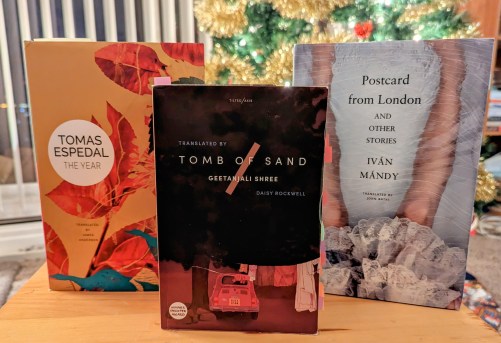
Tomas Espedal’s The Year (translated from the Norwegian by James Anderson) was one of the first books I read in 2022. A novel in verse, it is wise, funny and, nearing the end, surprisingly tense as Espedal’s potentially auto-fictional protagonist careens toward what could be a very reckless act.

International Booker Prize-winning Tomb of Sand  by Geetanjali Shree (translated from the Hindi by Daisy Rockwell) looks like a weighty tome, but blessed with humour, magic and drama—plus a healthy amount of white space—it flies by. An absolute delight and worthy award winner!

Postcard from London, a collection of short stories by Hungarian writer Iván Mándy (translated by John Batki) was a complete surprise for me. In what turned out to be a year in which I read a number of terrific collections of short fiction, I was a little uncertain about this large hardcover volume some 330 pages long, but by the end of the first page I was hooked by the author’s distinct narrative voice and I would have happily read many more pages.

The most absorbing book I read this year (and its companions):

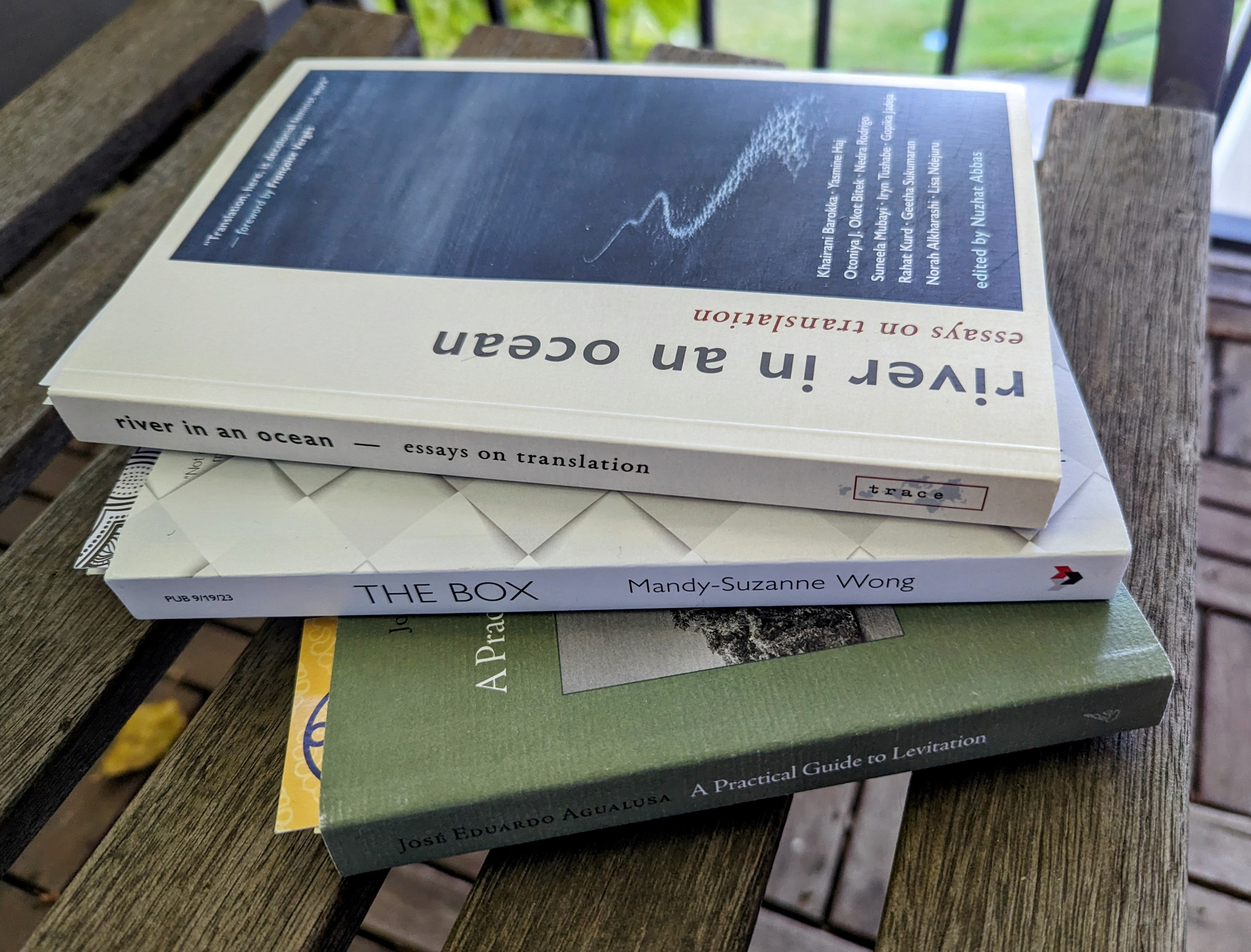
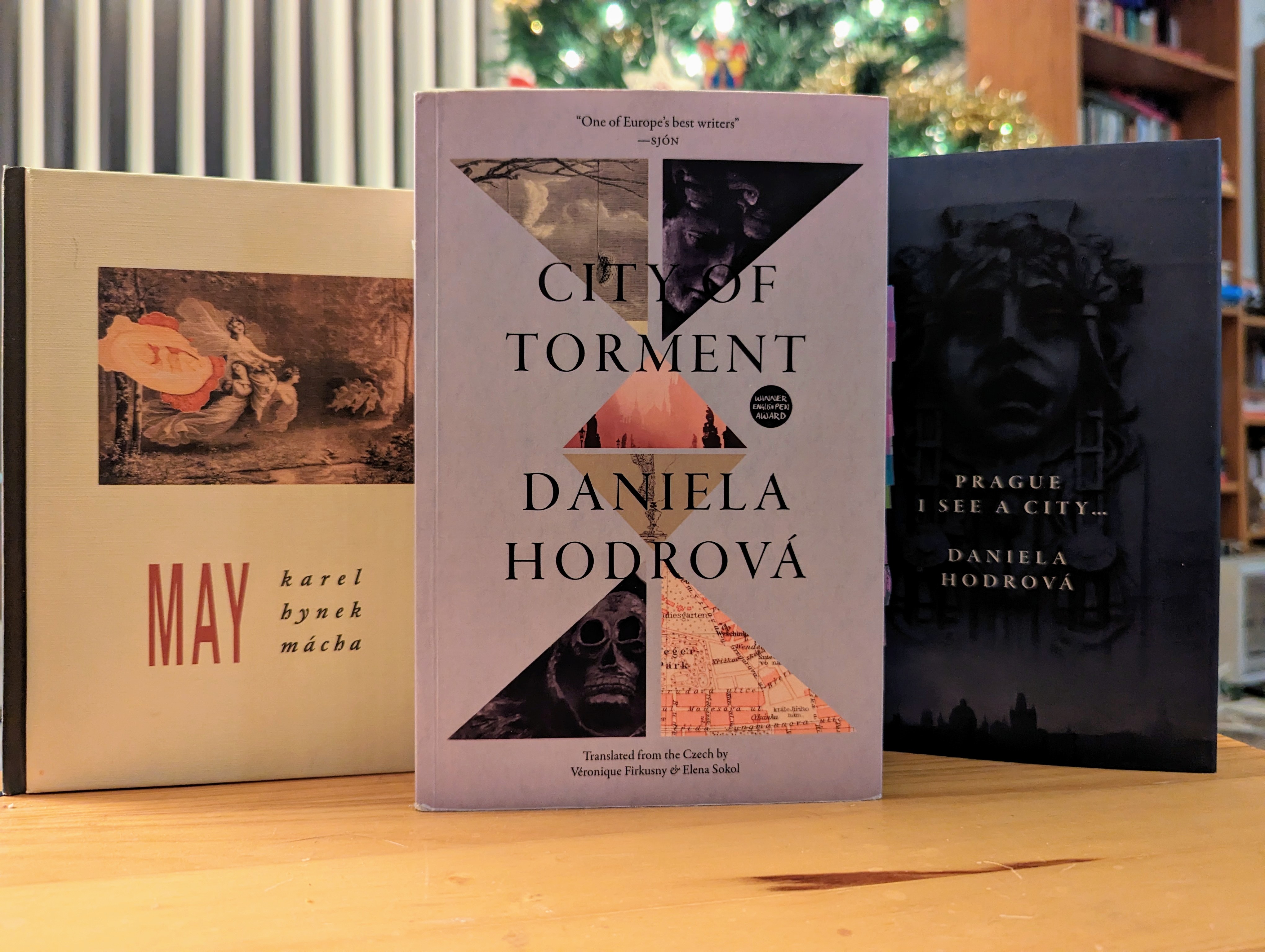
City of Torment – Daniela Hodrová’s monumental trilogy (translated from the Czech by Elena Sokol and others) is a complex, multi-faceted, experimental work that explores a Prague formed and deformed by literary, historical and political forces, haunted by ghosts and the author’s own personal past. After finishing the book, I sensed that I was missing much of the foundational structure—not that it effects the reading in itself—but I wanted to understand more. I read Hodrová’s own companion piece, Prague, I See a City… (translated by David Short) and more recently Karel Hanek Mácha’s epic poem May (translated by Marcela Malek Sulak), but I would love to have access to more of the related literary material, much of which is not yet available in English. I suspect that City of Torment is a text that will keep fueling my own reading for some time.

This year’s poetic treasures:
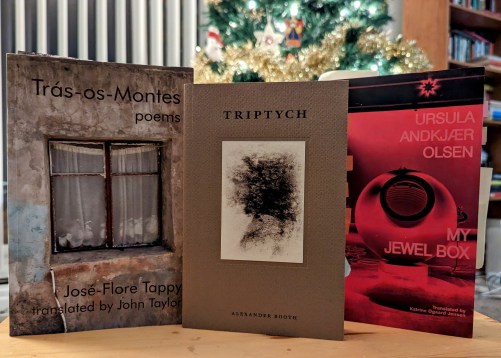
This is the most challenging category to narrow down. I read many wonderful collections, each so different, but three are particularly special.

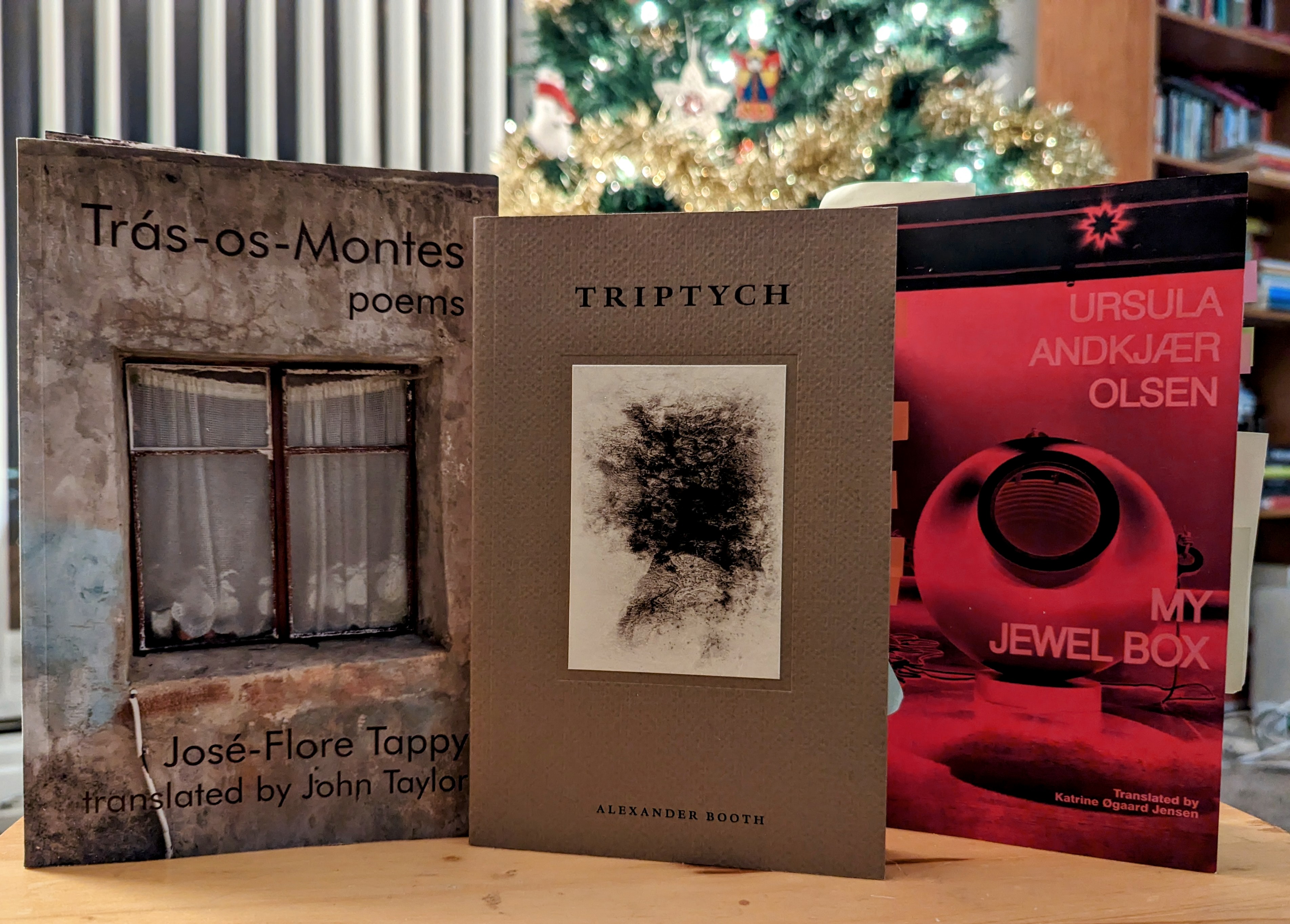
Translator John Taylor has introduced me to a number of excellent poets over the years and in 2022, it was his translation of French-language Swiss poet José-Flore Tappy’s Trás-os-Montes. I read this gorgeous book in August and it is still on my bedside table. It’s not likely to leave that space for a long time yet, and that’s all I need to say.  

I first came to know of Alexander Booth as a translator (and read a number of his translations this year) but his collection, Triptych, stands out not only for the delicate beauty of his poetry, but for the care and attention he put into this self-published volume. A joy to look at, to hold and to read.

Finally, My Jewel Box by Danish poet Ursual Andkjær Olsen is the conclusion of an organically evolving trilogy that began with one of my all-time favourite poetry books, Third-Millennium Heart. Not only is this a powerful work on its own, but I had the great pleasure to speak over Zoom with Olsen and her translator, Katrine Øgaard Jensen, for Brazos Bookstore in May. The perfect way to celebrate a reading experience that has meant so much to me.

Books that defied my expectations this year:

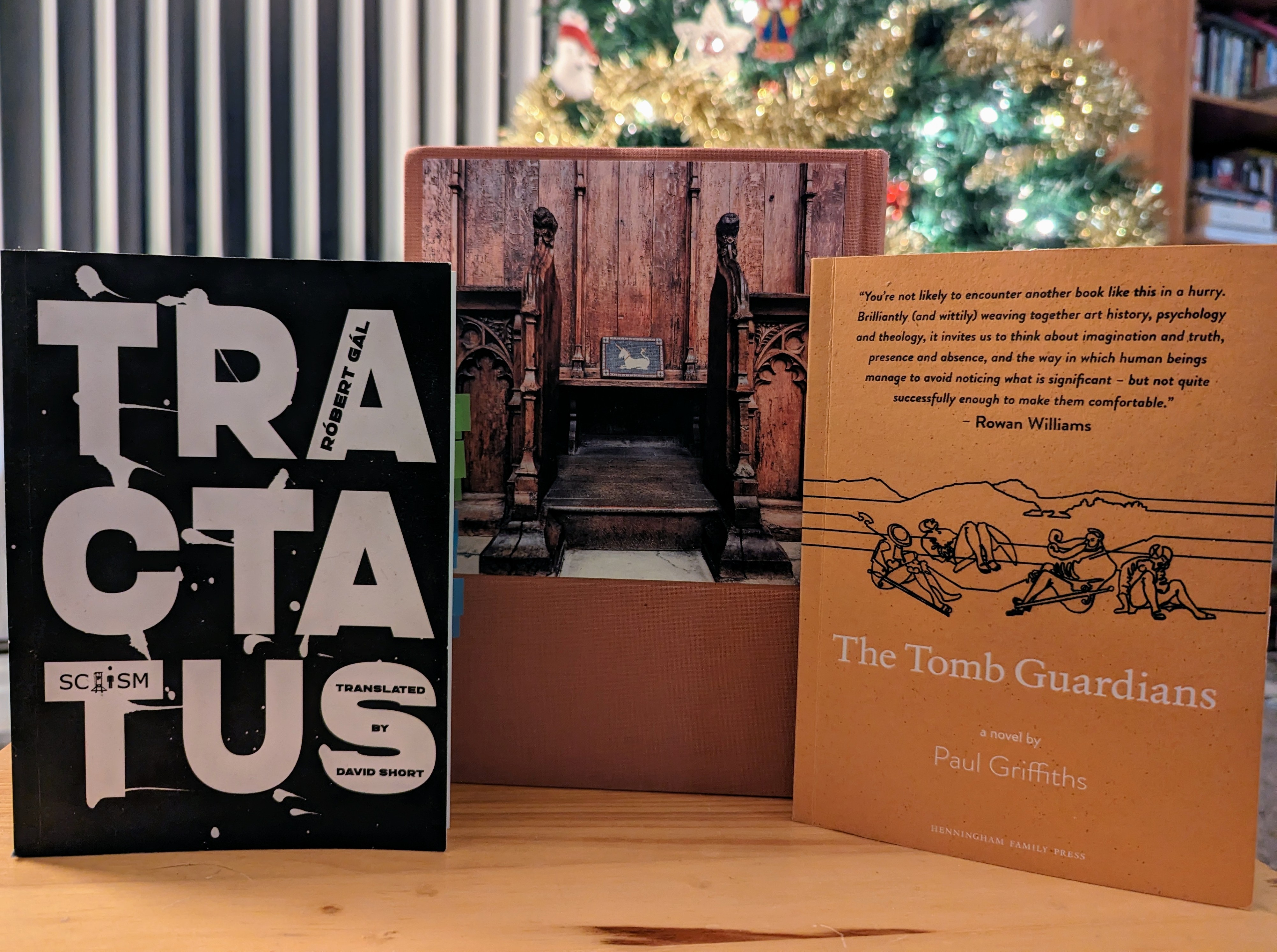
Prague-based writer Róbert Gál has produced books of philosophy, experimental fiction and aphorisms—each one taking a fresh and fluid approach to the realm of ideas and experience. His latest, Tractatus (translated from the Slovak by David Short) takes its inspiration from Wittgenstein’s famous tract to explore a series of epistemological and existential questions in a manner that is engaging, entertaining and provocative.

A Certain Logic of Expectations (you see the back cover here) by Mexican photographer and writer Arturo Soto is a look at the Oxford (yes, that Oxford) that exists a world apart from the grounds of the hallowed educational institution. Soto’s outsider’s perspective and appreciation of the ordinary offers a sharp contrast to the famed structures one associates with the city (and where he was a student himself) and what one typically expects from a photobook.

The third unexpected treat this year was The Tomb Guardians by Paul Griffiths. This short novel about the soldiers sent to guard the tomb where Jesus was buried is an inventive work that explores questions of faith, religion, and art history. Truly one of those boundary-defying works to use a term that seems to get used a little too often these days.

The best books I read in 2022:
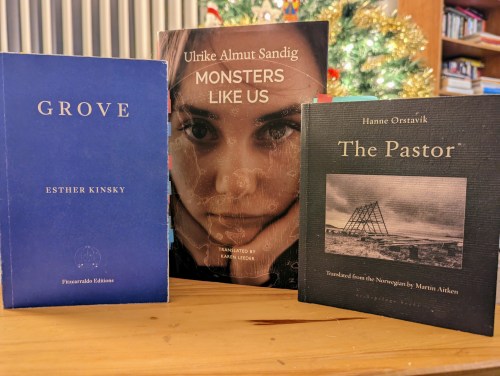
Again, an entirely personal assessment.

I loved Esther Kinsky’s River, but Grove (translated from the German by Caroline Schmidt), confirmed for me that she is capable of doing something that other writers whose work skirts the territory occupied by memoir and autofiction rarely achieve, and that is to write from the depth of personal experience while maintaining a degree of opaqueness, if that’s the right word. One is not inundated with detail about the life or relationships of her narrators. Rather, she zeros in on select moments and memories, allowing landscape to carry the larger themes she is exploring. So inspiring to the writer in me.

Monsters Like Us, the debut novel by Ulrike Almut Sandig (translated from the German by Karen Leeder) deals with an extraordinarily difficult topic—childhood sexual abuse. It does not shy away from the very real damage inflicted by predatory family members, nor does it offer a magical happy ending, but it does hint at the possibility of rising above a traumatic past. As in her poetry where Sandig often draws on the darkness of traditional European fairy tales, she infuses this novel with elements and characters that embody the innocence, evil and heroic qualities of folktales within an entirely and vividly contemporary story. So much to think about here.

Hanne Ørstavik’s The Pastor (translated from the Norwegian by Martin Aitken) was my introduction to the work of a Norwegian writer I had a lot about over the years. This slow, melancholy novel set in the far north regions of Norway, beyond the Arctic Circle in the dead of winter, was a perfect fit for me as a reader, in style and subject matter. The story of a female pastor who takes a position in a remote village following a personal loss that she does not fully understand, explores emotional, historical and spiritual questions through a character who is literally stumbling in the dark.

So, what might lie ahead? This past year I embarked on two self-directed reading projects—one to focus on Norwegian literature for two months, the other to read and write about twenty Seagull Books to honour their fortieth anniversary. I found this very rewarding experience. Both projects were flexible enough to allow me freedom, varietyand plenthy of room for off-theme reading, but in each case I encountered authors and read books I might not have prioritized otherwise. For 2023 I would like to turn my attention to another publisher I really admire whose books are steadily piling up in my TBR stack—Archipelago. As with Seagull, they publish a wide range of translated and international literature that meshes well with my own tastes and interests. I don’t have a specific goal in mind, but already have a growing list of Archipelago titles I’d like to read. Other personal projects—public or private—may arise, perhaps more focused toward the personal writing I always promise to get back to, but time will tell. If the last few years have taught us anything, it’s that it’s a long uncertain road from January 1st to December 31st and it’s best not to try to outguess what the road might hold. Hope for the best and prepare for the worst once more.

Best wishes for the New Year and thank you for reading!

Twenty Seagull books to mark forty years of publishing magic: A 2022 reading project wrap up

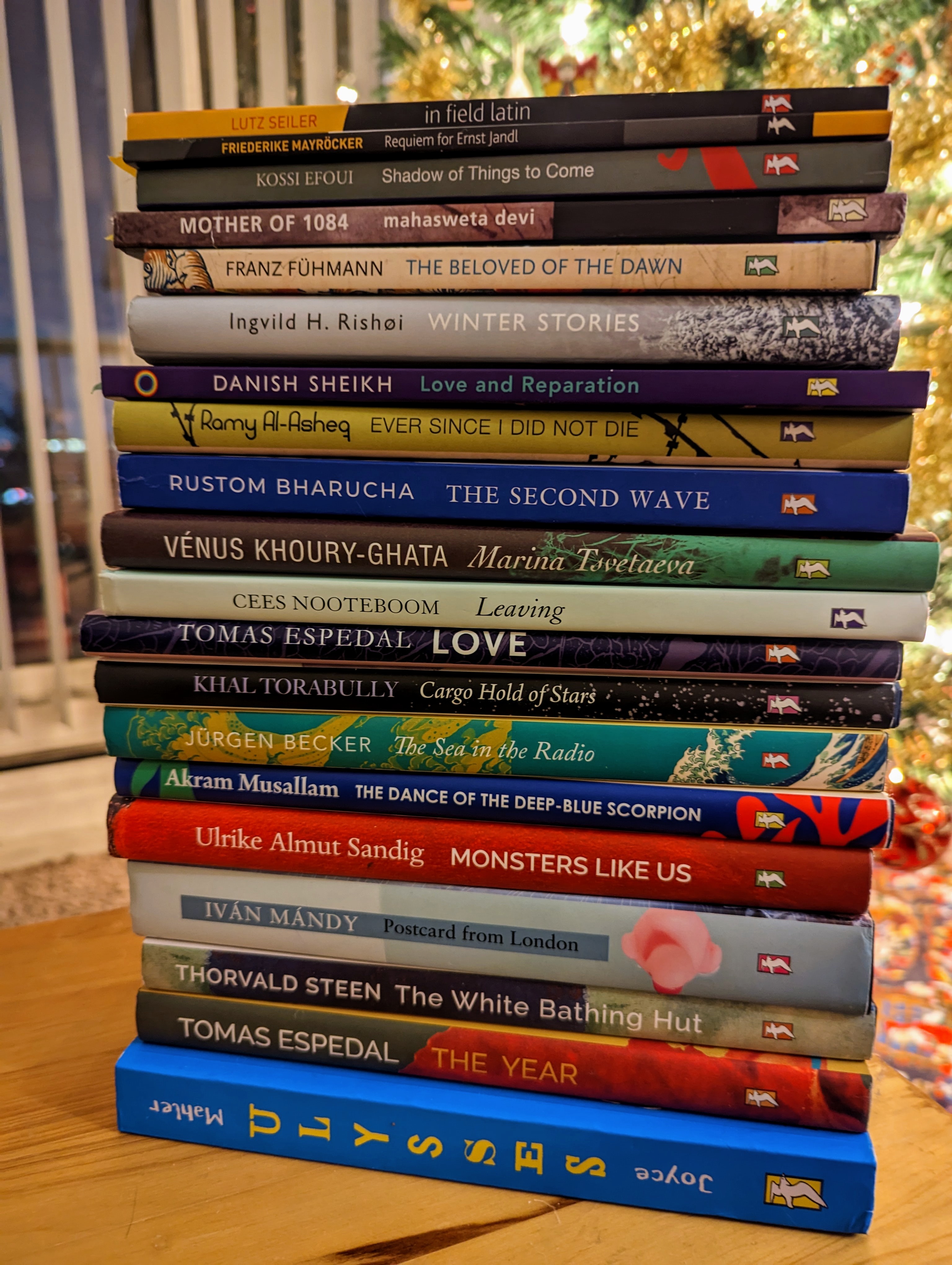
Long-time followers of roughghosts will know that I have a particular fondness for Seagull Books. They continually publish a wide range of interesting international and Indian authors, bring many to English language audiences for the first time and, oh, those covers! Senior Editor and Designer Sunandini Banerjee’s work is instantly recognizable, yet always original. And not only have I amassed a healthy collection of their publications, but I have also visited Calcutta twice, taught classes at their School of Publishing and treasured their friendship and encouragement over the years. I admire the work they produce, their dedication to supporting fellow independent publishers in India and abroad, and their work to further understanding and education through the Seagull Foundation for the Arts. So to mark their fortieth anniversary this year I decided, somewhat late in the game, to embark on a personal reading project. I promised myself that I would read and write about twenty Seagull books by year’s end. Twenty for forty.

And here we are.

To date, I have reviewed all but one of these books—the remaining review of Vénus Khoury-Ghata’s Marina Tsvetaeva will follow in the next few days—but I wanted to stop and celebrate twenty excellent reading experiences before the holiday busyness begins. My reading naturally overlapped with my other 2022 self-directed projected, a focus on Norwegian literature, and the annual months devoted to Women in Translation and German Literature that I try to contribute to each year. Within and beyond that there was still plenty of room for variety. Two of the books I read were English originals—both from India—and the rest were translated: six German, four Norwegian, three French (two of which were by African writers, the third Lebanese-French), two Arabic, one Hungarian, one Dutch and one Bengali. I read five works of poetry/prose poetry, nine novels, three collections of short fiction, one long form essay, one play, and one graphic novel. Had I planned this project a little earlier I might have read more nonfiction, but as the year was rushing to a close book length became a deciding factor—December’s four books were necessarily shorter and that influenced choice!

Among this stack of handsome books are some authors I had already come to know and love through Seagull—Tomas Espedal, Vénus Khoury-Ghata, Franz Fühmann, Ulrike Almut Sandig and Friedrike Mayröcker, plus one writer I have long wanted to read: Mahasweta Devi. But, as usual, there were some unexpected surprises among the authors I encountered for the first time, most notably German Jürgen Becker and Hungarian Iván Mándy.

Happy fortieth anniversary, Seagull! Here’s to an ever brighter future.

Books read:
in field latin by Lutz Seiler, (German) translated by Alexander Booth
Requiem for Ernst Jandl by Friedrike Mayröcker (German) translated by Roslyn Theobald
Shadow of Things to Come by Kossi Efoui (Togo/French) translated by Chris Turner
Mother of 1084 by Mahasweta Devi (India/Bengali) translated by Samik Bandyopadhyay
The Beloved of the Dawn by Franz Fühmann (German) translated by Isabelle Fargo Cole
Winter Stories by Ingvild Rishøi (Norwegian) translated by Diane Oakley
Love and Reparation by Danish Sheikh (India)
Ever Since I Did Not Die by Ramy Al-Asheq (Arabic) translated by Isis Nusair
The Second Wave by Rustom Bharucha (India)
Marina Tsvetaeva by Vénus Khoury-Ghata (Lebanese-French) translated by Teresa Lavender Fagan
Leaving by Cees Nooteboom, w/ drawings by Max Neumann (Dutch) translated by David Colmer
Love by Tomas Espedal (Norwegian) translated by James Anderson
Cargo Hold of Stars: Coolitude by Khal Torabully (Mauritis/French) translated by Nancy Naomi Carlson
The Sea in the Radio by Jürgen Becker (German) translated by Alexander Booth
The Dance of the Deep Blue Scorpion by Akram Musallam (Arabic) translated by Sawad Hussain
Monsters Like Us by Ulrike Almut Sandig (German) translated by Karen Leeder
Postcard from London by Iván Mándy (Hungarian) translated by John Batki
The White Bathing Hut by Thorvald Steen (Norwegian) translated by James Anderson
The Year by Tomas Espedal (Norwegian) translated by James Anderson
Ulysses by Nicolas Mahler, after James Joyce (German) translated by Alexander Booth

Celebrating forty years of Seagull Books

I’ve always maintained that I’m an accidental reviewer, writer and editor. These paths, almost exclusively volunteer, opened up when my professional life imploded in my mid-fifties. But I have always been a reader. The best part of this unexpected second-life has been the many enthusiastic readers, talented translators and dedicated small publishers I have come to know from around the world.  Many I’ve been lucky to meet in person as, for the first time in my life, I travelled beyond North America. To South Africa, Australia and India.

A common connection between many of the readers and translators I’ve come to know over the years is the inimitable Seagull Books in Calcutta. Thanks to an intriguing post on a blog I follow, I bought my first Seagull—The Loss Library by Ivan Vladislavić—sometime in 2015 and was instantly impressed by the presentation and the unique content. Before long I was a committed fan and in early 2018 I made my first “pilgrimage” to visit their office. At the time they were coming up on their thirty-sixth anniversary, celebrating a slow and steady climb from very humble beginnings to their present status as world-class publisher of international literature—all while maintaining their humility and remaining  close to their Calcutta roots. An interview I conducted with founding publisher, Naveen Kishore following my visit was published at 3:AM Magazine. One year later I was back and, had Covid not intervened, I would have been back again by now.

Now,in 2022, Seagull Books are celebrating forty years of producing beautiful books, many that would never have been picked up by other publishers, and supporting and encouraging writers, translators and independent publishers in India and around the world. The occasion has been marked by awards, interviews and articles like this recent one about their stunning office and bookstore in Architectural Digest India.

As an avid supporter of my friends at Seagull I also wanted to do something special to honour this milestone. I have, I confess, amassed a healthy collection of Seagull books over the years, many as kind gifts and many more with the assistance of my credit card, so I’ve set myself a reading goal for the balance of the year. Now, to read and review forty books would be ideal, but I’m not that fast a reader and it’s already September. However, I have read and reviewed nine of their books so far this year and I hope to add at least another eleven by year’s end. Twenty for forty. With this little side project I hope to call some attention to the range of books they publish. And enjoy plenty of good reading, of course!

Pride Reading—Three: Love and Reparation by Danish Sheikh

My first two Pride reads for June 2022 were works by trans women, from India and the US respectively. My third read returns my attention to the Subcontinent, and dramatizes the impact of two important legal milestones impacting the Indian LGBT community over the past few decades. Part of Seagull Books’ Pride List, Love and Reparation: A Theatrical Response to the Section 377 Litigation in India is playwright and activist lawyer Danish Sheikh’s professional and personal reckoning with the effort to overturn Section 377 of the Indian Penal Code, the colonial era prohibition against “carnal intercourse against the order of nature” which had long been used to target members of the LGBT community, and the strange emotions that can arise when a lengthy battle is finally won. If that sounds like dry subject matter for theatre it is anything but. Sheikh deftly weaves material drawn from court transcripts and witness affidavits, with his own experiences and those of others to create a multi-voiced, engaging response to a life-altering legal decision.

It was, of course, not an easy road to decriminalization. Love and Reparation gathers two plays into one volume, a pairing that reads as both complimentary and necessary. Section 377 was first overturned in 2009, following a long, ultimately successful challenge of its constitutionality, in Delhi High Court, by the NAZ Foundation, an NGO. This welcome release would prove to be short lived; a week later an astrologer filed an appeal to the Supreme Court. In 2012, the final arguments in the case were heard over a six-week period. The first play, Contempt, draws on the court proceedings to creatively stage the legal arguments and affidavits that were presented to the judges. It is grounded in reality, as the playwright puts it, but is allowed to wander into passionate and poetic musings as witnesses share their experiences. The play ends with the judges’ fateful decision. In December 2013, the Delhi High Court ruling was reversed and same sex activity was once again criminalized.

A series of petitions challenging the validity of the judgement followed and after much delay, a five-judge bench was finally assembled to hear the matter in 2018. In September of that year, the earlier ruling was overturned, effectually decriminalizing queer sexual relations, in privacy, between consenting adults. The second play Pride, dramatizes the state the community finds itself in once the battle is over—both joy and uncertainty arise once the unifying bonds of the battle are no longer holding people together or framing their engagements with one another. The what now? moment. As Sheikh says:

Pride was my attempt to come to terms with—what? This time around, the object of my dissent was less clear. All I knew was that I had to write my way through this tangle.

Or, perhaps, to wrought this tangle into shape.

The drama revolves around sessions between a gay man and his therapist. He is trying to figure out why love seems so elusive to him. A character chorus of voices spread through the audience, speak to the legal case and the post-ruling experiences and presence of LGBT persons in Indian society.

For each play the setting and stage directions are simple and clear. That makes them easy to read and imagine in performance. By incorporating a blend of history, legal argument, personal accounts, and literary references, Sheikh has created drama that is both moving and at times surprisingly funny. In Contempt, the judges unwittingly supply the humour, pushing the lawyer to the point of absurdity at times and taking a little too much interest in the exact nature of unnatural carnal knowledge. The playwright admits he didn’t need to alter their words as found in the transcripts. The dramatized witness statements from a gay man, two lesbians and a transgender woman bring to life the reality of forced psychiatric interventions, innocent love affairs and brutal treatment from the police.

Pride demonstrates that legalization is not the end. There are, of course, more battles to wage to level the playing field for LGBT people, but there is also an uncertainty about how to live and love in a decriminalized landscape. How to repair all the years of existence up against the fear of being arrested simply for loving, for being yourself. The dynamic between the older female therapist and the young gay man whose conversations form the core of the play is very effective, and gives the drama it immediate emotional energy. As A. recounts his multiple failed attempts to find someone to love, T. challenges his conclusions.

A.  How does it work? How can it just come and go without warning? How is this not the most terrifying thing in the world, how can I wake up one morning and realize I’m out of love with this man who is otherwise perfect for me? How could Socrates wake up one morning and realize he’s out of love with me?

T.  Maybe he wasn’t perfect for you?

A.  Maybe

T.  And you know you weren’t perfect for Socrates.

A.  Possibly

T.  And then there’s the other thing.

A.  That I’m terrible at this stuff?

T.  That nobody is actually perfect for anybody else. It’s never not work. Sometimes you choose to do the work. Sometimes you decide it isn’t worth the work. You can’t choose how you feel, you can’t choose when it comes and goes. But that other part—that you can choose.

Their sessions are broken up by interludes during which the chorus of voices/characters speak to the legal fight against Section 377, the ways their lives have or have not changed since it was ruled unconstitutional, and, as needed, taking on a role within the therapy sections.

As an non-Indian LGBT person, I was not aware of the exact status of queer people in the country until more recently, but the final decision on Section 377 did come down following my first visit to the country, so it was of great interest to me. No matter what concerns face LGBT folk in the west, especially with the increasing pressure of more extreme right-wing conservative political influence, we are still accustomed to much more freedom and access to resources than our brothers, sisters and peers in many countries. The interesting thing for me in this book, particularly with Pride, is the examination of the degree to which achieving a measure of freedom can lead to a confusion or loss of meaning. It occurs at the level of the “community” leading to splintering and divisions, but it also happens in a deeply private way. Given my own personal journey, I have always held that I feel no shame but cannot embrace the concept of Pride. Without disclosing the protagonist’s revelation, I will say that this play has really caused me to question my conviction.

I feel this pair of plays holds much to appeal to readers interested in contemporary drama, legal debate, social justice and the evolution of LGBT rights, in India and beyond. The playwright clearly frames his motivation and inspiration for the writing of these plays in his introduction, while a timeline and an extensive resource list round out the supporting material. But most critically, at the heart of both plays are very important recognizable, sometimes disturbing, human stories that deserve to be heard.

Love and Reparation: A Theatrical Response to the Section 377 Litigation in India by Danish Sheikh is published by Seagull Books as part of their Pride List series.

Pride Reading—Two: This Body I Wore by Diana Goetsch

The second trans-themed nonfiction book I chose to read this month is, in contrast to my first (My Life in Trans Activism by A. Revathi), a literary memoir, but the transgender journey it details differs from the one that is commonly told because the details of the author’s actual transition are minimal and confined to the closing chapters. It is, rather, the story of one woman’s fifty-year-long odyssey to finally come to acknowledge what she had sensed from a very early age—that despite being born male, she was, and always had been female. So why did it take so long to acknowledge the truth? This Body I Wore is Diana Goetsch’s answer to that question, an eloquent chronicle of life that conspired to cloud the reality haunting her relationships and filling her closets for so long.

Goetsch’s account opens with her early unsuccessful attempts to form romantic or sexual relationships and her first forays out into the culture inhabited by cross-dressers. She is in 1980s New York City. The push-pull of her attraction to women and women’s clothing is exciting and confusing. She graduates college, lands a teaching position at the prestigious Stuyvesant High School and soon finds herself juggling secrets, while trying to build friendships and find a girlfriend.  By her early thirties she seems to be dropping all or most of the balls. That leads her back into her past to begin to trace the roots of her predicament.

The childhood described in This Body I Wore is one marked by little affection and an unhealthy measure of abuse. The youngest of two boys, Diana—or rather Doug (and briefly I am using male pronouns, this book spans decades of evolving and context specific usage)—is told by his mother that he was an “accident,” that is, unintended and unwanted. He grows up on Long Island, an athletic, sports-minded young man who seems to become increasingly and inexplicably unpopular. Although he is determined to keep his secret fascination with girl’s shoes and dresses and feminine undergarments to himself, it’s almost as if others sense a difference. Friends fall away. Doug cannot understand why; by the end of high school, unable to secure a college placement he feels left behind. I wonder how many trans people have experienced similar sensations of being out of step? I know I did.

The bulk of this memoir follows Diana’s efforts to build relationships with a series of women, most of whom she comes out to as a cross-dresser and with whom she explores social outings as female, but again and again her own male body becomes a barrier to full sexual expression. A trail of broken hearts and extended periods of loneliness carry her into middle age. Professionally, she spends a number of years teaching in a youth correctional facility, begins writing and publishing poetry, and tries to build a career as a writing teacher. Meanwhile, she increasingly dedicates her weary spirit to Buddhism, attending retreats and developing her practice to a point where she finally finds a way into her deepest self. Throughout the course of more than two decades she moves in and out a female identity that can be outfitted and carefully applied, then washed away and returned to the drawer. The decision to move forward is liberating, and increasingly magic as it gradually becomes her normal, everyday existence.

I enjoyed this book very much, it is a poetic and finely crafted tale. I will confess that I was reluctant to take it on. I have an uncomfortable reaction to memoirs, especially those with recreated dialogue and the inclusion of the stories that belong in equal part to those who come in and out of the story. Goetsch handles this well, with respect, but I did at times wonder about the women whose lives were exposed along the way. However, my greater concern was, as I mentioned in my previous Pride post, a general anxiety about trans stories, fiction or nonfiction, which I can never entertain as an impartial reader. As a transitioned man it’s impossible not to read myself into and against the stories of others and very often I find it an alienating and depressing adventure. Yet, This Body I Wore was a pleasant surprise.

Trans women and trans men typically have rather different trajectories, in both the coming to a decision to transition and in the treatment available. At least twenty or more years ago, the accepted norm for a “transsexual” man was a childhood as a tomboy, attraction to women, and commonly, for lack of any other place to seek an understanding of oneself, questioning sexuality or living as a lesbian. By contrast, my early reaction to the feeling that there was “a boy inside me” was not a desire to be male but the fear that my body carried signs of my wrongness, something I hoped I could learn to overcome. Although I could not believe it, I was pretty and reasonably feminine, not athletic or a tomboy or attracted to girls, but the gender insecurity was deep and increased as I grew older. I married and eventually had children, pushing to the back any careers or opportunities that I feared might reveal the truth about me. In the absence of any notion that trans men existed or what testosterone could accomplish, it would take thirty-eight years and an incredible emotional and mental toll before I knew I was not alone. Within two years of realizing the male feeling I’d fought against was me I was starting to transition. But my extended confusion, the searching for clues, the fear of revealing or even exploring what was happening, mirrors in a way the cross-dresser to trans woman scenario much more closely than the tomboy to butch to trans man route. In truth of course, transgender people are as diverse as any other people with unique social, cultural and emotional journeys to finally come home, but it is not uncommon for us to wonder, and debate, what it means to be “trans enough”.

It also struck me after finishing this book how flat Goetsch’s depiction of Doug seemed through the mid-section—the long adult years of exile. When Diana finally comes out to herself an entirely fresh energy enters the narrative, her excitement and growing confidence is palpable. Not surprising when I reflected on my own early years post transition. Once I was passing consistently and had established a new career and identity, I was forced to live stealth in my professional life so as to be able to keep a job and support my children—that is, I came out only to disappear into a closet. Still, the daily validation as a man and the thrill of no longer having to try to feel female, cast an unreal light on the past. It’s as if that life belonged to someone else as it drifted into the distance. No matter how lyrical the language, how vulnerable the account, I sensed a similar estrangement permeating the text. It makes sense and at the same time it’s refreshing because transgender memoirs can sometimes be combative and defensive. Goetsch avoids a tendency to overwrite her former existence; I imagine her maturity and her Buddhist grounding are at play. Transitioning later in life brings up such a sense of lost time, a mourning for what might have been, and that comes up here too, but briefly and with empathy and grace. In my own experience, transition is an ongoing adjustment and reframing for oneself in relation to a life lived across time and gender lines that leads to an understanding that those years “before” are not lost but a fundamental part of the person we become that a compatible sex/gender history could never afford.

This Body I Wore by Diana Goetsch is published by Farrar, Straus & Giroux.