Three days in Mumbai: What a small taste of a small corner of a huge city can tell you (about yourself)

As I write this I am five days into my second visit to India in as many years. This time my stay is longer, my scope wider, my engagement deeper. It is as much about meeting, building and nurturing friendships and connections—long standing and new—as it is about “seeing a place.” One does not travel half the globe to inhabit, however briefly, a world that is so very different in texture, tone and sensations from one’s own without being open to experience. But it is a complicated negotiation at times.

As an outsider, and more specifically as a westerner from a city of a little over a million, I respond so viscerally to the intensity of the Indian metropolis. And yet I am ever conscious of my vantage point, skewed and out of context, informed by the romantic images of my youth and early adulthood—elegant colonial set-pieces, followed by the wave of popular biographies of Ghandi and Mother Theresa in the 80s. I do not wish to appear the starry-eyed searcher or the foreign curiosity seeker, for in truth I am neither. The attraction is real and formless. I feel it in my bones, but am hesitant to grant it words.

I am aware that I experience India from a point of both ignorance and privilege and to formulate a response to what I see and feel leaves me as anxious as a non-poet wanting to write about poetry but refusing to for fear of reading it “wrong”. As if there is only one way to read anything. There is no such thing as pure, unmitigated and unbiased experience.

And so to my present location: Bombay or Mumbai. With a population of over eighteen million souls, Mumbai is the largest city I have ever been in. It is arguably one of the very biggest on the planet. I have to confess I found it immediately oppressive and claustrophobic. From the moment you leave the airport, humanity crushes in on you. Densely packed slums crowd the space alongside the roadway, for kilometre after kilometre, giving way at times for marble and granite dealers, before returning again. Gradually the apparent quality of the hovels improves, but it is an urbanized poverty on a scale that is difficult to process. I knew it was there. Maybe I didn’t expect to see it so explicitly.

The ride into the city was endless. A thick yellow haze hung in the air and I began to regret my decision to hire a non-A/C cab. In the rear view mirror I could see the eyes of the driver watering. With the smog and exhaust fumes blowing in through the open windows, I wondered what it would be like to spend each day moving back and forth through the impatient traffic and gridlock hour after hour.

For the traveller who arrives by air, a city makes her first impressions in the journey in from the airport. Mumbai’s welcome is pungent and emotionally disarming. From the vibrant interior of an ancient yellow and black cab, I watch the corrugated metal landscape pass as we slowly descended into the city. I take no pictures. It would not feel right.
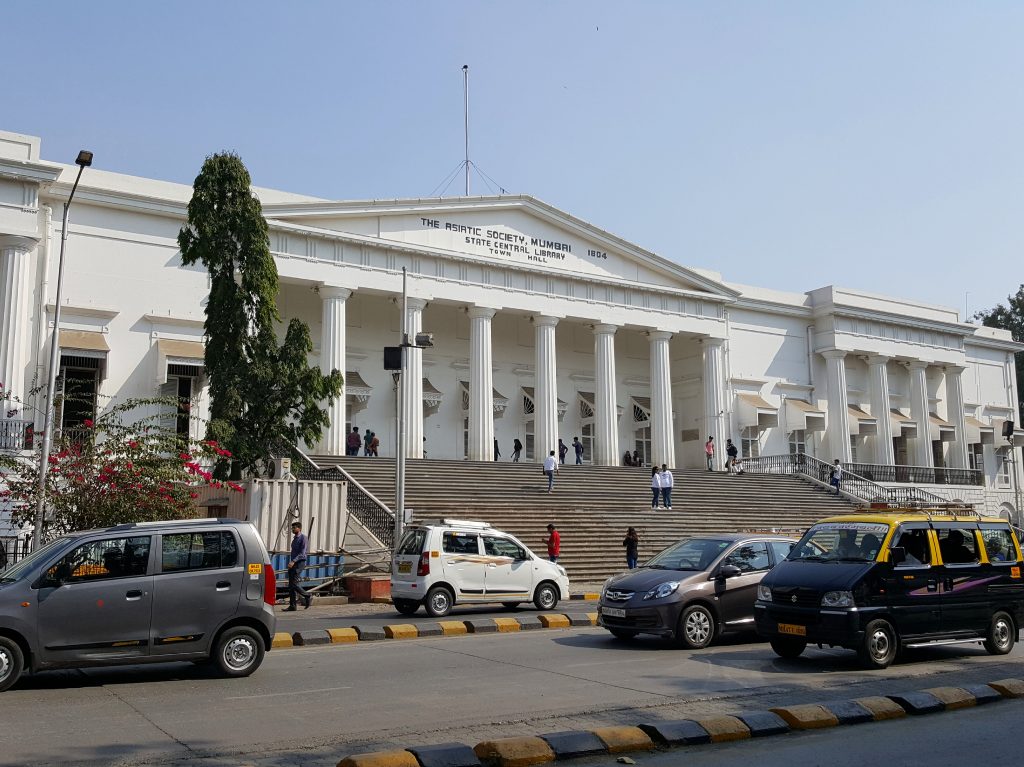
Once I am finally settled in my hotel in the Fort area of south Mumbai, I grab my backpack and head out. The streets of the city are noisy, fast and congested. (Don’t be fooled by the fact that they often appear empty in photographs—it’s an illusion!) They seem to change flavour and character from block to block. Crossing the street, even daring to walk along the edges where the uneven pathways are blocked, or nonexistent, is an exercise in blind faith. A motorcycle is likely to roar up behind you, racing against the flow of traffic, blaring its horn to make you disappear. A legless older woman working a rusted handcart down the side of the road is my new hero. I’m at odds to know what I think of this place. I feel a little pressed under the weight of the space.

As ever, I take note of the street dogs. Here they’re a rather sorry assortment of creatures, weary and worn. Perhaps they don’t stand a chance against the cats that appear to quite handily own this part of town.

My immediate destination lies in the heart of the Kala Ghoda arts district. The area is crowded. Following my friend google  in search of the library where the literary portion of the annual arts festival is to be held, leads me through a bag search, metal detector and frisking, and into a large square crowded with young people  A variety of  sometimes quite tacky horse-themed artworks are displayed and the selfie generation is quite enamoured of them all. I am a little perplexed. I later learn that this is a new addition to the festivities, one that has drawn large numbers of people, mostly young, in from the suburbs, not for the arts so much as the party atmosphere. This type of attraction and congestion alters the tenor of the area. Of course, I’m here for the festival too—a little unexpected serendipity—but fortunately the literary programming is taking place beyond this makeshift corral, across the road in a garden oasis behind the David Sassoon Library. There one is magically removed from the noisy traffic and crowds on the street outside.

Now on my final day in the city, at least one tiny corner of Mumbai is less strange. The streets seem shorter, less confusing. The architecture is beautiful. This part of the city wears its age with grace. I have been to the Gateway of India, the obligatory tourist gesture, and today I saw the sea from the other side, looking out from Marine Drive. A completely different world unfolds there. Large, expensive vehicles line the shady streets, students pour out of colleges and universities, and in the distance, across the waters, the towers of the city’s centre appear ghostly in the midday heat. But it’s hot. I don’t stay long.

So, after my first, brief encounter with Mumbai, three things remain: the gift of being a stranger in a place where, despite disorientation and an inability to comfortably communicate, a little semblance of familiarity begins to emerge; the necessary joy that literary community affords including the precious opportunity to meet, in person, supportive and inspiring writers previously known only online; and finally, the chance to experience a hectic, sometimes seemingly harsh, city at rest. Late last night, after a wonderful, long visit with a friend, I made my way back to my hotel through the quiet virtually empty streets. Ranjit accompanied me part of the way, down byways I likely would not have attempted on my own, until he was certain I knew where I was, and I finished the walk alone. Here and there men spoke quietly, or bid one another good night. On sidewalks, those without homes were already fast asleep, and lonely yellow and black cabs crawled by, hopeful for a late night fare.

Funny that such a huge city could test me by day, and win me over at night.

A new year, a new optimism, in spite of it all

As 2019 opens, my world is so much brighter than it has been for a long time—a strange sentiment given all the obvious and ominous shadows hanging over this sorry planet—but when you have been carrying darkness deep within and even the smallest moments of hope seem impossible, the lifting of that weight is near miraculous. The difficulties and challenges do not evaporate, but a renewed sense that they can be faced moving forward is the most wonderful feeling. On the Solstice I wrote about my recent medication adjustment and the subsequent easing of a depression that I had failed to recognize, being so tightly wound in its grasp that I was struggling to even find the will to continue living. Consumed by bitterness, anger, and grief I’d become a morbid, unpleasant soul by the end of November, unloading my misanthropic  self-hatred on a few trusted close friends, near and far. Now, with the unrepentant zeal of the born-again, I cannot stop marvelling at the sheer joy of not feeling miserable—it is not a delirious happiness, but damn, it does feel good. Or as a friend who nearly lost himself to a bout of  depression described the transition: I went from cowering in a corner wanting to die to crying at a stoplight overcome by the sheer beauty, intensity, and brilliance of the green light.

This past holiday season—the third since the loss of both of my parents and the suicide of a dear friend, and the fourth since my own very close encounter with death—feels like a turning of sorts. Or a recognition that we are ever turning and looking back over our lives, applying narrative arcs, seeking meaning and closure. However, this time, I refuse to be swayed by the temptation to believe this is even possible, let alone helpful. I’ve long doubted the narrative imperative, in fiction and memoir alike, and yet in our own lives we long for tidy, complete stories with meaning and message, and are continually upended every time life pulls the carpet from beneath our feet and we are forced to rewrite the script.

The major difference this year is that I have started to see my mother, in my dreams and my imagination. Always colourful and carefully coordinated, ageless and aged, believer and doubter, guardian angel and true friend. For long time, apart from a brief interlude when I was the desert of central Australia, my mother has remained a dull thickness in the core of my being. A mass of anger and guilt and self-pity. It’s easing. I feel sadness. I find myself crying. I know that I am finally beginning to grieve. It hurts so good. And I have a sense that this loosening, this opening up, is essential to releasing the blockages I’ve encountered in my own writing projects.

So with the new year ahead, I’ll begin with the resolution that marked every journal kept during decades of looking for a voice, an identity, and then, having found it, having to slip into a closet—This year I will write. Of course, I have advantages. I am no longer unpublished. I am part of an environment as a reader, writer and editor where I am fortunate to engage with inspiring and encouraging people. And I have formed some true, valuable, real friendships with people who accept the whole, weird me. These people, some of whom I have never met face to face, have sustained me through this darkness. A few with saintly patience and grace, I’m afraid. I hope that going forward I will become a calmer, more open listener, a better friend myself. And alert to the pain of others, like so many seemingly random twitter connections who heard me call out into cyberspace in my darker moments and responded with a good word or expression of concern.

My intended reading, moving into 2019, includes a few essay collections, a couple of photo essays, some long-deferred grief reading like Kate Zambreno’s Book of Mutter, and lots more poetry. With a month in India now just over four weeks away, I’ve also got some work by Indian writers in my TBR pile, and some books I’m reading in advance of a really exciting event I’ll be taking part in in Kolkata (more about that to come).

As I mentioned before, I became seriously concerned about my well-being last November, when I found myself so physically drained and emotionally exhausted that I was wondering if I could manage to get through my trip to India at all. I had been planning a return all year and, at last, with the tickets booked, I was overwhelmed by the prospect of going. The day after I finally allowed myself to accept my psychiatrist’s suggestion that I was under something more than the seasonal blues, I dragged myself down to Mountain Equipment Co-op and bought a new lightweight travel bag. And I haven’t looked back since! My agenda for my stay is still taking shape, with room for impulse and adventure. I look forward to spending time with friends, some I have met, and some I feel like I’ve known forever even though we’ve yet to meet. I will be flying in and out of Bangalore with plans to go to Kochi and a desire to visit Mumbai, and beyond that, who knows? I am less of a tourist attraction hunter and more of a flaneur on the road. My attraction to India has grown more out of friendship and literary connections than anything else. Its neither romantic nor idealized, but as I said in my RIC photo essay:

 I’m drawn to travel in uneven places. In scarred and wounded spaces I recognize myself. Complex, interrupted histories mirror my own.

Returning to Calcutta for the third week of February will feel like coming home to a creative space I cherish, this time with the added lucky coincidence that my stay will overlap with the poetry residency of Franca Mancinelli, the Italian poet whose wonderful The Little Book of Passage made my end of year list, and she will be staying about a five minute walk from where I’m likely to be! I expect a busy week in the City of Joy because all year I’ve been mapping out places I want to revisit and those I have yet to explore. With a camera and notebook in hand.

The greatest thing I hope to bring into 2019 is an openness to experience without prescribed expectations. Some very exciting threads are coming into view—writers, reading, artistic opportunities that need to be followed to see where they lead.  There is also a lot of personal work to be done on my grief, loss, and identity issues, be it fodder or foundation for future writing… well, only time will tell.

Best wishes for all in the year ahead. Personal, national and global storms are inevitable. A good word, a good book, and, as I’m learning, a little light can go a long way. With luck we can all sustain at least a glimmer of that light through the months ahead.

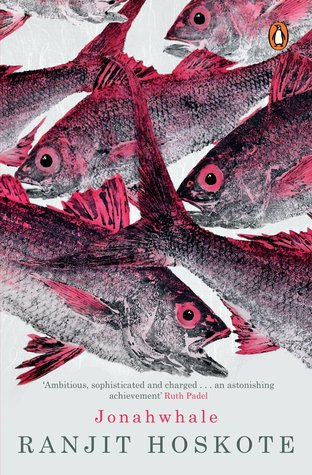
The expansive possibilities of Jonahwhale by Ranjit Hoskote

As someone who has lived a landlocked existence with an endless sea of prairie grass stretching to the east and the high cresting waves of the Rocky Mountains rising to the west, oceans have long held an inexorable pull on my imagination. Every family holiday that brought me close to either the Atlantic or the Pacific was magic. When I was younger I was drawn to stormy seascapes, images of rugged wave-ravaged shorelines, and stories filled with high sea adventure and intrigue. Now it is something else, something quieter, more metaphysical, that possesses me. From the far shores of Vancouver Island to a lonely beach on the eastern coast of South Africa, I’ve welcomed, however briefly, the untethering afforded by the impossible emptiness expanding beyond me, and revived that longing that no river, lake or landbound body of water has ever been able to fully resolve.

And so, I come to Indian poet Ranjit Hoskote’s  astonishingly rich, endlessly engaging Jonahwhale, a collection of poetry that returns, again and again, to gather inspiration, stories and imagery from the watery depths. For Hoskote, who grew up in Goa and Bombay, proximity to the sea has been a constant, one which he admits informs his life, his awareness and his writing. But as an accomplished translator and cultural curator with a seemingly inexhaustible curiosity that extends beyond boundaries, disciplines and art forms, his work cannot be confined to any specific thematic template. His poetry welcomes a wide array of influences, follows maps and legends that navigate an extensive territory, and resounds with an eclectic musicality. The poems in this collection run from multi-voiced epics taking their cues from historical, literary, or artistic starting points, to one line aphoristic pieces and everything in between. This book has accompanied me these past six months, and yet every time I open it I discover a line, a passage, or a verse that pulls me in anew, to reread, refresh, and reconsider.

I cannot assess or review such an impressive collection, I can only respond, which is perhaps the best I can manage with any of the poetry I have read this year.

Divided into three parts, or movements, the first section, “Memoirs of the Jonahwhale” summons voices from a wealth of historical, literary, and linguistic resources, some self-evident, others detailed in the poet’s endnotes, which, I understand, reflect Hoskote’s desire to honour his scholarly self rather than an obligation to explain his allusions. Some of these notes, crafted with a curator’s attention to detail, are fascinating in themselves and may well inspire a reader’s further exploration, but, as one would hope, context, background, and intertextual sources simply enrich the reading experience. They are not essential to the appreciation of the rhythms, images and intensity of his poetry.

A strong musical sensibility underscores the entire collection, and here Hoskote draws on an abiding interest in modern avant-garde music—composers like Brian Eno, Terry Reilly, and Steve Reich—a passion rekindled for me in recent years. It is, then, not surprising that my favourite piece is “Baldachin”. In memoriam Bruce Conner, the American filmmaker whose masterwork Crossroads combines classified footage of nuclear weapon tests with an eerily sublime soundtrack by Terry Riley and Patrick Gleason, the poem also incorporates the looped trigger line of Steve Reich’s Cuban Missile Crisis inspired composition “It’s Gonna Rain”. The result is an extended prose/verse piece that pulses with the energy of an impending storm:

You are the company the name is you poisoner you cannot pretend you cannot hide you cannot swim in these neon currents I am become Death the destroyer of worlds this ocean one open mouth swallowing islands this art of making things disappear in a glow that throbs in the eye that cannot sleep this frame that’s come apart leached the colour from every drifting current this voice that shakes the continents no earthly thing trembles on its breath this baldachin of milk-white smoke has nothing to hide no crystal globe no night of mean knives no shallows no depths all ploughed bare all punctured all furrowed It’s gonna rain It’s gonna rain It’s gonna rain

Beyond the sheer scope and wealth of Hoskote’s poetic vision, it is his keen sensitivity to rhythm, pacing, and visual space—the music and the architecture of a poem—that makes this collection so impressive, so endlessly engaging. If the first section contains some of the most ambitious epic offerings, complete with choral arrangements and refrains, the ten-part poem “Poona Traffic Shots”, which forms the second part, stands as sort of land-bound counterpoint tracing a cycle of rain-soaked ground voyages through countryside and memory, that calls back to the sea in its imagery:

The kick-starter has whooping cough, won’t purr.
.       A dead crow’s beak
points from the trash heap like the tip of a schooner
.       sunk in a shallow bay, a bruise
at first only grazed, then scooped by nautical furies
.       from the coast’s offered skin.

Moving into the final section, “Archipelago”,  the tone turns more intimate, not personal as these are not explicitly autobiographical or confessional poems, but smaller, sometimes quieter more focused, often inspired by art or classical themes. Like finely imagined poetic miniatures echoing history, the unforgiving beauty of nature and, as ever, rarely far from the water.

If literature can evoke a sensation so undefinable and expansive as that which I feel at the ocean’s edge, this wise and elegant collection comes close.

Jonahwhale by Ranjit Hoskote is published by Penguin India.


Who am I now? Slouching toward queerlessness.

I’ve had a strange and sombre day. Surrounded by hundreds of books and thousands of pages of words, with a couple of vague essay ideas sketched into notebooks or percolating in fragmented Word documents, I found myself thinking: What is the point? What value is there in this mass of words, written and unwritten?

Certainly we all hit creative impasses, as writers and as readers, but the impact is stifling all the same. For those of us who traffic in words, what are we when they cease to flow?

I have frequently posited my literary intention as an act of writing myself into being. By that I mean that I am acutely aware of my life, my being in the world, as an unfinished process—as is, of course, every human existence—but for me that process has grown increasingly undefined and undefinable over the years. I’ve been hunting for an existential language. I have, at heart, hoped that in my words someone else might recognize themselves; that I might not feel so alone.I’ve been thinking a lot about what drives us to tell our own stories. Some might argue that it is an essential element of human nature. We are story telling creatures. But to what end is it helpful to try to impose a narrative on lived experience? And what do I hope to achieve writing personal essays when I don’t have a very strong personal memory? There are huge swathes of my life that I cannot clearly remember or that are buried beneath the distractions of mood disorder and the disorientation of decades of gender insecurity. If I cannot clearly remember who I was, how can I hope to uncover any truths about who I am?

It might be easier if I was inclined to fiction, to creating shadows and echoes of myself and allowing them their own experiences. Play with variations on a theme. But my imagination is tethered to the hollowness that troubles my inability to find comfort within this real life lived. The only life I have. Queered and queerless.

When I started writing and publishing essays after an extended period of closeted post-transition existence, I hoped and believed that I could reclaim for myself an identity and a sexuality I had buried. Four years later I own even less than I started with. How do you write about an increasingly meaningless way of being in the world? It’s not a happy story; not the trans narrative that finds a ready audience. From the moment one comes out as transgender, the story you can tell defines your validity and access to services and support. Twenty years ago that was a very specific story, one I could not tell and so I had to carve my own path. I should assume it’s better now, but with the explosion of trans discourse, the narrative essentially remains the same. At odds with my own.

What do I know? All I know is that in my experience, this journey is intrinsically incomplete and unresolvable, lonely, and, in the wrong situation, dangerous.

I have friends who question my continued efforts to find myself within a conversation that cannot contain me, especially when my search for queer comfort causes so me much pain. I have good people and good things in my life, but when your history and your body are skewed against the norm there is a driving need to find a chorus to which to add your voice. A chance to a love song even. No matter how hard I try to believe, I cannot dream there is one. At least not for me.

Who wants words to that effect? There is no catharsis in writing or reading to that end. There are simply words, strings of syllables leading nowhere, achieving nothing at the end of the day.

§

Of course, I will find refuge in books again. And I will write. I just wrote this. For what it’s worth.

Disembodied desire: Murmur by Will Eaves

The price of consciousness, of power, is choice.

 Mathematician Alan Turing is remembered as much for his critical role in the development of computer science , his contributions to code-breaking during the Second World War and his work on artificial intelligence as for being a man whose homosexuality led to a charge of gross indecency and a period of enforced chemical castration. His life has been examined in print and film, his character analyzed and debated, and his death mythologized, but to truly venture deep into the recesses of the mind of such a complex and extraordinary character is to invite challenge, scrutiny and dissension. After all, what can we ever truly know of another person’s internal processes? Or, for that matter, our own?

In his latest novel, Murmur, British writer Will Eaves takes the key elements of Turing’s career and ultimate predicament, and creates a shadow character, Alec Pryor, slips inside his skin and inhabits his dreams and anxieties while the state takes control of his body. This audacious approach stays close to the outlines of Turing’s life, even borrowing first names and specific details like his fiancé or his fondness for Snow White, but avoids the constraints of conventional biographical fiction. Presented through journal entries, letters and a feverish dream chronicle, Murmur offers a poetically charged reading experience that is at once scientifically astute, philosophically engaging, and emotionally disturbing. It imagines a rational minded man pushed beyond the edges of rational existence who still manages, we assume, to hold the surface still, controlled and humane.

So much of real life is invisible.

The novel begins with Pryor’s recorded reflections on the circumstances that led to his charge and conviction, his dalliance with a young man and subsequent reported robbery echoing Turing’s misadventure. Choosing one year’s probation with hormonal treatment over jail, he begins therapy with a psychoanalyst, Dr. Stallbrook, and weekly injections to turn him “into a sexless person.” Analytical by nature, he cannot resist the temptation to filter his situation through scientific, historical, and philosophical musings. As if he wants to quantify a situation that clearly has left him concerned and uncertain about what lies ahead.

The central section, which comprises the bulk of the narrative consists of extended dream sequences and an ongoing epistolary correspondence between Alec and June, a former colleague and friend to whom he was once engaged. It begins with a disassociation, a stepping away into third person, which leads to a recognition of a division, necessary perhaps to observe the self, but also speaking to the effect that the treatments are beginning to have on Alec’s relationship to his own physical being:

I am a thinking reflection. He is the animal-organic part, the body unthinking. I am a searching mechanism with a soul. I’m him, but only when he’s near the glass, metal, water, the surface where I’m found. I search for some way to express this separation which feels all the wrong way round.

A bird is puzzled by its reflection; not, surely, the reflection by the bird. And yet I’m one with him. I’m one and separate. I search for ways to describe this. I live and think within all glass. He only has a body and can’t hear this murmuring; sees himself in a mirror—doesn’t know that it is me.

From his detached vantage point, the dreaming Alec revisits his younger self at school, observes a schoolmate whom he once loved, and watches as the two boys swim naked across a lake where they will spend a night together. This other boy, Christopher, has a counterpoint in name and fact in Turing’s biography, a close friend and object of an affection most likely unreturned in the same nature. In both realities, Christopher dies young. But in Alec’s dreamscape, his psychiatrist is conflated with his former schoolmaster, and his friend’s post corporeal essence becomes an abiding presence. His intellectual preoccupations, such as the limits of machine intelligence are personified in bizarre interactions with a real life associate who visits him as a computational illusion. His mother and brother appear as cartoon effigies straight out of Snow White. By opening this vast and increasingly distorted space where, as is common in dreams, people known and events experienced become the scenarios that are continually replayed in response to current waking affairs, Eaves is able to twist Alec’s past and present together to create a complex, introspective character who is both troubled by and curious about the impact of  the unnatural situation in which he has found himself.

With his sex drive disabled, Alec admits to June that he is plagued by dreams and desires, a “coded overcompensation” for a reality supressed. Ever the scientist, he understands these dreams as a means of functional storage and processing:

My dreams are candid with me: they say I am chemically altered. They are full of magical symbolism! At the same time, they are enormously clear—where there is high reason and much thought, there will be much desire and many imaginings. Urges. I can be given drugs and hormones but they will only work as drugs and hormones work. They cannot get at excess desire. Take out libido and another drive replaces it. Materialism and determinism define me through and through, and yet there is more than they allow. And if that illusion of more—call it free will—is itself a mere effect, then an ‘effect’ suggests, does it not, a real cause, as a film ‘suggests’ a projector?

Balanced against this projected, or perhaps, “reflected” reality, Alec’s correspondence with June provides a safe place for him to explore his physical and existential uncertainties. She serves as confessor, sounding board, and unconditional support. Early on, especially as the hormones begin to soften and alter his body, as the estrogen causes his breasts to grow, he expresses fear of becoming a hybrid—less the fear of change than of loss. He grieves his past, his one true, yet quite likely impossible, love for Chris, and worries that he will somehow lose himself.

The estrangement between physical and essential being continues to grow. The dreamer longs to grasp a sense of if, and how, the body exists beyond death—dispersed, yet tangible, and at the same time, its elemental links to a geological, and for Alec, icebound past. The “self” seems suspended between:

The lake freezes. Ice calls to ice and Pryor’s raised and summoning hand is frosted black.

No trees, no distant school, a greenstick whine as cities pop, scatter. Another order of significance arrives. Air thickens with the charge of glaciers. The former gas solidifies, the mirror plane of my glass eye is crushed and I am fractioned, like a mote among asteroids. Only the world’s ship-like trembling, its great pistons concealed, attests the passage of aeons, time brakeless and unpeopled. Then, as fast as they arrived, faster, the glaciers recede, the waters rise, anoxic bile that boils away at Pryor’s still, unvoiced command—and I am either glass again, or obsidian, axe flint, my face upturned and refashioned.

The veil of night drawn back. The sun comes close, colossal in the sky. A pale hand hangs me on a wall that rises from the desert’s fiery sands.

There has been much controversy around the matter of Alan Turing’s death by cyanide poisoning a little more than a year after his hormonal sentence ended. Suicide was the official verdict; accident and murder have also been argued. The fortitude he is reported to have displayed throughout his ordeal, is offered as an indication that his mind was not as troubled as imagined. But, for Eaves’ shadow protagonist, there is both profound growth and insight as a result of his enforced period of introspection, and a fundamental internal loss of self that others cannot see. His perception of and relationship to his body is ever altered.

Murmur is a bold, imaginative accomplishment—one that manages to convey the strangeness of conscious experience while asking what it truly means to be conscious, pushing at the edges of its limits and constraints. It is, in many respects, a natural evolution of Will Eaves’ experimental novel, The Absent Therapist, a fragmented blend of scientific fact, philosophical reflection and fictional vignettes that read, not like snatches of overheard conversation, but as fleeting encounters with the thoughts of a wide range of characters. Murmur pulls you deep into the mental reality of one man whose rational and logical grounding is upended, but this time the therapist is present and inseparable from the subject.

However, as much as this is a novel embedded in conscious experience, it is a memoir of the body and its essentialness to being. It asks: Can a machine be encoded with emotional intelligence? What happens to the substance of the body after death? What of the self is lost or altered when the body is rendered sexless? No matter how cerebral one may be, the body matters. In my own, long-standing, welcomed and self-administered treatment with contrasexual hormones, I have experienced an evolving disassociation from the altered body I now inhabit. Yet, at face value, I look right. I am afforded the ability to live in the world in a manner that conforms with the internal gendered self I’ve always known. In a way that feels right. But I am changed. My body is othered and alien, de-sexualized. Over time that disassociation feeds existential discontent. Threatens the self in weird and curious ways I hear echoed in this book—a book which echoes my own murmurings.

Murmurs by Will Eaves is published by CB Editions and shortlisted for the 2018 Goldsmith Prize. A North American release is forthcoming from Bellevue Literary Press in April, 2019.

Musing about maintaining wellness on World Mental Health Day

World Mental Health Day. In the handful of years that I’ve been maintaining this blog, I have yet to stop for a moment to acknowledge this annual effort to raise awareness of mental health issues around the world.  In fact, I rarely address the subject even though mental illness, and the stigma it carries, has profoundly impacted my life. With significant costs.

And yet, compared to many of the people I have known, worked with, and cared about, I am lucky. I am capable of functioning well with medication and therapy. Mind you, I was well into my fifties with a ruined career behind me before adequate support for my bipolar condition was finally in place. It shouldn’t be so hard to access care, but it is, and continues to be so no matter where one lives.This morning, with another fresh snowfall on the ground, only a week after we were treated to an entirely unseasonal 40 centimetres of the stuff, I made my way downtown to volunteer with our annual readers’ festival. As I walked through the cold and fog, my mood was bleak. The importance of a strong social network is regularly stressed for the maintenance of mental health and well-being. However, in this city where I’ve lived for most of my life, I have no strong social connections. I have family, but we are not close. I have children—a daughter who is making plans to move to the US to marry her boyfriend and an adult son I live with who has his own long standing mental health concerns, but they really need to be living their own lives. Close friendships, meaningful relationships, continue to elude me. My closest friends, even my last partner, have been at a great distance.

A sense of loneliness, growing deeper and more pervasive in recent years, has become my most constant companion.

*

The city’s damp, misty streets seemed to feed negative ruminations as I walked. Much of a mood disorder is, to be certain, beyond one’s immediate control—my darkest, near suicidal depressions have come at times when things in my life were positive—but I am fully capable of falling into dark spaces when I allow myself to dwell on what I don’t have. My losses. My failures.

Fortunately, although the weather remained dismal, my day brightened. I made three runs to the airport to pick up visiting authors and, as a result, I was able to enjoy in depth conversations about life, literature, and writing with journalist and author Rachel Giese, and novelists Rawi Hage and Patrick de Witt. I was kept busy, engaged, and interacting with writers.  A good day—good for my writerly self and really good for my mental health.

So on this World Mental Health Day, I suppose I want to say that access to appropriate mental health care is vital. And for each person that can look  very different.  But the reality of living well with a serious mental illness, even with medical support, is a daily effort. For myself, being able to engage with others who are passionate about reading and writing is a vital part of maintaining wellness. It’s one of the factors that keeps me engaged with an online literary community, but it is always nice when I can enjoy a good conversation in person.

The never-ending ending: When will this move be over?

Although my son and I moved into our new home a week ago—that is, our furniture and all of my books and our two confused cats made the transition—this has become an endless process. In part it is a matter of proximity. Moving less that a kilometre invites a false sense that you can manage the bulk of it on your own. In packing and unpacking my little Honda Fit and trundling boxes and bags up to our second floor walk-up over and over, two things become painfully clear: (a) I was completely unprepared for the reality of downsizing and moving after twenty-four years in the same place, and (b) I am twenty-four years older than I was the last time I moved.

Tonight, back at the house with possession date quickly approaching, I was emptying the entryway closet and cursing myself for not clearing out all of the coats, boots, and orphan mittens stashed into boxes or bags long ago. It depresses me how much I’ve managed to acquire through all of my incarnations, hobbies, and business schemes. I’m shocked how many toys my children accumulated over the years. As a queer single parent with a relatively low income, I always wanted my kids to have a lot of things. I couldn’t afford vacations, or all of the fancy things their friends had, but somehow toys with lots of small pieces seemed like having more. Or like giving more.

What was I thinking? What are we ever thinking?

Even my single friends assure me that the more space one has, the more it seems to fill itself with stuff. We admire sparse décor, but given a chance, human nature abhors a vacuum.

And then there’s the emotional baggage one has to sift through, and decide to purge or pack. For both my son and myself, there’s evidence of the losses we’ve suffered, or worse, created, in every corner. This final clear-out is overwhelming. And there is still so much to do. We’ve rented a van and made a few runs to the landfill and wasted a couple of hours carting well-used, but still serviceable solid wood furniture around to charities but were unable to pass anything on. It’s a bit heartbreaking but, at this point, I am content to pass on the hauling away to a junk removal firm, cost be damned, I need my life back!

I haven’t read a book for almost two weeks. I feel like I’ve been cut off from my literary lifeline, but have yet to unpack and fill all my empty shelves. Where to begin? How to organize?

Soon. Soon this will pass and we’ll be able to settle into our new apartment.

But first we have a room full of charity donations to deliver, a mound of recycling to cart away, and a garage full of old furniture, junk and all of the tools and outdoor items we’ll no longer need, but simply don’t have time to take care of. Hopefully the removal firm has better luck finding a home for some of the stuff but for now the clock is ticking and we have to clear out, tidy up, toss the keys in, and lock the door.

When it’s all over, maybe I’ll feel sad. I know my son will; he’s spent most of his life there, give or take, but I am ready to let go. The house is old and when I look around I am haunted by all of the projects I lost interest in, or could not afford to complete. It’s as unfinished as my life. I feel sad, strangely, for birds who will be losing their nesting spaces as the lot is redeveloped and the industrious little red squirrel who has amassed himself a huge pile of pine cones for the winter. And for the old apple tree.

For nearly a quarter century, that overgrown yard and 50s glass stucco bungalow was home. The only house I ever owned. Charged with memories of motherhood, madness, the end of a marriage, and the advent of my own manhood. Now its sale has afforded me a new lease on life.

Or so I hope.

Neither here nor there: Esther Kinsky’s River and a link to my review at Music & Literature

Since I finished Esther Kinsky’s magnificent novel River, it has been difficult for me to contain my enthusiasm for this work, and yet, with a major review on the way, I wanted to refrain from talking at length about my reading of this languid, mesmerizing meditation on the relationships we have with place—those we live in, pass through, or linger in uncertainly during points of transition.  That review is now live, and yet Kinsky’s book is still working its way through my system.

River is a slow read; immersive, poetic, attentive to detail. It creates an atmosphere of intimacy with the spaces the unnamed narrator traverses during a time of restless displacement in a community on the edge of London; a time of gathering and preparation for leaving the city where she has lived for a number of years. Some of these spaces are immediate, defined by the course of the river Lea. Others exist in the distance, temporally and physically. And yet, although there are clear parallels between Kinsky’s own life history and the locations her narrator visits, River occupies an intentionally indistinct borderland between fiction and memoir, focusing on experience in the moment over biographical background and detail, resulting in a narrative that flows, organically, like the rivers than run through it.

My review of River can be found at the online site of the singular journal Music& Literature. The opening passages are reproduced below, you can read the rest of it here.

A mood, an atmosphere, rises up from the opening pages of Esther Kinsky’s River—a melancholy that unfolds so softly, so insistently that I repeatedly had to remind myself that I was reading words that originally existed in German. I found myself wondering: What would the German feel like in my hands? How would its texture taste, guttural tones against the back of my throat? These are questions that, in their asking, underscore how River is a text to linger in, to touch, to absorb, and recognize one’s self in. We follow the narrator as she temporarily suspends her life, settling for a time in a marginal community on the edge of London, so she can slowly disengage herself from a number of years spent in the city, and prepare, mentally and emotionally, to take her final leave. The process she details seems to be one we, too, undergo in reading River.

Under a pale sun and in the whitish, shadowless light peculiar to this place and these seasons, I took to following tracks which, time and again, led me back through the alder grove. This partly mutilated wetland wood with its childhood flowers and wild birds secretly appealing to my memory was my gateway to the lower reaches, to the path downstream that gradually taught me, during the final months of my stay, to find my own names for a city I had already spent many years labouring to decipher—names only walking and looking could force me to extract and reassemble from a web of trickling memories, a debris of stored images and sounds, a tissue of tangled words.


River by Esther Kinsky is translated from the German by Iain Galbraith and published by Fitzcarraldo Editions in the UK and Transit Books in North America.

A constant procession of ghosts: A reflection

August has passed, it seems, with little to show for itself. Smoky skies and an air quality rivalling that of some of the most polluted cities of the world curtailed much outdoor activity here. Further to the west, where the smoke originated and forests burned, it was worse. Now, as skies clear, temperatures are dropping and summer’s fading fast. Leaves are turning yellow. Autumn nears.

Two years ago today, September 1st 2016, a dear friend took her life. A second attempt after years of trying to fight off crushing bipolar depression. Unable to work and living on savings, treatment often meant driving to a public hospital, an hour each way. She lived in a small village in the Eastern Cape Province of South Africa. We only met once. I spent a week with her in 2015, but from the moment we first met online, it was as if we had known each other forever. We could joke and riff off each other, falling into a regular routine as a dysfunctional divorced couple that often fooled others. In truth, we were bound by queerness, books, and bipolar disorder. Soul mates shipwrecked in our own lives.

But, of course, I couldn’t save her.

In the months before Ulla died I held a certain distance. I was reeling from the recent death of my mother, followed closely by that of my father. Knowing that she was fragile, and, after three years, still grieving her own mother, I was unable to reach out to her to seek or offer support. We were both drowning, but her sea was darker and more deadly. It had been for a long time.

With my parents’ sudden and tightly timed deaths, I had imagined the possibility of an exercise of writing immediate grief—echoing Barthes and Handke—but the burdens of being an executor distorted and distended the mourning experience and, for the most part, these losses remain unwritten. Then again, my parents were in their eighties with long lives, well-lived, behind them. My friend’s death, at forty-six, was more complex. I knew it had to be addressed, not simply for myself but for a community of followers who responded to her actions intently and personally. It took three months to salvage words and craft a 300-word piece which was published, with my own photographs, in late November of 2016. Each time I come back to this eulogy I realize how much of my immediate grief is contained there, perfected and concise.

Who, and what, in the end, do we write grief for? If we are looking for catharsis, a way to move beyond grief, we may be disappointed. Perhaps grief simply moves with us, evolving and softening over time.

If Ulla’s death sits especially heavily at this time of year, at the moment there is an extra weight. Earlier this month, my son’s best friend lost a difficult battle with opioid addiction. He had been at our house quite a bit in the last weeks, and although clean at the time, he was really struggling. My son is devastated. He’s been seeking refuge in alcohol and routinely breaks down in a flood of tears and despair. His sister and I feel a loss too; Dylan was a common presence in our lives over the past twelve years, but to be honest, in recent times I wasn’t always happy to see him on the doorstep. He and Thomas have both, at twenty-eight, been fighting their own mental health and addiction issues for a long time. And they were not always good for each other. They could be up all night arguing—usually about politics, but sometimes about really “important” matters like the difference between a canon and fugue. Things could get violent. One morning Thomas broke his hand on Dylan’s head (and glasses). But music was their real bond. They wrote and recorded songs together and spent hours busking on street corners over the years. They believed in each other when neither could believe in himself.

As a parent it is agonizing to watch my child in pain and know that his is a mourning song I cannot write.

*

As September begins, I am aware more than ever that we are surrounded by a constant procession of ghosts. I’ve bought a two-bed flat and, at the moment, I’m deeply engaged in the process of emptying out closets, cupboards and rooms of accumulated stuff so that, by October 1st, my house will be empty and I will be settling into a much smaller space. The sheer volume of junk that needs to be dumped, donated, or moved is overwhelming. And with it, reminders of the losses of the last few decades keep resurfacing when I least expect it.

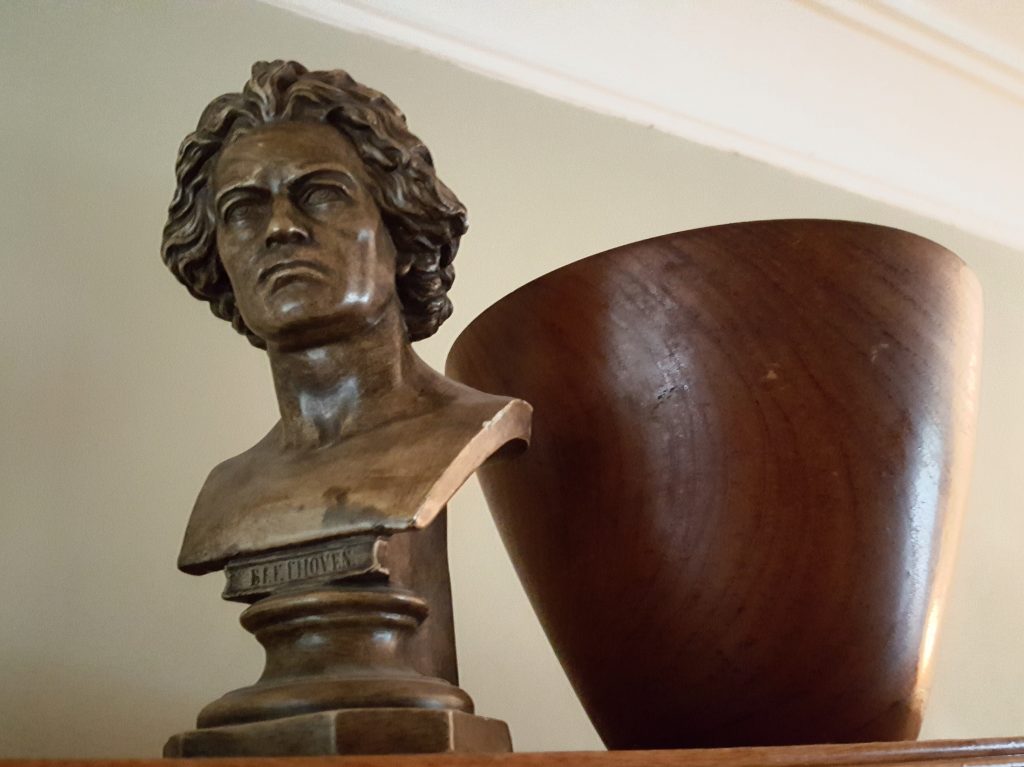
Out in my unfinished garage where I have amassed a mound of old, damaged furniture and broken objects waiting for pick up, I found a windshield propped against the wall. I have no idea what it was for or why it is there, but I know it was something my father must have picked up and forgotten. I’m surprised how much of him I couldn’t part with after his death—his Russian literature, a bust of Beethoven, a grandfather clock—all tangible reminders of a man who was so elusive, so hard to know.

Of my mother, there are few objects I wanted to bring home but her presence permeates so much of my life. Especially the one I tried to live in her image. As a girl and woman. Packing up children’s clothing for donation I find the beautiful outfits she crafted for her precious granddaughter—lined coats, fancy dresses—her attentions to Ginny’s wardrobe becoming ever more feminine as I, her only daughter, transitioned to male. I also unearth all the outfits I myself made for both my children in their early years when I was still determined to play the part birth had granted me. A part that, ultimately, has nothing to do with gender at all. I truly enjoyed creating beautiful things for my children. It just didn’t alter the sense that I wasn’t female.

And so, this house is also haunted by ghosts of myself, the selves I wanted to be, the self I became while living here. The self I still don’t know what to do with. I haven’t even uncovered the boxes filled with all my childhood photographs or angst-ridden adolescent writing. But documents with my old names, once-treasured possessions, and even a wedding dress have been revealed. Some will be retained, others hastily stuffed in bags and carted off to Goodwill.

Then last night, another more recent, unresolved ghost emerged. In a closet I found a manual from a leadership workshop I took a number of years back. At that time I was confident, more secure in my sense of self than I would ever be. My transition, in my mind, was complete and a success. But within a few years, my brief, yet promising, career in not-for-profit management would be destroyed by circumstance and my own mental illness. A loss I still have not come to terms with and yet it seems like something that belonged to another person. As if my life has just been a series of reincarnations that seem to leave me no wiser or further ahead.

And no more certain who I am.

And then there is my own addiction: books. Spread through three rooms, with most shelves double stacked, I shudder to think how many boxes there will be. No mercy for old magazines and outdated textbooks. They are bound for the recycling bin. But every time I scan my bookcases to collect charity sale donations, my decisions about what to hold on to shift. My anthropology and ecology texts are now gone, but my philosophy, classics and ancient Near Eastern history volumes remain. I notice that so many of the books I bought during my years of bookstore employment in the early 80s are still valued, even if I didn’t appreciate some for decades after purchase, whereas the literary bestsellers I devoured in my thirties and forties have been, and are, regularly pruned and sent off to new homes. Some of the obsessive tangents reflected in my collection are held dear, others are an embarrassment.

The books we read, and perhaps even more tellingly, the books we buy with the intention to read them, reveal a lot about who we are, who we want to be, and who we want others to imagine we are. More ghosts in our own lives.

And I suppose moving is one more opportunity to encounter, reshape, and even resolve a few of those ghosts—our own and those of others whom time, distance, or death have taken away.

Maybe even grieve.

Holding a creative distance: The origin of my recent engagement with Marcus Aurelius’ Meditations

This month I made my second appearance at Burning House Press. The first, a poem, was a distinctly personal effort, the most openly vulnerable piece of writing I have created this year. I’ve been debating the idea of what it means to write memoir—the only genre that really makes sense—and why I have a strange discomfort with much of what falls into that category. I’ve tossed about all sorts of approaches, from the straightforward essay to the fragmentary to the semi-poetic narrative and, in the end, I will probably just have to stop procrastinating and start putting down one word after another and see where it leads me.

In the meantime, I’ve long wanted to balance more experimental and detached projects against the personal. In particular, I wanted to find a way to engage with some of the books I brought home from my father’s library after his death. I started with randomly generated extractions from some of his collection of Russian literature, but quite honestly the material was not holding my attention. Of much greater appeal are his specialty volumes—slip-cased, illustrated collectible editions of classics like The Adventures of Marco Polo, The Rubiyat, and HG Well’s Time Machine.

One of my treasures is a small pocket-sized hardcover edition of The Meditations of Marcus Aurelius. And that’s where the current project began.

The theme at Burning House this month, craftily curated by my friend John Trefry, is “Non-nonfiction.” Inspired by a black and white postcard from New York City that I found tucked into my father’s copy of The Meditations, I decided to create a series of hyper-processed pseudo-wet plate images from some of my photographs. At first I imagined writing a mock report cataloguing these acquired images in some undefined post-apocalyptic future. But it felt too much like writing speculative fiction, forced and odd because fiction is not my territory. So I went back to Marcus, to exactly the location where the postcard still rests and extracted material from two verses on those pages. That material, manipulated with minimal intention, was then employed with the images to create an “excerpt” from an imagined series. Working like this allows me a creative expression from which I am distanced, at least to a degree, while at the same time honouring my father.

My piece, The Soul of a Man: A Meditation can be found here.  I hope you enjoy it.