When I started this blog in 2014, I was reeling in the aftermath of a major manic episode. One that effectively cost me my career. My early posts were angry, fueled by the shame and trauma of having endured such a public breakdown, and the complete insensitivity of my employer, a situation compounded by the fact that I had worked in the disability and mental health field and had never denied my own mental health history. But when I needed someone to step in and guide me to medical care there was no one.
On this day it would be good to stand up and say: Yes, I’m a survivor. Truth is, I’m lucky. I respond well to a long standing medical treatment (if I’m not so reckless as to believe I don’t need it) and I was able to coast for about seventeen years between breakdowns and, after losing everything in my mid-fifties, finally access solid supportive psychiatric and psychological care.
Over the past year I have needed that support twice when stability waned.
That’s actually a rather dismal situation, truth be told, but like I said, I am lucky, I respond well to medication and compared to many other people with bipolar disorder, I’ve been able to function well—most of the time. My son has faced much greater obstacles.
But today I want to talk about Ulla.
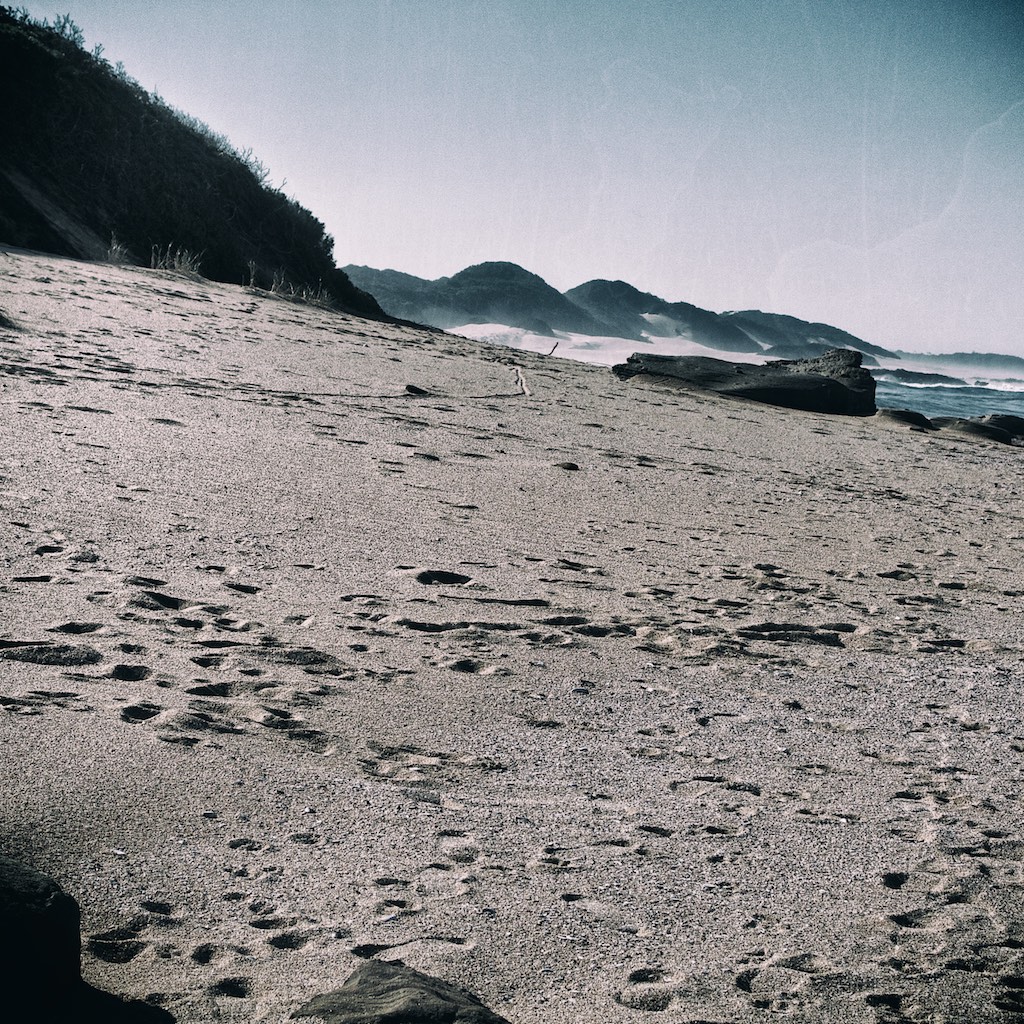
When I appeared online as a rough ghost, I quickly became connected with a group of fellow bloggers dealing with mental health challenges. Ulla, who went by the name Blahpolar was funny, outrageous, tragic, and queer. She lived in South Africa, a country I had long been interested in, and she was a huge fan of Canadian literature. We bonded almost instantly. We could joke and riff off each other as if we’d been friends forever. A little more than a year after we met online, I flew to South Africa and spent a week with her in the Eastern Cape Province. We were as comfortable together in person as we had been online.
But Ulla was struggling.
She had had a rough life. Her illness had only been diagnosed recently, at age forty-five. But the damage ran deep, complicated by so many factors. And yet she was one of the most gifted writers and wonderful people I ever met.
By the time I got to know her she was unable to work, living on saving s in a small house she’d inherited from her mother, in a remote seaside community. But the blackness was closing in fast, even at the time we met. Every rand stretched, she tried everything she could afford to fight it off. No treatment—not even shock therapy—seemed to have any effect.
She survived the first suicide attempt. Succeeded the second time, a little over three years ago now.
I say “succeeded” because it is selfish of me to insist that a woman of forty-six, who has waged many long and bitter battles, does not have the right to say: I cannot live this way. But it breaks my heart that she is gone, and angers me that in the end, she had to die alone.
Miriam Toews’ All My Puny Sorrows was her favourite book. A bold plea for assisted death for those with severe depression who see no other option.
Who has the right to weigh another’s pain?
Unaware that World Mental Heath Day was approaching, I pulled out the elegy I wrote for her the other night and tried to read it through. When I composed it, three months after her death, I was numb. My parents had died less than two months before her and all those losses were deeply intertwined. They are only breaking loose now.
I can’t get through this piece right any more. A sob rises in my chest just thinking about it. But on his day I wish to share it once again.
It is the best way to honour my friend Ulla. And everyone else who has reached the point where they felt no option but to join “that nocturnal tribe.” One should not wish that on anyone, but we cannot judge them. Least of all those of us who have known some measure of the pain depression and bipolar can bring. We can only try to ensure that support, understanding, and services are available for those who need it.
I am presently reading Herbert, the Seagull edition of the Bengali cult classic by Nabarun Bhattacharya. I just finished reading in the New Directions American edition, published as Harbart. I will write a review after this second reading, not as point of comparison because both are publishers I greatly admire and strongly support. However, it is impossible to read both and not wonder what, if any, small changes are made in making a text more, shall we say palatable, for a particular English language audience. Don’t worry, the ribald, piercing vibrancy of Sunandini Banerjee’s translation shines through in both editions celebrating a work that is gritty, funny and tragic in equal measure. That’s not the issue, but so often when one sees a critical assessment of a translation by someone familiar with the original, the translator is the larger and obvious target of an attack, one often illustrated with specific examples that are seen as muting or distorting the original. Invisible in the equation is editorial input. Translations, like any literary work, are subject to editing before they are published.
The differences here are, so far as I can tell, primarily language choices—what do you leave in a vernacular, what do you edit for the ease of an American or a British audience (as relevant)? This is a frustration I have long had with translation, something that bothered me, for example, with South African books edited for audiences outside South Africa, especially translations from Afrikaans. With my favourite writers I have tried to obtain the original South African translation if possible. One that hasn’t been sanitized for an “average” English language reader (whatever the editor feels “average” is).
Why is so hard to imagine a readership unable to guess at the meaning of a word from context? For the purist there is always Google, but that is ultimately as fallible as trusting any one editor’s word preference. Even in our native languages we often encounter words whose meaning we are at best vague, if not entirely off course with as to the exact definition. With learning a second language this disorientation is increased, but it should not necessarily be a barrier, students are encouraged to try to fill in the gaps from what they do know about vocabulary and grammar as their fluency improves. Is it an extension of some skewed political correctness that we should never meet a word we don’t recognize?
This is why I love Michel Leiris. I am currently working on a critical essay about his work. He loved language, delighted in meanings. And misunderstandings. In the way an assumed meaning is sometimes more magical than the actual one. Or how a door is opened when we take it upon ourselves to become enlightened as to the nuances of a word or expression’s meaning. Or it’s relation to root forms or variations in other languages.
In a translation there is a place for a glossary, but it ought to be a carefully mediated tool. Broader political references or identification of figures of importance mentioned in the text are one thing, especially in a novel as socially and politically charged as Bhattacharya’s. However, deciding which idiosyncratic word or expression must be defined or replaced is a question of balance. Less is more, I’d argue. If you read literature from foreign cultures, don’t you want your equilibrium challenged a little along the way? I suppose it is, in the end, a question of what kind of traveller one is—of how one wants to experience the world. You can pop in, hire a car and see the main tourist attractions then fly off to the next stop. Or you can find a path or two and navigate it until it feels, even for a few days, familiar. I am of the latter sort.
My first few days in Calcutta in February of 2018—my very first days in India ever—were ones of complete and total culture shock. I was aware of nothing but the mangy dogs, the tired poor, the crumbling footpaths, the incessant noise. It took a few days of making my way through the city on foot to begin to see it. To begin to open my heart to it. I spent a full two weeks there and didn’t go anywhere else. I took the Metro, rode ferries and yellow cabs. Met up with friends, sat in restaurants, coffee shops and parks.
I returned to the city again this year fresh from my first encounters with a wider range of Indian cities—Bangalore, Bombay and Kochi—and saw Calcutta from a new angle once again. Everything is relative. The traffic that had horrified me on my first visit now seemed remarkably—or almost—orderly (albeit still incredibly loud).
Granted, I read books from many countries I have never visited, translated from languages I have not even a passing acquaintances with, so I rely on the wisdom of translators and their editors. It’s a tricky thing, I know. I was once faced with editing an excerpt from the translation of an Arabic novel, a situation in which I respected both the original author and the translator very much. But I was afraid to question anything, for fear of showing my ignorance. Surely the process leading to a final published book would ideally be one that engages the editor, translator, and if possible, the author (or those who knew him or her well). Should I be tasked with taking on that entire manuscript—one of the most startling and discomforting I have ever read—I would have to overcome that fear.
Herbert or Harbart is a very special little book, one that is inextricably bound to the city in which it was birthed; its power is not lost in either edition for the very minor differences. It is also a book that benefits from a re-read, beginning as it does with the end of the story some of the magical elements can be lost on a first encounter.
Why read both editions? Why not?
So that is where I am at the moment. I’ll be back to write more about this wonderful book soon.
Each August is Women in Translation Month, a time set aside to promote women writers from around the world who write in languages other than English and, of course, encourage increased translation of these authors into other languages so that they may be more widely read. This initiative, started by blogger Meytal Radzinski, is now in its sixth year.
My best ever effort to participate was during 2015, my first year as a blogger. Not only was this before writing critical reviews and editing commitments started to creep into my reading time, but I was also recovering from a cardiac arrest and could stretch out on the sofa and read without guilt. Doing much else was painful! Since then, each year I have made public or private commitments to toss a few extra appropriate titles on the TBR pile and, if lucky, read one or two. I console myself by remembering that reading women in translation is something that naturally seems to occur throughout the year in the course of my normal reading. As so it should.
This year I have a few books earmarked for the month (fingers crossed), but I thought I would take a little time to suggest some titles that might not be so well known. They’re all taken from my own bookcases and most are (as of yet) unread.
I’ll start with those that I have in fact read and reviewed. First up, poetry:
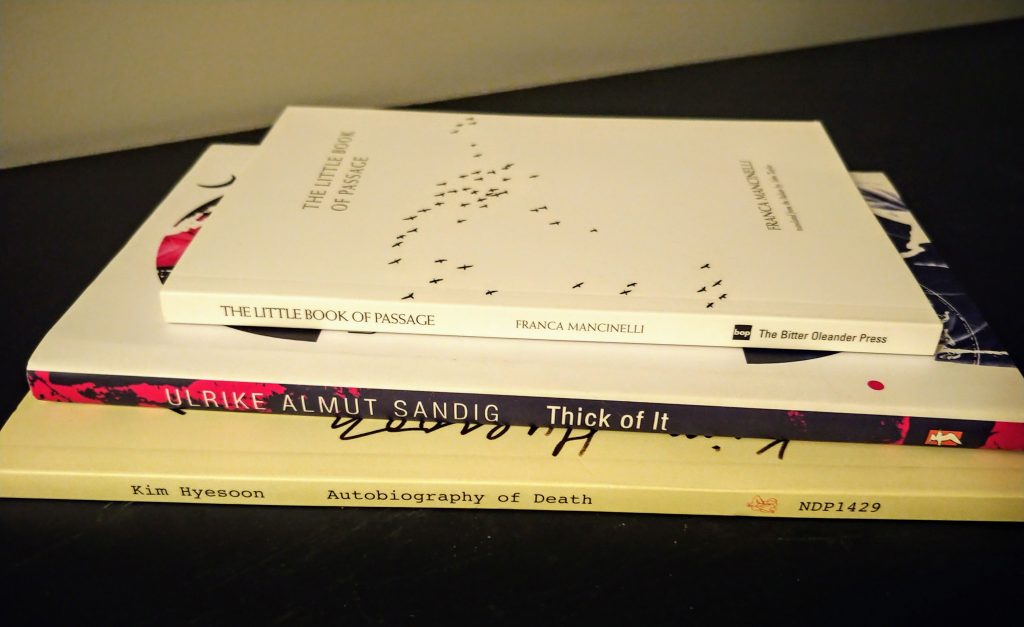
From the bottom up:
Korean poet Kim Hyesoon won the 2019 International Griffin Poetry Prize for this book Autobiography of Death, a cycle of 49 poems and one longer piece inspired by national tragedies and personal experience. Her daughter’s distinctive illustrations accompany this powerful collection translated by Don Mee Choi.
Thick of It by German poet Ulrike Almut Sandig, translated by Karen Leeder, is a wonderful blend of the magical and the everyday. Fresh and alive.
Finally, Italian poet Franca Mancinelli’s The Little Book of Passage, translated by John Taylor, is a spare and delicate collection that invites rereading. Earlier this year she and I were able to meet and spend a few days together in Calcutta when my visit happened to overlap with a residency she was doing in the city—evidence that reading the world makes the world smaller in unimaginable ways!
*
Second, I wanted to highlight a book I recently reviewed that I am afraid has not had the attention it deserves:
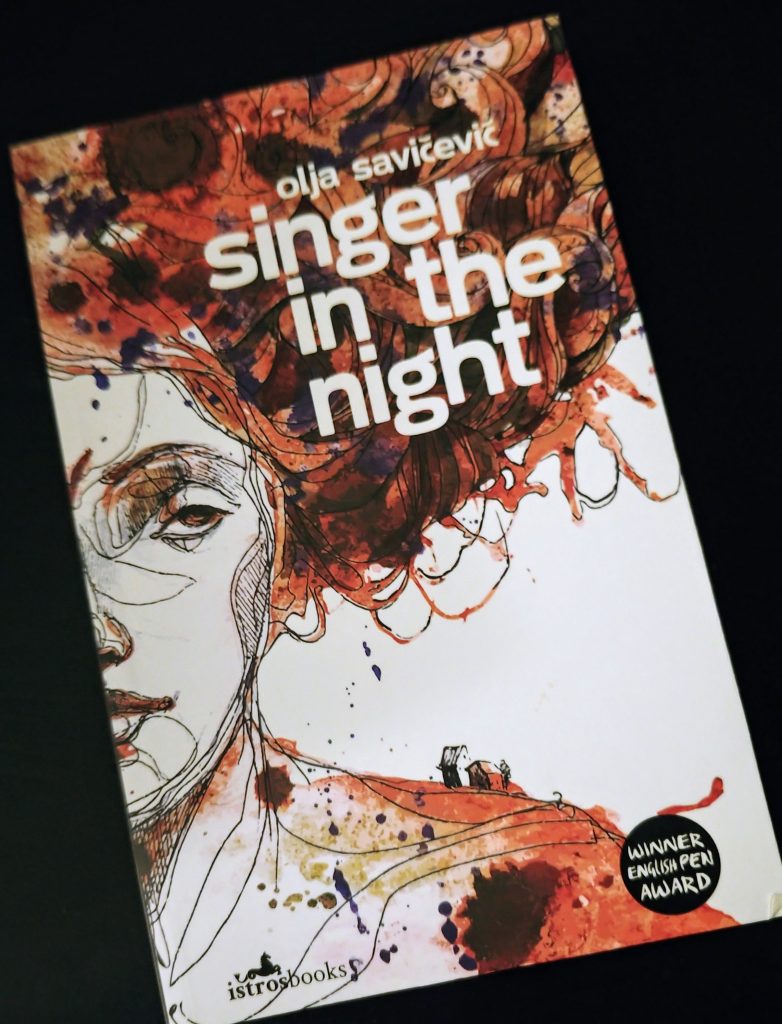
Croatian writer Olja Savičevič’s Singer in the Nightfeatures a wildly eccentric narrator and a highly inventive style to tell a story that paints a serious portrait of the world that her generation inherited after the break up of the former Yugoslavia. Translated by Celia Hawkesworth, this book is already available in the UK and well worth watching for when it comes out on October 1 in North America.
*
Third, I have an impressive stack of Seagull Books by female authors that I am ashamed to say I have not read yet (save for the poetry title tucked in here). The interesting thing for me about this selection is that although I did purchase many of these books, other titles arrived as unexpected—but very welcome—review copies by writers previously unknown to me.
Most of the above are German language writers; two, Michele Lesbre and Suzanne Dracius are French, the latter from Martinique. The review copy at the bottom of the stack is East German writer Brigitte Reimann’s diary I Have No Regrets.
*
Finally, I wanted to include a couple of translated titles by Indian women writers. Two vastly different offerings.
Translated by Kalpana Bardhan and published by feminist press Zubaan, Mahuldiha Days is a novel by Anita Agnihotri, one of West Bengal’s best known writers. She draws on the decades she spent in the Indian Administrative Service in this story of a young civil servant caught between her obligations to the tribal community she is working with and the state. By sharp contrast, I Lalla, gives a fresh voice the poems of fourteenth century Kashmiri mystic poet, Lal Děd. A detailed introduction by translator Ranjit Hoskote provides a fascinating background to her life and the tradition to which she belonged, opening a world little known to most Western readers.
*
So, what are my best laid plans for this month? I would like to read one or two titles from my Seagull stack—not sure which—and I have a new Istros title Wild Woman by Marina Sur Puhlovski on my iPad in PDF format, but the following three books have been patiently waiting for August:
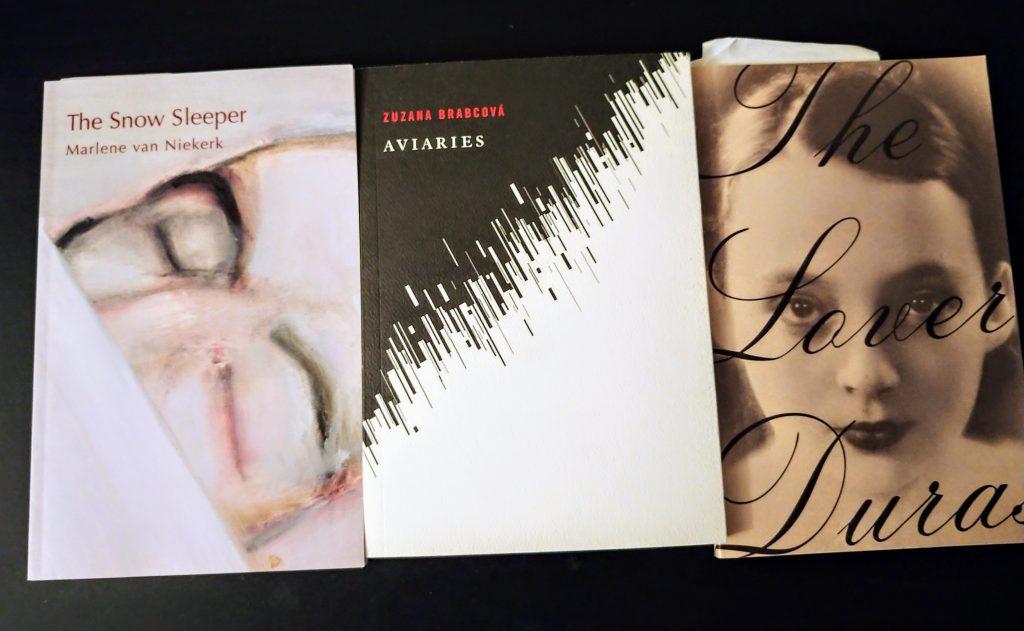
The Snow Sleeper by Marlene van Niekerk, translated from the Afrikaans by Marius Swart, is a recently released collection of short pieces, including “The Swan Whisperer” which was published as part of the Cahier Series. I ordered it as soon as I heard of it—new van Niekerk is a rare and special treat. Aviaries by Czech writer Zuzana Brabcova caught my attention when fellow readers and reviewers started talking about it so it’s another title I sought out when it was released here this spring. And last but not least, Marguerite Duras’ The Lover is a book I’ve been meaning to read for years now. Will I fit it in this August? Time will tell. And, of course, I reserve the right to change my plans altogether…
The nice thing about books is that, at least with the old fashioned solid form variety, they don’t vanish at month’s end if you don’t get to them. They will still be there on the shelf waiting no matter how much time I do or do not have to read amid all my other projects on my plate this August!
In the last years, like a bird. Delicate, frail, angel wings slowly folding in embrace. Each time I saw her, after time away, the gentle shaking, the pale whitened hair startled me anew.
So tired. But still sharp.
Wise, but weary. Fragile, breakable, skin like frosted glass. Always able to ease, with a word, every worry I laid on her.
Three years ago today, my mother left us. Slipped away, ready to move on. Calm. Welcoming peaceful release from the simple struggle to breathe.
Gathered round her bed, we asked: Are you afraid?
No.
A thousand times, whispered: I love you.
With a kiss to the forehead
I don’t know, for myself, the faith she held. Can’t quite imagine what it must have been like to feel assured she was leaving to join her parents, her sister, my sister, her God.
As she passed into to the night in one ICU, across town my father slept unknowing on another hospital ward. Eleven days later he would join her. Once he learned that she was gone, he no longer had the need to fight.
Perhaps he was afraid to be left behind.
Mourning aside, these past few days have been difficult.
My son confessed what I’d already suspected. After three months sober, he was drinking. Again.
Truth is the periods of sobriety have been but islands in a decade-long battle. Six or seven months total over the past nineteen.
His grandmother lived to see none of these passages of hope. She would have been heartened with every dry spell, distressed with every setback.
June lengthens, rising toward the longest day of the year. This is my most painful, impossible month and this year my awareness of the layering of repeated circles around the sun is taking on a new intensity.
Like a film flickering at the edge of my field of view, Junes of the past keep rolling in and out of focus. This week. Convergence.
Twenty-two years ago today, I was released from a period of involuntary hospitalization. The psychiatric ward was a strange place, with strange characters from the requisite Jesus dispensing wisdom in the dining room, to the young orthopaedic surgeon on suicide watch. I recall my time on the unit as the first opportunity I’d had in years to worry about no one but myself—and plenty of medication to ensure that I didn’t do too much of that either.
I was a manic patient in the process of coming back down to earth.
*
Eighteen years ago this week I had my first shot of testosterone. My partner of twenty-one years moved out the next morning. I cried for fifteen minutes, dusted myself off and moved on into a new reality. A single parent. A shape-shifter, slowly masculinizing.
Out of madness and into manhood. Or something.
Five years ago this week—summer solstice, 2014—I summited the heights of mania, once more, after a long steady climb over the crumbling rocks of my own sanity. I can only imagine the spectacle I’d become over the final months at the office. I remember trying to hold together an agency that seemed to be coming apart at the seams, everyone looking to me to fix things and ultimately taking the fall when I lost my grip. Nobody intervenes with a madman if that madman is doing a job no one else wants.
Nobody catches him when he falls or helps pick up the pieces. No one sends flowers.
The undignified end of my career forever unresolved. June 20, 2014, a day I can barely remember. A day I will never forget.
Exactly one year later I sought my own closure. Booked a trip to South Africa—the first and sadly only chance I would ever have to spend time with a close friend, queer and bipolar like me, but down a much deeper darker road, one with no escape, as it would turn out.
I timed my arrival so I would be in Cape Town on June 20, 2015. Imagining that I would invert my fortunes by marking winter solstice in the southern hemisphere. That I would stand and face the sun going down and bring to a close a difficult twelve months. Put it all behind me and move forward into a renewed life.
Reinvent myself again.
But of course, closure is a myth and life writes its own lessons. I would have to come to terms with death first. Very nearly my own within a month of returning home. Then my mother’s, my father’s, my friend’s.
I was torn open. Again. I’m still pulling myself together.
*
This June, for all the added hours of daylight, it’s darkness I am fighting. The malaise, the murky waters of the bipolar cycle were never my habitat until these past few years. To feel my spirit and energy ebb as the seasonal shift ushers colour into this dead brown world is difficult to bear. With the added rainbow intensity of Pride Month, ever reminding me of everything I cannot find within my own queered reality, I keep falling further into the dark corners of my own imagination.
All month I’ve been pushing against this current of discontent.
I can’t stop thinking ahead. This October brings my 59th birthday. Next year I turn 60. I don’t even know how I got here. No other milestone has pressed down on me like this one. I have a number of friends who are over 60, but not one of them is facing their seventh decade alone.
Alone. That is what I didn’t expect at this age. Or if I suspected it, I didn’t think it would hurt like hell. Alone is not a lack of people in your life. It is a lack of something you know is missing, that you cannot even fully define so it’s hard to know how to fill it. A close friend? A lover? Something to give your life meaning?
For me feeling alone is something pervasive. Embodied. Written into the physical and gendered trajectory of my existence. Here. In June. Once again.
*
June lengthens, rising toward the longest day of the year.
Passing rain. An image that stirs, the shifting light, sun, darkening skies and sun again, on a wet and glittering world. This is summer. Not quite but almost.
An odd thing happened when I was reading Kate Zambreno’s remarkable Book of Mutter, her fragmented meditation on grief and loss—a mix of memoir and literary and artistic criticism—that took her more than a decade to write. I sensed a strain in her relationship with her mother, reading it against my own circumstances. Of course there were huge differences between our lives and the ages at which we lost our mothers, but it seemed that even after such a long gestation period, her effort to work through her complicated emotions was still uncertain and unresolved. And, why not? Is grief ever really resolved?
Appendix Project, the unintentional follow up or companion piece to Book of Mutter, is a collection of lectures and essays composed during the year following the original book’s publication. It offers Zambreno a unique opportunity to continue a process that, to her surprise, was not put to rest with the final edits and release of a text she had already dedicated so much of her writing energy to. What more could be said? A lot it turns out. And the result is a more intimate, thoroughly engaging meditation on the impossibility of ever fully writing through grief, the limits of language, and the intensified emotional connection to her mother that she discovers through her own experience of motherhood. The entries gathered into Appendix Project trace the first year of Zambreno’s daughter’s life, and as such, her mother’s absence is filtered, re-imagined and given greater dimension through the presence of her child. In becoming a parent herself, her understanding of her mother as a mother has been altered.
What I never anticipated is how much being pregnant, and having a baby, would change the nature of time for me, and how that would interfere with the mourning of my mother, which I thought was finished, since the book I wrote about her was finished… My baby is almost four months old, but I feel she was just born, and that she’s been alive forever. I am 39 years old, but I have never felt more the past year like I was a child, have never felt more strongly the absence of being a daughter, of having a mother.
More haphazard, natural and organic than the book that proceeds it, this series of talks and reflections is not simply an addendum to Book of Mutter, or an alternative to reading from the book at public events, rather it grows over the course of its evolution into an intimate investigation into the act of remembering and attempting to put into words that which cannot be readily defined, confined, contained and released. There are many spaces where language is inadequate, where writing to process experience is not only irresistible but often impossible. Drawing on—that is, thinking and writing through—the work of artists and writers like Barthes, W.G. Sebald, On Kawara, Anne Carson, Bhanu Kapil, Marguerite Duras, Louise Bourgeois, Peter Handke and many more, Zambreno is not just continuing to think and re-think her own work, she is opening up avenues of inquiry and contemplation for any intuitive reader or writer to follow to their own ends. To read Appendix Project is akin to listening to its author thinking aloud as she reads the works others, reflects on motherhood, and returns to reconsider the elements of Book of Mutter that, over its long journey to a finished form, were either abandoned or edited out.
During the course of preparing the pieces that come to comprise Appendix Project, Zambreno resists the idea that they will be published as a book, knowing at the same time that she is engaged in a project. Others suggest that she should just repeat her these lectures, considering the time it takes to put them together, but there is an important temporal element at play, an ongoingness that is essential:
It feels like a necessary act, at this point where I am as a writer, and also as a published author, to re-engage in a passionate way in the ephemeral and daily practice of the writer, a way of returning back to the semi-privacy of writing—the different forms this might take—the letter, the notebook, and the talk. A talk however, Barthes notes, is not quite a performance. A talk is an outline for writing and speaking, a means to prepare and vocalize one’s thoughts.
Herein lies the key, at least for me, to the success of this project. As Zambreno sorts her thoughts out in the course of these lectures and essays, an attentive reader/writer can find their own launching points to questions that they may be dealing with. Reading Book of Mutter set me off on long stretches of writing in my notebook as passages I encountered facilitated unlikely connections I might not have made otherwise. It was often less what was said than the way something was said that caused me to think: how is that different for me? The fruits of my very idiosyncratic reading led to an understanding of my own queered relationship with my mother that I had never appreciated. I have since written about that in an essay posted here on my blog on Mother’s Day. My reading of Appendix Project, which I had little desire to rush, has likewise opened up further channels of exploration for my own writing—this time broader because the scope is broader—and some of this meandering has become key to another piece I have recently written for publication next year.
My point in bringing in my own reactions here, without fleshing out any of the details of the connections I made because they are relevant only to me, is by way of saying that this is not a book I can stand back from and review with the critical displacement required. Well I could, but that is not what excites me about this work. What makes this form of intelligent, personalized critical essay writing so powerful when it works (and it does not always work, especially when it slides into the overly self-indulgent and solipsistic) is that it can send readers (or listeners when presented as a lecture) to consider their own intersection with the topics discussed. Certainly grief and addressing the loss of a mother are central themes, but other losses—childhood, language, land, even sanity—can be subject to the same challenges of understanding and expression. My copy of Appendix Project is decorated in marginalia spinning off in a multitude of directions. And I have a stack of books Zambreno dips into—some old favourites, others yet unread—now sitting close at hand, not to mention a few more titles added to my wish list.
Finally, it’s worth asking whether familiarity with Book of Mutter will provide context for this collection of lectures and essays, and of course it won’t hurt, but this really more a book about everything that book (or perhaps any book) does not contain—what was removed, what was never there, what may never adequately be captured in any written text. They are really very different works, in form and intention. Book of Mutter, if unconventional, is still a highly structured work of mourning that, in the end, left me feeling a little disconnected. Appendix Project fills in those gaps and much more. And as such it is an exceptionally original, intelligent, and generous work in its own right.
Appendix Project by Kate Zambreno is published by Semiotext(e).
This Mother’s Day marks the third that I have faced alone since my mother’s passing in 2016. Last year was painful; this year, the passage between her birthday on May 2nd and today has been even more difficult. I have been angry, frustrated, agitated, depressed. Beset with a loneliness that is bone-deep, existential, wordless. I debated whether I should even attempt to express it because my specific pain is coloured not only by my loss of a beloved parent, my own mother, but because, although I face the world as a male person, understood as a man even to those who know otherwise, I am also a mother. Mother’s Day opens itself to women who have longed for motherhood (including those born male) or taken on motherlike roles in a wide variety of contexts, but holds no space for a mother like me. Even my own children tend to overlook my desire for just a moment’s recognition.
The only person who fully understood, honoured and respected this incongruous aspect of my being in the world was my own mother. And she is gone.
Up until the week she died, my mother called me, like clockwork, every Saturday night at 7:00 pm. I’m not sure when this pattern was established, but it extended back for decades. We were so very close. I listened to her joys and trials; she listened to mine. But there was never a exchange more difficult than my call, almost twenty years ago, to tell her that, after nearly forty years of trying to make myself into the woman she naturally assumed I was, I could no longer fight a persistent agonizing sense that I was not really female. My thirties had been, she was well aware, a decade of peculiar turmoil; that behind the birth of two children and a dutiful effort to craft a home that resembled the one I’d grown up in, something darker was brewing. I was increasingly, obviously miserable. I had experienced a serious manic psychosis and spent the better part of a month on the psychiatric ward. But nothing could have prepared her for my revelation. I had never shown the slightest masculine tendencies or interests and “transgender” was only just beginning to become a topic of conversation. However if gender roles and experiences—including pregnancy and childbirth— could a woman make, I could have managed to quell the dysphoria. I could not.
My mother, bless her, responded to the news that I was planning to divorce and transition to a life as male, with the promise that she would always love me unconditionally. She asked for no more than a few weeks to adjust to the idea. She became my advocate, quietly, faithfully, unstintingly. If she had her own doubts and grief over the loss of her daughter, she never let me know. And I never got the chance to ask. It was a subject left unaddressed in death.
My mother died from complications of osteoporosis and, as we learned in the final days of her life, post-polio syndrome. In eighty-two years the markers of exposure to that disease had never been detected, but together these conditions had gradually reduced her body to a hunched, frail, crippled cage. Until the very last month, when the lack of adequate oxygen exchange began to impair her thinking processes, she remained alert, intelligent and fresh. When I spoke to her, her age was ambiguous, eternal. Every time I saw her in person, I would be shocked anew. She spent her final years trapped in a delicate, fragile frame that constrained the spirit of a woman who had been so active and physically vital most of her life.
Her body betrayed her.
My mother’s death, followed eleven days later by my father’s death from the complications of a head-on collision, unravelled my reality in ways I am only beginning to fully appreciate. My parents spent their final years in a cottage in the woods outside a small village about two hours northwest of the city I live in. It was the final destination of lives that had started in large urban centres—New York and Toronto—and ended in a place in which they had few, if any connections. To everyone who knew them in this ultimate location, I was the oldest son. To most of the distant and scattered friends and relations I was tasked with notifying of their passing, I was their only daughter. For my brothers, never entirely at ease navigating the decade and a half between my two opposed public identities, I will always be a sister.
My parents’ final home.
For my own two children, I am the parent who transcends and defies gender, who struggled to raise them alone from the ages of eight and eleven, with little financial and emotional support, with one identity at home, but hidden, vague and uncertainly defined to the outside world. I referred to myself as their parent, only explicitly defining the biological reality when medical or educational situations commanded more specific terms. To do so was to invite the question of how much my issues were or were not impacting my son or daughter who each had their own challenges. No one ever asked how the practical emotional distance of their father played a role. I looked like a father and it is difficult for others, even if they are fully aware of my past to hold mother as a reality in the existence and life of someone who looks like a man. I was, more often than not, reduced to that oddity that, even today, is poorly appreciated—a single male parent.
I would be asked: Where is their real parent? Who? Their mother? What could I say? She’s dead? And yet, I resisted revealing my identity unnecessarily. I have long known single fathers, not widowed but left with the care and responsibility while mothers moved on, and I felt it was important to call attention to the fact that not all single parents are women. I also feared negative fallout. As a closeted transgender person I stood in isolation.
Yet raising children through their difficult adolescent years gave my life meaning, value. My own parents stood by me, pitched in, built strong and vital relationships with their grandchildren while the other side of their family, maintained a distance. Only their stepmother, their father’s new wife, made an effort. As I built a new identity and a new history as a man in the world, my children and my parents provided essential continuity. They allowed me to feel whole, to carry motherhood and manhood as part of who I was.
Who I was.
The last few years have not been so easy. The artificiality of this assumed completeness was shattered when I became ill and lost my job. The scaffolding provided by my short-lived career, the years I spent working in social services fully and completely accepted as male, was stripped away leaving me defenseless. By this time, my children were in their twenties, both dealing with their own serious issues, and I had no friends, community or support to fall back on.
In retrospect, the sharp jolt into recognition of the limitations of transition to address the longstanding dislocation of gender dysphoria, has been a blessing. I could have continued to imagine that my artificial existence was sufficient for some time, but in truth, cracks in my carefully tended armour were showing long before the tentacles of mania pried them open. Career success was only a passing indication of achievement. My failure to make friends or forge a sexual identity spoke much more acutely to the truth that I could live as a man, but would never really be a man. Yet, as transgender, my own experience—past and present—is never echoed in the endless stream of gender different narratives that have become so ubiquitous in queer and public discourse. My personal efforts to find comfort, community or safety in LGBTQ space have been a dismal tribute to the heartache of finding oneself doubly alienated among the alienated. I sometimes feel like I have never fit in anywhere.
So I sought to find myself where I had no reason or expectation of fitting in. Where I once sought to ensure protection by building walls between myself and the world, I now seek escape. Through reading, writing , and travel. South Africa. Australia. India.
And again, India.
My mother only lived to know of the first of these journeys, one that in my complete ignorance about the risks of long haul sedentary travel, very nearly cost me my life—blood clot to pulmonary embolism to cardiac arrest—saved against incredible odds, by my son who found me and started CPR. But I know she would never have discouraged my continued travel. In her lifetime she managed to visit Cairo with a friend and Russia and New Zealand with my father, but had she not been constrained by an increasingly brittle body and an increasingly eccentric and intransigent husband, she would have travelled longer and farther. Perhaps I have inherited some of my restlessness from her.
That restlessness is growing. I have never felt “at home” in the city where I have lived for most of my life. I was not born here. I have no roots or connections here. Both of my brothers are married to women with deep histories in this part of the country. But my ex was of the first generation born to migrants, refugees. My own mother was a migrant and, back only two generations of a family of refugees herself. I feel this eternal disconnect enhanced by the embodied dislocation I feel as someone who has navigated womanhood and manhood, but belonged to neither. In this present #MeToo era I am even more adrift. I am torn between a genuine empathy for men—informed by living as a male person in society keenly aware of the ways testosterone has altered my mental and emotional engagement with the world—and the feeling that my own experiences as a girl and woman have lost their currency. I look like a middle-aged white man and that is all that I am allowed to speak to. There isn’t even a language which can adequately address my dual life and my role as a parent. Transgender men who opt to have a child at the beginning of the transitional process engage a queer parenthood that is unlikely to ever be labelled “motherhood” as language now tends to be gender neutralized, distorted. Which is fine for them, but it silences and disowns the reality of my, admittedly less common, hybridized experience.
I want to speak for no one but myself. I do not regret the decision to transition, I am entirely comfortable with the face I see in the mirror. I am male and enjoy a hormonal rightness that grants me a certain completeness. The body, well that is another possibly unsolvable matter. However, of late I find myself wanting to claw back some sense of dignity for my early, pre-transition life. It isn’t easy. It is unsettling, even with my most generous and supportive friends— those who fully accept me but have only known me with this present name, this current appearance. And very often it angers transgender activists because it defies the accepted discourse. I can’t help but fear that the only person who might have ever come close to truly understanding, who might have been able to walk with me through this unending, evolving, shifting, and ever ill-defined journey is no longer here. My mother contained all that I am—all that I have ever been, and all that I ever will be. My absolute alpha and omega. Her love was whole, at times skeptical perhaps, but expansive and complete.
And for that reason, on this Mother’s Day, I miss her with all my heart and soul.
Back from a month in India, I am struggling to reorient myself. The jet lag and the cold I thought I had shaken that has now morphed into a different version of moderate misery do not help. My brain is foggy. My body is trying to adjust to the twelve and a half hours I just gained back. My heart is sick with a longing to grasp again, just for a minute, whatever it is that I left behind. That I leave behind every time I return.
India has a strange charm. One I can’t quite place. I never imagined I would go there; I cannot pinpoint when the seed was sown. I do know that for years it was a secret wish, not bound to any particular calling but simply a desire to go there. Last year’s chance decision to visit Seagull Books in Calcutta was an opening, this year I expanded my time and orbit, and met so many more people along the way. Had so many great conversations.
How is it, I ask myself again and again, that I can travel halfway around the world, and make more solid connections—new or renewed—in four weeks, than I can manage in an entire year in a city I have lived in for most of my life? Is it, perhaps, that I am able to be myself in a strange land, relax into a comfort with who I am in a place where I do not naturally belong? Why can I not bring that person back with me? Or at least feel at ease with him when I come home.
What is home, then? And why does this place fail to complete me? Why do I feel a home-away-from-homesickness weighing on me? I envy those who belong someplace.
As long as I can remember, I have felt that I was out of step, out of sorts, a misfit. Marriage, moving, midlife metamorphosis—nothing has ever completely eased the discomfort. Only in travelling do I find relief. Only in upsetting the equilibrium do I feel whole.
At least for a while.
Toward the end of my visit, an unexpected event challenged this temporary relief. I went out to visit a friend at a school in Andhra Pradesh. Here, in a rugged and breathtaking location with only the faintest internet signal, the world was out of reach for the night. In the morning, as I climbed into the car, my driver greeted me with news he had just received. “India attacked Pakistan,” he reported with enthusiasm, “people are celebrating in Bangalore!” I politely responded that I wasn’t sure that was a good thing, but all the way back into the city I contemplated what it would mean to be in a country at war. I was not unaware of the tensions that had been building, but I had no clear grasp of the historical context. As an outsider, I am cautious to hold to a respectful neutrality, but somewhere along the way a line is crossed. I have become attached to people and places. I am not simply a visitor.
Once again I am aware of a sensation similar to what I feel as a person without a coherent gender history. A neither-here-nor-thereness defines my life. Always has, always will. Only now it is slipping across other boundaries, opening new possibilities.
After this recent trip to India, and the many rewarding and validating encounters that I was fortunate to have, I am beginning to believe that if I can learn to embrace an inherent disequilibrium as a fundamental and vital part of who I am, I can finally move ahead to tell the story that has been eluding me. My own story.
A week in Calcutta, my second visit to the city, now lies behind me. I am back in Bangalore again, looking out over the rooftops as the sounds of a busy Saturday remind me that life is ever alive and vital in a large Indian metropolis. But, as I sit here, the sights, sounds and scents of Calcutta are still coursing through my imagination. It’s a hard city to shake once it gets into your system.
Last year, as my first introduction to India, Calcutta was not what I expected. A full assault on the senses in ways I was not prepared for. It is still is, but this year I returned with a little bit more perspective, however limited. Unlike some people I’ve spoken to who cannot imagine why anyone would want to, or dare to, go to Calcutta, picturing the city at its most difficult times (enhanced perhaps by a little Hollywood melodrama as well), I had arrived expecting it to be more modern than what I found, especially in the grand, old, if somewhat decaying central parts of town. This time, however, I noticed more office complexes and taller buildings although somehow Calcutta manages to do “modern” and yet maintain a distinct element of shabby chic. Either that or, as in the new curator’s offices at the stately Victoria Memorial demonstrate, create a generic and unremarkable annex completely at odds with the echoes of the past. It’s a wonderfully eccentric we’ll do it our way way of being as stubbornly defiant as the hand pulled rickshaw drivers that continue to make their way along the back streets.
And speaking of streets, after a taste of the traffic in Bangalore, Mumbai or Kochi, Calcutta is comparatively ordered and slow. Very slow. Typically vehicles stay in their lanes, and the traffic police ensure a general order, lights at intersections are obeyed, and major roadways can be safely crossed. Which is saying a lot to be honest. It is a walkable city. The pathways can be rough at times, or filled with street sellers and food vendors, but if necessary one can generally manage to travel along the edge of the roadway. Some of the backstreets are fairly quiet and empty much of the day. But if a single vehicle comes along, you will hear of it. More than one vehicle and you won’t be able to hear yourself think. The noise of the car horns can be ear splitting. I’m inclined to think that anyone out to acquire a new or used vehicle must head to the showroom, car lot, back alley or wherever such transactions might occur and simply lean on the horn. If a few windows shatter, it does not matter if the wheels are falling off, it’s good to go!
Another traffic related observation I noted this time is the increased use of helmets on motorcycles. Friends told me that it has been a point of enforcement over the past year. And a good thing too. I was heading up a major thoroughfare on my way to meet a friend at the Marble Palace, when I came across a motorcycle accident. There were two children and one or two adults on the cycle, all fortunately with helmets. The one boy must have fallen off. As I passed, they were carrying this dazed child to a bus stop bench and a large crowd was gathering all shouting and offering their opinions. Without helmets it could have been far worse. All I could think of was the woman I saw speeding down the expressway in Bangalore with her young daughter on her lap, neither with helmets. But of course, where I live, motorcycles are a seasonal mode of transport, not a practical necessity as they are in this part of the world.
Traffic and faded architectural glory aside, to be back in Calcutta felt like coming home. A place I returned to seeking to refine a creative focus. On my first visit I came fully intending to write; this time I came with no such illusions. I came to experience, to meet other creative spirits, and to reconnect with all the good people at Seagull Books who have become dear to me. This time my stay was shorter, but coincided with so many wonderful visitors and events. It began, the night I arrived, with the opening of Removing the Gaze, an exclusive showing of collages by German artist Max Neumann. Monday morning began with NYRB Classics editor Edwin Frank’s masterclass at the Seagull School of Publishing, followed in the evening by my conversation with him at the Victoria Memorial (still fretting a little at what I had hoped to talk about but didn’t, I’m afraid). Tuesday it was my turn to lead a school session. As with my first experience last year, I was caught off guard by how quickly the three hours passed and by the engagement of the students. Wednesday was a full day of sightseeing with a new friend, Italian poet Franca Mancinelli who, by coincidence, has been in the city on a residency, and Thursday morning featured a masterclass with conversationalist extraordinaire, Paul Holdengraber. Throughout the week I also had a number of meaningful conversations with Colin Robinson, the co-publisher of OR Books who was staying at the same residence where I was and doing some work with Seagull. Along with many visits to Seagull Books’ new office in their former school space, now newly opened up—a bright, cheery and inspiring creative environment—this was week packed with literary energy.
Now to see if I can carry some of the inspiration and focus I was seeking forward.
In Bangalore tonight, the friend I am staying with remarked on a new sense of perspective, of direction, and perhaps peace. As if India does give me something I need. The one thing it won’t give me is planned time for the two of us to travel, as unexpected circumstances now call him to be with his family. But such is life. This leaves me with a little over a week, and apart from one more overnight journey out of the city, much needed time and solitude to put some perspective to my own writing goals and direction before I return to the distractions and demands of life at home.
Of course, I will be back. India is not finished with me yet. Nor I with her.
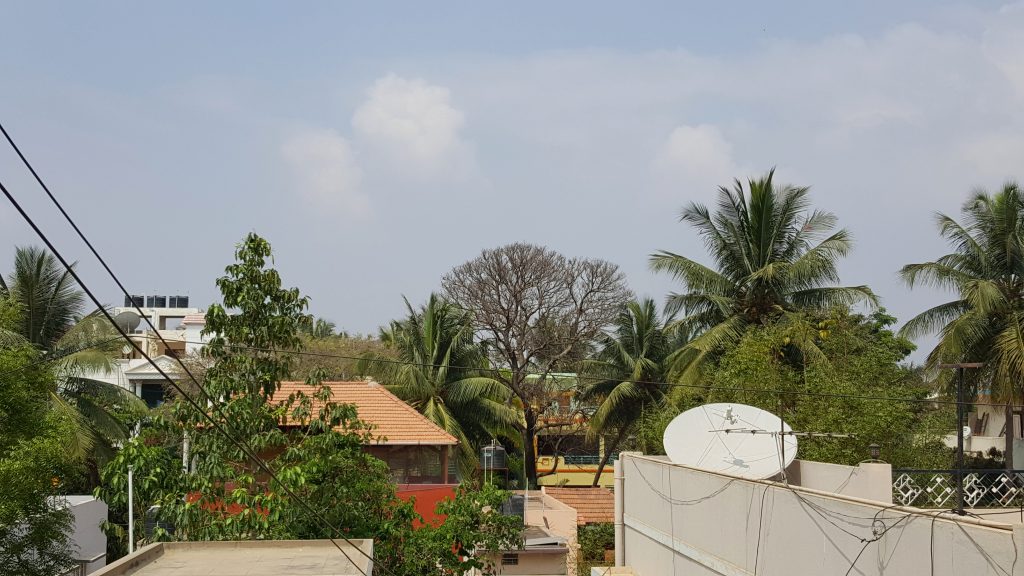
As I write this I am back in Bangalore, my pivot point, my home base for this month-long stay in India. A fresh breeze drifts in through the open balcony door of my friend’s flat. The comforting noises of a city and neighbourhood gearing up for another day—traffic, dogs barking, children singing—rise from the streets below. The sounds carry a certain comfort, a connectedness to life, a rhythm timed to the swaying coconut palms and soaring black kites that pass from rooftop to treetop roost.
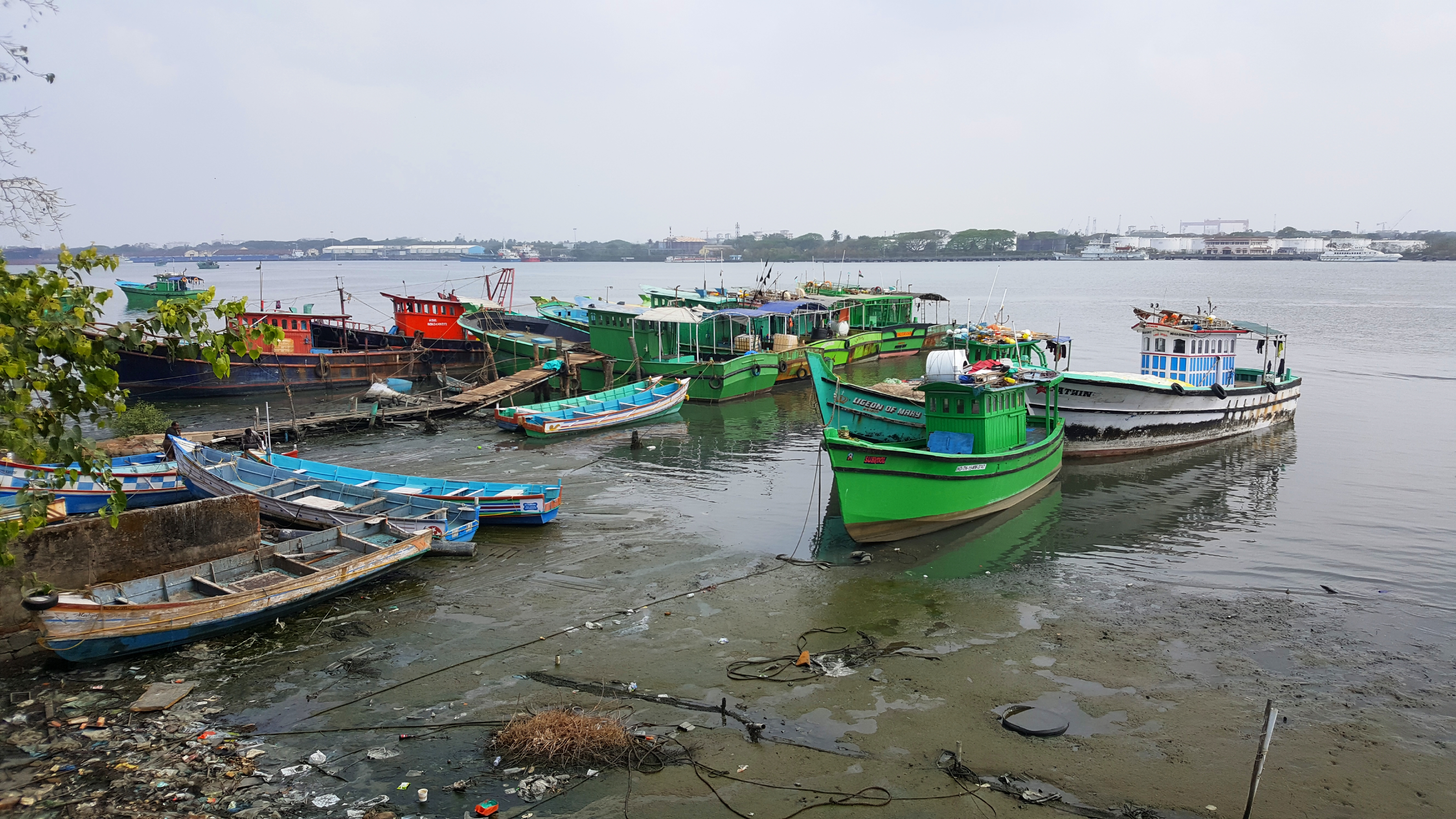
The past week took me to Mumbai, then south to Kochi. While my hometown back in Canada is in the midst of the longest unbroken deep freeze in decades, I struggled to adjust to the intense tropical heat and humidity, aware that it is not even the hot season in Kerala. Kochi is a port city, ribbons of land and ribbons of water, on the edge of the Indian Ocean. Huge tankers, barges and colourful fishing boats move in and out. It is lush and green, infinitely greener, they say, in the rainy season. With a population of about two and a half million, it is small in terms of Indian metropolises, with a greater sense of space and openness than I’ve noted elsewhere, perhaps due to the way the water is such a necessary and defining feature of the urban landscape.
I stayed with a friend at the beautifully tranquil compound where she owns a flat. Her recent return home from “exile” in Dubai makes perfect sense. Here, seemingly cut off from the inevitable rush and commotion of the city streets, it is easy to imagine the stresses of the world away for a moment. And yet it is in the midst of an almost fully developed residential neighbourhood, easily accessed by auto rickshaw over a a pedestrian bridge down the lane, but by car, only through a maze of the most circuitous and narrow roadways I’ve ever travelled. Passage across the city is a disorienting journey to say the least, but within a few days, I began to register landmarks and gain a basic sense of direction.
In Kochi I was aware of two elements in particular: the striking presence of Christian churches—a testament to the historical role the Portuguese and the Dutch played for better or worse—and the overwhelming number of tourists, both on my flights and on the ground. With so much of my travel in India, I am drawn by connections to people I know, even if I have yet to meet them personally, and this often allows me to explore a space either on my own or guided by locals. So I arrived in Kerala unprepared to encounter the typical tourist experience. The only specific destination on my agenda was the Kochi Biennale, but this extensive and diverse series of art exhibits was set up, understandably, throughout the tourist-heavy areas of Fort Cochin and Jew Town. Of course, now that I have been to Kochi, and had my first introduction to the fascinating textures and tones of the region, another visit with a wider focus will be in order.
As ever, the most precious moments of travel are, for me, time for face-to-face conversations with friends I’ve come to know through the internet. India then becomes the backdrop, its sounds the accompanying chorus. In Kochi, I had several days to visit with a friend I feel like I have, in some fashion, known forever, and an afternoon with another friend I met through her, an artist who came into the city to take in some of the Biennale with me. Although it can’t be long, I am often hard pressed to remember just how, or when, some of my Indian friends, Mini in Kochi, Sachin here in Bangalore, or the Seagull Books folk in Calcutta came into my life. Each city I visit expands my circle. I feel so very fortunate to have been given this opportunity to travel, something I never imagined, but for a serious of fortuitous, albeit essentially “unfortunate” circumstances, I would ever be able to experience. It is not a gift to be undervalued. And yet I carry, somewhere inside, a fear that I’m unworthy.
Now the halfway mark of my visit is nearing. I wait on the edge of a return trip to Calcutta, eager to be back in that most singular of cities, keen to reconnect with old friends and meet with new ones. I must confess, however, to being just a little anxious about an event that awaits me there.In a few days time, on February 18th, I will be in conversation with Edwin Frank, the founding editor of NYRB Classics at the impressive Victoria Memorial. No pressure! In truth I’m very honoured to have been invited to be part of the visit of such an esteemed guest and will be sure to report back on the experience once I recover! In the meantime, I will sign off with a few more images from Kochi…

 On this day it would be good to stand up and say: Yes, I’m a survivor. Truth is, I’m lucky. I respond well to a long standing medical treatment (if I’m not so reckless as to believe I don’t need it) and I was able to coast for about seventeen years between breakdowns and, after losing everything in my mid-fifties, finally access solid supportive psychiatric and psychological care.