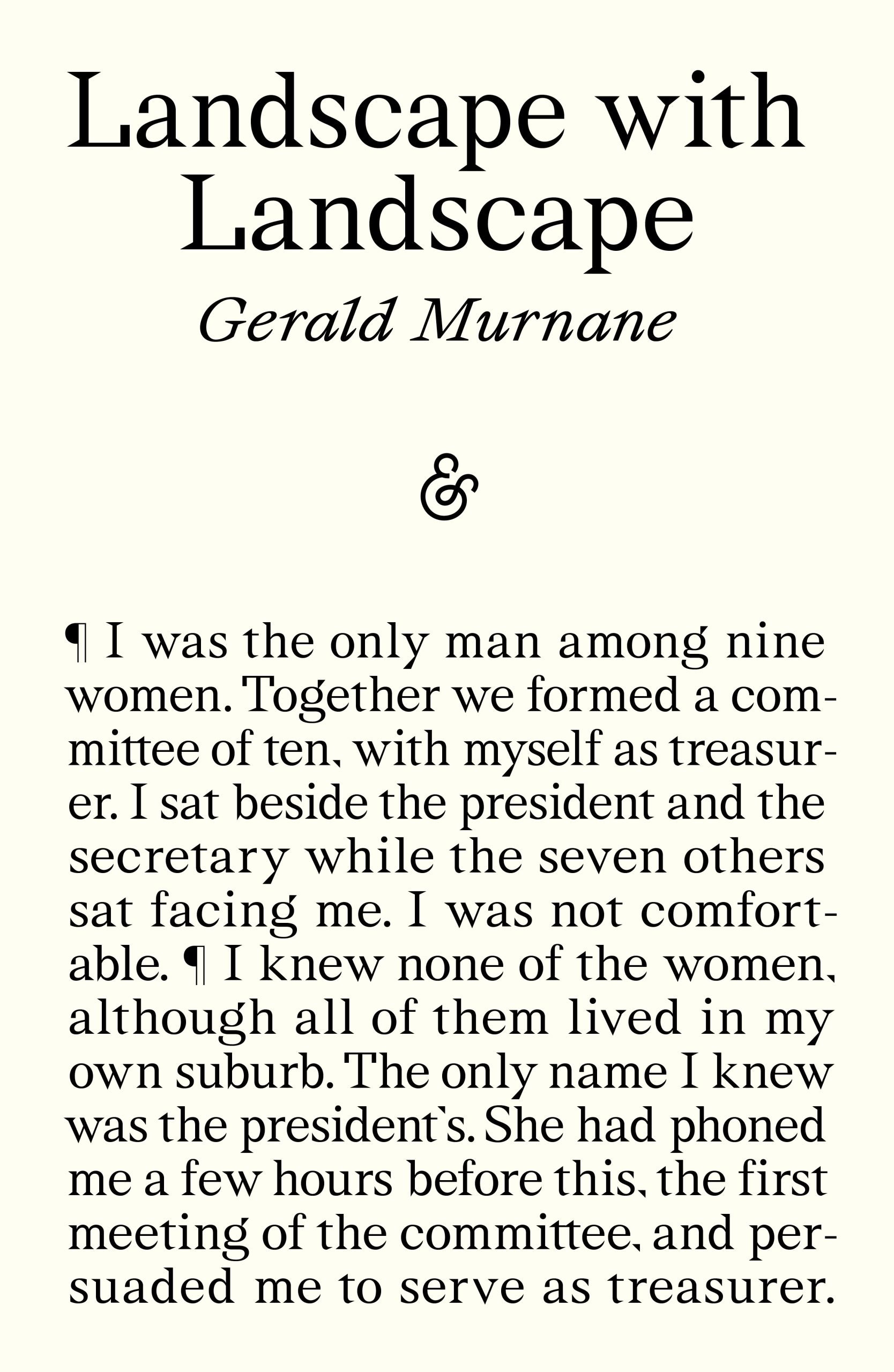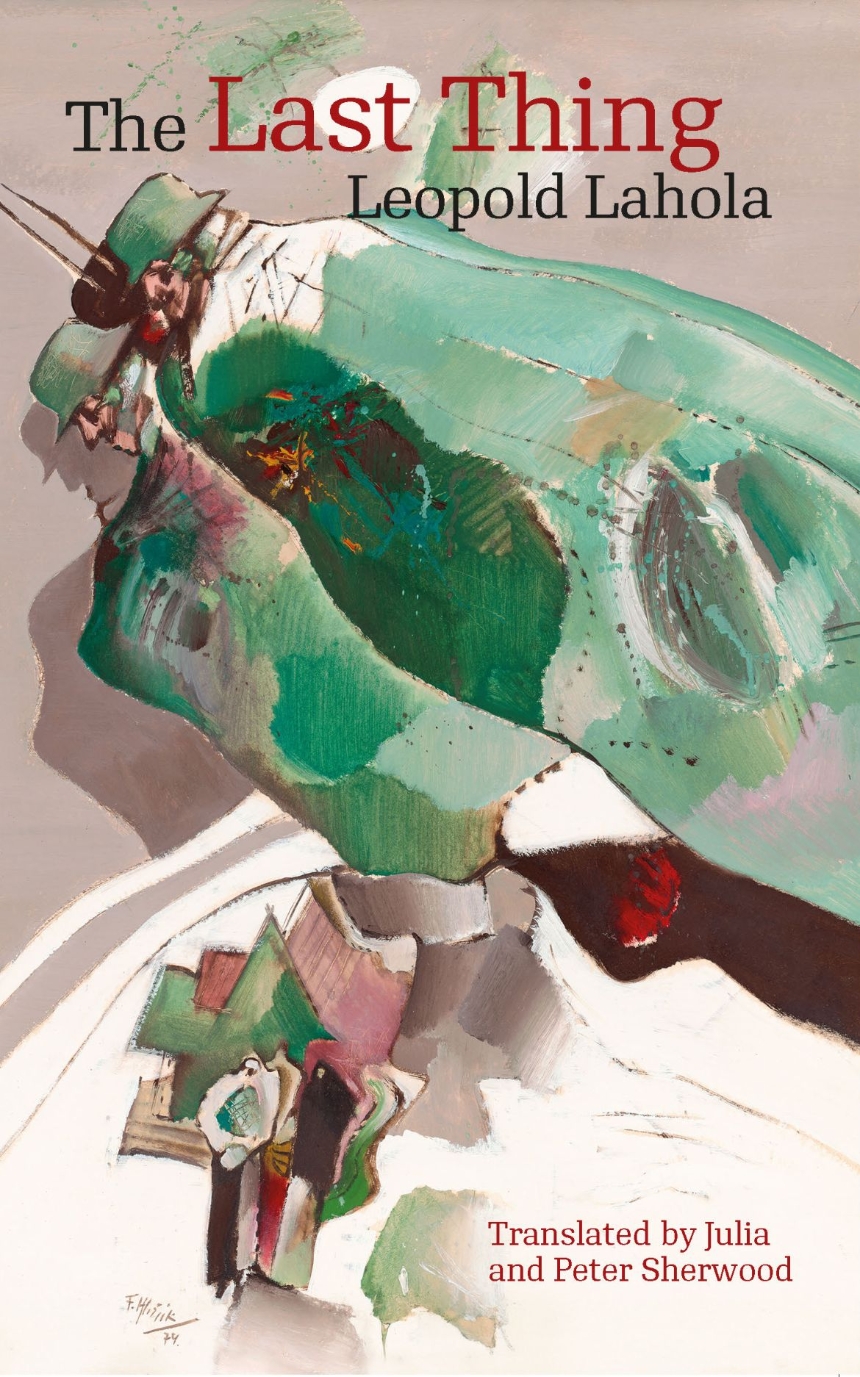
“Pain is a privilege of the living.” The Last Thing by Leopold Lahola

One day, a hundred thousand years ago, during the Ice Age or soon after, when the world began to melt from below, an iceberg must have carved out this valley, with its body dragging its tail behind it like an enormous scaly reptile. At least according to the long-winded account he heard yesterday from Big Joco as the two of them had been left to their own devices with machine guns aimed at the valley they were watching intently, charged with providing cover for their unit lying low in the woods behind them, and now, rushing hell for leather from the woods back to Big Joco after an endless night when they had not been relieved as planned, Melius concluded that very little had in fact changed, that they had entered another damned ice age and that even the sun, sinking its teeth into him like a cannibal, would also soon turn to ice.

This is the opening paragraph of the title story of the newly released collection of tales by the Jewish Slovak writer Leopold Lahola, available in English for the first time in Julia and Peter Sherwood’s translation. The brutal cold and the  isolation of partisan fighters in the final winter of the Second World War cuts through to the bone in this tale of one man’s efforts to respect the dignity of a friend and fallen comrade. When Melius makes it back to the windthrow where he an Big Joco had been positioned, he finds his companion dead. To leave him there to suffer further indignities should the Germans pass by is unthinkable. But Big Joco is a monstrously huge man, now lying face down, stuck to the frozen ground. When Melius encounters a stray fellow partisan, a miserable character referred to simply as Walrus due to his distinctive moustache, he tries to enlist his support to move his friend. The reluctant recruit balks when he sees Joco’s massive form, and even when the two men combine forces their task seems impossible. So Melius conjures an ingenious, if gruesome plan to divide the load.

This desperate urgency to cling to some measure of humanity under inhumane conditions, with the inevitable conflicts that arise between individuals with different motivations—regardless of whether they are on opposing sides or not—is a key theme running through all of Lahola’s wartime stories. His ability to quickly set a scene, craft strong, often eccentric characters and his keen ear for dialogue give his fiction its unique cinematic intensity. It is not surprising that he was also an accomplished playwright and filmmaker. However, due to his own postwar malaise, he ended up spending much of his life in exile. In fact, the collection from which the stories in the present volume were drawn was not published until 1968, months after his early death just shy of his fiftieth birthday.  However, the Soviet invasion that same year  would lead to the erasure of his work from Slovakian literary history,  not be rediscovered until twenty years later following the Velvet Revolution.

Born Arje Friedmann in northeast Slovakia in 1918, Lahola was conscripted into the Slovak Army in 1940. He deserted in 1942 to avoid deportation, but when he learned that his mother and younger brother had been interned in a labour camp, he willingly joined them. When they were to be taken away on a transport, he again offered to join them, however a friend working in the camp administration removed his name from the list. He then went on to join the armed resistance and engaged in front-line combat during the Slovak National Uprising. The final winter of the war he spent in the mountains fighting with the partisans. After the war he worked as a journalist and began writing for the theatre, adopting his more distinctive Slovak name, Lahola, inspired by a sign above a butcher’s shop. For a time he achieved considerable success in the postwar world, but he found it hard to shake the weight of the recent past. Following the Communist takeover in 1948, he emigrated, first to Israel and then to Germany, before finally returning to Czechoslovakia in the late 1960s in the light of growing liberalization.

Lahola drew on his own wartime experiences in his short fiction, not only the hardships and cruelty, but also the recognition that his enemies, the German Nazis and their collaborators, were human beings too. As he noted in his diary, “I participated in a war against people who were my spitting image.” It is this reality that complicates the emotional and ethical implications of many of the stories collected here. These are not heroic tales with clear black and white divisions between good and evil, shades of both exist on both sides as it turns out. The longest piece in the collection, “A Conversation with the Enemy,” is a prime example. It begins with a partisan, captured by the Germans, anticipating a harsh interrogation and summary execution. He finds, instead, bored officers who ask him nothing. He is then sent off and finds himself followed by an armed soldier who cordially introduces himself as Helmut Kampen. Fully expecting to be shot, the partisan is disarmed by the German’s desire to engage him in conversation, longing for a little friendly debate. As they make their way through the snowy woods, their banter continues—eagerly pursued by the soldier and suspiciously challenged by the partisan. It becomes, over time, an extended interaction between two men who, under other circumstances, might be friends. But ultimately, when the tables are abruptly turned, they each still have a role to play.

The nine stories gathered in this volume were composed primarily during the early years of Lahola’s exile, from the late forties through the mid-fifties, and are set amid rising facsism just before the war, through the years of concentration camps, direct conflict and on into the tragic aftermath. All feature third person narratives, save for one, aptly titled “In the First Person” set during the first summer after the war, in which the narrator, returning to his home community, collects the first person accounts of those who have survived as he seeks his own closure. Among writers chronicling this period,  Lahola’s work stands apart, not simply because he can draw out the humanity in the enemy (not to mention the inhumanity on his own side) but because his narratives tend to adopt a dispassionate, distanced tone. This heightens the intensity of the moral choices he places before his characters, typically driving them to a point at which a decision must be made, and then leaving them there, in the terrible moment. The very clear theatrical quality of his stories, tinged as they are with a dark touch of the absurd, allows for an exploration of the realities of life during wartime intended to raise more questions than it answers. As such, The Last Thing is a long overdue opportunity for English language writers to come to appreciate the work of this remarkable Slovak writer.

The Last Thing by Leopold Lahola is translated from the Slovak by Julia and Peter Sherwood and published by Karolinum Press.

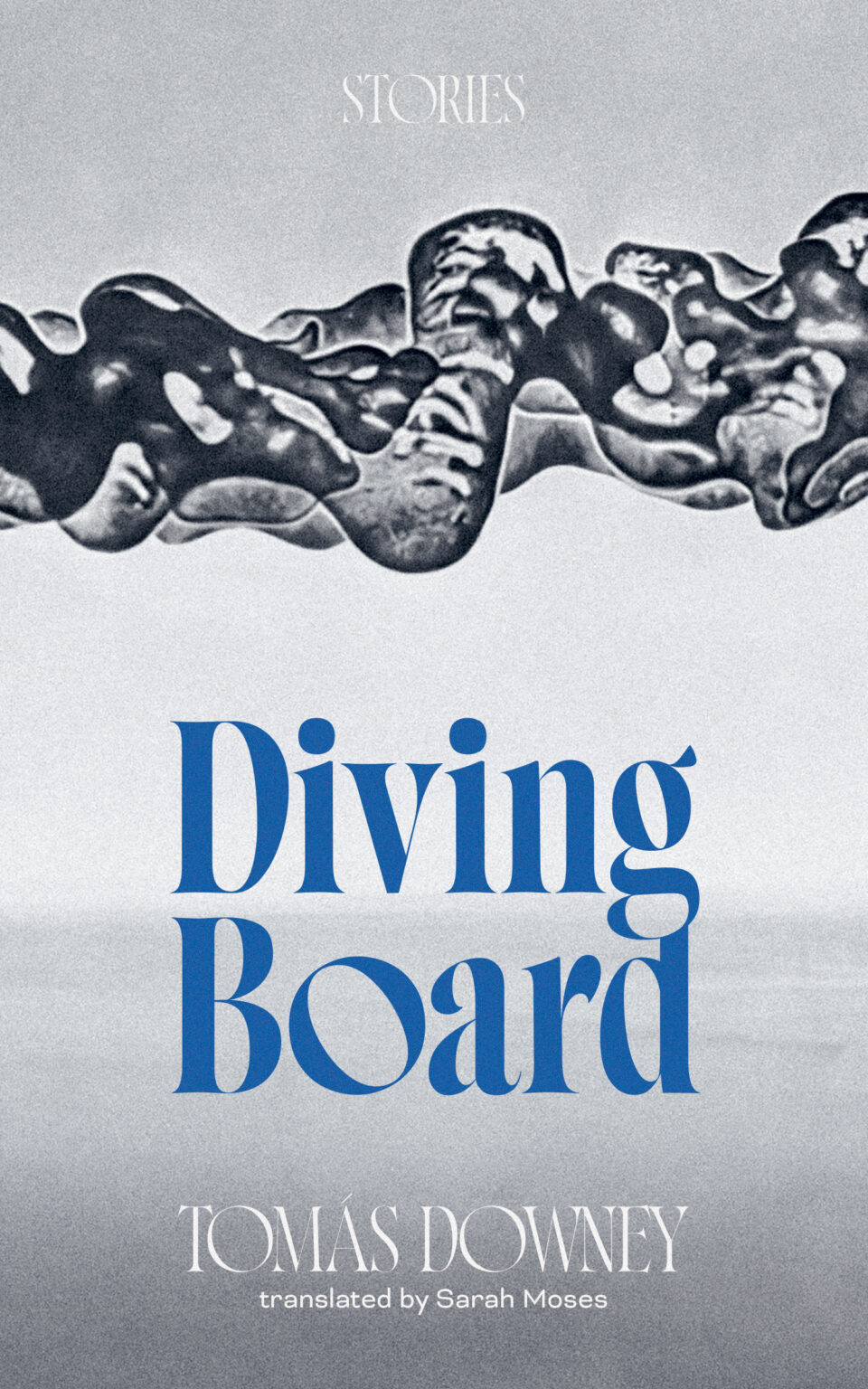
Slipping into the twilight zone: Diving Board by Tomás Downey

The first thing I think to write is this: what’s happening to me is incredible. But immediately, I stop—I’m suspicious of everything. I think about it, reread the sentence, and the pen slips through my fingers and falls to the floor. It bounces and flips in the air, does some involuntary acrobatics. Describing what’s concrete is easier.
(from “Astronaut”)

If there’s a common feature uniting the nineteen stories gathered together in Diving Board, Argentinian writer Tomás Downey’s first collection in English translation, it’s the uncomfortably close focus he places on the experiences of his narrators or protagonists. His lens is so tight that the edges of the world around them becomes  increasingly distorted, leaving them emotionally isolated and alone. Consider “The Astronaut” quoted above, for instance. The narrator is a man who has inexplicably found himself freed from the restraints of gravity, a condition that has literally turned his world upside down. Only at ease resting on the ceiling, every time he returns, even briefly, to the floor he is struck by waves of dizziness and nausea. There is no magic in this altered reality; everyone else, his wife included, remains grounded, unreachable. He decides there is only one means of escape—an open window.

Born in Buenos Aires in 1984, Downey is one of Argentina’s foremost short story writers, a master of a strangely unsettling terrain that his fellow Argentinian writer Mariana Enriquez refers to as bizarro fiction, not a genre but: “a disturbing variant that hides a vague threat, that leaves the reader feeling something between awe and unease.” As such, his stories vary from harsh realism to fantasy to horror to speculative fiction, but regardless of form, he tends to minimize set-up and avoid resolution altogether, intensifying the tension. In most instances, his settings lack excessive detail which allows circumstances, personalities, and interrelationships to take centre stage. As a result, even stories that take place in rural settings have a certain pervasive claustrophobia.

Short story collections, especially those that contain so many titles, can run the risk of falling into either unevenness or sameness. With Diving Board however, even if many of the tales involve either couples or families, no two stories are alike. Each treads a distinct terrain. In “The Cloud,” a thick, damp fog settles on a community, driving everyone indoors as the temperature rises and snails and slugs seem to multiply rapidly. A family tries to wait it out as this strange, heavy, wet plague spreads. In “Horce,” a man buys a seed that grows into a horse, a creature he hopes will offer him an excuse to reach out to the woman he loves, but instead the vegetal animal only increases his isolation. And, in the title story, a divorced father takes his daughter to a swimming pool, but when he finally agrees to allow her to jump off the diving board, she disappears into thin air:

Josefina leans over again, gauging the distance. She walks back to get a running start. She runs, jumps. He closes his eyes for a second, they’re irritated by the sun and the bleach. He hears a scream or a laugh. When he opens his eyes, Josefina should be in the air, about to fall, but she’s not. He hasn’t heard a splash either.

While many of Downey’s stories exist on the edge of the uncanny, reminiscent of Rod Serling’s Twilight Zone and its iterations, others lean straight into horror with characters who harbour cruel and twisted intentions. The action often stops just as things fall apart or in some vague aftermath. No explanations or reasons are ever offered. But sometimes there seems to be a deeper, more serious message. Such is the case with my favourite piece, “The Men Go to War.” Although it is not tied to any specific conflict, Argentina and other Latin American countries have seen their share of uprisings, coups, and warfare, but in truth this tale could take place anywhere, any time. The setting here lies in the shadow of a brutal war. Jose’s husband Manuel is a soldier. Every day she sits at home, refusing invitations to go out or welcome visitors. She is angry at her husband’s willingness to get involved. Then two officers appear at the door with the grim news that Manuel has been killed. They tell her that the incident occurred in a critical battle. They assure her they are winning:

Jose nods, possibly without listening. She’s used to condolences and accepts them with the hint of a smile, trying to downplay their importance, and always responds with a look that’s melancholic and resigned. She waits for the moment to pass, for nothing further to be said on the subject. Whatever it takes, she needs to believe that Manuel’s death is one fact among many, that it’s not of great importance. Thousands have died, all the women are widows, all the children orphans, winter is almost over, and the roofs of the houses need to be repaired. This week there were bananas at the market. When was the last time there were bananas at the market?

Jose’s measured response only cracks briefly when she is given all that remains of her husband, a knife with a mahogany handle and leather sleeve that had once belonged to his father. But when the men have left, she places it in a drawer. Then, as the days pass and winter begins to give way to spring, the official visits continue repeating the same script. Jose seems to be trapped in some kind of time loop, a repetition she responds to with the same questions, the same acceptance, the same self-control. This is yet another story that dissolves into its mysteries rather than revealing them.

Downey’s haunting, weird tales tend to linger, leaving a discomposing sensation in their wake. But they leave one wanting to move on and find out where his imagination will wander next. His stories have appeared in a number of English language publications, but now with this collection, translated in clear, clean prose by Sarah Moses, a broader introduction to the eerie landscape his characters inhabit is available in one volume.

Diving Board by Tomás Downey is translated from the Spanish by Sarah Moses and published by Invisible Publishing.

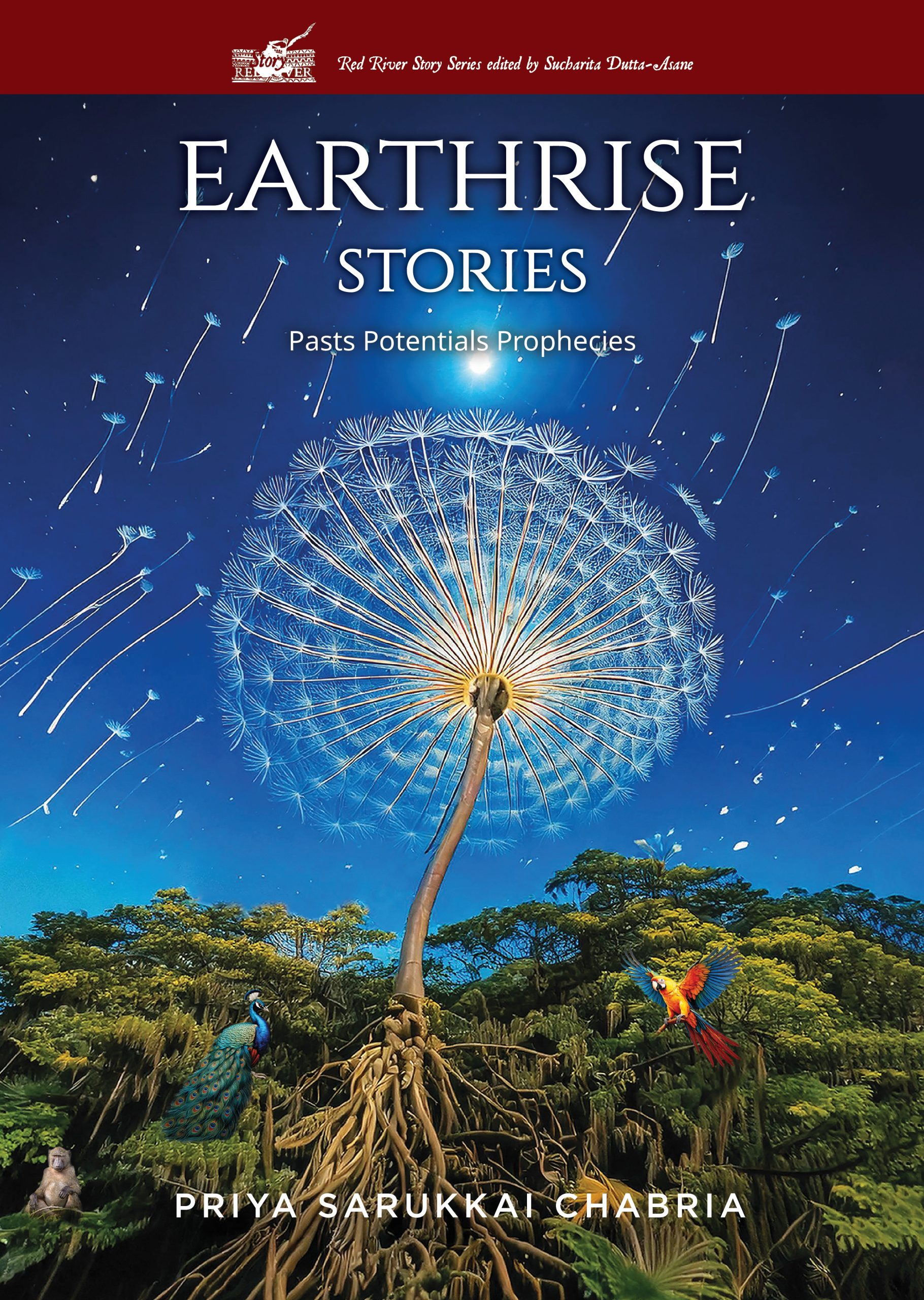
For all the possible and impossible futures: Earthrise Stories Pasts Potentials Prophesies by Priya Sarukkai Chabria

Of late, concern for the environment has fallen out of fashion in much of the world. Where I live, and in any other regions, oil companies, and forestry and mining interests exercise an outsize influence on governments, especially in a world of global economic uncertainty, fueling resistance to monitoring greenhouse gas emissions, investing in clean energy projects or promoting electric vehicles. It’s suddenly become too expensive, too inefficient to worry about the future. Besides, many insist that climate change is a hoax. So by the time we really feel the heat, so to speak, it will be too late to act. What stories will we, or rather our ancestors, tell to make sense of the damage done?  Will it even matter?

For Indian poet and writer Priya Sarukkai Chabria, the fate of our planet is an ongoing and vital theme. She sees it as a question that arises in the myths and traditions of a distant past, swirls around the influence of technology and artificial intelligence shaping our present existence, and reaches far into the future where an unknown realm of possibilities can only be imagined. Yet, she is prepared to explore new ways of thinking about and envisioning what we have come from and where we may be going. Now a wide-ranging selection of her poignant and thought-provoking fictional imaginings have been gathered in her new book, Earthrise Stories: Pasts Potentials Prophesies.

As a novelist and short story writer, Chabria has long sought expression through speculative fiction, typically with a strong Indian sensibility, and this collection highlights her strength in this genre, along with her distinct ability to flesh out the sensual intensity of her female protagonists, be they drawn from epic literature, or existing on a far distant timeline. But more than anything, these stories form a coherent project  in which the reality of climate degradation and what it means for the fate of the planet is a driving force. As she says in her Introduction:

I write stories of Earth, and some of the ways we could love her as she spins through our present dark time; the small gem of her seemingly weightless sphere spiraling through space, circling the sun like a prayer, sapphire and emerald as the eye of a dream, summoning tenderness.

Earthrise is divided into six sections, each one featuring a striking illustration by artist Gargi Sharma, and expanding in different spatial directions. “Past Re-Presented” is rooted in mythic times; “Now” searches for grounding in our ever-evolving present; “Ten Years from Now” turns to nonhuman life, natural and artificial; “In the Near Future” reaches deeper into the consequences for nature and a memory of humankind; “In the Far Future” contemplates the possible regeneration of a nearly dead planet; and, finally, “Prophesies that Come True” reintroduces a recognizably human narrator in in one story and offers a comet-focused cautionary tale in the other. Together, the eighteen stories that comprise this volume take the reader on a journey through time and space, marked by a  wide variety of shifting voices, styles, and tones.

The opening section re-animates tales drawn from Indian myth, legend, and literary tradition.  Characters like the celestial nymphs (aspara) Menaka and Urvaśī are realized as full-bodied sensual creatures rising above their passionate and tragic circumstances to set commonly accepted records straight. Episodes from the Mahabharata and the Ramayana are re-imagined with multi-dimensional, even cosmic, elements to at once reinforce their timelessness and set a foundation for many of the stories to follow.

The mood changes abruptly, however, as we enter the realm of the present day. The stories in “Now” are playful and inventive in style, but darkness and warnings lurk in their narrative themes. War, migration, economic turmoil, ecological devastation, and the increasing presence of robotic and artificial intelligence all feature here. There is even a lecture—or the draft of one—about the promises of a technologically driven future in one of my favourite pieces, “Cockaigne A Reappraisal (Draft) by Dr Indumati Jones (To be presented at UTIIMDS),” a text complete with the professor’s own personal notes to self:

With augmented AI inputs that analyse large amounts of financial data this sector is being steered towards making more predictive decisions in the stock market, and can tailor options to meet the investment patterns of specific financial firms. (Add examples. Quote sources?) On a lighter note, (smile here) Photoshop will be relegated to the past as in-camera devices will automatically correct flaws. Power outages like the one I’m currently experiencing will be out-dated — pun intended! — (smile here) as various AI driven units will be linked to a central intelligence system – as is already occurring in certain Smart Cities worldwide.

Dr Jones’s cynical optimism aside, the atmosphere that dominates the four stories in this section is ominous.

Ten years on, things are no better, flora and fauna are in serious decline (the author setting a fictional report in her hometown of Pune, even) and hopes that damages might be undone are outsourced to the services of a LoveBot  who can customize a dream, but has no power to make it come true. Moving on, further into the future, the Eco-Lit exam that makes up the content of one of the stories of the next section, leaves no question about ecological outcomes, but the prose in other tales becomes more poetic, dream-driven and, in one story, “The Princess: A Parable,”  folkloric. But the hard reality of the potential fate (or fates) of the Earth and the life she once sustained cannot be denied.

Yet, this is where Chabria’s stories of Earth take a detour from the classic dystopian formula. Although she leaves no question about the destructive tendencies of man and the fragility of life on our planet, when we reach the far distant future, there is the hint of a utopian possibility, however unlikely (and unlike anything we have ever known) that might be. In the two penultimate stories, she envisions variations on a world where life at its most fundamental cellular level has been preserved, integrated with novel notions of consciousness, historical awareness, and the means to reproduce or self-evolve. In this sort of speculative realm, the poetic, passionate energy that fills Chabria’s female protagonists charges her post-human narrators. “Paused,” for instance, imagines a planet where proto or potential lifeforms that can decide how they wish to evolve. But it is a lonely existence, and evolving is a process fraught with challenges. After an aborted attempt, her narrator retreats in a panic:

I trigger TEMP TORPOR in myself. It causes shuddering standstill of all activities. Cessation shocks my systems. Quieten down, please, down. Alarm still volcanoes. Shuush, shuuhh. Quieten to hill size. Rolling boulders. Be still, shuush. Become pebble size. Still, be still. Be spore. Be a drop of silence, a bead of spreading stillness. My systems slow, calm. I’m sliding into deep sleep; almost a hibernating pod again. Scan the damage. I must create low energy compounds to coat the membrane till it can sustain survival. I’m barely born but must manage so much!

Clearly, earthly recovery will be a slow and painful, but re-birth, in this scenario, could be intentional, not accidental. What then?

Earthrise presents many questions, and offers no clear solutions (except, of course, the ones we’re already boldly ignoring). Yet, in drawing on such a vast array of inspirations, from mythology, history, science—natural, physical, ecological— and, of course, poetry, Chabria has crafted a collection that values life, all life, not just the hair-covered, supposedly “Wise Ones.” It is sad and hopeful—a warning, a promise, and a prayer.

Earthrise Stories: Pasts Potentials Prophesies by Priya Sarukkai Chabria is published by Red River Story. (Available worldwide through Amazon.)

What passes and what remains: Walter Benjamin Stares at the Sea by C.D. Rose

The fictional world of British writer C. D. Rose is one that slips in and out of time, balancing the fantastic and the realistic, peopled with the lonely, the lost, and the brilliant misfits, some drawn from history, others from his expansive imagination. His universe is at once familiar and strange, and as is the case with the best literary fables, it offers a welcome refuge in a troubled world. At least, that was what I found after floundering with attempts to lose myself in prose during a busy, stressful stretch. Rose’s short story collection Walter Benjamin Stares at the Sea turned out to be the perfect antidote to a reading slump.

Central to this collection of nineteen tales is the idea and experience of time—tracking its passage, defying its constraints, longing to hold it fast. Rose’s characters often have a most awkward relationship with time. The protagonist of “Everything is Subject to Motion, and Everything is Motion’s Subject,” for example, nineteenth century French physiologist and chronophotographer Étienne-Jules Marey, in a narrative that flows with the imagery of his two obsessions, circulation and the pursuit of the fine details of movement, feels himself divorced from any perception of time beyond the immediate:

In life, this tangle. His constant passage from Paris to Naples, Naples to Paris. The demands of work, love, money pushing him one way and pulling him the other. A life always in transition, never stopping, always moving. Always in the present tense. Were he to stop and think of the past or the future, what would happen? When and where, he sometimes thinks, will I finally rest? His life like his pictures: tracing a motion back and forth across Europe.

Elsewhere, philosopher Henri Bergson, defender of primacy of immediate experience, finds himself caught a warped time loop of maids and spilled tea in “Henri Bergson Writes About Time.” Or in “Violins and Pianos are Horses,” an unnamed composer fitfully tries to reclaim his past on a visit with his daughter to the town he grew up in. Memories beset him during their stay, but the childhood home he remembers remains elusive, while all his fame and achievements are cold comfort.

Sometimes time takes on a surreal, even ghostly, quality in Rose’s fables. At other times, he leans hard into the absurd. “The Neva Star,” for example features three Russian sailors, all named Sergei, who have stubbornly (or perhaps foolishly) stayed aboard their ship, abandoned by its owners to rust in a port in Naples. In the charming “Arkady Who Couldn’t See and Artem Who Couldn’t Hear,” the narrator passes a long train trip across the snow-covered Russian landscape in the company of an odd pair of twins, one blind, one deaf, who are engaged in the careful construction of a matchstick model of their childhood home—a collaborative effort to remember their birthplace:

They were thin men, curiously built, with long square bodies and short legs, but both moved with a careful grace, their slow, deliberate gestures reminding me of mime artists or expert craftsmen. When I asked how long they had been building their model, they looked at each other and smiled. All our lives, said Arkady, all our lives.

The stories the brothers share about their lives conflict depending on which twin is doing the telling and whether the other is asleep, but it is clear that neither intends to allow their life project to come to completion. As if one can preserve time so it never truly passes. But, of course, time has its own designs.

Rose crafts many of his tales over the biographies of real people—photographers, scientists, writers, philosophers—stretching, reshaping, and imagining them from the inside looking out at a world that moves too quickly, too slow, or too strangely. Other narratives tend to similarly feature protagonists, narrators or characters that connect with temporal reality in idiosyncratic ways. And some seem to defy time and conventional narration altogether, like the experimental “What Remains of Claire Blanck” in which the narrative has all but evaporated leaving only footnotes, their numbers hanging against empty space above a detailed literary analysis of a story that can no longer be read. The nature of storytelling, how or if one can or even should write about a particular subject, also preoccupies certain narrators or protagonists, but again, that is a theme not inseparable from time.

Writing this review on the day that the new pope, an American of the Augustinian order, has been elected and the curious have been scrolling through his twitter account to gather a sense of the man, it’s some strange coincidence that the funniest, most affectionately absurd title in this collection is “St Augustine Checks His Twitter Feed.” In this brief tale the saint struggles with the temptation of social media, fretting about likes and the lack of a blue check mark, as he tries to focus on beginning to write his confessions. This clever little piece works, as do the others in this collection of intelligent, wide ranging fables, because Rose has a keen sense of just how long a story should be based on its level of absurdity and relative complexity. Frequently that is no more than a few pages. His mastery of the form is impressive, bringing to mind writers like Italo Calvino, Magdelena Tulli, and, of course, Borges, and yet his voice is distinct and contemporary and this collection a delight.

Walter Benjamin Stares at the Sea by C. D. Rose is published by Melville House.

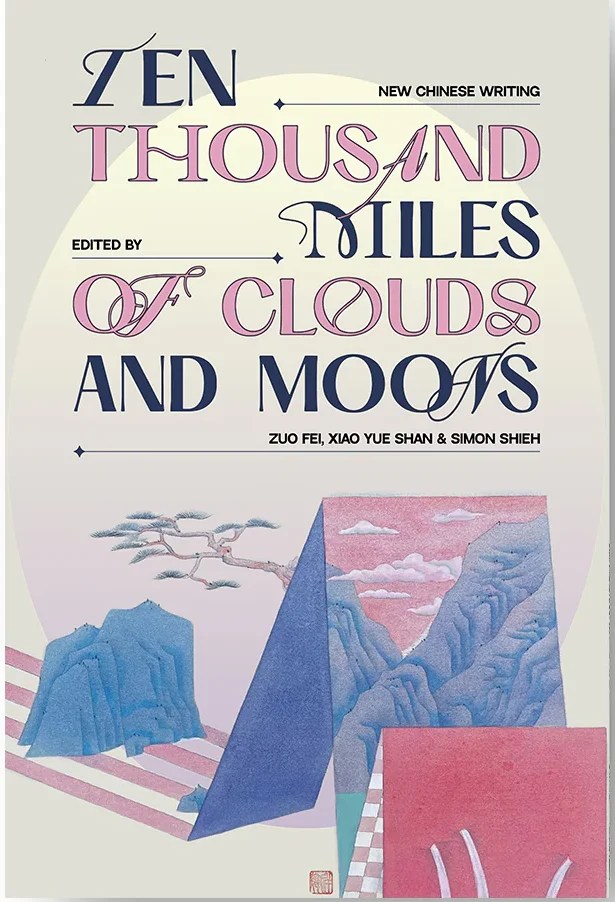
To go where the language goes: Ten Thousand Miles of Clouds and Moons – New Chinese Writing, edited by Zuo Fei, Xiao Yue Shan and Simon Shieh

Grey cloud grasping light,
unrolling the softness of another world
towards the wobbling plane wing; its folds ripple,
someone has scattered seeds in each furrow.

Who’s thinking, underneath the clouds,
how hard it is to restore the life of a flower,
when rain never coincides with favorable winds.

But we have a shred of light.
Today, passing through a mid-gate
as if remembering.

(from “Introspection on a Cloud” by Du Lulu, translated by Dave Haysom)

What exactly does it mean to enter into another world, to open oneself to a landscape at once familiar and strange? That is, one might suggest, one of the functions of literature. But if the map that grants access to that other world with its many artistic and cultural riches is in another language, translation is the key. For the editors of Ten Thousand Miles of Clouds and Moons, a collaboration between Beijing-based Spittoon Literary Magazine, a dual-language journal of contemporary Chinese literature, and Honford Star, the guiding inspiration for this first anthology project is, in keeping with that of the magazine, to seek out and bring into English translation, some of the most original, exquisite, and daring voices—new and established—contributing to the present literary landscape in China.

The introduction lays out the vision that guided their selection of pieces

The work had to be excellent; the writer had to have a point of view that is under-explored in the Anglosphere; there had to be a balance of genders; and the language had to be so special that it has the potential to torture translators. This final aspect came only from our love for the Chinese language—which, like all languages, has a singular soul, a force drawn from its age and its malleability throughout time. The more a writer is able to tap into that soul, the more difficult the piece would inevitably be to translate.

Thus sixteen contributors—eight writers of fiction, six poets, and two essayists—were paired with eighteen translators, to offer readers a journey that covers a wide literary terrain. You will find yourself in a world with a long rich cultural history and traditions, and you will find stories that depict a modern society that Western, English language readers will instantly recognize, with influences drawn from an international well of literary sources. You will find work that pays homage to the China’s past and tales that turn on distinctly futuristic, apocalyptic visions. And surreal, experimental tones alongside traditional Chinese poetic form.

The opening story in the compilation sets the mood perfectly. A piece of dystopian science fiction that  revolves around the fate of the 18th century work considered the greatest of all Chinese novels, “Mass in Dream of the Red Chamber” by Chen Chuncheng (translated by Xiao Yue Shan) is set in the far future—the 4800s—at a time when this great work of literature is not only lost, but any effort to retrieve its contents or storyline are strictly forbidden. There is, at this time, a belief that the text was completed at the peak of the universe’s development, and that all had begun to decline and dissipate since that time. The narrative follows the recorded account of a prisoner, a man born in 1982, who fell into a deep coma for several thousand years, only to miraculously awake and find himself as a specimen in a museum exhibit. He becomes a kind of missing link to the lost masterpiece for a clandestine organization desperate to recreate, as much as possible, the original; its preservation being essential to the continued existence of the universe itself. But that also makes him, and those who come to hear him access his memories of the text, the target of murderous government forces. It is a wonderful meeting of the glory of past achievements and the horrors of a post-apocalyptic totalitarian future, connected with an out-of-time protagonist’s personal recollections of life in the 1990s and 2000s.

The settings of the tales that follow vary, from a contemporary urban environment where bored youth hang out and make trouble, to the account of family history, to a mystical encounter on a mountainside. The energy shifts from story to story, often turning to the unexpected, cracking the fragile veneer of reality. Particularly delightful is the excerpt from Lu Yuan’s novella The Large Moon and Other Affairs (translated by Ana Padilla Fornieles), a piece of weird fiction that reflects, perhaps, in its magical strangeness, the influence of Bruno Schulz whose work the author has translated. As the moon, being pulled toward the earth, grows larger and larger in the sky, the eccentric Mr. Lu struggles with insomnia and troubled dreams. One night, having taken a concoction to aid his sleep, he finds himself carried off on a nocturnal adventure through the skies:

Mr. Lu rose from the valley of dreams and rowed out the window, picturing himself an unthinking mycoplankton or a sea cow, heading back to the Amazon River Delta. Riding upon the clouds and the wind with neither a northeastern wife nor a Vietnamese mistress at his side, the invoices seeking his death yet to arrive, and the murderous plots working their shapeless, invisible night shifts had been temporarily put on hold. There were no cold, mechanical alarms, no greasy company breakfasts, and definitely no covetous relatives, neighbours, acquaintances, or colleagues. The naked Mr. Lu, wearing only a heavy pair of  plastic slippers, flew over the sparse suburban streetlights, bounding towards the corridors of stars spiraling in a snail-shell pattern along the horizon’s towers. A thin sheet of air gently caressed his bulging beer belly, and the city was as far away as a firefly, succumbing to the hallucinatory bird’s eye view of inebriated men.

The two nonfiction pieces add a welcome new dimension to the collection. Hei Tao’s “Three Essays” (translated by Simon Shieh and Irene Chen) paint delicate portraits of southern China, and a lifestyle that is gradually disappearing, while Mao Jian’s “No One Sees the Grasses Growing” is a relatable, and humorous, memoir of her years as a student at East China Normal University in Shanghai in the 1980s and 90s. She recalls a time when students paid less attention to their studies than might have been wise. They were young and in love with a certain literary coolness. Her first degree was in Foreign Languages, but she found it hard to resist the allure of another course of study:

The truth is, in the eighties, it was impossible to resist the passions of the Chinese Department. The notice boards were plastered with adverts promoting literary lectures, and all sorts of clubs and societies adopted the grandiose affectations of belles-lettres, prancing about the center of campus. If someone were to ask you about going corporate after graduation, you’d have to self-reflect on the unrefined impression you must have been giving off. Those years were the golden age of Casanovas, who made names for themselves by proclaiming their undying love for poetry, and any girl who could be moved by Rilke would inevitably enter into a spontaneous fling with one of these campus poets.

It was an era of living away from home, first trips to KFC, young love, and inspiring and unconventional professors. But looking back decades later, now a professor herself at the same institution, she realizes that that time is past, in so many different ways.

Spread out among the prose pieces, are the contributions of the poets, three poems each. This arrangement works very well, offering a change of pace and granting each poet the space to have their unique voice heard. As with the fiction and nonfiction, there is both variety and, of course, precise, evocative imagery that is at once modern, yet with an echo of the long-standing traditions of Chinese verse.

Anthologies can be uneven projects, but this selection of new Chinese writing is strong, varied, and continually fresh and surprising from beginning to end. The contributors range in age, with the youngest in his mid-twenties, the oldest in his mid-sixties. Their work is consistently fresh and vibrant, and the translators all appear to have produced results that feel effortless. It should also be noted that this volume is beautifully presented, with a simple, yet elegant design. This is an endlessly engaging collection for anyone with an interest in contemporary Chinese literature, especially if you are seeking work that challenges expectations.

Ten Thousand Miles of Clouds and Moons: New Chinese Writing is edited by Zuo Fei, Xiao Yue Shan and Simon Shieh, and published by Spittoon Literary Magazine in collaboration with Honford Star

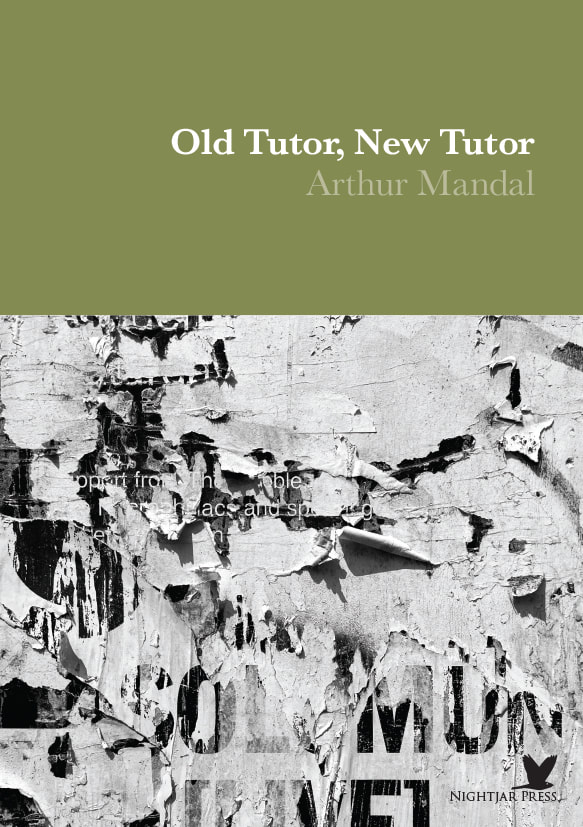
The strange and even stranger world of Nightjar Press: Fabrication by Imogen Reid and Old Tutor, New Tutor by Arthur Mandal

There is something very precious about the chapbook format. The presentation of a single short prose piece or sequence of poems in a single bound volume, often printed as a defined, numbered run, is a way of isolating and calling special attention to a writer and their work. Since 2009, UK based Nightjar Press has published limited edition single short-story chapbooks. Editor Nicholas Royle and designer John Oakley have a fondness for stories that lean toward the uncanny, darker, and stranger side, as the press’s namesake might imply:

The nightjar – corpse fowl, goatsucker – is a nocturnal bird with an uncanny, supernatural reputation that flies at dusk or dawn as it hunts. It is more often heard than seen, its song a series of ghostly clicks known as a churring. Sylvia Plath, in ‘Goatsucker’, wrote that the ‘Devil-bird’ flies ‘on wings of witch cloth’; David Morley, in ‘Beethoven’s Yellowhammer’, calls it simply ‘Satanic’.

Two releases from this past October offer two different examples of the kind of oddly unsettling offerings they specialize in.

Imogen Reid’s Fabrication is a piece of experimental fiction that draws on the author’s interest in the way techniques employed in film can transform narrative form and readability. This story builds on an observed/experienced scene—a room, a desk, a man, a faded “missing” notice—that echoes and repeats elements as it circles back on itself, creating and reinforcing the ambient quality of a dream or remembered moment within which the subject, addressed in the second person, is both protagonist and object, perhaps in more than one sense.

you can’t recall being there, but you can feel the frayed edges of an unwritten narrative slowly crystallise around the grainy image tacked to the wall, barely held in place by a steel pin, its fragile edges fluttering in the breeze like shackled butterfly wings. Beneath it, in front of the desk, partially illuminated by the eerie glow emanating from the computer screen, the chair turns and re-turns silently swivelling on its well-oiled axis, the monotonous rhythm neither surging nor subsiding.

Disorienting and intriguing, this very short story invites repeated rereading becoming in the process a longer, circular piece without beginning or end.

More conventional in form, but equally unnerving and ambiguously unresolved, is Arthur Mandal’s Old Tutor, New Tutor. As this story opens, the tutor Mrs Craig hired to help her daughters prepare for their A-levels is late. The girls took immediately to Mark  (“he just wants to be called MO”) and now, suddenly, after six weeks, he has failed to arrive at the usual time. When she is finally convinced to call the number he had provided, she reaches what sounds like a distant, distorted connection. The tutor apologizes and promises to be back the following week. But a few days later when Mrs Craig is in town with her daughters she spots the tutor—pictured on a leaflet attached to a lamppost. Wanted for assault. The girls are in denial (“It’s nothing like him”), but their mother is convinced it’s the same man. Calls to Mark’s number go unanswered.

Then, the following week, a new tutor arrives at the usual date and time. The family is surprised, no one had called to arrange a replacement, but here he is. He introduces himself as Alan.

The new tutor stood before them, unperturbed. He wore a long, grey overcoat which dropped vertically from his shoulders to his knees. His face was young, freckled, cheeky but handsome. Although in his late twenties, he had the demeanor of a small child. In one hand he carried a briefcase; in the other an old-fashioned umbrella with a crocodile-skin handle.

The girls quickly take to the new tutor, even their previously resistant father warms to Alan’s charms. But Mrs Craig is uneasy. The source of her discomfort is uncertain; even she is at a loss to explain it. As the tale unfolds, we only have her perspective, and it becomes increasingly unclear whether her paranoia has any basis or whether she is losing her grasp on reality.

My first purchase from Nightjar Press was a signed M. John Harrison story in 2013. With a print run of only 200 copies per title, their chapbooks tend to sell out quickly, so one cannot wait too long if an offering  sounds intriguing. As with these two recent purchases—one an author familiar to me, the other new—something weird and wonderful is almost certainly guaranteed.

Fabrication by Imogen Reid and Old Tutor, New Tutor by Arthur Mandal are published by Nightjar Press (October 2024).

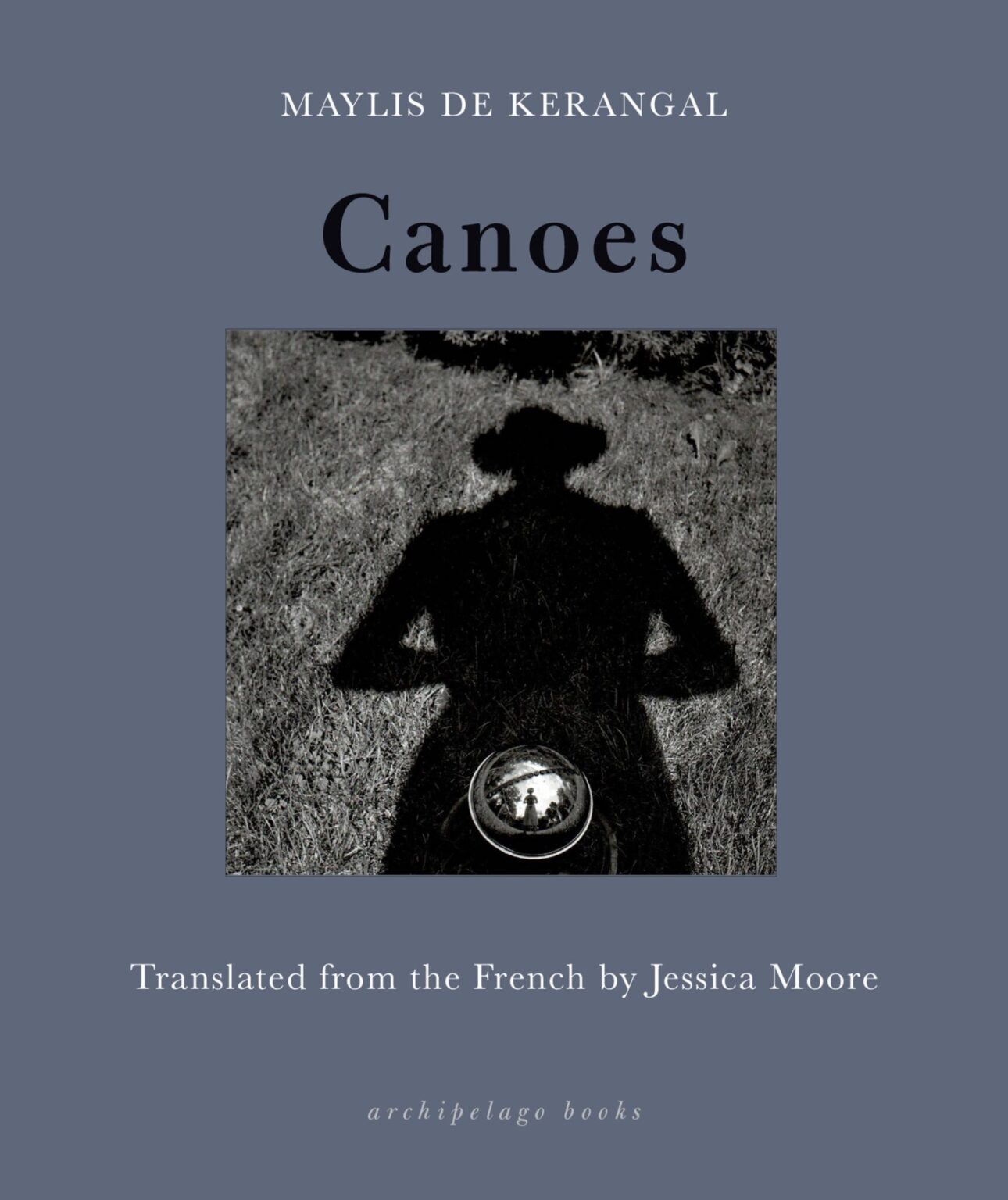
Bound by a single image: Canoes by Maylis de Kerangal

I grab the neck of a dinosaur with long lashes and the hand of a small boy with dark-chocolate eyes, put them both in the car, half my body engulfed by the back seat, torso twisted, fingers straining to reach, and then fasten the seatbelt. I put a multicoloured backpack containing a lunch in a plastic box, a bag of chips, a bottle of water, a change of clothes, size 5T, on the seat beside them. Then I walk back around the car, keys bouncing against my palm, sit down behind the wheel, and start the car. First Tuesday in December, mid-1990s, it’s 8:30 a.m., bitterly cold, and blue is the colour of the sky.

This is the opening of the novella “Mustangs,” the centrepiece of Maylis de Kerangal’s collection Canoes. It’s a precise description of a routine series of actions, but then, in the French writer’s fiction, the seemingly ordinary moment can contain multitudes and what begins quiet and lowkey, can turn unexpectedly, toward an ending suspended in possibility. Her ability to balance emotional restraint against an exceptional eye for detail, and a fondness for sweeping sentences and paragraphs that frequently go on for pages, allow her to tell stories that are at once spare and revealing. She knows just where to turn her narrators’ attention as their stories unfold.

The pieces in this volume—seven short stories and one novella—are connected by a common theme and by a singular image. The theme is “voice.” From a story about a woman consciously trying to lower her voice to advance her career in broadcasting, to the tale of a father reluctant to remove his dead wife’s recorded greeting from the family answering machine, voices—changed, analyzed, unleashed, unexpected—feature directly or indirectly throughout. Translator Jessica Moore indicates in her Note that de Kerangal began working on this collection just as mask mandates “caused mouths to disappear,” something that also often altered sound and auditory comprehension, and may have contributed to this thematic link. But the distinct image or motif that recurs in each of these very different stories seems much more random and therefore a is little treat each time it makes an appearance. The “canoe” of the collection’s title only appears in any particular detail in one of the stories, otherwise it might be a pendant, a craft observed in the distance, or mentioned in some other passing context. A nice, fun touch.

As one might expect, the extended piece, “Mustang,” anchors the collection. The unnamed narrator is a French woman who is living with her husband and young son (whom she simply calls Kid) in Golden, Colorado. Sam is taking a course at the School of Mining where he is quickly adapting to American life and language, while she struggles to find her footing in this vast suburban community in the foothills of the Rockies. At first walking suffices, but the lack of the kind of integrated train and transit system of a European city soon leaves her frustrated, as does the lack of purpose and work to fill her now empty days. So her husband, who has actually arranged this short term foreign escape more for her sake than his own, suggests she learn to drive. He buys a used Mustang and she gets her license. Funny, bittersweet, and ultimately terrifying, this is wonderful story of a woman seeking to redefine herself after loss in a mythic Western landscape of cowboys and dinosaurs.

By contrast, each of the other much shorter stories are condensed, finely drawn episodes that reveal something, often unsettling, of their narrator’s life or engagement with others, yet leaving much unsaid or unresolved. One of the best, perhaps, is the final tale, “Arianspace.” The narrator is a ufologist—an investigator of UFO sightings. She has been sent to visit a ninety-two year-old woman living along among mostly abandoned homes in a rural area. From her earliest impressions, the researcher can tell that she facing someone special:

I had imagined her small and wizened, the wrinkled skin of an old fig, hair sparse, body brittle and slow, an apron tied around her waist and black peasant stockings, but she was something else: a tall, regal woman in jeans, a red T-shirt, and boots, and she was thin, long grey hair over her shoulder, cheekbones still high, and beneath ragged eyelids, eyes of a deep black – the kind of black that absorbs nearly all visible light, and which is found in bird of paradise feathers or on the belly of peacock spiders; altogether wizened, dry, and flaking, but conveying a great impression of physical strength and brutality.

Indeed, not only is Ariane a no nonsense woman with a firm commitment to the alien phenomena she observed, she has impressive evidence. . .

With short story collections, especially dedicated volumes like this as opposed to larger compilations, a test of success can lie in the degree to which each entry stands apart from the others. Even though some of these pieces have a very tight focus, the characters and narrative voices (all first person), are distinct, the settings varied, and in some instances I was left with this eerie feeling—a sense that I wanted to know where the characters went after the story closed, a what-happened-next sort of thing. That is for some readers a negative to the shorter forms, but especially with a writer like Maylis de Kerangal, who is unafraid to leave an open door, the extended possibilities only make the situations she depicts seem more real.

Canoes by Maylis de Kerangal is translated from the French by Jessica Moore and published in North America by Archipelago and MacLehose Press in the UK.

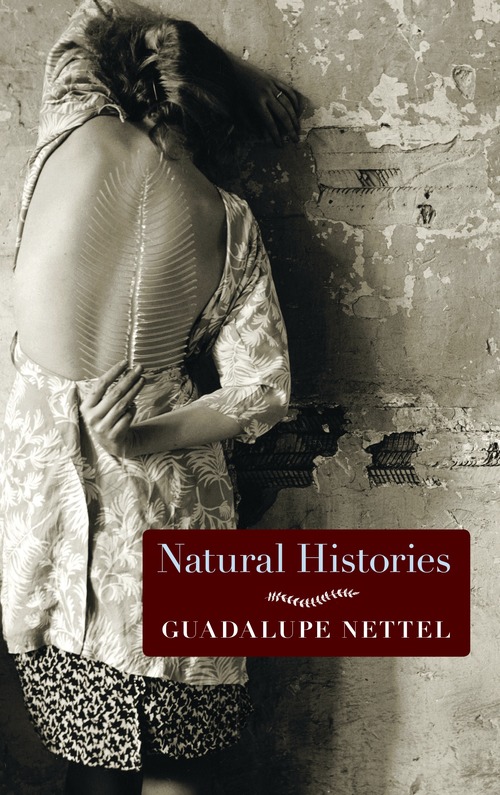
Creature discomforts: Natural Histories by Guadalupe Nettel

The ties between animals and human beings can be as complex as those that bind us people. There are some who maintain bonds of reluctant cordiality with their pets. They feed them, take them for walks if need be, but rarely do they speak to them for walks if need be but rarely do they speak to them other than to scold or “educate” them. In contrast, there are others who make of their turtles their closest confidants. Every night they lean in toward their tanks and tell them about what happened to them at work, the confrontation they put off with their boss, their doubts, and their hopes for love.
(from “Felina”)

Guadalupe Nettel is one of those writers I have long wanted to read. The kind that when you finally do get to them, you ask yourself: “Why have I waited so long?” Natural Histories, a collection of five short stories, each exploring a protagonist’s engagement with an animal of some description—from felines to fungus—offers a perfect introduction to her uncanny ability to craft strong characters and compelling narratives that slip seamlessly into the murkier regions of ordinary human existence.

Born in Mexico City in 1973, Nettel spent part of her childhood in France, returning again to Paris to complete a PhD in linguistics. As a result, she is very much at home setting her stories on either side of the Atlantic as this compilation clearly demonstrates. The first story, “The Marriage of the Red Fish” is set in Paris and follows the breakdown of the narrator’s marriage following the birth her first child, a trajectory that seems to be mirrored in the tenuous relationship between a pair of Beta splendens, or Siamese fighting fish, gifted to the couple just months before their daughter was due. Lila’s arrival puts an immediate strain on the professional couple who are not quite prepared for the shift in their domestic situation and it gets worse when the narrator’s maternity leave is unexpectedly extended—she begins to feel trapped at home, her husband feels confined when he has to come home. Like their pet fish who, true to their species, are not inclined to peaceful cohabitation, the new parents find their personal dynamics altered:

As it were, in those stagnant waters in which Vincent and I moved, our relationship continued on its gradual course toward putrefaction. We never laughed anymore, or enjoyed ourselves at all. The most positive emotion I was able to feel toward him in several weeks was appreciation every time he made dinner or stayed home to takr care of Lila so I could go to the movies with a friend. It was a blessing, his relieving me. I adored my daughter and overall delighted in her company. But I also needed to have moments by myself, in silence, moments of freedom and escape in which I could reclaim, even if only for a couple of hours, my individuality.

This story, although it traces a common path of marital dissolution, stands apart by virtue of a strong narrative voice and the magnified role the fate of the unhappy fish play in what we want to imagine should be the happiest time of a new family’s life together.

The tensions evident in the opening story, become subtly darker and stranger in the stories that follow. In my favourite piece, “War in the Trash Cans,” an entomologist recounts her childhood experiences at the home of her middle class aunt with whom she was sent to live after her bohemian parents split and neither was up to childcare responsibilities. For the young narrator, the housekeeper and her mother become her unlikely allies in an otherwise alien environment and, as she puts it, “those two women taught me more things than I’d learned in an entire year of school.” Those lessons, rooted in folklore and traditional wisdom, arise when an invasion of cockroaches sets the entire household on edge.

Other stories involve unwanted pregnancy, a musician who nurtures a strange fungus she acquires from a married lover, and a boy whose father brings home a poisonous  snake as part of his obsessive endeavour to reconnect with his Chinese roots. In each case, the protagonist or one of the characters finds in another creature or creatures, something that balances their insecurities, and reflects the unfamiliar circumstances in which they have found themselves. And yet, each story, its characters and setting, opens up new and unexpected territory. As a set of five, loosely thematically linked, longer pieces—ranging from about twenty to thirty pages—this collection is well-paced, always entertaining, now has me keen to read more of Guadalupe Nettel’s work.

Natural Histories by Guadalupe Nettel is translated from the Spanish by J. T. Lichtenstein and published by Seven Stories Press.

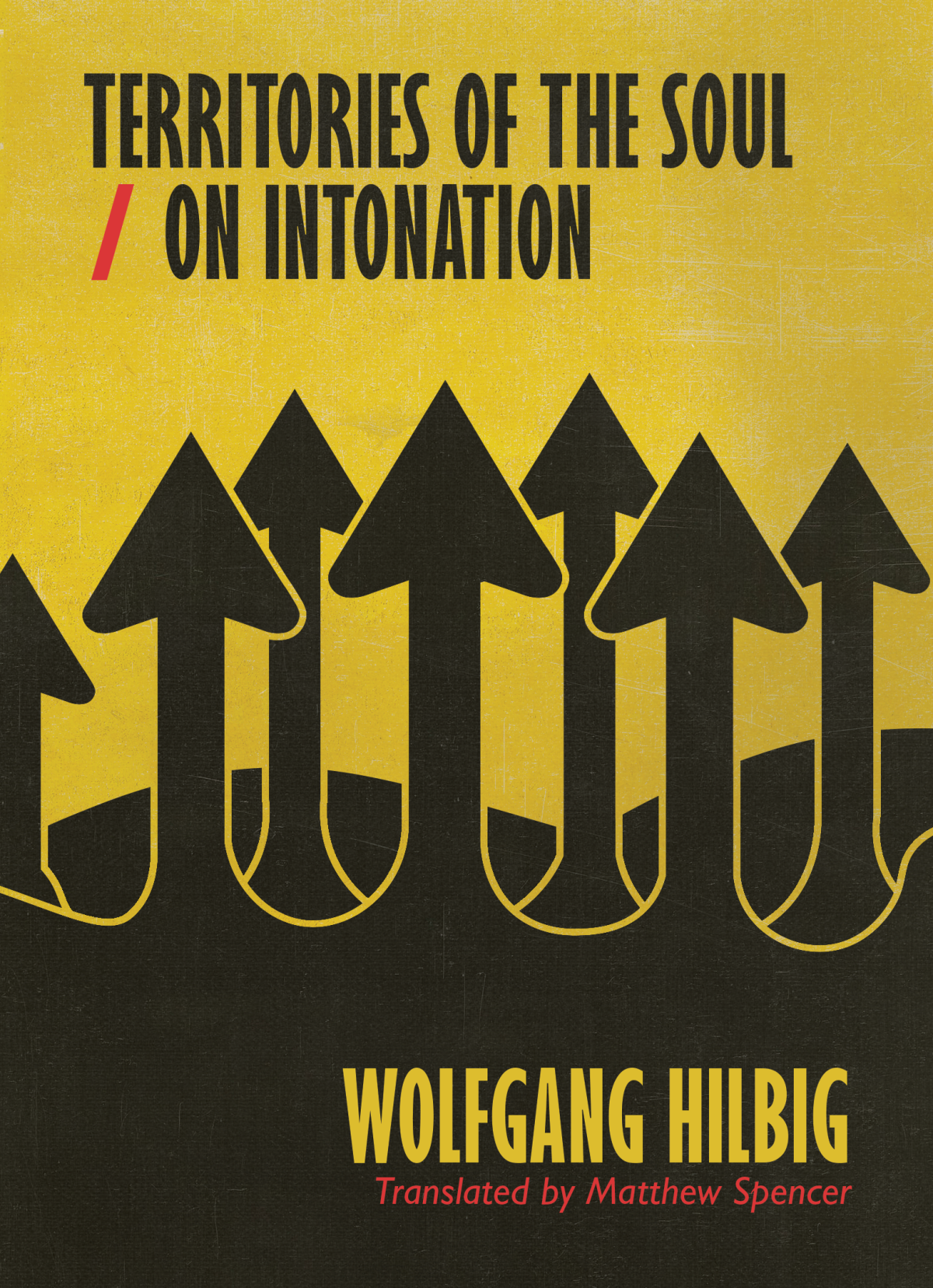
“wrestling words, terror at the morning gray”: Territories of the Soul / On Intonation by Wolfgang Hilbig

Ah, yes, to enter Hilbig territory, be rural or urban, is to travel a terrain that is at once suffocating and strangely comforting. With each new work to emerge in English translation it is, for an admirer of his melancholy poetics, like coming home:

—Then comes the city of S., our destination almost, laagered on the valley floor, admitting no beam of spring sunlight; it resembles, in fact, a reservoir for all the wet the clouds cast down when they’ve finally gained the surrounding heights. I would have to continue further southward, continue further southwestward, until the actual sea, I think, if I wanted to breathe a sigh of relief . . . here in this valley you remain imprisoned, unarousable, and held to the earth here by an apparently stronger local gravitation, you walk stooped through the city with its churches, descend even lower, to where the empty markets stand, assembled against a yellow prefab administrative circus, such a scene has a sundial on its dome—, but there is no sun here.
From “Adieu”

No one creates an atmosphere quite Wolfgang Hilbig.

Territories of the Soul / On Intonation, pulls together short works from two collections published in the closing years of the GDR—eight stories and two poems—translated by Matthew Spencer and published by Sublunary Editions. Hilbig was born in Meuselwitz, Thuringia in 1941, and grew up in the industrial wilderness of postwar East Germany. He began writing poetry while working as a stoker, but his literary sensibilities were never going to fit with the socialist realism the GDR wanted its working-class poets to produce. Yet, although he migrated to West Germany in 1985, his spirit and his themes tended to remain anchored in the East.

The stories in this slim volume offer a classic cast of Hilbig characters—tloners, dreamers, misfits at odds with themselves and the world around them. They are also often writers, or aspiring writers, even if their literary endeavours take place after work, or in secret on the job if possible. And the workplaces many of them are bound to, like Hilbig himself in his early adult years in the GDR, are mines and factories in set grim, urban or rural wastelands. His work can evoke an atmosphere so heavy and gritty one can almost taste it; his protagonists wander landscapes marred by sludge, refuse, and discarded armaments, their restlessness fueled by anxiety, remorse, and regret. The narrator of “Adieu,” quoted above, has just walked out on his only child, knowing he is wrong, and wondering “how does love become just a thing I rob from another, become a thing I can feel only by denying it to another.” It’s an uncomfortable monologue, made more so by the weight of the speaker’s tortured conscience.

One  of the strongest pieces here is the second title story, “On Intonation.” It opens with a chilling description of a stormy, wet night, viewed from the cockpit window of the nightwatchman’s station above an open-pit mining operation. The narrator is filling in for a missing watchman, a task he put himself up for thinking it would provide him the necessary space, away from the heat of the boiler room, to address a long pressing concern:

What I needed to work out—I had known this for years—was a kind of self-assessment, which would either certify me as a worker or as a true writer; however, since my presentiment was that I had insufficient reasons to properly continue writing, I had so far neglected this decisive memorandum; and yet I needed to fix these details in written memory, so I could exhibit them as proof against myself. —Meanwhile, I had come to a conclusion: I had to note down some urgent thoughts about the intonation of these modern lyrics . . . so I could implicate myself in evading duty.

And, yet, although he had been thinking about this question for some time, he finds himself, at his little makeshift desk, unable to find a word to replace intonation—his thoughts are frozen, he is unable to write the words he is convinced will prove he cannot write. But through this night, as he makes his rounds and struggles with his creative despair, his monologue turns on its own existential exploration of the lyric. The speaker, fearing that he lacks what he needs to be a writer, finds, in spite of himself, that he does.

This compilation, which includes work originally published in 1986 and 1990, is a particular treat for fans of Old Rendering Plant and The Tidings of the Trees—not only for its misanthropic souls, distinctive landscapes, and the occasional hint of gothic horror, but for those long winding and unwinding sentences that seem to pull the narrative into dark corners, resisting but unable to avoid a splash of milky light now and again. Even better, it may serve as the perfect introduction for those who have not yet encountered the addictive terrain of Wolfgang Hilbig.

Territories of the Soul / On Intonation by Wolfgang Hilbig is translated from the German by Matthew Spencer and published by Sublunary Editions.

Exploring the uncomfortable corners of human existence: The Birth of Emma K. and Other Stories by Zsolt Láng

The fiction of Zsolt Láng inhabits a slippery space where time, genre, and realities shift and bend, where history shapes and distorts the landscape, and where characters are driven by conflicted passions and paranoias. Think of Flann O’Brien with a side order of Beckett, born and raised in Transylvania, charting his own course to become one of the premier postmodernist Hungarian language writers of our time and you have a hint of what you might find in Láng. And now, for the first time, we can sample that strange brew in English through the stories collected in The Birth of Emma K., translated by Owen Good and Ottilie Mulzet, but, be prepared, it is a delightfully odd journey during which one can lose one’s bearings from time to time.

The collection opens with “God on Gellért Hill,” set in Budapest, which finds “Our Lord” standing or floating above the city, intent on setting right the fragmenting relationship between two rather unattractive lovers. But to His dismay, God—and here the narrator reasons that we are witnessing neither the Father nor the Holy Spirit, but the Son—has been blessed with all kinds of powers, none of which are absolute. And, of course, under the often muddled efforts of their heavenly benefactor, the former lovers, Ida and Tamás, experience intensely swinging emotions that they are each at a loss to understand.

Our Lord followed them, as long as he’s here, he wants to see it through to the end. There’s still no guarantee he’ll intervene. Creation is like throwing a stone: There’s that ballistic arc from taking aim until reaching the target, and then there are the changes caused by gravity and wind; to intervene meant to retroactively meddle with time, at least that’s what a philosopher claimed with whom Our Lord didn’t agree (hence he never read the philosopher’s thoughts, though he could see into them). Our Lord is Our Lord because he sees things differently, his reasoning is different from man’s. But let’s not get mixed up in the difficulties of creation. (Good)

Determined as he is to try grant his subjects a happy ending they may not even want and are bound to undo, the burden of not-quite-absolute power weighs heavily on our heavenly hero, but in this clever opening piece there is a hint of the author’s own inability (or rather, wilful unwillingness) to exercise absolute control over his own characters—he’s happy to let them, and their stories, slip into strange territories, sometimes dark, sometimes light, and, more often than not, somewhere in between.

Láng , born in 1958, studied engineering at university in Cluj. Since 1990 he has lived in Marosvásárhely / Târgu Mureș, Romania, where he is an editor of the literary journal Látó. He has published close twenty volumes including short stories, novels, essays and plays. His work is deeply rooted in his Transylvanian homeland with its complex historical, multicultural, and multilinguistic  dynamics, but also reaches beyond to other European settings. His stories not only exhibit a broad range of characters and conundrums, they have a tendency to transform in style and form as they unfold. As translator Owen Good describes in an informative essay for Hungarian Literature Online:

Zsolt Láng’s is a nonconformist oeuvre. A story turns on a dime from a jovial satire to a poignant coming-of-age tale, from autofiction to metanovel to crime, leaving the reader forever playing catchup. Worlds blur and fantasy simmers to the surface.

If Láng is happy to allow his stories change without warning, he is also content to allow the reader to fumble their way into a tale for a while, or craft anachronistic realities in which, say, a preference for horse and buggy transportation exists alongside an internet café. Likewise, he does not feel inclined to bring all of his stories to a clear and defined conclusion, nor does he need sympathetic characters—some of his most unfortunate protagonists are driven by their own selfish or self-destructive motivations.

Consider “Like a Shaggy Ink-Cap Mushroom,” the tale of a depressed Inspector obsessed with death—his own. He sits at his desk surrounded by, but estranged from, the Beat Cops and the File Desk Girls, and feeling pressure from the powers above. He visits a gravestone with his own name on it, drinking in the sense of relief that comes with the thought of lying beneath it. And, when his former partner reaches out to him for personal assistance, a request that will begin to initiate a change in the Inspector’s sorry trajectory, his initial reaction is rather comically tragic:

He was surprised when his partner called. He didn’t recognize his voice. Hence, maybe, he was filled with the cool, soft promise of the hope for happiness. The tranquility of promise. A deep and hoarse voice. Slowly pronounced sounds. Containing an impossible amount of pain. He shuddered. Furthermore, the ring of the phone had electrified him. He jumped up and almost fell on the handset. The voice’s lumpy sadness. A fine, floury, lumpy sadness. Immediately he thought of Death. Death was calling. Or he was about to hear news of someone else’s death. He wouldn’t be surprised if it was his own. There could be no greater gift. Inspector, sir, I have to relay some really sad news. You’ve passed away, sir . . .  (Good)

In many stories Láng drills directly into his protagonists’ deep (and often dark) desires and fixations—two homeopathic doctors that each share a visceral hatred of the other, a lonely actress past her prime, or an inmate in an asylum conducting his own “research” and engaging the resident intern with his experimental theories. In others, like the longest piece, “The Cloister of Sanctuary” set in a monastery in Moldova, he works across wider canvas to craft an horrific folktale of mystery, manipulation, and cruelty. And then there is the final piece, the title story, which follows the metaphysical musings of an embryo, not exactly desired by her young would-be parents, from conception through a vigorous campaign to dislodge her from her watery accommodation, to her defiant arrival months later. It offers a fresh, insightful embryo-eyed perspective on the world she imagines versus the one she’s potentially heading towards.

With a touch of magic  and a measure of absurdity, the stories collected in The Birth of Emma K. offer an entertaining exploration of the virtues and foibles of human nature and an excellent introduction to another fine Hungarian language writer.

The Birth of Emma K. and Other Stories by Zsolt Láng is translated by Owen Good and Ottilie Mulzet and published by Seagull Books.