2025 Wrap Up: Reading and other stuff


I don’t know what I expected when this year began. Ever since 2020 it seems we have greeted each year with some measure of optimism—I mean how could it be worse than the one that just passed? And somehow, each year has managed to be worse in some new, unanticipated way. 2025 saw the continuation of conflict, famine, destruction, climate catastrophes.  We also witnessed the further escalation of intolerance, racism, sexism, anti-trans sentiment, religious fundamentalism, and autocratic politics. Where I am in western Canada we have witnessed all of this, not just from our neighbours to the south, or distant nations, but right here close to home. It is hard not to lose hope, but giving up is not an option and so, 2026, here we come, preparing for the worst but dreaming of the best.

Personally, I struggled a bit this year. Family stuff, some depression, and, in late November, a car accident that has left me with stiffness and pain that is slow to subside. But, on the bright(er) side, my focus and concentration has returned, and replacing my damaged car proved easier than it might have been. My old Honda Fit had more value than I expected, and I happened to see a (newer) used vehicle that fit my needs for a very good price and was fortunately in the position to buy it. If the police manage to find the impaired driver who hit me (assuming she was insured) I will even get my deductible back. But, quite honestly, I’ll be happy to be able to look over my left shoulder again!

As for reading/reviewing, 2025 was a mixed year. I had a few off times when I struggled to finish books (or gave up altogether), and a number of mediocre reads passed without public mention. At the same time, I read some excellent poetry in English, but could not find the words to write coherent reviews. For some reason, I feel I lack the knowledge and vocabulary to say the “right” thing about poetry in my own language—I feel more comfortable responding to translations. And I did read a lot of poetry in translation this year.

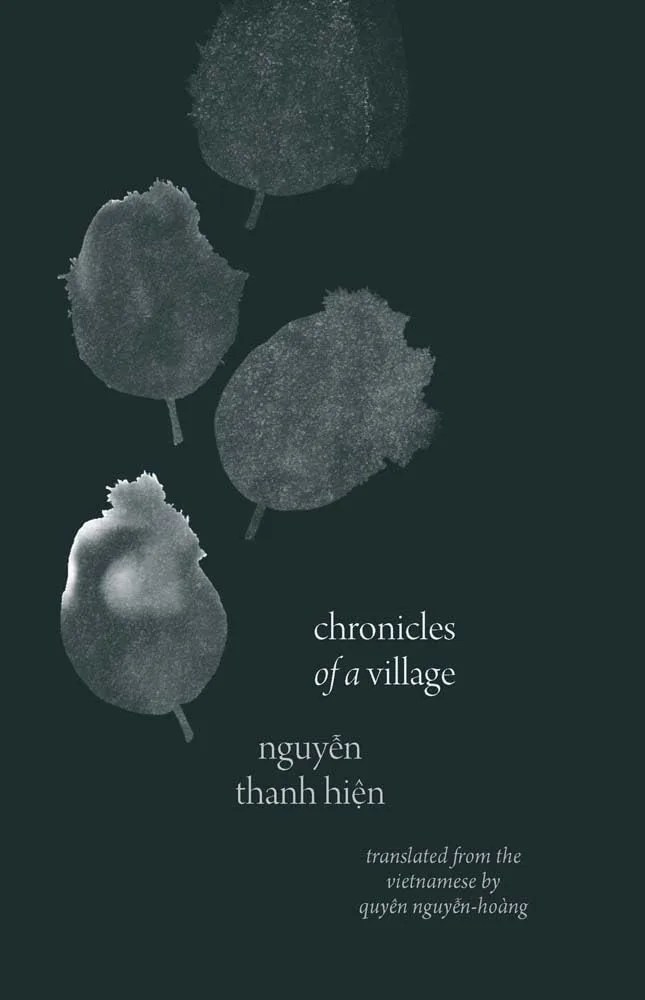
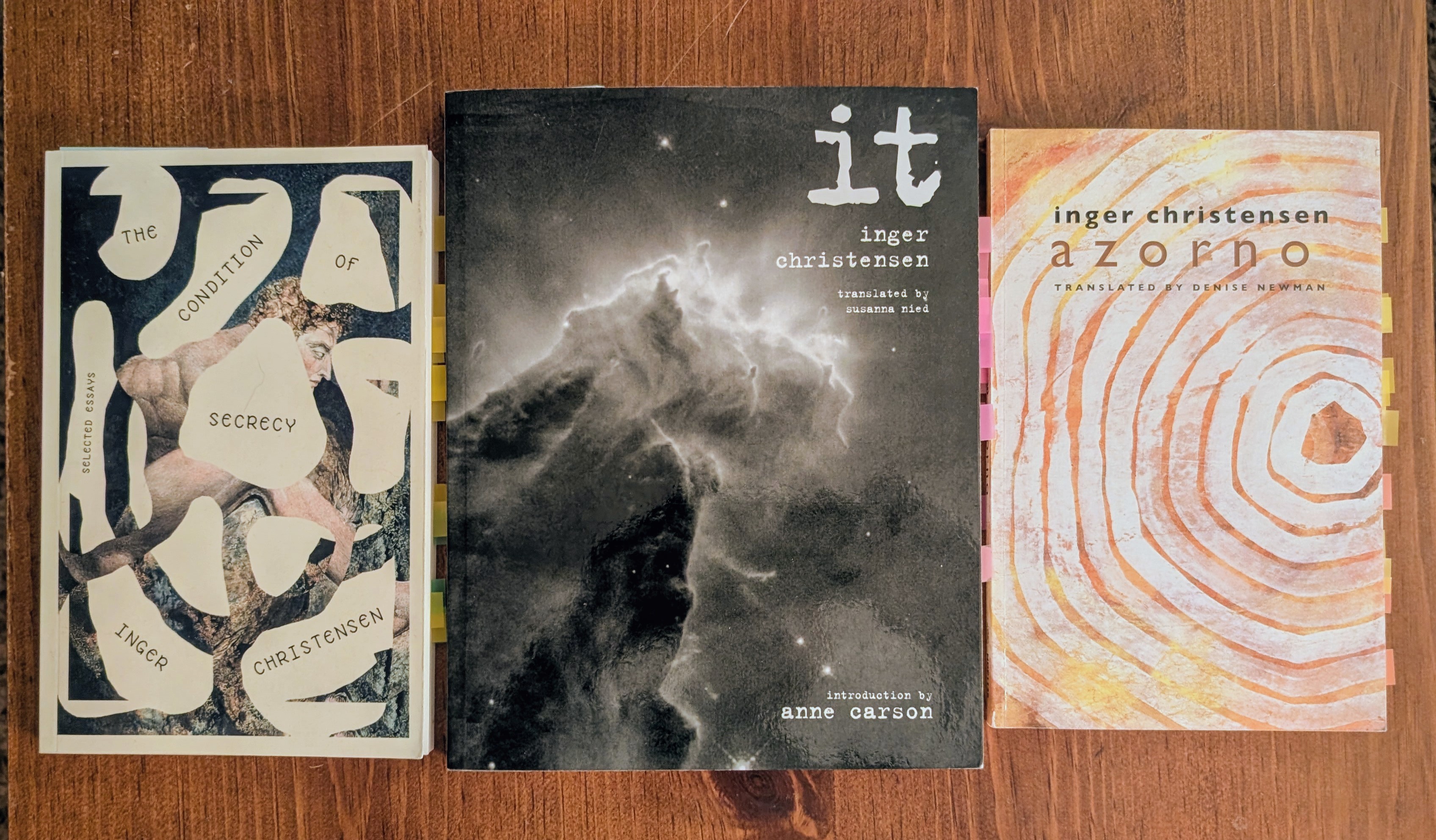
Looking back over 2025, the singular defining force for me was the work of Danish experimental poet and writer Inger Christensen (1935–2009). In January I read her essay collection  The Condition of Secrecy, and I was immediately entranced by her love of language and her view of the world as informed by science, nature, music, and mathematics. I knew I wanted to read all of her poetry and fiction and, throughout the year, that is exactly what I did. I read eight of her translated works and only have one left to obtain although I have a dual language edition of one of the sequences in that volume (“Butterfly Valley”). Along the way I also decided I wanted to learn to read Danish as there are elements of her work that simply cannot be reproduced in translation (mathematical constraints in particular).

And so, I am learning Danish, or, should I say, jeg lærer dansk.

Although I enjoyed all of her books, my favourite piece of fiction was the crazy word play mystery Azorno (1967) and my favourite work of poetry was her monumental it/det (1969), both earlier works. Of course, the wonderful book length poem alphabet (1981) is also amazing. Her poetry and essays are translated by Susanna Nied, her fiction by Denise Newman.

Some thoughts about a few of my other favourite reads from the past year:

 Prose:

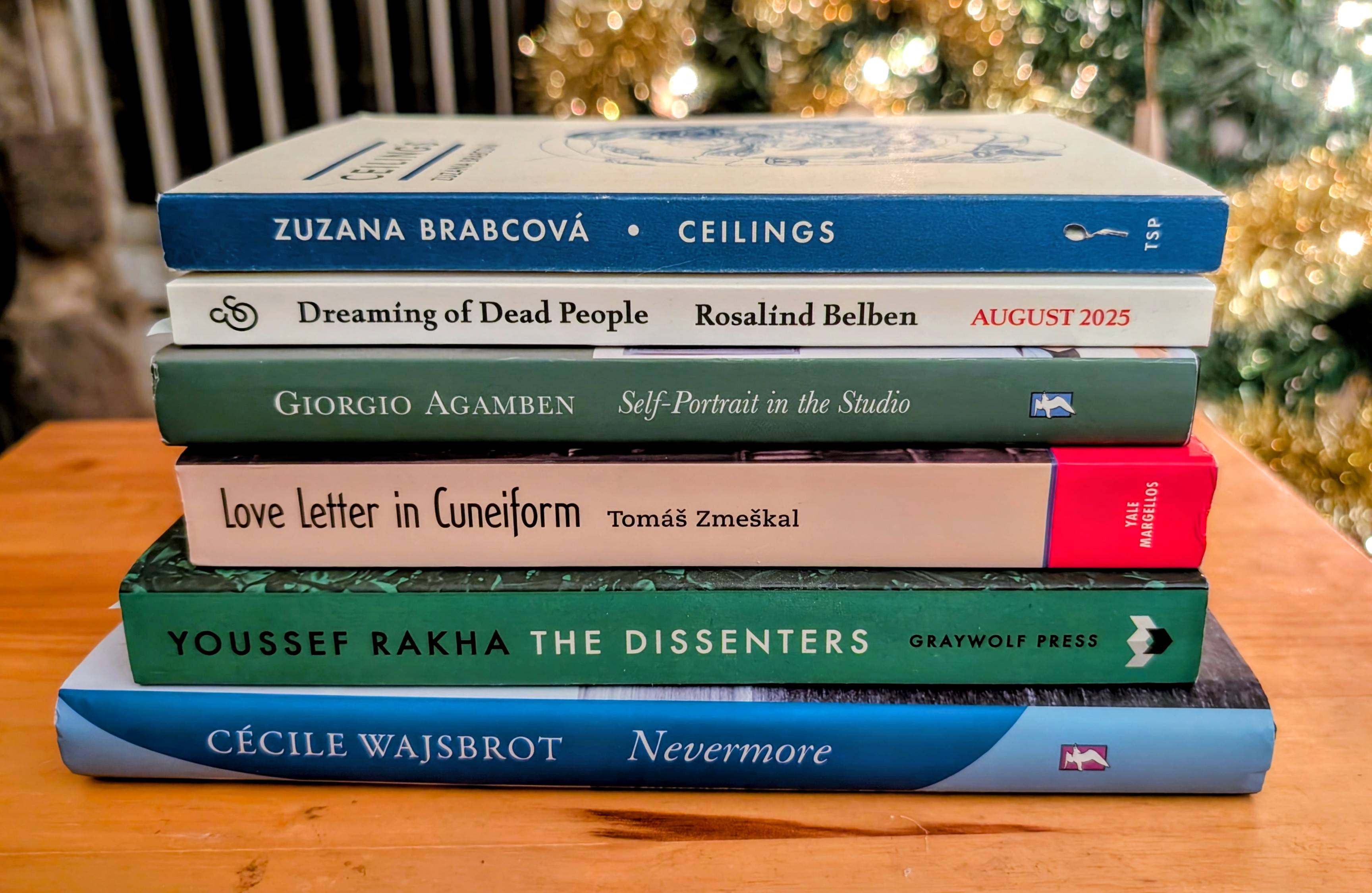
Ceilings – Zuzana Brabcová (translated from the Czech by Tereza Veverka Novická)

Set on the detox ward of a psychiatric hospital in Prague, Brabcová captures the institutional environment and the strangeness of psychotic interludes with the skill only personal experience can provide. This wild and delirious ride pulled me out of a reading slump.

Dreaming of Dead People – Rosalind Belben

I read two novels by Rosalind Belben this year, The Limit which was re-issued by NYRB Classics several years ago and this one which was re-issued by And Other Stories this year. Both are strange in a brutal yet beautiful way, but Dreaming is, to me, a more accomplished, in depth novel.

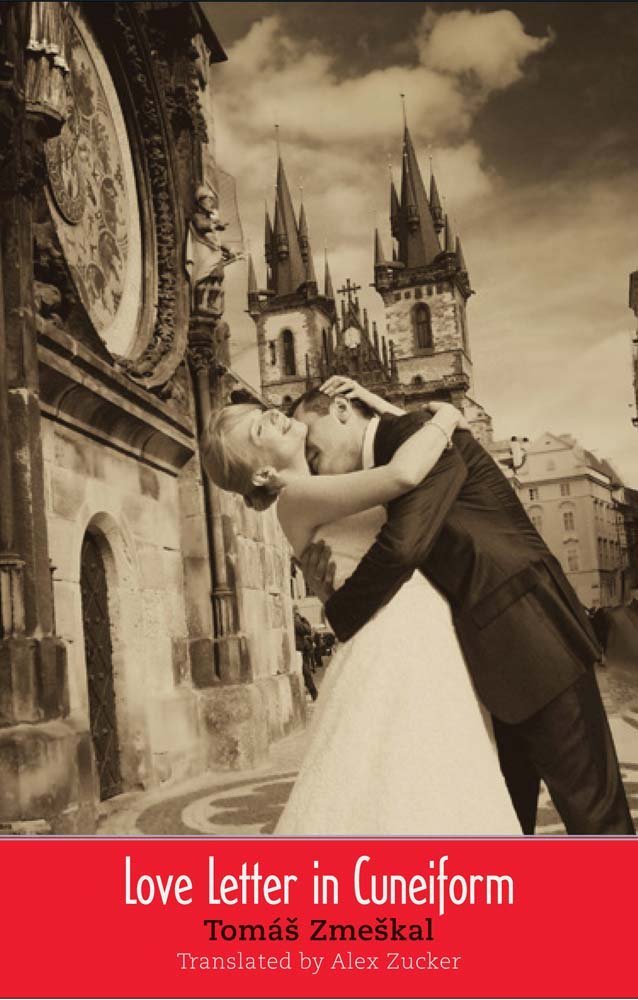
Love Letter in Cuneiform – Tomáš Zmeškal (translated from the Czech by Alex Zucker)

One of those books I’ve been meaning to read for years and when I finally picked it up off the shelf, I was delighted to find out how funny and weird this multi-generational family drama truly is. Zmeškal lends magical realism and historical reality with a cast of eccentric characters to create a memorable tale.

Self-Portrait in the Studio – Giorgio  Agamben (translated from the Italian by Kevin Attell)

Far from a conventional memoir, Agamben invites his reader on a tour of the various studios he has occupied over the years, reflecting on the people, books, and places that come to mind along the way. A surprisingly engaging work.

The Dissenters – Youssef Rakha

The final two novels on my list are both highly inventive in style and form. Egyptian writer Youssef Rakha’s first novel written in English manages to seamlessly incorporate Arabic expressions without explanation, adding to the richness of this original, multi-dimensional story of one remarkable woman set against the events of recent Egyptian history. Endlessly rewarding.

Nevermore – Cécile Wajsbrot (translated from the French by Tess Lewis)

This ambitious novel is a moving evocation of loss and change. A translator has come to Dresden to work on a translation of the central “Time Passes” section of Virginia Woolf’s To the Lighthouse from English into French. Reflections on change and transformation drawn from her own state in life and various historical events accompany the process of translation.

Poetry:

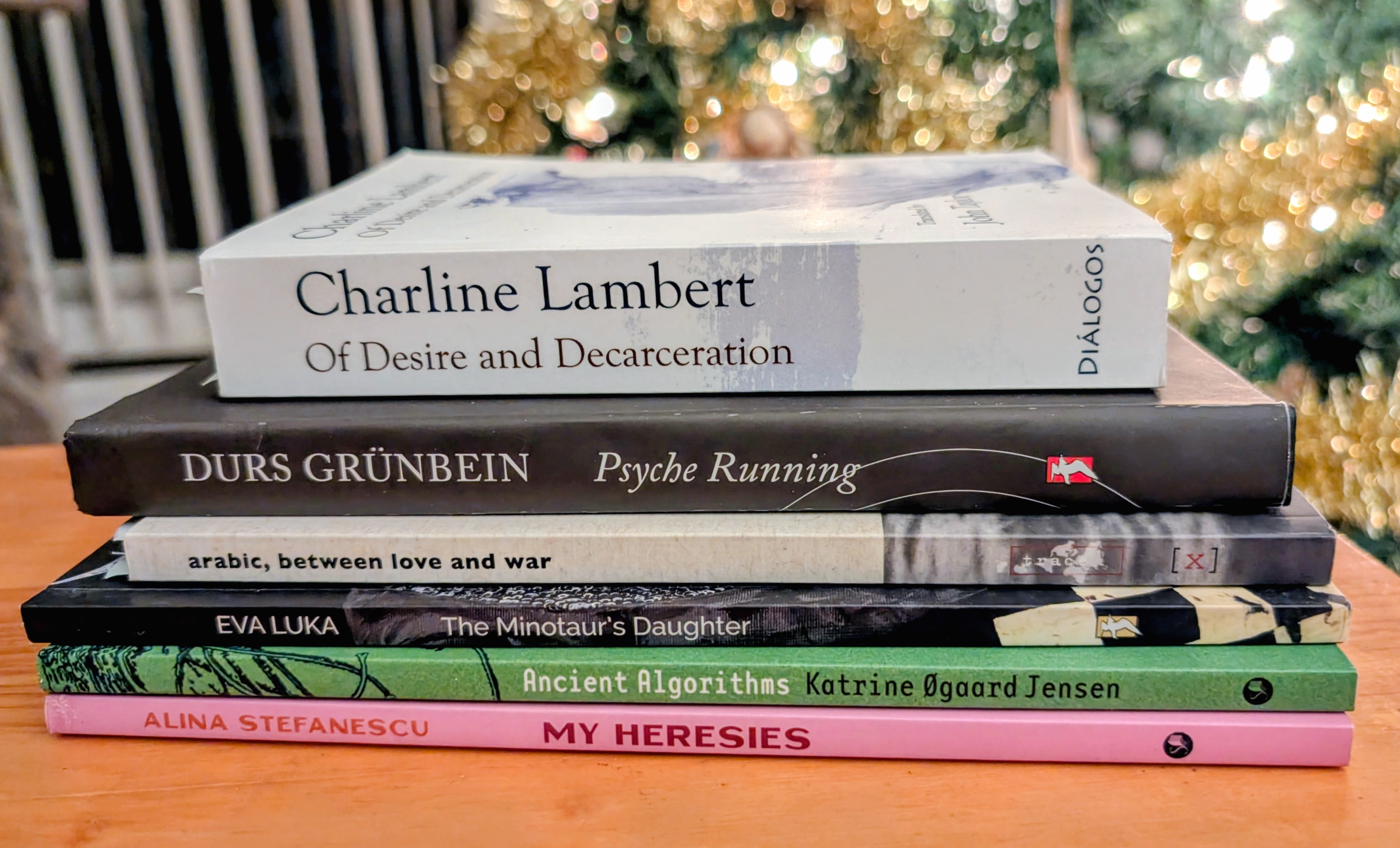
Of Desire and Decarceration – Charline Lambert (translated from the French by John Taylor)

It is most unusual for a poet as young as Lambert (b. 1989) to see her first four volumes of poetry published together so early in her career, but translator John Taylor felt that the Belgian poet’s books show a natural growth best appreciated as a whole. He is not wrong (he is also a translator whose judgement I always trust).

Psyche Running: Selected Poems 2005–2022 – Durs Grünbein (translated from the German by Karen Leeder)

This selection of poetry rightfully won the Griffin Prize this past year. Grünbein’s work tends to draw on his hometown of Dresden and Italy where he now spends much time, and this selection presents a good introduction to the variety of his mid-career work. One can only hope that the attention he has received with this book will lead to full translations of more of his work.

arabic, between love and war – Norah Alkharrashi and Yasmine Haj (eds)

The first of a new translation series by Toronto-based trace press, this selection of original poems with their translations—most written in Arabic, with some written in English and translated into Arabic, exists as a kind of conversation between poets from across the Arabic speaking world and its diaspora. Vital work.

The Minotaur’s Daughter – Eva Luka (translated from the Slovak by James Sutherland-Smith)

This book, a complete surprise tucked into a package from Seagull Books, is a delight. Luka’s world is a strange and quirky one, transgressive and fantastic. Leonora Carrington is a huge influence, with a number of  ekphrastic poems inspired by her paintings but given life from Luka’s own unique angle. Loved it!

Ancient Algorithms – Katrine Øgaard Jensen (with Ursula Andkjær Olsen and others)

This is the book that marked my return to reading post-accident. And how could it not. Jensen’s translations of Olsen’s poetic trilogy are very close to my heart. This unique work begins with poems selected from those books (in the original Danish), followed by Jensen’s translations, which set the stage for a series of collaborative mistranslations guided by rules set by the various poet translators involved. A wonderful celebration of poetry and translation and the necessary bond between the two.

My Heresies – Alina Stefanescu

Finally, one of the English language poetry collections I read and did not review (I did have a great title though). Alina Stefanescu breathes poetry as a matter of course, as is clear to anyone who has had an opportunity to engage with her online. There is an infectious defiance to this collection which straddles Romania and America, conjures angels and demons, and explores the everyday reality of romantic and parental love. I connected most directly with wry observations of motherhood that resonated with my own less than conventional parental existence.

There are, as ever, many other books I read this year that could have made this year end review. You’ll have to check my blog to find them!

Happy new year!

If all happy families are alike, each strange family is strange in its own way: Love Letter in Cuneiform by Tomáš Zmeškal

The novel begins with a wedding.

Alice and Maximilian exchanged rings and kisses, and signed a document confirming that the state of matrimony was primarily a contractual arrangement, which at the moment was of course the last thing on the newlyweds’ minds. After the ceremony, the priest invited the wedding party to the sacristy. Now, whether they liked it or not, Alice and Maximilian were on their own in the world. They answered everyone’s questions,  chatting about the declining quality of sacramental wine under the communist regime. Alice joked and laughed with her friends, while Maximilian drank a toast with  a bottle of slivovice, which, as usual on occasions like these, somebody suddenly seemed to pull out of nowhere, but through it all the metallic lace of their new situation slowly began to envelop them, closing in on them, fragment by fragment. Slit by slit the lacework net descended on them, enveloping them, protecting them, sealing them off.

Actually, there will be two weddings, because only the civil service later in Prague can be recognized by the law. But in the time between the two ceremonies, the couple and their friends and families gather in Alice’s parents’ apartment where her father’s friend, Dr. Antonin Lukavský, has a surprise in store. He has commissioned the eccentric pastry chef Marek Svoboda (who we will soon learn is also the doctor’s patient at the psychiatric hospital where he works) to prepare a cake for the festivities. And what a cake it turns out to be—an elaborate three-tiered marzipan castle of mythic proportions depicting, from top to bottom, the heavenly heights, the earthly realm, and a rich chocolate hell. So although it may be billed as a family sage, it’s clear from the start that  Tomáš Zmeškal’s Love Letter in Cuneiform will be anything but ordinary.

For one thing, Alice and Maximilian’s marriage is not the central focus and the “metallic lace” enveloping their new marriage does not prove very resilient because, after the birth of their son Kryštof, it unravels quickly. Rather, it is the marriage of Alice’s parents, Josef and Květa which runs the course of the novel, from the end of the second world war through to the early years of the 1990s, even if they themselves are separated and then estranged for most of those years. Love is a complicated affair for all, it seems. Meanwhile, as the family drama unfolds in a strange and sometimes disturbing fashion, Svoboda the pastry chef regales his doctor with fantastic visions that span both time and space. The result is an ambitious, layered work that is by turns tragic, philosophical, and absurd.

Zmeškal was born in Prague in 1966 to a Czech mother and a Congolese father. In 1987, he was granted permission to leave Czechoslovakia and travel to London, but when the Iron Curtain fell two years later, he chose to stay on in the UK to study English language and literature. Finally, in 1998, he decided to resettle in his home town where he soon began work on what would become his first novel. Following a lengthy search for a publisher, Love Letter in Cuneiform was finally released to widespread acclaim in 2008, with an English translation by Alex Zucker following in 2016. As Zucker notes in his Afterword, original reviewers responded to this unique, award-winning novel with efforts to place Zmeškal within the context of Czech post-Velvet Revolution literature. But that might be too limiting. Zucker argues that it also makes sense to look beyond the boundaries of the author’s homeland as well, indicating that Love Letter’s distinct labyrinthian construction and mythogenic qualities call to mind Borges, whereas an underlying “paranoia and slippery identity” may even suggest Philip K. Dick. It is, to be fair, a work that defies attempts at simple summaries, and is, in fact, perhaps better approached without an overly detailed road map.

The love story of structural engineer Josef Černý, lover of classical music and passionate devotee of the slide rule, and his wife Květa may be the central thrust of the novel, but the narrative does not proceed chronologically. Rather, it unfolds in fragmented pieces with shifting styles, forms, and voices. Letters of varied types, including a formal appeal to authorities to address a past crimes and lengthy romantic plea in cuneiform script, take up some of the key aspects of the story, while a forged letter does irreparable damage. But this is no epistolatory novel—the letters form only part of the picture and go only one way—nor does it confine itself to Josef, Květa, their daughter, grandson, and a few friends and extended family members. There is also the side story of the pastry chef, the most eccentric character in a cast of idiosyncratic individuals who not only terrifies a would-be thief with his bizarre marzipan creations, but entertains the good doctor with his detailed psychotic visions. He tells of a strange, manipulated existence in the Arizona desert, a journey to ancient Persia, and the assignment to repair a mysterious device in a Prague hundreds of years in the future. By bending expected storytelling conventions, vastly expanding the time scale, and playing with genre, Zmeškal crafts a tale that is not only heartbreaking and human, but that opens up plenty of space for questions of good and evil, immortality and death, belief and atheism, and of course, the endurability of love.

Josef first met Květa when he and his friend Hynek Jánský were at University during the war. Both men took a liking to her, but she chose Josef. Then, in the early years of their love affair, Josef was introduced to cuneiform through an odd coincidence. He learned in a class that his birthday, November 24, 1915, corresponded exactly with the date that Czech orientalist and linguist Bedřich Hrozný announced to a meeting of the German Oriental Society that he had deciphered the language of the ancient Hittites, a people who lived in Anatolia (present day Turkey and Syria) three thousand years ago. This sparks his interest in the curious wedge shaped script that originated in Mesopotamia but was adapted by other cultures, and the idea of solving the riddle of a previously unknown language. When he shares it with Květa, she tells him she is certain he could do the same. “She had a better imagination than I did,” he confesses, “she always has, and over time I learned not to oppose her using logical arguments and facts.” So it becomes his secret mission to crack some as yet untranslated language.  Or at least learn to read cuneiform.

Josef and Květa marry after the war ends and welcome Alice, their first (and only) child, in 1950. But their old friend Hynek soon plots his revenge. The communist government has taken advantage of his “talents” of persuasion and punishment, and promoted him accordingly. He arranges for Josef’s arrest and ultimate imprisonment on obscure charges. As a result, Josef will be gone for the first ten years of his daughter’s life. Uncertain what to do, Květa turns to Hynek hoping he will help her free her husband and thus begins one of the most deeply disturbing aspects of the book—a prolonged and brutal relationship that, when it is later exposed, will drive Josef and Květa  to part shortly after Alice’s wedding. Alice stays in her family apartment to raise her son after her own marriage ends , Josef spends most of his time at the rural house where he grew up, and Květa moves in with her aging Aunt Anna, an outspoken spinster with an opinion on everything. And life goes on, fraught with heartbreak, misunderstandings, and stubborn resolve. Alice is caught between her parents, while Josef forges an increasingly deep bond with his grandson. Finally, the Iron Curtain falls and a newly independent nation and its citizens are left to find their bearings in a world of new possibilities.

Some reviewers of the translated text have suggested that the novel loses its intensity in its later chapters, but it is perhaps more accurate to describe what occurs as a change in tone as threads of the story begin to converge. The central characters—Josef, Květa, Alice, and the seemingly indestructible Aunt Anna are all getting older. Kryštof, now an adult, has become accustomed to the countryside where he has spent so much time and has set his sights on marriage to a girl his grandfather insists on calling “the blonde.” But into the mix comes a distant cousin,  Jíří (or George), a young man of Czech heritage, related to Aunt Anna but born abroad and raised in England, who arrives to experience his ancestral homeland now that the Iron Curtain has fallen. He stays with Alice and works in the city, but his regular letters to his sister offer his impressions of their ancestral nation and its peculiarities (not to mention the oddities of their relatives) often revealing more of the evolution of Czech society and the transition from communism to capitalism than he realizes. This is yet another layer that Zmeškal deftly weaves into his broader narrative tapestry.

Love Letter in Cuneiform is a novel that challenges and exceeds the norms of a multigenerational family saga at every opportunity. Josef and Květa’s love story has a grand, tragic arc to it that mirrors the kind of conditions—unfaithfulness, cruelty, misunderstanding, separation, failed attempts at reconciliation—that often tear lovers apart in mythological traditions. In an interview with Words Without Borders, Zmeškal confides: “I love old stories and myths, and I think that whatever changes in the world, we still live similar lives, though in different circumstances, of course.” That spirit comes through. This is a novel that is on one level very much bound to the history and politics of Czechoslovakia (as it was known from 1918 through 1992) through the second half of the twentieth century, while, on another level, it is a larger-than-life and often very funny tale of love, loss, wisdom, madness, and evil—though not necessarily in that order. Throughout, its unique energy is sustained in translation with Zucker’s careful, and at times creative, attention to the subtleties and playfulness of Zmeškal’s language.

Love Letter in Cuneiform by Tomáš Zmeškal is translated from the Czech by Alex Zucker and published by Yale University Press.
Looking back at a year of reading: 2024 edition

Each year when I review the list of books that I have read, I face the same challenge deciding what to include and what to leave out of a final accounting. As usual there are the books that I know, even as I am reading them, will be among my favourites for the year. Just as I know the ones I don’t like, the ones I won’t even mention or take the time to review. Basically, everything else that I have reviewed, was a good book.

This year, my count far exceeds a respectable “top ten” or “baker’s dozen” and there are some striking factors at play. One is that the ongoing  violence in Gaza has heightened my focus on Palestinian and Arabic language literature—long an area of interest and concern. Five of the Palestinian themed books I read made my year end list. As well, I have paired several titles, typically by the same author or otherwise connected, because the reading of one inspired and was enhanced by the reading of the other (not to mention that such pairings allow me to expand my list). Finally, as reflected by my top books, I read and loved more longer works of fiction this year than usual (for me). No 1000 page tomes yet, but perhaps I’m overcoming some of my long book anxiety.

And so on to the books.

Poetry:
I read far more poetry than I review, but this year I wanted to call attention to four titles.

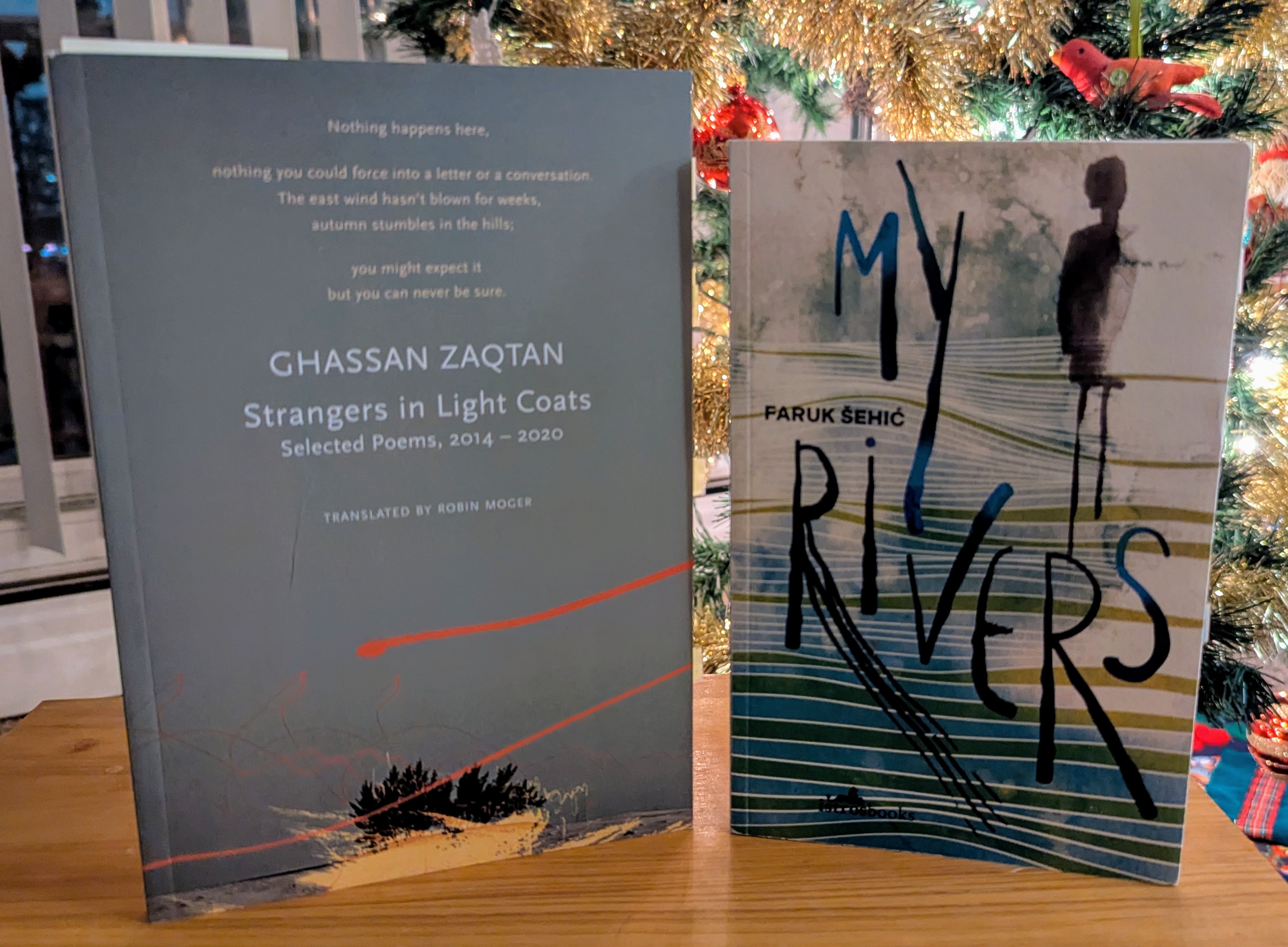
Strangers in Light Coatsevokes by Palestinian poet Ghassan Zaqtan (Arabic, translated by Robin Moger/Seagull Books) is, perhaps, a darker than his earlier collections. Comprised as it is, of poems from recent releases, it actively portrays a world shaped by the reality of decades of occupation and war.

My Rivers by Faruk Šehić (Bosnian, translated by S.D. Curtis/Istros Books) is a collection particularly powerful for its depiction of a legacy of wars in Bosnia/Herzegovina including the genocide in Srebrenica. His speakers carry the burden of history.

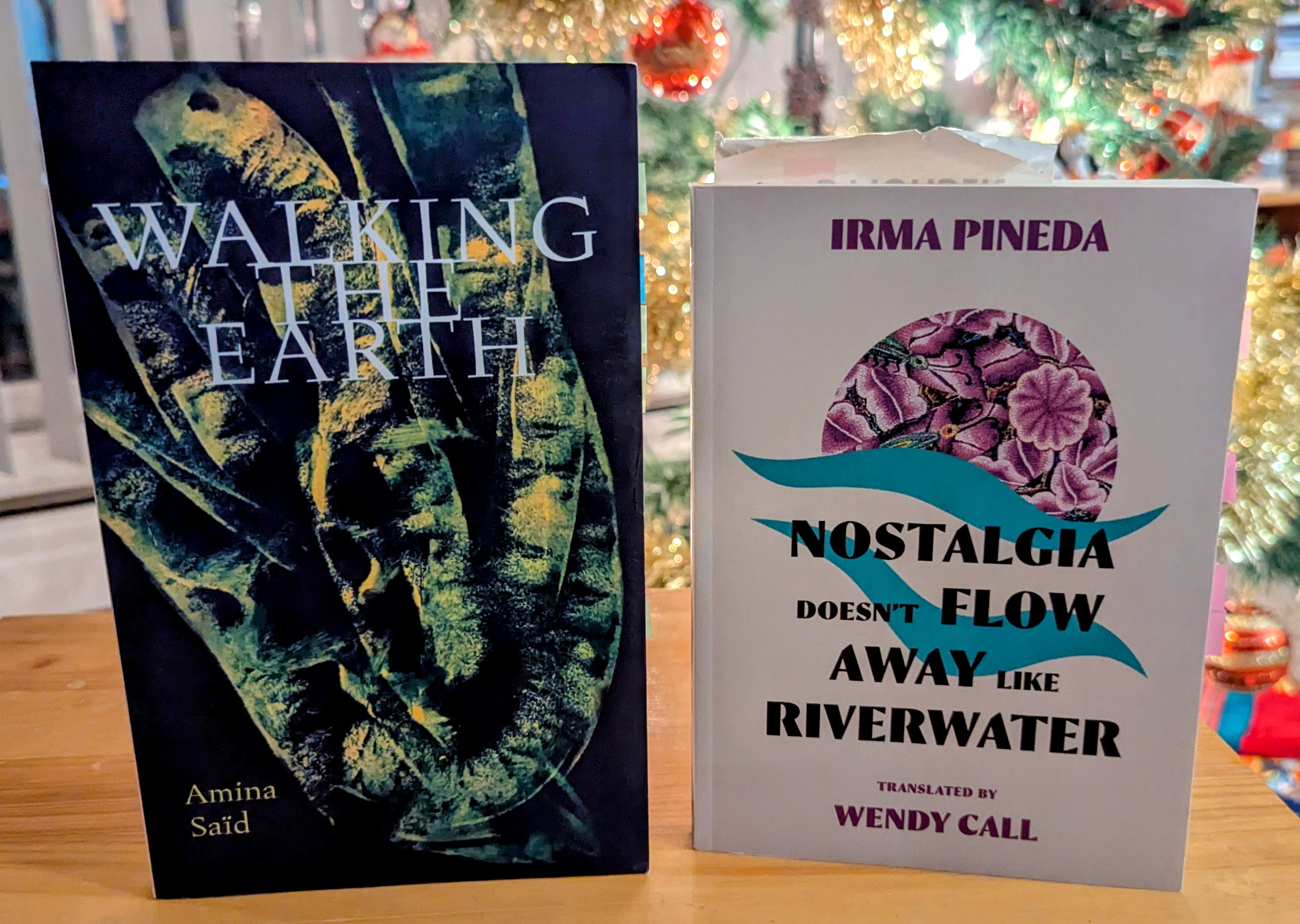
Walking the Earth by Tunisian-French poet Amina Saïd (French, translated by Peter Thompson/Contra Mundum) is such a haunting work of primal beauty that I can’t understand why more of her poetry has not been published in English. Perhaps that will change.

Nostalgia Doesn’t Flow Away Like Rainwater by Irma Pineda is one of a number of small Latin American poetry collection from poets and communities that have not been published in English before. This book, a trilingual collection in Didxazá (Isthmus Zapotec) and Spanish with English translations by Wendy Call (Deep Vellum & Phoneme Media) was particularly special.


Nonfiction:
This year, my favourites include a mix of memoir and essay and a couple of works that defy simple classification.

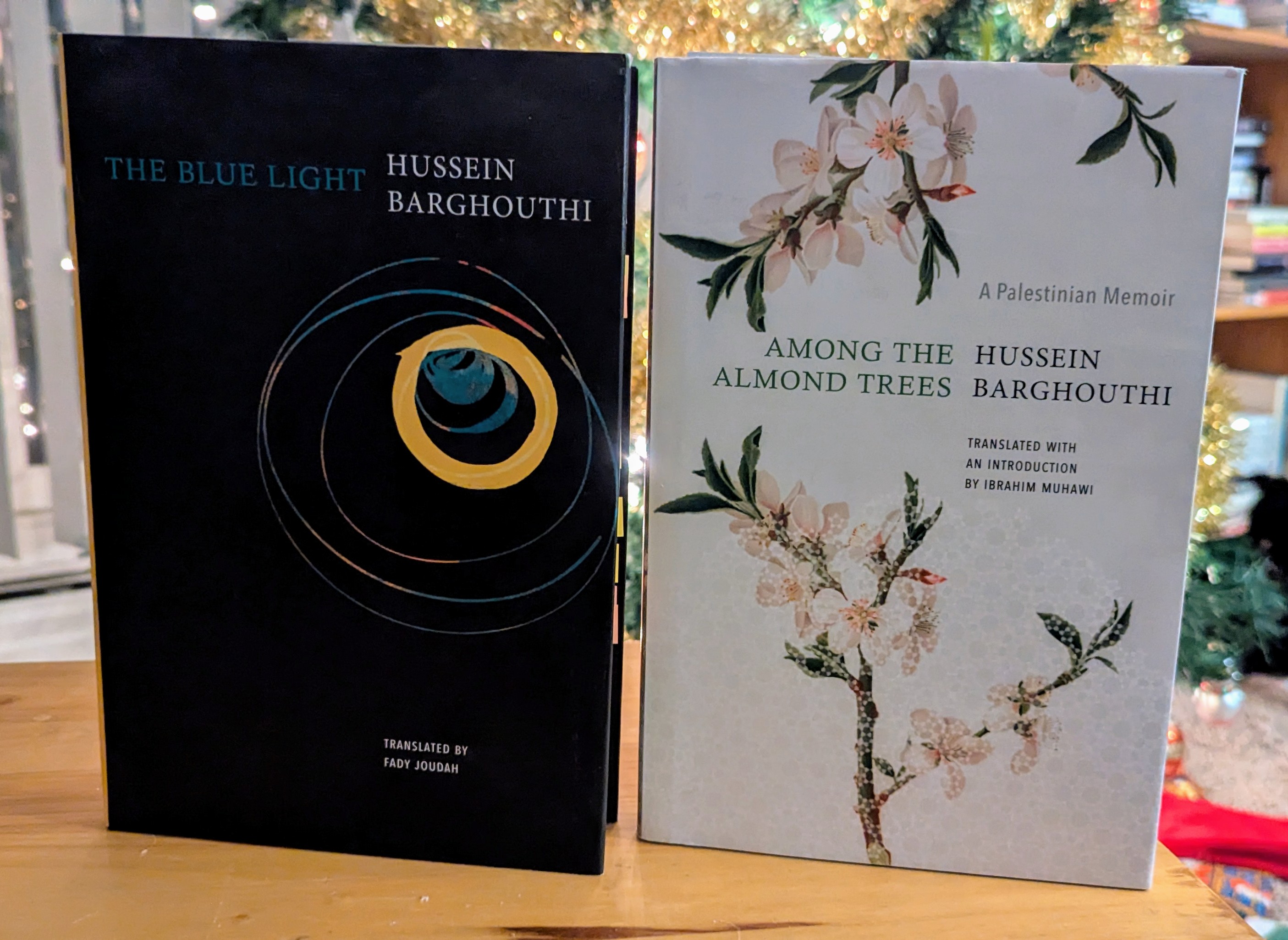
The Blue Light / Among the Almond Trees by Palestinian writer Hussein Barghouthi (Arabic, translated by Fady Joudah and Ibrahim Muhawi respectively/Seagull). Blue Light chronicles Barghouthi’s years in Seattle as a grad student and the eccentric circles he travelled in, whereas Among the Almond Trees is a much more sombre work written when he knew he was dying of cancer. The two books complement each other beautifully.

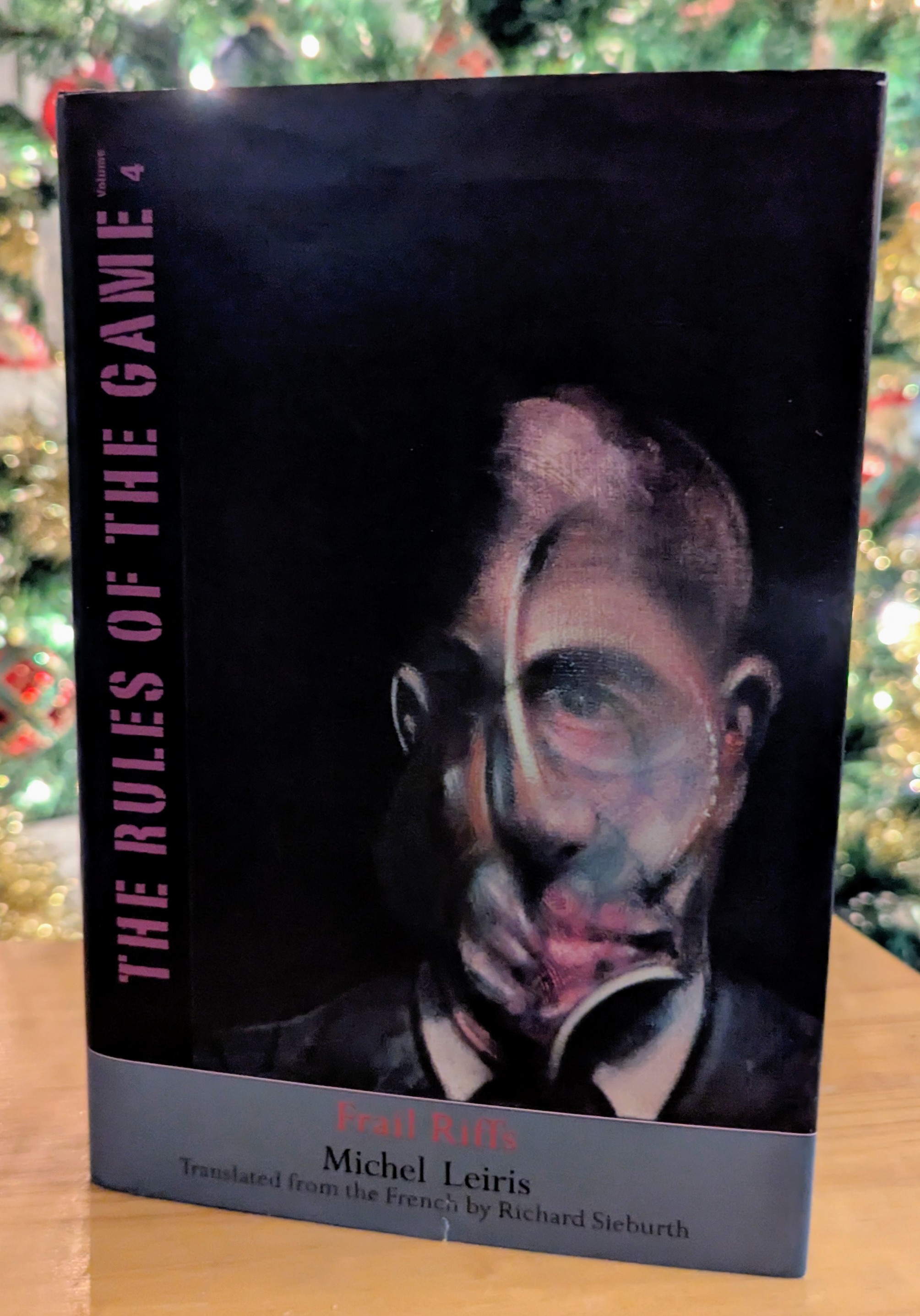
French intellectual, critic, ethnographer and autobiographical essayist Michel Leiris is a writer who means so much to me that the occasion of the release of Frail Riffs (Yale University), the fourth and final volume of his Rules of the Game in Richard Sieburth‘s translation, was not only an excuse to pitch a review but an invitation to revisit the earlier volumes. Definitely a highlight.

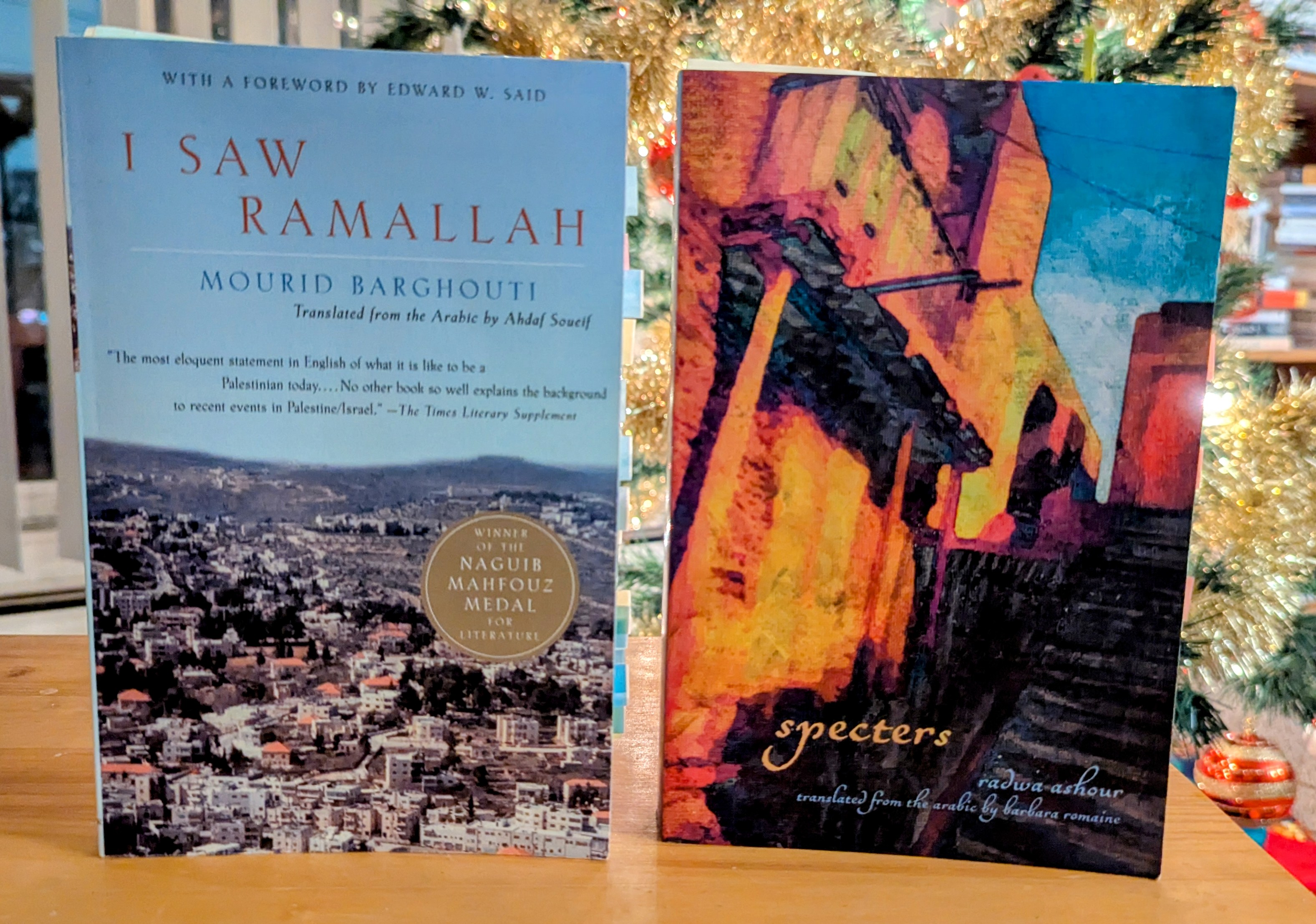
I Saw Ramallah by Mourid Barghouti (Palestinian/Arabic, translated by Ahdaf Soueif/Anchor Books) is a moving memoir detailing the author’s return to his homeland after thirty years of exile. Reading it reminded me that I had a copy of Scepters by his wife, Egyptian novelist Radwa Ashour (Arabic, translated by Barbara Romaine/Interlink Books). This ambitious work blends fiction, history, memoir, and metafiction and I absolutely loved it, but my decision to include it here, like this, rests on the memoir element which complements her husband’s in its account of the many years he was exiled from Egypt—a double exile for him—especially the years in which she travelled back and forth with their young son to visit him while he was living in Hungary.

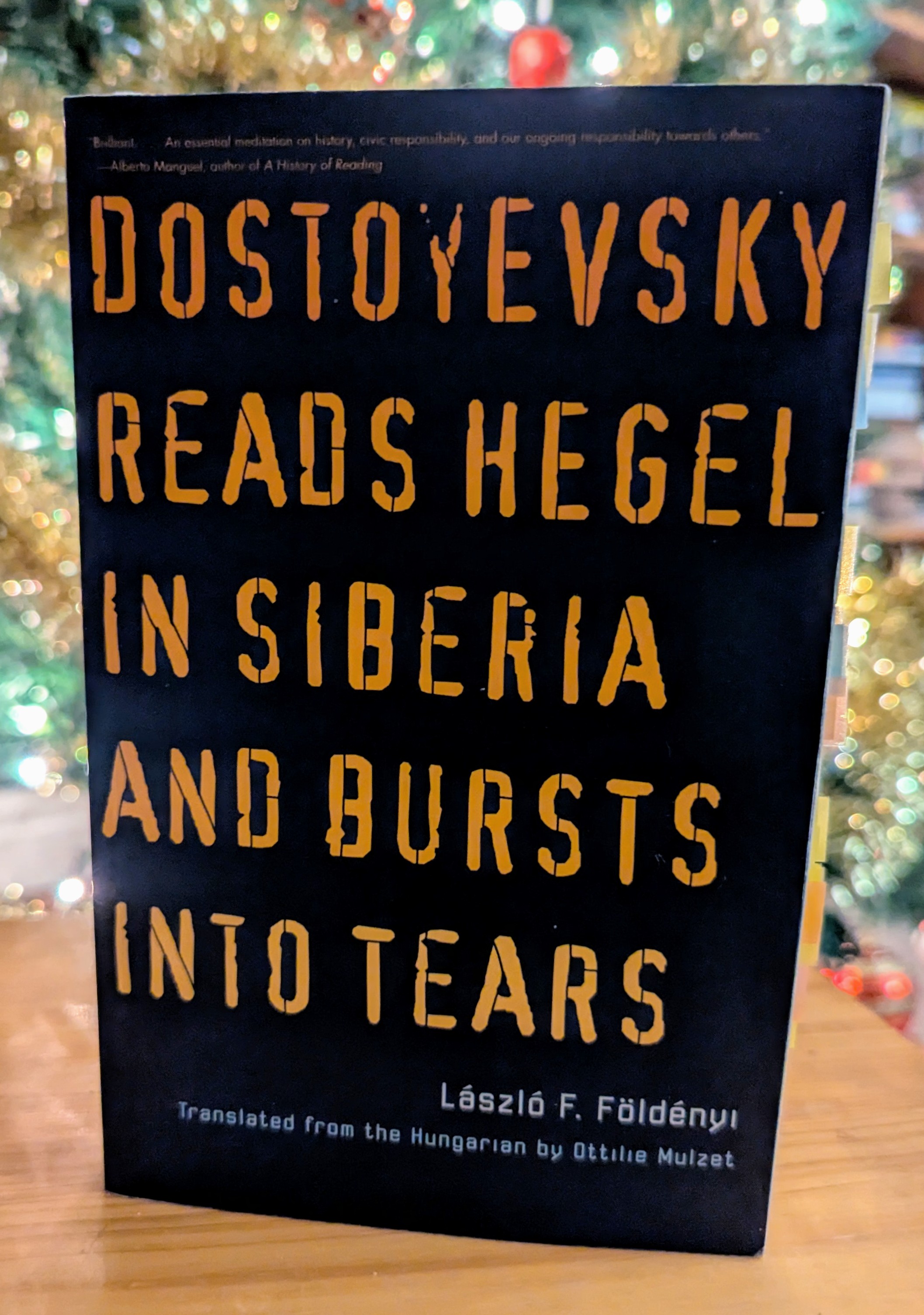
Candidate for the book with the best title, perhaps ever, Dostoyevsky Reads Hegel in Siberia and Bursts into Tears by Hungarian scholar  László Földényi (translated by Ottilie Mulzet/Yale University) was an endlessly fascinating collection of essays exploring the relationship between darkness and light (and similar dichotomies) through the ideas of a variety of writers, thinkers and artists.


Fiction:
As usual, fiction comprised the largest component of my reading and, as I’ve said, I read more relatively longer works than in the past. Normally I have a special fondness for the very spare novella and, of course, my list would not be complete without a few shorter works, including one more pair.

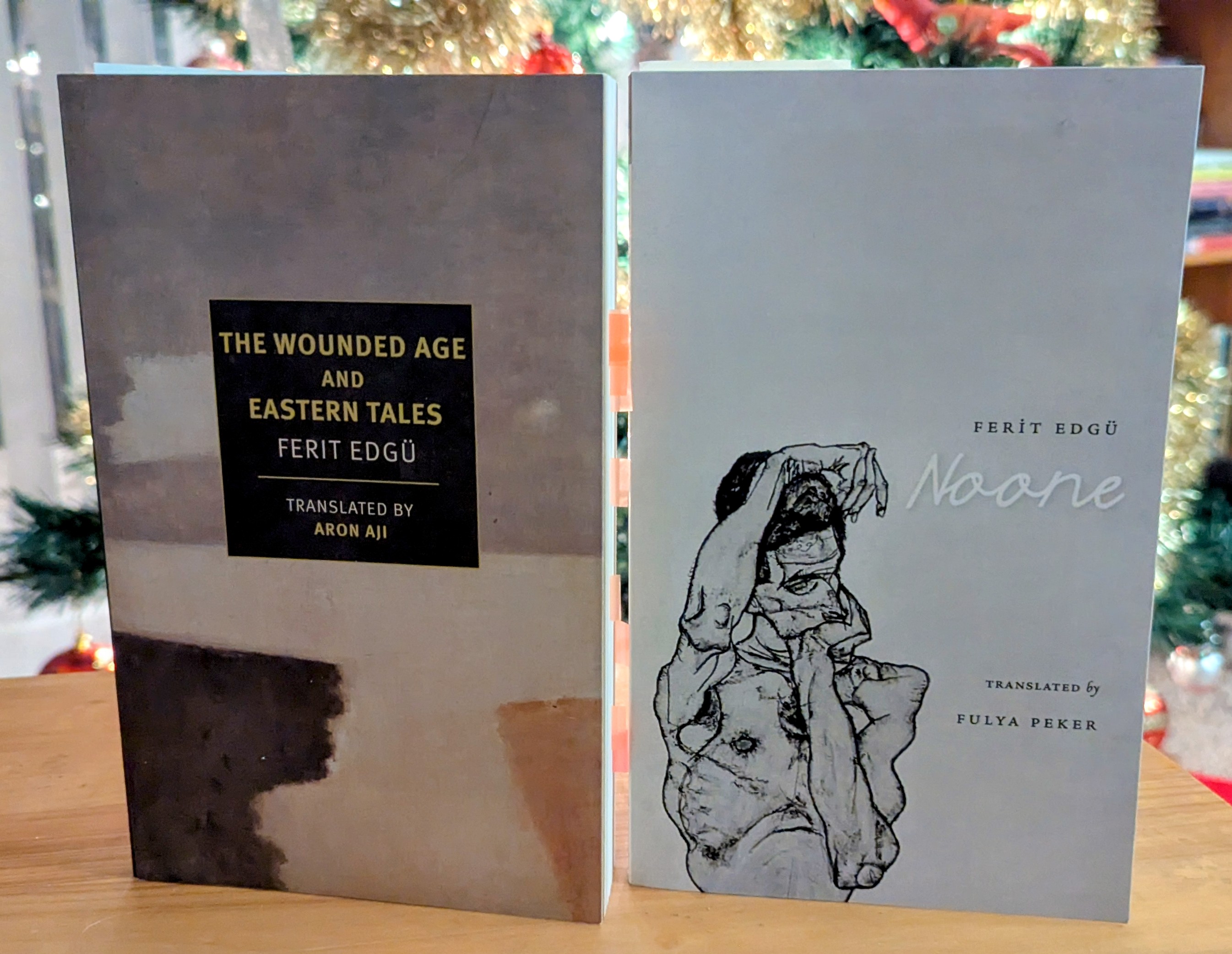
The Wounded Age and Eastern Tales  / Noone by Turkish writer Ferit Edgü—translated by Aron Aji (NYRB Classics) and Fulya Peker Cotra Mundum) respectively—who is sadly one of the writers we lost this year. His work, which draws on the time he spent teaching in the impoverished southeastern region of Turkey in lieu of military service, is filled with great compassion for the people of this troubled area. But his prose is stripped clean, bare, and remarkably powerful.

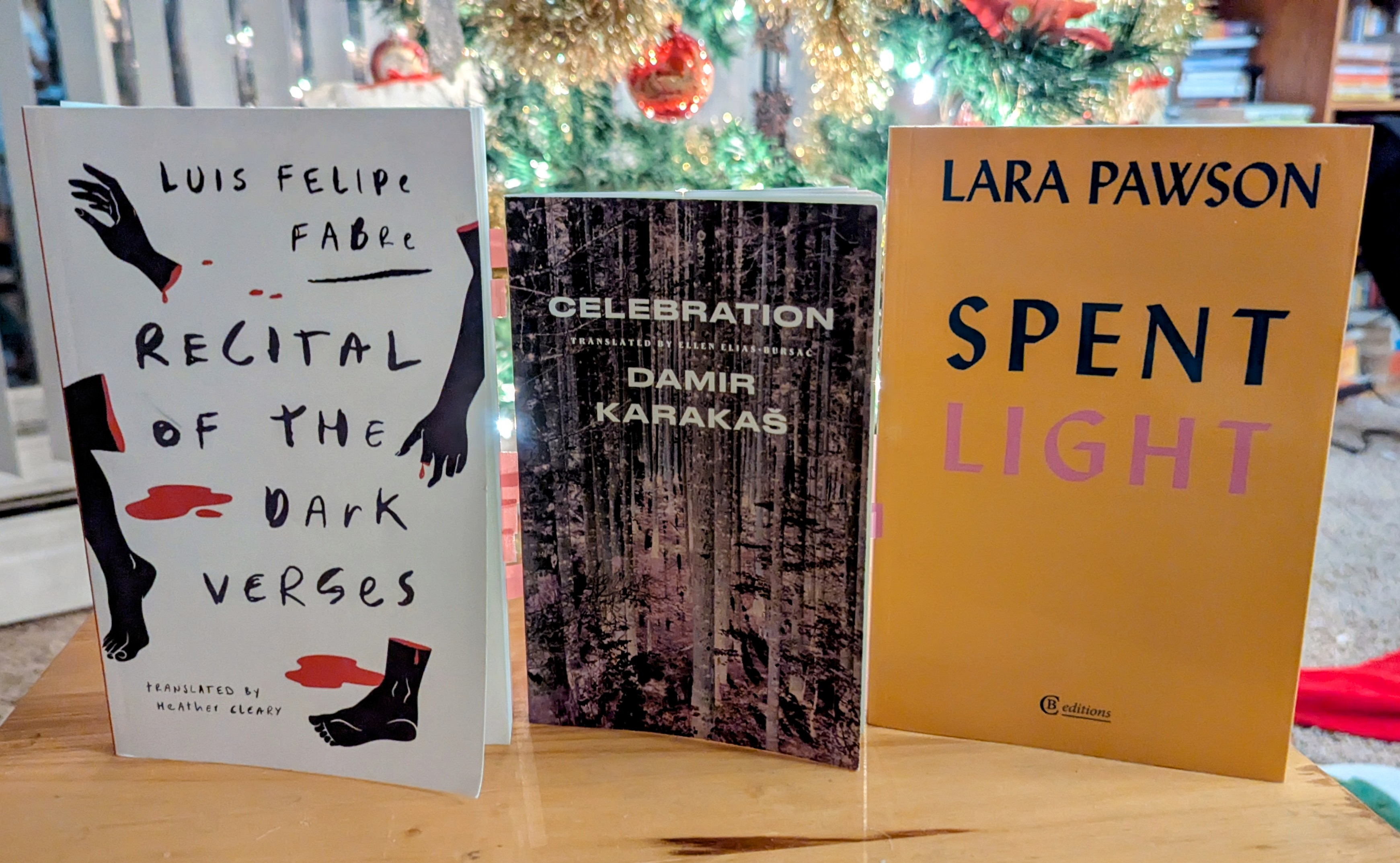
Recital of the Dark Verses by Luis Felipe Fabre (Mexico/Spanish, translated by Heather Cleary/Deep Vellum) is an award wining translation that seems to have garnered less attention than it deserves. This comic Golden Age road trip follows the misadventures of the body of John of the Cross on its clandestine voyage to Seville. Brilliant.

Celebration by Damir Karakaš (Croatian, translated by Ellen Elias-Bursać/ Two Lines Press) is an exceptionally spare, unsentimental novella about the historical forces that pulled the residents of Lika in central Croatia into World War II.

Spent Light by Lara Pawson (CB Editions) is a book I’d been anticipating since reading her This Is the Place to Be. Strange, at times disturbing, often hilarious and always thoughtful, this is one of those books that (thankfully) defies description.

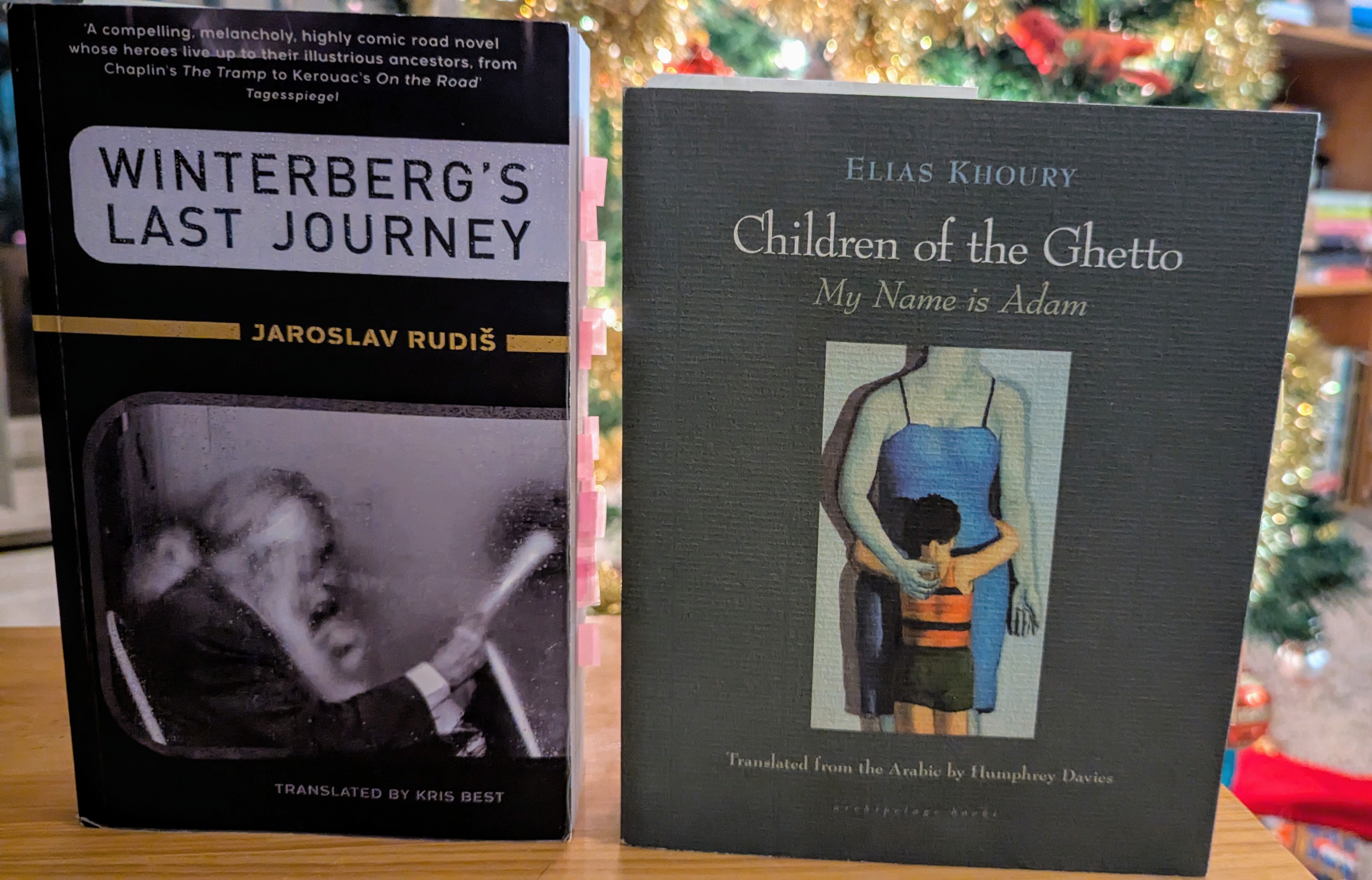
If Celebration is historical fiction at its most spare, Winterberg’s Last Journey by Czech writer Jaroslav Rudiš (German, translated by Kris Best/Jantar Publishing) is the exact opposite. Ambitious, eccentric, and filled with detail, it follows a 99 year-old man and his male nurse as they travel the railways with the aid of 1913 railway guide. What could possibly go wrong?

Children of the Ghetto I: My Name is Adam by Lebanese author Elias Khoury who also died this year (translated by Humphrey Davies/Archipelago Books) is the final Palestinian themed work on my list. This is a challenging and rewarding novel about a man born in the ghetto of Lydda during the Nakba that examines complex questions of identity.

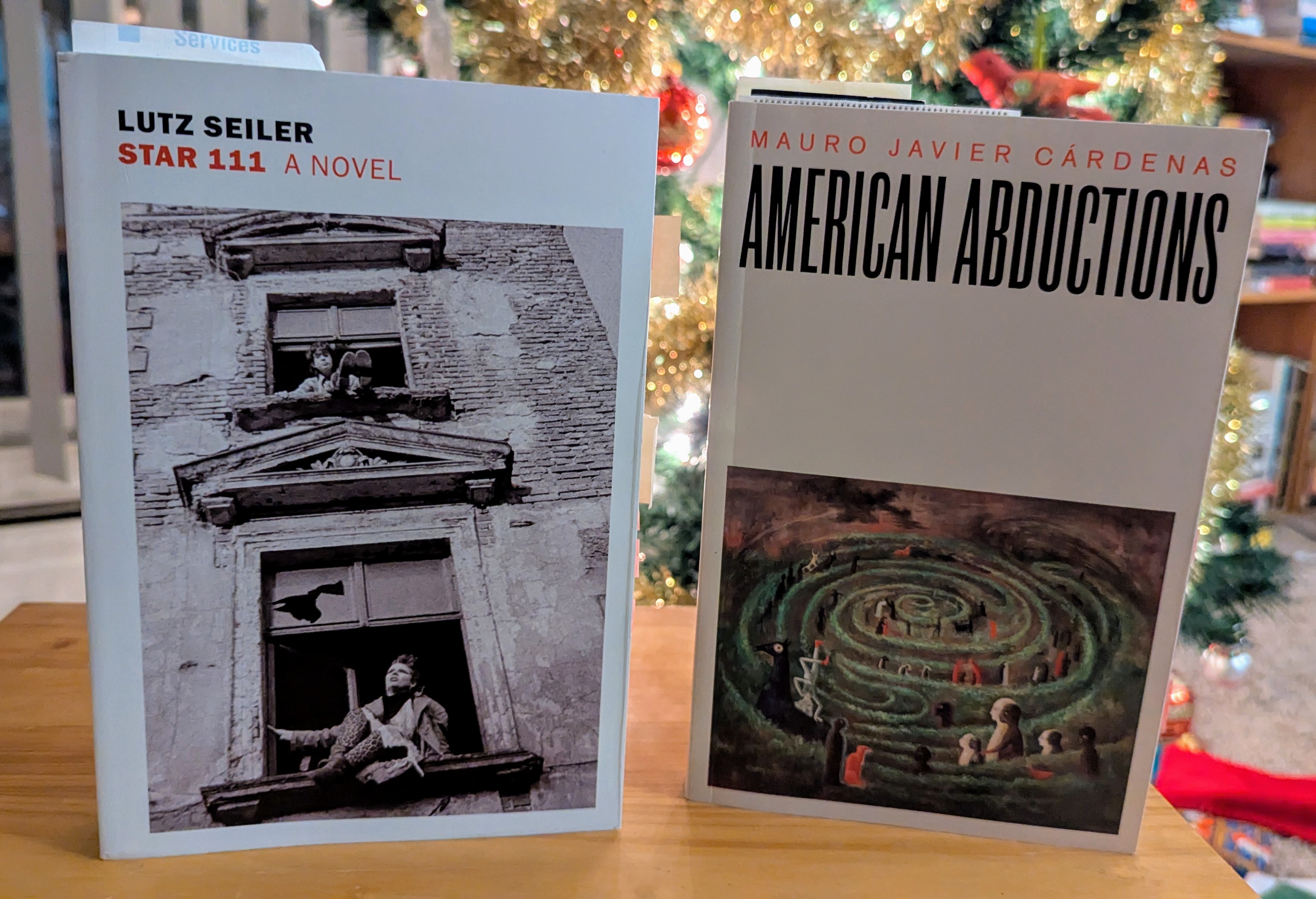
Star 111 by Lutz Seiler (German, translated by Tess Lewis/NYRB Imprints)is the autobiographically inspired story of a young East German would-be poet’s experiences among an eccentric group of idealists in Berlin in the immediate aftermath of the fall of the Wall. I was familiar with Seiler’s poetry before reading this, but I liked this novel so much that it lead me to follow up with his essays and the work of other poets important to him—the best kind of expanding reading experience.

Mauro Javier Cárdenas’ third novel American Abductions (Dalkey Archive) imagines the latest iteration of his hero Antonio in a future in which Latin American migrants are systematically sought out, separated from the children and deported. With a stream of single sentence chapters, he creates a tale that is both fun and uncomfortably too close for comfort. Quite an achievement!

Last but not least, my two favourite books this year are Hungarian:

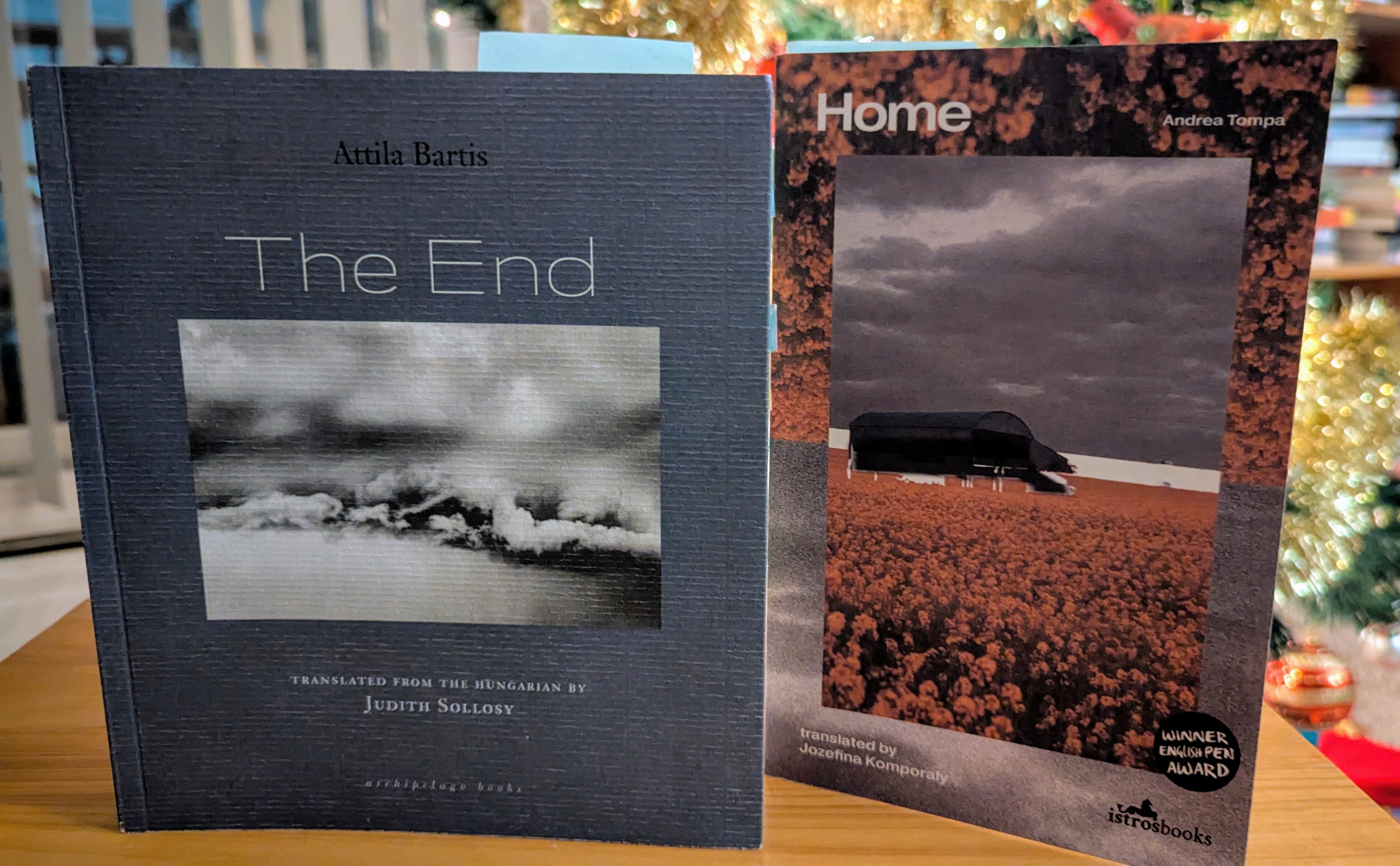
In The End by Attila Bartis (translated by Judith Sollosy/Archipelago Books), a fifty-two year old photographer looks back on his life—his successes and his failures. He reflects on his relationship with his mother, his move to Budapest with his father in the early 1960s following her death, life under Communism and the secrets held by those around him, and the role the camera played in his life. Presented in short chapters, like photographs in prose each with its “punctum,” the 600+ pages of this book just fly by.

Like Attila Bartis, Andrea Tompa also comes from the ethnically Hungarian community of Romania’s Transylvania region and now lives in Budapest. Her novel Home (translated by Jozefina Komporaly/Istros Books) follows a woman travelling to a school reunion, but it is much more. It is a novel about language, about what it means to belong, to have a home and a mother tongue. It’s probably not surprising that my two favourite novels involve protagonists in mid-life, looking at where they are and how they got there. As to why they’re both Hungarian—I suppose I’ll have to read more Hungarian literature in the new year to answer that.

So that is my 2024 wrap up. I’d like to think 2025 will be better than I fear it will, but at least I know there are countless good books to look forward to.

Happy New Year!

At last, the final volume of Michel Leiris’ The Rules of the Game is available in English—a few (well, more than a few) words about it and a link to my review at Minor Literature[s]

As a reader, I do not tend to be a completest, collecting and diligently making my way through the complete works and associated letters and journals of a particular writer, but if I have made one exception, it is for French poet, novelist, essayist, ethnographer, and critic Michel Leiris. However, as English language Leiris enthusiasts will know, his most important work—the four-volume autobiographical essay to which he devoted thirty-five years of his writing life, The Rules of the Game—was not yet translated in full. That is, until now. This spring, Yale University Press released the final volume, Frail Riffs in Richard Sieburth’s translation.

Sieburth, who translated the book that served as my introduction to Leiris, his 1961 dream diary, Nights as Days, Days as Nights, takes over the Rules of the Game translation enterprise from Lydia Davis, who translated the first three parts of the project, plus Leiris’ novel Manhood. But, if there is any stylistic shift, it is not an issue because Frail Riffs itself marks a sharp shift in approach and style from the dense, labyrinthine prose that characterizes the first volume, Scratches, Scraps and Fibrils toward the fragmented, eclectic form of Leiris’ late work which will be familiar to readers of The Ribbon at Olympia’s Throat (which I wrote about at length for The Critical Flame).

Leiris was, throughout his long life which spanned most of the twentieth century, deeply engaged with the political, intellectual and artistic culture of Paris. Yet, his influential autobiographical endeavour was self-focused, scrupulous and often obsessive and critical. It’s not an accounting of his life, per se, but rather of episodes that strike him as important or interesting, against which he can analyze or dissect himself. A love of language and a concern about truthfulness and discretion in the autobiographical exercise are critical. He draws on, among many things, his childhood experiences, travel (as an ethnographer or as part of political or artistic delegations) and, in a particularly vulnerable section of the third volume of Rules, on his suicide attempt, the affair that triggered it and his difficult recovery.

Frail Riffs continues in this vein, but in a more open manner, with short essays and observations, typically grouped thematically, and interspersed with poems, lists, and passages of word play. One of the aspects of Leiris’ character that becomes more apparent in this book and again in Olympia, is his deep despair with the ongoing state of war and violence in the world. He is, as he ages, increasingly confirmed in his anti-colonial and anti-racist convictions. He knows he is too afraid of pain and death to be a true “revolutionary” but as students take to the streets of Paris in 1968, he watches from his well-placed apartment with admiration and offers what refuge he can (the irony of his own bourgeois contradictions never lost on him). I’ve thought about his observations a lot in recent weeks. He would, were he here now, still be in despair.

Anyhow, this long introduction stands as an invitation to follow up with my review of The Rules of the Game Volume 4: Frail Riffs, which has been published at Minor Literature[s]. Thank you to everyone for welcoming my work back to this great literary journal .

The Rules of the Game Volume 4: Frail Riffs is translated from the French by Richard Sieburth and published by Yale University Press.
There are no roads here: The Last Lover by Can Xue

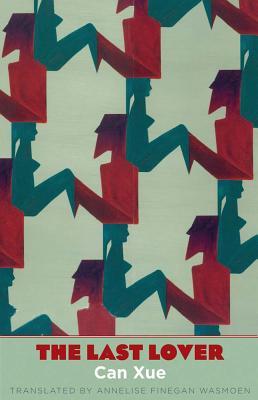
To enter into the pages of The Last Lover by Chinese author Can Xue, is to surrender yourself to a shimmering, surreal dream world – a space where human souls cross paths with animal spirits, experience love and loss, and embark on journeys that intersect with some measure of a real world then cross back into magical landscapes. There are no clear parameters to follow, once you feel you are beginning to make sense of things, the floor falls away beneath you or you find yourself trapped in a labyrinth, or both at once. Nothing is what it seems, and the main characters are equally confused, conflicted, uncertain about whom to trust or what is happening to them.

Does it all come together at the end? Brilliantly yes. Perhaps. And I’m not entirely certain.

lastTo attempt to outline the plot of The Last Lover would be fruitless. Essentially the novel revolves around several key couples living in an unnamed ostensibly western country. The central figure, if it is possible to see him as such, is Joe. He is an avid reader, capable of losing himself in books, forever weaving a story of his own from the threads of the stories he reads. His wife Maria is a housewife who weaves images into tapestries and seems to have a capacity to channel mystical energies. Daniel is their teenaged son who drops out of school to take up his passion for gardening full-time. The dynamic between the three family members shifts – close on some levels but following separate trajectories on others.

Vincent is Joe’s employer, the owner of a successful clothing company. He seems distracted and at odds from the onset, while his intense wife Lisa is convinced he is having an affair. Apparently he also appears to be able to be in two places at once, a remarkably common occurrence in the world of The Last Lover. Vincent and Lisa are deeply in love but wrestling with the demons of their own peculiar mid-life crises.

Reagan, a client of Vincent’s Rose Clothing Company, is the 50 year-old bachelor and owner of a rubber plantation south of the city where the others live. He is drawn to Ida, a young woman of obscure Asian origin, who is working on his farm. Theirs is probably the most overtly surreal of all the relationships, but that is not imply that any couple has anything approaching a routine domestic existence. The overlapping and entwined connections between the six key characters forms a strong thread that pulls the reader into and through this anfractuous tale.

Winding in and out of the lives of the key figures is an ambiguous cast of other entities – mysterious Asian and/or Middle Eastern women, odd servants and drivers, eccentric loners, beautiful street cleaners with curious doppelgängers and a host of cats, snakes, birds, mice, insects and other creatures. Earthquakes rumble throughout the novel, shaking some characters to the core while passing unnoticed by others. Fires rage, floods wash mountainsides away, roses exert magnetic energies, and dream worlds collide – not just with assumed reality, but between dreamers. Sexual desire arises frequently – at times characters are surprised by the intensity of the arousal, the unexpected gender of their object of attraction and the insubstantiality of most ensuing encounters.

As the story unfolds, moving through of layers of unreality, the tendency is to try look for clues, to assign meaning and value. My thought is that meaning is a slippery concept here, amorphous and shifting. Can Xue herself has advised that modernist literature requires the reader to turn inward to seek the structure of time and space within one’s soul, to be able to grasp the structure of the work. But structure is one thing, meaning is something else entirely. I would argue that this a work that will open itself up to the receptive reader, and be met by each reader on his or her own terms with what they bring to the experience.

I took pages and pages of notes, delighting in tracing connections, amazed by the depth of reading possible. In the end I was most keenly aware of themes of migration, the sense of a lost connection with a home left behind, the loneliness of love, the ambiguity of remembering and forgetting, and the increasingly virtual quality of our connections with others in our modern world. But those are my perceptions at this moment. Can Xue, (her real name is Deng Xiaohua, her pseudonym meaning “dirty snow that refuses to melt”) is a self taught writer. The Cultural Revolution abruptly ended her education after elementary school, so she took to educating herself, reading poetry and fiction and steeping herself in the classical Western canon and Russian literature. She has cited Kafka, Borges, Cervantes and Dante as influences. Echoes of Calvino are strong and I could not help but think of contemporary writers like Ben Okri and Sjón among others.

This is actually my first encounter with contemporary Chinese literature. This morning it was announced as a contender for the Best Translated Book Award (BTBA), making it the one title to appear on both major annual translated fiction award longlists. Annelise Finegan Wasmoen’s translation is clear, spare and lyrical. She maintains a steady pace and brings to life the sounds that reverberate throughout the text – the su su rustling of pages, si si hissing of snakes, the cha cha whisper of snow – preserving what one imagines might approach the sensory experience of reading The Last Lover in the original Chinese.

Independent Foreign Fiction Prize 2015 / Best Translated Book Award 2015: A demanding read that defeated a few members of our IFFP shadow jury, this was a highly rewarding reading experience for me. I will definitely seek out more of Can Xue’s work. A taste of her short stories, some of which can be found on line and this insightful feature from Music & Literature were helpful, though I avoided reading other interpretations closely before finishing the book. I would encourage a reader interested in a challenge to persevere, open to the riches that this type of literature can offer.

Update: The Last Lover has been awarded the 2015 BTBA Award. Of the six of the ten shortlisted BTBA titles I read it was my favourite all along. Congratulations to Can Xue and Annelise Finegan Wasmoen!