2025 Wrap Up: Reading and other stuff


I don’t know what I expected when this year began. Ever since 2020 it seems we have greeted each year with some measure of optimism—I mean how could it be worse than the one that just passed? And somehow, each year has managed to be worse in some new, unanticipated way. 2025 saw the continuation of conflict, famine, destruction, climate catastrophes.  We also witnessed the further escalation of intolerance, racism, sexism, anti-trans sentiment, religious fundamentalism, and autocratic politics. Where I am in western Canada we have witnessed all of this, not just from our neighbours to the south, or distant nations, but right here close to home. It is hard not to lose hope, but giving up is not an option and so, 2026, here we come, preparing for the worst but dreaming of the best.

Personally, I struggled a bit this year. Family stuff, some depression, and, in late November, a car accident that has left me with stiffness and pain that is slow to subside. But, on the bright(er) side, my focus and concentration has returned, and replacing my damaged car proved easier than it might have been. My old Honda Fit had more value than I expected, and I happened to see a (newer) used vehicle that fit my needs for a very good price and was fortunately in the position to buy it. If the police manage to find the impaired driver who hit me (assuming she was insured) I will even get my deductible back. But, quite honestly, I’ll be happy to be able to look over my left shoulder again!

As for reading/reviewing, 2025 was a mixed year. I had a few off times when I struggled to finish books (or gave up altogether), and a number of mediocre reads passed without public mention. At the same time, I read some excellent poetry in English, but could not find the words to write coherent reviews. For some reason, I feel I lack the knowledge and vocabulary to say the “right” thing about poetry in my own language—I feel more comfortable responding to translations. And I did read a lot of poetry in translation this year.

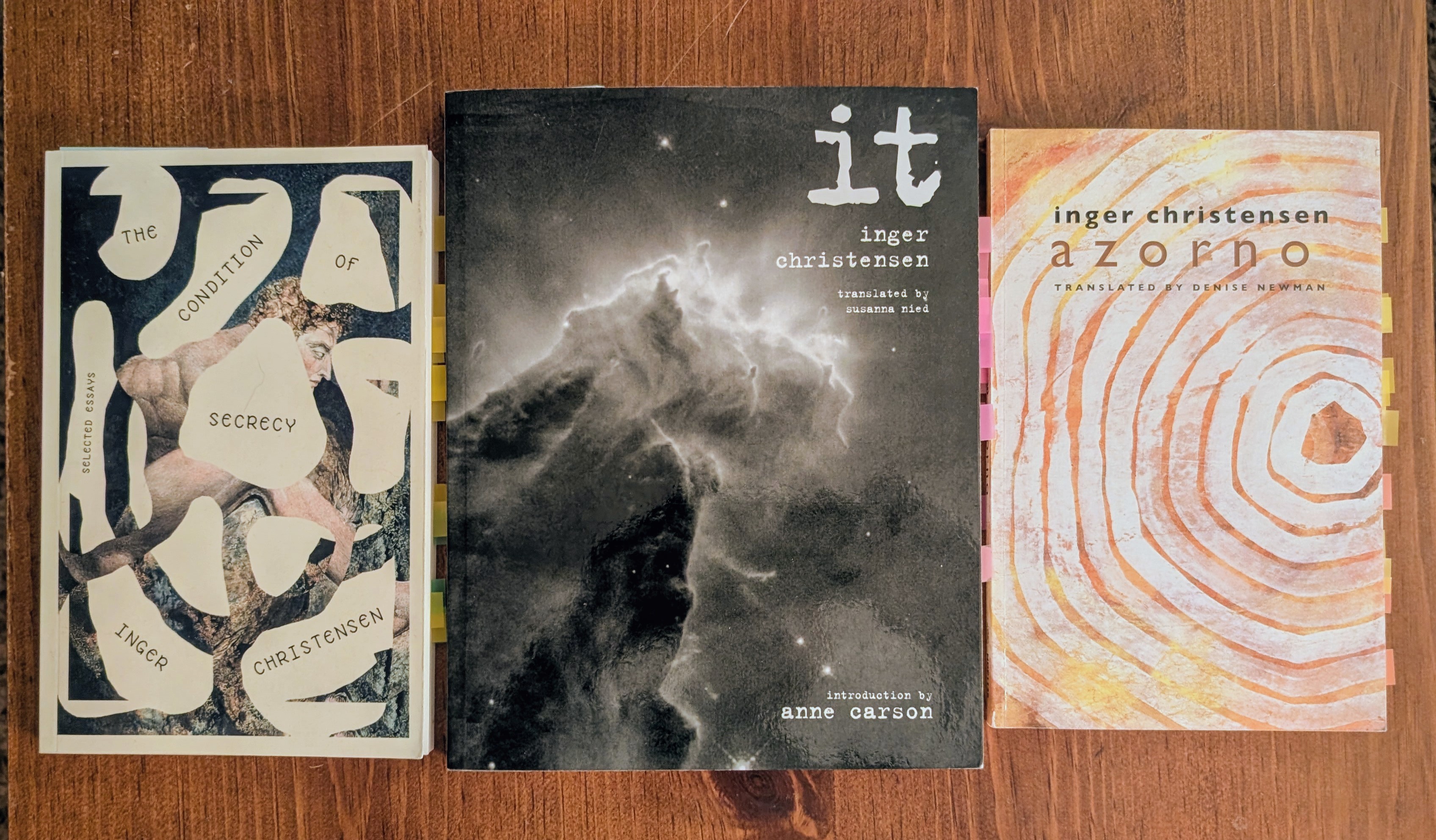
Looking back over 2025, the singular defining force for me was the work of Danish experimental poet and writer Inger Christensen (1935–2009). In January I read her essay collection  The Condition of Secrecy, and I was immediately entranced by her love of language and her view of the world as informed by science, nature, music, and mathematics. I knew I wanted to read all of her poetry and fiction and, throughout the year, that is exactly what I did. I read eight of her translated works and only have one left to obtain although I have a dual language edition of one of the sequences in that volume (“Butterfly Valley”). Along the way I also decided I wanted to learn to read Danish as there are elements of her work that simply cannot be reproduced in translation (mathematical constraints in particular).

And so, I am learning Danish, or, should I say, jeg lærer dansk.

Although I enjoyed all of her books, my favourite piece of fiction was the crazy word play mystery Azorno (1967) and my favourite work of poetry was her monumental it/det (1969), both earlier works. Of course, the wonderful book length poem alphabet (1981) is also amazing. Her poetry and essays are translated by Susanna Nied, her fiction by Denise Newman.
Some thoughts about a few of my other favourite reads from the past year:

 Prose:

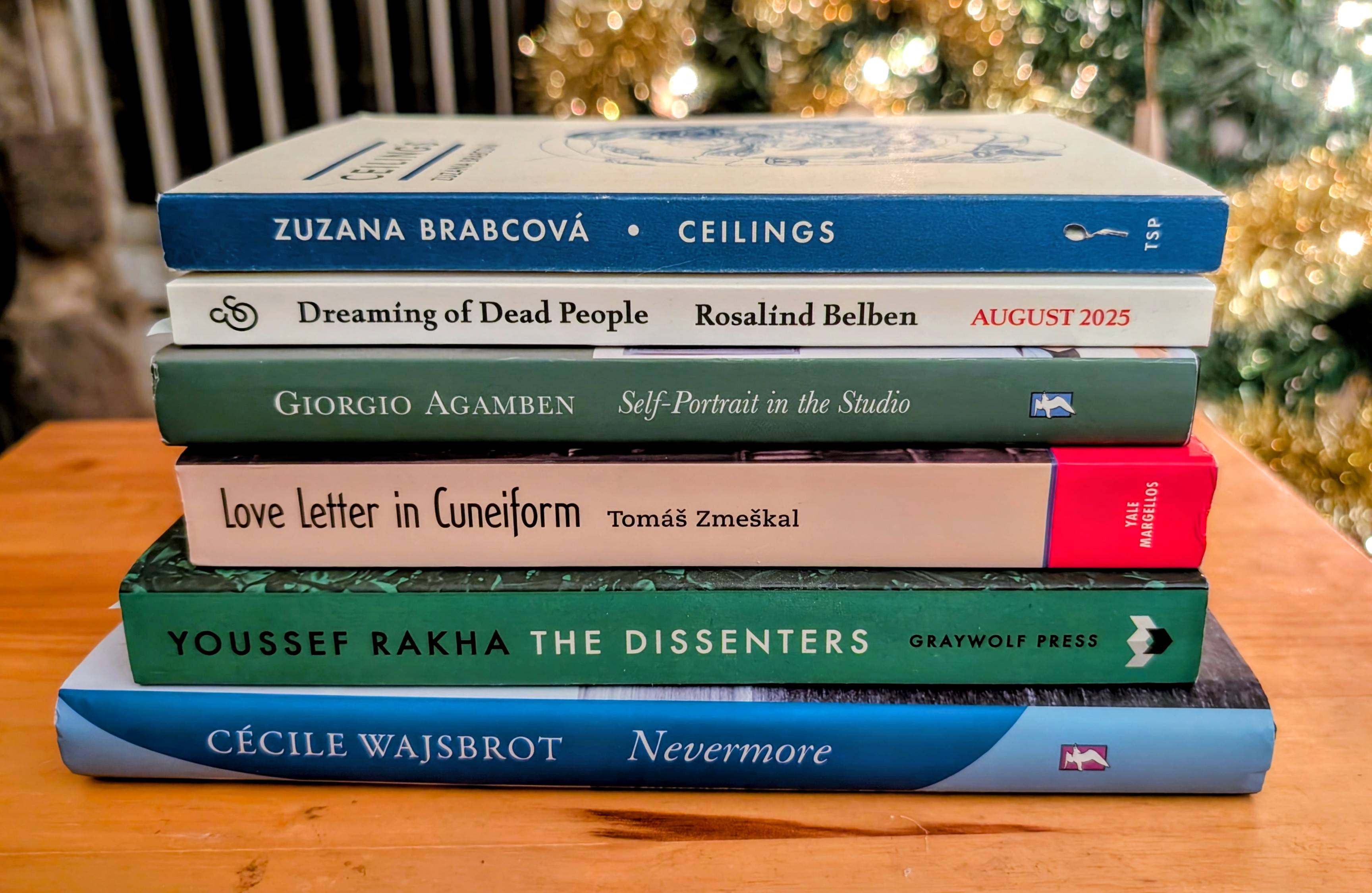
Ceilings – Zuzana Brabcová (translated from the Czech by Tereza Veverka Novická)

Set on the detox ward of a psychiatric hospital in Prague, Brabcová captures the institutional environment and the strangeness of psychotic interludes with the skill only personal experience can provide. This wild and delirious ride pulled me out of a reading slump.

Dreaming of Dead People – Rosalind Belben

I read two novels by Rosalind Belben this year, The Limit which was re-issued by NYRB Classics several years ago and this one which was re-issued by And Other Stories this year. Both are strange in a brutal yet beautiful way, but Dreaming is, to me, a more accomplished, in depth novel.

Love Letter in Cuneiform – Tomáš Zmeškal (translated from the Czech by Alex Zucker)

One of those books I’ve been meaning to read for years and when I finally picked it up off the shelf, I was delighted to find out how funny and weird this multi-generational family drama truly is. Zmeškal lends magical realism and historical reality with a cast of eccentric characters to create a memorable tale.

Self-Portrait in the Studio – Giorgio  Agamben (translated from the Italian by Kevin Attell)

Far from a conventional memoir, Agamben invites his reader on a tour of the various studios he has occupied over the years, reflecting on the people, books, and places that come to mind along the way. A surprisingly engaging work.

The Dissenters – Youssef Rakha

The final two novels on my list are both highly inventive in style and form. Egyptian writer Youssef Rakha’s first novel written in English manages to seamlessly incorporate Arabic expressions without explanation, adding to the richness of this original, multi-dimensional story of one remarkable woman set against the events of recent Egyptian history. Endlessly rewarding.

Nevermore – Cécile Wajsbrot (translated from the French by Tess Lewis)

This ambitious novel is a moving evocation of loss and change. A translator has come to Dresden to work on a translation of the central “Time Passes” section of Virginia Woolf’s To the Lighthouse from English into French. Reflections on change and transformation drawn from her own state in life and various historical events accompany the process of translation.
Poetry:

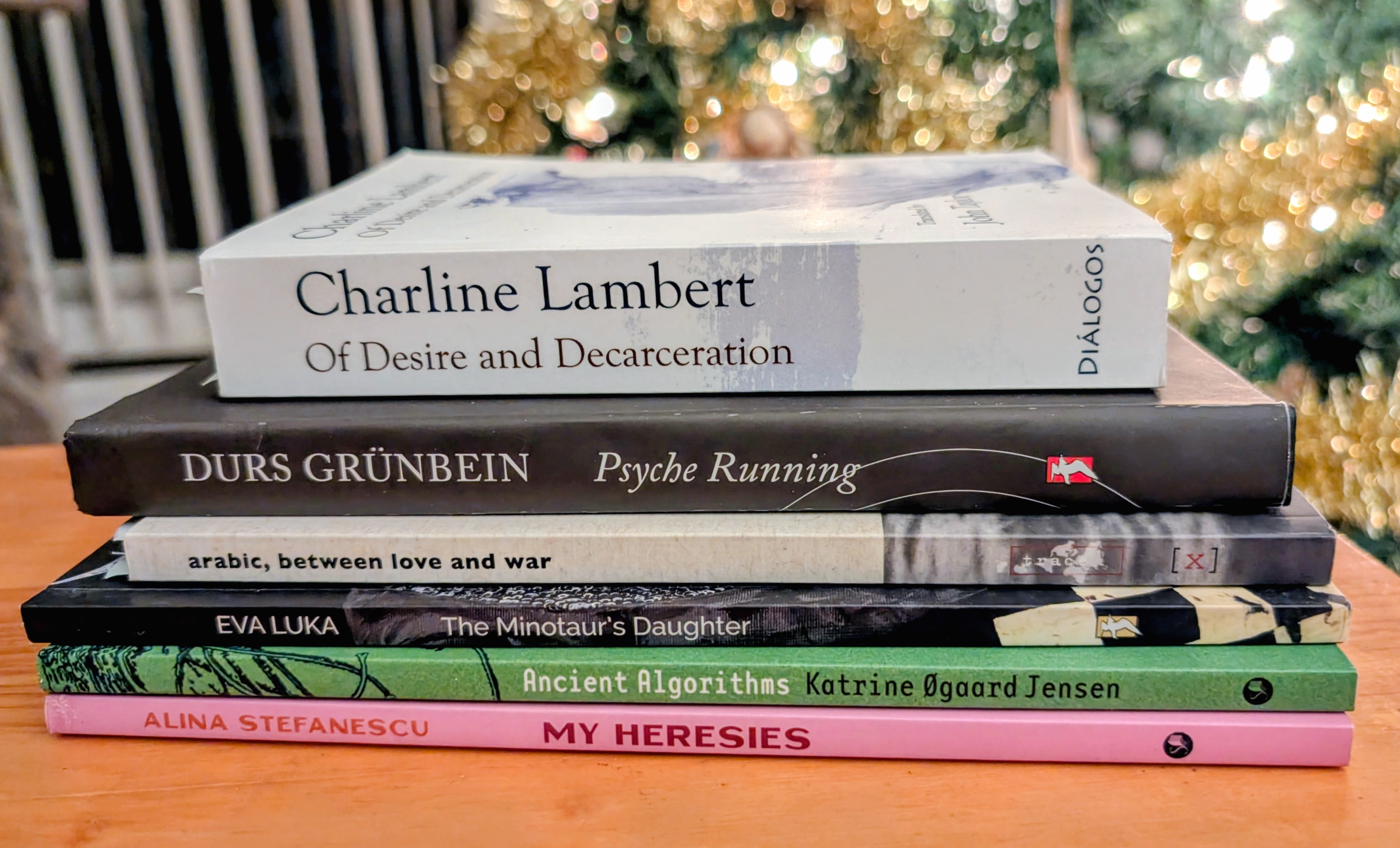
Of Desire and Decarceration – Charline Lambert (translated from the French by John Taylor)

It is most unusual for a poet as young as Lambert (b. 1989) to see her first four volumes of poetry published together so early in her career, but translator John Taylor felt that the Belgian poet’s books show a natural growth best appreciated as a whole. He is not wrong (he is also a translator whose judgement I always trust).

Psyche Running: Selected Poems 2005–2022 – Durs Grünbein (translated from the German by Karen Leeder)

This selection of poetry rightfully won the Griffin Prize this past year. Grünbein’s work tends to draw on his hometown of Dresden and Italy where he now spends much time, and this selection presents a good introduction to the variety of his mid-career work. One can only hope that the attention he has received with this book will lead to full translations of more of his work.

arabic, between love and war – Norah Alkharrashi and Yasmine Haj (eds)

The first of a new translation series by Toronto-based trace press, this selection of original poems with their translations—most written in Arabic, with some written in English and translated into Arabic, exists as a kind of conversation between poets from across the Arabic speaking world and its diaspora. Vital work.

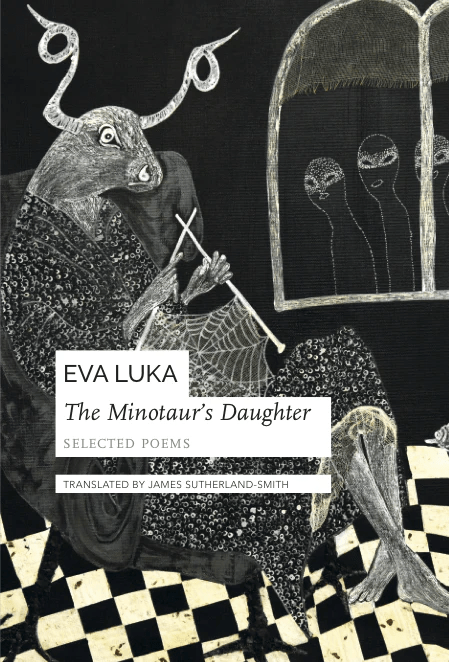
The Minotaur’s Daughter – Eva Luka (translated from the Slovak by James Sutherland-Smith)

This book, a complete surprise tucked into a package from Seagull Books, is a delight. Luka’s world is a strange and quirky one, transgressive and fantastic. Leonora Carrington is a huge influence, with a number of  ekphrastic poems inspired by her paintings but given life from Luka’s own unique angle. Loved it!

Ancient Algorithms – Katrine Øgaard Jensen (with Ursula Andkjær Olsen and others)

This is the book that marked my return to reading post-accident. And how could it not. Jensen’s translations of Olsen’s poetic trilogy are very close to my heart. This unique work begins with poems selected from those books (in the original Danish), followed by Jensen’s translations, which set the stage for a series of collaborative mistranslations guided by rules set by the various poet translators involved. A wonderful celebration of poetry and translation and the necessary bond between the two.

My Heresies – Alina Stefanescu

Finally, one of the English language poetry collections I read and did not review (I did have a great title though). Alina Stefanescu breathes poetry as a matter of course, as is clear to anyone who has had an opportunity to engage with her online. There is an infectious defiance to this collection which straddles Romania and America, conjures angels and demons, and explores the everyday reality of romantic and parental love. I connected most directly with wry observations of motherhood that resonated with my own less than conventional parental existence.
There are, as ever, many other books I read this year that could have made this year end review. You’ll have to check my blog to find them!

Happy new year!
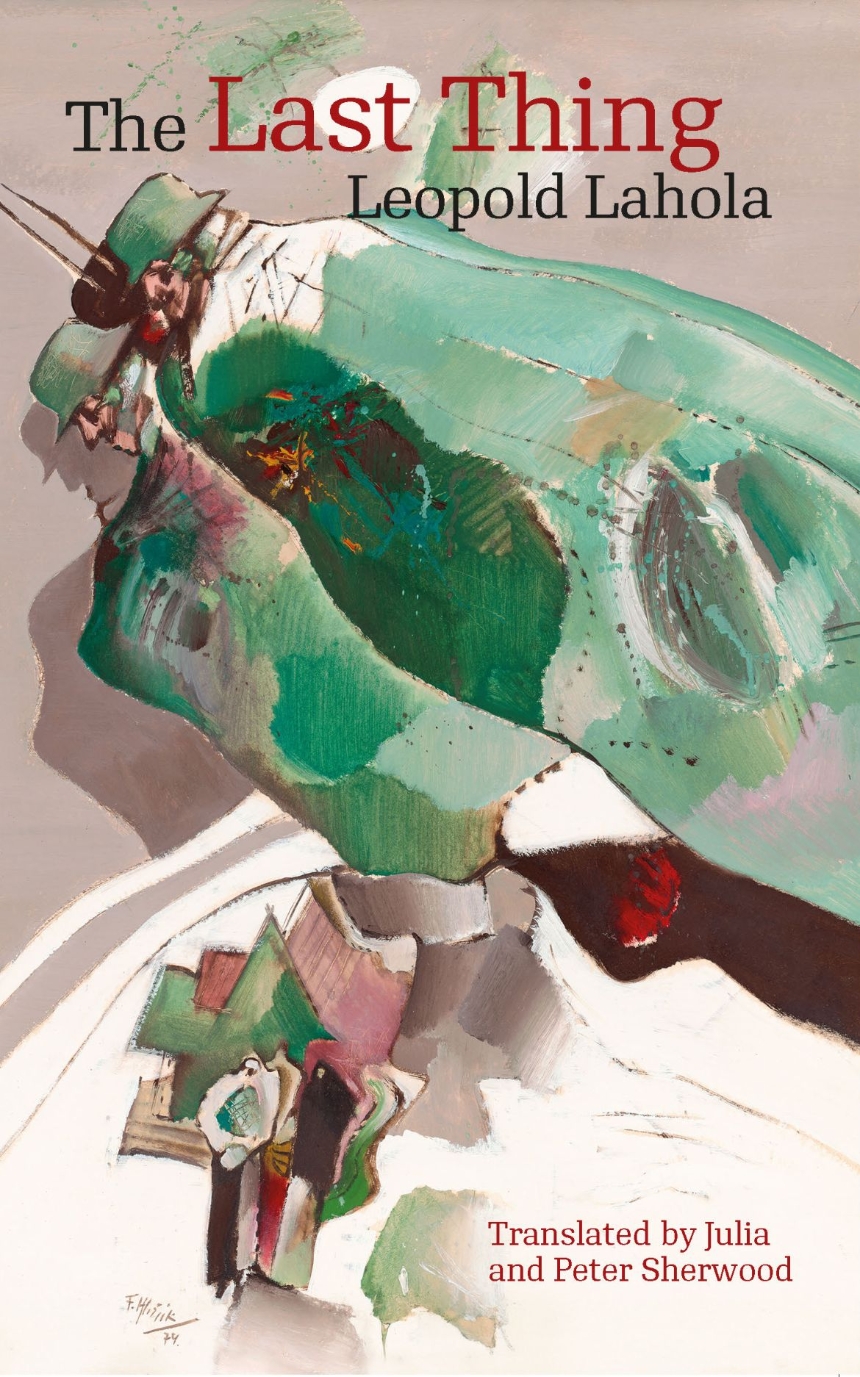
“Pain is a privilege of the living.” The Last Thing by Leopold Lahola

One day, a hundred thousand years ago, during the Ice Age or soon after, when the world began to melt from below, an iceberg must have carved out this valley, with its body dragging its tail behind it like an enormous scaly reptile. At least according to the long-winded account he heard yesterday from Big Joco as the two of them had been left to their own devices with machine guns aimed at the valley they were watching intently, charged with providing cover for their unit lying low in the woods behind them, and now, rushing hell for leather from the woods back to Big Joco after an endless night when they had not been relieved as planned, Melius concluded that very little had in fact changed, that they had entered another damned ice age and that even the sun, sinking its teeth into him like a cannibal, would also soon turn to ice.

This is the opening paragraph of the title story of the newly released collection of tales by the Jewish Slovak writer Leopold Lahola, available in English for the first time in Julia and Peter Sherwood’s translation. The brutal cold and the  isolation of partisan fighters in the final winter of the Second World War cuts through to the bone in this tale of one man’s efforts to respect the dignity of a friend and fallen comrade. When Melius makes it back to the windthrow where he an Big Joco had been positioned, he finds his companion dead. To leave him there to suffer further indignities should the Germans pass by is unthinkable. But Big Joco is a monstrously huge man, now lying face down, stuck to the frozen ground. When Melius encounters a stray fellow partisan, a miserable character referred to simply as Walrus due to his distinctive moustache, he tries to enlist his support to move his friend. The reluctant recruit balks when he sees Joco’s massive form, and even when the two men combine forces their task seems impossible. So Melius conjures an ingenious, if gruesome plan to divide the load.

This desperate urgency to cling to some measure of humanity under inhumane conditions, with the inevitable conflicts that arise between individuals with different motivations—regardless of whether they are on opposing sides or not—is a key theme running through all of Lahola’s wartime stories. His ability to quickly set a scene, craft strong, often eccentric characters and his keen ear for dialogue give his fiction its unique cinematic intensity. It is not surprising that he was also an accomplished playwright and filmmaker. However, due to his own postwar malaise, he ended up spending much of his life in exile. In fact, the collection from which the stories in the present volume were drawn was not published until 1968, months after his early death just shy of his fiftieth birthday.  However, the Soviet invasion that same year  would lead to the erasure of his work from Slovakian literary history,  not be rediscovered until twenty years later following the Velvet Revolution.

Born Arje Friedmann in northeast Slovakia in 1918, Lahola was conscripted into the Slovak Army in 1940. He deserted in 1942 to avoid deportation, but when he learned that his mother and younger brother had been interned in a labour camp, he willingly joined them. When they were to be taken away on a transport, he again offered to join them, however a friend working in the camp administration removed his name from the list. He then went on to join the armed resistance and engaged in front-line combat during the Slovak National Uprising. The final winter of the war he spent in the mountains fighting with the partisans. After the war he worked as a journalist and began writing for the theatre, adopting his more distinctive Slovak name, Lahola, inspired by a sign above a butcher’s shop. For a time he achieved considerable success in the postwar world, but he found it hard to shake the weight of the recent past. Following the Communist takeover in 1948, he emigrated, first to Israel and then to Germany, before finally returning to Czechoslovakia in the late 1960s in the light of growing liberalization.

Lahola drew on his own wartime experiences in his short fiction, not only the hardships and cruelty, but also the recognition that his enemies, the German Nazis and their collaborators, were human beings too. As he noted in his diary, “I participated in a war against people who were my spitting image.” It is this reality that complicates the emotional and ethical implications of many of the stories collected here. These are not heroic tales with clear black and white divisions between good and evil, shades of both exist on both sides as it turns out. The longest piece in the collection, “A Conversation with the Enemy,” is a prime example. It begins with a partisan, captured by the Germans, anticipating a harsh interrogation and summary execution. He finds, instead, bored officers who ask him nothing. He is then sent off and finds himself followed by an armed soldier who cordially introduces himself as Helmut Kampen. Fully expecting to be shot, the partisan is disarmed by the German’s desire to engage him in conversation, longing for a little friendly debate. As they make their way through the snowy woods, their banter continues—eagerly pursued by the soldier and suspiciously challenged by the partisan. It becomes, over time, an extended interaction between two men who, under other circumstances, might be friends. But ultimately, when the tables are abruptly turned, they each still have a role to play.

The nine stories gathered in this volume were composed primarily during the early years of Lahola’s exile, from the late forties through the mid-fifties, and are set amid rising facsism just before the war, through the years of concentration camps, direct conflict and on into the tragic aftermath. All feature third person narratives, save for one, aptly titled “In the First Person” set during the first summer after the war, in which the narrator, returning to his home community, collects the first person accounts of those who have survived as he seeks his own closure. Among writers chronicling this period,  Lahola’s work stands apart, not simply because he can draw out the humanity in the enemy (not to mention the inhumanity on his own side) but because his narratives tend to adopt a dispassionate, distanced tone. This heightens the intensity of the moral choices he places before his characters, typically driving them to a point at which a decision must be made, and then leaving them there, in the terrible moment. The very clear theatrical quality of his stories, tinged as they are with a dark touch of the absurd, allows for an exploration of the realities of life during wartime intended to raise more questions than it answers. As such, The Last Thing is a long overdue opportunity for English language writers to come to appreciate the work of this remarkable Slovak writer.

The Last Thing by Leopold Lahola is translated from the Slovak by Julia and Peter Sherwood and published by Karolinum Press.

That day was a little bit odd: The Minotaur’s Daughter: Selected Poems by Eva Luka

That day was a little bit odd. After walking down the street
      I stopped in a movement,
at one particular moment of growing older.
And I sensed it (the moment of growing older) like a scientist
     over a microscope:
the precise split-second border between the former and the
      future me.
In that borderline, tangible second, I was nothing; only an echo
of a former self and the germ of the future, the old me.

It lasted for only that one moment. Then the air rustled like
     golden hay
and into the street a horse came.

(from “A Horse Came Into Our Street”)

Odd is one way to describe the poetry of Slovakian poet Eva Luka—deliciously, devilishly, delightfully odd. Her poems open up strange, shimmering vistas filled with fantastic imagery. Born Eva Lukáčová  in Trnava, Slovakia, in 1965, she studied English and Japanese, first in Slovakia and later in Japan. She began publishing poetry under her given name, first in anthologies and then, in 1999, with her first collection Divosestra (Wildsister).  For her second book, Diabloň (Deviltree), published in 2005, she adopted her nom de plume, along with what would become her practice of selecting a poem from each collection to provide the title for the work to follow. In this way, her poems speak to one another within and across collections which also include Havranjel (Ravenangel, 2011) and Jazver (I-Beast, 2019).

With The Minotaur’s Daughter, translated by James Sutherland-Smith, a selection of poetry drawn from her work to date, is now available in English for the first time. In his Afterword, Sutherland-Smith suggests that Lukáčová  may be one of the last great poets of resistance in Europe, citing her:

resistance to conform artistically and [a] resilience against the potential psychological pressures resulting from the circumstances of her life and times. Eva’s resistance to conform to being categorized within a specific poetic movement—particularly those associated with a single gender—reflects the individual nature of her work, and this artistic independence even challenges gender identity in the personae that inhabit her poems.

A transgressive spirit illuminates her poetry, extending beyond matters of gender, to explore questions of personal freedom, sexuality, and desire within a phantasmagorical landscape featuring eccentric figures, mythical creatures, and fabulous flora and fauna. She creates, with her poems, haunting, often dark, scenes or vignettes that can be as intriguing as they are disarming.

Unlike many similar selections that draw from across a poet’s oeuvre, the fifty-nine poems that comprise The Minotaur’s Daughter are not presented chronologically, or divided according to the individual volumes they come from. Rather, the assortment seems to be loosely thematic, with many of the earlier poems coming from more recent collections, and some of the Japanese inspired work from her first book coming later. And, because she sometimes writes companion pieces that appear one or two volumes apart—for example, “Wildsister,” the title poem from her first book, is later answered with “Wildbrother” in her third—here they are presented together. The impact is more powerful this way. It is also evident that Luka appreciates the poetic storytelling potential of triptychs and series, something that may have developed over time, as Sutherland-Smith seems to think that her upcoming fifth collection may include even more.

One of the most developed sequences in this selection begins with an ekphrastic poem inspired by Leonora Carrington’s painting  Portrait of the Late Mrs Partridge. In this piece, the speaker is the artist commissioned to capture the likeness of the wild-haired woman in her odd partridge skirt. He then becomes famous, but is ever haunted by the painting. Four more “Late Mrs Partridge” poems follow, addressing her body, her death, her husband, and finally her wake. Mrs Partridge herself voices all but her husband’s lament from beyond this life, even returning to her own wake, still nursing an internal flame, to drink a toast with the bereaved:

A man sits at the top table, his face,
wrinkled from the tertiary era, with an incalculable expression.
The atmosphere is gloomy, but still audible
is a ubiquitous slurping, gurgling and belching,
as if the whispered stories haven’t had as much power
as unstoppable bodily hunger and thirst.

Leonora Carrington’s eerie, fantastic paintings appear again as the stimulus for five other poems in this translation (not to mention the poet’s own artwork which graces the cover). At times, Luka stands as an observer, as in “And Then They Saw the Minotaur’s Daughter”  where she watches  the “two well-behaved boys—somewhere between childhood and doubt” watching the noble horned woman-creature while spirit-like forms fill the room, Elsewhere she animates and engages directly with the scene, even imagining the central figure outside their fixed setting as in the Mrs Partridge quintet and  “Necromancer,”  a poem after the abstracted, surreal painting of the same name.

The images that dominate Luka’s poetry are drawn from nature—water, flowers, birds, reptiles, and animals—but, as with her human beings, the line between the real and the spiritual is fluid. They inhabit a shifting borderland and there is a pagan, pantheistic sensibility at play. Her animals inspire awe and fear, mythological figures speak, and a woman invites an angelic black bird (Ravenangel) into her bed in a dark sequence of desire, longing, and loss. Hers is a magical world, albeit one that accepts that mystery can be tinged with heaviness and pain. But it is not a relentlessly dark place; rather it exists in a kind of intermediate, and yet, ultimately familiar, space:

It’s incomprehensible, that border of yours
between the feverish night and the healing morning; as if you
      didn’t recognize
the differences between frenzied hyacinths and tamed hyenas.
      What you tell me
in the evening, no longer applies in the morning, and vice versa

(from “You and Me When the Cock Crows”)

One might describe the poetry of Eva Luka as akin to richly woven tapestries; the vignettes she crafts are vivid, often disturbing, but they tend to close with a note of promise, that is, with a measure of the resilience that characterizes her work. This quality is evident in The Minotaur’s Daughter. Her striking imagery is well captured in Sutherland-Smith’s translations, while his decision to break with the typical chronological ordering of a “selected poems” collection offers her first English language readers a deeply rewarding introduction to her singular poetic universe.

The Minotaur’s Daughter: Selected Poems by Eva Luka is translated from the Slovak by James Sutherland-Smith and published by Seagull Books.

Women in Translation Month 2023: Some suggestions from the past year of reading

August. Another Women in Translation Month is upon us. I have already read my first contribution to the annual project with a review to come in a few days but, as usual, there will be a few non-women read and reviewed this month as well. Nonetheless, I hope to make a good showing.

Looking back over the reviews I posted since last year’s edition, I see that I have read less women in translation than I expected—less women over all, perhaps, but my reading has been governed a little more by review copies and release dates than usual, something which can be offer opportunities and present restrictions. However, I have read some excellent books since last August and if you are looking for suggestions, I have linked them here:

Eastbound by Maylis de Kerangal, translated by Jessica Moore (French)             — A spare, yet intense thriller. (Archipelago)

Balkan Bombshells: Contemporary Women’s Writing from Serbia and Montenegro, compiled and translated by Will Firth — A  surprisingly sharp, strong collection introducing many new voices. (Istros Books)

Grove by Esther Kinsky, translated by Caroline Schmidt (German) A novel born of grief and a healing sojourn in Italy by one of my favourite contemporary writers. (Fitzcarraldo /Transit Books)

Rombo by Esther Kinsky, translated by Caroline Schmidt (German) — Again Kinsky’s acute sensitivity to landscape writing frames this fictionalized account of a year of devastating earthquakes in northern Italy. (Fitzcarraldo/NYRB)

The Book of Explanations by Tedi López Mills, translated by Robin Myers (Mexico/Spanish) — A highly original collection of essays that I simply loved. (Deep Vellum)

Mothers and Truckers by Ivana Dobrakovová, translated by Julia and Peter Sherwood (Slovak) — Five stories, five difficult, complicated women you won’t easily forget. (Jantar Publishing)

The Geography of Rebels Trilogy by Maria Gabriela Llansol, translated by Audrey Young (Portugal) — A surreal, immersive tale of saints, heretics, philosophers, strong-willed women and what it means to write. Quite unlike anything I’ve ever read. (Deep Vellum)

Requiem for Ernst Jandl by Friederike Mayröcker, translated by Roslyn Theobald (German) — A collection of poems Mayröcker composed after her long time partner’s death, perhaps the best place to start with her idiosyncratic work. (Seagull Books)

Hospital by Sanya Rushdi, translated by Arunava Sinha (Australia/Bengali) — Rushdi, a Bangladeshi Australian writer draws on personal experience to capture the reality of psychosis with humour and grace. (Seagull Books/Giramondo)

Twilight of Torment I by Léonora Miano, translated by Gila Walker (Cameroon/French) — Over the course of one night, three women with a connection to a man who is absent, tell their stories of love and determination. (Seagull Books)

Marina Tsvetaeva: To Die in Yelabuga, by Vénus Khoury-Ghata, translated by  Teresa Lavender-Fagan (Lebanese French) — Another favourite author offers an intense, short fictional account of the life of the tragic Russian poet.

If you are looking for Women in Translation Month inspiration, I can recommend any one of these wonderful books.

The ties that bind and confine: Mothers and Truckers by Ivana Dobrakovová

Meet Svetlana, Ivana, Olivia, Lara, and Veronika, the protagonists who carry the five stories that comprise Slovak writer Ivana Dobrakovová’s collection, Mothers and Truckers. They are each, to a greater or lesser extent, caught up in the tangled webs of memories, failures and desires that occupy their thoughts and drive their actions, often to potentially counterproductive ends. Memorable and intense, these stories pull the reader into the interior lives of five very different, complicated, and not always likeable, women trying to navigate the expectations of family and society for better or worse.

Born in Bratislava in 1982, Dobrakovová studied English and French translation at Comenius University before moving to Italy where she works as a freelance translator of Italian into Slovak, notably of Elena Ferrante’s Neapolitan novels. The present collection, her third, was awarded the 2019 EU Prize for Literature and is her second work to be made available in English (following her novel, Bellevue which was, like this,  also published by Jantar in Julia and Peter Sherwood’s translation). Her stories here tend to be on the longer side—two are about 50 pages in length and one is almost 70—and clear or suggested mental instability is a common theme, one that reflects, she says, an interest arising from the fact that her husband and sister are both psychiatrists. It is a quality that lends the three central, longer stories a particular claustrophobic, compelling power.

“Ivana,” the near-novella length piece, offers the most explicit portrayal of the impact of serious mental illness with its tragic and endearing narrator, a thirty-one year old woman who lives with her mother. Ivana, in a sometimes disjointed and exuberant narrative, recounts her childhood love of horses and the long hours she spent at the stables to the cost of her education, all the while hinting at the horrifying trauma that marked the sharp shift in her personal destiny. In the meantime, she has met R., a journalist and local celebrity, through the one friend who has not long since abandoned her. This has given her a renewed interest in life, even if she risks threatening peace with her overbearing mother, this budding relationship largely bound to fantasy, and her own mental stability which is being carefully contained:

It’s taken my psychiatrist in Tehelná Street years to fine-tune my medication, to find the right level between my mood swings and make sure I was neither too subdued and slowed down or too hyper and upbeat, that I was under control, hers, Mum’s, my own, that I didn’t get so high that I would have to be dragged down to earth, or get so low that I would need to be helped back onto my enfeebled legs, in a word, so that I would be myself again, albeit within some sensible, clearly defined limits, myself but not too much myself.

Ivana has a wonderful sense of self-deprecating humour and, although she is pretending to be working on a novel and hiding the truth of her circumstances from R., she demonstrates a canny ability to vividly unfold what is ultimately a very painful story.

Olivia’s eponymous tale, the first of two stories set in Turin, presents a conflicted narrator obsessed with the news story of a teacher who was seduced by a young student to very unfortunate ends. She is also a teacher, albeit it one who was married and, in her own estimation, still attractive for her age. Surely she would not be so gullible. As her monologue proceeds, she reveals herself to be lonely, bitter and excessively paranoid about germs. As she tries to justify the situation in which she has found herself at the age of thirty-nine, she cannot quite accept the part she has played in her own life. And she prides herself in the fact that, unlike Gloria, the victim in the news reports, she is not living with—heaven forbid—her parents. Like all of the protagonists in Mothers and Truckers, relationships with parents, especially mothers, are fraught. Even though she has long been out of the house, Olivia’s mother still manages to intrude on her life almost daily, by phone, WhatsApp, Facebook, more so now that she is once again “single.”

Because my mother, by contrast, is present. Far too present, in fact. The usual story. She compensates. My mother spreads like mildew around the window. She devours everything that happens to find itself in her way. Overpowers it, supresses it. She’s everywhere. When I’m with her, it’s as if she was twice my size, with me being just a kind of external appendage  to her body that has never managed to cut itself off.

The third longer story, “Lara,” is also set in Turin, but her mother is dead and sorely missed. One has to wonder if her presence might have mediated what this unhappy, brutally self-centred mother of two has become. Lara’s internal monologue is perhaps the most exhausting and disturbing. She’s a complicated, damaged woman who questions her own mental functioning, but seems powerless to stop the very dangerous path she is on.

Together, the three central stories in the collection confirm Dobrakovová’s ability to inhabit distinct, multifaceted women caught in complicated predicaments that offer no easy resolution. The intensity of their internal monologues is fueled by a fluctuating style and form. At times, thoughts unwind in long sentences, strung together with commas while other passages feature short, staccato sentences. She also relies on a strong sense of space, her characters traverse the environments in which they live, in memory or in real time, in Slovakia or Turin, places she knows well. By contrast, “Father,” the opening story is a somewhat simpler tale of a man who largely neglects his family in pursuit of impossible, if relatively humble, dreams until alcohol and madness take a toll, but the final tale, “Veronika,” the only third person narrative, paints the portrait of a student who is embarking on a path that is bound to become difficult, even threatening, as she loses herself in chat room flirtations on the pretext of improving her French. As a whole, this volume is an immersive and intense reading experience.

Mothers and Truckers by Ivana Dobrakovová is translated from the Slovak by Julia and Peter Sherwood and published by Jantar Publishing.

Reading highlights of 2022: A baker’s dozen and then some…

It seems to me that last year I resisted the annual “best of” round-up right through December and then opened the new year with a post about some of my favourite reads of 2021 anyhow. This year I will give in, look back at some of my favourite reading experiences out of a year in which I had a wealth to choose from and aim to get some kind of list posted before friends start hanging up their 2023 calendars around the globe. In a year with war, floods, famine, storms and still no end in sight to Covid infections, books seemed more important than ever, as a respite, a record and a reminder that we, as human beings, have been here before and must learn from the past to face the increasing challenges of the future.

As ever, it is difficult to narrow down twelve months of reading to a few favourites. One’s choices are always personal and subjective, and many excellent books invariably get left out. This year especially—2022 was a productive and satisfying year for me as a reader and as a blogger. Not much for other writing, I’m afraid, but that’s okay.

This year I’m taking a thematic approach to my wrap-up, so here we go.

The most entertaining reading experiences I had this year:

Tomas Espedal’s The Year (translated from the Norwegian by James Anderson) was one of the first books I read in 2022. A novel in verse, it is wise, funny and, nearing the end, surprisingly tense as Espedal’s potentially auto-fictional protagonist careens toward what could be a very reckless act.

International Booker Prize-winning Tomb of Sand  by Geetanjali Shree (translated from the Hindi by Daisy Rockwell) looks like a weighty tome, but blessed with humour, magic and drama—plus a healthy amount of white space—it flies by. An absolute delight and worthy award winner!

Postcard from London, a collection of short stories by Hungarian writer Iván Mándy (translated by John Batki) was a complete surprise for me. In what turned out to be a year in which I read a number of terrific collections of short fiction, I was a little uncertain about this large hardcover volume some 330 pages long, but by the end of the first page I was hooked by the author’s distinct narrative voice and I would have happily read many more pages.

The most absorbing book I read this year (and its companions):

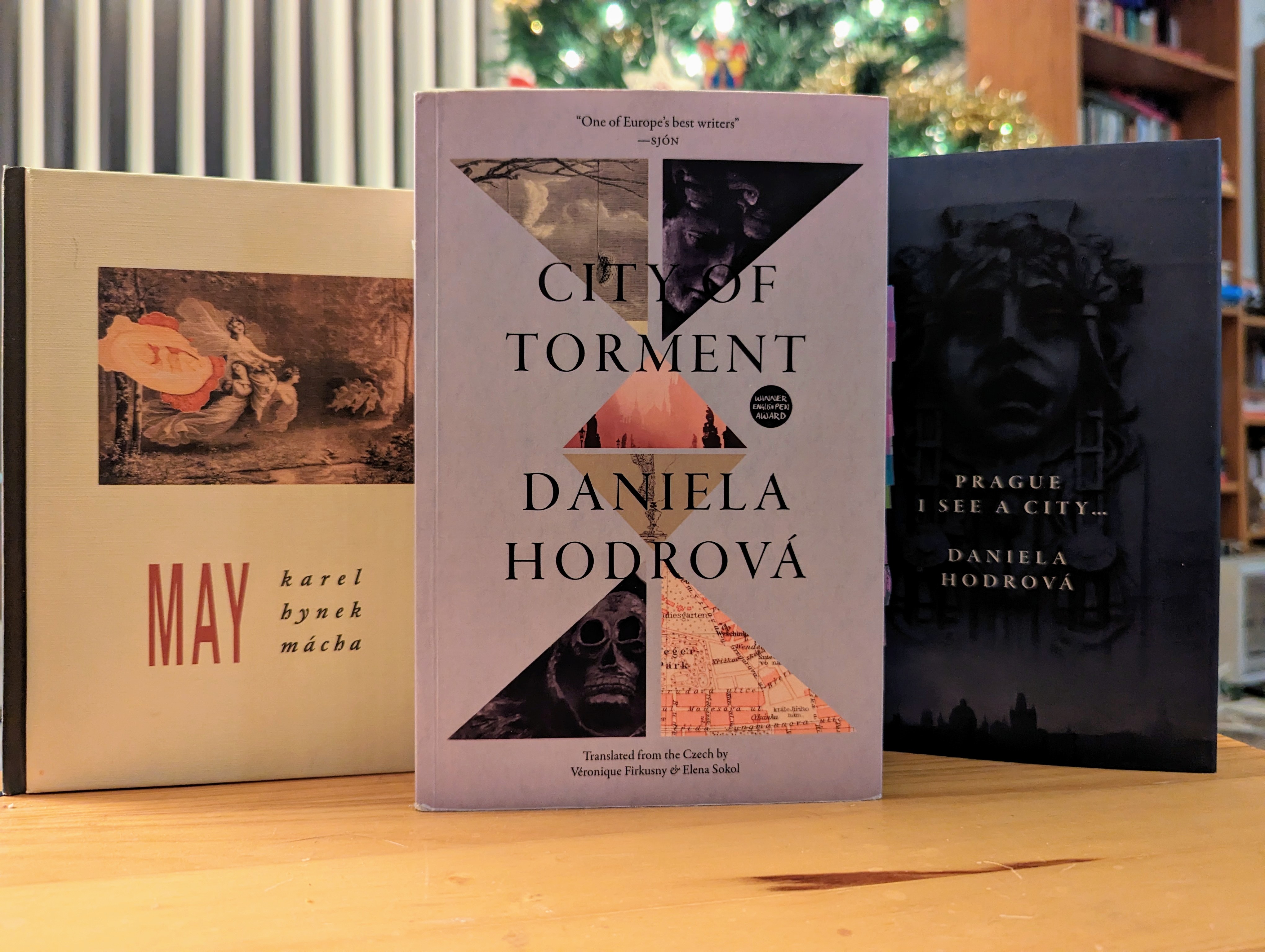
City of Torment – Daniela Hodrová’s monumental trilogy (translated from the Czech by Elena Sokol and others) is a complex, multi-faceted, experimental work that explores a Prague formed and deformed by literary, historical and political forces, haunted by ghosts and the author’s own personal past. After finishing the book, I sensed that I was missing much of the foundational structure—not that it effects the reading in itself—but I wanted to understand more. I read Hodrová’s own companion piece, Prague, I See a City… (translated by David Short) and more recently Karel Hanek Mácha’s epic poem May (translated by Marcela Malek Sulak), but I would love to have access to more of the related literary material, much of which is not yet available in English. I suspect that City of Torment is a text that will keep fueling my own reading for some time.

This year’s poetic treasures:

This is the most challenging category to narrow down. I read many wonderful collections, each so different, but three are particularly special.

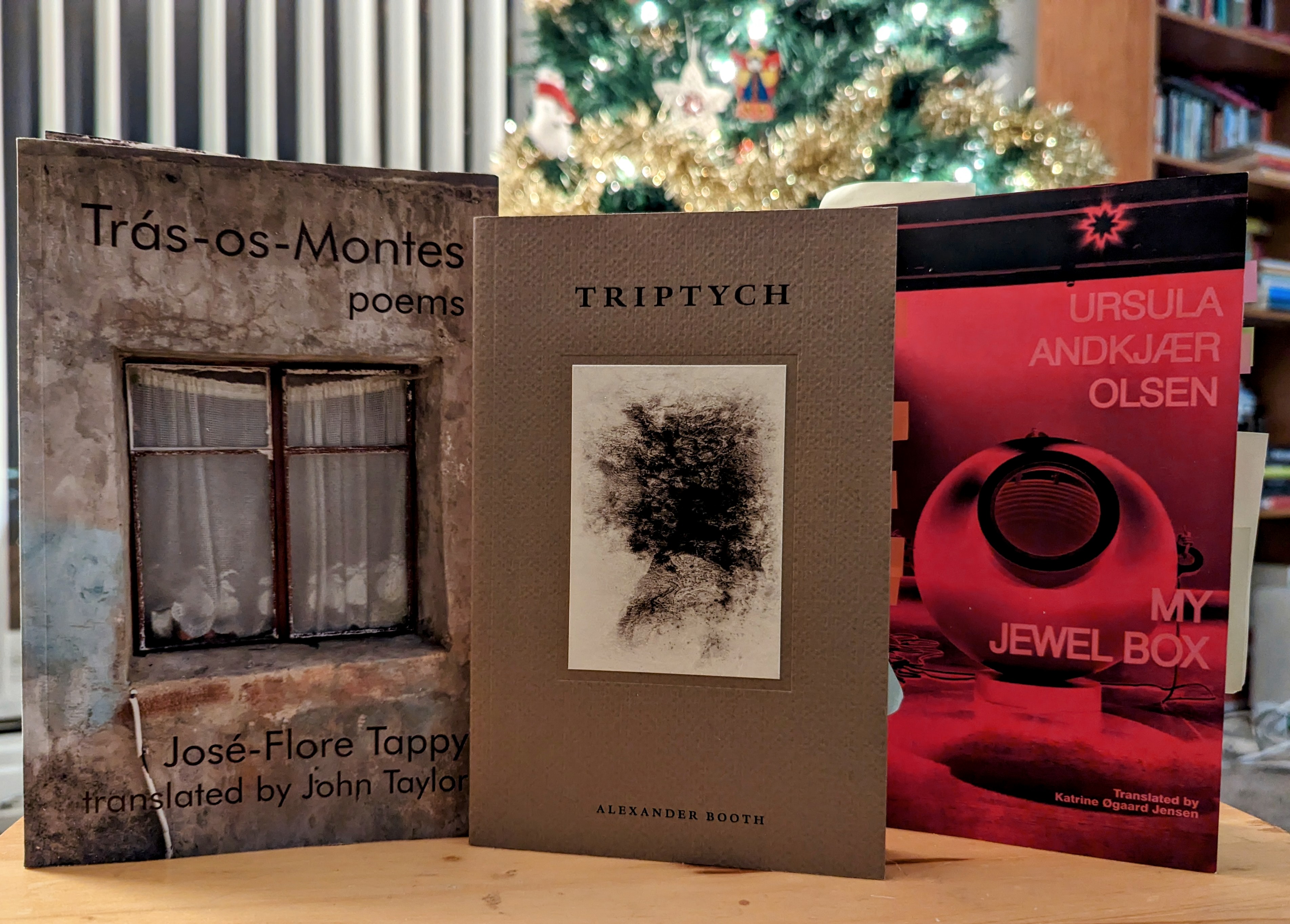
Translator John Taylor has introduced me to a number of excellent poets over the years and in 2022, it was his translation of French-language Swiss poet José-Flore Tappy’s Trás-os-Montes. I read this gorgeous book in August and it is still on my bedside table. It’s not likely to leave that space for a long time yet, and that’s all I need to say.  

I first came to know of Alexander Booth as a translator (and read a number of his translations this year) but his collection, Triptych, stands out not only for the delicate beauty of his poetry, but for the care and attention he put into this self-published volume. A joy to look at, to hold and to read.

Finally, My Jewel Box by Danish poet Ursual Andkjær Olsen is the conclusion of an organically evolving trilogy that began with one of my all-time favourite poetry books, Third-Millennium Heart. Not only is this a powerful work on its own, but I had the great pleasure to speak over Zoom with Olsen and her translator, Katrine Øgaard Jensen, for Brazos Bookstore in May. The perfect way to celebrate a reading experience that has meant so much to me.

Books that defied my expectations this year:

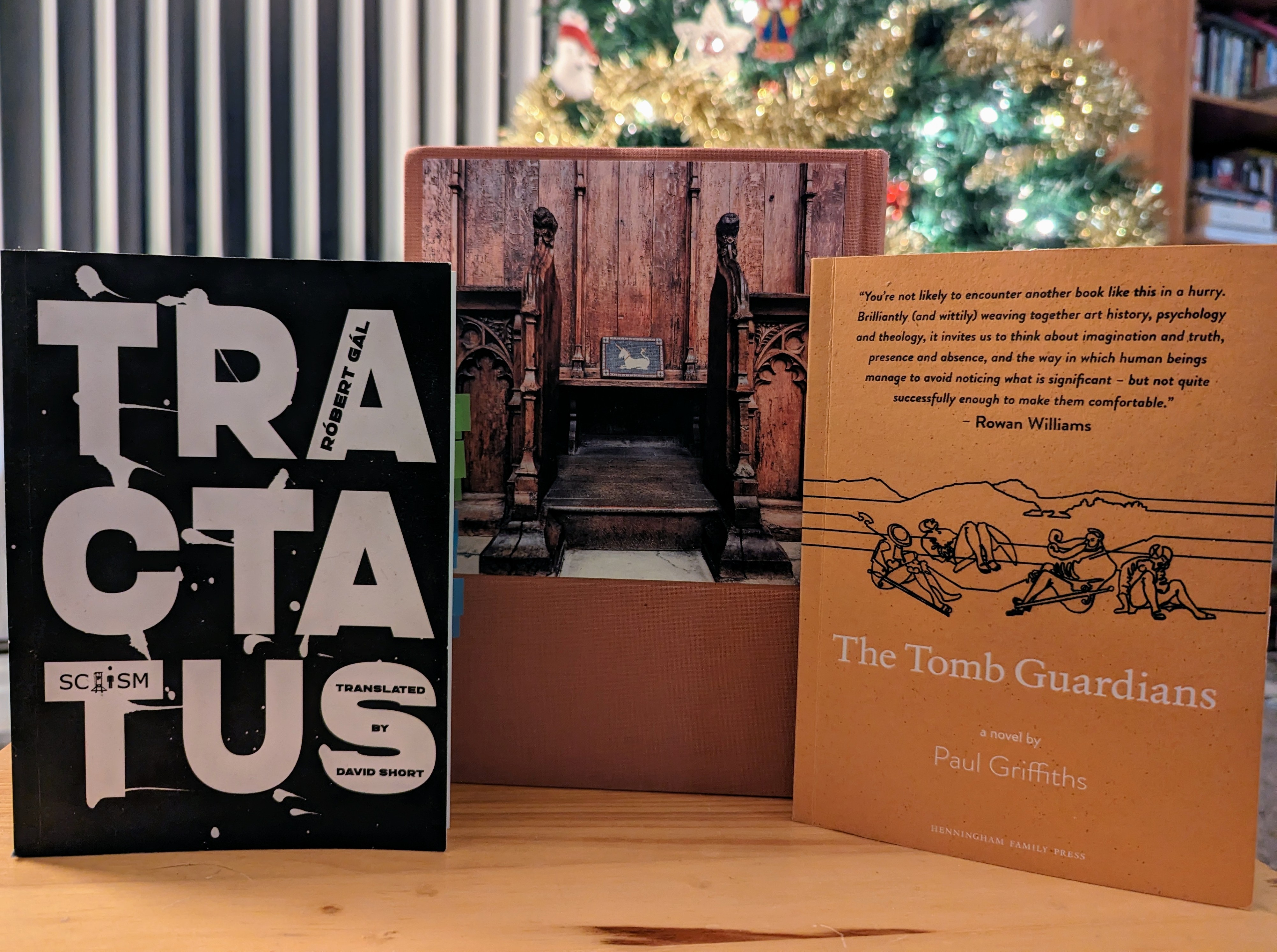
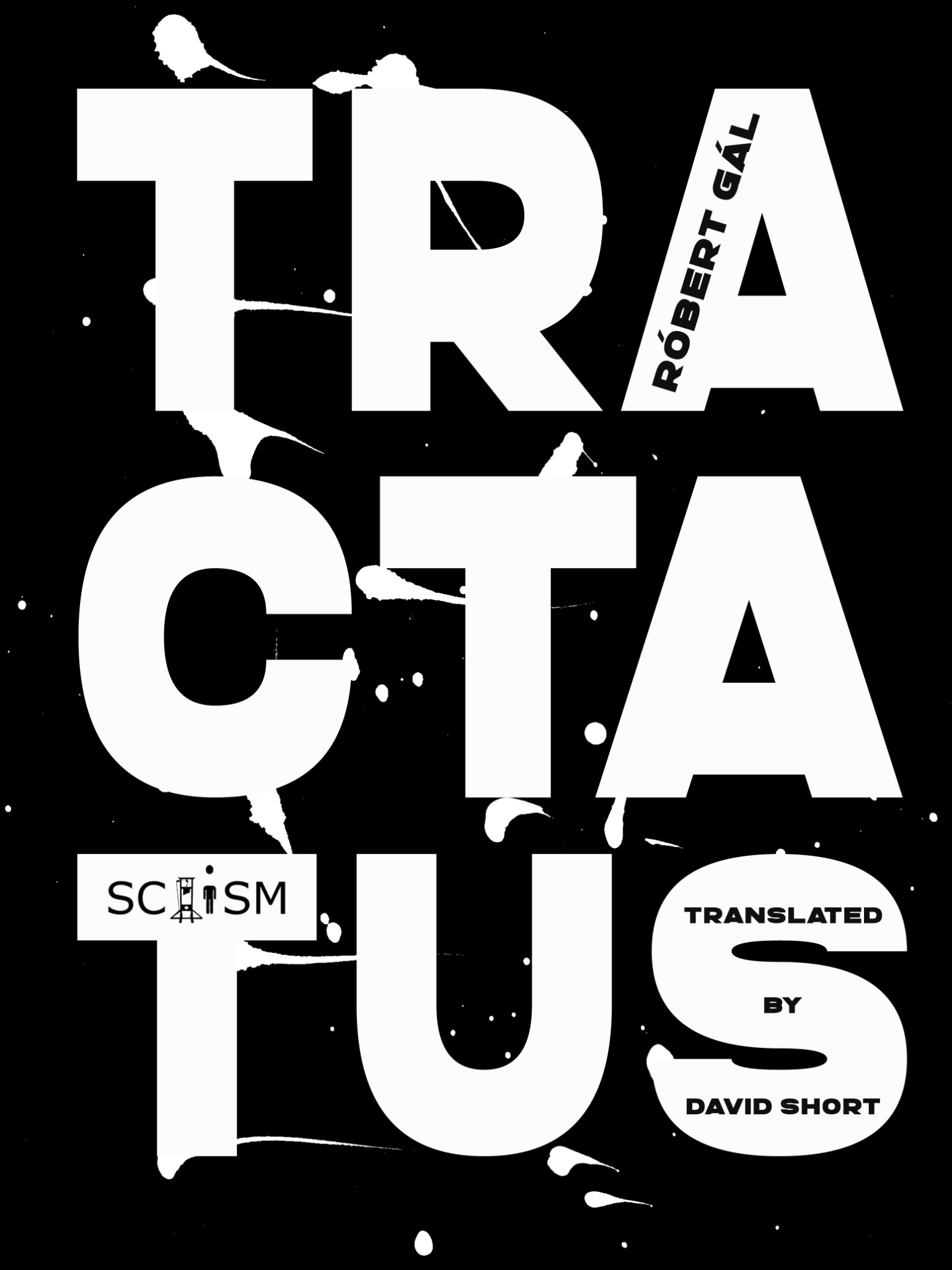
Prague-based writer Róbert Gál has produced books of philosophy, experimental fiction and aphorisms—each one taking a fresh and fluid approach to the realm of ideas and experience. His latest, Tractatus (translated from the Slovak by David Short) takes its inspiration from Wittgenstein’s famous tract to explore a series of epistemological and existential questions in a manner that is engaging, entertaining and provocative.

A Certain Logic of Expectations (you see the back cover here) by Mexican photographer and writer Arturo Soto is a look at the Oxford (yes, that Oxford) that exists a world apart from the grounds of the hallowed educational institution. Soto’s outsider’s perspective and appreciation of the ordinary offers a sharp contrast to the famed structures one associates with the city (and where he was a student himself) and what one typically expects from a photobook.

The third unexpected treat this year was The Tomb Guardians by Paul Griffiths. This short novel about the soldiers sent to guard the tomb where Jesus was buried is an inventive work that explores questions of faith, religion, and art history. Truly one of those boundary-defying works to use a term that seems to get used a little too often these days.

The best books I read in 2022:

Again, an entirely personal assessment.

I loved Esther Kinsky’s River, but Grove (translated from the German by Caroline Schmidt), confirmed for me that she is capable of doing something that other writers whose work skirts the territory occupied by memoir and autofiction rarely achieve, and that is to write from the depth of personal experience while maintaining a degree of opaqueness, if that’s the right word. One is not inundated with detail about the life or relationships of her narrators. Rather, she zeros in on select moments and memories, allowing landscape to carry the larger themes she is exploring. So inspiring to the writer in me.

Monsters Like Us, the debut novel by Ulrike Almut Sandig (translated from the German by Karen Leeder) deals with an extraordinarily difficult topic—childhood sexual abuse. It does not shy away from the very real damage inflicted by predatory family members, nor does it offer a magical happy ending, but it does hint at the possibility of rising above a traumatic past. As in her poetry where Sandig often draws on the darkness of traditional European fairy tales, she infuses this novel with elements and characters that embody the innocence, evil and heroic qualities of folktales within an entirely and vividly contemporary story. So much to think about here.

Hanne Ørstavik’s The Pastor (translated from the Norwegian by Martin Aitken) was my introduction to the work of a Norwegian writer I had a lot about over the years. This slow, melancholy novel set in the far north regions of Norway, beyond the Arctic Circle in the dead of winter, was a perfect fit for me as a reader, in style and subject matter. The story of a female pastor who takes a position in a remote village following a personal loss that she does not fully understand, explores emotional, historical and spiritual questions through a character who is literally stumbling in the dark.

So, what might lie ahead? This past year I embarked on two self-directed reading projects—one to focus on Norwegian literature for two months, the other to read and write about twenty Seagull Books to honour their fortieth anniversary. I found this very rewarding experience. Both projects were flexible enough to allow me freedom, varietyand plenthy of room for off-theme reading, but in each case I encountered authors and read books I might not have prioritized otherwise. For 2023 I would like to turn my attention to another publisher I really admire whose books are steadily piling up in my TBR stack—Archipelago. As with Seagull, they publish a wide range of translated and international literature that meshes well with my own tastes and interests. I don’t have a specific goal in mind, but already have a growing list of Archipelago titles I’d like to read. Other personal projects—public or private—may arise, perhaps more focused toward the personal writing I always promise to get back to, but time will tell. If the last few years have taught us anything, it’s that it’s a long uncertain road from January 1st to December 31st and it’s best not to try to outguess what the road might hold. Hope for the best and prepare for the worst once more.

Best wishes for the New Year and thank you for reading!

And we’ve come full circle: Tractatus by Róbert Gál

1.103
Not every pearl of wisdom is necessarily true. Not every catharsis necessarily amounts to understanding.

The Latin title, Tractatus, is ominous, immediately conjuring images of Ludwig Wittgenstein’s famously difficult text, Tractatus Logico-Philosophicus, and indeed a quick glance inside reveals a sequence of numbered statements and passages with an epigram from the great Austrian philosopher himself: Philosophy ought really to be written only as poetry. Yet anyone who has struggled through the logical propositions and equations at the core of Wittgenstein’s critically important, if cool and austere, treatise, will be relieved to know that it is a later, less certain, more playful expression of the philosopher’s thinking that seems to be inspiring much of what unfolds in the latest work from Slovak-born writer and editor, Róbert Gál. But he is also forging his own idiosyncratic path.

Gál has, over the years, produced a collection of writings that have ranged from the fictional to the philosophical, highlighting a gift for aphorisms, a fondness for tautologies, neologisms and rhetorical questions, and a tendency to riff off ideas with the improvisational energy of a jazz stylist. Now, in what may be his shortest work (or a close tie with Naked Thoughts), he is, with a nod to Wittgenstein, engaged in surprisingly dense axiomatic exercise that endeavours to examine what we can know about our experience of truth and reality, and what that implies for our ethical and metaphysical existence in the twenty-first century. That is, of course, not to suggest that his is a rigidly structured systemic exposition—it is a much more fluid, free-flowing and varied engagement with ideas, beginning with a most unconventional approach to a first principle:

1.1
I don’t remember the day I died, but it was obviously before I’d had time to be born. And nothing had mattered more to me than that very business of getting myself born. Ideally getting myself born into the me that had been born already, discretely, corpuscle by corpuscle. Born into the ready and waiting, hence painlessly. Not being born, though born already. But what into? Shall we imagine it? Might it not play havoc with the seeming need to have one’s own outer shell, for all that it just keeps on cracking?

Ah, yes, a rather different game is afoot, and yet not so much as one might expect. Anecdotes, asides and aphorisms are woven into the exercise that follows, an investigation that begins with the self as an entity, the interface through which we interpret the experiences that shape our understanding of the world. By the second section, the discussion starts to open up to the question of what we can intuit about that which cannot be directly observed or proven, and the we are invited to slow down and work our way through the reasoning at hand. Logic, truths, reality, these are the problems that begin to surface, as they will again and again throughout. But buffered by aphorisms, reflections and anecdotes this is neither a dry nor an unduly taxing read. By contrast, this is a living philosophy. Gál is working with large concepts with his signature inventive wit and creative energy. He makes you think:

3.4
Sorrow is one of the joys. Its basis is a process of projecting. If this projecting collapses beneath the pressure of reality, joy is put to an end. However, the pressure of reality also means that our projecting is petrified—and that is the precondition for any further projecting to be possible. Reality becomes the back-up to its own power to bring pressure to bear on us. It is no less prone to being continually deformed as it is subject to being continually formed. The mind by which it is formed becomes a reflection of the mind that it itself is giving form to, and we’ve come full circle.

As we work our way through Tractatus, we are continually challenged to engage with our own assumptions about truth, thought, memory, emotion and much more. Existence becomes understood as a dance with the experience of reality, or that which we imagine reality to be:

7.11
If the truth is meant to be a possibility, then by some means it has to be imposed upon reality.

13.11
Anything is never anything. Anything is a sonorous option between nothing and something that carries weight.

16.3
Intelligence, unlike memory, selects from time only those truths, instants and items of knowledge that it finds worthwhile. Which is why memory is the more truthful.

22.12
Can interior actions have exterior manifestations if interior and exterior are but abstract notions invented by us? Or, conversely, are interior actions—and their exterior manifestations—the reason why these notions have been abstracted by us?

These scattered passages are offered simply to give a taste of the kind of musings that comprise this short volume. Some may seem self-evident, others may trigger a little dissonance. And that’s okay. As the work progresses, the axiomatic elements carry an increasing value. From an open and playful beginning, over less than sixty pages and twenty-seven brief sections of between one and twenty-four sub-sections, the material in Tractatus builds upon itself to create a loosely spiraling structure of statements, questions and extrapolations leading to, a final and important conclusion.

As with all of Gál’s previous publications, this book is small, almost pocket-sized, the kind of thoughtful companion you can easily tuck into a bag. I also want to suggest this is his most accessibly serious philosophical work to date—challenging but not heavy, wise but not dogmatic—and as ever, deceptively playful.

Tractatus by Róbert Gál is translated from the Slovak by David Short and published by Schism Press.

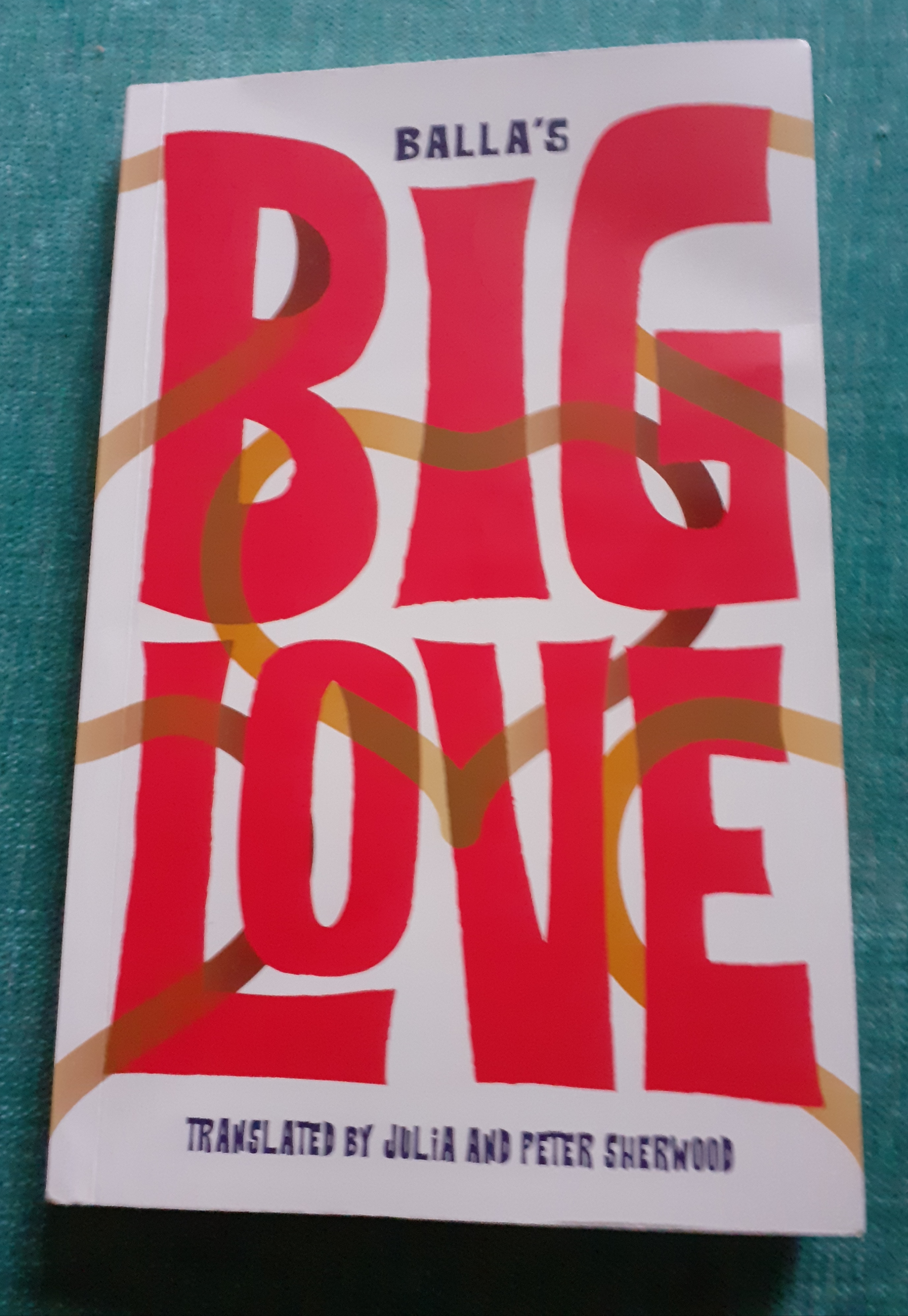
Writing one’s self out of romance: Balla’s Big Love

Big Love by the self-deprecating and humorously misanthropic Slovak writer, Balla, is an anti-love love story in which the hapless protagonist fumbles around in the dark, imagining he knows what love is while perhaps the best relationship he will ever have slips from his clumsy grasp. This short novella is not only a sharp witted critique of contemporary post-socialist society in Slovakia, in the form of a fondly satirical take on its bureaucratic ineptness and literary pretensions, but it is also an endearing and all too recognizable romantic comedy of the kind that actually exists in real life more often than in the movies.

Our hero, Andrič, as is typical for Balla, is a thinly veiled version of the author himself—a writer at heart but a bureaucrat by day. Not unlike another absurdist author from the other side of what is now, once again, the Czech-Slovak divide. And like Kafka, his protagonists tend to exist in isolation, unable to communicate with or understand the world around them. In this case Andrič is trapped in such a strangely off base circle of reasoning about human nature and his own place within it that he routinely and consistently misconstrues his unnecessarily patient girlfriend’s cues until, of course, it is finally too late.

The first time Andrič sees Laura she is wearing a neck brace. She has been injured in a car accident. A strange impetuous for a budding attraction. A single mother with a young daughter, Laura seems to be everything he is not. She is boisterous, outgoing, physically active, responsible and capable of looking after herself and her child, even if it means being creative in seeking out opportunities and resources. It’s hard to imagine what she sees in Andrič. But somehow their relationship, albeit a long distance one, manages to survive for two years. She is, however, one of the least developed characters in the book, a function of how limited Andrič understanding of her truly is.

The supporting cast, if you like, is wonderful. In fact, it is these two unlikely, eccentric characters, who play well against the two aspects of Andrič’s life, the professional and the literary, and serve to challenge his limitations while furthering the overall satirical intent of the novel as a whole. Panza is his office mate and best friend. Unmarried, he lives with his sister, a fact that inspires a healthy amount of curiosity around the office. Even more than Andrič, he exists in isolation, formed and informed by his long bureaucratic career which has left him vacillating between paranoia and despondency. He exhibits a practiced form of engagement with the world that reflects his rejection of ordinary human interaction:

Panza is sitting, listening to Andrič and nodding, or rather, he’s not listening, only nodding, his eyes and his whole face make it clear that he doesn’t understand, and how could he, since he’s not listening, it’s not that he is stupid, he just can’t be bothered to listen, he’s had bad experiences in the past  when  he  used  to  listen  and  got nothing  in  return,  so  now he  professionally  and  routinely  doesn’t  listen,  especially  when a sentence begins in a complicated way.

Because how could such a sentence possibly end?

Panza, whose tendency to express panic about the state of affairs within the system to which he has dedicated his career and within which he should long been disavowed of any ideals or illusions of freedom promised by the collapse of Communism, fuels the younger Andrič’s own fears. And fascination. Together they are a misfit pair, with Panza consuming more of Andrič’s attentions than Laura even if it is, again, difficult to figure out if their bond is more than circumstantial, because they never seem to enjoy each other’s company. Or perhaps these are two men for whom enjoy and company are not natural counterparts.

By contrast, Laura’s mother Elvira, is a former school teacher with an apartment filled with books and a string of former husbands, one for any necessary anecdote or discussion point. An ethereal being who almost floats around the jumbled space she shares with her daughter and granddaughter, her disaffection with contemporary society comes from a different angle than Panza’s. Reading and everything associated with it seems, so far as Andrič can tell, to be the source of her particular melancholy, her “sadness beyond words.” She views her nation as a country of sleepwalkers, dulled into a state of semi-consciousness—a state which has extended to Slovak writers. She is especially harsh on them claiming they all, even the female writers, lack experience with women. Without experience, how can anyone write? But, as she says:

Fortunately,  writers  don’t  exist  anymore.  Because to exist is to mean something. But they don’t mean anything. We  should erase them from our diaries, we should stop phoning them on their name day. They are nobodies. Yet these nobodies haven’t even noticed.

As a writer himself, Andrič makes the mistake of equating his ability to create with some measure of accomplishment in his personal life, no matter how obvious the messages Laura is signalling should be. Over and over he fails to see that what he imagines is, at last, “big love”with Laura, is rapidly losing its hold on her. We only have the briefest glance into her side of the equation and she comes across as unconvinced of her love forAndrič as we are. Once she slips away, he is left to slowly realize that big love is sometimes measured by the space left in your heart and life once someone is gone. And, of course, by then it is too late. But even then, he salvages a perverse pleasure that he somehow found the words, although he cannot remember uttering them, that finally severed their relationship for good:

After Laura informed him about the termination of their relationship Andrič gradually began to swell up with a kind of absurd pride about the fact that he, too, was capable of using words, that his words had consequences  – and this also applied to statements he couldn’t remember at  all  –  but Laura refused to  repeat  those  words  of  great  significance  and  merely  reminded him that he had uttered them in a wine cellar in Spišská Sobota.

Who else but Andrič would follow such reasoning?

For such a short book, Big Love offers a lot through the somewhat thick lens of its hapless protagonist. It is relentless in its critique of society, family, love and literature. Many of the references are specific to Slovak history and culture, but a lack of familiarity with the underlying intertextual content will not impair the enjoyment of this funny/tragic tale. Andrič, for all his tendency to overthink the emotions out of any reasonable situation is endearing, the humour is bitter, sarcastic and wise. Yet, as the ending nears, his own existential crisis deepens, lending more credence to that well-worn Kafka comparison.

Just released from Jantar Publishing, Big Love by Balla is translated from the Slovak by Julia and Peter Sherwood.

Given to thinking: Naked Thoughts by Róbert Gál

The impossible, until it proves possible, will always appear for a time to be wrong or inappropriate . The inappropriate, until it proves wrong, will always appear for a time to be possible. (XXII)

The aphorism is a literary form with a long history, reaching back to Classical philosophy. Over the centuries, the form—a sharp, memorable image speaking to some broader facticity—has appeared in literature, folklore, and scientific and political discourse. It is not enough to be witty and concise, an aphorism must also contain a truth, insight, or a piece of wisdom. It is much easier to describe than to create. But, for many, the aphorism, with a risk of appearing too clever or cliché, has no place in serious writing. What, then, is serious writing? Aphorisms, when well-crafted, hold a lasting appeal and, I would argue, that in a day when truths are suspect, the form is perhaps even more essential as an accessible opening for melancholy reflection.

And so, to my friend Róbert Gál. The Slovak writer has been proclaimed a modern master of the aphorism, a rather heavy mantle that he has worn with modesty for more than a decade. The form finds its way into all of his work, often providing more than a little poetic heavy lifting along the way. Now, with the release of Naked Thoughts from Black Sun Lit, Gál’s unadorned—yes, naked—gift for the form is on full display, presented against some of his idiosyncratic poetic prose.

Divided into five short sections, or three sets of numbered aphorisms set apart by two stylistically distinct interludes, Naked Thoughts begins, not unlike Gál’s recently released fictional work Agnomia, with the question of beginnings and endings. He appears to be setting a grounding principle—Life is a book of record, the first page of which is a stigma—and offering unsettling images of pathways, progress and temporal relativity. Toward the end of the long first entry he says: “To travel in time is pure recreation; to travel through space is an instinct born of a neurotic imbalance.” Where one finds oneself in the process of tracing the thoughts to follow, if in fact one finds oneself anywhere at all, is not prescribed.

While some of his ponderings in the “naked thoughts” segments are slightly longer, slipping into expected philosophical terrain, the brief—frequently sarcastic, wise, even beautiful—entries are, as one might expect, the ones that tend to stand out. These are aphorisms, after all:

He who seeks solutions has knots on his mind. (X)

The best school of life is a life misspent. (XXXIII)

To give life meaning means to make something of it deliberately—and thereby go against it. (XXXVIII)

Unspeaking silence supplies an act with its substance. (XLV)

or

Love is like scales at rest. It weighs nothing, but it carries weight. (LVIII)

The second and fourth sections, in contrast to the numbered aphorisms, are more poetic in form—in the first instance fragmentary, the latter primarily as a set of very short prose pieces—and yet, similar themes and ideas continue to percolate in these breaks. The first of these interludes, titled “in the bosom of indifferent virtues” which features an epigraph from Antonin Artaud, is perhaps the more curiously intriguing. It consists of three sets of fragments, some complete aphorisms, others incomplete thoughts, that have a subtle theatrical resonance. One begins:

She takes her dreams as the one thing that’s sure. And even though this certainty is not of negation, she does occasionally shake her head in doubt.

Within breaks in happiness.

Tacit contiguity.

He writes the terrible out of his system, she the beautiful out of hers.

The pros and cons of one con.

A failure is a first draft. And a first draft needs no motives.

This is a small book, a slender, pocket-sized volume, but it is not insubstantial. A thoughtfulness, an attentive sense of thinking out loud welcomes the reader into the meditative experience. Rhetorical inquiries, lexical truisms, wry musings, pointed barbs, and sly juxtapositions play out across the pages. Originally published in Slovak in 2014, translated by David Short, and featuring with the spare designs of Viktor Kopasz, this is the type of book that welcomes rereading, opening up fresh insights with each visit. Sometimes serious, sometimes light, Róbert Gál has the right feel and touch for this type of writing. His experience and comfort with the form is fully evident here in these “naked thoughts.” And, what is the harm in encouraging a little thinking? After all:

The only fear of one who is given to thinking is that he will see the light. (III)

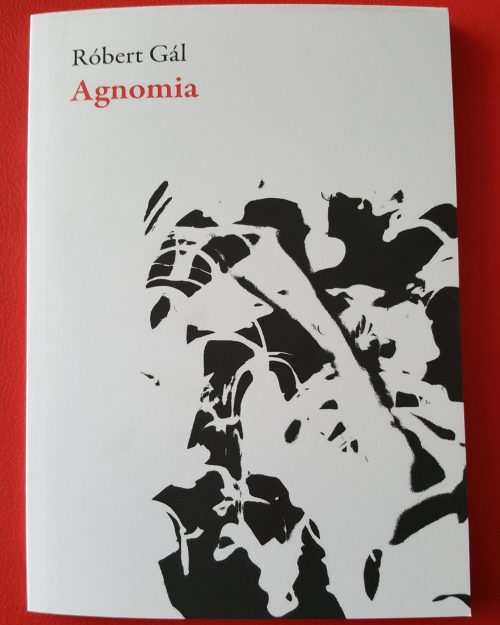
Lost in the endlessly circular experience of Agnomia by Róbert Gál

Stories that begin at the end don’t need beginnings that would convict them of making a point, that is, of committing a falsehood. A falsehood that loses its falsehood, being turned inside out by the truth, as if that were possible at first sight. But in any subculture there are other rules and privileges accorded to others that permit them to fire off viruses at everyone else, as if all that was at issue were the odd truth. As indeed is the case.

After what seems an impossible delay, and an unthinkable series of detours, Agnomia by Slovakian writer Róbert Gál is finally available in English, only a decade after its original release. I originally encountered Róbert’s writing in 2015 with what was, at the time, his first published work of fiction in English, On Wing (Dalkey Archive). After that I slipped back  to what was, at the time, his only other available translated book, 2003’s more explicitly philosophical Signs & Symptoms (Twisted Spoon Press). I have to confess that these two volumes served as important inspirational triggers for my own writing, and Róbert has become part of my far-flung circle of literary friends. He is, however, stubbornly reticent to talk about his own work, so I have no advantage in crafting my response to this text which fits, chronologically speaking, subsequent to Signs & Symptoms and On Wing, holding thematic ties to both, but standing uniquely as an attempt to offer a solid, singular prose piece, albeit one that disrupts the lines between fiction, memoir, and philosophy.

Unfolding in a single, unbroken paragraph, Agnomia runs to just under 80 pages. The narrator is, as one would expect, a Slovak writer named Róbert Gál. But where the enigmatic author and his fictional alter ego converge and diverge is unclear; it’s not even clear that they know:

For the author wants to tell his tale, but doesn’t know where to begin, and he doesn’t even know if there is a tale to be told at all. He tries to get inside it, as if any entrance on his part would automatically coordinate with the context in which the tale is being played out. Coordinate with what is being played out, whatever that might be, on a parasitical basis, though it’s erroneously taken to be symbiotic.

This metafictional segue that arises in the early pages of the book is not sustained, the narrative “I” soon takes centre stage, such as it is, but he is an impatient, introspective, and alternately obsessive and ambivalent participant/observer/chronicler, inclined to lapse into philosophical musings. If the story does, in fact, have a beginning and end, it seems to be in New York City, with plenty of Prague in between. But this tale is circular rather than linear. Our author appears to be piecing together his account as he goes, fueled by memories and dreams, however ambiguous and unformed. The result is an meandering prose poem, regularly folding back on itself as if to take stock of its own ability to write itself into being, a post-punk Bernhard monologue set to an erratic thrash jazz soundtrack, playing out inside the mind of a mildly neurotic writer.

And that mindscape is a busy place. Old friends and passing acquaintances, former girlfriends, fellow artists, even the author’s parents pop in and out, arising in fractured conversations, their off-hand gestures observed, their habits briefly dissected, their otherness serving as springboards for the narrator’s digressions. The men are analyzed and compared, while women are allowed a certain magical leeway, like L., a former lover whose diaphanous nudes he’d “used in another book of aphorisms” (see Signs & Symptoms). But between them all, the narrator, seems to be navigating ghosts, remembering encounters, propelled by his own recurrent personal and philosophical obsessions. Nothing is fixed fast in time, lines of thought spin off in all directions, always circular in motion with a relentlessly engaging force.

Driving the narrative are several persistent themes: an underlying bitterness about the futility of being involved in the creative process, especially as a purveyor of words, and more explicitly as the citizen of a small, insignificant country like Slovakia (where “a poet is dead before he’s even born”) ; a fascination with the curious dynamics of romantic and sexual involvement; and a penchant to wander down metaphysical and epistemological wormholes, get tangled up in tautologies, and play with words:

I’m gazing at a tree-shrub hastily planted in a demolished square. I want to tie the moon in with it so that the image I’m creating looks fully formed. It’s a full moon. Is it fulfilled? My room is inhuman. It isn’t accessed by a door, but by clockwork, with a key poking from outside in. A bit like a deep intake of breath whose exhalation and exhaustion are identical. Music has an instant effect. That’s something it shares with a drug or a telling aphorism. Circular self-relocation, each time a total gyration round one of a pair of aching legs. Oneness with pain like a fly with a wing torn off. The whirling of a whirligig beetle. Extirpation of redundancy by stretching it on the rack of a thing that at that instant is no longer a problem.

The flow of accounts, anecdotes, aphorisms, and anxieties continues unabated from end to end of this slender, philosophical fiction, inviting and rewarding rereading—as is typical of all of Gál’s other writing. The abiding presence of his holy trinity of influences is increasingly evident with each re-encounter: Thomas Bernhard, Georges Bataille, and the wildly prolific and ambitious avant-garde composer John Zorn. Readers familiar with the author’s aphorisms and other published work will recognize strong cross currents running throughout Agnomia, but the tone here is lighter, the logical challenges more accessible, and more of Gál’s spirit and humour comes through. The “truth” of fiction? Who knows?

The “stories” or memories that form the loose, fractured framework of this book support what is, in fact, its beating heart—the endlessly unanswerable questions about the nature of thought, truth, and the possibility of adequately representing reality. The balance of narrative—fiction or memoir, it matters not at all—against the narrator’s musings and meditations is pitch perfect. An account of an evening out with a woman, for example, leads to further considerations:

“We’re going now,” I say. I might have helped her break free from certain stereotypes, but she didn’t need my help. She might have helped me break free from certain stereotypes, but I didn’t need her help. Repetition is reminiscing ahead. Ineffectual dreams don’t exist, so the unconscious is more effectual than consciousness. And since my pain doesn’t follow from the findings of philosophy, the question is: In what respect can clarification of the cause of my pain be aided by the findings of philosophy? In being accountable for anything’s enduring, since for what else can one be held accountable? This raises more questions: To what extent can the consciousness’s accountability for something enduring be its consistent monitoring of it, and to what extent is the monitoring of what endures even conceivable and admissible? Is every story a manipulation? And so forth.

At the end of the story we have more questions than answers and that’s the point. After all, what truths lie in the thoughts we think we have?  And is it possible to express them, or is all creative process dependent on our own inherent ignorance?

Agnomia by Róbert Gál is translated from the Slovak by David Short, and published by Dalkey Archive.