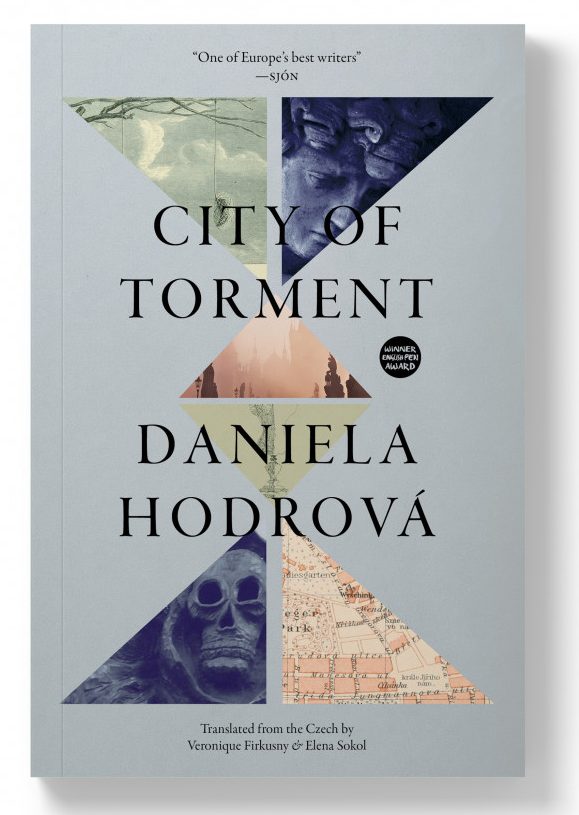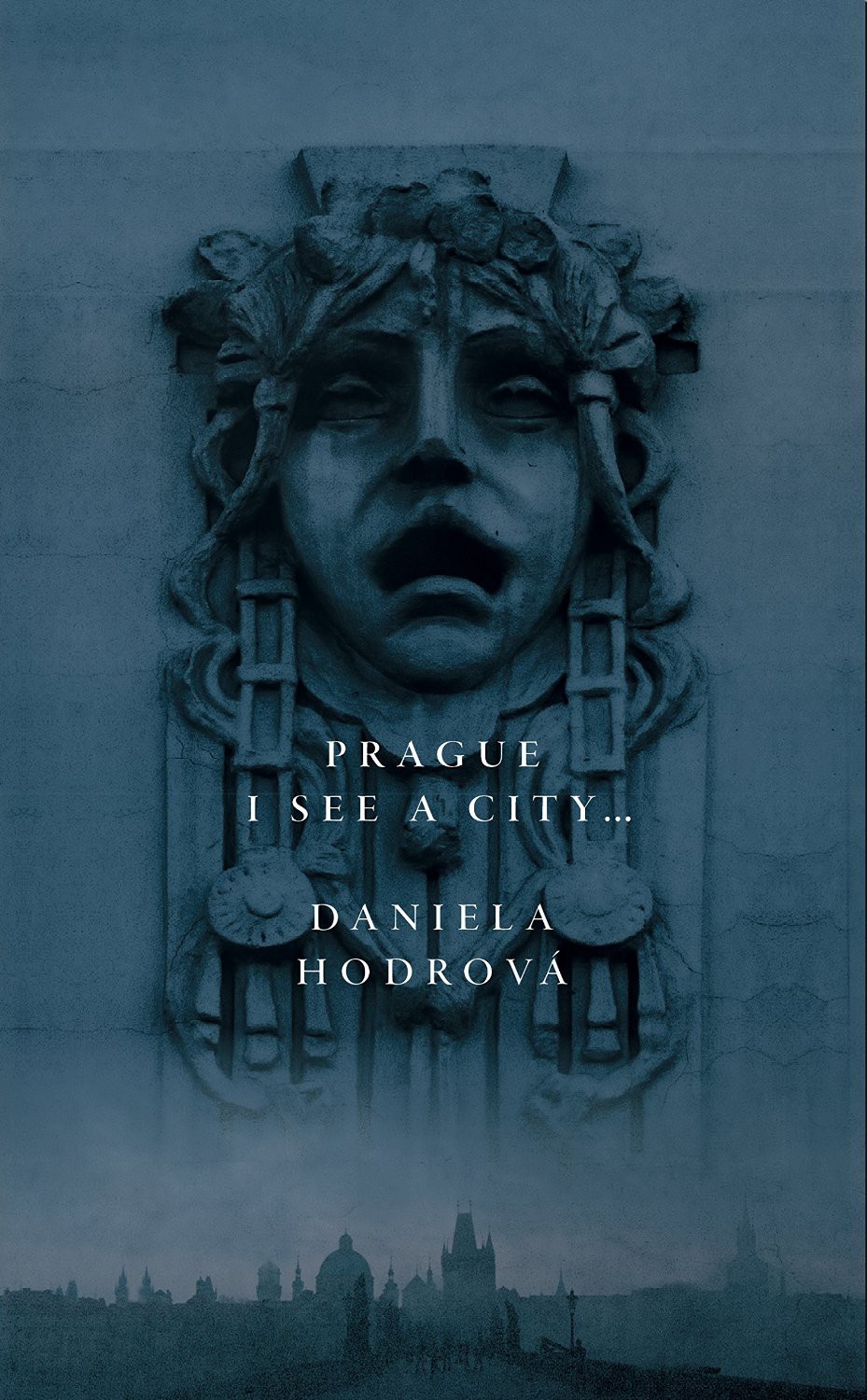
At the threshold: City of Torment (and Prague, I See a City…) by Daniela Hodrová

Founded, according to legend, with the prophetic proclamation of the mythical Princess Libuše, Prague rose from a hilltop settlement to become the political and economic hub of Central Europe. Forged in stone, blood and bone over a thousand years it is a place dense with history, a city that cannot escape itself, often depicted as a labyrinthine maze of magic, madness and despair. City of Torment, a loose trilogy by Czech author and theorist Daniela Hodrová, falls into the literary tradition of writers like Karel Hynek Mácha, Gustav Meyrink and Franz Kafka in its portrayal of the city as a distorted space within which the individual can become lost or disoriented. Her Prague is a layered, cyclical place in which spatial and temporal dimensions shift, trapping its living and the ghostly inhabitants in a grand circle game, one that plays out again and again in a number of distinctive settings or “stages” throughout the city centre. As such, the narrative that runs through the course of the three novels that comprise City of TormentIn Both Kinds, Puppets and Theta—is fragmented, kaleidoscopic and cumulative, peopled by characters that defy boundaries between life and death, human and nonhuman, animate and inanimate.

There is no succinct way to provide an outline of City of Torment as a cohesive work of fiction; it is akin to an organic, evolving entity that gradually takes on a life that even seems to confound its own author by the time we reach the third part. It was not conceived as a trilogy. Hodrová began the first novel, In Both Kinds, in December 1977 and finished it the following year, but, like the two novels that would follow, it could not be published until after the fall of the Communist government. This work, narrated by an omniscient third person narrator that occasionally takes on the direct voice of a character or an object, is centred around an apartment block across from the famed Olšany Cemetery, and those who reside in or pass through in the building and the graveyard. It opens near the end of the Second World War, as young Alice Davidovich throws herself from the window of the building’s fifth floor flat to avoid being taken away to the gas chambers, thus making a direct transit from the building to the cemetery. Alice, who will spend much of her after-life repeating a fruitless rush to meet her beloved Pavel, is the central female protagonist in this first book, and provides a critical yet curious continuity linking the women at the heart of each of the following texts.

A wide cast of eccentric characters populate the pages of In Both Kinds. The living, the dead (recently and long dead), and the few who have found themselves charmed (or cursed) with the ability to negotiate a space in between the two states, exist alongside one another. Souls trapped inside inanimate objects, or transformed into birds interact on both sides (with both kinds) and, naturally, many characters will make the passage from the world of the living to the community of the dead over the course of the novel. Their personalities and the events or activities marking their lived existences follow them to their graves. Clothing and objects—a sweater, a coat, a mother of pearl button, a Persian lamb muff—become talismans, symbols (but of what?). And woven into all of this are historical personages and events that appear or are referenced, exaggerated or confined by the mythology that has grown around them over time. It is a strange and wonderful ensemble piece, but hanging over it all is a disquieting sense of directionlessness.

This sensation becomes more pronounced in the second novel, Puppets (Living Pictures), composed between 1981 and 1983. Composed of one hundred and twenty-six “living pictures” or vignettes, this novel focuses closely on Sophie Souslik, a seamstress at the Realm of Puppets, and her parents and grandparents. Prague with its warren of streets and public squares forms a wider backdrop against which the action—much of it imagined, remembered and echoed—is staged. And staged is the appropriate word, Prague has become a city of marionettes. But something darker lurks here. Specific spaces and objects, like the courtyard with its rug beating rack or Sophie’s father’s office with its heavy black furniture and spinning chair, hold special powers and seem to become portals to painful personal and historical pasts, hidden or forgotten. There is a significant and welcome crossover of characters from In Both Kinds as well as new characters that sometimes act as alternate versions of previous actors. For example, Sophie is sometimes mistaken, at least briefly, for Alice Davidovich, and she also has a boyfriend named Pavel. Identities are frequently confused, experiences are repeated merging the familiar with the strange, and characters increasingly begin to change—humans metamorphize into insects and birds, while statues and household objects fall in love with people and long for release from their solid states. Still, an atmosphere of detachment colours the text.

With the third and final novel, Theta, composed between December 1987 and January 1990, the project that will become City of Torment begins to take form (the books will ultimately be published individually before being gathered together into a single volume). It opens with a variation on the first lines of Dante’s Inferno. Prague is now clearly depicted as its own special version of hell, a city of torment. The title, Theta, has a double meaning—it’s association with death, Thanatos, and its use, θ, as a proofreader’s symbol for “delete”—and as soon becomes apparent, “this novel” now exists an entity within itself. Here, the solitary, curious female protagonist, Alice and Sophie’s heir/doppelgänger, is Eliška Beránková (Lamb). But, not only is she less satisfied to stay within the confines of the text, Daniela Hodrová continually allows the boundary between herself and her creation to blur, even disappear. In a full metafictional turn, the author enters her own novel, and, at one point, Eliška steps out and tries to become a living being. Fiction and fact clash. Some new characters that initially appear to be entirely the product of the text grow more transparent. Others openly straddle the line between fact and fiction. For example, Hodorva introduces her real life husband, trying and failing to keep to the fictional name she assigns him. She grants Eliška imitations of her own life, consciously negotiating her two identities as the manuscript on her desk grows. Through her alter ego, Hodrová, the author, merges with the central figure who is descending into the city of torment in search of her own past.

If this all sounds like an overload—and these are densely packed works—Hodrová writes with a style that constantly refers back on itself, without being repetitive, so the reader does not lose track of who is who. Her narrative second guesses itself constantly (questioning meaning in parentheses) implying that nothing is certain, nothing is written in stone. There is, however, much more going on beneath the surface—historical, literary and place references that would likely be less of a mystery to those familiar with Prague—but for a visitor stumbling into her City of Torment with less background, the Appendix that closes out the work might not quite suffice. So I turned to Hodrová’s Prague, I See A City…, written after the completion of the trilogy, first as an alternative guidebook, but then released as a kind prologue/companion piece to her major work. A short, engaging, magical exploration of her hometown, this book is a perfect follow-up read, not only because it will fill in some of the biographic, geographic and historical details behind the novel, but because, written in 1990, in the aftermath of the Velvet Revolution it looks forward, however cynically, to new possibility, with hope of shedding the weight that had oppressed the previous decades.

As noted earlier, the first two novels of City of Torment are characterized by a certain flattened affect and sense of detachment. Composed during the restrictive Normalization period under the Communist government of the 1970s and 1980s, Hodrová was writing without knowing if, or when, it might be possible to release her fiction. It must have felt akin to writing into a void in a world where the dead seemed more alive than the living. The final novel was composed at the end of this period, a time of turmoil, and, when the government fell she stopped writing it, not knowing how a dynamic text informed by a city (or a city formed by a text) might now be altered. In Prague, I See a City… she says of this time:

A revolution of words, an almost fairground battle of words really did take place last year, though its tumult now reaches us only dimly. The city is once more slipping back into its sleep, its unconsciousness, its oblivion.

In those November days, something fundamental happened to the life of this city, to my life. I finished writing Theta at the very moment the battle broke out, for at that moment the city ceased, at least briefly, to be a city of torment.

Far from a conventional travel guide, Prague, I See a City… serves as an immediate refocusing of Prague after the fall of Communist Czechoslovakia and as an introduction to Hodrová’s world-view. As she wanders her city, as if in a dream, the boundaries between the real and the imagined blur. The city she sees is perhaps on the cusp of a new beginning, but the weight of the past, historical and literary will not pass lightly. She reflects on her own childhood, comments on the novels of her trilogy, and visits museums, St Vitus Cathedral, Prague Castle and other sites, evoking the lives of long dead kings and more recent political environments along the way. Published before the recent complete translation of the trilogy, this book could easily be read first, and for its own merits alone, but it is just as effective (if not more so) read as an extended (and exceptionally entertaining) epilogue that offers a fuller understanding of both Hodrová’s literary vision and her idiosyncratic relationship with Prague.

In Both Kinds is a revised translation by Véronique Firkusny and Elena Sokol (an earlier English translation by Tatiana Firkusny and Véronique Firkusny was published in 2015 as Kingdom of Souls). Puppets is translated by Elena Sokol and Véronique Firkusny, and Theta is translated by Elena Sokol. Prague, I See a City… is translated by David Short.

Daniela Hodrová’s City of Torment, Prague, I See a City… and Kingdom of Souls are all published by Jantar Publishing.


And Usman keeps singing: Another Gulmohar Tree by Aamer Hussein

Aamer Hussein is a gifted storyteller. His clean, spare, emotionally sensitive tales explore, with just the right amount of detail, journeys, experiences and relationships that cross borders and cultures. His prose leaves his reader space to breathe in, room to recognize the sense of displacement, disorientation and disappointment his characters often encounter. This is especially true of Another Gulmohar Tree, a moving parable of love and marriage.

This novella begins, rather unexpectedly, with a series of short, fragmented fables. In one tale young man sits in the shade of a gulmohar tree to eat the midday meal his aunt has packed—stale bread and rancid buttermilk—which he shares with a strange talking frog. Tired after eating, he falls asleep, only to awake beside a pile of gold coins. In another, a farmer’s daughter is married to a crocodile king, soon her parents and a brother join her in his river kingdom. Much later, the providence of these tales will be made clear, but in the meantime, the narrative shifts to London in 1950. Here, a Pakistani man, a journalist on a year’s secondment, meets a British woman who is working as an illustrator. They are drawn to one another and begin to spend time together, Lydia showing Usman the sights of the city and keeping him company on his days off. Both are divorced after brief, unhappy marriages, both are lonely and ungrounded, but despite Lydia’s hopes, their friendship remains just that. Usman is forty-one, eleven years older than she is, London’s bleak winters and endless summer days bring him down and, in these early years following Partition, he feels an obligation to return to the newly independent country he has determined to make his own. Yet an uncertainty haunts him. In Lydia’s company he is at peace, but:

at work, or waiting at the bus stop to Oxford Circus or walking home from Marylebone Station, alone in the vanilla evenings that refused to shade into night, with his mind fixed on his return to Karachi, he’d ask himself questions to which he had no answer. What awaited him in the seaside city he had chosen as his home, he, a man who had no home because he’d lost his birthplace long ago and never learnt to belong anywhere else, what would he do with his life in that open city teeming with strangers like himself?

Two years after his return to Pakistan, Lydia follows on her own initiative, holding on to a few faint hints in Usman’s letters. She has prepared—even to the point of learning to speak  Urdu—intent on winning his love, which she already had won even if he hadn’t acknowledged it. They marry and set up home in a growing suburb of Karachi. Over the coming years she settles into the community with remarkable ease and good cheer, turning their humble little house into a home as they welcome three children into their family. Lydia who now prefers to be called Rokeya, fully embraces life in her adopted country while maintaining an ability to connect with other foreign-born (or foreign-focused) women when she wishes to. Over time, her husband begins to question himself, his career, his life.  He had once been a promising writer, but his dreams have faltered. He resents others who have found success (even plagiarizing his work to do so), and envies his wife who is devoted to their children, yet expanding her own creative and professional pursuits. Ten years into marriage, silence and unease starts to work its way into their relationship. Will Usman be able to see the beauty he has become blind to as bitterness and malaise has set in?

The outline of this tale is simple, but as ever, Aamer Hussein excels in the depiction of the attractions, affections and tensions that draw people together or threaten to push them apart. With Another Gulmohar Tree, he employs careful observation combined with literary restraint to create an unusual, intelligent, slyly romantic story, short enough to read in a day. And sometimes that is just perfect in itself.

Another Gulmohar Tree by Aamer Hussein is published by Telegram.

Pride Reading—Three: Love and Reparation by Danish Sheikh

My first two Pride reads for June 2022 were works by trans women, from India and the US respectively. My third read returns my attention to the Subcontinent, and dramatizes the impact of two important legal milestones impacting the Indian LGBT community over the past few decades. Part of Seagull Books’ Pride List, Love and Reparation: A Theatrical Response to the Section 377 Litigation in India is playwright and activist lawyer Danish Sheikh’s professional and personal reckoning with the effort to overturn Section 377 of the Indian Penal Code, the colonial era prohibition against “carnal intercourse against the order of nature” which had long been used to target members of the LGBT community, and the strange emotions that can arise when a lengthy battle is finally won. If that sounds like dry subject matter for theatre it is anything but. Sheikh deftly weaves material drawn from court transcripts and witness affidavits, with his own experiences and those of others to create a multi-voiced, engaging response to a life-altering legal decision.

It was, of course, not an easy road to decriminalization. Love and Reparation gathers two plays into one volume, a pairing that reads as both complimentary and necessary. Section 377 was first overturned in 2009, following a long, ultimately successful challenge of its constitutionality, in Delhi High Court, by the NAZ Foundation, an NGO. This welcome release would prove to be short lived; a week later an astrologer filed an appeal to the Supreme Court. In 2012, the final arguments in the case were heard over a six-week period. The first play, Contempt, draws on the court proceedings to creatively stage the legal arguments and affidavits that were presented to the judges. It is grounded in reality, as the playwright puts it, but is allowed to wander into passionate and poetic musings as witnesses share their experiences. The play ends with the judges’ fateful decision. In December 2013, the Delhi High Court ruling was reversed and same sex activity was once again criminalized.

A series of petitions challenging the validity of the judgement followed and after much delay, a five-judge bench was finally assembled to hear the matter in 2018. In September of that year, the earlier ruling was overturned, effectually decriminalizing queer sexual relations, in privacy, between consenting adults. The second play Pride, dramatizes the state the community finds itself in once the battle is over—both joy and uncertainty arise once the unifying bonds of the battle are no longer holding people together or framing their engagements with one another. The what now? moment. As Sheikh says:

Pride was my attempt to come to terms with—what? This time around, the object of my dissent was less clear. All I knew was that I had to write my way through this tangle.

Or, perhaps, to wrought this tangle into shape.

The drama revolves around sessions between a gay man and his therapist. He is trying to figure out why love seems so elusive to him. A character chorus of voices spread through the audience, speak to the legal case and the post-ruling experiences and presence of LGBT persons in Indian society.

For each play the setting and stage directions are simple and clear. That makes them easy to read and imagine in performance. By incorporating a blend of history, legal argument, personal accounts, and literary references, Sheikh has created drama that is both moving and at times surprisingly funny. In Contempt, the judges unwittingly supply the humour, pushing the lawyer to the point of absurdity at times and taking a little too much interest in the exact nature of unnatural carnal knowledge. The playwright admits he didn’t need to alter their words as found in the transcripts. The dramatized witness statements from a gay man, two lesbians and a transgender woman bring to life the reality of forced psychiatric interventions, innocent love affairs and brutal treatment from the police.

Pride demonstrates that legalization is not the end. There are, of course, more battles to wage to level the playing field for LGBT people, but there is also an uncertainty about how to live and love in a decriminalized landscape. How to repair all the years of existence up against the fear of being arrested simply for loving, for being yourself. The dynamic between the older female therapist and the young gay man whose conversations form the core of the play is very effective, and gives the drama it immediate emotional energy. As A. recounts his multiple failed attempts to find someone to love, T. challenges his conclusions.

A.  How does it work? How can it just come and go without warning? How is this not the most terrifying thing in the world, how can I wake up one morning and realize I’m out of love with this man who is otherwise perfect for me? How could Socrates wake up one morning and realize he’s out of love with me?

T.  Maybe he wasn’t perfect for you?

A.  Maybe

T.  And you know you weren’t perfect for Socrates.

A.  Possibly

T.  And then there’s the other thing.

A.  That I’m terrible at this stuff?

T.  That nobody is actually perfect for anybody else. It’s never not work. Sometimes you choose to do the work. Sometimes you decide it isn’t worth the work. You can’t choose how you feel, you can’t choose when it comes and goes. But that other part—that you can choose.

Their sessions are broken up by interludes during which the chorus of voices/characters speak to the legal fight against Section 377, the ways their lives have or have not changed since it was ruled unconstitutional, and, as needed, taking on a role within the therapy sections.

As an non-Indian LGBT person, I was not aware of the exact status of queer people in the country until more recently, but the final decision on Section 377 did come down following my first visit to the country, so it was of great interest to me. No matter what concerns face LGBT folk in the west, especially with the increasing pressure of more extreme right-wing conservative political influence, we are still accustomed to much more freedom and access to resources than our brothers, sisters and peers in many countries. The interesting thing for me in this book, particularly with Pride, is the examination of the degree to which achieving a measure of freedom can lead to a confusion or loss of meaning. It occurs at the level of the “community” leading to splintering and divisions, but it also happens in a deeply private way. Given my own personal journey, I have always held that I feel no shame but cannot embrace the concept of Pride. Without disclosing the protagonist’s revelation, I will say that this play has really caused me to question my conviction.

I feel this pair of plays holds much to appeal to readers interested in contemporary drama, legal debate, social justice and the evolution of LGBT rights, in India and beyond. The playwright clearly frames his motivation and inspiration for the writing of these plays in his introduction, while a timeline and an extensive resource list round out the supporting material. But most critically, at the heart of both plays are very important recognizable, sometimes disturbing, human stories that deserve to be heard.

Love and Reparation: A Theatrical Response to the Section 377 Litigation in India by Danish Sheikh is published by Seagull Books as part of their Pride List series.

Pride Reading—Two: This Body I Wore by Diana Goetsch

The second trans-themed nonfiction book I chose to read this month is, in contrast to my first (My Life in Trans Activism by A. Revathi), a literary memoir, but the transgender journey it details differs from the one that is commonly told because the details of the author’s actual transition are minimal and confined to the closing chapters. It is, rather, the story of one woman’s fifty-year-long odyssey to finally come to acknowledge what she had sensed from a very early age—that despite being born male, she was, and always had been female. So why did it take so long to acknowledge the truth? This Body I Wore is Diana Goetsch’s answer to that question, an eloquent chronicle of life that conspired to cloud the reality haunting her relationships and filling her closets for so long.

Goetsch’s account opens with her early unsuccessful attempts to form romantic or sexual relationships and her first forays out into the culture inhabited by cross-dressers. She is in 1980s New York City. The push-pull of her attraction to women and women’s clothing is exciting and confusing. She graduates college, lands a teaching position at the prestigious Stuyvesant High School and soon finds herself juggling secrets, while trying to build friendships and find a girlfriend.  By her early thirties she seems to be dropping all or most of the balls. That leads her back into her past to begin to trace the roots of her predicament.

The childhood described in This Body I Wore is one marked by little affection and an unhealthy measure of abuse. The youngest of two boys, Diana—or rather Doug (and briefly I am using male pronouns, this book spans decades of evolving and context specific usage)—is told by his mother that he was an “accident,” that is, unintended and unwanted. He grows up on Long Island, an athletic, sports-minded young man who seems to become increasingly and inexplicably unpopular. Although he is determined to keep his secret fascination with girl’s shoes and dresses and feminine undergarments to himself, it’s almost as if others sense a difference. Friends fall away. Doug cannot understand why; by the end of high school, unable to secure a college placement he feels left behind. I wonder how many trans people have experienced similar sensations of being out of step? I know I did.

The bulk of this memoir follows Diana’s efforts to build relationships with a series of women, most of whom she comes out to as a cross-dresser and with whom she explores social outings as female, but again and again her own male body becomes a barrier to full sexual expression. A trail of broken hearts and extended periods of loneliness carry her into middle age. Professionally, she spends a number of years teaching in a youth correctional facility, begins writing and publishing poetry, and tries to build a career as a writing teacher. Meanwhile, she increasingly dedicates her weary spirit to Buddhism, attending retreats and developing her practice to a point where she finally finds a way into her deepest self. Throughout the course of more than two decades she moves in and out a female identity that can be outfitted and carefully applied, then washed away and returned to the drawer. The decision to move forward is liberating, and increasingly magic as it gradually becomes her normal, everyday existence.

I enjoyed this book very much, it is a poetic and finely crafted tale. I will confess that I was reluctant to take it on. I have an uncomfortable reaction to memoirs, especially those with recreated dialogue and the inclusion of the stories that belong in equal part to those who come in and out of the story. Goetsch handles this well, with respect, but I did at times wonder about the women whose lives were exposed along the way. However, my greater concern was, as I mentioned in my previous Pride post, a general anxiety about trans stories, fiction or nonfiction, which I can never entertain as an impartial reader. As a transitioned man it’s impossible not to read myself into and against the stories of others and very often I find it an alienating and depressing adventure. Yet, This Body I Wore was a pleasant surprise.

Trans women and trans men typically have rather different trajectories, in both the coming to a decision to transition and in the treatment available. At least twenty or more years ago, the accepted norm for a “transsexual” man was a childhood as a tomboy, attraction to women, and commonly, for lack of any other place to seek an understanding of oneself, questioning sexuality or living as a lesbian. By contrast, my early reaction to the feeling that there was “a boy inside me” was not a desire to be male but the fear that my body carried signs of my wrongness, something I hoped I could learn to overcome. Although I could not believe it, I was pretty and reasonably feminine, not athletic or a tomboy or attracted to girls, but the gender insecurity was deep and increased as I grew older. I married and eventually had children, pushing to the back any careers or opportunities that I feared might reveal the truth about me. In the absence of any notion that trans men existed or what testosterone could accomplish, it would take thirty-eight years and an incredible emotional and mental toll before I knew I was not alone. Within two years of realizing the male feeling I’d fought against was me I was starting to transition. But my extended confusion, the searching for clues, the fear of revealing or even exploring what was happening, mirrors in a way the cross-dresser to trans woman scenario much more closely than the tomboy to butch to trans man route. In truth of course, transgender people are as diverse as any other people with unique social, cultural and emotional journeys to finally come home, but it is not uncommon for us to wonder, and debate, what it means to be “trans enough”.

It also struck me after finishing this book how flat Goetsch’s depiction of Doug seemed through the mid-section—the long adult years of exile. When Diana finally comes out to herself an entirely fresh energy enters the narrative, her excitement and growing confidence is palpable. Not surprising when I reflected on my own early years post transition. Once I was passing consistently and had established a new career and identity, I was forced to live stealth in my professional life so as to be able to keep a job and support my children—that is, I came out only to disappear into a closet. Still, the daily validation as a man and the thrill of no longer having to try to feel female, cast an unreal light on the past. It’s as if that life belonged to someone else as it drifted into the distance. No matter how lyrical the language, how vulnerable the account, I sensed a similar estrangement permeating the text. It makes sense and at the same time it’s refreshing because transgender memoirs can sometimes be combative and defensive. Goetsch avoids a tendency to overwrite her former existence; I imagine her maturity and her Buddhist grounding are at play. Transitioning later in life brings up such a sense of lost time, a mourning for what might have been, and that comes up here too, but briefly and with empathy and grace. In my own experience, transition is an ongoing adjustment and reframing for oneself in relation to a life lived across time and gender lines that leads to an understanding that those years “before” are not lost but a fundamental part of the person we become that a compatible sex/gender history could never afford.

This Body I Wore by Diana Goetsch is published by Farrar, Straus & Giroux.

Pride Reading 2022 – One: A Life in Trans Activism by A. Revathi

I have touched on the question of Pride before here on roughghosts. Each year as June comes around I face the increasing onslaught of rainbow enthusiasm with trepidation. It brings up a lot of complicated emotions for me as someone who technically falls within the LGBTQ spectrum but has never managed to find a home within that space. I am not ashamed of who I am, but I feel no thrill of connection with the notion of Pride and have some very painful memories of the rejection and intolerance I’ve encountered from within that “community.” However, every June I promise myself that I will face my anxieties head on with some sort of nod to the season, and, since my city does not celebrate Pride until late August, it’s more of an abstract goal. I don’t have to be out there, so to speak. I can read my way through.

This year I decided to read three books, two from India, one from the US. Two of these books are trans-specific, one of the Indian titles and the American work, both nonfiction. I don’t think I’ve read any trans-related nonfiction for at least twenty years, since the time when I myself was exploring transition and beginning my own journey. The works I have on my shelves and the common language and perspectives typically held within the transgender male support networks that saw me through the early years tend to be, to a new, vocal generation, offensively outdated. Distance and experience shape each trans person but, unfortunately, true diversity is not always applauded within groups of marginalized people who tend to be just as capable as any other group of fracturing along lines of race, class, sex, sexuality and gender, and insisting that those who are not like them do not belong. Trans people seem to be centre stage right now, inspiring plenty of negative and positive reactions in the process, but my own feelings about all of this, more than twenty years post-transition, are conflicted. I will just say that I am glad I came out and transitioned before the advent of social media.

The first book on my list is one I’ve been curious about for years, A Life in Trans Activism by A. Revathi, a trans woman and activist from India. Published in 2016, this book is a follow up to her popular memoir, The Truth About Me (2010). She does include an overview of her own basic life experiences: growing up longing to be a girl, running away from home to join a hijra community, her family’s often violent reaction, her eagerness to have surgery—castration for which she was awake—the dynamics within hijra society and the necessity to engage in begging and sex work for lack of other options. The world she describes is one which provides support but is also strictly hierarchical and sometimes cruel. It is an honest account, nothing is idealized, but she expresses pride in herself as woman and has tirelessly advocated for hijra and other transgender communities.

Revathi’s account of her work within not-for-profit agencies dedicated to supporting sexual and gender minorities, is quite telling. Initially she was welcomed to help expand their mandate, but it was often a fraught relationship in which, as a non-English speaking trans woman, she still battled the stigmas faced by hijras and other gender different persons. As her advocacy opened up to include the concerns of lower caste, dalit and adivasi (tribal) populations, the persistence of class biases even within organizations devoted to marginal groups ran deep. She spent a decade working with an agency in Bengaluru, an experience which offered a dignified, if less lucrative alternative to sex work, and taught her how to effectively advocate for trans people,  fight for their (and her own) basic rights—ID cards, passports—provide crisis support and legal resources, speak to international audiences, and much more. However, in the end it became clear she would never gain real respect from her co-workers. As she says:

We say that we work for the non-English speaking working class, for sexual and gender minorities. But I realized that as a director you are respected only if you are upper class and English speaking.

After leaving the agency, Revathi was again faced with the question of making a living without returning to the only avenues typically available to hijra. She decided to write a book. Sharing her story brought her attention and increased opportunities to speak for transgender people. Her memoir, originally published in her native Tamil, has subsequently been translated into English and a number of other Indian languages. Although a current of financial insecurity, family conflict and the tragic loss of friends and “chosen family” members runs through her life, I found her enthusiasm and heartaches to be endlessly moving. She seems to be forward looking, ever seeking to improve her own life and that of her community even when it has meant resisting the norms of traditional hijra culture. At the same time she alludes to moments of devastating despair along the way. Although my own experiences were not complicated by the extremes of class inequality and poverty faced by so many trans people in India, it was not and has not been easy. Discrimination, loss and isolation are very real for many of us. But what really excited me about this book is the extensive coverage of trans men who not only tend to be less visible, but lack the type of support network available to hijra who in turn frequently look at them with distrust, refusing to accept them as men. Revathi admits that she also had to overcome her own initial skepticism about the validity of the female to male experience—no surprise, I’m aware that many people, even trans women, still do not know we exist.

Included in My Life in Trans Activism are five profiles of trans men, transcribed from interviews the author collected, and two autobiographical pieces. I recognized these stories, but within the Indian context poverty, social class and the severe expectations and limitations placed on girls and women, especially in villages and small towns, vastly increase the challenges faced. The two personal essays were of particular interest to me, especially “Emperor Penguins” by Gee Imaan Semmalar who was involved in the theatre at the time of publication of this book but is now (I just had to search) a PhD candidate at the University of Kent. His account is striking because his mother, like mine, was supportive and his top surgery botched. Similarly, a long, lonely search for other trans men, a difficult decision to transition, then saving and searching for surgeons within a nascent resource network were challenges familiar to me, but this passage spoke clearly to concerns that never go away:

Health care (or the lack of it) is one glaring example of how trans people across caste along with the millions of poor dalits, Muslims, and adivasis of this subcontinent are denied basic rights. And so, every time a speeding ambulance goes past me on the streets, I relive my worst nightmare—of being in an accident and taken to a hospital on time, unconscious, with nobody to ‘explain’ why my body looks the way it does.

Health care where I live, even in an emergency, has been remarkably safe and respectful, but over the past few years I began to travel. I’ve made several trips to India where I am keenly aware of the relative security looking like a man affords me on streets where I sometimes see few women alone. But the thought of an accident or illness that would send me to hospital with a body that would instantly betray me is unsettling. I do have friends in the country who are aware of my status but I don’t think any realize what a predicament I could find myself in.

My Life in Trans Activism has an accessible, colloquial quality. Revathi was unable to physically write the book due to back problems, so she told her story in Tamil to Nandini Murali who translated it into English. Both women describe their working relationship as a special friendship and as such the narrative retains a natural conversational feel. What comes through repeatedly is Revathi’s passion and vision. She has observed divisions arise among members of the trans community within organizational settings, a not uncommon phenomenon within the wider LGBTQ community as well, but she continually speaks to unity that respects diversity, among trans people:

I believe that we are who we are. Being a transgender is all about who you are deep inside, not how you appear on the outside. Whether we call ourselves male to female trans persons, female to male trans persons, gender queer, we have to negotiate our transitions and our place in the world and struggle against oppression.

This is then, in many senses, a manifesto, one that ends with hope for a better world in which differences no longer tear people apart. Unfortunately, I’m afraid that may yet be a long way off.

A Life in Trans Activism by A. Revathi, as told to Nandini Murali, is published by Zubaan. Tilted Axis in the UK will be releasing this book in the fall of 2022. I imagine it may be updated as some of the legal circumstances impacting sexual and gender minorities in India have changed in the past few years. If so I will be curious to know her response to the current state of affairs.

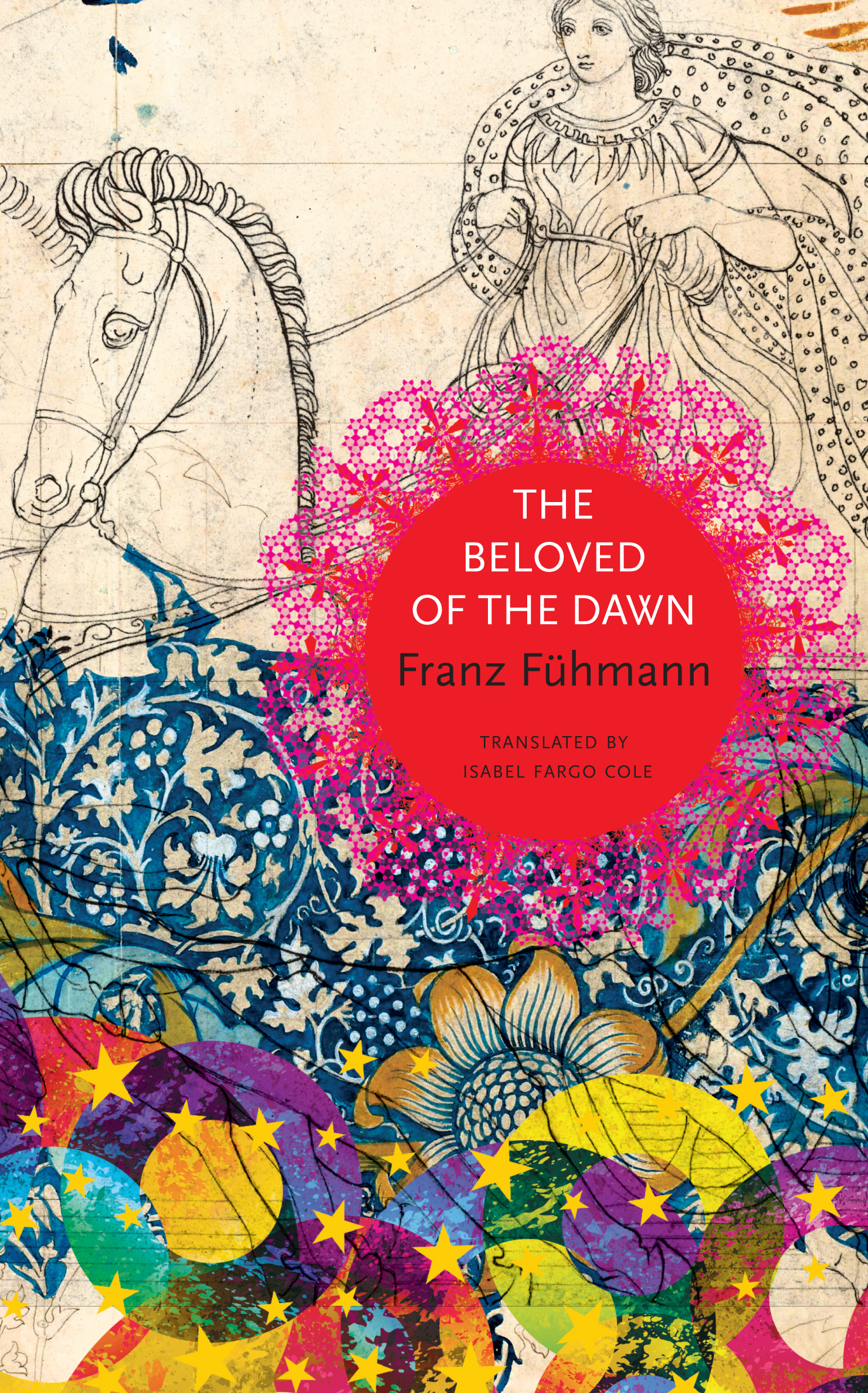
Among the immortals: The Beloved of the Dawn by Franz Fühmann

Franz Fühmann was a prolific and important East German poet and writer whose own life was fascinating. Born in 1922, in the predominantly German Sudetenland region of Czechoslovakia, he was the son of an apothecary who fostered the development of an ardent German nationalism. After the annexation of Sudetenland in 1938, he volunteered for the Wehrmacht but was deemed to be too young so he joined the Reich Labour Service which performed construction work for the military. He saw little direct action until the end of the war when, between 1941 and 1943, he was deployed to various areas of Ukraine. Then, as Germany’s final retreat began, he was transferred to Greece, an experience that would later have a significant influence on his writing. In the closing days of the war he was captured by Soviet forces and would spend the next four years in a POW camp in the Caucasus.

Fühmann emerged from captivity passionately converted to the tenets of Soviet Socialism; he had rejected the Nazi ideology on which he had been raised and was dedicated to the vision of a new world view. He chose to settle in the GDR where his mother and sister were living. He would remain there for the rest of his life, working solely as a freelance writer from the early 1950s until his death in 1984, but his conviction to the realist approach to poetry and literature favoured by the government soon wavered, as his writings grew increasingly confrontational and, to the Stasi, suspect. He would, however, go on to produce work in a wide variety of genres, for both adults and children, and became an important advocate for the translation and publication of authors previously banned in East Germany and a mentor for younger non-conforming writers like Wolfgang Hilbig and Uwe Kolbe.

I have previously reviewed Fühmann’s story cycle The Jew Car, which offers a fictionalized account of his childhood and war years, and his magnificent final major work At the Burning Abyss, a meditation on poetry—in particular that of Georg Trakl—and its power to speak to what is fundamentally human. In this essay he reflects on the way Trakl’s poetry triggered a crisis of literary faith, so to speak, allowing him to heal and understand himself in a way no rigid doctrine could ever manage to do. Both books are translated by Isabel Fargo Cole and published by Seagull Books, as is the very different Fühmann title I am looking at here, The Beloved of the Dawn, a slender volume comprised of four retellings of Greek legends, beautifully presented alongside vivid digital collages by Sunandini Banerjee.

As mentioned, Fühmann spent time in Greece toward the end of the war. As translator Isabel Cole indicates in her note at the end of The Jew Car, this opportunity to spend time in the country was especially valuable: “Since childhood Greek mythology had fascinated him, and the confrontation with Greek reality, the juxtaposition of myth and war, would inspire much of his literary work.” This awareness charges his personal take on these stories—drawn from a collection originally published in 1978—with a certain tension that gives them a contemporary energy. Despite its colourful presentation, this is not a book for young children, rather he is speaking to young adult and adult readers, fleshing out well known incidents with a very human, somewhat subversive tone.

The first of the four legends to which Fühmann turns his imagination in this collection is Homer’s Hymn to Aphrodite (219-239) which chronicles the love of Eos, the goddess of the dawn, for the mortal Tithonus. She begs Zeus to grant him immortality so they can spend eternity together, but forgets to ask for eternal youth. The reality of life with an immortal mortal is vividly evoked. The second tale focuses on Hera’s magic-enabled seduction of her wandering husband as depicted in Homer’s Iliad, chapter XIV, portraying the great king of the gods, he of enormous appetites, in his moment of weakness and subsequent bitter revenge:

That night, three hundred years, he’d sworn fidelity: one night, but what a night!—He was Zeus, and he was who he was.—Then he’d deceived her ten thousand times: with her sister, with the Wanton One and her retinue, with all the nymphs, all the Muses, all the Horae, all the Charities, with all the wives of all the gods and all the daughters of all of the goddesses,  even with his own, not to mention countless mortals: she-humans, she-beasts, and even plants, and with boys, too, with monsters, with ghosts.—He was who he was, and now he was one who desired Hera and none other.

The third story—dedicated to Heinrich Boll— recounts the silenus Marsyas’ reckless challenge of Apollo to a musical duel with melodious pipe cursed by Athena. In its graphic depiction of agony, this version makes the hideously aging Tithonus’ fate seem mild. Marsyas’ grisly destiny is hinted at throughout, but he ignores the warnings of dreams and even fails to believe his opponent is serious in exercising his reward for winning as the blade slips beneath his hide. Fühmann makes visceral what no marble statue and few paintings can aspire to.

The final tale similarly breathes depth and life into another of the less fortunate characters in the Greek pantheon of major and minor deities, in this case Hephaistos the physically disabled god of fire, the eternal guardian of blacksmiths, craftsmen and artisans who was, in this role, worshipped and yet required to serve in Olympus. Fühmann portrays this conflicting position, its balance of strength and weakness clearly in his hero. The story at hand is, of course, the famous account of Hephaistos’ response to the news that his wife, Aphrodite, is having an affair with Ares, the god of war. The crafting of an invisible, infinitely strong web to capture a theoretically invincible foe is depicted with poetic, elemental detail:

He laid his hand on the pristine metal.

The beauty of its coldness and resiliency, and the force of the fire that conquers them both.

He melted off a handful of the material and once it had cooled began to rub it between the fingertips of his right hand while stretching it out with his left. When the hot metal had a ductility, when a cool hardness such as he had never encountered, such as could arise only here, as the solar plexus of all metal veins between the heart of the earth and its diaphragm.—Soul of matter: his medium.—What he need now was the finest of eyelets: a flake from a diamond, shot through by a sunbeam.

The net he weaves and the trap he sets succeeds, but only so far. Hephaistos is too bold, and too stigmatized to not be mocked even in his triumph. The resulting story is one of a bittersweet and complicated relationship between a gifted genius and his fellow gods and goddesses, even his beautiful wife.

The strength of each of the tales collected in The Beloved of the Dawn lies not in the overall arc of events which have been illustrated and revisited countless times, but in Fühmann’s ability to tell them anew. His distinctive prose style which employs poetic fragments and a frequent use of em-dashes, often to open new sentences, allows him to add colour, shadow and character to these archetypal figures and convey a relatable, recognizable agency to his portrayals of these familiar legends. His narrative acknowledges that many poems and artworks have come before, and openly claims to be more interested in some of the lesser known backstory, but he never abandons the mythic form. Witty and sharp, he is having fun with these timeless tales of Gods behaving badly.

The Beloved of the Dawn by Franz Fühmann is translated by Isabel Fargo Cole and published by Seagull Books with full colour illustrations by Sunandini Banerjee.

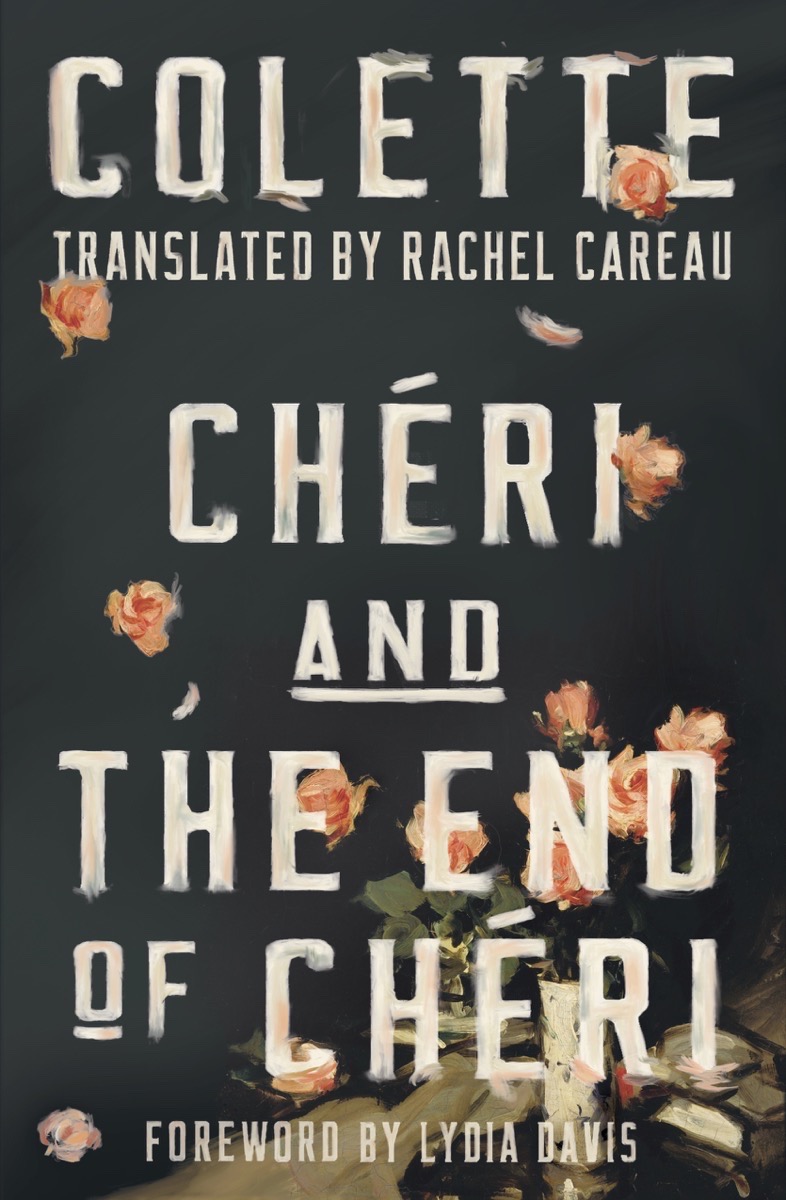
You who have loved me: Chéri and The End of Chéri by Colette (A new translation by Rachel Careau)

“My poor Chéri . . . It’s strange to think that in our loss—for you of your spent old mistress, for me of my scandalous young lover—we have lost the most honorable thing that we possessed on earth . . .”

It might surprise many English speaking readers to learn that writer, journalist and actress Colette was one of the most important literary figures in twentieth-century France, second only to Proust. Beautiful, resourceful, and sexually liberated, known for her liaisons with women and younger men, her persona may seem to overshadow her talent even though her better known contemporaries held her in very high esteem. And, of course, there is the matter of her gender and the name she ultimately chose to use which, contrary to expectation is not a diminutive but rather her last name. She was born Sidonie-Gabrielle Colette in 1873, would be the first woman elected president of the Académie Goncourt and, upon her death in 1954, she was given a state funeral. Yet if, as Lydia Davis suggests in her Foreword to the recently released edition of Chéri and The End of Chéri, Colette has not generally been afforded the respect she enjoyed in her native country, that may begin to change thanks to Rachel Careau’s brilliant new translation of two of her best loved works.

In her extensive and informative Translator’s Note, Careau discusses the unique qualities of Colette’s language and exposes the challenges of preserving the taut beauty of her prose:

what becomes most apparent to the reader of her work in the original French is its extreme and seemingly effortless economy: it contains no excess, no ornament, nothing beyond the essential. Her sentences can feel skeletal, the flesh carved away to convey their meaning with the fewest possible words. A master of concision, subtraction, condensation, renunciation, she is always trying to do more with less: “You become a great writer,” she states, “as much through what you refuse your pen as through what you grant it.”

This economy is difficult to capture without the temptation to fluff the pillows a little, correct her punctuation, fill in missing conjunctions, relative pronouns and even invent adjectives so as to keep her language from appearing too stiff—a tendency that marred earlier translations. But then one risks losing the spirit that animates her work. At once ornate and lean, her sentences flow unhindered by unnecessary clutter. Fond of ellipses, she paints small details with carefully selected words, side glances and intimations allowed to just drift unfinished into the air. Her ear for dialogue, both spoken and unspoken, is finely tuned, sharp and sharpened with complex emotion and barbed intensity. Chéri and its companion novel, The End of Chéri offer, in Careau’s crystalline translation, a welcome opportunity to fully appreciate the power of Colette’s literary talent.

Chéri, originally published in 1920, famously revolves around the affair of an aging courtesan, Léa, and her lover, affectionately called Chéri, a vain and spoiled young man nearly twenty-five years her junior. Set in the final years of the Belle Epoque, amidst the acquired (and sometimes feigned) luxury of the leisured class—not the uppermost layer of society but the strata composed of courtesans, former prostitutes and dancers—hers is not a work of social commentary. Colette’s tapestry features the intricacy and dynamics of human interaction: affection, obsession, deception, hostility, even tedium. She was a keen observer, not only of people, but of plants and animals. Small dramas play out on the page, but the magic lies not so much in what is happening as in how it is depicted in her precise, spare elegant prose.

Chéri has a languid pace, despite the inevitable romantic dissolution that lies at its core. It opens with the petulant, self-absorbed Chéri, playfully donning Léa’s pearls while she observes him from the depths of her bed. They have, at this point, been together for six years although she has known him since he was a small boy as he is the son of a long-time friend and fellow courtesan. He is twenty-five, while she is nearing her fiftieth birthday. The dynamics of their relationship are dissected, dramatized in intimate detail. Colette zooms in on the hint of a smile, the arch of a brow, the subtle movement of a limb. Repeated images—the cast of light, mirrored reflections, passing aromas—serve to heighten the tensions simmering beneath the surface of every thought or interaction. Chéri is aware of his beauty, terrified of losing it, suspecting perhaps that little lies beneath the surface. Léa is also conscious of the creeping ravages of time but her confidence and security runs deep after a lifetime of carefully leveraging her charms:

She stood up, wrapped herself in a dressing gown, and opened the curtains. The midday sun entered the cheerful, overly decorated pink room whose luxury was dated, double lace panels at the windows, rosebud-pink faille on the walls, gilded woodwork, electric lights veiled in pink and white, and antiques upholstered in modern silks. Léa would not relinquish either this cozy room or her bed, a considerable, indestructible masterpiece of copper and wrought iron, severe to the eye and cruel to the shins.

It has always been inevitable that Chéri would one day be expected to take a suitable bride, but when that day arrives suddenly and sooner than either he or Léa anticipated, neither one is prepared for how it unsettles their personal and emotional  equilibrium.

The End of Chéri, conceived of separately and published six years later in 1926, is essentially a companion piece and completion of what can be understood as one work. It is now 1919, six years after the setting of Chéri, and war has changed everything and everyone except, tragically, Chéri himself in spite of his time in the trenches. Still beautiful, his beauty will no longer suffice. His young wife, Edmeé, to whom he was needlessly cruel, is now more than capable of holding her ground. The only character who insists on calling Chéri by his proper name, Fred, she is managing a hospital for wounded soldiers, clearly in love with the head doctor, and together with Chéri’s mother, managing the family fortune. Unable or unwilling to take up any meaningful labour, Chéri drifts through the days, looking for an anchor in past connections and spiraling deeper into depression.

The End of Chéri has a darker, even tighter tone. Physical descriptions can be brutal, grotesque—and often wryly funny—filtered through the thoughts of the characters, revealing more about the viewer than the viewed. Chéri is at once the central and increasingly isolated figure. New power dynamics are revealed, playing out between the many female characters who are strong, independent, even eccentric. Likewise, the fabrics, the colours, the floral displays, the household routines evoke an atmosphere that drives Chéri to become more bitter and defiant. Léa, in their shocking reunion, quickly diagnoses him:

 “You have altogether the look of someone who suffers from the sickness of the times. Let me speak! . . . You’re like all your fellow soldiers, you’re looking for paradise, eh, the paradise that’s owed to you, after the war? Your victory, your youth, your beautiful women . . . You’re owed everything, you were promised everything, well, it’s only fair . . . And you find what? A nice ordinary life. So you become nostalgic, spiritless, disappointed, depressed . . . Am I wrong?”

“No,” Chéri said.

Because he thought he would have given a finger off his hand to make her shut up.

The impact of the war is present throughout this novel, but always beneath the surface, a tribute to Colette’s impeccable restraint. The characters, their appearances, conversations and mannerisms hint at how great a shift has occurred. The world will never be the same, and, sadly, some of the most profoundly wounded victims are those who were untouched in battle.

Chéri and The End of Chéri is my first introduction to the work of Colette and I am grateful to have made my acquaintance with her through this attentive and astute translation. I came to know of Rachel Careau through her translations of another very different and yet very distinct French author, Roger Lewinter. With this release, English language readers finally have the opportunity to appreciate the economical beauty of Colette’s prose, her strong, independent female characters and her ability to expose the timeless vulnerabilities and strengths of the human condition.

Chéri and The End of Chéri  by Colette is translated by Rachel Careau with a Foreword by Lydia Davis and published by W. W. Norton.

Seven (slightly vain) exercises in style: Rabelais’s Doughnuts by Pierre Senges

French writer and playwright, Pierre Senges, is a most subtle conjuror who casts a sidelong glance and exercises a sharp pencil to bring literary, historical, and contemporary notions together in unexpected intermixtures of fact, fiction and philosophy. An erudite alchemist, he spins extravagant, satirical, richly intertextual essays and imaginings that exploit that hallowed ground between the actual, the probable and the impossible. He may be dancing in the footsteps of Borges and Calvino, but Senges is the choreographer of his own inimitable style.

I have read and reviewed several of Senges’ works—the brilliant The Major Refutation, a conspiracy theory for the ages, the collaborative Geometry of Dust, and the chapbook Falstaff: Apotheosis—but on the menu today is an assortment of his idiosyncratic musings, half a dozen plus one tasty treats gathered together for the first time as Rabelais’s Doughnuts. Translated, like the other works, by Jacob Siefring, a veritable Senges evangelist, this slender volume is published by Seattle-based Sublunary Editions, their third contribution to the mission to bring more of the prolific French writer’s oeuvre into English. Six of the seven titles included in Rabelais’s Doughnuts were previously published in a variety of online and print journals over the past decade, but Siefring’s translations have been revised for this collection.

It tends to be difficult to succinctly summarize a Senges story/essay without tripping over one’s words. The most straightforward pieces here are two that involve Michelangelo’s famed painting Last Judgement. The first, “Last Judgment (detail),” is one of my favourites, revolving around a real person and situation that I was unaware of and would have thought to be entirely fanciful were it not for our friend Google. (One of the great joys of reading a writer like Senges is that he inspires a reader to look up an individual or a circumstance to find out what he is referencing—for those more cultured than myself that might be unnecessary, for those to impatient to seek out the subtext it could be frustrating, but in my mind it is a bonus.) This first Michelangelo piece considers the fate of Daniele Ricciarelli (called Daniele da Volterra or “il Braghettone”) who was commissioned to add tasteful coverings to several of the unsuitably exposed figures in the great artist’s masterpiece. With a certain empathy, Senges considers the task, the betrayal of his master, to which Daniele Da Volterra is committed:

When he draws, he draws, when he paints, he paints: depending on the point of view, the veils of the Braghettone benefit from his skill as the author of a Descent from the Cross, which has since become famous (famous as a reference, not as a celebrity). Or rather, it’s quite the opposite, one hundred and fifty veils fastened like so many pairs of underwear on the men and women of Judgement Day, all stretching towards their salvation or damnation, and disregarding as they would disregard a prune a nakedness that is more or less suited to the gravity of the occasion, one hundred and fifty veils are a valuable exercise for a painter.

The other Michelangelo related piece, “Measure of All Things,” imagines its way into the mind of the influential and critical writer Pierre Aretino who wrote an open letter to the artist offering his opinion on The Last Judgment.

Other works sing the dubious praises of the six hundred page novel, riff on one of Heinrich von Kleist’s prescient anecdotes about possible long distance communication, dragging it piecemeal into our modern world of the internet and Amazon, muse about writing exercises, and take on the character of a counterfeiter baring his sorry soul, such as it is, to a client. Figures from history and literature appear throughout, sometimes even providing a framework for Senges’ wide-ranging reflections. “Many Ways to Stuff a Watermelon” is a perfect example. He wanders through the libraries of a host of real and fictional characters, from the scant collections Russian writer Sigizmund Krzhizhanovsky granted his impoverished characters, to the actual library an aging Giacomo Casanova found refuge in, this tribute to libraries great and small will resonate with anyone who collects more books than they can ever hope to live long enough to read. In this, one English writer’s despair at the incalculable extent of available material speaks volumes (so to speak):

The reader’s tininess signifies the brevity of our lives: it follows that the impossibility of reading everything takes the measure of our mortality, provoking frustration and vertigo at the same time—to Thomas De Quincey, in any case, one hundred thousand forever unknown volumes brought forth tears which he compared to those of Xerxes countenancing the death of his soldiers: not some “fanciful case of misery”, but “as real a case of suffering as ever can have existed.”

Senges’ elaborate language and dry wit allow him to take a small idea and expand it into an intelligent, extravagant exercise, one that takes chances but always steers close to the truth, or a truth, digging freely into the past to make astute observations about the here and now. If you are new to his work (or well acquainted), this short collection is a an ideal way to meet (or spend more time with) this witty, intelligent writer.

Rabelais’s Doughnuts by Pierre Senges is translated from the French by Jacob Siefring and published by Sublunary Editions.

And now for something completely different: the adventures of char, vol #1 by Whiskey Radish

I have, for a number of years now, been an ardent admirer of Whiskey Radish, the enthusiastic, energetic creator of a world like no other—one peopled with an inexhaustible cast of characters whose adventures unfold in single-sentence illustrated frames. These moments sometimes stand alone, sometimes riff off one another with a free form jazz vibe. Her distinctive sketches have been a regular presence online and off—illustrating articles, decorating freely gifted postcards, stickers and other treats, and gathered together in books created and often sold for a song. Now, for the first time, a selection of Ms. Radish’s images have been collected in a fabulous full-colour book published by Ice Floe Press. The adventures of char, vol #1 is a labour of love. It is a treasure for existing fans and a welcome introduction for those who have not yet met the cheerful madness of Whiskey Radish.

Behind the playful moniker is an artist, writer and jazz lover who lives near Boston. A wife and mother of three who teaches private art classes to teenagers, the core stimulus of her art rests in the daily practice of producing a daily “sortie” or burst of thought. Illustrated with her boisterous ink drawings, each thought becomes a story in itself. The images in this volume are drawn from around 300 “sorties” made between October of 2020 and July of 2021. Robert Frede Krenter, the publisher of Ice Floe Press, selected and ordered the images with their descriptive wisdoms and observations to titled create mini-adventues. The result is a collaborative visual poetry.

Whiskey Radish’s primary template is black ink on white, a blend of blotchy exuberance and startlingly fine detail, but in this collection colour is invited to join the party, often adding texture, density and a remarkable range and variety to the images. The creative process and the method of assembly heightens the variability. Some of Whiskey’s familiar characters—Char, Slimbo the Rocket Dog, You and the King—are joined by other wise, wistful and magical personas and even, for a change of pace, a selection of drawings of plants.

I first read this book in PDF—full disclosure, I was asked to provide a blurb—a format that enforces a linear reading. But, now that I have a paper copy, it is just as delightful, if not more fun, to just open it up and slip in and out of the short segments moving forward and back. During a month in which a broken leg has me tethered to home as outside spring is bursting with green leaves and blossoms, and so much news has been shrouded in darkness, it has been wonderful to have a book so full of life close at hand.

The adventures of char, vol #1 by Whiskey Radish is published by Ice Floe Press.

No promised lands: Canzone di Guerra by Daša Drndić

Each time I come back to Croatia, I see that it is not the Croatia I left, that I am not the person who left. Today, every lengthy departure from Croatia promises a still more difficult return, an ever more remote chance of establishing a firm, tenuously secure basis for living. Today, when I leave, I no longer know who I will find alive when I come back.

Croatian writer Daša Drndić was singular literary force, able to deftly weave facts—often gathered and presented in an unapologetic, even confrontational manner—with fiction to create compulsively readable, powerful works. Her novels incorporate lists, historical details, interview excerpts, documentary asides and lengthy footnotes into a character-driven story to achieve more than what either fiction or nonfiction could do alone. In Canzone di Guerra, recently released in English translation from Istros Books, we see an early form of this distinctive approach to storytelling, deeply political yet strikingly novelistic, echoing the author’s own experience in Toronto, Canada, as a single mother escaping conflict as the former Yugoslavia was falling apart in the early 1990s. Given this context, this work also stands as an increasingly relevant portrait of the immigrant experience—one in which my own country does not come out too well.

Originally published in 1998, Canzone di Guerra’s opening chapters zero in immediately on the narrator’s decision to leave Croatia and the varied circumstances immigrants and refugees face in Canada after the collapse of “Socialist Yugoslavia.” Framed by short digressions about the origin and fate of certain varieties of pigs—parables of culture, dislocation and loss—Drndić quickly shatters idealistic illusions and hints at the embedded inequalities and ethnic divisions that her superficially homogenous community carries with it to new shores. Imagined, in part, as the transcript of a radio documentary we hear the voices of an array of characters struggling to find work, dismayed at the lack of recognition for their professional credentials, and coping with loneliness and alienation:

Here we sleep peacefully, there’s no shelling, but we’re waging a different war. A war in the soul, a war in the head. Why did we come? We thought Canada was a country of great possibilities. I don’t know why no one told us the truth.

Beneath the dialogue, footnotes discuss the disappearance of trees in Sarajevo parks, coping strategies for stretching food or resources, even quote George Orwell. Throughout the text, such notes offer the opportunity for a multilayered discourse. There is always more going on beneath the surface.

Of the migrants, seeking a better life, some will thrive, some will not. The narrator, Tea Radan (“my name in this story” as she later says), has her young daughter Sara, to consider. She has to hope for the best. But what is she really hoping for? That is, at best, uncertain. Prior to moving to Canada, Tea and Sara had lived in Belgrade before moving to Rijeka in her native Croatia. Her sister lives in Slovenia, her brother is restless but goes nowhere. Those she knows want to leave but most don’t get far. However, the distance that her ability to migrate affords her seems to focus her attention back on her family, her parents and grandparents, and their actions and political associations during and after the Second World War. Her grandfather’s letters and mother’s diary entries help flesh out the story, but questions remain unresolved.

A romance with a fellow Croatian immigrant sets her off on an extensive, obsessive search through archives and records available in Canadian libraries, triggered by the notion that his family’s circumstances may have been connected to her own, most particularly to a betrayal of her mother during the war. It is not a healthy basis for a relationship, but it spurs a journey that leads Tea from one rabbit hole to another, as she delves into the history of Croatian communist and fascist movements, through the treatments of Jews in Canada, to tragic accounts of the concentration camps Theresienstadt near Prague and Jasenovac in Croatia. It is a gut-wrenching whirlwind tour, one that invites readers to slip down their own rabbit holes. Yet the intensity of her investigations, only trigger more questions:

The more I read, the less I knew. No one was entirely innocent, no one was entirely guilty: not the cardinals, nor the bishops, nor the popes, nor the churches, nor the Vatican. Nor the communists. As for the Ustasha ‘truths’, I read them too, but I didn’t believe them. They all had their version of history. Those who survived. The CIA had its truth as well. America and Great Britain their own.

Uncomfortably, for a Canadian reader, Drdnić, through her narrator, is unsparing in her critique of Canada’s failure to deal with a number of high profile war criminals who found their way here—something I was not unaware of but was chastened to review it all again.

This novel is, nonetheless, more than a vehicle to delve into past darkness. It is charged with a certain humour and warmth as Tea and her daughter navigate life in a new country. It is not easy. Along with other migrants they are forced to seek social supports, take degrading work under the table, and scour second hand shops for clothing and shoes. It sounds bleak, but Tea’s defiance and Sara’s spirit carry them through the endless bureaucratic mazes of the modern capitalist state.

Entertaining, intelligent and disturbing, to read Canzone di Guerra today, thirty years after the time when it was set, is enlightening. Immigrants still face the same frustrations finding support, resources, and work that recognizes their training. Yet, as refugees from the war in Ukraine flow into Canada and many other countries—often moving ahead of those waiting in line much longer—it is clear that all refugees and immigrants are not treated equally. The migrants arriving from the collapsing Yugoslavia note at one point that they are invisible compared to other more “obvious” newcomers. But visibility is not an asset, as long-time Canadians from visible minorities can attest. Racism and xenophobia has grown even more over the past few decades, buoyed by the same kind of nationalist sentiments that played such a key role in World War II and the Balkan Wars alike.   Daša Drndić’s work remains, as ever, clear-eyed, critical and timely.

Canzone di Guerra by Daša Drndić is translated from the Croatian by Celia Hawkesworth and published by Istros Books.