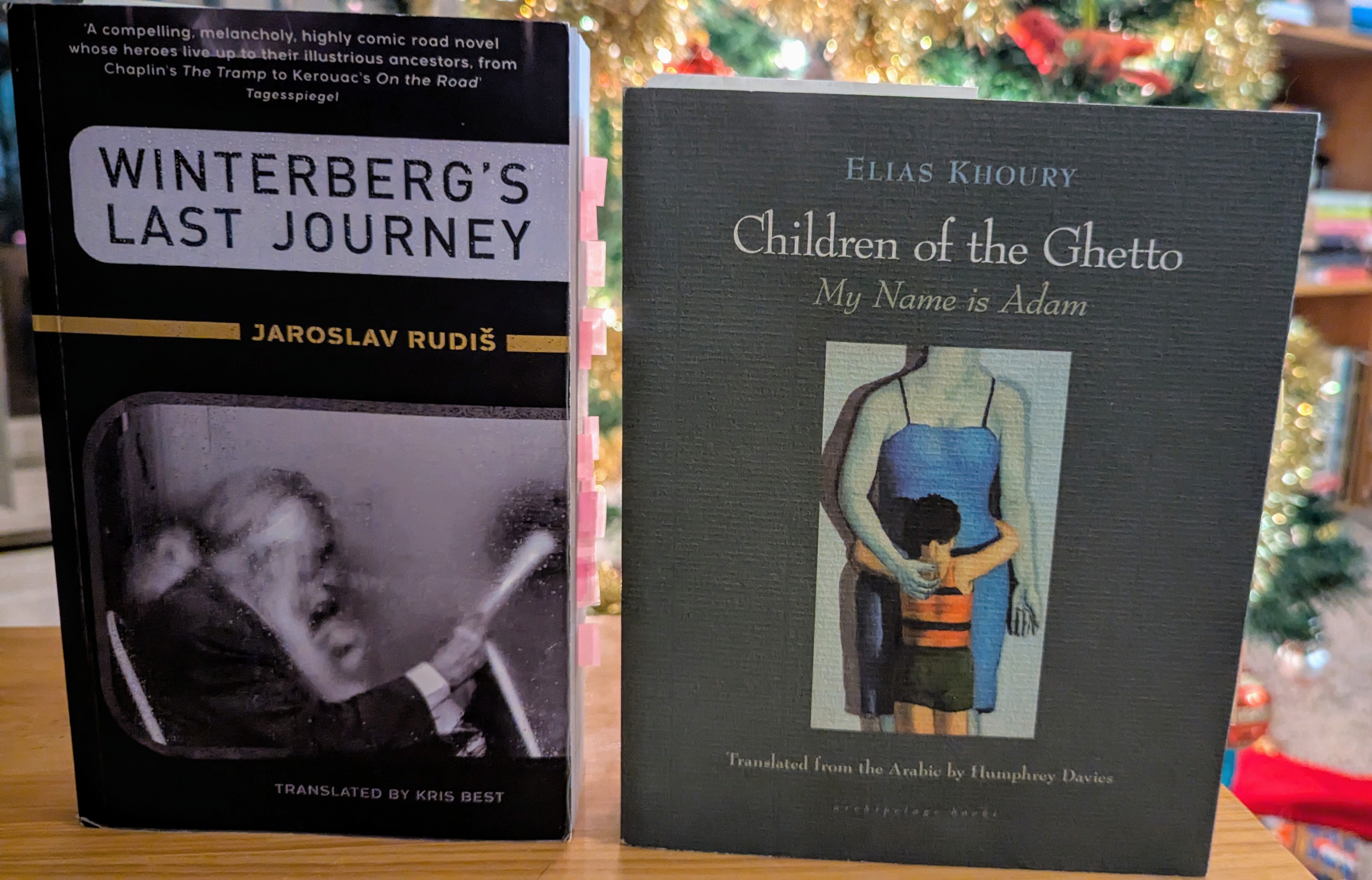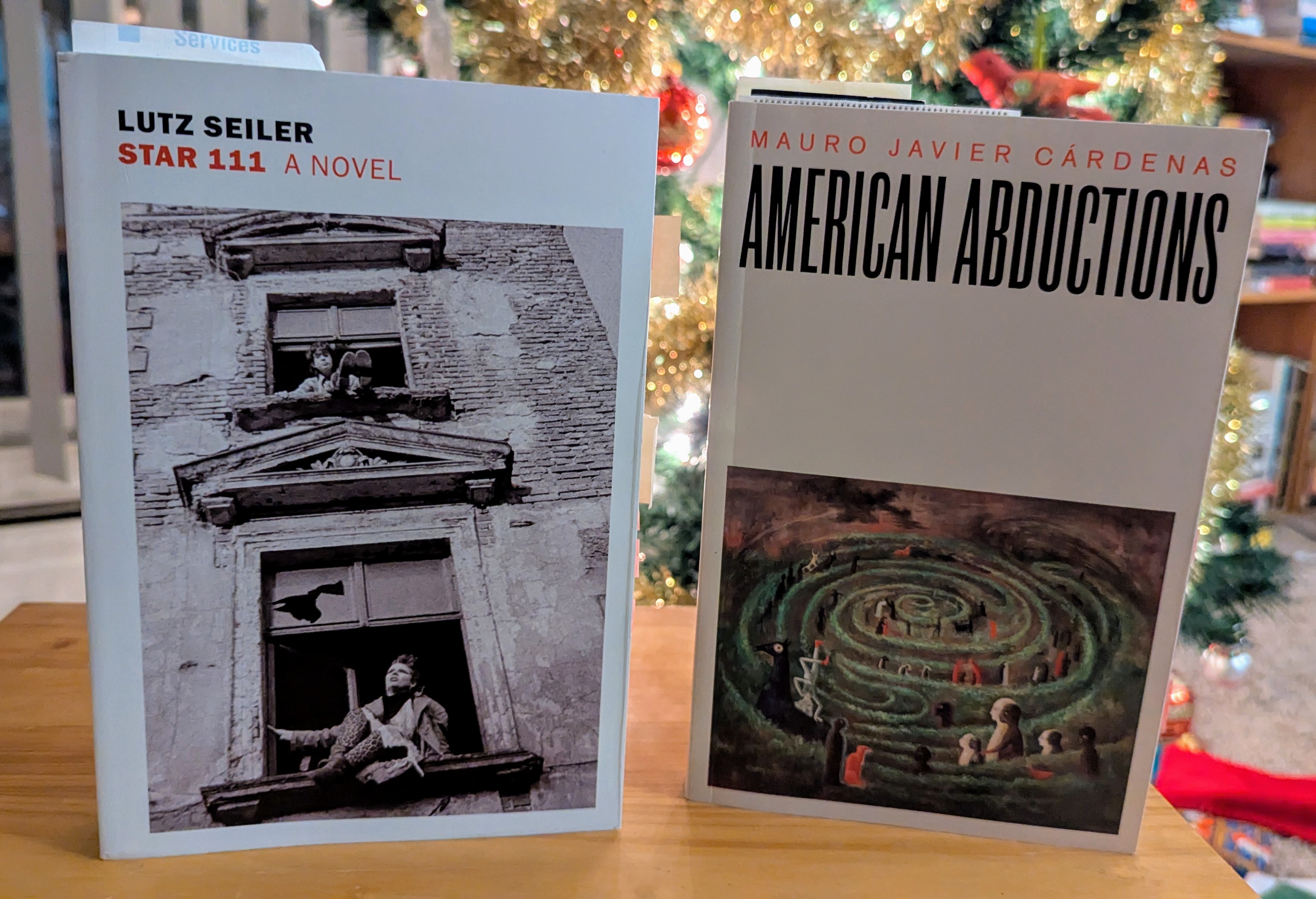
Dramatically, melodramatically, or obliquely: American Abductions by Mauro Javier Cárdenas

. . . no, Antonio says to his daughters during dinner, Americans can’t imagine the conditions, and if they can’t imagine the conditions, they can’t imagine themselves as refugees, and if they can’t imagine themselves as refugees, they will conclude that refugees are different from them, a different species, Eva says, they read in the news that a different species from Central America have to flee their homes and that they’re coming here, and that we’re abducting their children to teach them a lesson, life is hard and then we die, Ada says. . .

There is something distinctly unsettling about reading the latest novel by Ecuadorian-American writer  Mauro Javier Cárdenas on the eve of Trump’s second term—Racist in Chief, anyone?—especially with tech billionaire Elon Musk on his arm assuming they haven’t broken up by then. Projected into a future that now seems shockingly close, American Abductions envisions a US in which the mass deportation of Latin American migrants, not just those who are illegal but naturalized citizens and sometimes even their children, is a large scale, technologically advanced, industrialized, and profit motivated operation. It consumes the waking and sleeping hours of its unfortunate targets and tears their lives apart in distinct yet similar ways. Antonio, the divorced cubicle-bound data analyst hero of Cárdenas’s last novel, Aphasia, who was trying to write a novel while juggling  commitments to his ex, his daughters, his mother and sister, plus a couple of girlfriends, has, in this scenario, been abducted and deported to his native Colombia. He was driving the girls to school when immigration officials apprehended him, a scene recorded by Ada, his eldest, on a video that subsequently went viral. When we catch up with him, decades have passed and his health is failing (he will die but continues to appear in recollected scenes from the past or via recordings of the many interviews he conducted with fellow deportees over the years). His daughters are grown. His youngest, Eva, a conceptual artist, joined him in Bogota after finishing university and has been there for seven years, while Ada has remained in San Francisco where she works as an architect. Add to this a varied cast of Latin American exiles and their families connected through either Antonio’s ongoing interview project and /or the lucid dream workshops of an online doctor, and you have the basic sketch of this dynamic and original work.

Cárdenas is a passionate devotee of the long sentence, producing multi-page strings of thoughts, reflections, and dialogue that tend to shift mid-stream—watch those commas, those “he says,” or “she thinks”—demanding attention while providing ample room for humour, recurring themes, and often biting commentary. But he is not simply obsessed with word count, an objective that in itself can lead to the proliferation of hopelessly unnecessary, redundant clauses. Rather, his sentences seem to propel themselves with an intrinsic energy that never overstays its welcome. There was, he admits in an interview for Minor Literature[s], a method guiding the writing of this book:

I wrote every sentence in American Abductions the same way. I started each sentence with a human impulse that I attempted to exhaust within the same sentence. This attempt to exhaust could be called In Search of Unexpected Linkages, with the caveat that this doesn’t translate to anything goes since the human impulse at the beginning determines the radius of operations. This approach also doesn’t allow for me adding a reference or an image three months later because that would disturb the progression of the sentence, which is based on the linkages previously generated. I typically spend one week on a 1,000-word sentence. Every day during that one week I read the sentence from the beginning so that I can ground myself on the opening impulse and what has already been generated. During that one week I have to read widely and wildly but in the vicinity of the radius of operations, which is as vague as it sounds — more Ouija board than research — though obviously I also do primary research (you would be surprised by how many facts are included in the opening sentence, for instance).

If that sounds like a recipe for a forced and artificial exercise it is anything but. This is a serious, albeit futuristic, novel that is unafraid to tilt at uncomfortable truths. There are continuing and developing threads and characters, whose stories reflect the fear, isolation, and (quite literal) dreams of those directly impacted by the anti-Latin American agenda of the “Pale Americans.” Central to this are, of course, Eva and Ada who are not only deprived of their rather eccentric father at a young age, but are unable to be together when he is sick or after his death, as they decide to continue his work. But there are other strained or separated families as well.

The subject matter—especially in light of the increasing antipathy and hostility toward immigrants in the Global North—may be grim, but this is a playful, absurdist novel nonetheless. Curious data and scientific facts are woven in to the narrative and literary references abound, some direct, such as the discussion of texts by Leonora Carrington, Bernhard, Borges, and Sebald; others less so, such as the adoption of the names of authors, musicians, artists, and Bolaño characters as intentional pseudonyms or nicknames for intelligent technologies. Sentence by sentence, each chapter builds on those that proceed it to create an intelligent, entertaining and, dare we say it, unnervingly prophetic novel.

American Abductions by Mauro Javier Cárdenas is published by Dalkey Archive Press. An excerpt can be found at Minor Literature[s].

The strange and even stranger world of Nightjar Press: Fabrication by Imogen Reid and Old Tutor, New Tutor by Arthur Mandal

There is something very precious about the chapbook format. The presentation of a single short prose piece or sequence of poems in a single bound volume, often printed as a defined, numbered run, is a way of isolating and calling special attention to a writer and their work. Since 2009, UK based Nightjar Press has published limited edition single short-story chapbooks. Editor Nicholas Royle and designer John Oakley have a fondness for stories that lean toward the uncanny, darker, and stranger side, as the press’s namesake might imply:

The nightjar – corpse fowl, goatsucker – is a nocturnal bird with an uncanny, supernatural reputation that flies at dusk or dawn as it hunts. It is more often heard than seen, its song a series of ghostly clicks known as a churring. Sylvia Plath, in ‘Goatsucker’, wrote that the ‘Devil-bird’ flies ‘on wings of witch cloth’; David Morley, in ‘Beethoven’s Yellowhammer’, calls it simply ‘Satanic’.

Two releases from this past October offer two different examples of the kind of oddly unsettling offerings they specialize in.

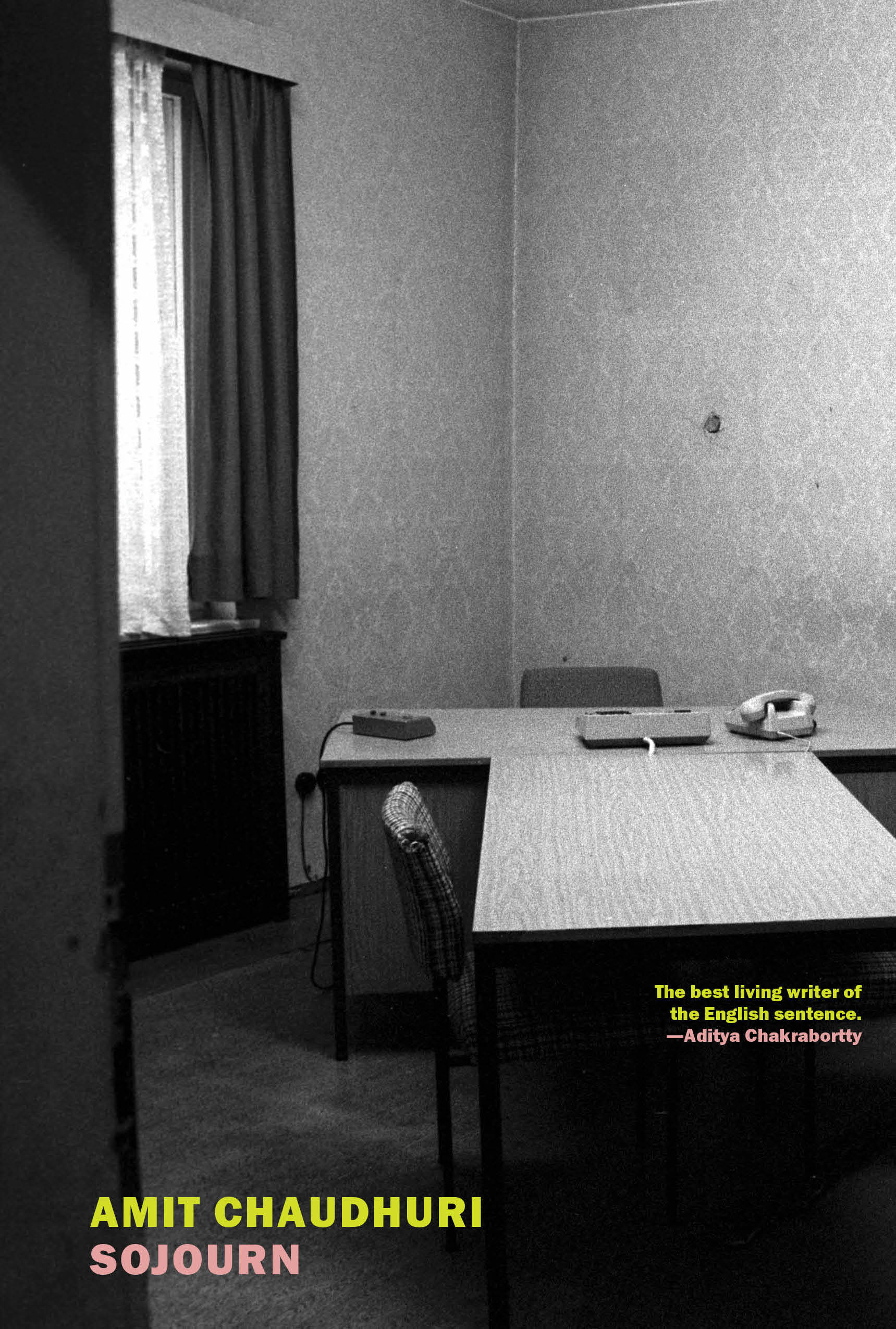
Imogen Reid’s Fabrication is a piece of experimental fiction that draws on the author’s interest in the way techniques employed in film can transform narrative form and readability. This story builds on an observed/experienced scene—a room, a desk, a man, a faded “missing” notice—that echoes and repeats elements as it circles back on itself, creating and reinforcing the ambient quality of a dream or remembered moment within which the subject, addressed in the second person, is both protagonist and object, perhaps in more than one sense.

you can’t recall being there, but you can feel the frayed edges of an unwritten narrative slowly crystallise around the grainy image tacked to the wall, barely held in place by a steel pin, its fragile edges fluttering in the breeze like shackled butterfly wings. Beneath it, in front of the desk, partially illuminated by the eerie glow emanating from the computer screen, the chair turns and re-turns silently swivelling on its well-oiled axis, the monotonous rhythm neither surging nor subsiding.

Disorienting and intriguing, this very short story invites repeated rereading becoming in the process a longer, circular piece without beginning or end.

More conventional in form, but equally unnerving and ambiguously unresolved, is Arthur Mandal’s Old Tutor, New Tutor. As this story opens, the tutor Mrs Craig hired to help her daughters prepare for their A-levels is late. The girls took immediately to Mark  (“he just wants to be called MO”) and now, suddenly, after six weeks, he has failed to arrive at the usual time. When she is finally convinced to call the number he had provided, she reaches what sounds like a distant, distorted connection. The tutor apologizes and promises to be back the following week. But a few days later when Mrs Craig is in town with her daughters she spots the tutor—pictured on a leaflet attached to a lamppost. Wanted for assault. The girls are in denial (“It’s nothing like him”), but their mother is convinced it’s the same man. Calls to Mark’s number go unanswered.

Then, the following week, a new tutor arrives at the usual date and time. The family is surprised, no one had called to arrange a replacement, but here he is. He introduces himself as Alan.

The new tutor stood before them, unperturbed. He wore a long, grey overcoat which dropped vertically from his shoulders to his knees. His face was young, freckled, cheeky but handsome. Although in his late twenties, he had the demeanor of a small child. In one hand he carried a briefcase; in the other an old-fashioned umbrella with a crocodile-skin handle.

The girls quickly take to the new tutor, even their previously resistant father warms to Alan’s charms. But Mrs Craig is uneasy. The source of her discomfort is uncertain; even she is at a loss to explain it. As the tale unfolds, we only have her perspective, and it becomes increasingly unclear whether her paranoia has any basis or whether she is losing her grasp on reality.

My first purchase from Nightjar Press was a signed M. John Harrison story in 2013. With a print run of only 200 copies per title, their chapbooks tend to sell out quickly, so one cannot wait too long if an offering  sounds intriguing. As with these two recent purchases—one an author familiar to me, the other new—something weird and wonderful is almost certainly guaranteed.

Fabrication by Imogen Reid and Old Tutor, New Tutor by Arthur Mandal are published by Nightjar Press (October 2024).

And we turn toward the sun once again: Winter Solstice 2024

whoever has kept the night in suspense
for light or for a star

while we were stealing words
from joy and its opposite

in this way day is torn from night
and shadow from our eyes

they open yet again
renewing the pillaged
miracle

(– Amina Saïd, tr. Peter Thompson)

These are dark times. I know that almost sounds cliché at this point after years of widespread illness, growing polarization, rising right wing sympathies, increased intolerance of differences of any nature, profit motivated denial of climate change, and the clear demonstration of a shocking capacity to either justify or look away from horrific violence and injustice, but I don’t know of too many people who can continue to pretend that maybe next year will be better. It won’t, at least not on any global scale. It is far more likely to be worse in ways we can’t even imagine.

I’m not depressed, not at the moment anyhow, but I am fundamentally pragmatic going forward.

When I first started this blog in 2014, I used to mark the solstice—winter in particular—as a sort of touch point. It originated in relation to the date when a mental health crisis reached its zenith, on the job, effectively (although I did not know it at the time) ending my career. On June 20th I was at the height of a devastating manic episode; six months later in the darkness of December, I was in a state of despair. I channeled that into a post marking the shortest day of the year, a short piece of writing that looked back at the unresolved loss and shame of becoming seriously ill at work, something that would I carry to this day without any closure. Mental illness still faces an often unsurmountable stigma. And I even worked in the disability field.

Anyhow, that first winter I was looking forward to rebuilding. The following June I turned the solstice on its head and wrote a post from South Africa where, of course, it was winter. I believed I had come full circle, one trip around the sun, and I was ready to put pen to paper and tell a story I had kept supressed for much of my life. My story. But then, about two weeks after I got home I had a cardiac arrest secondary to a pulmonary embolism and suddenly I realized that my story was being rewritten for me. As it would continue to be revised and edited over the years and through the solstices that have since come and gone. My solstice reflections, regular for the first five years or so and occasional since then, have remained a winter inspired project (considering that two June posts being related to trips to South Africa and Australia respectively were technically winter solstice as well). Here in the Northern Hemisphere there is something about the long nights, the holiday season—which for my small family is quiet—and the approaching new year that encourages a little inward-looking self-assessment.

That spark that comes with the almost immediate shift in the quality of the light as the sun begins its migration northward once more.

Looking back over my past Solstice missives I was often wistful, looking ahead with quiet optimism that the next twelve months would finally see progress toward the goals I set for myself, more travel, more writing. But as the years have passed, the pandemic, a series of disasters, natural and manmade, war in Ukraine, ongoing genocide in Gaza, rising transphobia, and the steady erosion of democratic values and principles combined, perhaps, with getting older has tempered my expectations, if not extinguished them altogether. Close to home this past year has had its difficulties, with several serious medical issues arising with loved ones, and the stresses that come along with challenging diagnoses—or worse, the lack of a clear diagnosis. And there are stresses that continue without resolution. But I have good health and a roof over my head. I’m far from the uncertainty, violence and devastation that so many people face across the globe, and I have the sanctuary of a forested trail to retreat to.

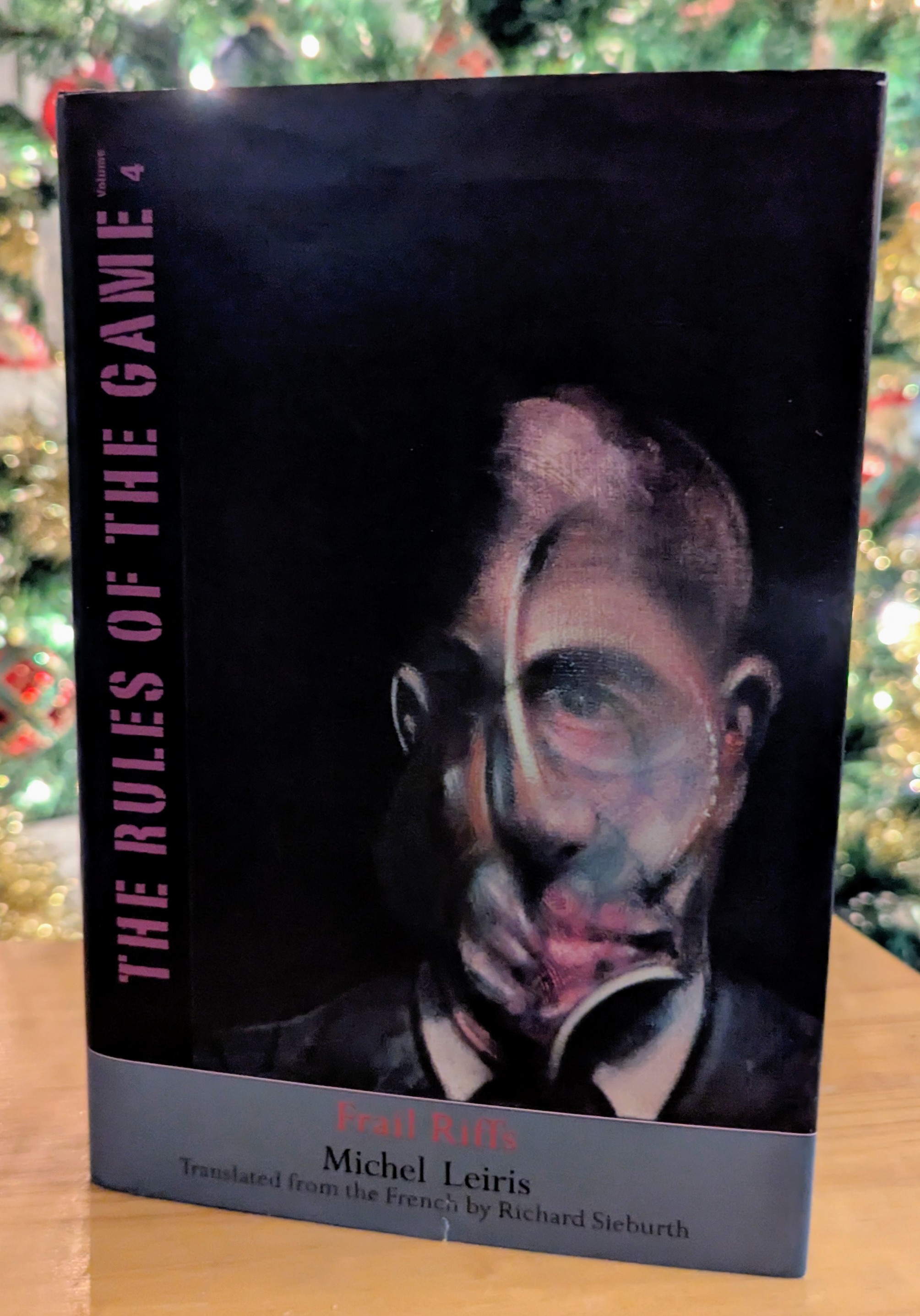
I have yet to seriously recommit myself to writing, but I did pitch and publish a piece outside this site for the first time in years with a review of Frail Riffs, the fourth and final volume of Michel Leiris’ Rules of the Game which was finally released in English this spring. It was actually a wonderful excuse for me to go back and reread volumes 2 and 3 in preparation. I also returned to editing this past summer, taking on the role of Essays Editor for Minor Literature[s], a journal that has published some of my own writing over the years, including the recent Leiris review. It feels good to be editing again, something that I like to think of as having a measure of the satisfaction of writing without having to come up with all the words! And I made my editorial debut at Minor Lit[s] with what turned out to be one of our most popular essays of the year. And for good reason. It is Haytham el-Wardany’s devastating and powerful “Labour of Listening”. It was critical and timely when we published it, and sadly it is still critical and timely now.

Closer to New Year’s Eve I will gather a list of some of the best books I read this year. Until then, stay safe and Happy Solstice.

The only possible way: from In Case of Loss to Pitch & Glint by Lutz Seiler (and much more)

Some writers pass through your reading life and move on, perhaps appearing by chance now and then over the years, others ignite a clear desire to read more, if not all, that you can get hold of. That might be a small library of volumes to collect, but for those of us drawn to writers in translation—writers we often discover as a direct result of following a known or trusted translator—it can mean watching and waiting for more work to slowly emerge in English.

For me, one such writer is German poet, essayist and novelist Lutz Seiler. I first encountered his poetry about two and half years ago through Alexander Booth’s translation of his 2010 collection in field latin. At the time, the only other title available was his first novel Kruso which was, when I first checked, out of stock. Yet, when UK publisher And Other Stories announced they would be publishing Seiler’s debut poetry collection, Pitch & Glint, his second novel, Star 111, and a collection of essays, In Case of Loss, in late 2023, I took note. Then, when I had the opportunity to read Star 111 this year in advance of its North American release from NYRB in October, I quickly set about acquiring his other work. And, as these things go, while reading the poetry and the essays, I was inspired to add work by two of the poets Seiler writes about or honours—but more about that later.

Born in the Thuringia region of the GDR in 1963, Seiler’s poetry is rooted in the rural landscape of his childhood, scarred by years of uranium mining, sensitive to place and relationship to family, as child and as a parent. However, unlike many writers, he had no interest in books or literature when he himself was young. He did not start reading poetry until he was completing his mandatory military service in his early twenties, having already trained as a bricklayer and carpenter. He was certainly not writing, not even jotting the odd observation down, but something was brewing. As he says in his essay “Aurora: An Attempt to Answer the Question ‘Where is the Poem Going Today?’”:

Yet a good ten years later, I wrote poems that had been, in that earlier period, when poetry did not feature in my life, gathering and storing their subject matter, their materials. Doubly hidden from me at the time, clearly the poems had been, even then, making their way towards me. What is different these days is that I have become more conscious of the signs of a poem being on its way. I am aware of what situations, materials and substances it might respond to, what it is likely to ingest—for later use.

For a poet who came to literature somewhat unexpectedly, Seiler’s writing about writing, and about the poetic art and process is excellent, presumably of interest to other poets, but also, and perhaps more critically, for those of us who enjoy poetry but sometimes feel inadequate to examine a poem without a strong literary vocabulary and the requisite coursework (assumed to be) required to read and write it. In Case of Loss contains several essays about the work of other poets. One, Peter Huchel (1903–1981), was new to me. I was aware that Seiler is the custodian of the Huchel House in Wilhelmhorst near Berlin, but knew nothing of Huchel himself, one of the most an important German poets of the post-war era who ended up running afoul of the government of the GDR and was eventually allowed to migrate to the West. The title essay is an account of Seiler’s first impressions of the house itself after breaking in with Huchel’s widow’s blessing and his coming into possession of a notebook the poet kept all his life in which he recorded images, metaphors, lines, and tentative sketches, all categorized by theme. The manner in which Seiler traces some of the formative elements that will, often years later, appear as shadows or echoes in a finished piece is fascinating and a testament to the gestation period a poem can have. Of course, I wanted to read more, so I sought out These Numbered Days, Huchel’s 1972 collection, released in 2019 in an award winning English translation by Martin Crucefix (who is also the translator of In Case of Loss). His poetry often draws on the landscape of his youth for atmosphere frequently in concert with mythological, historical, and Biblical images to create crisp, even chilling poems. Although they are generally spare, one can sense that they have been carefully shaped and honed over time, each word or phrase carrying much weight, very often political—something confirmed by both Seiler’s insights, Crucefix’s notes, and Karen Leeder’s Introduction.

At the edge of the village the wind
flung its ton of frost
against the wall.
The moon lowered a fibrous gauze
on the wounds of the rooftops.

Slowly the emptiness of night descended,
filled with the howling of dogs.
Defeat sank
into the frozen veins of the country,
into the leather-upholstered seats
of old Kresmers in the coach sheds,
between the horse tack and grey straw
where children slept.

(Peter Huchel — from “Defeat”)

In addition to an unusual back to front reading of a book by Ernst Meister, the other poet Seiler devotes an essay to is Jürgen Becker. I had already read Becker’s fragmentary poetic novel, The Sea in the Radio, but a dedication to the poet (who very recently passed away) in Seiler’s collection Pitch & Glint, called to mind a collection of selected shorter poems, Blackbirds in September, which I was able to track down and read alongside the essay “’The Post-War Era Never Ends’: On Jürgen Becker.” Here Seiler takes a more personal approach acknowledging Becker’s influence and his own friendship with the older established poet. He traces his own process of learning to read and appreciate Becker’s poetry. Born in Cologne in 1932, Becker was a member of Group 47, the organization formed to promote young German writers after the war. He employed an experimental, open form of writing with an emphasis on landscape and the persistence of memories of the war in German land and history. His language tends to be spare and his poems have a calm, light feel, but that is only the surface.

But the landscape is rather quiet.
Invisible the destruction, if in fact
there is destruction.

And the time is passed
which the subsequent, the subsequent time produced.

But you never speak of Now.

Probably in the summer. At that time of year
we remember. Fence posts follow the paths,
or turned around, all of it belonging
to the landscape . . . who owns it? The landscape
leads into landscapes, from the visible ones
to the invisible ones which await us.

(Jürgen Becker — from “A Provisional Topography”/translated by Okla Elliott)

Other essays of particular interest in this collection (which gathers a selection of Seiler’s nonfiction from across twenty-five years) include “Illegal Exit, Gera (East),” a return in memory and in more recent years to a landscape that is being transformed and remediated, and “The Tired Territory” which begins as an exploration of the history of uranium mining in his home state, but turns into a meditation on the distinct poetic sensibilities that he had to define for himself after what he describes as the difficulties encountered in his “brief  career as a doctoral student in literary studies.” The categories that hold his fascination are intangible: heaviness, absence, tiredness. Understanding this for himself is essential:

Writing poetry: a difficult way to live and, at the same time, the only possible way.

One aspect of all this is that the poem engages specifically with what cannot be verbalised. The mute and non-paraphrasable and its unique, existential origin: the particular qualities of any poem arise from these two subtly interwoven elements. The poem travels towards the unsayable, yet this is a movement without an end.

It is not only the reading and writing of poetry that slips into Seiler’s essays—to a greater or lesser extent—but the final piece tackles his slow transition to prose. “The Soggy Hems of His Soviet Trousers: Image as a Way into the Narration of the Past” chronicles the year he moved with his wife and children to Rome for a period of dedicated novel writing. He dragged along boxes and boxes of books, research and paraphernalia he had gathered in preparation for the writing of his first novel. He’d planned to draw heavily on his own experiences moving to Berlin in the aftermath of the fall of the Wall and the more he describes his intentions, the more it sounds like what would eventually become his second novel, Star 111. But it’s only 2011 and our would-be novelist is staring at an empty page day after day. It is not until he finally gets out of his room, into the city, that everything changes. A suggestion that he write a short story set in a location he had not previously considered soon conjures forth an image so strong that ten pages become 500 and he has what will ultimately become his first novel Kruso.

Finally, if I return now to own Seiler’s poetry, in field latin and his debut collection from 2000, Pitch & Glint, more recently released in Stefan Tobler’s translation, many of the allusions in individual poems become clearer in light of having read his essays and the autobiographically influenced novel Star 111. But neither is necessary. Seiler’s poetry has a natural appeal. I wrote about in field latin here, and this earlier work (ten years separate the two volumes) is likewise rooted in the East Germany of the poet’s youth—the wildness, the strict schools, the land with its slag heaps and detritus of mining. Yet, for Seiler, the sound and rhythm are critical, as is the construction of images that move beyond the mere biographical. Darkness, frost, echoing footsteps recur. You can feel the chill:

wind came up the border
.   dogs were rising on
their delicate branching skeletons

whistled a bewitching witless
wanderlied. the snow came in
& tore the iron

curtain of their eyes, a
blunted gaze towards the hinterland
and made plain that we do.

(— from “in the east of the land”)

Seiler’s characteristic use of lower case letters and ampersands (especially striking in German where nouns are capitalized) adds to the mood and intensity of his poetry. One of the blurbs on the back of Pitch & Glint describes it as “a real-world Stalker with line breaks.” That captures the feel well.

The beauty of reading a number of works—nonfiction, fiction and poetry— that intersect like this is that each individual experience is heightened. Seiler’s poetry and fiction easily stand on their own, but the essays add an extra dimension. To be fair, one’s enjoyment of this collection may depend on whether one is a poet, or interested in poetry and the process of poetic inspiration/creation, or familiar with his other work. Nonetheless, his essays are thoughtful with a very strong personal flow and reflect the mind and experiences of a man for whom poetry is central to his very existence—in his memories, in his specific creative pursuits, and even in the everyday act of taking his daughter to dance lessons or son to football practice.

In Case of Loss and Pitch & Glint by Lutz Seiler are translated from the German by Martin Crucefix and Stefan Tobler respectively and published by And Other Stories. These Numbered Days by Peter Huchel is translated from the German by Martin Crucefix with and Introduction by Karen Leeder and published by Shearsman Books, and Blackbirds in September by Jürgen Becker is translated from the German by Okla Elliott and published by Black Lawrence Press.

Other titles mentioned and reviewed earlier on this site are Star 111 (And Other Stories/NYRB Imprints) and in field latin (Seagull Books), both by Lutz Seiler, translated from the German by Tess Lewis and Alexander Booth respectively.

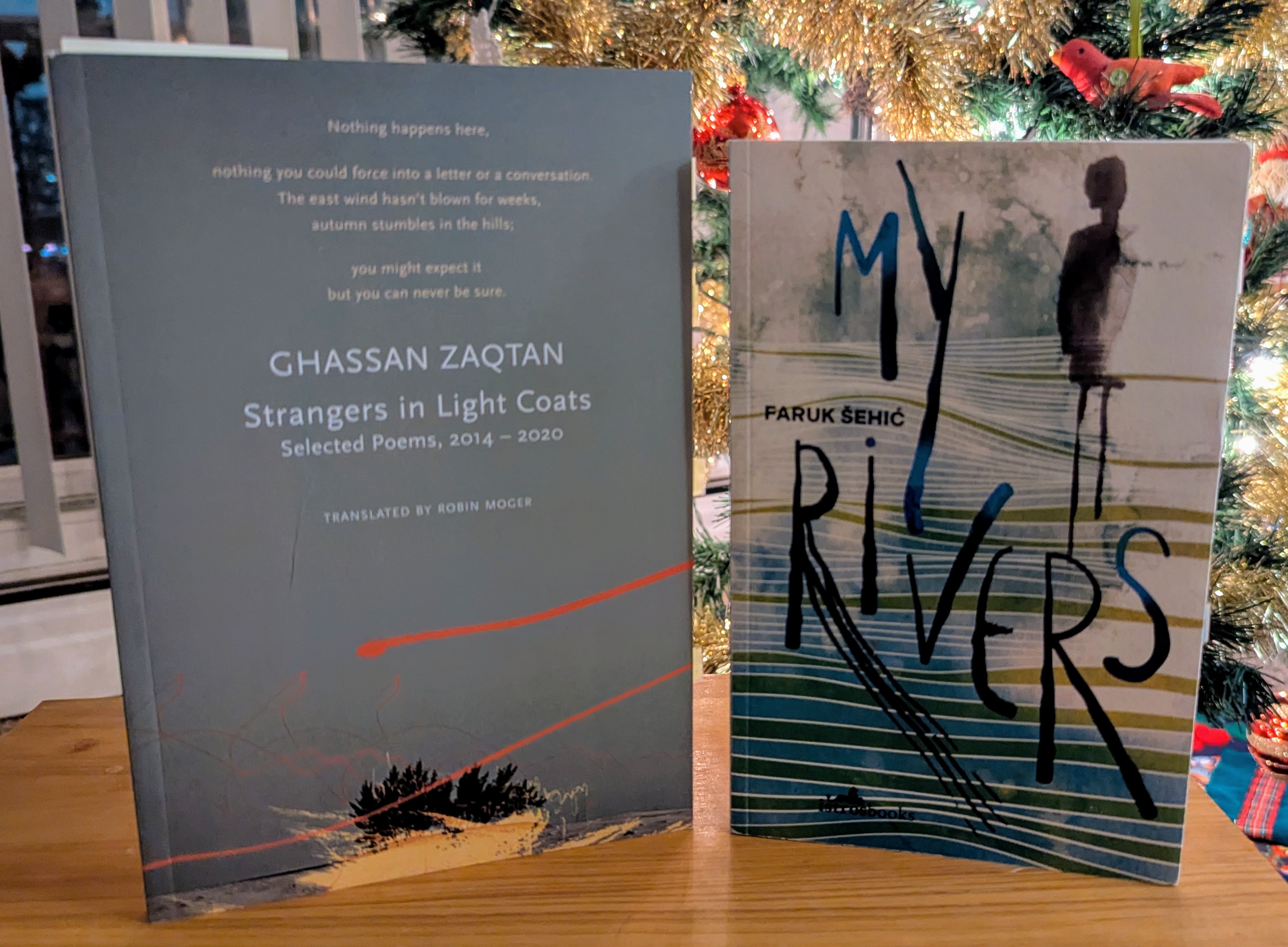
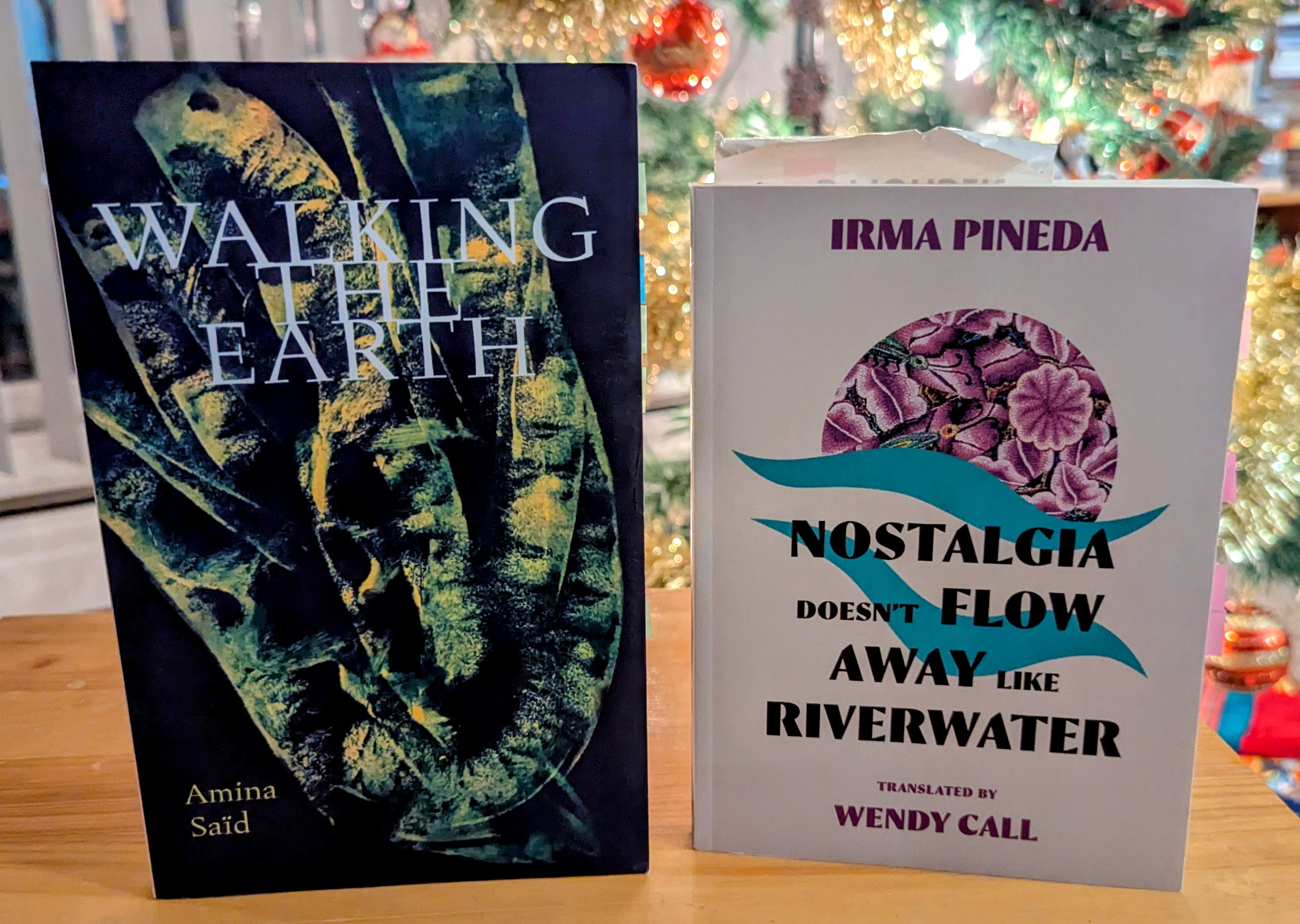
“in the nostalgia of a world / from before this world”:  Walking the Earth by Amina Saïd

all paths
lead to the same place
journey is illusion’s horseback

the world’s embers
blacken its wanton footstep

they burn
our anxious tongues

within its form
the poem seeks itself

Poems for wanderers, or the poem as a series of wandering, emergent forces, Walking the Earth by Amina Saïd hums with an intoxicating, primal energy that speaks to something fundamentally vital and human, in a sense that is too easily buried in the noise and chaos of our constantly plugged-in contemporary reality. Born in Tunisia in 1953, to a French mother and Tunisian father, Saïd was raised in both Arabic and French. At the age of sixteen she moved to Paris with her family where, when she entered university, she decided to study English literature so not to have to choose between her two native languages. Her poetic vision, however, draws on French and Arabic sources and the sunlit Mediterranean landscapes of her birthplace.

Today, Saïd can be considered, according to Hédi Abdel Jaouad, the author of the Preface present text, as the “most potent—and prolific—poetic voice in Tunisia today, if not in the whole of Francophone Africa.” Yet, until this point, no complete, single volume of her work has been made available in English. Now, thirty years after its original 1994 release, Walking the Earth (Marche sur la terre), in Peter Thompson’s translation, finally corrects this oversight.

This haunting sequence of poems, untitled and distinguished only occasionally by dedications, or by shifts in format or theme, has a hushed meditative quality reinforced by the poet’s spare, concise language, subdued and mystical tone, and the recurrence of common motifs. The world her speakers evoke is shaped by primordial elements in concert with journeys across a vast unformed terrain:

earth is this round dream

in its heart
stones fusing

their fire tongues
gouge the pathways of blood
where another fire burns

In her prefatory Note, Saïd writes that this, her seventh book, can be understood as a search for “place”—one that moves from the intimate to the universal—her own journey and that of many who pass through spaces “as much geographical as mental.” She is thinking of the displaced, those driven to move by war or disaster, but also the wanderer and traveller. Wandering is a theme of particular importance in Maghrebi (Northwest African) literature, and one that touches the poet, as someone who writes to hold an intermediary space between the Orient and the Occident, deeply:

My belonging to these two worlds both legitimizes the quest for place and generates a proliferation of doubles: shadows, voices, witnesses, angels, those who keep vigil. . .

This quest for place is born of a profound feeling of exile. Isn’t any creative person “exiled,” a nomad, an eternal wanderer seeking a place—a utopia, a place imaginary, impossible, dreamed of—which poetry can, with a sudden flaring, show in an unforeseeable image?

The quest that stretches across the pages of Walking the Earth is rich in mythological and archetypal images. The recurrence of specific motifs—light, darkness, stones, deserts, shorelines, blood, fire, tongues, voices, screams, silence—contributes to the cyclical feel of the work. Walking is an existential act while language and words are formative elements:

a voice recites
a voice despairs
the choir takes heart

a hand inscribes
ancient alphabets

the light awakens

As the sequence progresses, it becomes clear that the search for “place” is ultimately a search for meaning. The poem itself is the journey, even if the end is but another beginning. It is a path a reader can walk over and over again, and arrive at a different “place” each time.

the poem scents itself
with deepest night

I inscribe myself with sand and dust
in the nostalgia of a world
from before this world

I’m absent
from the mirror of the tribe

Walking the Earth by Amina Saïd is translated from the French by Peter Thompson with a Preface by Hédi Abdel Jaouad and published by Contra Mundum Press.

People can grow old anywhere: Man in the Holocene by Max Frisch

—only human beings can recognize catastrophe, provided they survive them; Nature recognizes no catastrophes.

—man emerged in the Holocene.

It has been raining for days now, no night passes without thunderstorms and cloudbursts. In fact, Geiser can catalogue more types of thunder than the Encyclopedia which, to be fair, is rather mute on the subject, preferring to describe lightening instead. But, when we meet him, the seventy-four year-old widower is passing yet another stormy night trying to build a pagoda out of crispbread. And worrying the possibility of landslides. The highway through the valley is blocked so the mail bus can’t get through. Periodically the power goes out. To get through, he is intent on keeping his mind active, reading, accumulating facts and endeavouring to remember those details—like mathematical formulas—that have slipped into the dust of his aging memory.

Man in the Holocene by Swiss writer Max Frisch is by turns the funny, unconventional, and bittersweet tale of a man who is waging his own little battle against the dying of the light, and attempting to construct a refuge in a gallery of facts while the storm rages outside his door.

Somewhere a tapping on metal.

He trains his field glasses on the mountainside watching for cracks, and reads up on the meteorological history of the valley he has lived in for the past fourteen years. He  delves into matters of rock formation, studies the measurement of geological time, and records details about dinosaurs. He begins by copying out information, but soon realizes that it is far more efficient to clip out passages of interest from the encyclopedia, the Bible, and other books, and then tape them to the walls of his home. Reproductions of his various cut and paste selections are embedded in the text.

Occasionally Geiser ventures out, umbrella in hand, to examine the state of his garden with its fallen dry stone wall, or once the power goes out for an extended period, to give away all the food in his deepfreeze—“the meat, usually hard as iron, is flabby, and the trout are repulsive to the touch, the sausages soft as slugs.” Only when he returns home, having foisted his thawed goods on his befuddled neighbours, does he remember that he could have at least roasted the meat over the fire in the wood stove.

One is becoming stupid—!

Through a fragmented text, repeated refrains, collected facts, and Geiser’s increasingly muddled meditations, Frisch brings us into the interior world of a truly memorable protagonist. He is a modest, somewhat eccentric figure who, at least since his wife’s death, has tended to keep to himself. Originally from Basel, where his daughter, son-in-law and grandchildren still live, he is an outsider, no matter how long he has lived in the valley. “A valley without through traffic,” as he describes it. A detailed description of the region, its industry, and social history is, if rather nonchalant in tone, not without moments of dry humour:

In the summer there are cranberries, also mushrooms. When it is not raining, the white trails of passenger planes can be seen high in the sky, though one does not hear them. The last murder in the valley—and that only rumored, since it never came to court—happened whole decades ago. Ever since the young men have owned motorcycles, incest has been dying out, and so has sodomy.

Women have had the vote since 1971.

What makes this novella work so well is that it is not simply an assemblage of fragmented passages, repeated refrains, and a collection of assorted facts. It is a well-paced and orchestrated, if crumbling, tragic comedy.  Geiser’s memory may be fading, but the narrative takes us into vivid accounts of the Icelandic landscape he once visited and a youthful attempt to climb the Matterhorn with his brother (a story he’s told so often that even his grandchildren are tired of it). And then there is his possibly ill-advised decision to, due to the blocked highway, head off early one morning with the goal of crossing the mountain pass so he can catch a train to the city. He changes his mind quite late into the adventure and returns home a weakened and diminished soul. A tired, confused man now determined to shut out the world once and for all, but still the reluctant hero of a story that is beautiful, sad, and quite unexpected.

Man in the Holocene by Max Frisch is translated from the German by Geoffrey Skelton and published by Dalkey Archive.

The reversal of the currents: The Lockmaster by Christoph Ransmayr

Five dead. That is the fact the opens and haunts The Lockmaster: A Short Story of Killing by Austrian author Christoph Ransmayr. Five people are killed when a longboat carrying twelve capsized above the Great Falls of the White River when the sluice gates suddenly opened releasing a torrent of water that caused the vessel to lose control and shoot downstream, all while a crowd of festival goers watched from the sidelines. The lockmaster, who had for thirty years, proudly guided boats safely around the falls through a series of locks, made a valiant effort to manually close the gate, and was locally regarded as a hero. But when his son, a hydraulic engineer working on a project in Brazil, receives word of the event, he is not so sure it is an accident.

Set in some indeterminate future time, when sea levels are rising and inland regions are drying out, this novella depicts a world in which water is a precious resource to be defended by force. In many places the tensions over resources have ignited tribal wars or enabled the rise of brutal dictatorships while in Europe the political landscape has been shattered into a vast number of warring microstates each with their own flags, languages, cultures and long list of enemies. The narrator and his sister Mira, as the children of the lockmaster and his foreign wife, grow up in a socially isolated home situated above the falls. The waterways are their playground, but all of their education is conducted over screens, so they rarely engage with other young people. As a result, they develop an intimate relationship, something that is no longer taboo but nonetheless unsettling to imagine, especially because the narrator is still so thoroughly obsessed with Mira who has a rare condition that makes her bones exceptionally fragile.

One year after the incident at the festival, the lockmaster himself disappears. When an angler reports having seen a man in a boat dragged over the crest of the Great Falls, although no remains are found, he assumed to have drowned. At this point, the narrator is still in Brazil, the very tight, globally controlled restrictions surrounding major water projects forbid his departure even for a family emergency. His sister is left to tidy up their father’s affairs (their foreign mother had long since been deported from the small central European microstate in which they lived) and by the time he finally gets home, even his beloved Mira is gone, having married a dyke reeve and moved with him to the rapidly eroding shoreline of the Elbe estuary. Already questioning his father’s innocence in the collapse of the festival longboat, when the narrator reaches his next assignment on the Mekong River, he is certain that his father is both a heartless killer and still alive.

Five or seven or twelve cannot have made any difference to him—after all, the precise number of their victims did not bother the bomb planters and well poisoners who were, in those times, bent on drawing attention to themselves and their grand ideas in countries, tribal areas and microstates. Deaths meant fear; and fear meant open ears and open eyes. No one could fail to hear; no one could fail to see what a murderer did, even if he denied his deed.

With this crime, my father clearly wanted to defy the course of time and take himself back to overweening dreams where a lockmaster had been more, much more and more influential than the curator of an open-air museum on the White River could ever be.

The world of conflict, armies, mercenaries, and rebels within which the narrator moves in his work which has taken him to so many of the earth’s great rivers, colours his understanding of the tragic event at the Great Falls and his father’s presumed role in it. He vows to hunt him down and kill him.

This is a more focused effort than Ransmayr’s more sweeping work like Atlas of an Anxious Man, but it does highlight his broad global perspective and ability to evoke a vivid natural—or unnatural—atmosphere as his protagonist navigates the world of his present and remembered past. But the narrator is not a readily sympathetic character. He continually refers to his father as a “man of the past,” but his own refusal to accept that his fragile sister has had the audacity to marry someone else and not sit at the Great Falls waiting for him while he travelled the world, demonstrates that he too is caught in his own self-centred and, to be honest, somewhat disturbing incestuous longings. This is, of course, a fable. A dark speculative folktale. Neither the characters nor the political and environmental dimensions are fully fleshed out—but in such a fractured and volatile world, the protagonist’s insularity would be an expected coping mechanism. As such, the oddly discomfiting narrator is not only plausible, but he adds a suitably unnerving tone to the gloomy undercurrents already driving his story. And Ransmayr’s trademark spare, poetic prose adds a further chilled quality to the work.

The Lockmaster: A Short Story of Killing by Christoph Ransmayr is translated from the German by Simon Pare and published by Seagull Books.
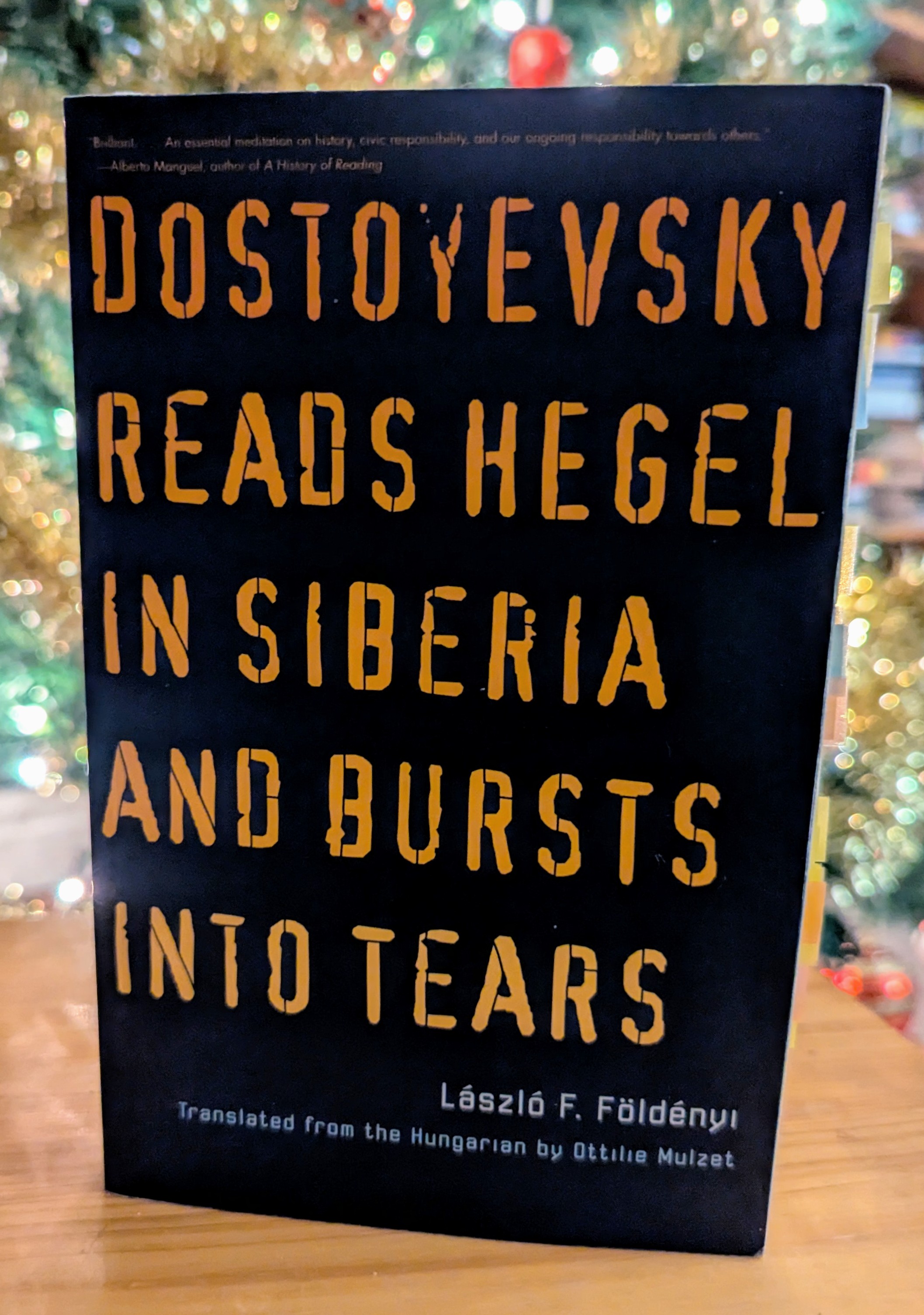
There be monsters: Dostoyevsky Reads Hegel in Siberia and Bursts into Tears by László Földényi

Humans have become alienated from their own history, as they are from their own cosmic nature.
– “Mass and Spirit”

The title is irresistible. It is impossible to read it and not wonder: what is this book about? In truth, it is about many things, or rather, many ideas, but in essence they can all be understood as variations on a dichotomous theme: darkness and light. Pivotal to these inquiries is the lasting impact of post-Enlightenment thinking on a traditional understanding of metaphysics, that is, questions of being and the nature of reality. Where once religion, or belief in God, gods, or some transcendent quality of existence could be turned to in times of darkness, the Enlightenment heralded a belief in “the omnipotence of reason that illuminates all phenomena.” Yet, as László Földenyi posits in this wide-ranging collection of essays, adroitly translated by Ottilie Muzlet, darkness and light (or other similar opposites or variants) are inextricably linked—one cannot be imagined or understood without the other—but in our secularized modern age, we, in our restricted, nondivine omnipotence can find ourselves confronting our own fragility in situations where reason alone may not seem like enough to fall back on. What then?

In his explorations of this conundrum, Földenyi, a Hungarian critic, essayist and professor of art based in Budapest, entertains the ideas, experiences and tribulations of a broad cast of thinkers, writers, poets, artists, and literary figures including Elias Canetti, Heinrich von Kleist, Caspar David Friedrich, Nietzsche, Novalis, Marquis de Sade, Antonin Artaud, and many more. And, of course, the protagonists of the evocatively titled eponymous essay: Dostoyevsky and Hegel. As he examines the manner in which rationalism, and within it a constrained idea of freedom and existence, has been met by those who chafed against its confines to a greater or lesser extent, Hegel is often assigned to the role of advocate for the primacy of logic and reason—not necessarily always fairly—so he makes a regular appearance in a number of pieces. But his main starring role is as philosophical foil to a certain Russian writer exiled to Siberia.

“Dostoyevsky Reads Hegel in Siberia and Bursts in Tears” is a vivid exercise in imagination which takes us to Semipalatinsk in southern Siberia where Dostoyevsky was sent in 1854, to serve a period of military service following four years of forced labour. In this barren, desert environment, he lived in a sparely furnished room and made friends with the young local prosecutor, Aleksander Yegorovich Vrangel, with whom he recited poetry, discussed religion, most critically, studied the books that Vrangel was able to secure for him. There is some reason to believe that one of the authors they read together was Hegel, possibly his lectures on the philosophy of world history, either ordered from Germany or in the form of the book in which they had been gathered and published. Földényi enthusiastically admits that he is taking liberties with his assumptions, but the notion is too tempting to resist.

Dostoyevsky emerged from his years of imprisonment and exile, as a man and writer whose experience with hardship and isolation had ignited a metaphysical drive that he would go on to channel against nineteenth century Europe’s adherence to utilitarianism and rationality through his protagonists. For Hegel, history, despite its messiness and violence,  could only be properly understood as the logical, progressive march of reason. That which fails to conform—at least in terms a European mind might understand, as such Africa and Siberia—is relegated to stand outside of the historical process and to be worth no further consideration.

If the infinite and the transcendent become lost behind the finite things, then it is no longer possible to speak of freedom. God, subjugated to rationality, is not the God of freedom, but of politics, conquest, and colonization. This is the secular religion of the God of the modern age. And history—looking at it from a Hegelian point of view—is the history of secularization. Dostoyevsky might have justifiably felt that Hegel was not just ushering Siberia (and himself with it) out the door; he was trying to convince, in missionary-like fashion, all humanity to accept as historical only that which the censorship of rationality admitted as such.

In envisioning an intellectual clash between the ideals represented by Hegel, and Dostoyevsky’s own experience of life in a place deemed separate from history, under conditions he would never have known had he not been forced to leave Europe, Földényi sees the ground for the openly acknowledged spiritual transformation that the Russian underwent in Siberia, and the writer he would become.

This may be the most passionate essay in the collection, but many of the smaller, quieter pieces turn on equally intriguing ideas in an open, speculative manner. He writes, for example, about happiness and melancholy, fear and freedom, sleep and dreams. Often his intention is to push beyond a simple dichotomy, at other times he wishes to dig down into an idea through the examination of the lives and ideas of one or more individual who found themselves confronting the limitations imposed by a society dedicated to the furthering of rational ideals. Case in point, in the also cleverly titled “Kleist Dies and Dies and Dies,” Földényi unwinds Kleist’s trajectory from an enthusiastic supporter of Enlightenment ideas through an early “Kantian crisis” which shattered his faith that Truth was knowable, to an act—possibly inspired in part by Goethe’s Werther—that eclipsed any of his writing: his carefully orchestrated double suicide with Henriette Vogel on November 21, 1811.

It bears repeating: the death of Kleist is the most thoroughly documented event of his entire life. The French-Romanian philosopher Emil Cioran justifiably states that it is impossible to read even one line of Kleist without thinking of how he put an end to his own life. His suicide preceded, as it were, his life’s work.

It is tempting to consider, and Földényi obliges, how Kleist’s embrace of death, or the act of dying, might be an answer to the loss he felt in an uncertain world.

The pieces in this collection were published in their original form (some have been substantially revised) between 1990 and 2015. They are not presented chronologically, nor can they be read as one cohesive argument, not least due to the fact that times, and presumably their author’s views, change. But it is telling that the volume opens and closes with essays addressed to Elias Canetti: the first, “Mass and Spirit” written in honour of his ninetieth birth anniversary, the latter, “A Capacity for Amazement,” an examination of his seminal Crowds and Power, fifty years after its original publication in 1960. His examination of Canetti’s exploration of the universal crowd and its ambiguous role in human history is measured, at least for Földényi, against Hegel’s understanding of universal freedom as a rational ideal. For Canetti, the crowd is more than a gathering of humans, it transcends that simple notion to incorporate all natural phenomena, it is cosmic and inherently irrational. Although he may or may not be onside with all the implications of Canetti’s singular arguments, Földényi clearly admires his metaphysical energy and, as the title suggests, his capacity for amazement.

The best essays wrestle with ideas, challenge assumptions, and invite the reader to entertain possibilities, debate with them or, even better, be inspired to read further. Dostoyevsky Reads Hegel is filled with references to so many writers and works that it is impossible not to stop to look someone or something up, or pull a volume off one’s shelves. It encourages side trips down rabbit holes. And that is what is so rewarding about spending time with László Földényi and the fascinating company he keeps.

Dostoyevsky Reads Hegel in Siberia and Bursts into Tears by László Földényi is translated from the Hungarian by Ottilie Mulzet and published by Yale University Press.

Who holds the truth? Sister Deborah by Scholastique Mukasonga

The latest work from Rwandan writer Scholastique Mukasonga, to be released in English translation, is a novella that takes us back to 1930s Rwanda when the small, landlocked east African country was under the administrative control of Belgian authorities and the religious influence of the Catholic church. With the arrival of a group of black American evangelists, life in a small community faces unprecedented challenges to both the externally enforced regulations and the traditional norms of social conduct. When the local chief grants them permission to establish their mission on a hillside long associated with pagan rituals of the past, rumours spread and curiosity is aroused by their seemingly strange services and the enigmatic prophetess who dances, babbles in strange tongues, and appears to have miraculous healing powers. Women, in particular, are drawn to her, while the village men tend to regard her and her odd companions with distrust.

Meanwhile, the narrator of this tale, Ikirezi, is a sickly young girl mysteriously prone to endless maladies. Suspicious of the white man’s medicine, her mother applies all of the home remedies she can think—all to no avail. Ikirezi’s illnesses only grow worse. There is, she decides, but one solution:

“Tomorrow we’ll go to see Sister Deborah, she’ll be able to cure you. Tomorrow we’ll go to Niyabikenke, to the mission of the black padri.” If my father noticed our travel preparations, he exploded in fury. “You are not going to that devil’s mission. I forbid it! Didn’t you hear what our real padri said about it? They’re sorcerers from a land called America, a country that might not even exist because it’s the land of the dead, the land of the damned. They have not been baptized with good holy water. And they are black—all the real padri are white. I forbid you to drag my daughter there and offer her to the demon hiding in the head and belly of that witch you call Deborah. You can go to the devil if you like but spare my daughter.”

Ikirezi, we will later learn, is not only strengthened physically and intellectually as result of her encounters with the foreign faith healer, but she goes on to study abroad and become an anthropologist. This accounts, perhaps, for the  tone of the of the extended first section of Sister Deborah which  often relies on varying details, reports, and speculation about what might or might not have happened, resembling at times a sort of gathering and integration of field data. The narrative extends beyond that of a child’s experience, describing the conditions surrounding the settlement of the American missionaries, the black pastor’s talk of the impending return of the Savior to this very location in the heart of Africa, and Sister Deborah’s particular appeal to the womenfolk, some of whom come to understand her to be implying that the Savior will likely be a black woman who will descend from the clouds bearing a special seed that will grow and flourish to feed their families without back breaking labour, thus releasing them from the constraints imposed on them by their husbands and economic traditions. Needless to say, the men of the community, the church, and the administrative powers are unsettled by the disruptions and feminine empowerment that arises in the wake of Sister Deborah’s influence. A series of events that lead to the expulsion of the Americans and the disappearance, or possible death of the prophetess are shrouded in confusion and conflicting accounts.

A brief second part considers the possible fate of Sister Deborah and allows Ikirezi to explain how she came to be a professor based in Washington, DC, dedicated to the study of her people but oddly aware of the hands of Sister Deborah somehow guiding her. She senses she has to follow a path laid out for her. Research leads her to a shantytown in Nairobi where she finds the faith healer, now known as Mama Nganga, and turns the narrative over to her. Now, the woman at the heart of this tale, has an opportunity to tell, on her own terms, the story of her life, reaching back into her own childhood in America and forward, through the formation of the missionary project, the long journey to Rwanda, her mystical awakening, and beyond the turmoil in Niyabikenke, to the life and identity she has created for herself in Kenya.

Her own spiritual evolution, as she describes it, was filled with mystery, even as she reflects on it years later. Early on, for example, when the  mission pastor suggests that the otherworldly sounds she makes when she falls into a trance may come from an African dialect, to be understood as a sign that all the black peoples will be liberated and saved from the coming  biblical Apocalypse, she has her private interpretation:

As for me, I was prey to a strange thought that I didn’t dare confess to Reverend Marcus. It seemed to me that the spirit speaking through my mouth was not the Holy Spirit of the pastors, who was always trailing behind the Father and Son. For one thing, it spoke neither Hebrew nor Greek nor Latin, but perhaps indeed, as Marcus believed, an African tongue. The spirit that had chosen me as medium could only be an African spirit, perhaps the spirit of the black woman who had visited me during my trance. I made prayers to her; I diverted toward her the worship that the pastor celebrated for the Savior. I preciously guarded that secret in the deepest recesses of my heart.

Sister Deborah Nganga’s account is ultimately one without clear resolution. Forces run through it that neither she nor the narrator, who also feels their presence, can fully articulate. Ikirezi’s later return to Nairobi to follow up on the fate of the former faith healer is again, like the opening section, guided by rumour, informants, and speculation. This is a book that continually asks questions about truth and memory, in the context of oral history, recorded biography, and academic research. There are no firm answers: Mukasonga allows uncertainty to linger in this story that explores the challenges and varying fates experienced by African women in times of shifting social and political conditions, yet keeps the spirit—or spirits—alive.

Sister Deborah by Scholastique Mukasonga is translated from the French by Mark Polizzotti and published by Archipelago Books.

On through the dark forest: Celebration by Damir Karakaš

This taut novella opens in 1945. Above a little village, Mijo lies hidden in the woods, looking down at he house where his wife and sons live. In his yellow-brown uniform he must stay out of sight. The war is over and the soldiers of the Nazi-allied Ustaša force are now on the run or in hiding. He hopes against hope that he will someday be able to return to the little family he left behind when he was recruited into what would become an infamously brutal campaign:

He lay on the blanket that had over the last days soaked up the smell of rotten leaves and damp earth: under his thick brows he spent most of his time watching the village, then the mixed canopy above his head, noticing all the while how the colors were fading. Sometimes out of the corner of his eye he’d peek at the gleaming orb of the sun, gauging the time of day; never had time passed more slowly: he kept lying there in that one spot, sensing in his nose the sharp odor of melting resin, and all that was moving around him began to bother him: the sun, the wind, the birds that often flew low with their winged sounds over the forest.

Celebration, set in the mountainous region of Lika in central Croatia, explores the harsh realities that can lead poor, under educated individuals to embrace an ideology that appears to offer something they need and become involved in actions that they do not fully understand. There is no question that Mijo is hardened and isolated by his experiences, but in this, our initial encounter with him in the first chapter of this book, his emotions swing between anger and an idealized hope that he will be able to avoid the fate that seems almost all but inevitable.

Croatian author Damir Karakaš does not provide an elaborate historical context for the events reflected in the four short chapters that comprise Celebration, preferring to allow references to slip in through the thoughts, comments and actions of his characters.   However, in an interview for Center for the Art of Translation, he describes the people of Lika as predominantly peasant farmers and herders who were historically expected to be ready to go to war at a moment’s notice for a series of occupying forces over the years:

Croatia has always been governed by powers who exploited it. In the First World War, Croats from Lika fought, wearing the uniform of the Austro-Hungarian army, on the side of the Central Powers, against the forces of the Entente. Serbia, on the other hand, was part of the Entente, so when the Central Powers lost the war, the Yugoslav peoples were organized in a new country that the Croats were not pleased about. Croats referred to the new country as a “dungeon of peoples.” And I have to say that the Serbs did dominate the new country. Most of the generals in the army were Serbs, the leaders in the cities were also Serbs, and the government treated Croats very poorly, especially in Lika, with constant harassment, steep taxes, villagers were not allowed to keep dogs, there were even times when women were required to pay for the bullet that the constables used to kill their husbands.

This environment proved to be ideal for fertilization of the seeds of the kind of extremism promoted by the ultranationalist organization the Ustaša. With the onset of the Second World War, under the patronage of Hitler, the independent state of Croatia was formed, while the Ustaša leadership embraced Nazi ideology with a murderous enthusiasm that even shocked the German dictator himself. In Lika, recruitment was conducted through celebrations held in rural communities with plenty of free food, a festive atmosphere, and simple promises that young men living in poverty without even a pair of decent shoes would see as a chance to secure a future for their families.

After introducing Mijo, so close but unable to return to the life he longs for, Karakaš takes us back in time to explore how it is that he came to find himself in this uncertain state. He does so in tight chapters that each read like a stand-alone story—intense, densely detailed scenes that follow the characters closely, through rural landscapes of farms, forests, meadows, and mountains, over the course of no more than a day or two. In “Dogs,” dated 1935, Mijo is still living with his parents on their small farm. When a constable is attacked by a dog, the officials announce that no one is allowed to own a dog any longer. It is Mijo’s responsibility to take their poor hound into the woods to meet his fate. “Celebration,” dated 1941, follows Mijo, his girlfriend Drenka, and her brother Rude, as they make their way to the nearest larger town where a celebration is being held. The walk takes hours as they make their way through forests, meadows, and over hills. Rude, already sporting army boots, impatiently hurries them along and fretting that they will be late. The final chapter, “Father,” dated 1928, focuses on Mijo’s impoverished father struggling to imagine how he can possibly provide for his wife, four children and aging father. There is a longstanding tradition that will at least relieve him of one of those mouths to feed. It plays out in this chapter, as Mijo tags along filled with all the joy that only a child can find in the wonders of nature, oblivious to what lies ahead.

This is a small, slender volume, easily read in an afternoon, and inviting a reread to open up the references woven into what is an intensely detailed, yet spare, text. Karakaš evokes a strong sense of place, the harshness of the environment, the vast distances regularly travelled, dense woods, howling wolves, and the grinding poverty of the people. But with his characters, he  zeroes in on gestures, expressions, fragments of conversations. He says: “I am all for editing, I tighten my writing a lot, and maintain Chekhov’s principle that a writer should be frugal with words and generous in thoughts.” The multigenerational portrait he sketches in this powerful novella offers sharp insight into the formation of a soldier like Mijo from the perspective of the poor rural population he comes from—and naively imagines he might return to. It is a story applicable beyond this specific place and time, and one that only further heightens the tragedy of war.

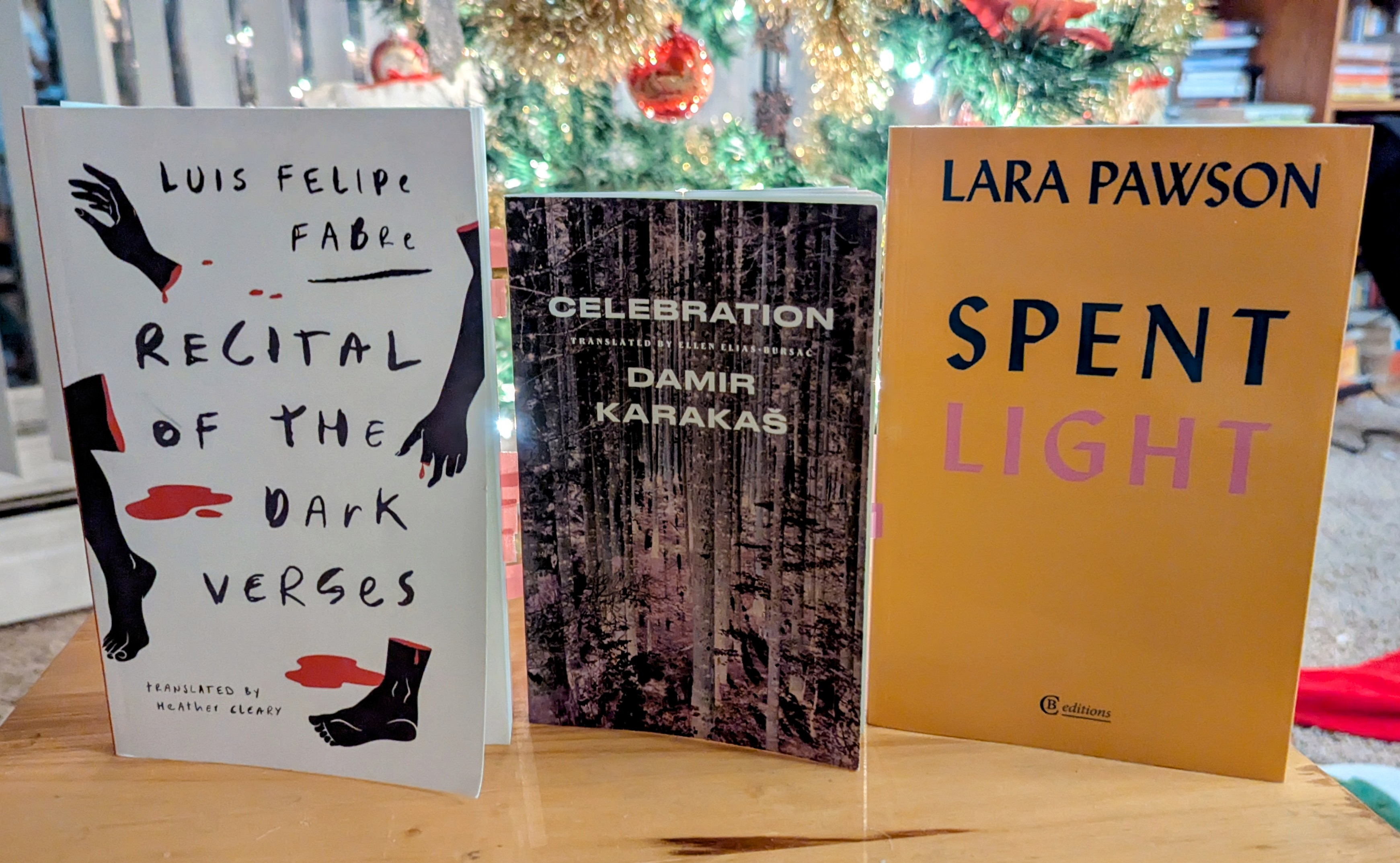
Celebration by Damir Karakaš is translated from the Croatian by Ellen Elias-Bursać and published by Two Lines Press.