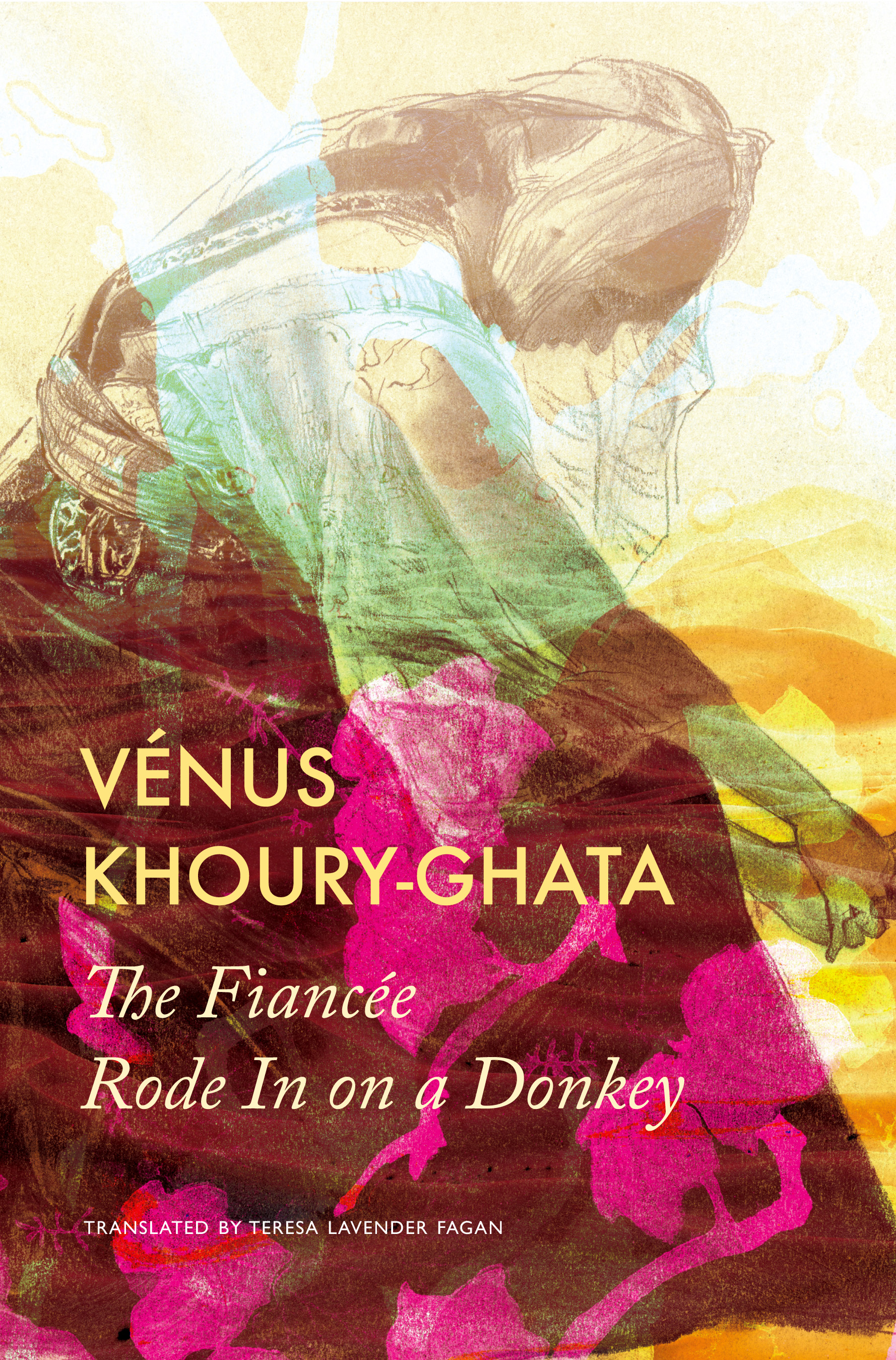
Each person has their own star: The Fiancée Rode in on a Donkey by Vénus Khoury-Ghata

Deep in the desert, excitement is building. Among the Qurayza, a Jewish nomadic tribe, young girls are being readied for the arrival of a special visitor. An important rabbi is coming to select a bride for the great Algerian military and religious leader Emir Abdelkader. He has wives already, of course, but another, a Jewish girl, is to be offered to secure protection for her people.  For the girls, scrubbed and polished and hennaed, to be chosen would mean a chance to escape a prison of sand for a better life. Or so everyone believes.

Just one look around is enough for the rabbi to find the chosen one. He picks Yudah for her name, a contraction of Yahuda, and for her eyes which she lowers when he looks at her. Every woman is beautiful to the rabbi as long as she isn’t one-armed or one-eyed.

Each one of Khoury-Ghata’s spare novellas is different, exploring a different time and place, and The Fiancée Rode in on a Donkey is no exception. Set in the mid-1800s, this tale follows Yudah, the promised fiancée, from her desert home to the streets of Paris in a year rocked by revolution. Although, if time frames are correct, her journey lasts little more than ten or twelve months at the most, it will test the courage and resolve of this young heroine.

When Yudah arrives on the back of the rabbi’s weary old donkey, she is dismayed to discover that Abdelkader’s entourage is not housed in town, but in an encampment nearby. She realizes that she has traded one kind of tent life for another, but the welcome she might have anticipated is not forthcoming. The Emir is away on campaign, engaged in a battle that he will not win, and no one seems to know what to make of this scrawny teenager who claims she is his bride-to-be, destined for his bed. An outsider trying to find a small corner in the camp or wandering around town alone, she begins to mourn the desert community she has left and the boy, her cousin, to whom she had given her heart. It is but the first of a series of displacements to follow.

Before Yudah has a chance to meet the man she has been led to believe would become her husband, Abdelkader is forced to surrender and exiled to France with his family. Yudah, with no formal connection to him, is taken to Île Sainte-Marguerite with the great man’s followers—hundreds of men, women and children, few of whom will survive the winter on the island. But here, too, the young daughter of the desert is still an outcast. She does find refuge in a convent where she is, for a time, renamed Judith, until her stubborn nature and—at least to the eyes and ears of the nuns—cultural coarseness disrupts the strict order of religious life. She is forced to move on several more times until she eventually finds herself in Paris in the spring of 1848.

Alone and forced to repeatedly adapt to circumstances and customs that her fifteen years of life have in now way prepared her for, Yudah clings to the superstitions of her tribe:

The Qurayzas say that the sound of a badly oiled drum can unleash a war, but who among all these people has ever heard of the Qurayzas? Do they know that the inhabitants of the desert see farther than life? That their gaze goes beyond the horizon that separates the living from the dead? That the parched camel drivers who dream of wells and rain drown in the sand as in the sea? That the palm tree at arm’s length is only a mirage and that what they think is a galloping horse coming to meet them is only the slow steps of the evil spirits crying between the dunes? Female spirits, they point out, the only ones authorized to accompany the lost at the time of their death.

Her conviction that a special destiny awaits her, born less out of any sense of superiority than out of a belief that the well-being and security of her people depend on it, keep her from losing all hope even when she falls into thinking that she is insignificant and could disappear from life without anyone ever noticing. Uneducated and illiterate, Yudah carries a traditional wisdom that belies her age, one that intersects with French society at such a distinctly foreign angle that it allows her to see and measure things differently. This otherworldly charm will lead her into the most unlikely situations, both fortunate and tragic.

What allows this historical, yet slightly magical, tale to work so well is the light touch with which it is told. As a poet, Khoury-Ghata is capable of creating memorable characters, and capturing settings and interactions with a devastating economy of words, whether she is working with well-known figures like Osip Mandelstam or Marina Tsvetaeva, or someone like this young Jewish girl from the Algerian desert. In tracing the fate, not only of Yudah but of the other young men and women she meets, this novella offers an unexpected view of a well-known period of French history, highlighting the challenges endured and the damage that can be done to ordinary people caught up circumstances they cannot control.

The Fiancée Rode in on a Donkey by Vénus Khoury-Ghata is translated from the French by Teresa Lavender Fagan and published by Seagull Books.

We’re too small for the sky to pay attention to us: Great Fear on the Mountain by Charles Ferdinand Ramuz

In this novel, the stage is set quickly with little fuss. The story opens at a village council meeting in an unnamed Swiss alpine community where the members have gathered to discuss the shortage of available grazing land for their cattle. The situation is acute and the answer seems obvious to some and ominous to others. High on the mountain lies the verdant Sasseneire pasture, abandoned for many years after an event so terrifying that the elders dare not speak of it, warning that to go back would be to invite evil to return once more. But the young, who don’t remember that time, put little stock in what seems more folklore than fact. As the Chairman argues:

“Those are just stories. No one ever really found out what happened up there. It’s been twenty years since then, all that’s in the past. To my mind, the long and the short of it is that for twenty years now we’ve been making no use of that fine grass, which could feed seventy animals all summer long; if you think the village can afford to be extravagant, then say it; myself, I don’t think so, and I’m the one who’s responsible . . .”

The debate is short; the younger folk win the vote. And so begins the process of securing the site, repairing the chalet, and, most challenging of all, finding enough men willing to spend the summer up on the mountain with the herd.

Great Fear on the Mountain, the 1926 novel by Charles Ferdinand Ramuz, is a bucolic tale that takes place in the looming shadow of mystery and death with a hint of the supernatural. Ramuz (1878 – 1947) was a Swiss-French writer who, although he spent his adult years in Paris where he counted Igor Stravinsky among his close friends, continued to look to Switzerland for his fictional landscapes. He set his stories in rural communities, writing of farmers, villagers, and mountaineers often confronting disaster and tragedy. His distinctive style would later influence Jean Giono and Céline. And, it is this style, with its shifting, almost omnipresent, narrative voice, vivid depictions of nature, and the ominous repetition of key phrases, that manages to build the intensely claustrophobic atmosphere of dread that gives this spare  novel its power.

Seven men ultimately come forward to go up to Sasseneire. They include the leaser of the land, Crittin, generally referred to as the master and his nephew, a young man named Joseph who hopes the extra money earned will allow him to marry his beloved sweetheart, and old Barthélemy, a survivor of the last summer on Sasseneire who wears, as a protective talisman, a bag containing a piece of paper on a rope around his neck. Along with an adolescent and another townsman, the team is rounded out with the strange, physically deformed Clou—an odd man who seems to have his own agenda.

Once they are up on the mountain with the herd, a sense of unease quickly settles over the men, becoming especially palpable once night falls:

Outside, it must have been thoroughly dark, and perhaps there were stars, perhaps there were not; they couldn’t know. Nothing could be heard. Listening did no good, nothing at all could be heard: it was like at the beginning of the world, before there were humans, or, at the end of the world after humans had retreated from the surface of the earth—nothing was moving anymore, anywhere, there was no longer anybody, nothing but air, stone, and water, things that do not smell, things that do not think, things that do not speak.

Before long, disease begins to appear among the animals. Just like the last time. The boy comes home shaking with fear, soon followed by another man. The villagers react to news of the sick cattle with alarm. They establish an armed guard on the access road to prevent anyone else from returning and spreading this mysterious  illness. The remaining men and their slowly diminishing herd are essentially trapped and only Clou, who disappears each day, shows no concern about being unable to return to the village. As the men try to cope with increasingly dire circumstances, various shades of despondency and madness begin to take hold.

As the details of the events that originally led to the abandonment of the Sasseniere pasture are alluded to yet never fleshed out, the happenings this time around are equally ambiguous. And potentially much more devastating. A steady sense of dread builds and spreads, up on the mountain and down below, while around them all nature seems to be at once ambivalent and mildly malevolent. It’s a delicate balance:

It was perhaps midday. The sky was arranging itself, without paying any attention to us. At the chalet, they’d tried once again to look into the mouths of suspected animals, grasping their pink muzzle in one hand, introducing the fingers of the other between their teeth, while the animals lowed; up above them, the sky was arranging itself. It was covering itself, was turning gray, with an array of small clouds, lined up evenly spaced from one another, all around the combe, some of them capping the peaks, at such moments they’re said to be putting their hats on, others lying flat on the ridges. There was no wind.

The omniscient third person narrative occasionally shifts perspective, into second and more commonly first person plural. Bill Johnston’s translation traverses this shifting narrative terrain with ease. Great Fear on the Mountain is presented as an allegorical tale that has become part of a larger consciousness, and one that is made more suspenseful by the intentional, almost jarring, repetition of phrases and images, and the depiction of natural phenomena, such as the light and shadows on mountain peaks, as portents of ill fate. You know it can’t end well, but like all the members of this little community, you cannot see what is coming.

Great Fear on the Mountain by Charles Ferdinand Ramuz is translated from the French by Bill Johnston and published by Archipelago Books

It’s so hard to be a stranger: A Blind Salmon by Julia Wong Kcomt

i looked into his low eyes
black, tired
i looked into his heart
and that splotch of vigor
made me
ephemeral, tardy, rancid, and fleeting

we arrive at the altar
in a state of absorption
i request a living offering
start to cough, phlegmy
till i’ve nearly smashed to pieces
at his feet

– from “opium weddings”

The poetry of Julia Wong Kcomt turns on the unexpected, crosses cultures, languages and borders, reflecting who she is, where she comes from and where she has travelled to and lived. Born into a Chinese-Peruvian (tusán) family in the desert city of Chépen, Peru, in 1965, she was a prolific writer whose work included eighteen books of poetry, along with a number books of fiction and hybrid prose. Questions of identity and belonging are central to her writing, as are themes of migration, motherhood, and the body.

A Blind Salmon, her sixth collection, originally published in 2008, is her first full-length work to be published in English translation. Translator Jennifer Shyue who has a particular interest in Asian-Peruvian writers, has been engaged with her and her poetry for several years making this volume a welcome introduction to an intriguing and important poetic voice. Sadly, however,  Kcomt did not live to see its release; she died in March of this year at the age of 59.

Composed while she was living in Buenos Aries, the poems in this dual-language collection, often involve a shift between languages—Kcomt was multilingual, speaking Spanish, English, German, and Portuguese—creating a challenge of sorts for Shyue, especially when the original contains English. This is handled with the use of an alternate sans serif typeface when appropriate, or by bringing Spanish into her English translation for the words or lines in English in the original, as in the poem “tijuana big margarita.” When German arises, it is left as is. This shifting linguistic terrain, like the sands of the region she comes from, adds texture and variation when they appear.

The poem “on sameness” which is repeated or echoed in the collection, is another wonderful example of the multilingual dynamic at play. The first appearance features Kcomt’s own English version of her poem “sobre la igualdad,” presented in two different typefaces on facing pages (the regular typeface and that which is used to denote English in the original). The wording is, naturally, identical. It opens:

in the circle, sweet circle
of intense immortality

where is my china?
the land with no owners
the face is not repeating itself

Later, when the poem is revisited, Kcomt’s Spanish original faces Shyue’s translation, which she made before reading the poet’s own translation (or at least refreshing her memory of a more distant encounter). The similarities and differences shine a light on the perspective a translator brings to her reading of another’s work—line by line and as a whole:

in the circle, sweet circle
of intense immortality

where my faraway chinese country stayed
the great country of all
where no faces repeat

This collection contains a mix of verse and narrative prose poems, the latter sometimes stretching on for three or more pages and offering a broader canvas for the exploration of identity and belonging, in some instances twice removed when set in Germany where Kcomt studied for a time. They address trying to find a home of some sort, balancing relationships, and finding invisible lines can be crossed in an instant as in “aunt emma doesn’t want to die” where the Asian-Latin American speaker, a foreign student, offends her elderly employer with her attraction to a man in a photo (“no looking, margarita. he’s not for you.”) and is forced to leave her home:

when i was moving out, you wouldn’t look at me. at  the geographic latitudes i’m from, we’re unfamiliar with that feeling, is it called ethnic guilt? perpetuation of folklore.

reiner was the forbidden fruit next to that tiger from kenya and you hated me because I took a bite that full-moon night as the children danced in costumes in the square.

[. . .]

and though i thought reiner would come looking for me or call me, that didn’t happen. not that it would have been necessary. his torso had imprinted on my groin. sometimes skin serves as a sort of reproduction.

in student housing i was once again surrounded by people like me. foreigners. it’s so hard to be stranger, to come from elsewhere, to fight, to steal, to do anything to get inside and the insiders throw you bait only to take it away.

The poems in A Blind Salmon seem to become increasingly charged with life and energy each time they are revisited. Kcomt’s speakers are bold and unapologetic, reaching out with language that is sensual, unexpected, unsettling. Her images are often startlingly corporeal, yet always touching the tender complexities of being in the world, a world that does not always no how to understand you, or you it, but one that is fully alive.

A Blind Salmon by Julia Wong Kcomt is translated from the Spanish by Jennifer Shyue and published by Deep Vellum/Phoneme Media.

“wrestling words, terror at the morning gray”: Territories of the Soul / On Intonation by Wolfgang Hilbig

Ah, yes, to enter Hilbig territory, be rural or urban, is to travel a terrain that is at once suffocating and strangely comforting. With each new work to emerge in English translation it is, for an admirer of his melancholy poetics, like coming home:

—Then comes the city of S., our destination almost, laagered on the valley floor, admitting no beam of spring sunlight; it resembles, in fact, a reservoir for all the wet the clouds cast down when they’ve finally gained the surrounding heights. I would have to continue further southward, continue further southwestward, until the actual sea, I think, if I wanted to breathe a sigh of relief . . . here in this valley you remain imprisoned, unarousable, and held to the earth here by an apparently stronger local gravitation, you walk stooped through the city with its churches, descend even lower, to where the empty markets stand, assembled against a yellow prefab administrative circus, such a scene has a sundial on its dome—, but there is no sun here.
From “Adieu”

No one creates an atmosphere quite Wolfgang Hilbig.

Territories of the Soul / On Intonation, pulls together short works from two collections published in the closing years of the GDR—eight stories and two poems—translated by Matthew Spencer and published by Sublunary Editions. Hilbig was born in Meuselwitz, Thuringia in 1941, and grew up in the industrial wilderness of postwar East Germany. He began writing poetry while working as a stoker, but his literary sensibilities were never going to fit with the socialist realism the GDR wanted its working-class poets to produce. Yet, although he migrated to West Germany in 1985, his spirit and his themes tended to remain anchored in the East.

The stories in this slim volume offer a classic cast of Hilbig characters—tloners, dreamers, misfits at odds with themselves and the world around them. They are also often writers, or aspiring writers, even if their literary endeavours take place after work, or in secret on the job if possible. And the workplaces many of them are bound to, like Hilbig himself in his early adult years in the GDR, are mines and factories in set grim, urban or rural wastelands. His work can evoke an atmosphere so heavy and gritty one can almost taste it; his protagonists wander landscapes marred by sludge, refuse, and discarded armaments, their restlessness fueled by anxiety, remorse, and regret. The narrator of “Adieu,” quoted above, has just walked out on his only child, knowing he is wrong, and wondering “how does love become just a thing I rob from another, become a thing I can feel only by denying it to another.” It’s an uncomfortable monologue, made more so by the weight of the speaker’s tortured conscience.

One  of the strongest pieces here is the second title story, “On Intonation.” It opens with a chilling description of a stormy, wet night, viewed from the cockpit window of the nightwatchman’s station above an open-pit mining operation. The narrator is filling in for a missing watchman, a task he put himself up for thinking it would provide him the necessary space, away from the heat of the boiler room, to address a long pressing concern:

What I needed to work out—I had known this for years—was a kind of self-assessment, which would either certify me as a worker or as a true writer; however, since my presentiment was that I had insufficient reasons to properly continue writing, I had so far neglected this decisive memorandum; and yet I needed to fix these details in written memory, so I could exhibit them as proof against myself. —Meanwhile, I had come to a conclusion: I had to note down some urgent thoughts about the intonation of these modern lyrics . . . so I could implicate myself in evading duty.

And, yet, although he had been thinking about this question for some time, he finds himself, at his little makeshift desk, unable to find a word to replace intonation—his thoughts are frozen, he is unable to write the words he is convinced will prove he cannot write. But through this night, as he makes his rounds and struggles with his creative despair, his monologue turns on its own existential exploration of the lyric. The speaker, fearing that he lacks what he needs to be a writer, finds, in spite of himself, that he does.

This compilation, which includes work originally published in 1986 and 1990, is a particular treat for fans of Old Rendering Plant and The Tidings of the Trees—not only for its misanthropic souls, distinctive landscapes, and the occasional hint of gothic horror, but for those long winding and unwinding sentences that seem to pull the narrative into dark corners, resisting but unable to avoid a splash of milky light now and again. Even better, it may serve as the perfect introduction for those who have not yet encountered the addictive terrain of Wolfgang Hilbig.

Territories of the Soul / On Intonation by Wolfgang Hilbig is translated from the German by Matthew Spencer and published by Sublunary Editions.

And so they will travel by night: Recital of the Dark Verses by Luis Felipe Fabre

Out into that wondrous night
I stepped unseen and stealthy,
with not a thing in my sight
nor any light to guide me
but one burning in me bright.

(from “On a Dark Night” by Saint John of the Cross)

If Fray Juan, the determined and devout evangelist of the barefoot or Discalced Carmelites, the reformed order founded by Saint Teresa of Ávila, was deemed troublesome during his lifetime, the humble Spanish friar, poet and mystic who would later become known as San Juan de la Cruz or, in English, Saint John of the Cross, was no less disruptive in the months and years that followed his death. In life, his dedication to the austere principles of the reformed order and his success in fostering it’s expansion across sixteenth century Spain upset other Carmelites. In 1577, this led to his torture and confinement in a monastery in Toledo where he composed and committed to memory one of his best loved poems prior to making his daring escape, naked into the “pitch-dark night.” After recovering from his ordeal, he returned to assisting with the spread of chapters of the Discalced Carmelite before eventually joining the monastery in Segovia as prior. Yet, when he disagreed with some changes being made in his order, he was moved to an isolated location where he fell ill with erysipelas. As his condition worsened, he was transferred to the monastery in Úbeda where he died on December 14, 1591 at the age of forty-nine. However, he would not stay there, well, at least not in one piece. The widow doña Ana de Peñalosa, sister of the influential don Luis de Mercado who was Fray Juan’s friend and the funder of the monastery in Segovia, wanted his remains to rest there.

The effort to satisfy that desire is where Mexican writer Luis Felipe Fabre’s Recital of the Dark Verses begins. What follows is an unexpectedly energetic historical-fiction-meets-comic-road-novel that serves up spirituality, adventure, with a healthy amount of bawdy humour. When the bailiff, whose name biographical sources fail to agree on, and his two young assistants, Ferrán and Diego (thus named because no record exists to confirm or contradict the author’s fancy), arrived at the monastery in Úbeda in September or October of 1592 with orders to collected the late friar’s body, they are met with no small measure of resistance. First there’s the matter of the smell emanating from the corpse that has inspired ecstasy in the monks and near frenzy among the townsfolk who have clamoured for any available piece of Fray Juan’s tattered clothing, soiled dressings, or physical person. As the porter explains to Diego and Ferrán, it is a question of:

“The aromatic clamor of his body. The scent of saintliness. The gentlest of perfumes which stirs in the soul yearnings, burnings, and zeal, and which, emanating from beneath the slab whereunder lies Fray Juan and drifting through the air, at times reaches my own nose  like a distant jasmine while at this door I stand.”

It is a scent that cannot be silenced, an aroma that inspires a devotion so intense that it can lead to feverish displays of ardor or, if one fears being deprived of access to it, potential violence. Of course, for those who cannot smell it, or who only detect the normal odour of decay, it can engender doubt and fear about the solidity of one’s own faith.

But that is not all that delays the planned retrieval. When it is uncovered eight or nine months after the friar’s demise, the body Fray Juan, even with all the sores caused by the disease that killed him, is uncorrupted. A finger cut off still draws blood. So the bailiff takes the finger as a token for doña Ana, and instructs the monks to make an effort to encourage some further desiccation, vowing to return the next year. So it is not until April of 1593, that the bailiff and his assistants finally manage to depart Úbeda with the body of Fray Juan in a large leather case—albeit absent an arm left behind as relic. They travel by night, staying off the main roads, but they cannot escape the saintly scent, impossible to disguise, that arises from their secret cargo and which will be responsible for much of the undue attention and danger that will stalk them as they seek to carry out their mission.

Along the way they not only have to face their own fears as the dark nights threaten to close in around them, they must fend off amorous barmaids, a group of shepherds with ill intent, and an angry mob of townsfolk from Úbeda who are determined to retrieve the body of their blessed friar at all costs. Fabre draws on a wealth of often conflicting historical and biographical accounts of the saint’s posthumous journey, while liberally incorporating themes and figures from Greek mythology. But fundamental to this absurd tale of devotion, temptation, and misadventure are the words of San Juan de la Cruz himself. Three of his best known poems—“On a Dark Night,” “Love’s Living Flame” and “Spiritual Canticle”—are recited in full or in part throughout the novel, along with passages from the extensive commentaries the friar wrote to flesh out his own work.

For a man so committed to an especially extreme expression of faith, Fray Juan’s verse is  intensely passionate and sensual in nature, with a speaker that often takes on a female voice, that of a lover seeking to join with her Beloved. The spiritual ecstasy inspired by his words contrasted with the religious attachment his followers hold to his physical body (which will not make it to Segovia fully intact—only his head and torso rest there to this day), set the stage for a philosophical exploration of the blurred line between the heavenly and the worldly domains. On their journey, the three couriers tasked with the transportation of the friar’s body, will all face their own demons. The bailiff doubts his faith, while twenty-year-old Ferrán, who is trying to stay one step ahead of the Inquisition is cynical and unmoved by the mystic’s poetry. However, sixteen year-old Diego, a naive youth in the full turmoil of puberty, finds his tongue possessed by Fray Juan’s words and his soul struggling to balance spiritual inspiration with his own blossoming sexuality:

He was delirious. Delirious with fear, with fever, with hunger, exhaustion, and love. But through his deliria did Diego speak truth as if by the tongue of another. For his deliria were none other than Fray  Juan’s liras and, though Diego knew them not, from him did they spring forth as if from an old and distant void or night or heart.

The result is a tale that is light in tone, but one that easily carries deeper and darker themes on its playful narrative stream. Careful attention is paid to the exegetic tradition and the formal conventions of the saint’s own commentaries. Each chapter opens with an introduction incorporating the specific lines that will be expanded upon therein along with the particular challenges that await our protagonists. To further evoke the mood of the era, Fabre, in the original Spanish text, employs certain archaic verb forms and syntax. Translator Heather Cleary, unable to access exactly the same measures, choses to:

play with word order, an antiquated past tense, and a few lexical choices here and there in order to create similar rhythmic effects, shift the temporality of the narrative without sacrificing clarity, and evoke the ludic sensibility that evades the original.

It works beautifully. The result is a comic Golden Age-hued celebration of the many questions that can arise about the nature of the relationship between the body and the soul, the sacred and the profane. You can take any answers it may suggest as you will.

Recital of the Dark Verses by Luis Felipe Fabre is translated from the Spanish by Heather Cleary and published by Deep Vellum. This book was read as part of Spanish Lit Month 2024.

“Mad, it’s all mad” Winterberg’s Last Journey by Jaroslav Rudiš

‘The Battle of Königgrätz doesn’t just run through my heart, it also runs through my head, and through my brain, and through my lungs and liver and stomach, it’s part of my body and soul. Two of my ancestors lost their lives, dear Herr Kraus, one on the side of the Prussians, and the other on the side of the Austrians, Julius Ewald and Karl Strohbac, yes, yes, I can seek out either side, but in the end I’m laying with both of them in the grave, I don’t know if you can imagine that, I want to understand it, I want to finally understand everything in my life, you understand, dear Herr Kraus, that’s why we’re here now, in order to understand it, dear Herr Kraus, here at Königgrätz was where the entire tragedy began,’ rambled Winterberg, still looking out of the window.

Just a few pages into the madcap epic adventure Winterberg’s Last Journey it’s immediately clear that the erstwhile hero of the story, ninety-nine year old Wenzel Winterberg, is quite the character. He is not only possessed by history, obsessed with railways, and haunted by the memory of a long lost love, but he is determined to exhaust an unexpected death bed second wind with a wintery escapade guided by his precious bible, the Baedeker for Austria-Hungary from 1913—the final edition of the railway travel guide published five years before he was born. His reluctant companion is Jan Kraus, a palliative nurse hired as live-in caregiver to usher the old man on his final passage to the other side, who now finds himself struggling to keep up with his near-centenarian “patient” for Kraus is also carrying plenty of his own baggage on this Central European odyssey.

Czech writer, playwright and musician Jaroslav Rudiš is clearly having fun with this eccentric tragicomedy, but he is also exploring the complicated history of his homeland. As his first novel originally written in German, Winterberg’s Last Journey is centred around two men who have left what is now Czechia and settled in Berlin. Winterberg is an ethnic German, born in Reichenberg (now Liberec) in 1918, just as Czechoslovakia declared its independence from Austria-Hungary. This liberation allowed his father to open the first crematorium—or as Winterberg calls it Feuerhalle— in the newly formed country. Seemingly proud of the family business and his father’s extensive experience with a variety of unfortunate corpses, he did not want to follow in his footsteps. After the war he left for Berlin where he resumed the trade he’d first undertaken in Reichenberg, thus spending the rest of his working life as tram driver.

Kraus, by contrast, is an ethnic Czech who grew up in the southern area of the country during the Communist post-war era. He too was eager to leave as young man, but what he thought was his ticket out landed him in prison. After his release he trained as a nurse and joined some kind of informal network of caregivers who provide comfort, companionship and live-in support for those who are dying. Upon meeting Winterberg, he is certain the “crossing,” as he calls it, will be swift. The old man does not seem long for the world. But when Kraus happens to remark to the unconscious patient that he is from Vimpek, the town known in German as “Winterberg,” something starts to percolate and before long he is piloting a remarkable return from the nearly-dead. As Winterberg regains his strength and his faculties, he begins to hatch a plan to follow the trail of postcards left by his first great love—Lenka Morgenstern—when she was forced to flee as the tides were turning in the Sudentenland region prior to the Second World War. He is convinced that if he can make it to Sarajevo, the location of her final missive, he will find out what happened to her so many long years ago.

The strength of this unlikely voyage lies in the chemistry, if that’s the right word, between this Bohemian odd couple. Winterberg is subject to rambling and very loud readings from his precious Baedeker, much to the dismay of anyone in earshot including  his weary companion. For long stretches he carries on one-sided conversations, providing questions and commentary as needed (“I know what you’re going to say, Herr Kraus…”) leaving Kraus himself barely able to get a word in edgewise. He has stock phrases to which he constantly returns, like “the beautiful landscape of battlefields, cemeteries and ruins,”  the adage of an Englishman he once knew, and a seemingly endless repertoire of all the possible corpses that “are not a pretty sight, as my father would say.” He’s also subject to “historical fits,” extended passionate, agitated soliloquies that always end with a sudden collapse into sleep:

Cork pulled.

Air out.

Eyes closed.

Good night.

As narrator and reluctant participant, Kraus is the dramatic foil. He falls into spare, sometimes almost desperate,  reflections against the deluge of Winteberg’s ravings, and their dialogue, when they are able to find the space for it, is funny and tight. But he is, in his way, no less damaged than the self-described mad man in his care. He drinks too much, smokes too much, and is weighed down by secrets and a lost love of his own. In the end, each man is searching to understand something about himself and his life, and charting his own personal battles, those events large and small that threaten to derail us all. And along the way, through railway stations, museums, cemeteries, and a handful of countries, we learn a lot about the history of Central Europe and the network of rail lines that have bound it all together.

Winterberg’s Last Journey is an ambitious and wide-ranging outing—one that depends on strong characterizations, a balanced narrative energy, a careful distribution of the ongoing repeated expressions and internal jokes, and a few unexpected twists and turns to shift the flow of what could easily fall into a tired routine in less talented hands. And, as Kris Best tells us in her Introduction to this novel, her impressive first translation, Rudiš draws heavily on factual details to recreate the world Winterberg remembers from the 1920s and 30s, right down to the Fuerehalle in Reichenberg.  The result is a highly engaging adventure with both historical depth and comic breadth.

Winterberg’s Last Journey by Jaroslav Rudiš is translated from the German by Kris Best and published by Jantar Publishing. It is available now in the UK and worldwide from the publisher. It will be published in North America in September.

“There is something priming itself in these shadows” Strangers in Light Coats: Selected Poems, 2014 – 2020 by Ghassan Zaqtan

The wooden bell that hangs in the dark is struck.
Is struck.
No one sees it
but it is struck.
No one is there
and the bell is struck.

It is struck on the front porch of the dream and in its shadowed corridors.

There is something priming itself in these shadows.

There is someone waiting.

Natures that never made it past the line are being shaped in vain.

A blind creature walks on air and collides with butterflies.

(from “The wooden bell”)

The poetry of Ghassan Zaqtan elicits images that seem to emerge, take shape, shift, and evaporate on the page. As if deeply rooted in the soil, yet present only in passing, and in the memories they inspire.  His poems are home to rivers, birds, strangers, and ghosts of the dead. A chorus of voices rise and fall away. The Palestinian poet bears witness. To the spirit of his people, the beauty of his homeland, and the long history of displacement and conflict. But he does so with the same folkloric melancholy that characterizes his prose, the novellas that address political and personal loss through characters and settings that blur, to a greater or lesser extent, the boundary between fact and fable, myth and materiality.

Strangers in Light Coats, his latest collection to be published in English, gathers a selection of poems written between 2014 and 2020. Although drawn from work originally published in four volumes, Robin Moger’s sensitive translation presents the selected poems as a cohesive work divided into six sections. Together, they unfold against a backdrop of mountains and valleys, in a melancholic world shaped by memories, dreams, and the painful reality of occupation and war. His poems speak to lost lovers, reimagine a collective history that is fading, wonder about the fate of exiles, conjure up djinns, and call out to the forces of nature:

River, river,
soften your breeze
as the daughters wade the fords into the twin darknesses
of temptation and patience;
be still as the muezzin’s daughter crosses at the ford, be
as a carpet laid out for her by the birds
.  as she steps down, out of his voice,
    into the prayers and the dawn.

(from “The river hymn”)   (30)

War is an ever present motif, both as a remembered event, and as a possibility that is never far away. In the lull there is an abiding unease, the silence of waiting for something to happen or the inability to find silence at all, as in “It happened during the mountain war,” which tells of a man who is haunted by a memory that carries with it sounds, smells, and the sensation of the weight on his shoulders of “the body of a young man heavy with death”:

This happened in autumn,
during the mountain war that no one wants to remember,
the war in which many were killed
before it was covered over by other, more senseless wars,
the war which they, whenever they dug to bury it,
would find another war down there taking shape,
the war which was dropped from memories
like an eighth daughter who should have been a son.
In his solitude, even he would forget those weeks and push them aside.

This is a strangely beautiful and deeply unsettling collection. One that raises questions about what history and territoriality mean under occupation, in migration, in exile. Memory, imagined and reimagined through a mythic and elegiac landscape reaches for possible answers at a time when Palestine and the Palestinian people are facing ever increasing uncertainty.

Strangers in Light Coats: Selected Poems, 2014 – 2020 by Ghassan Zaqtan is translated from the Arabic by Robin Moger and published by Seagull Books.

Our loneliness is always plural: Noone by Ferit Edgü

What do you want me to do? says the First Voice.
I want you to talk a little more, says the Second Voice.
Wasn’t it enough? says the First Voice.
Not yet, says the Second Voice.
What should I tell you? says the First Voice.
Anything. Everything, says the Second Voice.
So hard, says the First Voice.
I know, says the Second Voice. But it’s worth trying.
You mean to work our memory? says  the First Voice.
Yes, says the Second Voice. Our scabbed memory.
I don’t remoment anything, says the First Voice. I can’t remoment anything important. Things I remoment are all broken.

Noone, by Turkish writer Ferit Edgü, opens with a chorus of voices, each with an ascribed character or quality—the Initial Voice, the Alwaysasking, the Broken, the Ramshackled, and so on—setting the stage for the unconventional narrative that will follow. Part I finds us alone with two apparently distinct voices, the First and the Second. It is the depth of winter and the voices converse, debate and remoment—a most striking way of saying remember—as they sit together in a dark and cold dwelling somewhere in a remote mountainous region. Outside wolves and dogs howl. Snow falls without respite. And nearby there are others, village residents who, do not share the same language or culture. The Voices interact to pass the time, waiting for the long winter to end and the roads to open. But are they two disembodied voices, two distinct individuals, or one man trying to find company within himself?

This spare novella, which was composed over the span of ten years, from 1964 to 1974, is a response to what Edgü has referred to as the most transformative experience of his writing life—the nine months he spent, at the age of twenty-four, teaching in the village of Pirkanis in an isolated part of the province of Hakkâri in southeast Turkey. This region, his time there, and its more recent bloody history has influenced much of his writing, including the 2007 novella and 1995 short story collection published together, in Aron Aji’s English translation, as The Wounded Age and Eastern Tales by NYRB Classics. This volume was a runner-up for the 2024 ERBD Literature Prize which will hopefully bring attention to this earlier book. Work on what would become Noone was actually begun while Edgü was in Hakkâri, but the fact that it took him a decade to complete it implies that a certain amount of time and distance was required to articulate and make sense of what had been a profoundly disorienting experience, and, as he says at the outset: “transform a monologue into a dialogue.”

The abstracted doubled character that emerges and recedes during the first part of Noone—the “we”/ “I” / “you” of the First and Second Voices—often resembles a world weary soul, an exile who has travelled far and wide and now finds himself on this mountain top, uncertain how he got there. The Voices share stories, dreams, and memories, often provoking, confusing, or irritating one another. For, as translator Fulya Peker says in her lyrical introductory Note:  “Noone compels us to consider the politically imposed idea of ‘the other’ and how this ‘other’ is not somewhere outside, external to us, but within.” To this end, the use of the grammatically incorrect spelling for “no one” is telling. The translator does not explain this decision or its relation to the original Turkish title Kisme, but because the word appears to function as both a pronoun and a noun, it is an affecting choice. Along with “remoment” and an ongoing shifting tapestry of pronoun usage—you, we, I, he—Edgü is repurposing language, perspective, and narrative in a manner that reflects the shifting personal, psychological, social, and political territory within which his story unfolds.

The second part of the novella, while still featuring the two Voices, steps outside of the snowbound dwelling, at least initially, to offer an account of the protagonist’s arrival in Pirkanis, a village comprised of only thirteen houses and one hundred people, so isolated it is ultimately accessible only by horse or on foot. It is an impoverished community with strange traditions, an unfamiliar tongue, and at least one potentially suspicious resident. Life is hard, death is always near at hand, and loneliness takes on a whole new meaning for the outsider who has come to provide medical support. As loneliness begins to take its toll, the isolation is stark and haunting:

He takes a book Opens He quits without reading
He takes an envelope Opens He tears up the letter and throws it away before getting to the end
He opens the lid of the stove & throws the letter on top of the fading ashes
Again he returns to his mattress
Again his eyes are fixed to a spot on the wall
No
His lips are black and blue
Black and blue lips (only) tremble
His teeth are chattering
Dogs are again howling outside
A stranger is approaching
Or the wolves are coming down again

With no period no comma no question with no ending dead night goes on like this in fragments

An interlude like this, in which the dialogue of Voices is temporarily silenced, feels heavy, intense. Our exiled hero is naked. Stark, spare, and poetic, Noone offers an existential, dramatic portrayal of extreme isolation, not only that of the central character, but of the people he finds himself among.

Noone by Ferit Edgü  is translated from the Turkish by Fulya Peker and published by Contra Mundum Press.

Exploring the uncomfortable corners of human existence: The Birth of Emma K. and Other Stories by Zsolt Láng

The fiction of Zsolt Láng inhabits a slippery space where time, genre, and realities shift and bend, where history shapes and distorts the landscape, and where characters are driven by conflicted passions and paranoias. Think of Flann O’Brien with a side order of Beckett, born and raised in Transylvania, charting his own course to become one of the premier postmodernist Hungarian language writers of our time and you have a hint of what you might find in Láng. And now, for the first time, we can sample that strange brew in English through the stories collected in The Birth of Emma K., translated by Owen Good and Ottilie Mulzet, but, be prepared, it is a delightfully odd journey during which one can lose one’s bearings from time to time.

The collection opens with “God on Gellért Hill,” set in Budapest, which finds “Our Lord” standing or floating above the city, intent on setting right the fragmenting relationship between two rather unattractive lovers. But to His dismay, God—and here the narrator reasons that we are witnessing neither the Father nor the Holy Spirit, but the Son—has been blessed with all kinds of powers, none of which are absolute. And, of course, under the often muddled efforts of their heavenly benefactor, the former lovers, Ida and Tamás, experience intensely swinging emotions that they are each at a loss to understand.

Our Lord followed them, as long as he’s here, he wants to see it through to the end. There’s still no guarantee he’ll intervene. Creation is like throwing a stone: There’s that ballistic arc from taking aim until reaching the target, and then there are the changes caused by gravity and wind; to intervene meant to retroactively meddle with time, at least that’s what a philosopher claimed with whom Our Lord didn’t agree (hence he never read the philosopher’s thoughts, though he could see into them). Our Lord is Our Lord because he sees things differently, his reasoning is different from man’s. But let’s not get mixed up in the difficulties of creation. (Good)

Determined as he is to try grant his subjects a happy ending they may not even want and are bound to undo, the burden of not-quite-absolute power weighs heavily on our heavenly hero, but in this clever opening piece there is a hint of the author’s own inability (or rather, wilful unwillingness) to exercise absolute control over his own characters—he’s happy to let them, and their stories, slip into strange territories, sometimes dark, sometimes light, and, more often than not, somewhere in between.

Láng , born in 1958, studied engineering at university in Cluj. Since 1990 he has lived in Marosvásárhely / Târgu Mureș, Romania, where he is an editor of the literary journal Látó. He has published close twenty volumes including short stories, novels, essays and plays. His work is deeply rooted in his Transylvanian homeland with its complex historical, multicultural, and multilinguistic  dynamics, but also reaches beyond to other European settings. His stories not only exhibit a broad range of characters and conundrums, they have a tendency to transform in style and form as they unfold. As translator Owen Good describes in an informative essay for Hungarian Literature Online:

Zsolt Láng’s is a nonconformist oeuvre. A story turns on a dime from a jovial satire to a poignant coming-of-age tale, from autofiction to metanovel to crime, leaving the reader forever playing catchup. Worlds blur and fantasy simmers to the surface.

If Láng is happy to allow his stories change without warning, he is also content to allow the reader to fumble their way into a tale for a while, or craft anachronistic realities in which, say, a preference for horse and buggy transportation exists alongside an internet café. Likewise, he does not feel inclined to bring all of his stories to a clear and defined conclusion, nor does he need sympathetic characters—some of his most unfortunate protagonists are driven by their own selfish or self-destructive motivations.

Consider “Like a Shaggy Ink-Cap Mushroom,” the tale of a depressed Inspector obsessed with death—his own. He sits at his desk surrounded by, but estranged from, the Beat Cops and the File Desk Girls, and feeling pressure from the powers above. He visits a gravestone with his own name on it, drinking in the sense of relief that comes with the thought of lying beneath it. And, when his former partner reaches out to him for personal assistance, a request that will begin to initiate a change in the Inspector’s sorry trajectory, his initial reaction is rather comically tragic:

He was surprised when his partner called. He didn’t recognize his voice. Hence, maybe, he was filled with the cool, soft promise of the hope for happiness. The tranquility of promise. A deep and hoarse voice. Slowly pronounced sounds. Containing an impossible amount of pain. He shuddered. Furthermore, the ring of the phone had electrified him. He jumped up and almost fell on the handset. The voice’s lumpy sadness. A fine, floury, lumpy sadness. Immediately he thought of Death. Death was calling. Or he was about to hear news of someone else’s death. He wouldn’t be surprised if it was his own. There could be no greater gift. Inspector, sir, I have to relay some really sad news. You’ve passed away, sir . . .  (Good)

In many stories Láng drills directly into his protagonists’ deep (and often dark) desires and fixations—two homeopathic doctors that each share a visceral hatred of the other, a lonely actress past her prime, or an inmate in an asylum conducting his own “research” and engaging the resident intern with his experimental theories. In others, like the longest piece, “The Cloister of Sanctuary” set in a monastery in Moldova, he works across wider canvas to craft an horrific folktale of mystery, manipulation, and cruelty. And then there is the final piece, the title story, which follows the metaphysical musings of an embryo, not exactly desired by her young would-be parents, from conception through a vigorous campaign to dislodge her from her watery accommodation, to her defiant arrival months later. It offers a fresh, insightful embryo-eyed perspective on the world she imagines versus the one she’s potentially heading towards.

With a touch of magic  and a measure of absurdity, the stories collected in The Birth of Emma K. offer an entertaining exploration of the virtues and foibles of human nature and an excellent introduction to another fine Hungarian language writer.

The Birth of Emma K. and Other Stories by Zsolt Láng is translated by Owen Good and Ottilie Mulzet and published by Seagull Books.

“I do not live in a place. I live in a time.” I Saw Ramallah by Mourid Barghouti

When his name is finally called after waiting for hours, he grabs his small bag and steps on to the Allenby Bridge to cross, for “the first time in thirty summers,” from Jordan to the West Bank:

Is this a political moment? Or an emotional one? Or social? A practical moment? A surreal one? A moment of the body? Or of the mind? The wood creaks. What has passed of life is shrouded in a mist that both hides and reveals. Why do I wish I could get rid of this bag? There is very little water under the bridge. Water without water. As though the water apologized for its presence on this boundary between two histories, two faiths, two tragedies. The scene is of rock. Chalk. Military. Desert. Painful as a toothache.

Palestinian poet Mourid Barghouti’s thoughts are flooded with questions as crosses into the land he has been barred from entering for three decades. The year is 1996. His account of his visit, one that necessarily looks back on his many years of exile and the changes to his homeland that confront him on his return, is vividly captured in his memoir I Saw Ramallah. First published in Arabic in 1997 (and three years later in Ahdaf Soueif’s English translation), this is a work that speaks passionately and unapologetically to the reality of existence of the Palestinian people today, of their displacement and their lives under the Occupation.

Barghouti does not enter the West Bank alone. He carries the weight of the memory of the long years of exile, of family and friends scattered near and far. And he’s haunted by the ghosts of all of those who are buried in distant lands, those who never managed to return, either as a visitor or as a resident, especially his older brother Mounif:

After how many more thirty years will the ones who never came back return? What does my return, or the return of any other individual mean? It is their return, the return of the millions, that is the true return. Our dead are still in the cemeteries of others. Our living are still clinging to foreign borders. On the bridge, that strange border unmatched on any of the world’s five continents, you are overwhelmed by your memories of standing at the borders of others.

As he takes in the altered landscape, the ever expanding Israeli settlements, and the once familiar hills, now alien, the connection and disconnection is profound. He stays with a family member, explores the city, and visits his birthplace, Deir Ghassanah, where he reads poetry to an assemblage of villagers unfamiliar with poetry readings but responding to his words and images nonetheless.

But, of course, thirty years does not vanish just in the act of returning. As much as Palestine and her people have changed and are continuing to be changed under the forces of Occupation, Barghouti’s life has been impacted by his identity no matter where he has lived. Nor is it his first return from exile, so to speak.  In the 1970s, his involvement in earlier student protests against Sadat in Cairo led to his forced separation from his wife and infant son when all non-Egyptian participants were deemed to be infiltrators and removed from the country. The prohibition lasted seventeen years, his family-time suddenly telescoped into winter and summer holiday breaks wherever he was living at the time. By the time he was able to return to live in Egypt, his child was long out of diapers and ready to start shaving! And when that exile within exile came to an end he realized:

You do not arrive unchanged at the moment of joy dreamt of for so long across the years. The years are on your shoulders. They do their slow work on you without ringing any bells for you.

Now, one of his primary goals during his time in Ramallah is to obtain the necessary permit to allow his son Tamim to finally see the land of his ancestors.

Moving, poetic, and beautifully written, this is, nonetheless, a narrative dotted with question marks. Barghouti regularly questions the descriptions, the emotions, and the meanings that he grasps at as he tries to articulate the strange in between state in which has found himself over and over throughout his life—in Occupied Palestine, Cairo, Budapest, Amman and elsewhere. So many places, so many pillows beneath his head:

My relationship with place is in truth a relationship with time. I move in patches of time, some I have lost and some I possess for a while and then I lose because I am without a place.  I try to regain a personal time that has passed. Nothing that is absent ever comes back complete. Nothing is recaptured as it was.

A memoir recounting the return to one’s homeland after thirty years, is necessarily a story of exile, of the Diaspora, and of the way the Occupation has closed in on the land and claimed the freedom of the Palestinian people. Focused as he is on the present moment, that of his precious time in Ramallah, Barghouti is also continually looking back—to the Nakba, to the 1967 War, to the Intifada. Yet to read this book in 2024, one cannot but look ahead through further wars to the escalating incursions into the Occupied West Bank, to the conflict in Gaza. To genocide. For a book first published twenty-seven years ago, it reads like it could have been written yesterday. Netanyahu was prime minister then, he is still prime minister now.

After the popular Intifada on the land of Palestine we went to Oslo. We are always adapting to the condition of the enemy. Since ’67 we have been adapting. And here is Benyamin Netanyahu, prime minister of Israel, calming America’s fears for the current agreement by saying that the Arabs will in the end adapt to his harshness because they always adapt to whatever they have to.

And what if they refuse to adapt? When speaking to the spirit and resilience of his people, Barghouti often calls attention to the Palestinian inclination to seek the comic in the tragic, but he is keenly aware that for the generation after his—those who grew up in the aftermath of the 1967 war—the tone has shifted, something he witnesses in the appeal of resistance movements: Fatah, Communism, the Front, and Hamas. This is the legacy of the Occupation itself.

I Saw Ramallah is not exactly a work infused with nostalgia. It is searching and existential in nature, a memoir tinged with sadness and a measure of grief. And as he nears the end of his account, he refuses to hold his anger at bay. He is blunt in his assessment of his people’s circumstances and the history that has been thrust upon them, as a man born four years before the Nakba who, now in his fifties, is determined to ensure his son’s right to a space in a land that now carries two conflicting and interconnected stories:

But I cannot accept any talk of two equal rights to the land, for I do not accept a divinity in the heights running political life on this earth. Despite all this, I was never particularly interested in the theoretical discussions around who has the right to Palestine, because we did not lose Palestine in a debate, we lost it to force. When we were Palestine, we were not afraid of the Jews. We did not hate them, we did not make an enemy of them. Europe of the Middle Ages hated them, but not us. Ferdinand and Isabella hated them, but not us. Hitler hated them, but not us. But when they took our entire space and exiled us from it they put both us and themselves outside the law of equality. They became an enemy, they became strong; we became displaced and weak. They took the space with the power of the sacred and with the sacredness of power, with the imagination, and with geography.

This is an important, affecting, and highly readable memoir for anyone who wishes to have a clearer understanding of the situation in the Middle East. But, if you have read other Palestinian literature, it may sound eerily familiar. These stories are not new; they have been expressed in literary works—poetry, fiction, nonfiction—for many decades now and, as we have seen, Palestinian voices continue to refuse to be silenced.

I Saw Ramallah by Mourid Barghouti  with a Foreword by Edward Said, is translated from the Arabic by Ahdaf Soueif  and published by Anchor Books. In the UK, a new edition is forthcoming from Daunt Books in August 2024.