An anguish like ether: Dreaming of Dead People by Rosalind Belben

Abruptly, I was lonely. A slight ache opening into a grand, raw wound, very cutting. Bother it. I was, I am, lonely.

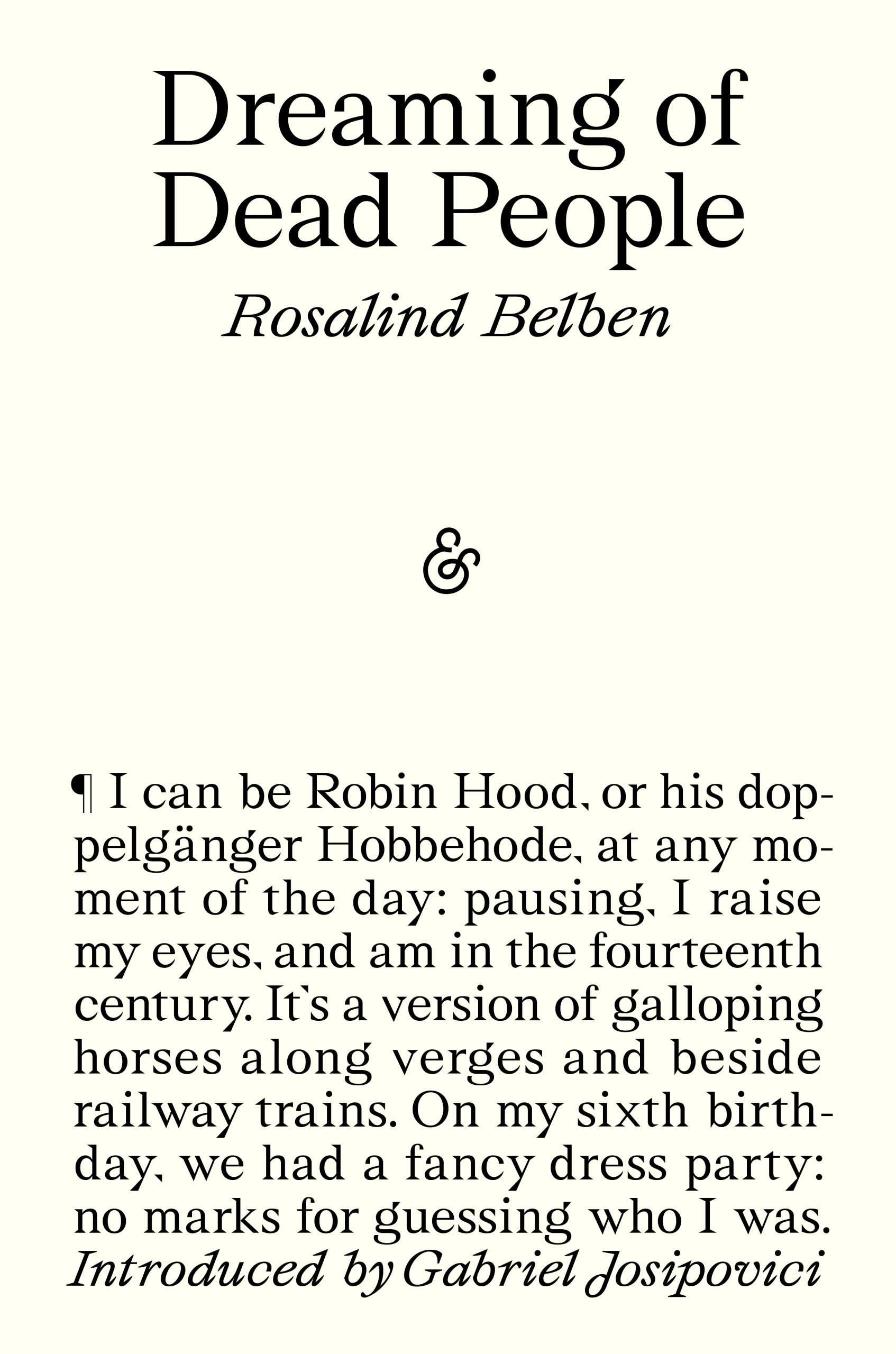
Lavinia, the narrator of Rosalind Belben’s fourth novel, Dreaming of Dead People, is thirty-six years old and, in terms of marriage and child-bearing potential, past her prime. At least in the context of the mid-seventies English society within which she defines herself. Standing on the cusp of spinsterhood, she wonders how she got to be where she is, longing to make sense of the tangle of emotions that beset her as she readies herself to leave the fancies and expectations of her past behind and move on with the rest of her life. Through an extended monologue that shifts between measured reflection, unguarded self-exposition, and fanciful and poetic imaginings, a portrait emerges of an intelligent and introspective woman trying to find her place in the world.

In his introduction to And Other Stories’ re-release of this 1979 novel, writer and critic Gabriel Josipovici describes it as, in his mind, Belben’s finest book. Anyone who has read The Limit (1974, re-issued in 2023) will know that she often writes about the physical needs, desires and sufferings of people and animals with a blunt frankness that can be difficult to read simply because she tends to approach such subjects with a naked honesty that can be alarming. There is some of that here—most notably when her protagonist launches into a an account of her exploration of masturbation that is as graphic as it is wryly funny—but there is so much more. This is a complex, emotionally intense narrative with experimental shifts in style and tone, and vivid lyrical passages. Lavinia is a strong personality that some may find hard to connect with (that was not my experience), but she will likely linger in the reader’s imagination long after the last page is turned.

Truth be told, Lavinia’s tale is a maze of contradictions. Though she speaks of loneliness and a longing for children, she has a defiant and independent spirit that runs counter to what she claims to have wanted. The spectre of the spinster that haunts her, is one very much rooted in her rural upbringing and on characters from books of her childhood like Mary Swainson from Arthur Ransome’s  Swallows and Amazons series. However, Lavinia had never waited at home for a suitor to arrive; her early twenties were filled with travel, adventure, and lovers—even an unwanted pregnancy terminated without regret—but this free-spirited life comes to an abrupt end when her mother is diagnosed with a serious illness and she returns home to be with her, thinking the end is near. When her mother defies expectations, living for five years beyond the predicted two, she stays on in a state of conflicted hope and dismay. Yet, once her freedom is returned to her in full, she finds herself unable to pick up where she left off:

I thought I could resume. It was stupid. A lot of water had gone churning through the mill. I was older. I hadn’t the slightest inclination to sally forth metaphorically and look for a fuck as if I’d been twenty-one again. I didn’t fancy anyone I met, well, hardly anyone. Something had happened to me. I was changed, reclusive, and I daresay unlucky.

Measuring herself against other women, Lavinia admits ato n anxiety about her future self—be that the self “in five years, one year, ten minutes”—and wonders if, one day, she will feel fear or regret, or not much either way. She wonders what she should feel. At thirty-six and untouched sexually for ten years now, she worries that she will one day find herself endlessly feeding on memories of a past when she loved and was loved, watching them recede into the distance as her body wrinkles and ages. Her destiny seems fixed, she acknowledges as much, but she looks for release elsewhere:

I turned to nature. To tracks in the snow. To things that lead somewhere. I love rivers, canals, streams, water which holds the mirror up. I love lakes. I imagine swimming very much. The clasp of water, of glittering liquid. I will squat in my imagination by a loch in the Highlands dabbling my toes and watching my own body as it breaks the ripples, stroking the glass face, into the sun or away from it, toward the motionless invisible heron, stubbing my feet on a submerged tree trunk. I am anxious about drowning; I am not out of reach of help, out of my depth; and the long-tailed tits twitter in the pine tree tops. I wait for the osprey which could change one’s life but which never appears, forever a possible, and its absence.

Belben writes about nature with a poetic intensity that is quite wonderful, revealing a deep connection to the natural world, that her protagonist clearly shares—among a number of biographical details—and, at least for Lavinia, the roots lie not only in her rural childhood, but in an early and passionate identification with Robin Hood.

In the chapter “Cuckoo,” with its integration of ballads from the medieval legends, she depicts her hero without some of the more fanciful inventions which she tends to reject, focusing instead on the degree to which he was an outcast, living outside the law without rights, as a non-person. “Therein a metaphor of myself,” she insists. But then she goes on to invent an erotic encounter between Robin Hood and Hilda, the wife of Sir Richard at Lee, allowing the hero to flee before daybreak, frightened by his conflicting emotions, but ever feeling he’d left something unfinished. A metaphor indeed.

Lavinia’s own emotional world is complicated, though she tries to maintain a hardened, matter-of-fact attitude even when chronicling painful circumstances like the need to let go of a beloved dog, or the tensions of her relationship with her family. After her mother’s death, she moves to the city, in part to avoid the suspicion and pity with which spinsterhood is viewed in the country. London offers her an anonymity she treasures, but it comes with costs. Here she imagines in detail how it would be to raise a daughter she would name Jessie, fretting over the understanding of animals and nature the child would miss out on, and worrying that Jessie would not inherit her mother’s love of language and literature. She is working her way through a parenthood that will never materialize, this vicarious motherhood that stands, perhaps, as a parallel process to grieving her own complicated relationship with her mother. She is also attempting to resolve her state of placelessness, her sense of belonging to neither the city nor the country.

In London no life; no ditches; no hedgerows; no death. No worms, no bugs; no thorns, no wire. No cattle, no stock of any sort. No thrills and no excitement. It is undramatic.

Venturing back into rural solitude she feels invigorated, at least for a few hours:

But the country is a great deceiver. Because it is, of course, no longer there: the land of my imagination. I have been sniffing and sniffing; and the rose is blown. A lot of the country has become ghastly. Bungaloid, obliterated, crowded, and spoiled. It is . . . progress.

She has to venture further to regain the natural connection she craves, returning in memory to a trip to the Highlands as, for a stretch, the narrative becomes a rich and vivid piece of nature writing. And then, following this Scottish reverie, we reach the final, ecstatic, dream-filled title chapter. Herein the reckoning. In her own way, Lavinia comes to make sense of her life.

With an inventive narrative that is ever shifting gears, moving from language that can be blunt and coarse, to the rich and poetic, to the deeply introspective, even obsessive, Lavinia’s monologue can be a little disorienting at times. Form and style are mutable, and it is not always apparent whether she is remembering a real event, re-imagining a memory, or reasoning her way through her own uncertainties. But ultimately this is a novel of grief and loss, of mourning loved ones who have passed and a future that will never exist, thus learning to open oneself up to the freedom that lies beyond defined expectations and roles.

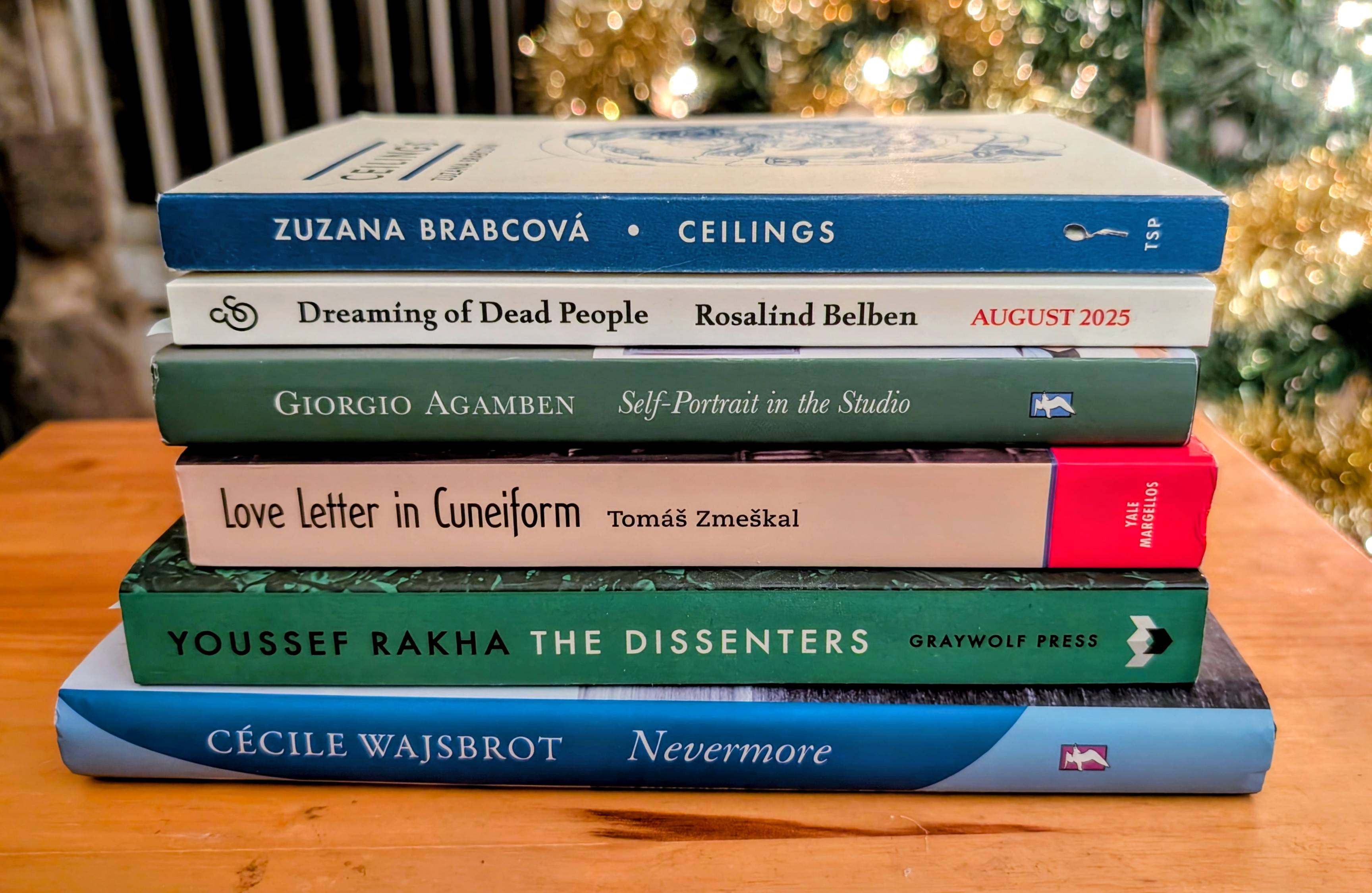
Dreaming of Dead People by Rosalind Belben, with an introduction by Gabriel Josipovici, is published by And Other Stories.

You can listen to Rosalind Belben read from the chapter about Jessie here:

The only possible way: from In Case of Loss to Pitch & Glint by Lutz Seiler (and much more)

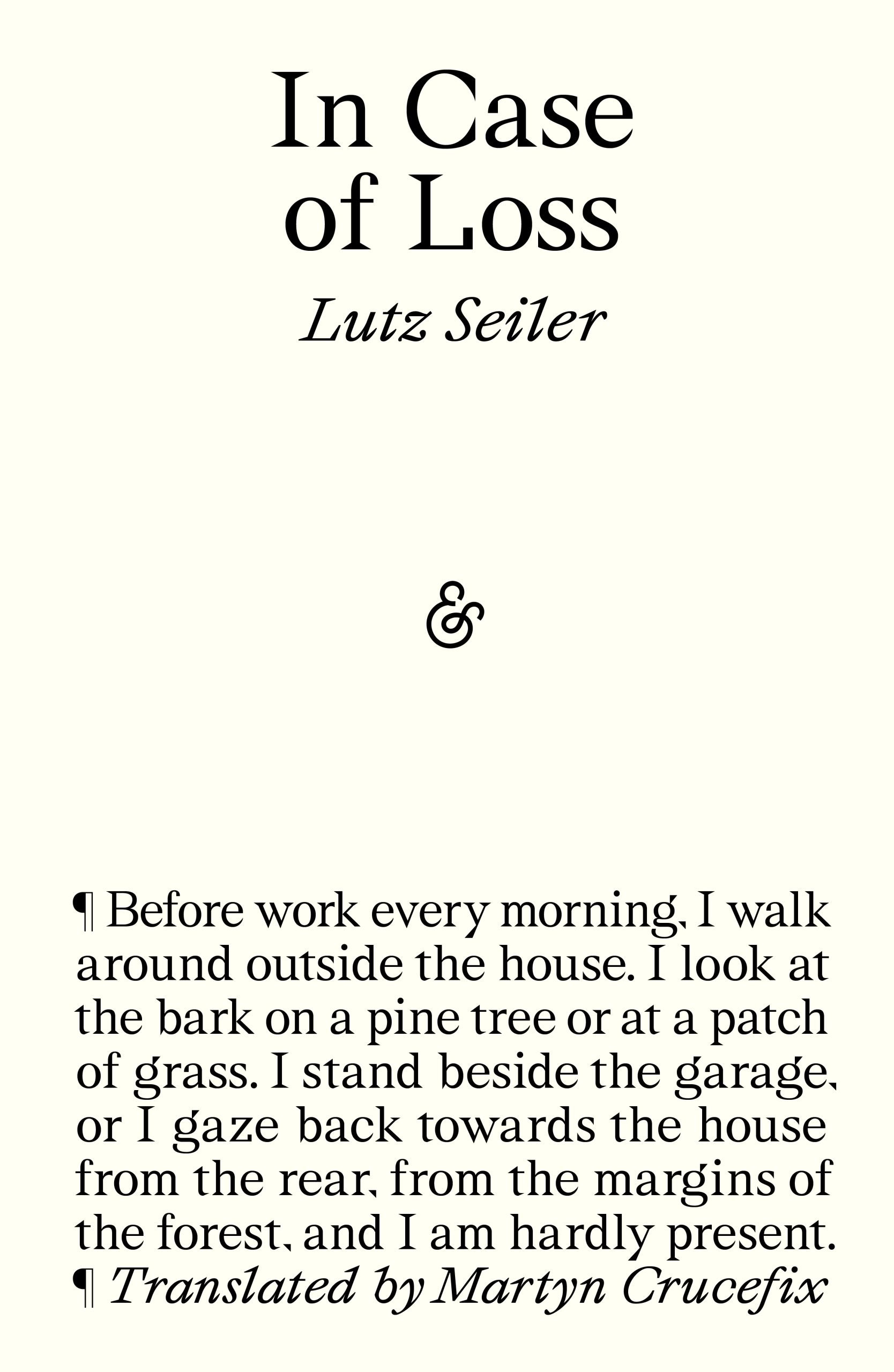
Some writers pass through your reading life and move on, perhaps appearing by chance now and then over the years, others ignite a clear desire to read more, if not all, that you can get hold of. That might be a small library of volumes to collect, but for those of us drawn to writers in translation—writers we often discover as a direct result of following a known or trusted translator—it can mean watching and waiting for more work to slowly emerge in English.

For me, one such writer is German poet, essayist and novelist Lutz Seiler. I first encountered his poetry about two and half years ago through Alexander Booth’s translation of his 2010 collection in field latin. At the time, the only other title available was his first novel Kruso which was, when I first checked, out of stock. Yet, when UK publisher And Other Stories announced they would be publishing Seiler’s debut poetry collection, Pitch & Glint, his second novel, Star 111, and a collection of essays, In Case of Loss, in late 2023, I took note. Then, when I had the opportunity to read Star 111 this year in advance of its North American release from NYRB in October, I quickly set about acquiring his other work. And, as these things go, while reading the poetry and the essays, I was inspired to add work by two of the poets Seiler writes about or honours—but more about that later.

Born in the Thuringia region of the GDR in 1963, Seiler’s poetry is rooted in the rural landscape of his childhood, scarred by years of uranium mining, sensitive to place and relationship to family, as child and as a parent. However, unlike many writers, he had no interest in books or literature when he himself was young. He did not start reading poetry until he was completing his mandatory military service in his early twenties, having already trained as a bricklayer and carpenter. He was certainly not writing, not even jotting the odd observation down, but something was brewing. As he says in his essay “Aurora: An Attempt to Answer the Question ‘Where is the Poem Going Today?’”:

Yet a good ten years later, I wrote poems that had been, in that earlier period, when poetry did not feature in my life, gathering and storing their subject matter, their materials. Doubly hidden from me at the time, clearly the poems had been, even then, making their way towards me. What is different these days is that I have become more conscious of the signs of a poem being on its way. I am aware of what situations, materials and substances it might respond to, what it is likely to ingest—for later use.

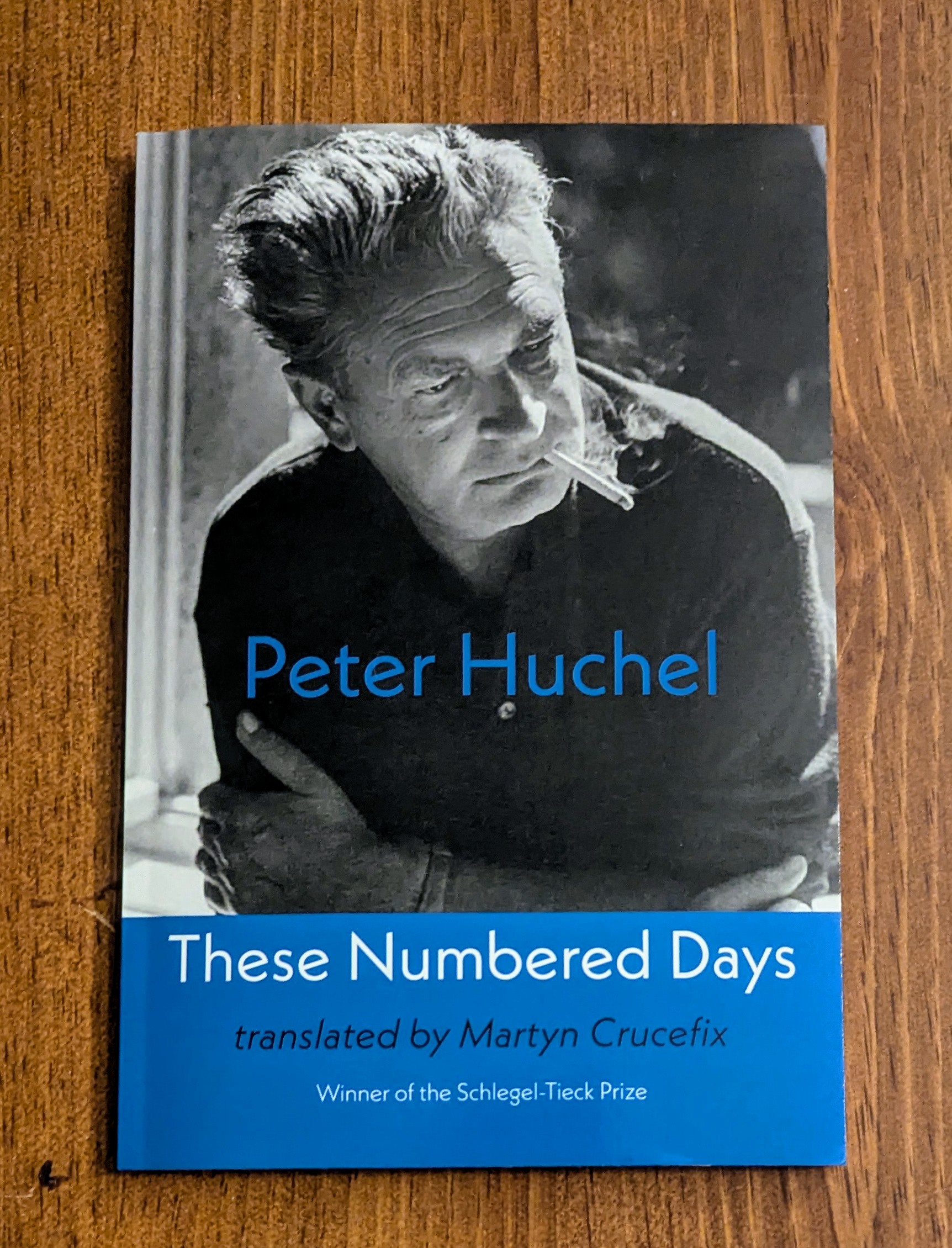
For a poet who came to literature somewhat unexpectedly, Seiler’s writing about writing, and about the poetic art and process is excellent, presumably of interest to other poets, but also, and perhaps more critically, for those of us who enjoy poetry but sometimes feel inadequate to examine a poem without a strong literary vocabulary and the requisite coursework (assumed to be) required to read and write it. In Case of Loss contains several essays about the work of other poets. One, Peter Huchel (1903–1981), was new to me. I was aware that Seiler is the custodian of the Huchel House in Wilhelmhorst near Berlin, but knew nothing of Huchel himself, one of the most an important German poets of the post-war era who ended up running afoul of the government of the GDR and was eventually allowed to migrate to the West. The title essay is an account of Seiler’s first impressions of the house itself after breaking in with Huchel’s widow’s blessing and his coming into possession of a notebook the poet kept all his life in which he recorded images, metaphors, lines, and tentative sketches, all categorized by theme. The manner in which Seiler traces some of the formative elements that will, often years later, appear as shadows or echoes in a finished piece is fascinating and a testament to the gestation period a poem can have. Of course, I wanted to read more, so I sought out These Numbered Days, Huchel’s 1972 collection, released in 2019 in an award winning English translation by Martin Crucefix (who is also the translator of In Case of Loss). His poetry often draws on the landscape of his youth for atmosphere frequently in concert with mythological, historical, and Biblical images to create crisp, even chilling poems. Although they are generally spare, one can sense that they have been carefully shaped and honed over time, each word or phrase carrying much weight, very often political—something confirmed by both Seiler’s insights, Crucefix’s notes, and Karen Leeder’s Introduction.

At the edge of the village the wind
flung its ton of frost
against the wall.
The moon lowered a fibrous gauze
on the wounds of the rooftops.

Slowly the emptiness of night descended,
filled with the howling of dogs.
Defeat sank
into the frozen veins of the country,
into the leather-upholstered seats
of old Kresmers in the coach sheds,
between the horse tack and grey straw
where children slept.

(Peter Huchel — from “Defeat”)

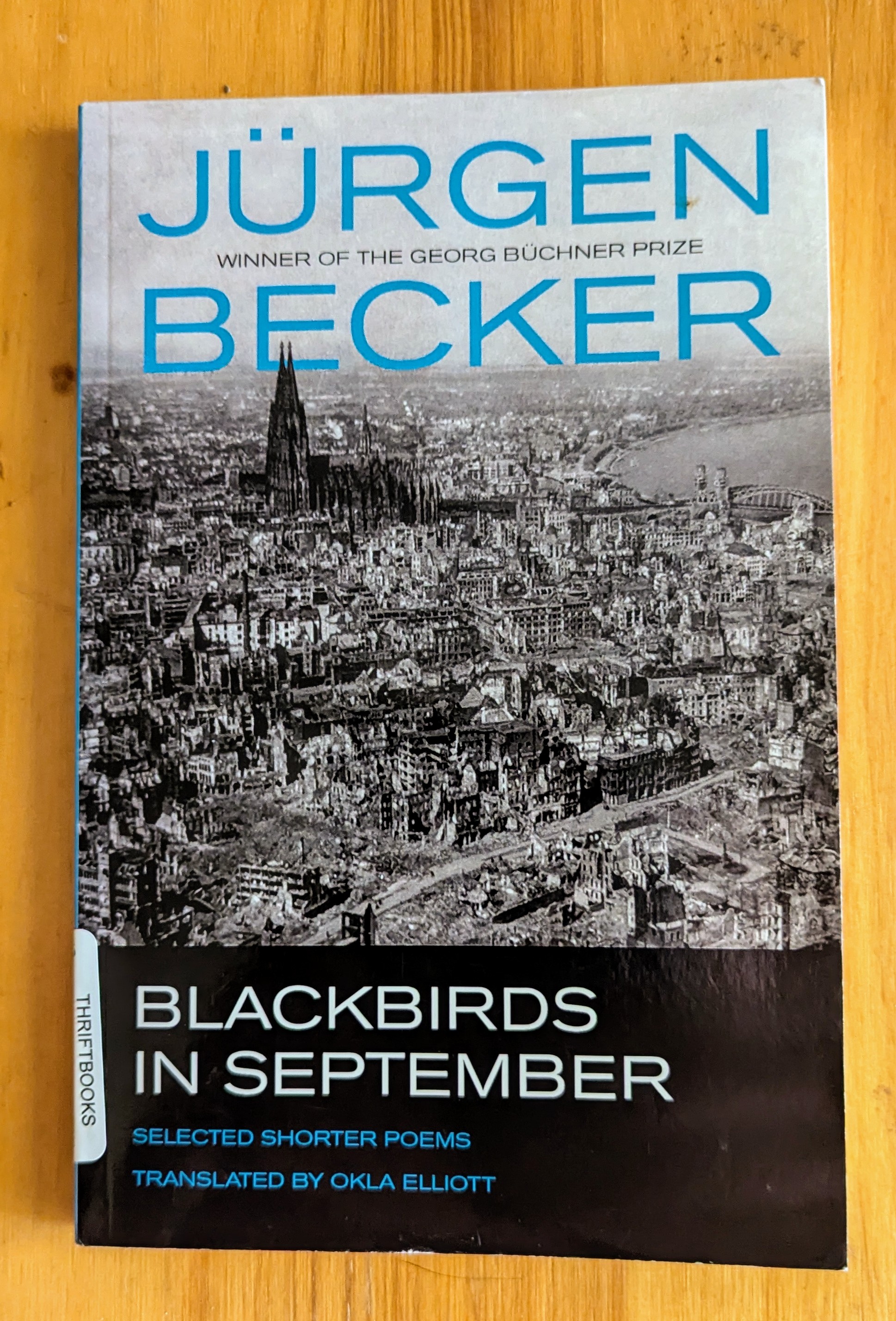
In addition to an unusual back to front reading of a book by Ernst Meister, the other poet Seiler devotes an essay to is Jürgen Becker. I had already read Becker’s fragmentary poetic novel, The Sea in the Radio, but a dedication to the poet (who very recently passed away) in Seiler’s collection Pitch & Glint, called to mind a collection of selected shorter poems, Blackbirds in September, which I was able to track down and read alongside the essay “’The Post-War Era Never Ends’: On Jürgen Becker.” Here Seiler takes a more personal approach acknowledging Becker’s influence and his own friendship with the older established poet. He traces his own process of learning to read and appreciate Becker’s poetry. Born in Cologne in 1932, Becker was a member of Group 47, the organization formed to promote young German writers after the war. He employed an experimental, open form of writing with an emphasis on landscape and the persistence of memories of the war in German land and history. His language tends to be spare and his poems have a calm, light feel, but that is only the surface.

But the landscape is rather quiet.
Invisible the destruction, if in fact
there is destruction.

And the time is passed
which the subsequent, the subsequent time produced.

But you never speak of Now.

Probably in the summer. At that time of year
we remember. Fence posts follow the paths,
or turned around, all of it belonging
to the landscape . . . who owns it? The landscape
leads into landscapes, from the visible ones
to the invisible ones which await us.

(Jürgen Becker — from “A Provisional Topography”/translated by Okla Elliott)

Other essays of particular interest in this collection (which gathers a selection of Seiler’s nonfiction from across twenty-five years) include “Illegal Exit, Gera (East),” a return in memory and in more recent years to a landscape that is being transformed and remediated, and “The Tired Territory” which begins as an exploration of the history of uranium mining in his home state, but turns into a meditation on the distinct poetic sensibilities that he had to define for himself after what he describes as the difficulties encountered in his “brief  career as a doctoral student in literary studies.” The categories that hold his fascination are intangible: heaviness, absence, tiredness. Understanding this for himself is essential:

Writing poetry: a difficult way to live and, at the same time, the only possible way.

One aspect of all this is that the poem engages specifically with what cannot be verbalised. The mute and non-paraphrasable and its unique, existential origin: the particular qualities of any poem arise from these two subtly interwoven elements. The poem travels towards the unsayable, yet this is a movement without an end.

It is not only the reading and writing of poetry that slips into Seiler’s essays—to a greater or lesser extent—but the final piece tackles his slow transition to prose. “The Soggy Hems of His Soviet Trousers: Image as a Way into the Narration of the Past” chronicles the year he moved with his wife and children to Rome for a period of dedicated novel writing. He dragged along boxes and boxes of books, research and paraphernalia he had gathered in preparation for the writing of his first novel. He’d planned to draw heavily on his own experiences moving to Berlin in the aftermath of the fall of the Wall and the more he describes his intentions, the more it sounds like what would eventually become his second novel, Star 111. But it’s only 2011 and our would-be novelist is staring at an empty page day after day. It is not until he finally gets out of his room, into the city, that everything changes. A suggestion that he write a short story set in a location he had not previously considered soon conjures forth an image so strong that ten pages become 500 and he has what will ultimately become his first novel Kruso.

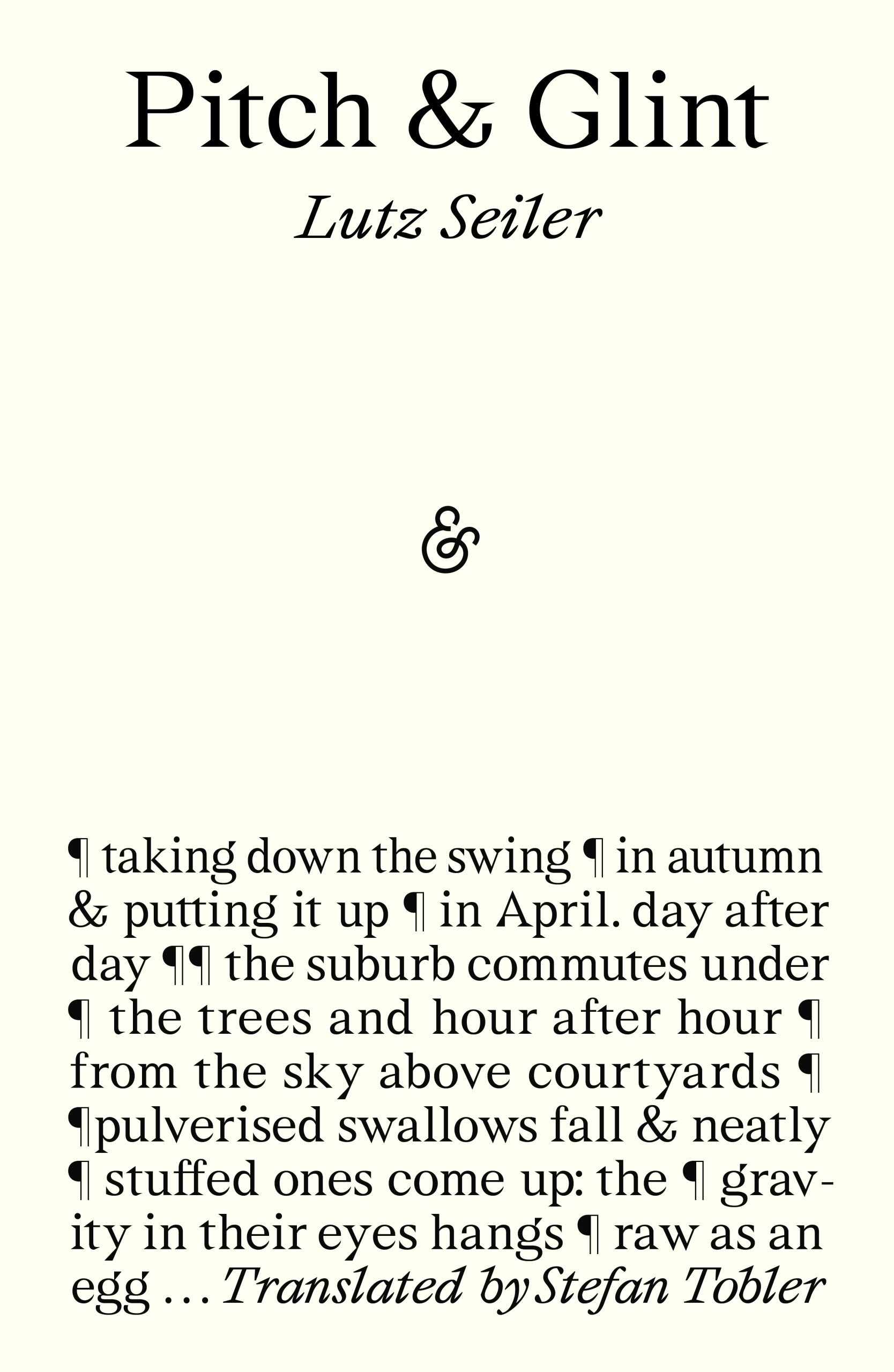
Finally, if I return now to own Seiler’s poetry, in field latin and his debut collection from 2000, Pitch & Glint, more recently released in Stefan Tobler’s translation, many of the allusions in individual poems become clearer in light of having read his essays and the autobiographically influenced novel Star 111. But neither is necessary. Seiler’s poetry has a natural appeal. I wrote about in field latin here, and this earlier work (ten years separate the two volumes) is likewise rooted in the East Germany of the poet’s youth—the wildness, the strict schools, the land with its slag heaps and detritus of mining. Yet, for Seiler, the sound and rhythm are critical, as is the construction of images that move beyond the mere biographical. Darkness, frost, echoing footsteps recur. You can feel the chill:

wind came up the border
.   dogs were rising on
their delicate branching skeletons

whistled a bewitching witless
wanderlied. the snow came in
& tore the iron

curtain of their eyes, a
blunted gaze towards the hinterland
and made plain that we do.

(— from “in the east of the land”)

Seiler’s characteristic use of lower case letters and ampersands (especially striking in German where nouns are capitalized) adds to the mood and intensity of his poetry. One of the blurbs on the back of Pitch & Glint describes it as “a real-world Stalker with line breaks.” That captures the feel well.

The beauty of reading a number of works—nonfiction, fiction and poetry— that intersect like this is that each individual experience is heightened. Seiler’s poetry and fiction easily stand on their own, but the essays add an extra dimension. To be fair, one’s enjoyment of this collection may depend on whether one is a poet, or interested in poetry and the process of poetic inspiration/creation, or familiar with his other work. Nonetheless, his essays are thoughtful with a very strong personal flow and reflect the mind and experiences of a man for whom poetry is central to his very existence—in his memories, in his specific creative pursuits, and even in the everyday act of taking his daughter to dance lessons or son to football practice.

In Case of Loss and Pitch & Glint by Lutz Seiler are translated from the German by Martin Crucefix and Stefan Tobler respectively and published by And Other Stories. These Numbered Days by Peter Huchel is translated from the German by Martin Crucefix with and Introduction by Karen Leeder and published by Shearsman Books, and Blackbirds in September by Jürgen Becker is translated from the German by Okla Elliott and published by Black Lawrence Press.

Other titles mentioned and reviewed earlier on this site are Star 111 (And Other Stories/NYRB Imprints) and in field latin (Seagull Books), both by Lutz Seiler, translated from the German by Tess Lewis and Alexander Booth respectively.

If such a thing is possible: Star 111 by Lutz Seiler

Maybe at twenty-six he was already too old to seriously go about becoming a poet.

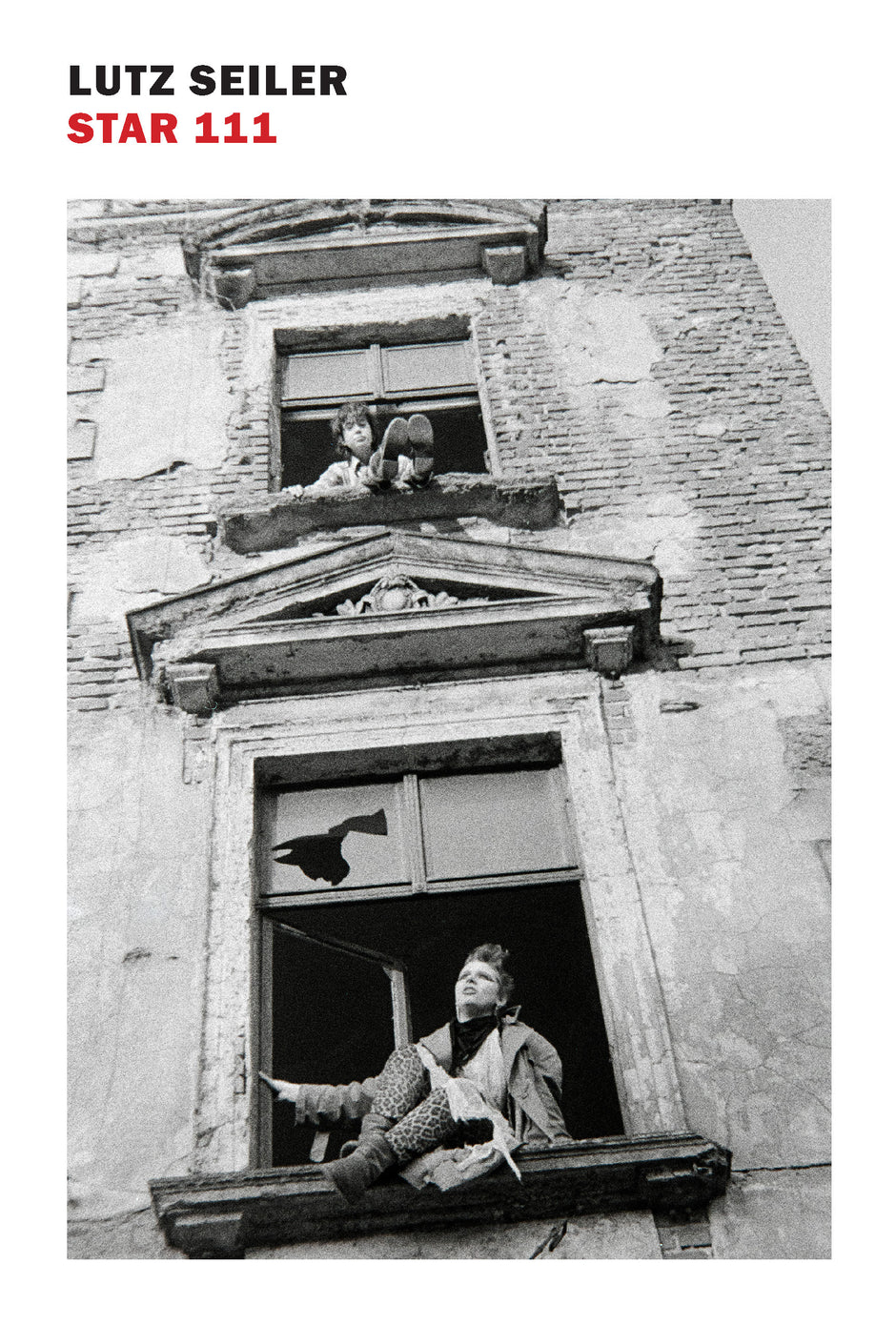
The fall of the German Democratic Republic was rapid and unexpected. As other communist regimes in Eastern Europe began to disintegrate, the East German government tried to maintain control, but in early November 1989 a mistaken announcement led to the sudden opening of border crossings through which hundreds of thousands of East German residents would soon pass. This is where Star 111 by German poet and writer Lutz Seiler begins.

Twenty-six year old Carl Bischoff has just been summoned from Leipzig to his home town Gera in the state of Thuringia. The telegram, dated November 10, reads “we need help please do come immediately,” but as he waits for the train, he has no inclination that all the childhood securities he once imagined were unassailable are about to be upended. His parents, Inge and Walter (Carl has long addressed them by their first names), waste no time announcing their intentions. They are going to take advantage of the crumbling state of the GDR and cross the border. Now. This is, they tell him, a dream they have long held and, should the precious opportunity be short lived, they plan to leave promptly. They will head for the refugee camp at Giessen, and then split up to better their chances of finding suitable lodgings and employment on the other side. Carl’s assignment is to stay behind and look after the apartment. He will be the rearguard. But left behind, Carl finds he is at a loss, confused by this sudden inversion of what he imagines the parent-child dynamic should be and worried about his middle-aged parents who by rights should be the ones at home worrying about him.

His age is critical. Carl will repeatedly question what it means to be in his mid-twenties as if there’s some kind of high-watermark that he’s worried he has already missed. He has completed military service, learned a trade, and spent a few years at college, but he is without direction. His dream is to become a poet. Yet, when he is called home, he is apparently recovering from a breakup and a breakdown—something he alludes to but does not discuss because there’s no time. His parents’ departure is so immediate and unnerving that it entirely usurps whatever crash course he might have been on. But, even if it leaves him temporarily unmoored in a world that is rapidly changing, it does offer him a chance to chart a new direction for himself. After a few weeks in Gera, trying to keep a low profile while working his way through the preserves in the cellar, Carl is beginning to bottom out. So he loads up his father’s beloved Zhiguli with tools, a sleeping bag, and some provisions, and heads to Berlin. He has no particular destination in mind. He is simply following a fantasy founded on little more than a few poems set in that mythical city, seeking, as he will later describe it, “the passage to a poetic existence.

Arriving in East Berlin, Carl tries to get his bearings, picks up the odd unofficial taxi fare, and sleeps in his car. But, with winter settling in it’s a bleak—and cold—existence. Before long he falls ill. When, freezing and feverish, he happens to find his way through the rear door of a cinema, he suddenly steps into another world. So to speak. He finds himself in the company of an odd collection of individuals, led, it would appear, by a charismatic man they call the Shepherd—the owner or companion of a goat named Dodo—who nurse him through his illness and welcome him to their breakfast table, impressed in no small part by his car with its trunk full of tools. His tools?

“No, no Zhiguliman, you don’t have to explain anything here. More than a few people are on the move in this freshly liberated city. The whole world is being parcelled up anew these days—but if you’re looking for something permanent. . .”

Carl is not certain what he is looking for, or what something permanent might even mean. If stability cannot be assured in unstable times, he wants whatever it is the handful of men and women around him seem to have—community. And it seems to be on offer:

It was as if he were already part of a pack, as if he were of the same breed. Everything seemed already embedded according to a long-standing plan and leading toward the only logical conclusion. It was a strange feeling. It was the presentiment of a legend (if there is such a thing, thought Carl), on the point of taking him to its profound, all-embracing “once upon a time.”

It is, in fact, just the beginning. He settles into a spartan empty apartment and soon finds a place among a group of misfits, artists, and anarchists who are systematically occupying abandoned buildings, hoping to take advantage of the shifting political and social terrain to craft a kind of anti-capitalist utopia amid the ruins of a damaged urban landscape before others come to reclaim it. His bricklaying skills secure his place.

Over the months that follow, Carl will oversee renovations, begin to work in the Assel, the  café the Shepherd sets up, and embark on a romantic relationship with, much to his surprise and naïve delight, a woman from his hometown. Meanwhile, the progress of his parents is revealed regularly, but only insofar as his mother’s letters allow him to it piece together through what is shared, or more critically, what is left unsaid. For months after he had dropped them off at the border, there had been an unsettling silence. Then, once he has relocated to Berlin, the missives begin to arrive, secretly rerouted through the post office in Gera. For a long time Inge and Walter are apart (“separately after Giessen”, as planned), and the latter’s whereabouts are unknown. On her own, Inge proves to be remarkably self-sufficient, working and making social connections until Walter is finally found and the couple are reunited. From that point on, Carl’s father will rely on his computer programming skills to build toward the shared future they envision. Inge’s cryptic comments and idiosyncratic expressions imply that there is a greater game afoot, but Carl is being kept in the dark. But then, many months will pass before he finally confesses that he has abandoned his post as rearguard.

As Carl constructs a life for himself in Berlin, building relationships with others, testing his emotional boundaries, and tracing a regular path through the streets of his dilapidated neighbourhood, one central focus drives his days—the need to write, to dedicate at least some time to poetry. With a little promising feedback, he fantasizes about the day he will publish a book of his own poems. Yet, with all the uncertainty (and opportunity) that a rapidly evolving Germany promises, for Carl writing is a discipline that exists on its own ground away from it all. He is a purist, not a documentarian:

So-called reality and its abundance (“the most exciting times of our lives,” as everyone was claiming)—it would never have occurred to him to write about it, not even in a journal, never mind that he clearly wasn’t in any state to keep a proper journal (with regular entries). The main question was whether or not the next line would work. The next line and its sound preoccupied Carl, not the demise of the country outside his window. If the poem didn’t succeed, then life wouldn’t either.

It’s not an easy path to follow, but it’s one that sustains him when everything falls into place  and one that devastates him when life runs off the rail and words fail to come.

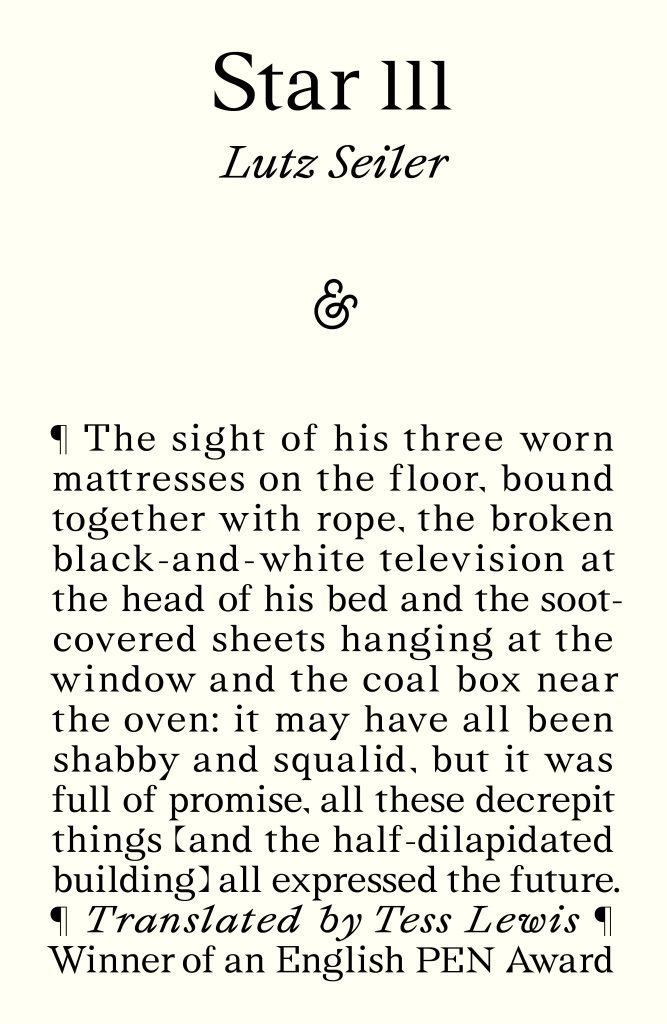
Decidedly autobiographical in nature, Star 111 is a tale of self-discovery, a portrait of a young man seeking to define his identity as an adult and as a poet against a backdrop of rapid change when, for a moment, all the old rules have been suspended before inevitably being rewritten and reshaped by capitalist interests. Seiler’s limited third person narrative with its frequent parenthetical refrains and clarifications, captures Carl’s insecurity and self-doubt as he navigates this strange terrain. It also facilitates the integration of a wide range of eccentric characters: members of the Shepherd’s “pack,” his neighbours, co-workers and customers at the Assel, his lover and her young son, and the many people he encounters vicariously through his mother’s regular updates. Essentially, then, this is a novel about family—natal, accidental, and imagined—and the forces that gather to form and inform one’s independent being. The “Star 111” of the title refers to the popular transistor radio that was the centrepiece of Carl’s family life when he was a child. The memories of it that haunt him reflect the strange longing that tends to set upon us when life conspires to force us to accept that not only are we truly grown up (whether or not we feel like it), but that our parents are independent adults too. As Carl spends a lot of time re-evaluating his relationship with Inge and Walter, he will wonder whether he ever really knew them at all. Or they him.

Lutz Seiler is, of course, like his protagonist, a poet first and foremost. This can be seen in the way his chapter titles are picked up in the text, often in the closing line, but more explicitly in his attention to the sounds and the rhythms of language. Translator Tess Lewis—who also translated his first novel Kruso which she describes as forming a sort of diptych with Star 111—writes in her Afterword of the challenge presented by his “ability to capture the minutiae and texture of a vanished world in rhythmic, lyrical prose.” She pays particular attention to the various registers in the original reflecting the different tenors of West and East German bureaucracy, varying speech patterns associated with social class, and the lines of poetry by a host of other poets that echo through Carl’s imagination. When words with multiple meanings afford the author an onomatopoeic flexibility that cannot be fully replicated, Lewis found she sometimes had to make alternate word choices, knowing the full affect could not always be maintained. This is not a loss noticed in the English reading though. The sense that this is a moment in time that will not last long and will never come again is captured so vividly through Carl’s adventures (and misadventures), not to mention those of his parents, that it feels, above all, like a privilege to be along for the ride.

Star 111 by Lutz Seiler is translated from the German by Tess Lewis and published by New York Review Books in North America and by And Other Stories in the UK.

The conversation we can’t have: Ti Amo by Hanne Ørstavik

Loss and grief are experiences that inspire and drive so much literature. For a writer there seems to be a compelling need to try to sort out the complicated flood of emotions that the injury, illness or death of a loved one releases with the only tool that makes sense—the pen. But that response typically requires a certain degree of distance before the diaries and records can be weighed against whatever it is one feels at the time and in the aftermath. The exercise of writing immediate grief is much more difficult. In his memoir, A Sorrow Beyond Dreams, Peter Handke seeks an element of closure by writing about his mother within two months of her death. He wants to honour her life without slipping into sentimentalism but discovers the peace he seeks is elusive, he cannot keep himself out of the story, and that is the best part of this raw, affecting meditation. More successful precisely because it was never intended for publication, is Roland Barthes’ Mourning Diary. This collection of fragments, scribbled on scraps of paper during the first days, weeks and years following his beloved mother’s death is entirely unselfconscious, honest and stripped to the barest essential emotions. As such it is one of the very few books a recently bereaved person can turn to for company. There are no conclusions, no prescriptions, and many unanswerable questions.

One could say that Hanne Ørstavik’s Ti Amo is also an exercise is immediate grief writing, but she turns to fiction, choosing to hold close to the details of her own life, and at the time of writing—or at least beginning to write—her ailing husband is still alive. Her unnamed narrator, a Norwegian novelist, is living in Milan with her Italian husband who is dying of cancer. The work she is writing, addressed to the man she loves, is an attempt to put some kind of meaning to a time in which their relationship, and the expectations and dreams they once had, is shifting, losing direction. It is an effort to reach out across the space that has opened up between their respective realities:

Why can’t we speak the truth? Why can’t we say things the way they are? Why do they have to hide your death from you? Do you really not want to know, not be in contact with, not feel, the truth about yourself?

“Ti amo”—I love you—is the phrase that links the narrator and her husband, becoming in moments of physical and psychological distance, a mantra that reaches out through the fogginess of medication and the void created by that which is not being said. At the time when he first became ill, they were still in the early, heady years of a mid-life romance. He was her Italian publisher and, as their desire to be together intensified, she relocated from Norway to Milan, immersing herself in a foreign culture and language. Their lives were filled with travel, literary events, social engagements. When the first indications that something was wrong appeared, they both tried to imagine it was nothing but before long his symptoms could no longer be ignored. A diagnosis, surgery and chemotherapy followed but the cancer is refuses to be stayed. In the present moment of the emerging text, it is early 2020. Their relationship goes back only four years and almost half of that time has unfolded under the shadow of serious illness. Even their marriage, the formal recognition of their partnership, was a response, at his insistence, to the suddenly altered circumstances.

Tracing the onset and progression of illness against an account of their lives before and after diagnosis, the narrator is continually seeking to understand what she feels and who she is in relation to a man who often seems so helplessly far away. Through the maze of appointments and tests and endless trips to the pharmacy in the hope that the prescribed pain meds have finally arrived, small things, the simple moments together—stopping for hot chocolate, buying suet for wild birds, tea in the morning—take on an added poignancy. The narrative is nonlinear but regularly circles back to January, 2020, as the last of the normal treatment options have been exhausted. And still, they are not together in accepting the one truth that hangs in the air.

Ti Amo is novel of passion, commitment and confusion. It is an open window into the complicated, often conflicted, emotions of caregiving without the numbing effects afforded by time and distance. Details of the ravages of an aggressive cancer are laid bare, woven into a story of two people brought together by a love of literature, art and travel. Two different natures, she reasons at one point, recalling that he always exhibited a certain degree of hesitancy while she always carried “a compulsion for truth that feels like my very life force itself.” Is that why they can’t approach the topic of death?

This is, of course, a one-sided story. The narrator’s husband is hostage to pain and its pacifiers, grasping at normal whenever he has the strength, and much of the time that entails going into the office. As if a semblance of work will keep him alive. But isn’t that what the narrator turns to as well? Her own work? “I write novels,” she says, “It’s my way of existing in the world…” If he will not or cannot ease her through her fear of bereavement by bravely accepting his own death (for is that not what lies behind her sense of loneliness?), she will turn their situation into a novelized love letter.

The resulting brief novella, written in just ten days, overflows with warmth, tenderness and  grief rendered in spare, poetic prose. Through her looping narrative style, Ørstavik allows emotional tension to build, in her protagonist and her reader, as a moment of reckoning dawns for the narrator and her husband in their separate but parallel journeys. However, the end, as such, lies outside the frame of the story. The author’s real-life husband, Italian publisher, translator and painter Luigi Spagnol, died on June 14, 2020. Ti Amo, in arising so directly from her experiences and emotions in his final months, is more than autobiographical fiction or memoir—it is also a deeply personal tribute to power of love.

Ti Amo by Hanne Ørstavik is translated by Martin Aitken and will be published by Archipelago Books in North America and And Other Stories in the UK in September.

To make the invisible visible: Brother in Ice by Alicia Kopf

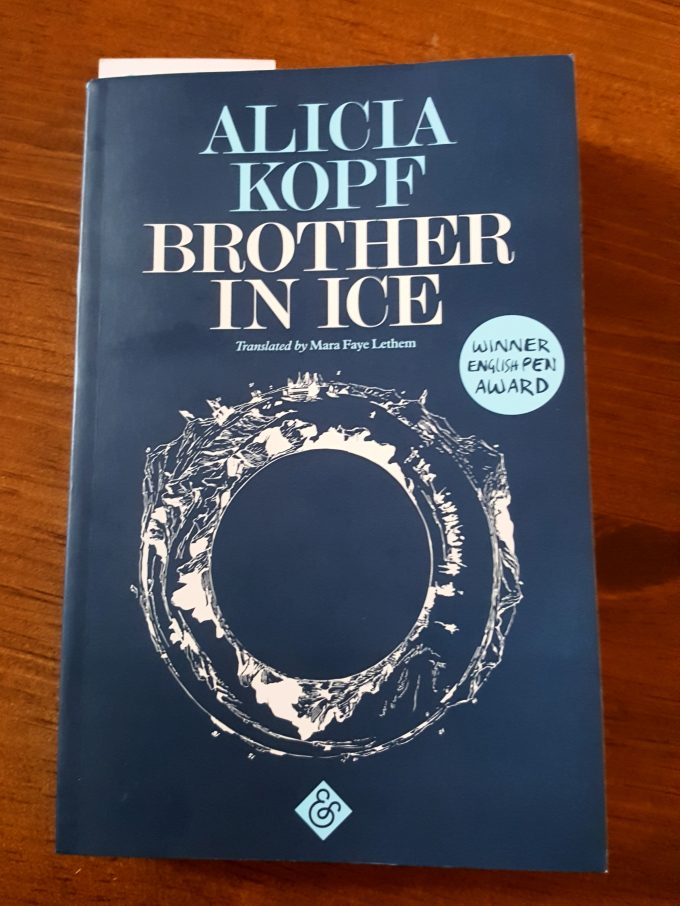
Brother In Ice is an exercise in trust—a risky venture, not unlike the expeditions  into the  blank canvas of the polar regions that Alicia Kopf traces in the early chapters of her ambitious hybrid novel. There is a distinct sense that the Catalan artist and writer is thinking out loud, mapping her own haphazard journey across the page. She could have lost her way, slipped into a crevasse and disappeared beneath the weight of her own icebound mission. But no. What she has produced, in the end, through an eclectic and inventive blend of autobiographical fiction, arctic-inspired scientific detours, and historical diversions, is a thoughtful meditation about identity, family, and the challenges of trying to explore one’s self through art.

To dissect  Brother In Ice is to risk making it sound strange, possibly unreadable, but Kopf’s balance and restraint hold its often disparate pieces together. The opening section of the book, “Frozen Heroes”, reflects the narrator’s obsession with all things polar: shipwrecks, penguins, the anatomy of snowflakes, and, above all, the heroic, often reckless, rush to explore the furthermost regions of the globe and endure extreme conditions, all with the desire to lay claim to undefined spaces, explain mysteries and achieve impossible goals. To be the first. Grainy black and white archival photographs add to the accounts, but what allows such brief, nonfictional excursions to work is the author’s light hand and thoughtful voice. In these early pages we are also offered our first glimpse into the narrator’s family and personal life. In particular we are introduced to her autistic older brother:

My brother is a man trapped in ice. He looks at us through it; he is there and he is not there. Or more precisely, there is a fissure inside him that periodically freezes over. When he is present, his outline is more clearly defined; other times he’s submerged for a while.

He is interested in planes, trains, cars, cats, dogs and birds, inclined to watch them carefully and intently, but he is consistently unable to carry out ordinary tasks without  being cued or asking what he should do. His presence, in what is ultimately a broken family, is significant.

The scientific diversions continue into the second section, “Library Atop an Iceberg” but gradually the autobiographically toned fiction moves to center stage. After a rather defiant adolescence, complicated by negotiating the rough terrain between her divorced parents, the narrator makes her way to university where she persists in studying art and literature, worrying about the practicality of pursuing endeavours that are likely to be less than self-sustaining. She supports herself, first in retail and then with odd teaching jobs, has her first serious romance, and ultimately, her first art show. She travels, struggles to get along with her mother, and worries about what will become of her brother and her responsibility for him as he ages. The chapters, if you can call them that, are short, vignettes and reflections, played out against glacial motifs.

Finally, in the third section, she visits Iceland.

Throughout this unusual novel, the narrator herself is on a quest. She is not even certain what it is that she is searching for. Like the polar explorers, in pursuit of a shifting point on the ice, in a vast white terrain, she is writing in an effort to render the invisible visible. This is the artist’s quest—one in which the question may be as elusive and ill-defined as the answer. Near the end of the first part, the narrator admits:

I often find myself getting stuck in this project. I see nothing before me, just white. Yet beneath there are many things. The shrieking of seals. Was it the poles I wanted to talk about? Or is it just the image of the snow that fascinates me? Instability, confusion, cold (it’s hot), determination. Sensations that were the constant companions of the polar explorers, as well as those of us who work with the blank white page. Because I’m not interested in the polar explorers in and of themselves, but rather in the idea of investigation, of seeking out something in an unstable space. I’d like to talk about all of that as a metaphor, because what interests me is the possibility of an epic, a new epic, without foes or enemies; an epic involving oneself and an idea. Like the epic that artists and writers undertake.

Hers is a journey that resonated deeply with me. Especially as a writer working in the uneasy territory of memoir, I loved the openness, the questioning, the self-doubt Kopf allows her narrator (and presumably herself) as this odd creation takes shape. As her own questions and explanations start to come into focus, the layers of inspiration that preceded her quest, finally start to make sense. The beauty of this book is not simply that it is an intriguing and original account of one woman’s coming to terms with some of the unresolved fractures in her own history, it is a challenge to other explorers who venture forth with pen or paintbrush in hand to forge their own paths as they seek to tell their stories.

Brother In Ice by Alicia Kopf is translated from Catalan by Mara Faye Lethem, and published by And Other Stories.

Now and at the Hour of Our Death by Susan Moreira Marques, a reflection and review

We obsess over lasts as we do over firsts. Last days, last images, last words. We want signs.

Last month, my brothers and I made a most difficult decision about our father who was, at the time facing a cluster of serious complications resulting from a stroke and car accident. Four days earlier we had gathered around our mother’s bedside as the respirator that was barely keeping her breathing was removed. Within four hours she was gone. After agreeing to discontinue treatment of our father, he would continue to live, slowly dying, for another week. As I kept vigil day after day I tried to remind myself that there was a time when death was allowed to take its course, in the home, even as so-called “normal” life would begin to spin, a troubled satellite, around the dying person. Death was part of life, not something that happened elsewhere, surrounded by tubes and machinery. Although my dad remained in the hospital until the end, he was moved to a quiet, private room where he was kept comfortable, free of pain, and cared for by the nursing staff. As a family we were supported and respected. It wasn’t easy, and we’re all still numbed and distorted in our grieving, but if there is such a thing as a good death, I think that both of my parents had good deaths, if good means having a chance to say I love you, over and over and over until the end.

nowdeathWhen I first started to read Susana Moreira Marques’ Now and at the Hour of Our Death, I wondered if I was too raw, too plagued with second thoughts about the decisions we had made, to be able to surrender to a lyrical and experimental essay about death and dying. This book had been sitting on my shelves since it arrived last year with my And Other Stories subscription, several times I had opened it but somehow the time was not right. I suppose the book was waiting for me.

Over the course of five months in 2011, Marques made several visits to a palliative care project in rural north-east Portugal. She accompanied a team of health care professionals as they traveled from village to village to assist those on their final journeys, allowing them to be able die, as comfortably as possible, in their own homes; and along the way she recorded her own observations, collected anecdotes, and listened to the stories of the people she met. The result is powerful meditation dying, as a lived experience shared by a family, a community.

The first half of the book is fragmentary in style and form, blending facts and definitions, character sketches, brief stream-of-conscious like passages, pieces of wisdom—all presented with a quiet dignity in lucid, affecting prose:

The swallows have already built their nests above the back door; this is how they do it every year. They are useful birds, and beautiful, and have always been a favourite of his. But now he watches them as he never has before, because he might not see another spring.

*

AGONY: 1. The last struggle against death. 2. [Figurative] Anguish, affliction. 3. An imminent conclusion (preceded by a great disturbance).

‘Agony,’ the dictionary does not note, is a technical term.

*

Immortal in the morning. At night, the fear of never waking.

*

Lands, roads, people, time, time, people, roads, land. What matters here is different, very different.

The second half of the book, entitled “Portraits”, offers a closer look at three individual stories. Here Marques becomes a gentle presence as she describes each situation, then she steps back and lets those involved have their say. There is Paula, a woman with a young family, who is dying of cancer. She speaks with a brave spirit about how she and her husband had taken their time, waiting to have their second child, assuming they had “all the time in the world.” She will only have another year to live at the time that her thoughts are recorded. Then we meet João and Maria, a couple in their 80s who reminisce about their years in Angola. Both are ill, yet neither feels that they are ready to die, they live for visits from their children and grandchildren, and each one fears being the one left behind.

Finally, in the third portrait, the dying person is silent by the time Marques meets the family. While their father Rui lies on his death bed, his adult daughters, Elisa and Sara, each respond in their own way in his final months, the latter driving home from France every fortnight to spend time with him and her mother. Their own accounts follow his death, capturing the early weeks of grief, anger and regret. Very different in temperament, the sisters respond in their own ways to the loss, but for each of them it is the first time they have come up against the close experience with death and it is a leveling experience. Sara realizes she had never appreciated the magnitude of what others she had known would have been going through when they lost a parent, regretting that she had failed to say anything. I can’t help but feel that that is a common occurrence. Nothing but the death of a close friend or family member prepares you for the experience. Elisa, on the other hand, is surprised to find that she is unable to shriek and scream in anguish the way her sister and mother do when her father finally passes:

. . . I couldn’t react. It must have been two months before I cried. It’s really hard for me to cry. And now I’ve finally started crying, but only because I’ll get all worked up over something minor, and then I might cry a little out of frustration. But when it happened – and the atmosphere at our house was just so strange . . . It took me a long time to realize what was going on.

The final section, a single page long, is a guide for “When you come back from the journey no healthy person wants to take,” a list of the ways “you”, that is anyone who survives the death of a loved one, can be expected to act. . . paying attention to time, the things and people that are precious, the bridges that need to be mended and, simply, endeavouring to live well. I hope I can follow this wisdom even if, at the moment, I am inclined to relate to Elisa’s reaction, with grief coming in angry outbursts more than tears.

witm-logo

Now and at the Hour of Our Death is translated from the Portuguese by Julia Sanches and published by And Other Stories.


Castles in the air? The Folly by Ivan Vladislavić

Imagine an empty lot. A curious stranger arrives one evening. He steps into the lot and makes his way across the dry winter grass, stopping when he hits a large anthill.

“It seemed a pity to waste this discovery, so he stood on top of the hill and turned his face ceremoniously to the four corners of his inheritance. It was a big face, with a crack of a mouth and a stump of a nose, with unfathomable sockets, craggy brows and a bulging forehead dented in the middle, altogether suited to the play of moonlight and shade. His survey revealed a single tree in the elbow of the hedge, and he chose that spot for his camp.”

As this newcomer sets up camp, the residents of the house next door are settled in front of the TV consuming prepared dinners on tray tables while they watch the usual turmoil and violence exploding on the evening news. Yet for Mr and Mrs Malgas, the quiet, unassuming domestic existence they have enjoyed is about to be changed – disturbed, unwound and distorted – by the very presence of this most unconventional new neighbour.

follySuch is the premise of The Folly. Newly released in North America, this haunting modern day fable, originally published in 1993, was the first novel by South African author Ivan Vladislavić. Mr Malgas, the owner of a local hardware store, reaches out to this oddly eccentric character who has suddenly taken up makeshift residency on the dusty patch of veld next door. He imagines the newcomer with the best intentions, excited when he learns that, true to his name, Nieuwenhuizen does in fact plan to construct a “new house” on the vacant lot. The Mrs will not be appeased. She is suspicious at every turn.

When convenient, Malgas’ enthusiastic assistance is welcomed by his fickle neighbour but the building project is unlike anything he has ever known. Nieuwenhuizen is methodical and will not be rushed. He deliberates, meditates and paces around his piece of land, frequently flinging his ungainly long frame about in the most unusual manner. Prancing, jumping, spinning and throwing himself to the ground. All the while Mrs keeps an anxious eye from behind the lace curtains of her lounge. When the “construction phase” finally gets into full swing things get even stranger.

Nieuwenhuizen is an enigmatic character, he can be pleasant and sociable one moment, suddenly turning to shower insults on his eager helpmate the next. Malgas takes it hard. Back at home his wife feels increasingly powerless against this mercurial influence. One evening when her husband, exhausted from a long day working beside his neighbour, collapses in the La-Z-Boy in front of the TV, she confronts the state she has come to:

“Mrs went into the bedroom, seated herself before the winged mirror of her dressing table, and said, ‘Although I appear to be thin and small, and fading away before your eyes, I am a substantial person. At least, it feels that way to me.’

Her pale reflection repeated the lines in triplicate.

Yet she saw through the pretence. It was clear: she was made of glass. And under the bell-jar of her skin, in a rarefied atmosphere, lashed by electrical storms and soused by chemical precipitations, her vital organs were squirming.”

Parable or fable, comparisons to Borges, Calvino and Beckett have been suggested by reviewers, but this timeless allegory owes its intensity to the brilliant descriptive power and sly humour of Vladislavić’s prose. As this tale rises (and falls?) to a stunningly surreal and dramatic climax, we are, as readers, as completely enmeshed in Nieuwenhuizen’s architectural chimera as the hapless Malgas.

Originally published at a pivotal moment in South African political history, it is tempting to read politics into the allegorical dimensions of this tale. I read it more broadly as a parable of our complex anxieties and attractions to others. Malgas is drawn to Nieuwenhuizen immediately. Mystery, curiosity perhaps, but there is a romance in his simple camp life and his creative fashioning of implements out of found objects and trash that evoke the magic of boyhood adventure. As a man ensconced in a secure, if unexciting, domestic life this appeal sets the groundwork that will allow him to be drawn into Nieuwenhuizen’s scheme. The ephemeral success of the envisioning and realization, however fantastic and temporary, of their dream mansion depends on Malgas’ desperate desire to believe and his longing for companionship. For the Mrs however, the new neighbour is a source of fear at first, of danger, and then of loss. He threatens their privacy, their way of life, and ultimately their marriage. The “other” forever holds that mixed appeal and repulsion.

The past two years have seen a growing awareness of and appreciation for Vladislavić’s work outside South Africa. It is well deserved and long overdue. The Folly was released in North America by Archipelago Books in September of 2015, the UK release from And Other Stories is due in November.

In praise of small publishers

In honour of World Book Day, I thought I would take a few moments to reflect on my growing obsession for small publishers. Once you start to turn your attention to non-mainstream literature, follow literary journals and publications online, or seek out works in translation; the world of independent publishers invariably opens up. As readers we live in a global world, and we engage in discussions with fellow readers spread far and wide, so it seems natural that you will hear about intriguing works that are not available wherever you happen to live. Sometimes, it’s simply a matter of time but years can separate releases in North America from those in the UK and Australia. Here in Canada we sometimes end up in between the two. Some small publishers do not yet have distribution on one side of the planet or the other, some may never manage it, but I would argue it is still worth trying to support independent publishers no matter where they are, whenever possible.

Why? Small publishers uncover challenging, interesting works, take chances, bring long ignored literature back into circulation, or into translation. Or both.

2015-04-23 13.08.58My two favourite books last year introduced me to two small publishers: CB Editions with Will Eaves’ The Absent Therapist and Istros Books with Selvedin Avdić’s Seven Terrors. Sadly both are publishers without North American distribution. That does not mean, of course that their books can’t be sourced, but the magic of a browsing reader happening to stumble across one of their titles on a bookstore shelf is lost. The joy of random discovery is denied.

After paying extra attention to the IFFP and BTBA longlists this year, I will now be watching out for titles from Pushkin, Open Letter, Deep Vellum, Archipelago among many others. Becoming more engaged as a book blogger and negotiating twitter has caused me to be distracted by some irresistible “shiny objects” – treasures like the stunning A Gothic Soul which arrived earlier this week, in a package covered in Czechoslovakian stamps, direct from Twisted Spoon Press. Oh yes, I could have downloaded it from Amazon for almost a third of what I paid but that would have been a pale substitute for what is truly a work of art and devotion from a small not-for-profit press.

2015-04-23 13.10.55And then there is And Other Stories. I don’t know how I was so late to the party but it was the release of The Alphabet of Birds by SJ Naudé in January that put them on my radar. Dovetailing nicely with my interest in South African literature, their publication of this brilliant debut of stories translated from Afrikaans as well as their ongoing release of works by Ivan Vladislavić was an obvious draw. But as soon as I learned about their grassroots funding of initial releases with subscription support and their engagement of readers in the process of exploring potential writers from around the world… well, I was sold. I subscribed right away. My only regret is that temporary financial uncertainty led me to opt for a 4-book rather than a 6-book subscription. A number of other publishers utilize subscriber support models so I hope in the future to extend my support further and wider.

Today my biggest thrill comes from walking into one of our local indie bookstores and finding a gem on the shelves. Of course I still end up placing special orders, through the same stores or from overseas. And, when there seems to be no option I order e-books but my preference for paper copies has grown after an initial blush of affection for the digital. I am even the sort of person who, having truly fallen in love with a book read electronically or borrowed from the library, just has to own a hard copy.

There must be diagnosis for this illness. But I don’t want to be cured.

Border crossing ahead: Signs Preceding the End of the World by Yuri Herrera

“You don’t lift other people’s petticoats.
You don’t stop to wonder about other people’s business.
You don’t decide which messages to deliver and which to let rot.
You are the door, not the one who walks through it.”

signsA sinkhole opens up in the road in the opening passage of Yuri Herrera’s brilliantly inventive Signs Preceding the End of the World. Makina, a streetwise young Mexican woman charged by her mother with a mission to deliver a message to her brother who has disappeared across the border in the US, just narrowly misses being swept into its depth. Or does she? She is a wary customer, old beyond her years, capable of communicating in native, latin and anglo tongue – a skill that has secured the task of manning the central switchboard in her hometown and has equipped her, as well anyone might be, for the daunting task her mother has set out.

The rules outlined above are those that Makina holds close. Securing her safe passage will require making deals with a series of shady characters and her hardened discretion will be vital if she is to reach her destination. The language matches her pace. The short chapters, clipped sentences, and unique vocabulary hurry along, sweeping the reader with it as if time is of the essence and dare not be wasted. There is no time for for frivolities, Makina – and with her the reader – must be on the alert. This is a dangerous journey. It is one that many desperate people make every day. On the far side, the world to be navigated is both familiar and strange.

“The city was an edgy arrangement of cement particles and yellow paint. Signs prohibiting things thronged the streets, leading citizens to see themselves as ever protected, safe, friendly, innocent, proud, and intermittently bewildered, blithe, and buoyant; salt of the only earth worth knowing.”

But for the illegal migrant, temporary or permanent, the risks are real. The rewards often elusive, the costs high.

This slim novel is filled with passages of vivid intensity. Dark, epic in scope if not in scale, a few hours with Herrera is akin to a journey with Dante or Lewis Carroll. Right through to the final breath taking passages, I would challenge a reader to not emerge gasping for air.

Another wonderful offering from And Other Stories, Signs Preceding the End of the World is a deeply rewarding way to spend a few hours. In the Translator’s Note at the end of the novel, Lisa Hillman describes the joys and challenges she faced in capturing the right tone and shaping the language to preserve the magic and power of the original text. The result is an absolutely compulsive read. Highly, highly recommended.

Now, after this brief respite, back to reading the International Foreign Fiction Prize long list with my fellow bloggers on this year’s shadow jury.

A childhood of magic and darkness: By Night The Mountain Burns by Juan Tomás Ávila Laurel

“Every man on our Atlantic Ocean island has his own canoe, and if he doesn’t have one, a new canoe is brought into the world so that he does, so that nobody on the island has to borrow one from anyone else.”

A detailed account of the traditional construction of a canoe on the tiny island of Annobón, an activity that gathers the resources of the entire community, opens By Night the Mountain Burns by Equatorial Guinean writer and political activist Juan Tomás Ávila Laurel. Immediately we are drawn into an engaging, personal, conversational tale. The narrator is a deeply sensitive, if not well educated, man. His voice is fresh, at times naive, frequently looping back to revisit details, questioning the reader or foreshadowing events but deciding to hold off so that he can best share his childhood experiences, as he remembers them, on this remote island where natural resources are limited, life is difficult.

2015-03-14 02.11.35As a young boy, our narrator, lives in a large home with his grandparents and a number of mothers and siblings. Any fathers have long since disappeared to a land across the ocean, so no necessary distinction is made between birth connections, he sees all of the mothers as belonging to all of the children. His grandmother rules the roost while his grandfather is a curiosity to his many grandchildren. For some reason he has built his house facing the away from the sea and he sits watching the mountain that rises above the town day after day. He does not fish or go down to the beach to visit with the other men. In fact he does not come downstairs at all and the children never see him eat.

For our storyteller, the secrets of his his grandfather and a sense of the danger and misery adults must learn to live with begins to become clearer as a series of devastating events sweep his island community, beginning with a fire that starts on the mountainside destroying plot after plot of precious crops and threatening the town itself. Officially a Catholic community, the roots of superstition, folklore and mythology run deep and are intertwined with Christian saints and celebrations. In the wake of the fire, an especially violent act of retribution is carried out against a local woman assumed to be a she-devil, and then, before the community can heal, a plague of cholera sweeps through exacting a devastating toll on the population. Curiously, in this tale in which most characters remain nameless, every adult who dies is named in in full, and a cluster of crosses are inserted into the text to represent the numbers of dead who now crowd the sole cemetery on the island.

Even without the tragedies that run through the core of this account, daily life on the island is filled with challenges. Shortages of kerosene, among many other provisions – salt, soap, matches, tobacco, spirits, fish hooks, nylon rope, clothing – necessitate a careful rationing of light and flame. As a result, this novel is infused with a haunting darkness that is literal, metaphorical and even lyrical. Night brings both security and vulnerability. But moonlit nights are seen as even more threatening:

“… on moonlight nights we felt exposed, for the moon lit up the whole village and advertised our helplessness. I always felt that moonlight nights revealed our skeletons, our defects.”

Magical and evocative in the telling, mixing childhood wonder with reflective adult wisdom, Ávila Laurel introduces a place few will likely have heard of – the island where he grew up. He has been compared to Achebe and Marquez among others, but his account has a much more contemporary edge. When his character speaks of evil on the island, it is difficult not to think of the very brutal reality of the extreme poverty and social inequity that exist in his country as a whole, despite great resource wealth. Rooted in traditional story telling, this is a story for our modern times. It is exactly the type of important story that literature in translation should be bringing to a wider audience and a clear example of the vital role that independent publishers like And Other Stories play in this regard.

Finally, Jethro Soutar’s translation from the original Spanish is fluid, maintaining difficulties that the narrator, who is sharing his tale in Spanish, has finding words to express what Spanish cannot capture of his native island language. The quirks and qualities of his oral account are intact, the humour and insight shine through. Quite an accomplishment given that Ávila Laurel’s involvement in a hunger strike against the government of Equatorial Guinea that led to his ultimate exile to Spain added challenges to the communication between translator and author during the translation process.

International Foreign Fiction Prize 2015: By Night The Mountain Burns is the first long listed title for And Other Stories, and I confess my bias in that I have developed a great affection for this publisher so I am thrilled. I had in fact just purchased this title along with several others and it was sitting at the very top of my TBR list so it was a happy coincidence that it was selected.