“No, you are better than me, Yahya”: Where the Bird Disappeared by Ghassan Zaqtan

He felt he was walking inside a book, stumbling inside stories that had circulated in these hills since his birth. Journeys and names kept repeating themselves in succession without end.

The enclosures were always building themselves in processes to which everything contributed. Everything gave birth to everything. Time, places, names, women, trees, men. He felt he was traversing the book, word by word.

Memory, for Palestinian poet and writer Ghassan Zaqtan, is a troubled quantity, shaken and shaped by the past, near and distant. His work is rooted in the land and the lives of his people, disrupted and dislodged by the forces of history. The losses cross generations. The tremors run deep.

His first work of prose to be translated into English, Describing the Past, was set in a refugee camp east of the River Jordan, a location based on the settlement where Zaqtan grew up after the Israeli invasion of 1948 forced his family out of their home village. The first part of a trilogy, this dream-like coming-of-age story is a tale of loss—the loss of childhood friend and of childhood innocence itself. The narrative, shared by three voices, has a gently circular flow. The young man at the centre, continually eludes to the future yet is sensitive to the ongoing presence of the past, to the ghosts that continue to have a tangible existence in the community.
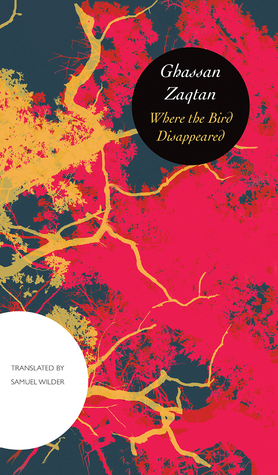
With the second installment, Where the Bird Disappeared, Zaqtan takes a somewhat different approach, but one that is likewise weighted with lyrical beauty and sorrow. The narrative begins in the years just prior to the invasion and extends to the present day, while its echoes with the past go much farther back in history. Set in the Palestinian village of Zakariyya, the central character is a youth also named Zakariyya. He and his best friend, Yahya not only share their names with two prophets so strongly associated with the region—known to Christian tradition as Zechariah and his son, John the Baptist—but bear distant imitations of their personalities and fates. Other characters and images also shadow figures from the shared Biblical and Koranic traditions.

This novella adopts a narrative style with more of a mythic feel than Describing the Past. The tone is still dream-like, spare and poetic. However, the disruption and violence of the invasion is much more explicitly portrayed in this tale which unfolds in a series of short, intimate vignettes. As adolescents, Yahya is a restless spirit, given to wandering alone in the countryside around the village. Zakariyya is the more reflective of the two, intuitive and sensitive to place. Together with the other boys of their village, they have their own visions and dreams for the future. Until the military arrive.

With the sudden forced migration, as families flee into the hills, all of the young men are thrown into dangerous new roles. They are drawn back to their villages, to try to protect their homes against impossible odds. There are casualties, including Yahya who is captured, and shackled inside the citadel outside Zakariyya. His friends keep vigil for three days and nights until he is finally killed:

Yahya knew that they were listening to him from the cactus field. His voice was full of testimonial. The pain had stopped and the fear had stopped with it. Only the testimonials remained, running through his voice and pouring into the air. They gathered them in the cactus field.

Zakariyya’s own journey commences with the death of his friend. He sets off to find Sara, who had loved Yahya, drawn by his own attractions as much as the need to bring her the difficult news. Along the way, he takes refuge at the Monastery of Saint Saba carved into the mountain side overlooking the Kidron Valley, halfway between Old Jerusalem and the Dead Sea. His short stay is a time of mystical suspension and release from the burdens weighing him down. He is attuned to the presence of the thousands of monks who passed through the complex over the previous fifteen centuries:

Saints, and pious men at the edges of sainthood, rose up, their chanting lingered as the living met the dead in the vestibules and halls of the monastery, sharing bread from nightfall to dawn.

He listened to their talk and their steps, he distinguished between the weightless steps of the dead and the empty stammerings of language. He arrested the movement of his body and left the air entirely to them.

Gathering the peace afforded him by his time at Mar Saba, Zakariyya sets off again to find Sara. He joins a refugee camp where she also comes to settle with her family. But once he is in close proximity to her, he comes to realize that he cannot approach her, and that to preserve his memories of both Yahya and Sara as they were all once together, to hold on to what little he has of his own past, he must leave. He returns to pass the night at the monastery before continuing “down the falling road” to the Dead Sea.

Zakariyya will settle to work the salt mines, in a land yet again bound to the far-reaching named and remembered history within which he is half aware that he exists. As the years pass, and age bends his back, he finds himself haunted by the strange notion that he was born a father. It’s a sensation that increasingly troubles him. He does not understand it, knowing only that it is bound to a name and that it is becoming more oppressive, leading down a road carved through memory. A road that will ultimately lead him back to Zakariyya. The place. His home.

Rich with allusions, but never forced or heavy-handed, Ghassan Zaqtan weaves a delicately devastating fable that illustrates that the connection of the Palestinian people to their land is not simply geographical, political and economic, but bound through mystical and psychological ties that are enduring. And not easily severed.

Where the Bird Disappeared is translated from the Arabic by Samuel Wilder and published by Seagull Books. The final part of the trilogy will be published in Spring of 2019.
Being sneaky and queer within: Brink by Jill Jones

This past fall I had several precious opportunities to speak with the exceptional Caribbean-Canadian poet, NourbeSe Philip. On the first occasion, we were riding in the rear seat of a vehicle en route to the venue where she would be performing from her innovative masterwork Zong! I told her that I was taking some time to focus on writing, admitting that I was troubled that, at fifty-seven, I only just beginning to try to find self-expression and was having trouble sifting through a mess of accumulated personal experience. She smiled and said, “Oh you’re still young.” She went on to say that, as far as she was concerned, novels might be the sort of heavy-lifting suited to younger writers, but that poetry required a significant measure of life-lived perspective, adding that Thomas Hardy, after whom she named her son, didn’t write any poetry until he was finished with fiction.

I don’t write poetry, but I think that, at best, I aim to write somewhere in the intersection between poetry and prose. The more I focus on writing, and the older I get, the more I find myself turning to poetry with a new hunger and intention. I am drawn to both the experimental and the expressive elements afforded by the form. And although I’ve enjoyed and deeply admired so many of the works—primarily shorter contained collections— that I have encountered over the past year or so, something different happened with Brink, by Adelaide-based poet, Jill Jones.

Now I don’t want to speculate on age, with only an author’s photo to go by, but I did sense a degree of generational comfort in my engagement with her poetry. And by that I simply mean that I sensed I was in the presence of a poet who has come to understand, as I have, that questions are easier asked than answered, and that observations are often best left open-ended. This is where the ability to continue to marvel at life’s small wonders crosses weary wisdom and the understanding that words are at once necessary and inadequate. The poems in this collection, which range from the lyrical to the linguistic and experimentally playful, examine the emotions, images, and concerns that reflect an awareness of place and of the passage of time on an increasingly small planet.

In an interview with Tony Messenger, Jones admits that this book which had, at the time of their conversation, just been released, “covers a lot of ecopoetic territory, as the title Brink would suggest.” Natural elements—earthy textures, weeds, leaves, sky, clouds, birds, waters—are all recurring images. The fragile state of the world’s climate is a longstanding concern for her. But this collection is varied in practice and purport, “a big mix of detail and dislocation, images and word play, a lot of play, actually.” Indeed, these are poems that demand to be read, not just for the alliteration, and the slippery shifting of vowels, but for crunchy crispness of the language and the unlikely juxtapositions.

Shape-not-shape and
other shape
move with

wind, mind
argument between
ground, grass, leaf, cloud

barely words
for ephemeral world
beneath breath bones

                   — from “Arkaroola”

What a poet imagines into her own poetic explorations and what a reader meets there is complex and dynamic. In my personal encounter with this collection, I was drawn into the poems that spoke to me of the weight (or weightlessness) of words, and the longing for a language to express or make sense of, a pervasive restless disconnect. This is a sensation that is fundamental and primal, but coloured with the mixed blessings and illusions of modern interconnectedness:

I’m helpless against sky, shadow, gutter
clouds without formality, empty grey branches.
How to explain light on glass
and how not to do that
in this return after work’s decorum
another animal listening into the air.

Each evening practices its street repertoire.
Night blurs lines against my gate.
Tonight the moon is nearly naked.
Forgive me if I seem scrawled
with prefab thought rather than thinking.
I’ve brought no conclusions with me.

                            —from “Scrawl”

Sometimes writing is as much about being unable to write than it is about being able to tell stories, articulate experience or find self-expression. As words try to reach closer to the self, the more contrived or meaningless they tend to become. In my efforts, as an essay/memoirist (a preferred construct) I am fascinated and frustrated by the difficulty of finding a way to talk about a real and persistent experience for which I had no vocabulary until I was in my late thirties. In the meantime, an entire queer discourse has arisen over the past twenty years to parse the intricacies of gender non-conformity, to simultaneously celebrate and police self-definition, and yet it says little about my own queered experience. The words I am searching for remain elusive. My favourite piece in this entire collection, the one that I keep returning to repeatedly and that has earned this book a spot on the shelf inside my bedside table, speaks so clearly to my existential voicelessness. It is called, most fittingly, “Self and Nothingness” and I’m reproducing it here in full:

I’m running all over the world. I’m running
within sight of what might happen.
I’m running with a crazy kind of make-do.

The new plants waver in the cold evening.
It’s cooler than when I left these things, these ideas
in rooms. Is there a knack to it?

If I could shift my head without the world
shifting: It can’t be that hard to look up
into the trees. I know they’re there.

I’ve argued over silence.
I’ve collected nonsense.
I crave nothingness.
I know it doesn’t exist.
That it does.
I am a source of virtual violence.

What senses are, I’m not sure, or how many.
I smell strange but that could be
the way the air is.

The craft is the devil, disquiet a relief
jokes become bullet points, and my life
an account explained in columns.

Perhaps the essence has dissolved, become paler.
Whether to drink it, whether to pour it
whether to watch something else drink it.

Perhaps it’s all a set-up. It doesn’t matter
what it is. Everything in my mouth
cracks like a sweet.

I am a project as I scour the streets, for
what it’s worth, and I’m looking for ways
to write back the damage.

                    — Jill Jones, “Self and Nothingness”, from Brink

Looking for ways to write back the damage. Looking for ways to be. Mid-way through this collection I encountered a poem that, in the moment, spoke to me of conversation about a mutual sense of groundlessness that a faraway friend and I had shared.  I immediately had to photograph the page and send it to him. That is poetry that speaks.

In the end, Brink is, for me, a strange brew. It is blend of perceptive, sensual imagery; a confident exercise in word-crafting; an ode to a stressed climate; and, above all, wise counsel to: “Take better joy.”

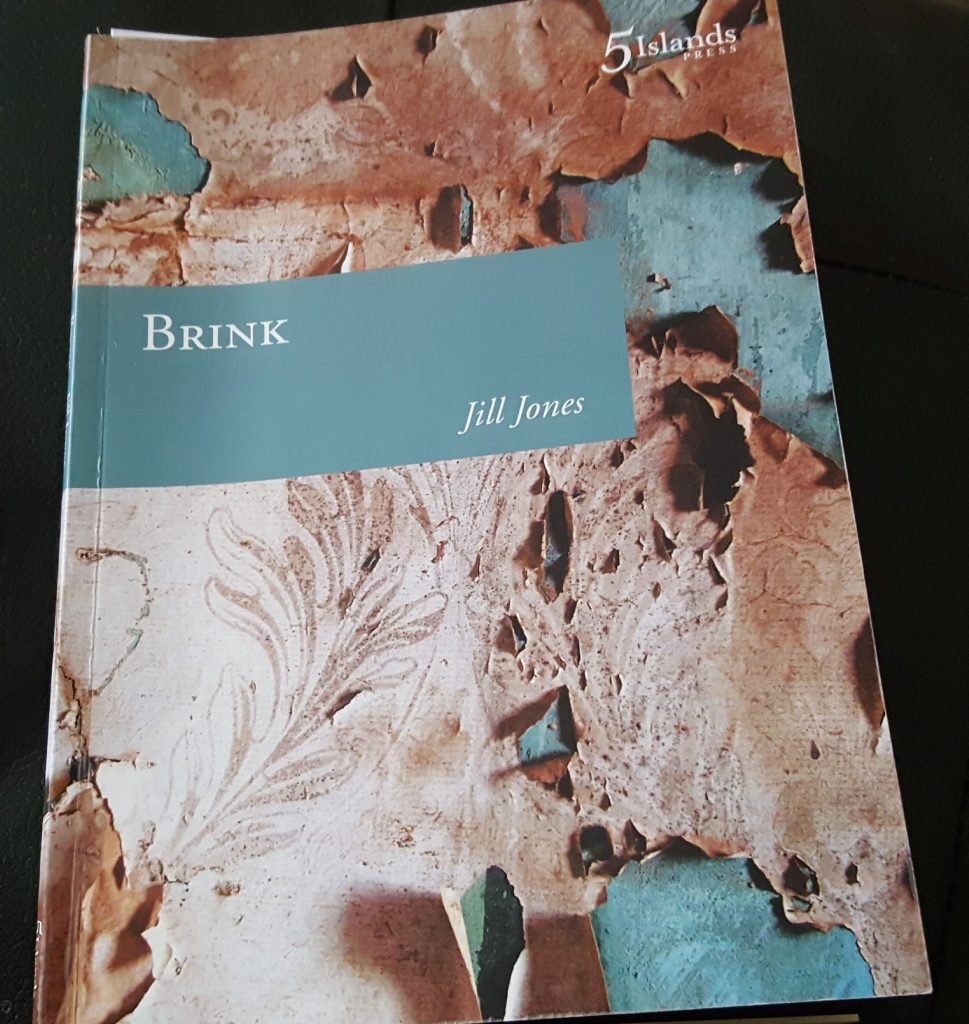
Brink by Jill Jones is published by Five Islands Press.

No country for young men: Border Districts by Gerald Murnane

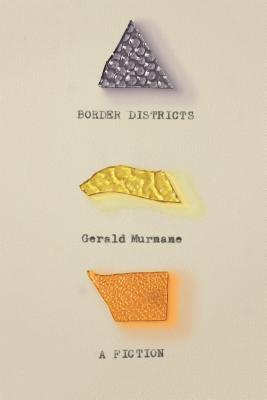
The reflective, circular “report” that occupies the narrator of Gerald Murnane’s latest, and if he can be believed, last, novel is presented as an account “of actual events and no sort of work of fiction.” This clarification, coming in the midst of an extended extrapolation of possible impossibilities, anticipates the skeptic:

As I understand the matter, a writer of fiction reports events that he or she considers imaginary. The reader of fiction considers, or pretends to consider, the events actual. This piece of writing is a report of actual events only, even though many of the reported events may seem to an undiscerning reader fictional.

Of course, in Murnane’s mental terrain the line between fiction and events actually experienced is a slippery one, but Border Districts reads like a meditation on a lifetime of traversing imaginary landscapes as a reader and writer famously adverse to physically travelling beyond the confines of his home state of Victoria, refracted through a playfully multi-toned meta-fictional prism. This is a novel about perception and memory, and the degree to which we can ever hope to grasp the contents of our own minds. More critically it’s about the way our experiences and our experiences of our experiences are inflated or telescoped with the passage of time.

The narrator of Border Districts has relocated from a capitol city to a small town near the state border, echoing a similar move made by Murnane a number of years ago. He has not entirely shunned the city, he makes several return trips to visit friends and family, but his stated goal in moving to this remote place is to spend his last years focusing on the images, emotions and words that have stayed with him over time, “guarding” his eyes, as he puts it, so that “I might be more alert to what appears at the edges of my range of vision.” Anticipating the essential, fragmentary quality of this mental inventory he embarks on a meticulous effort, paragraph by paragraph, to trace the connections from one recollection or set of recollections to another.

The result is a digressive internalized odyssey. Perspective shifts from first to third person for a time as the book-hungry boy approaches the remembering man. Uncertain boundaries exist between recalled events and the fiction writer (and reader)’s inclination to wander off on paths not taken, to imagine what might have been, sketch out potential storylines, flesh out characters that could have existed, and step out from the shadows of possible unlived trajectories to anticipate a meeting of minds on the open plains of a mental landscape. Idiosyncratic sideways cognitive processing is acknowledged, examined, and entertained. But the challenge with exploring the way our minds work is that we can never clear the workspace, step back from the stage. We are always in our own way.

There are a number of key motifs or pivot points to which the narrator returns as he attempts to maintain order and control of his own report. Lines of thought that keep circling back and merging. Readers familiar with Murnane will recognize the elements of the rural Australian landscape, the fondness for horse-racing, and a certain literary cynicism. Houses with return verandas hold a peculiar affection. But the key image that recurs is one of coloured glass—from the windows of the unassuming church in his adopted hometown, to observations about stained glass, to a treasured marble collection—and the difficulty of accurately perceiving the shade and details therein. Just like our memories, in our mental images, appearances are mutable. Light is the key because:

. . . a coloured pane better reveals itself to a viewer on its darker side, so to call it; that the colours and designs in glass windows are truly apparent only to an observer shut off from what most of us would consider true light—the light best able to do away with mystery and uncertainty. The paradox, if such it is, can be otherwise expressed: anyone observing the true appearance of a coloured window is unable, for the time being, to observe through the window any more than a falsification of the so-called everyday world.

Yet knowing this limitation does not diminish the narrator’s natural inclination to want to penetrate the opaque surface of the window, to truly see the nature of the glass itself. He even attempts to capture, on film, the coloured windows of a friend’s house. When he retrieves the processed images and brings them home, he realizes that the image-panes are less colourful than they were when he photographed them. Was this a function of his modest photographic skills or further evidence of the unreliability of memory? Perhaps. But the explanation he chooses to endorse, is that the qualities he perceives as lacking are not inherent to the glass, but rather unique to himself:

. . . what I missed when I looked at the photographic prints was the meaning that I had previously read into the glass. And if I could give credence to such an eccentric theory, then I might go further and assert that I saw in the glass part of the private spectrum that my eyes diffused from my own light as it travelled outwards: a refraction of my own essence, perhaps.

As he makes his way through a range of remembered images, experiences, and feelings, obscured with the patina of time, he is interested in what details he does recall. What he has forgotten, if it does not resurface on its own by association, is of no regard. He is keenly aware of his age and fascinated by the memories that have persisted, with a measure of intensity, for thirty, forty, sixty years. The narrator’s associations and meanderings are unique to him, but they reflect our own idiosyncratic mind loops—those layered networks of connections constructed through exposure to art, literature, landscape, life experience—which increase in depth but become more firmly attached to our specific pivot points or mental signposts, as we get older.

I have come to this book midway through my sixth decade (as frightening as that sounds), younger than Murnane and his alter-ego, but close enough. I come to it as a writer interested in capturing his perceived experience, rather than biographical detail, and inclined to believe that we only have the ability to know what we think we know, a through-the-coloured-glass perspective at best. Border Districts is an older writer’s reverie. It dips back to childhood and adolescence, marriage and parenthood, and spins off into realm of possible lives unlived. There is something to greet a reader at any point in life, but I wonder what my twenty-eight-year-old self might have found. What I do know is that this novel entertains the kind of questions about memory—about the feelings, colours, and images that linger ever “on the edges of my range of vision”—that occupy me more and more with each passing year.

 Border Districts by Gerald Murnane is published by Giramondo Publishing in Australia. It is now available in North America through Farrar, Straus and Giroux.

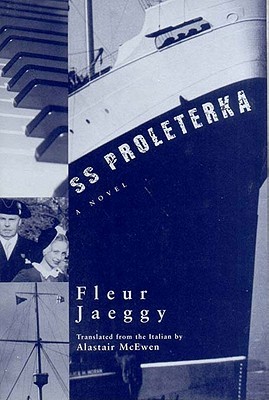
The truth has no ornaments: SS Proleterka by Fleur Jaeggy

You don’t tell the story of your own life, there’s no time. Life began the moment in which we got on board. The beginning is the Proleterka.

SS Proleterka was the last of Fleur Jaeggy’s currently available translated works that I had left to read and I did not want it to end. I used to think Sweet Days of Discipline was my favourite but this novel is far more subtle, real, and painful. And with none of the gothic overtones that creep into so much of her other work. A most dispassionate and restrained coming of age story, it is cold, calculated, yet charged with a deep, sorrowful beauty.

Central to this novella is the account of a cruise to Greece that the unnamed narrator and her father take when she is fifteen years old. It will turn out to be the last opportunity they have to get to know each other. Her parents separated when she was young, and she was deposited with her maternal grandmother, leaving her father effectively exiled from her life, forced to request time with his daughter—applications that were frequently denied or strictly curtailed. To have two weeks together over the Easter holidays is unprecedented, and precious, but unlikely to resolve the existing distance between parent and child. They are too much alike, too accustomed to emotional self-preservation. But, with almost surgical precision, Jaeggy’s crystalline prose exposes the currents of repressed affection that run deep beneath the surface of their relationship.

Our protagonist is looking back from mid-life, at her childhood and youth. She offers an unsentimental, clinical assessment of her own experiences, emotions, and interactions. It is a learned response to the world. Occasionally she speaks of “my father”, but most commonly she refers to him by his first name, Johannes. With respect to herself, she alternates between first person and third, talking of “Johannes’ daughter,” “she” or “the girl”—at times employing all three in the same paragraph. She is thus able to step back and place herself within the regard (or lack thereof) of others. Detachment is her means of coping.

As a young girl, she tells us, she lived with Orsola, her mistress or “the mother of my mother, of her who had been Johannes’ wife.” After her own parents’ divorce, her father’s parents who had moved south for the health of their other son, an invalid, lost the textile factory that had been in the family for generations. Johannes lost his inheritance and his wealth. For the narrator, her father’s family hold a tragic fascination. She does not know them beyond their photographic images. But then she hardly knows her father any better. It is her mother’s family who control her destiny, which will ultimately be boarding school. She is disposable and knows it early on. Still, she describes her “quasi-glacial” relationship with her maternal grandmother as the most intense she ever had, even if she is at a loss to know if she felt affection for the woman:

Orsola treats me like an adult. Like a peer. Obedience does not mean subordination. I close all the shutters. I do not open them in the mornings. A continuous closing. I close the day. Closing is order. It is a form of detachment. An ephemeral preparation for death. An exercise. It was entirely natural that that woman and the garden corresponded to the vision of a happy land. How much time did I still have at my disposal? The curtains at the window are fragile, almost dust. And she, the mistress, looks like a white plaster bust.

If her relationship with Orsola is formal and defined by expectation, her mother exists almost entirely in absentia. She is “Johannes’ wife.” By the time the protagonist is recounting her tale, she too is dead. Her daughter has only her jewels and her piano to remember her by. It is the Steinway, purchased in New York and carried across the ocean to Europe, that is the narrator’s closest connection to her mother. As an object resting in a specially prepared room, she endows it with personality, demonstrating an intimacy she could never find with the pianist who once played it:

You do not want me to touch your keys yet. My fingers are unfamiliar to you. That slight hint of carnality. But I am sitting beside you. I watch over you. In the first years I always kept the door closed. I wanted to be sure that no one came in. You alone, locked in. Now no longer. Now I allow you more freedom. And at the same time I allow myself more freedom too. I have become wiser. Before, if I felt resentment, it seeped into my veins, my eyes, my thoughts. An insomniac resentment.

Aboard the SS Proleterka, the connection between father and daughter is marked by a formality that neither can seem to breach. They have, she has told us, always been able to “perceive the exceedingly fine line between equilibrium and desperation.” By the time they are on this shared voyage, the daughter on the cusp of womanhood and the father aging quickly, they can no longer negotiate that line. The ship has been chartered by the Guild to which Johannes has belonged since he was a student. Having fallen into poverty, he is treated by his peers with a measure of pity. He is awkward, out of step. His daughter, meanwhile, is looking to test other waters while they are out to sea. As the voyage progresses, she engages in a number of rather abrupt sexual encounters with several of the officers. She is being used and she knows it, but she wants the experience. She likes and dislikes it at once. Having been raised by a family who could not show love, she seems unable to accept more than brute affection. Yet there is also the sense that she wants to evoke a reaction in Johannes, protective, angry, disappointed—anything—but if he registers her absences from their cabin he refuses to show it.

Day by day, their extended visit slips away. Trips ashore to visit ruins and others sites, exhaust Johannes and confuse his daughter. At Knossos, for example, his sadness weighs on her and distracts her:

I should pay attention to the woman’s explanations, says Johannes; I continue to look at her white gloves, the seams of her stockings. Her calves. “Höre, höre zu,” says Johannes, listen. I cannot catch her words. Only in my mind’s eye can I grasp what I see. The words are too much. And the light is extremely bright. The journey is important for Johannes. The journey to Greece, father and daughter. The last and first chance to be together. But we do not know this. Or perhaps he does.

There will be no magic breakthrough on this voyage, nor in any of the remaining visits the narrator makes to have dinner with her father in the hotel where he lives. There is an emotional stasis that defines their relationship and in a strange way it suits them. The narrator’s father will be long dead before she really confronts the importance of their bond. And even then it is stretched taut and unarticulated.

Perfectly paced and tightly controlled, the devastating power of SS Proleterka lies in the way Jaeggy manages to capture the complicated and unexpressed affection that underlie even the most strained parent-child relationships, while demonstrating the lengths to which a child who knows they have been disposed of will go to maintain a sense of identity. Self-preservation requires distance. If the narrator seems dispassionate at times, she is also resilient and real.

SS Proleterka is translated from the Italian by Alastair McEwen who maintains a remarkably clean, even tone throughout, seamlessly incorporating the German dialogue, and allowing the stark beauty of Jeaggy’s prose to shine. Highly recommended. Available from New Directions.

Some measure of an innovative response to Liberating the Canon: An Anthology of Innovative Literature

So I’m sitting here at looking at my copy of Liberating the Canon: An Anthology of Innovative Literature and feeling sick when I think about whether or not I can, or should, write about it. Which makes it sound like I did not enjoy the book. Or that it is not worth reading. I did. And it is.

But, can I talk about the way it also twists me up inside? That a book that I should connect with on a level beyond the written word leaves me wondering if there is a space for me? On the back cover (which on my copy is terribly warped after a fall on snow-covered ice landed me with a concussion) editor Isabel Waidner is quoted:

If there were a literary avant-garde that were relevant now, it would be what the queers and their allies are doing, at the intersections, across disciplines. This avant-garde would be inclusive, racially and culturally diverse, migrants galore, predominately but not exclusively working-class, transdisciplinary, (gender)queer and politically clued up (left).

I like the sound of this. But is this what the queers and their allies are doing? Possibly. I am the ineptest (gosh I didn’t even know “ineptest” was a word, but Word suggested it and I kind of like it) queer writer ever because, off the page, queer is the loneliest reality I’ve ever known, and the many queer writers included here seem to have lives in which their queerness is essential, not accidental. And that makes me feel as alienated as my real life adventures in queer spaces do. I’m awfully pasty white and ordinary, and although my mother’s family were, at one time, potato famine refugees from Ireland, and I was not born in the country where I live, I am a migrant on an axis other than the here-to-there displacement in space. The only true migration I have ever made—the one that I am always making—is the one from female to male.

And I am not even certain how to think about “working class.” If it’s about wage-labour, a blue- and pink- collar, and sometimes white collar existence, then for the exception of about one decade of my life, I’m your man. But I’ve always preferred to think of myself as under-employed, as if the status was temporary, collarless. Over-educated. Just barely keeping my head above poverty level. You know: What are you going to do with an arts degree? Or two? When things are good where I live, blue collar workers can haul in six-figure incomes. Classless, misfit, my work-life fits into no definable category.

At 57, I’m not even under-employed any more. I’m not employed at all. And too old to start over. (Which leads me to wonder, while we’re being all diverse and intersectional, where disability lies in this re-invigorated literary avant-garde.)

But, enough wound-nursing and equivocating. Back to the task at hand.

I do love the idea of literature that is innovative, experimental, and breaks boundaries especially in my arena, that of the essay/memoir. And, did I mention that nowhere in Isabel’s detailed and entertaining introduction (check it out, if you want, at 3:AM) does that over-used term “genre-bending” appear? The writing she invites the reader to envision, “itself must transgress the various structures through which the avant-garde literary canon has perpetuated itself and its exclusiveness.” Okay, now we’re talking. She goes on to say:

To reiterate, the writing needs to work across various systems of oppression (intersectionality), across formal distinction (prose and poetry, critical and creative, and the various genres), and across disciplines. Same goes for publishing, editing, reading, referencing and designing curricula. Change literature (or what is defined as such) and the discipline will diversify. Diversify the discipline and the literature itself will change. Liberating the canon depends on inclusion and formal innovation in equal measures. The two are interrelated.

And the question then becomes: Just how liberated is this canon? How much of a meaningful advancement have we made toward this ambitious goal by the selections gathered in this anthology?

Honestly, I am not so sure. (Maybe I am.)

I already tend to read a fair amount of innovative literature, and have admitted to a hunger for work that pushes the confines of literary style and form, so the more experimental pieces really, uh, turn me on. The contributions from Mojilsola Abedayo, Joanna Walsh, Isabel Waidner, Timothy Thornton, Mira Mattar, Nisha Ramayyar, Richard Brammer (cheating I skipped this having already the entire book from whence it came) and Nat Raha were, for me, standouts. The most explicitly trans pieces were my least favourite, pushing subject more than form, but as an idiosyncratic, fickle reader—a body dysmorphic, ex-gender dysphoric soul—I am looking for a transvant-garde that speaks to trans in a way that would make me say “HELL, YES.”

This canon still needs to be loosened a little further, I suppose. Or rather, the liberation is just starting.

This book could be considered a primer. An Anglophone primer. An anthology of primarily UK based writers with a few US contributors tossed in for good measure. How about round two? With a glance to Canada (where I am), Australia and New Zealand, South Africa, and desi (South Asian and diaspora) writers.

Ah, one can dream. But if this book can exist, anything is possible.

So, there you have it. I have written about Liberating the Canon without really writing about any of the varied pieces contained within. You’ll have to read it, if you dare. Or desire. Or are simply curious.

It’s worth the risk.

Liberating the Canon: An Anthology of Innovative Literature, edited by Isabel Waidner is available from your friends at Dostoyevsky Wannabe.  To be printed at your pleasure, and obtained through a distributor like that place that starts with A.

The Endless Summer by Madame Nielsen

The following review was originally published in the Spring 2018 edition of The Quarterly Conversation which is no longer accessible.

The Endless Summer by Madame Nielsen, translated by Gaye Kynoch. Open Letter Books.

I remember the year I became an adult. I was twenty-four. I had completed one degree, married, and moved across the country to continue my education. After rent, bus fare, and the student loans we’d secured, we were left with $10 a week for food and barely enough to keep the huge empty front room of our apartment heated through the frigid Ottawa winter. So we turned the registers off and retreated to the bedroom. Homesick, we missed our friends and families. By the end of the term we both recognized that something had been irrevocably altered; an intangible light had been extinguished. This was real life. We had grown up. Our own “endless summer,” that fragile Garden of Eden, was over.

“It is not the bite in the apple that makes the Fall. It is the idea of a life after this one-and-only now.”

Perhaps it is something you only notice once it’s gone; the last traces of a moment when you still believed in the possible, caught up in a lingering nostalgia for a time before the burden of responsibility took its toll. If only one could go back and recreate the mythical intensity of the past, eulogize the lost magic, just like the old woman whose most unusual story lies at the heart enchanting novel, The Endless Summer, by the equally enchanting Madame Nielsen.

The Danish transgender performance artist, has, over the course of her career, presented, masqueraded, invented, and re-invented herself many times, even having her birth-identified self, Claus Beck-Nielsen, declared dead along the way. (He was ultimately revived when the lack of any identity altogether proved too difficult to sustain.) The multi-facetted Madame Nielsen is a novelist, poet, artist, performer, stage director, composer, and singer. With The Endless Summer, newly released from Open Letter Books in a translation by Gaye Kynoch, Nielsen weaves a tale that sidesteps the common expectations of narrative progress and character development. Rather, an odd cast of characters is choreographed through a shifting, dreamlike landscape openly reminiscent of David Lynch, complete with digressions into side stories, tales from the past, and glances into the future. The stories are continually being started, interrupted, and resumed again. The influence of Proust and other French novelists is evident, but Nielsen’s wistful narrator, who will ultimately become an actor, demonstrates a strong theatrical sensibility throughout.

The novel opens with a simple statement, the oddly incomplete sentence: “The young boy, who is perhaps a girl, but does not know it yet.” This phrase will be echoed, with slightly different shades, gradation, and detail, throughout the text. Likewise, the other main characters’ defining characteristics or curious features will be continually evoked, elaborated, and elegized as the tale unwinds. This is, as the subtitle advises, a requiem. A deep melancholy is never far from the surface. But first there is the summer, the “endless summer” a nebulous state of being which exists outside of time, a world unto itself “where time and light stand still and the dust rotates and no one does anything, nothing other than living as if they were in a different era and a completely different location.”

The young boy, who is in fact in his late teens, but so slender, delicate, and shy, falls into this other world after meeting a girl, an ebullient, full-figured, dark-haired girl. He becomes her lover and slips into her household, joining her two little brothers, her jealous, gun-loving stepfather, and her enigmatic mother in a little white farmhouse. The last, a dazzling, long-limbed Nordic beauty spends her days riding her beloved stallion through the surrounding fields. The boy and girl spend their days in bed, losing themselves in one another’s bodies. All the while other characters are introduced, ready to take their places in the drama that will eventually unfold, we are warned, to its necessarily tragic end.

The narrative advances through a series of scenes played out on this other plane of existence, a fairytale space without distinct boundaries. It is not clear when it begins, or when it is truly over. This extended moment of impossibility, or rather, all possibilities, draws others into its sphere of influence—young men on the cusp of adulthood, wayward artistic wanderers, and those going nowhere, like the perfectly handsome, utterly unambitious Lars, the daughter’s best friend. Other characters circle, like satellites, around the periphery of this space of suspended reality, and thus on the edges of the story, providing substantive props against the ephemeral timelessness of the “endless summer.” Aware that the cautious reader may be inclined to advance with incredulity, the narrator is quick to advise:

… if the story so far sounds like a dream, a glossy tale of the kind one occasionally—on holiday or a long-haul flight—allows oneself to lean back into and, as if it were sinful, a praline, vanish within for a brief moment, then it’s because life is a dream, a dream from which you never wake up, but which one day is nonetheless suddenly long since over, but you’re still here and can either use “the rest of your days” to forget and “get on with it” or on the other hand, like me, abandon what is and try to retrieve what was, even the tiniest little thing that has been lost, even what perhaps didn’t really exist but nonetheless belongs in the story, call it forth and tell it so it doesn’t vanish but on the contrary now at last becomes real and in a way more real than anything else.

At the nexus of this act of remembering is the almost otherworldly presence of the mother, a romantically idealized woman, cool, impenetrable, and independent, who casts a spell on all who fall within her orbit, including the Portuguese artist half her age who will become her lover. The slender young boy is clearly enthralled by her, by “the inscrutability and the light that makes it impossible” for him to ever be finished looking at her, “because as soon as he glances away for a moment he has a feeling that he has not yet seen her.” She can be thought of as the embodiment of womanhood to which he, the boy who might be a girl but doesn’t know it yet, is unconsciously drawn. His first sexual and gender explorations are deeply enmeshed with the softly rounded body and pleasure-loving spirit of the daughter, but it is the mother who holds him in awe.

The only character about whom we have no solid background, who falls into the “endless summer” with little more than a passing reference to a family that pretended they had money but in truth had none, is the narrator’s own past self, the slender young boy. The rest of the cast, even those who pass through peripherally, have a story, with dramatic beginnings and occasionally exceptional, but most often disappointing or tragic ends. Early on, when he is spending his days lost in bed with the girl, she entertains him with accounts of her childhood with her grandparents in Spain, her discovery of the truth of her real father’s identity, and the details of her stepfather’s inherited wealth and decline into possessive aggression. It is noted that she has lots of stories. He, on the other hand, has only those he creates.

So this story, this winding, dreamy, melancholic tale of the “endless summer” and everyone and everything it contained, where does it lie? In memory? In longing? Or in the romantic imagination of the “weird cobweb-flighty female being” that the young boy, who might be a girl but doesn’t know it yet, ultimately becomes?

The success of this unlikely, sprawling reverie with its expansive cast and uncertain timeline lies in the emotionally absorbing, reflective tone of the narrative. To read is to submit, to trust the voice. The repeated descriptive motifs are reassuring rather than affected. When new characters appear, instantly vivid portraits are created with the capture of curious details and ineffable traits and qualities:

And shortly after midnight, the two Portuguese arrive with their rucksacks, the one, the pen pal, actually not so dark at all, far from it, tall and strong and with golden curls, Peixe, he is called, “The Fish,” but where he comes from they call him “o Vikingo,” the other one is smaller but equally masculine, dark and mysterious, a little shy like a wild cat, the same soundless movements, an abrupt laughter cracking his face in a flash of light that has disappeared before you have seen who he is.

However, the illusory nature of the entire enterprise, this attempt to recreate the transcendent quality of the “endless summer,” is never denied. Little by little, disillusionment and disappointment dilutes and denudes the magic; characters begin to fall out of that other world, and back into this one. But the end of the “endless summer” is as mutable as its onset.

The transformation of the slender young boy into an old woman lost to her memories is never openly explored. It is an inevitability written into the texture of the account. Rarely does the narrator admit a first person pronoun. This is her (or his) story retold from the sidelines of his (or her) life—a life in which “none of the things he promises himself or dreams about will ever come to anything, while all the things he has never wished for or promised himself will happen and amount to all there has been.” As a reader who was, at one time, a girl who was a boy, but didn’t understand it, I registered a particular resonance with The Endless Summer. The experience of living and writing across a gendered expression creates a haunting sense of disconnect, an otherworldliness. But this poignant novel is much more. It is a requiem for the death of dreams, and a hymn to keeping the spirit alive in the exercise of living beyond the moment when you still believed.

“Earth to earth, ashes to ashes, dust to dust.”


Ancient sorrows, modern woes: The Teeth of the Comb & Other Stories by Osama Alomar

Don’t let the current fashionable popularity of flash fiction deceive you—it is a form with a long history in Arab literature, an allegorical tradition to which Syrian writer and poet Osama Alomar proudly belongs. But, as an immigrant living in exile in the United States, his tightly crafted parables and short fictions have a quality that is both timeless and timely. We cannot but recognize ourselves and the world we live in today.

Free Elections
When the slaves reelected their executioner entirely of their own accord and without any pressure from anyone, I understood that it was still very early to be talking about democracy and human dignity.

In his most recent collection,  The Teeth of the Comb & And Other Stories, Alomar employs this traditional manner of storytelling to craft pieces that range from a single sentence to a page or more. Animals and objects—man-made and natural—are often animated to take centre stage, offering philosophical reflections on life, humanity, or wondering at strangeness of the universe. His narrators and protagonists, human or otherwise, speak to sadness, loneliness, and injustice while the shadow of his troubled homeland hangs over their tales. It cannot be ignored. The futility and violence of war is a frequent theme. These pieces may read like age-old wisdoms, but their message is immediate. If they sound timeless, it is because, at the end of the day, little changes.

The Dark Side
The moon wished to punish humans for the many transgressions and frightful crimes they commit against each other and against nature. She decided to hide her lighted side so that they would curb their behavior and return to reason. And so the eclipse took place. But great was the surprise of the moon when she saw millions of people coming out of their houses to enjoy the view of her dark side.

His style is spare and unsentimental. The shortest entries have a sharp aphoristic tone, whereas the longer ones, with a wider stage on which to play out contemporary themes, are painfully heart-wrenching. “Love Letter” is a long message addressed to a woman with whom the narrator was involved. It speaks to intimacy against a backdrop of war and revolution, an intimacy that deepened even after he left the conflict zone. When her letters and emails stop he fears the worst but holds to faint hope. “The Shining Idea,” one of my favourite pieces, is a dialogue between an unconceived child and the man he hopes will give him life. The would-be child sees only the beauty and joy in the world beyond the transparent boundary that contains him. The father he beseeches knows only suffering and poverty and cannot be convinced that his is a world worth bringing another life into.

Time and again, knowledge, compassion and understanding are the ingredients most at risk, or missing altogether in the world Alomar presents us with. His weary narrators and anthropomorphic characters know this well. But, in keeping with the tradition from which he emerges (Kahlil Gibran is one of his heroes), his messages are never forced or dogmatic. They are simply laid bare for the reader to encounter:

 Never Been Touched
A book sitting on the shelf with torn covers and pages filled with comments and notes in the margins said to his colleague who stood behind him, “I envy so much your freshness and your eternal youth!”
But his colleague answered him dejectedly, “I never been touched!”

With over 160 stories spreading across no more than 95 pages, one might be tempted to consume the accessible, entertaining short fictions that comprise this collection in quick succession, swallowing one after another. However, these fables, wisdoms and cautionary tales are best digested slowly, over a few days perhaps. At once beautiful and urgent, they deserve a little extra attention. The chorus of their voices deserves to be heard.

The Teeth of the Comb & And Other Stories by Osama Alomar is translated from Arabic by C J Collins with the author, and published by New Directions.

Revisiting a past review: A little radiance: Farewell, Cowboy by Olja Savičević

The following is a re-post of a review originally published on April 28, 2015. WH Smith Travel have selected this title as part of their Fresh Talent 2018 campaign, so readers in the UK—or visitors passing through airports and railway stations—have a special opportunity to discover this lively, affecting contemporary Croatian novel. Keep your eye out! It would make an ideal traveling companion.

Everything’s the opposite of what it seems: hell is a comfort to the living, while heaven is ordinary blackmail.

A deeply personal piece of unfinished business draws Dada, the spirited heroine of Farewell, Cowboy, from the towers of Zagreb, back to the grimy streets of her hometown on the shores of the Adriatic in this debut novel from Croatian poet and writer Olja Savičević. Once she arrives, her first task is to relieve her older sister of the responsibility of keeping track of their mother who seems to be surviving on a routine of pharmaceuticals, soap operas and bi-weekly treks to the cemetery to visit the graves of her son and husband. But at the heart of Dada’s return to the Old Settlement is a need to lay to rest her questions surrounding the suicide of her beloved younger brother Daniel several years earlier.

Dada is feisty, in keeping with her fiery hair, an attribute she shared with Daniel and their late father who succumbed to at an early age to asbestos poisoning. An aficionado of the western film, spaghetti and American classics alike, her father spent his final years working at the local movie theatre and then, after the war, in a video store. He bequeathed to his son his love of western heroes and a jammed Colt pistol.

Upon her return to the Old Settlement, Dada settles in to her room under her brother’s fading movie posters, gets an old scooter running and cruises through town on her mission to piece together the past. She recalls the eccentric playmates with whom she roamed the streets and encounters a most beautiful young man who appears and reappears, usually playing a harmonica. Meanwhile it seems that a movie crew has moved in to shoot a film on a drab grassed expanse that will double as the prairie for a project spearheaded by no less than a legend of the bygone era of the spaghetti western.

The primary focus of Dada’s pursuit however, lies closer to home. The family’s neighbour, known to most as Herr Professor, a veterinarian who had befriended Daniel, has resurfaced. After a violent attack triggered by rumours about his sexual proclivities, he had disappeared. Months later, seemingly without warning, 18 year-old Daniel threw himself beneath a speeding express train. Now the old vet has returned. And Dada is certain he holds the key to her brother’s death; in fact she is bitterly obsessed with a desire to confront him, to confirm that he is the author of a cryptic typewritten letter that arrived a few weeks after the funeral, a letter that seemed to indicate that Daniel had been trying to contact the sender. Face to face over cake and brandy she cannot quite say what she wants. She grinds her teeth over his melancholy insistence that “I don’t ask anything of life other than a little radiance.” What on earth is that radiance he asks for, she wonders.

This postwar Balkan world is one of decaying architecture, graffiti scarred walls and woodworm rotted buildings. Tourists are moving in or passing through. Modern technology and old customs exist side by side. Dada is a most engaging heroine, her voice rings through the grime and dust of her environs with a cool crystalline clarity and youthful spirit. For example, after tracking down her former room-mate she recalls that her friend had considered herself the last emo-girl:

‘You’re certainly the oldest emo-girl, and probably the last’, I said.
I imagined her as a little old Gothic lady, but little old ladies, at least the ones here in the Settlement, are generally Gothic in any case, it’s in their dress code.
My room-mate and my Ma would get on well, I reflected. They could go to the graveyard together and shave their heads in keeping with the Weltschmerz.
I’m thinking as though she had settled in my head, I reflected, immediately after, anxiously. I really am my sister’s sister.
Sar-cas-ti-cal-ly, I reflected, in syllables.

Savačević continually surprises with the originality and energy of her prose, translated skillfully by Celia Hawkesworth. Images are revisited, lines repeated, like refrains, throughout the novel, creating a very dynamic and original flow. Tragedy lurks in these pages, but what could be a dismal heartbreaking tale is lifted with humour and thoughtful asides. And that is the sense that lingers.


The restless traveler in an imaginary world: Invisible Countries by Sylvia Brownrigg

Each edition to the Cahier Series, the joint project of the Center for Writers and Translators at the American University of Paris and Sylph Editions, is a short meditation that, like the gatefold illustrations within, opens up to encompass a larger, wider world of ideas, words, and meaning. Running to less than forty pages apiece, half typically given to specially selected images, these small volumes  invite the reader to slow down, take a little time, enjoy the journey. The reward is a story, fable, or essay that lingers in the imagination.

The latest Cahier, the thirtieth, is Invisible Countries by American novelist Sylvia Brownrigg, an author new to me. Evoking a mood reminiscent of Calvino’s guide to fantastic metropolises, this contemporary fable traces a female traveler’s visits to seven imaginary destinations. Each encounter is unsettling and unnerving in its own way; each locale hovers somewhere between the realistic and the impossible; and each country embodies a concern of our modern global existence. Samarkind, for example, is an island nation with boundaries that are shifting and threatened by rising ocean waters. It might seem counterintuitive, but the response to their shrinking land mass, has been to construct a tunnel under the waves to serve as a connection to the mainland, and that is how we see our traveler warily making her way to the island:

The train dips, a singsong announcement is made in a pair of languages – the distinctive Samarkind full of hiss-clicks and spirants spoken with native confidence; the other, romance-influenced but hesitant, uttered with deliberation, for profit – and then the visitor watches the world go dark. The moment gives an inkling of the planet’s approaching apocalypse; she shudders. She is in a lit moving bullet that penetrates the ground. Down, gradually, down; then level. Above the visitor’s head, though it hardly bears thinking about, is a tremendous body of water, alive with sea creatures, ocean vessels, corpses, aquatic plants, and debris – plastic bags, shipwrecks, messages in bottles that will never reach their intended shores.

We will learn that this far-seeing island state, once reticent about visitors, is planning to recreate themselves as a modern-day Atlantis in an inevitable underwater future.

Thanistan is, as its name implies, is a harsh, silent country that is likely more appealing to the dead (and philosophers seeking peaceful reflection), whereas Alluria, a land promoted with bright and inviting posters promising relaxation and fun in the sun, is but a façade, briefly enjoyed, of a dismal, impoverished world. The exact nature of the place is only hinted at. Lured there once, no one returns for a second visit. One can, of course, travel to a disadvantaged society and stay safely ensconced within the environment of an inclusive five-star resort. Isn’t that what “getting away from it all” promises?

These encounters with foreign spaces, fraught as they are with anticipation and disillusion, anxious border crossings, and concern about understanding and being understood communicating in foreign tongues within cultures with different mindsets (“as she mentally formulates her response, the visitor becomes uncertain whether the agent indeed said to her, ‘Don’t worry,’ or whether it might have been ‘You would worry, you could worry,’ or possibly even the command – ‘Worry!’”) are delivered with such a delicate touch that a strange, haunting beauty comes through. The allusions are offered and allowed to lie as they are, each trip only touches the surface of the visitor’s experience, leaving the reader to wonder how each adventure unfolds and reflect upon what these strange, evolving, troubled landscapes have to say to us now, travelers as we are, together on a finite planet.

Accompanying Brownrigg’s imaginary travelogue are a series of vivid chalk and charcoal illustrations by British artist Tacita Dean. Lush bright scenes alternate with grey, abstract, stormy images to reinforce a sense that this journey has taken us to places that, if nowhere, could be anywhere at all.

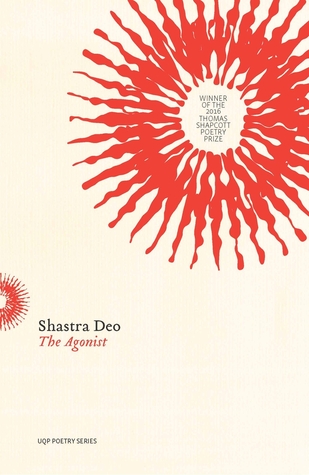
The beauty of bloody fists and broken bones: The Agonist by Shastra Deo

Once again, my attention turns to a work of contemporary Australian poetry, and this time it’s a remarkably gritty, often grisly, exploration beyond the raw edges of physical and emotional endurance. Embodiment. Disembodiment. Lyrical evisceration.

Evoking characters and imagery drawn from diverse, seemingly unlikely sources—anatomy textbooks, World War I poetry, a scout manual, boxing, entomology, ichthyology, divination, tarot cards—Shastra Deo’s debut collection, The Agonist, is an impressive, unforgettable experience. Like a sucker punch to the gut.

But in the best way possible.

Agonist: (n) one that is engaged in a struggle

The narrators that move through these poems—the voices Deo borrows or inhabits—cover terrain familiar to poetry. They speak to pain, love, loss, damage, healing. But they engage with the world at a visceral, cellular level. Their words work their way into and through the hollows of memory, exploring what slips though the passages of the brain, examining what the muscles retain and imagining the intersection between reading the past and foretelling the future.

So what does that entail? The Agonist is divided into three sections, each of which opens with an illustration from Gray’s Anatomy. Many of the poems in the first section deal with relationships, familial or romantic, employing surreal thaumaturgic, and anatomical imagery.

“Arrhythmia,” for example, details the painful, desperate emotions of the partner not ready to accept that a love affair is coming to an end:

             You count the notches of his spine.
His eyelashes flutter and he sighs, his breath
so warm that for a moment you can
pretend you aren’t cold. You want
to crack him open and hold
his heart in your hands, sink your fingers
into the thin membrane of his lungs.
You want to pull back his skin
and curl up inside his ribcage.
You want to know what he is inside.
Find the symptom, the sickness,
the anomaly that let him love you.
You want to be warm again.

Deo is adept at creating a surprising, brutal beauty in her romantic imagery. We see it again with “Cutman,” a graphic, meaty piece that opens the second section of the collection. Here the connection between a boxer and the attendant who cleans and cares for his wounds between rounds is reimagined in intensely intimate context:

He comes home each night with his hands soaked red,
and when he smiles it’s sharp and jagged and his teeth
quake in his wet mouth. You card your cold fingers
through his hair and lead him to bed, wait
for the weight of his arms around your neck, warm
and drowsy, the familiar shape of his bones and tendons
cradling the base of your skull…

In this part, Deo calls on themes drawn from war and boxing to engage in dialogue with other poets and experiment with poetic form. Included are three centos formed from the Index of Titles and First Lines in The Penguin Book of First World War Poetry. Moving into the final section, inspiration is found in, among other things, a Boy Scout manual from 1914 and a deck of Tarot cards. Consider “XIII—Death”:

. . . I live in the present tense,
tensed and present at the wheel
of a car wreck. My name is re-
membered. I apologise too often
for my lack of biography. He
does not yet know what divinity
he belongs to, but he knows I was
not born for this. He takes the
sheets off the mirrors. He escapes
our mythology.

In my experience of this work, which is of course, all I can honestly speak to, The Agonist is a collection in which the sound of the words and the impact of images are central, the point from which a narrative emerges and takes form. These are not autobiographical poems, for the most part. Nor do they read like “stories” so much as they remind me of paintings or photographs out of which vignettes have been abstracted with vivid, scalpel-sculpted, incantatory language.

Reading this book has left me with the sense of having spent time in a gallery. Attending a deliriously disturbing exhibit.

Shastra Deo was born in Fiji and raised in Melbourne. She presently lives in Brisbane where she is pursuing a PhD in Creative Writing. The Agonist is published by University of Queensland Press and, as ever, the indefatigable Tony Messenger has a review and interview with Shastra on his website.