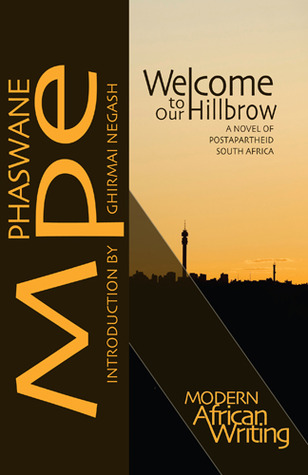
You do not own life: Welcome to Our Hillbrow by Phaswane Mpe

The first thing you notice from the opening words of Phaswane Mpe’s only novel, Welcome to Our Hillbrow, is an unusual, and to Western readers, unconventional narrative voice:

If you were still live, Refentše, child of Tiragalong, you would be glad that Bafana Bafana lost to France in the 1998 Soccer World Cup fiasco. Of course you supported the squad. But at least now, you would experience no hardships walking to your flat through the streets of Hillbrow—that locality of just over one square kilometre, according to official records; and according to its inhabitants, at least twice as big and teeming with countless people.

This is not, as some mistakenly assume, a second person perspective, but rather a communal first person plural voice, speaking from a universal omniscient viewpoint to a character who is dead. It is a narrative form that freely moves from the physical to the metaphysical and back again. By drawing on traditional storytelling techniques, language, and expressions to tell a story that is rooted in one of the most crowded, disadvantaged, and violent inner-city neighbourhoods of post-Apartheid Johannesburg, Mpe is able to explore the intersection of complex issues—linguistic and literary marginalization, xenophobia, suicide, AIDS, and rural superstition—with a dazzling immediacy and intensity.

mpeMpe (1970-2004) was born in Limpopopo Province (formerly Pietersburg) in northeastern South Africa and, like his main character, Refentše, he moved to Johannesburg at the age of nineteen to attend the University of Witwatersrand, which had recently opened its doors to black students. Unable to afford accommodation on campus, he lived in Hillbrow. He would go on to complete an MA in publishing at Oxford Brookes in the UK—an experience that he would, in his novel, grant Refilwe, the female character whose life crosses and parallels that of Refentše. Thus, Mpe’s urban and rural experiences, informed by his modern liberal arts education, contributed to the development of a distinctive new literary voice, one which would be cruelly silenced all too early when he died suddenly at the age of thirty-four.

The voice that carries the narrative directly addresses the primary character throughout the course of this short novel, and is at once challenging and understanding. The voice recounts Refentše’s actions and emotions for him, reminding or reinforcing a memory of his experiences because he and  most of the primary characters have met untimely or unfortunate fates by end of the book (or, if you would rather, before the account even begins). This is a narrative to the dead from the dead. This unusual approach not only allows for a surprisingly effective engagement with a tragic tale of unfortunate coincidences, misunderstandings, and consequences, but it also creates a unique dialectical context for the exploration of the deep and critical issues that lie at the core of the story.

In simple terms, although it does not unfold in a straightforward manner, Welcome to Our Hillbrow, follows two main characters: Refentše, who comes to the city to study, and settles in Hillbrow, becoming a sensitive observer of the community; and Refilwe, his childhood friend and former girlfriend, who arrives in the city shortly before his death. He falls in love with Lerato, the “Bone of his Heart,” who is also an academic. But his mother and fellow villagers are not happy to see him with a city woman—urban/rural prejudices are acute. When a couple of unfortunate moments of infidelity “shatter” his enthusiasm for life and lead to his suicide, Refilwe exasperates the situation by implying that Lerato is the daughter of a Nigerian man, a curse that plays into a deep-seated xenophobia toward African migrants that still exists in some black South African communities today. Tribal justice, more suicide, and madness follow in the wake of Refentše’s death. Yet the narrator continues to address him in Heaven, where he is able to observe the action that ensues but is, of course, powerless to intervene.

I do not own life, you often said when you tried to laugh your difficulties away.

Many people could not see that you were not merely throwing jokes around. You did not own your life when you were alive. Now that you are alive in a different realm, you know for sure that you do not own life. You have watched God and Devil, gods and Ancestors, wondering whether *they* owned it, this thing called life. As far as you could see no one seemed to own it, judging by the way they too cast their eyes in the directions of our Hillbrow, Alexandra, and Tiragalong, clicking their tongues in deep sadness or grim amusement as people devoured one another. You were right there with them, still on your way to finding out whether any of them owned life.

The novel opens with a vivid evocation of the riotous atmosphere of Hillbrow, an area populated primarily by migrants from the townships, rural areas, and from beyond the borders of South Africa. Unemployment and poverty prevail. Those who have arrived from other countries, especially Nigeria, are rudely referred to as Makwerekwere, and are accused of bringing drugs, crime, and prostitution. AIDS is also beginning to take a toll, but the disease is poorly understood and also seen as imported by the outsiders. Rural residents, like the villagers of Refentše’s hometown, Tiragalong, believe they are protected from this mysterious ailment because they don’t eat Green Monkey meat as some West Africans are rumoured to do, and they don’t engage in anal sex. Xenophobia and ignorance in the face of the rising AIDS epidemic are two of the key concerns that Mpe sets out to address. The distrust of immigrants is both timeless and exceptionally timely. Refentše often debates the matter with his cousin, who claims that the neighbourhood had been fine before the arrival of the Nigerians with all their drug dealing:

You, Refentše, child of Tiragalong (and, as you insisted in the days just before your death, also of Hillbrow), had never shared such sentiments. It was your opinion that the moral decay of Hillbrow, so often talked about, was in fact no worse than that of Tiragalong.

Think about it, Cousin, you would challenge. How many people are here in Hillbrow? How many of them are criminals? If you consider that the concentration of people in Hillbrow is dense, and work out the number of crimes in relation to the number of people, I tell you, you will find Tiragalong to be just as bad…. And while we’re so busy blaming [the Makwerekwere] for all our sins, hadn’t we better also admit that quite a large percentage of our home relatives who get killed in Hillbrow are in fact killed by other relatives who bring their home grudges with them to Jo’burg. That’s what makes Hillbrow so corrupt…

Refentše tries to remind his cousin that many of those coming into the country are fleeing violence and deprivation elsewhere—they are driven into exile. Yet his cousin’s response echoes that which so often meets refugees, no matter the time or place:

Cousin insisted that people should remain in their own countries and try to sort out the problems of those respective countries, rather than fleeing them; South Africa had too many problems of its own.

During his years in Hillbrow, Refentše completes his studies and becomes a lecturer at the university. He dreams of writing a novel about his neighbourhood, believing it to be the kind of place underrepresented in literature. He only manages to publish one short story, one that explores, through the fate of its female protagonist, the limitations of writing in traditional tongues in a country with eleven official languages, but where only two dominate to the practical exclusion of the others. Mpe quite effectively works his arguments into and against the prevailing dynamics in South African literature: his main character reads Coetzee (Waiting for the Barbarians), while later, in Oxford, Refilwe introduces an Irish barman to Zakes Mda (Ways of Dying). He can be seen as attempting to build a bridge between established authors—with novels that reflect themes in his own work—and a vision of a literature that could be more inclusive of other languages, such as his native Sepedi.

Toward the end of the novel, the narrative zeroes in on Refilwe as she finally has the opportunity to pursue her MA at Oxford, but the narrator(s) will not actually address her directly until the closing passages of the book. Several years have passed since Refentše’s death, and guilt over her treatment of Lerato, plus her experiences living and working in Johannesburg, have softened her own xenophobic tendencies. While she is overseas she meets and falls in love with a Nigerian man. However, their bliss is cut short when they learn they both have AIDS, and would have in fact been HIV positive for many years. Her fate will serve to challenge the prejudices of Tiragalong when she returns home. Subtle shifts in the narrative voice through the final chapter, serve to add power to its heartbreaking conclusion.

The critical examination of contemporary themes, within a narrative shaped by the rhythms and poetry of an African oral tradition, offers readers an experience that is both fresh and deeply moving. Echoes of Mpe’s work, together with that of K. Sello Duiker, another young and tragically short-lived black writer who emerged in the early post-Apartheid years, has continued to resonate through an entire generation of young South African writers who are producing vital and original literature today.

Welcome to Our Hillbrow: A Novel of Postapartheid South Africa, by Phaswane Mpe is available from Ohio University Press, with an excellent introduction by Ghirmai Negash.

2017 Africa Reading Challenge.

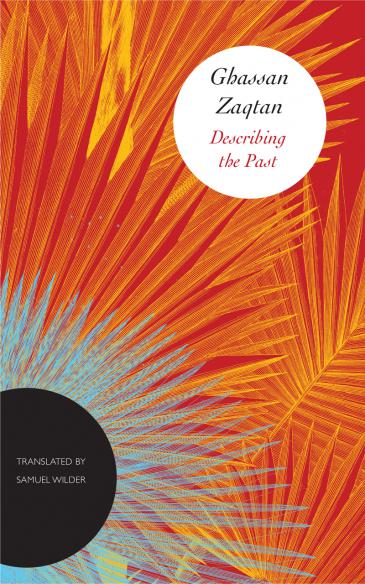
Ever returning: Describing the Past by Ghassan Zaqtan

She is my loss and she knows this. She is my absence and knows this too.

From the earliest passages, there is an abiding transience to the narrative flow of Ghassan Zaqtan’s novella, Describing the Past. The language is delicate, the imagery fragile and dream-like. The world his characters inhabit has an eerie timelessness. The past—immediate or distant—is tangible. Ghosts wander the streets, and memories are brought into being as ethereal images or objects that hold a vital presence in the room, breathe, come alive at night. We are among people who have been uprooted once and will be uprooted again; their dreams and recollections sustain them, give them something to hold on to.

ghassan_zaqtanZaqtan, a Palestinian poet, was born a refugee. In 1961, at the age of seven, his family was relocated (for the second time since 1948) from Beit Jala, in the West Bank, to the Karameh refugee camp across from Jericho, in the Jordan River Valley. But, as Fady Joudah indicates in his Foreword, the camp would be burned with the Israeli invasion in 1968. Zaqtan’s tale is set in this community, yet re-imagined and filtered through the chimerical memory of a place, like childhood itself, that no longer exists.

The narrative is carried by three separate voices—designated I, He, and She—each speaking in first person. The central narrator is nicknamed Christian (his mother was Christian, his father Muslim), and his friend, the other young man, is known as the Iraqi’s son after an uncle who identified himself as Iraqi due to his brief role helping the Iraqi Army at the end of the 1948 war, an experience he built into a sustaining myth that coloured his entire family’s identity. The young woman who holds their attention is, at the outset, married to an elderly man who takes her and her mother into his home. When he dies, she will marry the Iraqi’s son and bear him a child before he drowns, leaving her alone. As such, the outline of the plot is simple, much of it alluded to in the first chapter. However, the story is unwrapped slowly, moving back and forth in time, and relying on poetic imagery and the vagaries of memory to sketch out the spaces that exist between these three individuals.

And that is where the magic lies. In the opening section Christian inadvertently chances to see “her”, the young wife of the old man, naked in her room. He had come seeking some tea leaves for his mother and had not realized she was home. Transfixed by the sight of her body he watches her in hiding until she begins to sob and he runs away, terrified and exhilarated by what he has seen. Of course he must tell his friend, who beautifully describes the vividness of the account:

At first I didn’t believe it, it was not his voice. There was a strand of fantasy that glimmered in his words, some current of rash hunger and desire, of fear and fraud. Little by little, like dust growing slowly and insistently into heaps, she started to gather there in the voice toward the point of completion. She became clear and close. I saw her in his voice reclining nude and whole. Her knee flashed at a distance. At the centre of her figure a dark spot of light amassed, turning and breathing. I was there. I saw her in his voice with a clarity that did not exist for him; she was clearer and more complete in his voice than anything he had looked at and beheld.

The narrative glances forward and retreats in time. The voice of the Iraqi’s son who meets an early demise, disappears from the discourse about halfway through. But the dead are never gone. They are greeted in the street. They emerge from photographs. One has the sense of a world crowded with memories, individuals weighed down by what they have lost. The level, steadily-paced poetry of the language enhances this sensation. This novella, only 84 pages long, is best if savoured slowly, allowing the words to be absorbed.

As each of the narrators picks up the pieces of their own stories, the temporal distortion, shifting from chapter to chapter, can be disorienting. “Here” and “now” are terms without a fixed frame of reference. This is intensified because Christian, as the central narrator, rather than providing structure, is the most abstract and philosophical in his manner of being in the world. He is most sensitive to a past that extends beyond his experience. To ghosts. At one point his father had crept into forbidden territory in search of his village, only to find it in ruins, home now to a curtain of cacti and one remaining pomegranate tree. Stuffing his pockets with pomegranates he arrived home covered in juice, clutching one whole fruit:

He placed it on our only table, and the fruit stayed there. We were unable to wound it. We were afraid to cause it, or him, pain. It was in front of us—breathing and remembering—on that squat table, next the knife that my youngest sister had brought and about which we quickly forgot. It was impossible for us to go beyond that. The fruit was completely alive and necessary for him, his only means to make us believe him, to make us believe all those stories he had brought to us—of his house, his village and his land.

Our house, our village, our land.

There is a sense that the three young characters at the centre of Describing the Past are trapped, suspended in lives they cannot control. It is not clear how much time passes. Hopes and ambitions are fleeting when you face an uncertain future in a refugee camp—when the land you live on is shared with ghosts, haunted by memories, and liable to turn to dust without warning. Yet, circular, the dream-like narrative returns, in the end, to complete the fragmentary images that the set up by central narrator in the opening passages. The mood is gently haunting, beautiful and sad.

And it leaves you with chills.

Describing the Past by Ghassan Zaqtan is translated by Samuel Wilder and published by Seagull Books.

Of reality and imagination: To Begin at the Beginning by Javier Marías

In the opening paragraph of her “Postface” to Javier Marías’ recently released contribution to the Cahier Series, To Begin at the Beginning, famed translator Margaret Jull Costa confesses that every time she starts to work on a new Marías novel, she thinks: “I can’t do this.” His work, with its long, convoluted sentences, and its precise, but shifting, language lies ahead of her at the outset of each project, and until she gets back into the flow she feels a sense of anxiety. I must admit that similar sort of uncertainty faces me as a reader. I wonder, am I ready to commit to Marías again right now? Unfortunately, with a few efforts since I was first swept away by A Heart So White many years ago, the answer has been no, not now.

beginSo imagine my delight with this short, reflective essay about the art of taking the stuff of life—the truths and myths that arise from one’s own family history—and using, even re-using them, to tell stories, create literature. I found this Marías, talking about his family, and his approach to the art of writing, so wonderful to read that I’ve mentally added his trilogy to my list of books to read. And that is one of the absolute joys of the Cahier Series: the opportunity to meet, or meet again, a writer or translator, and spend a little time with them as they explore writing or translating, or the intersection of both, in unique and original ways.

Marías, the highly-respected Spanish novelist and translator, sets out in this piece to explain his desire to devote his energies to writing “inventions,” and why, even when he borrows elements from real life, so to speak, he is inclined to break them up, and blend them into his fictional characters and creations rather than putting them in, unaltered.

2017-01-15-02-12-11 He begins by trying to set himself apart from writers who make every effort to make their fictional offerings appear factual, and expresses his dismay whenever presented with the expression: Based on real events. His inevitable reaction? “I’m filled with a feeling of tedium and anticipatory boredom, of distrust and resistance, of suspicion and even scepticism,” he says, going on to be more exacting:

‘What is so strange and unbelievable, so extraordinarily random, arbitrary, and corny about this story that, even though it’s already happened in real life, they still want to tell me about it, even warning me that I have to believe it whether I like it or not, because this is how it was, this is what actually happened?’

2017-01-15-02-13-49Of course, in the essay that follows, he goes on to share aspects of his own family history, reaching back to his Cuban great-grandfather, pulling out some of the stories that have made their way into one or more of his novels. This abbreviated family history is fascinating in its own right (inadvertently causing one to think that any story “true” or otherwise can be magic in the hands of the right storyteller), but his discussion of his process of re-imagining and working people and incidents from the past into his fictions—and the decisions he has faced when handling elements of the real within the world of invention—is equally compelling.

2017-01-15-02-10-09Marías reports that, when he writes, he applies the same principle of knowledge that is at play in life. He does not know if what he writes at page five of a novel will prove to be a good idea at page 200 any more than we can know if what we do at age twenty will seem to have been wise from the vantage point of forty, and so on. In writing, one has the advantage of editing, adjusting events back and forth between earlier and later portions of the work, giving meaning to the capricious and superfluous, as required, so that “what had no meaning at the beginning does have meaning at the end.” Subject as it is to the unforeseeable variables that mould reality, he contends, life makes a very poor novelist. Imagination is a critical mediator—and one of the essential keys to literature— filtering the invented and the actual, rendering everything equal.

To Begin at the Beginning, the twenty-eighth addition to the Cahier Series, offers an opportunity to spend a little time in the company of a renowned novelist and his chief translator. Illustrated by the works of Cuban artist Wilfredo Lam, it will likely be appreciated by Marías’ committed readers. For those who have little or no experience with his novels, it serves as an ideal introduction, or, as in my case, an inspiration to read more.

The Cahier Series is a joint publication from the Center for Writers and Translators of the American University of Paris and Sylph Editions.

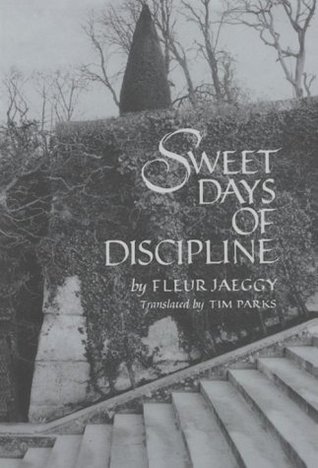
“Childhood is ancient”: Sweet Days of Discipline by Fleur Jaeggy

The bell rings, we get up. The bell rings again, we go to bed. We retire to our rooms; we saw life pass beneath our windows, observed it in books and on our walks, watched the seasons change. It was always a reflection, a reflection that seemed to freeze on our windowsills. And perhaps now we saw a tall marbly figure stand out before us: it is Frédérique passing through our lives and maybe we’d like to go back, but we don’t need anything, anymore. We imagined the world. What else can we imagine now if not our own deaths? The bell rings and it’s all over.

Switzerland, the Appenzell: the area where Robert Walser took his walks, including his final snowy outing, and the location of the boarding school where the narrator of Fleur Jaeggy’s hauntingly pristine first novel is living, at the age of fourteen. She regrets that they didn’t know of the writer’s existence at the time, but the perfection of his death, and the season, set the tone for the story that she is about to share—a chilling winter tone that persists even as the months and years pass and the harsh, spare beauty of Sweet Days of Discipline works its way right through to the bone.

sweetdaysThis novella is marked by a tightly controlled narrative voice. It is a tale of obsession. There is little action, it is the narrator’s emotional intensity that drives the story forward. Looking back on the years she spent in a series of boarding schools, from the age of eight to seventeen, she zeroes in on this one particular year, at the Bausler Institut, where Frédérique—beautiful, remote, and obedient—first entered her life. She sets out to conquer this newcomer who, only a few months older, has come from the outside with a certain detached worldliness that instantly sets her apart from the other girls.

The narrator, whose education is directed, long distance, by her mother in Brazil, is a seasoned veteran of boarding schools where, as she puts it, “a sort of senile childhood was protracted almost to insanity.” She knows the game, and how to play it, which she does with a healthy measure of cynicism:

Part of your education is learning how to thank with a smile. An awful smile. There is a mortuary look somehow to the faces of the boarders, a faint mortuary smell to even the youngest and most attractive girls. A double image, anatomical and antique. In the one the girl runs about and laughs, in the other she lies on a bed covered in a lace shroud. It’s her own skin has embroidered it.

She is, however, only an average student—a fact that does not trouble her at all. At one point she admits that all she remembers from her school years is Baudelaire. No surprise. She seems to have almost absorbed his dark poetic soul. Her narrative is liberally strewn with metaphorical references to graves, coffins, corpses, and death.

She befriends Frédérique, in good part because the others find the new girl too distant, and keep their distance in return. They take walks together, and she listens with sometimes exhausted attention, as Frédérique talks of literature, philosophy, and travel. Her own obsession borders, she supposes, on love. But it is a chaste, almost brittle affection.

Spring thawThere is a simmering violence that runs beneath the surface of the narrative. The narrator, long neglected by her own family, harbours a bitterness that colours her detailed, frequently nasty, appraisals of the appearance and idiosyncrasies of others—the headmistress and her husband, her German roommate, the little black girl, and more. When Micheline, a gregarious new student arrives, she suddenly turns her back on her precious Frédérique, more it seems, out of a sadistic streak than affection for the newcomer. She registers no remorse until Frédérique’s father dies, causing her to leave the school for good.

This novella is filled with conflicted, often dark, emotion. The tension lies not so much in what happens, as in the sombre frostiness of the prose. Frédérique, it turns out, is deeply troubled; however, the nameless narrator, is perhaps more unsettling and tragic. Either way, the result is a tale—captured so deftly in this translation by Tim Parks—of stark, poetic beauty:

I persevered in the pleasure of taking my sadness to the limit, the way one does with some practical joke. The pleasure of disappointment. It wasn’t new to me. I had been relishing it ever since I was eight years old, a boarder in my first, religious, school. And perhaps they were the best years, I thought. Those years of discipline. There was a kind of elation, faint but constant throughout all those days of discipline, the sweet days of discipline.

Fleur Jaeggy is an Italian speaking, Swiss-born writer. Sweet Days of Discipline is published by New Directions. Two newly translated works will be coming out, July 2017, from New Directions in North America and And Other Stories in the UK. (Sweet Days of Discipline is now available outside North America from And Other Stories)


The enigmatic fiction of Roger Lewinter: Story of Love in Solitude and The Attraction of Things

It is unusual to come to the end of a book and be completely at a loss as to how to write about the reading experience one has just had, and yet feel compelled to make some sort of attempt, however indirect or uncertain that might be. And that is exactly how I find myself now, having just finished Roger Lewinter’s novella The Attraction of Things. Together with Story of Love in Solitude, a very brief collection of three short stories, these two recent releases from New Directions (translated by Rachel Careau) serve as an English language introduction to the French writer and translator’s beguiling, meditative, and sometimes simply perplexing, fiction.

lovesolitudeThe latter volume, originally published in 1989, is one of the most unusual and strangely captivating books I read all year. The stories are focused and contained, reading almost like prose poetry, but they offer a taste of Lewinter’s idiosyncratic unspooling sentences that can wind around seemingly unrelated clauses before finding their way, from beginning to end, by such a circuitous route that one often feels inclined to retrace the pattern back to its source. It is an experience akin to untangling a long garden hose, or, more appropriately, following the designs of a richly decorated tapestry such as the Kashmir shawls that Lewinter’s narrator—whose writing and translating projects mirror the author’s so directly that the line between fiction and memoir appear to blur—obsesses over in the story “Passion” and throughout the course of the longer novella. Even attempting to write about Lewinter’s prose invites a tendency to add divertive notes, set off with dashes, not entirely unlike the style he employs.

See? Already it feels as if I am spinning my wheels. The reward though, especially in the shorter pieces, lies in the attention to detail and emotion, often of a detached or self-reflective nature, that is granted the events, objects or individuals with whom the narrator is engaged. The simplest story, the opening titular piece of Story of Love in Solitude, lasts for less than three pages and concerns the persistent presence of a spider. It captures so acutely the type of everyday irritation that quickly turns to a sense of loss when the routine is broken and an odd affection is realized after the fact.

athingsThe other two stories are more complex in the attractions and obsessions they entail and introduce characteristics that are present—and I want to say, more inclined to cause a measure of frustration—throughout the novella: Lewinter’s tendency to use explicit dates and translation projects to track time while he dismantles and reconstructs the chronological (in)consistencies in his stories—one which involves an epic battle against insect infestation and fate to save two camellias, and the other, which traces the protagonist’s drawn out and ultimately fruitless obsession with a young man he observes in the market. What makes these set-pieces work is the way that, for all his musing and meandering, Lewinter writes with an almost symphonic intensity, building tension into his narratives, and bringing each one to a charged conclusion. These small discursive journeys relate ordinary events that are oddly familiar, sensitive, and moving.

The same forces are at play in The Attraction of Things, which is the earlier of the two works, originally published in 1985, and, again, the overlap of characteristics between the narrator of the novella and, at the very least, the literary career of the author, create the sense that this is one voice, an alter-ego or fictionalized version of Lewinter himself. As he states, Attraction is:

…the story of a being who lets himself go toward what attracts him—beings, works, things—and who, through successive encounters, finds the way out of the labyrinth, to the heart, where passion strikes. This is the story of a letting go toward that passion.

The path that this being follows is one that appears to be characterized by an attempt to avoid deep emotional engagement with people by allowing objects—78 RPM records, Kashmir shawls, porcelain collectibles—to distract him. Against this pursuit of things, his mother and father become ill and eventually die, he allows a relationship with a woman to drift away, and lets a man take advantage of him. His passivity approaches denial of mortality, commitment, and sexuality. The flea market and the lure of things is a refuge. So too, is his work, which primarily involves immersing himself in the words of others.

Lewinter, the author and his narrator alike, has translated Karl Kraus, Elias Canetti, Robert Walser, and Rilke among others. But of special significance perhaps, is his deep association with the work of Georg Groddeck (1866-1934), the German physician widely regarded as a pioneer of psychosomatic medicine. If nothing else, this presents a possible context for understanding the manner in which the protagonist and his parents each face, and deal with, illness and physical ailments. There is a strong self-determination and stubbornness shared by the three family members that is, at the same time, a source of frustration to the son in his own distracted state. It is also interesting that Lewinter—separating him from his narrator is becoming redundant in this context—mentions writing about the connection between Bosch and Groddeck in an essay on paradise in psychoanalysis (Groddeck et Le Royaume millénaire de Jérôme Bosch—1974). Immediately this adds a new dimension to the obsession with Kashmir shawls—the colours and designs integrating cardinal points, black hearts, and angels—that runs throughout the novella and resurfaces in the later story “Passion.” To what extent are the textiles collected, cherished and hung on the walls an attempt to reflect a dream of paradise? But, most critically, when winding one’s way through the elliptical sentences that stretch on and on, often for a page or more, the narrator’s absorption with the work of a man who envied Freud’s discovery of psychoanalysis offers a way to “read” Lewinter’s distinct style of writing.

Any quotation from either book that captures a fragment of one of the gloriously nested sentences, would fail to do justice to the effect, or serve as a necessary sample for discussion, so permit me one longer, complete quote (by happy coincidence, this passage, which I selected as I was reading, happens to end a longer excerpt that was reproduced on Lit Hub):

The health of my father, since the previous September, had been deteriorating, the drugs having less and less control over the tremor that was now paralyzing him in spurts, disjointing his day with gaps to which, not wanting to hear of another hospitalization, he reconciled himself, and which I likewise trivialized; while, returning after the three months’ interruption occasioned by Antigone to Le chercheur, I finished the word-for-word translation in June, to find myself confronted with the difficulty unresolved, since I still didn’t know how to convey in French what showed through in the German, in my version rendering, as I was aware, only a state of amazement, not, in its magnetization, the torrent  of a life; and, the more I advanced, the more I was losing my way, when, on August 13, I had to have my father admitted, despite his refusal—“because you die there”—, to Thônex so that they could try, by gradually changing his medication, to stabilize his condition; but it was the balance found upon the death of my mother, three years earlier, that was undoubtedly slipping away.

Lewinter’s narrative clearly fits into the broad category of stream of consciousness writing. It is not as loosely unformed as some variations; the insertion of exact dates and concurrent writing and translation projects provides a structural formality and logic to the account. Not being well acquainted (yet) with the pioneers of the nouveau roman, I am not as well equipped as another reviewer (see John Trefry here) might be to draw refernces from that direction—my reading is necessarily instinctual and informed by the spaces where I related with particular poignancy to the larger story. The way the narrator’s mind wanders is reminiscent of the way we talk to ourselves and allows him to capture something somewhere between unarticulated thoughts and formal discourse. This is the private debate, the ongoing perseveration, the way we justify our obsessions with objects or people, our impatience with others—especially with those closest who invariably raise the most complex emotions—and any other shortcomings we care to catalogue and excuse as we structure our own internal narratives. As we articulate ourselves into being.

As the narrator’s equilibrium is slowly undone, that is, as his father’s deteriorating health challenges him to break down his own defenses, he is forced to finally open himself up and truly embrace the man he must admit he has never really understood. Father and son, mirrors in more ways than either wishes to recognize, are drawn, both resisting the pull, into a full acknowledgement of their affection for one another. And what is the first thing our narrator does to mark this breakthrough? He looks for an object to commemorate the occasion. There is constant interplay between emotional exhilaration and exhaustion that drives The Attraction of Things, at the level of the sentence and across the text as a whole, that to no small degree, contributes to the state in which a reader emerges at the end. In the span of 79 small pages one has experienced something at once fantastic and draining.

Not unlike a session on the analyst’s couch. And very much like the experience of trying to untangle and make sense of our own lives.

Lewinter is not going to be for everyone. If I was uncertain in the early chapters of Things after loving the smaller pieces in Story of Love, I became increasingly engaged as the father’s health deteriorated, in part because there were echoes of my own father’s decline and death over the first six months of this year. At times I almost had to laugh out loud at the older man’s stubborn resolve and refusal to give in to a weakening, crumbling body—my father was exactly the same. Now, having taken the time to write about this novella, I have come to respect and marvel at what it demonstrates about how an essentially ordinary, even mundane story can be told—no, orchestrated—and granted an operatic arc that creates an experience a reader will have a hard time shaking. There is a lot in this slender volume.

In the end, I am not certain I have articulated or elucidated anything especially profound about these two small books. To date, there is one more piece of fiction in Lewinter’s oeuvre and, as I understand it, Rachel Careau is still dedicated to translating his works. I know I will be watching for more.

Story of Love in Solitude and The Attraction of Things are published by New Directions. Each book is bilingual, with the complete French text following the English.

In good company: The Walk by Robert Walser

On Christmas Day, sixty years after Swiss writer, Robert Walser, took his fateful last winter stroll, I went for a walk through my neighbourhood. It was cold, -23C, but the low sun shone on a fresh 15 cm of snow, making it an ideal day for photographs. This being the first Christmas after the deaths of three of the people closest to me, it was a time of invigorated spirit and creativity mixed with sadness. Not entirely unlike the emotions recounted in the book I opened after returning home—Walser’s novella, The Walk.

walkNotably the first of Walser’s work to be translated into English, the path that led to the present edition of this book, a part of New Direction’s Pearl series, is interesting and informative. The original translation by Christopher Middleton was published 1955, and based on the 1917 stand-alone publication of The Walk. When the same piece was released as part of the 1920 collection, Seeland, the author had edited his first version—streamlining some sections, padding out others. With this in mind, translator Susan Bernofsky, applied Walser’s edits, only as necessary, to Middleton’s work. The resulting volume is a unique collaboration and, as Bernofsky notes in her introduction, the two versions offer fascinating insight into Walser’s “evolution as a writer.”

The narrator is a writer and a self-styled flâneur whose environment is not the bustling metropolis, but a semi-rural/semi-suburban setting featuring bucolic scenery and peopled with eccentric characters. The novella opens with our hero leaving the gloomy isolation of his daily confrontation with the empty page, to set off on a series of errands. He is in a jaunty, positive mood. It’s evident that being out on the street is where he feels most free, confident, and at ease.  Opinionated, observant, and self-conscious, the narrative that unfolds is marked by an excessive chattiness. Whether he is addressing the reader or someone he encounters, a certain manic energy drives the perambulator’s account:

In the water of a fountain a dog refreshes itself, in the blue air swallows twitter. One or two ladies in astonishingly short skirts and astoundingly high, snug, fine, elegant, dainty colored booties make themselves as conspicuous as anything else. Moreover two summer or straw hats catch my eye. The story about the straw hats is this: it is that in the bright, gentle air I suddenly see two enchanting hats; under the hats stand two fairly prosperous-looking gentlemen, who by means of a bold, elegant, courteous waving of hats seem to be bidding each other good morning, which is an occasion upon which the hats are evidently more important than their wearers and owners. The writer is nonetheless very humbly asked to be a bit careful to avoid jokes as well as other superfluousnesses. It is hoped that he understands this, once and for all.

This excessive attention to detail, and the tendency to address himself in the third person with slightly self-deprecating humour, creates a distinctively Walserian tone that would influence Bernhard and be so admired by Walter Benjamin and W.G. Sebald.

As he continues on his walk, Walser’s narrator, will stop into a bookshop and bakery, dine with a female friend, and attend to a variety of errands. He waxes lyrical, sometimes taking his praise well over the top when describing some of the houses, gardens, and natural settings he passes by, while he explodes with outrage at the slightest provocation. Inspired to impromptu speech-making, he bends over backward to flatter several women he encounters, and recites from memory a long-winded insulting diatribe to the unknown recipient of a letter he mails:

“He who works honestly, and devotedly exerts himself, is in the eyes of people like you, an outspoken ass. In this I do not err; for my little finger can tell me that I am right. I must dare to tell you to your face that you abuse your position because you know full well how many annoyances and tedious complications would be entailed if anyone were to rap your knuckles. In the grace and favor which you enjoy, ensconced in your privileged prescriptive position, you are still wide open to attack, for you feel without a doubt how insecure you are.”

In his outbursts, it becomes increasingly apparent that the writer/walker is channelling his own insecurities such as in the much-foreshadowed incident in which he angrily confronts a tailor whom he is determined to take for task for the fit of a suit—one it’s uncertain he either wants or, more likely, can afford. At his next stop, he proceeds to grovel before a tax official, explaining how his writerly profession does not provide a reliable income and he thus requires that he be taxed at the lowest feasible rate. When the taxman points out that he always seems to be out walking rather than plying his trade, the narrator launches into a detailed explanation of the critical importance of his daily excursions to the gathering and processing of the ideas that he will commit to paper when he returns to his dwelling:

“Walk,” was my answer, “I definitely must, to invigorate myself and to maintain contact with the living world, without perceiving which I could neither write the half of one more single word, nor produce a poem in verse or prose. Without walking, I would be dead, and would long since been forced to abandon my profession, which I love passionately.”

As the narrator reaches his destination, the end point of his outing where he will rest and reflect, all pomposity and bravado give way to the underlying sadness and loss that he carries with him. He walks then, not just for inspiration, but to try escape a gloom that is not confined to his room alone.

31036737474_a1cd68f48e_b

The Walk was the only one of Walser’s works to be published in English during his lifetime. Now, sixty years after his death, his many novels and short story collections continue to appear regularly in translation. For a man who spent so much of his life confined to mental health facilities, nearly forgotten, and who fell silently in the snow on a solitary walk, this particular novella, so lovingly tended by two of his best known translators, is a fitting honour to his memory.

Round and round: 33 Revolutions by Canek Sánchez Guevara

The unnamed protagonist of 33 Revolutions, a stark, relentless portrait of life in Castros’ Cuba, is a divorced, black man—a misfit who chafes against the collective tedium of his existence until he is forced to decide, like so many before him, what, if anything, holds him to his wretched island nation. The revolutionary bloom is long off the Communist rose that once held his hopes and enthusiasm. With weary resignation, he shuffles off to his ministry job day after day, enjoying the few privileges afforded by the little bit of extra money sent to him from his mother overseas, but it is a hollow existence:

Duty and desire. Angrily, he bangs out his dilemma on the typewriter until the paper is perforated with periods and commas. His desire is to be alone in his office, in this city, in this country, and never to be disturbed. Monotony is expressed in a thousand ways and acquires various signs. Work, radio, new bulletins, meals, free time: I live in a scratched record, he thinks, and every day it gets a bit more scratched. Repetition puts you to sleep, and that sleepiness is also repeated; sometimes the needle jumps, a crackling is heard, the rhythm changes, then it sticks again. It always sticks again.

33Threaded through the thirty-three brief chapters of this slender novella, are two repeated refrains: the scratched record and the suffocating tropical heat. This imagery is employed so incessantly that it begins to wear a groove that could, in a longer or less deftly handled work, easily become irritating. Instead, the sheer beauty of the language lends the repetition a peculiar freshness. And that is exactly the intention. Tedium and repetition can be borne, can even seem bearable. Until one day it isn’t, and then all bets are off.

The author of 33 Revolutions, Canek Sánchez Guevara, inherited a proud and defiant spirit  from his grandfather, the famous Marxist revolutionary who fought alongside Fidel Castro. At the age of 22, he rejected the dictatorial politics of his homeland, and left for Mexico where he became a writer, graphic designer, and heavy metal guitarist. He was dedicated to writing and speaking out against Cuba’s single party system and its attendant human rights abuses until he died unexpectedly in 2015, at the age of 40. This hypnotically engaging novel allows his voice to continue on.

With a sense of absurdity that Kafka would appreciate, Sánchez Guevara creates, in his hero, a man who is aware that he stands at odds with the world around him. He finds refuge in books and an incongruous fondness for avant-garde music. He is aware that his life is paradoxical, verging on metaphysical weirdness that is both a blessing and a curse. And this painful self-knowledge does nothing to protect him from the monotony that curses his days or the vivid nightmares that haunt his sleep. He understands his reality all too well:

He looks down at the sea again and drinks straight from the bottle. Behind him, the dirty, beautiful, broken city; in front of him the abyss that suggests defeat…. We win by isolating ourselves, and in isolating ourselves we are defeated, he thinks. The wall is the sea, the screen that protects us and locks us in. There are no borders; those waters are a bulwark and a stockade, a trench and a moat, a barricade and a fence. We resist through isolation. We survive through repetition.

As this ceaseless repetition begins to weaken him, our protagonist’s disaffection grows. An undercurrent of protest starts to build within him, fueled by the oppressive heat and boredom. He had long managed to hold his distance, to stand apart from both the street corner reactionaries and the huddled gossips distorting what the rumours passed down to the masses—but this continual buffering against the insidious mechanisms of state control, starts to wear him down like, well, the needle on a scratched record.

The heat is criminal—it melts neurons, incites to violence, multiplies fertility tenfold. There isn’t a beer for miles around (or water, or a barley drink, or anything that can be bought with national currency). Nothing belongs to me, he thinks. And what about me, do I belong to anything? (The scratched record plays insistently.)

His rebellion starts passively, opting out and feigning sick, but in that act the course is turned.

He finds himself drawn to the shore. His experiences, not only of the city around him but the uncertain and desperate promise that waits beyond the waves, is mediated through the lens of his camera. The frame of the viewfinder becomes his means of contextualizing himself in the world and a focuses his hopes for a possible future elsewhere. Everyone seems to be leaving—his doctor, an old friend from school, groups of kids clinging to rafts of questionable seaworthiness. The camera with its ability to play with depth of field, becomes his tool in an attempt to tell an alternate story, take control of and document his own fate.

This brief novella hits hard. Harder perhaps in the light of Fidel Castro’s recent passing, and in the desperation of migrants risking the seas for a better life elsewhere. The anguish that comes through personal and powerful, and it is more important than ever that we stop for a moment to listen.

33 Revolutions, by Canek Sánchez Guevara is translated  by Howard Curtis and published by Europa Editions.

A modern day folktale: Baloney by Maxime Raymond Bock—my Rusty Toque review

baloneyOne of my favourite books of 2015 was Atavisms, a collection of short stories by Quebec writer, Maxime Raymond Bock. I was especially impressed by his ability to employ a wide range of styles and genres, from historical to speculative fiction, in a multi-faceted exploration of Québécois history, society, and identity. His newest release, Baloney,—now available from Coach House Books and translated, like Atavisms, by Pablo Strauss—offers further evidence of Bock’s versatility. This novella evokes the spirit of a traditional folktale, with its tragic-comic hero whose larger-than-life adventures are immortalized by a disillusioned young writer drawn to the aging, eccentric would-be poet. By turns funny, sad, and wise, this simple story is surprisingly moving and thoughtful, and stands as yet another fine example of a new generation of Quebec writers who deserve to be more widely read in English-speaking Canada and beyond.

My review of  Baloney can be found in the current issue of The Rusty Toque—my first contribution to this fine Canadian online literary and arts journal.

When you fall out of reality: Dispatches from Moments of Calm by Alexander Kluge & Gerhard Richter

As we witness an unprecedented assault on the integrity and role of journalists and the news media, fueled by recent events in the US—and, let’s be fair, in many other nations in our current climate of political unease—this collaborative effort to re-imagine an alternative approach to capturing reality is ever more timely and precious. The genesis of Dispatches from Moments of Calm (Seagull Books, 2016) lies in an unusual experiment. For one day, October 5, 2012, all of the noisy and distressing political reportage evaporated from the pages of the German national newspaper, Die Welt. In its place? Thirty pages of photographs capturing the simplicity of the everyday—a quiet interlude in restless times, created and directed by renowned artist Gerhard Richter.

calmInspired by this singular attempt to create a “moment of calm,” writer and film maker, Alexander Kluge, started to work on a collection of small stories to accompany the images. Richter responded in turn with the proposal of a collaboration. He added more photos; Kluge wrote more stories. The resulting book—a continuation of their first successful joint publication, December (2010/2012)is an important, and given the mood of the current times and the circumstances of the project’s origin, a more meditative and philosophical work.

The photographs scattered throughout the text isolate the ordinary instant. The atmosphere is placid, low-key. We see a dog sleeping in the sun, the blurred image of a family at a meal, a deserted downtown street, images of nature, children at play, a moody seascape, and more. But each image exists in a space apart from time and the world. And Kluge’s fictions, taking off as they so frequently do, from real life people, events, and ideas, offer the ideal counterpoint. Many of the stories explicitly explore the intersection between art, music and reality:

László Moholy-Nagy was asked whether a photograph reproduces a piece of reality. He denied the claim. He replied that a photograph is constituted by the fact that it concentrates on an actual moment and records it, becoming a textual addition existing outside the world. He knew, the Bauhaus man continued, series and networks of such photographs, which relate to reality or current events like a mirror (including the gaps in that reality, to a silence or to a nothingness), but which, when cut off from the rapidly receding stratification of time, would form themselves into their own republic, one that would superimpose itself (like an El Niño mudslide) onto the original impression that caused the photograph, which itself would have disappeared from the participants’ memory, had they never had the impression to begin with.

Dispatches comprises 89 stories and 64 pictures. Some of the stories—which range from a paragraph or two to a couple of pages—were composed to accompany, after the fact, specific images from the original Die Welt project. Both Kluge and Richter added more contributions on their own. In the resulting book, the confluence between images seems to be accidental, rather than exacting. Where a connection exists, the image is unlikely to occur near the corresponding story. This arrangement adds to the incidental flow of the work. There is, however a thematic structuring at play.

2016-11-30-22-39-33The book is divided into five parts. The stories in first section turn on the element of chance. With narratives featuring real figures from science, music, and history, alongside parables drawn from nature and from everyday life, Kluge explores the vagaries of fate and circumstance. The consequences, happy or unhappy, have the effect of promoting a sense of disequilibrium—an awareness of the fleeting quality of those moments of calm that we experience.

The second part takes us into the city starting with stories set in modern urban spaces, moving back in time to vignettes that speculate on the Mesopotamian origins of the city-state and ruminations on the nature of the concept “city.” This section closes with a story featuring sociologist Richard Sennett:

The city that we carry around inside ourselves, he said, is visible. But when you see a city destroyed by bombs, one which you do not know and means nothing to you, and you nevertheless feel sad, then you can see from this reaction that we carry around inside ourselves just such an invisible city. You see the city only when it has been lost.

These words seamlessly lead into a collection of stories set in the Middle East—Beirut, Lebanon, Syria, Israel—engaging current events, history and even opera to reflect, in words, the very instants Moholy-Nagy imagined captured in the mirror of a photograph.

2016-11-30-22-29-25The final two sections sharpen the focus on questions of reality—how we report it, record it, place ourselves in relation to it. The philosophical musings Kluge entertains in these brief stories offer so much to contemplate. His ability to exploit the fluid intersection between what we, especially in English language literature, want to divide into fact and fiction, lends his stories the sense that these should be considered fragmentary pieces of nonfiction. The influence that his work had on W. G. Sebald is evidenced in this regard. These stories, parables, and reflections are, in themselves, narrative truths—regardless of whether they describe events as they really occurred, or if they even occurred at all. Kluge wants to make you stop, in the moment, and think. Here, as an illustration, is one of my favourite stories, in its entirety to provide a taste of Kluge at work:

For many centuries, thousands of monks in monasteries between Ireland and Byzantium, dotted like islands across the barbaric land, were writing out the holy texts. Their zeal and their great efforts produced mistakes. The result was that the texts imperceptibly expanded. One learned monk in Samanca was delighted to find a text by Ovid on the back of a copy of the apocryphal LOGION OF ST JOHN. The copyist on the island of Reichenau could not resist including this interpolation. In this way, a text was expanded in a distinctly “unholy” manner.

A transcription of texts (just as if evolution had been tinkering with their DNA texts) doesn’t only create lines to new future texts. It can also be reconstructed in the direction of paradise. The way there leads through indeterminacies. ‘Nearer, my God to Thee’ was the music played by the orchestra on board the Titanic as the ship went down. But it is also the working instructions to copyists of all countries, who are driven from the omphalos of experience into the parallel world (heterotopia), the pre-world history and the future world (the world of our children, who are so attached to life). For copyists, all images are NOW-TIME.

I don’t know if it is the nature of the project from which this collaboration arose, that is, as an attempt to visually introduce an element of calm to the daily news cycle, that gives this book its impact, but in contrast to December, which I read at the end of last year (my review is here), Dispatches from Moments of Calm is a more powerful, comprehensive work. But then it may be a question of timing. Originally published in German in 2013, the driving forces against which Richter’s photographic interlude at Die Welt was superimposed, have not slowed. Uncertainty has increased and continues to grow. But as Kluge and Richter, two of the most influential and respected artists of their generation stand to remind us, art is more critical than ever at times like the one we find ourselves in at the end of 2016.

Like the dome of lights over a great city, the STATE OF THE NEWS forms an aura in which a general notion of what matters in the world coalesces.

It is out of such NEWS VALUES and not out of the facts themselves that the daily image of the reality of our world is put together. The products of poetry form an antithesis to this daily fluctuation. In painted images, and in the narratives of short stories and novels, time outside stands still.

Dispatches from Moments of Calm by Alexander Kluge and Gerhard Richter is translated by Nathaniel McBride and published by Seagull Books. A second edition of their earlier collaboration, December (translated by Martin Chalmers) will be published, also by Seagull, in paperback, in Spring 2017.

Cold comfort: The Absolute Gravedigger by Vítěslav Nezval

That terrible fist swings the bell
The blasphemer
Is boxing
Hell-bent on knocking out the eye of heaven
That cynically floods desolate white-washed houses
With radial light
With an iron resolution to act
While the knuckles crack
This fist delivers bruises shaped like swallow nests to roofs
In the name of vengeance
(from “The Blacksmith”)

Upon my first read-through of this newly translated collection of poetry by prominent Czech Surrealist, Vítěslav Nezval, I was struck by an eerie sense that the poet was speaking to the present moment. Published in 1937, the poems gathered in The Absolute Gravedigger form a gallery of darkening, disturbing, and frequently grotesque images that capture the mood of the shifting landscape of the years leading up to the Second World War. Some are small, contained, and often bucolic scenes. But others depict expansive nightmarish vignettes of obsession, violence, corruption and decay—evoking imagery worthy of Bruegel, Arcimboldo or Bosch—and closely aligned with the spirit and sentiment associated with the more widely known French Surrealism.

Returning for a second reading, in the immediate aftermath of the election of Donald Trump, I cannot help but wonder how quickly the lessons of the last century have been forgotten—and shudder at the thought of what potentially lies ahead.

gravediggerBorn in 1900, Nezval began writing and publishing poetry in the 1920s, but by the early ’30s, he and a number of his fellow Czech writers and artists had fallen under the influence of the French avant-garde. He first met André Breton in Paris in 1933, and the following year he helped found the Surrealist Group of Czechoslovakia, the first such group to receive the Breton seal of approval, so to speak, outside of France. Yet, even though they made important contributions to the movement, the Czech Surrealists have remained relatively obscure, a situation further exacerbated by the artistic restrictions applied under the years of Communist occupation. The release of The Absolute Gravedigger from Twisted Spoon Press should help to ameliorate that situation, and spark further interest in the work of Nezval and his contemporaries.

In his poetry, as evidenced in this collection, Nezval was a stylist who drew widely from the Surrealist playbook. In an interview in The Bohemist, translators Stephan Delbos and Tereza Novická describe their decision to work together as follows:

Nezval was prolific and incredibly gifted, so the book is over 200 pages, and contains a range of styles from traditional rhymed quatrains to freewheeling litanies and dense, paranoiac prose. A challenge to translate, to say the least, so approaching it as a team seemed like a good idea.

The diversity of the poems in this collection is difficult to capture in the space of a short review. Suffice to say that they range from the relatively conventional to the decidedly bizarre. For example, “The Windmill” is a section comprised of a series of rural compositions featuring farm and small town scenes. However, the imagery is vivid, sometimes surprising in its unexpected shifts, and an unmistakable darkness seems to wait just over the horizon, as demonstrated in this portion of “The Reapers”:

The birds have flown off
Everything on the verge of tears
Huge carts haul off bales of straw
A cock crows
And wheels squeak
The landscape changes
Brown pitchers peak from under gladiolas
And confusion seized the horses
The mills clatter
From afar
As a signal
Like an imminent declaration of war
And suddenly the whole place is holiday empty

Similar bucolic settings return in the later “Shadowplays” section which features tightly rhyming, orderly quatrains which, to preserve the feel of the originals, the translators have chosen to carry into English with as much of the spirit and musicality intact as possible. Because these pieces stand out so sharply against the more open and, at times, unrestrained quality of the rest of the book, this seems to be a wise choice. Coming on the heels of the intense, fantastic and disturbing imagery of the poems in the “The Absolute Gravedigger” section— the title poem, “The Fetishist,” The Blacksmith,” “Milking,” and “The Plowman”—the sudden appearance of a traditional formality catches the reader off guard.

2016-10-27-16-12-40The author has also included several pieces of his own artwork and the poems they inspired framed by two prose pieces in which he talks about the process of decalomania (the creation of abstract images by laying a thick layer of paint on a surface and pressing a piece of paper or canvas against it) and its influence on, not only the directly referenced pieces but other key poems in the book. Nezval explains that the process gave rise to prototypes of “the hybrid creatures” that people his most surreal poems.

There is harsh brutality that runs through the most fantastic and, to put it simply, “surreal” of these Surrealist poems. The characters that are brought to life, resemble the denizens of an adult Grimm’s fairy tale—grotesquely featured, obscenely sexualized, dirty, decaying—and trapped, sentenced to their miserable fates. But the piece that is most profoundly political, and devastatingly timely once again is the final poem, “The Iberian Fly.” Here on the wings and body of a gigantic fly making its way through the skies, a terrifying spectacle is playing out, summoning imagery reaching back to the Spanish Inquisition, but zeroing in on the rising waves of fascist ideology sweeping Europe. Nezval’s original version was apparently more specific, naming names, but increasing censorship stayed his hand before the final version went to print. All the same, the message is clear:

[The Iberian fly’s] proboscis
Was gradually
Immersed
Into several drops of blood
Squeezed out
Of different races
And subjected these drops
To analytical chicanery
Whose fraudulent result manifested
As diagrams
Once these drops
Of blood
Hardened into a crust resembling sealing wax

As the drop
Of drying Aryan blood
Turned into a faux jewel
Spectrally depicting
Absolute nobility
In the form of Ionic columns
Under which reflected in miniature
The beguiling image of bathing women
On the sparkling left wing of the Iberian fly
The other drops
Drying
Transformed
Under the touch of the dirty finger
Of the little man with the Chaplin mustache
Into this pictorial relief

The relief that is depicted in the following stanzas incorporates African and Asian features—a chilling echo of the type of racist graffiti, propaganda and attacks that we have seen post Brexit and, now Trump. And these patterns know no borders. In Canada, where I live, the past week has seen a sharp upturn in the same trends. The immergence of this translation, at this time, is uncanny, there is a new chill to these words, almost eighty years after they were first published.

Plus ça change.

The Absolute Gravedigger is published, by Prague-based Twisted Spoon Press, in a handsome hardcover edition featuring Nezval’s own decalomania artwork on the cover.