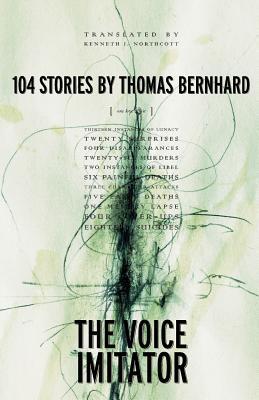
THIRTEEN INSTANCES OF LUNACY
TWENTY SURPRISES
FOUR DISAPPEARANCES
TWENTY-SIX MURDERS
TWO INSTANCES OF LIBEL
SIX PAINFUL DEATHS
THREE CHARACTER ATTACKS
FIVE EARLY DEATHS
ONE MEMORY LAPSE
FOUR COVER-UPS
EIGHTEEN SUICIDES
With the list above, the cover of the University of Chicago publication of The Voice Imitator offers a warning to the potential reader of the themes that feature in the 104 stories that lie ahead. For seasoned readers of Thomas Bernhard none are likely a surprise, though it is quite possible to emerge at the end thinking, “were there only 26 murders and 18 suicides?” Chances are it feels like there are more. But that’s okay. Would you really expect less?
If the thought of encountering a volume containing 104 stories sounds intimidating, be assured that this collection spans all of 104 pages. This is Bernhard in microcosm, all of the acerbic wit and dark charm one could want from the Austrian playwright, poet and novelist distilled into brief anecdotal tales, each recounted within the space of one page.
The longest fill the page, the shortest are no more than a few lines.
Drawing on newspaper reports, rumour, and overheard conversations, Bernhard exploits this condensed form of fiction to tackle his favourite targets, including, of course, his native country. Even in a confined space, he finds room to explore the foibles of human nature and contemplate the bitter ironies of life. There is a healthy dose of death – murder, suicide, accident – some, tragic, some absurd; and no small measure of madness. Featuring a familiar retinue of philosophers and professors, craftsmen and woodcutters, musicians and artists, freaks and loners; the stars of these anecdotes and fables are driven by conviction, thwarted ambition, disillusion, and disappointment. Just like, well, the rest of us.
The least effective pieces are the very shortest. A few more lines are often in order to set the scene, to draw the drama, to pull the the punch. But even then, the emotional impact can be striking with less than half a page:
“Sitting in the early train, we happen to look out of the window just at the moment when we are passing the ravine into which our school group, with whom we had undertaken an excursion to the waterfall, had plunged fifteen years ago, and we think about how we were saved but the others were killed forever. The teacher who had been taking our group to the waterfall hanged herself immediately after a sentence of eight year’s imprisonment had been passed on her by the Salzburg Provincial Court. When the train passes the scene of the accident, we can hear our own cries intermingled with the cries of the whole group.” (Early Train)
The use of the first person plural in the majority of these stories lends an intimate tone. One can almost imagine the narrator as one of those inveterate storytellers who always has an entertaining morsel at hand: a family legend, a piece of wisdom, a mini tirade to share. Bernhard’s language plays on repetition, relies on qualifiers like “so-called” – one can almost see the air quotes – and, in this shortened format, he delights in throwing a punch at the end, leaving the reader with a gasp, a nod, or an ironic laugh.
Some might see this as an introduction to Bernhard for those uncomfortable diving into, say, a single-paragraph 200 page novel. But it works even better, one might argue, as a treat for those who are already acquainted with some of Bernhard’s classic works. Each little anecdotal story stands like a glimpse into the windows of Bernhard’s world… the themes, characters, and images that feature in his longer works shine, isolated for a moment, in the space of a single page or less. Contained in this way, his rhythm, his cynicism, and acerbic wit ring through. Bite-sized Bernhard to marvel at and enjoy.
The Voice Imitator is translated by Kenneth J. Northcott. This stands as my first contribution for the German Literature Month reading challenge.
“Schulz was incomparably gifted as an explorer of his own inner life.”
– J M Coetzee
The year is 1938. In the dull light of a basement apartment in the town of Drohobycz a man is anxiously penning a letter to his literary hero Thomas Mann. He works at a desk that is too low for him. When he is disturbed and distressed by the sound of birds pecking at the high windows he slips down onto the floor and continues working there until the falling autumn light forces him back up to the desk. On the walls of his room hang drawings he has made – fantastic dark sketches of domineering women and desperate men.
The man is famed Polish writer and artist Bruno Schulz. As he composes his missive to Dr Mann, German author Maxim Biller is conducting a guided tour to the interior thoughts, fantasies and fears – make that Fear with a capital F – that he imagines fueling Schulz’s surreal and creative imagination. The resulting novella, Inside the Head of Bruno Schulz serves as a delightfully inventive introduction to an original and influential writer.
“Ever since he could remember Bruno – for that was the name of the man with the face like a paper kite – had awoken every morning with Fear in his heart. Fear and he had breakfast together in Lisowski’s tearoom, Fear accompanied him to the High School and looked over his shoulder as the boys put their unsuccessful sketches of animals down in front of him, as well as plaster models, covered with black fingerprints, of their sweet little heads.”
Biller paints a portrait of a deeply anxious man… a character that would be at home in one of Schulz’s own stories. When he meet him he is unsuccessfully struggling with a novel. He lives with his sister and her two sons. She still believes her dead husband will return. His students whom he thinks of as “bird-brained” literally appear to him as birds, at his window and in his room. He has a conflicted affection for a sado-masochistic sports and philosophy teacher whom he describes as beautiful despite her hairy monkey face and filthy matted hair. But more critically, he carries an impending sense of doom as it increasingly seems inevitable that Germany will be moving toward Poland. It is with that in mind that he is writing to Thomas Mann.
A most curious and twisted fellow claiming to be the great writer has turned up in this small town, charming the residents with enticing stories and grotesque gatherings. The fictional Bruno is anxious to alert Dr Mann to the existence of this impostor whom he suspects is actually a Nazi spy, and to beseech him to consider offering a poor Polish writer critical assistance. With an opportunity to publish in a prestigious journal or an introduction to an important publisher, the timid Bruno believes he might find the courage to leave Poland. He has even written a story in German to include with his appeal.
Combining biographical facts with a wildly fantastic vision that echoes Schulz’s own dark, dreamlike work, Inside the Head of Bruno Schulz is a lateral approach to the writer’s restless creative energy. A brief biography and two of Schulz’s own short stories, “Birds” and “Cinnamon Shops” follow the primary text, making this short book which clocks in at under 100 pages, an irresistible invitation to explore more of the work of this important Polish writer. Unfortunately a number of stories and the unfinished novel he was at work on in this tale were lost after his death so what remains is limited. However, Schulz himself has resurfaced and been has been re-invented and re-discovered as a writer and artist time and time again in novels by Cynthia Ozick, David Grossman and Philip Roth among others, as well in plays and film. (See the essay “The Strange Afterlife of Bruno Schulz” by Jaimy Gordon for an excellent overview.)
Bruno Schulz was a Polish-Jewish writer born in 1892 in Drohobycz, a town historically part of the kingdom of Poland, now part of the Ukraine. During his lifetime he published two collections of short stories, The Street of Crocodiles and Sanatorium Under the Sign of the Hourglass. He was known to be at work on a novel, The Messiah, which has not survived. He worked as an artist and an art teacher for many years. When the Germans moved into Poland during the Second World War, his artwork granted him temporary protection under the auspices of an admiring Gestapo officer in exchange for the painting a mural in the officer’s home. On November 19, 1942, walking home with a loaf of bread, he was shot in the back of the head by another Gestapo officer, a rival of his protector. He was 50 years-old.
Published by Pushkin Press (April, 2015 in the UK/October 2015 in North America), Inside the Head of Bruno Schulz is translated from the German by Anthea Bell. The stories “Birds” and “Cinnamon Shops” from The Street of Crocodiles, were translated from the Polish by Celina Wieniewska and originally published 1963.
“My mother has been dead for almost seven weeks; I had better get to work before the need to write about her, which I felt so strongly at her funeral, dies away and I fall back into the dull speechlessness with which I reacted to the news of her suicide.”
With this simply stated aspiration, Austrian writer and dramatist Peter Handke set out to capture the essence of his mother’s life and chronicle the painful spiral that swept her into a darkness which would lead her to take her own life at the age of 51. Written over two winter months in 1972, the result is a slight volume, 69 pages, that can be read in afternoon. But length can be deceiving. Tracing out a life that spanned the rise of the Nazis, the Second World War, and the austerity and suffering that followed, A Sorrow Beyond Dreams is a spare and elegant memoir from which the reader emerges drained and aching alongside its author.
From the outset he admits that he is seeking an element of closure in the act of putting words to paper, but he wishes to avoid an overly sentimental account, concerned that he risks turning his mother, a real person, into a “character.” He intentionally adopts a more distanced perspective. He does not refer to her by name, and when he recounts the events of his early years he is “the child” or one of “the children”. He employs capital letters for emphasis (“she was a woman who had been ABROAD”). But there is another motive as well. He sees in her life an illustration of the social restraints that defined and limited the lives of so many women from poor rural communities such as the small Austrian village where she began and ended her life. As such he wishes to present her life story as one that is at once personal and exemplary.
The portrait he paints of his mother is one of a spirited young woman, who was denied her pleas to be allowed to continue her studies, for an education beyond the basics was not to be squandered on girls or women. So she ran away to the city to study cooking – not exactly an academic pursuit, but again the only option open for her. She thrived in her new environment: a world of new friendships, fashions, opportunity, and the heady comraderie that accompanied the rise of National Socialism.
The outbreak of war only added to the excitement as young soldiers, away from home and lonely, flooded into the city. She met and fell in love with a married man. Before long she was pregnant, but by the time her son Peter was born she had married another man. Her first romance would remain her only true experience of romantic love; what she had with her husband was a disappointing, often hostile, and very lonely existence. After the war the young family spent a few years in Berlin, living amidst the rubble. A second child is born there. (Over the years she will have two more children and secretly abort three others with knitting needles.) In 1948 they flee Germany and return to Austria, where she finds herself back in her family home, trapped again in a restricted environment, her life once more defined by the Catholic shame and guilt of village life.
Economic conditions at this time were harsh and her husband’s drinking and difficulty holding employment did not help. She responded with the only strategy available: “pure scrimping; you curtailed your needs to the point where they became vices, and then you curtailed them some more.” Necessities would be wrapped up and handed out at Christmas. As Handke recalls, “I was sincerely grateful for the most indispensable school materials and spread them out beside my bed like presents.” Yet she did not look to the possibility that life might hold more for her than housework and continually making the rounds required to keep her drunkard husband employed, creditors from the door and paperwork up to date just to assure access to the most basic benefits.
Finally, as modern appliances started to appear in her house, freeing up a little precious time, Handke’s mother took to reading. Not just the newspapers, but books he brought home from university: Fallada, Dostoyevsky, Faulkner and more. She took everything she read very personally as if each book was a commentary on her life. But by doing so she began to find the words to express herself and put voice to her experiences. As she gradually emerged from her shell, her son finally began to learn about her. However they did not give her a vision of hope for her own future, they spoke only to a past:
“Literature didn’t teach her to start thinking of herself but it showed her it was too late for that. She COULD HAVE made something of herself. Now, at the most, she gave SOME thought to herself, and now and then after shopping she would treat herself to a cup of coffee at the tavern and worry a LITTLE LESS about what people might think.”
For a while she become more engaged in the community, showed more compassion to her husband, and things might have improved but the disappointments of home life still seemed to defeat her. She began to have headaches. She started to withdraw from community life. Her spirit sagged and no one could tell her what was wrong until a neurologist in the city identified her condition as a “nervous breakdown”. With the comfort of having an explanation and medication to ease the pain, she eventually improved. There would be a respite. But in the end despair returned. In November of 1971, she wrote farewell letters to her each member of her family. Then one evening after dinner with her daughter and an evening watching TV with her youngest son, she took all of her sleeping pills and all of her antidepressants and laid down on her bed to welcome that final rest.
If Handke had imagined that in writing this account of his mother’s life he would be able to achieve some peace himself, he discovers, in the end, that that is not the case. The story continues to preoccupy him, to haunt him. Facing memories head on is an act of confronting horror but it does not ease it. The horror arises from the persistent attempt to reflect a truth. He admits that at times he longed to be able to lose himself in a fiction, to be able to tell lies for a while, write a play instead. No longer able to stay out of the frame, he closes the book with a collection of images, remembrances, and brief personal confessions.
A Sorrow Beyond Dreams is, as its subtitle indicates, a “Life Story” told with simplicity and honesty. As Handke reflects in an extended parenthetical aside almost halfway through the book, he wanted to pare his mother’s story down, to present her life with a focused clarity. He sees, in the type of project in which he is engaged, two particular challenges:
“These two dangers – the danger of merely telling what happened and the danger of a human individual becoming painlessly submerged in poetic sentences – have slowed down my writing, because in every sentence I am afraid of losing my balance. This is true of every literary effort, but especially in this case, where the facts are so overwhelming that there is hardly anything to think out.”
The result he achieves is a memoir stripped to its essentials, but delivered with stark, beautiful prose. His love comes through in every phrase as he recounts his mother’s story, and the emotions that arise as he sees her through the final rituals of her shortened life are real, complicated and raw.
*A Sorrow Beyond Dreams, translated by Ralph Manheim with an Introduction by Jeffrey Eugenides is published by Farrar, Straus and Giroux.
“Up above is a narrow strip of sky, and the smooth, dark ground below looks as if it’s been polished by human destinies. The buildings to either side rise boldly, daintily, and fantastically into architectural heights. The air quivers and startles with worldly life… And always people are walking here. Never in all the time this street has existed has life stopped circulating here. This is the very heart, the ceaselessly respiring breast of metropolitan life. It is a place of deep inhalations and mighty exhalations, as if life itself felt disagreeably constricted by its own pace and course.”
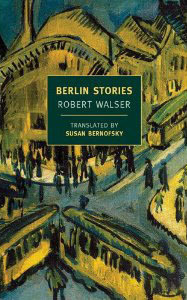
Great cities have their own personalities and in the company of Swiss writer Robert Walser, Berlin of the early twentieth century becomes a living, breathing entity, a dynamic metropolis drawing in the ambitious, the hopeful and the desperate in equal measure. As a guide to the city, its haunts, and its colourful inhabitants, he is endlessly engaging. His name has been surfacing in my consciousness for a while now, but I had not gotten more than a few stories into this collection before I wondered why it had taken me so long to “discover” him for myself.
Berlin Stories from New York Review of Books is a collection of short stories composed during Walser’s years in Berlin and the first few years after he left, originally edited and organized by German Walser scholar, Jochen Greven. In her introduction to this edition, translator Susan Bernofsky tells us that, with the beginnings of a literary career underway, Robert Walser moved to Berlin in 1907 at the age of 27. His brother had already enjoyed success as a set designer in the thriving theatre scene. The city was bursting with life. Over the next six years he would record that life in short stories or “prose pieces” and three novels. But financial security eluded him and his own eccentricities did not help him secure the patronage that would have benefited him. He returned to Switzerland in 1913.
The pieces in Berlin Stories are divided into four sections or “movements”: The City Streets, The Theatre, Berlin Life and Looking Back. Most of the pieces are quite short, often no more than a page or two. Narrators who may or may not be Walser himself, wander the streets, ride the trams, or take in theatrical performances while offering attentive discourses on the sights and experiences of city life. He can be thoughtful, melancholy, humourous or sarcastic, sometimes striking playful barbs at contemporaries.
As with any collection of short works, especially one with 38 stories, it is hard to capture a sense of the volume in a brief review. There is so much magic in these pages, it is difficult not to marvel at the acuity of Walser’s observations. He is especially gifted at peering behind the glitz and creating moving accounts of what Bernofsky calls the “humbler aspects of city life”. He has an uncanny eye for the small details that play across the faces and animate the actions of the characters he sketches. Sometimes his observations are direct, at other times his intentions are delivered with a deft backhand as in “The Little Berliner” a story in which he takes the voice of a precocious 12 year-old girl, who enjoys a life of wealth and privilege. But all is not as wonderful as one might suspect. She reports that: “For reasons whose depths I cannot understand and consequently cannot evaluate, my parents live apart. Most of the time I live with Father.” She admonishes herself for confessing to her diary, but Father, for all his wealth and charm, is sometimes a very angry and unpleasant man. The observations and attitudes swirling around in her child’s head present a rather caustic view of the rich delievered in a wonderfully clever way.
Another piece I really enjoyed for its pure descriptive power is “Fire”, in which the narrator and his companion get caught up in the excitement of what must have been a fairly regular occurrence at this time – a house on fire. A spectacle drawing the curious, it is an event at once ordinary and extraordinary:
“an entire street is brightly, garishly lit up by it, it resembles a sunset in the distant south, ten evenings ablaze, a host of suns setting in unison. You see the façades of buildings looking like pale-yellow paper, and the bright red glow of the fire approaches, a thick glowing, wounded red, and beside it the street lanterns look like feebly burning damp matches.”
No one is injured in this instance but a distinguished old piece of architecture is lost, a fact greeted by one of the observers as a healthy form of natural selection, clearing out the dead wood and making room for new construction.
I could go and quote from this work at length, there are little gems nestled in almost every piece. More than 100 years on, his work is vital, entertaining and immensely readable. At the height of his career he was a favourite of Kafka, Musil, Hesse and Walter Benjamin. The resonance of his voice has carried on through the influence of those who admired his work giving it the immediacy that feels so surprising when one first encounters him now. In his lifetime which was increasingly spent in mental asylums, Walser seemed to disappear off the radar. Greven’s German scholarship in the 1950s and the first English translation of his work not long before Walser’s death in 1956, brought him to the attention of a new generation of highly influential writers including WG Sebald, Peter Handke and JM Coetzee.
Now, if you have yet to make the acquaintance of Robert Walser, hurry along and check him out. Personally I’m sold and can’t wait to read more.
As I look back on a month which began, at least as I can best remember, in a hospital bed on the cardiac unit, it seems oddly serendipitous that my final read for August is a book that begins in the chest clinic of an Austrian hospital. I did not know much about Wittgenstein’s Nephew in advance beyond the fact that it dealt with madness, one of Bernhard’s common themes. I had ordered it, in all honesty, to reach the free shipment minimum on an Amazon order for a quality adaptor for my trip to South Africa. It’s long been on my wish list so I just tucked it in. I picked it up off the pile on my coffee table yesterday and could not put it down.
Bernhard is a favourite. I always find him, in his characteristic vitriol, to to be funny and wise. But this book is less caustic and more sentimental than I could possibly have anticipated. It is also a tribute to his real life friendship with Paul Wittgenstein, in truth a relative of the famous philosopher. In one singular paragraph that extends over a mere 100 pages, the narrator, one Thomas Bernhard, orchestrates a grand meditation on health and illness, sanity and madness, and the singular power of a friendship grounded in common interests and mutual intellectual respect.
As this novella opens Bernhard is recovering from surgery to remove a tumour from his thorax. While he lies in his hospital bed tormented by his roommates and ignored by the nursing staff, he comes to learn that his dear friend happens to be confined to the mental ward of the same facility, ironically in the Ludwig Pavilion. Paul, who may well have suffered from manic depression, is given to recurring bouts of madness. For Bernhard, the causes and courses of their conditions are analogous:
“Paul went mad because he suddenly pitted himself against everything and lost his balance, just as one day I too lost my balance by pitting myself against everything – the only difference being that he went mad, whereas I, for the selfsame reason, contracted lung disease. But Paul was no madder than I am: I am at least as mad as he was, as he was said to be, though I have lung disease in addition to my madness. The only difference between us is that Paul allowed himself to be utterly dominated by his madness, whereas I have never let myself be utterly dominated by my equally serious madness; one might say that he was taken over by his madness, whereas I have always exploited mine. Paul never controlled his madness, but I have always controlled mine – which possibly means that my madness is in fact much madder than Paul’s.”
A blend of fiction and memoir, fans of Bernhard’s trademark crankiness will still delight in his rants against psychiatrists, German newspapers, simple minded people, literary prizes, actors and in the end, the cruel inevitability of death. But the beating heart of Wittgenstein’s Nephew is an ode to the life sustaining value of a true friendship. Paul is remembered as “the only man I had ever been able to talk to in a way that was congenial to me, the only one with whom I could discuss and develop any topic whatever, even the most difficult.” They shared a passion for music, an inherent restlessness of spirit, and a love of philosophical discussion and debate. A most rare and precious bond.
Ultimately, especially after the death of his wife, Paul’s spirit deteriorates. He starts to die long before his final breath is drawn, and as his friend witnesses this decline he finds it increasingly difficult to be in his presence. Bernhard pulls away, a rejection driven perhaps by the fear of dying engendered by those on death’s doorstop. This slender volume is a eulogy to a man of wisdom and spirit who could not maintain his grip on a world that is perhaps more mad and unstable than he ever was.
Thanks to the fallout from the clot sitting in my lung and the cardiac arrest it triggered, I am presently experiencing a faint taste of what chronic sufferers of lung disease like Bernhard might have known; yet, like Paul, I have also been diagnosed with a serious mental illness. At one point, Bernhard talks about returning home from the hospital and the reckless urge to do more than one is physically capable of managing. This leads to a rant about how the healthy fail to understand the chronically ill. This is an unfortunately valid observation, one that is especially true when the illness is psychiatric. A year ago this spring I suffered a serious manic break after 16 years of stability and although I am still “technically” employed, no one from my former workplace is allowed to contact me. I am a leper. Admittedly I have built a new community of support since that time, but I have had many more offers for assistance after my recent health problems than I can handle. It is quite a contrast. Last year I was prone to a few rants of my own about how I suspected that my employers would have been much more sympathetic had I had a heart attack.
A month out now from an event that still haunts my thoughts and emotions, I am gaining strength each day. Sometimes I overdo things and have to rest. A high level of smoke in the air from distant forest fires kept me housebound for week causing me to feel a little edgy. But I have read a decent number of books, including a few that may be among my best of the year thanks to the Women in Translation challenge. Winding up August with this heartfelt ode to friendship is perfect, after all there a couple long distance calls to South Africa on my cell phone bill. There were a few moments in those very early days in the hospital that there was only one voice I needed to hear.
Originaly published in 1982, Wittgenstein’s Nephew translated from the German by David McLintock was first published in 1989.
The year is 2011. A disoriented Adolph Hitler awakes in an abandoned lot in Berlin. Yes, that Hitler. He doesn’t know how he got there, but in 66 years he has not aged a day. Taken in by a newsagent who marvels at his uncanny resemblance to you-know-who, right down to the authentic uniform, he has to accommodate himself to a world which is alien. But accommodation is not his strong suit. What follows is a biting commentary on our modern world and, as such, it is fitting that he finds an audience for his rehashed rhetoric through TV and You-Tube. An audience that does not always interpret his “performance” as satire. After all, in his mind he is dead serious.
As you might imagine, this premise affords Timur Vermes, the German author of Look Who’s Back, an opportunity for much humour. The newly revived Hitler faces a host of curiosities and surprising sights. He marvels at plastic bags, satellite dishes, the computer with its “internetwork” and all the residents of “dubious Aryan heritage.”
His first encounter with a modern television set is quite funny.
“To begin with I assumed that the flat, dark plate in my room must be some bizarre work of art. Then, taking into consideration its shape, I speculated that it might serve as a means of storing my shirts overnight without them creasing.”
Once a hotel maid introduces him to the secrets of the TV and its remote, he is very dismayed to find one cooking show after another. Naturally it is a waste to have such an effective tool for propaganda dedicated to such bland mediocrity. No worries though. Before long Hitler will be making his way on to the televised airwaves.
Even after more than six decades, he has not mellowed. His naivety is amusing, but his single-minded commitment to the visions, ambitions, and speeches of his past is chilling. It creates an abiding discomfort in the reader. That is, of course, the purpose, but the satire does wear a little thin over the course of the novel.
Author Timur Vermes does manage to maintain a consistent and steady voice throughout this accomplished debut. He keeps his Hitler grounded in reality, at least as he perceives it. Translator Jamie Bulloch does an excellent job of incorporating words that are most effectively kept in the original German, and in creating a realistic English slang for the younger characters. Together this all works to produce a quick, entertaining, if somewhat disturbing, read.
Independent Foreign Fiction Prize 2015:Look Who’s Back is well crafted and provides ample food for thought. It has a strong commercial appeal which may act in its favour for a spot on the short list.
“How can anyone live with the fact that they’re not Rubens? How does anyone come to terms with it? To begin with, everyone thinks they’re the exception to everything. But hardly anyone is an exception.”
This rhetorical question, posed by Martin to his half brother Ivan, is indicative of the truth that lies at the heart of F, the latest novel by German/Austrian author Daniel Kehlmann. Learning to live with mediocrity is something all of the Friedland boys struggle with. Martin has found everything he requires in the priesthood – everything, that is, but faith. The Rubik’s Cube, that multi-coloured plastic puzzle that was all the rage in the 1980s, retains the soul of his devotion while God has remained absent. Ivan is a would be artist who doubts his own ability but will ultimately find artistic expression forging “masterpieces” in collaboration with an elderly lover who agrees to take the credit. His twin brother Eric channels his personal insecurity into a career in asset management, complete with trophy wife, daughter and mistresses, until his increased involvement in fraudulent financial transactions drive him to a state of paranoid psychosis.
Faith, forgery, fraud. See a pattern? Don’t forget family. And, of course, father. As the book opens we see Arthur, a remarkably unambitious writer stagnating in his second marriage, as he takes his three young sons to see a performance by a hypnotist. Ivan and Arthur, both skeptics about the entire process, are invited to take turns on the stage. Their experiences that day could be said to set in motion the events that unwind and unspool as the boys grow up and try to find their footing as adults in the world. Or is there another, “F” word at play? Either way, Arthur disappears from the lives of his sons and their mothers on that very same day and none of them will hear from him for many years.
Confused yet? This is not a straight forward narrative by any means. It is told in parallel intersecting threads, a sweeping backward genealogy and a glimpse into the possible prospects of the next generation of the Friedland clan – prospects which rest rather heavily on the shoulders of Eric’s daughter Marie. At times insightful, sometimes funny and at other times drawing in elements of the gothic ghost story, F: A Novel endeavours to wind a tale too slippery to be tied down.
Ah but does it work? I was looking forward to this novel and, for pure entertainment I think it works quite well. The translation by Carol Brown Janeway is clean and precise. However, I am not convinced that it holds up to the critical reading expected of a potential prize winner. I found the characters too one dimensional and the coincidences just a little too neat and convenient for my tastes.
International Foreign Fiction Prize 2015: There are four German authors on the IFFP longlist this year. Compared to the two I have read so far, I am less inclined to feel this one is shortlist quality, but of course, we shall see what the jury decides.
“Some are destined to stay behind, some are destined to depart, and yet others to arrive.
That’s how life works.”
The metaphysical truth that binds the five overlapping narratives that tell this story of one German woman’s life is simple: A day on which a life comes to an end is still far from the end of days.
Like waves crashing upon the shore and retreating again, in each section of this mesmerizing novel by German author Jenny Erpenbeck, the unnamed female character at its centre dies. Born in Galicia, in 1902, to a Jewish mother and a Christian father, the first section imagines her dying before her first birthday. While her mother sits shiva, her father escapes to America in his grief and the young family never recovers.
But then, the narrator steps in and asks us to reconsider the possibility that the infant’s life might have been saved and that another fate unfolds. Now, a second daughter follows the first and the father relocates his family to Vienna in hopes of improving his ability to support his wife and daughters. But war breaks out and life is cold, unimaginably cold, and meagre provisions are meted out to the hungry residents who line up each night, through the night, clutching their ration cards. As her father obsessively copies out earthquake reports brought home from his work in the department of meteorology and her mother assumes she is leading a questionable life, our heroine is simply in her late teens, trying to understand all of the normal passions of adolescence in an atmosphere that seems to hold out little hope. This time she will lose hope and conspire to take her own life.
In her third incarnation we find her in Moscow, having aligned herself with the Communists and trying to write and re-write her own story in a desperate attempt to save herself and, if possible, her husband who has already been arrested. This central section, the longest and densest, forms the axis upon which 20th century European history and the life of the woman at the heart of The End of Days seems to turn. Her own allegiances are complicated, everything she had believed in is tested, and the ground shifts so quickly that holding fast to moral or political ideals is like, well, surviving an earthquake. Her fate, like so many of her relatives is seemingly inescapable.
Or is it?
New Directions edition
As well as being a writer, Erpenbeck is also an opera director; and the hypnotic, haunting images and motifs that arise, disappear, and resurface throughout this exquisite novel are reminiscent of the phrases that are repeated and built upon in an extended piece of classic music. The mood is mournful, as themes of loss and the experience of death and grief are revisited, each time within vastly different contexts. Susan Bernofsky’s deft translation sustains the rhythm and music of the language. In the hands of a lesser writer this would seem contrived, but here, the bones are bare, the emotions raw and the result heartbreaking, horrifying and beautiful in its sheer humanity. The prose is spare, evocative. It gets under the skin, works its way right into the reader’s heart.
I could say so much more, but quite honestly, this book deserves to be experienced not described.
International Foreign Fiction Prize 2015: I finished this book on the eve of the announcement of the IFFP long list and I am thrilled to see it included. (Published by Portebello in the UK, I have the New Directions edition.) I feel confident that it will be one of my personal top reads of the year and I will be looking to read more of Erpenbeck’s earlier work in the future.
Every year, rather than rushing through a book before the clock strikes midnight just to push up the book count of the year that is slipping away (an inclination likely idiosynchratic only to those who of us would rather read than party on New Year’s Eve), I prefer to walk into the coming year in the company of a great writer, allowing the experience to end one year and launch the next. My companion of choice to see out a year marked by loss, the resurgence of mental illness and a recognition of not only my own isolation, but my role in facilitating that condition; was the late German writer W. G. Sebald. More specifically his haunting and heartbreaking novel The Emigrants (translated by Michael Hulse). As a curious coincidence, the Word of the Day email from Meriam Webster that appeared in my inbox this morning for January 1 is:
emigrate\EM-uh-grayt\
verb : to leave one’s place of residence or country to live elsewhere
If you have never read Sebald, his work almost defies simple description. It must be experienced. Adjectives from admirers abound: mesmerizing, beautiful, subtle, sublime. Long evocative sentences unfold into even longer reflective paragraphs – at times running for pages – enhanced with the insertion of grainy photographs of people, scenery, pages from notebooks, objects, sketches. The reader is pulled in, guided along through landscapes, recollections, side observations and historical reflections by a narrator who is present, patient and human in the face of the incompleteness afforded by memory and the passage of time.
The Emigrants may well be the most accessible of Sebald’s work that I have read, especially because it forms its structure around the apparent biographies of four men who have emigrated or been exiled from their homelands. Three of the four have a Jewish heritage and World War I and II form a critical backdrop to the four very different accounts. Our narrator encounters each of these men, in person, even if only as a child, but in most cases he pieces together part or all of their life histories through the recollections of others, and the diaries and memoirs that he acquires along the way. In some cases he even attempts to revisit the locations that impacted the lives of his subjects, finding only decay or even complete obliteration in his vain efforts to find traces of a past that cannot be revisited.
There is such a deep and abiding melancholy that runs through these pages, that I don’t think I could have chosen a better literary companion to mark the passing of this difficult year. But it broke my heart and drove me to tears on more than one occasion. The first two chapters end with suicide. In the first we meet the eccentric Dr Henry Selwyn who, by the time the narrator and his wife come to know him, has taken to dwelling in the garden of the house owned by his wife from whom he is long alienated. He confesses to a greater sense of loss over a friend who had disappeared into the crevice of a glacier years before than any regret for the dissolution of his marriage. A Lithuanian Jew who had sought to conceal his heritage after emigrating England, the gentle doctor would eventually put his hitherto unused rifle to final lethal use.
In the second chapter the narrator revisits a beloved childhood teacher, Paul Bereyter, upon hearing of his suicide. Through his own reflections and conversations with a French woman who became Paul’s friend in his later years, an attempt is made to piece together the roots of the melancholy that had been hinted at when Paul was an unconventional but enthusiastic teacher; yet grew with the realization that even being 1/4 Jewish was sufficient to make him an exile in his own country. Meticulous and pragmatic to the end, the former teacher carefully researches his decision to end his own life. But although you know it is coming, the recounting of Paul’s final day is none the less devastating for the reader.
The narrator then traces the history of his own great-uncle Ambros Adelwarth in the third section. I found this portrait at once the most moving and the most devastating. Here the emigrant destination is North America and, for a change we are in settings with which I have some connection. Eccentric and meticulous in presentation and decorum, Ambros rises quickly in the hotel industry of the early 1900s and, once he joins his siblings in the US, secures works with a wealthy Jewish family on Long Island. He is given charge for their son Cosmo, a young man driven to reckless excess and, as we will also see, its dark counterpart so recognizable to those of who are bipolar. Ambros and Cosmo embark on a tour of Europe and the Middle East, marked by gambling, daring aerobatic performances and a certain display of personal affection that raises the eyebrows of the elite that inhabit the rarefied world of wealth and glamour in the years just before the First World War.
With the outset of war though, Cosmo begins to plummet into despair and despite the best remedies that money and contemporary mental health care can buy, he will end his days in a private sanatorium. After staying on and looking after the family, Ambros retires to live in quiet isolation. But he is seemingly haunted by a deep unbearable grief. Suicide would be too messy, one imagines, for a man who dresses and presents himself as a formal gentleman to his dying day. Rather Ambros opts for voluntary commitment to the same sanatorium where Cosmo died, stoically submitting to an extreme regime of ECT as if the only way to truly destroy traumatic memory is through one bone blasting jolt at a time.
The final chapter, one which Sebald admitted was based on the amalgam of a landlord he once had and a well known artist; finds our narrator in Manchester, England. The city centre is in rapid decline. Here he meets Max Feber, an artist who, having emigrated from Germany, has for decades been single-minded in his efforts to find refuge through art. He devotes himself to this task seven days a week, drawing and erasing his work repeatedly, beyond the patience of his models. The narrator is curiously drawn to this anti-social, unusual character and they form an odd friendship but it is not until he revisits Max 25 years later that he realizes that there is here another story of loss to be fleshed out. But the lasting impression of the emigrant experience is as one in which both the realities from which emigrant has come and those to which he arrived (in this case in Germany and in Manchester) are both subject to decay, dissolution and the vagaries of memory and time.
Copyright JM Schreiber, 2011
I have never been one for family history. My mother’s family emigrated from Ireland to Brooklyn, New York in the mid 1800s, my father’s mother’s family would have arrived in Toronto from England probably around the turn of the 20th century whereas his father’s family were United Empire Loyalists, making him a 7th generation Canadian. My parents met in New York City in the late 1950s, an era to which my father repeatedly tried to return long after it had ceased to exist. My brother and I were born in New Jersey but, after exploring a variety of options, my family pulled up stakes and moved to western Canada away from everyone they knew and settled here when I was only a few years old, soon adding another son.
Apart from that rough sketch, I am not inclined to family trees, I have only two photos of myself as a child and by the time my own children were born I had developed such a strong aversion to having my picture taken that I sometimes worry that I may have failed to take enough photos of my own children when they were growing up. Many years ago I finally understood why the person I saw in pictures or in the mirror was so at odds with the person I knew myself to be and started on a journey to correct the discord. Having reached my intended destination I no longer know how I fit into my family tree. In a very fundamental way I am an emigrant who has become exiled in his own life, still seeking to define what that means for me.
As the richly imagined portraits in The Emigrants illustrate there is a melancholy, anxiety and despair that can haunt the emigrant experience. I found myself wondering about origin, that is, how much of the melancholy was carried into the experience and how much owed its origin to dislocation and loss? As a person with bipolar disorder recovering a from a serious breakdown, questions of cause and effect always simmer. In the end it is impossible to distinguish loss leading to despair from despair that enhances a sense of loss. Having experienced both this past year I enter 2015 with a cautious mix of anxiety and anticipation.