Among the immortals: The Beloved of the Dawn by Franz Fühmann

Franz Fühmann was a prolific and important East German poet and writer whose own life was fascinating. Born in 1922, in the predominantly German Sudetenland region of Czechoslovakia, he was the son of an apothecary who fostered the development of an ardent German nationalism. After the annexation of Sudetenland in 1938, he volunteered for the Wehrmacht but was deemed to be too young so he joined the Reich Labour Service which performed construction work for the military. He saw little direct action until the end of the war when, between 1941 and 1943, he was deployed to various areas of Ukraine. Then, as Germany’s final retreat began, he was transferred to Greece, an experience that would later have a significant influence on his writing. In the closing days of the war he was captured by Soviet forces and would spend the next four years in a POW camp in the Caucasus.

Fühmann emerged from captivity passionately converted to the tenets of Soviet Socialism; he had rejected the Nazi ideology on which he had been raised and was dedicated to the vision of a new world view. He chose to settle in the GDR where his mother and sister were living. He would remain there for the rest of his life, working solely as a freelance writer from the early 1950s until his death in 1984, but his conviction to the realist approach to poetry and literature favoured by the government soon wavered, as his writings grew increasingly confrontational and, to the Stasi, suspect. He would, however, go on to produce work in a wide variety of genres, for both adults and children, and became an important advocate for the translation and publication of authors previously banned in East Germany and a mentor for younger non-conforming writers like Wolfgang Hilbig and Uwe Kolbe.

I have previously reviewed Fühmann’s story cycle The Jew Car, which offers a fictionalized account of his childhood and war years, and his magnificent final major work At the Burning Abyss, a meditation on poetry—in particular that of Georg Trakl—and its power to speak to what is fundamentally human. In this essay he reflects on the way Trakl’s poetry triggered a crisis of literary faith, so to speak, allowing him to heal and understand himself in a way no rigid doctrine could ever manage to do. Both books are translated by Isabel Fargo Cole and published by Seagull Books, as is the very different Fühmann title I am looking at here, The Beloved of the Dawn, a slender volume comprised of four retellings of Greek legends, beautifully presented alongside vivid digital collages by Sunandini Banerjee.

As mentioned, Fühmann spent time in Greece toward the end of the war. As translator Isabel Cole indicates in her note at the end of The Jew Car, this opportunity to spend time in the country was especially valuable: “Since childhood Greek mythology had fascinated him, and the confrontation with Greek reality, the juxtaposition of myth and war, would inspire much of his literary work.” This awareness charges his personal take on these stories—drawn from a collection originally published in 1978—with a certain tension that gives them a contemporary energy. Despite its colourful presentation, this is not a book for young children, rather he is speaking to young adult and adult readers, fleshing out well known incidents with a very human, somewhat subversive tone.

The first of the four legends to which Fühmann turns his imagination in this collection is Homer’s Hymn to Aphrodite (219-239) which chronicles the love of Eos, the goddess of the dawn, for the mortal Tithonus. She begs Zeus to grant him immortality so they can spend eternity together, but forgets to ask for eternal youth. The reality of life with an immortal mortal is vividly evoked. The second tale focuses on Hera’s magic-enabled seduction of her wandering husband as depicted in Homer’s Iliad, chapter XIV, portraying the great king of the gods, he of enormous appetites, in his moment of weakness and subsequent bitter revenge:

That night, three hundred years, he’d sworn fidelity: one night, but what a night!—He was Zeus, and he was who he was.—Then he’d deceived her ten thousand times: with her sister, with the Wanton One and her retinue, with all the nymphs, all the Muses, all the Horae, all the Charities, with all the wives of all the gods and all the daughters of all of the goddesses,  even with his own, not to mention countless mortals: she-humans, she-beasts, and even plants, and with boys, too, with monsters, with ghosts.—He was who he was, and now he was one who desired Hera and none other.

The third story—dedicated to Heinrich Boll— recounts the silenus Marsyas’ reckless challenge of Apollo to a musical duel with melodious pipe cursed by Athena. In its graphic depiction of agony, this version makes the hideously aging Tithonus’ fate seem mild. Marsyas’ grisly destiny is hinted at throughout, but he ignores the warnings of dreams and even fails to believe his opponent is serious in exercising his reward for winning as the blade slips beneath his hide. Fühmann makes visceral what no marble statue and few paintings can aspire to.

The final tale similarly breathes depth and life into another of the less fortunate characters in the Greek pantheon of major and minor deities, in this case Hephaistos the physically disabled god of fire, the eternal guardian of blacksmiths, craftsmen and artisans who was, in this role, worshipped and yet required to serve in Olympus. Fühmann portrays this conflicting position, its balance of strength and weakness clearly in his hero. The story at hand is, of course, the famous account of Hephaistos’ response to the news that his wife, Aphrodite, is having an affair with Ares, the god of war. The crafting of an invisible, infinitely strong web to capture a theoretically invincible foe is depicted with poetic, elemental detail:

He laid his hand on the pristine metal.

The beauty of its coldness and resiliency, and the force of the fire that conquers them both.

He melted off a handful of the material and once it had cooled began to rub it between the fingertips of his right hand while stretching it out with his left. When the hot metal had a ductility, when a cool hardness such as he had never encountered, such as could arise only here, as the solar plexus of all metal veins between the heart of the earth and its diaphragm.—Soul of matter: his medium.—What he need now was the finest of eyelets: a flake from a diamond, shot through by a sunbeam.

The net he weaves and the trap he sets succeeds, but only so far. Hephaistos is too bold, and too stigmatized to not be mocked even in his triumph. The resulting story is one of a bittersweet and complicated relationship between a gifted genius and his fellow gods and goddesses, even his beautiful wife.

The strength of each of the tales collected in The Beloved of the Dawn lies not in the overall arc of events which have been illustrated and revisited countless times, but in Fühmann’s ability to tell them anew. His distinctive prose style which employs poetic fragments and a frequent use of em-dashes, often to open new sentences, allows him to add colour, shadow and character to these archetypal figures and convey a relatable, recognizable agency to his portrayals of these familiar legends. His narrative acknowledges that many poems and artworks have come before, and openly claims to be more interested in some of the lesser known backstory, but he never abandons the mythic form. Witty and sharp, he is having fun with these timeless tales of Gods behaving badly.

The Beloved of the Dawn by Franz Fühmann is translated by Isabel Fargo Cole and published by Seagull Books with full colour illustrations by Sunandini Banerjee.

Departure is Liberation: All the Roads Are Open by Annemarie Schwarzenbach

On a journey the face of reality changes with the mountains and rivers, with the architecture of the buildings, the layout of the gardens, with the language, the skin colour. And yesterday’s reality burns on in the pain of parting; the day before yesterday’s is a finished episode, never to return; what happened a month ago is a dream, a past life. (“The Steppe”)

Swiss writer, photographer and journalist, Annemarie Schwarzenbach, remains, coming up on eighty years after her untimely death at the age of thirty-four, an enigma. A striking androgynous beauty, she grew up in luxury, and was dressed as a boy by her bisexual mother with whom her relationship remained complex and codependent.  Yet, a certain estrangement with her family began when she befriended Thomas Mann’s children, Erika and Klaus, both of whom were homosexual and politically engaged in anti-fascist movements. They introduced her to an intellectual environment in which she could express her own attraction to women, but they also introduced her to morphine, leading to an addiction that would haunt the rest of her life. When Hitler came to power in 1933, Annemarie began to travel, frequently on her own, through the countries of the Middle East, forays that would establish her career as a photojournalist. Over the course of her lifetime she would make return trips to Persia, two trips to America, travels through the Baltic States and up to Moscow, but it is perhaps her journey in a Ford, overland from Geneva to Afghanistan in 1939, with ethnologist and filmmaker Ella Maillart, that has become synonymous with the reputation as an adventurous early  LGBT icon that she has acquired since her relatively recent “rediscovery.”

Ella Maillart’s account of their trip, The Cruel Way, was published in 1947, five years after Schwarzenbach’s death from a brain injury caused by a fall from her bicycle. It is considered a classic of travel literature, but the name of her troubled and transcendent companion was changed to Christina, presumably at the intervention of Annemarie’s family. Although Schwarzenbach herself was a widely published author in her time and did manage to place some of her own Afghan-related material while the Second World War consumed journalistic attention, it was not until a curated selection of her essays and reflections on the experience was published in Germany in 2000, that her own version of their journey was given full voice. All the Roads Are Open: An Afghan Journey 1939 – 1940, published in 2011 by Seagull Books, in Isabel Fargo Cole’s lucid translation, offers a mix of automotive adventure and a lyrical, passionate account of a land and the people that enchanted her.

Although I didn’t realize it when I started reading, All the Roads Are Open is not intended as a single cohesive piece, but as a thematic, roughly chronological assemblage of short pieces written largely as Schwarzenbach made her way by steamship back to Europe from Bombay. As such the “chapters” have a quality not seen in more typical travel writing—these are descriptive passages tied to communities, encounters, and landscapes, and the images which hold most vividly in her memory drive her account and are revisited in several pieces. Thus it is clear which experiences had a profound impact on her. At the same time, there is little about the deterioration of her relationship with Maillart, and no mention of her romantic attractions or resumed drug use (if such material exists at all as much of her work was destroyed by her mother after her death), but a kind of sadness and isolation does rest beneath the surface in some passages. As well, certain described episodes seem to be the possible product of poetic license, but none of this matters; Schwarzenbach leaves us with a memorable, exciting and insightful look at a way of life in Afghanistan that was on the verge of disappearing—in more profound ways that she could have imagined.

The journey, two women travelling alone across a rugged, lonely terrain on roads that could fade into rough tracks, was met with concern and skepticism by many. Schwarzenbach revelled in the independence and their decisions to take the more challenging routes—confident in her ability to make basic repairs on the road or, if needed, secure assistance from the rare individuals in the communities they passed through who might have any experience with cars. Her description of Mount Ararat is moving, her evocation of desolate landscapes graphic, her account of three passages over the Hindu Kush invigorating, and her remembered belief that they never had to worry where they would stay, or how they manage is admirable. She speaks regularly of the warmth and hospitality of the Afghan people, be they nomads on the plains, or leaders in towns and villages. It is, again and again, her most cherished memory. Her writing, at times punctuated with a plethora of exclamation marks, is neither idealistic nor romanticized, nor condescending. But, by contrast, she has a few choice comments for some of the British and European expats they live among in Kabul or others who display their prejudice:

Recently, a Swiss man asked me whether the natives’ food was even edible and whether I hadn’t been afraid to sleep in these people’s midst without any protection. The good man really had no idea of Afghan hospitality! Despite the various mentions here of rich, spicy pilaf meals, it must be said that by far not all the inhabitants are able to afford rice and mutton. In the nomads’ tents, there is often nothing but sour milk and a little bread. And in many villages the poor people don’t even have that. In Turkistan, where the gardens and bazaar stalls brim with fruits in the summer, a few months later I saw the relentless winter loom. Then the same landscape was reduced to a wasteland scourged by the icy wind and cloaked in dense swaths of dust, and life in the farmers’ clay huts was quite spartan. But despite these worries, it was at this very time that laughing, waving women met me in the last village on the desert’s edge. (“Two Women Alone”)

One thing that does regularly concern Schwarzenbach, however, is the life of the girls and women in the communities they pass through. As an emancipated woman, the sight of another woman encased from head to toe in some regions is disturbing. But even in other towns and villages, a visible absence of women is noted—they are not seen. However, when invited into the inner garden of one home where their host’s wife and daughters greet them without head coverings, the travellers are able to enjoy a precious interaction afforded to them because they themselves are female. For Schwarzenbach there seems to be great satisfaction in engaging with women and, at the same time, being included with the men on hunting outings, as she is during a period when she works temporarily on an archaeological dig.

Once war is declared, the political climate in the world starts to shift, and Schwarzenbach’s restlessness grows. As the end of 1939 draws closer she prepares  for another departure, anticipating climbing the Khyber Pass in her beloved Ford and passing into India, on the first stage of a journey home. But, even as the steamer pulls out of Bombay, it is evident that Afghanistan has touched her deeply. More than she anticipated, perhaps. One of the most poetic essays, placed at the end of the penultimate section of the book, is “Chehel Sotum,” in which she recalls an experience years earlier at a small palace in the Persian city of Isfahan.

The palace, whose name means “Forty Pillars”—a reference to its twenty pillars and their corresponding reflections in its pool—inspires an Afghan friend to inform her that in his homeland there are forty kinds of grapes:

Overcome by memory and homesickness, he spoke of nothing but the bewitching forty-fold profusion of the grapes of Herat and Kandahar. But though I listened to him and these words about the forty kinds of grapes lingered in my mind, tied to the vision of a promised land, at the time I did not even desire to set foot there. You cannot love what you have not embraced and seen with your own eyes; longing itself is never anything but loneliness surging and bleeding away.

Once she had herself embraced Afghanistan, she understood. One can only imagine how she would be heartbroken by the tragic condition of the country today.

All the Roads Are Open by Annemarie Schwarzenbach is translated by Isabel Fargo Cole, and published by Seagull Books.

Station to station: The Interim by Wolfgang Hilbig

Will we survive this century? asked the lonely reader in his train compartment. Yes, surely we will survive this one last century.

East German author Wolfgang Hilbig was not the kind of writer one associates with sunshine and bucolic scenery. His skies seem to be forever suffused with pale white winter sun, his landscapes marked by the residue of post-war industrial expansion, his urban streets draped in shadow lit only by dim pools of artificial light. His characters typically wander through this environment, never certain where they came from, where they are going and who they are meant to be—pulling and chafing against the constraints of a life they cannot fit into. Their situations and circumstances vary, but they are all lost in some kind of provisional existence.

The Interim, the most recent Hilbig release from Two Lines Press, takes, as the name implies, this sense of impermanence and makes it explicit. This novel, originally published in 2000, is, as with previous translations, rendered into fluid, incisive English by Isabel Fargo Cole. It follows the emotional and physical restlessness of C., an acclaimed writer from the GDR who is afforded the tenuous “freedom” of life in the West in the years immediately leading up to reunification. It is a time of shifting energies on both side of the Wall and C. finds himself completely adrift, caught between the crumbling social infrastructure of his homeland and the hollow promise of Western capitalism. He endeavours to perform the part of the celebrated author, often without either ease or grace, while he struggles with writer’s block and resists committing to the woman he genuinely feels he cannot live without. Trapped in a cycle of relentless anxiety, depression, and addiction, his only refuge is the train with its familiar chain of stations carrying him back and forth across the border, between an equally elusive past and future.

To be honest, I was apprehensive about this book, afraid somehow that it would be a 300-page pilgrimage through one man’s dark and decaying life, claustrophobic and bleak. And, in a way, it is most of those things except that Hilbig is an exceptional writer. Even if he is, as ever, narrating from the edge of his own existence, he has, in this novel, wisely stepped back into a more conventional third person perspective to examine his protagonist from the distance necessary to be honest—to his character and to himself. The result is an engaging narrative tracing loss, displacement, creative struggles and romantic failures washed down with too much alcohol and self-loathing. There are unpleasant moments—wandering about drunk in strange cities, taking in pay-per-view porn with an almost clinical sense of disconnect, mopping up vomit with a book from the “Holocaust & Gulag” section of his personal book collection—but the main thrust of the narrative is fueled by real human longing, stark humour, and much of the kind of mesmerizing existential questioning that drives the dreamlike, meandering narratives more typical of his work.

C. is, by the time we encounter him, living in Nuremberg. He has been in West Germany, for several years—how many, he is never sure—with an expired visa, living in a small apartment near that of his girlfriend Hedda who is losing patience with his constant insecurities and consistent unreliability. Back in Leipzig there is another girlfriend, Mona, whom he has avoided on visits home but has never properly broken off with. Both women are aware of and challenge his insistence on holding to a series of “interim solutions” as an excuse to never have to accept any tangible solution to the existential restlessness that haunts him. But there is a sense, for C. that his entire identity is false, lacking, provisional. Especially as a writer in the increasingly forced ecosystem of the literary world around him where authors use their miseries justify their writings:

in some convoluted way he believed in the creative power of tormenting experiences (while Hedda disputed it, claim­ing that pain merely silenced people), and he’d always sus­pected himself of lacking that experience. – In fact he’d always written offhandedly, looking away from his words, which had flowed from him effortlessly. In his life he’d never done a stroke of real work, he’d done everything in passing, for the interim, as it were. The real thing is yet to come, he’d always thought, as though he had infinite time at his disposal. Now he was pushing fifty—just three years left to go—it was high time for the “real thing”…and suddenly nothing was coming at all!

If The Interim never expanded its focus beyond C.’s self-recriminations, sodden or sober, it would run the risk of becoming weighed down by its own protagonist, spinning through a circuitous, non-chronological narrative that turns in on itself to travel wide but get nowhere. But C.’s inability to find himself reflected in his own country’s marginal, backward declining state, or the West’s flashy commercialized culture of consumption, allows Hilbig to make sharp, cynical observations on the state of the world as the twentieth century is nearing its end. A century of lies, as C. describes it. Technology has fostered progress and destruction, looking back to the horrors of the Holocaust and the Gulag, and ahead to the escalation of depersonalization and commercialism under the force of Capitalism. Is the latter a saviour from the godlessness of the former or simply a new God? C. is not so sure as, from the window of a West German train, he observes cars racing along the autobahn:

Disciplined and united in close-massed squadrons, united for one minute, identical lobotomized brows behind the windshields, bodies perching their death-packed asses on a power that wasn’t theirs, fused to a steering wheel that mastered their fists, they’d flee onward as if set in motion by the lash of a great herd-driver’s whip. And that great shepherd was Capital…he said to himself each time he looked out the window of the train at the inter­twined chains of dimmed headlights, a light-suffused gas-cloud over them, a cloud of sweet Arabian perfumes as of burning pipelines, a cloud of colored miasmas that drifted along with them as they rushed down the course in formation, gigantic glittering automobile hives, and the shepherd whipped them on from one gas station to the next, where they filled themselves with their manna, tanked up on their divine gas. – Stick it to them! cried the shepherd, their God, who had long since grown weary of his flock.

If C. can never quite decide which side of the border he belongs to, within West Germany itself he is equally unsettled. He moves several times and travels for readings, tracing a network of cities through their train stations, their hotels and their seedy bars. He convinces himself that Hedda is the reason he stays at all, but he cannot understand why he seems destined to sabotage what they have. Whether it is a fear of failure or a fear of commitment, Hedda is certain that the problem, not only in their relationship but in his inability to write, lies in an unwillingness to address his childhood fears.

One of the later sections of The Interim takes C. back to memories of his childhood and youth, to an early secret love of writing through his lonely apprenticeship in a machine shop. His writing remains a hidden activity for many years, while conflicts between what he longs to be and what others expect him to be grows wider, more fraught, echoing themes that course through the pages of Hilbig’s strange and wonderful novellas. This book is essentially about becoming a writer and coming apart as a writer, while clinging to a transitional existence during a transitional time in history. In turning C.’s trauma into literature, Hilbig accomplishes the one thing the novel’s protagonist is presently unable to do.I have read, and written about, almost all of Hilbig’s work translated to date and have had the opportunity to discuss it at length with Isabel Fargo Cole who has done so much to help bring his writings to an English language audience. I loved this book. But I am not certain if I would recommend it as an introduction to his idiosyncratic writing. I feel somehow that if one has read and enjoyed other titles, especially Tidings of the Trees, Old Rendering Plant and his short story collection, Sleep of the Righteous, The Interim will feel like an opportunity to see the “Hilbig protagonist” and his creator in what might be his most true-to-life work—gritty at times, melancholy and dark, but filled with powerful language and insightful observations. Be warned, though, C. is an anti-hero unlikely to find redemption or accept it if offered.

The Interim by Wolfgang Hilbig is translated by Isabel Fargo Cole and published by Two Lines Press.

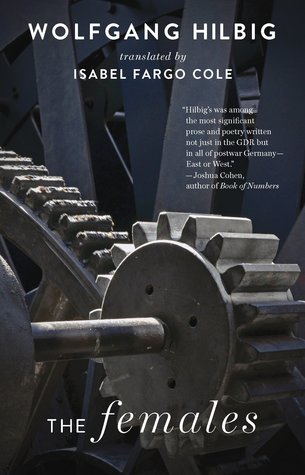
Nameless, neutered and neurotic: The Females by Wolfgang Hilbig

Over the past four years, five works by German author Wolfgang Hilbig have appeared in Isabel Fargo Cole’s lucid, evocative translations, each release bringing the late writer—always a literary outsider in life—an expanded following. The most recent offering, the fourth from Two Lines Press is the earliest, chronologically speaking. Originally published in 1987, The Females is an unrepentant portrait of a man burdened by a deeply and darkly distorted sense of shame and self-loathing. Classic Hilbig protagonist on one level, yet embryonic relative to the more abstract introspective narrators who move through many of his subsequent works.

This novella is set, like so much of Hilbig’s fiction, in a small industrial community in postwar East Germany. The narrator is, by his own description, a rather foul and socially inept misfit, a middle-aged man who still lives with his mother and harbours a troubled and seemingly stunted adolescent notion of women. He is not simply unnamed, but acutely aware of having been rendered nameless. Within the context of Hilbig’s shorter works this story is more explicit in its anger toward the state with its control of desire, creative and sexual. The recent history of his country, the ruins of war and the politics of the National Socialism, looms large. The imagery is gritty, coarse and vulgar, but the narrator’s desperate search for identity lends him a level of sympathy. He feels ashamed at his own corruption—especially a youthful turn at pornography, yet feels neutered and powerless. In the bluntness of its  approach, The Females seems somewhat less refined than Old Rendering Plant and the Tidings of the Trees which follow several years later, but having this earlier work published in English at this point allows readers familiar with his oeuvre to see developmental themes at play.

True to form, this is an absorbing, compulsive read, one that slips regularly into a nausea-inducing, full-frontal assault on the senses. The opening passages are fair warning. The protagonist is working at a pressing shop in a former munitions factory. The shop floor is entirely staffed by women and, confined to a dank basement room, his task is to clean the molds. From his subterranean vantage point he watches the women work the machinery:

Through the grating above me, damp, smoldering heat flooded down with steady force. I sat on a chair beneath the grate amid this hot tide, hidden in semidarkness, several bottles of beer by my chair; when I drank the beer seemed to gush instantly from all my pores, lukewarm, not even changing temperature inside my body. It was ceaseless strain—my head constantly tilted back—to stare through the grate into the light, always hoping to see the women up there step across the bars.

He obsesses over every movement the women make, sexualizing the physical routine of the manufacturing activity, longing for a fleeting taste of femininity, and masturbating in his gloomy enclosure. Needless to say, he is employed on borrowed time. “I had gradually begun to transform into a sickness,” he tells us, one that is characteristically “utterly excessive; an agony not quite human, it was no longer that of an animal either.” Dismissed from his job, he takes to wandering the streets at night and notices, that something has suddenly been drained from the atmosphere. As an aspiring writer, the only vocation he has ever truly desired despite the disdain this ambition evoked in his family and society alike, he had once been able to look at the dismal world around him and, as he puts it, “make the filth glitter”. Now, either in reality or in his madness, his environment had been altered.

Much to his dismay, he becomes convinced of a most horrifying truth:

It was no help at all to sense I was possessed by an obsession, in my overpotent head a cascade of letters blazed: all the females had vanished from town, and with them had fled every trace of femininity.—Not only that, I felt that even feminine nouns had fallen out of use; I thought I suddenly noticed people in town referring to trash cans as der Kübel instead of die Tonne. When I saw those trash cans from afar, set up in long rows along the curbs that summer—something unlikely to change, as the trash collection service was still more dysfunctional then than in the winter—at first I’d think a line of unshapely females was loitering there, dully iridescent in the bluish streetlights, and I’d hurry toward them. I’d realize they were just the trash cans I saw every night, from their gaping orifices hung rubbish that looked hairy, that had an undefinable evil about it.

His desperate, guilt-ridden efforts to make sense of this situation, to set it right somehow, drives the nonlinear, obsessive, self-deprecating and bitter narrative of The Females. Some of the imagery is harsh, off-putting, and sexist. In his defence the protagonist blames the psychopathology of the state under which he was raised, one in which “the sex drive was declared to be abnormal…and sex to be capitalistic”. He clearly has had no real, substantial and healthy relationships with women. He wants to be loved, longs for normal human contact, but fears that his anxious desire will drive others away, that as his desperation becomes evident, he grows increasingly hideous—“A monster with putrefaction written in the crannies of its skin as hectic red blotches, with uric acid drying and itching on its pate, a madness no longer stoppable as damp tufts of hair began painlessly detaching themselves.” His frustration is redirected back at women—his mother included—and it his inability to conform to the expectations of those around him. To see the world as he is supposed to see it.

At the core of this novella lies a crisis of masculinity. Hilbig, like many of his generation grew up fatherless. His father had disappeared at Stalingrad and he was raised by his mother and maternal grandparents. His characters often struggle with the rigid expectations of manhood in their closed society. As men who are naturally drawn to creative pursuits, they react against the predetermined factory life by trying to find their missing role models among the social outcasts—garbage men or the workers at a rendering plant. In the world Hilbig presents in The Females, the State is the all-powerful progenitor, women are brutish and masculine, men are soft and delicate, psychologically castrated. His protagonist is criticized by his family for failing to live up to an ideal set by his father, though it is not clear that his father is more than a myth he has no real memory of. He is seeking an absolution through the women who have controlled, avoided and now eluded him, longing to heal a wound with roots, ultimately, deep in childhood memory and buried national history. He chooses to work in a factory staffed by females to try to be near their presence and feels cut off from a vital reality when he is cast out. In the shadowy depths of the town’s laneways he is searching for a feminine presence which he can only vaguely remember, distrusting his imagination and distorting reality into misplaced freakish phallic and vaginal imagery.

His is a strange, and strangely fascinating existential pursuit. “The world outside my window,” he is inclined to tell himself, “lacks the gaze that is mine”:

But I’d had to realize that I was no one.—I didn’t know whether I existed; the fact of my birth had been kept secret from me. They kept it secret to punish me, for I hadn’t turned out to be the thing they’d hope to bestow upon the world. Yes, I’d made the mistake of having myself be born, having myself be raised by the state and its pedagogy, by pedagogy and its state—I’d practically volunteered for it—but then I turned out differently. And so I had to be nullified, voided; there was neither a womb nor a pedagogy nor a state for the creature I’d become. I didn’t even have a name to lay claim to.

The Females is a challenging read in today’s climate of gender sensitivity. But emerging at a time when Germany was still divided (though Hilbig was by this time already living in west Berlin), its message’s bold, brutal delivery possibly reflects a more immediate frustration. Either way, it is a powerful short work that takes no prisoners.

Deftly translated by Isabel Fargo Cole, The Females by Wolfgang Hilbig is published by Two Lines Press.

*Read for German Literature Month 2018.

Translating Wolfgang Hilbig: A link to my latest conversation with Isabel Fargo Cole

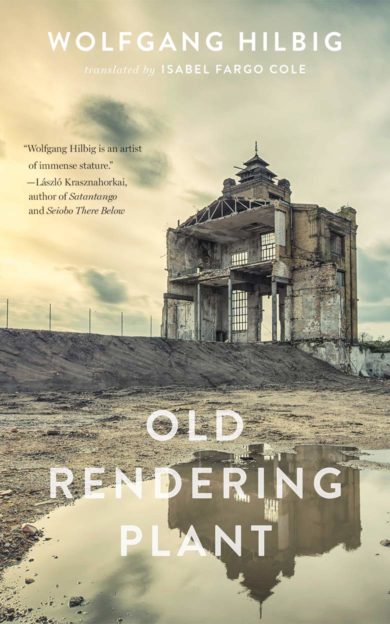
It was Wolfgang Hilbig’s story collection The Sleep of the Righteous, published in 2015 by Two Lines Press, that brought the late German author and his translator, Isabel Fargo Cole, to my attention. It might seem as if they arrived hand-in-hand, after all her translation of his novel I (Ich) appeared from Seagull Books around the same time, but of course, she has translated works by a variety of German language authors before and since those two titles emerged. But it would be fair to say that her efforts to champion Hilbig, her deep appreciation of his work, and her ability to be able to bring his  convoluted sentences and filmic imagery to life in English continue to win him more admirers with each subsequent release. Most recently, she was awarded the Helen & Kurt Wolff Prize for her translation of Old Rendering Plant.

Photo credit: Emma Braslavsky

I have had the pleasure of interviewing this gifted translator twice now, and both times, when her generous responses to my questions arrived in my email, I read them with excitement and renewed appreciation. The latest interview was published at Splice this past week.  In this piece, we talk about the most recent Hilbig release, The Tidings of the Trees, and the ways in which this work differs from last fall’s Old Rendering Plant. My questions were derived from my own reading of the book and were not sent until my review had been submitted for publication.

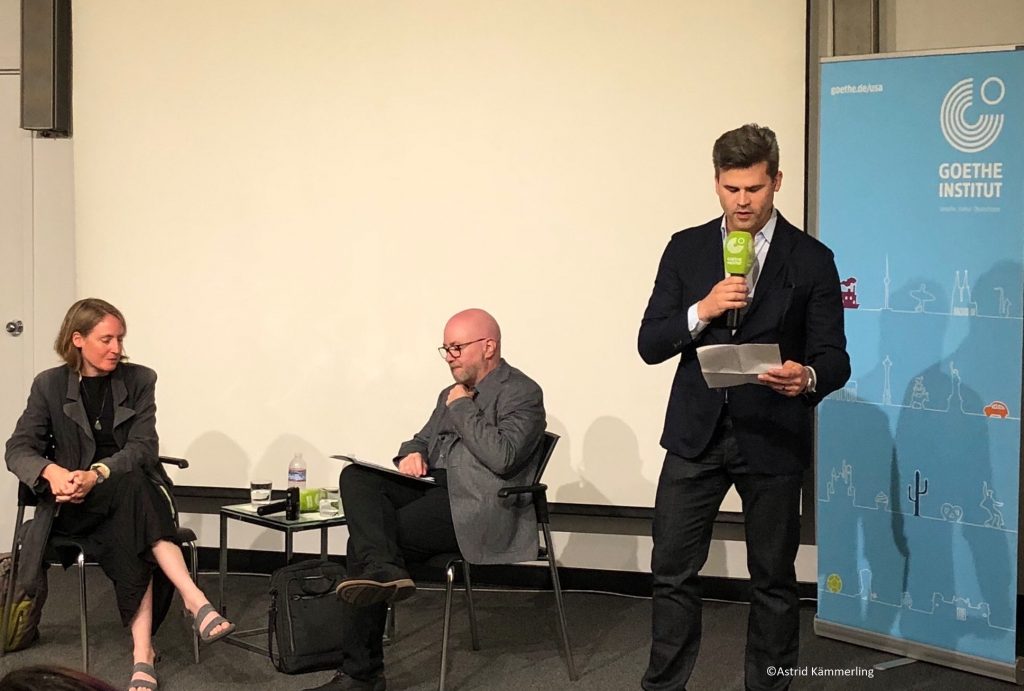
In the years since our first contact, I have read and reviewed Isabel’s translations of Klaus Hoffer and Franz Fühmann, and have added the works of several other authors she has translated to my library as well. But Hilbig remains central. So I am thrilled and honoured to be  speaking with her in person in San Francisco on Tuesday night, July 24, as the Center for the Art of Translation celebrates her work, her recent award, and the release The Tidings of the Trees.

UPDATE:
The online journal Splice was hosting no longer appears to exist, so I have reproduced the original interview with Isabel as it first appeared below:

Finding the Right Place to Write From: Isabel Fargo Cole on Translating Wolfgang Hilbig’s The Tidings of the Trees

by Splice


Wolfgang Hilbig, The Tidings of the Trees (trans. Isabel Fargo Cole)
Wolfgang Hilbig,
The Tidings of the Trees.
Translated by Isabel Fargo Cole.
Two Lines Press. $12.95.
Buy direct from the publisher.


Isabel Fargo Cole grew up in New York City and studied at the University of Chicago, but she has lived in Berlin as a writer and translator since 1995. In 2013 she received a PEN/Heim Translation Fund Award to translate Franz Fühmann’s At the Burning Abyss for Seagull Books, and in 2014 her translation of Fühmann’s The Jew Car was shortlisted for the Oxford-Weidenfeld Translation Prize. More recently, she has published several translations of the works of Wolfgang Hilbig, and she won this year’s Wolff Translator’s Prize from the Goethe Institut for her translation of Hilbig’s Old Rendering Plant, published by Two Lines Press.

Her latest Hilbig translation is The Tidings of the Trees. Reviewing the book for Splice, Joseph Schreiber praised it as “a tale rich with fantastic imagery that openly explores the ability of fiction to preserve the past, mediate the present, and offer hope for the future.” Concurrent with the publication of Trees, Isabel Fargo Cole generously gave her time to correspond with Joseph via email and offer her take on working with Hilbig’s words.


The Tidings of the Trees, newly released from Two Line Press, is your fourth published Wolfgang Hilbig translation. Would you mind taking a moment to frame this novella within his body of work? When was it released and where does it fit?

The German edition (Die Kunde von den Bäumen) first appeared in 1992. It’s the last of a number of novella-length works Hilbig wrote in the 1980s and early 1990s. In terms of subject matter, it fits into a broader complex of works, culminating in the story collection The Sleep of the Righteous (2015), which explore Hilbig’s home town of Meuselwitz and the industrial wasteland around it. Hilbig returns time and again to the same landscape to explore different aspects and develop different metaphorical images.

.

This novella is described as one of his most accessible works. On the surface, perhaps, relative to the very close, internalised monologue of Old Rendering Plant(2017), it might appear to be a more straightforward, less claustrophobic tale. It’s a multi-level narrative wherein the main character, Waller, is telling his story to an unidentified narrator who records the account. We can place him in time, we know how old he is, and we have passing outside observations of his actions and behaviour as he is speaking. However, as much as time, space, reality, and fantasy are blurred in both novels, Waller is less able to follow and make sense of his own memories, and seems as concerned with touching abstract truths as he is with tracking down his own lost time. Consequently, much is left unresolved, unresolvable even. 

Can you comment on the similarities and differences between these two novels with respect to the way reality is disrupted, and the challenges raised for yourself as translator?

Actually there’s just one narrator who sometimes refers to himself in the third person, as “Waller”. In many of Hilbig’s works — notably in ‘I’ (2015) — the author shifts between first and third person as a way of embodying how his narrators reflect on themselves or relate to their past, how writers observe and fictionalise themselves almost to the point of schizophrenia. In comparison with Old Rendering Plant, the landscape is more minimal, the language is a bit sparer; Hilbig is working with a more reduced and clear-cut palette of imagery and symbolism. This foregrounds the narrative structures, the interplay of perspectives and time frames. This is a story about storytelling, or rather its impossibility: the narrator tries to evoke the chopped-down cherry trees that once lined a road that led to a village that has vanished as well, swallowed by strip mines, and to describe the circumstances of these disappearances. This shifts to an effort to recall the taboo subject of Germany’s division and the disappearances it entailed.

On a number of levels, it’s about the difficulty of finding the right place to write from: “A place to sit! I’d lament, circling my empty chair.” Of course, the chair is just a metaphor or an alibi; the question is how to find the right perspective from which to reconstruct the memory or tell the story. And so the narrator shifts into the third person voice, as though that might help, or as though to watch himself writing; or he tries to adopt the perspective of the “garbagemen” who sift through the refuse of the past and seem to possess secret knowledge. Hilbig explores the question of adopting a persona or shifting personae to tell a story from, and the dangerous disorientation this can entail. And he explores how a writer devises and manipulates “figures” to act out his story: Figur in German is the standard word for a fictional character, but Hilbig exploits its literal sense of physical shapes that are seen from outside and remain rather alien, like puppets. Hilbig’s narrators find it difficult to relate to other people at all, and struggle with the sense that, in writing about them, they are producing mere simulations. In Trees, this takes physical form as the narrator arranges discarded store mannequins in tableaux in an attempt to communicate with the inscrutable garbagemen — an absurdist metaphor for storytelling.

These senses of simulation, unreality, dissociation, and an unstable “I” goes along with an unstable sense of time. Storytelling both asserts and complicates the notion of a linear timeline with a clear sequence of events bound by cause and effect — a story has to assume these things to some degree to have any coherence, but the very act of telling a story complicates the timeline and the causalities by situating a storyteller somewhere within or outside it. In Tidings of the Trees, Hilbig plays with the tension between the notion of a coherent “story” that exists out there, or within the memory, and simply needs to be recorded, and the teller’s actual struggle to grope toward this story and piece it together out of fragmented bits of time and space.

This is a struggle for the translator as well, as the often paradoxical-seeming tense shifts need to be attended to; the labyrinth of nested flashbacks and flashes of déja-vu is very much intended, and just as intentionally left without a resolution. In the end, the narrator comes to see the course of events as cyclical, narrated in “a language of return”, and he cedes the act of storytelling to the trees themselves: “storytelling without motive, a stream of story that followed only the slow rhythms at work in the place where the trees were.” The vanished trees write their story in their own ash upon the narrator’s empty page.

.

On a related note, I would like to ask you about the prose style in The Tidings of the Trees. In my reading, I sensed more variation in pace and tone than in some of Hilbig’s other stories and novels. There seems to be a more measured tone to much of Waller’s discourse; one finds more short sentences, less of the long, winding, stuttering flow of words. This is perhaps because the protagonist is trying to make himself understood to his audience. However, he has a hard time orienting himself within his own story and has an admitted disregard for reality. And there are many passages of exceptional urgency and poetic energy. How would you describe the differences in this narrative?

As you noted above, there is less of the intensely sensual, immediate, stream-of-consciousness style that you find in Old Rendering Plant or The Sleep of the Righteous. Perhaps the narrator of Trees is trying to access that more immediate mode of writing, but failing (at least until the very end, when he lets the trees speak). He has a greater detachment from the writing process; he’s reflecting on the act of writing, or rather his inability to perform that act: “But when storytelling reconstructs — or, in my case, manufactures — the problems of telling stories, it’s the pinnacle of self-circumscription. … I don’t know. Literature like that is unworthy of interest.” He’s ironising the postmodern irony of writing about writing — but taking it so far that irony turns into existential urgency. At the same time, Trees has more actual story, asserts more concrete, external goings-on (however fantastical and jumbled) than, say, Old Rendering Plant, which feels like a pure interior monologue.

.

Both Waller and the narrator of Old Rendering Plant are drawn to mysterious social outcasts, and, in each case, these elusive characters — the garbagemen who salvage goods from the ash heaps on the outskirts of town and the men who work in the depths of the rendering plant in the abandoned coal factory — are imagined in grotesque, surreal terms, and inspire some of the most exhilarating passages in each work. However, Waller’s identification with the garbagemen is more complicated, at once strange and enigmatic, and yet in their actions he sees a clear model for his intended act of preservation through storytelling. How do you see the roles, political and aesthetic, that these types of characters play in Hilbig’s work?

Hilbig was an outsider himself, as a self-taught non-conformist working-class writer in East Germany and as a working-class East German writer in West Germany. So it’s not surprising that he tended to write about outcasts — often his narrators are loners on the margins of society who become fascinated by people even more radically marginal than they are. Those marginal figures seem to represent, or have access to, things that society would prefer to forget, down to the crimes of the GDR and Nazi dictatorships. Interestingly, it’s hard to pin them down either as victims or perpetrators. In Old Rendering Plant, they might be war fugitives from Eastern Europe, or they might be old SS or Stasi men. In Trees, they seem to be in a state of exile from society, sifting through its detritus on the outskirts; on the other hand, they apparently act as an integral part of society’s digestive system, performing a function that remains constant across historical eras. They’re the people who quite literally do society’s dirty work.

.

Wolfgang Hilbig has a tendency to create narrators or protagonists who share basic biographical details very similar to his own, even if it is not made explicit. Their stories generally explore variations on a common theme — the search for identity in a society that enforces a rigid conformity of thought and action — and yet, each story or novel follows its own distinct path. Tidings is no exception, but this novel is also very explicitly about the responsibility of the writer and the enormity of his (or her) task. Waller’s twenty missing years form, in no small part, a severe case of writer’s block. Here he is, in mid-life, staring at the same sentence: “The cherry trees have vanished!” The question of the missing cherry trees that once lined the road to the nearby village, now also gone, represent a much larger, more vital story — about preserving memory, history, and hope. Would it be fair to say that this portrait of the writer’s task, if not his relative productivity, makes Waller an especially personal alter-ego for Hilbig?

I feel he’s actually a less personal and more abstract alter-ego: the Writer. There’s less of the texture of Hilbig’s own memories and biography, and he keeps stepping back from the narrator, referring to him in the third person, seeing him from the outside, actually spotting him in the distance, as a kind of doppelgänger. And he puts him in absurd situations that feel more consciously constructed, with more ironic detachment.

I think the cherry trees are in fact central: they are the story — or the storyteller, as the end hints. The cherry lane is one of Hilbig’s rare (but crucial) images of pure, innocent natural beauty, of a small paradise that existed within memory. It may have vanished, but it dominates the story, and in the end it prevails: the eternal, cyclical language of nature takes over the task of the writer.

.

Finally, you have recently been awarded the prestigious Helen & Kurt Wolff Prize for your translation of Old Rendering Plant. Congratulations! With another Hilbig translation, The Women, due later this year, the appetite for his work among Anglophone readers seems to be solid and growing stronger. There must be considerable satisfaction in this positive reception, and in being recognised for your intuitive and sensitive renderings. How do you feel about his reception? And more critically, in light of the disturbing political trends we’ve been witnessing in the West of late, do you think his message has a new relevance?

Thank you! I’m thrilled to see his work finally getting the English-language readership it deserves. I certainly think he has a lot to say to us about the cruel and unsavoury sides of social orders; about the way historical traumas are passed down and continue to do harm even (and especially) as they are denied and repressed; about the sheer mass of depression, anger, and hopelessness that can build up among people who feel alienated from their societies, from each other, and from their natural surroundings; about the (self-)destructiveness that results. I don’t think he has a “message” in the sense that he’s asking us to understand x so we can do y. But perhaps he asks us simply to recognise the dark shadows and the “garbage” on the outskirts of town as something integral to the human experience. Those strange sinister characters out there, whether they’re victims or perpetrators or both, aren’t “the other” — they’re alter-egos, reflections of ourselves and our own potentialities. Facing the darkness won’t perform some kind of therapeutic magic and automatically empower us to transcend it, but it could help us to proceed from a position of humility, a deeper understanding of our own and others’ limitations, absurdities, and burdens. At least that’s the best way I can think of to explain why I personally find his work moving and bracing, if not exactly comforting, at this particular time.

.


Joseph Schreiber is a writer based in Calgary, Canada. He is Criticism/Nonfiction editor at 3:AM Magazine. His reviews and essays have been published in a variety of literary sites and publications including Numéro Cinq, Quarterly Conversation, Minor Literature[s], and RIC Journal. He also maintains a literary site called Roughghosts and tweets @roughghosts.


Searching for traces of the past with Wolfgang Hilbig: A few thoughts and a link to my review of The Tidings of the Trees

He may confound some readers, but for my money, the enigmatic East German writer Wolfgang Hilbig is fine company. His landscapes are evocative, filmic spaces, obscured by the mists of a troubled history of secrets and shame. His narratives are restless. His characters are misfits, unable and unwilling to conform.  Their tales explore the dynamics of loss from personal, social and political angles. And even within the scope of a novella, these stories expand far beyond the confines of the pages, haunting and reworking themselves within the reader’s mind long after the book is finished.

Or, at least, that has been my experience.

The most recent Hilbig release from Two Lines Press, The Tidings of the Trees, traverses a terrain at once familiar and yet quite distinct from the watery byways of Old Rendering Plant. This is a complex, magical tale that examines the importance of stories to hold onto and preserve the memories that the State is intent on erasing. As ever, translator Isabel Fargo Cole deftly  captures the unique rhythms and energies of this text, and Hilbig fans will be pleased to know another work, The Women, is forthcoming in November.

I wrote about this book for an online journal run by the UK publisher Splice. It seems to no longer be online, so I’ve reproduced the original page and review below.

In Search of Lost Time: Wolfgang Hilbig’s The Tidings of the Trees

by Splice

by Joseph Schreiber


Wolfgang Hilbig, The Tidings of the Trees (trans. Isabel Fargo Cole)
Wolfgang Hilbig,
The Tidings of the Trees.
Translated by Isabel Fargo Cole.
Two Lines Press. $12.95.
Buy direct from the publisher.


When the Berlin Wall was closed in August 1961, effectively sealing the final point of exit for East German citizens seeking asylum in the West, Wolfgang Hilbig was just shy of his twentieth birthday. With this action, the GDR became a completely contained state, isolated from the rest of the world. In The Tidings of the Trees (trans. Isabel Fargo Cole), the latest Hilbig translation to be released from Two Lines Press, this moment and its impact open a vortex around which the protagonist’s crisis of identity spins. Described as one of Hilbig’s most accessible works, Tidings proceeds on a somewhat different note than last year’s release, Old Rendering Plant, but ultimately it follows a route no less oblique or circuitous. Powerful and more overtly political perhaps, it is also a tale rich with fantastic imagery that openly explores the ability of fiction to preserve the past, mediate the present, and offer hope for the future.

Whereas Old Rendering Plant was a deeply immersive first-person monologue slipping at times into pure stream-of-consciousness, The Tidings of the Trees presents a multi-level narrative with an unidentified narrator who records the first-person account of the central character, Waller, occasionally breaking in to describe the actions and behaviours observed as the story is being related. It can be argued that Hilbig’s protagonists tend to be, to a greater or lesser extent, shadows of himself, and Waller is no exception. He is an aspiring writer of approximately the same age, who lives with his mother and grandmother in a small industrial town surrounded by forests and the physical legacy of strip mining. Like his cohorts he is apprenticed into work at a local factory after finishing school, but over time this work gradually loses its relevance as he becomes more deeply absorbed in a desperate effort to write — to secure his story on the page. At the time of this recorded account, one can assume the frustrated storyteller is about forty years old, an age by which Hilbig had already abandoned the factory for a writer’s life and relocated to East Berlin. Our hero in this novel is finding that transition much more agonising, and yet for Waller, as for his creator, writing is an act of defiance and self-preservation:

Write… write, I say to myself, or everything will whirl into forgetfulness. Write so the thread won’t be severed… a thousand stories are too few. So the flow won’t be broken, so the lamps over the desks won’t go out. Write or you’ll be without a past, without a future, nothing but a will-less plaything of bureaucracy.

However, no matter how long he sits hunched over a desk, the words fail to come. The empty pages and scratched-out lines drive the would-be writer out, night after night, in search of his own story.

Waller’s regular expeditions lead him to an area on the outskirts of town, where an expanding field of garbage and ash has encroached on a roadway once lined with cherry trees. It is an abiding groundlessness that draws him here; for twenty years he has felt he has had “no place to sit”, as he puts it, nowhere to belong. This desolate area holds an attraction and, he hopes, the key to his own nebulous history, now strangely distorted by his alienation from community engagement within a society where collective historical amnesia has long been encouraged. The expanse of refuse which had originated as a disused strip mine, filled in initially with the rubble of bombed-out buildings, then successive layers of garbage and ash, carries an aura of stagnation and weighted silence. In this Waller recognises the ghosts of the past, his own included. But more specifically he is fascinated by the garbagemen who scour the discarded remains to salvage whatever they can. First presented as wraith-like spectres moving over the landscape, they are depicted as outcasts, as scavengers who have formed their own inaccessible culture. Yet, as Waller’s account proceeds, he is pulled closer into their orbit.

The other focus of his habitual visits to this location at the edge of the ash heap is an ongoing search for the cherry trees that he remembers from an earlier time. He was searching for them, he advises us, even when they still existed, and he continues, having come to the conclusion that, in most instances, reality “has been debased to a worthless product of language.” It is as if Waller imagines his mission to find his own story — that is, to grasp sensible hold of his own memories — as part of a greater effort to preserve and capture the memories of a time and place nearly forgotten. To that end, the proud and beautiful cherry trees stand as symbols of everything he has lost — youth, promise, and hope in the future. They haunt him. And he is determined to attempt to write them back into existence:

And the story might tell of a time ten years ago, or might date back two or three decades; the sentence I set down at the top of the page — twenty years or two days ago — made no difference whatsoever: The trees of the cherry lane have vanished! There can exist, it seems to me, an infinite series of stories telling how this happened. … I can fit only a fraction of them beneath that opening sentence. Or perhaps a barely graspable shadow of ash, light as a breath… for the cherry trees to return, I’d have to tell all the stories about them.

This endeavour to tell even a handful of the possible stories of the trees, has, over time, become entwined in Waller’s memory and imagination with a series of possible stories about the garbagemen. His willingness to embrace uncertainty contributes to the magical and disorienting qualities of his tale. He is not simply laying out one story, unwinding one single thread, but rather telling multiple variations of his own stories to find, he hopes, some truth, and release the barrier that has blocked the flow of words onto the page.

The Tidings of the Trees is a tale of dislocation, in time and space. Waller struggles with temporal context, not only in writing, but in recounting his story. His account stalls several times. His interlocutor notes that it seems as if he is uncertain about what time frame he should follow. He frequently repeats his conviction that twenty years of his life seem to have lost their meaning, passing in a haze, one moment blurred into the next, leaving his memories and time confused. He continually attempts to re-enter the story at different points because his own internal chronology is unreliable. The only clear point of reference he can hold to is that fateful summer when the borders closed, the “summer of the Wall.” From that point, his life began to take on a fictional tone. His thoughts became confused as reality started to slip its moorings. While everyone else seemed to move forward and forget how life used to be, Waller found himself tangled in a grey zone. And it has continued to become greyer.

Once East Germany is firmly sealed off, he is struck with the disheartening sense that his future is fixed, pre-written. This is the initial trigger of his retreat from town and factory life. If one feels trapped in a rigid, scripted narrative, the only rebellion is to attempt to seize control of one’s own story. For Waller, the answer seems to lie in writing. Yet, as his fellow citizens settle into a pattern of State-dictated ideals, routines, and conventions, he realises that they defy his attempts to craft characters and build stories around them. Where can he take them? The GDR encouraged a form of worker’s literature, a celebration of Socialist norms and values, but for Waller, as for Hilbig, art cannot be thus constrained. “Normality was normal”, we are told, “because it had lost its stories… [and] only when the mask of normality was torn off did reasons for stories exist once again.”

Stories, then, in the context of this novella, serve multiple functions, individual and societal. In the garbagemen, our dispirited writer sees a metaphor for the process of the preservation and maintenance of the past. As these marginalised individuals dig through the ash to retrieve discarded objects — utensils, tools, clothing, and an unseemly number of mannequins — Waller imagines that they are essentially performing a communal act of remembering, of keeping alive a history that would otherwise be buried and lost. Afraid that he too is at a loss, that critical events have slipped from his memory’s grasp, he is drawn to these enigmatic characters who are, he believes, incapable of forgetting. He finds himself moving among them, slowly assuming a similar appearance, and ultimately taking refuge in their storage shed during a storm:

Here I was… I’d been here for a near-eternity, and already I was almost a ghost… a monster, shaped from the substance of eternity, a sculpture of ash muffled in ancient ghostly garments… and the garbagemen, who believed in mythical creatures, had long ago accepted me as their ghost, slinking around me breathlessly and on tiptoe; and they’d consigned the citizens from the shop windows to the garbage, for I was the true artwork of their time, I was the statue which alone fulfilled all their time’s aesthetic requirements, their time that was no time at all… the trees of the cherry lane have vanished; this single sentence, long since extinguished and grown cold, stood there upon the page, and they’d given me infinite time to write a second one.

In classic Hilbig fashion, the narrative regularly loops back on itself, images are revisited again and again, and a restless, searching energy courses through the prose. Yet unlike the fluid, meandering flow of Old Rendering Plant, there is a greater variation of pace and tone, and a distinctive urgency and poetic passion to Waller’s discourse. Place is also a vital presence, but with Tidings, an emptiness or absence dominates. The vast field of refuse, home to little more than coarse shrubs, is a denuded environment. However, as the resting ground of discarded objects with a link to the past, it contains an existential element. This is realised not only through the actions of the garbagemen, but in the accumulated ash that hangs in the air, and clings to Waller and his surroundings. And then, of course, there are the cherry trees, natural and spectral at once, imagined alive, destroyed, or gone wild, the lost messengers whose tidings our protagonist so anxiously pursues.

Finally, as the fourth Hilbig translation to be released in English, The Tidings of the Treesis a testament to translator Isabel Fargo Cole’s exceptional acuity to the nuances of the late German author’s idiosyncratic prose. Although Hilbig typically starts with a character in a setting that has roots in his own life experience, once set in motion, his narratives each follow their own unique course. Where a predictable sameness might be expected to settle in, Hilbig’s ability to create strangely engaging characters and evoke distinct environments of oppressive beauty, in concert with Cole’s sensitive translations, ensure that each encounter with his work feels fresh and vital.

.


Joseph Schreiber is a writer based in Calgary, Canada. He is Criticism/Nonfiction editor at 3:AM Magazine. His reviews and essays have been published in a variety of literary sites and publications including Numéro Cinq, Quarterly Conversation, Minor Literature[s], and RIC Journal. He also maintains a literary site called Roughghosts and tweets @roughghosts.

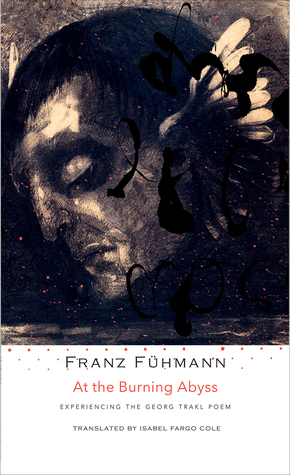
A poetic Pentecost: At the Burning Abyss by Franz Fühmann

I am not certain what has become of the person who first alerted me to the poetry of Georg Trakl, but it wasn’t very long ago and came backward through an interest in Celan. Then, over the last few years, Seagull Books released three volumes containing all of Trakl’s poems including significant variants and early versions, in new translations by James Reidel. I read and wrote about them all even though I had no particular confidence in myself as a reviewer of poetry. I’ve also explored other translations and biographical accounts of the troubled Austrian poet’s short life. So when I became aware of At the Burning Abyss: Experiencing the Georg Trakl Poem by Franz Fühmann, my interest was piqued. Finally, to be fully prepared, I recently read Fühmann’s autobiographical story cycle, The Jew Car.

I thought I was ready.

But no, nothing could have fully prepared me for the experience of experiencing At the Burning Abyss.

Fühmann was an important literary figure in postwar East Germany; a gifted, versatile writer who was no stranger to either reading poetry or fledgling efforts to write it when he first encountered Trakl. It was early May, 1945, just prior to the surrender of the Wehrmacht. As a young soldier in the German army, Fühmann had been granted a few days sick-leave following a stay in the hospital, and was taking advantage of the opportunity to visit his family. As bleak as things looked for Germany at the time, a reckless hope was still smoldering. Sitting with his father after dinner on the evening before he was due to leave for Dresden, he opened the volume he’d chanced to pick up in a used bookstore on his way home. One poem in particular, ominously titled “Downfall,” resonated:

Over the white pond
The wild birds have taken flight.
In the evening an icy wind blows from our stars.

Over our graves
The night bends its broken brow.
Under oak trees we sway on a silver barge.

The city’s white walls ring for ever.
Under vaults of thorns
O my brother we blind clock-hands climb towards midnight.

He knew nothing of Trakl but a conversation with his father that night revealed that the latter had served alongside “daft old Georgie” in the early days of the First World War. But beyond recollections of an eccentric character, Fühmann learned no more about the poet for many years. He would never see his father again, and his poetry book would be abandoned along with his coat and backpack a few days later. But the verse had worked its way into his consciousness and would keep him company and inspire his own desperate scribblings during his years in a Soviet POW camp in the Caucasus.

The Franz Fühmann who emerged from captivity in 1949 was a born again Socialist. He had seen the error of his ways, faced the reality of the horrors of Aushwitz, and rejected the false tenants of Nazi ideology on which he had been raised and indoctrinated. The final story in The Jew Car depicts the arrival of his fictional alter-ego in East Germany, his train journey into a new homeland marked with the composition of a suitably ambitious piece of Socialist-inspired realist poetry. However, his reunion with the decidedly anti-realist imagery of Trakl would soon occur.

Slowly, and steadily, the poems will challenge everything that he thinks he knows about reading and writing poetry, ultimately challenging his Socialist idealism and his own self-awareness.

At several points in At the Burning Abyss, Fühmann reminds his reader that the he is not writing an autobiography, insisting that he is engaged in a meditation on the experience of reading Trakl. However, this experience acts as a fundamental force within his own biography and cannot be read apart from it. His account of his personal response to Trakl is presented in first person singular against a broader examination of how a poem, and a couple of select pieces in particular, can and should be understood. This second thread is conducted as an extended first person plural conversation with the reader. His questions and concerns become our questions and concerns, we are invited to seek answers together.

He wants to know how the poem works on the unconscious, what gives it meaning, and what allows it to work across time and place. At the core of his examination is a conviction that the experience of a poem is necessarily subjective; that:

… a poem does not become a poem because it fulfils certain formal rules, but because a reader constitutes it. Until then it merely appears to belong to the genre of poetry, a dead form, interesting only once the interest in the poem as an artwork awakens.

The reader may take decades or even a century to appear, but if he does not, the poem does not come into being as poetry: there is no objective poetic form that legitimizes something a priori as a poem in the sense of an artwork.

This is then, a highly idiosyncratic engagement with the Trakl poem, but one that assures the reader that his own personal engagement with a poem, any poem, has its own validity. One should not be afraid of understanding wrong, or relating to something others eschew as unworthy. For, as he quotes Rilke in the opening sentence of the book: “poems are not feelings…they are experiences.”

For Fühmann, “Downfall” is the first Trakl poem that strikes him, across two decades from the time of composition, to capture the very moment in which he came to it. The blind clock-hands toward midnight climbing recur and echo throughout the text, joined in time, by other lines from other poems that become refrains, driving and troubling the attempt to resolve the dissonance that grows the further he explores Trakl’s poetry and life.

In his reading, an indication that the Trakl poem might reflect Decadence triggers his initial crisis of faith, if you will. Anxiously, Fühmann opens his text and lands, randomly on a poem filled with shocking imagery—“Night Romance.” He finds a “dreaming boy” with a “face decaying in the moon,” a murderer, a dead man, and a “nun with lacerated flesh” praying “naked before Christ’s travails.” All the features of decadence assembled and yet, somehow, the verses hold an undeniable appeal. Thinking of other poems, Fühmann’s anxiety increases:

What was this morass on which I’d lost my way?

And so it goes. The discussion turns to meaning. How literally can images be understood? Much of the focus turns on the poem “Decay,” but Fühmann insists that Trakl’s entire oeuvre can be seen as one great poem, so the discussion has broad application. Images of decay in all its aspects frequent his poetry, as do “autumn, “evening,” and “garden.” What weight can be applied to the startling images that appear, and to what extent is an exact explanation—a resolution of poetic riddles—possible or even desirable? If a mystery can be answered, is it answerable universally or for the reader alone? And, what role does the poet have in relation to the misery he or she records?

Of course, the questions, Fühmann raises are directly related to the threat Trakl poses to his schooling in the Socialist poetic form encouraged within the GDR. There is no place for mystery—a poem should be understood “at first go.” To rid himself of this contrary influence, Fühmann tries to destroy his Trakl books, but find himself unable to do so. He looks for comfort elsewhere, translating Vitězslav Nezval into German, for example, and finds himself sliding headlong in Surrealism! He seeks refuge in alcohol. For a long while, he struggles to mediate the conflict between the literature (and the grounding ideology) to which he is committed and this Austrian poet about whom, apart from his father’s cryptic recollections, he knows little. Having long professed to having little interest in the writer’s life, he suddenly desires to know all he can.

Shocked by his first encounter with Trakl’s awkward visage inside the covers of the slender biography he finds, Fühmann makes his way through the book in a single, fevered night. He is drawn into the account of “an unliveable life: an existence that fell to poetry.—An existence that fell to drugs and incest; a fall into decay, a plunge into suicide; a life at the zenith of European poetry.” What follows then, is a biography within this memoir, which includes the complete text of the sole eyewitness account of Trakl’s final days in a Krakow hospital.

Continuing to alternate between the analysis of what poetry can tell us about its author and, more critically, what it reveals about ourselves, Fühmann’s personal journey of self-discovery moves forward with an intensity that is powerful, irresistible and fundamentally human. The experience of the Trakl poem changes him and allows him to heal in a way doctrine never could. The reader can feel his pain and his passion, appreciate his conflicts and share his exhilaration when everything finally falls into place. “I believe in poetry,” he says, “because it works like fate—provided you stand within its magic circle.”

Well said, indeed.

At the Burning Abyss by Franz Fühmann, is translated with great dedication and affection by Isabel Fargo Cole, and published by Seagull Books.

The seduction of ideological extremes: The Jew Car by Franz Fühmann

For months The Jew Car, Franz Fühmann’s autobiographical story cycle, sat on my shelf unread. I had bought it in anticipation of the recent release, in translation, of his last major work, At the Burning Abyss: Experiencing the Georg Trakl Poem. However, for some reason, I could not bring myself to read it. I have never been especially attracted to World War II literature, and with the current resurgence of neo-Nazi sentiments and far-right movements in North America and Europe, I was uncertain if I wanted to venture into a series of stories in which an East German writer traces a path from his enthusiastic adoption of fascist rhetoric as a youth, on through his experiences as a German soldier during the war, to his eventual rejection of Nazi ideology and acceptance of socialism in a Soviet POW camp. I wondered if I had the heart for it, and yet the translator of both volumes, Isabel Fargo Cole, advised me that Fühmann’s personal reflections in At the Burning Abyss would have greater impact and resonance with the background afforded by The Jew Car.

Born in 1922, Fühmann grew up in the predominantly German Sudetenland region of Czechoslovakia, the son of an apothecary who encouraged the development of a strong German nationalism. From the age of ten to fourteen, he attended a Jesuit boarding school in Kalksburg but found the atmosphere stifling. In 1936, he transferred to a school in Reichenberg, where he lived on his own for the first time and became involved in the Sudeten Fascist movement. After the annexation of Sudetenland in 1938, he joined the SA. 1941, he was assigned to the signal corps serving in various locations in the Ukraine before being moved to Greece as Germany’s fortunes declined. He was captured by Soviet forces in 1945. During his years spent as a POW, he would embrace socialism and upon his release in 1949, he finally found himself on German soil for the first time, settling in the GDR where he would spend the rest of his life.

Originally published in 1962, the stories in The Jew Car, which is subtitled Fourteen Days from Two Decades, follow the trajectory of Fühmann’s life between the ages of seven and twenty-seven. Presented with dramatic colour, they offer an attempt to explore the progression of his ideological development during this period. Through an engaging, often ironic voice and well-framed narratives, we watch Fühmann’s fictional alter-ego confront the psychological seduction of the persistent propaganda machine and engage in the mental gymnastics required to continually readjust to accommodate or explain away any evidence that failed to fit with what he has been led to believe.

The title story opens the collection. Set in 1929, the seven year-old narrator is caught up in a wave of rumours sweeping through his grade school. The children listen with a mixture of rapture and fear, to breathless tales of a four Jews in a yellow car who are said to have been travelling through the surrounding countryside, snatching and murdering innocent young girls. When our hero happens to spy a brown car carrying three people one afternoon, it becomes, in his imagination, vividly transformed into the feared mysterious vehicle exactly as described. At school the next day, he is the centre of attention, holding his classmates in thrall until the one person he dearly wishes to impress the most, the girl “with the short, fair hair” neatly puts him in his place. Yet rather than causing him to question his hasty assumptions about the car he actually saw, his humiliation is turned into an increased, abstracted hatred of Jews.

And so the process begins.

Fühmann manages to capture the mixture of naïve enthusiasm, patriotic fervour, and boredom that he and his friends regularly encounter as the tides of history are building around them. He is young, the air is charged with excitement mingled with fear of the dreaded Commune and the anticipation of liberation. At times his young narrator is surprised to catch the worried looks on the faces of his parents and other adults. His faith in the Führer is unshakable and he believes that the German Reich will not abandon the Sudeten German population to murderous cutthroats. This conviction is well captured in the story “The Defense of the Reichenberg Gymnasium.” (September, 1938) Although no violence has yet occurred in his corner of the region at this point, when an alarm summons him and his comrades from the Gymnastic Society to defend the Reichenberg gymnasium from imminent attack, he is ready and eager:

I was excited: I’d never been in a battle like this; the occasional school scuffles didn’t count, the scouting games and the stupid provocations of the police in which I and all the others indulged; now it would turn serious, a real battle with real weapons, and I felt my heart beating, and wondered suddenly how it feels when a knife slips between the ribs. My steps faltered; I didn’t think about the knife, I saw it, and as I passed Ferdl, a sausage vendor who stood not far from the gymnasium, I even thought of stealing off down an alley, but then I scolded myself and walked quickly into the building.

But, as uneventful hours begin to stretch well past lunch time, boredom and hunger start to set in. Ultimately it is decided to send forth a series of provisioning parties to remedy the situation. Young Fühmann is assigned to the third group:

It was a puerile game we were playing, childish antics, and yet murderous, and the awful thing was that we felt neither the puerility no the murderousness. We were in action, under orders, advancing through enemy territory, and so, the five-man shopping commando in the middle and the three-man protective flanks to the left and right, we casually strolled up the street, turned off without incident, made our way back down the parallel street through the tide of workers, Germans and Czechs coming from the morning shift, cut through the arcade, side by side, and at discreet intervals each bought twenty pairs of sausages with rolls and beer.

Fühmann is a gifted storyteller whose poetic prose and ironic tone are pitch perfect, especially in the earlier stories. He creates a portrait of his younger self that is not sentimental or idealized. His moments of empathy for individuals otherwise thought to be inferior are quickly reframed with racist convictions. He does not speak too much about his involvement in direct anti-Semitic actions (though he will in later works). What comes through most strikingly in The Jew Car is the sense of rational isolation that surrounds the individual. Information is strictly mediated, so that otherwise intelligent individuals lose any frame of reference or develop extreme responses to the continual routine of work and deprivation. His steadfast devotion to the military structure will start to weaken as he discovers poetry, although his first published efforts during the war are very much on message. Fühmann will not become a dissident poet until much later, long after the war is over.

The tone of the later stories is soberer, more contained. The narrator describes his conversion to Socialism in terms that border on the religious. He talks about having “scales fall from his eyes” during his training, describes reading Marx, encountered before but now understood in a new light. But he never provides detailed justification—he believes with conviction and is not ready to be swayed. The final tale which describes his arrival in East Germany after his release from imprisonment to join his mother and sister who have been relocated there, is forced and marked by Soviet style melodrama.

In his afterword to the 1979 reissue of The Jew Car, which aimed to address some of the editorial changes made to the original publication, Fühmann noted a shift in tone that impacted the overall flow of the collection:

Probably even while writing I began to sense the inconsistency in this work, expression of a fractured mindset, a switch from self-irony to affirmative pathos that had to lead to a decline in literary quality such as that between the first and last story…

However, although they are autobiographical in nature, these stories are essentially fictionalized—this is not an essay or memoir. That lends the collection a particular power and energy. Yet, there is a clear sense that the ending is idealized and incomplete, as indeed it is. As Isabel Cole’s Afterword goes on to explain, Fühmann’s infatuation with the socialist vision of the GDR will fade as he chafes against the rigid restrictions imposed on individual and creative expression. He will, nonetheless, remain in East Germany for the rest of his life. In 1982, two years before his death, he will publish an in-depth exploration of his personal evolution through his discovery of and affection for the poetry of Georg Trakl. To that work, At the Burning Abyss, my attention can now turn…

The Jew Car by Franz Fühmann is translated by Isabel Fargo Cole and published by Seagull Books.

This review, together with my review of Malina by Ingeborg Bachmann represents my contribution to this year’s German Literature Month. Also related: See my recent interview with translator Isabel Cole, primarily regarding Wolfgang Hilbig, but also touching on Fühmann, which was published at 3:AM Magazine this past month.

Lost in time with Wolfgang Hilbig: Old Rendering Plant

It is easy to become lost in the dense and convoluted narrative Wolfgang Hilbig unspools in Old Rendering Plant, the most recent translation of his work to reach English audiences. This slight novella invites the reader to wander, with the narrator, through the fields and along the pungent waterways that extend beyond his small East German town. As he rambles on, caught up in his memories of the past and hopes for the future, it’s easy to get swept up—and find oneself disoriented—amidst the industrial ruins where he is forced to confront the dark echoes of recent history and the expectations of the socialist state. It may be, especially for those unfamiliar with Hilbig’s idiosyncratic, stuttering prose, a little unsettling at first, but if one is willing to forego linear narrative expectations, an unforgettable, immersive, atmospheric reading experience awaits.

I read this book last summer to write a review for The Quarterly Conversation. In fact, I probably read it three times over to be able to read and articulate an opening into the narrative, but every time my appreciation of this moody, filmic text increased. As a critic, I derive the most satisfaction from writing about complex, unconventional narratives. My goal is not to give a definitive reading, but to explore the possibilities and questions offered by a piece of literature, while leaving a reader to find his or her own answers (or further questions, as the case may be). It was a sheer joy to write about this book.

My review from the Fall 2017 Issue of The Quarterly Conversation is reproduced below:

Old Rendering Plant by Wolfgang Hilbig (Two Lines Press)

Long after he escaped East Germany to settle in the West, where he continued to reside until his death in 2007, Wolfgang Hilbig remained bound to the darkened landscapes of the GDR. He was not one to downplay the bleak and oppressive qualities of life amid the abandoned mines and crumbling factories of his hometown, Meuselwitz, and his dense, swirling prose evokes a world of strange, suffocating beauty. But his emotional attachment to his birthplace and his complicated misgivings about the benefits of reunification, left him forever torn between East and West—a conflict captured clearly in the stories that comprise the second part of the collection The Sleep of the Righteous. By contrast, Old Rendering Plant, the latest Hilbig offering to be released in English, presents a narrative firmly planted in the GDR that does not travel far beyond the immediate environs of the narrator’s home; yet this tightly defined arena affords the perfect space for a multi-layered exploration of one man’s struggle to define himself against the restrictions and expectations imposed by family, class, history, and circumstance.

Wolfgang Hilbig was born in 1941 in Meuselwitz, near Leipzig. His father disappeared at Stalingrad, so he was raised by his mother and grandparents. His illiterate Polish-born grandfather served as an important father figure, encouraging his aptitude for sports. However, as translator Isabel Fargo Cole notes in her afterword to the novel I, his early obsession with reading and writing soon alienated him from his own family. The works of Poe and the German Romantics held a particular appeal for the budding poet. Following his military service he spent years working in local factories, where, at least on the surface, he epitomized the ideal of the worker-writer that the GDR actively encouraged. Yet, unwilling to follow accepted scripts, Hilbig’s writing was seen as too challenging and obscure, and it soon drew the unwelcome attention of the authorities. Ultimately the desire to write would win out, but the tension between duty to work and to literature became a central theme that he returned to again and again.

In Old Rendering Plant, an extended monologue that slips in and out of passages of pure stream of consciousness, this tension is implicit. Originally published as Alte Abdeckerei in 1991, this novella is a meditation on the formation of identity in an environment that contains a complex network of buried secrets. The narrator is looking back from a vague and indeterminate adult perspective at that point of transition from adolescence to maturity. His is a restless narrative; memories and waters sweep by as he traces and retraces a path along a brook that, bordered by stands of willows, carves a channel through the fields on the outskirts of his hometown. As a child he found refuge in this landscape filled with magic, possibility, and adventure, armed with a wooden sabre and an imaginary foe. It was a place to feel safe and protected.

One of his favorite playgrounds was, against all adult admonishments, found in the fragmented ruins of a coal plant. Here he waged countless fanciful battles until one evening he slipped and fell off a concrete platform. He was fortunate to land in the grass, but later that night he remembered hearing people staggering across the platform above him, and he awoke to find on his right leg evidence of the substance that had caused his fall: “a dried mire, a black-green slurry mixed with blood.” This incident marks the beginning of a loss of innocence, the first intimations of the existence of dreadful truths that, as the narrator ages, begin to take on a greater, more complicated and disturbing significance. As the narrative unfolds, his reminisces and reflections trace his movement toward a reckoning. Gradually, as layers of memory are stripped away, he approaches an clearer understanding of the forces that have driven him. It’s not a comfortable space he finds.

The narrator is a solitary personality, both as a child and as a man, given to wandering the pathways on the edge of town during the hours that mark the transition from late afternoon light to early darkness. He speaks of his family without affection, referring to them as “my relatives.” He passes from childhood into manhood almost imperceptibly, when the adults in his life no longer show interest or concern about his habitual lateness, his tendency to come home after dark. There is only one mention of an anecdote involving a friend, someone he visits on a brief, aborted attempt to break free of the house and town in which he grew up—during that visit, an encounter with the bloated corpse of a dead rat, which he is not even entirely certain is not an illusion or dream, sends him hurrying home. It is perhaps the thought that the horror he hopes to escape is bound to his being, rather than his environment, that frightens him so.

Central to the narrative is a rendering facility hidden among the ruins of the former coal plant. The narrator’s fall from the cement platform was his first direct indication that something nefarious existed there, but he had always been aware of the signs of its presence:

As a child I knew it was the smell of the milk-colored current that washed down the brook, bubbling and steaming like warm soapsuds in the evening. I knew that the smell soaked the banks and seeped under the fields; the mist over the river channel was this smell, and the mist that rose from the topsoil too, infecting everything that grew in the fields, and it rose from the meadows, the grass of the paddocks smelled of the river mist’s cloying essence, the bushes on the banks thrived amid this smell, a smell of flesh . . . old, useless flesh relinquished to the waters, washed its smell through the land to the east, I knew this as a child. Tallow sheathed the snarls of grass on the brook’s edge, ancient fat clung indelibly to the slopes of the embankment; it was a brew of rancid fatback, even covering the paths, boiled-out horns, bones cooked to the point of disintegration . . . the old river-willows luxuriated in this nourishment; countless bluebottles, ill from overfeeding, dripping like glossy shapes made of wax, skimmed sluggishly through the foam, and this shimmering foam, rapidly turning black spun lazily on the water by the willow’s dangling roots.

At a later point—he is at a loss to even specify exactly when, the experience was so intense that it remains trapped in a level of reality between dream and waking—he happened to witness cadavers and sick, terrified animals being unloaded at the site. This plant, nestled among the ruins, was named Germania II after the mine that had once supplied the old coal factory, and it becomes, for the narrator, the source of such complicated questions and emotions that he finds himself unable to pass beyond the bridge and railroad embankment he encounters on his regular sojourns. The smells, memories, and anxieties that arise at this location routinely force him to turn and wearily head for home.

The rendering plant was rumored to employ society’s discarded men. At a time when radio reports of missing persons, and rumors of dangerous foreigners hiding in abandoned buildings, were commonplace, the workers belonged to a stratum of mysterious characters, unnamed and unseen by the light of day. The particular autumn forays that form the pivotal thread of this monologue are motivated by the narrator’s concerns about what his own future holds. He is remembering his final year of school when, with graduation approaching, he has a critical decision to make. This is where his fanciful nature, his defiant poetic spirit, begins to stir as he briefly considers becoming a gardener, inspired by the end of Candide rather than by any fondness for the tilling the soil, and entertains an idyllic life as a miller. He seems oddly determined to disturb his family and his teachers, ultimately announcing his intention to work at Germania II. With a mix of horror and fascination he develops an obsession with the process of rendering carcasses to make soap, and attempts to seek out the elusive workmen. But there is something more complex at play.

This is, at its core, a search for identity and the expression of individuality. The question of where one is heading, is necessarily a question of where one has come from:

my strange interest in bad places was an unacknowledged, unclear interest in our origins . . . because I had not actually experienced the affronts that went with the soil we had sprung from.— On reflection, we were actually exiles. Of course, only in the indefinite way in which all our names were sheer hubris . . . all our names, titles, and nouns. So we were not exiles based on some neat solid idea, but exiles out of instability . . . out of ineptitude, ignorance, antisocial tendencies; we hadn’t been torn from our roots, we had lost our rights, we were in exile because we’d never had roots or rights; we’d never even sought to find them, perhaps we constantly sought the world’s most noxious regions in order to rest our rootlessness, like gray vegetation, feeding on the ground’s nutrients but giving nothing back, we settled in the desolate provinces that were the strongholds of evil, we settled between slag and scrap where we could run riot, rank and uncontested.

What, then, do those most reviled of workers say about him, and his people, who are similarly dispossessed? Is it a matter of degree that divides them? Is it destiny? As the narrator’s monologue continually circles back to this place of darkness and all of the memories that point in its direction, he rekindles the oppressive existential crisis that once drew him to fantasize about disappearing into its foul depths.

As the narrative progresses, Hilbig’s characteristic prose, which flows in fits and starts, like eddies in a stream, swirling, reversing, and moving on again, is hypnotic and disorienting. It is easy to get caught up in the beauty and rhythms of his language, momentarily losing one’s temporal bearings. As such, it is especially ideal for this type of lyrical reflective monologue. When, on occasion, he slides into passages incantatory stream of consciousness the effect is exhilarating. Translator Isabel Fargo Cole has a strong sensitivity and fondness for his idiosyncratic style that comes through in this, as in all of her Hilbig translations (including The Sleep of the Righteous and I).

Reading Hilbig, I often find myself stopping to reread a section before moving on. I revel in losing myself in his long, winding sentences and paragraphs that can stretch on for pages. This can, on the surface, draw allusions to Sebald, though, Hilbig’s prose is quite different in quality, and unlike a Sebaldian narrator, the protagonist of Old Rendering Plant, although he sets out again and again, finds it difficult to push beyond the boundaries his memories and fears have imposed. What is similar in the reading experience, however, is that both can stimulate a desire to distinguish points of departure—with Hilbig, to find those moments where reflections, memories, and memories of dreams diverge, reinforcing temporal dislocations.

The narrator’s troubled forays are rooted in his reluctance to bend to the fate that awaits him, choosing a practical apprenticeship and accepting the bonds of adulthood. He harbours a Romantic sensibility that can only find expression in defiance, in word if not in deed. This resistance continues until one evening when he wanders farther afield than intended. Disoriented, he attempts to make his way back to town, only to witness a dramatic event—an apocalyptic cataclysm resulting from the extensive economic hollowing of the land that tears a wound into the darkened recesses of the soul of his nation and ultimately frees one rootless exile whose lonely monologue culminates in a rousing Joycean climax.


Thoughts on Among the Bieresch by Klaus Hoffer

Sometimes, when I am reading a book that I know I will want to write about, my thoughts about the work at hand take form in the process of reading in a manner that will later inform and direct my review. Other times, the route from reading to writing is more circuitous. I tend to take copious notes, underline and engage with my books, but, having said that, there is always the risk of failing to see the forest for the trees (or more explicitly, failing to appreciate the text for the words). Then, when I sit down to write, no matter how much I may love the work at hand, I look back over my notebook and face too many words to sift through.

BiereschAmong the Bieresch, the long-standing German cult classic by Austrian writer Klaus Hoffer is a book that threatened to undermine me, as a reviewer, with its words – words that are supercharged with meaning and reference to a broadly expanding literary and socio-economic landscape. The beauty of this book is that it works on so many levels and now, with its recent release from Seagull Books, in an animated translation by Isabel Fargo Cole, an English language audience has the opportunity to meet and explore the singular world of the Bieresch.

My review of Among the Bieresch has been published by 3:AM Magazine. I am most grateful to Tristan Foster for his wise and patient editorial guidance as I floundered, at times, in my own words.