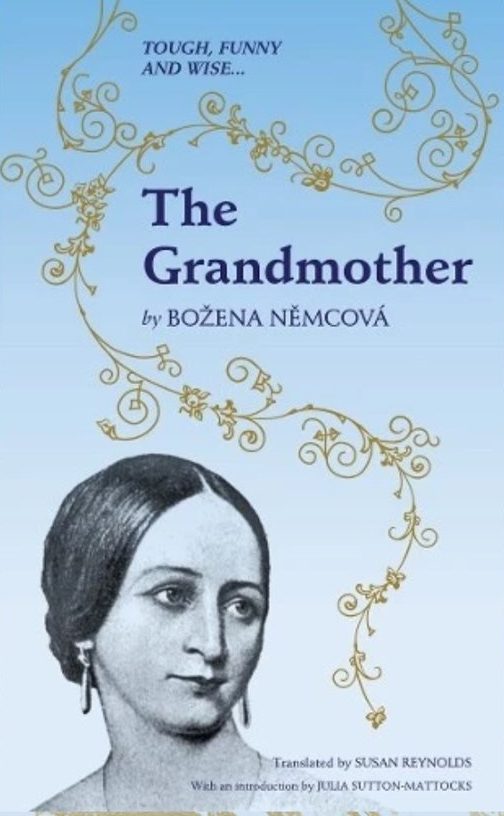
The premise of the novel regarded as a classic of nineteenth century Czech literature is as simple and unassuming as its title. An old woman enjoying a quiet life in a mountain village surrounded by friends receives news that her eldest daughter is returning to Bohemia from Vienna where she has lived for many years now that her German husband has taken on a position in the service of a princess who owns an estate in the area. However, because she will be alone with the children for the better part of the year while their father works in the capital, she invites her mother to join her at the rural residence where the family will now be living. The woman is somewhat reluctant to leave her home, but it is difficult to resist the opportunity to finally meet her four grandchildren and be part of their lives. And so, in the latter years of her life, the heroine of The Grandmother by Božena Němcová (1820?–1862), takes on a new role and title, earning love and respect that will extend far beyond her family.
 When she first arrives in a wagon bearing her few possessions—spindle and spinning wheel, small painted chest, basket holding four chickens, and bundle with two kittens— the children, accustomed to life in the big city, are stunned by the sight of this simple woman in a peasant’s outfit and white kerchief:
The children stood as if frozen to the spot, and it was only at their mother’s command that they offered their rosy cheeks to Grandmother to kiss. They couldn’t get over the unfamiliarity; this was a grandmother different from all those they had seen. No wonder that they kept their eyes fixed on her! Wherever she stood, they walked around her, weighing her up from head to toe.
They examine her strange clothing and investigate her pockets, but in no time she has won their hearts and devotion, and she, in turn, soon makes herself at home. But she never compromises her daily routine, or abandons her habits and convictions. She is also warmly welcomed by others in the community and before long everyone has taken to calling her Grandmother, only occasionally using her given name. They turn to her for advice, especially the young women, and although she is illiterate, she holds in her memory a wealth of stories, prayers, herbal remedies, and traditional recipes for seasonal celebrations. She is the ideal Grandmother, but a gently subversive one, in her own modest way.
As Julia Sutton-Mattocks tells us in her introduction to this first English language translation of Němcova’s beloved tale, The Grandmother has often been described as a sentimental evocation of the author’s own rural childhood as there is some overlap in the names and circumstances of her history and her fictional creation. But, she suggests, although there is some value to that interpretation it is both reductive and complicated by the myths that have arisen around Němcova’s life. Exceptionally well educated for a woman of her class and time, she was engaged in political and social concerns, and an early feminist with strong views on marriage and the value of free love. However, it is also important to understand the context within which she wrote. In the late eighteenth century, the Czech National Revival arose as a response to the increased Germanization and dismissal of Czech cultural and language that had occurred under the Hapsburg Emperors. This nationalist movement encouraged literature that celebrated Czech culture, history and legend. Although the Revival was falling out of favour by the time The Grandmother was composed in the 1850s, the novel clearly reflects Revivalist themes—romanticization of Bohemia and a deep interest (fueled by Němcova’s extensive ethnographic study) in folk festivals and traditional lore—and presents a portrait of a time that would have already seemed tinted with nostalgia.
The Grandmother is an episodic tale, with each chapter centred on an event, a visit, a holiday or feast celebration, or a story recounted by Grandmother or one of the other key characters. Outside of the immediate family there are a few significant subplots, like the troubled courtship of Kristla, the inn-keeper’s daughter, the affairs of the Princess and her charge, Countess Hortensie, and most tragically, the story of the wild woman Viktorka who lives in a mountain cave and wanders through the forest, long after she was apparently driven to madness in her youth. But uniting it all is the old woman with her wisdoms, her idiosyncrasies, and her particular charm.
Long set in her ways, Grandmother holds fast to her old-fashioned peasant’s dress with the skirts, aprons and starched caps. She gets the children up each day and leads them through their prayers, but refuses to help them dress, having no patience with all the buttons and fasteners. She takes over the household tasks that interest her and leaves the rest to others. Never having seen a doctor in her life, she collects, purchases, and keeps an extensive array of herbs, and has an answer for any ailment that might arise. She is devout, with many a spiritual saying to share, but she holds her religious standards to herself alone, preferring to carry herself in all matters with a measure of humility and dignity.
Always conscious of her social class, her personal appeal frequently crosses the typical boundaries of status, often to the dismay of those who jealously guard such things. She is, for example, modestly at ease with the Princess who comes to stay at the manor each summer, even surprising, perhaps, her noble acquaintance with the famed military leaders she has chanced to meet in her lifetime. She met Emperor Joseph when she was a child, and later spent fifteen years in Silesia while her husband was serving in the King in the Prussian Army. But when her beloved Jiří died of a gunshot wound during the invasion of Poland, leaving her with three young children, she returned to Bohemia and raised her family with the help of her parents. Grandmother wanted to be home. She is strongly attached to her native land and language, but recognizes that not all will feel the same. She accepts her daughter’s German husband and when her younger daughter falls in love with a Croatian man she marvels at how the young are finding love across national boundaries, reflecting not only a certain openness that has come with age, but also her creator’s interpretation of a nationalist perspective that is evolving.
Although to contemporary readers, The Grandmother bears the hallmarks of solid, traditional storytelling that brings to life a rich rural culture marked with a seemingly endless parade of holidays and feast days (and at times strange customs), in its day it signaled a shift toward a more modern form of novel, securing its importance in Czech literature. It is familiar to almost anyone growing up in Czechia, and reading it I could only imagine that for many contemporary youth it might feel ponderous and old-fashioned as a required text, but coming to it from outside the culture and much later in life, I found it to be a remarkably well-paced, moving story with a most fascinating female writer behind it. For that matter, the fact that the classic Czech novel of the nineteenth century should be one written by a woman is not as unlikely as it may sound, because Czech women writers were welcomed and encouraged to add their voices to the literature that was being developed at the time. “To this end,” Sutton-Mattocks tells us, “women’s writing was promoted to such an extent that some Czech men writers even felt it was in their interests to publish under female pseudonyms.” Now that is something worth noting!
The Grandmother by Božena Němcová is translated from the Czech by Susan Reynolds, with an Introduction by Julia Sutton-Mattocks and published by Jantar Publishing.










 roughghosts