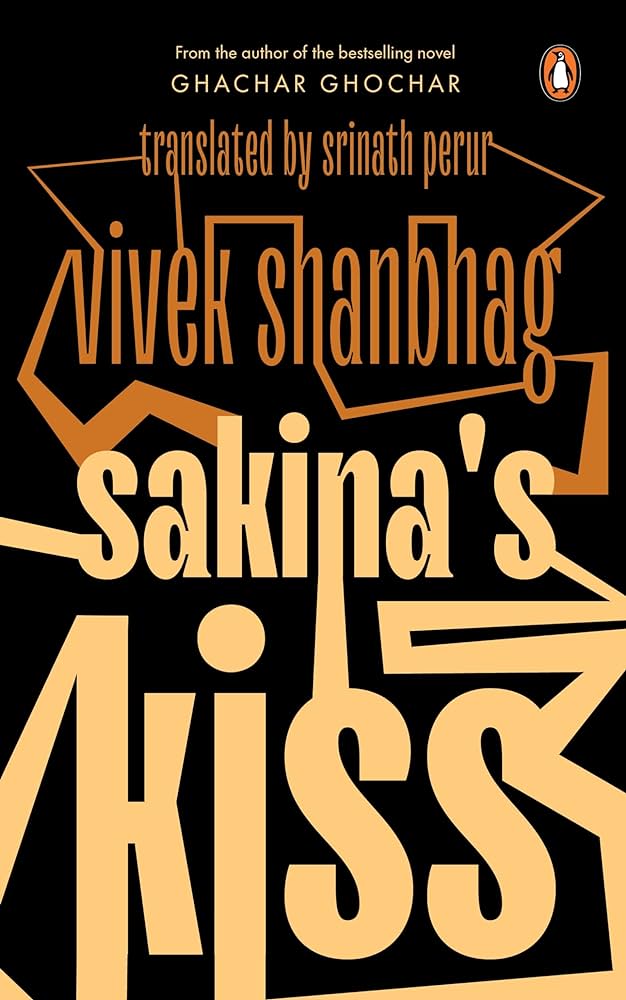
A knock at the door: Sakina’s Kiss by Vivek Shanbhag

Kannada author Vivek Shanbhag’s eagerly anticipated new novel opens with the statement: “There are no coincidences, only unseen chains of consequences.” It is a random quote that his middle-aged protagonist once scribbled down for future reference, accidently recovered during a search for something else altogether. Inspired by his finding, he rushes out to the kitchen to share it with his wife who is much too busy with dinner preparation to entertain his interruption. He is fully aware of this but intends to impose on her attention regardless when he is, in turn, interrupted by a knock at the door. That unexpected intrusion will mark the advent of a series of events that threaten to overturn Venkat’s comfortable complacency and not once over the following days will he heed the wisdom he was about to share with his wife on that fateful night.

As with Ghachar Ghochar, the widely acclaimed novella that, in English translation, introduced Shanbhag to a wide audience within and beyond India, Sakina’s Kiss also explores the impact of shifting dynamics within families, and is narrated by a man who is unable, perhaps unwilling, to understand the women in his life. But this time the cracks that threaten familial peace and security run along political, gendered, and generational fault lines and, although uncertain outside forces come into play, Shanbhag again resists any neat resolutions to the mysteries that arise.

Our hero is Venkat. Born and raised in a small rural community he comes to the big city somewhat conscious of his origins, and through his engineering studies and on into his career he works to cultivate the confident, sophisticated manner he wishes to project. He enters the workforce at a time when the necessity of dealing with foreign clients meant that offices tended to be places where Western styles and tastes were favoured and traditional Indian social factors such as caste advantages were publicly downplayed. When the insecure young manager happens to encounter a man whom he begins to see as a kind of secular guru, he is inspired to adopt a steady diet of self-help books as a roadmap to the life he hopes to craft for himself.

And, Venkat does achieve a respectable degree of professional and financial success but, as his narrative reveals, there is an underlying insecurity despite his expressed self-confidence. His wife, Viji, by contrast, appears to be the more rational, empathetic partner in their relationship even though we only see or hear her perspectives through Venkat’s report and, by the time this story opens, the couple has long since drifted into a rather distanced coexistence. When, early on, he launches into a rather detailed account of their arranged meeting, courtship and honeymoon, his descriptions are so oddly matter-of-fact and one-sided that it’s little wonder their marriage is strained decades later. She is also a successful professional and their combined incomes allowed them to purchase a decent two-bedroom apartment in Bengaluru where they still live with their adult child, a daughter who is now twenty-two and working toward an arts degree at university, much to her father’s dismay. He had, of course, favoured the sciences, but Rekha is a free-thinking, rather rebellious young woman. It is primarily around her that the troubling events at the heart of this novel revolve.

When two young men claiming to be friends of Rekha’s appear at the door desperate to reach her, Venkat explains that she is out in his home village, staying with her great uncle in a location where there is no landline or cell signal available and that they will have to wait until she calls to check in before their message can be passed on. The following day, a Sunday, the same young men return and when they receive the same response from Venkat, they leave and send in a couple of thugs to impress upon him the urgency of their need to contact his daughter. A strange story about two rival gangs, one led by the publisher of a sensational tabloid, the other led by the former owner of a poultry shop unfolds and somehow, in the middle of it, it appears that their sons are both smitten with Rekha who, curiously, is never mentioned by name. None of it makes any sense, but the messengers definitely look unsavoury. Neither Venkat nor Viji know what to make of it all, but when, on Monday, they learn that Rekha apparently left the village on the bus to Bengaluru on Saturday night, panic sets in.

Venkat’s narrative alternates between an ongoing account of current events and chapters that attempt to fill in the background, as he tries to explain and make sense of his marriage’s evolution, his daughter’s increasing radicalization, and the strange history of his politically active uncle Ramana. Buried family secrets and complicated levels of willful blindness and stubborn pride cloud his observations and limit his insight. He seems especially frightened of anyone who expresses individualistic or idealistic goals. For example, when Rekha becomes enamoured with the ideas her college English teacher espouses—“patriarchy, the myth of sexual purity, the shackles of marriage and so on”—Venkat responds defensively. Upon learning that this admired teacher secretly smokes on campus:

I began to criticize all smokers so I could ridicule him indirectly. I suppose I was trying to show that my contempt for Surendran was not without reason. This was a strange kind of envy. Or fear. Or something. Along with the feeling Rekha was escaping my orbit was the restlessness brought about by her infatuation with the words and ideas of this fool.

He makes a vain effort to expand his own world view to little avail. His fears only fuel his continued efforts to assert his role as the “man of the house.” This naturally causes his daughter to become even more defiant towards him while pushing her closer to her mother. That gulf only continues to grow.

There are many loose threads and potentially explosive elements in this novel, but with a narrator who is unable to step back and attempt to see the big picture, a number of “what ifs” remain just out of sight. Venkat comes close at times to wondering if he could or should have done something more with respect to the various dilemmas he has faced, yet, for all his self-help book consumption, a personal awakening eludes him. Even more critically, his fragile masculinity will not allow it. Unable to navigate a changing social and political terrain, he now finds himself excluded from his wife and daughter’s confidence and haplessly sliding into a potentially dangerous situation.

Sakina’s Kiss is, again like Ghachar Ghochar, a deceptively easy read with an unsettling undercurrent that leaves more questions than answers. Shanbhag excels at creating ordinary male characters who are unable or unwilling to fully appreciate shifting social dynamics or their role in them. As such, his narrators end up granting the women in their lives an insight that they are at a loss to understand. They find themselves in situations that are at once funny and tragic—how they will manage in the end is uncertain. In a way, his first two translated titles remind me of the work of South African writer Ivan Vladislavić who has perfected the myopic middle class male character who finds himself in over his head in a world that is changing around him.

Sakina’s Kiss by Vivek Shanbhag is translated from the Kannada by Srinath Perur and published by Penguin Random House India.

A tale of two travellers, You and I: In the Presence of Absence by Mahmoud Darwish

Allow me to see you, now that you have left me and I have left you, safe and sound like pure prose on a stone that may turn green or yellow in your absence. Allow me to gather you and your name, just as passersby gather the olives that harvesters forgot under pebbles. Let us then go together, you and I, on two paths:

You, to a second life promised to you by language, in a reader who might survive the fall of a comet on earth.

I, to a rendezvous I have postponed more than once with a death to whom I had promised a glass of red wine in a poem. A poet is at liberty to lie, but he only lies in love because the heart’s promises are open to alluring conquests.

The celebrated Palestinian poet Mahmoud Darwish was aware that his own death was nearing when he composed In the Presence of Absence, an intimate synthesis of memory and meditation that not only turns its attention to the past, but looks ahead to contemplate what words can carry into a future that he knows he will not see. It is a self-elegy, an established genre in classical Arabic poetry, re-imagined, reshaped and realized through a unique “convergence” of prose and poetry in which, as translator Sinan Antoon puts it in his Preface: “[t]he living ‘I’ bids farewell to its imagined dying other in a sustained poetic address divided into twenty untitled sections.” Presented as a dialogue between the poet’s present self and his absent self, each section explores a particular experience or theme.

Early on, Darwish invokes his younger self, a mischievous child caught up in the magic of the natural world, lured by curiosity toward adventure and injury. However, another love was also nurtured at a young age: the love of language. The third section is devoted to the endless possibilities that the future poet discovers in the wonder of letters and words. It will become his life:

You become words and words become you. You do not know the difference between utterer and utterance. You will call the sea an overturned sky and the well a jar to preserve sound from the world’s tinkering and the sky a sea hanging from clouds.

There is something that assumes the obscure. It cannot be smelled, touched, tasted, or seen. It is what makes childhood a sixth sense. They called you the dreamer because you often gave words wings invisible to grown-ups.

Darwish devotes several sections to this time of dreams and dreaming before, at the age of seven, dreams turn into nightmares. The Nakba’s destructive force drives him and his family from their homeland under the cover of darkness at a time when his absent self was:

Still too young, you could not imagine your own death. You did not yet grasp that children could die.

Life will go on but, but this sudden, unprecedented displacement  will cause him to hate the second half of his childhood and foreshadow the circumstances that will shape the rest of his life.

In the Presence of Absence is not a memoir in the familiar sense of the word, but significant life experiences—imprisonment, exile, heart surgery, a visit to his mother—shape his reflections. Yet, at times, he turns to more open meditation on themes like love, loss, dreaming and what it means to return. These meditations turn on the poetic as poetry is always, for Darwish, more than a vocation, but an essential means of making sense of the world. Ever the dreamer, his dreams are soaked in a melancholy that reveals itself in imagery bound to a land and a life forever lost:

Longing is the absent chatting with the absent. The distant turning toward the distant. Longing is the spring’s thirst for the jar-carrying women, and vice versa. Longing allows distance to recede, as if looking forward, although it may be called hope, were an adventure and a poetic notion. The present tense is hesitant and perplexed, the past tense hangs from a cypress tree standing on its rooted leg behind a hill, enveloped in its dark green, listening intently to one sound only: the sound of the wind. Longing is the sound of the wind.

The more you delve into your loneliness, like that tree, the more longing takes you with motherly tenderness to its country, which is made of transparent, fragile fibres. Longing has a country, a family, and an exquisite taste in arranging wildflowers. It has a time chosen with divine care, a quiet mythical time in which figs ripen slowly and the gazelle sleeps next to the wolf in the imagination of a boy who never witnessed a massacre.

Darwish plays presence and against absence through this text, the image surfaces and reshapes itself in endless variations, including the confrontation with his own absence when he visits the ruins of the village he was born in. For, to articulate an absence that is present or a presence that is absent is not only the task of this self-elegy, it is, for Darwish, a poet’s role. This is, then, more than anything, a book about language—as a means to express, to understand, and to exist in a world that has been torn apart. His prose is rich with metaphor and sensual, even sexual, imagery, but the pain of a man who was denied the ability to live freely within the land of his birth, and witnessed, by the time of his death in 2008, the impact of sixty years of occupation and conflict on the Palestinian people, is never far from the surface.  It is, sadly more timely than ever.

Sinan Antoon’s translation honours the poetic energy of this work, aiming, he tells us, to preserve, where possible, the pulse and rhyme of the original. Endnotes supply necessary context, as required. This text, like Journal of an Ordinary Grief and Memory for Forgetfulness, is classified as poetry, but, as poetic as these works are, I prefer to consider them closer to prose lest a potential reader who is apprehensive about poetry be inclined to avoid them. Darwish’s meditative, incantatory prose is neither elusive nor intimidating. He writes from the heart and with the heart his words are best met.

In the Presence of Absence by Mahmoud Darwish is translated from the Arabic by Sinan Antoon and published by Archipelago Books.

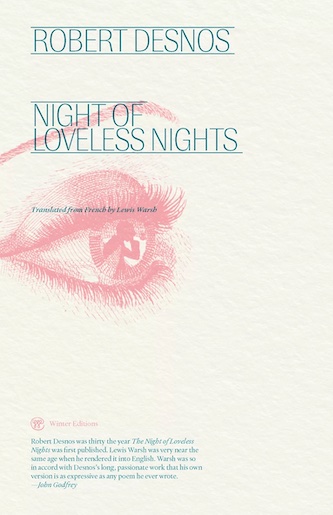
The heart’s nocturnal lament: Night of Loveless Nights by Robert Desnos

On the tree trunks the same two initials are always carved. By what knife, what hand, what heart?

 In 1973, Issue 10 of The Ant’s Forefoot, a New York City based poetry journal (originally started in Toronto) was devoted to one single epic poem—Lewis Warsh’s translation of Night of Loveless Nights by French poet Robert Desnos. As such, it was the first English publication of a book by Desnos, more than forty years after its original limited French release in 1930. The chemistry between Desnos, one of the early Surrealists and Warsh, a member of the second generation of the New York School of poets produced an translation that is attentive and sensitive to the original despite the fact that Warsh was born the year before the Desnos’s death. The context of the creation of Night of Loveless Nights is as fascinating as the story of its first appearance in English. Long out of print, this translation has now been rereleased in a special fiftieth anniversary dual-language volume from Winter Editions, complete with an afterword by poet David Rosenberg, the editor who originally gave Warsh’s translation a home.

Robert Desnos was born in Paris in 1900. He published his first poems in his teens and, in 1921, he was introduced to the Paris Dada group and André Breton through poet Benjamin Péret. He became an active member of the Surrealists and demonstrated a particular gift for automatic writing. But he began to move away from Surrealism due to political differences and this led to a falling out with Breton. By 1929 the rift was more or less complete as Desnos  joined Georges Bataille’s journal Documents. During the Second World War, he was active with the Resistance and, in February 1944, was arrested by the Gestapo. He died of typhoid in Terezin in occupied Czechoslovakia in 1945.

Desnos began writing Night of Loveless Nights, which he titled in English, in 1926 and completed it in 1928–29. It was inspired, like several other pieces he composed during this period, by his hopeless romantic obsession with night club singer Yvonne George. Although his love was not returned, he remained devoted to her through her increasingly crippling addiction to drugs and alcohol, to her death from tuberculosis in 1930. His epic unfolds over one anguished and feverish night filled with sleepless dreams, slipping in and out of opium delirium and infused with blues and jazz tones. Lewis came to Loveless Nights with little translation experience and less than full confidence with French, but he connected with the imagery, irony and rhythms of Desnos’s verse and felt he could carry it into English.

In his afterword, American poet and Biblical translator David Rosenberg recalls how he and his friend Warsh were both drawn to Desnos’s  poetry over that of his contemporaries:

We were twenty-somethings when we took the French avant-garde poets in primarily the 1920s, from Max Jacob to Pierre Reverdy, as our forefathers of deadpan, no less than Louis Armstrong: it was the decade in which American jazz riveted Paris. Stein, Breton—they were too pragmatic for our sensibilities, though Stein was in our blood and manifested later. But Robert Desnos. . . was in-between; he seemed to push through surrealism and come out the other side as a literal dreamer, in search of reality and lost love. Desnos’s dreamer was parallel to a soul, disembodied—not the disordered mind’s “we must change life” of Rimbaud. Desnos was more grounded by loss.

Warsh was a regular contributor to Rosenberg’s The Ant’s Forefoot when he shared with him his Desnos translation for potential inclusion in the magazine’s upcoming issue. As they read it together over a shared joint, Rosenberg marvelled at its length and wondered if it would be feasible to turn an entire volume over to a single text. Excerpting it did not seem to be an option; it had to be reproduced in full. Desnos’s original publication was a collaborative effort with painter Georges Malkine who provided illustrations to accompany the text. Financial constraints and devotion to a minimalistic aesthetic guided the layout and production of the English edition which included archival photos provided by Lewis. The cover featured original artwork by Rosenberg himself, which is reproduced in the present fiftieth anniversary edition. Otherwise, the materials and production techniques employed in issue 10 of The Ant’s Forefoot are now lost with a graphics art scene that no longer exists. But the Winter Editions anniversary edition now has the advantage of extra space—the French text runs alongside Warsh’s English version, allowing a bilingual reader to appreciate how poet meets poet in this now-classic translation.

Night of Loveless Nights opens with vivid imagery that leans toward the surreal, but with the long initial section of rhymed quatrains, Desnos is adopting a classical form. Warsh does not attempt to reproduce the rhymes, but focuses on staying to true to the mood, tone and important motifs that will recur throughout the long dream-soaked night that follows. One can almost smell the foul air:

Hideous night, putrid and glacial,
Night of disabled ghosts and rotting plants
Incandescent night, flame and fire in the pits,
Shades of darkness without lightning, duplicity and lies.

Who sees the rivers crashing inside himself?
Suicides, trespassers, sailors? Explode
Malignant tumors on the skin of passing shadows,
These eyes have already seen me, shouts resound!

Quatrains like these carry much of the poem, broken first by a section of landscape inspired prose poetry and then by stanzas that vary in length and form. Desnos then returns to the stricter quatrain format before falling into longer, often incantatory, free verse  as the night stretches on and the speaker wearily and warily faces the brightening sky and his growing fatigue.

Desnos never names the object of his desire, but his longing and unrequited passion is laid bare. His romantic desperation is tangible:

I give everything to you, down to the heart of the ghosts,
Submit it to my fatal and delicate torment
Leave in order to disappear in two lines of a book
Without having invoked the evening of lovers.

I am tired of fighting the destiny which conceals me
Tired of trying to forget, tired of remembering
The slightest perfume which rises from your dress,
Tired of hating you and blessing you.

Although Desnos had, perhaps, as Rosenberg suggests, “pushed through surrealism,” it is not entirely behind him here. Beyond a surreal quality to much of the imagery, Warsh’s translation retains a suggestion of Desnos’s experiments with automatic writing and especially something he called “sleep writing,” especially later in Loveless Nights where the verses become freer, the poet seeming to riff on an image, such as in an extended chant-like passage featuring hands which in part reads:

Hands that stretch hands that soften
Is there a sincere hand among them
Ah I no longer dare to shake hands
Lying hands loose hands hands that I mangle
Hands clasped in the prayer of one who trembles when I look him I the eye
Is there still a hand I am able to shake with confidence
Hands on the lover’s mouth
Hands on the heart without love
Hands cut by false love
Hands founded on love
Hands closed to love
Hands dead to love
Hands straining for love
Hands rising for love

And on it goes. It feels, when one reaches this passage, that the poet is drifting off while writing, until the hint of dawn at the windows pulls him back to attention. To read this poem is to accompany the lovesick speaker into the haunted and lonely night, but somehow the dark beauty and the underlying sense of opium-enhanced irony keeps it from feeling impossibly bleak. It is as if Desnos is aware that the depth and futility of his romantic and sexual obsession is the real drug that fuels his poetry and keep his pen on the page.

The fiftieth anniversary edition Night of Loveless Nights by Robert Desnos is translated from the French by Lewis Warsh, and published by Winter Editions.

Things that will come to pass and cannot be stopped: January by Sara Gallardo

What is a day? What is the world when everything inside you shudders? The sky darkens, houses swell, merge, topple, voices rise in unison to become a single sound. Enough! Who is that shouting? Her soul is black, a soul like the fields in a storm, without a single ray of light, silent as a corpse in the ground.

Sixteen year-old Nefer has a secret. A secret growing inside her body that is pushing her away from her family and deeper into herself. Desperate to resist the abrupt transition to womanhood that has been thrust upon her, her predicament is the central focus of Argentinian writer Sara Gallardo’s January. Originally published in 1958, when Gallardo was only twenty-seven, this unsparing novella about rape, pregnancy and abortion in a world where a woman’s body and being was strictly defined by church and convention, has come to be regarded as required reading in her native country. It has now been released in Frances Riddle and Maureen Shaughnessy’s English translation.

This brief novella simmers with stark intensity as it follows Nefer’s conflicted and tumultuous emotions as she struggles to cope with her unfortunate circumstances alone in a deeply religious rural community in mid-twentieth century Argentina. The youngest of three daughters, her life on her family’s farm is one filled with hard work and constant expectations. She admires her disabled father’s quiet dignity, resents her sister’s fulsome beauty and fears her mother’s large, threatening presence. And, in spite of her condition, she nurses a hopelessly passionate crush on her handsome neighbour, Negro. In her mind, in fact, it is he who is responsible for her pregnancy although the child is not his. She had invested so much time and desire into the design and creation of a dress for her eldest sister’s wedding imagining it might magically catch his eye and, had she not been so intent on making an impression, she believes she would not have inadvertently attracted the attention of the older man who forced himself that day.

Playing out against a landscape defined by blistering heat, vast open spaces, sparse shade and clouds of dust, Nefer’s experience of her surroundings is highly charged and fragmented. She swings from rage to fear to jealousy to waves of crushing guilt. Unable to escape the stain of her strict Catholic upbringing, the sorry state of her soul is a constant concern. Anxiety eats away at her. She cannot help but think back to a time when she was carefree, when the world still held promise. But she remains determined to face her fate on her own terms, no matter where it takes her. Gallardo brings us right into the heart of her effort to assert control over her mind, her body and her life, as in this scene where she slips out during siesta to sneak into town in search of a possible medicinal intervention:

She kicks and takes off at a gallop, steering toward the thick grass that will absorb the footfalls. She doesn’t want to think about the end of her journey, about the old lady she’s never seen but with whom all her hope now lies. Her eyes pick out objects one at a time, attributing an exaggerated importance to each. Thistle, she thinks, thistle partridge, dung, anthill, heat; and then she hears – one, two, three, four, one, two, three, four – as the hooves hit the ground. Slowly, sweat begins to appear behind the horse’s ears and runs in dark strands down his neck where the reins chafe against his coat, churning up dirty foam. Little voices, little voices speak to Nefer, but she continues her journey indifferent to them. Cow, she thinks, a Holstein, and another and another. That one’s overheated. Lapwings. Two lapwings and their chick. Those piercing shrieks!

In less than 120 pages, January offers a vivid, internalized account of a young woman facing impossible odds. Gallardo was born in 1931 to a wealthy Buenos Aires family with broad agricultural interests and this, her first book, shows a clear sensitivity to the social dynamics impacting disadvantaged rural communities and the suffocating influence of the Catholic mission churches. But beyond the constraints of her time, it is Nefer’s private horror, as reflected in her relationship to other people and to the natural environment, that makes this such a compelling—and timeless—read.

January by Sara Gallardo is translated from the Spanish by Frances Riddle and Maureen Shaughnessy and published by Archipelago Books.

The excellent books I’ve not been reading

As September began, with the prospect of a long-awaited trip looming, I had imagined I would have read and reviewed several new and recent releases before taking flight. Now it looks like these same books will be joining me on my way to India. I’d pictured myself only packing a few slender volumes so as to leave room to acquire more and still remain within the tighter weight restrictions of my internal flights. I should still be fine, of course, and I will still be able to fill up with even more books, so far as I can afford, before I head home from Bangalore. And, without even having to buy a second bag to get home as I have in the past.

It has been just shy of four full years since my last visit to India—in fact, since my last trip anywhere. I have spent hours sorting out flights, reserving hotels, making sure all my expenses at home are covered and making endless lists (which my toothless cat has mutilated on more than one occasion as he is inclined to do with my notebooks and sticky note reminders when I’ve recklessly left them unattended). I’ve also been invited to give a talk while I’m in India, so preparations for that have required my attention, as have an endless number of last minute errands. Considering how very busy I was prior to my last trip in 2019, it’s a wonder I got out of the door at all. Perhaps the enterprise of travel after the upheaval of the still-lingering pandemic is more precious and more precarious, and I don’t want to leave as much to chance as I did before.

Anyhow, the books I have been reading, each excellent in their own way, deserve a mention now should I not manage a proper review until I get back. I am not only a slow reader, but I’m an equally slow writer and I do hope to manage even a little personal writing while I’m away.

A Practical Guide to Levitation by José Eduardo Agualusa, translated from the Portuguese by Daniel Hahn (Archipelago) is a brilliantly fun collection of short stories set in Portugal, Brazil and Angola. For me, Agualusa’s eccentric characters and fondness for magical realism work so well in the short form.

The Box: A Novel by Bermudian writer Mandy-Suzanne Wong (Graywolf/House of Anansi Press) is a high-concept novel revolving around an enigmatic, unopenable box and the effect it has on those who come into contact with it. I’m only a couple of chapters in, but so far it makes me think of Czech writer Michal Ajvaz’s playful, intelligent postmodern fiction and I’m eager to see where it goes.

Finally, River in an Ocean: Essays on Translation, from the new Canadian publisher, trace press, is a collection of essays by poets, writers and translators from across the globe, edited by Nuzhat Abbas. These formally inventive pieces invite us, as the description advises, “to consider translation as a form of ethical and political love—one that requires attentive regard of the other—and a making an unmaking of self.” This project of decolonial feminism is a very important exploration of the intersection of language with questions of  identity, belonging, gender and sexuality, giving space to voices and perspectives that many of us might not hear or even consider otherwise. It is leading me to ask myself difficult questions about what my own interest in reading and promoting work in translation really means. And with many South Asian contributors I suspect this book would have landed in my travel bag anyhow—it seems only right.

Now, with only one day until I leave, I plan to continue to fuss over my packing, take a very long walk to celebrate the colours that will be gone by the time I get back and, with luck, get a little more reading done!

“I remain / in the baptism of this window.” All the Eyes that I Have Opened by Franca Mancinelli

from here ways parted
breathing was growing

in the collapse, something sweet
a hollow of time

all the eyes that I have opened
are the branches I have lost.

Ever since I started reading Italian poet Franca Mancinelli’s latest collection, recently released in a beautiful dual language edition, I have been haunted by the couplet from which the title was born—all the eyes that I have opened / are the branches I have lost. I have been more aware than ever of the eyes of the aspen meeting me on my daily walk, watching over me as in some sense I have always known them to, but now I was seeing my own journey reflected in their stare… the branches I have lost, and the growth that I have gained over the years.

I’ve always loved aspen, widespread as they are throughout North America. I found an adolescent refuge in the hidden depths of an expanse of aspen that spread across a wide, open field near my childhood home and, now, every day I look out at the clusters of aspen that mark the edges of the forest of Douglas firs I live above. Ever since I learned that they are typically colonial, that a growth of aspen are a single organism, I love them even more. An extended family in nature to balance my fragmented human one.

All the Eyes that I have Opened is a mature collection from a poet whose work I have read since her first English translation, The Little Book of Passage, arrived at my door courtesy of our mutual friend, her long-time translator John Taylor. A few months later, our paths would fortuitously crossed in Calcutta, so I can’t help but hear her voice when I read her words, even as her poetic voice continues to expand beyond the strictly personal to encompass an ever wider range of experiences and circumstances. The enigmatic title of this latest collection came to Mancinelli, as she explains in “An Act of Inner Self-Surgery,” a piece in her essay collection The Butterfly Cemetery, during a time of “inner devastation” when, walking through the woods she came upon a tree with a heavily scarred trunk. Despite many cuts and amputations the tree had healed and transformed itself, reaching ever upwards to the light:

I continued to walk with this voice that had been articulated in me, and one clear image: there are losses that you can weep over with all your tears, fight with every effort, yet they are necessary. We would give our life so that they won’t happen, yet they are guiding our sap toward the shape and the place that belongs to it.

This understanding is expressed most explicitly in an early sequence, “Master Trees,” which like many of the others in this book blends verse and prose poetry. The poet speaks of branches and pruning and seeing “the eyes of the trees,” of opening herself up “according to the light.” But growth is uneven:

the air was inert, traversed by trembling and quivering. It needed to withdraw, to set life aside, to push it towards areas where pockets of quietness opened. I thus grew in this maimed form. You can see in me how the nearby street burns.

Her ensuing engagement in the woods with the very bark of the trees is existential in nature. She emerges with her gaze freed. The following sequence, “All the Eyes that I Have Opened,” turns to experiences that have caused pain, abstracted in natural imagery that is often brutal yet from which new strength and determination seems to arise in the speaker. As ever, Mancinelli distills emotion, memory and experience into crystalline elements, moving from the intimate to the universal in rarely more than a handful of finely wrought lines. Drawing her metaphors from nature and the land, with eyes, sight, branches, darkness and light as recurring images throughout this book, she focuses her attention on a world—internal, external, and interpersonal—in which the dynamic tensions are always shifting, always in flux, and aims to capture its essence.

This collection, as Taylor points out in his introduction, sees an expansion of Mancinelli’s poetic universe, as she brings ancient and traditional sources into her work for the first time, including Saint Lucy (Lucia), the patron saint of the blind, often depicted with her eyes on a plate, whose own sight was restored by God. All the Eyes that I Have Opened also begins and ends with sequences in which the poet endeavours to give voice to the plight of migrants seeking a better life in Europe, meeting danger, cold, and closed borders along the way.

My body has an open texture from which hangs a thread. Someone at the other end, without even noticing, pulls it, and slowly I grow thin. The absence beckons me. I approach the spirits of the cold, that white wordless nucleus which governs this earth. I close my eyes as if pervaded by a flat colorless sea.  (from “Diary of Passage”)

These works stem from an interdisciplinary project she took part in which she and other artists traced a route through Croatia often used by refugees.

This is but a brief and rather personal response to this rich new collection. Every time I open it I find something else that catches my attention. I will be turning to it again and again, and thinking of these poems as I encounter the eyes of the aspen each day.

All the Eyes that I Have Opened by Franca Mancinelli is translated from the Italian by John Taylor and published by Black Square Editions.

A wanderer between two worlds: The Postman of Abruzzo by Vénus Khoury-Ghata

“Rifling through the papers of a dead man isn’t enough to bring him back to life.”

Ten years after her geneticist husband died following his return from a village in a mountainous part of southern Italy, Laure leaves her home in Paris in search of something—she’s not sure exactly what—that will help her understand why he kept returning to this isolated community of displaced Albanians again and again. As Luc travelled to collect samples from populations scattered across the globe, being left behind became such a constant condition of their marriage that Laure can’t quite accept that he is really gone for good. The only way to come to terms with this unsettled absence, she is certain, is to visit the one place he had returned to fifteen times and where, on his last trip, his “heart had broken down.” Armed with a folder of his final notes on the Albanians and her portable typewriter, she arrives in Malaterra in the region of Abruzzo, and rents a house.

This is the set-up of Lebanese-French writer Vénus Khoury-Ghata’s 2012 novella, The Postman of Abruzzo, the latest of her works to be released by Seagull Books in Teresa Lavender-Fagan’s English translation. But, if Laure embarks on her journey under the illusion that she will somehow be able to put names to the anonymous donors of blood, urine and saliva recorded in her husband’s files, as if some code rests in the notes she has yet to transcribe, she soon recognizes the foolishness of that idea. What she encounters instead is an eccentric collection of characters who hold fast to beliefs and traditions long since forgotten back in their homeland, preserved in Abruzzo like a fly in amber, and she discovers she is not the only one mourning an unresolved past.

The first and most essential villager Laure meets is Yussuf, the postman of the title. On her first day, he arrives on the doorstep of her cave-like temporary residence high on the exposed mountainside above the valley where the villagers are spending the hot summer months. He has come, he tells her, to feed a litter of kittens, and promises to return every day regardless of whether or not he has any mail to deliver. As one of the only people in town who can read, having learned in prison, he knows everyone’s secrets and has an opinion on everything, sharing his knowledge and uncanny insights with the newcomer as he see fit. Yet, although he can read, the postman has no time for writing:

Putting words on top of words doesn’t construct a house, doesn’t make a child or a tree grow, doesn’t plough a field or prevent locusts from devouring an entire crop of corn. The pages one writes on a table don’t change the shape of the table but make the brain of the one writing explode. Too many word’s crack one’s skull and shorten one’s life.

With his mailbag and his tendency to hold fast to the letters that he feels are too painful to deliver or too important to release to the vagaries of the postal system, Yussuf plays a critical role linking the residents of Malaterra to one another, and Laure, as an outsider, to the community where she hopes the answers to the questions Luc has bequeathed her lie.

The only person in the village who professes to have a true respect for words is the Kosovar, the sole Muslim in a community of Catholics, who has, over the years, bitterly retreated into the confines of his dusty bookshop. In Laure he hopes he has found a kindred spirit, but his desperation and general state of deterioration unnerve her. The other residents are of a much earthier stock, including Mourad, the lusty baker, who proposes marriage despite the fact that he already has a wife and household full of children and the local women who, guided by superstitions, eye the skinny, short-skirted foreigner with distrust. Most are widows, by fact or fate, as economics have driven husbands and sons away to seek work in cities from which they rarely return. And they all seem to remember a Luc very different from the one his wife thought she knew. But the one person who interests and terrifies Laure most is Helena, the woman who cared for Luc in his illness and sent his washed and ironed shirts to Paris after his evacuation to a hospital in Rome. Helena has been waiting thirty years, rusty rifle at hand, to avenge the deflowering and subsequent death of her daughter—by hanging from a fig tree with her mother’s assistance.

Even the mountains mourned the girl, only the mother’s eyes were dry. She cried inside. Condolences poured in from every direction: plastic buckets of every colour, aluminum pans, wicker baskets, even a nightingale in a cage, but nothing consoled her. The priest who refused to give her absolution because of suicide was immediately replaced with another priest. No people are more solidary than Albanians. It makes sense! The same blood flows in their veins . . .

This blood, O negative, not only binds this community and attracted the interest of the foreign medico, but nurtures a deep-seated tradition of blood tax and blood debt imported and preserved through generations of migrants. Laure’s agitation is heightened when Yussuf reveals that a letter sitting undelivered in his bag indicates that the “boy” Helena has been waiting for, known as the Australian because he was rushed off to an uncle in Sydney for his safety, is finally on his way back to Malaterra. His arrival will affect the entire village, Laure included.

The Postman of Abruzzo reads a little like a fable set in a place caught between the modern world and a past that is filled with a complicated network of ancient traditions and carefully maintained prejudices. Laure is also caught between two worlds, half-underground and half-aboveground as the Kosovar keenly observes. Khoury-Ghata’s prose, characteristically poetic, spare, and unsentimental, is perfectly suited for the telling. Sometimes it is simply breathtaking to experience the way she can conjure a vivid and moving image with just a few well-placed words. With this work she uses this gift for precision to craft a story of loyalty, love and loss that is both tender and gently absurd.

The Postman of Abruzzo by Vénus Khoury-Ghata is translated from the French by Teresa Lavender Fagan and published by Seagull Books.

In a hidden corner of the world: In Red by Magdalena Tulli

Whoever has been everywhere and seen everything, last of all should pay a visit to Stitchings. Simply take a seat in a sleigh and, before being overcome by sleep, speed across a plain that’s as empty as a bank sheet of paper, boundless as life itself. Sooner or later this someone—perhaps it is a traveling salesman with a valise full of samples—will see great mounds of snow stretching along streets to the four corners of the earth, toward empty, icy expanses.

It begins like this, with the sketch of a town isolated against a fanciful landscape of an unending winter, each gloomy day broken only for a moment at lunchtime between soup and the main course. It is sometime after the turn of the twentieth century, when Poland was divided among three empires—Austria-Hungary, Russia and Prussia—but Stitchings exists in an imaginary fourth partition under the control of a Swedish garrison, a condition the residents consider most favourable. As the years pass, however, conflict and commerce from the outside world will exert influence on the community of Stitchings for better or worse.

In Red, the 1998 novella by Polish writer Magdalena Tulli is a celebration of the power of stories to create a world that is at once magical and a microcosm of the early decades of the twentieth century in her native country. Echoes of Calvino and Saramago can be heard in her portrait of Stitchings and the many eccentric characters who pass through it and strange circumstances that arise in its streets, structures and public places. Defined by its industry and modes of approach—or exit—the town is, when we first arrive, home to three factories and a salt mine and, should one not approach by sleigh, a railway station to welcome newcomers. The primary businesses, all longstanding family concerns, are Strobbel’s porcelain works, Neumann’s phonograph record factory and Loom & Son who manage the flow of money and goods, and manufacture fine ladies’ corsets for the local and international market. Meanwhile, the salt mine and its miners hold an economic role that is essential to the very lifeblood of the town:

But it was to them alone that the factories, stores, banking houses, and law firms owed their prosperity. Any kind of enterprise would have run aground in a heartbeat if there’d been a lack of salt, which, as everyone knows, is the essence of tears. For along with riches, success in industry and commerce brings weeping. A boom requires weeping if it is to last. Otherwise it will dry up. A certain number of tears are needed to fill the channels of trade and allow the expeditious flow of assets and liabilities, just as water under the keel is essential for ships with holds full of cargo.

This town is no stranger to weeping. As war brings destruction its commercial strongholds, and death and injury to a generation of young men, the function of the various business and the visions of their new owners and managers evolve. Cycles of poverty and prosperity follow and the seasonal nature of the environment around Stitchings grows warmer. Eventually the snow is but a distant memory, a port is open to ships ferrying goods and visitors, and the daylight hours begin to expand until night is reduced to a brief daily moment of dimness. In the sweltering heat, sailors roam the streets and frequent the brothel. Life in Stitchings goes on. And, sometimes, it does not, as charcters fall prey to injury, illness and despair.

For a reader accustomed to following the path of an individual protagonist or collection of individuals, In Red might feel underdeveloped. But the primary character is the place, Stitchings. It evolves, with changes in development, climate and atmosphere rising and falling over the course of this short novella. People, as the framing reinforces—regularly describing how prospective visitors can approach or exit this mythical space—are transient figures whether they are born and die there or brought by commerce, external factors or familial obligation. They fall into routines, often emotionally destructive for themselves and those around them. There is, it seems, little true happiness in the streets and hallways of Stitchings. For that a person really needs to escape.

This fantastic fable moves forward with the inexorable pressure of forces that come from outside and from within. With a tumultuous flow of images, Tulli’s narrative never stops to take stock. It is up to the reader to catch references and pick up on the wry commentary woven into the account. Following the detail is less important than riding the flow, and appreciating the wisdom and humour woven into this dark tale. In the end we are reminded that the story is an entity with its own ontological motivation, but formed as it is on a community caught in the ebb and flow of larger world currents, it carries the best and worst of human nature in its wake.

In Red by Magdalena Tulli is translated from the Polish by Bill Johnston and published by Archipelago Books.

Days and hours, light and darkness: South by Babak Lakghomi

The sun setting. Quiet sea. The rig looked like a chandelier made of wire. The cranes slanted like seabirds waiting for prey.

This is not a book that eases you in gently, slowly constructing a framework and political context for the events to follow. We are offered no false assurance of safety and normal, only glances into the narrator’s past that indicate that at one time he might have harboured hope for the future, no matter how illusory. When we meet B in the opening passages, he is already off the map, so to speak, and heading for something much larger and darker than he can possibly imagine. But, as he makes his way to the South through a bleak, drought-ravaged landscape inhabited by a sparse impoverished, superstitious population with strange beliefs, he already has serious doubts about the wisdom of his mission:

As a journalist, I tried not to go after topics that the state was sensitive to. My father’s history and my mother’s continuous discouragement had made me conservative. I was diverging from that path now by taking this assignment.

South by Babak Lakghomi, a writer born in Tehran, currently living in Canada, is a desolate, dystopic fable unfolding in an undefined time and place where environmental devastation, political unrest and totalitarian control have distorted the rules that once governed human engagement. That is, a future that seems less distant, less improbable by the day. In Lakghomi’s vision, the increasingly dire economic and ecological circumstances that have plagued an unnamed country have forced men south to work in oil refineries and on off-shore oil rigs, but as the profitability of this industry also starts to decline, labour unrest has started to spread. This is the phenomenon his protagonist B has been sent to report on.

Having just secured a contract to publish a book about his father, a former union leader who mysteriously disappeared when he was a boy, B feels a certain obligation to take the assignment when it is offered to him by his editor. Perhaps it’s for the best. Back home his marriage is faltering and his recent sobriety is shaky. However, when he finally reaches his destination, it soon becomes clear that his presence on the rig will be tolerated, but not welcomed. Finding people willing to talk to him is difficult and, before long, dangerous. His past experiences researching and writing articles, such as an investigation into the extinction of the painted stork, have taught him that much of what is uncovered about the deep layers of corruption running through so much of what is happening in his country cannot be included in a final draft. This time he is even more restricted. He had been required to leave his cellphone and laptop before flying out to the rig. All communications with his editor and publisher, and even his wife, have to pass through administrative staff who can read every word, blocking, altering and fabricating his messages at will.

With a narrative style that is tight, almost skeletal in nature, South moves at a steady pace, growing increasingly distorted and claustrophobic. We gradually learn more about the protagonist, haunted as he is by the unexplained absence of his father, the crumbling state of his marriage, and a recent encounter with a strange woman back in the city, but much of what he is enduring as his circumstances and condition deteriorate, first on the rig and, later, captive on a cargo ship, remain shrouded by mystery. What is clear is that B has found himself caught in a net that reaches into his immediate past and perhaps further, back to whatever took his father away. The helplessness of being in a situation where you don’t even know what kind of a game you’re playing is chilling, a sensation that is heightened by the exceptionally spare prose. Every word counts.

Dystopic fiction can sometimes get bogged down in explanatory detail. In that regard South is stripped to its essentials. Acute attention is given to settings and sensations, but the only named characters are B and his wife Tara. Everyone else is referenced in simple terms—the Editor, the Assistant Cook, the girl with the lighter and so on—preserving an anonymity that reflects how precarious and unreliable every relationship is. And yet against this uncertainty, we have in B a compelling and empathetic narrative voice, continually questioning, struggling as his ordeal weighs on him physically and mentally. The horrific scenario he encounters in the South, one that is closely tied to the all-too-recognizable reality he observes back in the city, make this a novel that sits uncomfortably with a reader—as it should.

South by Babak Lakghomi is published by Rare Machines, an imprint of Dundurn Press.

Making every word count: The Questionable Ones by Judith Keller

A police car drives slowly along the streetcar tracks in front of the central station. The officers scrutinize the waiting pedestrians through the window. Most of those waiting here are out of the question. But some do come into question. These are the questionable ones.

This simple story, “Casting,” not only provides the title for Judith Keller’s collection of micro fictions, now available in English translation by Tess Lewis, but is a perfect representation of what this young Swiss writer is able to achieve with an economy words and a sensitivity to the multiple meanings that potentially blossom from familiar expressions. A quick glance at this book of short (sometimes very short) stories can be misleading. Some pieces are barely two sentences, a number extend for a page or two, while a few stretch to seven or more pages. One might then wonder how much a of story such an abbreviated form can contain, but as Keller knows well, the careful choice of words and the confidence to leave open space for the reader is key.

Arranged into sections named after stops on the Zurich tram line, the stories in The Questionable Ones offer snapshots into the lives, passions and idiosyncrasies of a variety of characters. Absurd, often humorous, sometimes reaching toward the political, Keller’s micro fictions reflect recognizable human emotions and actions, frequently relying on common expressions taken to their literal extreme, or language that is inherently ambiguous. Of course, this reliance on meaning, especially in such a confined literary space, presents a particular challenge for a translator.

The publisher’s webpage for this book features links to a published interview and a video conversation between the author and her translator, both recorded in April 2020 when the pandemic had intervened in Keller’s plans to attend a festival and a residency in New York City. Although both cover her literary influences—including Robert Walser and Ilse Aichinger—and the reasoning behind her unusual decision to study German as a foreign language in Bogota, Colombia, the video is particularly enlightening. It not only offers anyone interested a taste of Keller’s mini fictions, read by the author herself, but zeroes in on some of the difficult decisions her translator faced when the choice of an appropriate word to convey the nuances implicit in the original was not obvious. At this point, the translations were not necessarily fixed in their final form, so several times, Lewis and Keller discuss possible options for critical words in particular pieces. After all, if every word counts in the initial composition, the same is true for the translation. Further, the opportunity to witness the writer and translator openly examining the subtleties of meaning together is inspiring.

Keller’s playfulness with words and capacity to see things from a slightly odd angle allows her to pack more into a few sentences or a few pages in ways that longer, more conventional fiction might not. Less is more. Each piece is left open for interpretation, encouraging the reader to imagine a larger tale. They are at once sketches and revealing portraits of ordinary people trying to make sense of life, one way or another. As well, the spare prose, focused on the most essential, if unusual, qualities of  character and setting leads to some wonderful images. Take for example, the opening of the two-page story “In a House”:

A band of light lay on a hillside as if a glance from half-closed eyes had fallen from above. On the hill stood a house and in it lived a man whose movements were slow. He slowly raked the leaves. He had a wife and two sons. His wife looked like an owl with her brown and golden eyes. She had taken to standing behind herself and sending her body on ahead and calmly watching what happened to it. Their marriage was a muted one.

The only obvious connection between the stories that comprise The Questionable Ones and the tram stations that denote each section—Bucheggplatz, Schwert, Micafil and so on—is the recurring piece, always called “High Time” that closes out each sequence. The circumstances change, but each instance, begins with a “far-fetched woman” making her way through the city, by day or by night, often reaching the relevant tram station and, ends with the acknowledgement that she, or someone else, has been “waiting for it to be high time for a good while now.” This variation on a theme within which what “high time” is meant to refer to is never revealed, adds an intriguing continuity to this irresistible collection of microfictions.

The Questionable Ones by Judith Keller is translated from the German by Tess Lewis and published by Seagull Books.