The pursuit of happiness: Sergio Y. by Alexandre Vidal Porto

“If happiness is not where we are, we must chase her. She sometimes lives very far away. You must have the courage to be happy.”

When it comes to the depiction of transgender individuals in literary fiction, I will confess that I am a rather cynical customer. Lets just say I know the reality too well. So much of what I have read does not even come close to scratching the surface of what it means to be at odds with one’s own birth-assigned gender. Intentions are good and, of course, the transgender or intersex character always allows for an interesting twist but the results can be misleading, even distressingly off base. That’s why Sergio Y. by Brazilian author Alexandre Vidal Porto is such a refreshing and original read. Here is a novel that treats the subject with intelligence and compassion—quite the feat for a book in which the transgender character meets an untimely and unfortunate end before the story even gets started.

SergioThe title character, Sergio Y. is the son of a wealthy businessman in São Paolo, Brazil, and the great grandson of an Armenian immigrant who escaped the tragic fate of so many of his countrymen, including the rest of his family, when he crossed the ocean in 1915, seeking his happiness in the Americas. The narrator is Armando, a well-respected seventy year-old psychiatrist. Sergio had been referred to him for therapy at the age of seventeen, described simply as “articulate, intelligent and confused.” They meet regularly for several years. This mature young man—so handsome, wealthy and talented—intrigues Armando and yet, in spite of all of these advantages, he professes to be possessed by a deep and abiding unhappiness.

Following a visit to New York City one Christmas, Sergio informs Armando that he wishes to discontinue therapy. He has had a revelation, he says, and he believes he has found a way to be happy. Our narrator is a little disgruntled to be dismissed as such but, as the years pass, Sergio Y. fades from his mind until a chance encounter with his former patient’s mother. She reports that her son has moved to New York where he attended culinary school and is now about to open his own restaurant. Armando is surprised, but pleased by this news and the praise he is afforded for his role in helping Sergio find happiness at last. However, this boost to his ego is short lived. Armando’s world begins to crumble when he learns, quite by chance, that Sergio Y. has been murdered at his home in the West Village.

Obsessive by nature, Armando becomes haunted by the need to know more. What he discovers with the help of a private investigator is completely unexpected and sends him reeling. The murder victim is identified as Sandra Yacoubian, female. Sandra and Sergio he soon learns are, in fact, one and the same person. His young patient had found his happiness as a woman and now she was dead at the age of 23! How could he have failed to recognize that Sergio was transsexual? And, even more serious, was his failure in some way responsible for this tragic outcome?

The main source of my frustration was not having detected any hint of Sergio Y.’s transsexuality. I felt I had been duped solely and exclusively by my own incompetence. I had always though that the secret to transsexuality was not all that deep, that it revealed itself in all of the individual’s attitudes, at all times, in all the decisions he or she took, since early childhood. As far as I was concerned, the pain in the patient’s soul and their inner confusion would be so visible that one did not need to be a Freudian or Jungian psychoanalyst to make the diagnosis.

Armando’s search for answers and his personal quest for understanding lie at the heart of this book. He begins with a handful of stereotyped assumptions. He labels them, admits to them, and lays them out. In the end, as he comes to a clearer,more nuanced appreciation of the decision his patient chose to take to find happiness and the determination with which she pursued it.

The narrative tone is highly idiosyncratic, dictated by the analytical, mildly obsessive-compulsive, immodest character of Armando. Even when he begins to doubt and second-guess himself as the account progresses, he maintains the matter of fact, dry, clinical delivery of a psychiatric report. The attention to detail—his clothing choices, his tendency to note the approximate height and weight of people he encounters, even his reports of his own emotional ups and downs—all create the illusion of a sterile account. But when the careful veneer cracks from time to time, we see a moody, somewhat petulant character, prone to bursts of pride, mixed with episodes of guilt and shame. He is continually measuring himself against his own successes and failures. His internal machinations are fascinating.

Ultimately, Sergio Y. is novel that approaches the transgender experience from the inside and the outside, allowing for the comfort with names and pronouns to vary, over time and from person to person, reflecting the complexities of relationships that others, even loving family members, can have when an accepted and assumed identity is challenged. In his own journey to understand and set his mind at ease, the questions Armando raises and the answers he finds serve to create a moving and compassionate portrait of the transgender person’s conflicted internal experience and the search to find a way to be happy in the world.

Happiness may be an ideal; comfort or contentment might work as well. From my point on this same journey I would hasten to add that it can be a difficult and lonely path, but that does not mean it is not worth following. In fact, if it is the right path, there is no other. Semantics aside, this novel is an important, engaging read. It deserves to be written about and it needs to be discussed.

Sergio Y. is translated from the Portuguese by Alex Ladd and published by Europa Editions.

Immersed in the moment: Incidents by Roland Barthes

In his Publisher’s Note to the French edition of Roland Barthes’ Incidents, a collection of essays published shortly after the theorist’s death in 1980, François Wahl suggests that the four very different texts assembled form a coherent whole because each piece “strives to grasp the immediate”. These are not theoretical or critical investigations in any sense, rather, in each text, Barthes is immersed in the moment, observing, reflecting, and recording his reactions. There is an unchecked flow and intimacy, by turns nostalgic, sensual, and melancholic but always tuned to the instance of occurrence: to the incident.

2016-05-19 21.38.01These are works that invite the reader to engage with all five senses, mediated through words and memory–they are not formal pieces but rather take the form of journal entries, diary writing, and fragmented travelogue. Barthes writes people and he writes place, never really entirely at ease with too much of either. Delight, boredom, and sadness filter through his reflections creating an immediacy that is at times startling. He is not writing for posterity, he is writing for himself.

The collection opens with “The Light of the South West”, an evocative essay/memoir, a personal tribute to the south west region of France. He writes about the experience of traveling south from Paris. Passing Angoulème he becomes aware that he is on the “threshold” of the land of his childhood. It is the quality of light that defines the place:

. . . noble and subtle at the same time; it is never grey, never gloomy (even when the sun isn’t shining); it is light-space, defined less by the altered colours of things . . . than by the eminently inhabitable quality it gives to the earth. I can think of no other way to say it: it is a luminous light. You have to see this light (I almost want to say: you have to hear it, hear its musical quality). In autumn, the most glorious season in this land, the light is liquid, radiant, heartbreaking since it is the final beautiful light of the year, illuminating and distinguishing everything it touches. . .

He goes on to turn his attention to the elements of the south west that resonate with different aspects of his childhood, to reflect on the way that memories formed in childhood inform way we remember the places associated with that time, the magical spaces and the difficult times will each carry their own tone, their own qualities.

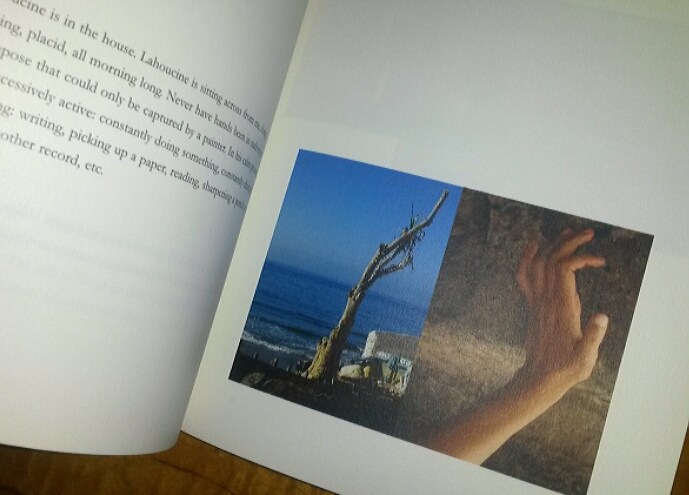
2016-05-19 21.41.06The title piece is the earliest in the book. Recorded in 1969 when the author was in his mid-50s, “Incidents”, as the name implies, captures moments from an extended stay in Morocco through an incidental series of fragmented encounters and experiences. Here, people form the scenery; with a special attention reserved for young men. Barthes demonstrates a a particular eye for detail (and somewhat of an obsession with hands) in these passing observations, combined with an acute sensitivity for scents and colours. The vibrancy, shades and contrasts of the country come alive. As a reader you become aware of the blinding light, the dark shadows–they are not described, you sense them in the background.

A young black man, wearing a crème de menthe-coloured shirt, almond green pants, orange socks and, obviously, very soft red shoes.

A handsome, mature looking young man, well dressed in a grey suit and a gold bracelt, with delicate clean hands, smoking red Olympic cigarettes, drinking tea, is speaking quite earnestly (some sort of civil servant? One of those who track down files?), and a tiny thread of saliva drips onto his knee. His companion points it out to him.

Some young Moroccans–with girlfriends they can show off in front of–pretending to speak English with exaggerated French accents (a way of hiding the fact without losing face that they will never have a good accent).

The art of living in Marrakesh: a fleeting conversation from open carriage to bicycle; a cigarette given, a meeting arranged, the bicycle turns the corner and slowly disappears.

The Marrakesh soul: wild roses in the mountains of mint.

The third essay, “At Le Palace Tonight . . .” is a tribute to a Paris club in a converted theatre. He describes the ornate detail, the mood and the atmosphere of this place where he seems to almost prefer to be an observer, watching the dancers and the human interactions rather than taking part. And as in the first essay, we find once again a wonderful evocation of light, this time light as informed by the interior of a structure:

Isn’t it the material of modern art today, of daily art, light? In ordinary theatres, the light originates at a distance, directed onto the stage. At Le Palace, the entire theatre is the stage; the light takes up all the space there, inside of which it is alive and plays like one of the actors: an intelligent laser, with a complicated and refined mind, like an exhibitor of abstract figurines, it produces enigmatic shapes, with abrupt changes: circles, rectangles, ellipses, lines, ropes, galaxies, twists.

This collection closes with “Evenings in Paris” a series of journal entries from 1979 that open with words Schopenhauer wrote on a piece of paper before he died: “Well, we’ve escaped very nicely.” The Barthes who comes through in this selection is tired, often impatient with colleagues and irritated by noise. A certain loneliness and dissatisfaction underscore his descriptions of dinners with friends, failed attempts to win the affections of the younger men he covets, and an unresolved mourning for his beloved mother. Most nights he finds himself heading home alone, half despairing, half relieved, to settle into bed in the company of Pascal, Chateaubriand, Dante, or the echoing ghost of Proust. Although he still enjoys longingly watching attractive men, he has little patience for crowds or social functions. This is a heavier, more emotionally intense offering, the intimacy of “the immediate” weighs heavily as Barthes commits his thoughts to paper, unaware in the writing as we are in the reading, that he is nearing the end of his life.

2016-05-20 02.33.11And, because he is recording the ordinariness of the daily encounter of the self with the world, there is the possibility of shock waves that ring down the years with a new intensity in light of the incidents (that word again) that have unsettled Paris in recent years:

The guy who sells Charlie-Hebdo walks by; on the cover in the publication’s idiotic style, there’s a basket of greenish heads that look like lettuces: ‘2 francs the head of a Cambodian’; and, right then, a young Cambodian rushes into the café, sees the cover, is visibly shocked, concerned, and buys a copy: the head of a Cambodian!

Not without a little social commentary, even in a deeply personal journal, Roland Barthes, remains ever relevant down the years.

Reading Incidents is, in itself, a sensuous experience, it is doubly so in this edition from Seagull Books. With a sparkling fresh translation by Teresa Lavender Fagan and illustrated with the evocative photographic images of Bishan Samaddar, this collection of writings becomes one that can, as Barthes himself would have intended, be savoured.

Quiet Creature on the Corner by João Gilberto Noll–my Numéro Cinq review

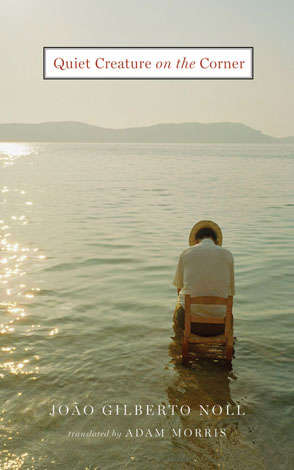
There is a most invigorating buzz around this book, Quiet Creature on the Corner, the latest release from Two Lines Press. This slender novel by Brazilian writer João Gilberto Noll is, to put it simply, a surreal, enigmatic tale that defies straightforward interpretation. Every reader and reviewer I have engaged with since my review went live yesterday at Numéro Cinq has had a somewhat different interpretation. And that’s part of the appeal–this book invites conversation.

On my first reading I was underwhelmed and uncertain how I could pull a 1500-2000 word critical review out of such a vague, odd offering. So I put it aside for a week and it started to percolate in my thoughts. Each time I returned and reread the text it grew in power and mystery. Since I finished and submitted this review I have continued to think about the book and aspects I wish I had explored. Here’s a taste, please click through the link at the end for the rest of the review.

Forever an Unknown Country: Review of Quiet Creature on the Corner by João Gilberto Noll—Joseph Schreiber

Quiet-Creature-web-294We humans tend to fancy ourselves rational beings. We hold to the convention of cause and effect. We imagine that if faced with strange and unusual situations, we would respond with curiosity, anxiety, or alarm and make an effort to act appropriately. We are inclined to believe that we need to understand what is happening to us and around us at all times. But, is that truly the way we actually exist in the world?

João Gilberto Noll is an author who dares to challenge that assumption. His novel, Quiet Creature on the Corner is, on the surface, a spare and modestly surreal tale of a young man who surrenders himself to a life that is inexplicably handed to him without seriously questioning his circumstances until he is deeply absorbed in a situation that is rapidly growing stranger and more uncertain. Newly released from Two Lines Press, in a measured, wonderfully restrained translation by Adam Morris, this novel offers an English language audience an absorbing introduction to this esteemed Brazilian author.

Continue reading here.

Beginning to find my voice: Reflections on publishing a piece of essay/memoir writing

We should only believe in our feelings, after the soul has been at rest from them; and express ourselves, not as we feel, but as we remember.
– Joseph Joubert, Pensées

Late last month I wrote about voice, about how I have recently been focusing more attention on voice; not only in literature, but as it pertains to meaning, sounds, and silences. I was, at that time, anticipating the publication of my first piece of non-review writing–not the first that I have written, there is a related piece, a parable, that will appear later this year–but rather the first to be published.

I was extremely anxious in advance of the release. I knew that I would be laying forth an aspect of my experience of being in the world that few people were aware of. I am not talking about my queer identity, that is something I have spoken of from time to time although it rarely impacts the books I chose to read and write about. I am referring to the fact that this short essay addresses my complicated relationship with my body in very bold terms.

It can be found here. (The journal that published my piece is under reconstruction so I have reproduced the essay below.)

Now that the piece is out there, granting me the necessary distance, I am extremely pleased with the results. It is raw and honest, but I feel comfortable that I have touched the heart of my experiences while maintaining a healthy and comfortable boundary. I am not a fan of confessional memoir/autobiographical fiction that tends to the revelation of excessive, unguarded intimate information. It is a delicate balance to measure vulnerability and self respect when writing about the personal details of one’s life. And, I would argue, it is essential to remember that there are limits to what we can ever really know about ourselves and if we remember that we can more honestly write from the heart.

Solitary daisyI have found that I am most comfortable leaning toward a more spare prose the closer I come to the self in my writing. I am hoping that it is a style, a voice if you like, that I can build on. But a detailed account of my life is not my goal in writing–my interest is more philosophical in nature.

I have to say that I am overwhelmed by the positive response to this piece. It is far beyond anything I could have hoped for. And I feel very excited about where I can go from here with further explorations. So much of my reading and the conversations that I’m having in the virtual sphere seem to be converging at this moment. Or perhaps I am simply in a fertile state of mind. It is not, however, an overnight phenomenon, these ideas have been growing for a long time, knocking around in awkward, unfinished form. I am grateful to everyone who has offered inspiration, support and encouragement to this point. I trust they know who they are.

May the conversations continue.

As published on Minor Literature[s], May 6, 2016.
Your Body Will Betray You — Joseph Schreiber

“From the inside out, but from which inside to which outside?”—Róbert Gál, On Wing

This is not the story of my life but the story of my living it, of my being in it.

And that’s a different story altogether.

I am, for lack of a better term, a differently gendered man. No, maybe there are better terms, more common terms—transgender, or queer, perhaps. I use these too. At least, when it’s expedient to do so or when I choose to take my place under a larger umbrella. But by their very inclusiveness, these terms are rendered senseless. Defining the self for one’s self requires an explicit ownership of the language employed. The words I embrace are mutable, evolving, even in the act of committing them to paper or speaking them aloud. Labels can only take us so far.

History is subjective. We can only know what we think we know.

And that isn’t very much at all.

This is what I do know:

I lived, for almost four decades, defined by the parameters of the body in which I was born. I recall the sensation of harbouring a fugitive being—an early social memory (at four? Five? Six?) This someone inside me was not with me, he was me. I saw him in my eyes and I wanted him gone. I wanted to be the girl my mother longed for—the one whose gender mattered solely because her first child, the sister I never knew, was stillborn.

I was not a tomboy. I did not wish to be a boy. I wanted to be the girl I confronted in the mirror, the one whose authenticity no one else questioned. I imagined that feeling female was something you learned, like tying your shoes or riding a bicycle. Yet, although I passed in the world of girls and women, this passing was a measured performance. The rules remained opaque.

The company of boys and men became a refuge—the space where my otherness was validated, where no one would ever question whether I was really female. Sexual attraction to men was a precious counterpoint to my persistent gender insecurity. Never mind that the romantic encounters between men in Mary Renault’s historical fiction held a far more desperate appeal that anything encountered in the pages of a typical boy-girl romance.  I reasoned that if I had a boyfriend, I must truly be female after all.

I married young and disappeared.

You have to understand, when I was growing up, in the 1960s and 70s in rural Canada, no one talked about ‘gender identity’ at all. And they certainly never suggested that it could differ from biological sex. Even now many choke on the concept, quote Bible and verse. My upbringing was liberal, neither fundamentalist nor homophobic, but still, my ‘out of placeness’ was my own, the faint light in the dark room. An old story, but I had no idea that there were others like me.

Self-defined gender insecurity continued to haunt me. It prescribed my path. Twice I walked away from graduate studies, turned down admission to law school, all because the more I exercised my intellect, the less energy I had to devote to maintaining the fragile equilibrium of being female in the world. I retreated to the most unequivocally female spaces I could imagine. Eventually, against my natural instincts, I decided to have children, and that was the beginning of the end—the beginning of the end of my ability to hang on to any reconciliation of my internal identity with the life I had constructed.

I fell apart.

Only in cobbling myself back together, in the aftermath of a breakdown, could I finally openly face the two fundamental notions that had driven me into mania—sexuality and gender. I realized that they were not going away, and that one could not make sense without the other.

Please note, in today’s world where trans* is appended to all manner of identities, where sexuality is no longer narrowly delineated and gender is something to defy, it may seem impossible to imagine that I could crack my head against the wall for so long before the light broke through. But mine was a different time.

I found myself in the library with a copy of Transgender Warriors and learned, for the very first time, what a few years of testosterone could do to transform the outside and fuel the inside of a female-born man. I understood, in that instant, that there was no other option. I finally had a name, a label for myself, and everything else started to fall into place.

I am not reckless. I knew there would be compromises. I knew what surgery could offer and what, at best, it could only approximate. I knew that the scalpel exacts more than its pound of flesh, that healing well is not the best revenge, and that there would be limits to the choices I would make. But none of that was on my mind as I waited for my first injection of the right hormones, the ones I had been craving, body and spirit, for so long.

That was fifteen years ago now. I was forty years old. And in puberty—even when you are old enough to know better—everything seems possible.

Today: 

On the street, I am invisible.

To see me, you would never suspect the truth of my history, the convoluted path to the dream of my genesis. Even those who do know, if they didn’t know me before, don’t ever think of me as any different from any other man.

I just am.

And yet I am not.

I am at once more, and less, than the sum of my parts.

Always have been. Always will be.

For a long time I believed that what I had rendered visible was the true me, the authentic self made flesh, but it’s not that simple. There is an inherent groundlessness, an embodied inauthenticity at play.

I am always in the process of coming into being.

The (meta)physicality of it all: 

I hold a life contained within a life—a life disjointed and hybridized, receding and resurfacing against the passage of time. That other life never leaves me, but with distance I can touch it less and less, as if it never was mine. Now it feels as if it belongs to someone else. It belongs to those who hold it in their memories—my parents, my siblings, my children—but what, if anything, does it mean to me?

It’s as if I own the inside, but not the outside, of the first forty years of my life.

So what do I have now? A more coherent existence, absolutely, but with the knowledge that a fully whole experience is not something I will ever have. My body is disfigured; not by choice or wilful design—it is simply the best I can achieve. And in the end as in the beginning, the body is only an echo of what I am, a reminder of what I have been.

You can change your face but your body will betray you.

The further I proceed, the more I realize that I will never arrive. Transition is an experience that is always in the reframing and redefining of boundaries.

Borderless, I am forever a migrant—endlessly coming into being.

Being cannot be measured.

Being cannot be reduced to the change of a marker on a passport.

On the street I am invisible.

And here lies the crux of the matter. Invisibility, once achieved, is deemed to be a mark of success. That’s what a person in transition means when they say: I pass. To pass is to be seen, without question, at one with a gender identity that feels true. And it is more than an ability to disappear in a crowd. There is an internal completeness that comes with the hormones and the pronouns and the new name—a levelling, a sense of peace.

But the body, the body is another matter. Only now, the axis of discord has shifted.

For those of us who traverse the visible lifeline from female to male, there is a sacrifice. The journey is forever written on the body, no matter how far one is able or chooses to travel. We are at once dramatically transformed and decidedly unfinished or differently designed. Scarred. I accepted that cost, assumed it would not matter.

Fifteen years on, it matters. At least, it does for me.

Don’t get me wrong. I made no mistake. This is the only path I could have taken once I found it on the map. I am infinitely happier, more settled than I might ever have imagined I could be. But if I long for anything, it’s the life I never had, the boy’s life—or any life, male or female—that might have been coherent, sex and gender, gender and sex. As much as the two are divided, the physical and the psychological, they are not separate in the living, in the experience of being. We exist as embodied minds, or if you prefer, embodied spirits, in the world.

Pre-transition, there was an internal fracturing of being. I struggled to align the outside world with the inside space I inhabited. I was an awkward misfit. Nothing made sense. Even the glam rock and punk of my teen years offered little more than a glimmer of hope before fading away. For years I fancied myself a Cartesian dualist. The ontological reality I experienced was akin to being tethered to a body that could never be a home. Over the years I began to talk about this body, to describe it as a distinct entity. I would catch myself at moments feeling like I was consciously moving my hips and propelling my legs forward, like an injured person re-learning how to walk. I floundered in pregnant form. By then I was at a complete loss.

Recognizing myself as transgender, that is, understanding that the real me was the male identity inside and learning that the outside could be modified to conform, was sufficient to see me through a divorce and launch me on my way into a new life. In the early years there was so much to look forward to, so many changes, and so much random strangeness. Puberty at forty is intense and wild and weird. For years I threw myself into work, measuring my worth by the title on my business cards, and finding validation in the sole corner of my life in which no one knew my past.

My transition was a textbook success. Or so it seemed.

I made no close friends, took no lovers, dared not risk the delicate balance of finally existing as a man in society. I sacrificed newfound authenticity for another superficial truth—one coherent with an implied history that would not threaten to expose me. The wall I had once constructed on the inside, I reconstructed on the outside.

Now I have dismantled and deconstructed it again.

But I still find myself troubled by a restless inauthenticity of being. It worries its way into the tension between my desire to blend and my need to be true to a life lived against the grain. It is looking for a voice.

On the street I am invisible.

I am. And I am not.

I am at once more, and less, than the sum of my parts.

Always have been. Always will be.

Here I am writing about my life, opening up the veins of the story without fleshing out the details. I have offered scraps and fragments, just enough to begin to frame a question, to try to begin to articulate my hybridized experience of living—then and now.

This is a sketch. That is all.

I am forever in the process of writing myself into being.

Postscript:

If the apex of manhood is to stand to pee, the nadir of manhood is to be gay and to understand that you will always arrive short-handed.

The bride stripped bare by his bachelors. Even.

 

“A wandering mind is a marvelous sight”: Moods by Yoel Hoffmann

When we, that is to say you, approach a work like Moods, by Yoel Hoffman, you have to be prepared to relinquish everything you expect a novel to be. You will encounter a story, no many stories, and stories within stories, working their way in and out of 191 micro chapters. You also have to be prepared to walk, lockstep, for the most part, with the author who invites you to join him under the umbrella of the third person plural–not the royal “we”–but something much more intimate except, of course, when it makes no sense to speak in the plural and the author has to step aside and admit that, by “we” he means “I”. Confused yet? Don’t be. This has to be one of the most infectiously readable pieces of experimental fiction that you can imagine.

MoodsMoods is, if nothing else, a metafictional playground peopled with characters drawn, for the most part, from the life of the author himself–aunts and uncles, childhood loves, neighbours and assorted professionals. And just when you least expect it, he hits you with an observation that catches you off guard. He weaves you, the reader, into a story that is, in all it’s assorted bits and pieces, about life–the messy business of living of it and the way a writer can or cannot write about it. He moves hypnotically from memories to philosophical musings:

. . . my father (Andreas Avraham) hides from Francesca, my stepmother, records he bought because the money he receives (in transparent bills) isn’t enough for her.

The music he listens to consists of a single sound, like the straight line on the monitor when the hearts stops beating. The scent of eternity is like that of goulash. Everything’s frozen over. Jokes one tells are revealed in full like that famous rainbow arched through a cloud. Each season extends to infinity. You stand there, and the streets run beneath you. Women lie down forever. A faint soft sound like the fur of a foal (of a donkey) wafts through the air, and the colours are all pastel.

It is a book, as the title tells us, of moods. And the mood that permeates this work is one of sadness. It is smelled in stairwells and trapped between the crumpled covers of physics textbooks. It is the sadness of missing loved ones, whether they have gone away or have died. There is a wide arc of time, reaching to eternity in its metaphysics, spanning some seven decades in the real life of the author (and vicariously for his reader companion).

The reader can no doubt guess what sort of music we’re trying to compose. Mostly blues. The sentimental melancholy suits us as a suit fits a tailor’s dummy. If someone asks us to look at something rationally, in a major key–as, for instance, Tellmann did–we get angry.

Hoffmann is an Israeli writer born in Romania in 1937. The history of his people, family members and friends, comes through as he writes about those he has known, but his worldview transcends religion and political boundaries. Hoffmann, a former professor of Japanese Buddhism at the University of Haifa, spent years studying in Japan, living for a time in a Zen monastery. His knowledge of and sensitivity to the Japanese koan, sets the tone for the questions he asks and the observations he makes, whether he is pondering the nature of the universe or the order of names in a phone book.

We can now reveal to the readers of this book a deep secret, but they’re not allowed to reveal it to readers of other books.

Feet follow one another. Hands cut through the air. The mouth opens and closes. The inner organs expand and contract, according to their nature. What’s outside is standing or walking.

Prayers can be heard everywhere, whether a person says them aloud or not. Frogs need only themselves. The marsh reeds know the right direction.

And because these things are set forth here, it’s a wonder this book is sold for so little.

So what to make of Moods? Novel or autobiography? The short chapters, most no longer than a couple of paragraphs, sometimes follow thematically or chronologically. Characters appear and reappear. Anecdotes lead to reflection which in turn to leads to metafictional contemplation about the nature of literature in general and fiction in particular. Hoffmann is skillfully and enthusiastically playing ideas against one another. It is both funny and emotionally engaging. Unlike many postmodern works that are so unabashedly metafictional in nature–that is novels that dissect the novel you are reading as you read it– Moods is infused with warmth and humanness. It pulls a reader in and treats him or her with a respect that is, Hoffmann would argue, with some seriousness, a responsibility for which a writer should be held criminally liable.

And although sadness is the underlying mood, reading this book is, quite simply, a joy.

Moods is translated with poetic sensitivity to the flow of the language and the linguistic playfulness by Peter Cole. Published by New Directions who have, over the years, published most of Hoffmann’s novels, Moods is a shortlisted title for the 2016 Best Translated Book Award.

The melancholy wanderer: War, So Much War by Mercè Rodoreda

Fresh air streamed in through the window. When the dining-room clock struck three, I rose and left without even washing my face and, you might say, with only the clothes on my back. I had taken some fifty steps when something made me turn around and glance back at the house. The moonlight fell full on it. My father stood at the door watching me, holding me–still a little boy–in his arms. It was the first night that I roamed alone through streets outside my neighbourhood. I ran. Goodbye carnations, adéu!

With this ghostly image of his deceased father holding his infant self, Adirà Guinart, the fifteen year-old narrator of Mercè Rodoreda’s poignant novel War, So Much War, turns his back on a fractious relationship with his mother and a life growing and selling carnations. He is seeking a life of adventure. Yet, as one must be careful what one wishes for, he is about embark on a journey that will leave him irrevocably changed, and sadly and wistfully mature for his age.

War_So_Much_War-front_largeAlthough the place and conflict is never explicitly named, it is assumed that the setting is Catalonia, the author’s homeland, during the Spanish Civil War. But in truth the exact details do not matter, this is a novel about the wide sweep of war beyond the front lines, about the damage, destruction and despair that works its way into the landscape, the villages and the lives of the people who are often hard pressed to explain who or why they are fighting. Yet, the bleakness is, in Rodoreda’s hands, filtered through a surrealist lens that renders it at once engaging, wise and profoundly sad.

Idealistic and bored, our young protagonist leaves home to join the war effort, but he is quickly disillusioned with the soldier’s life, and runs away again, falling into a life that suits his temperament, that of the wanderer. Unfolding over the course of a series of short episodic adventures he encounters an array of tragic comic characters–the bereaved, the abandoned and the eccentric–who share their wisdom, offer him lodging or seek his assistance. Classic folkloric elements are present, including a strange castle, an enigmatic young woman, an ugly old hag, a hermit with a tale of hard earned humility and a mysterious benefactor with a haunted mirror.

But War, So Much War is more than an allegory or a fairy tale, there is something profoundly serious and unsettling beneath the surface. The narrative, unadorned and seductive in tone, fuses sensuous evocations of natural beauty with brutal images of suffering and death. The ground is worked to plant crops in one place, only to be dug to bury piles of corpses in another. Our hero approaches each task without question, claiming resistance to the more tangible horrors of death; fearing instead the unseen,  phantasmagorical horrors that pursue him. But is there really a difference? In his world, reality blends with dreams, and the narrator treads a ground that gives away to as readily to natural beauty as to nightmare.

Even in romance, that line is readily crossed. Early on, Adirà falls in love with Eva, a free-spirited young woman. He is drawn to her most critically because she refuses to be held and restrained by anyone. As much as he admires that aspect of her character, a quality he also claims for himself, he begins to long for her as his journey moves, at least in spirit, toward home. Her ultimate fate is perhaps the most melodramatic, yet deeply tragic element of the entire tale.

The constant reminders of war–hunger, fear and confrontations with the stark face of human depravity–do not defeat Adirà, but their presence eventually closes in on him, working its way into his weary bones. At heart this pastoral novel is an existential coming-of-age story that leaves our hero enlightened but aged beyond his tender years. He is both a boy and an old soul at once. With so much disruption and young men lost to war, older men in particular seem drawn to his company. When a fisherman with who he has spent a couple of days invites him to stay on, become as a son to him, he explains:

My life is my own . . . A few months ago, I don’t know how many, I still had a pocket knife with a fork, spoon, corkscrew, and screwdriver that my father had given me, but I gave it away. And now the only thing I have is my own life. If I speak about it, it escapes, I lose it. He gave me a pat on the back, almost laughing as he did so. I know , I added, that all lives are more or less the same in the essentials. He thrust his head back and closed his eyes, leaving just a slit open to spy on whatever it was he wanted to see. Don’t make me laugh. What will you do, restlessly drifting from place to place? Do you want to end up sleeping on the street or in a church portico when you are an old man? I don’t care. I want to roam the world. Be from everywhere and nowhere.

For all its sadness, there is much wisdom in these pages. Rodoreda’s smooth, clean prose with its seamless flow between speakers without breaks or quotation marks, adds to the dreamlike, reflective feel of the narrative. For all the fairy tale elements that feature in Adirà’s wandering, the underlying current of his journey is marked by despair and hope. This is a novel that is not only timeless but, sadly, still very relevant today.

Mercè Rodoreda was born in Catalonia in 1908. Her native language, Catalan, was banned under Franco’s dictatorship, but she continued to write in the language throughout her career, even while living in exile following the Spanish Civil War. Today Catalan is spoken by only about nine million people and translations are critical to help keep the literature alive. Originally published in 1980, War, So Much War is translated by Maruxa Relaño and Martha Tennent, and published by Open Letter.

* War, So Much War has been shortlisted for the 2016 Best Translated Book Award.

Listening to voices in search of my own: A reflection

§ New Line of Thought

Every new line of thought is a departure.

Or a new way of arriving where one already is.

–  S.D. Chrostowska, Matches

I have been thinking about voice lately.

I am drawn to voices in literature, listening to the way stories are told, the language, the perspective, the vision, the content. I can’t say what I am looking for but I know when I find it. Or, more critically, I know when there is, in an otherwise worthwhile read, nothing for me at this time. As a reader I am grazing, hunting and pecking, listening for the voices that startle and ideas that stimulate. It is an entirely idiosyncratic endeavour driven by my own writing–reading to write that is sometimes at cross purposes with reading to review.

But it is reading that leads one down interesting side roads.

I’ve been immersed for the past few days, in en abîme, the blog of Daniela Cascella, in anticipation of reading her book of the same name and its successor F.M.R.L.. From the fragments and articles I have read to date, it is clear that she writes with an intuitive grace about the experience of language as rhythm, tone, and meaning. Reading, writing and listening are, for Cascella, deeply sensuous experiences. Most explicitly she is drawn to writing after sound, a project as seemingly elusive as the task that drives my own writing: that is, writing after being.

In her review of Marlene van Niekerk’s mesmerizing The Swan Whisperer for Music & Literature, Cascella prefaces her piece by describing this work as:

“ . . . a tale of transmission, disappearance, and utterance, of writing as it hovers at the edge of language, trafficking with the ephemeral and the unreliable; challenging the primacy of the written text through a compelling reflection on flow and interference, rhythms and non-origin.”

I am deeply interested in articulating the experience of being, an age old question I know, but I would suggest that its timelessness arises from the inherent challenge of adequately giving voice to an experience that, itself, “hovers at edge of language.”

We live in a world of sound-bites, of inspirational quotations, often ripped out of context and juxtaposed against images of flowers, beaches, or sunsets and spilled out on Twitter or printed on coasters and tea towels in gift shops. Authenticity is a watch word, To thy own self be true, as the Bard himself would say. We hunger after the healing journey of self-discovery, we admire it in our heroes, we long for it in our own lives.

I have sought it myself. My life has been a constant struggle to balance and rationalize an incongruent and conflicting experience of being in the world. I don’t know if my own challenges are, or have been, greater or less than those of anyone else, for in truth, the only truth I have is my own and even that is suspect.

“He has the feeling that merely by being alive he is blocking his own way. From this sense of hinderance in turn, he deduces the proof that he is alive.”
– Franz Kafka, Aphorisms

What I do know is that I am possessed of a persistent sense of groundlessness, a very real and present awareness of a fragile and constant process of coming into being. It is an ongoing expression of inauthenticity that I experience – if I could capture a truth it would be momentary and fleeting, cancelled out by its negative in the act of expression. My writing is directed toward giving this experience, as I know it, voice.

Which brings me back to the point where I started. As I said, I have been thinking about voice. But until this point I was thinking of voice in the sense of expression, not sound.

Spring in silverMy own voice is damaged. Metaphorically and in fact. I sacrificed my voice a number of years ago in my endeavour to be real, and as a result I have lost power and depth. My voice strains easily. To speak loudly and project takes concentration and effort and leaves me hoarse. Yet I frequently read aloud to myself. I find that to write seriously, I require silence and the freedom to read my writing aloud as I progress. Those that have the misfortune to live with me have learned to accept this quirk, but I must confess I really love to write when I am alone in the house.

That makes me wonder about the necessity of an aural component to the process of writing about being. About silence and sound.

Interactive Silence

“A stillness that is initially a stillness ready to be, once it ceases to be still . . . An end, recurring so many times that in the moment that it ends . . . An ignited fire of the end to an extent of necessary measure . . . A braided braid . . . Getting to know one another and being known . . . In the trap of mental unification . . . Nonbreak-down . . . Silence, sounded over, blaspheming about silence and about not being silent . . . The inability to locate the word, and yet the necessity to seek it, as if the word could save one from that which is unsaid.”
– Róbert Gál, On Wing

To talk about being, for now, for me, begins with writing about my life. I need to be able to frame the angle at which I intersect with the world. To that end my first piece of “memoirish” writing will be published on Minor Literature(s) in the near future. I am concurrently exhilarated and horrified by the prospect. This is an openly queer piece, at once honest and guarded, and marks the beginning of a journey to find that elusive voice in all its permutations.

Peace for the soul: Sebastian Dreaming by Georg Trakl

Mother bore the babe in the white moon,
In the shadow of the walnuts, ancient elderberry,
Drunk on poppy juice, the lament of the thrush;
And silently
A bearded face bows with compassion over her

Quietly in the dark of the window; and the old chattel
Of ancestors
Lay broken up; love and autumn reverie.

Layout 1So begins “Sebastian Dreaming”, the centre piece of the second and final collection of poems prepared for publication by Georg Trakl during his lifetime. His first collection, Poems (Gedichte) had been published to warm reception in 1913, but, one year later as he was awaiting the release of this volume, he received word that the war would indefinitely delay all further publications. It is thought that this news, in conjunction with the mental and emotional stress he suffered working in the dire conditions of a wartime military hospital, contributed to his early demise. On November 3, 1914, he was found dead of a cocaine overdose. He was twenty-seven years old.

Sebastian Dreaming (Sebastian im Traum), represents the second book of Our Trakl, a three part series of new translations of Trakl’s complete works by American poet and translator James Reidel. Recently released by Seagull Books, this volume joins Poems, which was published in 2015. True to form it is finely crafted and beautifully presented. Although the poems here have appeared in other compilations, and editions of selected works, Reidel contends that this book deserves to be read, as Trakl intended, as a single volume. As with Poems, the reader is invited to spend time with the work as a whole, to engage with Trakl’s fractured, dream-like vision.

In an earlier review of the first volume of this series, I traced an overview of Trakl’s life and included links to Reidel’s essay about this project in the journal Mudlark. The elements of Trakl’s poetry, and the challenges facing the translator, are perhaps even more strikingly evident in this book. The motifs that dominate his first collection – rural landscape, nature, colour, signs of life, images of death and the abiding presence of his beloved sister Grete – are all here, but there is a more restrained and disjointed feel to many of the pieces. This reflects, according to Reidel, Trakl’s continuous efforts to try to pluck poems out of his experience, efforts that fall apart and lead him to return to the same images and motifs repeatedly:

“Indeed, translating him is like finding ones footing on the blue glass mountain of fairy tales—with Grete the princess within. The great irony, for me, is that the constant improvements, revisions, and corrections are in keeping with Trakl’s method, with all his obsessive autumns, black birds, neologisms—and in that same spirit—his Schwesterei, his sistering his poems, his madness, decay, and constant sense of downfall and sunset and the like. There is in Trakl a constant reworking, a constant revisit to the same forest, to see the same blue deer, and so on, to the same working poems to see them in the right light, or, more often, the right gloom.”

As a reader coming to this work, I am neither inclined nor qualified to enter into a critical assessment of Sebastian Dreaming or the translation at hand. Other translations of Trakl’s poetry are available and I do not believe that any one translation is superior to another, especially with poetry, although readers, with or without an ability to approach the work in the original, are bound to have preferences. The first version of a piece encountered? The one that sounds most pleasing in English? The translation that is most exacting in content and form to the German?

As noted in my earlier review of Poems, Reidel indicated in his introduction to that volume that his intention is to try to capture Trakl in a sense that would be as close as possible to the experience of the original reading, keeping in mind the time and the influences that would have shaped his work. As he explains, “I want to actually channel Trakl, his craft (with its implicit painterliness) and work ethic, to have him, so to speak, absorbed in the right dosages he – as a poet, pharmacist and addict – intended.” The care and sensitivity Reidel has brought to his work comes through, touching the reader across the century that has passed since the poet’s death.

Sebastian Dreaming is divided into five sections. The final part, consisting of one longer, magnificent prose poem, “Dream and Benightment” (previously translated as “Dream and Derangement”) stands as my personal favourite, given my current fondness and attraction to the form. It is an intense and powerful piece:

Hate scorched his heart, lust. Then he stepped into the green of the summer garden in the guise of a silent child, in whom he recognized his benighted face shining. Woe the evening at the window, when a grey skeleton emerged from crimson flowers, death. O, you towers and bells; and the shadows of the night fell upon him as a stone.

The poems in this book are charged, if possible, with a more sombre atmosphere than his earlier collection. The sadness comes through clearly and lingers. The recurring themes are visited from varying angles and directions. One can sense the poet trying to focus his vision while over it all hangs the eerie premonition of death that will soon be freed from the pages and realized by the increasingly discouraged and depressed writer.

I will leave you with a complete taste from this collection, in the form of this striking, spare poem:

Peace and Silence

Shepherds buried the sun in the leafless forest.
A fisherman pulled
The moon from the freezing pond in a net of hair.

In the blue crystal
Lives the pale man whose cheek rests against his stars;
Or he nods his head in crimson sleep.

Yet the black flight of the birds always stirs
The beholder, the saint of blue flowers,
The stillness near recalls forgotten things, extinguished angels.

Once more the brow nights over the lunar stone;
A shining boy
The sister appears in autumn and black corruption.

Georg Trakl’s Sebastian Dreaming: Book Two of Our Trakl, translated by James Reidel, is now available from Seagull Books.

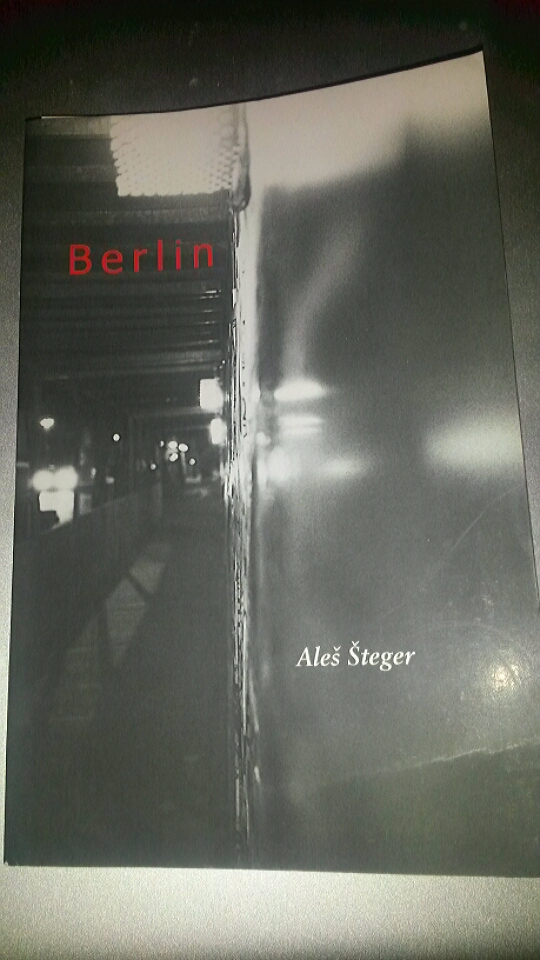
Twenty-first century flâneur in the German capital: Berlin by Aleš Šteger

‘Berlin separated me from my body. I searched for it as for a torn-off calendar page while scenes, streets, faces slowly migrated into me. Time doesn’t exist outside these streets, scenes and faces. Only in their lavish self-obliteration in space do hours acquire some meaning.’

Yesterday I spent a year in Berlin. I didn’t mean for the year to pass so swiftly, I intended, as has been suggested, to linger a little, take time to reflect, to let the sense of place sink in. But I could not refrain from inhaling the city in one fevered sitting. I walked, for a few hours, in the company of Aleš Šteger, a modern day flâneur, shadowing Walter Benjamin, through the German capital, experiencing it with an outsider’s eye and a poet’s soul – at once filtered and enhanced – emerging at the end, altered as only one can be, from the chance not just to visit but to inhabit a foreign space for a period of time.

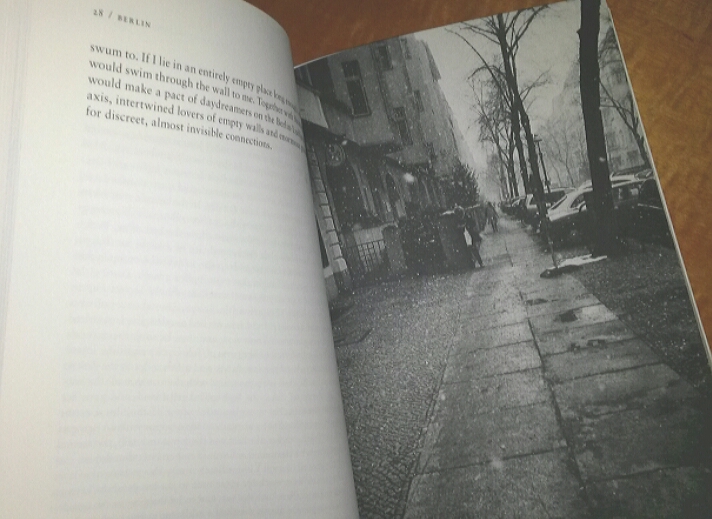
2016-04-16 18.26.37Berlin is a collection of short stories, very short in fact, that emerged from a year that the Slovenian writer spent in the city. Illustrated with Šteger’s own black and white photographs, these stories, two to three page single-paragraph pieces, tread the blurred line between fiction and essay, prose and poetry, and contain some of the most arresting urban imagery I have ever encountered in such a tight and concise format. With themes that run from the extravagant, to the insightful, to the mundane; this collection holds fast to the spirit of the epigraph from the German poet Durs Grünbein that opens the book:

‘Essentially every city is merely an extension of your own room, you are never entirely homeless/ . . . /The ideal city, which I see in all cities, is nothing but the brain turned inside out.’

Thus it is a book explicitly about Berlin, but implicitly about every city. Native son Walter Benjamin is a clear and present inspiration, and Bertolt Brecht figures, but a range of literary ghosts from antiquity through to the present day, visit the city through Šteger’s imagination. Their voices slide through German, into Slovenian, and back, in the book at hand, into English. The play of language is critical, it marks the experience of the outsider who not only shifts meanings but translates currencies, cultures and habits as he or she dwells in a strange place. In “Crack Berlin”, a story whose title refers to the map-like system of cracks running across the ceiling of an apartment bedroom, the narrator rests in the poetic arms of Ingeborg Bachmann to sketch out his space in this, his temporary home:

‘Translating words, I carry them from German into Slovenian, break them, spin them, just like I spin the map of Berlin, it turns me, searches me, moves me from place to place. The words of someone who died the year when I was born. Words of despair in some city, which has the same name as the city in which I am now alone. Words of despair and loss, which could also be mine, which could be from everyone.’

Berlin is as much a book about a city as it is a book about the language of being. Placing oneself in a foreign place, be it for a week or a year, and finding in the resulting otherness an ability to be present to the moment away from the routine demands of family, responsibility and commitments that pile up around us in those places we come to think of as home, can be an opportunity to open up to the small details, the sounds, the angle of light, and, yes, the people we might otherwise overlook.

Šteger, whose poetry collection The Book of Things, won the Best Translated Book Award (BTBA) for poetry in 2011, is a sensitive observer of objects and emotions, and of the relation between the two. Items that he (or his narrators, though the two seem indistinguishable) covet beckon with the allure of a lover – he looks, he resists, he panics and purchases the moment it appears that his beloved might have another serious suitor. The anxiety that wells up when it appears that he has tarried too long is captured deliciously in “Flea Markets”: ‘I looked at the spot where the object of my desire had stood before and didn’t see it. I dawdled and glanced around me like an abandoned bride, melted butter, a cracked bell. And finally I spied a pair of its elegant legs jutting from beneath a pile of old records.’ His pride is beyond him when he rides the subway home seated on his precious purchase, an antique chair/chamber pot.

For those seeking stories with more conventional style and narrative arc, this collection may bemuse, even disappoint. However, the compulsive appeal of the pieces in Berlin, for this reader at least, is largely a function of form. The single paragraph first person narratives unfold with the rhythm and restless energy of incantations, whether Šteger’s alter ego is observing animals in the zoo, describing an infestation of ladybugs in his apartment, or speculating about the potential, in a city of museums, for the creation of a museum of museum guards. His Berlin is a city marked by the wounds of war, bearing the scars and the monuments of its divided history. As a visitor from a land more recently ravaged by war, Šteger is acutely sensitive to this element, but he resists dwelling there. His Berlin is more importantly a city of infinite detail, a play of light and shadows, an intersection of bakeries and kebab sellers, a point bound by countless threads to the rest of Europe and beyond – a central hub, a beating heart.

2016-04-17 20.51.08This is a slim volume. It can easily be read in one sitting. I found it impossible to tear myself away and reread several pieces along the way, simply to immerse myself in the flow of words, to marvel at the imagery. I read much of it aloud. It would, on the other hand, be suitable for a slower, contemplative read. Steger’s grainy black and white photographs capture the ordinary, the every day – the buildings, streets and, of course, things – that complement the view of the city that he, through his twenty-first century flâneur, experiences and brings to life. It is also worth noting that the thrity-one stories that comprise this book are translated by three translators, Brian Henry, and the team of Aljaž Kovać and Forrest Gander. Although an index at the end lists the stories and the translators, it is not evident in the reading a shift from one translator (or pair) to another.
This book is, deservedly, one of the longlisted nominees for the 2016 BTBA for fiction, standing, if nothing else, as an indication of the rich diversity of that list. This is a special and unique collection.

I would be remiss though, to end this review without offering a taste of “About Temples”, one the most unabashedly romantic entries in Berlin. It would be a cold booklovers heart that could not at least smile at this evocation of that most sacred of spaces granted the full force of Šteger’s playful fondness for religious metaphor:

‘After the tinkling of the front door, the entrant is delivered to the grace and disgrace of fallen literary demons smuggled back into heaven. He climbs humbly like some pilgrim, only two steps and he is already in the highest spheres. The air is pregnant with the smell of myrtle, bookbinding glue and dust, and before he realizes it, a shadow of an angel’s wing of one of the classics printed in small letters has stroked him. Whoever enters must leave his reading, his literary snobbery, yes, even the power of credit, outside. Two spaces, two houses of prayer, from hell to heaven, nothing but books, books, books.’

Painting the world with words: Atlas of an Anxious Man by Christoph Ransmayr

“I saw a jet-black darkness tattooed with countless dots of light above me, an apparently boundless firmament stretching out to the deepest universe, while I lay on the bottom of a rowing boat that a Maori ferryman pushed through the night with the strokes of his oar.”

Layout 1Thus begins “In Space” one of the 70 episodes collected by Austrian writer Christoph Ransmayr in his unconventional and utterly captivating Atlas of an Anxious Man, newly released from Seagull Books in a translation by Simon Pare. Seemingly caught in a dreamscape somewhere between travelogue and memoir, he leads the reader on an unforgettable journey that stretches across the globe in a series of evocative vignettes. Such as the one quoted above which, we soon learn, is an account of a tour into a system of caves deep within mountains on New Zealand’s South Island. The night sky Ransmayr is lying beneath is an illusion created by the luminous larvae of a gnat species clinging to the cave ceiling. Insects that mistakenly fly up toward the false heavens are soon snared in a web of sticky silken threads and become nourishment for the growing larvae. Nestled securely within the bottom of the boat, the author goes on to recount a frightening experience from earlier that same day as he made his way through a high mountain pass to reach this site:

“After snow had begun to fall in large flakes just before the top of the pass, my rental car, not equipped for wintry conditions, began to slide backwards – backwards! – with churning wheels down an already snow swept rise towards the edge of the road and a rocky slope. The slope was so steep that my car seemed destined to somersault over and over down to a mountain stream far below, running black and silent towards the valley bottom.”

He is about to jump and let the car go on without him when it comes to a stop perilously close to the edge where passing trekkers find him and tow him to safety with their jeep. In four pages we are treated to both the wonders and the terrors of nature, narrated with the skill and confidence of a gifted storyteller.

Each episode begins with an observation: “I saw an open grave in the shade of a huge araucaria pine” or “I saw a fisherman cursing as he steered for Baltimore harbour in the south-west of Ireland” or “I saw a three-toed sloth on the veranda of blue wooden house on Costa Rica’s Pacific coast” or “I saw a naked man through binoculars from my cover behind dusty firethorn bushes.” Even a tale that seems to begin with a most ordinary descriptive passage becomes, before you know it, an engaging portrait of a place, an experience, a character. Ransmayr has an uncanny ability to focus his lens on the small details to bring a location, a time, an event to life.

The 70 entries follow neither chronological nor geographical order, and occasionally he even slips back in time to capture experiences from his own life in Austria, reaching as far as the age of three with the account of a storm that lifted the roof off his house when he was watching his mother hang wet laundry across the attic room. Whether he is observing a bird on a remote rock face, watching a man tee off at the North Pole, describing a bullfight in Spain, or trekking through the Himalayas; he is never a disinterested observer. His engagement with the people, creatures, and landscapes he encounters is always curious but respectful. In the waters of the Dominican Caribbean for example, he floats among the waves watching a humpback whale cow and her young sleeping far below. When the calf suddenly breaks free from its mother’s protective shadow and heads up for the surface, Ransmayr panics as the parent rushes up towards him in pursuit. She comes close enough that he can see the iris of her eye:

“The giant looked at me. No, she brushed me with her gaze and altered her course by a hair’s breadth, just enough that we didn’t touch each other. Yet although she avoided me with this hint of a deviation, and therefore recognized and acknowledged my existence, I discerned a complete indifference in her look – akin to the mountain’s toward someone climbing it, or the sky’s toward someone flying through it – that I was overcome by a feeling that I would dissolve into nothing before these eyes, disappear before them as though I had never lived. Maybe this Atlantic giant in black had actually swept up from its realm in the deep to convey to an Atlantic swimmer how rich and varied, unchanged and natural the world was without him.”

His travels typically take him to the far reaches, off the beaten track, to locations accessed on foot, or by bicycle, assorted boats, tour buses, rental vehicles and more. He explores history, lifts his telescope to the heavens, and encounters politically tense environments. No two entries are the same, few extend beyond 6 to 8 pages, some are only 2 or 3 pages long. I found it best to take my time with this book, reading a few entries a day and allowing the awe to linger. This is not an ordinary travelogue by any means, but it is a shimmering example of what makes the best travel writing sparkle. The theme, if there is one, that unites and drives the narrative from beginning to end is possibly simply wonder. Not that Ransmayr is blind to the poverty, suffering and threats he encounters. His immediate reactions are sometimes frustration, even fear, but he manages, remarkably to find a glimmer, an image, a thought that affirms life, no matter how small or seemingly insignificant.

However, what really makes this book such a joy to read is the sheer beauty of the language and the author’s ability to weave his experiences and observations into stories that are moving and original, time and again. I’ll leave you with end one of my favourites in which he tells of emerging from mangrove swamps in Sumatra to encounter, in a clearing, a building on stilts. On the patio a man is singing with a karaoke machine, but his only audience is composed of the geckos clinging to the roof. Ransmayr takes a seat and as he listens to the singer perform the Rolling Stones’ “Love in Vain” he is transported back to a snowy night in Austria, a wedding and corduroy suits. Suddenly a lightening strike from an approaching storm knocks the power out. Oddly, the singer fiddles with the controls, seemingly determined to try to turn the machine back on until a thin man in a sarong appears and calls to him:

“The singer laughed. And then the thin man was beside him, took him by the hand and led him carefully down the stage steps and between the empty chairs and tables to one of the walkways, and I realized that the singer, who was groping for obstacles with his free hand, could not have seen the lightening and could not have seen how the neon tubes and control lamps had gone out, nor how night had fallen so suddenly over the mangroves, swallowing up swarms of insects and a tin sky with hundreds of geckos stuck to it. Karaoke. A blind man had sung to me out of the mangroves of Sumatra back to the village of my birth.”

Thank you to Seagull Books for kindly sending me on this journey.