A little radiance: Farewell, Cowboy by Olja Savičević

“Everything’s the opposite of what it seems: hell is a comfort to the living, while heaven is ordinary blackmail.”

A deeply personal piece of unfinished business draws Dada, the spirited heroine of Farewell, Cowboy, from the towers of Zagreb, back to the grimy streets of her hometown on the shores of the Adriatic in this debut novel from Croatian poet and writer Olja Savičević. Once she arrives her first task is to relieve her older sister of the responsibility of keeping track of their mother who seems to be surviving on a routine of pharmaceuticals, soap operas and bi-weekly treks to the cemetery to visit the graves of her son and husband. But at the heart of Dada’s return to the Old Settlement is a need to lay to rest her questions surrounding the suicide of her beloved younger brother Daniel several years earlier.

2015-04-27 23.09.41Dada is feisty, in keeping with her fiery hair, an attribute she shared with Daniel and their late father who succumbed to at an early age to asbestos poisoning. An aficionado of the western film, spaghetti and American classics alike, her father spent his final years working at the local movie theatre and then, after the war, in a video store. He bequeathed to his son his love of western heroes and a jammed Colt pistol.

Upon her return to the Old Settlement, Dada settles in to her room under her brother’s fading movie posters, gets an old scooter running and cruises through town on her mission to piece together the past. She recalls the eccentric playmates with whom she roamed the streets and encounters a most beautiful young man who appears and reappears, usually playing a harmonica. Meanwhile it seems that a movie crew has moved in to shoot a film on a drab grassed expanse that will double as a prairie for a project spearheaded by no less than a legend of the bygone era of the spaghetti western.

The primary focus of Dada’s pursuit however, lies closer to home. The family’s neighbour, known to most as Herr Professor, a veterinarian who had befriended Daniel, has resurfaced. After a violent attack triggered by rumours about his sexual proclivities, he had disappeared. Months later, seemingly without warning, 18 year-old Daniel threw himself beneath a speeding express train. Now the old vet has returned. And Dada is certain he holds the key to her brother’s death; in fact she is bitterly obsessed with a desire to confront him, to confirm that he is the author of a cryptic typewritten letter that arrived a few weeks after the funeral, a letter that seemed to indicate that Daniel had been trying to contact the sender. Face to face over cake and barndy she cannot quite say what she wants. She grinds her teeth over his melancholy insistence that “I don’t ask anything of life other than a little radiance.” What on earth is that radiance he asks for, she wonders.

This postwar Balkan world is one of decaying architecture, graffiti scarred walls and woodworm rotted buildings. Tourists are moving in or passing through. Modern technology and old customs exist side by side. Dada is a most engaging heroine, her voice rings through the grime and dust of her environs with a cool crystalline clarity and youthful spirit. For example, after tracking down her former room-mate she recalls that her friend had considered herself the last emo-girl:

     “ ‘You’re certainly the oldest emo-girl, and probably the last’, I said.
I imagined her as a little old Gothic lady, but little old ladies, at least the ones here in the Settlement, are generally Gothic in any case, it’s in their dress code.
My room-mate and my Ma would get on well, I reflected. They could go to the graveyard together and shave their heads in keeping with the Weltschmerz.
I’m thinking as though she had settled in my head, I reflected, immediately after, anxiously. I really am my sister’s sister.
Sar-cas-ti-cal-ly, I reflected, in syllables.”

Savačević continually surprises with the originality and energy of her prose, translated skillfully by Celia Hawkesworth. Images are revisited, lines repeated, like refrains, throughout the novel, creating a very dynamic and original flow. Tragedy lurks in these pages, but what could be a dismal heartbreaking tale is lifted with humour and thoughtful asides. And that is the sense that lingers.

Farewell, Cowboy is another terrific offering from Istros Books, one of the wonderful independent publishers that can be harder, but not impossible, to source on this side of the Atlantic. And well worth the effort.

Coming of age in the 60’s: The Children’s Day by Michiel Heyns

Small town South Africa. The 1960’s. Rules govern social engagement. Black and white, Afrikaner and English, richer and poorer. Even in the smallest of towns a hierarchy of social stratification evolves and is reinforced with a blend of gossip and charity. And then there are those most ineffable mysteries of life: love, sex and death.

childrensSuch is the context of The Children’s Day by Michiel Heyns. At the heart of this Bildungsroman is Simon, a sensitive, intelligent boy charting his way through the machinations of childhood in the dusty environs of Verkeerdespruit. He is keenly aware that he is living in the heart of nowhere. But the books that are such a vital companion to this only child cannot even begin to answer the questions that his interactions with classmates and the curious behaviour of the adults around him continually raise. Simon is left with the impression that he is trying to put together a jigsaw puzzle without all the pieces.

The novel opens in the modest, relatively speaking, metropolis of Bloemfontein, where Simon, now 15, is attending Wesley College, a “second-rate” Methodist private school. The occasion of a tennis match between the boys of Wesley College and a nearby technical high school on a stifling hot December day in 1968 unspools a series of flashbacks that reach six years into the past and gradually move forward. Simon’s reflections are triggered by the unexpected, unwelcome appearance of a former classmate on the visiting school’s team – the awkward, epilectic Afrikaner Fanie van den Bergh.

From the time he first arrives in Verkeerdespruit, Fanie is a curiousity. His fits alarm his classmates and teachers, while his inarticulate, easy-going nature sets Simon off balance. He regards Fanie with a measure of contempt to which the latter appears oblivious. Yet  Fanie is a constant source of surprise. When Steve, in his tight jeans and white t-shirt, roars into town astride the magnificent Matchless G8 bringing a touch of heroic glamour to streets of the sleepy village, attracting the adoration of the boys,and the fluttering of female hearts, it is Fanie who disappears on the back of his bike. The fallout resulting from Steve’s arrival marks the advent of Simon’s awareness that the world is full of joys and dangers that the adults around him allude to with the most cryptic references. Frustratingly alert to the innuendos around him, Simon is delightfully naive as only a child of the pre-internet era can be. I remember it well myself. As Simon admits:

“Though I was probably quicker than my contemporaries at fitting together apparently unrelated observations, I was hampered in my deductions by an almost complete ignorance of sexual matters. I had arrived, for instance, at the conclusion that kissing was both a much sought-after pleasure for oneself and a much-ridiculed weakness in others, and that adults were too old for it and children too young.”

By observing the parade of adults that passes through his home town, Simon’s glimpses of the outside world become broader, if not necessarily clearer. A teacher who takes harsh discipline in the classroom a step too far is sent away, a pretty young girl he assumes is a special friend abandons him for the school jock, a woman with a shocking past appears and breaks the heart of one of his favourite teachers. And then there is Trevor with his dyed hair and pink shirts who shocks everyone by shaking up the life of the stuttering shy bachelor postmaster and his mother, briefly redesigning the beehived heads of the local women before being run out of town once speculations about the true nature of his friendship with the postmaster spread. Again Simon is perplexed, though it is Trevor who first implies that he sees in the boy a likely kindred spirit. The only outlet he has for the really “big” questions that trouble him are his Saturday afternoons at the local soda fountain with Betty “The Exchange”. The cynical, unfortunately chinless, telephone operator entertains Simon’s queries but confuses him as much as she informs him – children, after all, are only allowed so much enlightenment in this era.

It is Fanie who, in the end, stands to call attention to the missing puzzle piece that Simon has been holding in his hand all along.

I have an affection for strong coming of age/coming out stories. This is one. Sexually Simon is a slow learner, a boy who is less in touch with his body than the more viscerally grounded if intellectually dimmer Fanie. He over thinks the world even though he encounters more than one adult male who recognizes in him an inclination that he has, at an early age, no context for. Today with the ubiquity of queer conversation, imagery, access to internet, resources and young adult novels that explore queer themes, it may be hard to imagine how isolated a child could be growing up in earlier decades. Some claim this is an argument for censorship or against realistic sex education in the school system. But that is a spurious argument. One could still grow up LGBT in a vacuum. Or worse in denial. Many of us did.

I grew up in the 1960’s and 70’s in conservative rural Alberta. My parents, like Simon’s were liberal, but, like my peers, there were so many facts of life we did not understand and would not have dared to ask. Especially if there was any inclination that our own sense of self was off the norm. Long before one could retreat to the wisdom of Wikipedia, our resources were limited. I will never forget when the word “faggot” started to appear on our radar, probably as 10 or 11 year-olds. We would scurry to our dictionaries to find only “A bundle of sticks or an unpleasant woman”. Somehow we knew that couldn’t be right!

With The Children’s Day Heyns captures all of the curious confusion of growing up smart, bookish and not quite fitting in. And he does so with a warm, understated humour. Through his perceptive, yet naive, narrator the wonder and mystification, shame and humiliation of adolescence are evoked with remarkable resonance. Like many coming of age tales this was also a debut novel. But first published in 2002 when the author was in his late 50s, this novel also marked the debut of second career as a writer and translator – one that is still going strong – an inspiration to the rest of us in mid-life with writerly aspirations.

In praise of small publishers

In honour of World Book Day, I thought I would take a few moments to reflect on my growing obsession for small publishers. Once you start to turn your attention to non-mainstream literature, follow literary journals and publications online, or seek out works in translation; the world of independent publishers invariably opens up. As readers we live in a global world, and we engage in discussions with fellow readers spread far and wide, so it seems natural that you will hear about intriguing works that are not available wherever you happen to live. Sometimes, it’s simply a matter of time but years can separate releases in North America from those in the UK and Australia. Here in Canada we sometimes end up in between the two. Some small publishers do not yet have distribution on one side of the planet or the other, some may never manage it, but I would argue it is still worth trying to support independent publishers no matter where they are, whenever possible.

Why? Small publishers uncover challenging, interesting works, take chances, bring long ignored literature back into circulation, or into translation. Or both.

2015-04-23 13.08.58My two favourite books last year introduced me to two small publishers: CB Editions with Will Eaves’ The Absent Therapist and Istros Books with Selvedin Avdić’s Seven Terrors. Sadly both are publishers without North American distribution. That does not mean, of course that their books can’t be sourced, but the magic of a browsing reader happening to stumble across one of their titles on a bookstore shelf is lost. The joy of random discovery is denied.

After paying extra attention to the IFFP and BTBA longlists this year, I will now be watching out for titles from Pushkin, Open Letter, Deep Vellum, Archipelago among many others. Becoming more engaged as a book blogger and negotiating twitter has caused me to be distracted by some irresistible “shiny objects” – treasures like the stunning A Gothic Soul which arrived earlier this week, in a package covered in Czechoslovakian stamps, direct from Twisted Spoon Press. Oh yes, I could have downloaded it from Amazon for almost a third of what I paid but that would have been a pale substitute for what is truly a work of art and devotion from a small not-for-profit press.

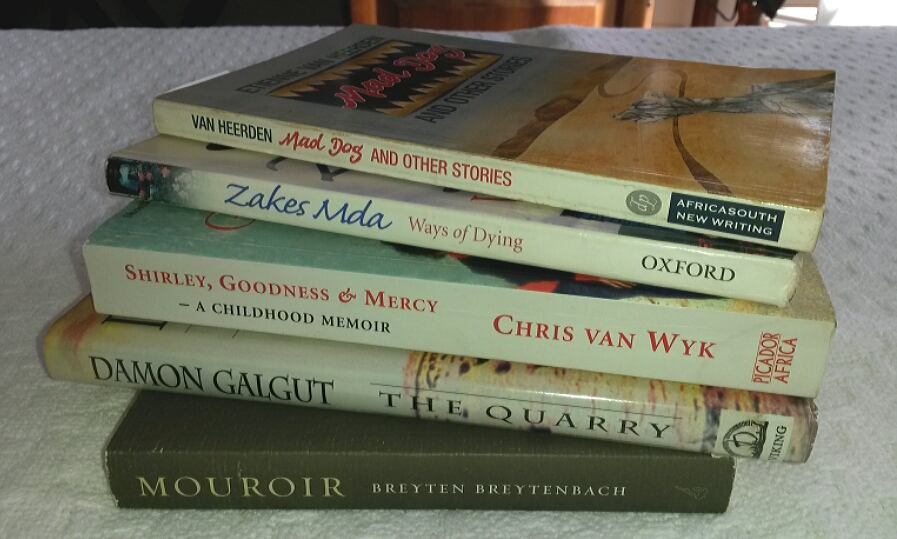
2015-04-23 13.10.55And then there is And Other Stories. I don’t know how I was so late to the party but it was the release of The Alphabet of Birds by SJ Naudé in January that put them on my radar. Dovetailing nicely with my interest in South African literature, their publication of this brilliant debut of stories translated from Afrikaans as well as their ongoing release of works by Ivan Vladislavić was an obvious draw. But as soon as I learned about their grassroots funding of initial releases with subscription support and their engagement of readers in the process of exploring potential writers from around the world… well, I was sold. I subscribed right away. My only regret is that temporary financial uncertainty led me to opt for a 4-book rather than a 6-book subscription. A number of other publishers utilize subscriber support models so I hope in the future to extend my support further and wider.

Today my biggest thrill comes from walking into one of our local indie bookstores and finding a gem on the shelves. Of course I still end up placing special orders, through the same stores or from overseas. And, when there seems to be no option I order e-books but my preference for paper copies has grown after an initial blush of affection for the digital. I am even the sort of person who, having truly fallen in love with a book read electronically or borrowed from the library, just has to own a hard copy.

There must be diagnosis for this illness. But I don’t want to be cured.

Do you see ruins? Pushkin Hills by Sergei Dovlatov

“ ‘Pushkin too had debts and an uneasy relationship with the government. Plus the trouble with his wife, not to mention his difficult temperament…
‘And so what? They opened a museum. Hired tour guides – forty of them. And each one loves Pushkin madly…’”

As Pushkin Hills opens, Boris Alikhanov is on his way to what he hopes will be a chance to pull the unravelling threads of his life together. He intends to secure a summer job as a tour guide at the Pushkin Preserve, a rambling estate dedicated to honouring and celebrating the life and memory of the famous Romantic Russian poet. He himself is writer whose literary ambitions have remained unrealized while his journalistic endeavours have raised a few official eyebrows. His marriage is in shambles, his refuge is the bottle.

As familiar as the tale may be, it is evident from the earliest pages that we are in the company of a narrator who is out to chart his own decline with a dry sardonic wit that manages to be, in turn, political, philosophical, and laugh out loud funny. Accepted on a trial basis by the collection of Pushkin fanatics in charge at the tourist centre – most of whom seem to be rather desperate middle aged women – Boris settles into ramshackle accommodations in a nearby village with a landlord even more decrepit than his abode. He then sets out to learn the tour guide’s script and routine.

PushkinHis stint at Pushkin Hills begins well. He masters the art of herding groups of tourists around the estate, riffing on the script when required and suffering the most foolish inquiries with surprising equanimity. Until his wife arrives. She is determined to move to America with their daughter, eager to follow the waves of immigrants leaving Russia, but Boris is bound by some attachment that he is not ready to cut. She asks him to join them or set them free, he begs her to stay. Yet once it becomes clear that she is committed, in fact even happy to be moving on with her life, he quickly begins to lose his precarious footing.

The end may seem almost inevitable. But the magic of this novel lies in author Sergei Dovlatov’s keen eye and ear for character and dialogue. Boris’ world, past and present comes alive in striking detail. At one point he reflects back on his courtship, such as it was, with his wife Tanya, noting the one time she called him. He arrives, after a little liquid fortification, to find her cousin waiting to meet him:

“The lad looked strong.
A brick-brown face towered over a wall of shoulders. Its dome was crowned with a brittle and dusty patch of last year’s grass. The stucco arches of his ears were swallowed up by the semi-darkness. The bastion of his wide solid forehead was missing embrasures. The gaping lips gloomed like a ravine. The flickering small swamps of his eyes, veiled by an icy cloud, questioned. The bottomless, cavernous mouth nurtured a threat.”

The purpose of this encounter is soon revealed:

“‘Why haven’t you married her, you son of a bitch? What are you waiting for, scumbag?’
‘If this is my conscience, ‘ a thought flashed through my mind, ‘then it is rather unattractive.’
I began to lose my sense of reality. The contours of the world blurred hopelessly. The cousin-structure reached for the wine with interest.”

Boris, for all his shortcomings is a deeply human and likeable protagonist. Even for a reader who lacks the depth of background in Russian literary and political history to pick up on all the allusions and often intentional misquotes in the text, Pushkin Hills is an intelligent, entertaining read. (An unobtrusive series of footnotes add basic background where relevant.) Originally published in Russian in1983, this translation by the author’s daughter, Katherine Dovlatov, brings to life a novel that manages to feel fresh and vital more than 30 years later and 15 years after the author’s death. As the translator notes in her acknowledgements, being able to work with her father’s rich material has allowed to her to continue a precious dialogue. A special gift indeed.

Pushkin Hills has been longlisted for the 2015 Best Translated Book Award (BTBA).

In the window of a passing train: Faces In the Crowd by Valeria Luiselli

“All novels lack something or someone. In this novel there’s no one. No one except a ghost that I used to see sometimes in the subway.”

Faces in the Crowd, the debut novel from the young Mexican novelist Valeria Luiselli, is indeed a book of ghosts. The narrator is a young wife and mother living in Mexico City. As she tries to carve out time and space to write a novel, she draws the reader into a reflective exploration of ghosts – the ghosts that haunt her present house, the ghost of a life she fell into living and working in New York City, and the ghost of Gilberto Owen, an obscure Latin American poet who lived in Harlem in the late 1920s.

And for a book of ghosts it is brilliantly, shockingly alive.

crowdThe novel opens with a deceptively simple narrative feel. Contemporary domestic life is played out against her reflections on her past life in New York City when she was younger, unencumbered and working as a translator for a small independent publisher. She catalogues the friends and lovers that drifted through her spare apartment. One day she happens to encounter the work of Gilberto Owen on a search for potential material for translation, but before long her professional interest turns into an obsession. She tries to pass off her translations of his work as translations by a better known poet, an attempt that comes dangerously close to succeeding. She rescues a dead plant from the roof of the building he once lived in. She imagines that she sees him in the subway – more than once. Finally it is clear to her that she must leave:

“In the subway, on my way home, I saw Owen for the last time. I believe he waved to me. But by then it did not matter, I’d lost my enthusiasm. Something had broken. the ghost, it was obvious, was me.”

For all the empty space in her earlier life, married life is clearly suffocating our narrator. She continually finds herself unable to breathe, struggling to focus on her writing in a large house, cluttered with toys, distracted by the demands of her children – simply referred to as “the boy” and “the baby” – and the jealous curiosity of her architect husband. As the fictionalized first person account of Owen’s life begins to assume a greater prominence within the story, her marriage starts to unravel (or perhaps she simply writes her husband into the background) while the overall narrative structure seems to disintegrate, boundaries blur. The novel within the novel becomes enmeshed with her day-to-day life, folding back on and re-envisioning the experiences recounted from her earlier life in New York. Or was that Owen’s life?

Echoing the continually reshaped game of hide and seek between mother and son running throughout this novel, Faces in the Crowd lays out a metafictional game of hide and seek. Can a horizontal novel be told vertically? How is such a story to be read? Where in translation does truth lie? And when can you play with truth? It winds up to a delightfully oblique ending. Or lack of ending – rather, an invitation to imagine, to reread.

I opened this book completely unprepared for the heart-stopping luminosity of the prose or the way that the narrative is fragmented and rebuilt to create a rich meditation on the nature of story telling. Valeria Luiselli demonstrates a maturity and confidence that belies her age without ever falling into a heavily somber tone. The translation by Christina MacSweeney maintains the lively, poetic flow of this impressive debut. I was pleasantly surprised by this intelligent and enjoyable read.

Faces in the Crowd has been longlisted for the 2015 Best Translated Book Award (BTBA).

Faces in the Crowd by Valeria Luiselli, translated by Christina MacSweeney                Coffee House Press, 2014

Some reflections on my first experience with (shadow) jury duty

The official shortlist for the Independent Foreign Fiction Prize was announced within the last 24 hours or so. A few hours before that, the shadow jury that I am part of revealed its selection of its six book shortlist. How do they match up? Only on two points. With The End of Days by Jenny Erpenbeck (translated by Susan Bernofsky) and Haruki Murakami’s Colorless Tsukuru Tazaki and His Years of Pilgimage (translated by Philip Gabriel). Personally I am pleased with the first title but would not have chosen the latter for either list. But that is the way it goes. The experience of reading alongside 10 other bloggers has been challenging, exciting and a terrific insight into the joys and frustrations of shadow jury dury. That includes: finding terrific new books, dragging oneself through books that – without obligation – would have been abandoned at page 30, and watching some books you want to champion proceed while others fall by the wayside.

iffpAnd we are not done yet. A winner, the shadow version and the real one, will be announced on May 27. We will see if we agree. The longlists are as follows:

The Shadow IFFP Longlist (with links to my reviews):
Boodlines
Marcello Fois (tr. Silvester Mazarella)

Colorless Tsukuru Tazaki and His Years of Pilgrimage
Haruki Murakami (tr. Philip Gabriel)

The Dead Lake
Hamid Ismailov (tr. Andrew Bromfield)

The End of Days
Jenny Erpenbeck (tr. Susan Bernofsky)

The Ravens
Tomas Bannerhed (tr. Sarah Death)

Zone
Mathias Énard (tr. Charlotte Mandell)
Added by jury members who feel it was an oversight
(I have yet to complete and review)

The official list, in addition to the Murakami and the Erpenbeck titles, includes the following:

By Night the Mountain Burns
Juan Tomás Ávila Laurel (tr. Jethro Soutar)

F: A Novel
Daniel Kehlmann (tr. Carol Brown Janeway)

In the Beginning was the Sea
Tomas Gonzalez (tr. Frank Wynne)

While the Gods Were Sleeping
Erwin Mortier (tr. Paul Vincent)

I believe that our shadow jury has presented a solid shortlist, but I must confess that my favourite overall title, While the Gods Were Sleeping, did not fare well on the shadow poll so I am secretly happy to see it receive the attention of the official shortlisting. Likewise I am delighted to see And Other Stories, one of my favourite independent publishers, make the cut with their first ever longlisted title.

So what have I learned so far?

– There is a great community of online book bloggers and I have “met” so many avid  readers of translated fiction (and other literature too)
– The jury process is one of compromise and strongly divergent opinions between readers based on taste and inclination
– I have never read so many books in such a short time – I can do it – but it is a relief to have the pressure off a bit (I do not envy the Booker judges their task!)
– Twitter can suck up hours of your life, but again, is a great way to engage with readers around the world (and with authors and publishers too which is very cool)
– My TBR pile continues to grow astronomically the more that I blog about books and encounter fellow readers and amazing indie publishers

Portents of death: The Ravens by Tomas Bannerhed

“The brook here in the forest – where did it begin —
Don’t think like that!
Not about beginnings and endings, but just about what is.
Throw in a stone and make time stop.”

The passage of time, the flow of seasons, the repetitive routine of life on the farm – these are the currents that course through The Ravens, the English-language debut from Swedish author Tomas Bannerhed. The landscape is rugged and raw. The land, reclaimed from peat bogs, is stingy and unforgiving. The weather is harsh and unpredictable. It can break a man’s back and, if he is not careful, it can drive him mad.

ravensThe events of this dark rural novel unfold over the span of one year from spring to spring. Our narrator, Klas, is a sensitive and intelligent 12 year-old boy with a passion for birds. His ear is finally tuned to the songs and calls of the species that nest in the trees and marshlands near his home, he knows their habits and is on the lookout for the chance visitors who may happen to appear outside their normal range. Birds are not only an obsession but a refuge and distraction from the pressures at home.

Klas has a troubled relationship with his father who, as the year progresses, is clearly losing his grip on reality. Ange is haunted by the cries of ravens that only he can hear. He constantly worries away at a huge pile of scrap metal and bemoans the endless work that weighs down on him on the farm. The more he complains and beseeches the Lord for the trials he suffers, the more he drives his older son to the marshes. Klas’ mother exercises a weary stoicism, continually working to pull her family together, while his younger brother spends much of his time retreating to increasingly juvenile behaviour. Hanging over the family is the legacy of mental illness. Klas’ grandfather committed suicide, his father is becoming more unpredictable and eccentric, and, in his heart, Klas is terrified that he too will inherit both the farm and the madness.

The summer sees a hint of respite for young Klas as the attentions of Veronika, an attractive girl from the city, set his hormones reeling. True to form he takes her on a late night birdwatching outing, but she disappears to the city soon after. Before long Ange overdoses on pills and is committed to a psychiatric hospital. As his father fades, Klas will be forced to question whether he will be able to carry the weight that will be placed on his shoulders. And as Klas appears to be pursued by voices and superstitions of his own, the reader has to wonder if he is not already haunted by demons. An eye he imagines above his bed disturbs his sleep, the voices keep driving him to the marsh’s edge.

“Stare down into a mirror.
No sign of life. Just my own blurred face and the tiniest ripples if you looked really carefully, like vibrations in the air from the silently whirring wings of the circling gnats. A pond skater came shooting across the water on its sewing-thread legs. Here and there, gas bubbles percolated gently to the surface and popped with a wet sigh.
Is that all?
No toothless Marsh Wife leering down there, no long arms and yellow nails like claws to draw you down into the black hole?”

There is much to love in this novel. The landscape comes alive. The language is achingly beautiful and spare, smoothly translated by Sarah Death. As someone who grew up in a rural environment in the 1970s, I found that the cassette tapes, aging hippies, and city fashions that Klas encounters when he visits Veronika brought back memories. The darkness that seeps through and builds as the story progresses is well managed. My only criticism would be that I felt it might benefit from being edited a little more tightly in the first half.

Independent Foreign Fiction Prize 2015: This is certainly one of the more ambitious of the long listed novels and I would be pleased to see it make the short list.

Border crossing ahead: Signs Preceding the End of the World by Yuri Herrera

“You don’t lift other people’s petticoats.
You don’t stop to wonder about other people’s business.
You don’t decide which messages to deliver and which to let rot.
You are the door, not the one who walks through it.”

signsA sinkhole opens up in the road in the opening passage of Yuri Herrera’s brilliantly inventive Signs Preceding the End of the World. Makina, a streetwise young Mexican woman charged by her mother with a mission to deliver a message to her brother who has disappeared across the border in the US, just narrowly misses being swept into its depth. Or does she? She is a wary customer, old beyond her years, capable of communicating in native, latin and anglo tongue – a skill that has secured the task of manning the central switchboard in her hometown and has equipped her, as well anyone might be, for the daunting task her mother has set out.

The rules outlined above are those that Makina holds close. Securing her safe passage will require making deals with a series of shady characters and her hardened discretion will be vital if she is to reach her destination. The language matches her pace. The short chapters, clipped sentences, and unique vocabulary hurry along, sweeping the reader with it as if time is of the essence and dare not be wasted. There is no time for for frivolities, Makina – and with her the reader – must be on the alert. This is a dangerous journey. It is one that many desperate people make every day. On the far side, the world to be navigated is both familiar and strange.

“The city was an edgy arrangement of cement particles and yellow paint. Signs prohibiting things thronged the streets, leading citizens to see themselves as ever protected, safe, friendly, innocent, proud, and intermittently bewildered, blithe, and buoyant; salt of the only earth worth knowing.”

But for the illegal migrant, temporary or permanent, the risks are real. The rewards often elusive, the costs high.

This slim novel is filled with passages of vivid intensity. Dark, epic in scope if not in scale, a few hours with Herrera is akin to a journey with Dante or Lewis Carroll. Right through to the final breath taking passages, I would challenge a reader to not emerge gasping for air.

Another wonderful offering from And Other Stories, Signs Preceding the End of the World is a deeply rewarding way to spend a few hours. In the Translator’s Note at the end of the novel, Lisa Hillman describes the joys and challenges she faced in capturing the right tone and shaping the language to preserve the magic and power of the original text. The result is an absolutely compulsive read. Highly, highly recommended.

Now, after this brief respite, back to reading the International Foreign Fiction Prize long list with my fellow bloggers on this year’s shadow jury.

The mind remains restless: While the Gods Were Sleeping by Erwin Mortier

“As you get older you no longer see people around you, only moving ruins. Again and again the dead find back doors or kitchen windows through which to slip inside and haunt younger flesh with their convulsions. People are draughty creatures. We have memories to tame the dead until they hang still in our neurons as foetuses strangled by the umbilical cord. I fold their fingers and close their eyes, and if they sometimes sit up under their sheets I know it’s enzymes or acids strumming their tendons. Their true resurrection lies elsewhere.”

Helena Demont, the aged narrator of While the Gods Were Sleeping by Dutch-language Belgian author Erwin Mortier, is a frail bodied but sharp-witted woman intent on employing the only weapon she has ever trusted, language, to rally her ghosts. Tended daily by her Moroccan carer, she fills notebook after notebook with her thoughts and reflections about the power and limitations of words, and the distortions and intensity of the memories that haunt us. She is, even at her advanced age, struggling to reconcile the fraught relationship with her mother whose voice still admonishes her in her quiet moments, come to terms with her envy of the freedom and detachment that her gay older brother Edgard seemed to enjoy, and sculpt into living memory the body and spirit of her long deceased beloved husband.

GodsAt the centre of this intensely powerful novel is Helena’s vivid account of her experiences in Flanders during the First World War. The breakout of war happens to coincide with the beginning of her bourgeois family’s annual summer pilgrimage from their home in Belgium across the border to her uncle’s farm in France. As a result, she and her mother end up confined to the farm for the years of the war, separated from her father who is unable to join them and her brother who volunteers and is sent off to the front. She sees much of the war from a distance, with a mixture of awe, adolescent romance, and horror but it will stand as the pivotal experience in her long, long life.

While the Gods Were Sleeping is a not a plot driven novel, highly descriptive language is employed to evoke a mood, to harness an experience, to pull the reader in to a vortex which, in the end, is as powerful as quicksand. Lengthy sentences unwind across the page:

“When I was allowed by my uncle, my mother’s older brother, to use the telescope, which stood up in the attic under a tarpaulin, I could see in those clouds of dust, in places where the roads came up to the same height as the fields, lances reflecting the sunlight, rifle barrels as fine as needles gleaming above a mass of figures marching over the cobbles, or the bustling horses’ hooves of the cavalry, and that dust they dragged behind them like a threadbare veil.”

Some may find the long, reflective (dare I say Sebaldian) transgressions about writing, and the rejection of clear chronological storytelling disconcerting at the beginning, but Mortier employs language, as his narrator wishes she could, like a painter, building up layers, blending colours and textures to create a deeply human experience that pulls together clearly and beautifully in the closing chapters. Paul Vincent’s translation captures the poetic beauty of the language and manages to navigate the contrast between the wartime dialogue as remembered and the narrator’s very contemporary tone when she is reflecting on the nature of writing or complaining about the regrets and annoyances of her life in the present day.

In the end, this novel is a meditation on the way that we remember; how memories are evoked, stored, treasured, and released. In a particularly powerful passage, Helena is following her British photojournalist husband across a bleak ice covered Flemish landscape and decides to take a photograph of him, from behind, simply for her own keeping. When the film is later developed in their makeshift darkroom, corpses are revealed trapped just below the surface of the ice. An horrific image of the aftermath of war for certain, but also a striking metaphor for the way that memories resurface as we look back over time, how ghosts we thought long put to rest can continue to rise up and haunt us.

International Foreign Fiction Prize 2015: Several of the novels in this year’s long list visit the First World War. This is another equally impressive yet unique approach. I would be happy to see this novel on the short list and I know that I will be seeking out Mortier’s earlier work.

The law of being average F: A Novel by Daniel Kehlmann

“How can anyone live with the fact that they’re not Rubens? How does anyone come to terms with it? To begin with, everyone thinks they’re the exception to everything. But hardly anyone is an exception.”

This rhetorical question, posed by Martin to his half brother Ivan, is indicative of the truth that lies at the heart of F, the latest novel by German/Austrian author Daniel Kehlmann. Learning to live with mediocrity is something all of the Friedland boys struggle with. Martin has found everything he requires in the priesthood – everything, that is, but faith. The Rubik’s Cube, that multi-coloured plastic puzzle that was all the rage in the 1980s, retains the soul of his devotion while God has remained absent. Ivan is a would be artist who doubts his own ability but will ultimately find artistic expression forging “masterpieces” in collaboration with an elderly lover who agrees to take the credit. His twin brother Eric channels his personal insecurity into a career in asset management, complete with trophy wife, daughter and mistresses, until his increased involvement in fraudulent financial transactions drive him to a state of paranoid psychosis.f_dhb

Faith, forgery, fraud. See a pattern? Don’t forget family. And, of course, father. As the book opens we see Arthur, a remarkably unambitious writer stagnating in his second marriage, as he takes his three young sons to see a performance by a hypnotist. Ivan and Arthur, both skeptics about the entire process, are invited to take turns on the stage. Their experiences that day could be said to set in motion the events that unwind and unspool as the boys grow up and try to find their footing as adults in the world. Or is there another, “F” word at play? Either way, Arthur disappears from the lives of his sons and their mothers on that very same day and none of them will hear from him for many years.

Confused yet? This is not a straight forward narrative by any means. It is told in parallel intersecting threads, a sweeping backward genealogy and a glimpse into the possible prospects of the next generation of the Friedland clan – prospects which rest rather heavily on the shoulders of Eric’s daughter Marie. At times insightful, sometimes funny and at other times drawing in elements of the gothic ghost story, F: A Novel endeavours to wind a tale too slippery to be tied down.

Ah but does it work? I was looking forward to this novel and, for pure entertainment I think it works quite well. The translation by Carol Brown Janeway is clean and precise. However, I am not convinced that it holds up to the critical reading expected of a potential prize winner. I found the characters too one dimensional and the coincidences just a little too neat and convenient for my tastes.

International Foreign Fiction Prize 2015: There are four German authors on the IFFP longlist this year. Compared to the two I have read so far, I am less inclined to feel this one is shortlist quality, but of course, we shall see what the jury decides.