“Mad, it’s all mad” Winterberg’s Last Journey by Jaroslav Rudiš

‘The Battle of Königgrätz doesn’t just run through my heart, it also runs through my head, and through my brain, and through my lungs and liver and stomach, it’s part of my body and soul. Two of my ancestors lost their lives, dear Herr Kraus, one on the side of the Prussians, and the other on the side of the Austrians, Julius Ewald and Karl Strohbac, yes, yes, I can seek out either side, but in the end I’m laying with both of them in the grave, I don’t know if you can imagine that, I want to understand it, I want to finally understand everything in my life, you understand, dear Herr Kraus, that’s why we’re here now, in order to understand it, dear Herr Kraus, here at Königgrätz was where the entire tragedy began,’ rambled Winterberg, still looking out of the window.

Just a few pages into the madcap epic adventure Winterberg’s Last Journey it’s immediately clear that the erstwhile hero of the story, ninety-nine year old Wenzel Winterberg, is quite the character. He is not only possessed by history, obsessed with railways, and haunted by the memory of a long lost love, but he is determined to exhaust an unexpected death bed second wind with a wintery escapade guided by his precious bible, the Baedeker for Austria-Hungary from 1913—the final edition of the railway travel guide published five years before he was born. His reluctant companion is Jan Kraus, a palliative nurse hired as live-in caregiver to usher the old man on his final passage to the other side, who now finds himself struggling to keep up with his near-centenarian “patient” for Kraus is also carrying plenty of his own baggage on this Central European odyssey.

Czech writer, playwright and musician Jaroslav Rudiš is clearly having fun with this eccentric tragicomedy, but he is also exploring the complicated history of his homeland. As his first novel originally written in German, Winterberg’s Last Journey is centred around two men who have left what is now Czechia and settled in Berlin. Winterberg is an ethnic German, born in Reichenberg (now Liberec) in 1918, just as Czechoslovakia declared its independence from Austria-Hungary. This liberation allowed his father to open the first crematorium—or as Winterberg calls it Feuerhalle— in the newly formed country. Seemingly proud of the family business and his father’s extensive experience with a variety of unfortunate corpses, he did not want to follow in his footsteps. After the war he left for Berlin where he resumed the trade he’d first undertaken in Reichenberg, thus spending the rest of his working life as tram driver.

Kraus, by contrast, is an ethnic Czech who grew up in the southern area of the country during the Communist post-war era. He too was eager to leave as young man, but what he thought was his ticket out landed him in prison. After his release he trained as a nurse and joined some kind of informal network of caregivers who provide comfort, companionship and live-in support for those who are dying. Upon meeting Winterberg, he is certain the “crossing,” as he calls it, will be swift. The old man does not seem long for the world. But when Kraus happens to remark to the unconscious patient that he is from Vimpek, the town known in German as “Winterberg,” something starts to percolate and before long he is piloting a remarkable return from the nearly-dead. As Winterberg regains his strength and his faculties, he begins to hatch a plan to follow the trail of postcards left by his first great love—Lenka Morgenstern—when she was forced to flee as the tides were turning in the Sudentenland region prior to the Second World War. He is convinced that if he can make it to Sarajevo, the location of her final missive, he will find out what happened to her so many long years ago.

The strength of this unlikely voyage lies in the chemistry, if that’s the right word, between this Bohemian odd couple. Winterberg is subject to rambling and very loud readings from his precious Baedeker, much to the dismay of anyone in earshot including  his weary companion. For long stretches he carries on one-sided conversations, providing questions and commentary as needed (“I know what you’re going to say, Herr Kraus…”) leaving Kraus himself barely able to get a word in edgewise. He has stock phrases to which he constantly returns, like “the beautiful landscape of battlefields, cemeteries and ruins,”  the adage of an Englishman he once knew, and a seemingly endless repertoire of all the possible corpses that “are not a pretty sight, as my father would say.” He’s also subject to “historical fits,” extended passionate, agitated soliloquies that always end with a sudden collapse into sleep:

Cork pulled.

Air out.

Eyes closed.

Good night.

As narrator and reluctant participant, Kraus is the dramatic foil. He falls into spare, sometimes almost desperate,  reflections against the deluge of Winteberg’s ravings, and their dialogue, when they are able to find the space for it, is funny and tight. But he is, in his way, no less damaged than the self-described mad man in his care. He drinks too much, smokes too much, and is weighed down by secrets and a lost love of his own. In the end, each man is searching to understand something about himself and his life, and charting his own personal battles, those events large and small that threaten to derail us all. And along the way, through railway stations, museums, cemeteries, and a handful of countries, we learn a lot about the history of Central Europe and the network of rail lines that have bound it all together.

Winterberg’s Last Journey is an ambitious and wide-ranging outing—one that depends on strong characterizations, a balanced narrative energy, a careful distribution of the ongoing repeated expressions and internal jokes, and a few unexpected twists and turns to shift the flow of what could easily fall into a tired routine in less talented hands. And, as Kris Best tells us in her Introduction to this novel, her impressive first translation, Rudiš draws heavily on factual details to recreate the world Winterberg remembers from the 1920s and 30s, right down to the Fuerehalle in Reichenberg.  The result is a highly engaging adventure with both historical depth and comic breadth.

Winterberg’s Last Journey by Jaroslav Rudiš is translated from the German by Kris Best and published by Jantar Publishing. It is available now in the UK and worldwide from the publisher. It will be published in North America in September.

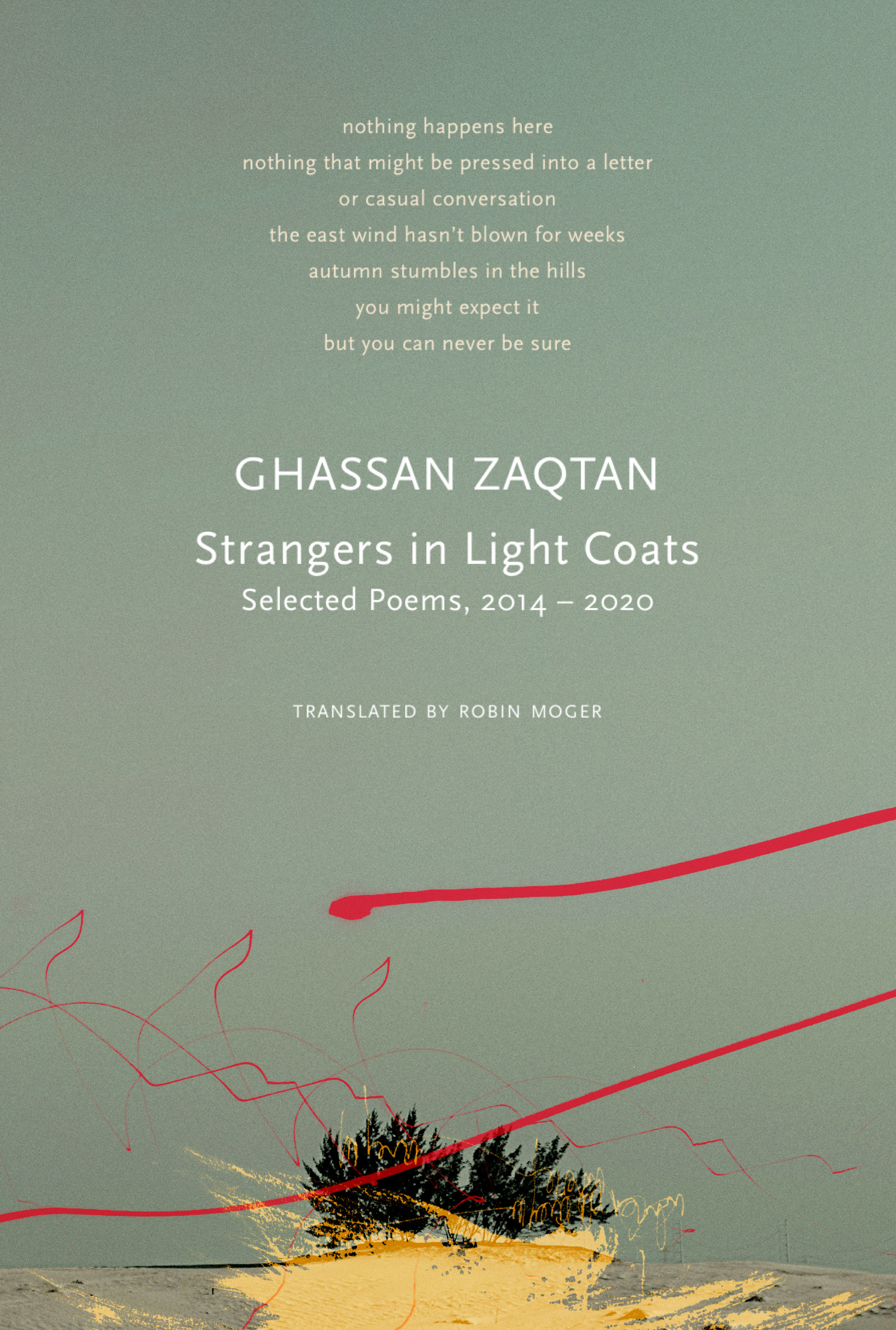
“There is something priming itself in these shadows” Strangers in Light Coats: Selected Poems, 2014 – 2020 by Ghassan Zaqtan

The wooden bell that hangs in the dark is struck.
Is struck.
No one sees it
but it is struck.
No one is there
and the bell is struck.

It is struck on the front porch of the dream and in its shadowed corridors.

There is something priming itself in these shadows.

There is someone waiting.

Natures that never made it past the line are being shaped in vain.

A blind creature walks on air and collides with butterflies.

(from “The wooden bell”)

The poetry of Ghassan Zaqtan elicits images that seem to emerge, take shape, shift, and evaporate on the page. As if deeply rooted in the soil, yet present only in passing, and in the memories they inspire.  His poems are home to rivers, birds, strangers, and ghosts of the dead. A chorus of voices rise and fall away. The Palestinian poet bears witness. To the spirit of his people, the beauty of his homeland, and the long history of displacement and conflict. But he does so with the same folkloric melancholy that characterizes his prose, the novellas that address political and personal loss through characters and settings that blur, to a greater or lesser extent, the boundary between fact and fable, myth and materiality.

Strangers in Light Coats, his latest collection to be published in English, gathers a selection of poems written between 2014 and 2020. Although drawn from work originally published in four volumes, Robin Moger’s sensitive translation presents the selected poems as a cohesive work divided into six sections. Together, they unfold against a backdrop of mountains and valleys, in a melancholic world shaped by memories, dreams, and the painful reality of occupation and war. His poems speak to lost lovers, reimagine a collective history that is fading, wonder about the fate of exiles, conjure up djinns, and call out to the forces of nature:

River, river,
soften your breeze
as the daughters wade the fords into the twin darknesses
of temptation and patience;
be still as the muezzin’s daughter crosses at the ford, be
as a carpet laid out for her by the birds
.  as she steps down, out of his voice,
    into the prayers and the dawn.

(from “The river hymn”)   (30)

War is an ever present motif, both as a remembered event, and as a possibility that is never far away. In the lull there is an abiding unease, the silence of waiting for something to happen or the inability to find silence at all, as in “It happened during the mountain war,” which tells of a man who is haunted by a memory that carries with it sounds, smells, and the sensation of the weight on his shoulders of “the body of a young man heavy with death”:

This happened in autumn,
during the mountain war that no one wants to remember,
the war in which many were killed
before it was covered over by other, more senseless wars,
the war which they, whenever they dug to bury it,
would find another war down there taking shape,
the war which was dropped from memories
like an eighth daughter who should have been a son.
In his solitude, even he would forget those weeks and push them aside.

This is a strangely beautiful and deeply unsettling collection. One that raises questions about what history and territoriality mean under occupation, in migration, in exile. Memory, imagined and reimagined through a mythic and elegiac landscape reaches for possible answers at a time when Palestine and the Palestinian people are facing ever increasing uncertainty.

Strangers in Light Coats: Selected Poems, 2014 – 2020 by Ghassan Zaqtan is translated from the Arabic by Robin Moger and published by Seagull Books.

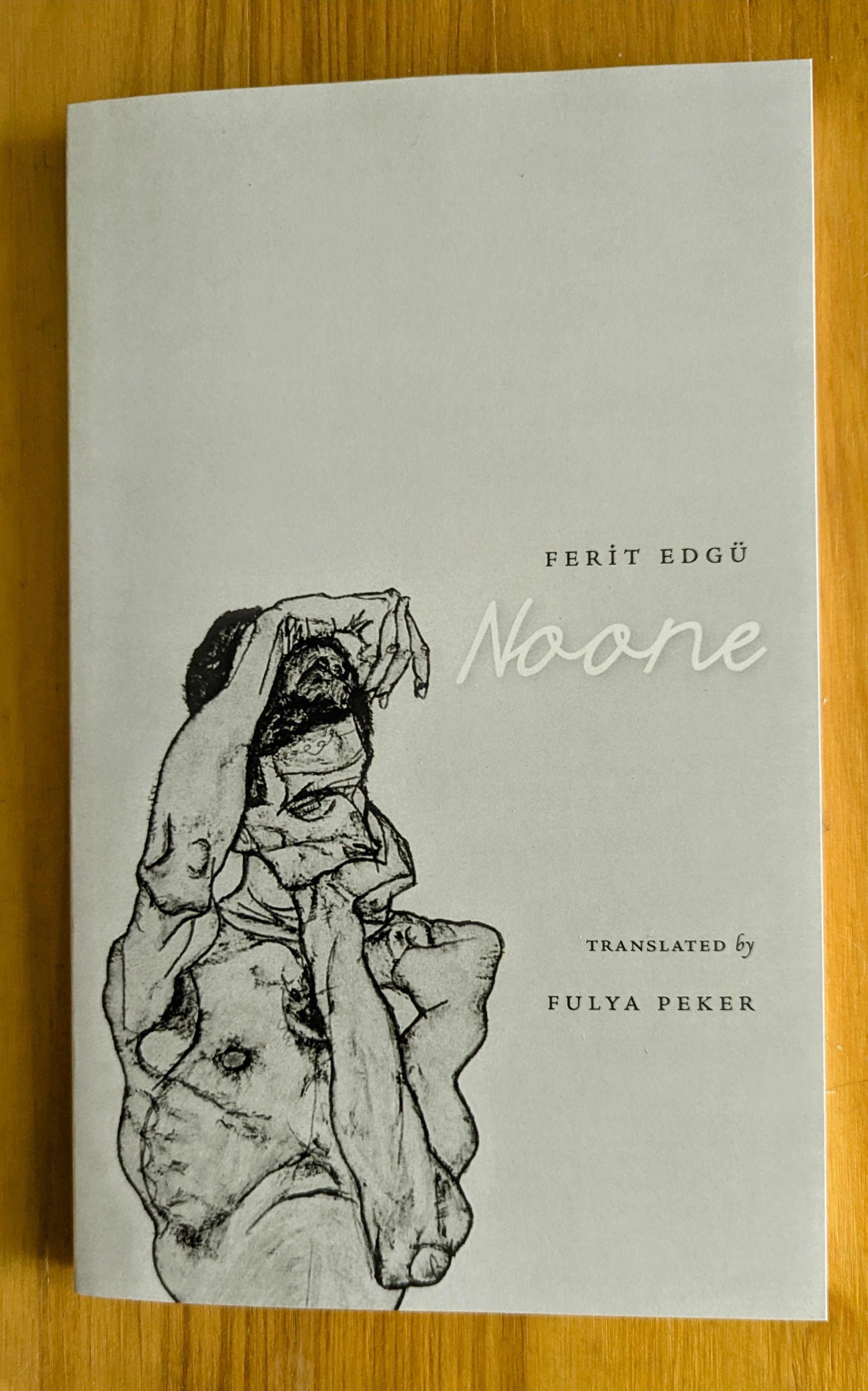
Our loneliness is always plural: Noone by Ferit Edgü

What do you want me to do? says the First Voice.
I want you to talk a little more, says the Second Voice.
Wasn’t it enough? says the First Voice.
Not yet, says the Second Voice.
What should I tell you? says the First Voice.
Anything. Everything, says the Second Voice.
So hard, says the First Voice.
I know, says the Second Voice. But it’s worth trying.
You mean to work our memory? says  the First Voice.
Yes, says the Second Voice. Our scabbed memory.
I don’t remoment anything, says the First Voice. I can’t remoment anything important. Things I remoment are all broken.

Noone, by Turkish writer Ferit Edgü, opens with a chorus of voices, each with an ascribed character or quality—the Initial Voice, the Alwaysasking, the Broken, the Ramshackled, and so on—setting the stage for the unconventional narrative that will follow. Part I finds us alone with two apparently distinct voices, the First and the Second. It is the depth of winter and the voices converse, debate and remoment—a most striking way of saying remember—as they sit together in a dark and cold dwelling somewhere in a remote mountainous region. Outside wolves and dogs howl. Snow falls without respite. And nearby there are others, village residents who, do not share the same language or culture. The Voices interact to pass the time, waiting for the long winter to end and the roads to open. But are they two disembodied voices, two distinct individuals, or one man trying to find company within himself?

This spare novella, which was composed over the span of ten years, from 1964 to 1974, is a response to what Edgü has referred to as the most transformative experience of his writing life—the nine months he spent, at the age of twenty-four, teaching in the village of Pirkanis in an isolated part of the province of Hakkâri in southeast Turkey. This region, his time there, and its more recent bloody history has influenced much of his writing, including the 2007 novella and 1995 short story collection published together, in Aron Aji’s English translation, as The Wounded Age and Eastern Tales by NYRB Classics. This volume was a runner-up for the 2024 ERBD Literature Prize which will hopefully bring attention to this earlier book. Work on what would become Noone was actually begun while Edgü was in Hakkâri, but the fact that it took him a decade to complete it implies that a certain amount of time and distance was required to articulate and make sense of what had been a profoundly disorienting experience, and, as he says at the outset: “transform a monologue into a dialogue.”

The abstracted doubled character that emerges and recedes during the first part of Noone—the “we”/ “I” / “you” of the First and Second Voices—often resembles a world weary soul, an exile who has travelled far and wide and now finds himself on this mountain top, uncertain how he got there. The Voices share stories, dreams, and memories, often provoking, confusing, or irritating one another. For, as translator Fulya Peker says in her lyrical introductory Note:  “Noone compels us to consider the politically imposed idea of ‘the other’ and how this ‘other’ is not somewhere outside, external to us, but within.” To this end, the use of the grammatically incorrect spelling for “no one” is telling. The translator does not explain this decision or its relation to the original Turkish title Kisme, but because the word appears to function as both a pronoun and a noun, it is an affecting choice. Along with “remoment” and an ongoing shifting tapestry of pronoun usage—you, we, I, he—Edgü is repurposing language, perspective, and narrative in a manner that reflects the shifting personal, psychological, social, and political territory within which his story unfolds.

The second part of the novella, while still featuring the two Voices, steps outside of the snowbound dwelling, at least initially, to offer an account of the protagonist’s arrival in Pirkanis, a village comprised of only thirteen houses and one hundred people, so isolated it is ultimately accessible only by horse or on foot. It is an impoverished community with strange traditions, an unfamiliar tongue, and at least one potentially suspicious resident. Life is hard, death is always near at hand, and loneliness takes on a whole new meaning for the outsider who has come to provide medical support. As loneliness begins to take its toll, the isolation is stark and haunting:

He takes a book Opens He quits without reading
He takes an envelope Opens He tears up the letter and throws it away before getting to the end
He opens the lid of the stove & throws the letter on top of the fading ashes
Again he returns to his mattress
Again his eyes are fixed to a spot on the wall
No
His lips are black and blue
Black and blue lips (only) tremble
His teeth are chattering
Dogs are again howling outside
A stranger is approaching
Or the wolves are coming down again

With no period no comma no question with no ending dead night goes on like this in fragments

An interlude like this, in which the dialogue of Voices is temporarily silenced, feels heavy, intense. Our exiled hero is naked. Stark, spare, and poetic, Noone offers an existential, dramatic portrayal of extreme isolation, not only that of the central character, but of the people he finds himself among.

Noone by Ferit Edgü  is translated from the Turkish by Fulya Peker and published by Contra Mundum Press.

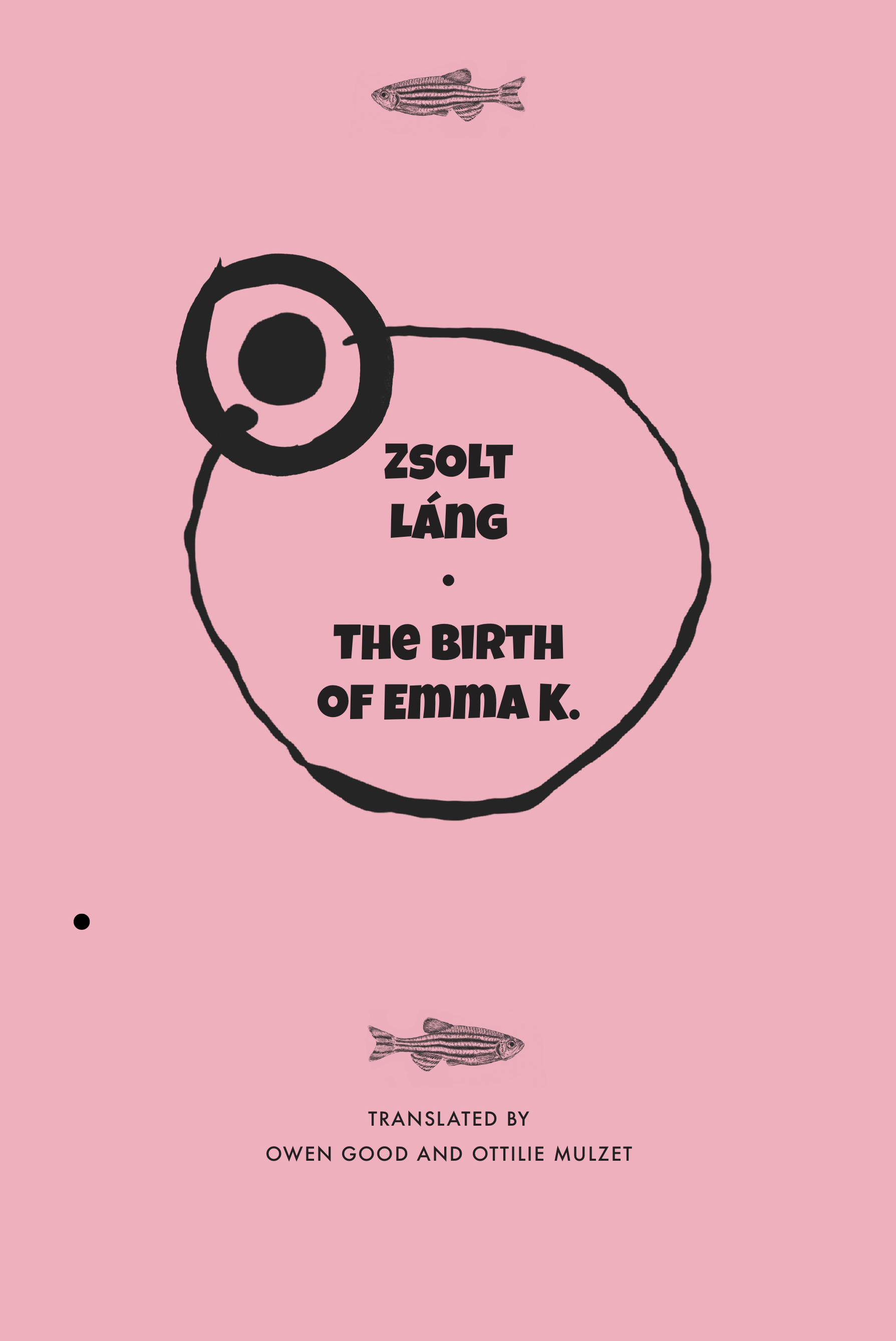
Exploring the uncomfortable corners of human existence: The Birth of Emma K. and Other Stories by Zsolt Láng

The fiction of Zsolt Láng inhabits a slippery space where time, genre, and realities shift and bend, where history shapes and distorts the landscape, and where characters are driven by conflicted passions and paranoias. Think of Flann O’Brien with a side order of Beckett, born and raised in Transylvania, charting his own course to become one of the premier postmodernist Hungarian language writers of our time and you have a hint of what you might find in Láng. And now, for the first time, we can sample that strange brew in English through the stories collected in The Birth of Emma K., translated by Owen Good and Ottilie Mulzet, but, be prepared, it is a delightfully odd journey during which one can lose one’s bearings from time to time.

The collection opens with “God on Gellért Hill,” set in Budapest, which finds “Our Lord” standing or floating above the city, intent on setting right the fragmenting relationship between two rather unattractive lovers. But to His dismay, God—and here the narrator reasons that we are witnessing neither the Father nor the Holy Spirit, but the Son—has been blessed with all kinds of powers, none of which are absolute. And, of course, under the often muddled efforts of their heavenly benefactor, the former lovers, Ida and Tamás, experience intensely swinging emotions that they are each at a loss to understand.

Our Lord followed them, as long as he’s here, he wants to see it through to the end. There’s still no guarantee he’ll intervene. Creation is like throwing a stone: There’s that ballistic arc from taking aim until reaching the target, and then there are the changes caused by gravity and wind; to intervene meant to retroactively meddle with time, at least that’s what a philosopher claimed with whom Our Lord didn’t agree (hence he never read the philosopher’s thoughts, though he could see into them). Our Lord is Our Lord because he sees things differently, his reasoning is different from man’s. But let’s not get mixed up in the difficulties of creation. (Good)

Determined as he is to try grant his subjects a happy ending they may not even want and are bound to undo, the burden of not-quite-absolute power weighs heavily on our heavenly hero, but in this clever opening piece there is a hint of the author’s own inability (or rather, wilful unwillingness) to exercise absolute control over his own characters—he’s happy to let them, and their stories, slip into strange territories, sometimes dark, sometimes light, and, more often than not, somewhere in between.

Láng , born in 1958, studied engineering at university in Cluj. Since 1990 he has lived in Marosvásárhely / Târgu Mureș, Romania, where he is an editor of the literary journal Látó. He has published close twenty volumes including short stories, novels, essays and plays. His work is deeply rooted in his Transylvanian homeland with its complex historical, multicultural, and multilinguistic  dynamics, but also reaches beyond to other European settings. His stories not only exhibit a broad range of characters and conundrums, they have a tendency to transform in style and form as they unfold. As translator Owen Good describes in an informative essay for Hungarian Literature Online:

Zsolt Láng’s is a nonconformist oeuvre. A story turns on a dime from a jovial satire to a poignant coming-of-age tale, from autofiction to metanovel to crime, leaving the reader forever playing catchup. Worlds blur and fantasy simmers to the surface.

If Láng is happy to allow his stories change without warning, he is also content to allow the reader to fumble their way into a tale for a while, or craft anachronistic realities in which, say, a preference for horse and buggy transportation exists alongside an internet café. Likewise, he does not feel inclined to bring all of his stories to a clear and defined conclusion, nor does he need sympathetic characters—some of his most unfortunate protagonists are driven by their own selfish or self-destructive motivations.

Consider “Like a Shaggy Ink-Cap Mushroom,” the tale of a depressed Inspector obsessed with death—his own. He sits at his desk surrounded by, but estranged from, the Beat Cops and the File Desk Girls, and feeling pressure from the powers above. He visits a gravestone with his own name on it, drinking in the sense of relief that comes with the thought of lying beneath it. And, when his former partner reaches out to him for personal assistance, a request that will begin to initiate a change in the Inspector’s sorry trajectory, his initial reaction is rather comically tragic:

He was surprised when his partner called. He didn’t recognize his voice. Hence, maybe, he was filled with the cool, soft promise of the hope for happiness. The tranquility of promise. A deep and hoarse voice. Slowly pronounced sounds. Containing an impossible amount of pain. He shuddered. Furthermore, the ring of the phone had electrified him. He jumped up and almost fell on the handset. The voice’s lumpy sadness. A fine, floury, lumpy sadness. Immediately he thought of Death. Death was calling. Or he was about to hear news of someone else’s death. He wouldn’t be surprised if it was his own. There could be no greater gift. Inspector, sir, I have to relay some really sad news. You’ve passed away, sir . . .  (Good)

In many stories Láng drills directly into his protagonists’ deep (and often dark) desires and fixations—two homeopathic doctors that each share a visceral hatred of the other, a lonely actress past her prime, or an inmate in an asylum conducting his own “research” and engaging the resident intern with his experimental theories. In others, like the longest piece, “The Cloister of Sanctuary” set in a monastery in Moldova, he works across wider canvas to craft an horrific folktale of mystery, manipulation, and cruelty. And then there is the final piece, the title story, which follows the metaphysical musings of an embryo, not exactly desired by her young would-be parents, from conception through a vigorous campaign to dislodge her from her watery accommodation, to her defiant arrival months later. It offers a fresh, insightful embryo-eyed perspective on the world she imagines versus the one she’s potentially heading towards.

With a touch of magic  and a measure of absurdity, the stories collected in The Birth of Emma K. offer an entertaining exploration of the virtues and foibles of human nature and an excellent introduction to another fine Hungarian language writer.

The Birth of Emma K. and Other Stories by Zsolt Láng is translated by Owen Good and Ottilie Mulzet and published by Seagull Books.

“I do not live in a place. I live in a time.” I Saw Ramallah by Mourid Barghouti

When his name is finally called after waiting for hours, he grabs his small bag and steps on to the Allenby Bridge to cross, for “the first time in thirty summers,” from Jordan to the West Bank:

Is this a political moment? Or an emotional one? Or social? A practical moment? A surreal one? A moment of the body? Or of the mind? The wood creaks. What has passed of life is shrouded in a mist that both hides and reveals. Why do I wish I could get rid of this bag? There is very little water under the bridge. Water without water. As though the water apologized for its presence on this boundary between two histories, two faiths, two tragedies. The scene is of rock. Chalk. Military. Desert. Painful as a toothache.

Palestinian poet Mourid Barghouti’s thoughts are flooded with questions as crosses into the land he has been barred from entering for three decades. The year is 1996. His account of his visit, one that necessarily looks back on his many years of exile and the changes to his homeland that confront him on his return, is vividly captured in his memoir I Saw Ramallah. First published in Arabic in 1997 (and three years later in Ahdaf Soueif’s English translation), this is a work that speaks passionately and unapologetically to the reality of existence of the Palestinian people today, of their displacement and their lives under the Occupation.

Barghouti does not enter the West Bank alone. He carries the weight of the memory of the long years of exile, of family and friends scattered near and far. And he’s haunted by the ghosts of all of those who are buried in distant lands, those who never managed to return, either as a visitor or as a resident, especially his older brother Mounif:

After how many more thirty years will the ones who never came back return? What does my return, or the return of any other individual mean? It is their return, the return of the millions, that is the true return. Our dead are still in the cemeteries of others. Our living are still clinging to foreign borders. On the bridge, that strange border unmatched on any of the world’s five continents, you are overwhelmed by your memories of standing at the borders of others.

As he takes in the altered landscape, the ever expanding Israeli settlements, and the once familiar hills, now alien, the connection and disconnection is profound. He stays with a family member, explores the city, and visits his birthplace, Deir Ghassanah, where he reads poetry to an assemblage of villagers unfamiliar with poetry readings but responding to his words and images nonetheless.

But, of course, thirty years does not vanish just in the act of returning. As much as Palestine and her people have changed and are continuing to be changed under the forces of Occupation, Barghouti’s life has been impacted by his identity no matter where he has lived. Nor is it his first return from exile, so to speak.  In the 1970s, his involvement in earlier student protests against Sadat in Cairo led to his forced separation from his wife and infant son when all non-Egyptian participants were deemed to be infiltrators and removed from the country. The prohibition lasted seventeen years, his family-time suddenly telescoped into winter and summer holiday breaks wherever he was living at the time. By the time he was able to return to live in Egypt, his child was long out of diapers and ready to start shaving! And when that exile within exile came to an end he realized:

You do not arrive unchanged at the moment of joy dreamt of for so long across the years. The years are on your shoulders. They do their slow work on you without ringing any bells for you.

Now, one of his primary goals during his time in Ramallah is to obtain the necessary permit to allow his son Tamim to finally see the land of his ancestors.

Moving, poetic, and beautifully written, this is, nonetheless, a narrative dotted with question marks. Barghouti regularly questions the descriptions, the emotions, and the meanings that he grasps at as he tries to articulate the strange in between state in which has found himself over and over throughout his life—in Occupied Palestine, Cairo, Budapest, Amman and elsewhere. So many places, so many pillows beneath his head:

My relationship with place is in truth a relationship with time. I move in patches of time, some I have lost and some I possess for a while and then I lose because I am without a place.  I try to regain a personal time that has passed. Nothing that is absent ever comes back complete. Nothing is recaptured as it was.

A memoir recounting the return to one’s homeland after thirty years, is necessarily a story of exile, of the Diaspora, and of the way the Occupation has closed in on the land and claimed the freedom of the Palestinian people. Focused as he is on the present moment, that of his precious time in Ramallah, Barghouti is also continually looking back—to the Nakba, to the 1967 War, to the Intifada. Yet to read this book in 2024, one cannot but look ahead through further wars to the escalating incursions into the Occupied West Bank, to the conflict in Gaza. To genocide. For a book first published twenty-seven years ago, it reads like it could have been written yesterday. Netanyahu was prime minister then, he is still prime minister now.

After the popular Intifada on the land of Palestine we went to Oslo. We are always adapting to the condition of the enemy. Since ’67 we have been adapting. And here is Benyamin Netanyahu, prime minister of Israel, calming America’s fears for the current agreement by saying that the Arabs will in the end adapt to his harshness because they always adapt to whatever they have to.

And what if they refuse to adapt? When speaking to the spirit and resilience of his people, Barghouti often calls attention to the Palestinian inclination to seek the comic in the tragic, but he is keenly aware that for the generation after his—those who grew up in the aftermath of the 1967 war—the tone has shifted, something he witnesses in the appeal of resistance movements: Fatah, Communism, the Front, and Hamas. This is the legacy of the Occupation itself.

I Saw Ramallah is not exactly a work infused with nostalgia. It is searching and existential in nature, a memoir tinged with sadness and a measure of grief. And as he nears the end of his account, he refuses to hold his anger at bay. He is blunt in his assessment of his people’s circumstances and the history that has been thrust upon them, as a man born four years before the Nakba who, now in his fifties, is determined to ensure his son’s right to a space in a land that now carries two conflicting and interconnected stories:

But I cannot accept any talk of two equal rights to the land, for I do not accept a divinity in the heights running political life on this earth. Despite all this, I was never particularly interested in the theoretical discussions around who has the right to Palestine, because we did not lose Palestine in a debate, we lost it to force. When we were Palestine, we were not afraid of the Jews. We did not hate them, we did not make an enemy of them. Europe of the Middle Ages hated them, but not us. Ferdinand and Isabella hated them, but not us. Hitler hated them, but not us. But when they took our entire space and exiled us from it they put both us and themselves outside the law of equality. They became an enemy, they became strong; we became displaced and weak. They took the space with the power of the sacred and with the sacredness of power, with the imagination, and with geography.

This is an important, affecting, and highly readable memoir for anyone who wishes to have a clearer understanding of the situation in the Middle East. But, if you have read other Palestinian literature, it may sound eerily familiar. These stories are not new; they have been expressed in literary works—poetry, fiction, nonfiction—for many decades now and, as we have seen, Palestinian voices continue to refuse to be silenced.

I Saw Ramallah by Mourid Barghouti  with a Foreword by Edward Said, is translated from the Arabic by Ahdaf Soueif  and published by Anchor Books. In the UK, a new edition is forthcoming from Daunt Books in August 2024.

That black night: Engagement by Çiler İlhan

Her hair was like her name. Dark as the night. Cloaking her to the waist. Bilal had been smitten by this hair while still a boy. This he told to Leyla many years later. When she reached the age of twenty, and continued to reject all her matches—including the son of an uncle a few weeks previously—her father Cemal had decided to give her in marriage to Tahsin, a relative from town, so she would not end up ‘stuck-at-home.’ The second he heard, Bilal jumped into his Renault and gulped down seventy kilometres of road quick as a pill. In this village, men know to stay away when the man of the house is gone.

Engagement by Çiler İlhan has all the qualities of a folktale. Set in a small Kurdish village in southeastern Turkey, known simply as “Our Village,” it unfolds over the course of sixteen hours. For one family it’s an auspicious day. The engagement of eldest daughter of Fatma and Cemal is to be celebrated that evening and the entire village is invited to join the festivities. But in the nearby “Other Village,” villainous plans are being made to upset the proceedings. And that’s putting it mildly.

These two villages—caught in a complicated nest of intermarriage, property disputes, and blood feuds—are at once timeless and yet very much part of the twenty-first century. Located in an area neglected by the state, life in these isolated, impoverished communities is simple. Traditional technologies and customs dominate the lives of most of the families, but there is also wealth in terms of land, mineral rights, and agricultural goods to be fought over and defended. Consequently, most of the men are required to participate in regular scheduled guard duty, a task for which they are heavily armed.

The playful, fable-like narrative, delivered by a mysterious omniscient narrator, carries an ominous tone. Reference is repeatedly made to the “incident” that lies just ahead. Complications are hinted at, assertions and accusations that will be made in its aftermath are alluded to, long before any description event itself. You know that something horrific and deadly is coming and that awareness fuels the growing tension. Meanwhile, at the home of Leyla, the bride-to-be, the women go about their preparations with excitement and dedication. Yet, there is a missing ingredient. Leyla’s younger sister Maral has forgotten to purchase the eau de cologne traditionally splashed on the hands of each guest as they arrive for the feast. Since she has other tasks to attend to that day, it falls to her cousin Halil  to secure the required scent.

On his way out to purchase the perfume, the young man is kicked when Chunky the cow is unexpectedly spooked. He hits the ground hard, causing a headache that will trouble him throughout the long hot day.

It is true that Halil’s mother saw him as clumsy fool, but he must have had a capable side too, for how else would he have been one of only three people to give the shroud the slip on that black night? The rest would be buried in the village graveyard he was nearing on his journey that day.

We learn that Halil had had a close call with death when he contracted meningitis as a child and, that he is now a distractable daydreamer with his teenage heart set on Maral. When he finds that he is unable to secure the necessary ten bottles of cologne locally, he is forced to walk all the way to Other Village. When he finally reaches the rival village, home of the evil, violent Osman and his band of brothers, Halil is surprised to find two dolls, representing a bride and a groom, hanging from the branches of the old sycamore in the town square. When he asks those he finds sitting there about the dolls he is treated as if he is seeing things, as if he is crazy. It is not the first time he will doubt his senses.

Throughout the day, a strange, unsettling atmosphere haunts Our Village—omens are witnessed and sudden dust storms blow up, but there is no consensus about any of these reported happenings. Both Maral and her mother Fatma feel anxious, their stomachs in knots. But the community is, of course, already a curious place, peopled by eccentric characters and home to “more than its fair share of crazies and cripples.” This is the inevitable result of the long standard practice of cousins marrying cousins. Residents are tightly connected by blood, but that is not sufficient to assuage long simmering conflicts between family groups. In fact, it may only make it worse. It certainly makes the events that will stain this dark night ever more tragic.

With this spare, haunting novella, Çiler İlhan has crafted a lyrical little tale that packs a devastating punch. No matter how many times the wily narrator refers to the coming “incident,” it is impossible to be prepared for the evil that descends on the engagement party. But the true depth of the horror portrayed in this folktale lies in the author’s Afterword where she puts her story into context.

Engagement by Çiler İlhan is translated from the Turkish by Kenneth Dakan and published by Istros Books.

There is always a forgetting in the remembering: Nervosities by John Madera

Nervosities, the debut short story collection from New York City based writer John Madera opens halfway around the world, amid the congested narrow laneways and confluence of contradictions that is Varanasi. An unnamed narrator has arrived in the holy city from his home in the unholy city of Las Vegas, in 2006, just days before a series of bomb blasts will render the city of funerals even more funereal. In the meantime, he will submit to the rhymes and rhythms of the place, driven by his own solemn agenda:

Think of me as a pilgrim—why not?—but not one tinkling bells, lighting candles or incense, clapping hands to wake up a god; not a seeker of relics, of transcendence, of release from earthly indignities, but as one contemplating the calamity of his life, one regarding ancient ruins as mirrors of his own rubble; or, instead, as a man with an unclean spirit like one of those biblical unfortunates wandering around vacant spaces, seeking solace and never finding it; an extinguished man; or perhaps as a man in pain seeking a cure for an illness he knows there is no cure for because what can cure nothing when something, no, countless somethings were the cause of that nothing?

In a crowded environment, filled with constant sensory stimulation, suddenly set off course by unexpected violence, the narrator finds himself caught up in his own recollections, justifications, questions, and commentaries, drifting off, more than once, into a sea of ellipses. There is, in his mind, only one reason to come to Varanasi, and to that end he is unwavering.

If this story, “Some Varieties of Being and Other Non Sequiturs,” is any indication of what one can expect in the thirteen stories that will follow, it is that you can expect the unexpected. Initial collections like this, drawn as they tend to be, from material written and often published over an extended period of time, can be weighed down by a certain degree of sameness. Not so in this case. Madera’s stories are surprisingly energetic, varied and frequently experimental. Having said that, his typical narrator/protagonist does tend to be a rather damaged, neurotic specimen, even if each one is damaged in his (and occasionally her) own way.

“Anatomy of a Ruined Wingspan” for example, follows the attempt of a man to find a place for himself back in the city after a period away (for reasons that are revealed in due course), but the accommodation—basically the couch—he was promised is revoked at the last minute, leaving him ready to go with no place to be:

And so the solitary unmoored himself from the boondocks and soon found himself standing on a familiar platform facing a familiar map and looking at encircled words, which said, “YOU ARE HERE,” the solitary feeling strangely flattened, not two-dimensional but emptied, without substance at all. How could he be there if he was here? He was not there, could not be there, but the map said he was there but here he was, here, standing on a familiar platform facing a familiar map feeling he was misreading it as well as being misread by it, feeling he was neither here nor there, feeling he was something real made increasingly abstract, tapering and tapering until he finally disappeared, which reminded the solitary of the many moments he had trouble with touchless, movement-sensitive machines, like towel dispensers and toilet flushers, automatic lighting and verbal address systems, non-contact toilet switches, each one failing to register his presence, as if remarking on his insubstantiality, the home security alarms failing to go off, marking him as the very definition of a false alarm. Where was he then if he was not here? Who was he if he was not here?

He does manage to secure temporary lodgings, first house- and pet-sitting for a friend, then at the apartment of a “friend of friend,” while a job and a more permanent placement remains elusive. Unmoored and haunted by absences, he finds the most unlikely companionship in an eccentric homeless man.

Madera’s characters, misfits, migrants, lonely widows, seem to come up against a world in which the everyday challenges of life are amplified or twisted. A fondness for vivid, visceral vocabulary and long serpentine sentences lend his stories their own particular momentum. He often engages in verbal playfulness—”I had been albatrossed to the job for so long now” or  “she spandexes her legs”—and allows his narrators, amid the drama and trauma of their lives, to pull up observations that speak, not only to the business of living, but the way we tell stories about it:

Relying on your memory, I realize, or trusting your memories is like dreaming your life instead of living it, existing, if you could call it that, in a space where details and so-called facts are played and replayed before your eyes, where you shuffle them, perhaps, into some kind of order but really haven’t done anything, made any real choice, and while you think you’re seeing what you should see in order to make a decision, you’re actually trusting in what you’ve imagined instead of paying attention to what is happening all around you. At the same time, I also know that to reject memory and memories would reduce me to being merely an actor acting without thinking, a dangerous man, in fact, dangerous mainly to himself.

The range of themes, voices, and settings packed into this collection is wide—each piece heads into fresh territory and even those that may touch on familiar ground, say, the mind of a traumatized soldier, are approached from original angles. Together, the stories gathered in Nervosities offer slices of contemporary American life and culture reflected in a cracked funhouse mirror, frequently dark but always honest.

Nervosities by John Madera is published Anti-Oedipus Press.

With a restless curiosity: A Question of Belonging: Crónicas by Hebe Uhart

To experience the world through the words of the esteemed Argentinian writer Hebe Urhart is to be offered a uniquely calm and compassionate view of ordinary places and people that effortlessly makes them seem anything but ordinary. A Question of Belonging, a newly translated collection of her crónicas—short, informal, observational writings, often published in newspapers or magazines—pulls together a selection of texts composed over five decades, and offers a fine introduction to the distinctive voice she brought to this form, one that became increasingly important to her over the course of her literary life (she also published two novels and collections of short fiction).

In her fascinating introduction, Mariana Enríquez reports that Uhart always considered herself a “writer of the outskirts.” She was born in Morena, a town on the edge of greater Buenos Aires, and experienced many family tragedies in her early life. As a young adult, she took on a position a rural school teacher in an impoverished region and cites that experience as one which not only helped her mature, but taught her to guard against self-centredness. Yet, she was also restless and loved to travel, devoting much of her writing to chronicling her excursions. Enríquez describes her friend as:

so unlike most people I have met in my life: she was brave, curious, carefree, sure of herself. Yet, as a traveler, she didn’t like going to big cities – they unsettled her (despite having visited many, of course). She preferred small towns. Places that were easy to get to know. Because what she loved was talking to people. These trips, day trips, in general (she referred to herself as a “domestic” chronicler) were a search for different ways of expression, a search that would take on the contours of the place itself.

The early pieces in A Question of Belonging, with the exception of a description of train trip to La Paz taken when she was twenty, tend to be brief musings, sometimes personal, but also more general observations about topics like the way pets seem to resemble their owners or how families commonly inherit a style in keeping with their political leanings, even if the politics themselves are not always passed down. Her writings are peppered with examples of her characteristic subtle humour, something is that sustained even as her work becomes more serious and more political throughout her career. “Inheritance,” reproduced on the Paris Review blog offers a perfect taste of her wit and style.

Once the travel bug sets in, her trips become a key subject for her chronicles. Her excursions would take her to cities, towns and communities throughout Latin America, but time and costs often kept her closer to home. In “Irazusta” she describes how:

Once, when I did not have the money to go on vacation, I saw a TV ad for Irazusta, a town of a thousand residents. The reporter explained that the town was near Gualeguaychú and then asked some women cooking what kind of tourist attractions it had to offer. One of them said, “The handcar on the railroad and the otters bathing in the lagoon.”

Not extraordinary attractions per se, but the women seemed optimistic about summoning a visitor. And so I went.

When she arrives, she discovers there are no accommodations. Residents simply open their homes to this novel phenomenon—a tourist. In fact, the TV ad lures twenty tourists and the town is beside itself with excitement. Undeterred by the ad hoc way interactions and opportunities that arise in this otherwise ignored community, Uhart manages to find, amid the pigs running around freely, an interesting assortment of intelligent people to engage with.

No matter where she goes, Uhart’s approach is one of open curiosity; she displays an honest interest without judgement, in the lives and customs of others. Socially conscious, she is keen to learn more about Indigenous peoples and, in her typically unobtrusive way, call attention to the layers of discrimination existing in Latin American societies—typically allowing the people she engages with to express their concerns in their own words. And, more than once, she finds herself up against people who do not wish to entertain her questions, or even her attempts to be cordial. But, she never lets that upset her. She figures they must have their reasons and, if she senses her presence is truly unwanted, she simply remains silent or, if possible, leaves.

A lifelong teacher, she frequently seeks out local historians or anthropologists to interview, and visits libraries and schools. She is especially interested in language and colloquial expressions—finding in them clues to the diverse ways that different peoples view and understand the world. But she also likes to take time to herself, to observe. One of her favourite means of exploration is to simply walk through neighbourhoods, look at the homes and gardens, visit local markets, and then find a comfortable café where she can sit and watch people pass by.

Uhart’s crónicas paint vivid portraits through relatively spare accounts. She tends to be well prepared when she ventures into a community, and draws on what she has read to guide her interactions, but the intention is to ignite her reader’s interest and awareness, rather than to overwhelm them. But she can be energetic in her descriptions, as in “Río is a State of Mind,” her rollicking take on Río de Janeiro during Carnival:

Río bares it all: its gardens, its past, its beggars, its beauty, its ugliness. An obese man with two bellies, one on top of the other, is eating at the restaurant. His shirt isn’t long enough, but he doesn’t mind. Beggars move around the street without fear for themselves or others: one of them was ranting with a very long iron bar in hand – nobody seemed to be frightened. A man with dyed blond hair was dipping a piece of bread inside a can of Coke and offering it to anybody who walked by. Another beggar, a woman this time, was wearing an underskirt that hung behind her like the train of an evening gown. She sat down at a bar next to some middle-class women and drank like any other customer.

During her time in the Brazilian city, she also takes an opportunity to explore another of her favourite resources—the programs available on the television set in her hotel room. Unlike many fellow writers and academics, Uhart loved TV. As a source of information and as entertainment.

Although she does not discuss finances, her excursions are generally modest, either day trips from her home in Buenos Aires (even visits to areas within the city limits), or longer trips by bus, train, car, small plane or some combination thereof. In addition to Argentina and Brazil, the crónicas in A Question of Belonging see her visiting Paraguay, Colombia, Bolivia, and Peru. Later in life, when her literary fame led to invitations to attend festivals in major centres, she would go, but tended to find the crowds, the disorienting hotels, the vast festival grounds, and the general businessiness overwhelming. She is inclined to try to get away, to explore and see what the location has to offer outside the closed festival environment. In the longest text here, “Off to Mexico,” she details a visit to Guadalajara and Mexico City in 2014, when she was already in her late seventies. It’s an account rich with humour, scenic descriptions, and historical and literary references. No trip can ever be wasted. Since she’s in the country, she hopes to come to understand something of Mexico’s history, society, and culture.

Rarely does Uhart write directly about her own life in these dispatches, the exceptions in this collection include the first piece, “A Memory from my Personal Life” in which she recalls an alcoholic boyfriend from her past, a brief account of her varied experiences with therapy, and the final crónica, “My Bed Away from Home,” published just days after her death in 2018, at the age of eighty-one. Here, with remarkable humour and sensitivity, she writes about a stay in the hospital when she already very ill. She starts in ICU and eventually gets “promoted” to Intermediate Care where she is delighted to discover her bed is close enough to the bathroom that she go on her own. She details her frustration with some of the staff and the humiliation of having her diapers changed in full view of others, but as ever, she is careful to keep in mind that so many of her fellow patients are in much more compromised and unfortunate circumstances than she is; she never wishes to be overly self-centred. Humble and grateful to the end.

A Question of Belonging: Crónicas by Hebe Urhart is translated from the Spanish by Anna Vilner and published by Archipelago Books.

Some thoughts about living with mental illness and a few books that, in my experience, address the matter well

May is Mental Health Awareness Month, at least in Canada and the US, and this morning I awoke to find an essay in my inbox titled “The Last Great Stigma” by Pernille Yilmam. This Aeon article addresses the workplace discrimination that workers with mental illness experience  claiming that it “would be unthinkable for other health issues,” and asking if it can change. As the piece demonstrates, this issue is widespread and can take many forms. The author explores ways in which misconceptions and concerns might be addressed. For me it is far too late. Next year I will have been out of the workplace for ten years—more than ten years earlier than I ever anticipated—because even if you are open about your diagnosis, a serious breakdown on the job (no matter if dysfunction at the job itself was a significant factor) is something your career might never recover from.

I’ve been thinking about this a lot lately. And about how mental illness has shaped my life—as someone with bipolar, as the parent of an adult child living with serious anxiety and addiction, and as a former professional in the disability and mental health field. Yet, like so much in my many decades on this planet, I still don’t know how to make sense of it all. When I was first diagnosed back in my thirties I read all kinds of books about my condition (against the advice of the psychiatrist I saw just once after discharge who told me not to read anything or go to any support groups), but after a while I moved beyond books. Life was busy. I had two children and, before long, I was a single parent facing major personal changes. By the time I finally sought out peer support, I attended one group and by the next month I was co-facilitating! I ended up finding most of my real support through volunteering and in my professional positions.

Then it was suddenly over. With no closure. The subsequent years have been marked by great trauma, loss, and unexpected adventures. Also, lots of reading and, here and there, a little writing. But, truth be told, mental illness can be very isolating. It skews one’s ability to gauge social interaction—Did I say too much? Too little? Why am I so nervous?—and often makes it seem easier to avoid meeting up with others or trying to cultivate friendships. Alone is safer. And the longer one’s life becomes, the more entangled the varied threads that make us who we are become, and the more difficult it is to trace back through years and attempt to untie knots that have formed and reconnect fibres that have fallen loose along the way.

My first major episode of mania occurred in my mid-thirties. It was not disconnected from other things happening in my life at the time, so it crept up on me, gradually intensifying existing tensions and distorting my sense of reality. I was, by the time I was admitted to hospital, in full-blown psychosis. Oddly, I sensed that what I was experiencing was psychological in nature, but in true manic-depressive style I figured I could ride it out. And, of course, those around you also sense something is wrong but don’t know what to do. From the inside, your thought processes are so accelerated and obsessive that perspective is lost; it becomes a matter of survival and it can get ugly. When it’s over, some say that a kind of amnesia clears your memory, but that’s not exactly true. You are left with fragments, some very vivid, a great deal of shame, and no way of knowing how others saw you when you were at your very worst.

It’s a difficult thing to articulate, but this where we come to books. More than any fictionalized account of madness and psychosis, Hospital by Bengali-Australian writer Sanya Rushdi (translated by Arunava Sinha) manages to recount the experience of psychosis from the inside with a remarkable sense of self-awareness, arising, I can only imagine, from the author’s own multiple experiences with the condition. This critically acclaimed novel captures the strange internal boundaries that the protagonist (also named Sanya) tries to negotiate in a manner that resonated with me. As I noted in my review:

Sanya’s narrative is restrained and oddly lacking in affect, even when she describes her tears and outbursts. She is continually trying to observe herself and logically reason her way through whatever arises. However, her reasoning is often disjointed and confused. She is constantly seeking symbols of significance, spends a lot of time trying to figure out the secrets behind the thoughts and actions of others, questions why certain song lyrics keep coming to mind, and fitfully attempts to draw strength from her faith.

I recognize this well. The thing is, whether one is manic or depressed, psychotic or not, the tendency is to assume that whatever is happening to you is you, not a physical illness that is directly affecting your mood and your perceptions of the world.

When it comes to poetry, it is well-known that many famous poets have, over the years, struggled with mental illness, often writing from within the depths of madness and, sadly, frequently ending their own lives. I am drawn to such poetry but admit to finding much of it painfully difficult to read. Too close, too unfiltered at times, it must be read slowly. And then there is the genius of madness question that comforts some of us and angers others, but in the interest of understanding mental illness I wanted to call attention to a poetry collection I read several years ago that I think of often.

Shahr-E-Jaanaan: The City of the Beloved by Pakistani-American poet, translator and ghazal singer Adeeba Shahid Talukder was a book that came to my attention in the early months of the pandemic, a background that coloured my reading. I was intrigued by this young woman who draws inspiration from the greats of Persian and Urdu poetry and the late Kashmiri-American poet Agha Shahid Ali to explore traditional and contemporary themes alike, from the conflicts between an American raised daughter and her immigrant family to the poignant drama of Laila and Manjoon. Yet, in spite of a clear reference to a hospital in an earlier poem, it was not until I hit the title sequence, that I began to sense something more might be at play. In my review I report that the sequence begins:

At December’s end Benazir died
in a suicide attack.

.                              Men burned

tires, cars, banks,
petrol pumps and factories

Perhaps in grief.

The nights in New York
were clear, cold

and I read Faiz
in a way I never would

again. In Washington Square,
the benches were empty.

What follows is a harrowing account of the speaker’s descent into madness, accompanied in her mania, by God and her poetic saints, culminating eventually in hospitalization and echoing back to the poem I quoted above. It’s devastating, horrifying and strangely familiar, but on my first encounter I did not recognize it for what it really is.

Although I was unaware of Talukder’s own bipolar history when I first read her collection, I did have the feeling that she knew an experience I had also had. An interview with the poet confirmed it, along with her desire to address some of the misunderstanding and stigma she has faced. My response to learning this and a link to said interview can be found in my review of this excellent collection.

Finally, when it comes to mental health memoirs I am perhaps even more cautious than I am about fictional or poetic works. However, within Stephen Johnson’s How Shostakovich Changed My Mind, I found moments that spoke to me so clearly in relation to my own experience of mental illness before and in the long years following diagnosis. That is possibly because it is not your standard mental illness memoir. A blend of musical biography, memoir, psychology and philosophy, this fascinating book-length essay draws its greatest strength from the author’s passionate affection for and deep connection to the music of Dimitri Shostakovich. As I note in my review:

As one might imagine, given the unusual title, How Shostakovich Changed My Mind is an intimate account of the intersection of music with the personal drama, and trauma, of life lived. Johnson draws on literary, philosophical, neurological and psychological resources as he explores the connection between music and the brain, an area of growing interest and investigation, but he anchors his inquiry in the story of Shostakovich’s life and work during some of the most tumultuous events of the twentieth century—a thoroughly fascinating account in its own right—while tracing out his own particular relationship to this music and the role it played, not only in adolescence, but in his own adult challenges with bipolar disorder.

As such, Johnson’s work is not only a powerful exploration of the ability of music to provide expression and meaning in times of joy and sorrow, but a moving personal memoir of how music can serve as a means to navigate madness, especially in those times when, from inside, all one knows is that something is not right, even if one does not know why.

So, three books for Mental Health Awareness Month, or any time, because it is important to continue to work towards increasing understanding and reducing stigma around mental illness year round—and around the world.

Hospital by Sanya Rushdi is translated from the Bengali by Arunava Sinha and published by Giramondo in Australia and Seagull Books everywhere else.

Shahr-E-Jaanaan: The City of the Beloved by Adeeba Shahid Talukder is published by Tupelo Press.

How Shostakovich Changed My Mind by Stephen Johnson is published by Nottinghill Editions in the UK and distributed by NYRB in North America.

At last, the final volume of Michel Leiris’ The Rules of the Game is available in English—a few (well, more than a few) words about it and a link to my review at Minor Literature[s]

As a reader, I do not tend to be a completest, collecting and diligently making my way through the complete works and associated letters and journals of a particular writer, but if I have made one exception, it is for French poet, novelist, essayist, ethnographer, and critic Michel Leiris. However, as English language Leiris enthusiasts will know, his most important work—the four-volume autobiographical essay to which he devoted thirty-five years of his writing life, The Rules of the Game—was not yet translated in full. That is, until now. This spring, Yale University Press released the final volume, Frail Riffs in Richard Sieburth’s translation.

Sieburth, who translated the book that served as my introduction to Leiris, his 1961 dream diary, Nights as Days, Days as Nights, takes over the Rules of the Game translation enterprise from Lydia Davis, who translated the first three parts of the project, plus Leiris’ novel Manhood. But, if there is any stylistic shift, it is not an issue because Frail Riffs itself marks a sharp shift in approach and style from the dense, labyrinthine prose that characterizes the first volume, Scratches, Scraps and Fibrils toward the fragmented, eclectic form of Leiris’ late work which will be familiar to readers of The Ribbon at Olympia’s Throat (which I wrote about at length for The Critical Flame).

Leiris was, throughout his long life which spanned most of the twentieth century, deeply engaged with the political, intellectual and artistic culture of Paris. Yet, his influential autobiographical endeavour was self-focused, scrupulous and often obsessive and critical. It’s not an accounting of his life, per se, but rather of episodes that strike him as important or interesting, against which he can analyze or dissect himself. A love of language and a concern about truthfulness and discretion in the autobiographical exercise are critical. He draws on, among many things, his childhood experiences, travel (as an ethnographer or as part of political or artistic delegations) and, in a particularly vulnerable section of the third volume of Rules, on his suicide attempt, the affair that triggered it and his difficult recovery.

Frail Riffs continues in this vein, but in a more open manner, with short essays and observations, typically grouped thematically, and interspersed with poems, lists, and passages of word play. One of the aspects of Leiris’ character that becomes more apparent in this book and again in Olympia, is his deep despair with the ongoing state of war and violence in the world. He is, as he ages, increasingly confirmed in his anti-colonial and anti-racist convictions. He knows he is too afraid of pain and death to be a true “revolutionary” but as students take to the streets of Paris in 1968, he watches from his well-placed apartment with admiration and offers what refuge he can (the irony of his own bourgeois contradictions never lost on him). I’ve thought about his observations a lot in recent weeks. He would, were he here now, still be in despair.

Anyhow, this long introduction stands as an invitation to follow up with my review of The Rules of the Game Volume 4: Frail Riffs, which has been published at Minor Literature[s]. Thank you to everyone for welcoming my work back to this great literary journal .

The Rules of the Game Volume 4: Frail Riffs is translated from the French by Richard Sieburth and published by Yale University Press.