A delicate exposition of the everyday: Vertigo by Joanna Walsh

“New Year’s Day on the sofa. I folded my life in on itself, seven times. The last few folds only bent. I was surprised it was so bulky.”

The cover of the book is simple. Pale yellow lettering across the horizon that separates a gray sky from the gray waters below. Vertigo. Joanna Walsh. Inside fourteen stories, elemental evocations of a woman’s existence, from the gently dissected vantage point of early mid-life, rolling out, reflecting back on one another, like waves lapping up against the shore. Emerging from the waters as the book draws to close, it is difficult to find words to encapsulate the experience of encountering this work.

vertigoThroughout this spare collection, Walsh demonstrates a stunning ability to pinpoint the imperceptible, bring it to the surface and spin a story around it. Her narrators, who may or may not all be the same woman, perseverate, observe, double check and doubt themselves. They are acutely aware of their bodies: bodies that are aging. They are aware of their clothes, of how their clothes fit, how they arrange their legs, if the man at the next table has noticed their legs. They turn their focus inward to the very act of breathing – in, out, or barely breathing at all. They are mothers, they are wives, they are ex-wives, they are daughters. Perspectives shift, sometimes even within the frame of the same story.

“I say ‘you’. Of course I mean ‘me’.”

The title story, “Vertigo”, is the account of a family vacation. The narrator, her husband and children have travelled to an unnamed country to spend as little money as possible, time is the currency of the holiday. Vertigo, she tells us, is “the sense that if I fall I will fall not toward the earth but into space.” The drive up the mountain to their guesthouse with a drop off to one side of the road is the worst. During the day the family visits a tourist site, ruins where the temptation arises to remove a stone or even a piece of the rubble from the original structure. This stirs anxieties the woman recognizes as echoes of her mother rising through her and creating conflict with her own role now as mother to her children. Meditative, her thoughts roam with the sun drenched unanchored processing that we often fall into when removed from the routine of ordinary life. It feels as if Walsh has simply opened her hands to capture her character’s reflections and spilled them gently across the page. It is almost impossible to pinpoint how it works, but it does.

The minute attention to the inner moment, pared down to its most essential, is the quality that sets these stories apart. The conscious detachment of the self from the body of the mother waiting in the hospital while her son undergoes surgery in “The Children’s Ward” is especially poignant and will ring true for any parent who has placed their emotions on hold, not daring to think too much about possibilities, waiting, just waiting, distracting oneself with mind games when the brain will often not even distract itself with a book or magazine. Waiting for Charlotte (whoever Charlotte is, she does not know) to update her, the mother wonders:

“If Charlotte comes with her words comes to tell me it all went wrong how would my body know it? How long before the parts of my body realized, independently, that something was wrong and arrived, severally, at panic? Panic is still a thing. I have felt it before: each limb nerve organ coming into extreme alert unrelated to any other, ready for action, but who knows what action, as there is no action that could help here.”

Many pieces are very short, prose pieces rather than stories perhaps, each finely honed. The voices are wryly observant, tuned in to an inner monologue that mediates between the self and the self in the world. One becomes ensnared in the mesh of words, even in the simplest of stories. In “Relativity” a woman is traveling by bus to see her mother. She compares herself to her teenage daughter beside her and to the other women on the bus:

“Among other middle-aged women I don’t look too neat, and this pleases me.

I am dressed for, what? For anything that might happen to me: keep it coming! I’ve learned that it does. I am dressed for things that are not. I am not too sexy, not too casual, not too unassumingly unassuming. I do not look like I have made an effort, but I do look like I might have made an effort to look like I have not made an effort, which is only polite. And I will not fall over if required to run in my shoes.”

I don’t want to say too much about the individual stories here. They are best encountered on their own terms. This is a book that invites a slow reading. It is not long, or difficult. But you want to savour each piece. This is fiction infused with fine imagery, charged with an electric current, shockingly alive to new possibilities of rendering the mundane exquisite. If you are not watchful it could leave you with a sense of vertigo.

Or maybe that is the goal.

Vertigo is published by the Dorothy Project in North America. The UK edition will be released by And Other Stories in 2016.

The illusion of reality: A Dream of Horses & Other Stories by Aashish Kaul

“A book is an enigma. Words that fill its pages present a shifty, relative universe. Through a reader, they create constructs where the past attempts to meet the future, the present arranging the meeting. In this present, as the reader receives and breaks apart the text – revives the past, contemplates the future – he, unknowingly merges the two and makes the present fluid, expansive, eternal: he defeats time.”

If the author’s medium is words – words strung together to hold a story until it can be read and unleashed by the reader, the reader who ventures into A Dream of Horses & Other Stories by Aashish Kaul is well advised to be prepared to follow those words on the paths they take, the forks they chose to follow, and the dreamscapes they uncover. And, if I advise said reader that they will emerge, in the final tale, on a boat on a lake listening in, no, almost absorbing, an imagined conversation between Jorge Louis Borges and Samuel Beckett, would that offer an indication of the journey in store? It should, but take that as an enticement. This is magical book. A magical book that celebrates the magic of books and traces the joys and heartaches that are bound to the process of translating the imagination into words on the page.

dreamhorsesThis slender collection of seven stories begins with two short tales, a parable about an archer who embarks on what starts out as way to occupy down time between periods of war, and becomes a mystical quest for knowledge; and a fable of sorts about a young child soldier, who wrenched from the opportunity to continue his education, finds himself ready to kill or be killed for the sake of a book. These stories follow a traditional, almost ancient form of storytelling. But from that point on, the influence of the two literary masters whom we will eventually meet on the boat mentioned above begins to infiltrate and inform the narrators, all writers themselves, who will carry us through the remaining tales.

In his enthusiastic introduction to this volume, Scott Esposito describes this collection as “seven dreams that Aashish Kaul has persuaded us to take for reality” but, as we discover, even the narrators often have a difficult time separating dream from reality in their own existences, creating a shifting maze, or labyrinth that must be negotiated. In the end the reader (and the narrator) can do little more than surrender to this blurred line between truth and imagination, and the experience of fiction is laid bare as an act of the suspension of disbelief.

The longer stories that form the centrepiece of this collection highlight Kaul’s ability to create dreamlike environments – landscapes or cityscapes – that contain and unfold for his characters as needed. The natural settings are typically isolated, atop mountains, amid pine forests or in desolate dry locations. Several stories take place, at least in part, in Paris, a ceaselessly romantic backdrop with bridges, wrought iron railings, gardens and the looming structure of the Eiffel Tour. The former become settings of solitude and refuge from the noise, intensity and heartache of the city. Time functions on different measures in different places, compresses or expands, hanging most heavily over the writer who fears he has lost his voice.

In “The Light Ascending”, a writer who is suffering from a creative block, finds himself retracing his steps daily along paths leading from the Institute where he is staying through forests and up hills, seeking answers, inspiration, a clue to the path he should follow. The one book he has published to date had the primary benefit of connecting him with the famed, but elusive writer “JC”. One night, drawn into the woods by the sound of a flute playing he will lose his way and discover that he is “in a dream, mine or another’s, I can’t tell.” He will find himself in a cottage engaged in a most unusual game of chess with JC himself – a game in which he is compelled to begin naming the pieces: Borges, Joyce, Faulkner… Beckett. As his blockage lifts, he is overwhelmed by the enormity of what he has come to realize about his chosen craft.

There is a melancholy chord that sounds throughout these pages. The question of capturing the moment and transmitting it in the written form becomes a philosophical question and a practical concern for several of the narrators. In the title story “A Dream of Horses” and the longest entry, “Tahiti”, our authors each have a story to tell inspired, no compelled, by a lost romantic experience. In the former story, the narrator is recovering from a long illness during which he was simply unable to write. He wants to recapture a particular autumn in his life, but reflects that we “breathe in the present, but are alive only in retrospect, in a time long lost to that treacherous monster: memory.” How then to do justice to this moment in time? When he finally feels up to the task, he finds that the effort is draining:

“How easily I tire. How difficult it seems to move your pen to shape words, sentences, stories. It has become a labour, a mere physical activity. And yet, I have not written, no scribbled, more than a handful of lines. So much the better to roll out words and sentences in your memory, where they float calmly and because they are formless always retain some element of the truth.”

And here he turns, as if abandoning the pen, to address directly the woman whom he met that autumn. In second person, he is able to unfold the story he wants to tell from her perspective. By the end we see why this is the only sensible way to attempt to tell the truth of what lies ahead.

“Tahiti” also involves a writer with a woman from his past who has returned to haunt his imagination. As the story opens he has sought respite from city life in an unnamed Asian country where he has come to live in a compound high atop a mountain. Here he discovers a library perched on the edge of a precipice over a deep ravine tended by a nearly blind librarian who knows and recognizes every volume on the shelves. In this environment our writer is able to rekindle an energy for writing through his conversations with the librarian and the books he borrows. Woven against this narrative is the story of his love affair with the enigmatic woman who calls herself Tahiti. As he moves back and forth in his story, the boundaries between reality and dreams – or rather, the realistic and the fantastic – begin to blur, raising the question whether a narrator is in control of the story he tells or subject to lose his own grounding in reality, whatever that is, before the tale is over.

For the reader of A Dream of Horses & Other Stories, the lines are so subtly shifted and so evocatively rendered that the sensation, as the last story draws to a close, is one of a renewed appreciation for the power of words and the books that contain them to inform, transform, and entertain. The imagined encounter between Borges and Beckett that rounds off the collection is followed with a brief essay in which Kaul compares the two writers, drawing the parallels that he sees in their work. This concluding piece nicely places into perspective much of the imagery and ideas encountered in the preceding work and brings this book to a satisfying conclusion, leaving the reader free to explore his or her own dreams. Maybe even those dreams that are calling to be put into words.

Born in New Dehli, Aashish Kaul presently lives in Sydney, Australia. A Dream of Horses & Other Stories was published in 2014 by Roundfire Books.

Probing the fantastic imagination: Inside the Head of Bruno Schulz by Maxim Biller

“Schulz was incomparably gifted as an explorer of his own inner life.”
– J M Coetzee

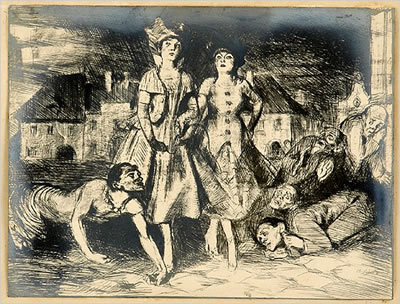
The year is 1938. In the dull light of a basement apartment in the town of Drohobycz a man is anxiously penning a letter to his literary hero Thomas Mann. He works at a desk that is too low for him. When he is disturbed and distressed by the sound of birds pecking at the high windows he slips down onto the floor and continues working there until the falling autumn light forces him back up to the desk. On the walls of his room hang drawings he has made – fantastic dark sketches of domineering women and desperate men.

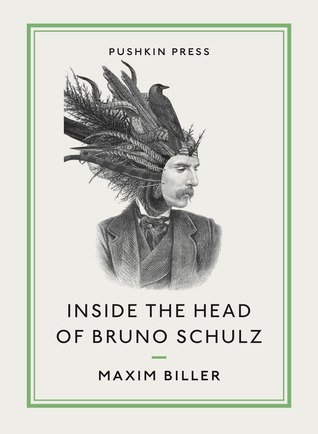
bruno_schulz_paintingThe man is famed Polish writer and artist Bruno Schulz. As he composes his missive to Dr Mann, German author Maxim Biller is conducting a guided tour to the interior thoughts, fantasies and fears – make that Fear with a capital F – that he imagines fueling Schulz’s surreal and creative imagination. The resulting novella, Inside the Head of Bruno Schulz serves as a delightfully inventive introduction to an original and influential writer.

“Ever since he could remember Bruno – for that was the name of the man with the face like a paper kite – had awoken every morning with Fear in his heart. Fear and he had breakfast together in Lisowski’s tearoom, Fear accompanied him to the High School and looked over his shoulder as the boys put their unsuccessful sketches of animals down in front of him, as well as plaster models, covered with black fingerprints, of their sweet little heads.”

Biller paints a portrait of a deeply anxious man… a character that would be at home in one of Schulz’s own stories. When he meet him he is unsuccessfully struggling with a novel. He lives with his sister and her two sons. She still believes her dead husband will return. His students whom he thinks of as “bird-brained” literally appear to him as birds, at his window and in his room. He has a conflicted affection for a sado-masochistic sports and philosophy teacher whom he describes as beautiful despite her hairy monkey face and filthy matted hair. But more critically, he carries an impending sense of doom as it increasingly seems inevitable that Germany will be moving toward Poland. It is with that in mind that he is writing to Thomas Mann.

inside headA most curious and twisted fellow claiming to be the great writer has turned up in this small town, charming the residents with enticing stories and grotesque gatherings. The fictional Bruno is anxious to alert Dr Mann to the existence of this impostor whom he suspects is actually a Nazi spy, and to beseech him to consider offering a poor Polish writer critical assistance. With an opportunity to publish in a prestigious journal or an introduction to an important publisher, the timid Bruno believes he might find the courage to leave Poland. He has even written a story in German to include with his appeal.

Combining biographical facts with a wildly fantastic vision that echoes Schulz’s own dark, dreamlike work, Inside the Head of Bruno Schulz is a lateral approach to the writer’s restless creative energy. A brief biography and two of Schulz’s own short stories, “Birds” and “Cinnamon Shops” follow the primary text, making this short book which clocks in at under 100 pages, an irresistible invitation to explore more of the work of this important Polish writer. Unfortunately a number of stories and the unfinished novel he was at work on in this tale were lost after his death so what remains is limited. However, Schulz himself has resurfaced and been has been re-invented and re-discovered as a writer and artist time and time again in novels by Cynthia Ozick, David Grossman and Philip Roth among others, as well in plays and film. (See the essay “The Strange Afterlife of Bruno Schulz” by Jaimy Gordon for an excellent overview.)

SchulzBruno Schulz was a Polish-Jewish writer born in 1892 in Drohobycz, a town historically part of the kingdom of Poland,  now part of the Ukraine. During his lifetime he published two collections of short stories, The Street of Crocodiles and Sanatorium Under the Sign of the Hourglass. He was known to be at work on a novel, The Messiah, which has not survived. He worked as an artist and an art teacher for many years. When the Germans moved into Poland during the Second World War, his artwork granted him temporary protection under the auspices of an admiring Gestapo officer in exchange for the painting a mural in the officer’s home. On November 19, 1942, walking home with a loaf of bread, he was shot in the back of the head by another Gestapo officer, a rival of his protector. He was 50 years-old.

Published by Pushkin Press (April, 2015 in the UK/October 2015 in North America), Inside the Head of Bruno Schulz is translated from the German by Anthea Bell. The stories “Birds” and “Cinnamon Shops” from The Street of Crocodiles, were translated from the Polish by Celina Wieniewska and originally published 1963.

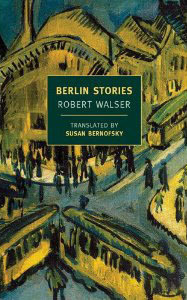
Dark brightness and bright darkness: Berlin Stories by Robert Walser

“Up above is a narrow strip of sky, and the smooth, dark ground below looks as if it’s been polished by human destinies. The buildings to either side rise boldly, daintily, and fantastically into architectural heights. The air quivers and startles with worldly life… And always people are walking here. Never in all the time this street has existed has life stopped circulating here. This is the very heart, the ceaselessly respiring breast of metropolitan life. It is a place of deep inhalations and mighty exhalations, as if life itself felt disagreeably constricted by its own pace and course.”

Great cities have their own personalities and in the company of Swiss writer Robert Walser, Berlin of the early twentieth century becomes a living, breathing entity, a dynamic metropolis drawing in the ambitious, the hopeful and the desperate in equal measure. As a guide to the city, its haunts, and its colourful inhabitants, he is endlessly engaging. His name has been surfacing in my consciousness for a while now, but I had not gotten more than a few stories into this collection before I wondered why it had taken me so long to “discover” him for myself.

BerlinBerlin Stories from New York Review of Books is a collection of short stories composed during Walser’s years in Berlin and the first few years after he left, originally edited and organized by German Walser scholar, Jochen Greven. In her introduction to this edition, translator Susan Bernofsky tells us that, with the beginnings of a literary career underway, Robert Walser moved to Berlin in 1907 at the age of 27. His brother had already enjoyed success as a set designer in the thriving theatre scene. The city was bursting with life. Over the next six years he would record that life in short stories or “prose pieces” and three novels. But financial security eluded him and his own eccentricities did not help him secure the patronage that would have benefited him. He returned to Switzerland in 1913.

The pieces in Berlin Stories are divided into four sections or “movements”: The City Streets, The Theatre, Berlin Life and Looking Back. Most of the pieces are quite short, often no more than a page or two. Narrators who may or may not be Walser himself, wander the streets, ride the trams, or take in theatrical performances while offering attentive discourses on the sights and experiences of city life. He can be thoughtful, melancholy, humourous or sarcastic, sometimes striking playful barbs at contemporaries.

As with any collection of short works, especially one with 38 stories, it is hard to capture a sense of the volume in a brief review. There is so much magic in these pages, it is difficult not to marvel at the acuity of Walser’s observations. He is especially gifted at peering behind the glitz and creating moving accounts of what Bernofsky calls the “humbler aspects of city life”. He has an uncanny eye for the small details that play across the faces and animate the actions of the characters he sketches. Sometimes his observations are direct, at other times his intentions are delivered with a deft backhand as in “The Little Berliner” a story in which he takes the voice of a precocious 12 year-old girl, who enjoys a life of wealth and privilege. But all is not as wonderful as one might suspect. She reports that: “For reasons whose depths I cannot understand and consequently cannot evaluate, my parents live apart. Most of the time I live with Father.” She admonishes herself for confessing to her diary, but Father, for all his wealth and charm, is sometimes a very angry and unpleasant man. The observations and attitudes swirling around in her child’s head present a rather caustic view of the rich delievered in a wonderfully clever way.

Another piece I really enjoyed for its pure descriptive power is “Fire”, in which the narrator and his companion get caught up in the excitement of what must have been a fairly regular occurrence at this time – a house on fire. A spectacle drawing the curious, it is an event at once ordinary and extraordinary:

“an entire street is brightly, garishly lit up by it, it resembles a sunset in the distant south, ten evenings ablaze, a host of suns setting in unison. You see the façades of buildings looking like pale-yellow paper, and the bright red glow of the fire approaches, a thick glowing, wounded red, and beside it the street lanterns look like feebly burning damp matches.”

No one is injured in this instance but a distinguished old piece of architecture is lost, a fact greeted by one of the observers as a healthy form of natural selection, clearing out the dead wood and making room for new construction.

I could go and quote from this work at length, there are little gems nestled in almost every piece. More than 100 years on, his work is vital, entertaining and immensely readable. At the height of his career he was a favourite of Kafka, Musil, Hesse and Walter Benjamin. The resonance of his voice has carried on through the influence of those who admired his work giving it the immediacy that feels so surprising when one first encounters him now. In his lifetime which was increasingly spent in mental asylums, Walser seemed to disappear off the radar. Greven’s German scholarship in the 1950s and the first English translation of his work not long before Walser’s death in 1956, brought him to the attention of a new generation of highly influential writers including WG Sebald, Peter Handke and JM Coetzee.

Now, if you have yet to make the acquaintance of Robert Walser, hurry along and check him out. Personally I’m sold and can’t wait to read more.

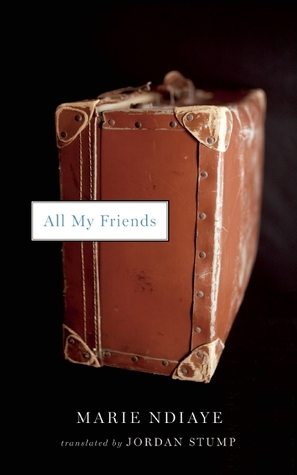
A tenuous grasp on reality: All My Friends by Marie NDiaye

Oh my.

I was looking for a short story collection, something that might fit neatly into the Women in Translation theme that is guiding the reading of many of my fellow bloggers this month. Having heard so much about French author Marie NDiaye I decided to have a look at her collection All My Friends. What I found was a portal to a bizarre, surreal, mildly horrific literary Twilight Zone. If you like your stories neat and clear cut this is territory best avoided. If you enjoy challenging tales peopled by troubled characters who stretch the boundaries of reality, fueled by obsessions, fantasies and psychoses, well, step right in.

All My FriendsThe final heartbreaking, but relatively straight forward story, is very short. The four stories that proceed it are long, convoluted and slippery. The reader really has to surrender him or herself to the experience, to the strangeness and stunning evocative beauty of the language. After finishing this slim volume I had a glance at a number of other reviews and was surprised how differently others saw or interpreted the stories. And perhaps that is the ultimate power of this collection.

The title tale, “All My Friends” is narrated by a school teacher whose wife and children have left him. He leaves his house like a museum and hires a former student, Séverine, to work as his maid. His attraction to her is complex, a curious blend of obsession and loathing that extends back to the days when, as a beautiful student, she resisted his charms and his efforts to impart knowledge on her. She is, however, married to another former student, an unassuming Arab that the teacher can barely remember. And then, to add to this peculiar triangle (quadrangle?) is Werner, yet another former student from the same cohort who went to Paris to better himself and returns, wealthy and well educated, to win Séverine’s love. Complicated? Definitely, especially because, so far as I could tell, Séverine herself is portrayed as a rather cold, obstinate creature and it is hard to imagine what sort of appeal she holds over all the men who are drawn to her.

Two of the stories revolve around celebrity. In “The Death of Claude François”, the passing of a famed singer devastates the women of a housing project. As the story opens, Dr Zaka meets her former best friend, Marlène Vador, after a 30 year separation. Marlène has remained on the project, nursing it seems, an undying love for the long dead hero. Dr Zaka never shared the depth of that affection:

“How ridiculous, she told herself, all that sniveling, all that sweat, all that sorrow simply because a man has died, a perfect stranger to every one of the women on the lawn, although dearer to their wanting hearts than the many children they’d borne, than the husband who had begotten them, whose eyes stayed dry on the death of that luminous, splendid stranger, so French, so blue eyed, so blond-headed.”

However, if the death of the French idol failed to move her, Dr Zaka has conceived a most unusual “gift” for her friend, presumably to make amends for leaving so many years before. In the longest story, “Brulard’s Day”, an overtired, psychotic woman has retreated to a resort town in the mountains. She is clinging to the idea that she was once a famous actress although the true extent of her acting career is not clear. She has left her husband and daughter and is awaiting funds she expects from a mysterious lover. In the meantime she is haunted by visions of her younger self, mortified by the fact that she is reduced to wearing – gasp – loafers and attempting to perform an appearance that befits her image of herself. When her husband appears on the scene it begins to become evident that neither have more than a desperate desire to be more than they are or have ever been.

Finally, the story, “The Boys”, reads like a dystopian tale in which poor rural families seek wealthy women to purchase their sons. A family fortunate to have a son handsome enough to fetch a price as a sex slave will stand to benefit from the income. As the Mour family pass their handsome son on to his fate, René, a poorer boy from a nearby home who picks up odd jobs with the family but is otherwise allowed to disappear into the shadows, watches and comes to decide that he too would like a ticket out.

“He’d always known he could make a gift of himself. Assuming someone would take him, assuming someone was eager to have him, a colorless boy named René, he could subjugate himself to the will of anyone at all. Little matter if he was purchased or picked up for free.”

Tightly paced, haunting and deeply disturbing, this is perhaps the strongest entry in the entire collection.

witmonth15Born in 1967 to a French mother and Senegalese father, NDiaye trained as a linguist at the Sorbonne. She was was playing with form and style at an early age and her first novel was published when she was only 18. In 2013, at the age of 45, she was long listed for the International Booker. This collection was originally published in 2004. The English translation by Jordan Stump was published in 2013 by Two Lines Press.

Ireland in the imperfect tense – Past Habitual: Stories by Alf MacLochlainn

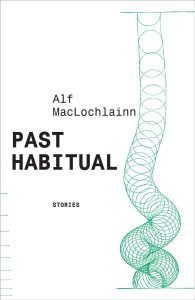
A short story collection can be a curious beast, for the reader who may have a defined expectation about structure and form and for the reviewer who endeavours to capture the encounter with a writer who embraces and defies form as it pleases him. Having emerged from Past Habitual, the newly released collection of stories by Irish writer Alf MacLochlainn, the most helpful advice I can offer is: prepare to encounter narratives that will, at times, ramble and diverge into detailed accounts of practical matters: the treatment of scarlet fever, the options for constructing toilet facilities, the systemic way to approach the assessment of a corpse, the history and development of the stereoscope and more, but if one surrenders to the voices of the narrators, imagining a story recounted over a pint, such excursions prove remarkably compelling and, more often than not, fall imaginatively within the broader arc of the story unfolding around it.

pastThat is not to say that each of the twelve stories in Past Habitual follows the same formula – far from it. There are more traditional stories – “A stitch in time”, Demolition of a gnome-house”, “Why dd I volunteer to kill the kittens?” – that explore with a striking sensitivity, a budding love affair, a boy’s creation of a cardboard house in the garden as a symbolic retreat from the tensions inside his real house, a young man’s clumsy effort to impress his girlfriend and it’s disastrous outcome. His narratives are, however, frequently more complicated and sometimes very experimental in form and varied in style. Yet his keen ear and eye for the tenderness and brutality of human interaction surfaces throughout.

My preference often favoured the more unconventional narratives such as “Dot-and-carry-on” in which the segments of the story are offered as a series of linked dots connecting scenes like a child’s drawing activity as the narrator ties together key events in his personal and family history reaching back to the Easter Week rising and forward to a curious encounter with a Nazi spy living in the officially neutral Ireland during the Second World War. “Imagined monologues at a college function yield some explanation of the survival of the fittest” is, as the title suggests, a flow of conversational fragments that captures latent biases and prejudices that were not uncommon among mid-century intellectuals.

Born in Dublin in 1926, MacLochlainn was a career librarian. He has published a previous story collection and a novella. His stories extend a broad sweep across 20th century Ireland, from the Easter Rising, through the Second World War, to the political upheavals that have marked more recent times. Some stories are set against the backdrop of WWII, while others explore the role of memory in shaping and distorting the communal folklore within which pivotal events are recorded, remembered and passed on. As the sergeant instructing officers on the careful and appropriate use of a newly arrived shredder in one the most wonderfully inventive stories warns:

“without that evidential support, Guard, are we not entirely dependent on memory? And memory can be so fallible, can it not? – Or perhaps in some cases I should call it imagination…”

In Past Habitual, MacLochlainn skillfully blends remembrances, facts and imagination to offer a collection that surprises, challenges and delights. This recent release from Dalkey Archive Press is part of their Irish Literature Series.

Variations on a tragedy: Death in the Museum of Modern Art by Alma Lazarevska

The longest siege of a capital city in the history of modern warfare began on April 5, 1992 when Bosnian Serb nationalists surrounded Sarajevo. The assault would last for 1,425 days, almost four years. Inside the blockaded city, citizens tried to pull together as their city was bombarded with mortars and artillery fire, cut off from access to food, power and communication. Families were driven from their homes, faced the real possibility of detention, rape, torture and slaughter. And yet, in small corners of daily life, small embers of humanity were kindled and nurtured. Death in the Museum of Modern Art is a testament to the fragility and the resilience of the ordinary people trapped in the city, an evocation of beauty in the face of unspeakable horror.

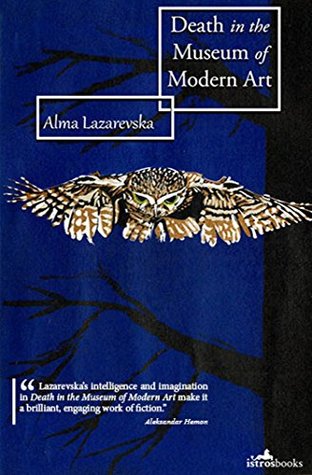
museumThis slim collection of six short stories by Bosnian writer Alma Lazarevska reads like a quiet musical meditation, a set of variations on a theme. Most of the stories are narrated by an unnamed woman, married, usually with a single child, a boy. The stories are imbued with a quiet humanness that is as comforting as the death and destruction that surrounds the characters is terrifying. To those of us who can only faintly imagine what it must be like to endure such conditions the effect is startling.

There is not a weak entry in this collection and despite the themes that do recur (in fact at times I wondered if the same family was at the core of some of the stories) each tale shines a light on a different angle of the experience of the residents of Sarajevo during the Bosnian war.

As a parent myself I was especially moved by the story “Greetings from the Besieged City”. Framed through a series of imagined picture postcard scenes this is a meditation on the desperate desire for a happy ending despite the awareness that in literature as in life, happy endings are elusive. While the knowledge of this truth drives a former classmate of the narrator mad, she herself tries to protect her own son from fictional unhappiness by changing the ending of the book she reads to him, The Seville Fan, a love story in which the hero dies:

“And so Pablo succeeded in not dying, which he was, after all, not accustomed to. Because, when I exhaled and put the closed book down, in its printed pages he was still dead. As I was pronouncing the sentences that were not in the book, it seemed to me that, for the first time in our reading sessions, our boy turned his eyes away from their fixed point. He glanced suspiciously at the book then at my face. A pedagogue would say that he was beginning to get used to the fact that parents tell lies. Or that they become accustomed to sentiment!”

The mother is conflicted by her need to prepare her child for the reality of death – of unhappy endings – and the desire to protect. But when “red-hot balls” start to fall on the besieged city, instantly transforming “human bodies into bloody heaps of flesh” the effort to create some variation of a picture postcard greeting against a landscape of horror is increasingly distorted. The impact is deeply unsettling, yet poignantly human.

The siege is a persistent presence in these tales. It drives the tenants of an apartment block from the odd niceties of shared accommodation to huddle in the basement in fear, or to flee the city if possible, in “Thirst in Number Nine”. The superstitious belief that each used match is a saved soul, leads a couple to use and collect precious matches to light cigarettes, rather than the candle that is equally vital in “How We Killed the Sailor”. This represents a perverse and symbolic luxury as civilian casualties mount around them. The wife wonders about these souls they pretend to protect as each day new faces grace the obituary pages of the paper: “Do they know that there is a besieged city somewhere in the world with the saviours of their souls in it?”

The title story “Death in the Museum of Modern Art”, features a narrator who muses on her involvement in a curious project. Bound for publication in a glossy magazine and an exhibit at the Museum of Modern Art in New York, photographs of 100 inhabitants of Sarajevo are to be paired with their answers to a survey which includes the haunting question: How would you like to die? In a besieged city how does one begin to answer a question like that?

Upon its publication, this collection received the “Best Book” award from the Society of Writers of Bosnia and Herzogovnia. In this lovely edition from Istros Books, the translator, Celia Hawkesworth, brings the gentle and shocking power of Lazarevska’s unique voice to life. I am extraordinarily grateful to Susan Curtis-Kojakovic, the editor of the wonderful Istros Books for selecting and passing this moving, haunting collection on to me. I can recommend it without reservation, these are stories that need to be read. After all, the Bosnian War only came to an end twenty years ago later this year and today, in so many parts of the world, ordinary families are still struggling to survive under the conditions of unimaginable conflicts.

Sadly the happy ending continues to be elusive.

We’re extras in our own stories: Atavisms by Raymond Bock

I am often at odds with the literature from my own country, in fact I’m increasingly at odds with my own country itself. When I heard about Atavisms, a newly released translation of Maxime Raymond Bock’s award winning collection of short stories it caught my attention immediately. I was keen to have a look at Canada through the lens of a contemporary Québécois writer. I don’t know what I expected, but I was hooked from the opening pages.

atavismsNot content with niceties, Bock catapults his reader into this collection with “Wolverine”, a story about a disaffected nationalist nursing his resentment long after the FLQ (Front de Libération du Québec – a separatist paramilitary organization) has fallen into decline in the years following the institution of the War Measures Act in October of 1970 in response to the hostilities that had risen to a crisis point. When he happens to encounter a former Liberal cabinet minister, aged and intoxicated, he enlists a couple of friends on an adventure of revenge that turns brutally violent. It is shocking even if you come to this tale from a distance, but as a Canadian who will never separate the October Crisis from his 10 year-old imagination, I met it with intoxicated horror. Suddenly I was thrown back to my prairie schoolyard where my friends and I re-enacted events we were in no way equipped to understand – but with kidnapped officials and bodies in trunks it was infinitely more exciting, and terrifying, than anything on TV.

The horror continues to unfold in the second story, “The Other World”, but this time the reader is thrown back hundreds of years, to the early Quebec settlers and the immediate aftermath of the surprise attack by of a band of Iroquois on a couple of traders and their Huron guides. As the lone survivor lies under a thicket of pine branches hoping to remain hidden as the attackers relieve their victims of goods and scalps, he muses that, no matter what happens, he has no regrets.

From there we move, in “Dauphin, Manitoba”, to look outside the borders of Quebec, with a man’s monologue directed at a girlfriend he left behind in a prairie town. They had moved out there together. While she found herself captivated by her work, he failed to get a foothold or feel at ease in the vast empty landscape and retreated to the familiar blanketing comfort of a Montreal winter.

“You could pace back and forth a hundred years without coming close to the boredom I felt on those prairies, once sifted by antediluvian oceans, sculpted by retreating glaciers, surveyed by rambling nomads – friendly spirits, even better warriors – plowed to-and-fro by combines kicking up the dust of buffalo skeletons. You could say I caught you off guard when I left you alone to follow your path; you could say it was a nice trip, the time of your life. Lies. We’re both free now. You can study law, become a pastry chef, take up curling, or stay out there and keep up the good work; I’ll stay here and the snow will keep coming down.”

I once made a move like that in the opposite direction, albeit no further than Ottawa; but in the end made my way back west, never really at home at either end of the equation. As the narrator frames his missive to his girlfriend in terms of the generic novels he is making his way through, he does not sound any more committed to his move as something intrinsically right than as an acknowledgement of where he does not belong.

As the stories in Atavisms unfold, stretching back and forward in time, common themes, from history to politics to parental anxiety, reoccur, reflecting off one another. It can be argued that these thirteen stories are interconnected although they do not explicitly share any repeating characters and range from historical to surrealist to speculative fiction. Some of the contemporary stories are deeply universal and could almost be set anywhere, like “The Bridge” in which a depressed history teacher muses about his fate should he give in to his suicidal whims; or “Room 103”, a son’s one sided conversation with his dying father:

“It’s the end, Antoine, there’s nothing left to be done. You’re so light you don’t even make a dent in the mattress. It’s just you all alone with your obsolete quarter-million dollar machines, your network of tubing, your probes and dreams.”

Like a fragmented block of glass, each story in Atavisms offers a view of the Québécois experience through a different prism until the final tale, “The Still Traveler”, pulls all the threads together into a time and place in a precolonial reality dating back to the legends of the earliest residents and visitors to the Americas. After all, atavism refers to the tendency to revert to an ancestral type and that, more than anything is the underpinning theme of this collection: fathers and sons, family histories, political legacies, the identities that contain and define us.

Outside of Quebec, a sense of identity is diluted. I was struck by the depth of the colonial commentary that runs through a number of these tales and how the early days of New France are revisited with a harsh measure of reality. This is a conversational point sadly under played in Canada as a whole. As a new level of racism and xenophobia directed at new Canadians grows across this country, we would do well to remember how recently white Europeans made their way onto these shores.

Newly released by Dalkey Archive Press under their Canadian Literature Series, Pablo Strauss’ translation very effectively maintains the distinctive flavour of Bock’s richly varied stories. Supplemental endnotes fill in some essential language and historical references to enhance the reading experience.

I would strongly recommend Atavisms to anyone interested in knowing more about the Quebec experience, whether inside or outside Canada. Not only because the perspective is not as widely known or understood as it should be, but because this is simply a collection of very good stories. Period.

Reality is a miracle… Things Look Different in the Light by Medardo Fraile

In a story titled “The Sea”, a couple vacationing on the Mediterranean make their way to the seashore each day where the husband joins the line of humans on the beach who sit staring at the water, mesmerized. The experience fills him with a sense of unease.

“The waves were never the same, although they may have repeated themselves in similar cycles. The meaning of the wave never went beyond being a rather comforting mystical murmur. But the sea seemed to express itself in ways superior to the wave, in whole unintelligible paragraphs and speeches, as rich in modes and forms as it was in depths and fishes. On the other hand, I understood nothing of what it said.”

thingsLike the vast sea with its hypnotic surface and hidden secrets, reality is a shimmering quantity in the hands of Spanish author Medardo Fraile. A master of the short story, he is able to distill an experience or sketch out an entire life span within a handful of pages. In this collection, Things Look Different in the Light, he breathes life into a wide variety of unforgettable characters – young or old, ordinary or eccentric. We meet weary professors, crafty spinsters, uncommunicative middle-aged couples, meek bachelors and curious children who don’t quite understand the world of adults. We even encounter inanimate objects that take on lives of their own rich with meaning and emotion, bound to and yet separate from the human with which they are associated.

Consider “A Shirt”, the simple fable of sailor who, after a single love affair, returns alone to his hometown to take up the life of a fisherman. Each day he dons the same tartan shirt until one fateful day when shirt is left behind on the line:

“At around four o’clock in the morning, with no wind to speak of, the shirt began to move. It flapped wildly about, anxious and empty, as if wanting to break free of the pegs gripping its shoulders. The flailing sleeves rose and fell, filled by the invisible lament of some terrible tragedy. They occasionally joined wrists or else stretched wide, arms spread.”

Or share the frustration of the lingerie salesman in “The Lemon Drop” who had imagined a literary career for himself and can’t quite come to terms with the place where life has left him. He wonders what happened to the scabby-kneed boy who used to go bird’s nesting and smoke on the sly:

“Now I never smoke. I used to own a pellet gun. I have big hands, like cowboys in the Wild West. And by ‘I’, I mean this person who is me. This weary fellow who walks home bent beneath the weight of his briefcase, which, one day, grabbed hold of his hand like a dog and feels equally weary.”

From the opening story about a tongue-tied man at a baby’s birthday party, set on edge by a woman he cannot bear to face, to the chillingly beautiful “Last Shout” in which a child recalls a beloved grandmother’s final months; you know you are in the presence of a gifted storyteller. He manages to adjust the focus to bring to light the details that are essential to the tale he wishes to tell. No more, no less. Simply perfect.

Born in Madrid in 1925, Fraile started his career in experimental theatre, a background that may well account for the spare, magical quality of many of his short stories. He left Spain in the 1950‘s, and although he would ultimately settle in Scotland, his work was not made available to English speaking readers until the release of this wonderful collection from Pushkin Press, translated by the renowned Margret Jull Costa, with a warm and enthusiastic introduction by Ali Smith. A fellow blogger, Jacqui at JacquiWine’s Journal first drew my attention to this book so I knew it was one that I wanted to read (sooner rather than alter, that is)  when it was longlisted for this year’s Best Translated Book Award. Things Look Different In the Light has progressed to the shortlist.

Medardo Fraile died in 2013.