Life in the Court of Matane by Eric Dupont – My Numéro Cinq review

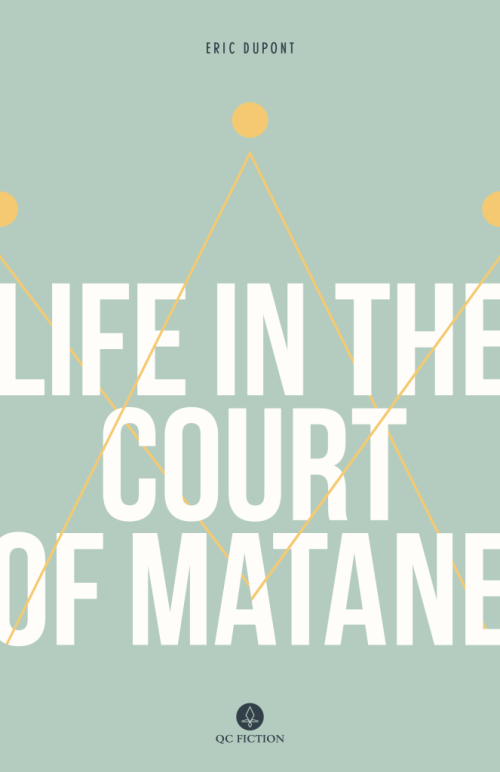
The publication of my most recent review for Numéro Cinq the other day, was, for me, a welcome opportunity to revisit an intelligent, humourous, bittersweet tale about growing up in Québec during the 1970’s and 80’s. This debut release from QC Fiction, a new imprint from Baraka Books created with the bold ambition to bring a new generation of Québec writers to an international audience through a subscription funded model, is first and foremost a story about family.

I have been thinking a lot about family myself these days as my brothers and I have been shaken and shattered by the critical injury of our father and the sudden passing of our mother within the span of the past week. Like all families, ours has its share of idiosyncratic dysfunction, but in our heartbreak we’ve been remembering the beauty and the humour above all of the difficulties and anxieties that have divided and united us over the years.

The family that Eric Dupont brings to life in Life in the Court of Matane, separated, defined and redefined by divorce and remarriage, shimmers with sparks of love, respect and affection. Even in the court of this latter day Henry VIII and his past and future queens, a sense of humour goes a long way, setting the ground for an unforgettable, original coming of age tale.

Here’s a taste of the review, please click through the link at the end to read the rest. A second link leads to an excerpt:

A Very Funny Novel: Eric Dupont’s Life in the Court of Matane — Joseph Schreiber

CoverLivreMatane_RVB

Growing up in a broken home is rarely easy. Too often children become pawns on the emotional battlefield as their parents face off against one another. This is the atmosphere of uncertainty and insecurity in which the eponymous narrator of Life in the Court of Matane and his sister find themselves at an early age. So it’s little wonder that they would recognize their predicament in the feats of a certain young Romanian gymnast swinging between the uneven parallel bars at 1976 Olympic Games in Montreal. But Nadia Comaneci is only one of a number of personalities evoked in this inventive coming-of-age story. She joins the re-imagined court of Henry VIII, key figures in the debate between Québec Separatists and Federalists, and a menagerie of assorted birds and beasts in Eric Dupont’s engaging account of a childhood defined by divorce.

Originally published as Bestiaire in 2008, Peter McCambridge’s translation of this acclaimed novel heralds the debut of QC Fiction, an ambitious publishing initiative dedicated to introducing readers to an new generation of Québec literature. Their goal is to be able to offer “surprising, interesting novels in flawless English translation” to a wide audience through a subscription funded model inspired by publishers such as And Other Stories, Deep Vellum, and Open Letter Books. With this in mind, it is difficult to imagine a more enchanting and original novel to launch this new imprint than Life in the Court of Matane.

Continue reading here:

Read an excerpt here:

Goethe Dies by Thomas Bernhard – My Numéro Cinq review

I have written about Thomas Bernhard’s novels before, but faced with prospect of writing a longer critical review of a book containing four short stories I was faced with a dilemma: What does one say about Bernhard?

The question really is: How much familiarity with Bernhard should one assume? He is, most definitely, a singular writer. Those of us who count ourselves among the converted tend to have bulging bookshelves filled with a healthy supply of Bernhard’s novels, memoirs and poetry. Others are uncertain or fail to be immediately captivated. A bit of Bernhard primer is thus in order for those potential new readers, especially in this instance, because Goethe Dies, the collection at hand, offers a perfect opportunity to experience the magic of the master in miniature. A treat I argue for readers no matter their degree of prior acquaintance.

So in the following review published at Numéro Cinq earlier this week I tried to balance my general discussion of Bernhard’s prose style to provide a context for the appreciation of my analysis of the stories that would not be too redundant for the experienced or too vague for the novice.

Here’s a taste of the review, please click through the link at the end to read the rest. And while you’re there have a look around. There is another great issue shaping up at NC.

A Master Set Loose in a Small Space: Review of Thomas Bernhard’s Goethe Dies — Joseph Schreiber

Goethe Dies

Once acquainted with the work of the late Austrian writer, Thomas Bernhard, it is difficult to remain indifferent. One is either put off by his endlessly convoluted sentences, his bitter, misanthropic vision, and his fondness for digressive, contradictory and self-obsessed narratives; or one is swept up in the singular energetic flow of his darkly comic genius and never looks back. For those who find themselves in the latter camp, the announcement of a newly translated collection of four short stories originally published in periodicals in the early 1980’s is good news indeed.

Bernhard in short form may lack the unleashed full force intensity afforded when a single paragraph is allowed to unspool over one or two hundred pages or more; but these minor works, if you like, offer a valuable and entertaining opportunity to observe a master at play in a small, contained space. As with the early stories of Prose and the micro-fiction of The Voice Imitator, the short pieces collected in Goethe Dies, recently released by Seagull Books, highlight many of the essential elements that lend Bernhard’s work such a distinctive, infectious voice. Consequently, they may be best appreciated against a certain familiarity with the author and the idiosyncratic features that characterize his novels.

Continue reading here:

Innocence betrayed: My Father’s Dreams by Evald Flisar

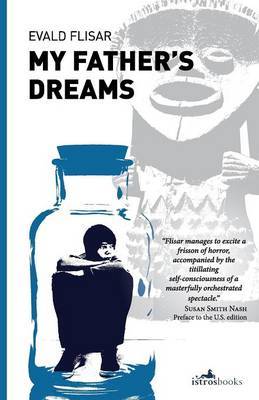
Adolescence is, at the best of times, a period of turbulence. Hormones take over, driving hopes, desires and emotions. For Adam, the fourteen year-old narrator of My Father’s Dreams puberty becomes a twisted, surreal experience as he finds himself swept up in a world in which the line between dreams and reality becomes dangerously blurred. In this dark multi-faceted tale, Slovenian author Evald Flisar sets the stage for a story that is oddly out of time and place—a contemporary novel that evokes, in its backward rural setting and naive tone, a feeling of gothic horror or psychological drama that would be perfectly at home in the literature of the early twentieth century. But themes running through the narrative that are distinctly modern in their context and execution create an atmosphere that is eerily discordant and profoundly disturbing.

fathersdreamsAdam is a loner. He lives with his parents in a small rural village in an unnamed country. He describes his mother as shrill, over emotional and unduly concerned with social appearances. But he adores his father, the local doctor, unreservedly. He is the centre of his universe and he cannot imagine that he would ever cause him any harm. Adam spends his free time devouring books borrowed from his father’s library, a wide range of classic literature that runs the gamut from Zane Grey to Goethe to de Sade and Kafka and more. Not one to make friends easily, his sole confidant is his assumed brother Abortus, a jarred fetus who “lives” in his father’s secret laboratory in the basement of the health centre.

As puberty hits, Adam is increasingly beset by vivid dreams. He is unaware of just how odd and unnerving the content is until he allows it to fuel a school assignment. His teachers and his mother respond with shock. However, his rich dream life quickly becomes an object of fascination—or perhaps manipulation—for his father. Before long Adam finds that he is losing the ability to define the intersection of dreams and ordinary life:

. . . soon I was having too many dreams, and they began to suffocate me. Daily hallucinations merged with nightmares so imperceptibly that I was finding it harder and harder to draw the line between them. Afraid that I would sink in the burgeoning swamp of my own imagination, I began to flee in the direction of hard reality, grasping at anything that could be seen, felt, heard, or smelled. Soon I became so oversensitive that I registered the slightest rustle, the tiniest change in light, the least noticeable smell.

Over the course of the summer, the content of his dreams continue to haunt his days and nights. They regularly feature a familiar theme. Time after time he finds himself observing his father engaged in sexual activity with Eve, an attractive young teenaged girl from the city who is staying with her grandfather for the school holidays.

His father had warned him not to discuss his dreams, but encouraged him to record them. In his journals, Adam documents his thoughts and dreams which, with the blurring of his sense of reality, he has come to understand as being one and the same… the dream context granting immunity from the content of his thoughts which are peppered with images of sexual arousal and a desire for revenge against his parents. He quickly learns that these diaries are better kept hidden. And he has the perfect location—behind his jarred little brother, with whom he shares all of his secrets without reservation. With adults he is cautious to edit his responses to their queries about his dreams which are then subjected to Freudian and Jungian inspired debates. The only adult with whom he dares to approach an honest account is Eve’s kindly grandfather, who listens with a sharp concern that Adam notices but fails to appreciate.

During his strange dreams, Adam sometimes questions his ability to fall in and out of a hallucinatory state as well as his peculiar ability to exercise some agency, but he invariably seems to be able to assure himself that he is dreaming and, as a result, safe from any real danger. He continues to trust his father implicitly even when during an intentional “shared dream” proposed as a potential cure, he finds himself abandoned in a strange town with two young women:

The mist is now all around us, I can feel it on my cheeks; it is cold. The church clock delivers eleven strikes. There is no sign of Father. They are closing the inn, we have to leave. Like shadows we slink off along the the road leading into the centre of the town. It’s a very small town, almost a village. I am tired and sleepy. I am beginning to worry that Father might not return. Where will I sleep? It’s a strange thought, asking oneself where one will sleep in a dream, but the night is cold, and my worry is almost real. We roam around, passing houses, shuttered shops, and silent buildings. The church clock announces the time: half past midnight. And still there is no sign of Father.

Curiously (or not), the dreams involving his father and Eve cease as soon as the latter returns to the city in September. With autumn’s arrival his mother makes increased efforts to salvage the family, while his father’s behaviour becomes more erratic and threatening. Adam’s “dreams” begin to seem more like a protective psychological suggestion or even a defense mechanism evoked to cloud his perception of the events he observes or experiences. But again, he never openly contemplates this. His narrative, offered from a future perspective, looking back, belies a folkloric sense of innocence that cannot entirely be trusted. It casts a strange shadow across the work contributing to the odd tone. Dark topics such as addiction, suicide and pedophilia lurk at the heart of this tale amid the supernatural, surreal and grotesque elements. As a result the reader is left to navigate a slippery substrate that, even as tensions build to to a horrifying conclusion, refuses to yield to clear interpretation. The result is a complex, unnerving, unforgettable novel.

Novelist, playwright, essayist, and world traveler, Evald Flisar is one of Slovenia’s best known writers. Translated from the Slovene by the author and Alan McConnell-Duff, My Father’s Dreams is published by Istros Books. In their new collaboration with Peter Owen Publishers, they will be releasing Flisar’s Three Loves, One Death in November.

The pursuit of happiness: Sergio Y. by Alexandre Vidal Porto

“If happiness is not where we are, we must chase her. She sometimes lives very far away. You must have the courage to be happy.”

When it comes to the depiction of transgender individuals in literary fiction, I will confess that I am a rather cynical customer. Lets just say I know the reality too well. So much of what I have read does not even come close to scratching the surface of what it means to be at odds with one’s own birth-assigned gender. Intentions are good and, of course, the transgender or intersex character always allows for an interesting twist but the results can be misleading, even distressingly off base. That’s why Sergio Y. by Brazilian author Alexandre Vidal Porto is such a refreshing and original read. Here is a novel that treats the subject with intelligence and compassion—quite the feat for a book in which the transgender character meets an untimely and unfortunate end before the story even gets started.

SergioThe title character, Sergio Y. is the son of a wealthy businessman in São Paolo, Brazil, and the great grandson of an Armenian immigrant who escaped the tragic fate of so many of his countrymen, including the rest of his family, when he crossed the ocean in 1915, seeking his happiness in the Americas. The narrator is Armando, a well-respected seventy year-old psychiatrist. Sergio had been referred to him for therapy at the age of seventeen, described simply as “articulate, intelligent and confused.” They meet regularly for several years. This mature young man—so handsome, wealthy and talented—intrigues Armando and yet, in spite of all of these advantages, he professes to be possessed by a deep and abiding unhappiness.

Following a visit to New York City one Christmas, Sergio informs Armando that he wishes to discontinue therapy. He has had a revelation, he says, and he believes he has found a way to be happy. Our narrator is a little disgruntled to be dismissed as such but, as the years pass, Sergio Y. fades from his mind until a chance encounter with his former patient’s mother. She reports that her son has moved to New York where he attended culinary school and is now about to open his own restaurant. Armando is surprised, but pleased by this news and the praise he is afforded for his role in helping Sergio find happiness at last. However, this boost to his ego is short lived. Armando’s world begins to crumble when he learns, quite by chance, that Sergio Y. has been murdered at his home in the West Village.

Obsessive by nature, Armando becomes haunted by the need to know more. What he discovers with the help of a private investigator is completely unexpected and sends him reeling. The murder victim is identified as Sandra Yacoubian, female. Sandra and Sergio he soon learns are, in fact, one and the same person. His young patient had found his happiness as a woman and now she was dead at the age of 23! How could he have failed to recognize that Sergio was transsexual? And, even more serious, was his failure in some way responsible for this tragic outcome?

The main source of my frustration was not having detected any hint of Sergio Y.’s transsexuality. I felt I had been duped solely and exclusively by my own incompetence. I had always though that the secret to transsexuality was not all that deep, that it revealed itself in all of the individual’s attitudes, at all times, in all the decisions he or she took, since early childhood. As far as I was concerned, the pain in the patient’s soul and their inner confusion would be so visible that one did not need to be a Freudian or Jungian psychoanalyst to make the diagnosis.

Armando’s search for answers and his personal quest for understanding lie at the heart of this book. He begins with a handful of stereotyped assumptions. He labels them, admits to them, and lays them out. In the end, as he comes to a clearer,more nuanced appreciation of the decision his patient chose to take to find happiness and the determination with which she pursued it.

The narrative tone is highly idiosyncratic, dictated by the analytical, mildly obsessive-compulsive, immodest character of Armando. Even when he begins to doubt and second-guess himself as the account progresses, he maintains the matter of fact, dry, clinical delivery of a psychiatric report. The attention to detail—his clothing choices, his tendency to note the approximate height and weight of people he encounters, even his reports of his own emotional ups and downs—all create the illusion of a sterile account. But when the careful veneer cracks from time to time, we see a moody, somewhat petulant character, prone to bursts of pride, mixed with episodes of guilt and shame. He is continually measuring himself against his own successes and failures. His internal machinations are fascinating.

Ultimately, Sergio Y. is novel that approaches the transgender experience from the inside and the outside, allowing for the comfort with names and pronouns to vary, over time and from person to person, reflecting the complexities of relationships that others, even loving family members, can have when an accepted and assumed identity is challenged. In his own journey to understand and set his mind at ease, the questions Armando raises and the answers he finds serve to create a moving and compassionate portrait of the transgender person’s conflicted internal experience and the search to find a way to be happy in the world.

Happiness may be an ideal; comfort or contentment might work as well. From my point on this same journey I would hasten to add that it can be a difficult and lonely path, but that does not mean it is not worth following. In fact, if it is the right path, there is no other. Semantics aside, this novel is an important, engaging read. It deserves to be written about and it needs to be discussed.

Sergio Y. is translated from the Portuguese by Alex Ladd and published by Europa Editions.

Immersed in the moment: Incidents by Roland Barthes

In his Publisher’s Note to the French edition of Roland Barthes’ Incidents, a collection of essays published shortly after the theorist’s death in 1980, François Wahl suggests that the four very different texts assembled form a coherent whole because each piece “strives to grasp the immediate”. These are not theoretical or critical investigations in any sense, rather, in each text, Barthes is immersed in the moment, observing, reflecting, and recording his reactions. There is an unchecked flow and intimacy, by turns nostalgic, sensual, and melancholic but always tuned to the instance of occurrence: to the incident.

2016-05-19 21.38.01These are works that invite the reader to engage with all five senses, mediated through words and memory–they are not formal pieces but rather take the form of journal entries, diary writing, and fragmented travelogue. Barthes writes people and he writes place, never really entirely at ease with too much of either. Delight, boredom, and sadness filter through his reflections creating an immediacy that is at times startling. He is not writing for posterity, he is writing for himself.

The collection opens with “The Light of the South West”, an evocative essay/memoir, a personal tribute to the south west region of France. He writes about the experience of traveling south from Paris. Passing Angoulème he becomes aware that he is on the “threshold” of the land of his childhood. It is the quality of light that defines the place:

. . . noble and subtle at the same time; it is never grey, never gloomy (even when the sun isn’t shining); it is light-space, defined less by the altered colours of things . . . than by the eminently inhabitable quality it gives to the earth. I can think of no other way to say it: it is a luminous light. You have to see this light (I almost want to say: you have to hear it, hear its musical quality). In autumn, the most glorious season in this land, the light is liquid, radiant, heartbreaking since it is the final beautiful light of the year, illuminating and distinguishing everything it touches. . .

He goes on to turn his attention to the elements of the south west that resonate with different aspects of his childhood, to reflect on the way that memories formed in childhood inform way we remember the places associated with that time, the magical spaces and the difficult times will each carry their own tone, their own qualities.

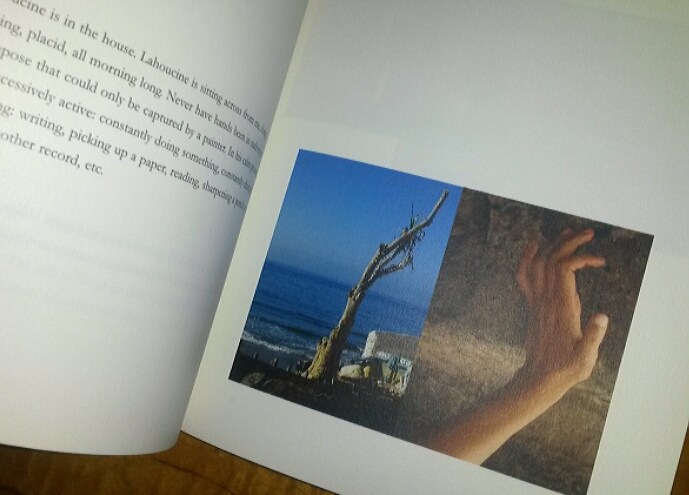
2016-05-19 21.41.06The title piece is the earliest in the book. Recorded in 1969 when the author was in his mid-50s, “Incidents”, as the name implies, captures moments from an extended stay in Morocco through an incidental series of fragmented encounters and experiences. Here, people form the scenery; with a special attention reserved for young men. Barthes demonstrates a a particular eye for detail (and somewhat of an obsession with hands) in these passing observations, combined with an acute sensitivity for scents and colours. The vibrancy, shades and contrasts of the country come alive. As a reader you become aware of the blinding light, the dark shadows–they are not described, you sense them in the background.

A young black man, wearing a crème de menthe-coloured shirt, almond green pants, orange socks and, obviously, very soft red shoes.

A handsome, mature looking young man, well dressed in a grey suit and a gold bracelt, with delicate clean hands, smoking red Olympic cigarettes, drinking tea, is speaking quite earnestly (some sort of civil servant? One of those who track down files?), and a tiny thread of saliva drips onto his knee. His companion points it out to him.

Some young Moroccans–with girlfriends they can show off in front of–pretending to speak English with exaggerated French accents (a way of hiding the fact without losing face that they will never have a good accent).

The art of living in Marrakesh: a fleeting conversation from open carriage to bicycle; a cigarette given, a meeting arranged, the bicycle turns the corner and slowly disappears.

The Marrakesh soul: wild roses in the mountains of mint.

The third essay, “At Le Palace Tonight . . .” is a tribute to a Paris club in a converted theatre. He describes the ornate detail, the mood and the atmosphere of this place where he seems to almost prefer to be an observer, watching the dancers and the human interactions rather than taking part. And as in the first essay, we find once again a wonderful evocation of light, this time light as informed by the interior of a structure:

Isn’t it the material of modern art today, of daily art, light? In ordinary theatres, the light originates at a distance, directed onto the stage. At Le Palace, the entire theatre is the stage; the light takes up all the space there, inside of which it is alive and plays like one of the actors: an intelligent laser, with a complicated and refined mind, like an exhibitor of abstract figurines, it produces enigmatic shapes, with abrupt changes: circles, rectangles, ellipses, lines, ropes, galaxies, twists.

This collection closes with “Evenings in Paris” a series of journal entries from 1979 that open with words Schopenhauer wrote on a piece of paper before he died: “Well, we’ve escaped very nicely.” The Barthes who comes through in this selection is tired, often impatient with colleagues and irritated by noise. A certain loneliness and dissatisfaction underscore his descriptions of dinners with friends, failed attempts to win the affections of the younger men he covets, and an unresolved mourning for his beloved mother. Most nights he finds himself heading home alone, half despairing, half relieved, to settle into bed in the company of Pascal, Chateaubriand, Dante, or the echoing ghost of Proust. Although he still enjoys longingly watching attractive men, he has little patience for crowds or social functions. This is a heavier, more emotionally intense offering, the intimacy of “the immediate” weighs heavily as Barthes commits his thoughts to paper, unaware in the writing as we are in the reading, that he is nearing the end of his life.

2016-05-20 02.33.11And, because he is recording the ordinariness of the daily encounter of the self with the world, there is the possibility of shock waves that ring down the years with a new intensity in light of the incidents (that word again) that have unsettled Paris in recent years:

The guy who sells Charlie-Hebdo walks by; on the cover in the publication’s idiotic style, there’s a basket of greenish heads that look like lettuces: ‘2 francs the head of a Cambodian’; and, right then, a young Cambodian rushes into the café, sees the cover, is visibly shocked, concerned, and buys a copy: the head of a Cambodian!

Not without a little social commentary, even in a deeply personal journal, Roland Barthes, remains ever relevant down the years.

Reading Incidents is, in itself, a sensuous experience, it is doubly so in this edition from Seagull Books. With a sparkling fresh translation by Teresa Lavender Fagan and illustrated with the evocative photographic images of Bishan Samaddar, this collection of writings becomes one that can, as Barthes himself would have intended, be savoured.

Quiet Creature on the Corner by João Gilberto Noll–my Numéro Cinq review

There is a most invigorating buzz around this book, Quiet Creature on the Corner, the latest release from Two Lines Press. This slender novel by Brazilian writer João Gilberto Noll is, to put it simply, a surreal, enigmatic tale that defies straightforward interpretation. Every reader and reviewer I have engaged with since my review went live yesterday at Numéro Cinq has had a somewhat different interpretation. And that’s part of the appeal–this book invites conversation.

On my first reading I was underwhelmed and uncertain how I could pull a 1500-2000 word critical review out of such a vague, odd offering. So I put it aside for a week and it started to percolate in my thoughts. Each time I returned and reread the text it grew in power and mystery. Since I finished and submitted this review I have continued to think about the book and aspects I wish I had explored. Here’s a taste, please click through the link at the end for the rest of the review.

Forever an Unknown Country: Review of Quiet Creature on the Corner by João Gilberto Noll—Joseph Schreiber

Quiet-Creature-web-294We humans tend to fancy ourselves rational beings. We hold to the convention of cause and effect. We imagine that if faced with strange and unusual situations, we would respond with curiosity, anxiety, or alarm and make an effort to act appropriately. We are inclined to believe that we need to understand what is happening to us and around us at all times. But, is that truly the way we actually exist in the world?

João Gilberto Noll is an author who dares to challenge that assumption. His novel, Quiet Creature on the Corner is, on the surface, a spare and modestly surreal tale of a young man who surrenders himself to a life that is inexplicably handed to him without seriously questioning his circumstances until he is deeply absorbed in a situation that is rapidly growing stranger and more uncertain. Newly released from Two Lines Press, in a measured, wonderfully restrained translation by Adam Morris, this novel offers an English language audience an absorbing introduction to this esteemed Brazilian author.

Continue reading here.

“A wandering mind is a marvelous sight”: Moods by Yoel Hoffmann

When we, that is to say you, approach a work like Moods, by Yoel Hoffman, you have to be prepared to relinquish everything you expect a novel to be. You will encounter a story, no many stories, and stories within stories, working their way in and out of 191 micro chapters. You also have to be prepared to walk, lockstep, for the most part, with the author who invites you to join him under the umbrella of the third person plural–not the royal “we”–but something much more intimate except, of course, when it makes no sense to speak in the plural and the author has to step aside and admit that, by “we” he means “I”. Confused yet? Don’t be. This has to be one of the most infectiously readable pieces of experimental fiction that you can imagine.

MoodsMoods is, if nothing else, a metafictional playground peopled with characters drawn, for the most part, from the life of the author himself–aunts and uncles, childhood loves, neighbours and assorted professionals. And just when you least expect it, he hits you with an observation that catches you off guard. He weaves you, the reader, into a story that is, in all it’s assorted bits and pieces, about life–the messy business of living of it and the way a writer can or cannot write about it. He moves hypnotically from memories to philosophical musings:

. . . my father (Andreas Avraham) hides from Francesca, my stepmother, records he bought because the money he receives (in transparent bills) isn’t enough for her.

The music he listens to consists of a single sound, like the straight line on the monitor when the hearts stops beating. The scent of eternity is like that of goulash. Everything’s frozen over. Jokes one tells are revealed in full like that famous rainbow arched through a cloud. Each season extends to infinity. You stand there, and the streets run beneath you. Women lie down forever. A faint soft sound like the fur of a foal (of a donkey) wafts through the air, and the colours are all pastel.

It is a book, as the title tells us, of moods. And the mood that permeates this work is one of sadness. It is smelled in stairwells and trapped between the crumpled covers of physics textbooks. It is the sadness of missing loved ones, whether they have gone away or have died. There is a wide arc of time, reaching to eternity in its metaphysics, spanning some seven decades in the real life of the author (and vicariously for his reader companion).

The reader can no doubt guess what sort of music we’re trying to compose. Mostly blues. The sentimental melancholy suits us as a suit fits a tailor’s dummy. If someone asks us to look at something rationally, in a major key–as, for instance, Tellmann did–we get angry.

Hoffmann is an Israeli writer born in Romania in 1937. The history of his people, family members and friends, comes through as he writes about those he has known, but his worldview transcends religion and political boundaries. Hoffmann, a former professor of Japanese Buddhism at the University of Haifa, spent years studying in Japan, living for a time in a Zen monastery. His knowledge of and sensitivity to the Japanese koan, sets the tone for the questions he asks and the observations he makes, whether he is pondering the nature of the universe or the order of names in a phone book.

We can now reveal to the readers of this book a deep secret, but they’re not allowed to reveal it to readers of other books.

Feet follow one another. Hands cut through the air. The mouth opens and closes. The inner organs expand and contract, according to their nature. What’s outside is standing or walking.

Prayers can be heard everywhere, whether a person says them aloud or not. Frogs need only themselves. The marsh reeds know the right direction.

And because these things are set forth here, it’s a wonder this book is sold for so little.

So what to make of Moods? Novel or autobiography? The short chapters, most no longer than a couple of paragraphs, sometimes follow thematically or chronologically. Characters appear and reappear. Anecdotes lead to reflection which in turn to leads to metafictional contemplation about the nature of literature in general and fiction in particular. Hoffmann is skillfully and enthusiastically playing ideas against one another. It is both funny and emotionally engaging. Unlike many postmodern works that are so unabashedly metafictional in nature–that is novels that dissect the novel you are reading as you read it– Moods is infused with warmth and humanness. It pulls a reader in and treats him or her with a respect that is, Hoffmann would argue, with some seriousness, a responsibility for which a writer should be held criminally liable.

And although sadness is the underlying mood, reading this book is, quite simply, a joy.

Moods is translated with poetic sensitivity to the flow of the language and the linguistic playfulness by Peter Cole. Published by New Directions who have, over the years, published most of Hoffmann’s novels, Moods is a shortlisted title for the 2016 Best Translated Book Award.

The melancholy wanderer: War, So Much War by Mercè Rodoreda

Fresh air streamed in through the window. When the dining-room clock struck three, I rose and left without even washing my face and, you might say, with only the clothes on my back. I had taken some fifty steps when something made me turn around and glance back at the house. The moonlight fell full on it. My father stood at the door watching me, holding me–still a little boy–in his arms. It was the first night that I roamed alone through streets outside my neighbourhood. I ran. Goodbye carnations, adéu!

With this ghostly image of his deceased father holding his infant self, Adirà Guinart, the fifteen year-old narrator of Mercè Rodoreda’s poignant novel War, So Much War, turns his back on a fractious relationship with his mother and a life growing and selling carnations. He is seeking a life of adventure. Yet, as one must be careful what one wishes for, he is about embark on a journey that will leave him irrevocably changed, and sadly and wistfully mature for his age.

War_So_Much_War-front_largeAlthough the place and conflict is never explicitly named, it is assumed that the setting is Catalonia, the author’s homeland, during the Spanish Civil War. But in truth the exact details do not matter, this is a novel about the wide sweep of war beyond the front lines, about the damage, destruction and despair that works its way into the landscape, the villages and the lives of the people who are often hard pressed to explain who or why they are fighting. Yet, the bleakness is, in Rodoreda’s hands, filtered through a surrealist lens that renders it at once engaging, wise and profoundly sad.

Idealistic and bored, our young protagonist leaves home to join the war effort, but he is quickly disillusioned with the soldier’s life, and runs away again, falling into a life that suits his temperament, that of the wanderer. Unfolding over the course of a series of short episodic adventures he encounters an array of tragic comic characters–the bereaved, the abandoned and the eccentric–who share their wisdom, offer him lodging or seek his assistance. Classic folkloric elements are present, including a strange castle, an enigmatic young woman, an ugly old hag, a hermit with a tale of hard earned humility and a mysterious benefactor with a haunted mirror.

But War, So Much War is more than an allegory or a fairy tale, there is something profoundly serious and unsettling beneath the surface. The narrative, unadorned and seductive in tone, fuses sensuous evocations of natural beauty with brutal images of suffering and death. The ground is worked to plant crops in one place, only to be dug to bury piles of corpses in another. Our hero approaches each task without question, claiming resistance to the more tangible horrors of death; fearing instead the unseen,  phantasmagorical horrors that pursue him. But is there really a difference? In his world, reality blends with dreams, and the narrator treads a ground that gives away to as readily to natural beauty as to nightmare.

Even in romance, that line is readily crossed. Early on, Adirà falls in love with Eva, a free-spirited young woman. He is drawn to her most critically because she refuses to be held and restrained by anyone. As much as he admires that aspect of her character, a quality he also claims for himself, he begins to long for her as his journey moves, at least in spirit, toward home. Her ultimate fate is perhaps the most melodramatic, yet deeply tragic element of the entire tale.

The constant reminders of war–hunger, fear and confrontations with the stark face of human depravity–do not defeat Adirà, but their presence eventually closes in on him, working its way into his weary bones. At heart this pastoral novel is an existential coming-of-age story that leaves our hero enlightened but aged beyond his tender years. He is both a boy and an old soul at once. With so much disruption and young men lost to war, older men in particular seem drawn to his company. When a fisherman with who he has spent a couple of days invites him to stay on, become as a son to him, he explains:

My life is my own . . . A few months ago, I don’t know how many, I still had a pocket knife with a fork, spoon, corkscrew, and screwdriver that my father had given me, but I gave it away. And now the only thing I have is my own life. If I speak about it, it escapes, I lose it. He gave me a pat on the back, almost laughing as he did so. I know , I added, that all lives are more or less the same in the essentials. He thrust his head back and closed his eyes, leaving just a slit open to spy on whatever it was he wanted to see. Don’t make me laugh. What will you do, restlessly drifting from place to place? Do you want to end up sleeping on the street or in a church portico when you are an old man? I don’t care. I want to roam the world. Be from everywhere and nowhere.

For all its sadness, there is much wisdom in these pages. Rodoreda’s smooth, clean prose with its seamless flow between speakers without breaks or quotation marks, adds to the dreamlike, reflective feel of the narrative. For all the fairy tale elements that feature in Adirà’s wandering, the underlying current of his journey is marked by despair and hope. This is a novel that is not only timeless but, sadly, still very relevant today.

Mercè Rodoreda was born in Catalonia in 1908. Her native language, Catalan, was banned under Franco’s dictatorship, but she continued to write in the language throughout her career, even while living in exile following the Spanish Civil War. Today Catalan is spoken by only about nine million people and translations are critical to help keep the literature alive. Originally published in 1980, War, So Much War is translated by Maruxa Relaño and Martha Tennent, and published by Open Letter.

* War, So Much War has been shortlisted for the 2016 Best Translated Book Award.

Peace for the soul: Sebastian Dreaming by Georg Trakl

Mother bore the babe in the white moon,
In the shadow of the walnuts, ancient elderberry,
Drunk on poppy juice, the lament of the thrush;
And silently
A bearded face bows with compassion over her

Quietly in the dark of the window; and the old chattel
Of ancestors
Lay broken up; love and autumn reverie.

Layout 1So begins “Sebastian Dreaming”, the centre piece of the second and final collection of poems prepared for publication by Georg Trakl during his lifetime. His first collection, Poems (Gedichte) had been published to warm reception in 1913, but, one year later as he was awaiting the release of this volume, he received word that the war would indefinitely delay all further publications. It is thought that this news, in conjunction with the mental and emotional stress he suffered working in the dire conditions of a wartime military hospital, contributed to his early demise. On November 3, 1914, he was found dead of a cocaine overdose. He was twenty-seven years old.

Sebastian Dreaming (Sebastian im Traum), represents the second book of Our Trakl, a three part series of new translations of Trakl’s complete works by American poet and translator James Reidel. Recently released by Seagull Books, this volume joins Poems, which was published in 2015. True to form it is finely crafted and beautifully presented. Although the poems here have appeared in other compilations, and editions of selected works, Reidel contends that this book deserves to be read, as Trakl intended, as a single volume. As with Poems, the reader is invited to spend time with the work as a whole, to engage with Trakl’s fractured, dream-like vision.

In an earlier review of the first volume of this series, I traced an overview of Trakl’s life and included links to Reidel’s essay about this project in the journal Mudlark. The elements of Trakl’s poetry, and the challenges facing the translator, are perhaps even more strikingly evident in this book. The motifs that dominate his first collection – rural landscape, nature, colour, signs of life, images of death and the abiding presence of his beloved sister Grete – are all here, but there is a more restrained and disjointed feel to many of the pieces. This reflects, according to Reidel, Trakl’s continuous efforts to try to pluck poems out of his experience, efforts that fall apart and lead him to return to the same images and motifs repeatedly:

“Indeed, translating him is like finding ones footing on the blue glass mountain of fairy tales—with Grete the princess within. The great irony, for me, is that the constant improvements, revisions, and corrections are in keeping with Trakl’s method, with all his obsessive autumns, black birds, neologisms—and in that same spirit—his Schwesterei, his sistering his poems, his madness, decay, and constant sense of downfall and sunset and the like. There is in Trakl a constant reworking, a constant revisit to the same forest, to see the same blue deer, and so on, to the same working poems to see them in the right light, or, more often, the right gloom.”

As a reader coming to this work, I am neither inclined nor qualified to enter into a critical assessment of Sebastian Dreaming or the translation at hand. Other translations of Trakl’s poetry are available and I do not believe that any one translation is superior to another, especially with poetry, although readers, with or without an ability to approach the work in the original, are bound to have preferences. The first version of a piece encountered? The one that sounds most pleasing in English? The translation that is most exacting in content and form to the German?

As noted in my earlier review of Poems, Reidel indicated in his introduction to that volume that his intention is to try to capture Trakl in a sense that would be as close as possible to the experience of the original reading, keeping in mind the time and the influences that would have shaped his work. As he explains, “I want to actually channel Trakl, his craft (with its implicit painterliness) and work ethic, to have him, so to speak, absorbed in the right dosages he – as a poet, pharmacist and addict – intended.” The care and sensitivity Reidel has brought to his work comes through, touching the reader across the century that has passed since the poet’s death.

Sebastian Dreaming is divided into five sections. The final part, consisting of one longer, magnificent prose poem, “Dream and Benightment” (previously translated as “Dream and Derangement”) stands as my personal favourite, given my current fondness and attraction to the form. It is an intense and powerful piece:

Hate scorched his heart, lust. Then he stepped into the green of the summer garden in the guise of a silent child, in whom he recognized his benighted face shining. Woe the evening at the window, when a grey skeleton emerged from crimson flowers, death. O, you towers and bells; and the shadows of the night fell upon him as a stone.

The poems in this book are charged, if possible, with a more sombre atmosphere than his earlier collection. The sadness comes through clearly and lingers. The recurring themes are visited from varying angles and directions. One can sense the poet trying to focus his vision while over it all hangs the eerie premonition of death that will soon be freed from the pages and realized by the increasingly discouraged and depressed writer.

I will leave you with a complete taste from this collection, in the form of this striking, spare poem:

Peace and Silence

Shepherds buried the sun in the leafless forest.
A fisherman pulled
The moon from the freezing pond in a net of hair.

In the blue crystal
Lives the pale man whose cheek rests against his stars;
Or he nods his head in crimson sleep.

Yet the black flight of the birds always stirs
The beholder, the saint of blue flowers,
The stillness near recalls forgotten things, extinguished angels.

Once more the brow nights over the lunar stone;
A shining boy
The sister appears in autumn and black corruption.

Georg Trakl’s Sebastian Dreaming: Book Two of Our Trakl, translated by James Reidel, is now available from Seagull Books.

Twenty-first century flâneur in the German capital: Berlin by Aleš Šteger

‘Berlin separated me from my body. I searched for it as for a torn-off calendar page while scenes, streets, faces slowly migrated into me. Time doesn’t exist outside these streets, scenes and faces. Only in their lavish self-obliteration in space do hours acquire some meaning.’

Yesterday I spent a year in Berlin. I didn’t mean for the year to pass so swiftly, I intended, as has been suggested, to linger a little, take time to reflect, to let the sense of place sink in. But I could not refrain from inhaling the city in one fevered sitting. I walked, for a few hours, in the company of Aleš Šteger, a modern day flâneur, shadowing Walter Benjamin, through the German capital, experiencing it with an outsider’s eye and a poet’s soul – at once filtered and enhanced – emerging at the end, altered as only one can be, from the chance not just to visit but to inhabit a foreign space for a period of time.

2016-04-16 18.26.37Berlin is a collection of short stories, very short in fact, that emerged from a year that the Slovenian writer spent in the city. Illustrated with Šteger’s own black and white photographs, these stories, two to three page single-paragraph pieces, tread the blurred line between fiction and essay, prose and poetry, and contain some of the most arresting urban imagery I have ever encountered in such a tight and concise format. With themes that run from the extravagant, to the insightful, to the mundane; this collection holds fast to the spirit of the epigraph from the German poet Durs Grünbein that opens the book:

‘Essentially every city is merely an extension of your own room, you are never entirely homeless/ . . . /The ideal city, which I see in all cities, is nothing but the brain turned inside out.’

Thus it is a book explicitly about Berlin, but implicitly about every city. Native son Walter Benjamin is a clear and present inspiration, and Bertolt Brecht figures, but a range of literary ghosts from antiquity through to the present day, visit the city through Šteger’s imagination. Their voices slide through German, into Slovenian, and back, in the book at hand, into English. The play of language is critical, it marks the experience of the outsider who not only shifts meanings but translates currencies, cultures and habits as he or she dwells in a strange place. In “Crack Berlin”, a story whose title refers to the map-like system of cracks running across the ceiling of an apartment bedroom, the narrator rests in the poetic arms of Ingeborg Bachmann to sketch out his space in this, his temporary home:

‘Translating words, I carry them from German into Slovenian, break them, spin them, just like I spin the map of Berlin, it turns me, searches me, moves me from place to place. The words of someone who died the year when I was born. Words of despair in some city, which has the same name as the city in which I am now alone. Words of despair and loss, which could also be mine, which could be from everyone.’

Berlin is as much a book about a city as it is a book about the language of being. Placing oneself in a foreign place, be it for a week or a year, and finding in the resulting otherness an ability to be present to the moment away from the routine demands of family, responsibility and commitments that pile up around us in those places we come to think of as home, can be an opportunity to open up to the small details, the sounds, the angle of light, and, yes, the people we might otherwise overlook.

Šteger, whose poetry collection The Book of Things, won the Best Translated Book Award (BTBA) for poetry in 2011, is a sensitive observer of objects and emotions, and of the relation between the two. Items that he (or his narrators, though the two seem indistinguishable) covet beckon with the allure of a lover – he looks, he resists, he panics and purchases the moment it appears that his beloved might have another serious suitor. The anxiety that wells up when it appears that he has tarried too long is captured deliciously in “Flea Markets”: ‘I looked at the spot where the object of my desire had stood before and didn’t see it. I dawdled and glanced around me like an abandoned bride, melted butter, a cracked bell. And finally I spied a pair of its elegant legs jutting from beneath a pile of old records.’ His pride is beyond him when he rides the subway home seated on his precious purchase, an antique chair/chamber pot.

For those seeking stories with more conventional style and narrative arc, this collection may bemuse, even disappoint. However, the compulsive appeal of the pieces in Berlin, for this reader at least, is largely a function of form. The single paragraph first person narratives unfold with the rhythm and restless energy of incantations, whether Šteger’s alter ego is observing animals in the zoo, describing an infestation of ladybugs in his apartment, or speculating about the potential, in a city of museums, for the creation of a museum of museum guards. His Berlin is a city marked by the wounds of war, bearing the scars and the monuments of its divided history. As a visitor from a land more recently ravaged by war, Šteger is acutely sensitive to this element, but he resists dwelling there. His Berlin is more importantly a city of infinite detail, a play of light and shadows, an intersection of bakeries and kebab sellers, a point bound by countless threads to the rest of Europe and beyond – a central hub, a beating heart.

2016-04-17 20.51.08This is a slim volume. It can easily be read in one sitting. I found it impossible to tear myself away and reread several pieces along the way, simply to immerse myself in the flow of words, to marvel at the imagery. I read much of it aloud. It would, on the other hand, be suitable for a slower, contemplative read. Steger’s grainy black and white photographs capture the ordinary, the every day – the buildings, streets and, of course, things – that complement the view of the city that he, through his twenty-first century flâneur, experiences and brings to life. It is also worth noting that the thrity-one stories that comprise this book are translated by three translators, Brian Henry, and the team of Aljaž Kovać and Forrest Gander. Although an index at the end lists the stories and the translators, it is not evident in the reading a shift from one translator (or pair) to another.
This book is, deservedly, one of the longlisted nominees for the 2016 BTBA for fiction, standing, if nothing else, as an indication of the rich diversity of that list. This is a special and unique collection.

I would be remiss though, to end this review without offering a taste of “About Temples”, one the most unabashedly romantic entries in Berlin. It would be a cold booklovers heart that could not at least smile at this evocation of that most sacred of spaces granted the full force of Šteger’s playful fondness for religious metaphor:

‘After the tinkling of the front door, the entrant is delivered to the grace and disgrace of fallen literary demons smuggled back into heaven. He climbs humbly like some pilgrim, only two steps and he is already in the highest spheres. The air is pregnant with the smell of myrtle, bookbinding glue and dust, and before he realizes it, a shadow of an angel’s wing of one of the classics printed in small letters has stroked him. Whoever enters must leave his reading, his literary snobbery, yes, even the power of credit, outside. Two spaces, two houses of prayer, from hell to heaven, nothing but books, books, books.’