A few thoughts about language and reading in translation

I am presently reading Herbert, the Seagull edition of the Bengali cult classic by Nabarun Bhattacharya. I just finished reading in the New Directions American edition, published as Harbart. I will write a review after this second reading, not as point of comparison because both are publishers I greatly admire and strongly support. However, it is impossible to read both and not wonder what, if any, small changes are made in making a text more, shall we say palatable, for a particular English language audience. Don’t worry, the ribald, piercing vibrancy of Sunandini Banerjee’s translation shines through in both editions celebrating a work that is gritty, funny and tragic in equal measure. That’s not the issue, but so often when one sees a critical assessment of a translation by someone familiar with the original, the translator is the larger and obvious target of an attack, one often illustrated with specific examples that are seen as muting or distorting the original. Invisible in the equation is editorial input. Translations, like any literary work, are subject to editing before they are published.

The differences here are, so far as I can tell, primarily language choices—what do you leave in a vernacular, what do you edit for the ease of an American or a British audience (as relevant)? This is a frustration I have long had with translation, something that  bothered me, for example, with South African books edited for audiences outside South Africa, especially translations from Afrikaans. With my favourite writers I have tried to obtain the original South African translation if possible. One that hasn’t been sanitized for an “average” English language reader (whatever the editor  feels “average” is).

Why is so hard to imagine a readership unable to guess at the meaning of a word from context? For the purist there is always Google, but that is ultimately as fallible as trusting any one editor’s word preference. Even in our native languages we often encounter words whose meaning we are at best vague, if not entirely off course with as to the exact definition. With learning a second language this disorientation is increased, but it should not necessarily be a barrier, students are encouraged to try to fill in the gaps from what they do know about vocabulary and grammar as their fluency improves. Is it an extension of some skewed political correctness that we should never meet a word we don’t recognize?

This is why I love Michel Leiris. I am currently working on a critical essay about his work. He loved language, delighted in meanings. And misunderstandings. In the way an assumed meaning is sometimes more magical than the actual one. Or how a door is opened when we take it upon ourselves to become enlightened as to the nuances of a word or expression’s meaning. Or it’s relation to root forms or variations in other languages.

In a translation there is a place for a glossary, but it ought to be a carefully mediated tool. Broader political references or identification of figures of importance mentioned in the text are one thing, especially in a novel as socially and politically charged as Bhattacharya’s. However, deciding  which idiosyncratic word or expression must be defined or replaced is a question of balance. Less is more, I’d argue. If you read literature from foreign cultures, don’t you want your equilibrium challenged a little along the way? I suppose it is, in the end, a question of what kind of traveller one is—of how one wants to experience the world. You can pop in, hire a car and see the main tourist attractions then fly off to the next stop. Or you can find a path or two and navigate it until it feels, even for a few days, familiar. I am of the latter sort.

My first few days in Calcutta in February of 2018—my very first days in India ever—were ones of complete and total culture shock. I was aware of nothing but the mangy dogs, the tired poor, the crumbling footpaths, the incessant noise. It took a few days of making my way through the city on foot to begin to see it. To begin to open my heart to it. I spent a full two weeks there and didn’t go anywhere else. I took the Metro, rode ferries and yellow cabs. Met up with friends, sat in restaurants, coffee shops and parks.

I returned to the city again this year fresh from my first encounters with a wider range of Indian cities—Bangalore, Bombay and Kochi—and saw Calcutta from a new angle once again. Everything is relative. The traffic that had horrified me on my first visit now seemed remarkably—or almost—orderly (albeit still incredibly loud).

Granted, I read books from many countries I have never visited, translated from languages I have not even a passing acquaintances with, so I rely on the wisdom of translators and their editors. It’s a tricky thing, I know. I was once faced with editing an excerpt from the translation of an Arabic novel, a situation in which I respected both the original author and the translator very much. But I was afraid to question anything, for fear of showing my ignorance. Surely the process leading to a final published book would ideally be one that engages the editor, translator, and if possible, the author (or those who knew him or her well). Should I be tasked with taking on that entire manuscript—one of the most startling and discomforting I have ever read—I would have to overcome that fear.

Herbert or Harbart is a very special little book, one that is inextricably bound to the city in which it was birthed; its power is not lost in either edition for the very minor differences. It is also a book that benefits from a re-read, beginning as it does with the end of the story some of the magical elements can be lost on a first encounter.

Why read both editions? Why not?

So that is where I am at the moment. I’ll be back to write more about this wonderful book soon.
Women in Translation Month 2019: Some off-the-radar reading suggestions and my own modest proposal

Each August is Women in Translation Month, a time set aside to promote women writers from around the world who write in languages other than English and, of course, encourage increased translation of these authors into other languages so that they may be more widely read.  This initiative, started by blogger Meytal Radzinski, is now in its sixth year.

My best ever effort to participate was during 2015, my first year as a blogger. Not only was this before writing critical reviews and editing commitments started to creep into my reading time, but I was also recovering from a cardiac arrest and could stretch out on the sofa and read without guilt. Doing much else was painful! Since then, each year I have made public or private commitments to toss a few extra appropriate titles on the TBR pile and, if lucky, read one or two.  I console myself by remembering that reading women in translation is something that naturally seems to occur throughout the year in the course of my normal reading. As so it should.

This year I have a few books earmarked for the month (fingers crossed), but I thought I would take a little time to suggest some titles that might not be so well known. They’re all taken from my own bookcases and most are (as of yet) unread.

I’ll start with those that I have in fact read and reviewed. First up, poetry:

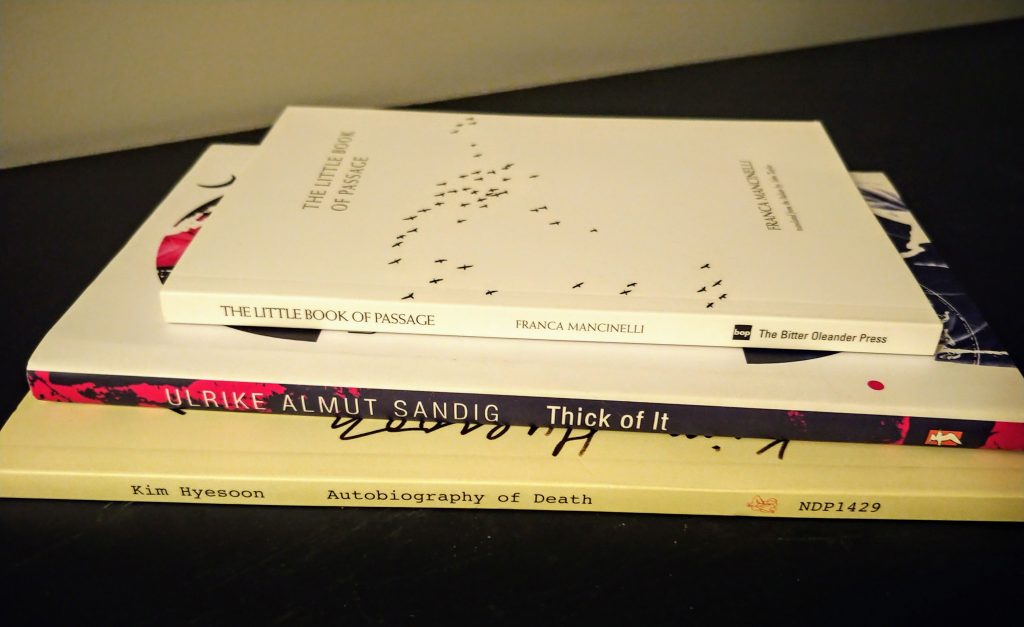
From the bottom up:
Korean poet Kim Hyesoon won the 2019 International Griffin  Poetry Prize for this book Autobiography of Death, a cycle of 49 poems and one longer piece inspired by national tragedies and personal experience. Her daughter’s distinctive illustrations accompany this powerful collection translated by Don Mee Choi.

Thick of It by German poet Ulrike Almut Sandig, translated by Karen Leeder, is a wonderful blend of the magical and the everyday. Fresh and alive.

Finally, Italian poet Franca Mancinelli’s The Little Book of Passage, translated by John Taylor, is a spare and delicate collection that invites rereading. Earlier this year she and I were able to meet and spend a few days together in Calcutta when my visit happened to overlap with a residency she was doing in the city—evidence that reading the world makes the world smaller in unimaginable ways!

*

Second, I wanted to highlight a book I recently reviewed that I am afraid has not had the attention it deserves:

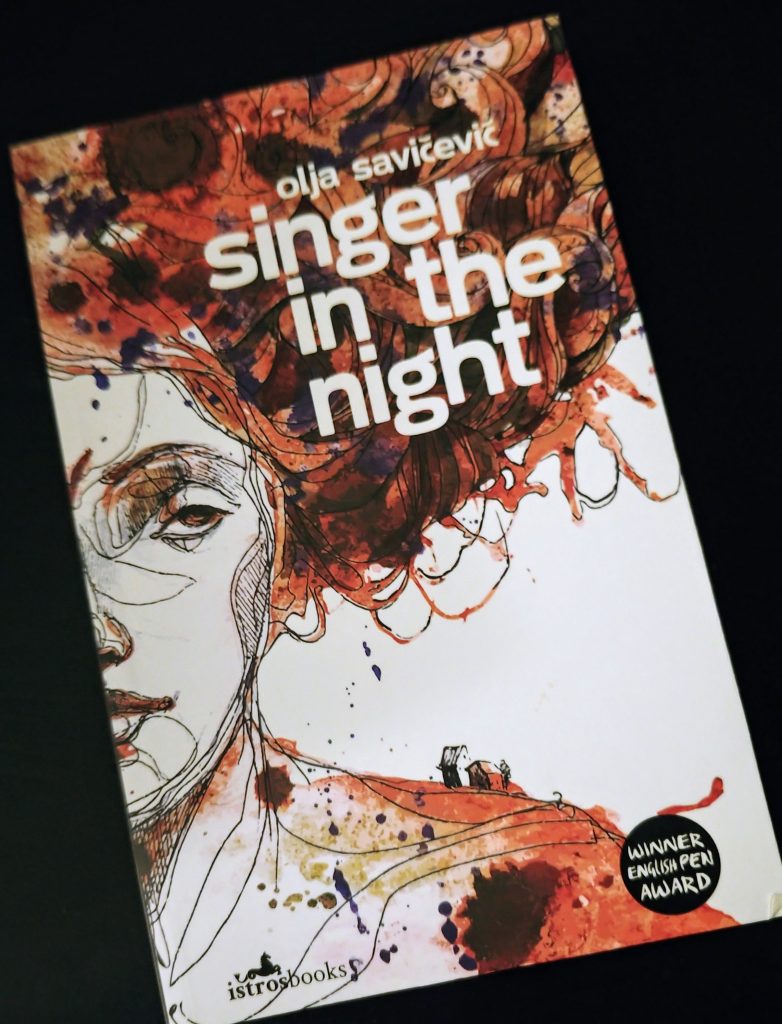
Croatian writer Olja Savičevič’s Singer in the Night features a wildly eccentric narrator and a highly inventive style to tell a story that paints a serious portrait of the world that her generation inherited after the break up of the former Yugoslavia. Translated by Celia Hawkesworth, this book is already available in the UK and well worth watching for when it comes out on October 1 in North America.

*

Third, I have an impressive stack of Seagull Books by female authors that I am ashamed to say I have not read yet (save for the poetry title tucked in here). The interesting thing for me about this selection is that although I did purchase many of these books, other titles arrived as unexpected—but very welcome—review copies by writers previously unknown to me.

Most of the above are German language writers; two, Michele Lesbre and Suzanne Dracius are French, the latter from Martinique. The review copy at the bottom of the stack is East German writer Brigitte Reimann’s diary I Have No Regrets.

*

Finally, I wanted to include a couple of translated titles by Indian women writers. Two vastly different offerings.

Translated by Kalpana Bardhan and published by feminist press Zubaan, Mahuldiha Days is a novel by Anita Agnihotri, one of West Bengal’s best known writers. She draws on the decades she spent in the Indian Administrative Service in this story of a young civil servant caught between her obligations to the tribal community she is working with and the state.  By sharp contrast, I Lalla, gives a fresh voice the poems of fourteenth century Kashmiri mystic poet, Lal Děd. A detailed introduction by translator Ranjit Hoskote provides a fascinating background to her life and the tradition to which she belonged, opening a world little known to most Western readers.

*

So, what are my best laid plans for this month? I would like to read one or two titles from my Seagull stack—not sure which—and I have a new Istros title Wild Woman by Marina Sur Puhlovski on my iPad in PDF format, but the following three books have been patiently waiting for August:

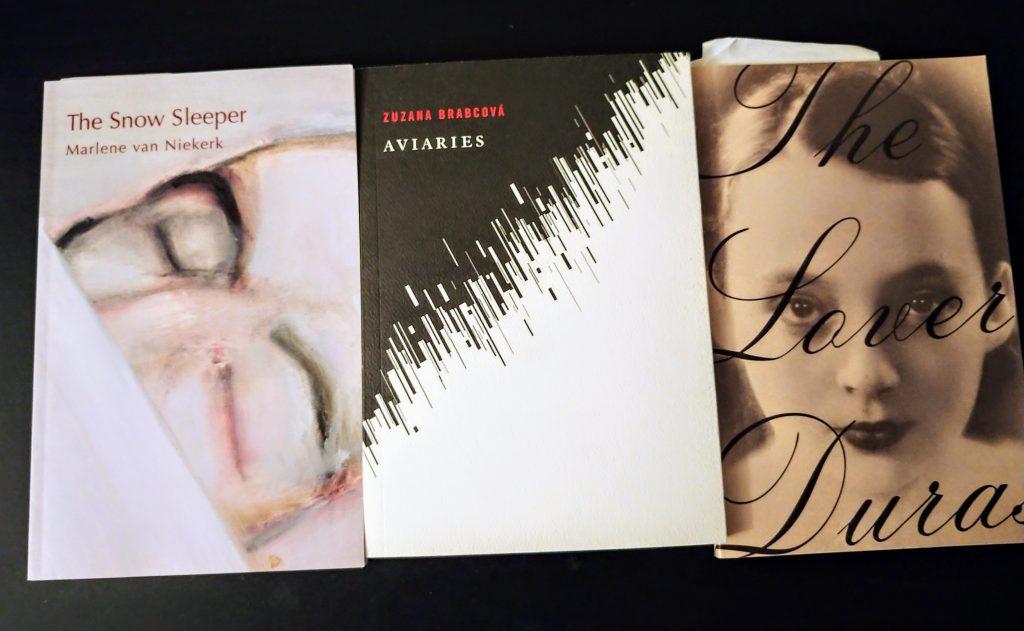
The Snow Sleeper by Marlene van Niekerk, translated from the Afrikaans by Marius Swart, is a recently released collection of short pieces, including “The Swan Whisperer” which was published as part of the Cahier Series.  I ordered it as soon as I heard of it—new van Niekerk is a rare and special treat.  Aviaries by Czech writer Zuzana Brabcova caught my attention when fellow readers and reviewers started talking about it so it’s another title I sought out when it was released here this spring. And last but not least, Marguerite Duras’ The Lover is a book I’ve been meaning to read for years now. Will I fit it in this August? Time will tell. And, of course, I reserve the right to change my plans altogether…

The nice thing about books is that, at least with the old fashioned solid form variety, they don’t vanish at month’s end if you don’t get to them. They will still be there on the shelf waiting no matter how much time I do or do not have to read amid all my other projects on my plate this August!

Writing the body: A link to a new poem published at Burning House Press

I have published very little work outside my blog over the past year. For a long time I  struggling with a serious writer’s block, something I have addressed here before. That had started to ease considerably while I was in India earlier this year, but when I came back, a period of editorial upheaval at 3:AM Magazine left me with increased editing responsibilities that have consumed much of my time and creative energies and, well, here we are.

Lately I have made an effort to claw some of that time back. I have contributed an essay for a book, pitched a critical piece I’m very excited about and even published a poem—my third piece to appear at Burning House Press.

This poem, “No (New) Man’s Land,” actually had its genesis in an earlier imperfect form, perhaps two years ago. I recently pulled it out again and worried over it until I was happy with the results and sent it in for consideration for this month’s theme: “Secrets&Lies.” It always thrills me to publish a poem or poem-like piece because I am an accidental poet. Occasionally I will go through a fit of scribbling down bits of random verse which then take years to ferment and maybe grow into a poem.

Here I am, once again, writing the body—a subject that is never far from my personal essay writing. “Your Body Will Betray You,” my first published piece, continues to attract a lot of attention three years after it was first published, and even if I would now use somewhat different language, I am proud of that odd little essay. But writing the body, especially when one is as dysmorphic as I am, is a vulnerable process. Catharsis is transitory. I’m finding that poetry offers a way to step back, pare the language, distort the imagery and grant a little distance to a story that is still entirely and inevitably mine. Employing third person (something that was a disastrous misstep in early stages of writing “Your Body Will Betray You”) can also make all the difference for me. That is what I chose to do with this new piece.

“No (New) Man’s Land” can be found here. With thanks to Robert Frede Kenter.

We live in a gingerbread house: In Life by Eugène Savitzkaya

“In this house, we live relentlessly, filling eternity with our detritus.”

Life sometimes holds the smallest, unexpected surprises. Unassuming, they come along and sit there quietly waiting to catch your attention until one day…

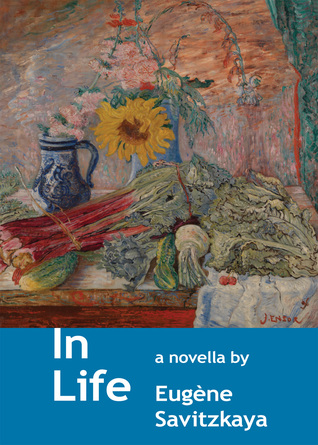
For me, those unanticipated gifts are invariably books. When, several months ago, In Life by Eugène Savitzkaya arrived, I was uncertain what to make of this slight novella with its simple cover featuring a still-life painting of flowers and vegetables. Savitzkaya, the publicity insert advised, is a French language Belgian poet, playwright, novelist and essayist, but what caught my attention was a link to an article about the author in Weird Fiction Review. Weird? That would not have been my first impression, it looks like such a simple text, yet as Edward Gauvin argues in his essay, the prose is minimal rather than abstract, but it is as if :

something has been subtracted from it, making us work harder for a fuller picture of what is being described. The result is a certain destabilization, dislocation, an alienation that does not distance you so much from the text as lock you alone inside it. Hence the usual adjectives: hallucinatory, intense, incantatory… the feel and unease of Weird.

With In Life, weird fiction is rendered domestic if you will, softly surreal, stubbornly anachronistic. In it, nothing happens and, yet, everything happens. Magical imagery, strange and wondrous, is applied to the quotidian ritual of hearth and home—cleaning,  cooking, repair and maintenance,  tending the garden, and nurturing of the soul of the house and its inhabitants. No task, no bodily function is unworthy of attention, often in unlikely detail. This is a book that revels in the minutiae of existence—the shed eyelashes and flakes of skin, the lost buttons, the crumbing walls, the weeds pushing through cracks in the walkway.

Above all, this is the story of a house surrounded by a garden, a neighbourhood, a town, hills, the sea and sky. A self-contained universe, from the crumbs that fall under the dining table to the scents that arrive on the breeze. At the heart of this universe, the house is a physical and metaphysical entity that must be maintained by those who dwell within, its contents sorted and preserved:

There isn’t only one way to tidy, but thousands—each necessary for structuring and mapping out the existence of the house, which is (well before it appears to be a system of doors, windows and walls) a whole system of alveoli. The simplicity of domestic life flows from the vast complexity of these alveoli. Just as you need a place for soap, you need a place for books. A place for sleeping and a place for sitting. A place for thumbtacks and a place for salt. A place for perfume and a place for stench. She who knows the place of each thing is capable of measuring the household’s degree of destitution or richness.

The narrator is a writer, a man with a fiancé and two children, a son and a daughter, echoing Savitzkaya’s own family, but this is not an autofiction, at least not in any biographical sense. His writing seems a secreted activity, gathered in snatches. He is aware of being unusual in that he is home at all hours of the day, actively engaged in caretaking, yard work, cleaning, ironing and, with special attention, preparing meals. His voice, however, is singular and plural, and shifts between perspectives. “We” might be the family, or a more comprehensive designation; second and third person may be employed to speak of others—for example the reader as an imagined guest—or to expand the universal nature of his reflections on the simple, most fundamental elements of life and the art of living.

Reading like an extended prose poem, this novella is a sensually charged evocation of the ordinary moment at its most ephemeral and most enduring. The narrator delights in unexpected imagery, sparking everyday rituals such as the family meal with fairy tale magic:

Thus assembled, we are ready to gobble a mountain of potatoes, loads of lamb, a cow, even an elephant. Animals fear us. But eyes are always bigger than bellies. They have a good sense of excess. As for us, we content ourselves with little, but have a yen to devour the world. We live in a gingerbread house. We drink birch sap from glasses made of sugar and when grief torments us, drops of brine fall from our eyes. We need light to eat—sun, honey or incandescent light.

Victuals are a central feature of life in this house, as one would anticipate. The meditation returns repeatedly to the growing, the preparation, the sharing, the bodily elimination and the disposal of leftover food. For vegetarians like myself, the meat content is considerable and carefully detailed, but, in fairness, the question of the respectful consumption of animals is not overlooked. Still, the passages on food are some of the most wonderful. After all, more than simply seeing to the nourishment of the family, the provision of food is an act of love with existential dimensions. Take for example, the act of peeling apples:

You can watch the blade as it slides under translucent skin. And, in your hand, you see a sort of phylactery unfurl, detailing the surface area of the fruit. This is a job that, if left only to me, would be eliminated evermore from the manuals of domestic life because an apple is a whole; the skin belongs to the flesh, the flesh is complete with the skin. Be that as it may, it’s worth the trouble. No activity, apart from washing dishes, is as soothing. From the instant that children ask for their slices of apples to bestowed on them without the peel, peeling becomes necessary and eminently interesting. Peeling becomes a way of being, a way of weighing the pros and cons, of conducting yourself in relation to objects, of searching under the skin for the illumination of flesh.

Love holds the house inhabited by Savitzkaya’s alter ego narrator and his family together. But the details fleshed out are not personal. It is as present in the cement troweled into cracked walls and the odours, fair and foul, that rise into the air, as it is in children’s laughter, or lovers in their shared bed. And embracing it all, is the garden. Here, as everywhere else in the universe contained within the pages of this small novella, reality is porous. It contains us but cannot be contained.

The garden’s only goal is abandon; it lives on abandon and thrives on the smallest opportunity to liberate itself and break through its imposed limits. Where is the garden? Between four walls or around the house? In the center or surrounding? In which garden am I sitting? In my garden. I am always in my garden, even when I’m not the gardener, and I don’t need anything, neither to move nor to identify what’s mine. It’s my garden because I’m there, because I live in it for just one second. And I part with it the next.

In Life is a small miracle of a book. It is a slippery object. Although it is filled with images and reflections on the tasks of daily life, it offers nothing firm to hold on to. In a way it is exactly like everyday existence—small moments, the beautiful and the mundane alike—slip by so quickly that we struggle to grasp them lest they be lost. We cling to impressions, to bits and pieces. Sometimes, we might even capture a few on the page.

Eugène Savitzkaya’s In Life is translated by Andrew Colpitts and published Quale Press. They have previously published a collection of his prose poetry, Rules of Solitude. In life is the first of his novels to be made available in English .

Are you afraid? In memoriam

In the last years, like a bird. Delicate, frail, angel wings slowly folding in embrace. Each time I saw her, after time away, the gentle shaking, the pale whitened hair startled me anew.

So tired. But still sharp.

Wise, but weary. Fragile, breakable, skin like frosted glass. Always able to ease, with a word, every worry I laid on her.

Three years ago today, my mother left us. Slipped away, ready to move on. Calm. Welcoming peaceful release from the simple struggle to breathe.

Gathered round her bed, we asked: Are you afraid?

No.

A thousand times, whispered:  I love you.

With a kiss to the forehead

I don’t know, for myself, the faith she held. Can’t quite imagine what it must have been like to feel assured she was leaving to join her parents, her sister, my sister, her God.

As she passed into to the night in one ICU, across town my father slept unknowing on another hospital ward. Eleven days later he would join her. Once he learned that she was gone, he no longer had the need to fight.

Perhaps he was afraid to be left behind.

Mourning aside, these past few days have been difficult.

My son confessed what I’d already suspected. After three months sober, he was drinking. Again.

Truth is the periods of sobriety have been but islands in a decade-long battle. Six or seven months total over the past nineteen.

His grandmother lived to see none of these passages of hope. She would have been heartened with every dry spell, distressed with every setback.

She worried about us all. As mothers do.

Her spirit lingers, but I miss hearing her voice.

Ropes across the abyss: How Shostakovich Changed My Mind by Stephen Johnson

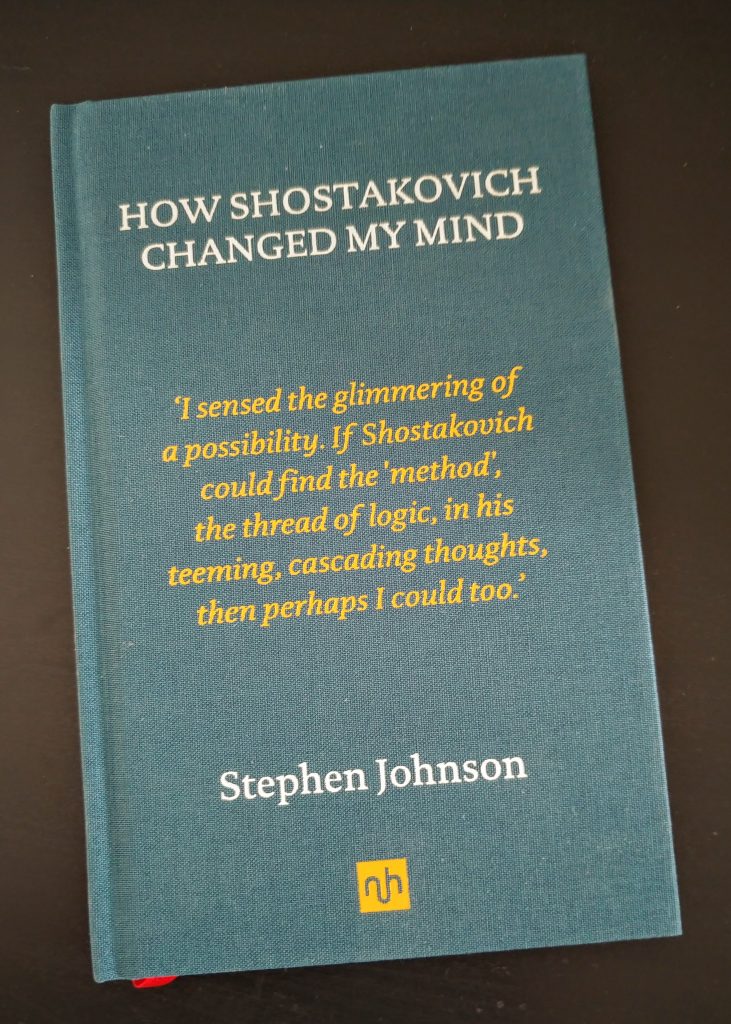
The opening pages of music broadcaster and composer Stephen Johnson’s How Shostakovich Changed My Mind detail what is clearly one of the most moving interview experiences of his career. He is in the St Petersburg apartment of Viktor Kozlov, one of the few surviving members of the orchestra that performed the triumphant debut of Shostakovich’s Seventh Symphony in 1942. He describes, with the clarinetist’s assistance,  how that performance was pulled together against all odds. Leningrad, as it was known at the time, was under siege, and Stalin not only wanted an opportunity to galvanize the beleaguered citizens, he wanted to send a message to Hitler who was waiting within earshot to celebrate victory. As an artist within a system that could turn against him in a heartbeat, the burden on Shostakovich to deliver a suitable masterpiece was immense. In the end, it was a rousing success. He managed to speak directly to the people’s emotions, and give them a reason to feel united in a time of war. The invigorated audience responded with an ovation reported to have lasted over an hour.

But here was something else too: that puzzling conundrum I had noted so often when pondering the appeal of Shostakovich’s music, but which now struck me with heightened force. In the Leningrad Symphony, Shostakovich had held a mirror up to horror, and reflected that horror back to those whom it had all but destroyed—and in response they had roared their approval, their delight, their gratitude to the composer for giving form to their feelings.

When Kozlov’s account of the event was complete, Johnson asked him a most formulaic question. He wanted to know how that same music made him feel when he heard it today, completely unprepared for the response. Both the elderly musician and his wife burst into tears—it was a question beyond any possible answer.

It is this ineffable power of music to reach into the deep emotional spaces in our lives where words often prove ineffectual, to give voice to that which we ourselves cannot express—especially in times of anxiety and distress—that becomes the very personal focus of this most fascinating book. Part musical biography, part memoir, part psychology and philosophy, this book-length essay draws its greatest strength from Johnson’s passionate affection for and deep connection to the music of Dimitri Shostakovich. His association with the composer’s repertoire reaches back to his own difficult adolescence when, ignorant of the world of rock ’n roll, he sought comfort in the Shostakovich’s thundering chords. Blessed with an acute musical memory, he was able to carry fully orchestrated movements in his mind in a manner he compares to a romantic teenage infatuation, during the times when his mercurial and unstable mother’s volatile behaviour made life otherwise unbearable. This uncanny musical aptitude serves him well as a writer. His ability to breathe life into complex orchestrated passages and open up the key elements at play in major works, is likely to inspire readers to download or stream the pieces under discussion, or pull dusty records or CDs from their shelves. It is not necessary to engage an aural experience in the reading, but it does tend to be difficult to resist the inclination to do so.

As one might imagine, given the unusual title, How Shostakovich Changed My Mind is an intimate account of the intersection of music with the personal drama, and trauma, of life lived. Johnson draws on literary, philosophical, neurological and psychological resources as he explores the connection between music and the brain, an area of growing interest and investigation, but he anchors his inquiry in the story of Shostakovich’s life and work during some of the most tumultuous events of the twentieth century—a thoroughly fascinating account in its own right—while tracing out his own particular relationship to this music and the role it played , not only in adolescence, but in his own adult challenges with bipolar disorder.

Shostakovich’s music can be wildly moody, shifting abruptly from lighthearted to savage to slow and achingly sombre. But it is not without structure. In listening carefully, Johnson became attuned, early on, to the thematic connections that he describes as ropes stretched across the composer’s own abyss, a bridge of sorts. It is a fundamentally important discovery for someone with a mood disorder—a condition I also understand too well:

As a bipolar sufferer, I know what it is to experience manic flight. At its worst it has been truly frightening, like a bad, drug-induced trip. Even when I’m not manic, I’m aware of how my conversation can go off on sudden tangents. Some of my friends have found it entertaining; others have found it bewildering, even alarming. It certainly alarmed my mother although she could be as dizzyingly tangential as anyone I’ve ever known. It was another aspect of my behaviour that provoked my father into panic-stricken attempts to close me down. I became seriously concerned about my own ‘intoxicating and leapfrogging’ thought processes—until, that is, I came to know Shostakovich’s Fourth Symphony. As I found Shostakovich’s connecting ropes and pulled them taut, it was though he personally was reassuring me. The exhilaration I felt was not dangerous; it was controlled, expertly rounded off by this extraordinary music.

If Shostakovich reached one troubled and alienated youth, it is not this particular music alone that holds the key. Johnson muses if he had been exposed to rock music he might well have found similar comforts and a peer group to share it with as well. But it matters not. The magic, if you like, lies in a link between music and listener, through a mechanism folded into the evolutionary structure of our brains. One that has the power to ease isolation, to unify, and to move both the individual and the crowd from “the ‘I’ to the ‘we’” as witnessed on that August night in Leningrad in 1942.

Moving deftly between the artistic, the scientific, and the autobiographical, this extended essay, never gets bogged down or off track. It makes no effort to be exhaustive, after all, at the core of the book is the relationship between the music of one very enigmatic Russian composer and the author whose life has been influenced, possibly even saved by it. Johnson’s own story unfolds like a well-crafted symphony itself, building through layers, in and out of the various streams of his narrative, to reach the point at which he was caught at the opposite end of the bipolar dance—in such an agonizing state of despair that suicide seemed the only way out. Again, he captures well the reaction of others to this side of the manic-depressive experience. In his darkened, unreliable state of mind, he came to believe that ending his life would not only ease what had somehow become an unbearable emotional pain, but would free up his wife Kate to get on with her life without the burden he felt he was invariably placing on her:

Depressives can be immensely frustrating for those who live with them. They tend to go around in the same anxious, obsessive circles endlessly; to the worried onlooker, it can seem that they actually don’t want to be helped; and they can be horribly irritable. For my part, I had still to learn that exasperation is more often a sign of love than its absence.

It was, ultimately, a fortuitous sequence of events that led him to his therapist’s office when he had intended to cancel; a lucky mistake that enabled an emotional breakthrough—or breakdown—that would turn the tide. However, Johnson can’t help but wonder if Shostakovich’s Eighth String Quartet had played even a small role on his road to recovery.

A year earlier, he had been given an assignment to prepare liner notes for a new recording of the popular Quartet, a task that had necessitated close engagement with a work composed when Shostakovich himself had been suicidal. He wonders if the writing and playing of the piece in which the composer famously places himself—or notes corresponding to his initials—as the central motif, had made him change his mind about killing himself, or whether it was simply the fact that a friend had intervened and removed the vial of sleeping pills he’d had on hand. And there’s the challenge: Music can do many things in times of emotional distress—reaching us in our darkened state with an image that is more accurate than the bleak self-portrait we cling to. However:

it cannot, in the broader sense, ‘see’ us. It can prepare us for the moment when we are seen; it can function as a life-raft in the most terrifying seas—for years, if necessary. But the moment of salvage needs a real living other, to see us and to know us, to signal to us that we are still worthy of rescue. Music could not do that for me, not quite—but it brought me very close.

How Shostakovich Changed My Mind is a rich account of the life and work of one of the most important composers of the twentieth century, a wide ranging discussion of the ability of music to provide expression and meaning in times of joy and sorrow, and, most importantly, a personal memoir of how music can serve as a means to navigate madness, especially in those times when, from inside, all one knows is that something is not right. This is a book for a wide audience, but for myself, as someone who also suffers from bipolar disorder, it has given me a lot to think about and reflect on looking back at my own relationship to music—and this illness—over the years.

How Shostakovich Changed My Mind by Stephen Johnson is published by Nottinghill Editions in the UK and distributed by NYRB in North America. Shostakovich: A Journey Into the Light, the 2011 BBC radio documentary that sets the groundwork for this book can be found online here.