The Endless Summer by Madame Nielsen

The following review was originally published in the Spring 2018 edition of The Quarterly Conversation which is no longer accessible.

The Endless Summer by Madame Nielsen, translated by Gaye Kynoch. Open Letter Books.

I remember the year I became an adult. I was twenty-four. I had completed one degree, married, and moved across the country to continue my education. After rent, bus fare, and the student loans we’d secured, we were left with $10 a week for food and barely enough to keep the huge empty front room of our apartment heated through the frigid Ottawa winter. So we turned the registers off and retreated to the bedroom. Homesick, we missed our friends and families. By the end of the term we both recognized that something had been irrevocably altered; an intangible light had been extinguished. This was real life. We had grown up. Our own “endless summer,” that fragile Garden of Eden, was over.

“It is not the bite in the apple that makes the Fall. It is the idea of a life after this one-and-only now.”

Perhaps it is something you only notice once it’s gone; the last traces of a moment when you still believed in the possible, caught up in a lingering nostalgia for a time before the burden of responsibility took its toll. If only one could go back and recreate the mythical intensity of the past, eulogize the lost magic, just like the old woman whose most unusual story lies at the heart enchanting novel, The Endless Summer, by the equally enchanting Madame Nielsen.

The Danish transgender performance artist, has, over the course of her career, presented, masqueraded, invented, and re-invented herself many times, even having her birth-identified self, Claus Beck-Nielsen, declared dead along the way. (He was ultimately revived when the lack of any identity altogether proved too difficult to sustain.) The multi-facetted Madame Nielsen is a novelist, poet, artist, performer, stage director, composer, and singer. With The Endless Summer, newly released from Open Letter Books in a translation by Gaye Kynoch, Nielsen weaves a tale that sidesteps the common expectations of narrative progress and character development. Rather, an odd cast of characters is choreographed through a shifting, dreamlike landscape openly reminiscent of David Lynch, complete with digressions into side stories, tales from the past, and glances into the future. The stories are continually being started, interrupted, and resumed again. The influence of Proust and other French novelists is evident, but Nielsen’s wistful narrator, who will ultimately become an actor, demonstrates a strong theatrical sensibility throughout.

The novel opens with a simple statement, the oddly incomplete sentence: “The young boy, who is perhaps a girl, but does not know it yet.” This phrase will be echoed, with slightly different shades, gradation, and detail, throughout the text. Likewise, the other main characters’ defining characteristics or curious features will be continually evoked, elaborated, and elegized as the tale unwinds. This is, as the subtitle advises, a requiem. A deep melancholy is never far from the surface. But first there is the summer, the “endless summer” a nebulous state of being which exists outside of time, a world unto itself “where time and light stand still and the dust rotates and no one does anything, nothing other than living as if they were in a different era and a completely different location.”

The young boy, who is in fact in his late teens, but so slender, delicate, and shy, falls into this other world after meeting a girl, an ebullient, full-figured, dark-haired girl. He becomes her lover and slips into her household, joining her two little brothers, her jealous, gun-loving stepfather, and her enigmatic mother in a little white farmhouse. The last, a dazzling, long-limbed Nordic beauty spends her days riding her beloved stallion through the surrounding fields. The boy and girl spend their days in bed, losing themselves in one another’s bodies. All the while other characters are introduced, ready to take their places in the drama that will eventually unfold, we are warned, to its necessarily tragic end.

The narrative advances through a series of scenes played out on this other plane of existence, a fairytale space without distinct boundaries. It is not clear when it begins, or when it is truly over. This extended moment of impossibility, or rather, all possibilities, draws others into its sphere of influence—young men on the cusp of adulthood, wayward artistic wanderers, and those going nowhere, like the perfectly handsome, utterly unambitious Lars, the daughter’s best friend. Other characters circle, like satellites, around the periphery of this space of suspended reality, and thus on the edges of the story, providing substantive props against the ephemeral timelessness of the “endless summer.” Aware that the cautious reader may be inclined to advance with incredulity, the narrator is quick to advise:

… if the story so far sounds like a dream, a glossy tale of the kind one occasionally—on holiday or a long-haul flight—allows oneself to lean back into and, as if it were sinful, a praline, vanish within for a brief moment, then it’s because life is a dream, a dream from which you never wake up, but which one day is nonetheless suddenly long since over, but you’re still here and can either use “the rest of your days” to forget and “get on with it” or on the other hand, like me, abandon what is and try to retrieve what was, even the tiniest little thing that has been lost, even what perhaps didn’t really exist but nonetheless belongs in the story, call it forth and tell it so it doesn’t vanish but on the contrary now at last becomes real and in a way more real than anything else.

At the nexus of this act of remembering is the almost otherworldly presence of the mother, a romantically idealized woman, cool, impenetrable, and independent, who casts a spell on all who fall within her orbit, including the Portuguese artist half her age who will become her lover. The slender young boy is clearly enthralled by her, by “the inscrutability and the light that makes it impossible” for him to ever be finished looking at her, “because as soon as he glances away for a moment he has a feeling that he has not yet seen her.” She can be thought of as the embodiment of womanhood to which he, the boy who might be a girl but doesn’t know it yet, is unconsciously drawn. His first sexual and gender explorations are deeply enmeshed with the softly rounded body and pleasure-loving spirit of the daughter, but it is the mother who holds him in awe.

The only character about whom we have no solid background, who falls into the “endless summer” with little more than a passing reference to a family that pretended they had money but in truth had none, is the narrator’s own past self, the slender young boy. The rest of the cast, even those who pass through peripherally, have a story, with dramatic beginnings and occasionally exceptional, but most often disappointing or tragic ends. Early on, when he is spending his days lost in bed with the girl, she entertains him with accounts of her childhood with her grandparents in Spain, her discovery of the truth of her real father’s identity, and the details of her stepfather’s inherited wealth and decline into possessive aggression. It is noted that she has lots of stories. He, on the other hand, has only those he creates.

So this story, this winding, dreamy, melancholic tale of the “endless summer” and everyone and everything it contained, where does it lie? In memory? In longing? Or in the romantic imagination of the “weird cobweb-flighty female being” that the young boy, who might be a girl but doesn’t know it yet, ultimately becomes?

The success of this unlikely, sprawling reverie with its expansive cast and uncertain timeline lies in the emotionally absorbing, reflective tone of the narrative. To read is to submit, to trust the voice. The repeated descriptive motifs are reassuring rather than affected. When new characters appear, instantly vivid portraits are created with the capture of curious details and ineffable traits and qualities:

And shortly after midnight, the two Portuguese arrive with their rucksacks, the one, the pen pal, actually not so dark at all, far from it, tall and strong and with golden curls, Peixe, he is called, “The Fish,” but where he comes from they call him “o Vikingo,” the other one is smaller but equally masculine, dark and mysterious, a little shy like a wild cat, the same soundless movements, an abrupt laughter cracking his face in a flash of light that has disappeared before you have seen who he is.

However, the illusory nature of the entire enterprise, this attempt to recreate the transcendent quality of the “endless summer,” is never denied. Little by little, disillusionment and disappointment dilutes and denudes the magic; characters begin to fall out of that other world, and back into this one. But the end of the “endless summer” is as mutable as its onset.

The transformation of the slender young boy into an old woman lost to her memories is never openly explored. It is an inevitability written into the texture of the account. Rarely does the narrator admit a first person pronoun. This is her (or his) story retold from the sidelines of his (or her) life—a life in which “none of the things he promises himself or dreams about will ever come to anything, while all the things he has never wished for or promised himself will happen and amount to all there has been.” As a reader who was, at one time, a girl who was a boy, but didn’t understand it, I registered a particular resonance with The Endless Summer. The experience of living and writing across a gendered expression creates a haunting sense of disconnect, an otherworldliness. But this poignant novel is much more. It is a requiem for the death of dreams, and a hymn to keeping the spirit alive in the exercise of living beyond the moment when you still believed.

“Earth to earth, ashes to ashes, dust to dust.”


Ancient sorrows, modern woes: The Teeth of the Comb & Other Stories by Osama Alomar

Don’t let the current fashionable popularity of flash fiction deceive you—it is a form with a long history in Arab literature, an allegorical tradition to which Syrian writer and poet Osama Alomar proudly belongs. But, as an immigrant living in exile in the United States, his tightly crafted parables and short fictions have a quality that is both timeless and timely. We cannot but recognize ourselves and the world we live in today.

Free Elections
When the slaves reelected their executioner entirely of their own accord and without any pressure from anyone, I understood that it was still very early to be talking about democracy and human dignity.

In his most recent collection,  The Teeth of the Comb & And Other Stories, Alomar employs this traditional manner of storytelling to craft pieces that range from a single sentence to a page or more. Animals and objects—man-made and natural—are often animated to take centre stage, offering philosophical reflections on life, humanity, or wondering at strangeness of the universe. His narrators and protagonists, human or otherwise, speak to sadness, loneliness, and injustice while the shadow of his troubled homeland hangs over their tales. It cannot be ignored. The futility and violence of war is a frequent theme. These pieces may read like age-old wisdoms, but their message is immediate. If they sound timeless, it is because, at the end of the day, little changes.

The Dark Side
The moon wished to punish humans for the many transgressions and frightful crimes they commit against each other and against nature. She decided to hide her lighted side so that they would curb their behavior and return to reason. And so the eclipse took place. But great was the surprise of the moon when she saw millions of people coming out of their houses to enjoy the view of her dark side.

His style is spare and unsentimental. The shortest entries have a sharp aphoristic tone, whereas the longer ones, with a wider stage on which to play out contemporary themes, are painfully heart-wrenching. “Love Letter” is a long message addressed to a woman with whom the narrator was involved. It speaks to intimacy against a backdrop of war and revolution, an intimacy that deepened even after he left the conflict zone. When her letters and emails stop he fears the worst but holds to faint hope. “The Shining Idea,” one of my favourite pieces, is a dialogue between an unconceived child and the man he hopes will give him life. The would-be child sees only the beauty and joy in the world beyond the transparent boundary that contains him. The father he beseeches knows only suffering and poverty and cannot be convinced that his is a world worth bringing another life into.

Time and again, knowledge, compassion and understanding are the ingredients most at risk, or missing altogether in the world Alomar presents us with. His weary narrators and anthropomorphic characters know this well. But, in keeping with the tradition from which he emerges (Kahlil Gibran is one of his heroes), his messages are never forced or dogmatic. They are simply laid bare for the reader to encounter:

 Never Been Touched
A book sitting on the shelf with torn covers and pages filled with comments and notes in the margins said to his colleague who stood behind him, “I envy so much your freshness and your eternal youth!”
But his colleague answered him dejectedly, “I never been touched!”

With over 160 stories spreading across no more than 95 pages, one might be tempted to consume the accessible, entertaining short fictions that comprise this collection in quick succession, swallowing one after another. However, these fables, wisdoms and cautionary tales are best digested slowly, over a few days perhaps. At once beautiful and urgent, they deserve a little extra attention. The chorus of their voices deserves to be heard.

The Teeth of the Comb & And Other Stories by Osama Alomar is translated from Arabic by C J Collins with the author, and published by New Directions.

Revisiting a past review: A little radiance: Farewell, Cowboy by Olja Savičević

The following is a re-post of a review originally published on April 28, 2015. WH Smith Travel have selected this title as part of their Fresh Talent 2018 campaign, so readers in the UK—or visitors passing through airports and railway stations—have a special opportunity to discover this lively, affecting contemporary Croatian novel. Keep your eye out! It would make an ideal traveling companion.

Everything’s the opposite of what it seems: hell is a comfort to the living, while heaven is ordinary blackmail.

A deeply personal piece of unfinished business draws Dada, the spirited heroine of Farewell, Cowboy, from the towers of Zagreb, back to the grimy streets of her hometown on the shores of the Adriatic in this debut novel from Croatian poet and writer Olja Savičević. Once she arrives, her first task is to relieve her older sister of the responsibility of keeping track of their mother who seems to be surviving on a routine of pharmaceuticals, soap operas and bi-weekly treks to the cemetery to visit the graves of her son and husband. But at the heart of Dada’s return to the Old Settlement is a need to lay to rest her questions surrounding the suicide of her beloved younger brother Daniel several years earlier.

Dada is feisty, in keeping with her fiery hair, an attribute she shared with Daniel and their late father who succumbed to at an early age to asbestos poisoning. An aficionado of the western film, spaghetti and American classics alike, her father spent his final years working at the local movie theatre and then, after the war, in a video store. He bequeathed to his son his love of western heroes and a jammed Colt pistol.

Upon her return to the Old Settlement, Dada settles in to her room under her brother’s fading movie posters, gets an old scooter running and cruises through town on her mission to piece together the past. She recalls the eccentric playmates with whom she roamed the streets and encounters a most beautiful young man who appears and reappears, usually playing a harmonica. Meanwhile it seems that a movie crew has moved in to shoot a film on a drab grassed expanse that will double as the prairie for a project spearheaded by no less than a legend of the bygone era of the spaghetti western.

The primary focus of Dada’s pursuit however, lies closer to home. The family’s neighbour, known to most as Herr Professor, a veterinarian who had befriended Daniel, has resurfaced. After a violent attack triggered by rumours about his sexual proclivities, he had disappeared. Months later, seemingly without warning, 18 year-old Daniel threw himself beneath a speeding express train. Now the old vet has returned. And Dada is certain he holds the key to her brother’s death; in fact she is bitterly obsessed with a desire to confront him, to confirm that he is the author of a cryptic typewritten letter that arrived a few weeks after the funeral, a letter that seemed to indicate that Daniel had been trying to contact the sender. Face to face over cake and brandy she cannot quite say what she wants. She grinds her teeth over his melancholy insistence that “I don’t ask anything of life other than a little radiance.” What on earth is that radiance he asks for, she wonders.

This postwar Balkan world is one of decaying architecture, graffiti scarred walls and woodworm rotted buildings. Tourists are moving in or passing through. Modern technology and old customs exist side by side. Dada is a most engaging heroine, her voice rings through the grime and dust of her environs with a cool crystalline clarity and youthful spirit. For example, after tracking down her former room-mate she recalls that her friend had considered herself the last emo-girl:

‘You’re certainly the oldest emo-girl, and probably the last’, I said.
I imagined her as a little old Gothic lady, but little old ladies, at least the ones here in the Settlement, are generally Gothic in any case, it’s in their dress code.
My room-mate and my Ma would get on well, I reflected. They could go to the graveyard together and shave their heads in keeping with the Weltschmerz.
I’m thinking as though she had settled in my head, I reflected, immediately after, anxiously. I really am my sister’s sister.
Sar-cas-ti-cal-ly, I reflected, in syllables.

Savačević continually surprises with the originality and energy of her prose, translated skillfully by Celia Hawkesworth. Images are revisited, lines repeated, like refrains, throughout the novel, creating a very dynamic and original flow. Tragedy lurks in these pages, but what could be a dismal heartbreaking tale is lifted with humour and thoughtful asides. And that is the sense that lingers.


The restless traveler in an imaginary world: Invisible Countries by Sylvia Brownrigg

Each edition to the Cahier Series, the joint project of the Center for Writers and Translators at the American University of Paris and Sylph Editions, is a short meditation that, like the gatefold illustrations within, opens up to encompass a larger, wider world of ideas, words, and meaning. Running to less than forty pages apiece, half typically given to specially selected images, these small volumes  invite the reader to slow down, take a little time, enjoy the journey. The reward is a story, fable, or essay that lingers in the imagination.

The latest Cahier, the thirtieth, is Invisible Countries by American novelist Sylvia Brownrigg, an author new to me. Evoking a mood reminiscent of Calvino’s guide to fantastic metropolises, this contemporary fable traces a female traveler’s visits to seven imaginary destinations. Each encounter is unsettling and unnerving in its own way; each locale hovers somewhere between the realistic and the impossible; and each country embodies a concern of our modern global existence. Samarkind, for example, is an island nation with boundaries that are shifting and threatened by rising ocean waters. It might seem counterintuitive, but the response to their shrinking land mass, has been to construct a tunnel under the waves to serve as a connection to the mainland, and that is how we see our traveler warily making her way to the island:

The train dips, a singsong announcement is made in a pair of languages – the distinctive Samarkind full of hiss-clicks and spirants spoken with native confidence; the other, romance-influenced but hesitant, uttered with deliberation, for profit – and then the visitor watches the world go dark. The moment gives an inkling of the planet’s approaching apocalypse; she shudders. She is in a lit moving bullet that penetrates the ground. Down, gradually, down; then level. Above the visitor’s head, though it hardly bears thinking about, is a tremendous body of water, alive with sea creatures, ocean vessels, corpses, aquatic plants, and debris – plastic bags, shipwrecks, messages in bottles that will never reach their intended shores.

We will learn that this far-seeing island state, once reticent about visitors, is planning to recreate themselves as a modern-day Atlantis in an inevitable underwater future.

Thanistan is, as its name implies, is a harsh, silent country that is likely more appealing to the dead (and philosophers seeking peaceful reflection), whereas Alluria, a land promoted with bright and inviting posters promising relaxation and fun in the sun, is but a façade, briefly enjoyed, of a dismal, impoverished world. The exact nature of the place is only hinted at. Lured there once, no one returns for a second visit. One can, of course, travel to a disadvantaged society and stay safely ensconced within the environment of an inclusive five-star resort. Isn’t that what “getting away from it all” promises?

These encounters with foreign spaces, fraught as they are with anticipation and disillusion, anxious border crossings, and concern about understanding and being understood communicating in foreign tongues within cultures with different mindsets (“as she mentally formulates her response, the visitor becomes uncertain whether the agent indeed said to her, ‘Don’t worry,’ or whether it might have been ‘You would worry, you could worry,’ or possibly even the command – ‘Worry!’”) are delivered with such a delicate touch that a strange, haunting beauty comes through. The allusions are offered and allowed to lie as they are, each trip only touches the surface of the visitor’s experience, leaving the reader to wonder how each adventure unfolds and reflect upon what these strange, evolving, troubled landscapes have to say to us now, travelers as we are, together on a finite planet.

Accompanying Brownrigg’s imaginary travelogue are a series of vivid chalk and charcoal illustrations by British artist Tacita Dean. Lush bright scenes alternate with grey, abstract, stormy images to reinforce a sense that this journey has taken us to places that, if nowhere, could be anywhere at all.

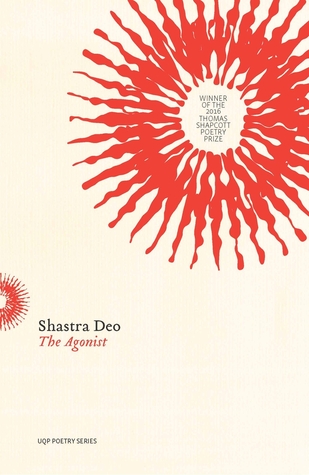
The beauty of bloody fists and broken bones: The Agonist by Shastra Deo

Once again, my attention turns to a work of contemporary Australian poetry, and this time it’s a remarkably gritty, often grisly, exploration beyond the raw edges of physical and emotional endurance. Embodiment. Disembodiment. Lyrical evisceration.

Evoking characters and imagery drawn from diverse, seemingly unlikely sources—anatomy textbooks, World War I poetry, a scout manual, boxing, entomology, ichthyology, divination, tarot cards—Shastra Deo’s debut collection, The Agonist, is an impressive, unforgettable experience. Like a sucker punch to the gut.

But in the best way possible.

Agonist: (n) one that is engaged in a struggle

The narrators that move through these poems—the voices Deo borrows or inhabits—cover terrain familiar to poetry. They speak to pain, love, loss, damage, healing. But they engage with the world at a visceral, cellular level. Their words work their way into and through the hollows of memory, exploring what slips though the passages of the brain, examining what the muscles retain and imagining the intersection between reading the past and foretelling the future.

So what does that entail? The Agonist is divided into three sections, each of which opens with an illustration from Gray’s Anatomy. Many of the poems in the first section deal with relationships, familial or romantic, employing surreal thaumaturgic, and anatomical imagery.

“Arrhythmia,” for example, details the painful, desperate emotions of the partner not ready to accept that a love affair is coming to an end:

             You count the notches of his spine.
His eyelashes flutter and he sighs, his breath
so warm that for a moment you can
pretend you aren’t cold. You want
to crack him open and hold
his heart in your hands, sink your fingers
into the thin membrane of his lungs.
You want to pull back his skin
and curl up inside his ribcage.
You want to know what he is inside.
Find the symptom, the sickness,
the anomaly that let him love you.
You want to be warm again.

Deo is adept at creating a surprising, brutal beauty in her romantic imagery. We see it again with “Cutman,” a graphic, meaty piece that opens the second section of the collection. Here the connection between a boxer and the attendant who cleans and cares for his wounds between rounds is reimagined in intensely intimate context:

He comes home each night with his hands soaked red,
and when he smiles it’s sharp and jagged and his teeth
quake in his wet mouth. You card your cold fingers
through his hair and lead him to bed, wait
for the weight of his arms around your neck, warm
and drowsy, the familiar shape of his bones and tendons
cradling the base of your skull…

In this part, Deo calls on themes drawn from war and boxing to engage in dialogue with other poets and experiment with poetic form. Included are three centos formed from the Index of Titles and First Lines in The Penguin Book of First World War Poetry. Moving into the final section, inspiration is found in, among other things, a Boy Scout manual from 1914 and a deck of Tarot cards. Consider “XIII—Death”:

. . . I live in the present tense,
tensed and present at the wheel
of a car wreck. My name is re-
membered. I apologise too often
for my lack of biography. He
does not yet know what divinity
he belongs to, but he knows I was
not born for this. He takes the
sheets off the mirrors. He escapes
our mythology.

In my experience of this work, which is of course, all I can honestly speak to, The Agonist is a collection in which the sound of the words and the impact of images are central, the point from which a narrative emerges and takes form. These are not autobiographical poems, for the most part. Nor do they read like “stories” so much as they remind me of paintings or photographs out of which vignettes have been abstracted with vivid, scalpel-sculpted, incantatory language.

Reading this book has left me with the sense of having spent time in a gallery. Attending a deliriously disturbing exhibit.

Shastra Deo was born in Fiji and raised in Melbourne. She presently lives in Brisbane where she is pursuing a PhD in Creative Writing. The Agonist is published by University of Queensland Press and, as ever, the indefatigable Tony Messenger has a review and interview with Shastra on his website.

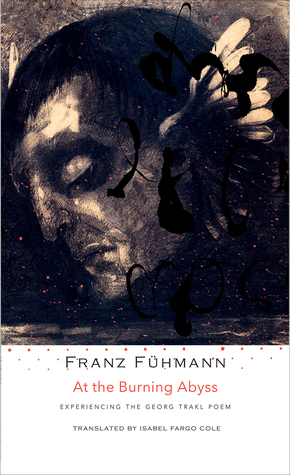
A poetic Pentecost: At the Burning Abyss by Franz Fühmann

I am not certain what has become of the person who first alerted me to the poetry of Georg Trakl, but it wasn’t very long ago and came backward through an interest in Celan. Then, over the last few years, Seagull Books released three volumes containing all of Trakl’s poems including significant variants and early versions, in new translations by James Reidel. I read and wrote about them all even though I had no particular confidence in myself as a reviewer of poetry. I’ve also explored other translations and biographical accounts of the troubled Austrian poet’s short life. So when I became aware of At the Burning Abyss: Experiencing the Georg Trakl Poem by Franz Fühmann, my interest was piqued. Finally, to be fully prepared, I recently read Fühmann’s autobiographical story cycle, The Jew Car.

I thought I was ready.

But no, nothing could have fully prepared me for the experience of experiencing At the Burning Abyss.

Fühmann was an important literary figure in postwar East Germany; a gifted, versatile writer who was no stranger to either reading poetry or fledgling efforts to write it when he first encountered Trakl. It was early May, 1945, just prior to the surrender of the Wehrmacht. As a young soldier in the German army, Fühmann had been granted a few days sick-leave following a stay in the hospital, and was taking advantage of the opportunity to visit his family. As bleak as things looked for Germany at the time, a reckless hope was still smoldering. Sitting with his father after dinner on the evening before he was due to leave for Dresden, he opened the volume he’d chanced to pick up in a used bookstore on his way home. One poem in particular, ominously titled “Downfall,” resonated:

Over the white pond
The wild birds have taken flight.
In the evening an icy wind blows from our stars.

Over our graves
The night bends its broken brow.
Under oak trees we sway on a silver barge.

The city’s white walls ring for ever.
Under vaults of thorns
O my brother we blind clock-hands climb towards midnight.

He knew nothing of Trakl but a conversation with his father that night revealed that the latter had served alongside “daft old Georgie” in the early days of the First World War. But beyond recollections of an eccentric character, Fühmann learned no more about the poet for many years. He would never see his father again, and his poetry book would be abandoned along with his coat and backpack a few days later. But the verse had worked its way into his consciousness and would keep him company and inspire his own desperate scribblings during his years in a Soviet POW camp in the Caucasus.

The Franz Fühmann who emerged from captivity in 1949 was a born again Socialist. He had seen the error of his ways, faced the reality of the horrors of Aushwitz, and rejected the false tenants of Nazi ideology on which he had been raised and indoctrinated. The final story in The Jew Car depicts the arrival of his fictional alter-ego in East Germany, his train journey into a new homeland marked with the composition of a suitably ambitious piece of Socialist-inspired realist poetry. However, his reunion with the decidedly anti-realist imagery of Trakl would soon occur.

Slowly, and steadily, the poems will challenge everything that he thinks he knows about reading and writing poetry, ultimately challenging his Socialist idealism and his own self-awareness.

At several points in At the Burning Abyss, Fühmann reminds his reader that the he is not writing an autobiography, insisting that he is engaged in a meditation on the experience of reading Trakl. However, this experience acts as a fundamental force within his own biography and cannot be read apart from it. His account of his personal response to Trakl is presented in first person singular against a broader examination of how a poem, and a couple of select pieces in particular, can and should be understood. This second thread is conducted as an extended first person plural conversation with the reader. His questions and concerns become our questions and concerns, we are invited to seek answers together.

He wants to know how the poem works on the unconscious, what gives it meaning, and what allows it to work across time and place. At the core of his examination is a conviction that the experience of a poem is necessarily subjective; that:

… a poem does not become a poem because it fulfils certain formal rules, but because a reader constitutes it. Until then it merely appears to belong to the genre of poetry, a dead form, interesting only once the interest in the poem as an artwork awakens.

The reader may take decades or even a century to appear, but if he does not, the poem does not come into being as poetry: there is no objective poetic form that legitimizes something a priori as a poem in the sense of an artwork.

This is then, a highly idiosyncratic engagement with the Trakl poem, but one that assures the reader that his own personal engagement with a poem, any poem, has its own validity. One should not be afraid of understanding wrong, or relating to something others eschew as unworthy. For, as he quotes Rilke in the opening sentence of the book: “poems are not feelings…they are experiences.”

For Fühmann, “Downfall” is the first Trakl poem that strikes him, across two decades from the time of composition, to capture the very moment in which he came to it. The blind clock-hands toward midnight climbing recur and echo throughout the text, joined in time, by other lines from other poems that become refrains, driving and troubling the attempt to resolve the dissonance that grows the further he explores Trakl’s poetry and life.

In his reading, an indication that the Trakl poem might reflect Decadence triggers his initial crisis of faith, if you will. Anxiously, Fühmann opens his text and lands, randomly on a poem filled with shocking imagery—“Night Romance.” He finds a “dreaming boy” with a “face decaying in the moon,” a murderer, a dead man, and a “nun with lacerated flesh” praying “naked before Christ’s travails.” All the features of decadence assembled and yet, somehow, the verses hold an undeniable appeal. Thinking of other poems, Fühmann’s anxiety increases:

What was this morass on which I’d lost my way?

And so it goes. The discussion turns to meaning. How literally can images be understood? Much of the focus turns on the poem “Decay,” but Fühmann insists that Trakl’s entire oeuvre can be seen as one great poem, so the discussion has broad application. Images of decay in all its aspects frequent his poetry, as do “autumn, “evening,” and “garden.” What weight can be applied to the startling images that appear, and to what extent is an exact explanation—a resolution of poetic riddles—possible or even desirable? If a mystery can be answered, is it answerable universally or for the reader alone? And, what role does the poet have in relation to the misery he or she records?

Of course, the questions, Fühmann raises are directly related to the threat Trakl poses to his schooling in the Socialist poetic form encouraged within the GDR. There is no place for mystery—a poem should be understood “at first go.” To rid himself of this contrary influence, Fühmann tries to destroy his Trakl books, but find himself unable to do so. He looks for comfort elsewhere, translating Vitězslav Nezval into German, for example, and finds himself sliding headlong in Surrealism! He seeks refuge in alcohol. For a long while, he struggles to mediate the conflict between the literature (and the grounding ideology) to which he is committed and this Austrian poet about whom, apart from his father’s cryptic recollections, he knows little. Having long professed to having little interest in the writer’s life, he suddenly desires to know all he can.

Shocked by his first encounter with Trakl’s awkward visage inside the covers of the slender biography he finds, Fühmann makes his way through the book in a single, fevered night. He is drawn into the account of “an unliveable life: an existence that fell to poetry.—An existence that fell to drugs and incest; a fall into decay, a plunge into suicide; a life at the zenith of European poetry.” What follows then, is a biography within this memoir, which includes the complete text of the sole eyewitness account of Trakl’s final days in a Krakow hospital.

Continuing to alternate between the analysis of what poetry can tell us about its author and, more critically, what it reveals about ourselves, Fühmann’s personal journey of self-discovery moves forward with an intensity that is powerful, irresistible and fundamentally human. The experience of the Trakl poem changes him and allows him to heal in a way doctrine never could. The reader can feel his pain and his passion, appreciate his conflicts and share his exhilaration when everything finally falls into place. “I believe in poetry,” he says, “because it works like fate—provided you stand within its magic circle.”

Well said, indeed.

At the Burning Abyss by Franz Fühmann, is translated with great dedication and affection by Isabel Fargo Cole, and published by Seagull Books.

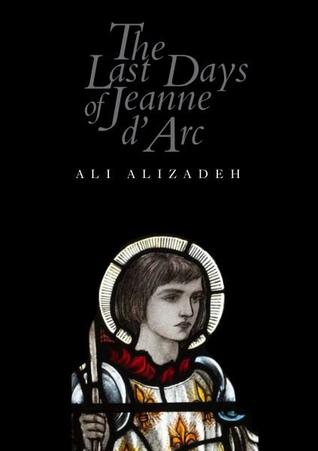
A delicate madness: The Last Days of Jeanne d’Arc by Ali Alizadeh

Jeanne d’Arc has been the subject of countless historical, literary and dramatic accounts, and it is likely that, at least in the western world, everyone has some image they associate most readily with the famed young woman who donned men’s clothing and led the army of France to a series of decisive victories against the English during the Middle Ages. The rough outline of her story is so ubiquitous in our culture that it is likely difficult to recall one’s first encounter. But I certainly remember my most intense moment of identification with the Maid. It was late May, just over twenty years ago. I was, at the time, at the height of an episode of psychotic mania that would lead to a bipolar diagnosis and, ultimately, to an understanding of the deep gender discomfort I had felt for as long as I could remember. At the time however, I was a mess. Female-born and married with two children, my ex and I had endured a few years of destructive soul searching on my part. My madness, complete with visions, was just one more thing we tried to survive in the desperate hope that it would all pass. In my experience I’d seen drag queens and butch lesbians but no one I identified with. Until May 30, when I suddenly realized—and to this day I don’t remember how or why I knew it—that it was the feast day of Joan of Arc. In this convergence I saw a message. I saw myself. In the state I was in, the timing was fortuitous and seemingly miraculous. In the end, the ultimate moment of self-understanding was still a number of months ahead, but I will ever think of Jeanne’s appearance on my journey toward belated manhood with a mixture of embarrassment and wonder.

When I first heard of the premise around which The Last Days of Jeanne d’Arc , the recent novel from Australian author, Ali Alizadeh is constructed, I was skeptical. It triggered my frustration that, looking back in history, cross-dressing women are typically conflated with lesbians or “straight” transmale identities, in these days of heightened trans awareness. However, it’s not always accurate, historically or today. But that is another matter. My initial negative reaction quickly turned to curiosity the more I heard about the unusual, innovative approach taken in this account of a life that has been celebrated, and excoriated, in so many well-known renditions over the past six centuries.

For Alizadeh, who was born in Iran and emigrated to Australia in his teens, the fascination with Jeanne d’Arc is long standing. It goes back to his childhood years.  His enigmatic heroine was the subject of an epic poem he wrote for his PhD and it is this background—a comprehensive understanding of the historical material combined with the spare elegiac prose of a poet—that allows him to create a curious, sensitive, and deeply human portrait of a complex historical figure.

The Last Days of Jeanne d’Arc, as the title implies, is structured around the final days of Jeanne’s life. After months of brutal interrogation, she has renounced her Voices and her actions by signing a letter of abjuration. She has saved herself from a charge of heresy, torture and execution, but now she is imprisoned in a cold, damp cell beneath the Treasury Tower of Rouen Castle. Forced to remove her male attire and put on a white gown, she feels vulnerable and alone. However, it seems that there is something more weighing on her, a sense that her passion runs deeper than a divinely inspired drive to serve her King and country—something much too fragile and painful to remember.

As Jeanne’s story is fleshed out, the narrative will return repeatedly to this dim prison, and each time we will know her a little better. But, Alizadeh, a skillful storyteller, takes his time, inviting the reader to remain open to possibility. Effectively employing an inventive style that weaves together a chorus of voices and shifting perspectives, The Last Days avoids falling into the morass of detail that can drag down more conventional historical novels. Narrated primarily in the present tense, from a third person perspective, the historical context and military conflicts are presented in a spare, dated, often time-stamped, documentary style echoing nonfiction prose poetry. It is blunt and remarkably effective:

1413

In England, Henry V succeeds his father, the Lancastrian usurper of the English throne. Twenty-seven years old, a grotesquely scarred face. An extremely devout Christian, not at all the fun-loving, riotous youth of Shakespeare’s future play. Severe and frankly soulless. Muscular. Possibly a psychopath, probably a war criminal. Is never seen to smile. Must prove himself to the English nobility as their ruler, as a real, mighty man. Or else his dynasty may be toppled just like the dynasty his father toppled. Is keenly aware of the turmoils in France. Decides that the time has come to renew the claim to the throne of France…

Once Jeanne enters history and, in her first battles proves her value, the narrator gradually moves closer into her thoughts, letting the account slip back in time again, to meet our heroine as she hits adolescence. It is at this time that young Jeannette, as she is still called, has her first visionary encounters. It is also the when she begins to sense that the affection she has for her childhood girlfriend is of a somewhat different order. Before long she finds herself distanced from the other youth of her village. She is excessively pious and decidedly indifferent to the idea of dancing with boys, marrying and having babies—something her peers are well on their way toward achieving by their early teens. There is a soul wrenching loneliness in being set apart like this, by desire and, if her beloved Saint Catherine of Alexandria is to be believed, by divine destiny.

As the narrative turns to follow Jeanne’s life more directly, her Voices are allowed to speak, set apart in italics and indentation, appearing to float in the text. Jeanne’s own voice also enters, slipping in periodically either to comment on or clarify the account, or to address another, a “you” who remains, for a time, unnamed as in this passage, just prior to her first encounter with her Voices, where perspective and tense shifts several times:

She has never been caught in such a terrible storm and there is so much pain in her skinny body. I struggled to stand back up. The whole world flared up in the lashes of blinding lightning. The rain immersed my being. She is kneeling, paralysed by the mud. My tears merged with the rainfall. (Did I tell you, my love, how exactly it happened?) The thunder strikes harder and the rain is now a flood and it is in this cascade—why do historians insist it was a sunny day?—amid the fruits and plants being washed away by the storm that Jeanette clenches her fists. It is then that she howls back at the unforgiving sky. She rips off her scarf.

O God O angels O Saint Catherine.

Are you there?

Are you there?

 Allowing room for Jeanne’s voice to reflect back on her experience deepens the intimacy of the present tense narrative. This polyphonic quality will become more pronounced as other emphatic voices interrupt with curses and threats as the story progresses toward its inevitable and unfortunate end.

The portrait of Jeanne d’Arc that emerges over the course of this novel is one of a mix of vulnerability and determination. We see a young woman torn between her convictions and her doubts, conflicted by her desires, and isolated from others by gender, lack of education, and the unconventional role she plays. She is never entirely free from concern about the reality of her Voices and her own sanity, especially when her entreaties meet silence. And, while she becomes hardened to the violence and gore of the battlefield, she grows increasingly distracted by her love for another woman and all of the complex emotions that such a forbidden affection arouses. What comes across is a certain naivety. She is, after all, young (only nineteen at her death) and has, in a sense, been protected from the kind of demands of life that would have hardened and matured her peers who married early. So although she becomes an experienced soldier and commander of men, her romantic love affair has an idealized, almost adolescent intensity that betrays her youth.

Alizadeh does not offer this speculative image of Jeanne d’Arc as a lesbian woman lightly. He knows the relevant documentary material exceptionally well and is aware not only of the limitations but of the spaces where possibility resides. His narrator respects his heroine, balances the historical account with the personal, and situates his chronicle to the contemporary reader. His Jeanne is a medieval heroine for a modern imagination, his novel is an absorbing, lightly experimental, and human re-imagining of the life and death of a young woman who has never ceased to be the source of inspiration and intrigue.

As I can attest.

The Last Days of Jeanne d’Arc by Ali Alizadeh is published by Giramondo.

With a multitude of voices: Star Struck by David McCooey

There is a line from Rilke’s The Notebooks of Malte Laurids Brigge that has haunted me since I first encountered it about a month ago. Quoted at the opening of Franz Fühmann’s At the Burning Abyss it reads: “For poems are not feelings, as people think (you have feelings early enough)—they are experiences.”

A simple statement, but one that instantly made sense. Poems are experiences. Rilke goes on to insist that everything the poet observes, everyone he or she encounters becomes part of the potential material for a poem. I have read a few highly praised poetry collections recently, typically by popular younger poets, that seemed to be exploiting emotional intensity without sufficient substance. By the end of a short book I tend to feel a little bludgeoned by the sameness and relentlessness of the imagery. I find myself wondering what the same poet might be like with just a little more life to draw from. Experience.

And so to my first review of the year, which happens to be the last book I finished in 2017. It is a collection of contemporary poetry and, once again, it’s Australian. David McCooey’s Star Struck is another book that came to my attention through a review and interview on Tony Messenger’s website. What initially drew my attention was a very immediate and personal connection. I was intrigued by the fact that one of the sections was inspired by his own encounter with a life-threatening medical event. Like McCooey, I have spent time on the cardiac ward and, whether the circumstances differ or not, there is nothing quite like heart trauma to upset your fragile equilibrium. To this date, I have not been able to write about my own experience, much of which is forever lost to my memory. And so I was curious to see where he would take his own explorations. Of course, I also found much more.

Star Struck is a lyrical collection, rich with musical and literary references, that relies on a wide range of voices and characters. Two poems, both titled “This Voice,” frame the work, reflecting the ambiguity and universality of speakers to be found within:

It goes without saying
that it sounds like your voice.
But is it yours? And if
not yours, then whose?

In his interview with Tony Messenger, McCooey admits that the second person “voice” here is intended “to be alienating, and to undermine simple ideas of my poems simply expressing ‘my voice’.” This is an awareness that continues, in varying forms throughout the main body of the text. Divided into four sections, the first part, “Documents,” traces his hospital adventure, from presentation at Accident and Emergency through surgery to rehabilitation. The experience is recounted with a level restraint that is mediated by the use of the second-person perspective. Addressing himself at a distance has several advantages—it allows the poet to ensure that it is not entirely about himself, accommodates exploration of some of the oddity of the hospital environment, and, as I read it, captures the strange surreality of the patient experience itself, the temporary suspension of control required:

There had been an earlier
waking,
in the ICU,

a time you have
deeply forgotten,
when you had the worst

of it—the pain, the detubation,
the harrowing scenes
of your return to life…

– from “Intensive Care (ii)”

Literary references appear throughout this work, his cardiac patient turns to Calvino, Muriel Spark and Tomas Tranströmer, while Georges Perec-style constraints shape a simple domestic scene; but since McCooey is also a musician, it is no surprise that he delights in incorporating characters and themes drawn from popular music into the eighteen dramatic monologues that comprise the third section of Star Struck, “Pastorals.” Here he takes on the voices of artists like Joni Mitchell and James Morrison, imagines scenes involving rock stars, music fans, and even peers out of the eyes of a caged primate watching a curious tailless creature  in a poem with the Peter Gabriel-inspired title “Shock the Monkey.” There is a restrained  confidence in these resulting mini-portraits that shift effortlessly between male and female speakers, taking their cues from music, musicians, movies, along with classic poetic sources, to give voice to those moments in life marked by association with an artist or piece of pop culture.

Poems as experience.

What marks the reading of this collection for me, moving in and out of it for several weeks as I have, is the way that the simplest observations can be spun into narratives that hint at a larger story. This is not say that there are not pieces that take on grander themes—“Election,” for example takes direct aim at the detention centre on Manus Island—but it is in the ordinary that we see ourselves. However, being drawn to this book for its hospital poetics, if you will, the poems that struck closest to home for me were those that revolved around the experience of illness and recovery. The final poem (before the closing version of “This Voice”) is one of my highlights. The narrator of “La Notte: A Tale of the Uncanny” is a widowed sixty-two-year-old who is recovering from a recent illness and surgery. It is a extended meditation on aging, loneliness, and the strangeness of post-illness existence, every other stanza an aside in parentheses:

I put off the performance of dinner, deciding
instead to have a lie down. Perhaps I had, after all,
overdone things a little by going out that afternoon.

(Time takes on a different quality when one lives alone;
the hours I sometimes longed for thirty years ago
can now feel like a ghostly presence in the house.)

I went to the bedroom, which used to be my son’s,
about to lie down, when something caught my eye.
The small glass owl on the windowsill had been moved.

(I do not say ‘had moved’, since such objects can’t move
by themselves. This goes without saying, I know, but I
want to make it clear this is not a supernatural story.)

Sometimes serious, sometimes satirical, Star Struck offers much to enjoy. Unsentimental, but attentive to the nuances of character, McCooey highlights the passions, regrets, and familiar associations that bind us in this accomplished collection.

Star Struck by David McCooey is published by UWAP, the poetry series of UWA Publishing of the University of Western Australia.

One last glance back at 2017, as 2018 dawns

A little more than a week ago I marked the solstice on a rather positive note after another difficult year. The holiday season has been, however, more painful than I had anticipated. The weather has been brutal—as I type this, the temperature is in the low minus twenties, think -28 or -29C with a wind chill factor approaching -37C, and we’ve received about 30cm of snow or more—which has contributed to a marked degree of cabin fever. But what has weighed on me most heavily is a peculiar loneliness, a very personal emptiness, and a measure of anxiety about some of the changes I thought I was looking forward to, like selling my house and moving into an apartment. I’m feeling a little conflicted now, oddly because if my son manages to stay sober, I think less of escaping a bad situation and think more about the advantages of having someone else around, at least until he is well stabilized and ready to move on. (Okay, there’s also the fact that he saved my life a few years ago…)

Taken this afternoon. Does it look cold? Copyright Joseph Schreiber, 2017

However, now that the end of 2017 is upon us, I can distract myself for a moment by looking back over my year in blogging. Although I started this blog in mid-2014, I did not begin to seriously write about books, or venture into the realm of mini personal essays until the end of that year. In the three years since, my blog has grown steadily and, I hope, developed a bit of a reputation for being unclassifiable. This year I noticed a marked increase in traffic from Canada and Australia, a result, I suspect, of my increased engagement with readers and writers from both countries. Still the largest number of viewers came from the US and the UK, followed by Canada, Australia, South Africa, and India. My most popular review written this year was, by a wide margin, of Welcome to Our Hillbrow by Phaswane Mpe. Mine must be one of the only reviews of this book online; it was even cited in an extensive overview of post-colonial African literature—the only blog review cited in the entire article. This book is a classic of early post-Apartheid South African black literature and I can’t understand why it hasn’t attracted more attention—clearly it was being studied extensively this year judging by the traffic generated. The second highest number of views for a 2017 review was for The Major Refutation by Pierre Senges (tr. Jacob Siefring), the third, My Heart Hemmed In by Marie N’Diaye (tr. Jordan Stump) and the fourth for Fleur Jaeggy’s Sweet Days of Discipline (tr. Tim Parks). The 50/50 split between new releases and older titles in this selection highlights one of the advantages of blogging—not being bound to focusing exclusively on recent releases as is so often the tendency in other literary venues you can read and write about whatever books catch your fancy. Or not. This year I read much more than I reviewed here or elsewhere.

My own occasional reflective posts, which always make me feel mildly self-conscious, tend to be very well received, generating more hits than the majority of my reviews. Considering that the reviews typically take me much longer to write, it never ceases to surprise me that people actually want to read my idle ramblings… something to hold on to as I start to finally (yes, finally) tackle my memoir project in the year ahead. I’ve been piddling around on this front, to be honest. But it’s so terrifying to put one’s own life on the page. However, I trust I’m not the only personal essayist to struggle with this conflict. As I’ve mentioned several times in recent months, the work of French poet, essayist and ethnologist Michel Leiris has occupied much of my attention this past year (with much to keep me going in 2018). I had expected I would write some kind of a “review” of Scratches, the first part of his four-part autobiographical project Rules of the Game, yet I can’t quite imagine how to write about this book. It has become embedded in my consciousness, and interwoven with my reading of his dream diary, Nights as Days and Days as Nights, and his massive travel journal, Phantom Africa.

Long before Knausgaard starting dissecting the minutiae of his experience, Leiris was reflecting, musing, analyzing, and agonizing over the stuff of his life and, more accurately, his emotional and intellectual engagement with the world as mediated by language and memory. Scratches begins with his earliest recognition that language held magic and secrets that he could unlock as he came to understand the meanings of words. Throughout the book his discourses, which range widely from childhood amusements to recent events and back again, hinge on the associations he has for certain words or phrases. (Lydia Davis’ remarkable translation seamlessly weaves the French words into the text so that the layers of sound and meaning ring through.) It can be quite wonderful to get swept up in his winding and circuitous streams of thought. However, what I love about Leiris is his idiosyncratic emotional volubility. He easily swings from being proud and confident, to wallowing in despair and self-doubt. If the contemporary “journey of self-discovery” model of the memoir enforces the notion that life has a narrative arc that leads to growth and improvement, Leiris is not the model. In fact, much of the time he simply seems to be travelling in wide sweeping circles without getting anywhere at all. Nor is he wretched enough to stand as a forerunner to the popular misery memoir. But he doesn’t hesitate to indulge in a little morbid excavation of his weaknesses and failures when his mood plummets. I well imagine this annoys some readers, but as someone who has struggled at length with mood regulation, I adore the honesty and the way he somehow manages to drag himself out to firmer ground. Toward the end of Scratches he very nearly gives up his entire autobiographic endeavour worrying that he has reduced himself to “a sort of aged child, a prisoner of a bygone period and henceforth shut off from all action—even thought—involving the future.” In his anxieties, I see reflected my own insecurities about committing to a long term project. He justifies his decision to break off work on his book saying:

Since the literary work to which I am devoting myself with such difficulty seems less and less uplifting and no longer necessary (since it gives me nothing beyond what I put into it myself more or less deliberately), it would be better to abandon it and wait for a more favourable time. And right now the most serious hope I have for recovery is to let everything lie dormant until the anecdotal illness ailing me… and my brain cleansed by this period of repose, I can shed my old skin. To come into a new skin after a long period of obliteration in blankness, like a drum one has beaten too persistently and which, even though its body may still seem in pretty good shape, absolutely must have its vibrating skin replaced by a fresh one.

Of course, he not only recovers his enthusiasm but will go on to produce three more volumes after this.

So, looking ahead to 2018, I have a small selection of books that I am especially keen to read, but I know better than to make any public lists. I do want to continue a steady diet of poetry, learning how to read it more deeply, and write some of my own. But writing and photography have to take centre stage. Most immediately, I am heading to India in February to spend a couple of weeks in Kolkata where I hope to be able to find some distance from home, a wealth of inspiration and a little quiet time to write.

Copyright Joseph Schreiber, 2017

Happy New Year to all. Here in my hometown, and in many cities across Canada it is so cold that outdoor celebrations have been cancelled. But if the meteorologists are right, we should start to climb out of the deep freeze tomorrow as 2018 rolls in.

Crazy in love with words: Attrib. by Eley Williams

Many year-end lists, especially those with an eye to the world of indie publishing, have been abuzz with praise for the linguistic gymnastics of Eley Williams and her debut collection Attrib. and Other Stories. And rightly so. Even those readers who might be strangers to experimental fiction have found themselves captivated by the slippery, dazzling wordplay on display. This book—which I read with this month’s Guardian Reading Group, a forum I’ve scarce had time for in recent years but where I probably first learned to analyze, articulate and defend my response to literary works—is certainly a highly entertaining, intelligent, tightly crafted foray into a slightly surreal space where words have a weight and reality that seems to hang in the air, creating the ground for an unusual assortment of narratives.

However, as one might expect, some stories are more effective than others, and though each reader is likely to measure impact differently, I couldn’t help feeling that the whole was somewhat more than the sum of its parts. This is a book well worth experiencing, but one might wonder where Williams could take this type of wordplay from here. Could it be expanded to novel length or does she have her sights on other literary visions? Fortunately, as Reading Group participants, we were able to pose our questions to her yesterday, and rather than rehash that discussion here, I would suggest anyone interested in getting a sense of the exuberance and energy that virtually bounces off the pages of Attrib., to have a glance at the webchat —the same spirit and charm comes through in her responses.

The stories that comprise Attrib. find their origins in the simplest ideas. In the most basic pieces, dictionary definitions and wordplay spark clever scenarios; in the more substantial offerings, her protagonists have odd occupations, want to express how they feel but lose themselves in microscopic self-inspection, or are beset by strange psychological afflictions. Somehow Williams manages to have fun and touch at real anxieties and emotions at the same time, even in the most curious tales.

Her gift for juggling words is evident from the opening entry, “The Alphabet,” artfully subtitled: “(or Love Letters or Writing Love Letters, Before I Forget How To Use Them or These Miserable Loops Look So Much Better On Paper Than In Practice)”. Here the narrator is dealing with a progressive form of aphasia, trying to hang on to her ability to use language as it erodes and, along with it, her relationship:

The plot, yes—the condition of its being lost. I have a great deal of nostalgia for having the plot and a full vocabulary. Both have been lost gradually along with the—what is it—marbles. My marbles, specifically. We have come to specific marbles. I have lost it, I have lost my marbles and I have lost the plot—the Holy Trinity of losing I have lost my faith in—wham bam thank you m’—ma—mate. Maybe the plot was connected with my marbles in some way. Maybe one plays marbles on a plot, plot being synonymous with pitch or field or court. I lost them all long ago is what’s important. Two weeks ago. You took my marbles and it with you and I appear to have mislaid the plot.

In my years working in brain injury, I encountered many people dealing with varying degrees of aphasia, and this bittersweet story captures beautifully, the spirit of losing one’s facility with language.

The title story, “Attrib.”, which, according to her Guardian Q&A was completed just before the manuscript of this collection was submitted, is a stand out—the magic of inspiration under pressure, perhaps? The narrator who has a hypersensitivity for sound, is Foley artist working to create incidental sounds for a soundtrack to accompany a gallery exhibition on Michelangelo which will feature reproductions of his major works. How exactly do you capture just the right sound to signify the Creation of Eve anyway? The theological and practical considerations that arise make for a most amusing dilemma.

While Williams shows herself capable of spinning the simplest idea into delightful yarn, one of my favourite pieces, “Bulk,” demonstrates her ability to orchestrate an eccentric cast to create a story with surprising depth of character. The narrator is a natural history museum employee who joins a collection of onlookers gathered around the carcass of a dead whale washed up on the shore. The protagonist, ostensibly the professional in the situation betrays a lack of confidence and unwillingness to take control that seems, more than anything, to reflect the smallness of humanity against the mass of the proud creature who has met such an unfortunate, undignified end:

‘I will touch it!’ declared the young woman suddenly with a renewed vigour and she slipped from her partner’s arm and ran in an arc out towards the head of the whale, picking out a route over the rocks with shoeless feet. There was an ungainliness about her small size next to the great bulk of the whale. There was an unbalance to the scene on the shoreline generally, as if a note was being sung off-key, or somewhere a pair of parentheses had been left unclosed.

Finally, the majority of the stories are first person narratives and in most cases, the gender of the narrator and, if relevant, the love interest is left unspecified. As a differently gendered reader I tend to be both gender sensitive and gender ambivalent. I like the openness that this approach allows in the reading, and I often prefer it to the awkwardness that sometimes comes through in cross-gendered narratives (authors writing from the opposite gender perspective), but whereas one can develop the personality of the narrator in a short space, the “you” addressed in the more romantically themed pieces can reduce the potential emotional depth of the situations. It is even more challenging when this kind of approach is extended over a longer format. This was the nature of the question I posed to Eley Williams in the chat (you can see it under my uncreative user name “jmschrei”). She responded that she left gender unspecified when she did not think it was crucial to the story but admitted:

I didn’t find writing ‘genderlessness’ a constraint, not wittingly anyway: I think for a reader confused acts of heroism don’t require specific or non-specific awareness of genitals.

Nice answer. I wish real life was more like that.

Attrib. and Other Storiesby Eley Williams is published by Influx Press.