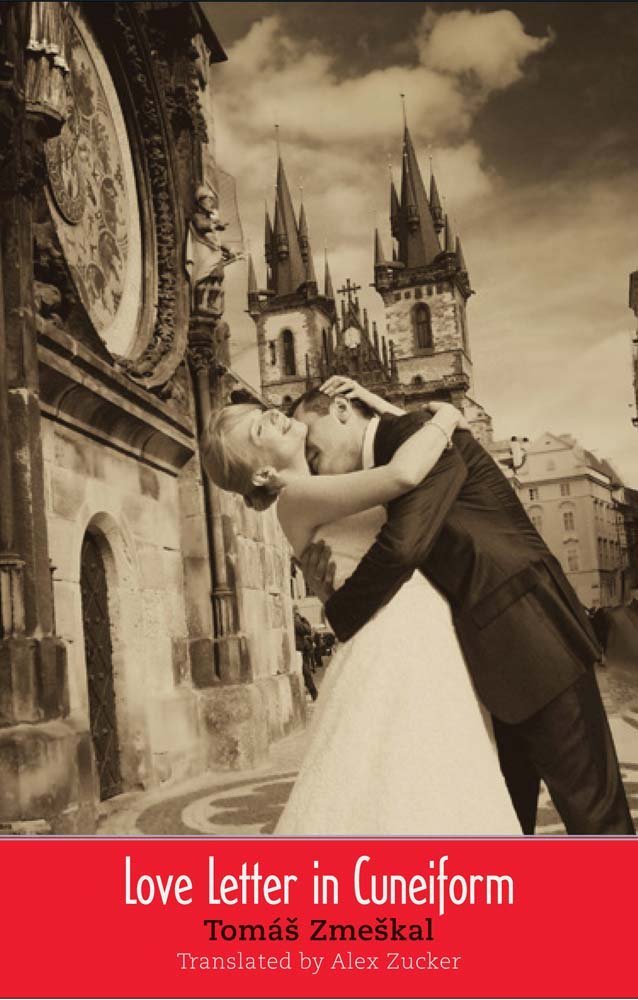
If all happy families are alike, each strange family is strange in its own way: Love Letter in Cuneiform by Tomáš Zmeškal

The novel begins with a wedding.

Alice and Maximilian exchanged rings and kisses, and signed a document confirming that the state of matrimony was primarily a contractual arrangement, which at the moment was of course the last thing on the newlyweds’ minds. After the ceremony, the priest invited the wedding party to the sacristy. Now, whether they liked it or not, Alice and Maximilian were on their own in the world. They answered everyone’s questions,  chatting about the declining quality of sacramental wine under the communist regime. Alice joked and laughed with her friends, while Maximilian drank a toast with  a bottle of slivovice, which, as usual on occasions like these, somebody suddenly seemed to pull out of nowhere, but through it all the metallic lace of their new situation slowly began to envelop them, closing in on them, fragment by fragment. Slit by slit the lacework net descended on them, enveloping them, protecting them, sealing them off.

Actually, there will be two weddings, because only the civil service later in Prague can be recognized by the law. But in the time between the two ceremonies, the couple and their friends and families gather in Alice’s parents’ apartment where her father’s friend, Dr. Antonin Lukavský, has a surprise in store. He has commissioned the eccentric pastry chef Marek Svoboda (who we will soon learn is also the doctor’s patient at the psychiatric hospital where he works) to prepare a cake for the festivities. And what a cake it turns out to be—an elaborate three-tiered marzipan castle of mythic proportions depicting, from top to bottom, the heavenly heights, the earthly realm, and a rich chocolate hell. So although it may be billed as a family sage, it’s clear from the start that  Tomáš Zmeškal’s Love Letter in Cuneiform will be anything but ordinary.

For one thing, Alice and Maximilian’s marriage is not the central focus and the “metallic lace” enveloping their new marriage does not prove very resilient because, after the birth of their son Kryštof, it unravels quickly. Rather, it is the marriage of Alice’s parents, Josef and Květa which runs the course of the novel, from the end of the second world war through to the early years of the 1990s, even if they themselves are separated and then estranged for most of those years. Love is a complicated affair for all, it seems. Meanwhile, as the family drama unfolds in a strange and sometimes disturbing fashion, Svoboda the pastry chef regales his doctor with fantastic visions that span both time and space. The result is an ambitious, layered work that is by turns tragic, philosophical, and absurd.

Zmeškal was born in Prague in 1966 to a Czech mother and a Congolese father. In 1987, he was granted permission to leave Czechoslovakia and travel to London, but when the Iron Curtain fell two years later, he chose to stay on in the UK to study English language and literature. Finally, in 1998, he decided to resettle in his home town where he soon began work on what would become his first novel. Following a lengthy search for a publisher, Love Letter in Cuneiform was finally released to widespread acclaim in 2008, with an English translation by Alex Zucker following in 2016. As Zucker notes in his Afterword, original reviewers responded to this unique, award-winning novel with efforts to place Zmeškal within the context of Czech post-Velvet Revolution literature. But that might be too limiting. Zucker argues that it also makes sense to look beyond the boundaries of the author’s homeland as well, indicating that Love Letter’s distinct labyrinthian construction and mythogenic qualities call to mind Borges, whereas an underlying “paranoia and slippery identity” may even suggest Philip K. Dick. It is, to be fair, a work that defies attempts at simple summaries, and is, in fact, perhaps better approached without an overly detailed road map.

The love story of structural engineer Josef Černý, lover of classical music and passionate devotee of the slide rule, and his wife Květa may be the central thrust of the novel, but the narrative does not proceed chronologically. Rather, it unfolds in fragmented pieces with shifting styles, forms, and voices. Letters of varied types, including a formal appeal to authorities to address a past crimes and lengthy romantic plea in cuneiform script, take up some of the key aspects of the story, while a forged letter does irreparable damage. But this is no epistolatory novel—the letters form only part of the picture and go only one way—nor does it confine itself to Josef, Květa, their daughter, grandson, and a few friends and extended family members. There is also the side story of the pastry chef, the most eccentric character in a cast of idiosyncratic individuals who not only terrifies a would-be thief with his bizarre marzipan creations, but entertains the good doctor with his detailed psychotic visions. He tells of a strange, manipulated existence in the Arizona desert, a journey to ancient Persia, and the assignment to repair a mysterious device in a Prague hundreds of years in the future. By bending expected storytelling conventions, vastly expanding the time scale, and playing with genre, Zmeškal crafts a tale that is not only heartbreaking and human, but that opens up plenty of space for questions of good and evil, immortality and death, belief and atheism, and of course, the endurability of love.

Josef first met Květa when he and his friend Hynek Jánský were at University during the war. Both men took a liking to her, but she chose Josef. Then, in the early years of their love affair, Josef was introduced to cuneiform through an odd coincidence. He learned in a class that his birthday, November 24, 1915, corresponded exactly with the date that Czech orientalist and linguist Bedřich Hrozný announced to a meeting of the German Oriental Society that he had deciphered the language of the ancient Hittites, a people who lived in Anatolia (present day Turkey and Syria) three thousand years ago. This sparks his interest in the curious wedge shaped script that originated in Mesopotamia but was adapted by other cultures, and the idea of solving the riddle of a previously unknown language. When he shares it with Květa, she tells him she is certain he could do the same. “She had a better imagination than I did,” he confesses, “she always has, and over time I learned not to oppose her using logical arguments and facts.” So it becomes his secret mission to crack some as yet untranslated language.  Or at least learn to read cuneiform.

Josef and Květa marry after the war ends and welcome Alice, their first (and only) child, in 1950. But their old friend Hynek soon plots his revenge. The communist government has taken advantage of his “talents” of persuasion and punishment, and promoted him accordingly. He arranges for Josef’s arrest and ultimate imprisonment on obscure charges. As a result, Josef will be gone for the first ten years of his daughter’s life. Uncertain what to do, Květa turns to Hynek hoping he will help her free her husband and thus begins one of the most deeply disturbing aspects of the book—a prolonged and brutal relationship that, when it is later exposed, will drive Josef and Květa  to part shortly after Alice’s wedding. Alice stays in her family apartment to raise her son after her own marriage ends , Josef spends most of his time at the rural house where he grew up, and Květa moves in with her aging Aunt Anna, an outspoken spinster with an opinion on everything. And life goes on, fraught with heartbreak, misunderstandings, and stubborn resolve. Alice is caught between her parents, while Josef forges an increasingly deep bond with his grandson. Finally, the Iron Curtain falls and a newly independent nation and its citizens are left to find their bearings in a world of new possibilities.

Some reviewers of the translated text have suggested that the novel loses its intensity in its later chapters, but it is perhaps more accurate to describe what occurs as a change in tone as threads of the story begin to converge. The central characters—Josef, Květa, Alice, and the seemingly indestructible Aunt Anna are all getting older. Kryštof, now an adult, has become accustomed to the countryside where he has spent so much time and has set his sights on marriage to a girl his grandfather insists on calling “the blonde.” But into the mix comes a distant cousin,  Jíří (or George), a young man of Czech heritage, related to Aunt Anna but born abroad and raised in England, who arrives to experience his ancestral homeland now that the Iron Curtain has fallen. He stays with Alice and works in the city, but his regular letters to his sister offer his impressions of their ancestral nation and its peculiarities (not to mention the oddities of their relatives) often revealing more of the evolution of Czech society and the transition from communism to capitalism than he realizes. This is yet another layer that Zmeškal deftly weaves into his broader narrative tapestry.

Love Letter in Cuneiform is a novel that challenges and exceeds the norms of a multigenerational family saga at every opportunity. Josef and Květa’s love story has a grand, tragic arc to it that mirrors the kind of conditions—unfaithfulness, cruelty, misunderstanding, separation, failed attempts at reconciliation—that often tear lovers apart in mythological traditions. In an interview with Words Without Borders, Zmeškal confides: “I love old stories and myths, and I think that whatever changes in the world, we still live similar lives, though in different circumstances, of course.” That spirit comes through. This is a novel that is on one level very much bound to the history and politics of Czechoslovakia (as it was known from 1918 through 1992) through the second half of the twentieth century, while, on another level, it is a larger-than-life and often very funny tale of love, loss, wisdom, madness, and evil—though not necessarily in that order. Throughout, its unique energy is sustained in translation with Zucker’s careful, and at times creative, attention to the subtleties and playfulness of Zmeškal’s language.

Love Letter in Cuneiform by Tomáš Zmeškal is translated from the Czech by Alex Zucker and published by Yale University Press.

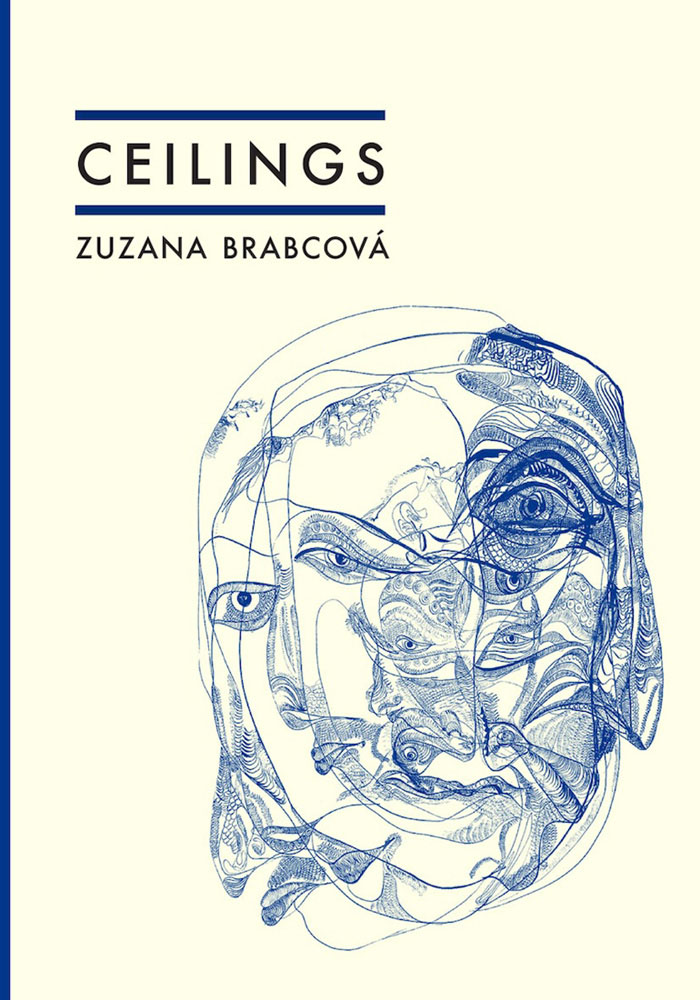
Dream follows dream: Ceilings by Zuzana Brabcová

Drink them up, swallow those clouds, gulp them down with all your might, because all you’ve got to look forward to now are ceilings.

As Ema, the fifty year-old protagonist of Zuzana Brabcová’s Ceilings, takes in her last view of the overcast skies over Prague before the ambulance attendant leads her into the Addiction Treatment Centre of the hospital, she knows that it will be months before she  sees them again—except, of course, in the strange, troubled, and fantastic dreams and psychotic episodes that will accompany her through the trials of detox. She’s been here before and is well aware of what lies ahead.

The daughter of two literary historians, Brabcová (1959–2015) was born in Prague. Under the Communist regime, she was denied the right to attend university so she worked as a librarian, a hospital attendant and a cleaner. Following the Velvet Revolution, she worked as an editor. Her first novel Far from the Tree, initially published abroad in 1987, won the inaugural Jiří Orten Prize. Ceilings (2012), recently released in Tereza Veverka Novická’s powerful English translation, was her fourth novel, a vivid, hypnotic account of one woman’s transit through drug rehab that clearly illustrates why she has been rightfully compared to Leonora Carrington and Unica Zurn (whose artwork graces the cover).

As soon as Ema enters the hospital, The Garden as it is known, she finds herself in a world that operates on its own set of rules and regulations. The clock is now set to institutional time, where order attempts to define but can never fully contain either the camaraderie or conflicts between an eccentric collection of women—druggie or alkie?—caught in an ever-swirling cascade of medications and madness. For Ema, navigating the neuroses and idiosyncrasies of her fellow inmates is as challenging as navigating her own, as delusions, paranoias, and troubled memories blur the fragile boundaries between reality and dream, external and internal existence.

This fluidity is reflected in a polyphonic narrative which moves smoothly between third and first person, often pulling in and out of Ema’s head in a single paragraph. Add to this, asides in second person, where Ema either addresses herself or directs her thoughts to her daughter Rybka, her lesbian partner Dita, or other family members. Finally, there is a second first person narrator, Ema’s brother—a “twin” although they were born one year apart—not an alter ego, but a distinct male gendered self. Ash. He emerges at an early age, perhaps to serve as a shield against the uncertain and frightening world both inside and outside the home, and inside and outside Ema’s own unstable emotional space. Ash comes into his own when they are very young, realizing he is different:

I said to myself this secret of mine must be something like chickenpox; okay, in that case an autovaccine was needed to reduce the most visible traces to a minimum. So I decided to become a normal little boy, if that’s what they wanted: I’d fight over toys in the sandbox and might even pee my pants in a temper tantrum, and I’d clap and giggle over my birthday cake; all this could be learned by observing other children. I methodically began to appropriate the behaviour of others, their expressions, emotions, and gestures, and chose from this panoply the ones I considered useful, purposefully aping them. It was glorious: one by one, every sensation sunk into the hollowed-out nutshell of nothingness.

My rebirth every morning soon became routine, and I put on my face like a prothesis.

Ema and Ash are not exactly like two manifestations of  a dissociative condition, nor do they represent a typical binary gender identity. Ema takes comfort in Ash’s existence, while he is both protective of and frustrated with his “sister,” yet cognizant of his own unreality, of the fact that he was not born and cannot die.

Confined to the hospital, Ema is forced to contend with various difficult personalities, while finding her place and forging alliances among the other patients and the nursing staff. Reality can be an anxious state. Meanwhile, dreams and episodes of delirium carry her back into her (or Ash’s) past, but the scenes are strange, distorted, and disturbing.  And she is haunted not only in her restless sleep; the ceilings that hang that above her are a constant reminder that she is trapped:

It’s come back after my body expelled, at least to some extent, the poisons that were competing with it. I’m in a room, I need to get out, I rise to the ceiling. I tear though it, really easily, because the walls and ceiling are made of cardboard, and I find myself in another room.  I escape through a chink into another room and so on and so forth, again and again, one room replaces another, always the ceiling, never the sky. But what if it’s not the dream that’s come back to me, but it’s me who’s come back to it? Maybe the waking life of Ema Černá is merely a sequence of pauses, brief interruptions of flight with no beginning and no end.

Ema’s dilemma, her inability to successfully integrate her internal and external reality, reflecting a lifetime of emotional and mental health challenges mediated by substance abuse, is the driving force of this intense, vulnerable, and moving novel, one that draws on Brabacová’s own experiences, including time in psychiatric rehab (and, one might imagine, the perspective afforded through her work as a hospital orderly). Its raw, unapologetic narrative slips seamlessly between voice and perspective, continually cross-referencing itself, to create a world—one woman’s world, past and present—that for all its surreal elements is cohesive, sympathetic and real.

Ceilings by Zuzana Brabcová is translated from the Czech by Tereza Veverka Novická and published by Twisted Spoon Press.

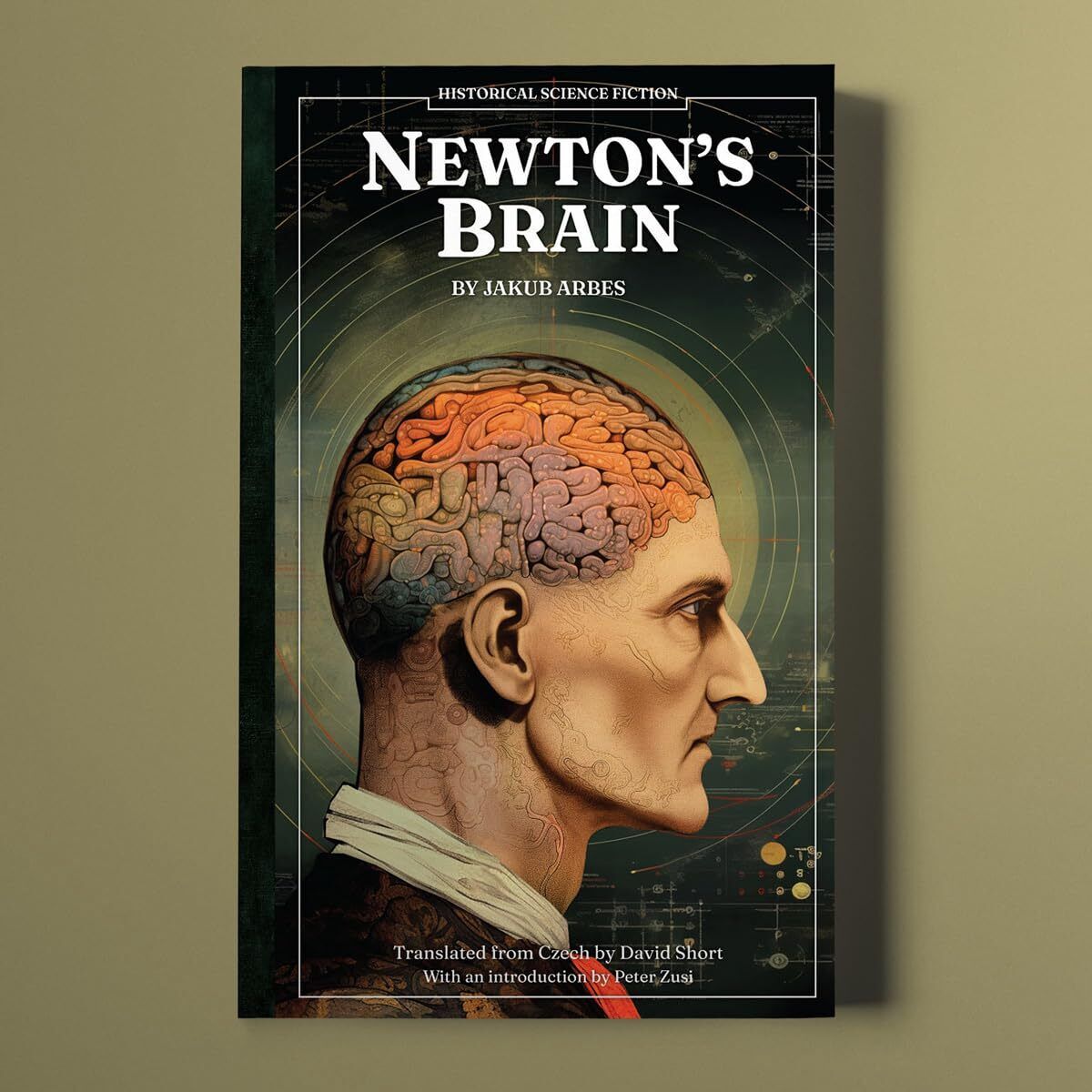
Journey into the distant past: Newton’s Brain by Jakub Arbes

G. Wells’ first novel The Time Machine, published in 1895, has long been considered not only one of the earliest works of science fiction, but the popularizer of the notion of time travel. It was a concept Wells had explored in short fiction some seven years earlier, but in 1877, a full eighteen years before his landmark novel was released, a Czech writer and intellectual named Jakub Arbes (1840–1914) had already depicted a machine designed to peer into times distant in Newton’s Brain, a very short novel the author described as a “romanetto.” Now, as part of their new Historical Science Fiction series, Jantar Publishing has issued this underappreciated text in a new translation by David Short, complete with a fascinating introduction by Peter Zusi (as a note of interest, the earlier 1892 translation by Josef Jiří Král is available from Sublunary Editions).

As Zusi indicates in his introduction, time travel narratives were rather popular in eighteenth and nineteenth century literature, but ghosts and supernatural influences were typically called upon to explain a protagonist’s encounter with past or future events. The time machine, by contrast, depends on scientific reasoning to lend a degree of credibility to the premise that one might disrupt normal chronological progress. For Arbes, Zusi suggests a very likely inspiration for the particular idea of time travel that underpins his story. In 1846, a small pamphlet called The Stars and the Earth; Or, Thoughts Upon Space, Time and Eternity was published in London and became a sensation. The work, attributed to Felix Eberty (1812–1884), a Berlin-born lawyer, author and amateur astronomer, is thought to have influenced Kafka and Einstein. It seems quite possible Arbes would have read it as well. Eberty takes the already accepted notion that the light we see from faraway stars has travelled a long distance so to look into the night sky is to look into the past, and argues that if one could travel sufficiently far from the earth, it would be possible to view our planet’s past, including all of human history. Arbes presents a similar notion, one that, for both men, assumes the ability to travel faster than the speed of light and the existence of a device powerful enough to permit the observation of small details over vast distances. Charming to today’s reader perhaps, but not implausible to nineteenth century audiences. And, Zusi points out that although Arbes takes more literary license in his work, he is actually more aligned a modern scientific perspective than Eberty whose goal was a greater understanding of God’s omniscience and thus limited to a Biblical timescale. Arbes’ universe is 30 million years old and, at least in this book, his view of human nature and progress rejects all mythological constructs.  However, specific scientific considerations aside, the primary stylistic influence on the tale that unfolds in Newton’s Brain lies in the gothic mystery and macabre spirit of Edgar Allen Poe.

The narrator invites his reader to the “whimsical” tale he plans to tell from the allegorical graveside of a man whom he insists would have welcomed release from the sorrow and distress that troubles the human soul—a man who would not have wanted to be mourned:

The man of whom I speak was my friend from earliest childhood, and he died – or more properly fell – at the Battle of Sadowa as an officer in the Prince Constantine infantry regiment. His skull had been split in two by a Prussian pallasch…

This friend was the handsome son of the head gardener for the wealthy Kinsky family in Prague, while he, the narrator, was, by comparison, poorer and “hideous,” but the two young men had been close since boyhood. Both exhibited a lively enthusiasm for exploration and debate when they were young, and eventually they were each drawn to the sciences. However, being the plainer of the two, the narrator “leaned towards dreary, tedious and rarely amusing mathematics,” while his dashing companion pursued the more exciting natural sciences. Yet, his friend not only studied physics, chemistry, and mechanics, he collected and poured through volumes of arcane and obscure philosophical works as well—all with one singular objective: to master the art of illusion. He is, in fact, so obsessed that his formal studies suffer, a circumstance that ultimately causes his family, who know nothing of his passion for magic, to insist he enlist in the army.

Before leaving to join his regiment, the newly enlisted soldier collected all of the books and equipment he had purchased over the years and stored in the narrator’s room and had it carried away. Soon he is called into active service and their once inseparable friendship falls victim to the distance of time and space. Several years pass before the narrator hears from his friend again. Two letters arrive, the second containing an odd request to be fulfilled should he die. If his wishes are followed, his friend writes, they will see one another one more time.

Soon after, war is declared between Prussia and Austria. The next notice to reach the narrator is a letter from the parish priest in the town of Nechanitz, to inform him that a critically injured, unidentified young man has been brought in to his care. A letter found in the soldier’s uniform bearing our protagonist’s address was the only means by which they could track down his identity.  The narrator travels to the town, recognizes his friend and is there to witness his burial. He returns to Prague devastated by the loss. In his grief, he resumes his once abandoned studies, now focusing his attention on applied mathematics and astronomy. But, of course, this is not the end of the story.

One night, the narrator’s friend appears at his door:

Without uttering a word, my friend stood there, motionless, while I was unable to tear my gaze from him.

His face was deathly pale, but his clear, blue eyes radiated life and a light, amiable smile played upon his lips.

“Good evening,” he said after a while and took several steps forward.

Catching the clink of a sabre I registered that he was wearing an officer’s uniform.

His friend insists that he escaped death, that the fallen soldier was another man altogether, and now, that very evening, he is hosting an event at the Kinsky chateau to which all of their friends have been invited. He must hurry back but invites the narrator to come as soon as he is able.

The evening at the chateau is strange, marked by elaborate illusions, the incredible assertion by returned or seemingly resurrected soldier that he has procured the brain of Isaac Newton and had it installed in his own skull, and a long speech to a room filled with officials, academics and theologians in which he systematically critiques modern society and tears apart the so-called advances of human knowledge and technology. Finally, he reveals the existence of a driver, realized with the assistance of the wisdom contained in Newton’s grey matter, that will allow him to travel back in time to observe selected moments from human history. Is this perhaps the greatest invention ever, or the most sophisticated deception?

Arbes’ narrative is moody and atmospheric, his narrator alert to his own emotional and psychological state. As he tells his tale, there is much room for speculation woven in the account. Cleverly, Arbes makes his time machine inventor a young man with an eccentric enthusiasm for magic, sleight-of-hand and a vast range of scientific and philosophical knowledge, practical and arcane alike. This allows for possible interpretations, closing none entirely. It is also an often biting commentary on religion, politics, education and, in particular, man’s capacity for violence. The Time Machine may be better known today, but while Newton’s Brain’s inventive hero sets his sights back to the very origins of human community and Well’s time traveller takes a journey into the incredibly far flung future manifestations of humanity, both men were skeptical about the promises of technology and the evolutionary potential of humankind.

Newton’s Brain by Jakub Arbes is translated from the Czech by David Short with an introduction by Peter Zusi. This attractively illustrated and generously annotated edition is published by Jantar Publishing. It is available in the UK now and will be out in North America next month.

Farewell to 2023 with the annual list of favourite reads

In my small corner of the world, away from forest fires raging, earthquakes and wars continuing and erupting anew, I read some very good books. 2023 was, world events aside, a complicated year, which is to say, a very human one. Within my extended family there were life-changing diagnoses and surgeries, but all in all, we’ve been fortunate to access care within a health system buckling under the strain that is far from unique. And I finally returned to India for a visit, my first trip anywhere in four years, which was a much-needed opportunity to connect and re-connect with many friends, and even take a little time to explore on my own. But travel did cut into my reading, as one often imagines that with all that time spent flying and waiting for flights, books will be avidly consumed, but that’s not always the case. And then, when I returned home, just days after the events of October 7, a renewed politically motivated awareness started to influence my reading choices and appreciation, something that will no doubt continue into 2024. If one sets out, as I do, to read with a special interest in works and authors from outside my own experience, especially in translation, reading widely and intentionally should ideally be a guiding factor.

So what of 2023’s reading? I read just over 60 books, a number I’m satisfied with. I wrote reviews or responses to 48 of them. The majority of the books I chose not to review are books of poetry, in large part because I do not always feel confident that I can add something meaningful to the conversation about such works no matter how much I might enjoy them and return to them often. (Perhaps this year I can gather some of my favourite “unreviewed” collections into  a special post.) Nonetheless, for the purposes of this annual exercise, I selected 14 books  that I particularly enjoyed or wanted to call extra attention to.  It includes four nonfiction works, nine fiction and one poetry collection. Ten books are translated literature, while four are written English, although one of those is a book about translation.

Listed chronologically according to date read, I’ve divided my 2023 favourites into two categories—books I particularly enjoyed and, then,  my top five:

Journey to the South – Michal Ajvaz (Czechia) translated from the Czech by Andrew Oakland
This wild murder mystery/adventure that begins with a murder during a performance of a ballet based on Kant’s Critique of Pure Reason was my first introduction to Ajvaz’s idiosyncratic story with a story within a story narrative form. I definitely want to read more.

A Mountain to the North, A Lake to the South, Paths to the West, A River to the East
– László Krasznahorkai (Hungary) translated from the Hungarian by Ottilie Mulzet
The historical details that emerge in this dream-like journey in search of a mystical Buddhist monastery have lingered with me with all the misty beauty of the initial reading experience.

 Falling Hour – Geoffrey D. Morrison (Canada)
This strange and wonderful tale of a man trapped within an urban park is both smart and funny in just the right measure.

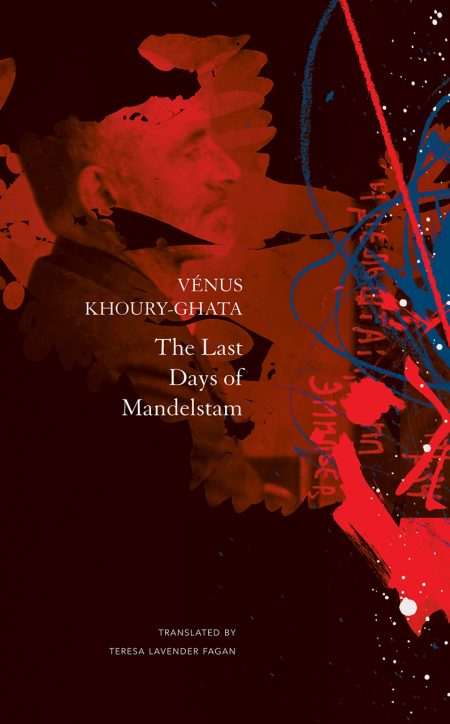
The Postman of Abruzzo – Vénus Khoury-Ghata (Lebanese-French) translated from the French by Teresa Lavender Fagan
As one of my favourite writers, it is difficult to imagine compiling a list like this without including Khoury-Ghata. This sharp, spare tale of a French woman who finds herself in a community of displaced Albanians in southern Italy in search of a connection with the work of her dead geneticist husband so that she may heal, is charming and profound.

All The Eyes That I Have Opened – Franca Mancinelli (Italy) translated from the Italian by John Taylor
Another favourite, a poet whose works always seems to speak directly to me, I would be hard pressed not to include her at year end, but this collection with its central image inspired by the eye-shaped scars on the trunks of trees continues to haunt me every day as I pass aspen trees on my walk.

river in an ocean: essays on translation – (Canada) Various authors, Nuzhat Abbas (ed)
The importance of this feminist decolonial project—a rich collection of essays on translation by writers with origins in the global South—was intensified by the changing world events that marked my reading, my review and every day since then. Vital and necessary.

A significant number of my favourite books of the year were read in the final months of the year, and hold political relevance for me by virtue of my desire to listen to the voices of those impacted by violence, occupation and genocide. The following three included:

Passage to the Plaza – Sahar Khalifeh (Palestine) translated from the Arabic by Sawad Hussain.
I have read a number of very powerful works by Palestinian writers and poets over the years. In search of more female voices I was drawn to this work by a new-to-me author who, fortunately, has been widely translated. Set, written and published during the First Intifada, this novel is the rarely told story of the impact of the events on women.

Tali Girls – Siamak Herawi (Afghanistan) translated by the Farsi by Sara Khalili
Based on true stories of girls and women in an isolated and impoverished region of Afghanistan under growing Taliban control and local corruption, this almost folkloric narrative is swift, devastating and, ultimately, hopeful.

Landbridge [life in fragments] – Y-Dang Troeung (Cambodian-Canadian)
Born in a Thai refugee camp just across the border from Cambodia, Troeung gathers memories, documents, photographs and artworks to tell the inspiring and difficult tale of her family’s survival against unspeakable horror, their lives as refugees in Canada, and her own personal journey to explore her own history in a world that, as we can see today, is reluctant to acknowledge genocide.

* * *

My top five reads of the year:

The Last Days of Terranova – Manuel Rivas (Spain) translated from the Galacian by Jacob Rogers
This was the first book I read in 2023 and I knew right away that it would be hard to beat.  Employing a narrative style that rewards the attentive reader, this is essentially the story of a family bookstore, the eccentric characters that pass through and their involvement in making banned literature available during the Franco years. I loved it.

The Book of Explanations– Tedi López Mills (Mexico) translated from the Spanish by Robin Meyers
As someone who has exclusively written and edited nonfiction, I am more often than not disheartened by the personal essays, book length or collected, that I try to read. This series essays exploring the nature of memory and identity blew me away. I don’t know if it was the innovative approach or the degree to which I related to the themes, but this is an excellent, innovative work.

The Geography of RebelsMaria Gabriela Llansol (Portugal) translated from the Portuguese by Audrey Young
This enigmatic work is simply a haunting and profound reading experience in which historical and imaginary figures interact in a world out of place and time, yet linked to faith, books and ideas. I can’t wait for her diaries to be released later this year.

AustralCarlos Fonseca (Costa Rica) translated from the Spanish by Megan McDowell
Another favourite author, Fonseca delights in intelligent, complex narratives that appear, on the surface, deceptively simple. Austral is perhaps his strongest work to date and, given that he is still a very young writer, I look forward to what may be yet to come.

We the Parasites – A.V. Marraccini (US)
As per what I said above about nonfiction, I approached this book with my usual essay wariness coupled by the fact that it was presented as a book about criticism. But everyone else is right, this is a singular piece of writing. Intelligent and completely original.

So, there you have it. As ever, many other excellent books from this year’s reading had to be left out but contributed, all the same, to a very satisfying literary year. This year I focused on Archipelago Books and will continue to read their publications with enthusiasm. I’ve found that looking at publishers rather than specific titles I hope to make my way through as each new year dawns is a good approach. To that end, I need to pay a little attention to some of the Dalkey Archive and NYRB books that I have been accumulating, among the many other works from worthy independent publishers that I do, and always will continue, to seek out. And, of course, all plans are subject to change, so I will commit to few.

Happy New Year. May there be peace in 2024.

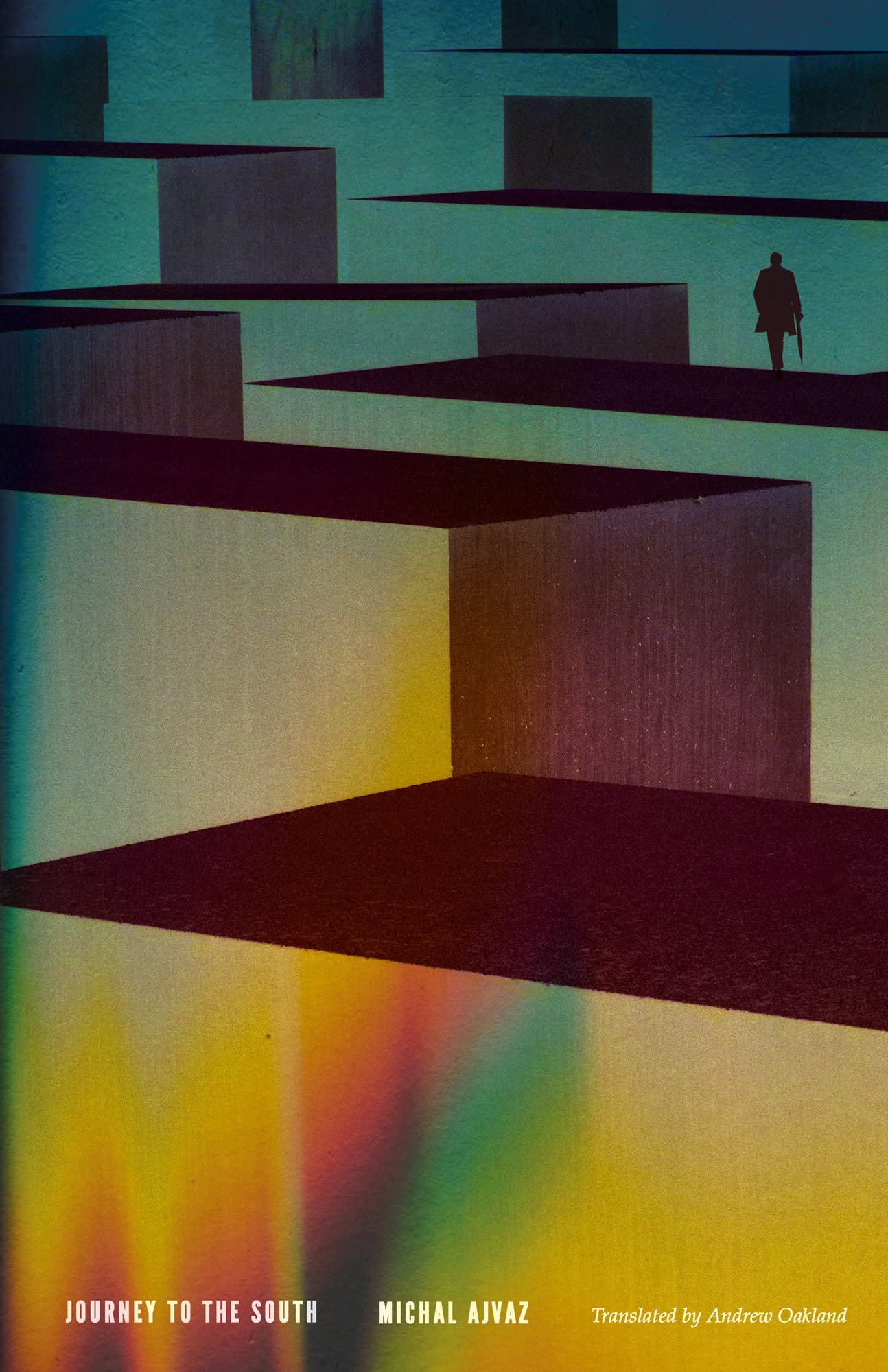
Out of the never-ending flow of stories: Journey to the South by Michal Ajvaz

“Little did he know—or maybe he refused to acknowledge—that there are no pure story streams; all stories are scary, all come from a single strange-smelling wellspring that seeps into the folds of things and collects in dirty corners of the spaces we inhabit, all trace patterns of desire and fear that aren’t even ours but those of a monster whose dream is our life.”

Here’s a story that starts innocently enough, like so many stories before it, with a murder—no, make that two. Of course, that’s too simple. No murder mystery, if you’re expecting a story that will attempt to reach some kind of conclusion, an explanation, starts with the act itself alone; it begins somewhere else, somewhere back where the story really begins… But here’s a warning: this is a murder mystery that will wind its way through more than a few wildly unlikely stories on the way from execution to explanation.

To be honest, I signed up for the adventure that is Michal Ajvaz’s Journey to the South without any clear expectation about what might lie in wait for me. If you come to this 2003 novel, newly translated by Andrew Oakland, with previous experience with the Czech author’s idiosyncratic approach to postmodern fiction, you will likely be prepared to simply strap yourself in for an improbable, endlessly discursive, multi-layered excursion into the heart of what it means tell stories at all. If you’re new to his work, consider this an invitation to dive into the deep end—about six hundred pages deep, give or take.

The novel opens in the isolated village of Loutro on the south shore of Crete, where an unnamed narrator chances upon a young man, a Czech it would seem, with an unusual assortment of reading material. Overcome with curiosity, he decides to eschew his typical tendency to avoid engaging with fellow countrymen when abroad, and comment on the books. Thus begins a lengthy conversation that will extend over several evenings and countless glasses of wine and ouzo as Martin, a philosophy student working on a PhD thesis on Kant, shares the strangely convoluted tale of the circumstances that have led him to travel from Prague to Crete.

One evening some four months earlier, on his way home from the library, Martin had chanced upon a poster advertising a ballet based on The Critique of Pure Reason by Emmanuel Kant. The show was playing every Wednesday for two months and, this being a Wednesday, he headed to the theatre that very night. According to the program, the composer Tomáš Kantor was a writer with little published work who had “died tragically in Turkey in July or August 2006”—the summer before. As the show began, the young Kant scholar endeavoured to interpret the meaning and roles of the dancers onstage. To his surprise it really did begin to make sense to him. Certain dancers were clearly portraying sensory matter, others pure form, with a violet clad figure to represent Transcendental Apperception, that which we call “I.” Standing in the back, was a veiled mysterious figure that could only be Ding an sich—“The Thing in Itself” or the true status of objects which we cannot know. All was going well until the end of the second act when suddenly The Thing In Itself emerged from the shadows and began to move about, throwing off the dancers. The figure advanced to centre stage where it stopped, pulled out a pistol and shot straight into the audience, killing a man seated in the front row.

Martin, like everyone else in the theatre, is now witness to a murder. But before long he is even more deeply involved. The victim, it turns out, was a wealthy businessman, Petr Quas, and the step brother of the ballet’s composer, Tomáš Kantor. However, what captures Martin’s interest is the lovely red-headed woman he sees, first at the police station and again at the university. Drawn to her, he discovers that she is Kristyna, Tomáš’s ex-girlfriend who is still holding an inextinguishable torch for him since he abruptly broke up with her two months before his mysterious death. Smitten, he arranges to meet with her daily so she can tell him all about Tomáš on the pretence of wanting to understand if and how the two brothers’ death may be linked.

So, now we have Martin reporting what Kristyna told him about the unhappy childhoods of Tomáš and Petr, the former’s multiple attempts at creative expression that ultimately ended in darkness and despair, and the latter’s brief success as a poet. But where one brother finds his way from poetry into business, the other settles into a post as a transportation dispatcher at the end of the tram line. Then, one day, while off sick, a novel suddenly starts to take shape before Tomáš’s eyes, first as an empty city, then as a coastal town in an imagined nation complete with characters and strange occurrences. A series of events ultimately leads to the injury of his protagonist, Marius, who is taken to recover at the home of his lover’s grandparents  where he is told a story, second-hand, which in turn contains a novel—science fiction this time—and by this point the depth of stories within stories is running very deep, taking us to cities and countries, real and imaginary, across oceans and continents. However, when he finally winds his way to the end of his composition, the author is unsatisfied. Tomáš feels that his book, which had arisen out of nothing, has failed to correspond to the nothingness he carries inside:

“There was nothing so rich that it could be expressed merely by an endless proliferation of stories, a never-ending cascade of events in which other events spurted forth from every object, space, and gesture, then yet more events from the spaces, objects, and gestures of these. Tomáš felt that even the entire cosmos would be too little for the expression of nothing; a cosmos that expressed emptiness would have to be endless.”

His overarching novel then starts to mutate and grow, sending out tendrils, so to speak that branch off and flower in unexpected ways forming part of a network of signs and rebuses that Martin and Kristyna will follow as they eventually travel from Prague to Crete in search of Tomáš’s killer.

If Journey to the South sounds like a baggy monster of a book, well, it would be if Ajvaz didn’t have both feet firmly planted in the tell-don’t-show school of storytelling. The ungainly nest of narratives he constructs has its own internal cohesion and propulsive energy—no matter how strange or how far reaching—because at the end of the day, Martin is reporting it all to his audience, the narrator who interjects when he wants to clarify something and reminds us that we are actually at a quiet resort in Crete. And, of course, Martin himself is an active participant in the story he is relaying, driven by his attraction to Krystina if nothing else. Their fanciful journey through Europe from one unlikely—and strangely unravelling—clue to another is marked by their own doubts about the reasonableness of the entire enterprise. At one point, Martin even wonders if he has gotten caught up in a cheap Dan Brown novel, his own private Da Vinci Code. But this is a murder mystery and our amateur detectives do manage to make their way to an oddly satisfying conclusion. If, in fact the story actually ends when this book does…

Journey to the South is, then, classic Ajvaz territory. Structurally he favours the mise-en-abîme, the story with a story framework (fittingly, “placed into the abyss”), and delights in cliché genre tropes like car chases, monsters, cartoon villains and more. Woven into this are philosophical, scientific and theoretical references, often in unexpected contexts. I suspect that one will either welcome the kind of world he creates and his exploration of the possibility of reaching some semblance of truth (reality) in the stories we read and tell, or find his work hopelessly restricted to a game of limited scope and value. However, although he likes to keep his fiction separate from his theoretical work, like fellow Czech postmodern novelist Daniela Hodrova, Ajvaz is a respected literary critic and it is unlikely that his critical principles have not seeped into his fantastic storyscapes to some degree. (For a discussion of his academic work see David Vichnar’s essay on the Equus site.) Nonetheless, some critics have accused Ajvaz of repeatedly playing in the same sandbox, hauling out the same tired toys. Vichnar also answers this complaint cleverly:

What this wide-spread, if also reductive and simplifying, viewpoint fails to acknowledge is that Ajvaz’s fictional world leaves unresolved, and thus in perpetual motion and fruitful exchange, the dynamics of opposing principles which his thought strove to bring to a stasis of resolution. His fiction is, thus, bound to repeat itself, again and again, in all of his attempted re-writes of the impossible accounts of all the other cities, all the other intimations of pre-articulated fields, approachable in fiction only through linguistic articulation, and thus always already pre-fabricated. If this be the failure of Ajvaz’s fiction—a simple formula repeated ad nauseam without conclusive progress—then its saving grace, like that of Beckett’s, is its continuous effort to “fail better” – imaginatively, challengingly, and ultimately, enjoyably.

At the end of the day, I am hard pressed to express how effectively Ajvaz manages to pull off such a multi-layered, wildly entertaining feat of storytelling making it intelligent and thought provoking at the same time. It’s easy to lose track just how deeply embedded you are in the stories within stories (or even now to unwrap them to remember just who was telling what when), but somehow it works. It’s serious and absurd, sad and funny, cheesy and moving. So, although it may have been my first Ajvaz adventure, it won’t be my last.

Journey to the South by Michal Ajvaz is translated from the Czech by Andrew Oakland and will be published by Dalkey Archive Press on March 28, 2023.

Reading highlights of 2022: A baker’s dozen and then some…

It seems to me that last year I resisted the annual “best of” round-up right through December and then opened the new year with a post about some of my favourite reads of 2021 anyhow. This year I will give in, look back at some of my favourite reading experiences out of a year in which I had a wealth to choose from and aim to get some kind of list posted before friends start hanging up their 2023 calendars around the globe. In a year with war, floods, famine, storms and still no end in sight to Covid infections, books seemed more important than ever, as a respite, a record and a reminder that we, as human beings, have been here before and must learn from the past to face the increasing challenges of the future.

As ever, it is difficult to narrow down twelve months of reading to a few favourites. One’s choices are always personal and subjective, and many excellent books invariably get left out. This year especially—2022 was a productive and satisfying year for me as a reader and as a blogger. Not much for other writing, I’m afraid, but that’s okay.

This year I’m taking a thematic approach to my wrap-up, so here we go.

The most entertaining reading experiences I had this year:

Tomas Espedal’s The Year (translated from the Norwegian by James Anderson) was one of the first books I read in 2022. A novel in verse, it is wise, funny and, nearing the end, surprisingly tense as Espedal’s potentially auto-fictional protagonist careens toward what could be a very reckless act.

International Booker Prize-winning Tomb of Sand  by Geetanjali Shree (translated from the Hindi by Daisy Rockwell) looks like a weighty tome, but blessed with humour, magic and drama—plus a healthy amount of white space—it flies by. An absolute delight and worthy award winner!

Postcard from London, a collection of short stories by Hungarian writer Iván Mándy (translated by John Batki) was a complete surprise for me. In what turned out to be a year in which I read a number of terrific collections of short fiction, I was a little uncertain about this large hardcover volume some 330 pages long, but by the end of the first page I was hooked by the author’s distinct narrative voice and I would have happily read many more pages.

The most absorbing book I read this year (and its companions):

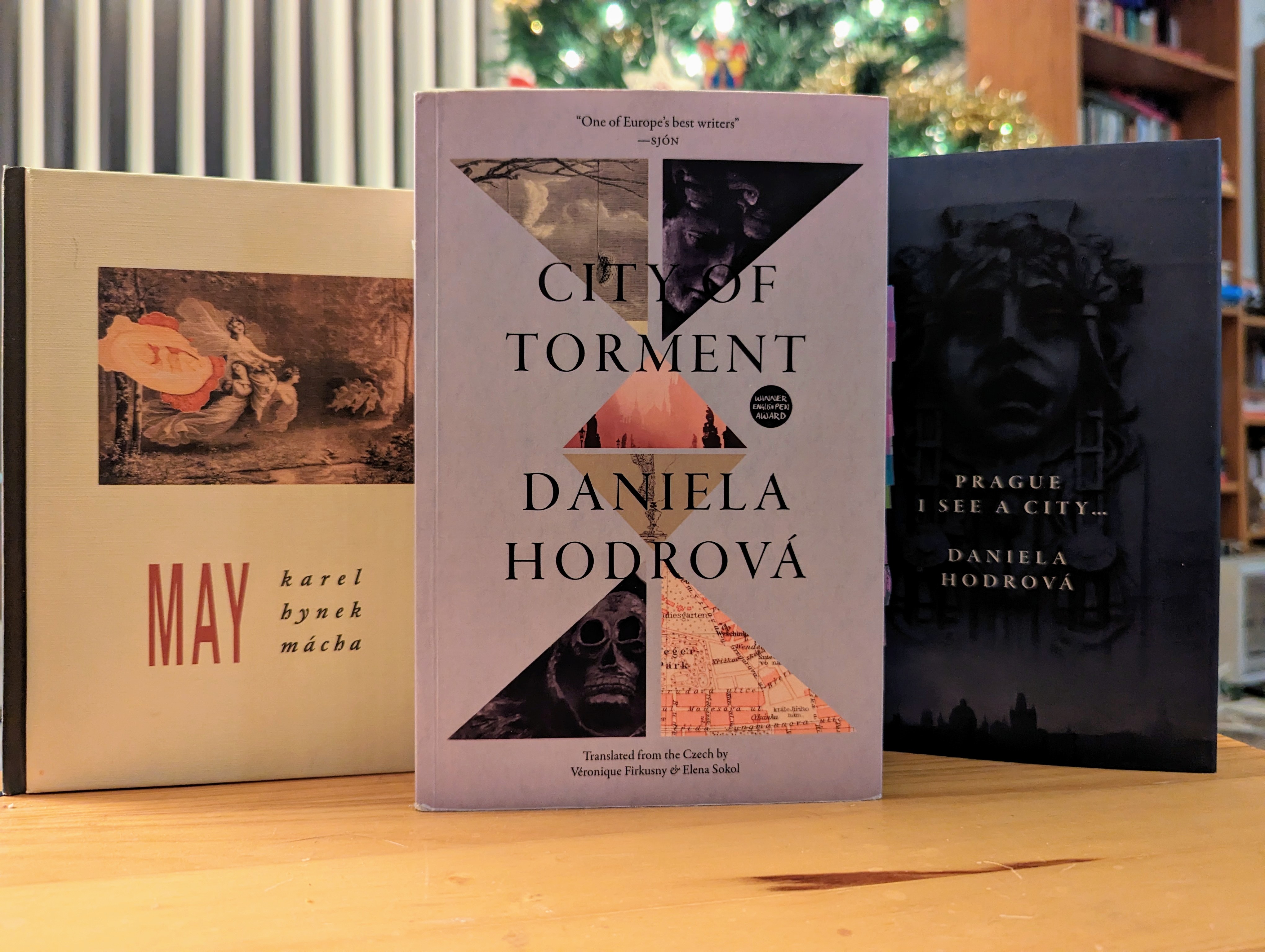
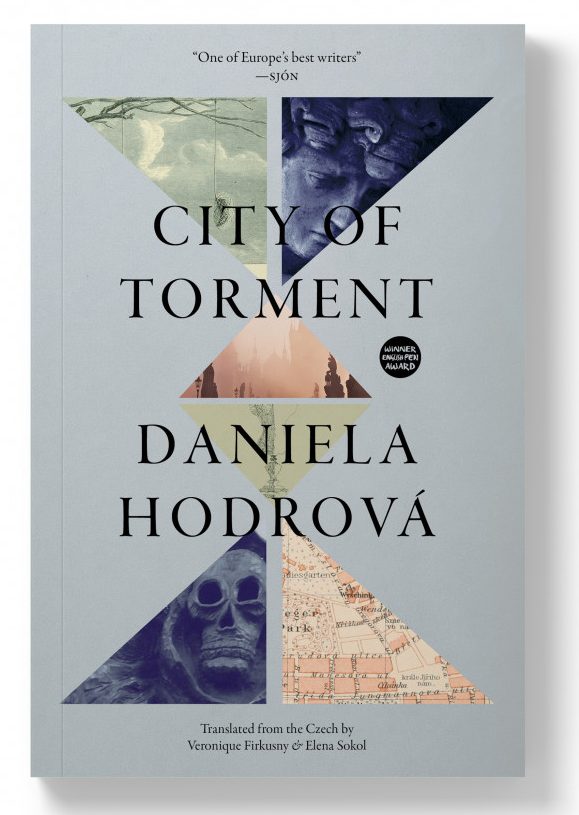
City of Torment – Daniela Hodrová’s monumental trilogy (translated from the Czech by Elena Sokol and others) is a complex, multi-faceted, experimental work that explores a Prague formed and deformed by literary, historical and political forces, haunted by ghosts and the author’s own personal past. After finishing the book, I sensed that I was missing much of the foundational structure—not that it effects the reading in itself—but I wanted to understand more. I read Hodrová’s own companion piece, Prague, I See a City… (translated by David Short) and more recently Karel Hanek Mácha’s epic poem May (translated by Marcela Malek Sulak), but I would love to have access to more of the related literary material, much of which is not yet available in English. I suspect that City of Torment is a text that will keep fueling my own reading for some time.

This year’s poetic treasures:

This is the most challenging category to narrow down. I read many wonderful collections, each so different, but three are particularly special.

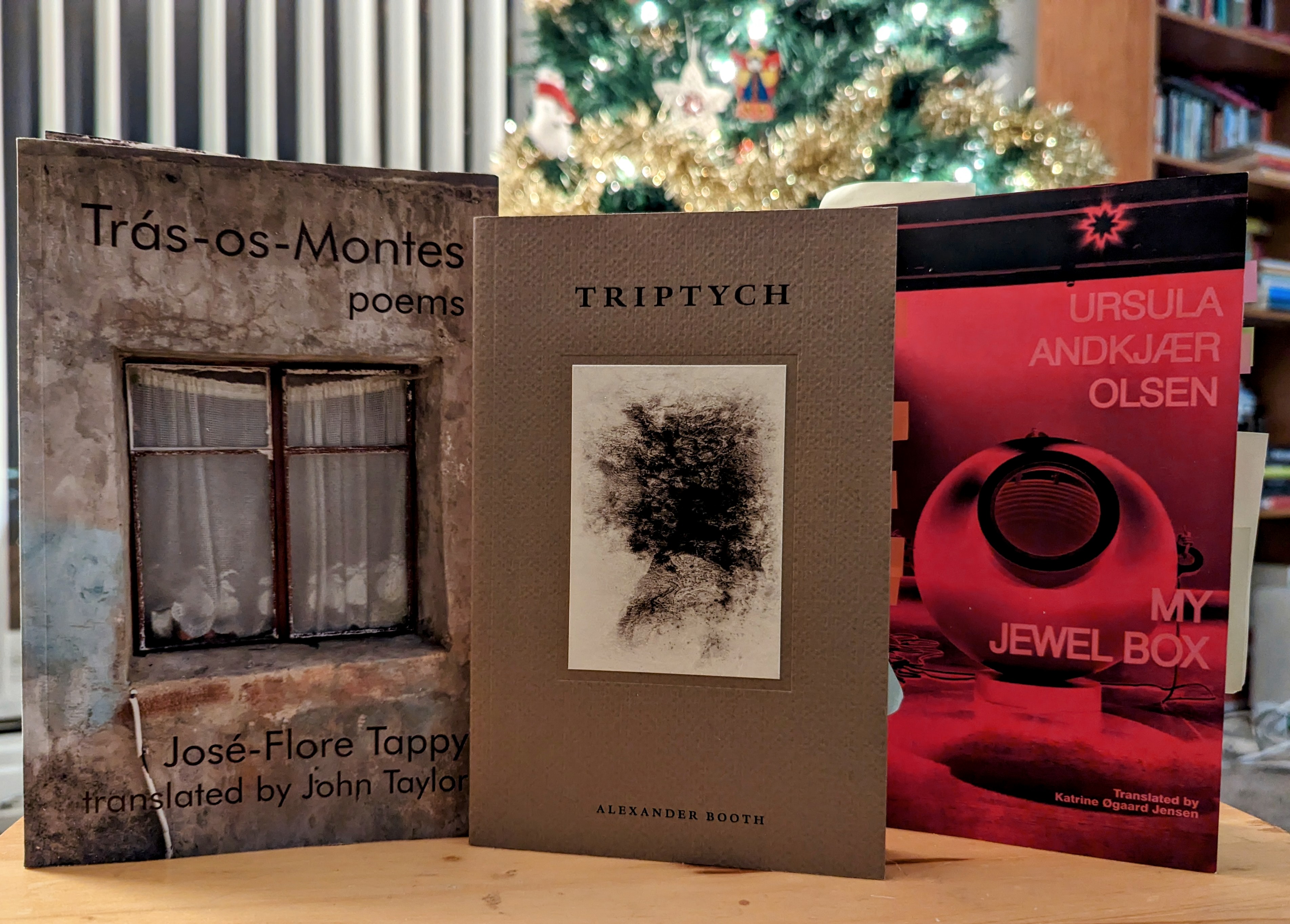
Translator John Taylor has introduced me to a number of excellent poets over the years and in 2022, it was his translation of French-language Swiss poet José-Flore Tappy’s Trás-os-Montes. I read this gorgeous book in August and it is still on my bedside table. It’s not likely to leave that space for a long time yet, and that’s all I need to say.  

I first came to know of Alexander Booth as a translator (and read a number of his translations this year) but his collection, Triptych, stands out not only for the delicate beauty of his poetry, but for the care and attention he put into this self-published volume. A joy to look at, to hold and to read.

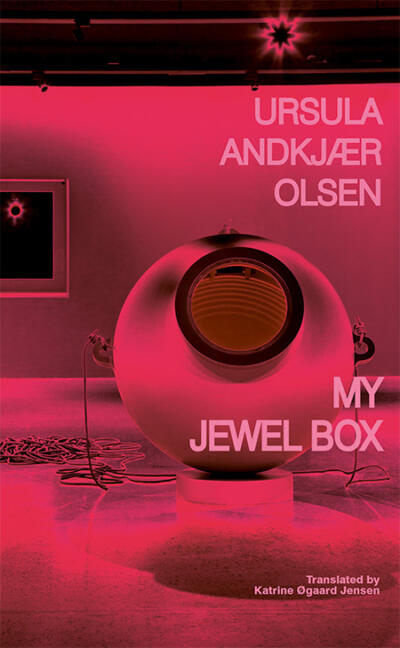
Finally, My Jewel Box by Danish poet Ursual Andkjær Olsen is the conclusion of an organically evolving trilogy that began with one of my all-time favourite poetry books, Third-Millennium Heart. Not only is this a powerful work on its own, but I had the great pleasure to speak over Zoom with Olsen and her translator, Katrine Øgaard Jensen, for Brazos Bookstore in May. The perfect way to celebrate a reading experience that has meant so much to me.

Books that defied my expectations this year:

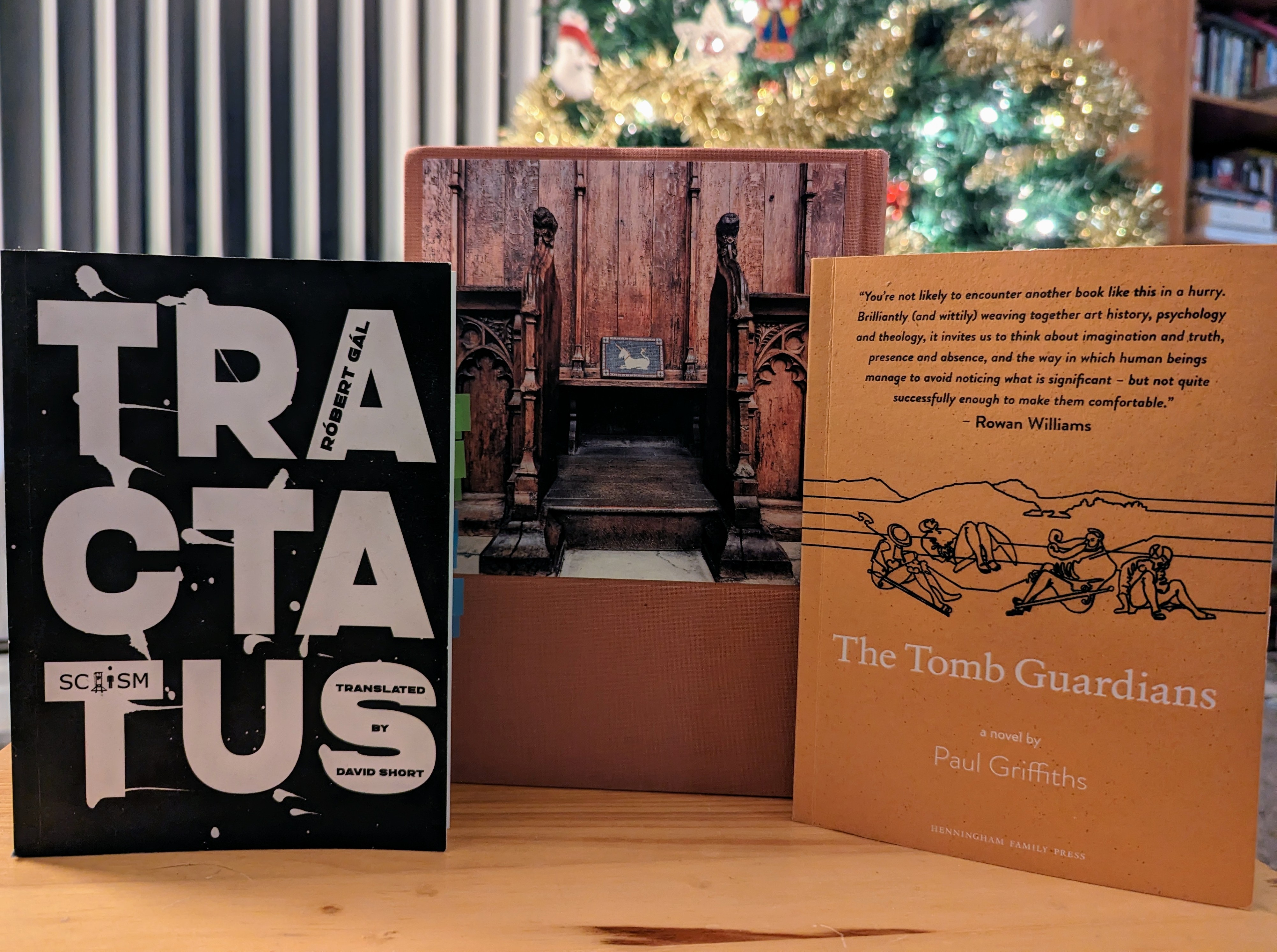
Prague-based writer Róbert Gál has produced books of philosophy, experimental fiction and aphorisms—each one taking a fresh and fluid approach to the realm of ideas and experience. His latest, Tractatus (translated from the Slovak by David Short) takes its inspiration from Wittgenstein’s famous tract to explore a series of epistemological and existential questions in a manner that is engaging, entertaining and provocative.

A Certain Logic of Expectations (you see the back cover here) by Mexican photographer and writer Arturo Soto is a look at the Oxford (yes, that Oxford) that exists a world apart from the grounds of the hallowed educational institution. Soto’s outsider’s perspective and appreciation of the ordinary offers a sharp contrast to the famed structures one associates with the city (and where he was a student himself) and what one typically expects from a photobook.

The third unexpected treat this year was The Tomb Guardians by Paul Griffiths. This short novel about the soldiers sent to guard the tomb where Jesus was buried is an inventive work that explores questions of faith, religion, and art history. Truly one of those boundary-defying works to use a term that seems to get used a little too often these days.

The best books I read in 2022:

Again, an entirely personal assessment.

I loved Esther Kinsky’s River, but Grove (translated from the German by Caroline Schmidt), confirmed for me that she is capable of doing something that other writers whose work skirts the territory occupied by memoir and autofiction rarely achieve, and that is to write from the depth of personal experience while maintaining a degree of opaqueness, if that’s the right word. One is not inundated with detail about the life or relationships of her narrators. Rather, she zeros in on select moments and memories, allowing landscape to carry the larger themes she is exploring. So inspiring to the writer in me.

Monsters Like Us, the debut novel by Ulrike Almut Sandig (translated from the German by Karen Leeder) deals with an extraordinarily difficult topic—childhood sexual abuse. It does not shy away from the very real damage inflicted by predatory family members, nor does it offer a magical happy ending, but it does hint at the possibility of rising above a traumatic past. As in her poetry where Sandig often draws on the darkness of traditional European fairy tales, she infuses this novel with elements and characters that embody the innocence, evil and heroic qualities of folktales within an entirely and vividly contemporary story. So much to think about here.

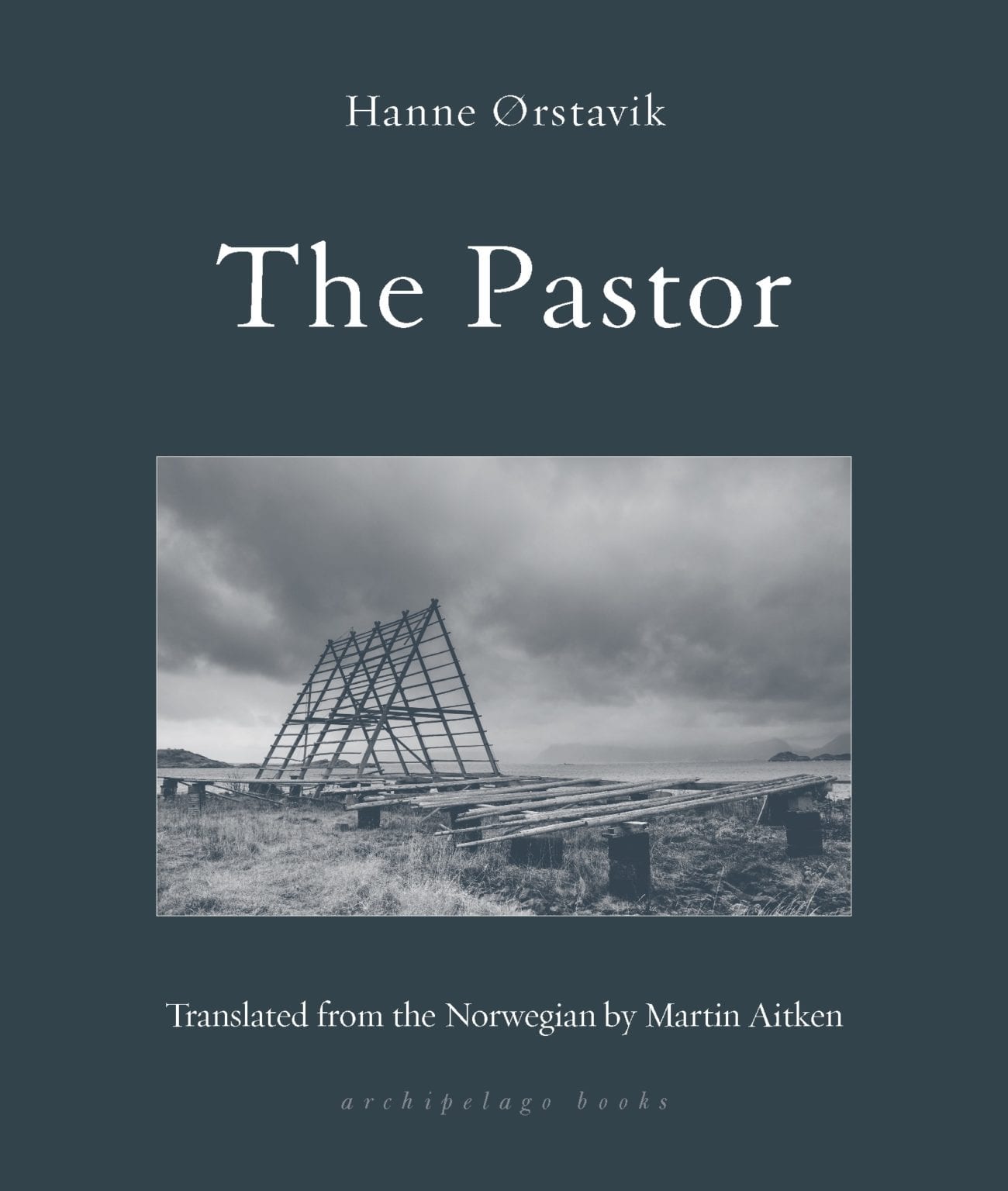
Hanne Ørstavik’s The Pastor (translated from the Norwegian by Martin Aitken) was my introduction to the work of a Norwegian writer I had a lot about over the years. This slow, melancholy novel set in the far north regions of Norway, beyond the Arctic Circle in the dead of winter, was a perfect fit for me as a reader, in style and subject matter. The story of a female pastor who takes a position in a remote village following a personal loss that she does not fully understand, explores emotional, historical and spiritual questions through a character who is literally stumbling in the dark.

So, what might lie ahead? This past year I embarked on two self-directed reading projects—one to focus on Norwegian literature for two months, the other to read and write about twenty Seagull Books to honour their fortieth anniversary. I found this very rewarding experience. Both projects were flexible enough to allow me freedom, varietyand plenthy of room for off-theme reading, but in each case I encountered authors and read books I might not have prioritized otherwise. For 2023 I would like to turn my attention to another publisher I really admire whose books are steadily piling up in my TBR stack—Archipelago. As with Seagull, they publish a wide range of translated and international literature that meshes well with my own tastes and interests. I don’t have a specific goal in mind, but already have a growing list of Archipelago titles I’d like to read. Other personal projects—public or private—may arise, perhaps more focused toward the personal writing I always promise to get back to, but time will tell. If the last few years have taught us anything, it’s that it’s a long uncertain road from January 1st to December 31st and it’s best not to try to outguess what the road might hold. Hope for the best and prepare for the worst once more.

Best wishes for the New Year and thank you for reading!

A romantic soul: May by Karel Hynek Mácha

A star has dropped from heaven’s height,
a dying star of dark blue light;
it falls through endless realms;
it dwells eternally in falling.
Its cry sounds from the grave of all,
a horrible shriek, a terrible scream.
“When will its falling end?”
Never—nowhere—there is no end.

There are many literary works that risk being ruined for readers simply because they are prescribed study in school, often presented in a rote manner that leaves its victims, er students, with few fond memories. No doubt, for generations of Czech students, Karel Hynek Mácha’s epic poem May might be remembered primarily as something they were required to read in school, old fashioned and difficult. But to come to this poem well into adulthood, without school-deadened experience and as someone whose first poetic passion was English Romantic poetry, this tale of romance, betrayal, patricide and brutal punishment is fascinating, as is the short, tragic life of its author.

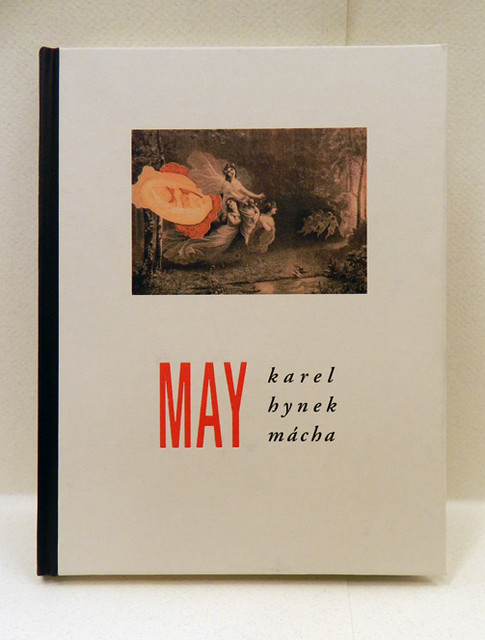
Image from Twisted Spoon Press on Flickr

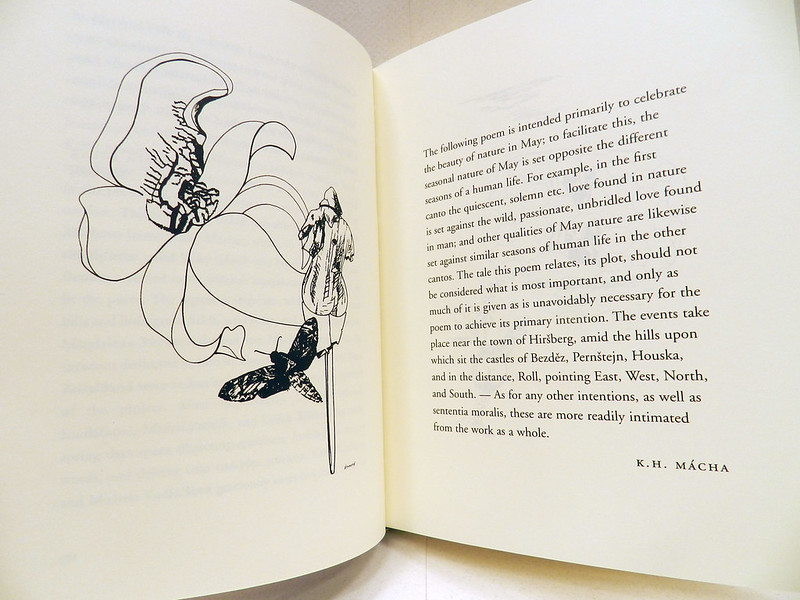
I was inspired to read this important Czech poem by my reading of Daniela Hodrova’s City of Torment earlier this year. Now recognized as the greatest Czech Romantic poet, Mácha is one of the many ghosts haunting this monumental trilogy and his story Márinka, which not yet available in English, forms an important part of the literary subtext of Hodrova’s work. May, however, has been published by Twisted Spoon Press in a handsome dual language volume translated by Marcela Malek Sulak with drawings by Jindřich Štyrský (1899–1942) that were specifically created for this poem.

Mácha was born in Prague on November 16, 1810 and educated in the two languages approved by the Hapsburg authorities, German and Latin. He would go on to study law at Prague University. Yet at heart he was a romantic who spent much of his time wandering the countryside, visiting castles and ruins, and embarking on extended walking tours across Moravia and Slovakia, even making his way to Venice on foot. His great inspiration was Byron.

Writing at a time when Czech poets were seeking to reclaim the Czech language from beneath to weight of two hundred years of imposed German, Mácha also chose Czech for his epic, but he rejected the current focus on folklore and myth as a means to define a new national identity and challenged the Czech language to stretch “to perform in innovative ways and borrowed from Italian landscape, Byronic themes, and local scandal” to fashion his tale of love and a passion denied by fate.

Image from Twisted Spoon Press on Flickr

The finished poem was not well received in Mácha’s circles, causing him to finance the publishing himself in 1836. He died of pneumonia later the same year, a few days shy of his twenty-sixth birthday and three days before he was to have married his lover, Lori, the mother of his child. He was buried in a pauper’s grave. His reputation grew over the decades following his death and a century later, in 1939, his remains were exhumed and he was granted a formal state funeral and buried in the Slavín Cemetery at Vyšehrad in Prague, his status as a national hero finally confirmed.

May consists of four cantos with two intermezzos. It relays the story of Vilém, the notorious “forest lord,” leader of a group of bandits, who is in love with Jarmila, a young girl who has been seduced by another man. In defense of his “wilted rose,” Vilém has killed her debaucher, unaware that his victim was his own father who had driven him out of his childhood home many years earlier. Sentenced to death, Vilém spends the night before his execution preparing to meet his fate:

“How long the night—how long the night—
A longer night yet comes for me!———
Perish the thought!”—The strength of terror
fells his thought.—
Profound silence.—A water drop,
falling, measures time once more.

The next morning, as a beautiful day dawns, the convict is led out to the hillock where a crowd has gathered. He surveys the landscape, bemoans that he will never see his beloved homeland again. The sword falls, and his head and broken limbs are left displayed on a pillar and wheel. Seven years later, a traveller, Hynek, encounters the site and Vilém’s remains. The following morning, the innkeeper in town tells him the tragic tale. Returning once more, many years later on the first of May, the traveller sits on the hillock until nightfall and sees his own and humanity’s fate reflected in Jarmila and Vilém’s story of love and betrayal.

Mácha’s attention to the beauty of nature in evident throughout this poem, from the opening lines of Canto I in which Jarmila waits in vain for Vilém to meet her:

It was late evening—first of May—
was evening May—the time for love.
The turtledove invited love
to where the pine grove’s fragrance lay.
The silent moss murmured of love,
the flowering tree belied love’s woe.
The nightingale sang rose-filled love,
the rose exhaled a sweet complaint.
The placid lake in shadowed thicket
resounded darkly secret pain,
embracing it within its shores;
the pristine suns of other worlds
were wandering through the sky’s blue band,
as fiery as a lover’s tears.

Holding close to his Romantic inspiration and instincts, nature reflects both the passion and the sorrow of his tale. The poem is well-paced and dramatic, speaking to particular style and time, of course, but with all the elements of an entertaining tragic romance. As Sulak explains in her Introduction, she tried to capture the exact meter of the original poem and, because Mácha paid close attention to sound when making language choices to capture his hero’s mental state, she tried approximate a similar affect with the words she used in Canto II, the prison sequence. Because Czech is a language with a much more flexible word order, an effort to reproduce the rhyming pattern was not made. These decisions help preserve the rhythm and flow, as well as the beauty and emotion that have made May such a well-loved poem.

May by Karel Hynek Mácha is translated from the Czech by Marcela Malek Sulak with drawings by Jindřich Štyrský and published  by Twisted Spoon Press.

Reading Women in Translation: Looking back over the past twelve months

For myself at least, as Women in Translation Month rolls around each August, there is, along with the intention to focus all or part of my reading to this project, a curiosity to look back and see just how many female authors in translation I’ve read since the previous year’s edition. I’ve just gone through my archives and am pleasantly surprised to find twenty titles, the majority read in 2022. Within this number are several authors I’ve read and loved before and a number of new favourites that have inspired me to seek out more of their work.

First among these is Lebanese-French writer Vénus Khoury-Ghata, whose The Last Days of Mandelstam (translated by Teresa Lavender Fagan) so thrilled me with its precision and economy that I bought another of her novellas and a collection of poetry, Alphabet of Sand (translated by Marilyn Hacker). I’ve just learned that another of her Russian poet inspired novels, Marina Tsvetaeva: To Die in Yelabuga, will be released by Seagull Books this fall. I can’t wait!


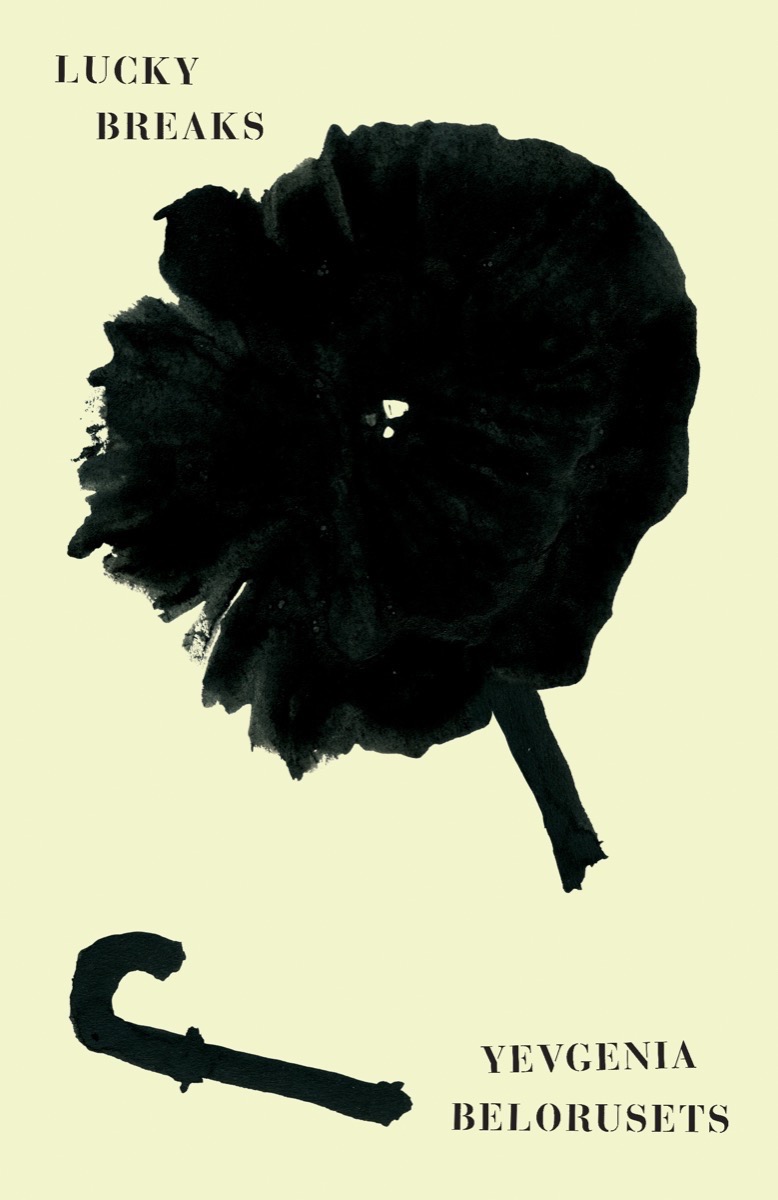
The advent of the war in Ukraine instantly drew my attention to a tiny book I had received from isolarii books. The name Yevgenia Belorusets became suddenly and tragically familiar as her daily diary entries from Kiev were published online. I read that small volume, Modern Animals (translated by Bela Shayevich), drawn from interviews with people she met in the Donbas region and as soon as it became available I bought and read her story collection Lucky Breaks (translated by Eugene Ostashevsky). Although both of these books reflect the impact of war in the east of the country, they could not be read without the context of the full scale invasion underway and still ongoing in her homeland.

Another author I encountered for the first time that inspired me to read more of her work was Czech writer Daniela Hodrová whose monumental City of Torment (translated by Elena Sokol and others) is likely the most profoundly challenging work I’ve read in along time. Upon finishing this trilogy I turned to her Prague, I See A City… (translated by David Short and reviewed with the above) which I happened to have buried on my kindle. A perfect, possibly even necessary, companion.

My personal Norwegian project introduced me to Hanne Örstavik, whom I had always meant to read. I loved her slow moving introspective novel, The Pastor (translated by Martin Aitken) and have since bought, but not read, her acclaimed novella, Love. However, lined up to read this month, I have her forthcoming release in translation, Ti Amo, a much more recent work based on her experience caring for her husband as he was dying of cancer. The only other female author I brought into this project was Ingvild H. Rishøi whose collection Winter Stories (translated by Diane Oatley) was a pure delight. I have been making note of other female Norwegian writers to fill in this imbalance in the future.

The past year also brought new work by two of my favourite poets: a book of prose pieces by Italian poet Franca Mancinelli, The Butterfly Cemetery (translated by John Taylor), and the conclusion to Danish poet Ursula Andkjær Olsen’s epic experimental trilogy, My Jewel Box (translated by Katrine Øgaard Jensen). In May I had the honour of speaking with Olsen and Jensen over Zoom for a special event—it was a fantastic opportunity I won’t soon forget. I also became acquainted with a new-to-me Austrian poet, Maja Haderlap, through her excellent collection distant transit (translated by Tess Lewis) and have since added her novel Angel of Oblivion to my shelves.

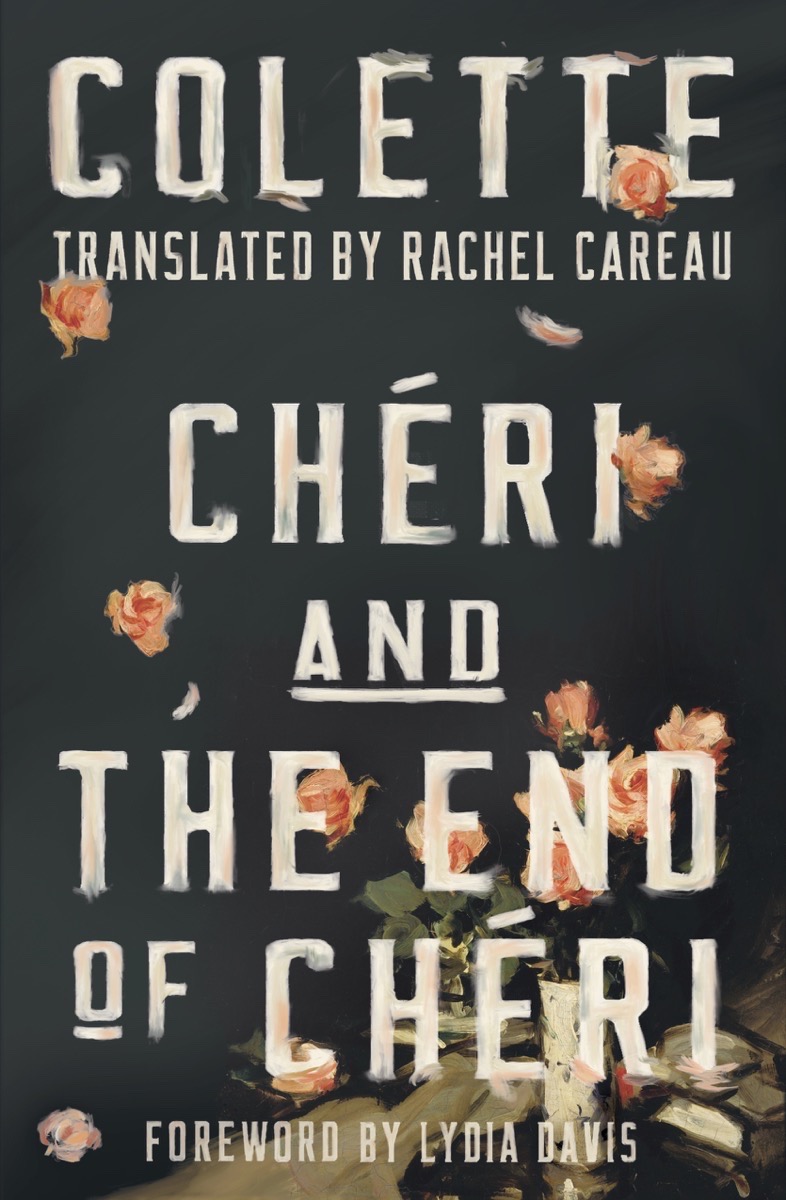
Among the many other wonderful women in translation I read over the past year, Geetanjali Shree’s International Booker winning Tomb of Sand (translated by Daisy Rockwell) needs no introduction—it is an exuberant, intelligent and wildly entertaining read. On an entirely different note, Rachel Careau’s brilliant new translation of Colette’s classic Cheri and the End of Cheri completely surprised me. I had no idea what a sharp and observant writer she was, in fact I didn’t know much about her at all and I discovered that she was quite the exceptional woman. Changing direction again, In the Eye of the Wild, French anthropologist Nastassja Martin’s account of her terrifying encounter with a bear in a remote region of Siberia (translated by Sophie R. Lewis) approaches the experience in an unexpected manner that I really appreciated.

Keeping with nonfiction for a moment, Grieving: Dispatches from a Wounded Country by Cristina Rivera Garza (translated by Sarah Booker), a collection of essays about contemporary Mexico, was a difficult, necessary read. Annmarie Schwarzenbach’s account of her overland journey to Afghanistan with Ella Maillart in 1939, All the Roads Are Open (translated by Isabel Fargo Cole) was another book I had long wanted to read that did not disappoint but which carries much more weight given the more recent history of that region. Finally, My Life in Trans Activism by A. Revathi (translated from Tamil dictation by Nandini Murali) offers vital insight into the lives of hijra and trans women and trans men in India from a widely respected activist. Tilted Axis in the UK will be releasing this book to an international audience later this year.

Rounding out the year, were three fine novels. First, I after owning it for years, I finally read Seeing Red by Chilean writer Lina Meruane (translated by Megan McDowell) and was very impressed. Last, but by no means least, I read two new releases from Istros Books who have an excellent selection of women writers in their catalogue. Special Needs by Lada Vukić (translated from the Croatian by Christina Pribichevich-Zorić) captures the slightly magical voice of child narrator with an undisclosed disability in a remarkably effective way, while Canzone di Guerra by the inimitable Daša Drndić (translated from the Croatian by Celia Hawkesworth) offers a fictionalized account of her years in Canada as a young single mother that was most enlightening for this Canadian reader.

I have, at this point, seven books selected for this year’s Women in Translation Month (#WITMonth) and we’ll see how I manage—and now I also have a goal to exceed for the eleven months before August 2023! I would, by the way, recommend any of the titles listed above if you are looking for something to read this month.

At the threshold: City of Torment (and Prague, I See a City…) by Daniela Hodrová

Founded, according to legend, with the prophetic proclamation of the mythical Princess Libuše, Prague rose from a hilltop settlement to become the political and economic hub of Central Europe. Forged in stone, blood and bone over a thousand years it is a place dense with history, a city that cannot escape itself, often depicted as a labyrinthine maze of magic, madness and despair. City of Torment, a loose trilogy by Czech author and theorist Daniela Hodrová, falls into the literary tradition of writers like Karel Hynek Mácha, Gustav Meyrink and Franz Kafka in its portrayal of the city as a distorted space within which the individual can become lost or disoriented. Her Prague is a layered, cyclical place in which spatial and temporal dimensions shift, trapping its living and the ghostly inhabitants in a grand circle game, one that plays out again and again in a number of distinctive settings or “stages” throughout the city centre. As such, the narrative that runs through the course of the three novels that comprise City of TormentIn Both Kinds, Puppets and Theta—is fragmented, kaleidoscopic and cumulative, peopled by characters that defy boundaries between life and death, human and nonhuman, animate and inanimate.

There is no succinct way to provide an outline of City of Torment as a cohesive work of fiction; it is akin to an organic, evolving entity that gradually takes on a life that even seems to confound its own author by the time we reach the third part. It was not conceived as a trilogy. Hodrová began the first novel, In Both Kinds, in December 1977 and finished it the following year, but, like the two novels that would follow, it could not be published until after the fall of the Communist government. This work, narrated by an omniscient third person narrator that occasionally takes on the direct voice of a character or an object, is centred around an apartment block across from the famed Olšany Cemetery, and those who reside in or pass through in the building and the graveyard. It opens near the end of the Second World War, as young Alice Davidovich throws herself from the window of the building’s fifth floor flat to avoid being taken away to the gas chambers, thus making a direct transit from the building to the cemetery. Alice, who will spend much of her after-life repeating a fruitless rush to meet her beloved Pavel, is the central female protagonist in this first book, and provides a critical yet curious continuity linking the women at the heart of each of the following texts.

A wide cast of eccentric characters populate the pages of In Both Kinds. The living, the dead (recently and long dead), and the few who have found themselves charmed (or cursed) with the ability to negotiate a space in between the two states, exist alongside one another. Souls trapped inside inanimate objects, or transformed into birds interact on both sides (with both kinds) and, naturally, many characters will make the passage from the world of the living to the community of the dead over the course of the novel. Their personalities and the events or activities marking their lived existences follow them to their graves. Clothing and objects—a sweater, a coat, a mother of pearl button, a Persian lamb muff—become talismans, symbols (but of what?). And woven into all of this are historical personages and events that appear or are referenced, exaggerated or confined by the mythology that has grown around them over time. It is a strange and wonderful ensemble piece, but hanging over it all is a disquieting sense of directionlessness.

This sensation becomes more pronounced in the second novel, Puppets (Living Pictures), composed between 1981 and 1983. Composed of one hundred and twenty-six “living pictures” or vignettes, this novel focuses closely on Sophie Souslik, a seamstress at the Realm of Puppets, and her parents and grandparents. Prague with its warren of streets and public squares forms a wider backdrop against which the action—much of it imagined, remembered and echoed—is staged. And staged is the appropriate word, Prague has become a city of marionettes. But something darker lurks here. Specific spaces and objects, like the courtyard with its rug beating rack or Sophie’s father’s office with its heavy black furniture and spinning chair, hold special powers and seem to become portals to painful personal and historical pasts, hidden or forgotten. There is a significant and welcome crossover of characters from In Both Kinds as well as new characters that sometimes act as alternate versions of previous actors. For example, Sophie is sometimes mistaken, at least briefly, for Alice Davidovich, and she also has a boyfriend named Pavel. Identities are frequently confused, experiences are repeated merging the familiar with the strange, and characters increasingly begin to change—humans metamorphize into insects and birds, while statues and household objects fall in love with people and long for release from their solid states. Still, an atmosphere of detachment colours the text.

With the third and final novel, Theta, composed between December 1987 and January 1990, the project that will become City of Torment begins to take form (the books will ultimately be published individually before being gathered together into a single volume). It opens with a variation on the first lines of Dante’s Inferno. Prague is now clearly depicted as its own special version of hell, a city of torment. The title, Theta, has a double meaning—it’s association with death, Thanatos, and its use, θ, as a proofreader’s symbol for “delete”—and as soon becomes apparent, “this novel” now exists an entity within itself. Here, the solitary, curious female protagonist, Alice and Sophie’s heir/doppelgänger, is Eliška Beránková (Lamb). But, not only is she less satisfied to stay within the confines of the text, Daniela Hodrová continually allows the boundary between herself and her creation to blur, even disappear. In a full metafictional turn, the author enters her own novel, and, at one point, Eliška steps out and tries to become a living being. Fiction and fact clash. Some new characters that initially appear to be entirely the product of the text grow more transparent. Others openly straddle the line between fact and fiction. For example, Hodorva introduces her real life husband, trying and failing to keep to the fictional name she assigns him. She grants Eliška imitations of her own life, consciously negotiating her two identities as the manuscript on her desk grows. Through her alter ego, Hodrová, the author, merges with the central figure who is descending into the city of torment in search of her own past.

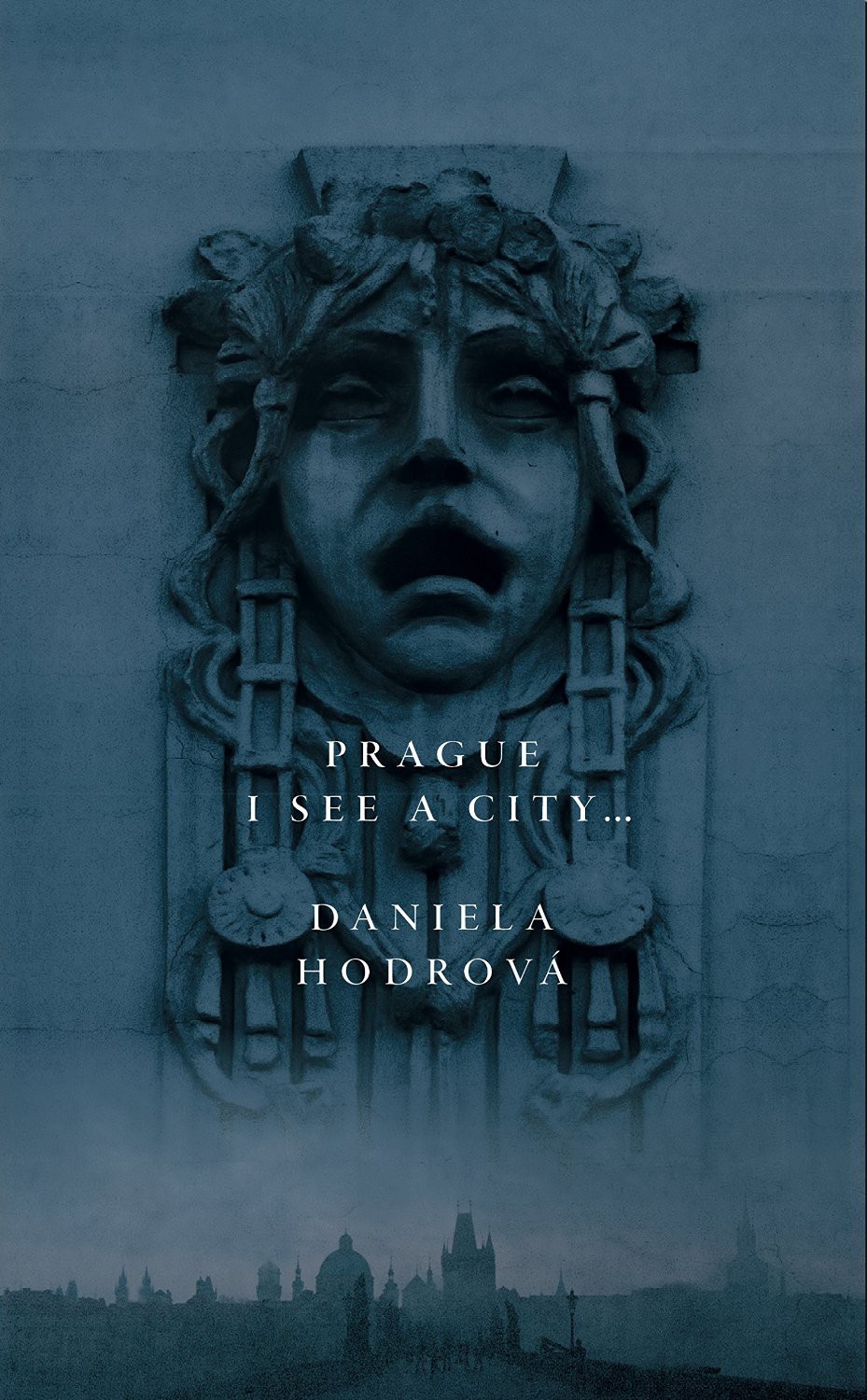
If this all sounds like an overload—and these are densely packed works—Hodrová writes with a style that constantly refers back on itself, without being repetitive, so the reader does not lose track of who is who. Her narrative second guesses itself constantly (questioning meaning in parentheses) implying that nothing is certain, nothing is written in stone. There is, however, much more going on beneath the surface—historical, literary and place references that would likely be less of a mystery to those familiar with Prague—but for a visitor stumbling into her City of Torment with less background, the Appendix that closes out the work might not quite suffice. So I turned to Hodrová’s Prague, I See A City…, written after the completion of the trilogy, first as an alternative guidebook, but then released as a kind prologue/companion piece to her major work. A short, engaging, magical exploration of her hometown, this book is a perfect follow-up read, not only because it will fill in some of the biographic, geographic and historical details behind the novel, but because, written in 1990, in the aftermath of the Velvet Revolution it looks forward, however cynically, to new possibility, with hope of shedding the weight that had oppressed the previous decades.

As noted earlier, the first two novels of City of Torment are characterized by a certain flattened affect and sense of detachment. Composed during the restrictive Normalization period under the Communist government of the 1970s and 1980s, Hodrová was writing without knowing if, or when, it might be possible to release her fiction. It must have felt akin to writing into a void in a world where the dead seemed more alive than the living. The final novel was composed at the end of this period, a time of turmoil, and, when the government fell she stopped writing it, not knowing how a dynamic text informed by a city (or a city formed by a text) might now be altered. In Prague, I See a City… she says of this time:

A revolution of words, an almost fairground battle of words really did take place last year, though its tumult now reaches us only dimly. The city is once more slipping back into its sleep, its unconsciousness, its oblivion.

In those November days, something fundamental happened to the life of this city, to my life. I finished writing Theta at the very moment the battle broke out, for at that moment the city ceased, at least briefly, to be a city of torment.

Far from a conventional travel guide, Prague, I See a City… serves as an immediate refocusing of Prague after the fall of Communist Czechoslovakia and as an introduction to Hodrová’s world-view. As she wanders her city, as if in a dream, the boundaries between the real and the imagined blur. The city she sees is perhaps on the cusp of a new beginning, but the weight of the past, historical and literary will not pass lightly. She reflects on her own childhood, comments on the novels of her trilogy, and visits museums, St Vitus Cathedral, Prague Castle and other sites, evoking the lives of long dead kings and more recent political environments along the way. Published before the recent complete translation of the trilogy, this book could easily be read first, and for its own merits alone, but it is just as effective (if not more so) read as an extended (and exceptionally entertaining) epilogue that offers a fuller understanding of both Hodrová’s literary vision and her idiosyncratic relationship with Prague.

In Both Kinds is a revised translation by Véronique Firkusny and Elena Sokol (an earlier English translation by Tatiana Firkusny and Véronique Firkusny was published in 2015 as Kingdom of Souls). Puppets is translated by Elena Sokol and Véronique Firkusny, and Theta is translated by Elena Sokol. Prague, I See a City… is translated by David Short.

Daniela Hodrová’s City of Torment, Prague, I See a City… and Kingdom of Souls are all published by Jantar Publishing.


A special type of perception: Responses · Kafka’s Prague by Jiří Kolář

I first encountered the work of Jiří Kolář (1914-2002), one of the most important poet/visual artists in post-war Europe—a man for whom the two descriptors very often went hand in hand—through A User’s Manual, first published in English translation in 2019. This intentional pairing of his so-called “action poems” written in the 1950s and 60s with collages from the series “Weekly 1967” was originally published together in 1969 and reproduced handsomely by excellent Prague-based indie press Twisted Spoon. Now, with the release of Responses · Kafka’s Prague, another of the Czech artist‘s idiosyncratic pairings, an intriguing overview of his opinions and reflections on the intersection of literature and art is set against a collection of his distinct “crumplages.” Again it makes for an unusual yet beautifully presented volume which also speaks to his creative processing as displayed in both this and A User’s Manual.

Responses is a sort of one-sided investigation, or what Kolář called an “imaginary interview,” a set of seventy-one answers without questions. Compiled in Prague and Paris in 1973, the topics covered include the development of his artistic sensibility, the writers, artists and movements that had an influence on him, and a discussion of technique. It has a thoughtful, conversational, musing-out-loud sort of feel and a sense of direction that is not explicit or artificial but gives the work a natural flow.

From the outset,  Kolář makes it clear that he sees art as part of the “general drive toward universal knowledge” and as such there can be nothing extrinsically new that is not a departure from that which is already innate to the practice. Art and literature are disciplines that do not create anything new so much as they create new ways of looking at (and using) what is already there, a “special type of perception.” As in science, artists are engaged in exploration and investigation, and those he admires, such as Mallarmé and those who followed in his footsteps, are those who become dissatisfied with the status quo. For Kolář this leads him to analyze and reflect upon what various poets were doing with language, and ultimately realize he had to dismantle language itself:

For me the destruction of poetic language followed the same path and the same type of perception as did a new and different perception in other disciplines. As I’ve already said, this is primarily the case in [modern] music and the visual arts. I was speaking about a type of perception — what I mean is that I couldn’t keep seeking poetry in the written word. I had to go beyond the written word. It meant finding another, living language.

There is a distinct restlessness to Kolář’s self-described poetic and artistic evolution, accentuated by the casual style of this particular discourse, but then he was working in trying times. Deemed publicly undesirable by the Communist government in Czechoslovakia he spent time in prison, saw the publication of much of his work delayed, and would eventually end up living in exile. Responses, however, is not concerned with political revolution, but rather with his artistic interests and endeavours, past and current. As translator Ryan Scott points out in his Translator’s Note, this work “should not be read as Kolář’s final word but as capturing a particular moment in time amid his creative flux.” Nonetheless, it makes for an interesting look into an original creative mind.

Kolář’s international reputation rests largely on his innovative collage techniques. He is so fond of printed materials—newspapers, letters, tickets, receipts—not only as raw materials but for the moment-in-timeness captured in them that one wonders how he would have adapted artistically to our increasingly digital environment. The present volume contains a series of “cumplages” constructed from photographs of buildings and landmarks in Prague, paired with brief quotes from Kafka’s writings. In these images, the shapes and angles of the structures are distorted, twisted and bent out of shape. The effect is quite striking and perfectly “Kafkaesque.” The process follows a specific routine, starting with moistened paper:

Crumpling must be done fast and carefully, and it’s difficult to predict results with this technique because it’s always the brother of chance. Because the moist paper is crumpled and the work has to be finished fast, hardly any adjusting can be done.

Later on he mentions that his “best crumplages were created from reproductions that readers had coloured themselves.” He delights in the touches human hands have left behind coming through in his art. Among the thirty-four images employed in Kafka’s Prague are buildings directly associated with the writer’s life, and other structures Kafka would have known well. (You can get a sense of the book here.) To have this work so beautifully reproduced in this book is a treat in itself, together with Responses it is an enriched experience.

Responses · Kafka’s Prague by Jiří Kolář is translated from the Czech by Ryan Scott and published by Twisted Spoon Press.