“Mad, it’s all mad” Winterberg’s Last Journey by Jaroslav Rudiš

‘The Battle of Königgrätz doesn’t just run through my heart, it also runs through my head, and through my brain, and through my lungs and liver and stomach, it’s part of my body and soul. Two of my ancestors lost their lives, dear Herr Kraus, one on the side of the Prussians, and the other on the side of the Austrians, Julius Ewald and Karl Strohbac, yes, yes, I can seek out either side, but in the end I’m laying with both of them in the grave, I don’t know if you can imagine that, I want to understand it, I want to finally understand everything in my life, you understand, dear Herr Kraus, that’s why we’re here now, in order to understand it, dear Herr Kraus, here at Königgrätz was where the entire tragedy began,’ rambled Winterberg, still looking out of the window.

Just a few pages into the madcap epic adventure Winterberg’s Last Journey it’s immediately clear that the erstwhile hero of the story, ninety-nine year old Wenzel Winterberg, is quite the character. He is not only possessed by history, obsessed with railways, and haunted by the memory of a long lost love, but he is determined to exhaust an unexpected death bed second wind with a wintery escapade guided by his precious bible, the Baedeker for Austria-Hungary from 1913—the final edition of the railway travel guide published five years before he was born. His reluctant companion is Jan Kraus, a palliative nurse hired as live-in caregiver to usher the old man on his final passage to the other side, who now finds himself struggling to keep up with his near-centenarian “patient” for Kraus is also carrying plenty of his own baggage on this Central European odyssey.

Czech writer, playwright and musician Jaroslav Rudiš is clearly having fun with this eccentric tragicomedy, but he is also exploring the complicated history of his homeland. As his first novel originally written in German, Winterberg’s Last Journey is centred around two men who have left what is now Czechia and settled in Berlin. Winterberg is an ethnic German, born in Reichenberg (now Liberec) in 1918, just as Czechoslovakia declared its independence from Austria-Hungary. This liberation allowed his father to open the first crematorium—or as Winterberg calls it Feuerhalle— in the newly formed country. Seemingly proud of the family business and his father’s extensive experience with a variety of unfortunate corpses, he did not want to follow in his footsteps. After the war he left for Berlin where he resumed the trade he’d first undertaken in Reichenberg, thus spending the rest of his working life as tram driver.

Kraus, by contrast, is an ethnic Czech who grew up in the southern area of the country during the Communist post-war era. He too was eager to leave as young man, but what he thought was his ticket out landed him in prison. After his release he trained as a nurse and joined some kind of informal network of caregivers who provide comfort, companionship and live-in support for those who are dying. Upon meeting Winterberg, he is certain the “crossing,” as he calls it, will be swift. The old man does not seem long for the world. But when Kraus happens to remark to the unconscious patient that he is from Vimpek, the town known in German as “Winterberg,” something starts to percolate and before long he is piloting a remarkable return from the nearly-dead. As Winterberg regains his strength and his faculties, he begins to hatch a plan to follow the trail of postcards left by his first great love—Lenka Morgenstern—when she was forced to flee as the tides were turning in the Sudentenland region prior to the Second World War. He is convinced that if he can make it to Sarajevo, the location of her final missive, he will find out what happened to her so many long years ago.

The strength of this unlikely voyage lies in the chemistry, if that’s the right word, between this Bohemian odd couple. Winterberg is subject to rambling and very loud readings from his precious Baedeker, much to the dismay of anyone in earshot including  his weary companion. For long stretches he carries on one-sided conversations, providing questions and commentary as needed (“I know what you’re going to say, Herr Kraus…”) leaving Kraus himself barely able to get a word in edgewise. He has stock phrases to which he constantly returns, like “the beautiful landscape of battlefields, cemeteries and ruins,”  the adage of an Englishman he once knew, and a seemingly endless repertoire of all the possible corpses that “are not a pretty sight, as my father would say.” He’s also subject to “historical fits,” extended passionate, agitated soliloquies that always end with a sudden collapse into sleep:

Cork pulled.

Air out.

Eyes closed.

Good night.

As narrator and reluctant participant, Kraus is the dramatic foil. He falls into spare, sometimes almost desperate,  reflections against the deluge of Winteberg’s ravings, and their dialogue, when they are able to find the space for it, is funny and tight. But he is, in his way, no less damaged than the self-described mad man in his care. He drinks too much, smokes too much, and is weighed down by secrets and a lost love of his own. In the end, each man is searching to understand something about himself and his life, and charting his own personal battles, those events large and small that threaten to derail us all. And along the way, through railway stations, museums, cemeteries, and a handful of countries, we learn a lot about the history of Central Europe and the network of rail lines that have bound it all together.

Winterberg’s Last Journey is an ambitious and wide-ranging outing—one that depends on strong characterizations, a balanced narrative energy, a careful distribution of the ongoing repeated expressions and internal jokes, and a few unexpected twists and turns to shift the flow of what could easily fall into a tired routine in less talented hands. And, as Kris Best tells us in her Introduction to this novel, her impressive first translation, Rudiš draws heavily on factual details to recreate the world Winterberg remembers from the 1920s and 30s, right down to the Fuerehalle in Reichenberg.  The result is a highly engaging adventure with both historical depth and comic breadth.

Winterberg’s Last Journey by Jaroslav Rudiš is translated from the German by Kris Best and published by Jantar Publishing. It is available now in the UK and worldwide from the publisher. It will be published in North America in September.

“keep turning forever, circling round”: Shining Sheep by Ulrike Almut Sandig

.   i have the same number of words inside me
as all of you have words, the exact same number

but how many times can they be combined? you
keep finding words that no one sang before you.

.  your godhead made you after his own image
.   stark naked, blind—wild things that you are.

– from “The Silent Songs of the Walls: l”

German poet Ulrike Almut Sandig’s latest poetry collection, recently released in Karen Leeder’s translation, is the modestly titled Shining Sheep—modest, that is after her 2016 offering, which appeared in English in 2020 as I Am A Field Full of Rapeseed, Give Cover to Deer and Shine Like Thirteen Oil Paintings Laid One on Top of the Other— but it is by no means a more restrained effort. Rather, this new collection, originally published in German in 2022, is an especially dynamic, ambitious affair.

Several of the pieces here were commissioned for performances, films, or arose out of collaborations with fellow artists and musicians. This has been a hallmark of Sandig’s approach to poetry ever since her early days posting poems to lampposts and handing them out as flyers. But that collaborative, multi-instrumental quality is now more pronounced, not only through the visual presentation of the poems, often incorporating shaped or concrete poetry, but with the inclusion of links, where appropriate, to recordings and video performances that bring her poems to life off the page.

Opening with a single word, alone on a black page—“Lumière!”—Sandig’s poetry is a call to light, but one that resonates with a dark exuberance. She draws on a wide range of influences—German folk songs, writers, and history—to address political and social issues, never turning away from difficult subjects, like maternal depression and alcoholism, living with Covid, migration, and climate change.

just let that melt on your tongue:
shining sheep, genetically modified
as night storage for the dark hours

visible in satellite images as little ghosts
their delicate shimmer on the radar
seems to be made to lull

the oppressive darkness between
the great golden bulls of the cities
into a comforting gleam. 

– from “Climate change is here, now. But we are also here, now. And if we don’t act, who will?”

Along with poems that arise out of commissions and direct collaborations with other artists, Sandig is also at times writing in response to, or in conversation with the work of late German authors, filmmakers and poets, including Friedrich Hölderlin’s “Wie wenn am Feiertage” (“As When on Holidays,” 1800). Other pieces have their genesis in more immediate encounters outside the artistic community, past or present.

A particularly moving sequence, “Lamentations in VI Rounds,” arose, poet tells us, out of a chance connection with a young man from Afghanistan who contacted her after she accidentally left her bank card in a ticket machine on the Berlin underground. He and his large family were living in the city as failed asylum seekers. She stayed in contact with them and, from their stories, wrote a piece she called “Five Lamentations,” adding a sixth round for this final version after the Taliban took control of Kabul in 2021.

the little man inside my head, he had
a daughter. he loved the way she boiled
minced beef, the way she answered back.
he loved the wonder of her eftertherain in Omid.

Omid sold his daughter in exchange for the value
of a ticket to Germany. today she called him up.
she sounded like she was sitting in his ear.
the pear tree in the yard was doing fine.

Shining Sheep is Sandig’s third poetry collection to be released in English, and the most inventive and experimental to date. Her long-time translator, Karen Leeder, is well attuned to the nuances of her uniquely playful, yet melancholic verse, bringing this energy and adventurousness to the forefront here. For a taste Sandig’s poetry and performances(with Leeder’s subtitles where available), her YouTube channel is well worth a visit.

Shining Sheep by Ulrike Almut Sandig is translated from the German by Karen Leeder and published by Seagull Books.

Making every word count: The Questionable Ones by Judith Keller

A police car drives slowly along the streetcar tracks in front of the central station. The officers scrutinize the waiting pedestrians through the window. Most of those waiting here are out of the question. But some do come into question. These are the questionable ones.

This simple story, “Casting,” not only provides the title for Judith Keller’s collection of micro fictions, now available in English translation by Tess Lewis, but is a perfect representation of what this young Swiss writer is able to achieve with an economy words and a sensitivity to the multiple meanings that potentially blossom from familiar expressions. A quick glance at this book of short (sometimes very short) stories can be misleading. Some pieces are barely two sentences, a number extend for a page or two, while a few stretch to seven or more pages. One might then wonder how much a of story such an abbreviated form can contain, but as Keller knows well, the careful choice of words and the confidence to leave open space for the reader is key.

Arranged into sections named after stops on the Zurich tram line, the stories in The Questionable Ones offer snapshots into the lives, passions and idiosyncrasies of a variety of characters. Absurd, often humorous, sometimes reaching toward the political, Keller’s micro fictions reflect recognizable human emotions and actions, frequently relying on common expressions taken to their literal extreme, or language that is inherently ambiguous. Of course, this reliance on meaning, especially in such a confined literary space, presents a particular challenge for a translator.

The publisher’s webpage for this book features links to a published interview and a video conversation between the author and her translator, both recorded in April 2020 when the pandemic had intervened in Keller’s plans to attend a festival and a residency in New York City. Although both cover her literary influences—including Robert Walser and Ilse Aichinger—and the reasoning behind her unusual decision to study German as a foreign language in Bogota, Colombia, the video is particularly enlightening. It not only offers anyone interested a taste of Keller’s mini fictions, read by the author herself, but zeroes in on some of the difficult decisions her translator faced when the choice of an appropriate word to convey the nuances implicit in the original was not obvious. At this point, the translations were not necessarily fixed in their final form, so several times, Lewis and Keller discuss possible options for critical words in particular pieces. After all, if every word counts in the initial composition, the same is true for the translation. Further, the opportunity to witness the writer and translator openly examining the subtleties of meaning together is inspiring.

Keller’s playfulness with words and capacity to see things from a slightly odd angle allows her to pack more into a few sentences or a few pages in ways that longer, more conventional fiction might not. Less is more. Each piece is left open for interpretation, encouraging the reader to imagine a larger tale. They are at once sketches and revealing portraits of ordinary people trying to make sense of life, one way or another. As well, the spare prose, focused on the most essential, if unusual, qualities of  character and setting leads to some wonderful images. Take for example, the opening of the two-page story “In a House”:

A band of light lay on a hillside as if a glance from half-closed eyes had fallen from above. On the hill stood a house and in it lived a man whose movements were slow. He slowly raked the leaves. He had a wife and two sons. His wife looked like an owl with her brown and golden eyes. She had taken to standing behind herself and sending her body on ahead and calmly watching what happened to it. Their marriage was a muted one.

The only obvious connection between the stories that comprise The Questionable Ones and the tram stations that denote each section—Bucheggplatz, Schwert, Micafil and so on—is the recurring piece, always called “High Time” that closes out each sequence. The circumstances change, but each instance, begins with a “far-fetched woman” making her way through the city, by day or by night, often reaching the relevant tram station and, ends with the acknowledgement that she, or someone else, has been “waiting for it to be high time for a good while now.” This variation on a theme within which what “high time” is meant to refer to is never revealed, adds an intriguing continuity to this irresistible collection of microfictions.

The Questionable Ones by Judith Keller is translated from the German by Tess Lewis and published by Seagull Books.

Women in Translation Month 2023: Some suggestions from the past year of reading

August. Another Women in Translation Month is upon us. I have already read my first contribution to the annual project with a review to come in a few days but, as usual, there will be a few non-women read and reviewed this month as well. Nonetheless, I hope to make a good showing.

Looking back over the reviews I posted since last year’s edition, I see that I have read less women in translation than I expected—less women over all, perhaps, but my reading has been governed a little more by review copies and release dates than usual, something which can be offer opportunities and present restrictions. However, I have read some excellent books since last August and if you are looking for suggestions, I have linked them here:

Eastbound by Maylis de Kerangal, translated by Jessica Moore (French)             — A spare, yet intense thriller. (Archipelago)

Balkan Bombshells: Contemporary Women’s Writing from Serbia and Montenegro, compiled and translated by Will Firth — A  surprisingly sharp, strong collection introducing many new voices. (Istros Books)

Grove by Esther Kinsky, translated by Caroline Schmidt (German) A novel born of grief and a healing sojourn in Italy by one of my favourite contemporary writers. (Fitzcarraldo /Transit Books)

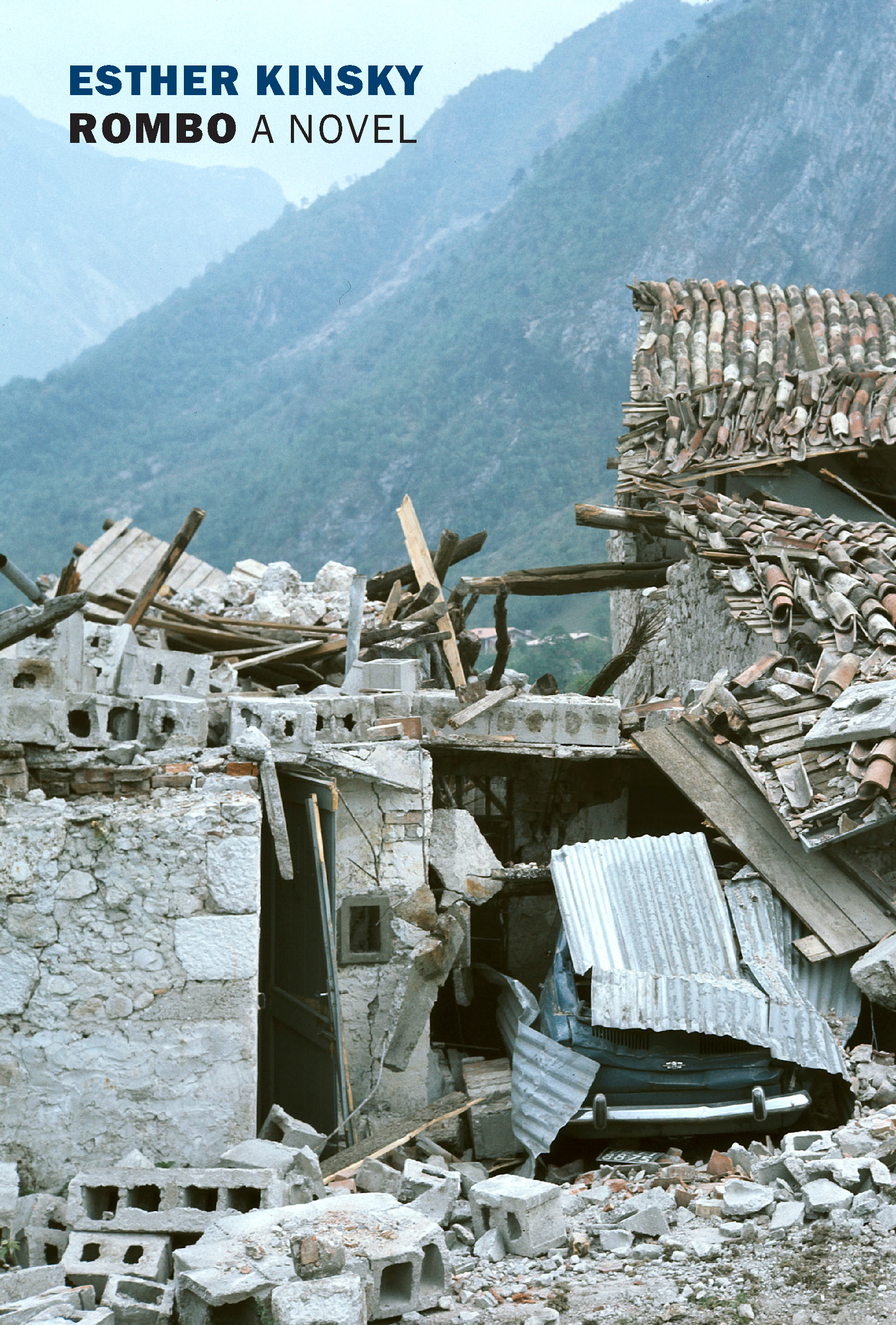
Rombo by Esther Kinsky, translated by Caroline Schmidt (German) — Again Kinsky’s acute sensitivity to landscape writing frames this fictionalized account of a year of devastating earthquakes in northern Italy. (Fitzcarraldo/NYRB)

The Book of Explanations by Tedi López Mills, translated by Robin Myers (Mexico/Spanish) — A highly original collection of essays that I simply loved. (Deep Vellum)

Mothers and Truckers by Ivana Dobrakovová, translated by Julia and Peter Sherwood (Slovak) — Five stories, five difficult, complicated women you won’t easily forget. (Jantar Publishing)

The Geography of Rebels Trilogy by Maria Gabriela Llansol, translated by Audrey Young (Portugal) — A surreal, immersive tale of saints, heretics, philosophers, strong-willed women and what it means to write. Quite unlike anything I’ve ever read. (Deep Vellum)

Requiem for Ernst Jandl by Friederike Mayröcker, translated by Roslyn Theobald (German) — A collection of poems Mayröcker composed after her long time partner’s death, perhaps the best place to start with her idiosyncratic work. (Seagull Books)

Hospital by Sanya Rushdi, translated by Arunava Sinha (Australia/Bengali) — Rushdi, a Bangladeshi Australian writer draws on personal experience to capture the reality of psychosis with humour and grace. (Seagull Books/Giramondo)

Twilight of Torment I by Léonora Miano, translated by Gila Walker (Cameroon/French) — Over the course of one night, three women with a connection to a man who is absent, tell their stories of love and determination. (Seagull Books)

Marina Tsvetaeva: To Die in Yelabuga, by Vénus Khoury-Ghata, translated by  Teresa Lavender-Fagan (Lebanese French) — Another favourite author offers an intense, short fictional account of the life of the tragic Russian poet.

If you are looking for Women in Translation Month inspiration, I can recommend any one of these wonderful books.

Remembering prewar Prague: House of the Nine Devils: Selected Bohemian Tales by Johannes Urzidil

This fine collection of stories by Prague native Johannes Urzidil, recently published in English translation by David Burnett, House of the Nine Devils, opens with—and takes its title from— a fantastic tale of a haunted house in the city’s Lesser Town that hides a dark mysterious past going back centuries. Although most of the stories that follow move away from this more explicitly gothic energy, they are filled with strange coincidences and unlikely adventures that lead their protagonists, all echoes of the author himself, into encounters that are coloured with the unique atmosphere of the capital of the Kingdom of Bohemia in the early twentieth century. As the narrator’s father story tells his son in the opening story:

“But this Prague, where you too were born, is an old city of magic. This is where the rabbis had their sorcerer’s apprentices and where the emperors kept their alchemists. Many things come together here — East and West, Jew and Christian, Czech and German, North and South — and where many essences converge, many wondrous, inconceivable things come to pass: things, words, characters and occurrences  that have never been seen before. It’s a breeding ground for spells and magic powers.”

And so it is. In the hands of a master storyteller, even a young boy can find himself encountering all kinds of unusual people and mysteries in this charmed city.

Johannes Urzidil (1896–1970) was the son of German nationalist and “passionate” railway official born in a rural part of western Bohemia, and a Jewish woman from Prague who died when he was just four years old. His father was a Catholic who never practiced his faith and believed in taking his son to various houses of worship to demonstrate that all religions were equal. Nonetheless, he insisted his boy practice Catholicism. His second wife, Johannes’ stepmother, was a staunch Czech nationalist, and their volatile marriage together Urzidil’s own fraught relationship with the woman he refers to as “ his step” adds much colour and humour to many of the stories collected here.

Urzidil published his first poems at age seventeen and began to associate with members of the so-called Prague Circle where he became friends with Kafka, Franz Werfel, Max Brod and others. In his Afterword, translator David Burnett, reports that he “had the honor of holding one of three funeral orations for Kafka in 1924, predicting his future fame.” Through the 1920s and early 30s, he worked as a translator and press attaché for the German Embassy while continuing to publish poetry, essays and criticism. He co-founded and managed the German Writers Union of Czechoslovakia until political tensions led to his resignation in 1933. By this time, despite his German background, his mother’s Jewish heritage and his marriage to the daughter of a rabbi, made it difficult for him to find work and, eventually, unsafe to remain in the city of his birth. He and his wife escaped in 1939, first to England, then to the US where they settled in New York City.

For Urzidil, fiction writing did not become a serious pursuit until later in life. His breakthrough work, The Last Beloved, a collection of autobiographical stories, was published in Munich in 1956 when he was sixty years-old.  His final decade of life, the 1960s, were very prolific. Of his seventy-odd stories, many blending elements of fiction, biography and essay, about a quarter were set in America, a handful in assorted European settings, but the majority of his best loved works take place in prewar Prague and Bohemia. It is from these stories across five German publications that the pieces in House of the Nine Devils are drawn. They are arranged in a roughly chronological order—by setting, not publication date—in an attempt to create a “more coherent whole” or a kind of fictional memoir, reflecting the degree to which Urzidil’s family and life experiences fed his writing.

Perhaps because he came to storytelling so late in life, Urzidil’s stories have the warmth and wry-humour of an older relative recounting tales of his youth, playing up the unexpected twists and turns. His narrators’ seemingly innocuous adventures—looking for a lost wallet, delivering messages, dropping in to visit with friends—put them in the paths of bored police officers late on New Year’s Eve, a fated opera singer, a suicidal railroad inspector, or a murderous fugitive. As he tells us in “The Last Tombola”:

People were always using me to drop things off. I was always running through streets and from floor to floor with notes, letters, and messages for other people. That’s pretty much my life. And whenever you have to drop something off, awful things always seem to happen.

This longer story begins with its young protagonist being charged to deliver a report to his father’s visiting superior with whom his family had dined the night before. He will soon learn that Herr Pernold has hung himself from his Grüss Gott suspenders, an event that sets off a richly complicated (and funny) tale of mystery, morality, concerns about renumeration, and ripe opportunities for humour at the boy’s step mother’s expense, something that first arises in the opening paragraph as the narrator notes that his delivery assignment will take him to The Imperial Hotel on Na Poříčí:

Na Poříčí is Czech for “on the riverbank,” which is fair enough for the Moldau flows nearby. Still, I had an instinctive aversion to this Prague street, its two chafing affricates reminding me of the sand-yellow paletot that hugged the hips of my stepmother around the time my father was courting her. I had witnessed this courtship and once heard her say, “It chafes me; I bought it on Na Poříčí.” “Good,” I remarked, because I felt this lady couldn’t be chafed enough. “Who asked you?” asked my father. “I asked me,” I answered. He was about to give me a royal smack in the face, which usually accompanied by the words, “When duty calls, feelings must be silent.” Yet this time he abstained from getting violent, not wanting to appear ungallant in front of the lady. He looked at me instead like Cronus before he ate his children.

This kind of sly, smart humour is one of the most wonderful features of Urzidil’s stories. And indicative of the relationship he, or rather his protagonist, has with his father with whom, for the cost of a slap in the face, he is allowed to voice what they both often think about his step’s moaning and complaining which only increase after the marriage. It is a recurring motif in many tales, one grounded in the author’s real life, as he reveals in the two, biographical essay-like pieces that round out the collection wherein he talks honestly about his beloved father and the difficult woman who became his second wife.

Prague in the first decade of the twentieth century is vividly evoked in so many of the tales in this collection, as are the social dynamics of the life of a lower middle-class family, the tensions that exist between Germans and Czechs, and the sense (at least to a young boy) that the Austro-Hungarian Empire is eternal. Then there are stories set during the First World War and, notably, “One Last Deed,” which depicts the dangerous environment in the city for men like Urzidil during Nazi occupation through an account that finds the protagonist taking refuge in the hovel of an eccentric former schoolmate.

The particular charm of Urzidil’s fiction lies in the warmth and charisma of his narrators, effortlessly spinning entertaining tales. Gathered together, the stories collected here do, as intended, read like a loose memoir recounted with a healthy measure of creative license. The boy, his railway official father, and his cantankerous stepmother provide the continuity. Like other natural story-tellers who regularly dip into the same well—perhaps a fictional community, or the life of a recurring alter ego—Urzidil has the ability to make each story feel fresh and unexpected. Hopefully more of his fiction will be translated in the future.

House of the Nine Devils: Selected Bohemian Tales by Johannes Urzidil is translated from the German by David Burnett and published in a handsome hardcover edition by Twisted Spoon Press.

Forever before and after: Rombo by Esther Kinsky

The seismic shocks of May divided life and the landscape into a before and after. The before was the object of memory, stories unceasingly layered and blown over by words. One argued over the form of the cliffs, the course of the brooks, the trees that avalanches rolled over. About the whereabouts of objects, the order of things in the house, the fate of animals. Each of these arguments was an attempt at orientation, at carving a path through the rubble of masonry, mortar, split beams and shattered dishes, to understand the world anew. To begin living in a place anew. With one’s memories.

On May 6, 1976, just before 9:00 pm, a devastating earthquake tore through the Friuli district of northeastern Italy. Several strong quakes followed in September. Bordered, today, by Slovenia to the east and Austria to the north, this region which extends from the slopes and foothills of the Carnic Alps, onto the flat flood plain of the River Tagliamento, would be forever changed, as would the lives and memories of those who survived that year of death and destruction. Rombo, the latest novel by German poet and writer Esther Kinsky, places this event at its centre and turns its attention to the rich and deeply interwoven stories that bind the land and its inhabitants together.

As her novels River and Grove demonstrate, Kinsky is deeply sensitive to and observant of landscapes, urban and rural; her narratives move through environments that are simultaneously emotional and physical—spaces of memory, grief and reconciliation. The same can be said of Rombo, but here, instead of a peripatetic first person narrator tracing a deeply personal journey, a chorus of voices carry the flow of a unique, multi-layered narrative that encompasses the human and non-human, the animate and inanimate alike. The text is divided into seven sections, each opening with a quote from a classic geological work and a coarse black and white illustration depicting a fragment of the remaining frescos from the cathedral at Venzone. A neutral narrative voice describes the landscape and its history—present and past—offering observations of a geological, ecological, folkloric and scientific nature. Woven into this tapestry are the memories and stories of seven men and women—Anselmo, Olga, Mara, Lina, Gigi, Toni and Silvia—who were children or youth at the time of the earthquake, and whose reflections take them back to the events that forever divided their world into before and after.

This choral narrative flows and swirls like a river, rising and falling, turning in eddies, joined by streams and tributaries along the way. Moving back and forward in time, repetition, contradiction and fractured accounts are gradually woven together to create a rich, if heartbreaking, whole. In the beginning we are briefly introduced to the seven survivors, from a third person perspective, on May 6 and in the present, decades later. Then, the dynamics of the seismic event are set up, the unevenness of the impending disruption are alluded to, and the forces of the earth are unleashed:

It is said that animals are much quicker to sense the vibrations that gradually build up in the Earth’s interior and eventually exceed the stress limit in the spreading centre, causing the tectonic plates to snag and tip, irrevocably shifting the order of hollow cavities and mass, the order of emptiness and fullness.

For each one of the survivors, the hours leading up to the May earthquake were marked by unusual observations—an unexpected sighting of a snake, anxious goats, loudly barking dogs, fitfully chirping birds. The day was unseasonably hot, the light oddly filtered. And everyone remembers the otherworldly sound, il rombo, rising out of the ground just before it started to shake. In the moment, they are pushed out of their houses, stand under archways or find themselves crawling out from under collapsed structures. Damage is extensive but, all things considered, their village is one of the lucky ones. Others are almost completely destroyed.

After our first glimpse of that fateful day, the survivors begin to speak for themselves. They talk of their memories of life in the valley, their families, and their later adult years. But mostly they speak of the earthquake and its immediate aftermath—the strange, dislocated summer of freedom for the school-aged children, the stress of rebuilding and rising tensions among the adults and, amid the turmoil, the accommodation of marriages and deaths and the business of life. Then, when things are beginning to promise a return to some degree of normal, the severe September shocks roll through. Everything is unsettled again.

The lives and stories of some of the characters intersect, contradict one another or offer different angles on the same situations or experiences. Their individual histories reflect the historical and economic realities of the region. Fractured, multi-generational families are common as people are forced to leave to search for work, or driven back again by the need for the support of extended family. Anselmo and Olga, for instance, were both born abroad, in Germany and Venezuela respectively. They come to the valley with their locally born fathers after divorce or widowhood finds them stranded in foreign lands and brings them home. Some couples comfortably fall into a pattern of living in different towns or countries, like Silvia’s parents or Lina and her husband. After the earthquake, many will leave the region for good, having lost their jobs and their homes, but for the seven villagers featured here, including those who do leave for a time and return, the valley is and always will be home. As Lina says about the land and her place in it:

The soil is poor here. Limestone ground, the ground of poverty. The flowers are paler here than elsewhere. The winter is long. But winter is alright by us, because it brings snow and whatever grows around here has snow and goat shit to thank for it. The snow saturates the ground differently than the rain does, they always say. On the other side of the mountain, in the south, it only rains, even in winter no snow falls. It’s God’s pisser, the people say.

What is my life? sometimes I ask myself. My life is this place. Here I know everything. Every stick and every stone. The animals and the people. I write down what I want to remember. The weather, the harvest, the comings and goings, misfortunes. Surprises.

As these witnesses, now looking back through the filter of more than half a lifetime’s experience, recall the upheaval of the earthquake and talk about their lives before and since, their reminisces are framed and reframed through the shifting sedimentary layers of accumulated memory. Just like the land around them. Unfolding with an uneven, yet natural pace, the flow of personal stories, woven among the descriptive passages, observations and anecdotes, lends a filmic documentary-like feel to the novel, successfully achieving a Sebaldian balance of truths and fictions imbued with Kinsky’s distinctly meditative poetics. The result is an unusual and highly affecting form of storytelling that follows its own narrative logic.

Rombo: A Novel by Esther Kinsky is translated from the German by Caroline Schmidt and published by New York Review Books  in North America and Fitzcarraldo in the UK.

Reading highlights of 2022: A baker’s dozen and then some…

It seems to me that last year I resisted the annual “best of” round-up right through December and then opened the new year with a post about some of my favourite reads of 2021 anyhow. This year I will give in, look back at some of my favourite reading experiences out of a year in which I had a wealth to choose from and aim to get some kind of list posted before friends start hanging up their 2023 calendars around the globe. In a year with war, floods, famine, storms and still no end in sight to Covid infections, books seemed more important than ever, as a respite, a record and a reminder that we, as human beings, have been here before and must learn from the past to face the increasing challenges of the future.

As ever, it is difficult to narrow down twelve months of reading to a few favourites. One’s choices are always personal and subjective, and many excellent books invariably get left out. This year especially—2022 was a productive and satisfying year for me as a reader and as a blogger. Not much for other writing, I’m afraid, but that’s okay.

This year I’m taking a thematic approach to my wrap-up, so here we go.

The most entertaining reading experiences I had this year:

Tomas Espedal’s The Year (translated from the Norwegian by James Anderson) was one of the first books I read in 2022. A novel in verse, it is wise, funny and, nearing the end, surprisingly tense as Espedal’s potentially auto-fictional protagonist careens toward what could be a very reckless act.

International Booker Prize-winning Tomb of Sand  by Geetanjali Shree (translated from the Hindi by Daisy Rockwell) looks like a weighty tome, but blessed with humour, magic and drama—plus a healthy amount of white space—it flies by. An absolute delight and worthy award winner!

Postcard from London, a collection of short stories by Hungarian writer Iván Mándy (translated by John Batki) was a complete surprise for me. In what turned out to be a year in which I read a number of terrific collections of short fiction, I was a little uncertain about this large hardcover volume some 330 pages long, but by the end of the first page I was hooked by the author’s distinct narrative voice and I would have happily read many more pages.

The most absorbing book I read this year (and its companions):

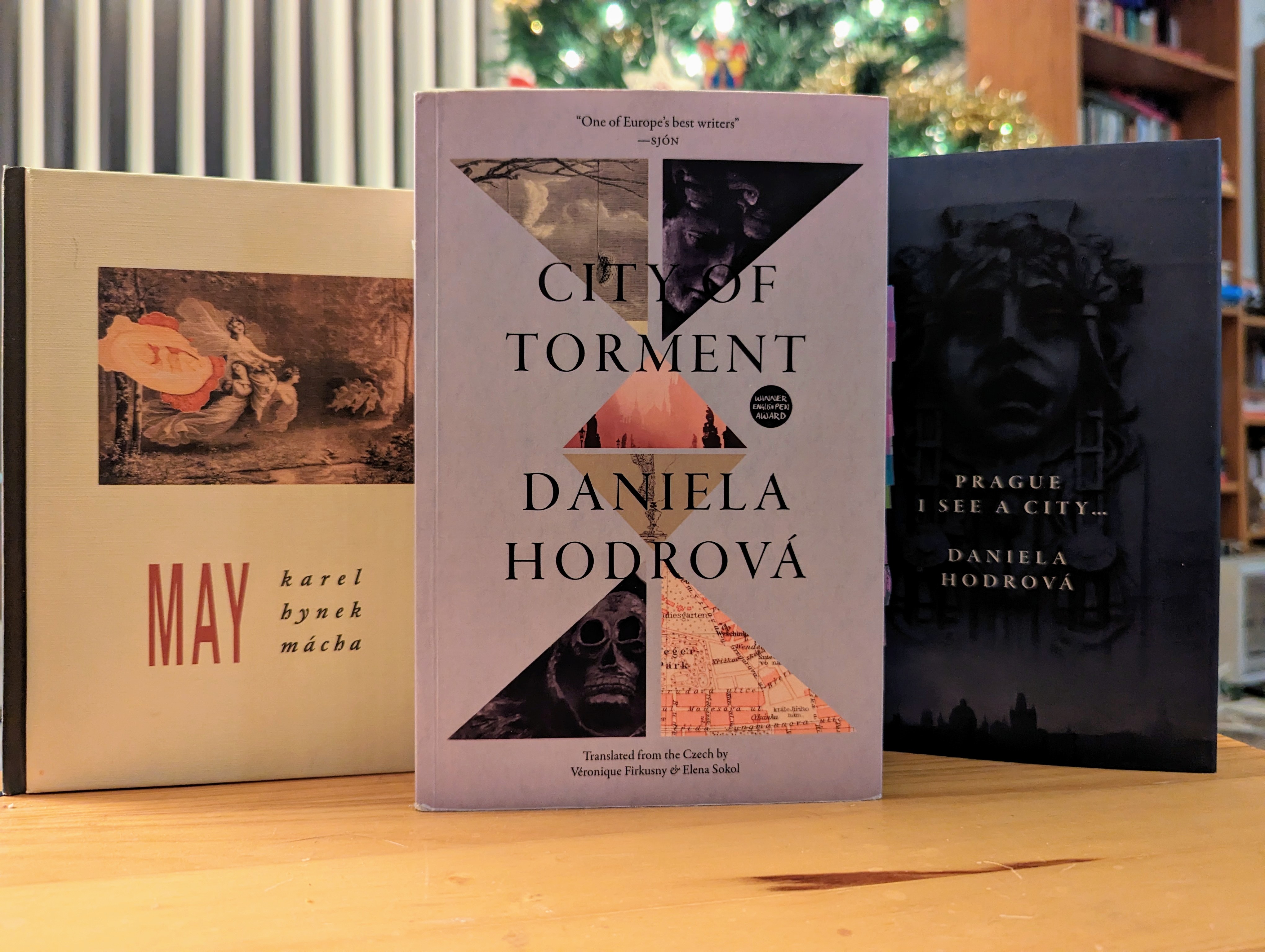
City of Torment – Daniela Hodrová’s monumental trilogy (translated from the Czech by Elena Sokol and others) is a complex, multi-faceted, experimental work that explores a Prague formed and deformed by literary, historical and political forces, haunted by ghosts and the author’s own personal past. After finishing the book, I sensed that I was missing much of the foundational structure—not that it effects the reading in itself—but I wanted to understand more. I read Hodrová’s own companion piece, Prague, I See a City… (translated by David Short) and more recently Karel Hanek Mácha’s epic poem May (translated by Marcela Malek Sulak), but I would love to have access to more of the related literary material, much of which is not yet available in English. I suspect that City of Torment is a text that will keep fueling my own reading for some time.

This year’s poetic treasures:

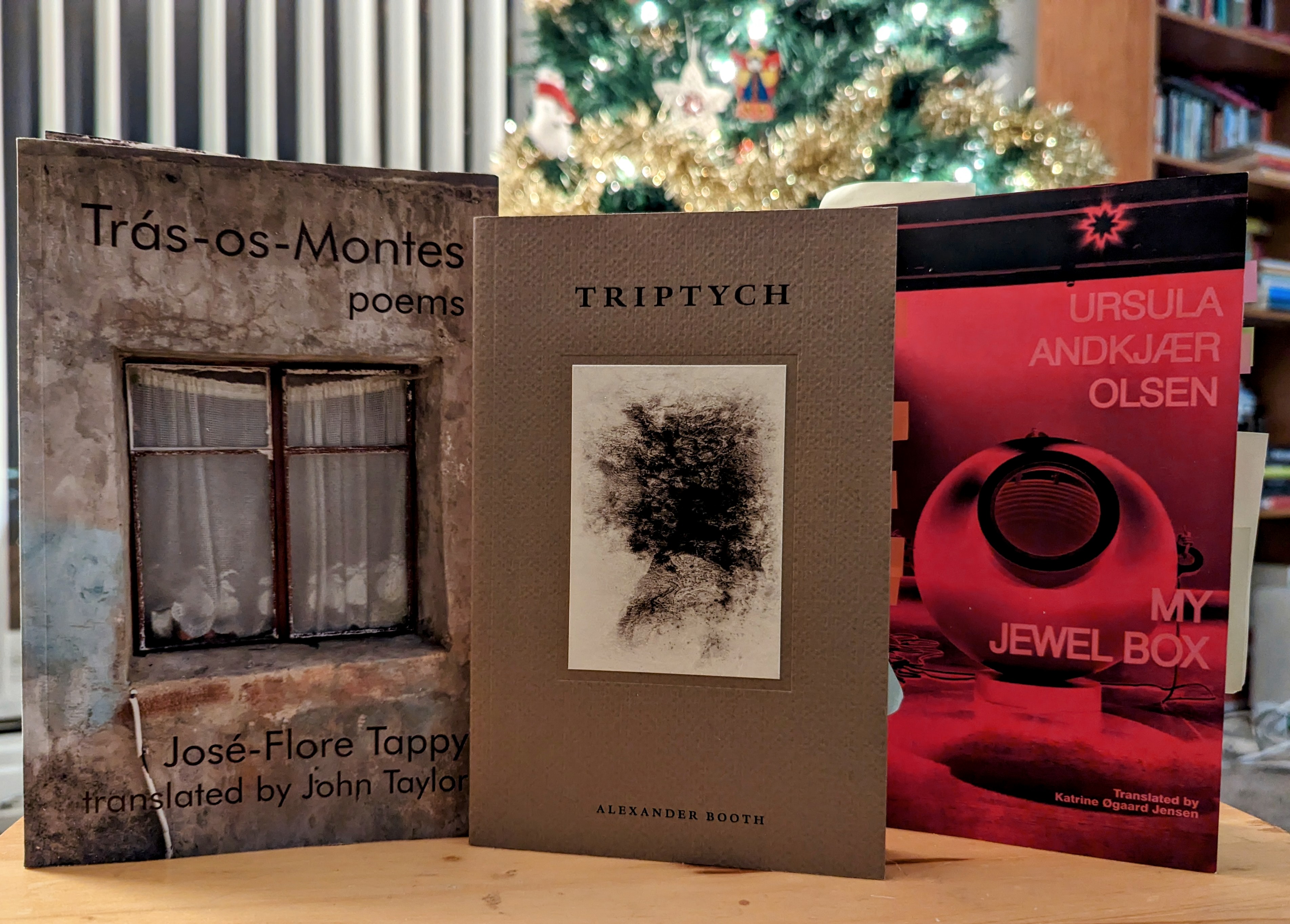
This is the most challenging category to narrow down. I read many wonderful collections, each so different, but three are particularly special.

Translator John Taylor has introduced me to a number of excellent poets over the years and in 2022, it was his translation of French-language Swiss poet José-Flore Tappy’s Trás-os-Montes. I read this gorgeous book in August and it is still on my bedside table. It’s not likely to leave that space for a long time yet, and that’s all I need to say.  

I first came to know of Alexander Booth as a translator (and read a number of his translations this year) but his collection, Triptych, stands out not only for the delicate beauty of his poetry, but for the care and attention he put into this self-published volume. A joy to look at, to hold and to read.

Finally, My Jewel Box by Danish poet Ursual Andkjær Olsen is the conclusion of an organically evolving trilogy that began with one of my all-time favourite poetry books, Third-Millennium Heart. Not only is this a powerful work on its own, but I had the great pleasure to speak over Zoom with Olsen and her translator, Katrine Øgaard Jensen, for Brazos Bookstore in May. The perfect way to celebrate a reading experience that has meant so much to me.

Books that defied my expectations this year:

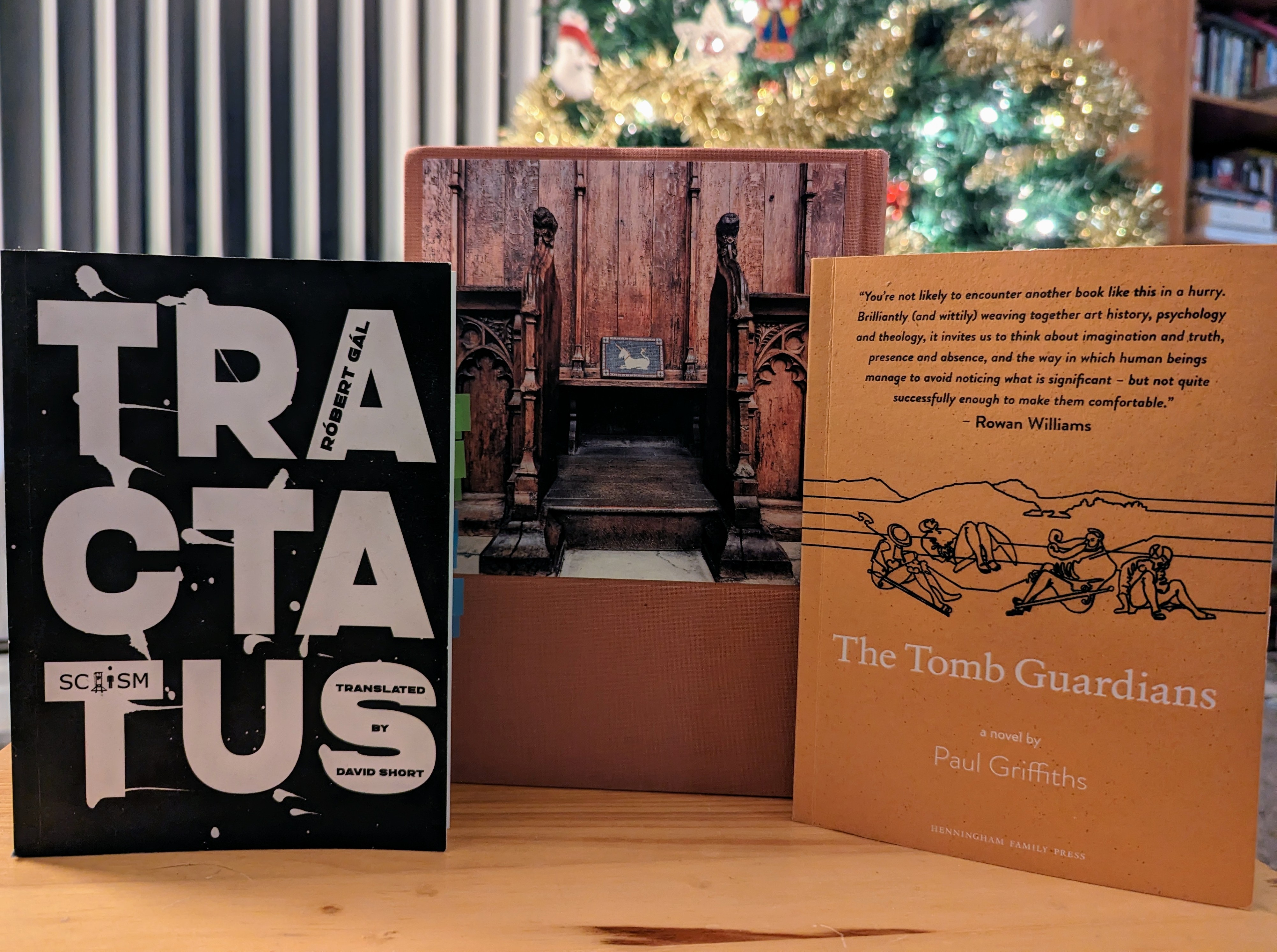
Prague-based writer Róbert Gál has produced books of philosophy, experimental fiction and aphorisms—each one taking a fresh and fluid approach to the realm of ideas and experience. His latest, Tractatus (translated from the Slovak by David Short) takes its inspiration from Wittgenstein’s famous tract to explore a series of epistemological and existential questions in a manner that is engaging, entertaining and provocative.

A Certain Logic of Expectations (you see the back cover here) by Mexican photographer and writer Arturo Soto is a look at the Oxford (yes, that Oxford) that exists a world apart from the grounds of the hallowed educational institution. Soto’s outsider’s perspective and appreciation of the ordinary offers a sharp contrast to the famed structures one associates with the city (and where he was a student himself) and what one typically expects from a photobook.

The third unexpected treat this year was The Tomb Guardians by Paul Griffiths. This short novel about the soldiers sent to guard the tomb where Jesus was buried is an inventive work that explores questions of faith, religion, and art history. Truly one of those boundary-defying works to use a term that seems to get used a little too often these days.

The best books I read in 2022:

Again, an entirely personal assessment.

I loved Esther Kinsky’s River, but Grove (translated from the German by Caroline Schmidt), confirmed for me that she is capable of doing something that other writers whose work skirts the territory occupied by memoir and autofiction rarely achieve, and that is to write from the depth of personal experience while maintaining a degree of opaqueness, if that’s the right word. One is not inundated with detail about the life or relationships of her narrators. Rather, she zeros in on select moments and memories, allowing landscape to carry the larger themes she is exploring. So inspiring to the writer in me.

Monsters Like Us, the debut novel by Ulrike Almut Sandig (translated from the German by Karen Leeder) deals with an extraordinarily difficult topic—childhood sexual abuse. It does not shy away from the very real damage inflicted by predatory family members, nor does it offer a magical happy ending, but it does hint at the possibility of rising above a traumatic past. As in her poetry where Sandig often draws on the darkness of traditional European fairy tales, she infuses this novel with elements and characters that embody the innocence, evil and heroic qualities of folktales within an entirely and vividly contemporary story. So much to think about here.

Hanne Ørstavik’s The Pastor (translated from the Norwegian by Martin Aitken) was my introduction to the work of a Norwegian writer I had a lot about over the years. This slow, melancholy novel set in the far north regions of Norway, beyond the Arctic Circle in the dead of winter, was a perfect fit for me as a reader, in style and subject matter. The story of a female pastor who takes a position in a remote village following a personal loss that she does not fully understand, explores emotional, historical and spiritual questions through a character who is literally stumbling in the dark.

So, what might lie ahead? This past year I embarked on two self-directed reading projects—one to focus on Norwegian literature for two months, the other to read and write about twenty Seagull Books to honour their fortieth anniversary. I found this very rewarding experience. Both projects were flexible enough to allow me freedom, varietyand plenthy of room for off-theme reading, but in each case I encountered authors and read books I might not have prioritized otherwise. For 2023 I would like to turn my attention to another publisher I really admire whose books are steadily piling up in my TBR stack—Archipelago. As with Seagull, they publish a wide range of translated and international literature that meshes well with my own tastes and interests. I don’t have a specific goal in mind, but already have a growing list of Archipelago titles I’d like to read. Other personal projects—public or private—may arise, perhaps more focused toward the personal writing I always promise to get back to, but time will tell. If the last few years have taught us anything, it’s that it’s a long uncertain road from January 1st to December 31st and it’s best not to try to outguess what the road might hold. Hope for the best and prepare for the worst once more.

Best wishes for the New Year and thank you for reading!

Twenty Seagull books to mark forty years of publishing magic: A 2022 reading project wrap up

Long-time followers of roughghosts will know that I have a particular fondness for Seagull Books. They continually publish a wide range of interesting international and Indian authors, bring many to English language audiences for the first time and, oh, those covers! Senior Editor and Designer Sunandini Banerjee’s work is instantly recognizable, yet always original. And not only have I amassed a healthy collection of their publications, but I have also visited Calcutta twice, taught classes at their School of Publishing and treasured their friendship and encouragement over the years. I admire the work they produce, their dedication to supporting fellow independent publishers in India and abroad, and their work to further understanding and education through the Seagull Foundation for the Arts. So to mark their fortieth anniversary this year I decided, somewhat late in the game, to embark on a personal reading project. I promised myself that I would read and write about twenty Seagull books by year’s end. Twenty for forty.

And here we are.

To date, I have reviewed all but one of these books—the remaining review of Vénus Khoury-Ghata’s Marina Tsvetaeva will follow in the next few days—but I wanted to stop and celebrate twenty excellent reading experiences before the holiday busyness begins. My reading naturally overlapped with my other 2022 self-directed projected, a focus on Norwegian literature, and the annual months devoted to Women in Translation and German Literature that I try to contribute to each year. Within and beyond that there was still plenty of room for variety. Two of the books I read were English originals—both from India—and the rest were translated: six German, four Norwegian, three French (two of which were by African writers, the third Lebanese-French), two Arabic, one Hungarian, one Dutch and one Bengali. I read five works of poetry/prose poetry, nine novels, three collections of short fiction, one long form essay, one play, and one graphic novel. Had I planned this project a little earlier I might have read more nonfiction, but as the year was rushing to a close book length became a deciding factor—December’s four books were necessarily shorter and that influenced choice!

Among this stack of handsome books are some authors I had already come to know and love through Seagull—Tomas Espedal, Vénus Khoury-Ghata, Franz Fühmann, Ulrike Almut Sandig and Friedrike Mayröcker, plus one writer I have long wanted to read: Mahasweta Devi. But, as usual, there were some unexpected surprises among the authors I encountered for the first time, most notably German Jürgen Becker and Hungarian Iván Mándy.

Happy fortieth anniversary, Seagull! Here’s to an ever brighter future.

Books read:
in field latin by Lutz Seiler, (German) translated by Alexander Booth
Requiem for Ernst Jandl by Friedrike Mayröcker (German) translated by Roslyn Theobald
Shadow of Things to Come by Kossi Efoui (Togo/French) translated by Chris Turner
Mother of 1084 by Mahasweta Devi (India/Bengali) translated by Samik Bandyopadhyay
The Beloved of the Dawn by Franz Fühmann (German) translated by Isabelle Fargo Cole
Winter Stories by Ingvild Rishøi (Norwegian) translated by Diane Oakley
Love and Reparation by Danish Sheikh (India)
Ever Since I Did Not Die by Ramy Al-Asheq (Arabic) translated by Isis Nusair
The Second Wave by Rustom Bharucha (India)
Marina Tsvetaeva by Vénus Khoury-Ghata (Lebanese-French) translated by Teresa Lavender Fagan
Leaving by Cees Nooteboom, w/ drawings by Max Neumann (Dutch) translated by David Colmer
Love by Tomas Espedal (Norwegian) translated by James Anderson
Cargo Hold of Stars: Coolitude by Khal Torabully (Mauritis/French) translated by Nancy Naomi Carlson
The Sea in the Radio by Jürgen Becker (German) translated by Alexander Booth
The Dance of the Deep Blue Scorpion by Akram Musallam (Arabic) translated by Sawad Hussain
Monsters Like Us by Ulrike Almut Sandig (German) translated by Karen Leeder
Postcard from London by Iván Mándy (Hungarian) translated by John Batki
The White Bathing Hut by Thorvald Steen (Norwegian) translated by James Anderson
The Year by Tomas Espedal (Norwegian) translated by James Anderson
Ulysses by Nicolas Mahler, after James Joyce (German) translated by Alexander Booth

Everything about everybody is nothing but diversion from death: Yes by Thomas Bernard

One would never accuse Thomas Bernhard of being a cheerful, optimistic writer—his fiction tends to themes of isolation, human misery and the deterioration of modern society. But that’s not to say he isn’t funny. His characters are typically wildly eccentric, usually scientists or scholars of some kind, with musical and/or philosophical inclinations. Yes, his fifth novel, originally published in 1978 and translated into English in 1991 by Ewald Osers, is a shorter work that ticks all these boxes and, for my money, is crafted with just the right balance of idiosyncratic energy and narrative tension.

Many of Bernhard’s novels and stories are presented through a secondary narrator, a friend or acquaintance who records the protagonist’s account, a style that can, at times, necessitate backtracking through a particularly serpentine sentence to determine whose words are actually being described. Yes features a direct first person narrator, a scientist living alone in a rural area in a ramshackle dwelling he retreated to many years earlier to dedicate himself to his studies on antibodies. Beyond science, his passions are the  music Schumann and the philosophy of Schopenhauer, most specifically The World as Will and Idea. The story he wants to impart, one which now lies at some distance, concerns the impact that the arrival of a Swiss engineer and his long-time companion, a Persian woman, had on his life and well-being at a point when he had reached the absolute depths of depression and despair. It is naturally, a roundabout exposition, beginning with the sudden arrival of the so-called Swiss couple at the home and office of his friend the realtor Moritz upon whom he has just unloaded the full and horrible truths of his mental sickness and self-loathing. He immediately recognizes in the Persian woman a certain kinship and a release from the suffocating conditions of his own mind and the stifling community he lives in. Over the course of the novel, he seeks to learn more about this man who had purchased a most undesirable piece of land with intent to build on it, and to further his association with his life-partner:

While the Swiss was busy, in the small towns nearby, looking for door and window fittings, for bolts and grilles, screws and nails and for insulation material and marine paint for the concrete house which, as I learned from him at our first meeting, he had himself designed and which was already going up behind the cemetery, and in consequence was almost never to be found at the inn (the Swiss couple’s quarters for the duration of the construction), I myself, quite suddenly and probably at the life-saving moment snatched by the couple from my depressed state, or in truth from a by then life-threatening depression, suddenly found in the woman friend of the Swiss, who soon turned out to be a Persian born in Shiraz, an utterly regenerating person, that is an utterly regenerating walking and thinking and talking and philosophizing partner such as I had not for years and would have least expected to find in a woman.

What unfolds is a relatively straightforward, well-paced, focused and affecting novel. There is humour, carried primarily in the narrator’s self-obsessed paranoias and blunt opinions, but the classic Bernhard absurdity and circuitous storytelling is contained within a serious, sombre atmosphere which, at least for me, grants the work a mood reminiscent of Wittgenstein’s Nephew in contrast to the relentlessly cynical tone that can weigh down some of his longer more convoluted narratives if one is not quite in the mood to surrender. Of course, the unnamed narrator is, as usual, suitably misanthropic and miserable about the rural environment his lung disease has forced him to retire to, the tedious characters who dwell there, and the current state of political decay in his nation and continent. But in spite of himself, he seems remarkably cognizant of his own role in the isolated circumstances in which he is trapped and in social settings often finds himself balancing his distaste for others with an equal level of attraction, fully aware that he is likely seen no better by anyone else.

Throughout the text, the narrator eludes to his friendship with the Persian woman and their frequent walks in the larch-woods, but it is clear that, despite the momentary release they both find in the company of the other, darkness lies ahead. Then, in the final twenty pages, the narrator draws his account together with increasingly disturbing revelations building to a final sentence that he has been leading to from the very first words he committed to the page. I may have a new favourite Bernhard book and I definitely have another suggestion to offer whenever anyone asks where to start with his work.

Yes by Thomas Bernhard is translated by Ewald Osers and published by The University of Chicago Press.

A Viennese Odyssey: Ulysses by Nicolas Mahler after James Joyce

James Joyce’s Ulysses is a monumental work of Modernist literature, dense with detail and interior narrative,  so when an illustrator and author known for a characteristically minimalist style of graphic storytelling decides to reimagine this classic what could possibly go wrong? Nothing if it’s Austrian illustrator and author Nicolas Mahler holding the pen.

This ambitious volume is my second encounter with Mahler’s ebullient art and wit. The first was his delightful take on fellow Austrian Thomas Bernhard’s Old Masters, a work that didn’t have to break with location or language in its reincarnation. However, this time he is transporting another equally idiosyncratic writer from Dublin to Vienna and from English to German (translated back into English in this edition by Alexander Booth). This is a retelling “after Joyce” as liberally inventive as the original. As one can imagine, the medium necessitates some streamlining of the story, so Stephen Dedalus is left out (although there is a nod to his tower abode) and some key scenes in which he appears are reimagined in a wild exposition of our German Bloom, Leopold Wurmb’s sexually frustrated, guilt-ridden fears and obsessions. But the parallels with Joyce’s masterpiece are wonderfully realized; after all, the visual medium can reproduce the overlay of experience and internal monologue in a remarkably efficient manner. As they say, a picture is worth a thousand words.

So we find ourselves tailing along after Wurmb (who unfortunately resembles his implied namesake  Wurm” or worm) as he makes his way around Vienna on June 16, 1904. While Bloom was an advertising canvasser with the Freeman’s Journal in Dublin, Wurmb is similarly employed by the Viennese Neuigkeits-Welt-Blatt. Headlines, excerpts and image offsets from the June 16, 1904 edition of this paper are used to great effect in the chapter where our hero goes to the office. Mahler also draws on images and advertisements from some other Vienna publications from the same day and finds German names for key characters from the same archival sources. But he also adds a really special touch to his Ulysses. Joyce’s novel was first published in 1922, at a high point in the history of newspaper comics, so we find in the pages of this graphic variation many of the cartoon characters who were popular at the same time. Most notably, Olive Oyl stars as his secret romantic pen pal, while Popeye takes on the role of the garrulous sailor W. B. Murphy who regales Wurmb with unlikely tales of adventure in the bar.

If some of the fun of reading Joyce’s novel is looking for the echoes of Odysseus’ journey in the narrative, some of the fun here is marveling at how cleverly Mahler manages to echo key features of Bloom’s journey in his Austrian themed tribute. Wurmb, like Bloom, is trying to avoid going home, knowing that his wife Molly, a singer, will be having sex with her manager Berlyak that afternoon. The impresario’s posters haunt him on his wanderings and reminding him he’s a cuckold, while recurring thoughts of sexual frustration, bitterness and depression mark his day. He mourns his infant son, dead now eleven years, attends a friend’s funeral, takes care of bodily functions and finally, after a day of work, social engagements and some wild, guilt driven fantasy, returns home without his key and is forced to break into his own home. From her bed Molly then takes the stage, so to speak, with a version of her infamous soliloquy which, if necessarily abbreviated, is not devoid of much of the key imagery and sentiment.

Of course, Ulysses is a novel famous for the use of stream of consciousness. Bloom’s inner thoughts are injected into the events of the day (or vice versa). One might wonder if a graphic novel, and one that leans toward a relatively spare open form, can reproduce this effect. Mahler’s solution is to project Wurmb’s thoughts in large, bold letters, across sparsely illustrated pages and over cartoon-strip style interactions when his thoughts wander. Obsessions are illustrated boldly. Thus his inner world takes precedence, as it should, if you want to do justice to Joyce’s masterpiece. Mahler’s variation on this classic is inventive and funny without undermining the sadness and ordinariness of the Everyman at its heart and might even inspire a few readers who have not yet read (or, ahem, finished) the Irish original to pick it up.

Ulysses by Nicolas Mahler, after James Joyce, is translated from the German by Alexander Booth and published by Seagull Books.