Last season in paradise: Alexandrian Summer by Yitzhak Gormezano Goren

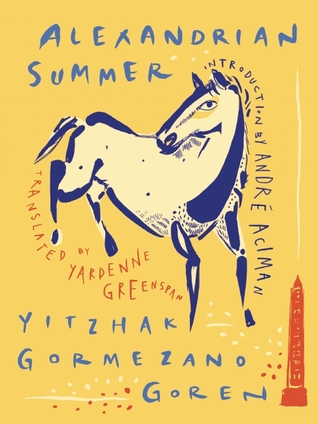
1951. In an apartment on the Rue Delta in Alexandria, a young boy plays a game to wile the hours away, recording and cataloging the makes and license plate numbers of the cars that pass on the street below. Inside, his mother, grandmother and an assortment of matrons gather and gossip over a game of rummy. Tourists flock to the city, to the beaches and warm waters. A rich mixture of languages play across the tongues of residents and visitors alike. But on the ground tensions are building, political frustrations run deep, threatening to fracture the tentative ties that have bound Muslims, Jews and Christians in this cosmopolitan playground. For thousands of families clinging to a fragile petit bourgeois existence, this may be one of the last glorious seasons of romance, horse racing and cool drinks served by discreet and obliging servants.

“True, Alexandria was rotten to the core, but its rot had roots, was saturated in history. Dig deep through the muck and you’ll find the remnants of a crumbling papyrus, or a lock of hair from the shrunken head of a mummy. Something is rotten, truly rotten in the kingdom of Alexandria. That’s why I love her so much, Alexandria. A city that lets you live like a carefree lord without even being rich. Of course you had to be European, or at least Jewish, and of minimal intelligence, and even that wasn’t always a staunch demand.”

GorenFrom the opening pages of Alexandrian Summer, the newly translated novel by Israeli author Yitzhak Gormezano Goren, the author’s deep affection for the city in which he spent the early years of his life is unmistakable. His narrator makes it clear that the story he is about to share is, in fact, his own. He is that 10 year old boy watching the cars pass. But he debates how best to tell the tale, admitting that he is looking back with the perspective and wisdom of an adult. First person, third person, real names, fictitious identites with the standard disclaimer? He opts to shift his focal length, like a photographer adjusting the depth of field of his lens, moving in and out of a series of scenes that collectively recount the visit of the Hamid-Alis, family friends from Cairo, who have come to spend the summer. Young Robby does not know it at the time but by the winter his family will leave for Israel. It is his mature self who is able to look back and sift through the events of his final summer in this magical city. Through Robby and a colourful canvas of characters – immediate family, extended family, friends and neighbours – he unfolds a story that is at once intimate and personal, and part of a broader political sea change.

From the moment that the Hamid-Alis pull up in their Topolino, an aura of glamour descends on the apartment on the Rue Delta. The father Joseph, a small man with his characteristic fez, is a former jockey who tasted fame and glory until the sudden and tragic death of his beloved mare. But rumours persist that, in his Turkish blood is a Muslim past that he abandoned to convert to Judaism when he fell in love with Emilie, his full bodied and patient wife. David Hamid-Ali, their 17 year-old son, is a perfectly pressed and groomed specimen of athleticism, a rising star on the horse racing circuit who has been groomed to take on his father’s sport. But the dedication is dependent on a strict diet to combat the tendency to weight gain inherited from his mother. And the one true desire of his heart, Robby’s older sister, is playing with his emotions. Finally the youngest son, 11 year-old Victor, is overlooked by his parents, subject to frequent pummeling at the hands of his older brother and, thus neglected, he occupies himself by engaging in sexual play with Robby and his friends. By the time they climb back into the Topolino to return to Cairo, the Hamid-Ali family will be reduced, weakened and irrevocably changed. Before long Egypt and Alexandria will also undergo a revolution.

By evoking small snapshots of the emotions, interactions, observations and events of this steamy summer, Gormezano Goren paints a heartbreaking and tender portrait of family dynamics complete with his own “Greek chorus” of rummy playing matrons. At the core of this story is the racetrack rivalry between David and the lightening fast Muslim jockey Al-Tal’ooni. Although he triumphs in the first race of the season, David’s loss in the second begins a series of conflicts between father and son, and spiraling self doubts and depression in the aging Joseph. Against the backdrop of a legendary city at a moment when the life that the Jewish and other European residents is about to unravel and dissolve, this one last summer blends the nostalgia of childhood with the disillusion of age to create a timeless tale, beautiful and sad.

Originally published in Hebrew in 1978, Gormezano Goren worked closely with translator Yardenne Greenspan to prepare this first English edition. In an interesting essay on Lit Hub, he recounts the challenges of preserving the polyglot quality of discourse in Alexandria and the value of being able to revisit the original text after so much time. Alexandrian Summer is published by New Vessel Press.

A Pastoral Dystopia: Trencherman by Eben Venter

“Tears, nearly; heartache that I’m almost able to touch in my chest. Bossieveld stretches around this dorp, as wide as the vulture flies. In rain years the red grass pushes up. The veld surges and flows, with koppies of ironstone and mountains with cliffs where animals find shelter during the cold winters, where ewes search out the warmth of besembos during the lambing season. Elsewhere it breaks open into rivers and streams and vleis full of platannas and bullfrogs and wild geese. But only when the water runs, when the eyes of the springs open. I want to remember it like that one last time.”

I am not typically a fan of post-apocalyptic or dystopian fiction. No matter how intriguing the scenario, I find myself too frequently disappointed with the writing or the realization of the plot, or both. However, when a trusted friend enthusiastically recommended  Trencherman, a harrowing vision of a devastated South Africa by Eben Venter, my interest was piqued in spite of any reservations I might have otherwise held and, quite frankly, I would never have stumbled across this book without her guidance. Even then I was unable to source a copy outside of South Africa so it was high on my wish list for my recent visit to the country. Little could I have appreciated how my experience of this novel would be heightened by the fact that I would read it while my time in the rolling landscape of the Eastern Cape province was still very fresh in my imagination. That is, it happens, where this story is set and, for all the horror it envisions, Trencherman is also very much an evocation to the beauty of the land.

VenterTaking his lead from Joseph Conrad’s The Heart of Darkness, Venter imagines his native country at an undefined point in the near future. Years of civil unrest and socio-political upheaval have rocked the nation which never really found its footing. Now a massive explosion in the southern part of the country has destroyed the infrastructure, left a lawless void in which bribes and syndicates are the order (or lack of order) of the day. Drought has wasted the land, AIDS has has devastated the population. Our protagonist, Marlouw (a contraction of his first and last names Martin and Louw) is bachelor living in Melbourne, Australia. Both he and his sister Heleen had rejected the family farm and homeland two decades earlier. Yet for all the financial success afforded by an uninspiring career selling high end cookware, Marlouw is a rather bitter, self-centred man, crippled with a clubfoot. He has never forgiven his parents for failing to secure the surgery that would have corrected the deformity and, despite his denial, the pain and embarrassment of his disability weigh heavily on him. When his sister calls him one night desperately entreating him to return to South Africa in search of her only son, his nephew Koert, who seems to have gone missing in that dark land, Marlouw feels no immediate obligation to assist. When he does finally agree, he tells himself that he is doing so for his own personal reasons. Without fully understanding his motivations he senses that something unfinished lies in the deep recesses of his memory. His journey to unravel his own baggage will nearly cost his sanity.

As soon as he sets foot on South African soil, Marlouw realizes that he has arrived in a country that operates on cryptic and shifting terms. He adopts a heightened almost mystical approach to the task ahead, attempting to open himself to the “guides” that cross his path, but he rocks between selfish irritation and a deepening alienation as his quest proceeds. As a hero he is deeply flawed and deeply human. When he reaches the family farm, the place where he knows that his nephew has taken refuge and built up some manner of hideous power base, he is routinely thwarted in any attempts to make direct contact. The degree to which drought, disease and apparent apathy have wasted the land and the people he once knew is a shock but he is soon swept into their confined and miserable world. Upon his father’s death, he and his sister had passed the once proud farm on to the black families who had worked it for so many years. After twelve generations of Afrikaner ownership, the thirteenth generation had set their sights on foreign shores. But, as Marlouw will soon realize, he still carries a deep ancestral horror in his bones. He will not only have to confront whatever it is that his nephew Koert has come to represent, he will also have to come to terms with his own ghosts.

This is not the first time an author has turned to the Heart of Darkness to explore the dark corners of humanity. The late Canadian author Timothy Findley placed his own Marlow and Kurtz in the halls of a modern psychiatric institution in the startling and disturbing Headhunters. Trencherman skillfully evokes the darkness of the journey Conrad imagined in the depth of another part of Africa and updates it, raising important issues along the way. Venter takes the opportunity to offer harsh indictments on the divisions within his native country, envisioning an outcome that has its roots in a recklessness and disregard for ultimate risks among the privileged classes. This is, of course, a common context of the dystopian novel, but one which is, for me, often too carefully removed or generalized in some abstract future. South Africa offers a more immediate tableau that Venter does not shirk from, perhaps afforded by the fact that he, like his hero, has been living in Australia for several decades. He aims his sights close to home, directly at his own heritage and at the decision he and many other South Africans have made to leave.

Originally published in Afrikaans, the translation by Luke Stubbs is seamless. IsiXhosa passages are incorporated, and unlike some translations specifically aimed at a broader (i.e. US) English speaking market, common South African and Afrikaans expressions and terms are left in tact. A detailed glossary is included. There is a point where the dialogue degenerates into a bastardized English mixed with German that had me curious as to how these passages exist in the original, but that is only because the translation process itself, especially when it is striking and effective, is of particular interest to me. This topic is, I discovered, covered in an interview with the author here.

The memory of a land once rich, the protagonist’s struggle to balance compassion with self preservation, and the truly horrific, yet oddly contemporary spectacle that awaits Marlouw when he finally confronts his nephew combine to create an engrossing read. The closer a reader’s connection to South Africa, the more intensely this book will resonate or push buttons, but even with distance it paints an unsettling portrait.

And so it should.

Note:                                                                                                                                                                         It is my understanding that Trencherman is scheduled to be released in the UK and Australia in 2016. However, my attempts to obtain Venter’s more recent novel Wolf, Wolf which was similarly released earlier this year leads me to believe that rights do not extend to North America. Even so, once there is wider for release for Trencherman outside of South Africa, it will be easier to obtain through UK distributors.

Variations on a tragedy: Death in the Museum of Modern Art by Alma Lazarevska

The longest siege of a capital city in the history of modern warfare began on April 5, 1992 when Bosnian Serb nationalists surrounded Sarajevo. The assault would last for 1,425 days, almost four years. Inside the blockaded city, citizens tried to pull together as their city was bombarded with mortars and artillery fire, cut off from access to food, power and communication. Families were driven from their homes, faced the real possibility of detention, rape, torture and slaughter. And yet, in small corners of daily life, small embers of humanity were kindled and nurtured. Death in the Museum of Modern Art is a testament to the fragility and the resilience of the ordinary people trapped in the city, an evocation of beauty in the face of unspeakable horror.

museumThis slim collection of six short stories by Bosnian writer Alma Lazarevska reads like a quiet musical meditation, a set of variations on a theme. Most of the stories are narrated by an unnamed woman, married, usually with a single child, a boy. The stories are imbued with a quiet humanness that is as comforting as the death and destruction that surrounds the characters is terrifying. To those of us who can only faintly imagine what it must be like to endure such conditions the effect is startling.

There is not a weak entry in this collection and despite the themes that do recur (in fact at times I wondered if the same family was at the core of some of the stories) each tale shines a light on a different angle of the experience of the residents of Sarajevo during the Bosnian war.

As a parent myself I was especially moved by the story “Greetings from the Besieged City”. Framed through a series of imagined picture postcard scenes this is a meditation on the desperate desire for a happy ending despite the awareness that in literature as in life, happy endings are elusive. While the knowledge of this truth drives a former classmate of the narrator mad, she herself tries to protect her own son from fictional unhappiness by changing the ending of the book she reads to him, The Seville Fan, a love story in which the hero dies:

“And so Pablo succeeded in not dying, which he was, after all, not accustomed to. Because, when I exhaled and put the closed book down, in its printed pages he was still dead. As I was pronouncing the sentences that were not in the book, it seemed to me that, for the first time in our reading sessions, our boy turned his eyes away from their fixed point. He glanced suspiciously at the book then at my face. A pedagogue would say that he was beginning to get used to the fact that parents tell lies. Or that they become accustomed to sentiment!”

The mother is conflicted by her need to prepare her child for the reality of death – of unhappy endings – and the desire to protect. But when “red-hot balls” start to fall on the besieged city, instantly transforming “human bodies into bloody heaps of flesh” the effort to create some variation of a picture postcard greeting against a landscape of horror is increasingly distorted. The impact is deeply unsettling, yet poignantly human.

The siege is a persistent presence in these tales. It drives the tenants of an apartment block from the odd niceties of shared accommodation to huddle in the basement in fear, or to flee the city if possible, in “Thirst in Number Nine”. The superstitious belief that each used match is a saved soul, leads a couple to use and collect precious matches to light cigarettes, rather than the candle that is equally vital in “How We Killed the Sailor”. This represents a perverse and symbolic luxury as civilian casualties mount around them. The wife wonders about these souls they pretend to protect as each day new faces grace the obituary pages of the paper: “Do they know that there is a besieged city somewhere in the world with the saviours of their souls in it?”

The title story “Death in the Museum of Modern Art”, features a narrator who muses on her involvement in a curious project. Bound for publication in a glossy magazine and an exhibit at the Museum of Modern Art in New York, photographs of 100 inhabitants of Sarajevo are to be paired with their answers to a survey which includes the haunting question: How would you like to die? In a besieged city how does one begin to answer a question like that?

Upon its publication, this collection received the “Best Book” award from the Society of Writers of Bosnia and Herzogovnia. In this lovely edition from Istros Books, the translator, Celia Hawkesworth, brings the gentle and shocking power of Lazarevska’s unique voice to life. I am extraordinarily grateful to Susan Curtis-Kojakovic, the editor of the wonderful Istros Books for selecting and passing this moving, haunting collection on to me. I can recommend it without reservation, these are stories that need to be read. After all, the Bosnian War only came to an end twenty years ago later this year and today, in so many parts of the world, ordinary families are still struggling to survive under the conditions of unimaginable conflicts.

Sadly the happy ending continues to be elusive.

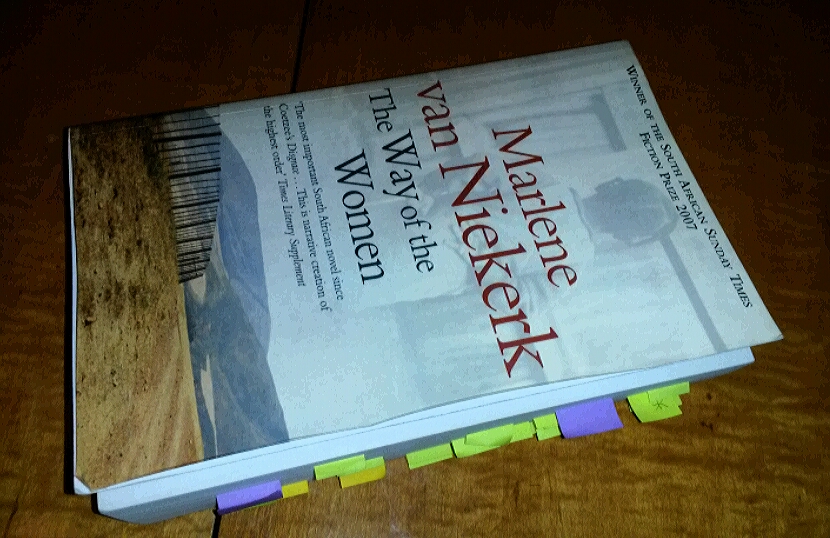
And her name was Good: Agaat by Marlene van Niekerk

“Poor Agaat. What has my life been? What has her life been? How can I ever reward her for coming this far with me here on Grootmoedersdrift? How does one compensate somebody for that fact that she allowed herself to be taken away and taken in and then cast out again? And to be made and unmade and remade. Not that she had a choice. I even gave her another name.”

This is a variation on the refrain that haunts Milla de Wet’s thoughts as she lies, paralyzed in the advanced stages of Lou Gehrig’s disease, completely dependent on her black servant turned caregiver Agaat to attend to her every need. As Marlene van Niekerk’s magnificent novel begins, the two women are reduced to communicating through eye movements. Eventually even that will be impossible. But Milla’s mind is sharp and brittle in her confined waking hours and Agaat, stalwart and efficient to the end, knows her mistress well. Too well.

AgaatFrom this claustrophobic perspective a remarkably expansive and complex novel of Apartheid South Africa unfolds. Van Niekerk, a nominee for the 2015 International Booker Prize, achieves this by deconstructing the traditional farm novel and weaving together a complex, poetic and devastatingly powerful epic. It is almost impossible to find the words to adequately capture the experience of reading Agaat (or The Way of the Women as it was published in the UK) without resorting to hyperbole. It is, quite simply, an inspiring, unforgettable novel. One that invites and rewards careful reading.

Despite the rolling fields and pastures, river and mountains, this is an intensely focused novel. It is not easy to exist with Milla trapped inside her immobile body, or to listen as she bitterly dissects and dismantles her life – alternately self righteous and regretful – addressing herself in the second person. It is not comfortable to be swept into the stream of consciousness of her internal ramblings that mix obsession over her current state of being with the flotsam and jetsam of her farm woman’s domestic life. Or to discover, through her notebook journals, the details of Jakkie’s childhood and, eventually, Agaat’s early years in her home. By masterfully weaving together these four distinct narrative streams in each chapter, van Niekerk creates an enduring portrait of the complexities of power as they play out within families, between races, and in a country that is in an increasingly volatile political state.

My well marked copy!

As the story is fleshed out, we meet Milla in 1948, as a young woman engaged to the dashing Jak de Wet, a trophy husband of sorts, handsome but ill suited to the farming life. Their marriage is increasingly volatile and strained, with both playing their own counterproductive roles out to the bitter end. For many years the couple is unsuccessful in their efforts to conceive. That is where Agaat comes in. The daughter of one of the labourers on her mother’s farm, she is born with a withered arm and, as a result, is subjected to horrific abuse in her early years. Milla imagines a heroic role for herself in rescuing the rejected child and bringing her into her home against the protests of her husband and the sidelong glances of her neighbours. For years Milla treats Agaat as a surrogate daughter – in so far as a segregated society will allow – teaching her to read and write, to explore and appreciate nature, and to master the fundamentals of animal husbandry. And then, suddenly, she discovers she is pregnant. Before the baby arrives, Agaat’s role is abruptly shifted. She is moved into an outside room and a maid’s uniform with strict expectations. But when little Jakkie arrives Agaat, barely more than a child herself, becomes the loving and compassionate caregiver that neither of his parents can ever manage to be.

As the end is approaching Milla is forced to weigh and reevaluate her own life and the fate to which her actions have tethered Agaat. As often as she questions her actions, it is not clear that she can ever stand back from herself and see the big picture. She is, in the end, complicit in maintaining the Afrikaner social order that Jak so proudly believes in even if, in her own mind, she is a martyr. Agaat is at once the angel in the wings, servant and nanny; and the witch still bound to her “primitive” ancestry. She has been molded and created by Milla, but her thoughts remain hidden. Not until the closing pages of the novel is her side finally revealed in the dark and heartbreaking bedtime story she that she and Jakkie shared when he was small.

Originally published in Afrikaans, the translation by Michiel Heyns is simply brilliant. Van Niekerk is first and foremost a poet and her language is filled with allusions to music, children’s rhymes, and literature. The scent of fennel, colours of flowers and foliage, the calls of birds and nosies of farm animals, the guttural g’s of Afrikaans all add to the multidimensional experience of reading Agaat. As Heyns points out in his Translator’s Note: “Agaat is a highly allusive text, permeated, at times almost subliminally, with traces of Afrikaans cultural goods: songs, children’s rhymes, children’s games, hymns, idiomatic expressions, farming lore.” The ultimate result appears effortless, mediating the boundaries where necessary but maintaining a distinct cultural experience. An interview with Heyns in Words Without Borders is an informative and entertaining exploration of the text and the translation experience that is highly recommended for interested readers.

Agaat is bookended with a Prologue and Epilogue in Jakkie’s voice. It is 1996 and he is flying home from Canada because his mother is near death at the beginning and returning after the funeral at the end. He left South Africa in 1985 to escape the political conditions in his native country, and, one suspects, his parents. As I write this, I am about to fly from Canada to South Africa myself for my first ever visit. I am aware of the fraught tensions that continue to run through the country, most recently arising in the literary community. I will be carrying the many complex currents that run through this important novel with me as I leave.

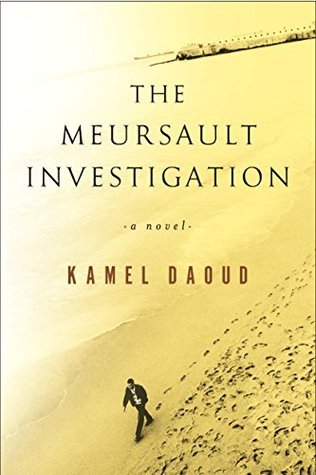
Naming the unnamed: The Meursault Investigation by Kamel Daoud

“A man who’s drinking is always dreaming about a man who’ll listen,” advises Harun, the aged man sitting in a bar in Oran, Algeria, in the opening chapter of The Meursault Investigation. His companion, night after night, is a young student intent on sorting out the mystery behind the iconic text he carries in his briefcase. What unfolds over a series of encounters is the tale of the unnamed Arab murdered in the pivotal scene of  L’Etranger by Albert Camus. In presenting Harun as the fictional counterpoint to Camus’ Meursault, Algerian author Kamel Daoud sets up to name and flesh out a life not only for the victim of violence on that hot beach, but for his brother and mother as well. What follows is more than an homage; it is an active dialogue from the other side of the equation – ethnically, politically and historically.

kamelAn acquaintance with L’Etranger is not only assumed but a recommended prerequisite to The Meursault Investigation. Both are novellas so reading or reviewing the former in advance is not an arduous task. I last read Camus’ classic in late 2013 with The Guardian Reading Group so I had the advantage of being able to search the online archives for my own reflections and the discussions that ensued. I still found myself dipping back into my own copy as I started out with this book but as I fell into the story it no longer seemed necessary.

Our narrator this time around is immediately a more likable character than our old friend Meursault. He is not happy, but we have a context for our sympathies. He is seven years old when his beloved older brother Musa meets his senseless fate. Their father had disappeared before he had a chance to even form a memory of him so his brother was his hero and a surrogate father figure. His senseless death, unreported save for two obscure newspaper accounts his mother clings to, cannot be proved. No body is ever found. After all, in the novel in which he is killed he is neither named nor is the fate of his body mentioned.

His mother becomes obsessed with seeking answers. In the process Harun is reduced to a shadow of himself, he feels like an effigy of his brother. He follows his mother as she searches for clues. He is blamed for surviving and denied his own identity. He becomes a ghost in his own life. While Meursault’s relationship with his mother is, from that famous opening line – “Mother died today” – cold and flat, Harun and his mother share a complicated, emotional dynamic. “Mama’s still alive today” he reminds us repeatedly, but both are wounded and reduced, survivors of the unnamed Arab in an uncertain and shifting post-colonial Algeria.

Eventually he is led to avenge his brother’s death by taking the life of a Frenchman. It is, in itself, an act rooted in the story of Cain and Abel:

“I blame my mother, I lay the blame on her. The truth is, she committed that crime. She held my arm steady while Musa held hers and so on back to Abel or his brother. I’m philosophizing? Yes, yes I am. Your hero had a good understanding of that sort of thing; whether or not to commit murder is the only proper question for a philosopher, the only one he ought to ask.”

In an echo of L’Etranger, where Meursault is condemned to death not for killing an Arab, but for failing to cry at his mother’s funeral; Harun faces imprisonment not for an act of murder, but for killing his Frenchman one day after the Declaration of Independence rather than alongside his countrymen during the battle for freedom. Close on the heels of this new found Independence, some two decades after his brother’s death, our hero finally encounters the famous text which he instantly recognizes as explaining, complementing and mirroring his own. He is at once intrigued and dismayed.

The echoes with L’Etranger resound throughout this novel. Daoud answers the absurdity of Camus with his protagonist’s own absurd predicaments. He matches Meursault’s rejection of God with Harun’s dissolution with his faith. But his hero’s hopes and disappointments are his own, solidly grounded and charged with a power that, from the Algerian perspective 70 years out from the publication of the original inspiration, demands to be heard.

This is, of course, not the first time that fiction has been answered by fiction, untold stories have been re-imagined, or silenced characters have been granted voice. The Meursault Investigation has been met with international praise, a measure of skepticism and, in the author’s home country, calls that he be tried for blasphemy. Translated from the French by John Cullen and published by Other Press, this is a deceptively simple yet deeply important work. Time will tell how it holds up in the light of such a famous counterpoint, but, for my money, it has to be seen as a continuation of a conversation that will, because it is so deeply informed by L’Etranger, serve to draw Camus’ work forward into twenty-first century discourse while setting its own very important and timely literary agenda as we move forward.

Besides, Harun with his diversions and penchant for storytelling is much better company than poor miserable old Meursault.

We’re extras in our own stories: Atavisms by Raymond Bock

I am often at odds with the literature from my own country, in fact I’m increasingly at odds with my own country itself. When I heard about Atavisms, a newly released translation of Maxime Raymond Bock’s award winning collection of short stories it caught my attention immediately. I was keen to have a look at Canada through the lens of a contemporary Québécois writer. I don’t know what I expected, but I was hooked from the opening pages.

atavismsNot content with niceties, Bock catapults his reader into this collection with “Wolverine”, a story about a disaffected nationalist nursing his resentment long after the FLQ (Front de Libération du Québec – a separatist paramilitary organization) has fallen into decline in the years following the institution of the War Measures Act in October of 1970 in response to the hostilities that had risen to a crisis point. When he happens to encounter a former Liberal cabinet minister, aged and intoxicated, he enlists a couple of friends on an adventure of revenge that turns brutally violent. It is shocking even if you come to this tale from a distance, but as a Canadian who will never separate the October Crisis from his 10 year-old imagination, I met it with intoxicated horror. Suddenly I was thrown back to my prairie schoolyard where my friends and I re-enacted events we were in no way equipped to understand – but with kidnapped officials and bodies in trunks it was infinitely more exciting, and terrifying, than anything on TV.

The horror continues to unfold in the second story, “The Other World”, but this time the reader is thrown back hundreds of years, to the early Quebec settlers and the immediate aftermath of the surprise attack by of a band of Iroquois on a couple of traders and their Huron guides. As the lone survivor lies under a thicket of pine branches hoping to remain hidden as the attackers relieve their victims of goods and scalps, he muses that, no matter what happens, he has no regrets.

From there we move, in “Dauphin, Manitoba”, to look outside the borders of Quebec, with a man’s monologue directed at a girlfriend he left behind in a prairie town. They had moved out there together. While she found herself captivated by her work, he failed to get a foothold or feel at ease in the vast empty landscape and retreated to the familiar blanketing comfort of a Montreal winter.

“You could pace back and forth a hundred years without coming close to the boredom I felt on those prairies, once sifted by antediluvian oceans, sculpted by retreating glaciers, surveyed by rambling nomads – friendly spirits, even better warriors – plowed to-and-fro by combines kicking up the dust of buffalo skeletons. You could say I caught you off guard when I left you alone to follow your path; you could say it was a nice trip, the time of your life. Lies. We’re both free now. You can study law, become a pastry chef, take up curling, or stay out there and keep up the good work; I’ll stay here and the snow will keep coming down.”

I once made a move like that in the opposite direction, albeit no further than Ottawa; but in the end made my way back west, never really at home at either end of the equation. As the narrator frames his missive to his girlfriend in terms of the generic novels he is making his way through, he does not sound any more committed to his move as something intrinsically right than as an acknowledgement of where he does not belong.

As the stories in Atavisms unfold, stretching back and forward in time, common themes, from history to politics to parental anxiety, reoccur, reflecting off one another. It can be argued that these thirteen stories are interconnected although they do not explicitly share any repeating characters and range from historical to surrealist to speculative fiction. Some of the contemporary stories are deeply universal and could almost be set anywhere, like “The Bridge” in which a depressed history teacher muses about his fate should he give in to his suicidal whims; or “Room 103”, a son’s one sided conversation with his dying father:

“It’s the end, Antoine, there’s nothing left to be done. You’re so light you don’t even make a dent in the mattress. It’s just you all alone with your obsolete quarter-million dollar machines, your network of tubing, your probes and dreams.”

Like a fragmented block of glass, each story in Atavisms offers a view of the Québécois experience through a different prism until the final tale, “The Still Traveler”, pulls all the threads together into a time and place in a precolonial reality dating back to the legends of the earliest residents and visitors to the Americas. After all, atavism refers to the tendency to revert to an ancestral type and that, more than anything is the underpinning theme of this collection: fathers and sons, family histories, political legacies, the identities that contain and define us.

Outside of Quebec, a sense of identity is diluted. I was struck by the depth of the colonial commentary that runs through a number of these tales and how the early days of New France are revisited with a harsh measure of reality. This is a conversational point sadly under played in Canada as a whole. As a new level of racism and xenophobia directed at new Canadians grows across this country, we would do well to remember how recently white Europeans made their way onto these shores.

Newly released by Dalkey Archive Press under their Canadian Literature Series, Pablo Strauss’ translation very effectively maintains the distinctive flavour of Bock’s richly varied stories. Supplemental endnotes fill in some essential language and historical references to enhance the reading experience.

I would strongly recommend Atavisms to anyone interested in knowing more about the Quebec experience, whether inside or outside Canada. Not only because the perspective is not as widely known or understood as it should be, but because this is simply a collection of very good stories. Period.

Small, quiet tale with a dark heart: Marcel by Erwin Mortier

In turning serious attention to the awards for translated and international literature that have dominated this spring, I have had pleasure of encountering many authors whose work I am looking forward to exploring at greater length. Belgian author Erwin Mortier is one such writer. His stunningly beautiful and moving account of a one woman’s experience coming of age in Flanders during the First World War, While the Gods Were Sleeping, was, truth be told, my personal favourite from the IFFP shortlist. A second installment of his epic WWI project has been released in Dutch, but until it sees an English translation I decided to turn my attention to his earlier novels which have recently been re-released by Pushkin Press.

MarcelI’ve started with his debut Marcel, originally released in Dutch in1999, followed by Ina Rilke’s English translation in 2001. This novella is a subtle and quiet work. The narrator is a sensitive ten year-old boy who lives with his grandparents, in a house that is sagging under the weight of time, literally and figuratively. From the opening paragraphs Mortier paints an image of the house as repository of secrets:

“Most of the rooms harboured a limbo of darkness, cool in summer, chilly in winter. In some the walls had absorbed the smell of generations of cooked dinners, as in the kitchen, where grease clung to the rafters. The cellar stored, the attic forgot.”

The grandmother, as he refers to her, is a dressmaker, tending to the sartorial needs – modest or grand – of the womenfolk of the small Flemish village where they live. But she is also her own family’s guardian of souls, helping to usher the dying to the afterlife, tending to their resting places in the nearby cemetery and, most critically, curating a parade of photographs of the deceased on display in a large glass cabinet. Four times a month, her grandson assists with the ritual removal, cleaning, naming, and replacement of generations of family portraits:

“When all the pictures had been properly dusted the grandmother closed the glass wings of her cabinet. She had reflected, reassessed and rearranged. She had piled proof upon proof, for and against Death, who was both her enemy and her most loyal ally. Death robbed her of her relatives, but he also fixed them in still poses ensuring they would meekly undergo her domestic ministrations.

When I saw my face reflected in the glass it was a fleeting glimpse, with far less substance than the images of the dear departed.”

The insubstantiality of his reflection is telling. The young narrator is routinely compared to Marcel, his grandmother’s youngest brother who died during the war. He is haunted by this spectral relative and, in a sense, never allowed to be seen for himself. He is routinely reminded that he is “Marcel to a tee, but for the eyes which I got from my mother.” Others remark that he takes after Marcel in nature: “Marcel always kept to himself, too.” But the exact circumstances of Marcel’s death are shrouded in mystery. Regular comments are made about the Germans, the aftermath of the war, implications about allegiances – but for all his perceptiveness, our narrator is too young to understand politics and history. It is not until he tries to impress his teacher, a buxom woman with whom he is utterly besotted, that a dark and ugly truth finally comes to light.

Mortier is a slow and patient writer, he allows his stories to unfurl in their own time. His love of language is evident – colours, patterns, textures, qualities of light, scents and sounds are all vividly evoked. But in contrast with his more recent work with its rambling, hypnotic Proustian sentences; the attention to detail is offered with a delicate restraint. The prose is spare and haunting, the mystery unfolds gently. Marcel stands as a most confident debut which, in hindsight, clearly points to great work to come.

Of misery and cauliflower: The Author and Me by Éric Chevillard

The tale that unfolds between the covers of The Author and Me by French writer Éric Chevillard is, to be honest, quite unlike anything I have ever read. In fact the tale, or rather tales and other sundry comments exist on two levels: in what might be considered the primary text and in an extensive series of footnotes, which at one point digress into a 40 page story called The Ant. And linking it all is the character’s (and possibly the author’s) explicit loathing for cauliflower gratin. And can the protagonist wax lyrical about his utter contempt for the cruciferous casserole? He can, and does. He also sings the praises of his most desired dish, trout amandine. It would be ridiculous – well perhaps it is ridiculous – if it was not so very funny.

AuthorOh wait, I can sense you backing away now and looking for a quick exit. Would it help if I add that you will also find murder and two shocking twists within these pages?

The book opens with a Foreword in which the author briefly discusses the way his past characters have been conflated with either real individuals or with himself. Questions of the nature of writing and an author’s responsibility for the beliefs and actions of his or her creations continue in the extensive, ongoing footnotes. Meanwhile, on ground level, shall we say, the main character, a middle aged man, collars a young woman sitting on the terrace of a café. With little preamble he launches into what may, or may not, be leading to the confession of a crime predicated on the indignity of being promised trout and being serve a dish of congealed cauliflower and cheese. He contrasts his views about the two dishes with passion:

“On the one hand, the vast openness of space, the loving moon, still more heavens beyond the heavens; on the other, a dull, leaden horizon, the collapsed roof, the flooded basement.

On the one hand, life in all its possibility, benign and, for a few moments – some ten mouthfuls – magnificent; on the other, the wretched gloom of day following endlessly upon day, a longing for death, death as rescue and release.”

As the character’s tale of woe continues, the footnotes run commentary on the author’s tendencies and predilections, muse on the relationship between the author and his character, the author and his reader, and the general nature of writers and their relationship to the world. As you might imagine, the lines between the actual author, M. Chevillard, who continually references his own prevous work, the (presumably) fictional author and the created character blur as the novel becomes increasingly bizarre.

Which all brings us back to this most reviled of vegetable dishes. How serious is the character’s diatribe? How much, against the footnote creator’s protestations, is ironic? Allegorical? To what is it a commentary on the state of literature? On the very state of civilization?

And when is cauliflower gratin simply cauliflower gratin?

For a taste of contemporary experimental absurdist French literature, tuck in your napkin, pray for trout but prepare for cauliflower. Created with finely seasoned humour by Éric Chevillard, carefully prepared and translated for your consumption by Jordan Stump and served up by Dalkey Archive Press, this is a novel that has to be experienced to be appreciated. It has definitely whet my appetite for tasting Chevillard’s earlier work.

This novel was shortlisted for the 2015 Best Translated Book Award.

Bohemian dreamer: A Gothic Soul by Jiří Karásek ze Lvovic

“Fiction is eternal; reality perishes” we are warned in the preface of A Gothic Soul, “Invented forms live, real ones vanish. Truth is ephemeral; illusion everlasting.” What follows in this classic of Czech Decadent literature, originally published in 1900, revived in a new translation by Kirsten Lodge and lovingly presented by Twisted Spoon Press, is a poetic account of the emotional and philosophical torments faced by a troubled young man who struggles to place his disaffected existence between real life as lived by others and the internal world of his dreams.

2015-05-19 19.33.24One can sense from the outset that this is not a happy story. The author has already made it clear that it will not be a “story” in the typical sense at all but rather a journey of internalized reflections. A romantic darkness and decay looms large, it is hard to imagine sunlight filtering through. The humour, the playful nods that the narrator directs to the great French Decadent writers, is very black indeed. And yet this work is permeated with a remarkable beauty.

The hero of A Gothic Soul is the last of his line, raised by maiden aunts after his parents’ death. His childhood is gloomy and oppressive, haunted by a fear of inheriting the religious mania that drove a cousin to take his own life. He responds to the external world with an affect of remote deadness while allowing to flourish, within his soul, an internal reality filled with light and magic. Each time he resolves to engage with world, to seek an end to his lonely isolation, he ends up retreating into his dreams to seek comfort. A deep conflict arises when his natural misanthropy clashes with his abiding desire for a true and perfect companion, a male friend and lover with whom he can meld body and soul. On the few occasions when he meets a potential friend, his fear and shyness drive him away.

“But everything was so distant. He was sick – he felt it. He could find no peace. It was as though all the atoms of his soul had been vapourized. He could no longer calm himself. He longed for a friend, a kindred soul. How beautiful to give himself to someone and to feel that he had given himself to someone. His life would immediately acquire meaning. What happiness! What charm!”

Early in his self-exploration he believes that the ultimate respite for his agonized soul lies in the Church, in monastic life. But his nihilistic temperament causes him to lose his grasp on his faith, to fall away from the idols and saints that once gave him comfort and to question what it means to believe in God. Spirits now begin to follow him through the streets and into his ancient family home. Fears of madness return.

His reflections then turn to the role that his Czech identity plays in this wretched existence to which he seems to be condemned. His Czechness, his city, become entwined with his struggle to make sense of his inability to live life fully. Is his nation seeking its own medieval traces, its own Gothic soul? Does the fate of his nation trying to define a space for itself in the Austro-Hungarian Empire mirror his own search? Some of the most stunning passages in this novella read like a heartbreaking ode to his native city.

“And now the evening bells rang out over Prague. A weight, darkly clanging and tragic, fell from their harmony. And unexpected numbness imbued the air. Stifling shadows hung drowsily over the rooftops. Not even a wing of a belated bird moved in this air. Everything suddenly seemed to be standing stock-still to listen to the conversing bells. Iron strokes broke through the windows of belfries and towers. The resonant sound cascaded down before dying out in the distance, flowing haltingly over the city’s rooftops.”

As the story progresses, our hero continues to overthink his dilemma as he wanders the streets of the city or takes refuge in his rooms. His reasoning pivots between optimism and despair. He realizes that he is losing his grip, that a life unlived is his likely destiny.

2015-05-19 19.38.39Jiří Karásek ze Lvovic (1871-1951) was an instrumental figure in the formation of the Czech Decadent movement. In a fascinating Afterword and author’s Biography, translator Kirsten Lodge describes the nature and development of this movement. In contrast with other strains of the same tradition, for the Czech Decadents the themes of despair and death are taken to the level of national obsession. For Karásek, his homosexuality also deeply informed his conception of Decadent thought. A desperate homoerotic longing runs throughout A Gothic Soul. This is complimented in this gorgeously presented publication by a series of illustrations by artist Sascha Schneider (1870-1927).

Twisted Spoon Press is a small independent publisher based in Prague. This is my first encounter with one of their publications. I was drawn in by the sheer beauty of this book. It is a joy to read and an important literary work that still resonates 115 years after it was first published. Trust me, an electronic copy would not be the same. You will want the hard cover version.

Collector of Corpses: Zone by Mathias Énard

Where to start with Zone by French author Mathias Énard?

“I climb into the trans-Italian express that must have been the zenith of progress and technology ten years ago for its doors were automatic and it went faster than 200 kilometers per hour in a straight line on a good day and today, a little closer to the end of the world, it’s just a train”

Imagine you are on a train bound from Milan to Rome, trapped inside the head of a French Intelligence Service agent, hung over and pumped up on amphetamines, who by reckless dalliance has missed his fight and is, as a result, having to make this critical trip by rail. Which gives him plenty of time to perseverate while he clutches a suitcase filled with documents graphically detailing war crimes, witnessed or reported to him during his time in the “Zone”, an area stretching from the Mediterranean to Central Europe. At the end of his journey he intends to sell the secrets he has collected, effectively resigning with a final act of treason, and disappear into a new existence with an identity assumed from a man long condemned to an asylum. And as the reader you are bound to the narrator, Francis Servain Mirković, for one breathless 517 page sentence.

zoneAs he streams forth a catalogue of brutal visions from his own memories, from history, art and literature, there is no respite. Even his love affairs are recounted with a desperate intensity. This not a book of bitter humour, it is a chronicle of horror, a memoir of regret. Francis is longing to be released from the burdens of his experiences, but that end is all very vague, growing even more so as he nears Rome. In the meantime, unable to sleep, to turn off his fevered brain, he is assaulted by grotesque images of his time on the battlefields of Bosnia with a Croatian militia unit. His lost comrades haunt him, his lost lovers loom large and through it all run threads of historical violence – decapitation is a particular obsession that he sees in, yet seemingly shares with, Caravaggio. Warriors of antiquity, martyred saints, Nazi war criminals all cast long shadows across the path of his racing thoughts. Violence is vividly described, and is often up close and personal.

This is not a leisurely read.

As a small concession to the reader, the single sentence is divided into chapters and periodically broken with segments of a novel about a female Palestinian fighter but there are times where one gets the distinct feeling that facts, and at times, streams of words words words are being employed as filler, as if anything less punishing than 500 pages would have been unthinkable. The risk however, is that the power of the images will be diluted, reduced to noise, numbing the reader, or worse, driving him or her away. Even the literary detours that turn toward Cervantes, Malcolm Lowry, William S. Burroughs, Jean Genet, James Joyce, Ezra Pound, Cavafy are typically delivered as measured portraits of ugliness and depravity.

If you have ever been in a room with someone who is in a manic state, you will know that they fill the space, suck up all of the available air. Such is the sensation of spending time in the presence of the narrator of Zone. Left to my own devices I am not sure I would have been inclined to open this book (sometimes size matters) or at least may well not have ventured past the first 150 pages or so. I may have disembarked at the next available station. And that would have been a shame.

Somewhere, two thirds of the way in maybe, the pressure begins to dissipate, perhaps as the drugs wear off, and the pace of the monologue eases, opening up space for more personal reflection and musing, more meaningful literary diversions and a sober assessment of his last serious love affair gone wrong. Even a little touch of humour. Mind you we are not exactly tripping through fields of daisies but the relentless deluge of decapitated heads, eviscerated corpses and raped women does ease to a slower flow of grisly images, as the full weary weight of the life Francis is longing to step away from settles in on him.

Zone 2

This novel, ably translated by Charlotte Mandell, was added to our IFFP Shadow Jury longlist when several members of the group argued that it had been sorely overlooked by the official jury. And it made the cut for our version of the shortlist. Given what I know now about the difference between the Independent Foreign Fiction Prize and the Best Translated Book Award, I feel that this is the type of book that more appropriately belongs to the latter. However in North America, Zone was released by Open Letter in 2011 (and, in fact, another Énard title was longlisted for the BTBA this year) whereas its eligiblity for the IFFP is based on the 2014 UK release from Fitzcarraldo Editions.

So what did I really think? My overwhelming first impression is that this book is one of style and literary merit but that at times it feels contrived. Perhaps, someday, when I look back I will think, yes, that was quite the experience. I may think back on Francis stepping forth at the end of his journey, reborn or perhaps beaten into the pavements of the Eternal City, with a sympathetic fondness of sorts.

I don’t know.