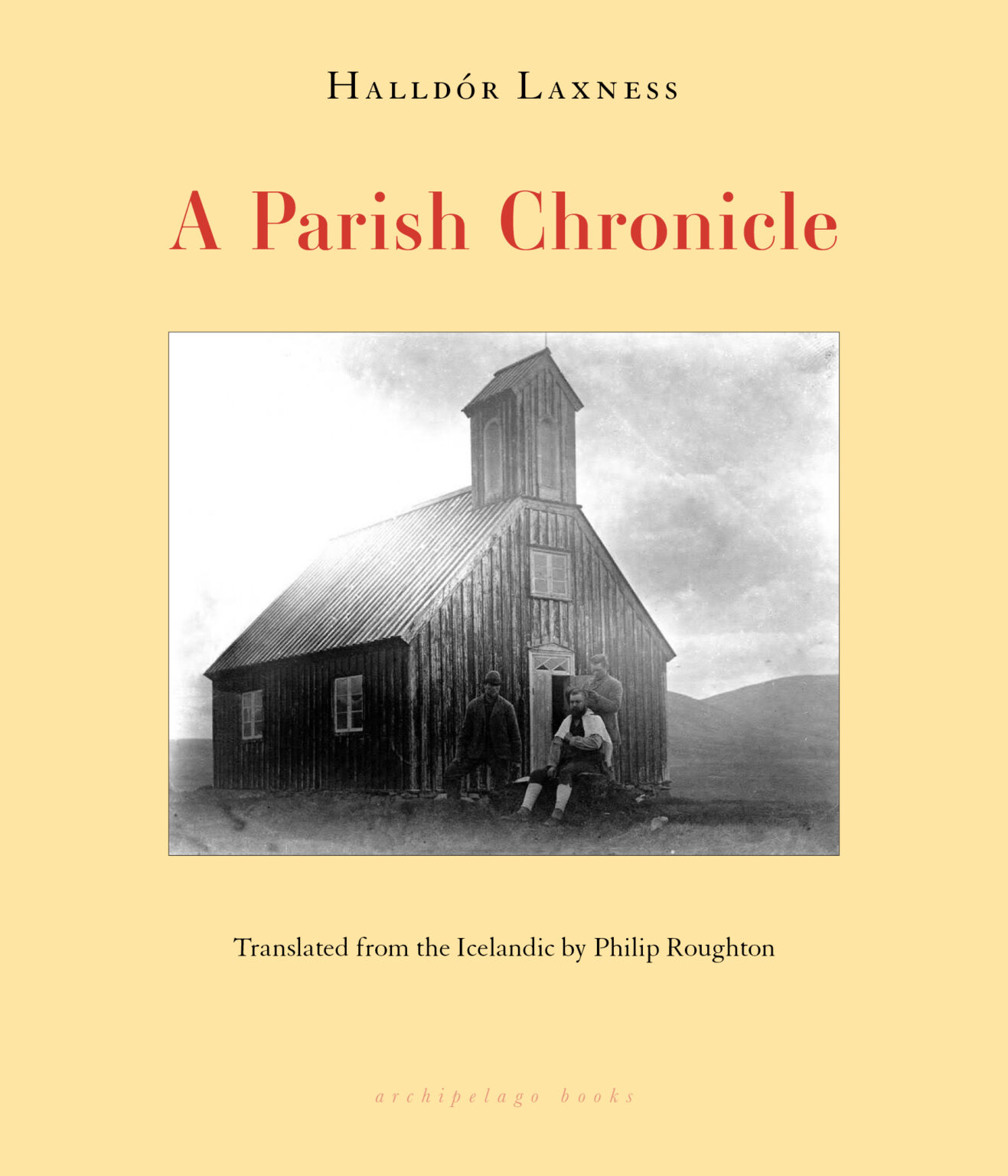
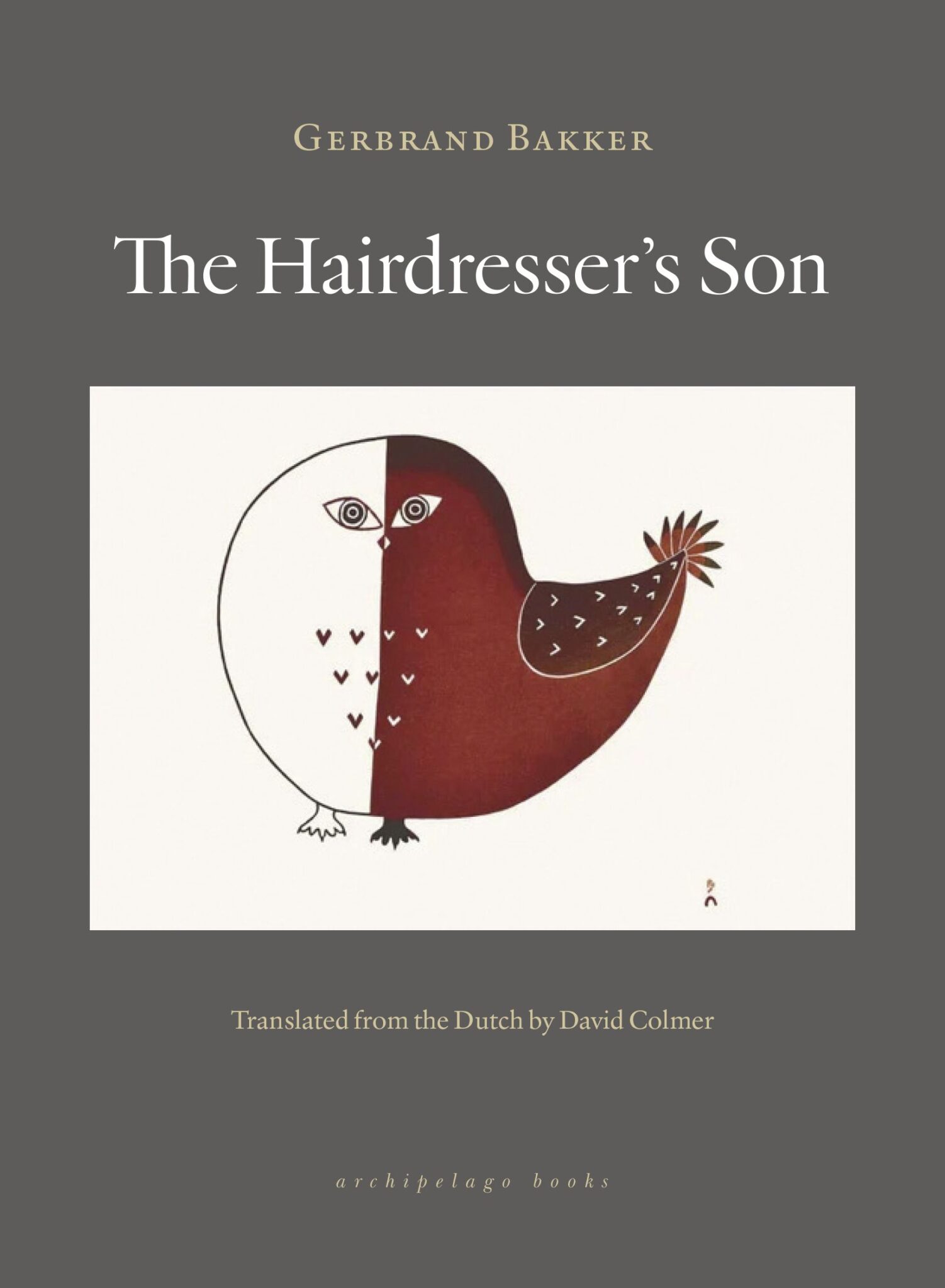
The reluctant barber: The Hairdresser’s Son by Gerbrand Bakker

Cut and shave, eat and drink, swim. Dead, unknown father, slightly hysterical mother. Never had a steady boyfriend. It was too easy, maybe, having an occupation thrown on his lap. He’d gone to hairdressing school, of course, but that didn’t mean it was something he wanted to do.

That, in a nutshell, is Simon Weiman. The protagonist of Dutch writer Gerhard Bakker’s novel The Hairdresser’s Son, now available in a meticulous English translation by his long-time translator, David Colmer. He is a middle-aged gay man living in an apartment above the shop he inherited from his grandfather, a once-bustling hair salon that is now a barbershop even though it’s “fancy” name—Chez Jean— and 70s décor have not changed. Simon runs his business at a relaxed pace, focusing on almost exclusively male clientele with no more than a few scheduled appointments per day. He values his privacy and free time, but seems to do little with it.

His  comfortable routine begins to change when his mother asks him to help out with a weekly swim for intellectually disabled adults. It seems that her friend and co-worker has suddenly run off to the Canary Islands with her new beau, a somewhat discomfiting echo of Simon’s father’s own sudden mysterious disappearance before he was born. One morning in 1977, Cornelus Weiman had slipped off without a word to anyone, to board the ill-fated KLM flight that would crash on the island of Tenerife later the same day. His death was a strange silent space in Simon’s life, one that had left him to ultimately assume his father’s place in the family business, an obligation he had accepted with the quiet reluctance that seems to underlie so much of his existence.

So, if he would rather not give up his Saturday mornings to some sort of poolside babysitting task, his mother’s request is one that he cannot turn down—not that she gives him the option—because he is more than qualified to assist. Swimming is the one personal passion he has. Once a competitive swimmer, he continues to work out in the pool three times a week, savouring a solid hour of laps in the quiet of the early morning, sometimes even hooking up with a fellow swimmer afterwards. But he’s not quite prepared for the group of young people he meets when he arrives for is first disabled swim session. For one thing, only one girl swims while the rest splash about or huddle in a corner. And then there’s Igor. He’s the spitting image of Simon’s favourite Olympic swimmer, Alexander Popov, an athlete whose framed poster still graces the wall of his bedroom. However, inside the fully grown man’s handsome body, is a non-verbal adult with the cognitive development of a child. It’s a contradiction Simon cannot square as, week after week, his obsession with Igor grows until this inappropriate attraction starts to slide toward seriously questionable territory.

Meanwhile, the other challenge to Simon’s settled order of being comes from one of his regular customers, a writer who asks if he can observe some of the typical activities and interactions in the shop because he is thinking of bringing a character who is a barber into his next novel. Lucky for him, he happens to stop by on a day when Simon’s gregarious grandfather Jan is in for his monthly haircut, and he is able to acquire far more enthusiastic detail about the profession than he would have gained otherwise. But it is the writer’s expansive curiosity that starts to trigger in Simon a deeper interest in the famous plane crash that apparently claimed his father’s life. This gradually becomes an obsession that begins to consume more of his free time. There are so many unanswered questions, including the absence of any identifiable remains from the accident site. Against this search for some kind of closure, a secondary thread is introduced that reveals the truth about Cornelus’ actual fate. The fiery crash in Tenerife was his official death, but not the end of his life. Rather it offered an unexpected new beginning, and Cornelus’ secret story forms a counterpoint to Simon’s.

Bakker is a slow, precise storyteller and this novel unfolds at a slow simmer. But it simmers for nearly 300 pages. One might argue that this is intentionally a book that focuses on slowly and deliberately bringing a character to life, but one might also question just how much life actually burns inside Bakker’s central protagonist. Almost everyone else in his life—his mother, his grandfather, the writer, the disabled swimmers—appears more vibrant and alive through vivid passages of description and dialogue in which Simon is typically the passive participant. There are moments where the energy and momentum rises, including the integration of the factual details of Tenerife accident and the stories of the victims and survivors.  But the tedium, routine, and internalization of Simon’s days only serve to make him feel even flatter and more repressed. He has difficulty allowing himself to be receptive to others, even men he has slept with. Then wonders why he is alone. His sensuality is primarily channelled into his touching and handing of the heads and necks of his clients, a safer contact perhaps, but one that preserves emotional distance. By contrast, what we come to know of his absent father’s life, its striking similarities and differences, only complicates one’s empathy for the solitary barber, or rather the “hairdresser’s son,” that lingers after the book closes.

The Hairdresser’s Son by Gerbrand Bakker is translated from the Dutch by David Colmer and published by Archipelago Books.
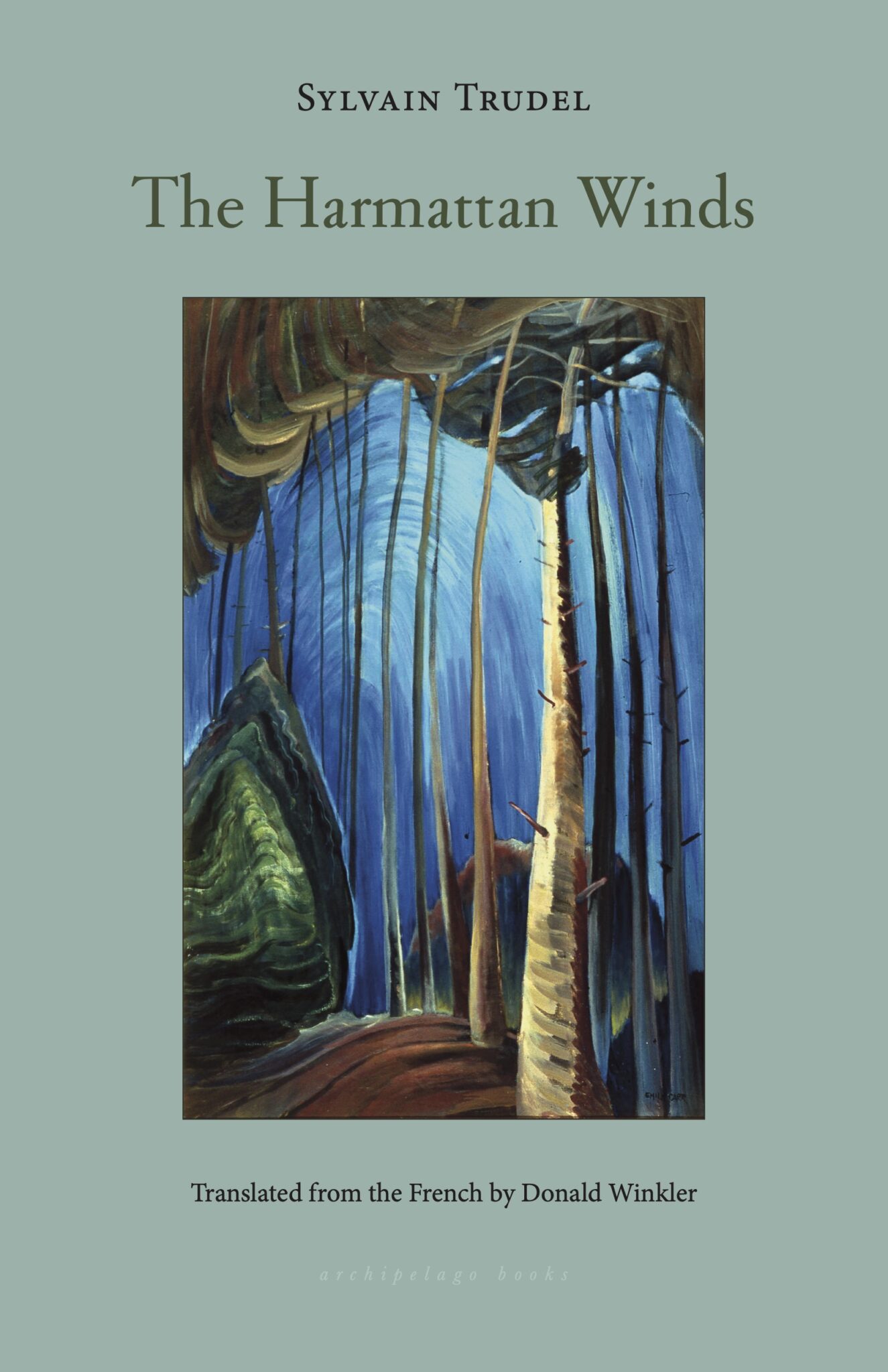
I who dreamed of Africas: The Harmattan Winds by Sylvain Trudel

As for me, I didn’t exist until I was six months old, because up to then no one wanted to be bothered with such a case. Just my luck, I was not an official being, since there was no trace in the records of my coming into the world. Born by the side of the road like a natural disaster incarnate, I had not known the holy oil of baptism, and no one thought to scrawl my name on a government document or anything resembling it, nor even to take an ink print of my tiny foot for a hospital data sheet, even if it was as cute as a tiny goblet. In short, no one dared to believe in me even if I was born bottoms up, like everyone else.

Such is the misfortune of Hugues, abandoned in a shopping cart in a bog of bulrushes by the side of the road, only to be rescued and adopted by Céline Francoeur and her new husband Claude, granting them an instant family, or as he describes it, “they could have all of that indescribable joy, minus nausea or miscarriages, as long as no one went to claim me from the lost property counter.” Despite his unfamiliar appearance, his crossed, slightly almond-shaped eyes, it is not until he overhears his “adaptive” parents arguing over whether he should be told the truth, that the reality of Hugues’ origin story becomes known to him, forever shifting his perspective. Céline and Claude become his semi-parents, his brother and sister his semi-siblings, and his entire existence, in his heart, is rendered incomplete.

The Harmattan Winds, by French-Canadian writer Sylvain Trudel, originally published in French in 1986, is the dramatic, youthful account of a boy who does not know where he really comes from. However, there are two unlikely companions who give meaning and purpose to what might have otherwise been a lonely life in an isolated town in 1970s Quebec. One is a well-worn  collection of poetry by the fictional Gustave Désuet, a flea market find that Hugues carries with him everywhere, reading from it like a guidebook, memorizing the florid and overwrought verses which he admits he doesn’t always understand. He turns to it for comfort and enlightenment—and one also suspects much of his exuberant sense of drama, tragedy and romance are inspired by the poet’s example, even if his misunderstandings and misspelling lend his often enigmatic narrative an internal logic entirely its own. Hugues believes that Désuet, long dead by his own hand (and a rope), helped him to live his life.

He was sort of a paper tiger who one day took up his pen as you would arm to do evil, and poison dripped from his nib. A real viper, that tiger. He said that we, the rich of America and Europe, we’re living in the Accident, curled up in our accidental countries, and the Bible’s Apocalypse is a great idiocy because it has already begun and no one sees it, it’s ongoing right under our eyes that choose to run and hide behind their lids, but it’s there, and, in fact it’s us, yes, the Apocalypse,  it’s ourselves, we are the cataclysm of the poor, seeing that we kill them with one hand hidden behind our backs in the convenient darkness of our heads, so as to stay rich at their expense.

This accidental (that is, occidental) guilt inspired in our hero by his beloved poet, no doubt prepares him to embrace the second companion who suddenly comes into his life. When Habéké, an Ethiopian boy orphaned by famine and adopted by a couple from Montreal, arrives in town, Hugues is naturally drawn to him. They are the same age, and both are potential social outcasts amid the vagaries of early adolescence and the latent racism of the local community, but even though Habéké has already learned the essentials of his new life—to speak French, sing O Canada, and ride a bicycle—he carries within him the dark mysteries of a world beyond the Accident. An irresistible attraction.

I remember that I loved talking with him about Africa, and that is why I know some things today, for example that Africa is a stew of languages and that Habéké’s is full of burgeoning vowels or that in Africa men’s problems, due to their galloping demography, are both acute and grave, high-pitched and low, therefore circumflex, making Africa a kind of quotient, for it is, according to Habéké, the product of divisions between peoples, and over there that’s all there is, peoples. . . . There exist, however, little hooded hats made of soft rubber to rein in the ardor of the peoples, not well attuned to the circumflex dilemmas of Muslims or animists. And then those rubbers look like the moltings of snakes or little caimans, and I’m wondering what a man of this ilk would do with such a device, he who revers the companionship of sacred pythons and crocodiles.

But there is more. Habéké’s exotic wisdom, along with his distinctive appearance, set him apart from the world in which fate had landed him so far from his native land, and in this Hugues finds an echo of his own mysterious dislocatedness.  He sees in him a brother in arms and confesses his own truth: “I told him about my calamity in the bulrushes, my botched birth, my lost invoice, my semi-family, my other man’s eyes, and all and all.” An unbreakable bond is formed—one that sees them through all manner of adventure, outrageous schemes, and some incredibly close calls.

With the spirit of a fairy tale, yet at the same time grounded in small town Quebec (or Canada generally) in an age before video games, computers or many available television channels, this novella surges with energy. Hugues’ willingness to follow Habéké’s increasing desire to connect with his traditional heritage, arising from myth as much as memory, and bound to their mutual desire to escape, not only lands them in more than a few risky situations, but also ends up threatening the safety of two teenage girls they befriend.

Youthful narrators can be hit or miss, but the magic of this coming of age tale rests firmly on the imagination, determination, and entirely idiosyncratic worldview of Hugues and Habéké. The endless forests, rivers, and railway lines that surround them become the African landscape they dream of exploring, and the island of exile they imagine escaping to to live out their naïve utopian dreams. Fast paced and original, it is wonderful to finally have access to The Harmattan Winds in Donald Winkler’s lively English translation.

The Harmattan Winds by Sylvain Trudel is translated from the French by Donald Winkler and published by Archipelago Books.
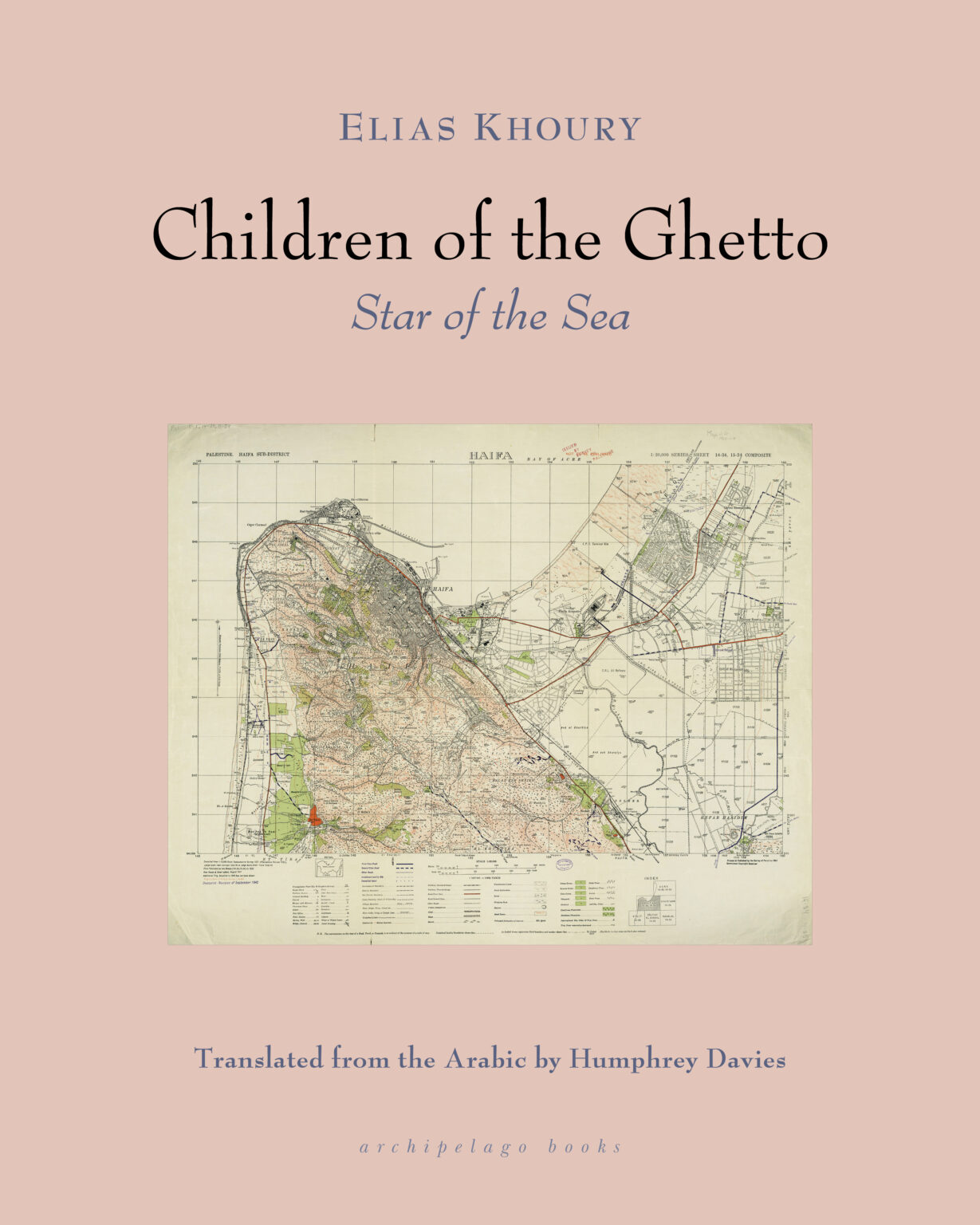
The invisible man’s story: Children of the Ghetto II: Star of the Sea by Elias Khoury

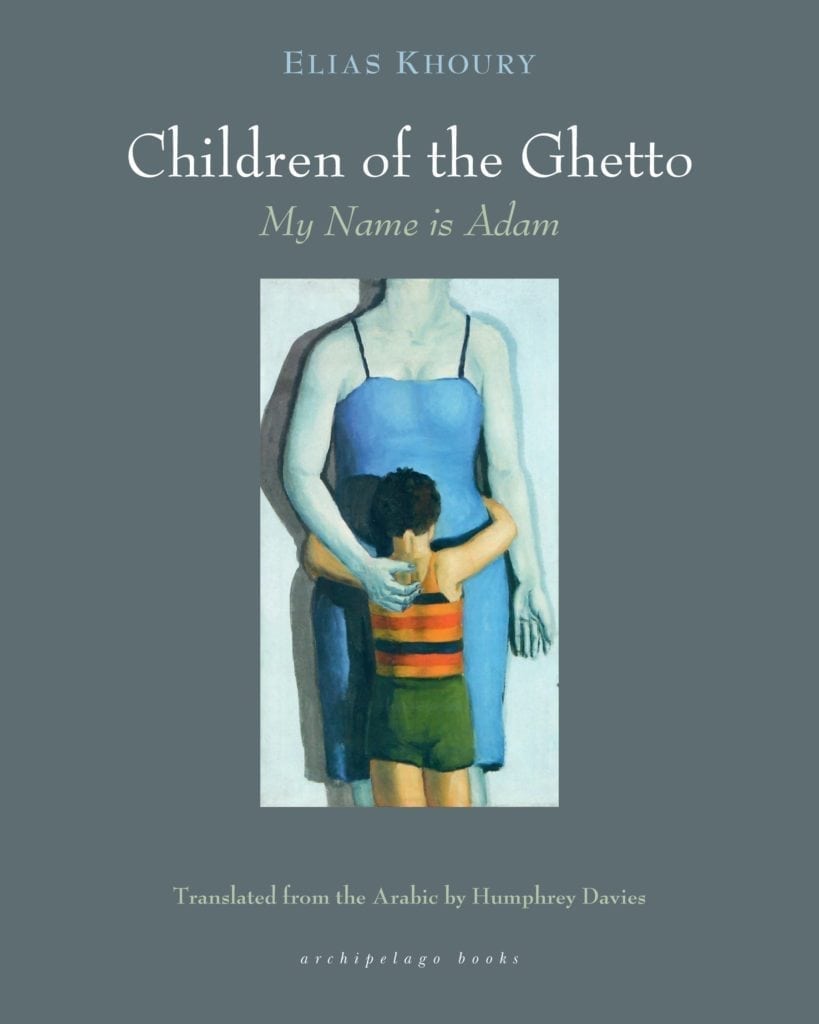
The first volume of Elias Khoury’s Children of the Ghetto trilogy, My Name is Adam, presents itself as a collection of writings by a Palestinian falafel maker living in exile in New York City. Never intended for publication, they include an aborted attempt to write a novel about a seventh-century Yemini poet and the unedited attempt by the author, Adam Dannoun, to understand himself by writing his own story. After a lifetime of trying to leave history, his own and his people’s, behind, two events—the screening of a film based on Khoury’s famous novel Gate of the Sun, and a conversation with a man he has not seen since he was seven years old—motivate this decision to finally commit an account of his life to paper. He will then set the stage for his own death. Elias Khoury supposedly comes into possession of Adam’s notebooks after he has died and, following some consideration, decides to publish them as they are, unedited. The result is an often troubled and circular narrative beginning in New York and making its way back in time in an effort to reconstitute what he knows of his earliest years, during and in the immediate aftermath of the Nakba. Born in Lydda in 1948 he wants to piece together as much as he can about the horrific events of the massacre in the city, the containment of the Arab residents in what the Israeli soldiers labelled a “ghetto,” and the harsh conditions he and his mother endured.

The double-authorship of the first volume—Khoury as the custodian of Adam’s writing—is assumed to be understood, but not mentioned, in Star of the Sea. Rather, the entire tone and approach of the work shifts as Adam steps back from his own story to adopt a distanced perspective: Point of Entry: the Third Person, or the Absent Conscience. That the narrator and author of the novel (and he does call it a novel at this point) is also the protagonist is not a secret, but as he makes clear in the opening passages, it does raise certain challenges:

The question keeping the writer of these stories awake at night is the following: how can the absentee write? Can they tell their own story using “I,” thereby writing as though remembering? Or should they employ the third person to write in their place?

Pronouns in Arabic are extraordinarily supple, unmatched in any other language. The written letters that take a person’s place are called “consciences”, but since the conscience is also an invisible  moral compass, how can a novelist write using the conscience of one who is absent? And finally, what does its corollary—that the conscience must be absent in order for a person to tell their story really mean?

So, although Adam’s account now takes a more straightforward and generally chronological quality, the multi-layered reflective and metafictional elements of the first volume persist, now that the present self (the writer) has separated himself from his past invisible, absent self and reluctant hero of his story.

Although he made passing references to his adolescent and young adult years in the first part of his grand life writing exercise, the primary focus of My Name is Adam was on a period of his life  history of which he had either no direct memories or only a child’s recollections. Now, Adam is on much firmer ground, memory-wise, and in a position to try to face his conflicted emotions about the choices he faced as he navigated life in a country to which he could never fully belong. This is, then, a story of one man’s relationship to his own identity and his desire to live without any history or nostalgia. Even if it means living a lie.

This second volume begins in 1963, with fifteen year-old Adam’s decision to leave home. He had moved to Haifa with his mother, Manal, following her marriage to Abdallah al-Ashal, and, after years of watching his relentless abuse drive her further into a lifeless shell, he knew it was time to get away. Manal seemed to know too and, on the night Adam left, she quietly saw him off, handing him his father’s will before he disappeared into the stormy night. He was now on his own.

With a short detour, Adam makes his way to the garage of mechanic named Gabriel, a Polish Jew who had picked him up one night when he was hitchhiking. Struck by the boy’s fair hair and skin, Gabriel saw in Adam the image of his deceased younger brother. He had promised that he could help him out, thinking of possibly teaching him his trade. But Adam was determined to continue his schooling. So the mechanic not only offered him a place to stay in return for odd jobs in the shop, but also helped him get into a Jewish school. His old life now behind him, this period marked the beginning of Adam’s new story. He changed his name from Dannoun to Danon, and with it he assumed a new identity. He looked the part, spoke Hebrew well, and his existing ghetto origin was malleable:

If the heroes of novels could break through the fourth wall (page) and speak without an intermediary, then Adam could very well have told his story not as the invisible man, but a man formed from his imagination. And indeed he had imagined an entire personality that both matched his true nature and was completely different. From the moment he left his mother’s house on the night of the rain, Adam realized that he could represent himself however he wanted by using certain true events to create a compelling background.

This new story follows the reinvented Adam through his first teenage love—unfortunately for him, it is with Gabriel’s daughter Rivka, a situation not destined to end well—into his university years and beyond. Although he enjoys new freedoms with his assumed Israeli identity, he cannot escape his official Arab designation so he often straddles the Jewish and Palestinian communities, spending his days in one and working and living in another. Along the way he meets an assortment of interesting individuals who will influence his life in varying ways, but the central focus of this second volume of Children of the Ghetto lies with the ghetto he where allows others to believe his origins actually lie—in Warsaw.

As a student of Hebrew Literature, Adam develops a close friendship with his German-born professor Jacob Ebenheiner, a relationship based on shared intellectual curiosities and interests. Jacob does not pry into Adam’s life, and the latter offers no details. But a class trip to Warsaw at the end of the first term will ultimately lead to a betrayal of his secret. The visit to Poland has huge impact on the eighteen year-old Palestinian-in-disguise—walking through the streets of the Warsaw Ghetto and listening, through a translator, to the stories of the guide and survivors. But it is an evening spent in the company of Marek Edelmann, one of the leaders of the Warsaw Ghetto Uprising and life-long anti-Zionist who remained in Poland and became a famed cardiologist, that unsettles him most. Adam is not only left questioning who he is and where he belongs, but it brings to light the extent of the gap that exists between himself and his defiantly proud Israeli teacher.

Throughout this book, Adam relies on a degree of invisibility afforded by his appearance to continue to live a lie into his adult professional life, but in his personal life the balance is more difficult, and not all ghosts can be left in the past, no matter how much he may want them to be. For many years he will keep to himself as much as possible, the personification of the “present absentee.” That is, until he meets Dalia, the young woman who turns his world upside down when he is in his mid-forties, the woman who finally makes him believe in love. But we know, for he has often told us, that it will not last.

Although familiarity with the first volume is assumed, Star of the Sea is building on a much wider story with a fresh angle on questions about what it means to write about one’s own life, about truth, and about what one can really tell. Given his reluctance to talk about his past, Adam does not detail his early experiences, nor does he explain things we as readers know about his true origins, facts that he himself was unaware of until much later in life. Here is focused on telling this aspect of his story in a specific manner. Yet, by the time the novel ends he has glossed over much of what will be the most significant romantic relationship of his life, so one can only assume that Dalia will take centre stage in volume three. But where will Adam be standing as he tells this part of his story? The final part of the trilogy only came out in Arabic in 2023, so it seems that Anglophone readers will have to wait for a translation to find out.

Children of the Ghetto: Star of the Sea by Elias Khoury is translated from the Arabic by Humphrey Davies and published by Archipelago Books.
Looking back at a year of reading: 2024 edition

Each year when I review the list of books that I have read, I face the same challenge deciding what to include and what to leave out of a final accounting. As usual there are the books that I know, even as I am reading them, will be among my favourites for the year. Just as I know the ones I don’t like, the ones I won’t even mention or take the time to review. Basically, everything else that I have reviewed, was a good book.

This year, my count far exceeds a respectable “top ten” or “baker’s dozen” and there are some striking factors at play. One is that the ongoing  violence in Gaza has heightened my focus on Palestinian and Arabic language literature—long an area of interest and concern. Five of the Palestinian themed books I read made my year end list. As well, I have paired several titles, typically by the same author or otherwise connected, because the reading of one inspired and was enhanced by the reading of the other (not to mention that such pairings allow me to expand my list). Finally, as reflected by my top books, I read and loved more longer works of fiction this year than usual (for me). No 1000 page tomes yet, but perhaps I’m overcoming some of my long book anxiety.

And so on to the books.

Poetry:
I read far more poetry than I review, but this year I wanted to call attention to four titles.

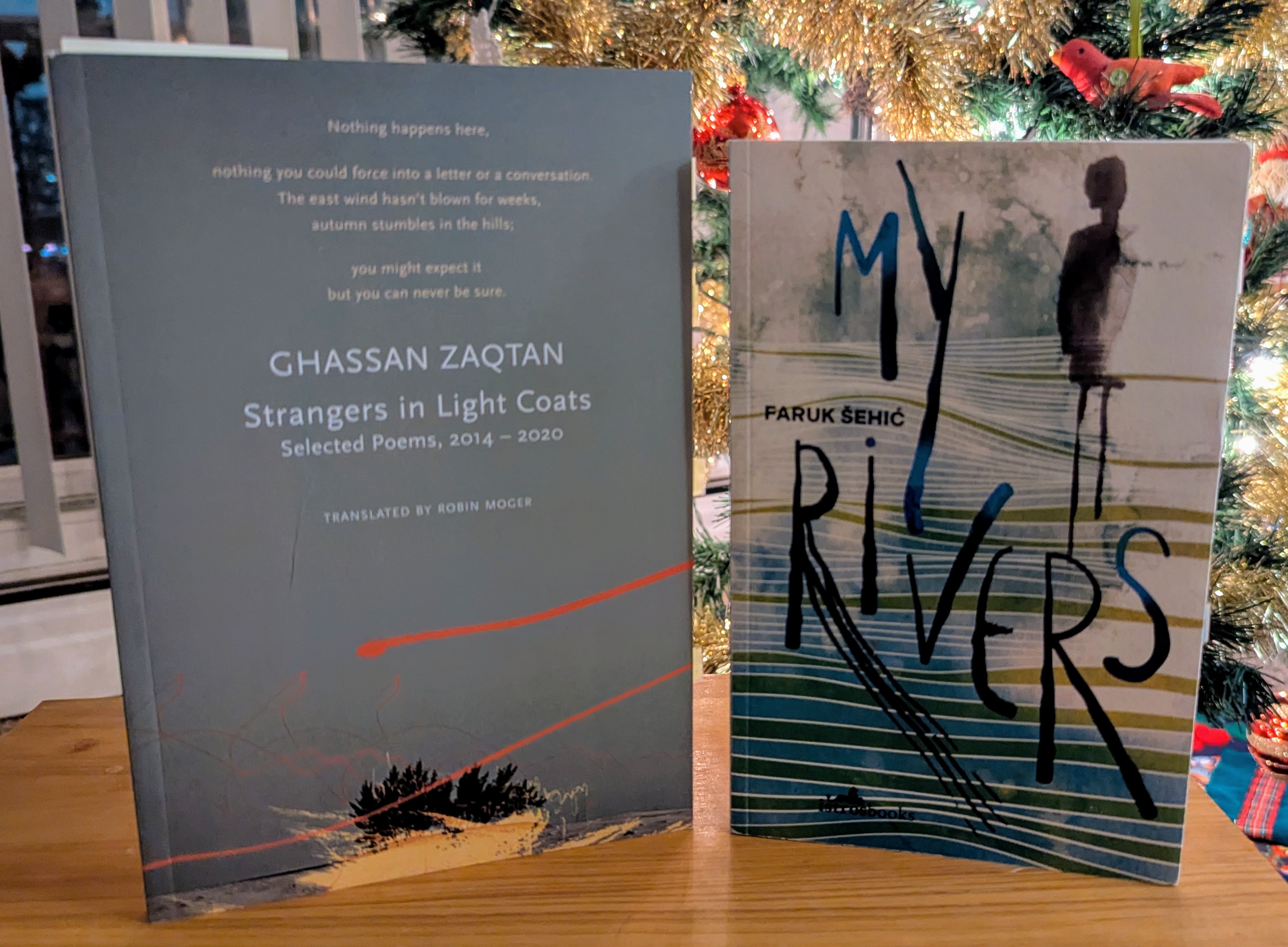
Strangers in Light Coatsevokes by Palestinian poet Ghassan Zaqtan (Arabic, translated by Robin Moger/Seagull Books) is, perhaps, a darker than his earlier collections. Comprised as it is, of poems from recent releases, it actively portrays a world shaped by the reality of decades of occupation and war.

My Rivers by Faruk Šehić (Bosnian, translated by S.D. Curtis/Istros Books) is a collection particularly powerful for its depiction of a legacy of wars in Bosnia/Herzegovina including the genocide in Srebrenica. His speakers carry the burden of history.

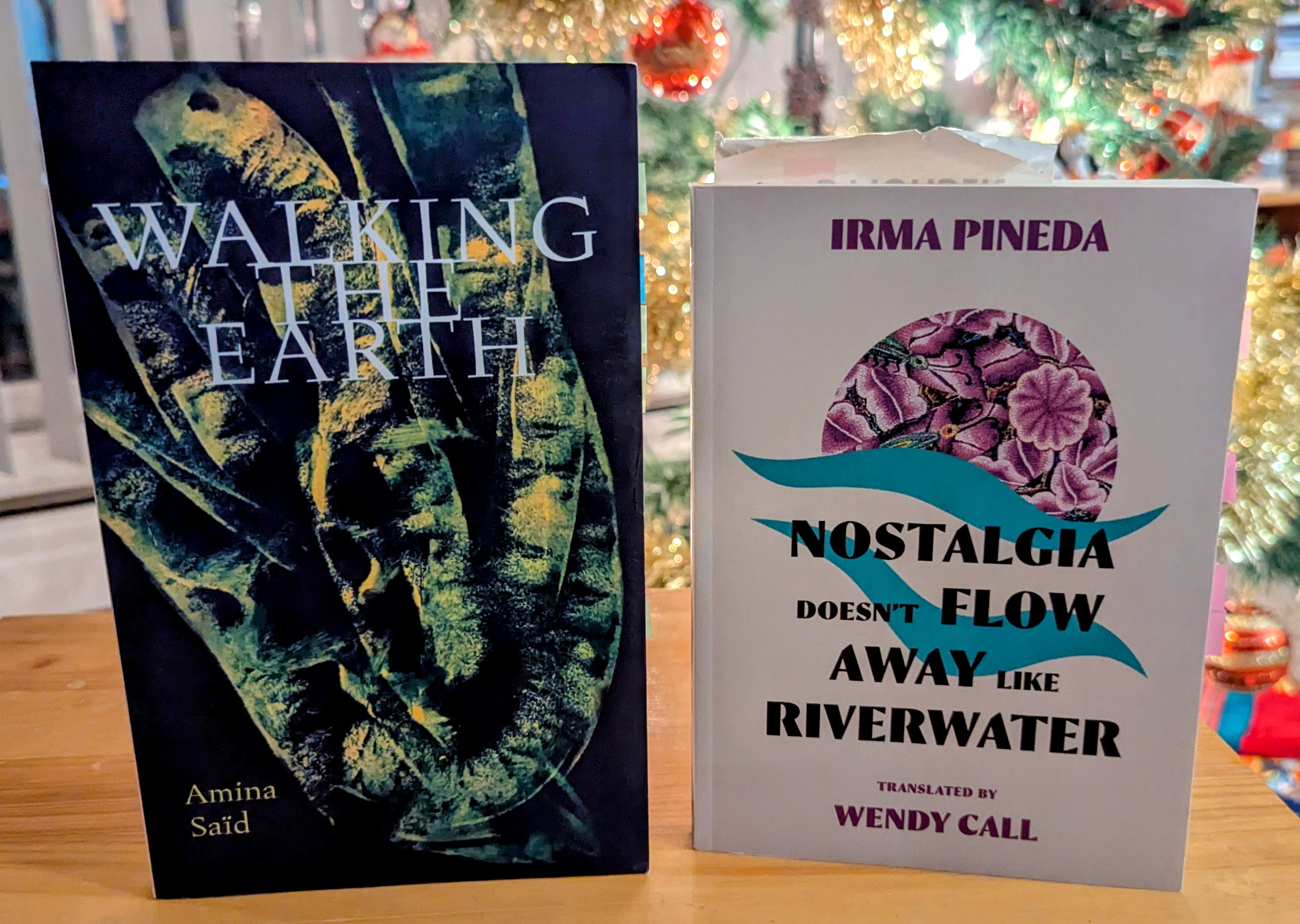
Walking the Earth by Tunisian-French poet Amina Saïd (French, translated by Peter Thompson/Contra Mundum) is such a haunting work of primal beauty that I can’t understand why more of her poetry has not been published in English. Perhaps that will change.

Nostalgia Doesn’t Flow Away Like Rainwater by Irma Pineda is one of a number of small Latin American poetry collection from poets and communities that have not been published in English before. This book, a trilingual collection in Didxazá (Isthmus Zapotec) and Spanish with English translations by Wendy Call (Deep Vellum & Phoneme Media) was particularly special.


Nonfiction:
This year, my favourites include a mix of memoir and essay and a couple of works that defy simple classification.

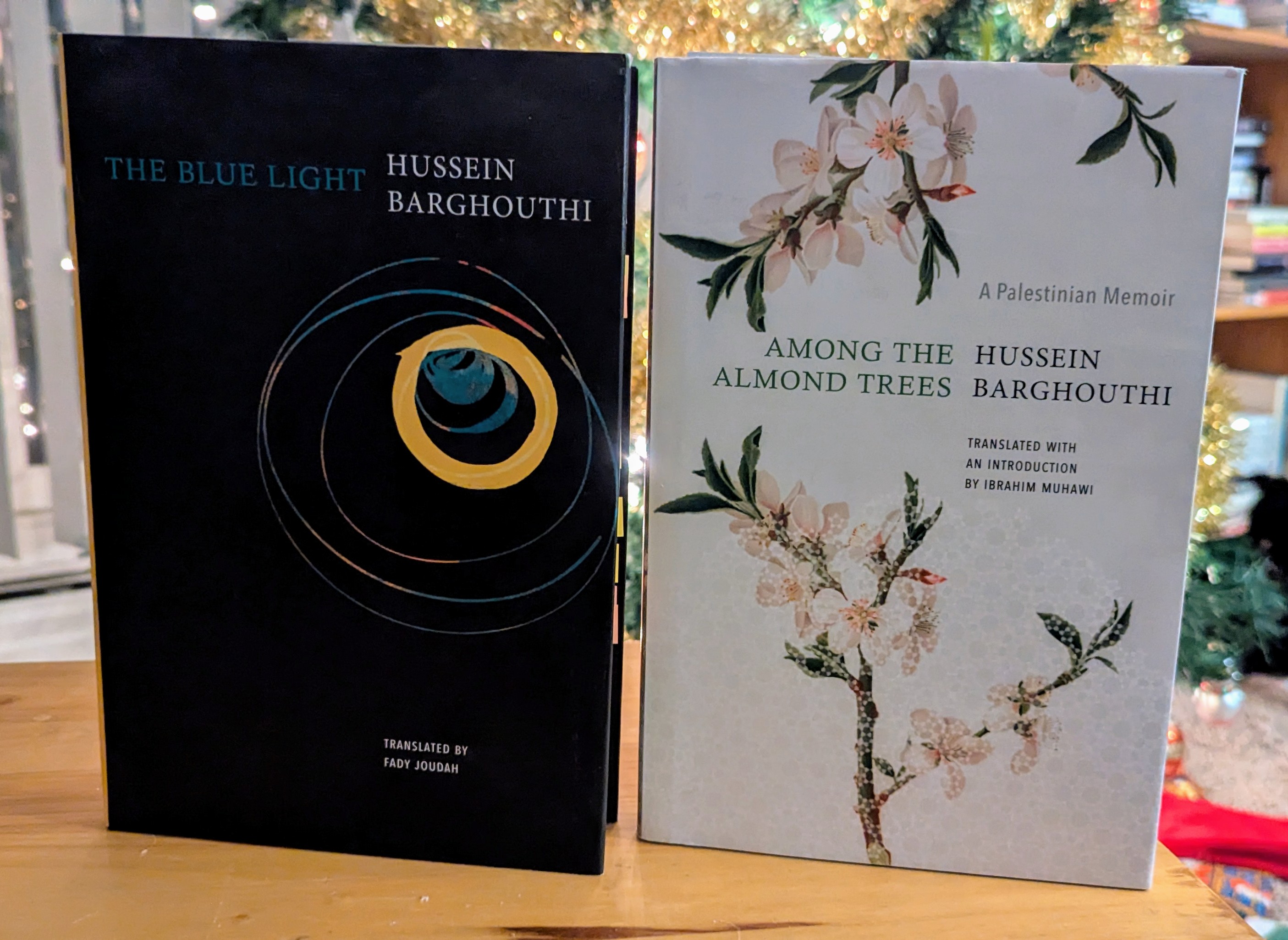
The Blue Light / Among the Almond Trees by Palestinian writer Hussein Barghouthi (Arabic, translated by Fady Joudah and Ibrahim Muhawi respectively/Seagull). Blue Light chronicles Barghouthi’s years in Seattle as a grad student and the eccentric circles he travelled in, whereas Among the Almond Trees is a much more sombre work written when he knew he was dying of cancer. The two books complement each other beautifully.

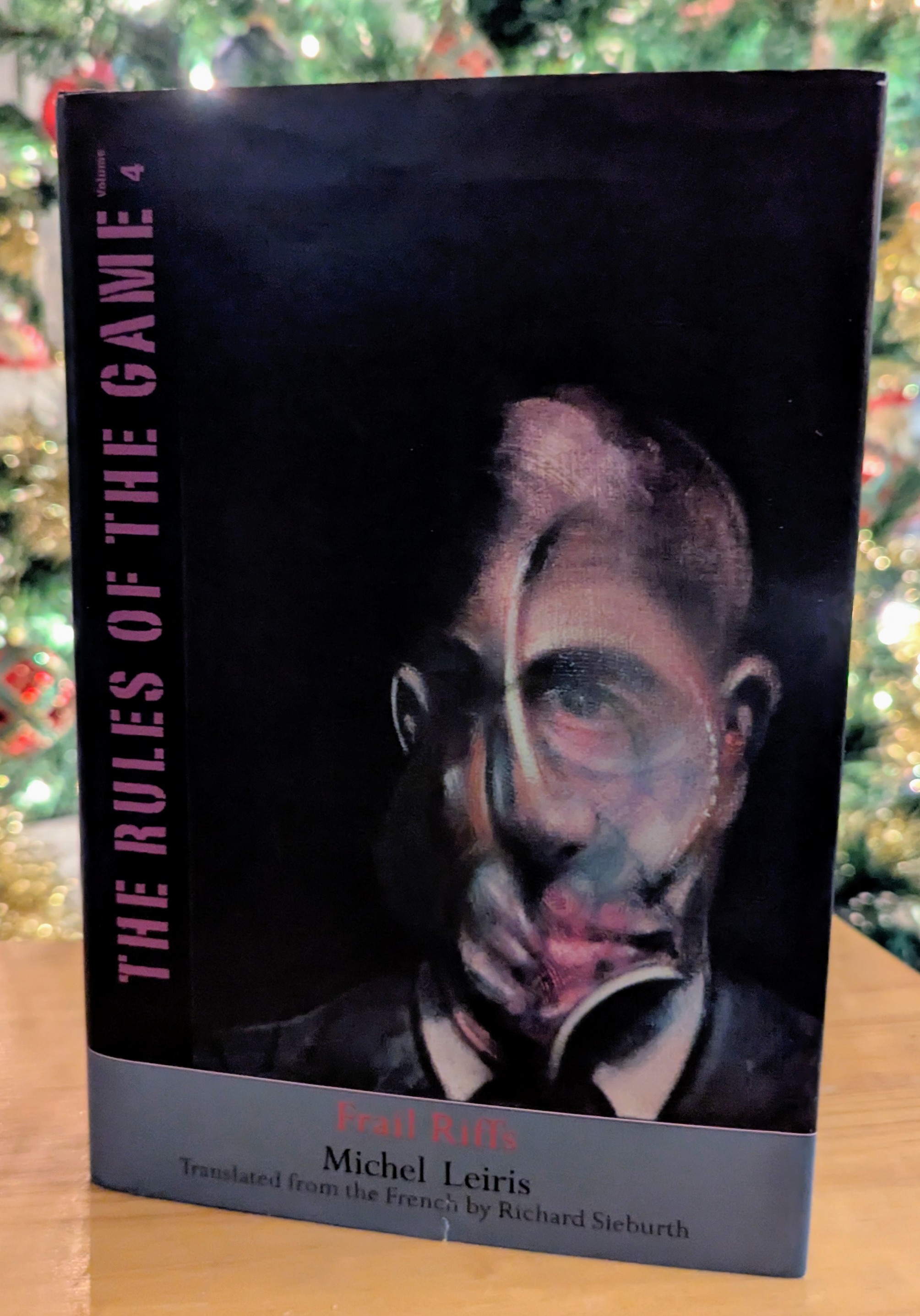
French intellectual, critic, ethnographer and autobiographical essayist Michel Leiris is a writer who means so much to me that the occasion of the release of Frail Riffs (Yale University), the fourth and final volume of his Rules of the Game in Richard Sieburth‘s translation, was not only an excuse to pitch a review but an invitation to revisit the earlier volumes. Definitely a highlight.

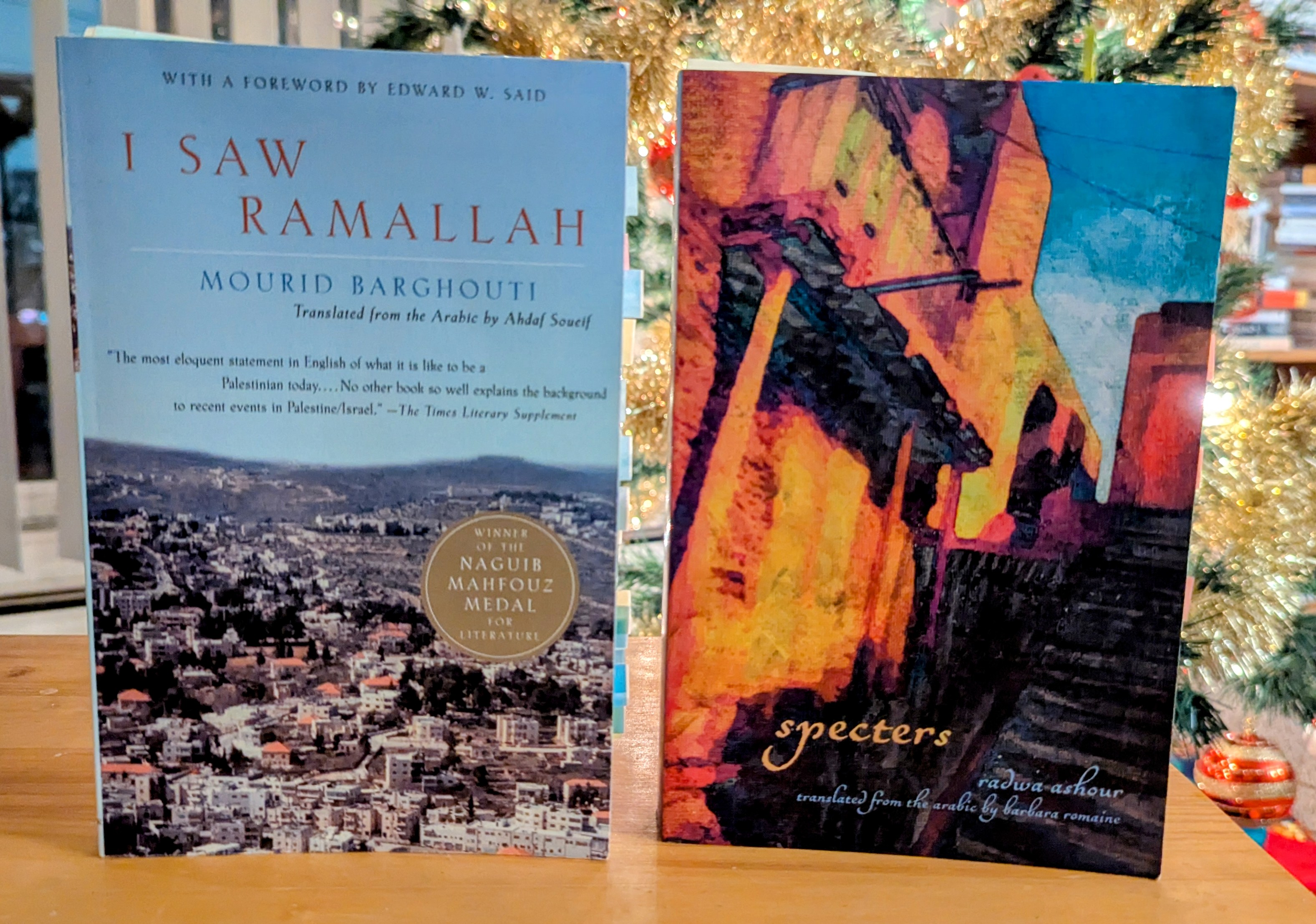
I Saw Ramallah by Mourid Barghouti (Palestinian/Arabic, translated by Ahdaf Soueif/Anchor Books) is a moving memoir detailing the author’s return to his homeland after thirty years of exile. Reading it reminded me that I had a copy of Scepters by his wife, Egyptian novelist Radwa Ashour (Arabic, translated by Barbara Romaine/Interlink Books). This ambitious work blends fiction, history, memoir, and metafiction and I absolutely loved it, but my decision to include it here, like this, rests on the memoir element which complements her husband’s in its account of the many years he was exiled from Egypt—a double exile for him—especially the years in which she travelled back and forth with their young son to visit him while he was living in Hungary.

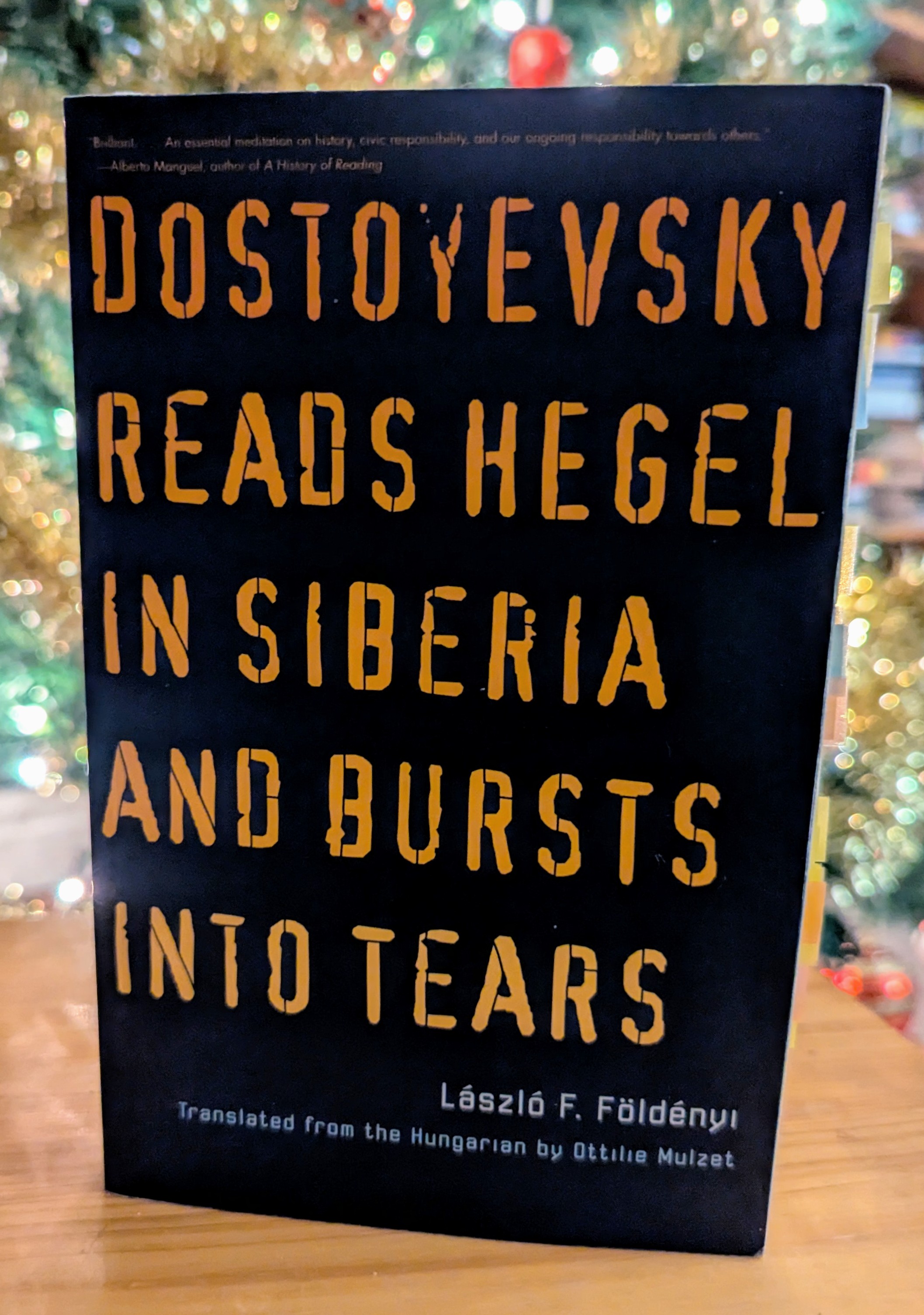
Candidate for the book with the best title, perhaps ever, Dostoyevsky Reads Hegel in Siberia and Bursts into Tears by Hungarian scholar  László Földényi (translated by Ottilie Mulzet/Yale University) was an endlessly fascinating collection of essays exploring the relationship between darkness and light (and similar dichotomies) through the ideas of a variety of writers, thinkers and artists.


Fiction:
As usual, fiction comprised the largest component of my reading and, as I’ve said, I read more relatively longer works than in the past. Normally I have a special fondness for the very spare novella and, of course, my list would not be complete without a few shorter works, including one more pair.

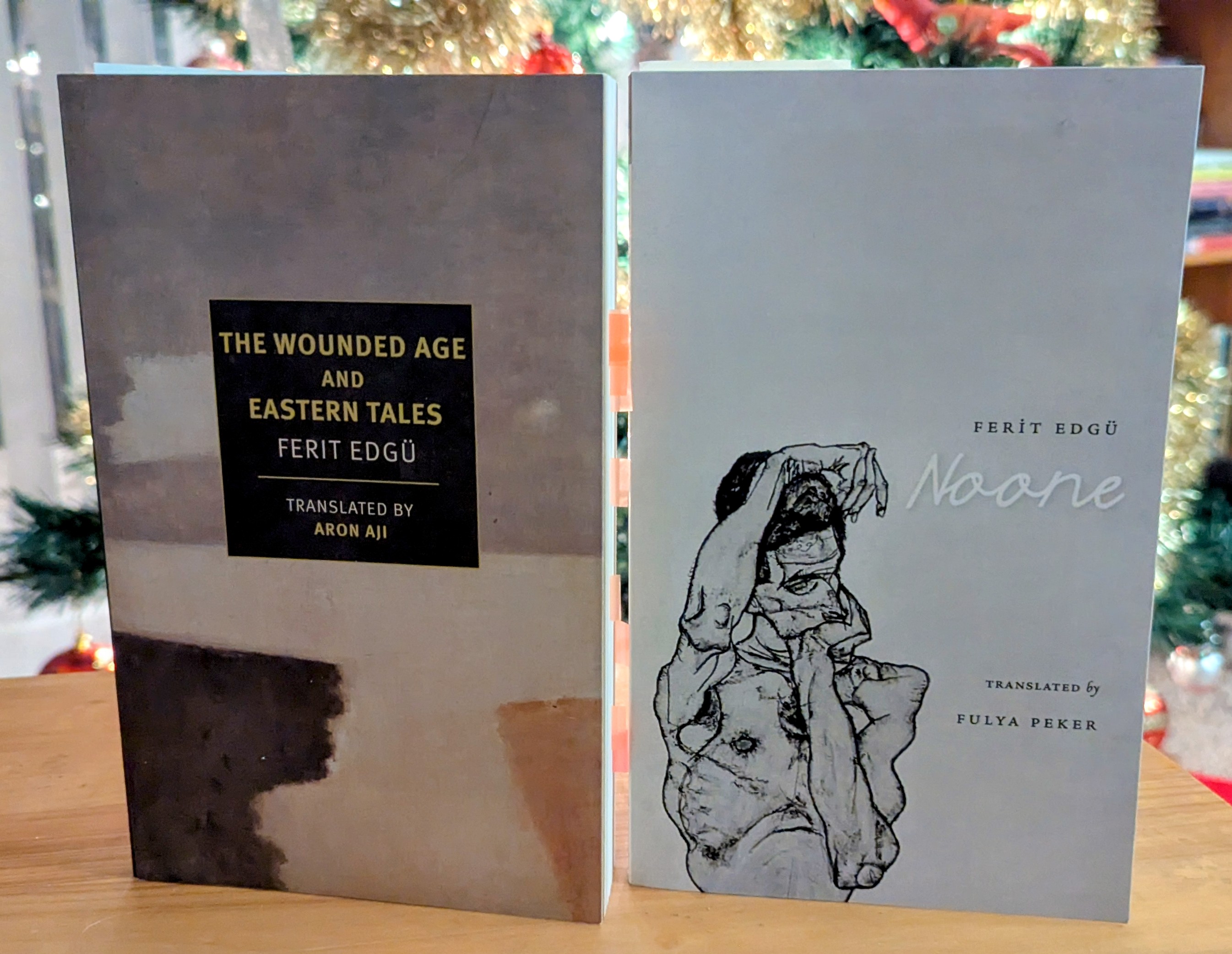
The Wounded Age and Eastern Tales  / Noone by Turkish writer Ferit Edgü—translated by Aron Aji (NYRB Classics) and Fulya Peker Cotra Mundum) respectively—who is sadly one of the writers we lost this year. His work, which draws on the time he spent teaching in the impoverished southeastern region of Turkey in lieu of military service, is filled with great compassion for the people of this troubled area. But his prose is stripped clean, bare, and remarkably powerful.

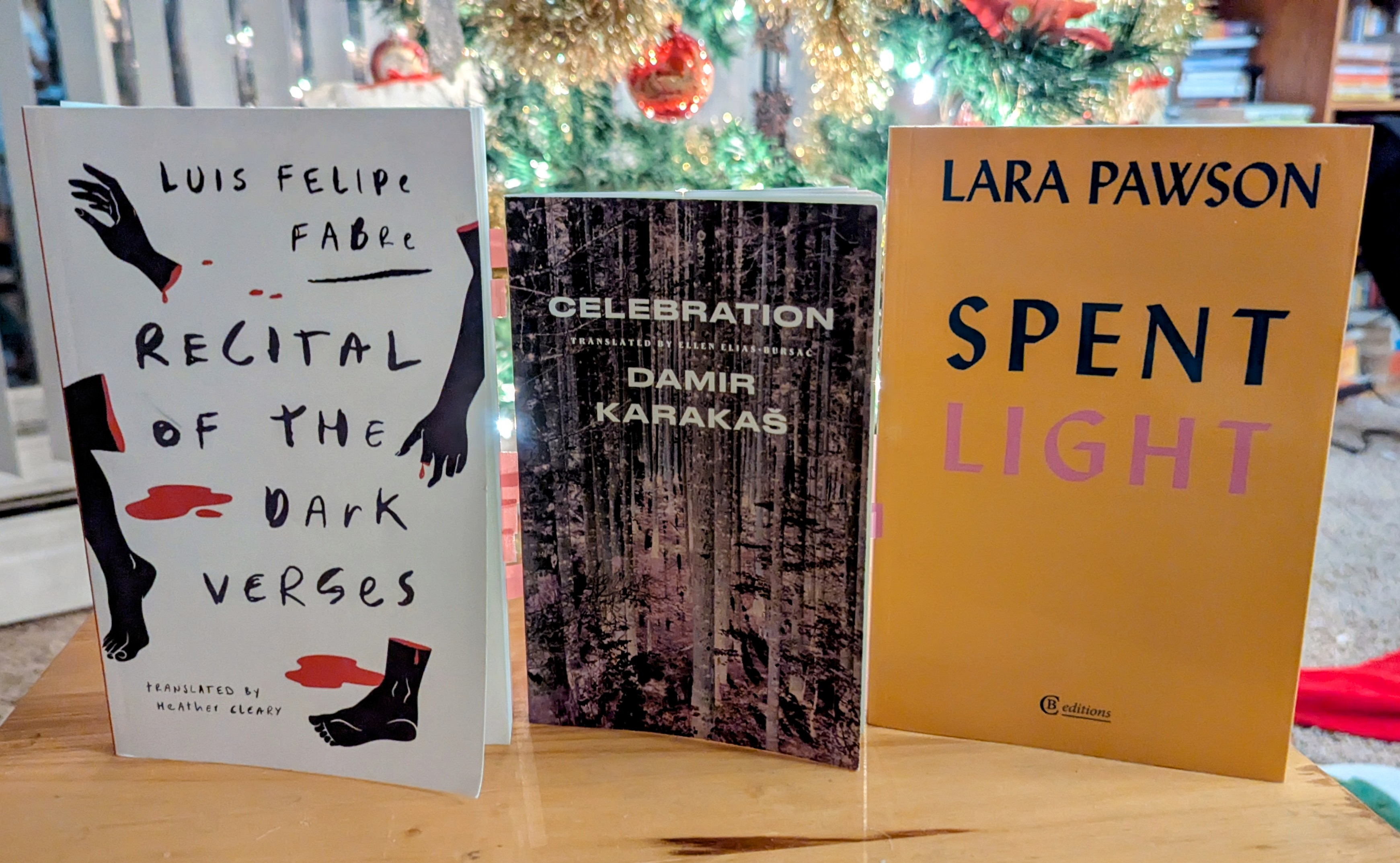
Recital of the Dark Verses by Luis Felipe Fabre (Mexico/Spanish, translated by Heather Cleary/Deep Vellum) is an award wining translation that seems to have garnered less attention than it deserves. This comic Golden Age road trip follows the misadventures of the body of John of the Cross on its clandestine voyage to Seville. Brilliant.

Celebration by Damir Karakaš (Croatian, translated by Ellen Elias-Bursać/ Two Lines Press) is an exceptionally spare, unsentimental novella about the historical forces that pulled the residents of Lika in central Croatia into World War II.

Spent Light by Lara Pawson (CB Editions) is a book I’d been anticipating since reading her This Is the Place to Be. Strange, at times disturbing, often hilarious and always thoughtful, this is one of those books that (thankfully) defies description.

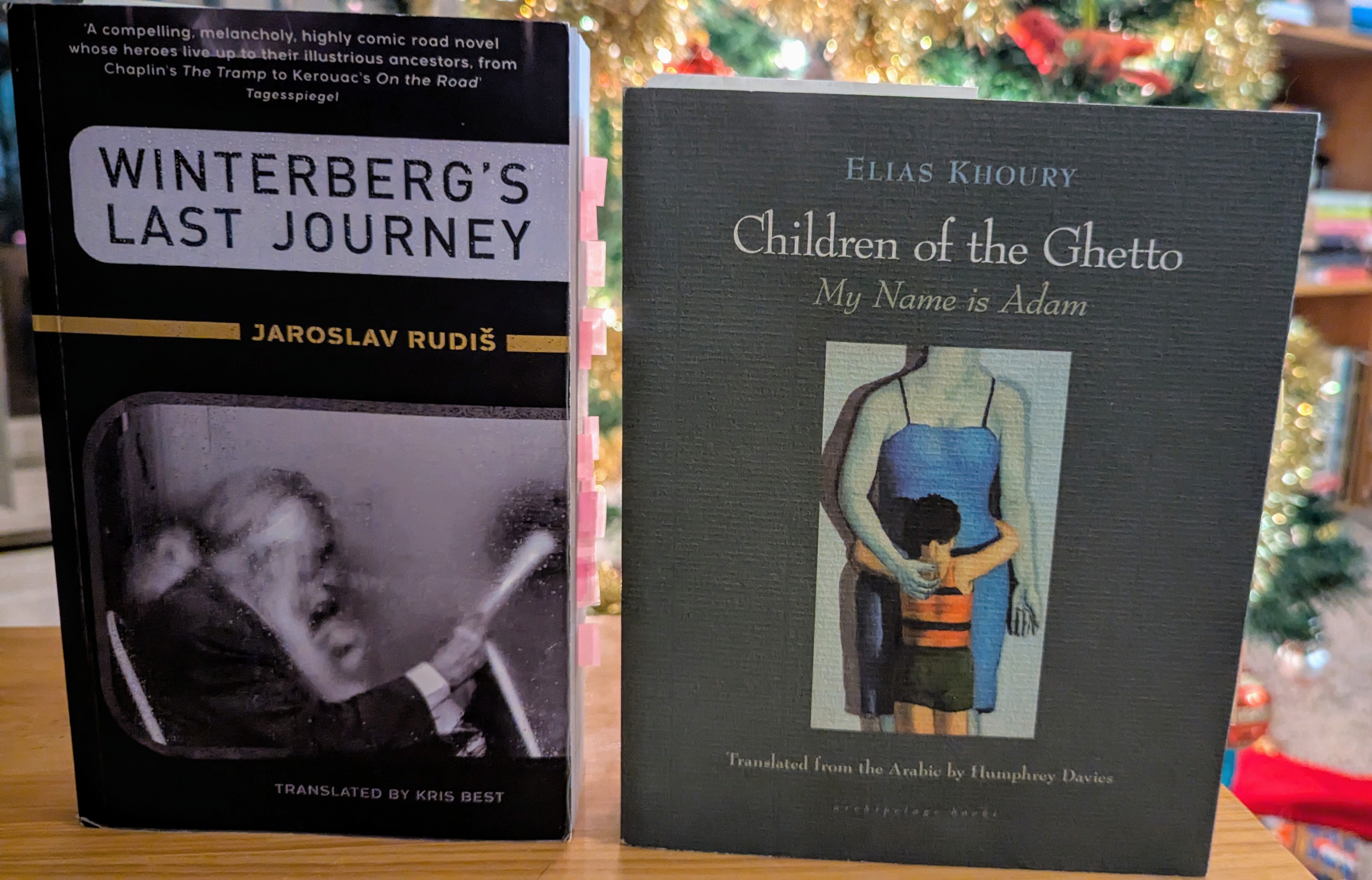
If Celebration is historical fiction at its most spare, Winterberg’s Last Journey by Czech writer Jaroslav Rudiš (German, translated by Kris Best/Jantar Publishing) is the exact opposite. Ambitious, eccentric, and filled with detail, it follows a 99 year-old man and his male nurse as they travel the railways with the aid of 1913 railway guide. What could possibly go wrong?

Children of the Ghetto I: My Name is Adam by Lebanese author Elias Khoury who also died this year (translated by Humphrey Davies/Archipelago Books) is the final Palestinian themed work on my list. This is a challenging and rewarding novel about a man born in the ghetto of Lydda during the Nakba that examines complex questions of identity.

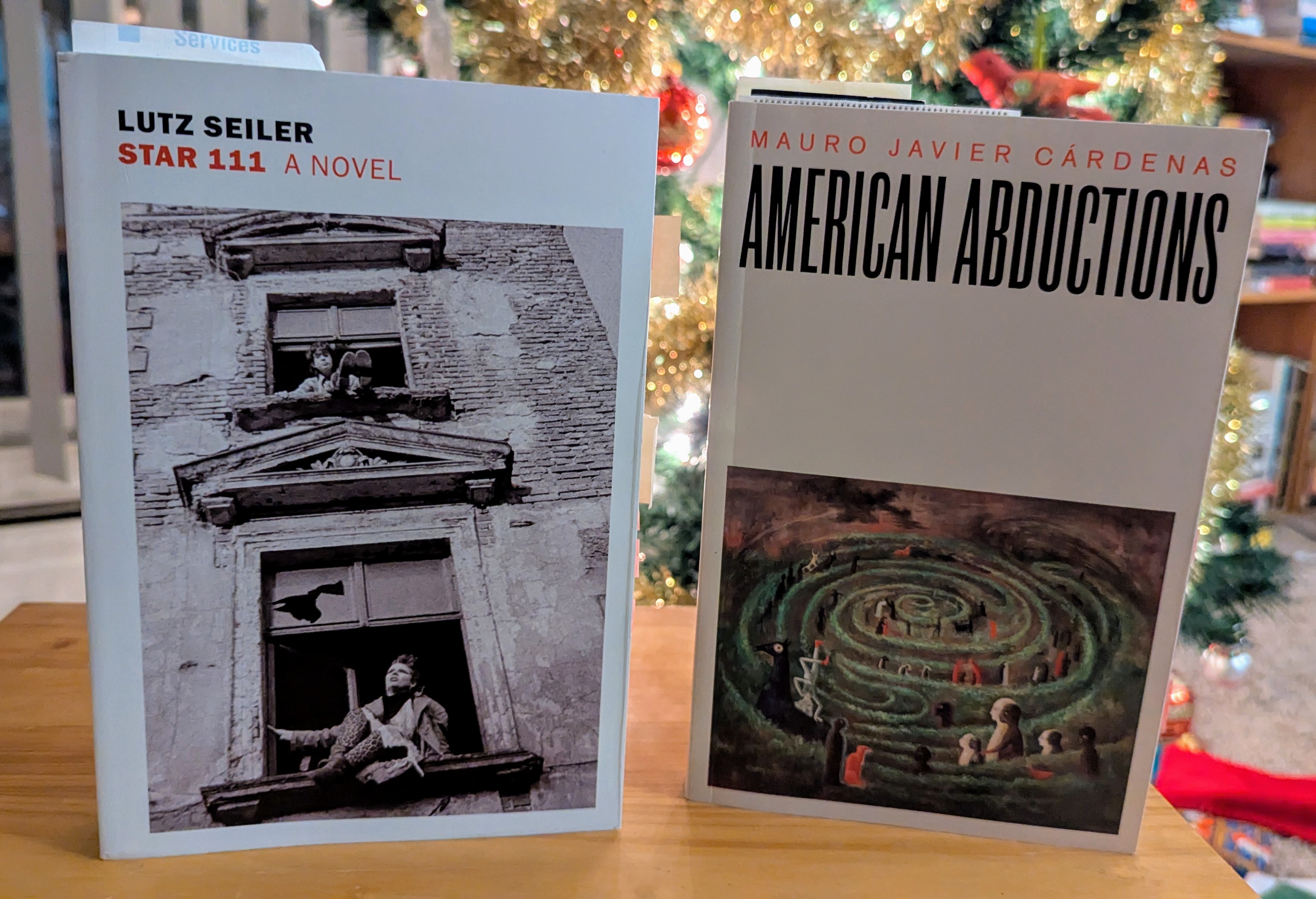
Star 111 by Lutz Seiler (German, translated by Tess Lewis/NYRB Imprints)is the autobiographically inspired story of a young East German would-be poet’s experiences among an eccentric group of idealists in Berlin in the immediate aftermath of the fall of the Wall. I was familiar with Seiler’s poetry before reading this, but I liked this novel so much that it lead me to follow up with his essays and the work of other poets important to him—the best kind of expanding reading experience.

Mauro Javier Cárdenas’ third novel American Abductions (Dalkey Archive) imagines the latest iteration of his hero Antonio in a future in which Latin American migrants are systematically sought out, separated from the children and deported. With a stream of single sentence chapters, he creates a tale that is both fun and uncomfortably too close for comfort. Quite an achievement!

Last but not least, my two favourite books this year are Hungarian:

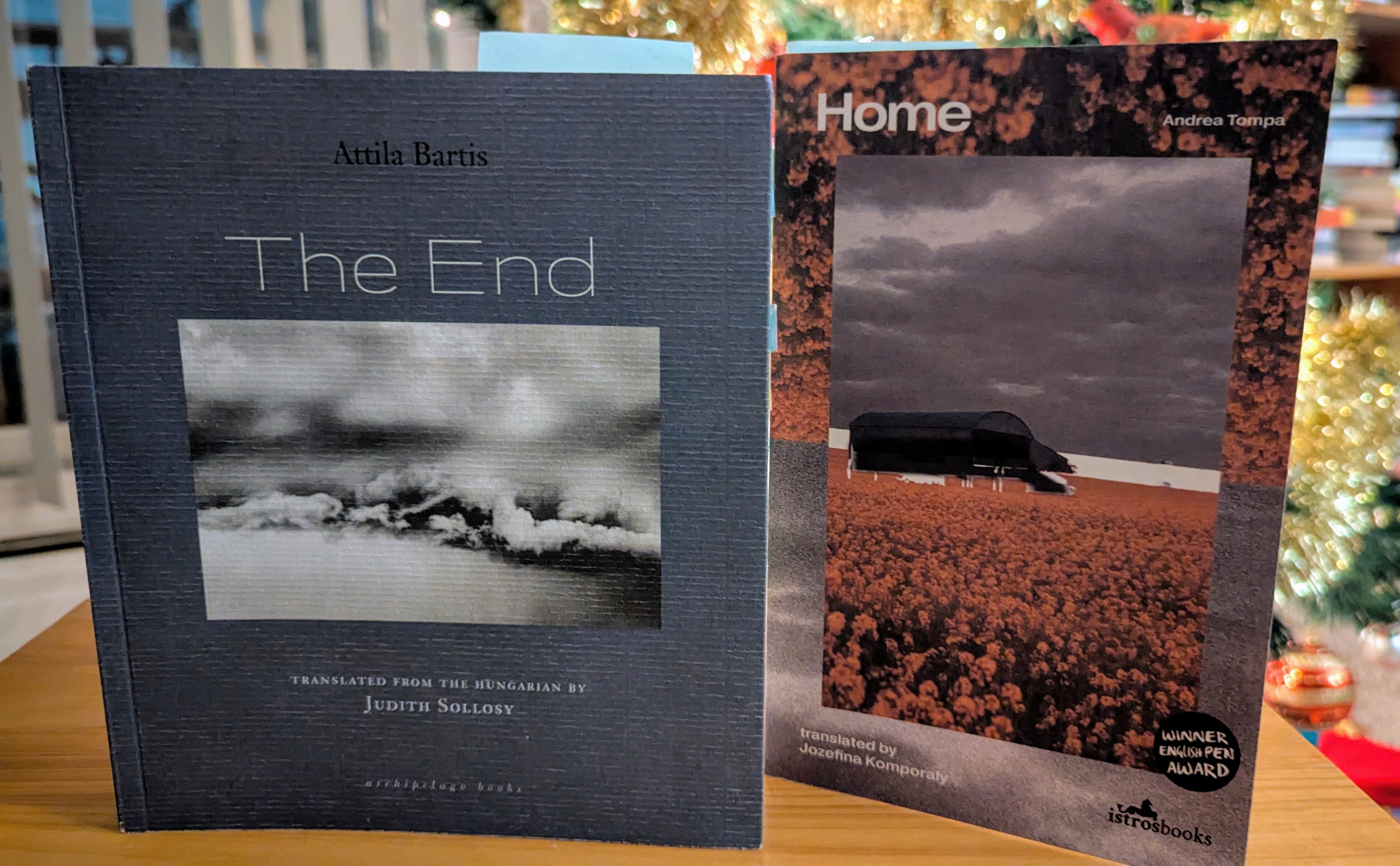
In The End by Attila Bartis (translated by Judith Sollosy/Archipelago Books), a fifty-two year old photographer looks back on his life—his successes and his failures. He reflects on his relationship with his mother, his move to Budapest with his father in the early 1960s following her death, life under Communism and the secrets held by those around him, and the role the camera played in his life. Presented in short chapters, like photographs in prose each with its “punctum,” the 600+ pages of this book just fly by.

Like Attila Bartis, Andrea Tompa also comes from the ethnically Hungarian community of Romania’s Transylvania region and now lives in Budapest. Her novel Home (translated by Jozefina Komporaly/Istros Books) follows a woman travelling to a school reunion, but it is much more. It is a novel about language, about what it means to belong, to have a home and a mother tongue. It’s probably not surprising that my two favourite novels involve protagonists in mid-life, looking at where they are and how they got there. As to why they’re both Hungarian—I suppose I’ll have to read more Hungarian literature in the new year to answer that.

So that is my 2024 wrap up. I’d like to think 2025 will be better than I fear it will, but at least I know there are countless good books to look forward to.

Happy New Year!

Who holds the truth? Sister Deborah by Scholastique Mukasonga

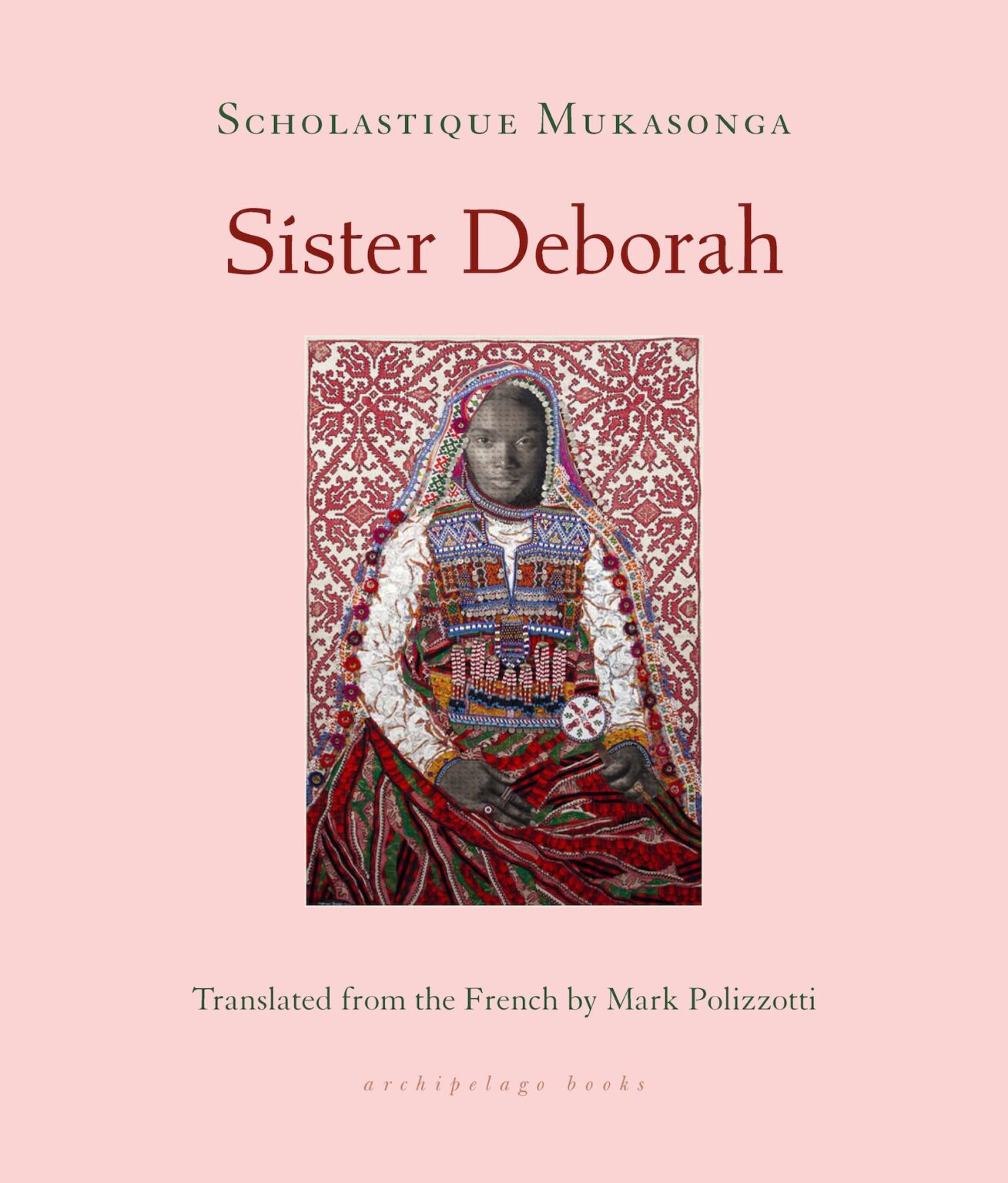
The latest work from Rwandan writer Scholastique Mukasonga, to be released in English translation, is a novella that takes us back to 1930s Rwanda when the small, landlocked east African country was under the administrative control of Belgian authorities and the religious influence of the Catholic church. With the arrival of a group of black American evangelists, life in a small community faces unprecedented challenges to both the externally enforced regulations and the traditional norms of social conduct. When the local chief grants them permission to establish their mission on a hillside long associated with pagan rituals of the past, rumours spread and curiosity is aroused by their seemingly strange services and the enigmatic prophetess who dances, babbles in strange tongues, and appears to have miraculous healing powers. Women, in particular, are drawn to her, while the village men tend to regard her and her odd companions with distrust.

Meanwhile, the narrator of this tale, Ikirezi, is a sickly young girl mysteriously prone to endless maladies. Suspicious of the white man’s medicine, her mother applies all of the home remedies she can think—all to no avail. Ikirezi’s illnesses only grow worse. There is, she decides, but one solution:

“Tomorrow we’ll go to see Sister Deborah, she’ll be able to cure you. Tomorrow we’ll go to Niyabikenke, to the mission of the black padri.” If my father noticed our travel preparations, he exploded in fury. “You are not going to that devil’s mission. I forbid it! Didn’t you hear what our real padri said about it? They’re sorcerers from a land called America, a country that might not even exist because it’s the land of the dead, the land of the damned. They have not been baptized with good holy water. And they are black—all the real padri are white. I forbid you to drag my daughter there and offer her to the demon hiding in the head and belly of that witch you call Deborah. You can go to the devil if you like but spare my daughter.”

Ikirezi, we will later learn, is not only strengthened physically and intellectually as result of her encounters with the foreign faith healer, but she goes on to study abroad and become an anthropologist. This accounts, perhaps, for the  tone of the of the extended first section of Sister Deborah which  often relies on varying details, reports, and speculation about what might or might not have happened, resembling at times a sort of gathering and integration of field data. The narrative extends beyond that of a child’s experience, describing the conditions surrounding the settlement of the American missionaries, the black pastor’s talk of the impending return of the Savior to this very location in the heart of Africa, and Sister Deborah’s particular appeal to the womenfolk, some of whom come to understand her to be implying that the Savior will likely be a black woman who will descend from the clouds bearing a special seed that will grow and flourish to feed their families without back breaking labour, thus releasing them from the constraints imposed on them by their husbands and economic traditions. Needless to say, the men of the community, the church, and the administrative powers are unsettled by the disruptions and feminine empowerment that arises in the wake of Sister Deborah’s influence. A series of events that lead to the expulsion of the Americans and the disappearance, or possible death of the prophetess are shrouded in confusion and conflicting accounts.

A brief second part considers the possible fate of Sister Deborah and allows Ikirezi to explain how she came to be a professor based in Washington, DC, dedicated to the study of her people but oddly aware of the hands of Sister Deborah somehow guiding her. She senses she has to follow a path laid out for her. Research leads her to a shantytown in Nairobi where she finds the faith healer, now known as Mama Nganga, and turns the narrative over to her. Now, the woman at the heart of this tale, has an opportunity to tell, on her own terms, the story of her life, reaching back into her own childhood in America and forward, through the formation of the missionary project, the long journey to Rwanda, her mystical awakening, and beyond the turmoil in Niyabikenke, to the life and identity she has created for herself in Kenya.

Her own spiritual evolution, as she describes it, was filled with mystery, even as she reflects on it years later. Early on, for example, when the  mission pastor suggests that the otherworldly sounds she makes when she falls into a trance may come from an African dialect, to be understood as a sign that all the black peoples will be liberated and saved from the coming  biblical Apocalypse, she has her private interpretation:

As for me, I was prey to a strange thought that I didn’t dare confess to Reverend Marcus. It seemed to me that the spirit speaking through my mouth was not the Holy Spirit of the pastors, who was always trailing behind the Father and Son. For one thing, it spoke neither Hebrew nor Greek nor Latin, but perhaps indeed, as Marcus believed, an African tongue. The spirit that had chosen me as medium could only be an African spirit, perhaps the spirit of the black woman who had visited me during my trance. I made prayers to her; I diverted toward her the worship that the pastor celebrated for the Savior. I preciously guarded that secret in the deepest recesses of my heart.

Sister Deborah Nganga’s account is ultimately one without clear resolution. Forces run through it that neither she nor the narrator, who also feels their presence, can fully articulate. Ikirezi’s later return to Nairobi to follow up on the fate of the former faith healer is again, like the opening section, guided by rumour, informants, and speculation. This is a book that continually asks questions about truth and memory, in the context of oral history, recorded biography, and academic research. There are no firm answers: Mukasonga allows uncertainty to linger in this story that explores the challenges and varying fates experienced by African women in times of shifting social and political conditions, yet keeps the spirit—or spirits—alive.

Sister Deborah by Scholastique Mukasonga is translated from the French by Mark Polizzotti and published by Archipelago Books.
Memory is a wound in the soul that never heals: Children of the Ghetto I: My Name is Adam by Elias Khoury

I want to clarify things for myself first. What I write now, and what I shall write, isn’t a novel or an autobiography and it isn’t addressed to anyone. It would be logical not to have it published as a book, but I don’t know. I shall let myself address itself as it desires, without rules, I will not change names to make myself think that I am writing a work of literature, and I shan’t cobble together a framework. I shall tell things as I told them to my young friend.

These are the directives the narrator of the first volume of Elias Khoury’s Children of the Ghetto sets for himself as he abandons his past literary ambitions to dedicate himself to his own story. But as he allows memory, investigation, and reflection to guide his pen, he is inadvertently, and unintentionally, moving toward something much grander even if the result, My Name is Adam is presented as an unedited collection of writings never intended for publication. In a post-dated fictional introduction, Khoury claims that these notebooks were passed on to him after the death of Adam Dannoun, a Palestinian born falafel seller living in New York City, by a mutual acquaintance, Sarang Lee, who was the young friend Adam refers to above and a student of Khoury’s. By his own admission, Adam himself was neither a friend nor an admirer of the famed Lebanese novelist. It was his contention that Khoury had “stolen” the stories of his friends and used them to write his epic novel Gate of the Sun which had then been turned into a movie. When Khoury comes to possess Adam’s texts—which include a series of attempted approaches to a novel he had hoped to write, along with an extended autobiographical effort that combines remembered detail with information gathered from a range of sources—his first inclination is to rework the material into a formal novel and pass it off as his own. At the last minute though, he decides to simply send Adam’s writing, as is, to his publisher in Beirut.

The resulting novel is a masterful, unconventional work, and a complex, multilayered meditation on the nature of memory—individual and collective—truth, and the search for meaning. Adam is a man trying to find himself within the history of his family and his own people. Although he is only in his fifties, he has already decided he wants to die, but first he needs to write his own story, not for posterity but for his own ends. He had long dreamed of writing a novel based on the tragic fate of seventh century Yemini poet Waddah al-Yaman, a man driven to a silent death, buried alive for love—an effort preserved in its formative stages in the earliest sections of My Name is Adam. But this task is set aside for his personally directed endeavour as the result of two events: an unexpected meeting with Blind Ma’moun, an important figure from his childhood who reveals an unsettling truth about his parents, and the screening of the film based on Gate of the Sun in which he sees the story of Dalia, a woman he once loved. He realizes that he must reclaim his story, and that of his friends, from the darkness of the past and the distortions of literary accounts.

I don’t like playing games with life. We aren’t heroes of novels that our fates and stories should be played around with like that. I’m not a child and I hate heroes. I’m just a man who has tried to live and has discovered the impossibility of doing so. I’m not saying life has no meaning, because meaning has no meaning and looking for it seems to be boring and trivial. I’m a man who’s lived all his life in the postponed and the temporary.

Yet, to resolve this suspended state, even if he is only writing toward his own death, the tale he will need to address is one that involves loss, historical tragedy, assumed identity, and ultimately, self-imposed exile from his homeland.

The central focus of Children of the Ghetto I: My Name is Adam is the brutal massacre at the city of Lydda in July 1948 and the trials of the months that followed when the remaining Palestinian survivors were forced to live in an area enclosed within barbed wire fences, described, by the Jewish Israeli soldiers guarding them, as the “ghetto.” Adam, thought to be the first child born within this space—hence his unconventional name—was an infant during this period, but he grew up as the child of a honoured martyr and carried with him a legacy born of the stories told to him by his mother and many others. Blind Ma’moun’s late revelation shatters the foundations of his identity (even if it was something he was never quite at ease with) and drives him to work his way back to lay bare the details of one of the many horrifying and disturbing incidents that accompanied the forced formation of the new Jewish state. When the IDF moved into Lydda—an ancient town recognized as the martyrdom site of a figure revered by Orthodox Christians and Muslims alike, Saint George or Al-Khadr—hundreds of residents were killed and 50,000 were forcibly displaced. But, that is just the beginning, Adam knows, recalling, Blind Ma’moun’s powerful New York University lecture some fifty years or so after the massacre:

“I shall not fall into the trap of saying that the Nakba was a unique historical event. History, ancient and modern, is a series of catastrophes afflicting numerous peoples. I might tell you the story of the corpses we had to collect from the alleyways, fields, and houses of Lydda, or I might tell you about the men who were executed in al-Tantoura and how the soldiers of Israel’s Alexandroni Brigade ordered the Palestinian men of the village to dig their own graves using their hands—but what benefit would there be in that? The issue isn’t just the crime of the expulsion of the Palestinians from their land, because a bigger crime followed—the crime of the imposition of silence on an entire people. . . the silence imposed by the victor on the vanquished through the power of the language of the Jewish victim, which dominated the world, meaning the West, following the crimes of the Second World War and the savagery of the Nazi Holocaust. No one listened to the cries of the Palestinians, who died and were dispossessed in silence. This is why literature came to forge a new language for the victim, or in other words to proclaim a literature of silence, and to take us, with Mahmoud Darwish, to ‘wherever the wind blows.’”

As a child of the Nakba, Adam believes that only by going back to his own origins can he hope to make sense of where he comes from and who he is, and begin to understand the relationships and choices that have shaped his life. His autobiographical journey may have started with a cynical attitude toward the notion of “meaning,” but as he fills the pages of his notebooks with memories and research, the more existential questions he asks, of himself and those he loved. It is not just the unspeakable pains his mother endured or the secrets that may have been kept from him that trouble his inquiry, he is also struck by the resilience and resourcefulness of the inhabitants of the Lydda ghetto who are forced to secure their own food and water, and share limited resources and accommodation. He wonders at the human capacity to keep living against the odds.

Because this a work that evokes the often unstructured gathering and reworking of remembered elements, “derived from the scraps of stories that I patch together with the glue of pain and arrange using the probabilities of memory,” Adam’s narrative is one that tends to circle back on itself, digging deeper, and going farther with each turn, while bringing up references to aspects of his youth and adult life that he continually places aside as “a story for later.” If that sounds frustrating, it is not, for the momentum is maintained as he pushes closer to a fuller picture of the extent of the massacre, the deprivation that ensued, and the deeply buried scars borne by those who survived. And, of course, in light of the current situation in Gaza, the parallels are clear even though, in 1948, the displaced still had a place to go and the escaped had a place to run to.

My Name is Adam is an imaginative, prescient novel that lives within the literary, artistic and historical threads of Palestinian history. Adam is likewise well-versed in Arabic and Israeli literature, while at the same time being aware of himself as both a protagonist and an insecure writer. “Am I merely a story, fashioned out of words?” he asks. He is much more. And his story, beyond his early years in the Lydda ghetto, will cross paths with that of the occupier—he will change his identity and pass as an Israeli Jew (“from the ghetto,” implying Warsaw) for a period of time, revealing his truth only for love. But that is, one would guess, primarily a tale for book two. In the meantime, as he is composing his autobiographical account, in wintery New York City, years after leaving the Middle East, he is writing to reframe a Palestinian identity that goes beyond simply making falafel and other authentic dishes. He is writing, he says, to forget. Perhaps he also is preparing to make peace with the past, but if so, that too awaits the second volume.

Children of the Ghetto I: My Name is Adam by Elias Khoury is translated from the Arabic by Humphrey Davies and published by Archipelago Books. Children of the Ghetto II: Star of the Sea will be released in November 2024.
Bound by a single image: Canoes by Maylis de Kerangal

I grab the neck of a dinosaur with long lashes and the hand of a small boy with dark-chocolate eyes, put them both in the car, half my body engulfed by the back seat, torso twisted, fingers straining to reach, and then fasten the seatbelt. I put a multicoloured backpack containing a lunch in a plastic box, a bag of chips, a bottle of water, a change of clothes, size 5T, on the seat beside them. Then I walk back around the car, keys bouncing against my palm, sit down behind the wheel, and start the car. First Tuesday in December, mid-1990s, it’s 8:30 a.m., bitterly cold, and blue is the colour of the sky.

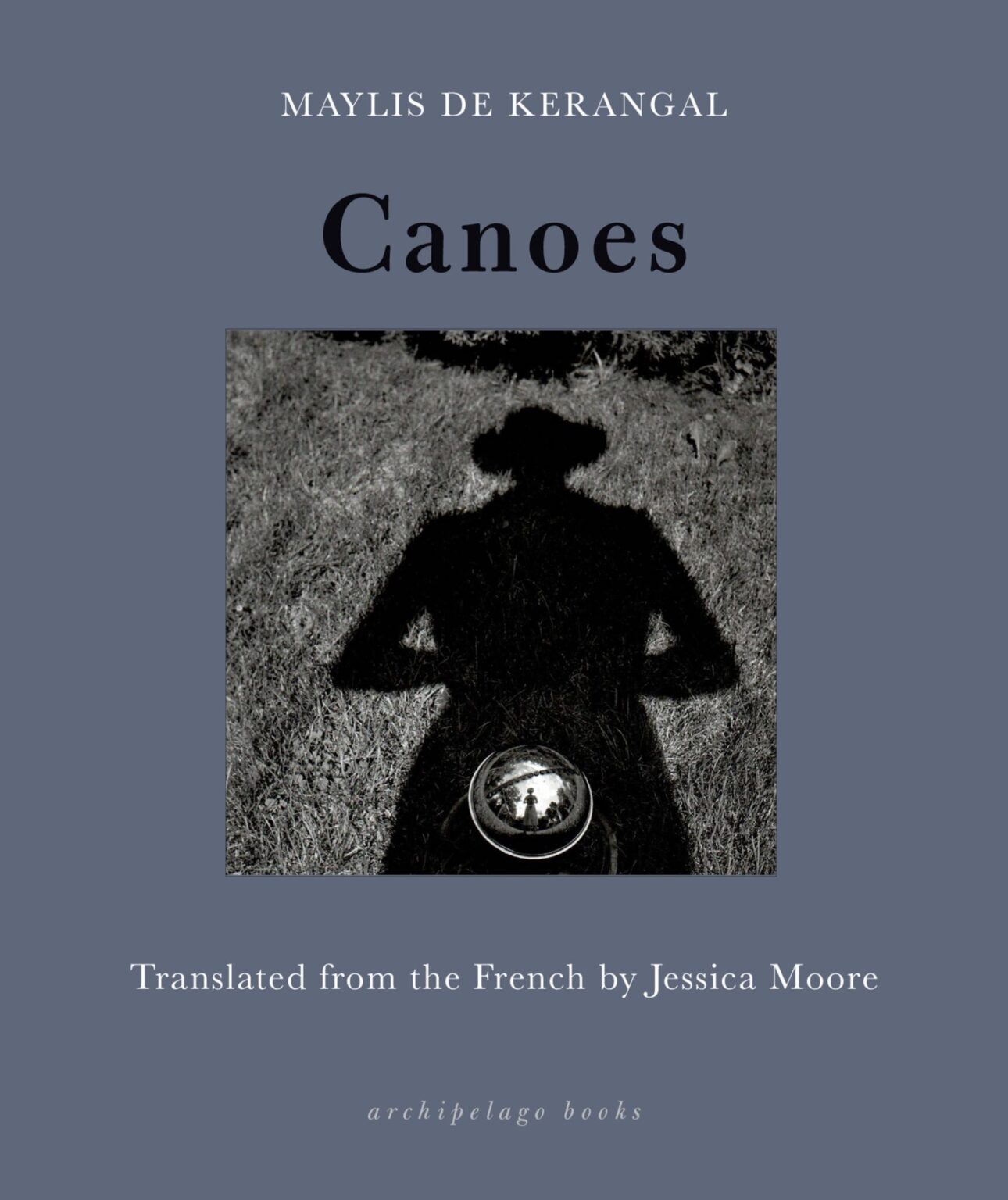
This is the opening of the novella “Mustangs,” the centrepiece of Maylis de Kerangal’s collection Canoes. It’s a precise description of a routine series of actions, but then, in the French writer’s fiction, the seemingly ordinary moment can contain multitudes and what begins quiet and lowkey, can turn unexpectedly, toward an ending suspended in possibility. Her ability to balance emotional restraint against an exceptional eye for detail, and a fondness for sweeping sentences and paragraphs that frequently go on for pages, allow her to tell stories that are at once spare and revealing. She knows just where to turn her narrators’ attention as their stories unfold.

The pieces in this volume—seven short stories and one novella—are connected by a common theme and by a singular image. The theme is “voice.” From a story about a woman consciously trying to lower her voice to advance her career in broadcasting, to the tale of a father reluctant to remove his dead wife’s recorded greeting from the family answering machine, voices—changed, analyzed, unleashed, unexpected—feature directly or indirectly throughout. Translator Jessica Moore indicates in her Note that de Kerangal began working on this collection just as mask mandates “caused mouths to disappear,” something that also often altered sound and auditory comprehension, and may have contributed to this thematic link. But the distinct image or motif that recurs in each of these very different stories seems much more random and therefore a is little treat each time it makes an appearance. The “canoe” of the collection’s title only appears in any particular detail in one of the stories, otherwise it might be a pendant, a craft observed in the distance, or mentioned in some other passing context. A nice, fun touch.

As one might expect, the extended piece, “Mustang,” anchors the collection. The unnamed narrator is a French woman who is living with her husband and young son (whom she simply calls Kid) in Golden, Colorado. Sam is taking a course at the School of Mining where he is quickly adapting to American life and language, while she struggles to find her footing in this vast suburban community in the foothills of the Rockies. At first walking suffices, but the lack of the kind of integrated train and transit system of a European city soon leaves her frustrated, as does the lack of purpose and work to fill her now empty days. So her husband, who has actually arranged this short term foreign escape more for her sake than his own, suggests she learn to drive. He buys a used Mustang and she gets her license. Funny, bittersweet, and ultimately terrifying, this is wonderful story of a woman seeking to redefine herself after loss in a mythic Western landscape of cowboys and dinosaurs.

By contrast, each of the other much shorter stories are condensed, finely drawn episodes that reveal something, often unsettling, of their narrator’s life or engagement with others, yet leaving much unsaid or unresolved. One of the best, perhaps, is the final tale, “Arianspace.” The narrator is a ufologist—an investigator of UFO sightings. She has been sent to visit a ninety-two year-old woman living along among mostly abandoned homes in a rural area. From her earliest impressions, the researcher can tell that she facing someone special:

I had imagined her small and wizened, the wrinkled skin of an old fig, hair sparse, body brittle and slow, an apron tied around her waist and black peasant stockings, but she was something else: a tall, regal woman in jeans, a red T-shirt, and boots, and she was thin, long grey hair over her shoulder, cheekbones still high, and beneath ragged eyelids, eyes of a deep black – the kind of black that absorbs nearly all visible light, and which is found in bird of paradise feathers or on the belly of peacock spiders; altogether wizened, dry, and flaking, but conveying a great impression of physical strength and brutality.

Indeed, not only is Ariane a no nonsense woman with a firm commitment to the alien phenomena she observed, she has impressive evidence. . .

With short story collections, especially dedicated volumes like this as opposed to larger compilations, a test of success can lie in the degree to which each entry stands apart from the others. Even though some of these pieces have a very tight focus, the characters and narrative voices (all first person), are distinct, the settings varied, and in some instances I was left with this eerie feeling—a sense that I wanted to know where the characters went after the story closed, a what-happened-next sort of thing. That is for some readers a negative to the shorter forms, but especially with a writer like Maylis de Kerangal, who is unafraid to leave an open door, the extended possibilities only make the situations she depicts seem more real.

Canoes by Maylis de Kerangal is translated from the French by Jessica Moore and published in North America by Archipelago and MacLehose Press in the UK.

Poetry as an act of resistance: A River Dies of Thirst by Mahmoud Darwish

A great poet is one who makes me small when I write, and great when I read.

A River Dies of Thirst, the last volume of Mahmoud Darwish’s work to be released in Arabic, just eight months before his death in 2008, offers a precious opportunity to spend a little more time with a great poet as he casts a sorrowful eye at his beloved Palestine, and reflects on love, life, time, and memory. But more than anything this collection of poems, reflections, and journal fragments is a meditation on what it means to be a poet. And for him that is a distinctive vision, for Darwish was not only one of the most remarkable and humane poets of our time, but he gave  voice to the Palestinian consciousness and was someone who believed that “every beautiful poem is an act of resistance.”

To read this final collection now, more than eleven months into the longest, deadliest sustained attack on Palestinian citizens since the creation of the Israeli state, is to hear that voice of resistance resounding so clearly that it is almost unsettling. So many of the pieces here feel as if they could have been written yesterday, beginning with the opening poem “The girl/The scream”:

On the seashore is a girl, and the girl has a family
and the family has a house. And the house has two windows
      and a door.
And in the sea is a warship having fun
catching promenaders on the seashore:
Four, five, seven
fall down on the sand. And the girl is saved for a while
because a hazy hand
a divine hand of some sort helps her, so she calls out: ‘Father
Father! Let’s go home, the sea is not for people like us!’
Her father doesn’t answer, laid out on his shadow
windward of the sunset
blood in the palm trees, blood in the clouds

The girl becomes the endless scream, echoing without echo across the land, as an aircraft returns to bomb the house with two windows and a door, silencing her family’s story.

This heartbreaking  image is followed by a series of poems and short prose pieces that speak to war and Palestinian suffering in Lebanon, Gaza, and the West Bank. The uncanny timelessness of his poetry betrays the truth: there is nothing new about what we are witnessing today save for the intensity. And as Darwish reminds it, the violence is not just directed at people—it is an attack on the land, on nature, and the memory held in the soil. Consider the olive tree, the venerable grandmother-like figure, “modest mistress of the hillside.” She is spoken of with reverence: “In her restrained silvery greenness is a colour too shy to declare itself openly, a glance toward something beyond description, for she is neither green nor silver. She is the colour of peace, if peace needs a colour to distinguish it.” It is message lost on the occupying forces:

But these soldiers, these new soldiers, surround her with bulldozers and uproot her. They crush our grandmother, so that now her branches are in the earth and her roots in the air. She did not weep or shout, but one of her grandsons who witnessed the execution, threw a stone at a soldier and was martyred alongside her. When the soldiers left triumphantly, we buried him there, in the deep hole, our grandmother’s cradle. For some reason we were convinced that after a while he would become an olive tree, spiky and – green!

(from “The second olive tree”)

As a late work by a poet who is simultaneously conscious of his timelessness and his mortality, it feels as if Darwish is allowing himself to focus his attention on what is most important to him as he knows, not necessarily that his own end is as near as it would happen to be, but that time, and the heart, has its limits. As such, the themes that recur throughout these pieces reflect elements common to all his work, but are tinged with the melancholy that comes with age and a long life marked by exile and the ongoing occupation of his homeland.

Amid the poems that reference war and occupation directly—the more political pieces—are quieter reflections on the poetic existence, that is, on poetry as a way of being and engaging with world. Darwish is a poet immersed in his environment, the sights, scents and sounds all echoing longing and loss, but now the atmosphere evoked is more ephemeral, his awareness more attuned to the spaces between sleep and waking, in the flickering shadows where words might be found:

Leaves in summer whisper modestly, call out shyly, as if to me alone, stealing me away from the burden of material existence to a place of delicate radiance: there, behind the hills, and beyond the imagination, where the visible equals the invisible, I float outside myself in sunless light. After a short sleep like an awakening, or an awakening like a short sleep, the rustling of the trees restores me to myself, cleansed of misgivings and apprehensions.

(from “Rustling”)

There is also a more direct engagement with the idea of writing  poetry and recollections of his past encounters with other prominent poets, their conversations and interactions. And the two sections of fragments that round out this collection contain many wise observations about the  life, identity, perception and, of course, poetry.

With a total of 127 short pieces—including fully finished poems (both prose poems and verse), commentaries, and assorted observations and aphorisms—A River Dies of Thirst is a collection that may be best read slowly, taking in a little at a time. There is so much beauty in the language and so much to reflect on. It might also serve as a good introduction for those who have yet to hear Darwish’s masterful voice. And this certainly is the time to listen.

A River Dies of Thirst by Mahmoud Darwish is translated from the Arabic by Catherine Cobham and published by Archipelago Books.
We’re too small for the sky to pay attention to us: Great Fear on the Mountain by Charles Ferdinand Ramuz

In this novel, the stage is set quickly with little fuss. The story opens at a village council meeting in an unnamed Swiss alpine community where the members have gathered to discuss the shortage of available grazing land for their cattle. The situation is acute and the answer seems obvious to some and ominous to others. High on the mountain lies the verdant Sasseneire pasture, abandoned for many years after an event so terrifying that the elders dare not speak of it, warning that to go back would be to invite evil to return once more. But the young, who don’t remember that time, put little stock in what seems more folklore than fact. As the Chairman argues:

“Those are just stories. No one ever really found out what happened up there. It’s been twenty years since then, all that’s in the past. To my mind, the long and the short of it is that for twenty years now we’ve been making no use of that fine grass, which could feed seventy animals all summer long; if you think the village can afford to be extravagant, then say it; myself, I don’t think so, and I’m the one who’s responsible . . .”

The debate is short; the younger folk win the vote. And so begins the process of securing the site, repairing the chalet, and, most challenging of all, finding enough men willing to spend the summer up on the mountain with the herd.

Great Fear on the Mountain, the 1926 novel by Charles Ferdinand Ramuz, is a bucolic tale that takes place in the looming shadow of mystery and death with a hint of the supernatural. Ramuz (1878 – 1947) was a Swiss-French writer who, although he spent his adult years in Paris where he counted Igor Stravinsky among his close friends, continued to look to Switzerland for his fictional landscapes. He set his stories in rural communities, writing of farmers, villagers, and mountaineers often confronting disaster and tragedy. His distinctive style would later influence Jean Giono and Céline. And, it is this style, with its shifting, almost omnipresent, narrative voice, vivid depictions of nature, and the ominous repetition of key phrases, that manages to build the intensely claustrophobic atmosphere of dread that gives this spare  novel its power.

Seven men ultimately come forward to go up to Sasseneire. They include the leaser of the land, Crittin, generally referred to as the master and his nephew, a young man named Joseph who hopes the extra money earned will allow him to marry his beloved sweetheart, and old Barthélemy, a survivor of the last summer on Sasseneire who wears, as a protective talisman, a bag containing a piece of paper on a rope around his neck. Along with an adolescent and another townsman, the team is rounded out with the strange, physically deformed Clou—an odd man who seems to have his own agenda.

Once they are up on the mountain with the herd, a sense of unease quickly settles over the men, becoming especially palpable once night falls:

Outside, it must have been thoroughly dark, and perhaps there were stars, perhaps there were not; they couldn’t know. Nothing could be heard. Listening did no good, nothing at all could be heard: it was like at the beginning of the world, before there were humans, or, at the end of the world after humans had retreated from the surface of the earth—nothing was moving anymore, anywhere, there was no longer anybody, nothing but air, stone, and water, things that do not smell, things that do not think, things that do not speak.

Before long, disease begins to appear among the animals. Just like the last time. The boy comes home shaking with fear, soon followed by another man. The villagers react to news of the sick cattle with alarm. They establish an armed guard on the access road to prevent anyone else from returning and spreading this mysterious  illness. The remaining men and their slowly diminishing herd are essentially trapped and only Clou, who disappears each day, shows no concern about being unable to return to the village. As the men try to cope with increasingly dire circumstances, various shades of despondency and madness begin to take hold.

As the details of the events that originally led to the abandonment of the Sasseniere pasture are alluded to yet never fleshed out, the happenings this time around are equally ambiguous. And potentially much more devastating. A steady sense of dread builds and spreads, up on the mountain and down below, while around them all nature seems to be at once ambivalent and mildly malevolent. It’s a delicate balance:

It was perhaps midday. The sky was arranging itself, without paying any attention to us. At the chalet, they’d tried once again to look into the mouths of suspected animals, grasping their pink muzzle in one hand, introducing the fingers of the other between their teeth, while the animals lowed; up above them, the sky was arranging itself. It was covering itself, was turning gray, with an array of small clouds, lined up evenly spaced from one another, all around the combe, some of them capping the peaks, at such moments they’re said to be putting their hats on, others lying flat on the ridges. There was no wind.

The omniscient third person narrative occasionally shifts perspective, into second and more commonly first person plural. Bill Johnston’s translation traverses this shifting narrative terrain with ease. Great Fear on the Mountain is presented as an allegorical tale that has become part of a larger consciousness, and one that is made more suspenseful by the intentional, almost jarring, repetition of phrases and images, and the depiction of natural phenomena, such as the light and shadows on mountain peaks, as portents of ill fate. You know it can’t end well, but like all the members of this little community, you cannot see what is coming.

Great Fear on the Mountain by Charles Ferdinand Ramuz is translated from the French by Bill Johnston and published by Archipelago Books

With a restless curiosity: A Question of Belonging: Crónicas by Hebe Uhart

To experience the world through the words of the esteemed Argentinian writer Hebe Urhart is to be offered a uniquely calm and compassionate view of ordinary places and people that effortlessly makes them seem anything but ordinary. A Question of Belonging, a newly translated collection of her crónicas—short, informal, observational writings, often published in newspapers or magazines—pulls together a selection of texts composed over five decades, and offers a fine introduction to the distinctive voice she brought to this form, one that became increasingly important to her over the course of her literary life (she also published two novels and collections of short fiction).

In her fascinating introduction, Mariana Enríquez reports that Uhart always considered herself a “writer of the outskirts.” She was born in Morena, a town on the edge of greater Buenos Aires, and experienced many family tragedies in her early life. As a young adult, she took on a position a rural school teacher in an impoverished region and cites that experience as one which not only helped her mature, but taught her to guard against self-centredness. Yet, she was also restless and loved to travel, devoting much of her writing to chronicling her excursions. Enríquez describes her friend as:

so unlike most people I have met in my life: she was brave, curious, carefree, sure of herself. Yet, as a traveler, she didn’t like going to big cities – they unsettled her (despite having visited many, of course). She preferred small towns. Places that were easy to get to know. Because what she loved was talking to people. These trips, day trips, in general (she referred to herself as a “domestic” chronicler) were a search for different ways of expression, a search that would take on the contours of the place itself.

The early pieces in A Question of Belonging, with the exception of a description of train trip to La Paz taken when she was twenty, tend to be brief musings, sometimes personal, but also more general observations about topics like the way pets seem to resemble their owners or how families commonly inherit a style in keeping with their political leanings, even if the politics themselves are not always passed down. Her writings are peppered with examples of her characteristic subtle humour, something is that sustained even as her work becomes more serious and more political throughout her career. “Inheritance,” reproduced on the Paris Review blog offers a perfect taste of her wit and style.

Once the travel bug sets in, her trips become a key subject for her chronicles. Her excursions would take her to cities, towns and communities throughout Latin America, but time and costs often kept her closer to home. In “Irazusta” she describes how:

Once, when I did not have the money to go on vacation, I saw a TV ad for Irazusta, a town of a thousand residents. The reporter explained that the town was near Gualeguaychú and then asked some women cooking what kind of tourist attractions it had to offer. One of them said, “The handcar on the railroad and the otters bathing in the lagoon.”

Not extraordinary attractions per se, but the women seemed optimistic about summoning a visitor. And so I went.

When she arrives, she discovers there are no accommodations. Residents simply open their homes to this novel phenomenon—a tourist. In fact, the TV ad lures twenty tourists and the town is beside itself with excitement. Undeterred by the ad hoc way interactions and opportunities that arise in this otherwise ignored community, Uhart manages to find, amid the pigs running around freely, an interesting assortment of intelligent people to engage with.

No matter where she goes, Uhart’s approach is one of open curiosity; she displays an honest interest without judgement, in the lives and customs of others. Socially conscious, she is keen to learn more about Indigenous peoples and, in her typically unobtrusive way, call attention to the layers of discrimination existing in Latin American societies—typically allowing the people she engages with to express their concerns in their own words. And, more than once, she finds herself up against people who do not wish to entertain her questions, or even her attempts to be cordial. But, she never lets that upset her. She figures they must have their reasons and, if she senses her presence is truly unwanted, she simply remains silent or, if possible, leaves.

A lifelong teacher, she frequently seeks out local historians or anthropologists to interview, and visits libraries and schools. She is especially interested in language and colloquial expressions—finding in them clues to the diverse ways that different peoples view and understand the world. But she also likes to take time to herself, to observe. One of her favourite means of exploration is to simply walk through neighbourhoods, look at the homes and gardens, visit local markets, and then find a comfortable café where she can sit and watch people pass by.

Uhart’s crónicas paint vivid portraits through relatively spare accounts. She tends to be well prepared when she ventures into a community, and draws on what she has read to guide her interactions, but the intention is to ignite her reader’s interest and awareness, rather than to overwhelm them. But she can be energetic in her descriptions, as in “Río is a State of Mind,” her rollicking take on Río de Janeiro during Carnival:

Río bares it all: its gardens, its past, its beggars, its beauty, its ugliness. An obese man with two bellies, one on top of the other, is eating at the restaurant. His shirt isn’t long enough, but he doesn’t mind. Beggars move around the street without fear for themselves or others: one of them was ranting with a very long iron bar in hand – nobody seemed to be frightened. A man with dyed blond hair was dipping a piece of bread inside a can of Coke and offering it to anybody who walked by. Another beggar, a woman this time, was wearing an underskirt that hung behind her like the train of an evening gown. She sat down at a bar next to some middle-class women and drank like any other customer.

During her time in the Brazilian city, she also takes an opportunity to explore another of her favourite resources—the programs available on the television set in her hotel room. Unlike many fellow writers and academics, Uhart loved TV. As a source of information and as entertainment.

Although she does not discuss finances, her excursions are generally modest, either day trips from her home in Buenos Aires (even visits to areas within the city limits), or longer trips by bus, train, car, small plane or some combination thereof. In addition to Argentina and Brazil, the crónicas in A Question of Belonging see her visiting Paraguay, Colombia, Bolivia, and Peru. Later in life, when her literary fame led to invitations to attend festivals in major centres, she would go, but tended to find the crowds, the disorienting hotels, the vast festival grounds, and the general businessiness overwhelming. She is inclined to try to get away, to explore and see what the location has to offer outside the closed festival environment. In the longest text here, “Off to Mexico,” she details a visit to Guadalajara and Mexico City in 2014, when she was already in her late seventies. It’s an account rich with humour, scenic descriptions, and historical and literary references. No trip can ever be wasted. Since she’s in the country, she hopes to come to understand something of Mexico’s history, society, and culture.

Rarely does Uhart write directly about her own life in these dispatches, the exceptions in this collection include the first piece, “A Memory from my Personal Life” in which she recalls an alcoholic boyfriend from her past, a brief account of her varied experiences with therapy, and the final crónica, “My Bed Away from Home,” published just days after her death in 2018, at the age of eighty-one. Here, with remarkable humour and sensitivity, she writes about a stay in the hospital when she already very ill. She starts in ICU and eventually gets “promoted” to Intermediate Care where she is delighted to discover her bed is close enough to the bathroom that she go on her own. She details her frustration with some of the staff and the humiliation of having her diapers changed in full view of others, but as ever, she is careful to keep in mind that so many of her fellow patients are in much more compromised and unfortunate circumstances than she is; she never wishes to be overly self-centred. Humble and grateful to the end.

A Question of Belonging: Crónicas by Hebe Urhart is translated from the Spanish by Anna Vilner and published by Archipelago Books.