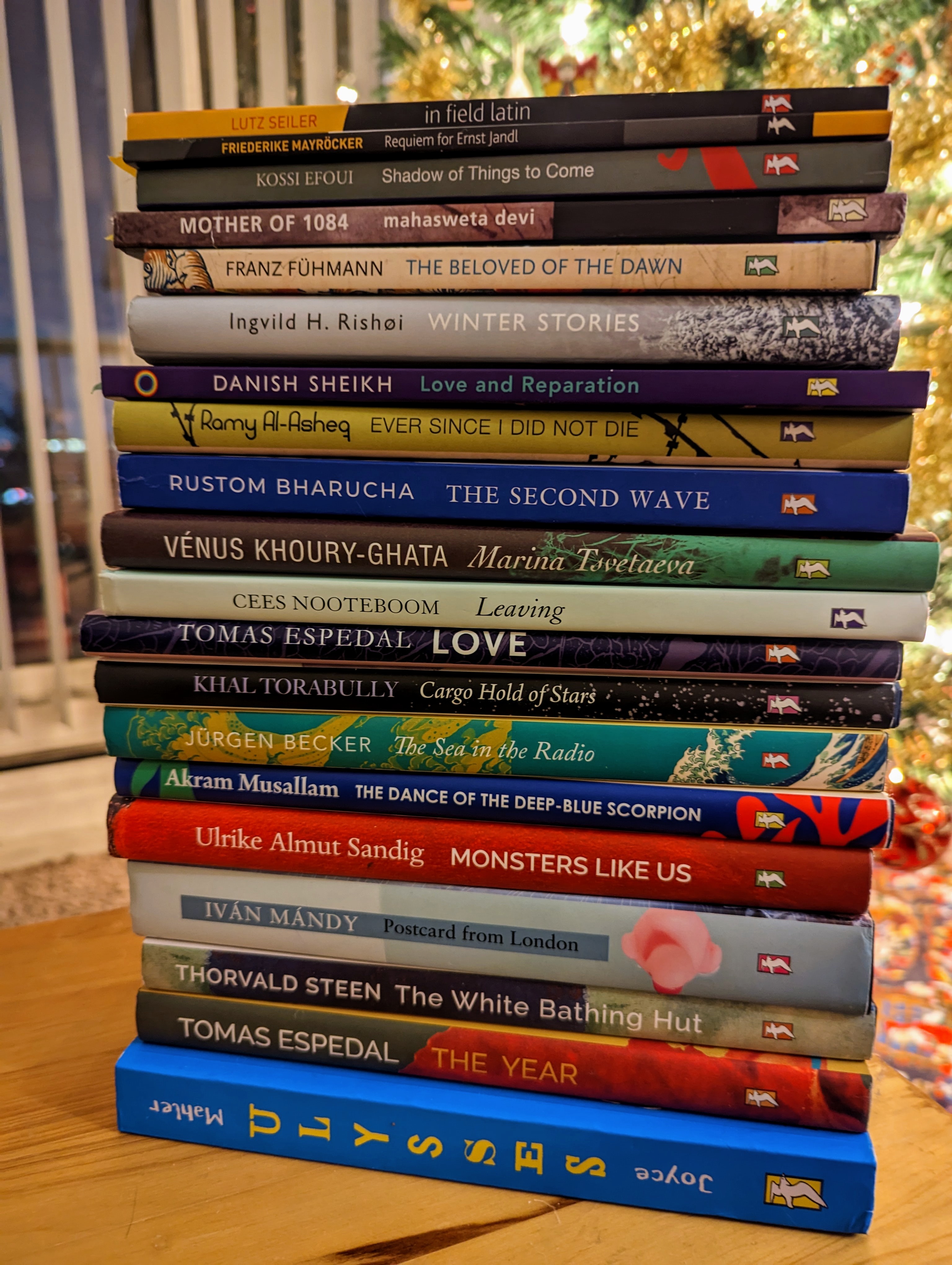
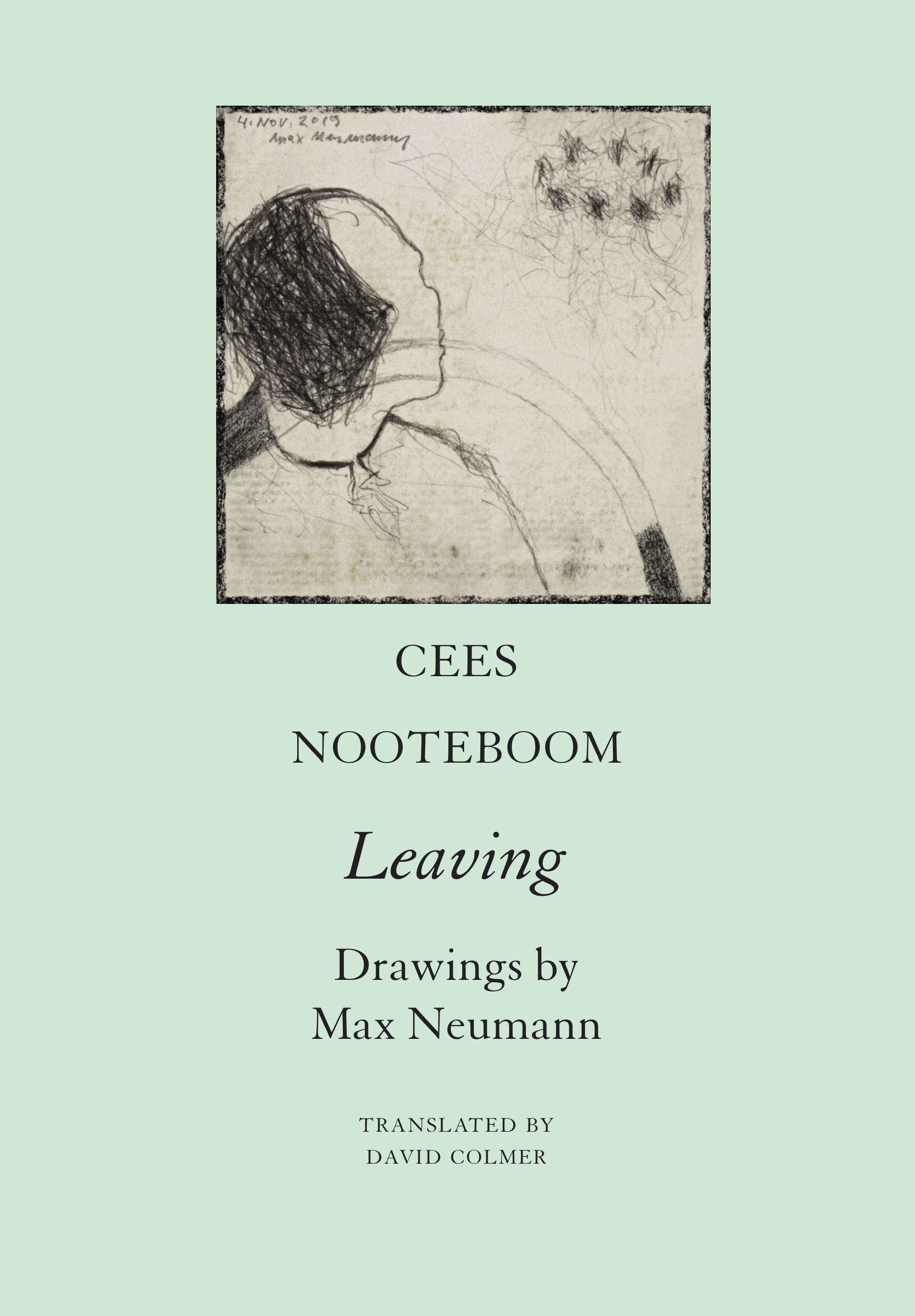
“How many lives go into a life?” Leaving by Cees Nooteboom, Drawings by Max Neumann

A man standing in a winter garden becomes aware of something not quite right—a cloud that seems too heavy, bare branches against an ancient wall, the refusal of neighbouring geese—an unspoken uneasiness that carries his thoughts back to the war:

The war that never stopped coming back,
a guest who’s known to all, a toothless
kiss, the language of intimate betrayal
around him now again, remembering a past

he couldn’t share with anyone.

This is how Dutch poet and writer Cees Nooteboom’s Leaving begins, its speaker in his garden thinking about family, war, times past. About those images that fail to fade. But as this three-part sequence of poems was coming into being, another guest, unexpected and uncertain, arrived and shifted the focus. His work would, in the end, acquire a subtitle: A Poem from the Time of the Virus. Without ever mentioning the virus itself outside of his Afterword, the shifting currents of the early months of its spread cannot be ignored even within the poet’s green refuge, for “Whimpering at the garden gate is the world, the / fuss of a newspaper.”

Heads and faces—remembered, imagined, dreamed—form a key motif throughout these poems, complemented by German artist Max Neuman’s series of drawings of abstract figures with spare features, completed in advance of news of the pandemic, for this, their second collaboration. The man in his garden is haunted by heads:

I saw heads, countless heads,
field marshals, lovers, travellers
from star to star. Each head its
own story, hidden in the folds

of the brain, alongside narrow streams
of blood, reeds on the banks, secret
landscapes no one can reach,
except for a lonely traveller

This leads into the second sequence, where the poet, the lonely traveller, wants to make sense of the darkness and strangeness of his visions  that surface from memory. All these heads. Who are these people, he asks, these creatures, these voices? As spartan as Neumann’s drawings, these poems propose questions that the poet cannot or does not want to answer. Can one look for meaning in life if, when looking back, one is confronted with forms, shadows, faces without mouths? The past seems intent on revisiting the man who knows that the end is nearing:

Life, the song of songs? Sure,
but underneath there is that other truth,
the truth of night and fog,
the test that lasts

until the end.

The third and final sequence, or movement if one wishes to read this poem as a musical composition, moves into a space of quiet and melancholy. Others—friends, brothers, lovers—have left the path once shared, one by one, “disappearing like ghosts.” The silence descending on the world is like a nothingness the poet has never heard before: “contradiction / surrounds me, an organ, / no keys, a song // whose sound has been sealed.” Yet, where the poet is troubled by the images that confront him in the second sequence, he is now coming to a place of peace with himself and others in the silence and isolation, and finds he is ready to take the road ahead and let the past be:

Now my feet are counting the road, I know,
looking back is not allowed. My steps measure time,
a dark and peerless poem, a beat
that can’t be slowed.

In the Afterword, Nooteboom who is not a writer to shy away from contemporary issues,  talks about how a poem comes to be, how influences enter and make themselves known, changing the direction in which the poet thought he was headed. It would be strange, he says, if the arrival of a mysterious virus were to be completely ignored; sometimes reality intervenes to help one write. And so we have this thoughtful, timely work, one that invites rereading and lingering on the words and the drawings.

Leaving: A Poem from the Time of the Virus by Cees Nooteboom with drawing by Max Neumann is translated by David Colmer and published by Seagull Books.

A romantic soul: May by Karel Hynek Mácha

A star has dropped from heaven’s height,
a dying star of dark blue light;
it falls through endless realms;
it dwells eternally in falling.
Its cry sounds from the grave of all,
a horrible shriek, a terrible scream.
“When will its falling end?”
Never—nowhere—there is no end.

There are many literary works that risk being ruined for readers simply because they are prescribed study in school, often presented in a rote manner that leaves its victims, er students, with few fond memories. No doubt, for generations of Czech students, Karel Hynek Mácha’s epic poem May might be remembered primarily as something they were required to read in school, old fashioned and difficult. But to come to this poem well into adulthood, without school-deadened experience and as someone whose first poetic passion was English Romantic poetry, this tale of romance, betrayal, patricide and brutal punishment is fascinating, as is the short, tragic life of its author.

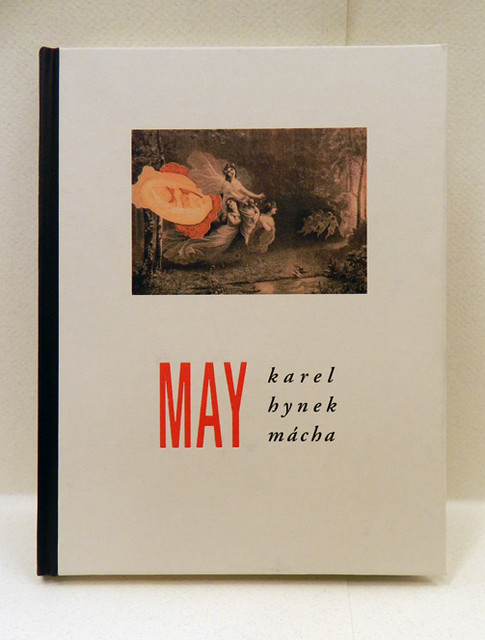
Image from Twisted Spoon Press on Flickr

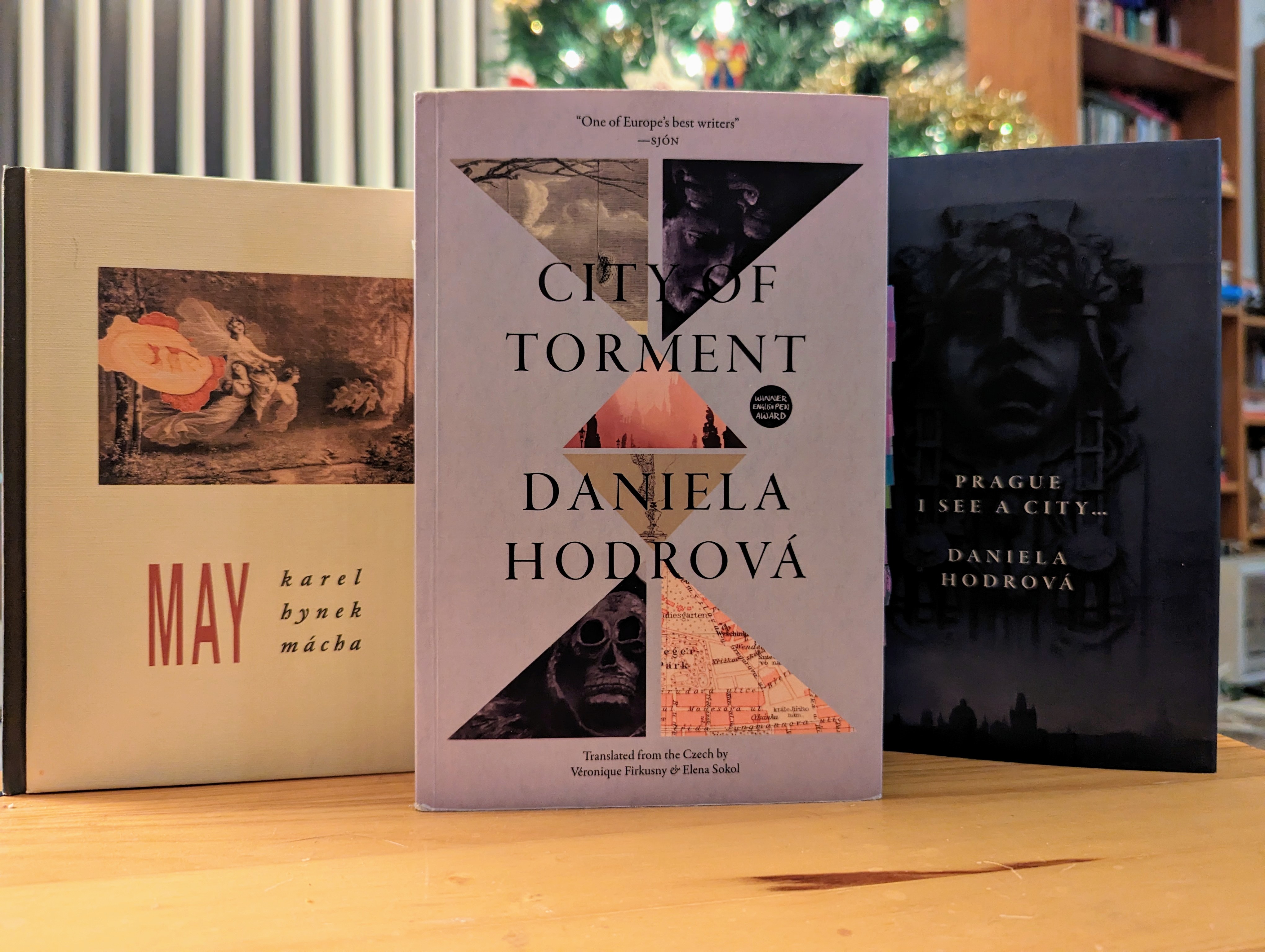
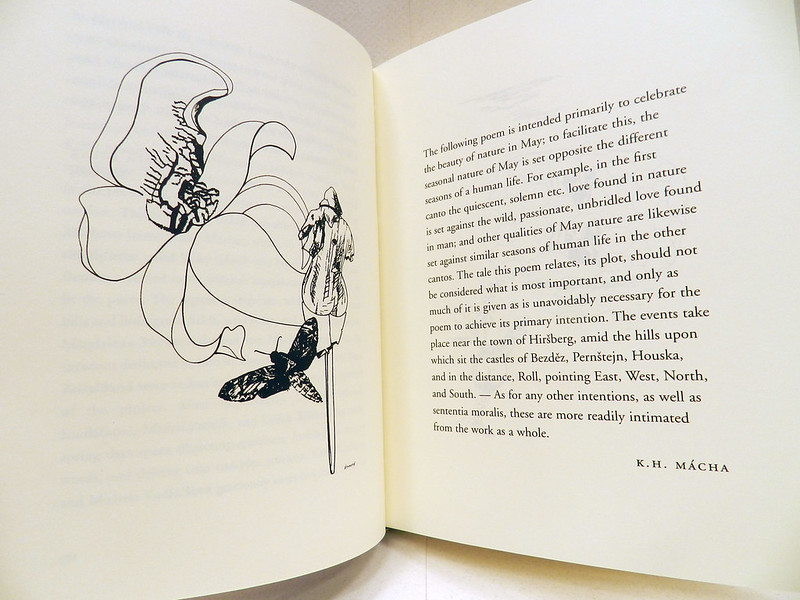
I was inspired to read this important Czech poem by my reading of Daniela Hodrova’s City of Torment earlier this year. Now recognized as the greatest Czech Romantic poet, Mácha is one of the many ghosts haunting this monumental trilogy and his story Márinka, which not yet available in English, forms an important part of the literary subtext of Hodrova’s work. May, however, has been published by Twisted Spoon Press in a handsome dual language volume translated by Marcela Malek Sulak with drawings by Jindřich Štyrský (1899–1942) that were specifically created for this poem.

Mácha was born in Prague on November 16, 1810 and educated in the two languages approved by the Hapsburg authorities, German and Latin. He would go on to study law at Prague University. Yet at heart he was a romantic who spent much of his time wandering the countryside, visiting castles and ruins, and embarking on extended walking tours across Moravia and Slovakia, even making his way to Venice on foot. His great inspiration was Byron.

Writing at a time when Czech poets were seeking to reclaim the Czech language from beneath to weight of two hundred years of imposed German, Mácha also chose Czech for his epic, but he rejected the current focus on folklore and myth as a means to define a new national identity and challenged the Czech language to stretch “to perform in innovative ways and borrowed from Italian landscape, Byronic themes, and local scandal” to fashion his tale of love and a passion denied by fate.

Image from Twisted Spoon Press on Flickr

The finished poem was not well received in Mácha’s circles, causing him to finance the publishing himself in 1836. He died of pneumonia later the same year, a few days shy of his twenty-sixth birthday and three days before he was to have married his lover, Lori, the mother of his child. He was buried in a pauper’s grave. His reputation grew over the decades following his death and a century later, in 1939, his remains were exhumed and he was granted a formal state funeral and buried in the Slavín Cemetery at Vyšehrad in Prague, his status as a national hero finally confirmed.

May consists of four cantos with two intermezzos. It relays the story of Vilém, the notorious “forest lord,” leader of a group of bandits, who is in love with Jarmila, a young girl who has been seduced by another man. In defense of his “wilted rose,” Vilém has killed her debaucher, unaware that his victim was his own father who had driven him out of his childhood home many years earlier. Sentenced to death, Vilém spends the night before his execution preparing to meet his fate:

“How long the night—how long the night—
A longer night yet comes for me!———
Perish the thought!”—The strength of terror
fells his thought.—
Profound silence.—A water drop,
falling, measures time once more.

The next morning, as a beautiful day dawns, the convict is led out to the hillock where a crowd has gathered. He surveys the landscape, bemoans that he will never see his beloved homeland again. The sword falls, and his head and broken limbs are left displayed on a pillar and wheel. Seven years later, a traveller, Hynek, encounters the site and Vilém’s remains. The following morning, the innkeeper in town tells him the tragic tale. Returning once more, many years later on the first of May, the traveller sits on the hillock until nightfall and sees his own and humanity’s fate reflected in Jarmila and Vilém’s story of love and betrayal.

Mácha’s attention to the beauty of nature in evident throughout this poem, from the opening lines of Canto I in which Jarmila waits in vain for Vilém to meet her:

It was late evening—first of May—
was evening May—the time for love.
The turtledove invited love
to where the pine grove’s fragrance lay.
The silent moss murmured of love,
the flowering tree belied love’s woe.
The nightingale sang rose-filled love,
the rose exhaled a sweet complaint.
The placid lake in shadowed thicket
resounded darkly secret pain,
embracing it within its shores;
the pristine suns of other worlds
were wandering through the sky’s blue band,
as fiery as a lover’s tears.

Holding close to his Romantic inspiration and instincts, nature reflects both the passion and the sorrow of his tale. The poem is well-paced and dramatic, speaking to particular style and time, of course, but with all the elements of an entertaining tragic romance. As Sulak explains in her Introduction, she tried to capture the exact meter of the original poem and, because Mácha paid close attention to sound when making language choices to capture his hero’s mental state, she tried approximate a similar affect with the words she used in Canto II, the prison sequence. Because Czech is a language with a much more flexible word order, an effort to reproduce the rhyming pattern was not made. These decisions help preserve the rhythm and flow, as well as the beauty and emotion that have made May such a well-loved poem.

May by Karel Hynek Mácha is translated from the Czech by Marcela Malek Sulak with drawings by Jindřich Štyrský and published  by Twisted Spoon Press.

No one accepts an honest mirror: Ever Since I Did Not Die by Ramy Al-Asheq

Minutes before the Resurrection, the dead-alive walked across the crooked path towards a lesser death. The soldiers shoved them, drove them, robbed them. ‘Who is you God?’ they asked each one, ‘What is your religion? What is your book?’ Rifle butts struck him. He screamed a scream the whole universe heard, except for three: God; the international community; and his people. The wounded rise up like waves before they fall again. They are resurrected, only to be thrown again into the hell that is the tent for seventy more years. There is no power for them, surrounded by nothing but desert and their own skin. (“Escaping from Paradise”)

It is, sadly, easy to turn away from the horror of war when it happens “over there” or occurred “long ago,” to turn a deaf ear to the flood of testimonies that continue to flow out of embattled zones and occupied territories; time and again immediate concern and outrage becomes just more white noise in a world thrumming with a continuous level of sustained violence too uncomfortable to acknowledge. That is why the voices of the people must be reported, shared and amplified not only by journalists, but by writers and poets—those who can deftly wield words sharpened like knives. Like Ramy Al-Asheq.

Ever Since I Did Not Die is a collection of seventeen short prose pieces that bear witness to the unspeakable experiences of war, escape and migration. A Palestinian poet raised in the Yarmouk Refugee Camp in Damascus, Syria, Al-Asheq was jailed during the Syrian uprisings that followed the Arab Spring, escaped to live under an assumed name in Amman, Jordan, and finally migrated to Berlin where he now lives in exile. The pieces in this slim volume, which were written between 2014 and 2016 for an Arabic series called Syrian Testimonies, intentionally stand in a space between poetry and prose, intended by their author, to be “saved from classification.” The first lines of his Preface set the tone for the works that follow:

I gathered these texts like someone collecting body parts. Here are the pieces of my body, haphazardly brought together in a paper bag. This randomness of body parts is real in its destruction. Bloody at times, violent, honest, imaginary, personal. It looks like me with all my madness and sickness, how the revolution made me grow, what the war broke inside me and what exile chipped away.

Breathless in its brutality, its despair and longing, this collection bears witness to an array of experiences, some recounted in heartbreaking detail, some depicted allegorically, others arising out of dreams and nightmares. The pieces are no more than three or four pages long, each maintaining a steady rhythmic pace that pulls the reader through from beginning to end with little respite, but the language is so vivid, so shocking in its poetic intensity, that it is best to read one or two at a time and pause to let them settle in.

The refugee is a central figure here, doubly displaced, identity fractured, longing for a permanent home. For some, the tent they know is preferable to the unknown, but it is impossible to set down roots. Women’s bodies are often associated with notions of homeland and freedom, sexual imagery often representing the battles and struggles over the “body” of a nation, and Al-Asheq embraces and challenges that convention while questioning and rejecting traditional ideas of masculinity and heroism. This is not to say that there is not the desire for love and belonging to be found in a relationship and family. Meanwhile, the continual pressures of living under siege exacts a harsh toll. Moments of unthinkable cruelty arise without notice, bullets pierce fleeing bodies, bombs rain down from above and in a particularly horrific scene, a bomb decorated like gift explodes blowing three of four children to pieces, leaving the survivor mute.

Mercifully, these pieces are varied and very short. The blow is swift and efficiently delivered, the language is startling, even beautiful at times. That terrible beauty only poetry or poetic prose can achieve. The title piece which closes out the collection, is Al-Asheq’s dynamic testament to his survival, his rejection of totalitarian, patriarchal countries and the necessity of redefining his place in the world in his own terms:

Ever since I did not die, I started to taste beauty. I open war’s door, the chapter of fear, and sink further into the hatred of heroism. I shed all I thought was right for love. There is no reality in believing. Believing is the enemy of reality. Identity is everything except for place, flag, race, religion and gender. Ever since I did not die, I have lost my identity. I do not care much if I carry one or it carries me!

Translator Isis Nusair conveys the emotional energy that charges these poetic prose pieces while her Introduction and Notes provide a framework for appreciating many of the elements at play. Editor Levi Thompson’s Afterword captures the spirit of Al-Asheq’s work which, as he claims, crosses borders in form and content echoing the troubled journey of its author. This powerful collection is a testimony to war and dislocation that does not easily fade into the background.

Ever Since I Did Not Die by Ramy Al-Asheq is translated from the Arabic by Isis Nusair, edited by Levi Thompson and published by Seagull Books.

Death with romantic complications: Love by Tomas Espedal

Each and every leaf is unique. And yet not, the leaves grow together and clothe the tree like a unifying thought: we are the tree. The tree is us. We are spring, summer and autumn. In the winter we’re gone, laid beneath the soil. Dead and overgrown. In the winter we dissolve. The winter is when we die.

Love, the eternal flame that has sparked many a tale of passion, loss, betrayal. So often two essential human experiences, love and death, are bound in life and literature, but leave it to Norwegian writer Tomas Espedal to turn the classic love story on its head with his tale of a protagonist who is committed to keeping a self-imposed date with death—decided a year in advance without any idea of how or where he will meet it—a commitment that is challenged when he unexpectedly falls in love and his new girlfriend becomes pregnant with his child.

As ever, the Espedal hero/anti-hero is a complicated and conflicted character. His narrators are often outsiders, lonely and lovelorn. His last two books, Bergeners and The Year, feature a writer named Tomas whose wife has left and daughter moved away. His latest to be published in English, again translated by James Anderson, is Love, a slender novella centred around “I,” that is, a person referred to as I—a name rather than a pronoun, but clearly a choice that blurs the distinction—who has abandoned love. After the death of his first wife and six years after the end of a second long-term relationship, he is living alone in his childhood home. A writer who has enjoyed some success and experimented with living for better or worse, now that I has made “the exquisite decision to die,” he is filled with a fresh new purpose. He wants a good death, a beautiful death, and he has granted himself one last year to live his best possible life in anticipation of that final moment. Go out on a high, he might say.

Love is a most unusual novella. With a protagonist called “I,” the third person narrative has an initially jarring feeling. Once one gets used to the oddness, the occasional sentence that naturally reads as a first person statement reminds you of the internal otherness of the character whose thoughts and feelings you are following so closely. Not long after his springtime commitment to one final year of life, I is invited to join some friends for a week in Loire where they have rented a large house. He purchases a one-way ticket to Paris and makes his way by train to where they are staying. He knows everyone there except two women, Rie and Aka. He keeps his distance from them, in fact he prefers to enjoy all his friends from afar. Yet when the week is over, he announces that he is planning to walk to Paris and wonders if anyone would care to join him. To his surprise, Aka offers. She is young—thirty-two years-old to his fifty-six—carefree, confident and creative. I is smitten, but he’s careful to maintain his space. By the time they reach Paris he is in love. At an exhibition of the work of Dutch photographer Ed van der Elsken it happens:

I had lost faith in a new love, nor did he want one; but here in the gallery amongst the van der Elsken photographs, standing behind Aka, who suddenly turned and kissed him, he was struck by something unexpected, like a bolt of lightning, or a shaft of light, as if the light from the photographs flashed into his eyes and exposed an inner picture, a picture of Aka and himself as lovers, as a couple; he was filled with a yearning for love.

The advent of a passionate love affair gives I the desire to live, but also causes him to wonder if this is not the perfect time to die, right at the height of happiness? A romantic death. And as the seasons pass, these paradoxical desires will intrigue and trouble him.

Naturally he tells Aka nothing of the pledge he has made. When she discovers she is pregnant and wonders if she is ready to become a mother he insists he does want to have a child with her. Yet he remains torn between the longing to live and the notion that it is the knowledge that he intends to die that heightens the exhilaration he feels in his relationship with Aka. He cannot stop thinking about where and how he will come to take his last breath even as doubts about his decision and the desire to live both continue to plague him. What unfolds is an existential exploration of the tensions tearing I apart inside. As he reveals more of his past experiences with difficult, painful deaths, one can imagine what he might be hoping to avoid, but it seems I is as afraid of life as he is afraid of dying. Or of simply growing old. The past holds a series of lives of loves and losses and the future holds, what, more of the same?

The drinker empties his life of content, fills his life with meaning. The drinker fills his life with death. Those who have been close to death know how beautiful life is. And life is beautiful and precious because death has set its mark upon it. The sick will be cured. The dying will live. But I wanted to die. It was this resolution that made his life beautiful. Which filled his last year with meaning.

Spare and poetic, this slender volume raises infinitely more questions—ethical and existential—than it answers, its weight and intensity resting in the strange contrary emotions of a man who is possibly happier than he has ever been, steadily making his way through a year of doubt, delight  and determinedness toward a destination at once individual and universal.

Love by Tomas Espedal is translated from the Norwegian by James Anderson and published by Seagull Books.

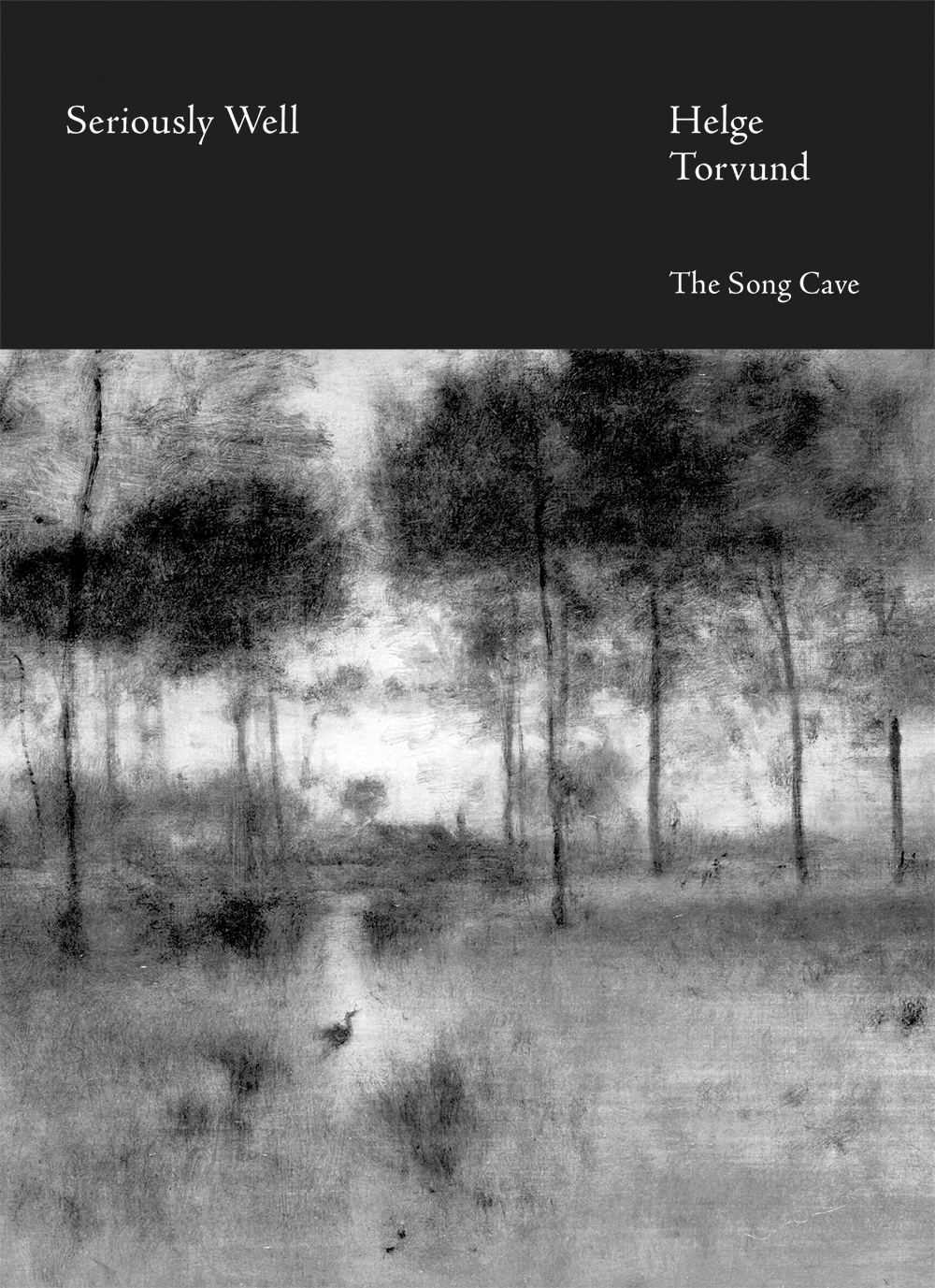
“Trembling in the dew. / Dancing in the fog.” Seriously Well by Helge Torvund

Can you
instead of
grieving the awful
deeds you have done,
or shuddering
dread the horror
that may come,
enjoy the fact
that you are
seriously well?

With a work of poetry that arises from an experience of significant illness, one might expect a to travel a familiar pathway through diagnosis, treatment and recovery—a healing journey. In his book-length poem, Seriously Well, Norwegian poet Helge Torvund begins with a meditation on the wonderous power of poetry to facilitate emotional connection and moves through a sequence of poems that explore questions of the relationship between mood and environment, the possibility of welcoming of Death as a companion in life, and the bond between the physical body and the energies of the world. The speaker calls to mind adult and childhood memories. Fashions thoughtful wisdoms and parables. These gentle free verse pieces unfold in quiet anticipation, or preparation, for what ultimately lies ahead in the doctor’s office where he receives worrying news.

Originally published in Norwegian in the collection Alt Brenner in 2011, this sequence of poems has now been translated by the author and released by The Song Cave. The tone of this work is crystalline, meditative and wise. The wonder of nature, the quality of light, and the comforting nearness of water are key motifs that recur, but there is also, underlying it all, an ever present awareness that life is fragile and death will, in time, come for all living creatures and things. A most affecting poem, not quite midway through, finds the speaker waking in the middle of a winter night noticing:

that something,
one thing or another,
was different,
strange, remarkable.

With his family asleep, he gathers his clothing, gets dressed and steps outside into a snowy world lit by a full moon. He marvels at the distorted landscape:

You recognize this side
but still it is different,
strange, peculiar, odd,
remarkable.
Sinister,
but beautiful too.
Changed. Deformed.

Further along, down by the water, he notices a strange shape, an object that suddenly moves. A heron on the ice cold concrete:

I went a bit closer,
stopped for a while.
I saw its ancient gaze
staring at me over
the long narrow beak.
There was great wisdom
in that eye.
I moved even closer.
It did not fly away?
No.
How
strange.
Suddenly it lay down
on the concrete.
And the eyes
became begging, helpless.

This nocturnal encounter with a dying heron seems to embody the keen perception and restrained sentiment that gives this sequence its immediate emotional force. Through a series of similar meditations and tales,  Torvund guides his reader toward what so often feels elusive—even impossible in our darkest moments—an expression of acceptance that is timeless and enduring.

Seriously Well by Helge Torvund is translated from the Norwegian by the author and published by The Song Cave.

Everything about everybody is nothing but diversion from death: Yes by Thomas Bernard

One would never accuse Thomas Bernhard of being a cheerful, optimistic writer—his fiction tends to themes of isolation, human misery and the deterioration of modern society. But that’s not to say he isn’t funny. His characters are typically wildly eccentric, usually scientists or scholars of some kind, with musical and/or philosophical inclinations. Yes, his fifth novel, originally published in 1978 and translated into English in 1991 by Ewald Osers, is a shorter work that ticks all these boxes and, for my money, is crafted with just the right balance of idiosyncratic energy and narrative tension.

Many of Bernhard’s novels and stories are presented through a secondary narrator, a friend or acquaintance who records the protagonist’s account, a style that can, at times, necessitate backtracking through a particularly serpentine sentence to determine whose words are actually being described. Yes features a direct first person narrator, a scientist living alone in a rural area in a ramshackle dwelling he retreated to many years earlier to dedicate himself to his studies on antibodies. Beyond science, his passions are the  music Schumann and the philosophy of Schopenhauer, most specifically The World as Will and Idea. The story he wants to impart, one which now lies at some distance, concerns the impact that the arrival of a Swiss engineer and his long-time companion, a Persian woman, had on his life and well-being at a point when he had reached the absolute depths of depression and despair. It is naturally, a roundabout exposition, beginning with the sudden arrival of the so-called Swiss couple at the home and office of his friend the realtor Moritz upon whom he has just unloaded the full and horrible truths of his mental sickness and self-loathing. He immediately recognizes in the Persian woman a certain kinship and a release from the suffocating conditions of his own mind and the stifling community he lives in. Over the course of the novel, he seeks to learn more about this man who had purchased a most undesirable piece of land with intent to build on it, and to further his association with his life-partner:

While the Swiss was busy, in the small towns nearby, looking for door and window fittings, for bolts and grilles, screws and nails and for insulation material and marine paint for the concrete house which, as I learned from him at our first meeting, he had himself designed and which was already going up behind the cemetery, and in consequence was almost never to be found at the inn (the Swiss couple’s quarters for the duration of the construction), I myself, quite suddenly and probably at the life-saving moment snatched by the couple from my depressed state, or in truth from a by then life-threatening depression, suddenly found in the woman friend of the Swiss, who soon turned out to be a Persian born in Shiraz, an utterly regenerating person, that is an utterly regenerating walking and thinking and talking and philosophizing partner such as I had not for years and would have least expected to find in a woman.

What unfolds is a relatively straightforward, well-paced, focused and affecting novel. There is humour, carried primarily in the narrator’s self-obsessed paranoias and blunt opinions, but the classic Bernhard absurdity and circuitous storytelling is contained within a serious, sombre atmosphere which, at least for me, grants the work a mood reminiscent of Wittgenstein’s Nephew in contrast to the relentlessly cynical tone that can weigh down some of his longer more convoluted narratives if one is not quite in the mood to surrender. Of course, the unnamed narrator is, as usual, suitably misanthropic and miserable about the rural environment his lung disease has forced him to retire to, the tedious characters who dwell there, and the current state of political decay in his nation and continent. But in spite of himself, he seems remarkably cognizant of his own role in the isolated circumstances in which he is trapped and in social settings often finds himself balancing his distaste for others with an equal level of attraction, fully aware that he is likely seen no better by anyone else.

Throughout the text, the narrator eludes to his friendship with the Persian woman and their frequent walks in the larch-woods, but it is clear that, despite the momentary release they both find in the company of the other, darkness lies ahead. Then, in the final twenty pages, the narrator draws his account together with increasingly disturbing revelations building to a final sentence that he has been leading to from the very first words he committed to the page. I may have a new favourite Bernhard book and I definitely have another suggestion to offer whenever anyone asks where to start with his work.

Yes by Thomas Bernhard is translated by Ewald Osers and published by The University of Chicago Press.

A Viennese Odyssey: Ulysses by Nicolas Mahler after James Joyce

James Joyce’s Ulysses is a monumental work of Modernist literature, dense with detail and interior narrative,  so when an illustrator and author known for a characteristically minimalist style of graphic storytelling decides to reimagine this classic what could possibly go wrong? Nothing if it’s Austrian illustrator and author Nicolas Mahler holding the pen.

This ambitious volume is my second encounter with Mahler’s ebullient art and wit. The first was his delightful take on fellow Austrian Thomas Bernhard’s Old Masters, a work that didn’t have to break with location or language in its reincarnation. However, this time he is transporting another equally idiosyncratic writer from Dublin to Vienna and from English to German (translated back into English in this edition by Alexander Booth). This is a retelling “after Joyce” as liberally inventive as the original. As one can imagine, the medium necessitates some streamlining of the story, so Stephen Dedalus is left out (although there is a nod to his tower abode) and some key scenes in which he appears are reimagined in a wild exposition of our German Bloom, Leopold Wurmb’s sexually frustrated, guilt-ridden fears and obsessions. But the parallels with Joyce’s masterpiece are wonderfully realized; after all, the visual medium can reproduce the overlay of experience and internal monologue in a remarkably efficient manner. As they say, a picture is worth a thousand words.

So we find ourselves tailing along after Wurmb (who unfortunately resembles his implied namesake  Wurm” or worm) as he makes his way around Vienna on June 16, 1904. While Bloom was an advertising canvasser with the Freeman’s Journal in Dublin, Wurmb is similarly employed by the Viennese Neuigkeits-Welt-Blatt. Headlines, excerpts and image offsets from the June 16, 1904 edition of this paper are used to great effect in the chapter where our hero goes to the office. Mahler also draws on images and advertisements from some other Vienna publications from the same day and finds German names for key characters from the same archival sources. But he also adds a really special touch to his Ulysses. Joyce’s novel was first published in 1922, at a high point in the history of newspaper comics, so we find in the pages of this graphic variation many of the cartoon characters who were popular at the same time. Most notably, Olive Oyl stars as his secret romantic pen pal, while Popeye takes on the role of the garrulous sailor W. B. Murphy who regales Wurmb with unlikely tales of adventure in the bar.

If some of the fun of reading Joyce’s novel is looking for the echoes of Odysseus’ journey in the narrative, some of the fun here is marveling at how cleverly Mahler manages to echo key features of Bloom’s journey in his Austrian themed tribute. Wurmb, like Bloom, is trying to avoid going home, knowing that his wife Molly, a singer, will be having sex with her manager Berlyak that afternoon. The impresario’s posters haunt him on his wanderings and reminding him he’s a cuckold, while recurring thoughts of sexual frustration, bitterness and depression mark his day. He mourns his infant son, dead now eleven years, attends a friend’s funeral, takes care of bodily functions and finally, after a day of work, social engagements and some wild, guilt driven fantasy, returns home without his key and is forced to break into his own home. From her bed Molly then takes the stage, so to speak, with a version of her infamous soliloquy which, if necessarily abbreviated, is not devoid of much of the key imagery and sentiment.

Of course, Ulysses is a novel famous for the use of stream of consciousness. Bloom’s inner thoughts are injected into the events of the day (or vice versa). One might wonder if a graphic novel, and one that leans toward a relatively spare open form, can reproduce this effect. Mahler’s solution is to project Wurmb’s thoughts in large, bold letters, across sparsely illustrated pages and over cartoon-strip style interactions when his thoughts wander. Obsessions are illustrated boldly. Thus his inner world takes precedence, as it should, if you want to do justice to Joyce’s masterpiece. Mahler’s variation on this classic is inventive and funny without undermining the sadness and ordinariness of the Everyman at its heart and might even inspire a few readers who have not yet read (or, ahem, finished) the Irish original to pick it up.

Ulysses by Nicolas Mahler, after James Joyce, is translated from the German by Alexander Booth and published by Seagull Books.

“Quiet the evening through till dawn.” The Sea in the Radio: Journal Sentences by Jürgen Becker

Whenever a story began, he never quite understood where it was supposed to go.

After my father died I found, in his office, a journal he kept for the last full year of his life. He recorded each day’s trips, chores and purchases with occasional comments about my mother’s health, the quality of a restaurant meal, or some other personal detail like a book he was reading. He also tracked the weather and key stock market statistics. It demonstrates just how unwilling he was to let a day pass without a set of accomplishments, but captures none of his opinions, worries or hopes. However, it is one of my most precious possessions, a diary I read as a man in his eighty-eighth year trying to hold on to the passage of time.

There is an element of this kind of reporting the mundane ordinariness of the everyday in Jürgen Becker’s The Sea in the Radio: Journal Sentences, a fragmentary novel stripped to its most essential elements. Within the series of isolated sentences, phrases and brief passages that comprise this work, a regular report of the day to day flow of weeks, seasonal tasks, and observations of nature not only contribute to an atmosphere of place but speak to the desire to believe that some things stay the same, hoping that as long as this flow continues, the story will not end and one can defy death a little longer. But this novel does not recreate a diary as such, rather it constructs a picture of a village or community, past and present, as its residents age and face the end of life, as memories and images surface from a dark history that has left its mark on a generation that spent their childhood and youth during the war.

A train station appears in the course of everyone’s life.

Poet, writer and radio dramatist, Becker was born in Cologne but spent the war years in Thuringia. He was a participant in Gruppe 47, a collection of important German writers, from 1960 until their dissolution in 1967 and has long been involved with PEN Centre Germany and the German Academy for Language and Poetry. He is known for an open form of experimental literature set in opposition to narrative conventions. The Sea in the Radio (2009), perhaps the first of his prose works to be translated into English, reflects the importance of landscape seen in his later works as well as the tendency to cast side-long glances at the experience of growing up during the Second World War that drives so much of his prolific literary output.

This spare, evocative novel speaks, without a direct narrative voice, from the shadows and the corners of a world drawn with sharp, poetic precision. Unnamed characters, recurring motifs and locations and wisdoms build a tale that captures the ordinary business of every day against the long shadows history casts. It begins with bucolic imagery—snow in the winter woods, owls that call at night, the glow of the light—but an ominous tone appears early: the trains off behind the woods that one never saw, the off-road vehicle that is always moving from place to place, photographs showing people or houses that are gone, allusions to secrets lurking. Grammatical tense can be misleading. Is this a statement about the present or the past? Outside the odd quoted statement there is no “I,”, the closest one gets is with the indefinite, gender neutral pronoun “one,” otherwise we move between second, third, and first-person plural perspectives. Wordplay and aphoristic observations also appear, contributing to the overall poetic feel of the text. As we move through the three parts—three orchestral movements that each end with the acknowledgement of the relevant conductor—the story that emerges is dramatic and vivid, despite the fact that so much of it lurks in the silences and spaces between the sentences.

Fine, if you know everything already.

When it is hot and dry, you don’t see any snails in the garden.

What should one do? One does what one can. One does what one can’t.

Motorcycles whining through the village. It’s Sunday.

Watching TV for hours. And then what?

After the storm the sun, immediately humid again, the next storm.

A hissing. Gravel sliding of the loading bed.

He says, Night’s shorter when you can sleep.

The pace is not slow, but charged with a kind of quiet restlessness. This is a novel that invites you to listen closely. An acute awareness of the passage of time and circumstances permeates the work, seeding it not with nostalgia but melancholy. Motifs recur and sentences play off one another, often contradicting what has recently been said, small themes build across a page or two then fade into the background, and there is a knowing humour to some of the observations: “In the waiting room there are magazines that one would never read otherwise.” There is, decades after the years that haunt the aging children that people this landscape, no closure, only increasing decline, illness and loss. And a little wisdom.

When you are old yourself, you treat the old people who are already dead in a friendlier fashion.

Translated by Alexander Booth with an ear to maintaining the rhythm and flow of this fragmentary work, The Sea in the Radio is presented with a design of subtle beauty that features detail from Hokusai’s iconic print The Great Wave off Kanagawa and a pattern simulating water that runs across the lower edge of every page.

The Sea in the Radio: Journal Sentences by Jürgen Becker is translated by Alexander Booth and published by Seagull Books.

The disquieting terrain of loss: Grove by Esther Kinsky

I arrived in Olevano in January, two months and a day after M.’s funeral. The journey was long and led through dingy winter landscapes, which clung indecisively to grey vestiges of snow. In the Bohemian Forest, freshly fallen, wet snow dripped from the trees, clouding the view through the Stifteresque underbrush to the young Vltava River, which not had even a thin border of jagged ice.

As the landscape past the cliffs stretched into the Friulian plains, I breathed a sigh of relief. I had forgotten what it is like to encounter the light that lies behind the Alps and understood, suddenly, the distant euphoria my father experienced every time we descended the Alps.

The unnamed narrator of Grove arrives in Italy, fresh from the loss of her long-time partner, planning to spend three months contemplating the possibility of forcing her life “into a new order that would let me survive the unexpected unknown.” As she travels down from Germany, she stops in Ferrara, a town she had and M. had planned to visit on the Italian trip they would never manage to take together. But the literary landscape of Georgio Bassani will have to wait, at this time her destination is further south, a small village south-east of Rome. There she will walk the streets and roadways of the rolling landscape, orienting herself in relation to the house where she rents an apartment, the nearby cemetery and grove of trees. An anchor for an unanchored time.

German author and translator Esther Kinsky’s books cannot be rushed. They unfold slowly and linger in the imagination. Like her acclaimed novel, River, this meditation on grief offers an intimation of autofiction but I prefer to see her work as fiction bound to real-life experience and location that conceals as much as it reveals. Intimate yet not overtly confessional in nature. The focus is on immediate response to encounters, observations and memories, while autobiographical details tend to be limited, leaving both the author and her protagonist in the shadows. The narrator has recently lost her husband after a serious illness; Kinsky’s husband, Scottish-born German translator Martin Chalmers, died in October, 2014. The grief, the loss, is palpable, yet still too recent to be fully articulated, not only in the first section chronicling those early months alone, but in the third part set exactly one year later. M.’s memory haunts the narrator’s dreams, her attachment to an article of his clothing, his image. However, we learn very little of anything about him or their life together. Likewise, what the narrator is looking for and what she finds is unclear—as in River, it is the journey, or rather journeys, not the destination that guides the narrative.

In the first part of Grove, “Olevano,” one has the sense that the narrator is attempting to find herself in the landscape of a place where death is never far away. Cemeteries, the sellers of fresh and plastic flowers to mark graves, the sight of a body being removed from a house, memories of the Etruscan tombs her father loved, even trees being felled to combat the spread of disease all summon thoughts of morti, followed by sounds of vii—bird song, children’s voices, the daily ordinary routines of life. It’s a slow unfolding, gradual emergence from winter to the early signs of spring, that accompany the narrator’s wandering through the village, the countryside, to Rome, to the sea and back to her temporary refuge on the hillside. She is learning how to live again, awaking in an alien place, a stranger to each new day:

When after sweeping the landscape my gaze fell to my hands on the window ledge, I thought I saw M.’s hands beneath them, in the space between my fingers – white and delicate and long, his dying hands, which were so different from his living hands, and they lay beneath mine as if on a double exposed photograph. Then the coffee maker hissed, and the coffee boiled over, and my living hands had to break away from M.’s white hands in order to turn off the stove and remove the pot, but I inevitably burned myself, and this pain made me aware that I hadn’t relearned anything yet.

The flowing language, poetic, careful and observant, traces a slow burning existential pilgrimage. Kinsky paints a rich portrait, not only of the landscape and urban areas, but of the people—from the reticent village population to the groups of African migrants who cluster around marketplaces and bus stations, barely surviving on the outskirts of society, unable to leave, with no home to return to. As in River, a novel set on the edge of London along the Lea River, her narrator here similarly is attentive to the character and quality of place; she does not simply see, she feels her way through the misty months of early disorienting grief and necessary solitude.

I became dizzy looking at this unfurled country which was laid so bare yet remained so incomprehensible to me. A rugged terrain with a restless appearance – it presented itself differently from each side. On each side the routes drew a different script, the mountains cast different shadows, and the plains, foregrounds, midgrounds, and backgrounds shifted. A terrain that left traces in me, without a recognizable trace of myself remaining in it. Something about the relationship between seeing and being seen – between  the significance of seeing and being or becoming seen, as a comforting conformation of your existence – suddenly appeared to me as a burning question, which defied all names and acts of naming. If on that hillside some had told me that I might die from the inability to answer or simply even phrase this question, I would have believed them.

It is clear from the beginning that she is no stranger to Italy. Her father spoke Italian, was fascinated with the history of the Etruscans, and year after year family holidays were spent exploring the country. The second section of Grove begins with her father’s death, then revisits memories of trips taken over the years. Grief, through the lens of time and distance becomes an attempt to understand a somewhat elusive man against the backdrop of his knowledge of architectural sites, landscapes and bird calls, his tendency to disappear for hours and his penchant for outings that often led to the family getting lost. In the end though, this fascinating and recognizable account of lengthy family car trips reminds anyone with a similarly enigmatic parent that we can ever fully know them when so much of our experience rests deeply in childhood. Loss and mourning is perhaps always incomplete.

So we come to the third and final part of the novel which finds our narrator returning to Italy exactly one year after her stay in Olevano. Again it is January when a certain colourlessness and frosty otherness mutes the land. She travels first to Ferrara, orienting herself by the landmarks of the life and characters of Georgio Bassani, haunted more by the fictional environs of the Finzi Continis. From there she moves to Comacchio, on the Adriatic, where she spends her days walking through the stark salt pans, observing flamingos and other shore birds, and seeking out the site of a fabled necropolis. It’s a sad and lonely time to be wandering this place devoid as it is of tourist activity, but she seems to be approaching a new, peaceful meditative relationship with loss. If she set out to consider how she might force her life into a new order one year earlier, the apparent bleakness of this last stop in Italy carries the quiet promise of moving forward anew even if where she is heading and what she has learned is not clear, or not for sharing.

Grove by Esther Kinsky is translated from the German by Caroline Schmidt and published by Fitzcarraldo Editions in the UK and as Grove: A Field Novel by Transit Books in North America.

Is he really gone: Requiem for Ernst Jandl by Friederike Mayröcker

The loss, he says, the loss of someone so
close, the loss of a HAND and HEART
PARTNER is something so completely and
utterly devastating, yet it may be, we may be
able to keep right on speaking with this HEART and
LOVE PARTNER continue conversing and may
even expect a response from this person.

I’ve long had an interest in literary expressions of immediate grief, a much more elusive task than one might imagine until actually faced with the intensity of loss and the longing to express that experience at its most raw. Then it seems almost impossible, yet Friederike Mayröcker’s Requiem for Ernst Jandl may be one of the most successful unmediated responses to the loss of a loved one that I have encountered.

Paperback edition, German List

Mayröcker met fellow Austrian poet and writer Ernst Jandl in 1954. They both left marriages to be together, but did not marry or share a home. Theirs was a deeply creative lifelong partnership, they supported one another’s work and collaborated on radio plays and other projects over the next forty-six years. When Jandl died on June 9, 2000, she was devastated by the loss yet miraculously she was able to channel it into a series of poems composed within the first months after his death. The rawness and confusion of grief is evident. Her characteristic, experimental style which employs capitalization, italics and numerals, and often incorporates fragments of private conversations and excerpts from letters and diaries, serves to heighten the anxiety, confusion and emotion of this period of early grief. Also woven into the series of poems that comprise this requiem is an earlier piece that captures the nature of the interplay of the their creative energies.

There is a sense throughout this slender collection of words and emotion spilling out on the page, gathered up and coming loose again. The great love, the completeness of the loss, and the exhaustion of caring for a weak and dying man all have to be released, repeatedly, in the tumult of grief and guilt that colours these early months. Each poem approaches these conflicts, but the final long piece in the book, the prose poem “’the days of wine and roses’, for Ernst Jandl,” reflects this emotional urgency with particular power. Here Mayröcker seems to be sorting out a flux of memories, thoughts and feelings as expressed to a friend, Leo N.

And what about the pencil, I say to B., why
on the morning of his death did he draw a
pencil on a piece of note paper, I say to B.,
why did he ask for a pencil, there were
plenty of pens on the little table next to his
bed, the quill of the Holy Ghost lingered
longer on Job’s sorrows than it did on the
delights of Solomon, B. says, I tell Leo N.,
is he really gone, is he really in heaven now,
a heaven you yourself believe in, the
passageway into the other world, says Leo
N., is described as stepping through a
waterfall, and the vulture flies through the
sun, I went up to his room, up to a bed that is
empty and say to him I feel better today, but
I am thinking: I NO LONGER have any hope
for this life, at 3 o’clock in the morning…

In the crush of the weeks and months following Jandl’s death the voices of some friends and phone calls from others rise and fall. This is a loss both deeply personal and shared with a community of artists, and at times a tension is evident, one senses that the poet both welcomes the company and wants to be alone. Needs the comfort and doesn’t know what to do with it.

Of course, the death of her companion and creative partner did not silence Mayröcker. She continued to write startling, challenging and innovative poetry and prose right up until her death last year at the age of ninety-six. Jandl continues to appear and inspire along the way but never in such an open, unabashed lament as in this Requiem—one that fittingly closes with one of his best known poems, the humorous sound poem ottos mops complete with Mayröcker’s original reflection on the composition written in 1976, long ago she admits, adding that if she could have one single year from that now distant time back, “how intensively I would live it, how tenderly and how happily.”

Requiem for Ernst Jandl by Friederike Mayröcker is translated from the German by Roslyn Theobald and published by Seagull Books.