With a restless curiosity: A Question of Belonging: Crónicas by Hebe Uhart

To experience the world through the words of the esteemed Argentinian writer Hebe Urhart is to be offered a uniquely calm and compassionate view of ordinary places and people that effortlessly makes them seem anything but ordinary. A Question of Belonging, a newly translated collection of her crónicas—short, informal, observational writings, often published in newspapers or magazines—pulls together a selection of texts composed over five decades, and offers a fine introduction to the distinctive voice she brought to this form, one that became increasingly important to her over the course of her literary life (she also published two novels and collections of short fiction).

In her fascinating introduction, Mariana Enríquez reports that Uhart always considered herself a “writer of the outskirts.” She was born in Morena, a town on the edge of greater Buenos Aires, and experienced many family tragedies in her early life. As a young adult, she took on a position a rural school teacher in an impoverished region and cites that experience as one which not only helped her mature, but taught her to guard against self-centredness. Yet, she was also restless and loved to travel, devoting much of her writing to chronicling her excursions. Enríquez describes her friend as:

so unlike most people I have met in my life: she was brave, curious, carefree, sure of herself. Yet, as a traveler, she didn’t like going to big cities – they unsettled her (despite having visited many, of course). She preferred small towns. Places that were easy to get to know. Because what she loved was talking to people. These trips, day trips, in general (she referred to herself as a “domestic” chronicler) were a search for different ways of expression, a search that would take on the contours of the place itself.

The early pieces in A Question of Belonging, with the exception of a description of train trip to La Paz taken when she was twenty, tend to be brief musings, sometimes personal, but also more general observations about topics like the way pets seem to resemble their owners or how families commonly inherit a style in keeping with their political leanings, even if the politics themselves are not always passed down. Her writings are peppered with examples of her characteristic subtle humour, something is that sustained even as her work becomes more serious and more political throughout her career. “Inheritance,” reproduced on the Paris Review blog offers a perfect taste of her wit and style.

Once the travel bug sets in, her trips become a key subject for her chronicles. Her excursions would take her to cities, towns and communities throughout Latin America, but time and costs often kept her closer to home. In “Irazusta” she describes how:

Once, when I did not have the money to go on vacation, I saw a TV ad for Irazusta, a town of a thousand residents. The reporter explained that the town was near Gualeguaychú and then asked some women cooking what kind of tourist attractions it had to offer. One of them said, “The handcar on the railroad and the otters bathing in the lagoon.”

Not extraordinary attractions per se, but the women seemed optimistic about summoning a visitor. And so I went.

When she arrives, she discovers there are no accommodations. Residents simply open their homes to this novel phenomenon—a tourist. In fact, the TV ad lures twenty tourists and the town is beside itself with excitement. Undeterred by the ad hoc way interactions and opportunities that arise in this otherwise ignored community, Uhart manages to find, amid the pigs running around freely, an interesting assortment of intelligent people to engage with.

No matter where she goes, Uhart’s approach is one of open curiosity; she displays an honest interest without judgement, in the lives and customs of others. Socially conscious, she is keen to learn more about Indigenous peoples and, in her typically unobtrusive way, call attention to the layers of discrimination existing in Latin American societies—typically allowing the people she engages with to express their concerns in their own words. And, more than once, she finds herself up against people who do not wish to entertain her questions, or even her attempts to be cordial. But, she never lets that upset her. She figures they must have their reasons and, if she senses her presence is truly unwanted, she simply remains silent or, if possible, leaves.

A lifelong teacher, she frequently seeks out local historians or anthropologists to interview, and visits libraries and schools. She is especially interested in language and colloquial expressions—finding in them clues to the diverse ways that different peoples view and understand the world. But she also likes to take time to herself, to observe. One of her favourite means of exploration is to simply walk through neighbourhoods, look at the homes and gardens, visit local markets, and then find a comfortable café where she can sit and watch people pass by.

Uhart’s crónicas paint vivid portraits through relatively spare accounts. She tends to be well prepared when she ventures into a community, and draws on what she has read to guide her interactions, but the intention is to ignite her reader’s interest and awareness, rather than to overwhelm them. But she can be energetic in her descriptions, as in “Río is a State of Mind,” her rollicking take on Río de Janeiro during Carnival:

Río bares it all: its gardens, its past, its beggars, its beauty, its ugliness. An obese man with two bellies, one on top of the other, is eating at the restaurant. His shirt isn’t long enough, but he doesn’t mind. Beggars move around the street without fear for themselves or others: one of them was ranting with a very long iron bar in hand – nobody seemed to be frightened. A man with dyed blond hair was dipping a piece of bread inside a can of Coke and offering it to anybody who walked by. Another beggar, a woman this time, was wearing an underskirt that hung behind her like the train of an evening gown. She sat down at a bar next to some middle-class women and drank like any other customer.

During her time in the Brazilian city, she also takes an opportunity to explore another of her favourite resources—the programs available on the television set in her hotel room. Unlike many fellow writers and academics, Uhart loved TV. As a source of information and as entertainment.

Although she does not discuss finances, her excursions are generally modest, either day trips from her home in Buenos Aires (even visits to areas within the city limits), or longer trips by bus, train, car, small plane or some combination thereof. In addition to Argentina and Brazil, the crónicas in A Question of Belonging see her visiting Paraguay, Colombia, Bolivia, and Peru. Later in life, when her literary fame led to invitations to attend festivals in major centres, she would go, but tended to find the crowds, the disorienting hotels, the vast festival grounds, and the general businessiness overwhelming. She is inclined to try to get away, to explore and see what the location has to offer outside the closed festival environment. In the longest text here, “Off to Mexico,” she details a visit to Guadalajara and Mexico City in 2014, when she was already in her late seventies. It’s an account rich with humour, scenic descriptions, and historical and literary references. No trip can ever be wasted. Since she’s in the country, she hopes to come to understand something of Mexico’s history, society, and culture.

Rarely does Uhart write directly about her own life in these dispatches, the exceptions in this collection include the first piece, “A Memory from my Personal Life” in which she recalls an alcoholic boyfriend from her past, a brief account of her varied experiences with therapy, and the final crónica, “My Bed Away from Home,” published just days after her death in 2018, at the age of eighty-one. Here, with remarkable humour and sensitivity, she writes about a stay in the hospital when she already very ill. She starts in ICU and eventually gets “promoted” to Intermediate Care where she is delighted to discover her bed is close enough to the bathroom that she go on her own. She details her frustration with some of the staff and the humiliation of having her diapers changed in full view of others, but as ever, she is careful to keep in mind that so many of her fellow patients are in much more compromised and unfortunate circumstances than she is; she never wishes to be overly self-centred. Humble and grateful to the end.

A Question of Belonging: Crónicas by Hebe Urhart is translated from the Spanish by Anna Vilner and published by Archipelago Books.

Some thoughts about living with mental illness and a few books that, in my experience, address the matter well

May is Mental Health Awareness Month, at least in Canada and the US, and this morning I awoke to find an essay in my inbox titled “The Last Great Stigma” by Pernille Yilmam. This Aeon article addresses the workplace discrimination that workers with mental illness experience  claiming that it “would be unthinkable for other health issues,” and asking if it can change. As the piece demonstrates, this issue is widespread and can take many forms. The author explores ways in which misconceptions and concerns might be addressed. For me it is far too late. Next year I will have been out of the workplace for ten years—more than ten years earlier than I ever anticipated—because even if you are open about your diagnosis, a serious breakdown on the job (no matter if dysfunction at the job itself was a significant factor) is something your career might never recover from.

I’ve been thinking about this a lot lately. And about how mental illness has shaped my life—as someone with bipolar, as the parent of an adult child living with serious anxiety and addiction, and as a former professional in the disability and mental health field. Yet, like so much in my many decades on this planet, I still don’t know how to make sense of it all. When I was first diagnosed back in my thirties I read all kinds of books about my condition (against the advice of the psychiatrist I saw just once after discharge who told me not to read anything or go to any support groups), but after a while I moved beyond books. Life was busy. I had two children and, before long, I was a single parent facing major personal changes. By the time I finally sought out peer support, I attended one group and by the next month I was co-facilitating! I ended up finding most of my real support through volunteering and in my professional positions.

Then it was suddenly over. With no closure. The subsequent years have been marked by great trauma, loss, and unexpected adventures. Also, lots of reading and, here and there, a little writing. But, truth be told, mental illness can be very isolating. It skews one’s ability to gauge social interaction—Did I say too much? Too little? Why am I so nervous?—and often makes it seem easier to avoid meeting up with others or trying to cultivate friendships. Alone is safer. And the longer one’s life becomes, the more entangled the varied threads that make us who we are become, and the more difficult it is to trace back through years and attempt to untie knots that have formed and reconnect fibres that have fallen loose along the way.

My first major episode of mania occurred in my mid-thirties. It was not disconnected from other things happening in my life at the time, so it crept up on me, gradually intensifying existing tensions and distorting my sense of reality. I was, by the time I was admitted to hospital, in full-blown psychosis. Oddly, I sensed that what I was experiencing was psychological in nature, but in true manic-depressive style I figured I could ride it out. And, of course, those around you also sense something is wrong but don’t know what to do. From the inside, your thought processes are so accelerated and obsessive that perspective is lost; it becomes a matter of survival and it can get ugly. When it’s over, some say that a kind of amnesia clears your memory, but that’s not exactly true. You are left with fragments, some very vivid, a great deal of shame, and no way of knowing how others saw you when you were at your very worst.
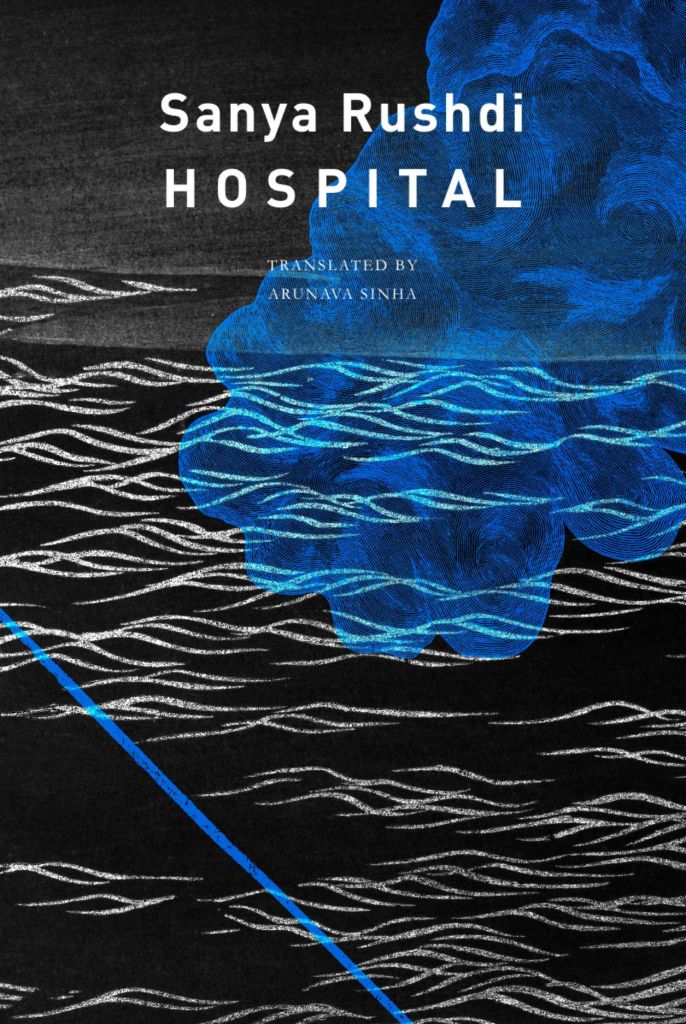
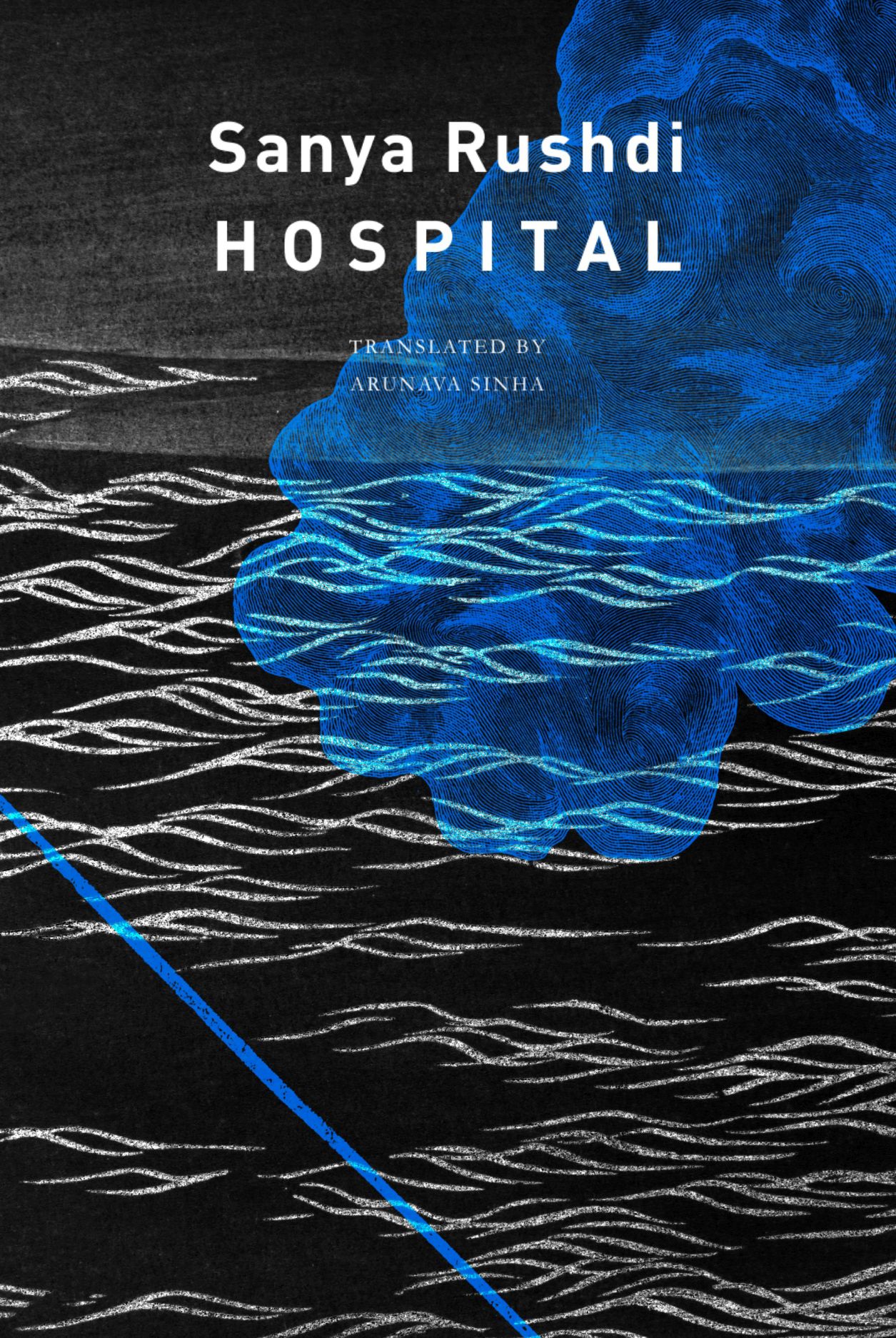
It’s a difficult thing to articulate, but this where we come to books. More than any fictionalized account of madness and psychosis, Hospital by Bengali-Australian writer Sanya Rushdi (translated by Arunava Sinha) manages to recount the experience of psychosis from the inside with a remarkable sense of self-awareness, arising, I can only imagine, from the author’s own multiple experiences with the condition. This critically acclaimed novel captures the strange internal boundaries that the protagonist (also named Sanya) tries to negotiate in a manner that resonated with me. As I noted in my review:

Sanya’s narrative is restrained and oddly lacking in affect, even when she describes her tears and outbursts. She is continually trying to observe herself and logically reason her way through whatever arises. However, her reasoning is often disjointed and confused. She is constantly seeking symbols of significance, spends a lot of time trying to figure out the secrets behind the thoughts and actions of others, questions why certain song lyrics keep coming to mind, and fitfully attempts to draw strength from her faith.

I recognize this well. The thing is, whether one is manic or depressed, psychotic or not, the tendency is to assume that whatever is happening to you is you, not a physical illness that is directly affecting your mood and your perceptions of the world.

When it comes to poetry, it is well-known that many famous poets have, over the years, struggled with mental illness, often writing from within the depths of madness and, sadly, frequently ending their own lives. I am drawn to such poetry but admit to finding much of it painfully difficult to read. Too close, too unfiltered at times, it must be read slowly. And then there is the genius of madness question that comforts some of us and angers others, but in the interest of understanding mental illness I wanted to call attention to a poetry collection I read several years ago that I think of often.
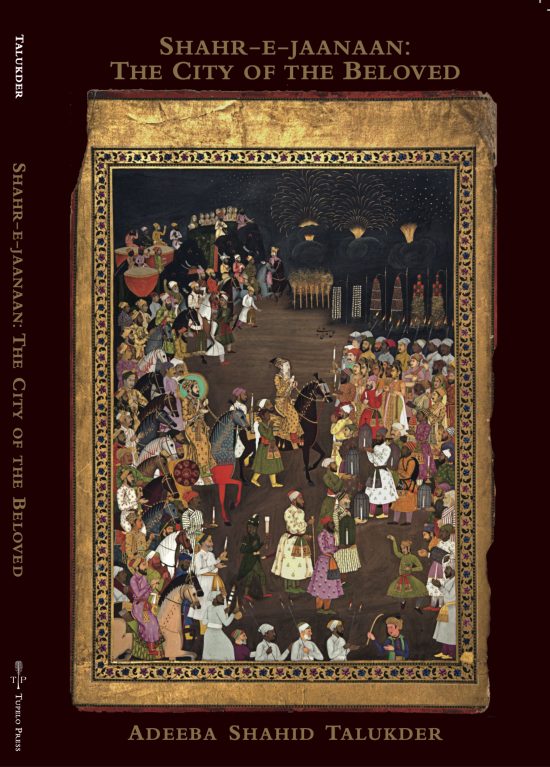
Shahr-E-Jaanaan: The City of the Beloved by Pakistani-American poet, translator and ghazal singer Adeeba Shahid Talukder was a book that came to my attention in the early months of the pandemic, a background that coloured my reading. I was intrigued by this young woman who draws inspiration from the greats of Persian and Urdu poetry and the late Kashmiri-American poet Agha Shahid Ali to explore traditional and contemporary themes alike, from the conflicts between an American raised daughter and her immigrant family to the poignant drama of Laila and Manjoon. Yet, in spite of a clear reference to a hospital in an earlier poem, it was not until I hit the title sequence, that I began to sense something more might be at play. In my review I report that the sequence begins:

At December’s end Benazir died
in a suicide attack.

.                              Men burned

tires, cars, banks,
petrol pumps and factories

Perhaps in grief.

The nights in New York
were clear, cold

and I read Faiz
in a way I never would

again. In Washington Square,
the benches were empty.

What follows is a harrowing account of the speaker’s descent into madness, accompanied in her mania, by God and her poetic saints, culminating eventually in hospitalization and echoing back to the poem I quoted above. It’s devastating, horrifying and strangely familiar, but on my first encounter I did not recognize it for what it really is.

Although I was unaware of Talukder’s own bipolar history when I first read her collection, I did have the feeling that she knew an experience I had also had. An interview with the poet confirmed it, along with her desire to address some of the misunderstanding and stigma she has faced. My response to learning this and a link to said interview can be found in my review of this excellent collection.
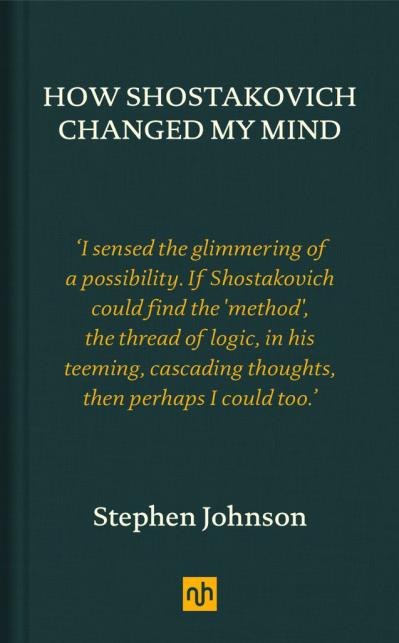
Finally, when it comes to mental health memoirs I am perhaps even more cautious than I am about fictional or poetic works. However, within Stephen Johnson’s How Shostakovich Changed My Mind, I found moments that spoke to me so clearly in relation to my own experience of mental illness before and in the long years following diagnosis. That is possibly because it is not your standard mental illness memoir. A blend of musical biography, memoir, psychology and philosophy, this fascinating book-length essay draws its greatest strength from the author’s passionate affection for and deep connection to the music of Dimitri Shostakovich. As I note in my review:

As one might imagine, given the unusual title, How Shostakovich Changed My Mind is an intimate account of the intersection of music with the personal drama, and trauma, of life lived. Johnson draws on literary, philosophical, neurological and psychological resources as he explores the connection between music and the brain, an area of growing interest and investigation, but he anchors his inquiry in the story of Shostakovich’s life and work during some of the most tumultuous events of the twentieth century—a thoroughly fascinating account in its own right—while tracing out his own particular relationship to this music and the role it played, not only in adolescence, but in his own adult challenges with bipolar disorder.

As such, Johnson’s work is not only a powerful exploration of the ability of music to provide expression and meaning in times of joy and sorrow, but a moving personal memoir of how music can serve as a means to navigate madness, especially in those times when, from inside, all one knows is that something is not right, even if one does not know why.

So, three books for Mental Health Awareness Month, or any time, because it is important to continue to work towards increasing understanding and reducing stigma around mental illness year round—and around the world.

Hospital by Sanya Rushdi is translated from the Bengali by Arunava Sinha and published by Giramondo in Australia and Seagull Books everywhere else.

Shahr-E-Jaanaan: The City of the Beloved by Adeeba Shahid Talukder is published by Tupelo Press.

How Shostakovich Changed My Mind by Stephen Johnson is published by Nottinghill Editions in the UK and distributed by NYRB in North America.

At last, the final volume of Michel Leiris’ The Rules of the Game is available in English—a few (well, more than a few) words about it and a link to my review at Minor Literature[s]

As a reader, I do not tend to be a completest, collecting and diligently making my way through the complete works and associated letters and journals of a particular writer, but if I have made one exception, it is for French poet, novelist, essayist, ethnographer, and critic Michel Leiris. However, as English language Leiris enthusiasts will know, his most important work—the four-volume autobiographical essay to which he devoted thirty-five years of his writing life, The Rules of the Game—was not yet translated in full. That is, until now. This spring, Yale University Press released the final volume, Frail Riffs in Richard Sieburth’s translation.

Sieburth, who translated the book that served as my introduction to Leiris, his 1961 dream diary, Nights as Days, Days as Nights, takes over the Rules of the Game translation enterprise from Lydia Davis, who translated the first three parts of the project, plus Leiris’ novel Manhood. But, if there is any stylistic shift, it is not an issue because Frail Riffs itself marks a sharp shift in approach and style from the dense, labyrinthine prose that characterizes the first volume, Scratches, Scraps and Fibrils toward the fragmented, eclectic form of Leiris’ late work which will be familiar to readers of The Ribbon at Olympia’s Throat (which I wrote about at length for The Critical Flame).

Leiris was, throughout his long life which spanned most of the twentieth century, deeply engaged with the political, intellectual and artistic culture of Paris. Yet, his influential autobiographical endeavour was self-focused, scrupulous and often obsessive and critical. It’s not an accounting of his life, per se, but rather of episodes that strike him as important or interesting, against which he can analyze or dissect himself. A love of language and a concern about truthfulness and discretion in the autobiographical exercise are critical. He draws on, among many things, his childhood experiences, travel (as an ethnographer or as part of political or artistic delegations) and, in a particularly vulnerable section of the third volume of Rules, on his suicide attempt, the affair that triggered it and his difficult recovery.

Frail Riffs continues in this vein, but in a more open manner, with short essays and observations, typically grouped thematically, and interspersed with poems, lists, and passages of word play. One of the aspects of Leiris’ character that becomes more apparent in this book and again in Olympia, is his deep despair with the ongoing state of war and violence in the world. He is, as he ages, increasingly confirmed in his anti-colonial and anti-racist convictions. He knows he is too afraid of pain and death to be a true “revolutionary” but as students take to the streets of Paris in 1968, he watches from his well-placed apartment with admiration and offers what refuge he can (the irony of his own bourgeois contradictions never lost on him). I’ve thought about his observations a lot in recent weeks. He would, were he here now, still be in despair.

Anyhow, this long introduction stands as an invitation to follow up with my review of The Rules of the Game Volume 4: Frail Riffs, which has been published at Minor Literature[s]. Thank you to everyone for welcoming my work back to this great literary journal .

The Rules of the Game Volume 4: Frail Riffs is translated from the French by Richard Sieburth and published by Yale University Press.

“Everything meant something else. The apple no longer an apple.” Divided Island by Daniela Tarzona

State the manner of panic, the voice of terror. Approach the scream and grab it with your mouth to make it heard. Right now you’re shouting. You shout with so much force your jugular vein pops out.

If one of the possibilities inherent in the form of the novel is the freedom to break with expectations when the expression of the pressing strangeness of being in the world demands it, Mexican writer Daniela Tarazona’s Divided Island is a work that opens itself up, stretches the boundaries of reality, and fractures into shards of glass to reflect pieces of an uncomfortable and incomplete whole. It is also a response to grief and neurological disorder that is as entrancing as it is disorienting. The brain scan illustrations that open each section of this slender novel seem to indicate that the protagonist (or protagonists) may not be on stable ground, but this fragmented narrative explodes with emotion and shifts gears so abruptly that it undermines the natural inclination to want to “figure it all out” which is, of course, the point. But it is not without meaning, as a meaning does gradually begin to become clearer although the mist never lifts entirely.

Essentially, it is the story of a writer who is grieving the death of her mother. The grief permeates her life and surroundings. This is intensified when, after a series of brains scans, she is given a diagnosis of cerebral dysrhythmia, and suddenly finds herself splitting in two.

Once upon a time there was the sun. Seething sphere. If the word were she, it meant you; you were replicated. Her over you. You over her. Two bodies spinning in circles.

One of the women she becomes leaves and travels to an island where she intends to kill herself. The other, addressed as “you,” stays behind to try to pick up the pieces of her fractured existence and make sense of her life. Her mother and grandmother, both passionate yoga practitioners, come back to her in memories (or are they dreams?), while visions and paranoias haunt her days. And meanwhile, “she” is on the island, contemplating death.

The narrative maintains a trancelike quality throughout as the woman navigates the painful loss of her mother and the altered reality in which she finds herself:

It turns out you’re surrounded, you’re an island with water on all sides: the reams of paper by the desk, the books, the suitcase of jewelry. Your mother’s things. Notes. Letters. Your grandmother’s manuscripts.

Strange things happen to you. The decorations in that tableau of wonders, seem to accurately describe the moment you’re living in: you’ve got an orange tabby; the porcelain plates your mother painted arrive at the house; you wrote a novel about a woman who lays an egg. The tableau existed before the novel. Does the order in which things happen in time really matter? Being surrounded means sinking in sand. Your body gets lost among objects, you can barely open your eyes. Seeing is a state of grace, here, right now.

Several historical and literary figures, most notably the Costa Rican born poet Eunice Odio who emigrated to Mexico, appear in the woman’s memories and dreams of her grandmother—the woman who stays, mind you, the woman who wants to die is on an island awaiting her own demise. Despite their separate trajectories, it is made clear on several occasions that these women are one and the same being. Two selves estranged from one another? Or an existential neural short circuit? Or are both emerging and diverging through the act of writing itself? The story runs toward and against itself as images resurface and the medical mystery lying behind the neurological scattering is given more substance—as much as substance is possible from measuring electrical patterns and data, that is.

The brain scan images that illustrate the book do belong to the author herself, so although this is far from a clinical text, Tarazona may be drawing, to some extent, on personal experience. Yet, one senses she is guided by a desire to explore emotional intensity and perceptual distortion from a purely poetic perspective. And that is the best way to read and appreciate Divided Island. A close comparison (and probable influence) is Clarice Lispector, but this unusual, alluring tale of an excitable mind and the two women who share it is a startling and singular work that rewards multiple readings.

Divided Island by Daniela Tarazona is translated from the Spanish by Lizzie Davis and Kevin Gregory Dunn and published by Deep Vellum.

The only liveable space is language: Home by Andrea Tompa

On the surface, Andrea Tompa’s Home is, like its name implies, a story about home, or, rather, a journey from one home to another. Although it is never explicitly specified, her unnamed protagonist is, like the author, a writer born into an ethnically Hungarian community in Romania who moved to Hungary to study Russian literature. As the novel opens, its heroine, a successful novelist nearing fifty, is waiting at the airport to pick up a long-time friend and the adult daughter of one of their classmates who are both arriving on a flight from the US. Together they will make their way across the border to their hometown for a class reunion that has been years in the making. For the driver, still nervous at the wheel having acquired her license fairly recently, the journey will also be an opportunity to try to understand something about herself and where she truly belongs. As someone who makes magic with words for a living, she is aware that articulating truth is an act that often seems to escape the limitations of language, and that even a concept like “home” can be slippery:

Stuck between two worlds, no longer at home but not yet back at home either, overwhelmed with fear because something has definitely come to an end, at least temporarily, while something else cannot yet commence. In other words, this place called home and obtained at the cost of tremendous effort, has to be left behind in order to depart from home to (another) home, the latter without loved ones or  a house to call ones own, only with some sort of a shared past, yet still experiencing the sensation that there must be something there for the articulation of which she is unsuitable.

Over the thirty years since she first left her hometown to study, the protagonist has returned frequently, at first every summer and for holiday gatherings, and then more sporadically, but it will be the first time that all of her surviving classmates, at least those who agree to come, will be together for an entire weekend. Many will be coming from around the globe having found careers and a new lives abroad, others will have stayed close by, aging and changing along with the town. As she anticipates this reunion, she will think back on her own life experiences, in contrast with the varied paths others have happened upon, in this wide ranging meditation on the meaning of home. Three decades is, after all, a long time.

Intrinsic to the question of home is the matter of language. The main character does not have to give up her mother tongue when she leaves migrates, but she thinks often of the Russian writers who were forced into exile and the ways they adapted, or failed to adapt, to a new literary voice. When encountering friends who are living away from where their shared native language is spoken, questions often arise about how one might translate one word or another. During a six-month student residency in Saint Petersburg she gathers Russian vocabulary and expressions that appear and reappear within the text in Cyrillic script. Borders and, for better or worse, identities blur. And this groundlessness is not exclusively limited to language either. The paintings of an artist from her hometown whom she happens to meet and befriend toward the end of his life, has style that “balances the boundaries of different worlds, a sort of homeless landscape.” Her own life seems to navigate a similarly homeless landscape, one she wants to pass on to her son who is, for all intents and purposes far more grounded and unambiguous in his own identity and sense of belonging than she ever will be.

With the looming class reunion, Home is also very much a novel about the way our view of the world and our place in it changes as we age. Once excited with all the trappings of travel, the protagonist is now uncomfortable with the idea of flying and disenchanted after years of book tours, factors that likely enhance her uncertain appreciation of middle age existence:

In her, several ages coexist at once, she often scrutinizes her mirror image with some consternation because she feels so much younger within, as if she was glowing like a child, if not a little girl. This is what she sees.  Not the mature face, never, the fine yet clearly visible wrinkles, the creases and treacherous spots appearing on the skin. Countless ages coexist within her side by side, a multitude of figures are sitting on the barge of the past, trying to make peace with one another and the world, it seems as if the fifty springs, summers, hard-working autumns and increasingly faster-thawing winters had gathered together a proper crowd. Yet many more have sunk without a trace, people she would find it hard to remember.

Of course, once she and her classmates are finally together, all decidedly slower, heavier and more subdued than their younger selves, she is far from the only one with ambivalent feelings about what it means to be “home.”

The narrative traverses the distance between the airport and the reunion, and the space of at least thirty years, at a pace that is negotiated with confidence and skill. Tompa not only refers to her lead as “our protagonist”—especially in the early chapters—but other key figures are similarly unnamed. Her son is simply “the Son,” her father, whose police surveillance file is, she hopes, a key to his troubled life, is called “the Father” as distinct from the man who becomes her husband and the father of their child who is referred to at one point as “the Other.” Likewise, there is “the Professor,” “the Teacher,” and “the Painter.” By contrast, her peers from school and college, form a varied, distinctive, and named cast of characters. In the hands of a less experienced author, this could feel performative, but here it works very effectively. It is, in a sense, a means of keeping a level of anonymity and displacement in what is a story about identity and what it means to have a home, and a mother tongue. A third person perspective that is at once close, yet held at a certain distance from its subject, mirrors the privacy one senses the professional writer values in her public life, while permitting certain insights that she might not actually be able to find words for herself. We learn about her, and her life, gradually, in relation to those around her, while certain aspects—the details of her literary career and her marriage—remain largely in the shadows. Language conceals as much as it reveals.

First published in Hungarian in 2020, Home is not only a novel rich in literary references, from Homer to Shakespeare to Nabakov, but a very contemporary tale wherein characters often search desired quotes on their phones during conversations and the children who have accompanied their parents to the reunion try to teach the adults TikTok dance routines. With humour and intelligence, Tompa has crafted a compelling tale that explores the complicated question of the nature of belonging through and beyond language, while Jozefina Komporaly’s translation deftly carries the magic and wisdom into English.

Home by Andrea Tompa is translated from the Hungarian by Jozefina Komporaly and published by Istros Books.

“keep turning forever, circling round”: Shining Sheep by Ulrike Almut Sandig

.   i have the same number of words inside me
as all of you have words, the exact same number

but how many times can they be combined? you
keep finding words that no one sang before you.

.  your godhead made you after his own image
.   stark naked, blind—wild things that you are.

– from “The Silent Songs of the Walls: l”

German poet Ulrike Almut Sandig’s latest poetry collection, recently released in Karen Leeder’s translation, is the modestly titled Shining Sheep—modest, that is after her 2016 offering, which appeared in English in 2020 as I Am A Field Full of Rapeseed, Give Cover to Deer and Shine Like Thirteen Oil Paintings Laid One on Top of the Other— but it is by no means a more restrained effort. Rather, this new collection, originally published in German in 2022, is an especially dynamic, ambitious affair.

Several of the pieces here were commissioned for performances, films, or arose out of collaborations with fellow artists and musicians. This has been a hallmark of Sandig’s approach to poetry ever since her early days posting poems to lampposts and handing them out as flyers. But that collaborative, multi-instrumental quality is now more pronounced, not only through the visual presentation of the poems, often incorporating shaped or concrete poetry, but with the inclusion of links, where appropriate, to recordings and video performances that bring her poems to life off the page.

Opening with a single word, alone on a black page—“Lumière!”—Sandig’s poetry is a call to light, but one that resonates with a dark exuberance. She draws on a wide range of influences—German folk songs, writers, and history—to address political and social issues, never turning away from difficult subjects, like maternal depression and alcoholism, living with Covid, migration, and climate change.

just let that melt on your tongue:
shining sheep, genetically modified
as night storage for the dark hours

visible in satellite images as little ghosts
their delicate shimmer on the radar
seems to be made to lull

the oppressive darkness between
the great golden bulls of the cities
into a comforting gleam. 

– from “Climate change is here, now. But we are also here, now. And if we don’t act, who will?”

Along with poems that arise out of commissions and direct collaborations with other artists, Sandig is also at times writing in response to, or in conversation with the work of late German authors, filmmakers and poets, including Friedrich Hölderlin’s “Wie wenn am Feiertage” (“As When on Holidays,” 1800). Other pieces have their genesis in more immediate encounters outside the artistic community, past or present.

A particularly moving sequence, “Lamentations in VI Rounds,” arose, poet tells us, out of a chance connection with a young man from Afghanistan who contacted her after she accidentally left her bank card in a ticket machine on the Berlin underground. He and his large family were living in the city as failed asylum seekers. She stayed in contact with them and, from their stories, wrote a piece she called “Five Lamentations,” adding a sixth round for this final version after the Taliban took control of Kabul in 2021.

the little man inside my head, he had
a daughter. he loved the way she boiled
minced beef, the way she answered back.
he loved the wonder of her eftertherain in Omid.

Omid sold his daughter in exchange for the value
of a ticket to Germany. today she called him up.
she sounded like she was sitting in his ear.
the pear tree in the yard was doing fine.

Shining Sheep is Sandig’s third poetry collection to be released in English, and the most inventive and experimental to date. Her long-time translator, Karen Leeder, is well attuned to the nuances of her uniquely playful, yet melancholic verse, bringing this energy and adventurousness to the forefront here. For a taste Sandig’s poetry and performances(with Leeder’s subtitles where available), her YouTube channel is well worth a visit.

Shining Sheep by Ulrike Almut Sandig is translated from the German by Karen Leeder and published by Seagull Books.

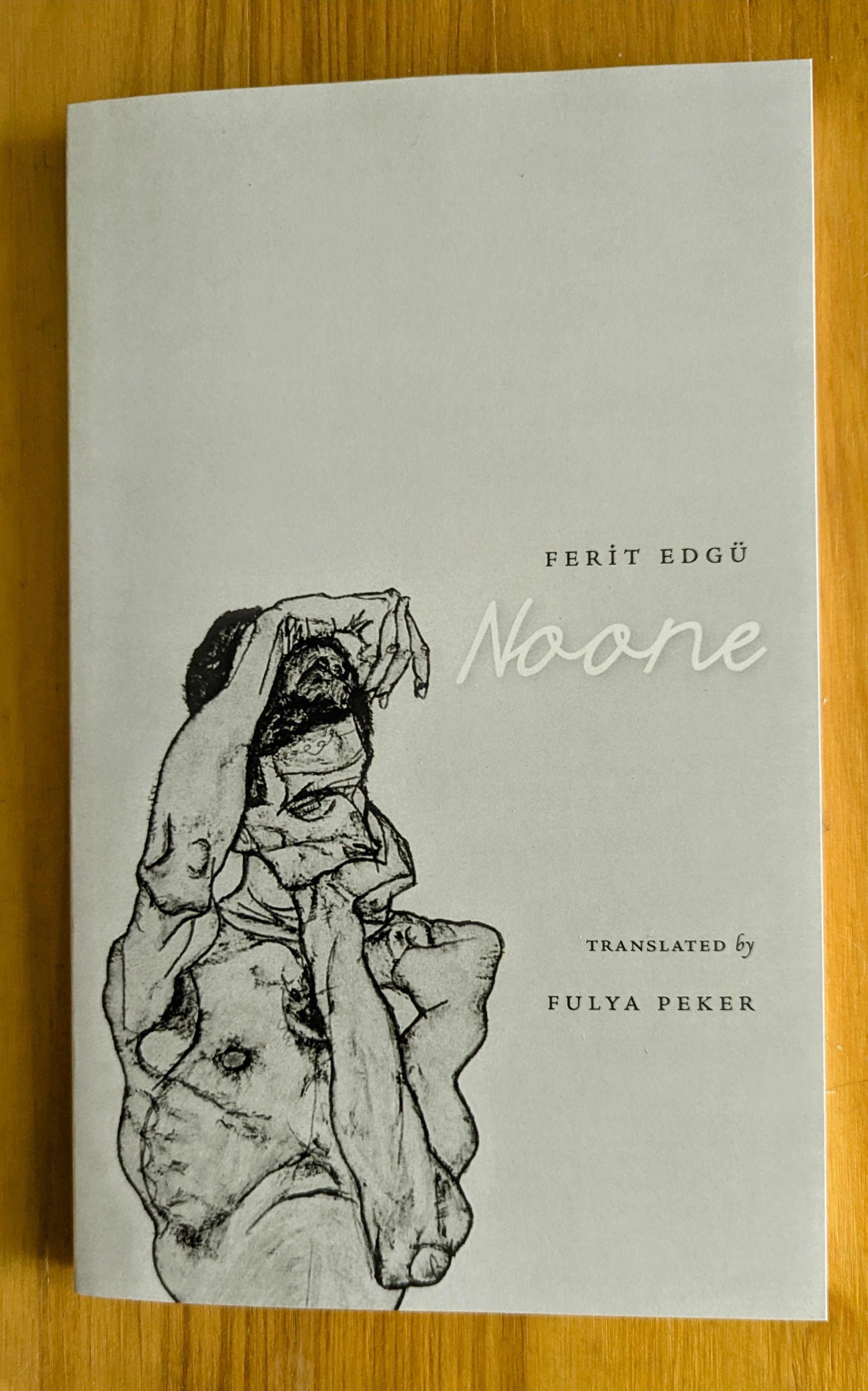
“Here, on this mountain, there’s the living and the dead.” The Wounded Age and Eastern Tales by Ferit Edgü

Years later, as I leaf through the notebooks,
I see that these people and I,
who didn’t speak each other’s languages,
had understood one another.
I don’t know what language we had I common,
nor do I want to know.
Our common language didn’t change them
but it changed me. I’m sure of it.
Every passing day returns to me the traces
of our shared life in that mountain village;
I see them. I live them.
And these words I’ve been scrawling through the years
are those traces, words wounded like me.

Hakkâri is a province in the southeast corner of Turkey with an overwhelmingly Kurdish population and a long history of violence and displacement amid the various ethnic and tribal communities that have called the area home over the years, up to the present military subjugation of insurgents fighting for an independent Kurdistan. It is a rugged region comprised of mountains, steppes and deserts drained by the Great Zab River and it is the setting, a character in its own right even, in much of the fiction of Turkish writer Ferit Edgü, including the two texts published together by New York Review of Books Classics as The Wounded Age and Eastern Tales.

In 1963, after graduating with a degree in fine arts and philosophy, the then twenty-four year-old Edgü was assigned, in lieu of military service, to a nine-month teaching post in the village of Pirkanis in an area of Hakkâri so remote it could only be reached on foot or by horseback. The experience would be, by his own frequent admission, the most transformative of his writing life. For a young man raised in Istanbul who went on to study in France, it must have been a shock to arrive in such an isolated location, but, as the quote above, taken from the preface to his 1995 collection of short fiction, Eastern Tales, shows, the differences between himself and a people with a culture and language so foreign to him somehow melted away. He was never able to return in person, but his characters, narrators and stories have continued to find a life there.

Edgü’s narratives are, in manner that seems appropriate to the harshness of the environment and the simplicity of the lives of the people of Hakkâri Province, characteristically stripped to the bare essentials. His language is spare and unadorned, often reading as a kind of prose poem, with each sentence or two appearing on a new line. He is quoted in the translator Aron Aji’s Afterword as follows:

I want nothing superfluous in my writing. Texts cleansed of details; the event giving rise to the story distilled to its concisest form…. I’ve tried to do away with narration, fictionalization, similes and metaphors…. I cannot stand metaphorization… [or] descriptions built with ornate words, long, unbearable sentences that serve as signs of an author’s mastery…. Just as we have freed writing from psychology, we must free it from metaphors and similes (nothing resembles anything else).

He relies rather on voice, perspective, and tone, allowing dialogue—internal or external—to carry the narrative force. Meanwhile, the same words tend to appear again and again—bear, wolves, dog, snow, mountain, people—this repetition or, if you prefer, intentionally limited or controlled vocabulary has an incantatory effect.

The present volume consists of a novella, The Wounded Age (2007) and Eastern Tales (1995), a collection of four short stories and seventeen minimal or micro-fictions. The reverse chronological placement is apparently designed to foreground “the trajectory of stylistic distillation” typical of Edgü’s work. The novella is the account of an unnamed narrator who returns to report on a crisis in the same mountainous region he once visited in his youth. According to an essay in The Nation, the inspiration was the Halabja Massacre on March 16, 1988, when Iraqi troops attacked the Kurdish town of Halabja with mustard gas and nerve agents, killing up to 5000 residents and injuring many thousands more. As survivors tried to flee over the border into Turkey, they were blocked by the army. Edgü had wanted to cover the situation but his editors felt it was too dangerous for him. So he relied on his memories of the place and its people. Thus, the incidents depicted in The Wounded Age do not reference any specific event or location (although the border is a key element), and the horrors captured on the faces of the adults and children the reporter encounters and their accounts of rivers of blood filled with corpses speak volumes.

They come in wave after wave. Down the mountains, down the rocks.
Women, men, children. A human deluge.
Some come carrying saddlebags. Others, rifles. Their women and children on mules. Or their wounded.
Not their dead. Those they’ve buried.

Unfolding in short segments, through conversations he has with survivors, army officers, and his patient guide and translator, Vahap, the reporter gradually pieces together a larger tapestry of loss, dislocation, and destruction. He listens. He photographs. His dreams and nightmares attempt to fill in the gaps.

Where’s my mother? Where’s my father? My brother, my sisters?
Where’s my dog? Where’s my house? Where’s my village?
Where are my mountains? Where am I? Where’s here?
Desolate. Eerie emptiness. But a voice kept screaming these questions.
I wanted to photograph this voice. The one asking the questions. That’s why I was sent here. I could hear the voice but saw no one to whom the voice belonged.
Since I couldn’t photograph the questioner, I’ll photograph the questions, I said to myself. And so I did.

The stories collected in Eastern Tales tell of a proud people, with simple lives shaped by landscape and tradition. Sometimes the narrator is an outsider, a teacher or in one instance an architect, who has come into the community with a particular role to fulfil, but other tales belong solely to the people themselves. The longer pieces tend to contain somewhat more descriptive detail than the spare and poetic novella, but most still rely on dialogues—with the attendant confusions that tend to arise between villagers and anyone from outside, be it a larger town or a distant city—or unaffected monologues to carry the thrust of the narrative. In the ultra-short pieces, this is stripped down further. Life in this corner of the world is hard, but it is met by its inhabitants with a stoic fatalism that is well honoured through the sharp focus and stark beauty of Edgü’s prose.

The Wounded Age and Eastern Tales by Ferit Edgü is translated from the Turkish by Aron Aji and published by NYRB Classics. It has been short listed for the 2024 ERBD Literature Prize.

In search of a shadow: Indian Nocturne by Antonio Tabucchi

When the murky waters that obscure any tangible connection between an author and his or her “unnamed protagonist” are intentionally stirred in the opening lines of a text, it is a not-so-subtle cue that that things may not be what they seem. Add an ostensibly exotic foreign location into the mix and there is plenty of space for the edges to become blurrier. Indian Nocturne, by Italian writer Antonio Tabucchi, is a case in point. He describes this book as an insomnia, but also a journey—the insomnia his own, the journey that of his protagonist. Yet, should one wonder, he has himself passed through the places that will be described so, in lieu of titles, he provides a brief index of the settings of each of the novella’s nine chapters for the sake, perhaps, of some wayward traveller who might wish to follow a similar trail of shadows.

The story opens in 1980s Bombay as the narrator is making his way into the city from the airport with a map spread across his knees and a copy of India, a Travel Survival Kit in hand. The taxi driver seems determined to disregard his requested destination, certain that this European gentleman has made a common tourist’s error and is mistakenly bound for a most undesirable area. Angered, our hero insists on getting out and making his own way. The neighbourhood is he reaches is certainly rough, worse than he’d imagined, but he is hoping to find a woman, a prostitute, who might have some information that will help him on his mission. He’s looking for a friend, someone who seems to have disappeared. What little he gleans at this first stop takes him, on the following day, to the office of a tired doctor at a busy public hospital:

‘What was his name?’

‘His name was Xavier,’ I answered.

‘Like the missionary?’ he asked. And then he said: ‘It’s not an English name, that’s for sure, is it?’

‘No,’ I said, ‘it’s Portuguese. But he didn’t come as a missionary; he’s a Portuguese who lost his way in India.’

The doctor nodded his head in agreement. He had a gleaming hairpiece that shifted like a rubber skullcap every time he moved his head. ‘A lot of people lose their way in India,” he said, “it’s a country specially made for that.’

Spare and elusive, the tale unfolds as a series of encounters with places and people, as the narrator travels from Bombay to Madras by train (published in 1984, the British names for Mumbai and Chennai are still in use), then back across the country by bus to Goa. He shares a railway retiring room with a Jain bound for Varanasi, meets with the strange leader of a spiritualist movement, shares a bus shelter with a crippled fortune teller, and finds an American lost by choice, shall we say, on a Goan beach. Add to that a couple of women who happen to cross his path and you have the makings of a dreamy, subtle mystery with more empty spaces than solid clues, enigmatic conversations that drift off unresolved, and a healthy metafictional twist.

Always economical, Tabucchi excels at creating atmospheric settings, enigmatic characters, and cryptic dialogue. He captures the strangeness of being in an unfamiliar country surrounded by unintelligible languages, and the passing, often odd, communion with other foreigners who each have their own reasons for being far from home. And no one, not even the first-person narrator, is  ever really showing themselves fully. Indian Nocturne is my first experience with Tabucchi, a writer I have long been meaning to read. This novella, which almost seems slight at first blush, lingers vividly in the imagination so I will be definitely be reading more of his work soon.

Indian Nocturne by Antonio Tabucchi is translated from the Italian by Tim Parks and published by Canongate in the UK and New Directions in North America.

After the night, day breaks: The Brush by Eliana Hernández-Pachón

Pablo and Ester live in the hills. Their children are grown. Their lives are simple, bound to the land, but lately there have been signs, omens. Pablo is concerned:

For some time now
he’s felt a heavy change pressing the air,
and can’t explain it.
Like when
he walks through town at night,
and when he hears the animals
can’t sleep.

Sensing danger, he gathers some papers and items in a box and goes out to bury it while Ester sleeps. And then they come.

Between the 16th and the 21st of February, 2000, members of the United Self-Defense Forces of Colombia descended upon the Montes de Maria region and attacked the people:

During this incident, known as the Massacre of El Salado, paramilitary forces tortured, slashed, decapitated, and sexually assaulted the defenseless population, forcing their relatives and neighbors to watch the executions. Throughout, the militiamen played drums they found in the village cultural center and blasted music on speakers they took from people’s homes.

Sixty people were killed. The Colombian Marine Corps battalion charged with protecting the area was nowhere in sight—they had withdrawn the day before the massacre began. With The Brush, a taut work of narrative poetry, Colombian poet and educator Eliana Hernández-Pachón draws on the official 2009 report on the massacre to bring the story of this brutal event into focus in an unusual and affecting manner.

The tragedy of this horror exists on many levels—the unimaginable terror of the attack itself which was not an isolated event, the lingering trauma of the survivors, and the years of fighting for a formal apology and reparations from the government. As a story well-known within Colombia, the poet says in an interview that “if I was going to tell it anew, then I would need a new form.” Her approach is to pass the account on to several distinct characters or voices and allow these diverse perspectives to carry the varied layers of this tragedy.

The first of three sections belongs to Pablo who has reason to be worried about the growing tensions. He will not survive the attack. The second part belongs to the thoughts of Ester, his wife, in the days that follow. She wonders where Pablo is, what might have happened, heading out into the brush to try to find him. And then…

Crossing the glade, she sees
a shadow vanish
in a glimmer of undergrowth.
Hey! she shouts.
And the woman approaches warily
leading a little girl by the hand.
A whisper first, and now her clearer voice:
They did it to me with a knife, the woman says
and points to a mark on her arm.
They also did things
I can’t talk about.

Knowing it is unsafe to return, the two women and child are now forced to keep moving through the brush.

In the third section, the Brush—the dense, living forest vegetation—is granted it own direct, poetic voice. It is The Brush that stands as witness, to sights, sounds and sensations, from the crushing footfalls of the approaching militants and falling bodies in the town square, to the careful movement through the forest of survivors, and, finally, to the blossoms and blooms that will welcome those who eventually return.

In conversation with The Brush’s testimony, Hernández-Pachón engages input from The Investigators and The Witnesses. These perspectives, drawn from official sources, define and correct one another, while the Brush adds its own comments and clarifications. The human choruses are presented in prose, but even if the Witnesses’ offerings are more poetic in tone, both stand in sharp tonal contrast with the lyrical, omniscient voice of the Brush. The Brush, it turns out, can tell a tale of horror and grief that people, especially those who have been victimized, are often unable to fully articulate.

The questions still survive:
what does it think about, the brush, somnambulist,
after it’s seen it all?
The day that follows night returns
its artifice, the well-known
interlocking of the hours:
how is it that time didn’t stop,
why do the grain’s unopened eyes
keep growing?

A disconcerting calmness rests over this book-length sequence of poems that, in a mere 57 pages, manages to capture the contradictions and harmonies that arise in response to acts of extreme violence. That calmness serves to unsettle the reader and honour the survivors, while placing this event within a wider ecosystem and granting a voice to nature, the one force, perhaps, that can truly offer both understanding and healing.

The Brush by Eliana Hernández-Pachón with an Afterword by Héctor Abad is translated from the Spanish by Robin Myers and published by Archipelago Books.

The vanished railway station: An Old Carriage with Curtains by Ghassan Zaqtan

In the western foothills of the Hebron Mountains, about forty kilometres southwest of Jerusalem, lies what remains of Zakariyya, a village with a history stretching back millennia. It was the birthplace of the parents of Palestinian poet and writer Ghassan Zaqtan. When the community was occupied and depopulated by Israeli forces following the Nakba, they were forced flee to Beit Jala near Bethlehem. That is where Zaqtan was born in 1954. Seven years later, in 1961, circumstances compelled his family to move again, this time to Karameh refugee camp in the Jordan Valley, across the river from Jericho. Though the settlement was destroyed during the 1968 War of Attrition, Zaqtan would return to it as the setting for his 1995 novella Describing the Past (published in English in 2016), the tale of three teenagers coming of age and dealing with love and loss in a world haunted by war, death, and dislocation. With Where The Bird Disappeared (2015), Zaqtan’s second prose work to appear in translation in 2018, the village of Zakariyya comes into central focus. This lyrical, almost fable-like story follows the fate of two boys, Zakariyya and Yahya, who grow up in the village. They are both in love with Sara. However, the arrival of “armed Jewish forces” changes everything.

Now, with the English release of Zaqtan’s 2011 novella, An Old Carriage with Curtains, the three works—all translated by Samuel Wilder—can be seen as a loosely linked trilogy, or as being in conversation with one another. Each is different, and, as such, not need be read in any particular sequence, but they are bound by a common spare, poetic, dreamlike narrative style, and by echoing images and motifs. Yet, this third book seems closer to the author’s own life, suggesting that it is somewhat more autobiographical. Here the protagonist is an unnamed middle-aged man living in Ramallah. His aging mother, who lives in Jordan, longs to see her birthplace again for the first time since the “migration.” It is the place that has always loomed large in his family’s history, its existence nearly mythical, its sudden loss impossible to put into perspective:

He arrived late to Zakariyya, his village, occupied since 1948, where his father and mother were born. Somewhere in a drawer inside the house there was a faded, tormented picture that redeemed nothing, but which kept in place the stories that amassed in the family home. The picture showed a distant spectre of forest trees, and the ghosts of houses at the far-right edge of the frame. This was all it contained. It looked tired, faded, closed; nonetheless, it asserted some incredible forbearance. Under the pressure of the cruel importance placed on it, it could hardly go on existing, pressed down by the dependence of all those contradictory memories, all the longing that pervaded their stories.

By the time of the key events traced in this novel, the protagonist has passed through or near the abandoned townsite a number of times, but he has resisted sending his mother any photographs, as he had promised. Now, as her anticipated visit nears, her descriptive recollections of Zakariyya take on new dimensions and details. For the first time, she talks of a railway station and a Palestinian Jewish friend she used to meet there as a child, but her son has seen no sign of a station or tracks. This disconnect causes him to feel that the images and memories he has been trying to preserve for her are hollow, “not convincingly alive, because the railway station was gone. Its absence diffused through life, evaporating everything.”

Absence, the mutability of memory, and the importance of stories to sustain individual and collective identity are common elements of Zaqtan’s fiction. In An Old Carriage with Curtains, the nonlinear narrative proceeds through short scenes that move between a number of themes or threads. Some are conceptual, others more practical. Because movement is restricted, there is the matter of obtaining the required permits, a frustrating, complicated and time-consuming process that becomes, for many Palestinians, a fruitless life-long ritual. For the protagonist, his current application for a Visitor’s Permit that will allow him to travel to see his mother in Ammam has taken three tries; his efforts to secure one to allow her to visit her homeland just once has taken much longer. But, what he does finally manage to obtain for her, sadly, does not include either Jerusalem where she had hoped to pray, or Zakariyya; nor is it the prize she had long dreamed of, the right to return for good.

Permit in hand, there is then the question of making the passage between the West Bank and Jordan across the Allenby Bridge. The protagonist’s somewhat surreal experiences on his way to see his mother form one of the novel’s central threads. Broken down into snapshot vignettes, there are the queues, the restless waiting travellers, an old man who makes repeated and increasingly desperate attempts to pass through a mechanized gate, and a woman soldier who, when checking his documents, betrays the recognized agreement he maintains between himself, a Palestinian, and them. She simply asks him a question: Do you like to travel? Innocent enough in any other reality of human interaction, her unexpected transgression unnerves him.

Another thread that appears throughout the narrative features Hind, an actress friend with whom he has a relationship he does not fully understand, though he senses that his role is primarily be that of a listener, an audience. Thus, her voice enters his narrative directly, in first person, as he recalls stories she has told him about her own life or family, even if he is not always certain whether he has remembered them accurately or added his own embellishment. She seems to carry an anger that she accuses him of lacking whereas, by contrast, he tends to exhibit a more contained, thoughtful, and melancholic perspective.

Finally, as a tale of journeys—across borders and into the past—passages, landscapes, and the idea of home play an important role. The novel opens with the protagonist making his way along the Wadi Qelt , following the ancient path between Jerusalem and Jericho, aware that he is walking in “the valley of the shadow of death,” en route  to the Monastery of Saint George which he had visited as a young school boy. Yet, when he reaches it, he finds it closed to visitors for the day, and he is denied a chance to reclaim his memories. Later, an intellectual detour will take him on an exploration of the exile literature of Naim Kattan, Emile Habibi, Imre Kertész, and Muhammad al-Qaysi. And, more than once, his thoughts turn back to the first time he returned to his homeland in 1994, to the trip by road from Gaza to Ramallah, past Zakariyya and nearing, but not passing through, his own birthplace near Bethlehem. He knows that any specific location, a house or community, can be emptied, reoccupied or left to fall into decay, but a history inextricable from the landscape—its hills, valleys and roads—cannot be destroyed:

The story of Palestine was hidden inside the roads, he thought, where the depth and necessity of things appear, where cold description was overturned, yielding to a depth found in trails that connect, vectors passing through the mountains and strange wadis. It was not the quest for exaggerated aesthetics of poets and romantic novelists, but a scene of painful, violent, uncontrolled energy, cold and bitter directions that course through astonishing, contradictory forms, forging ways through the alloy of fear, belief, rebellion, contentment and self-annihilation. The lote tree of the lowlands connected to the olive tree the hills. All this confusion, he thought, was like some rough draft of wisdom thrown on the shoulders of this country.

The story of Palestine is still being written, in defiance of the forces that have escalated the attack on its right to exist. This novel, with its maze of checkpoints, permits, and restrictions is only more relevant now than it was a dozen years earlier. In fact, in one scene the protagonist says to Hind, “I didn’t sleep well. They are bombing Gaza.” Thus, on its own or in concert with Describing the Past and Where the Bird Disappeared, An Old Carriage with Curtains evokes a contemporary portrait of a world attuned to the voices of the past, facing an uncertain future, where the preservation of the spirit of memory against its inevitable tendency to shift and transform itself may be the only way to move forward. And, if one continues to listen to the stories of others, that vanished railway station might even be found.

An Old Carriage with Curtains by Ghassan Zaqtan is translated from the Arabic by Samuel Wilder and published by Seagull Books.