Limping into December

Nothing like a car accident with the attendant whiplash and concussion—not to mention worrying about whether the impaired driver who hit me can been tracked down, if she is insured, and questions about buying another car—to really put the brakes on one’s reading an writing. I finished two books last month, abandoned one, am still crawling through another, and the two short volumes I expected to easily breeze through last week for the end of German Lit Month are far from finished.

To add insult to injury (so to speak), my blog has been subject to an unending stream of bot traffic from China over the past few months. It kind of takes the fun out of everything when you cannot even tell where the legitimate, organic (i.e. human) engagement is going. WordPress keeps congratulating me on my incredible booming stats, but the possibility of installing a plug-in to help stem the unwelcome traffic requires upgrading to a nearly $400/year Professional Plan which is surely overkill for a pastime that earns me little more than a number of (greatly appreciated) review copies while inspiring continual purchases of even more books that I would like to read and write about.

All this to say: Where has 2025 gone? And how has the world become uglier, meaner, and ever more subject to conflict, political corruption, and natural destruction? I wish I knew.

Halfway through 2025: Less reading, but hope for the future beyond the page

Somewhere in the city last night there must have been fireworks, officially that is, I’m sure illegal sparklers were also fired. It was Canada Day, after all. July 1. This same holiday back in 1987, marks the day I finally quit smoking for good. I’m quietly hoping that this year July 1 will be remembered as the day my son quit drinking. We’ve stood at this precipice so any times before, I’m almost afraid to believe it might be true. I’ve said it before, I know, but this time really feels different.

The last few months have been especially difficult. In May my son’s computer was hacked. We stood in horror and disbelief, watching as the hacker systematically and openly carved his way through programs while outside no less than five firetrucks descended on the building next door. The excitement at the neighbours’ subsided, but in our home the damage was done. A text to my daughter, whose boyfriend is a computer tech, provided guidance for the initial security steps, and by the weekend the virus was isolated, the hard drive wiped, and rebuilding was underway. But for my son, a tidal wave of anxiety had been unleashed. And it continued to build. His preferred remedy, as it has been for the past fifteen years, was to drink more than ever. He is thirty-five.

Over the years, I’ve learned the hard way that it does no good to confront him or to overreact. Begging, bribing, and passive aggressive accusations are counterproductive. Or worse. Now that his other parent has been diagnosed with high blood pressure, diabetes and, after repeated small strokes, early onset dementia (and this without a history of alcoholism), the medical risks of his addiction have taken on a new intensity. But the thought of facing panic attacks “alone” and the very real nightmare of withdrawal have long stood in the way of any true desire to quit. Each time I’ve suggested he seek support (something that he has tried over the years, of course) I see that the legacy of his abysmal experiences in the child and adolescent mental health system run deep. And I cannot blame him at all, I’m still angry about the way he was mistreated.

However, something changed in the past few days. Suddenly beer no longer tasted good. No longer provided relief. Made him feel ill. Frightened by the symptoms, he finally agreed to call the public health nurse and after assessing his condition she recommended  he go to the hospital emergency. So that’s where we were when fireworks rang out, and where we were until after three o’clock in the morning. At one point my son insisted we leave as no one had been called in to see a doctor since our arrival, but I insisted he inform the triage nurse and when she saw him he was experiencing serious symptoms of detox. She convinced him to take some medication to help him relax and before long his name was called.

I stayed in the waiting room, hoping to finish the book I was reading. I only had about 20 pages to go when we arrived (in fact, I tucked several books in my pack figuring I would be moving on to something else before the night was out). But then a couple arrived and the woman started listening to an evangelical sermon aloud, on her phone. Stressed and tired, I could not shut it out. I thought, God gave us headphones, surely you could use them. Fortunately, it was not too long before I could go back and join my son.

Now, the road he has ahead will not be easy. He has been drinking so heavily on a daily basis it is no less than a miracle that his blood work came back as good as it did. He has been prescribed medications to reduce cravings and protect against seizures, but he doesn’t seem keen on the side effects (which unfortunately are not unlike the withdrawal symptoms). For someone who has admittedly self-medicated for so long, my son is skeptical about anything that comes from the pharmacy. All I can do is support him with patience and love. This is the first time he has sought medical support, fully and openly admitting to his circumstances, and I am so proud. And cautiously optimistic.

The strain of living with an alcoholic takes a toll. Over the last month and a half I have been distracted, stressed, irritable. I could see that things were escalating, that my son was not coping, but I knew that he had to be ready to take things into his own hands. Meanwhile, I’ve struggled to focus on reading and writing, moving through words at a glacial pace, picking up and putting down book after book after only a few pages. Funny, but only the dream-filled madness of Zuzana Brabcová’s novel of detox, Ceilings has consistently cut through my own anxiety. If I can see my son safely through the next few days of early detox, maybe things will finally be back on track for me—and on to a new future for him.

Note: I debated whether I should write this or not, but decided I needed to put it out there.

Marking eleven years of roughghosts with a few thoughts about writing book reviews

It always catches me by surprise, that annual notification from WordPress informing that yet another year has passed. As of yesterday, May 31, 2025, roughghosts is eleven years old.

Each anniversary leaves me a little bemused. After all, this modest corner of the internet was birthed at the height of a major manic episode—one that would end my career and fundamentally change my life. And although I created this blog with the vague notion that it might offer a space for my own writing, I could not have imagined where it would be eleven years on. It has not only become a place in which I write, primarily about books, but an avenue to writing and editing for online journals.

I have found that I find writing about books very rewarding, but am bemused by the ongoing complaints about a lack of book reviews, especially of titles published by smaller independent publishers. For some reason, book blogs don’t count. (Personally I prefer to describe roughghosts as a “literary site” because of this stigma even though I do not have a problem with the other designation.). My intention with the majority of the reviews I publish is to maintain the same practice I was first exposed to when I was invited to contribute to Douglas Glover’s late great journal Numéro Cinq. They are the same principles that I have preached when invited to speak about reviewing to others, and relied upon as Criticism Editor for 3:AM Magazine.

Basically, my goal is to fashion a piece that is well-written and entertaining,  that attempts to open up a way into a text for a potential reader (especially with books that may be more complex or unconventional) and that aims to call attention to what is interesting about it. In a longer (2500+ word) piece for publication elsewhere, I will take this aspect to a greater depth, but for my blog I am generally aiming for a simpler, shorter (less than 1500 word) review. Most critically, I try to stay out of  my reviews as much as possible unless I have a very good reason to share a little of my own experience or a particularly personal perspective. As Doug Glover would say—I try to limit the “I” statements. You are still reading my reaction, of course, and at times my enthusiasm is palpable, but I always want to leave a text, especially one that raises more questions than answers, open for a reader to explore on their own. I may have very strong feelings about what is really happening, or what something really means, but my specific opinions to that end have no place in a review. That kind of response is for a book club or a conversation with a bookish friend over coffee. However, I do occasionally allow myself to be more present when I am writing what I describe as a “response” to a book—typically one where I know the author fairly well, in person or virtually—or where my own lived experience strongly colours my reading of particular work.

I also tend to spend a ridiculous amount of time writing most of the reviews on my site, regardless of how long they might be. It can take me days to complete a piece, much of that time spent spinning my wheels trying to find the best way to frame my approach. Then, when I finally find my footing it rarely takes less than six to eight hours of focused writing, often a lot more to complete a post. So, I’m a slow reader and an even slower writer. My productivity is not high (I like to imagine it’s quality over quantity) and when life gets complicated, as it does from time to time, it’s even lower. But between reading, writing about books, and editing essays for Minor Literature[s], I am quite content with this blogging life. It has introduced me to so many interesting, intelligent people, opened unexpected opportunities to travel, and, of course, led me to so many wonderful writers, translators, and publishers—not to mention more books that I will ever have time to read.

And now, on to year twelve!

Looking back at a year of reading: 2024 edition

Each year when I review the list of books that I have read, I face the same challenge deciding what to include and what to leave out of a final accounting. As usual there are the books that I know, even as I am reading them, will be among my favourites for the year. Just as I know the ones I don’t like, the ones I won’t even mention or take the time to review. Basically, everything else that I have reviewed, was a good book.

This year, my count far exceeds a respectable “top ten” or “baker’s dozen” and there are some striking factors at play. One is that the ongoing  violence in Gaza has heightened my focus on Palestinian and Arabic language literature—long an area of interest and concern. Five of the Palestinian themed books I read made my year end list. As well, I have paired several titles, typically by the same author or otherwise connected, because the reading of one inspired and was enhanced by the reading of the other (not to mention that such pairings allow me to expand my list). Finally, as reflected by my top books, I read and loved more longer works of fiction this year than usual (for me). No 1000 page tomes yet, but perhaps I’m overcoming some of my long book anxiety.

And so on to the books.

Poetry:
I read far more poetry than I review, but this year I wanted to call attention to four titles.

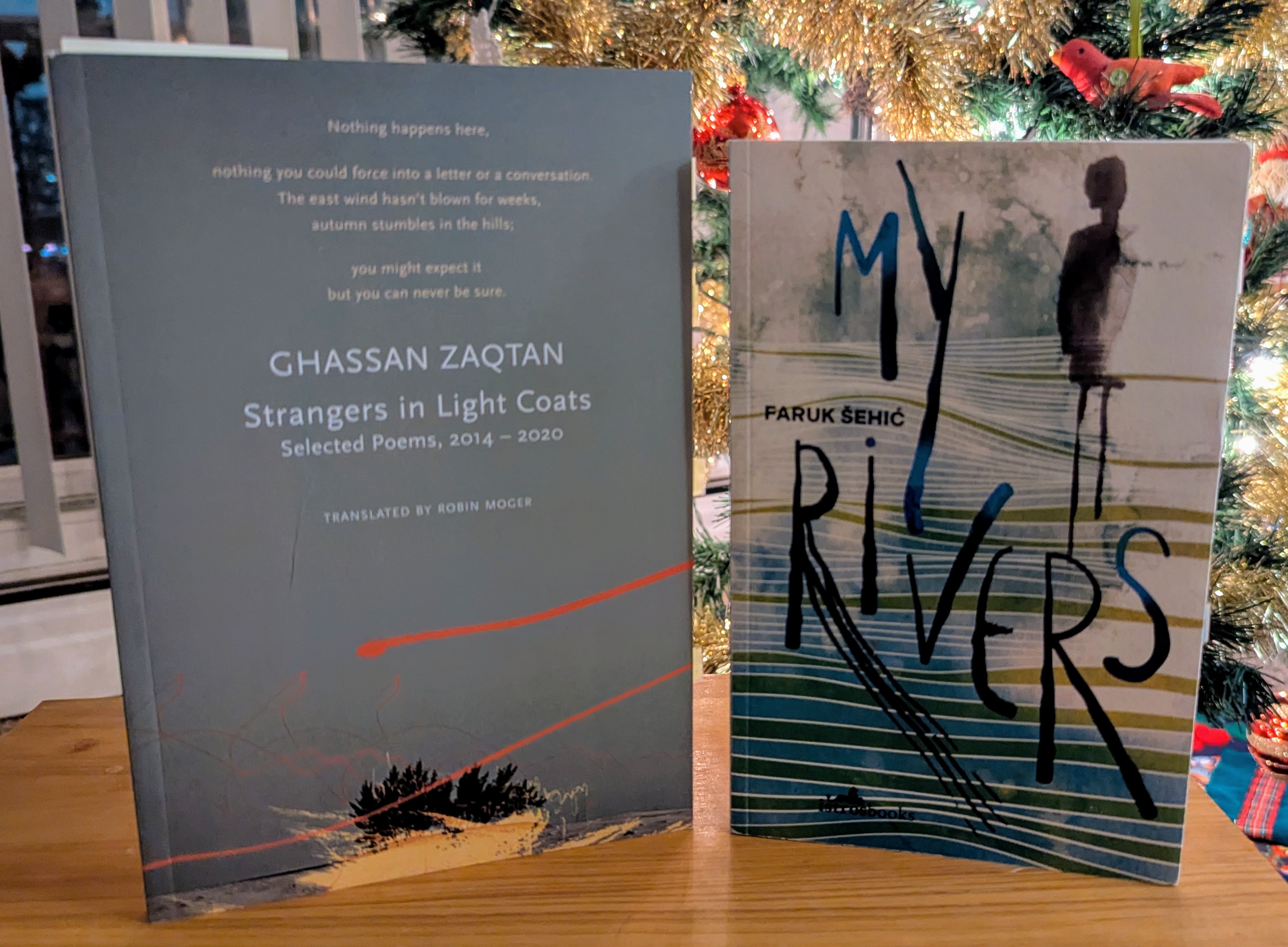
Strangers in Light Coatsevokes by Palestinian poet Ghassan Zaqtan (Arabic, translated by Robin Moger/Seagull Books) is, perhaps, a darker than his earlier collections. Comprised as it is, of poems from recent releases, it actively portrays a world shaped by the reality of decades of occupation and war.

My Rivers by Faruk Šehić (Bosnian, translated by S.D. Curtis/Istros Books) is a collection particularly powerful for its depiction of a legacy of wars in Bosnia/Herzegovina including the genocide in Srebrenica. His speakers carry the burden of history.

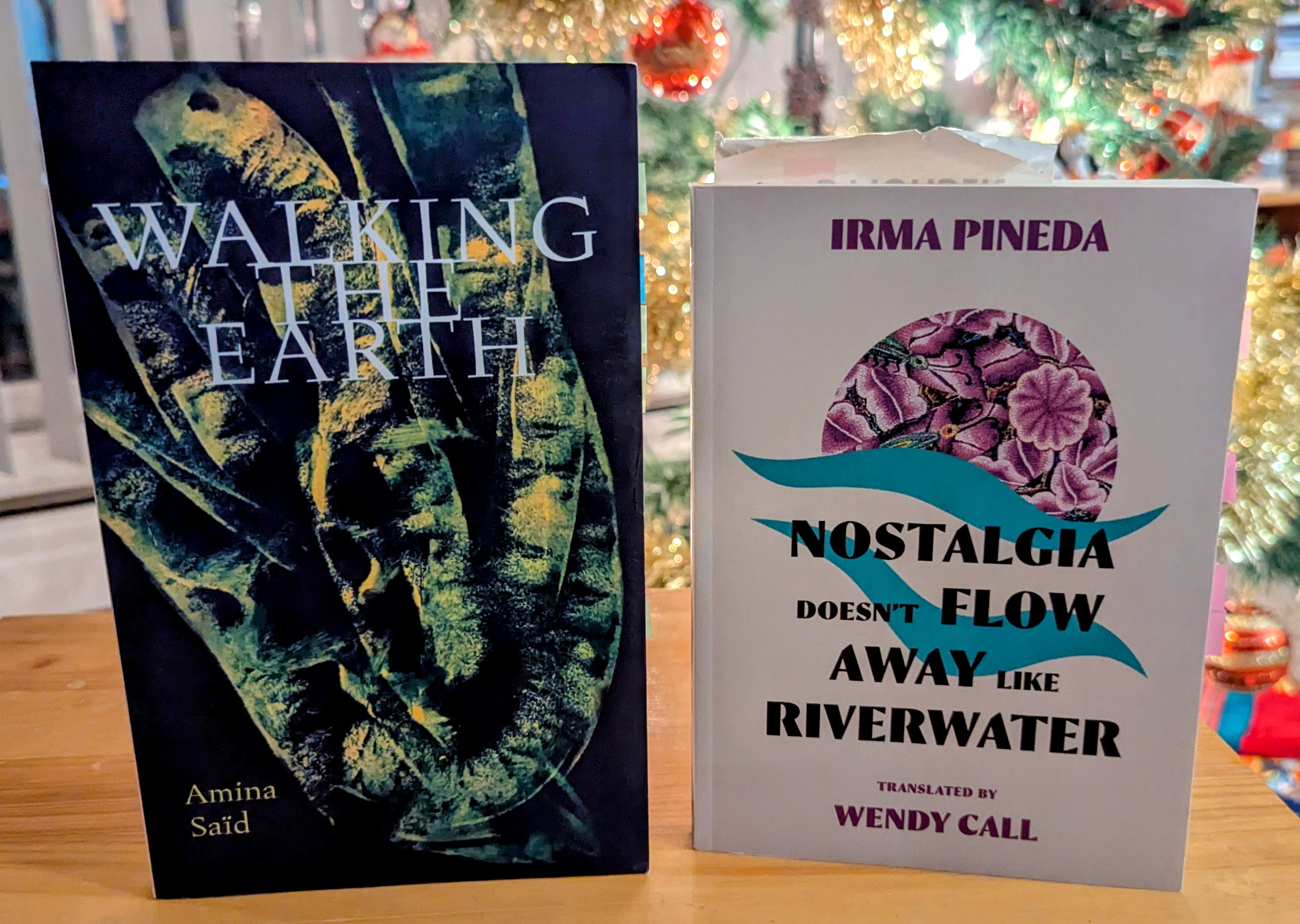
Walking the Earth by Tunisian-French poet Amina Saïd (French, translated by Peter Thompson/Contra Mundum) is such a haunting work of primal beauty that I can’t understand why more of her poetry has not been published in English. Perhaps that will change.

Nostalgia Doesn’t Flow Away Like Rainwater by Irma Pineda is one of a number of small Latin American poetry collection from poets and communities that have not been published in English before. This book, a trilingual collection in Didxazá (Isthmus Zapotec) and Spanish with English translations by Wendy Call (Deep Vellum & Phoneme Media) was particularly special.


Nonfiction:
This year, my favourites include a mix of memoir and essay and a couple of works that defy simple classification.

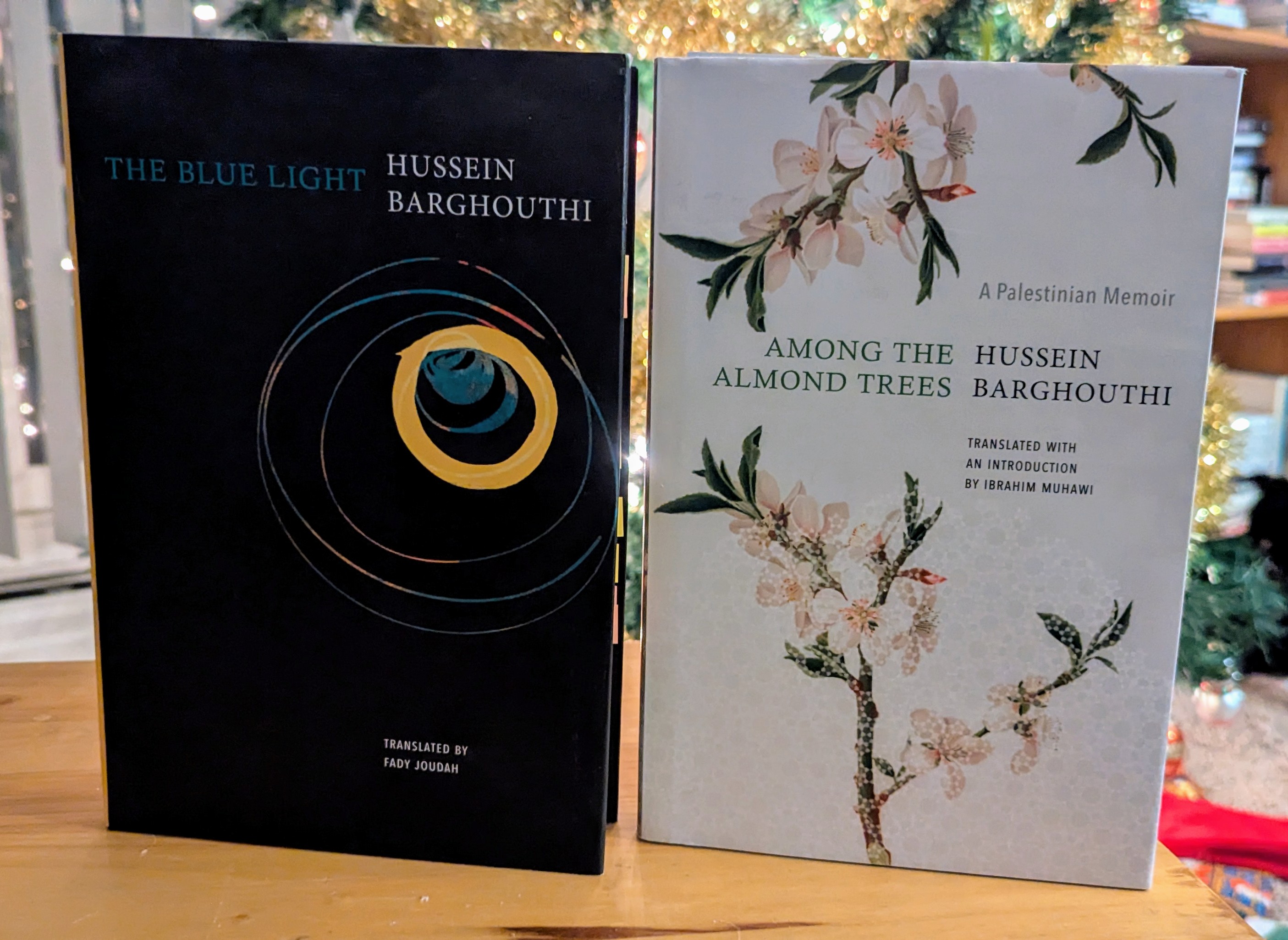
The Blue Light / Among the Almond Trees by Palestinian writer Hussein Barghouthi (Arabic, translated by Fady Joudah and Ibrahim Muhawi respectively/Seagull). Blue Light chronicles Barghouthi’s years in Seattle as a grad student and the eccentric circles he travelled in, whereas Among the Almond Trees is a much more sombre work written when he knew he was dying of cancer. The two books complement each other beautifully.

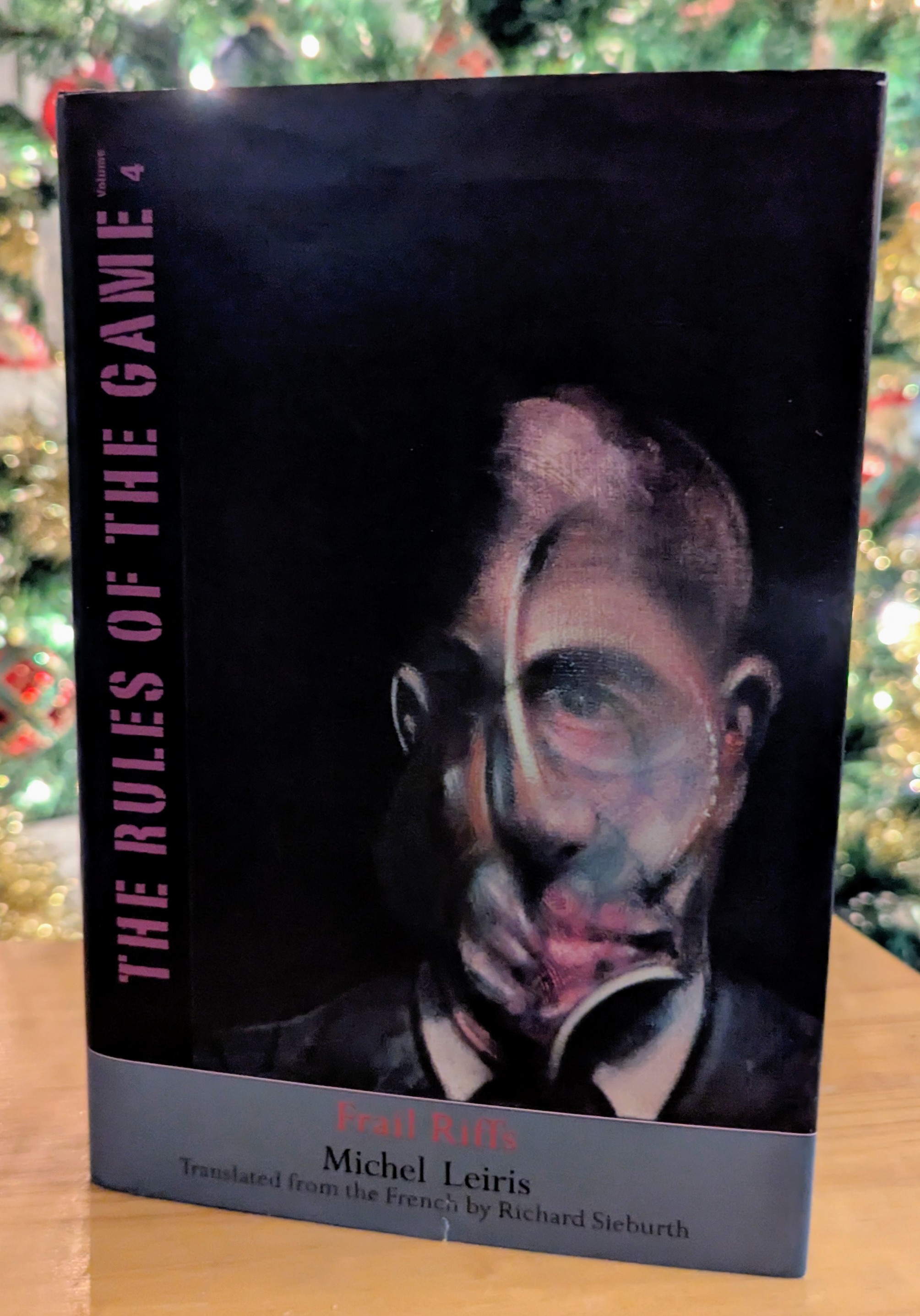
French intellectual, critic, ethnographer and autobiographical essayist Michel Leiris is a writer who means so much to me that the occasion of the release of Frail Riffs (Yale University), the fourth and final volume of his Rules of the Game in Richard Sieburth‘s translation, was not only an excuse to pitch a review but an invitation to revisit the earlier volumes. Definitely a highlight.

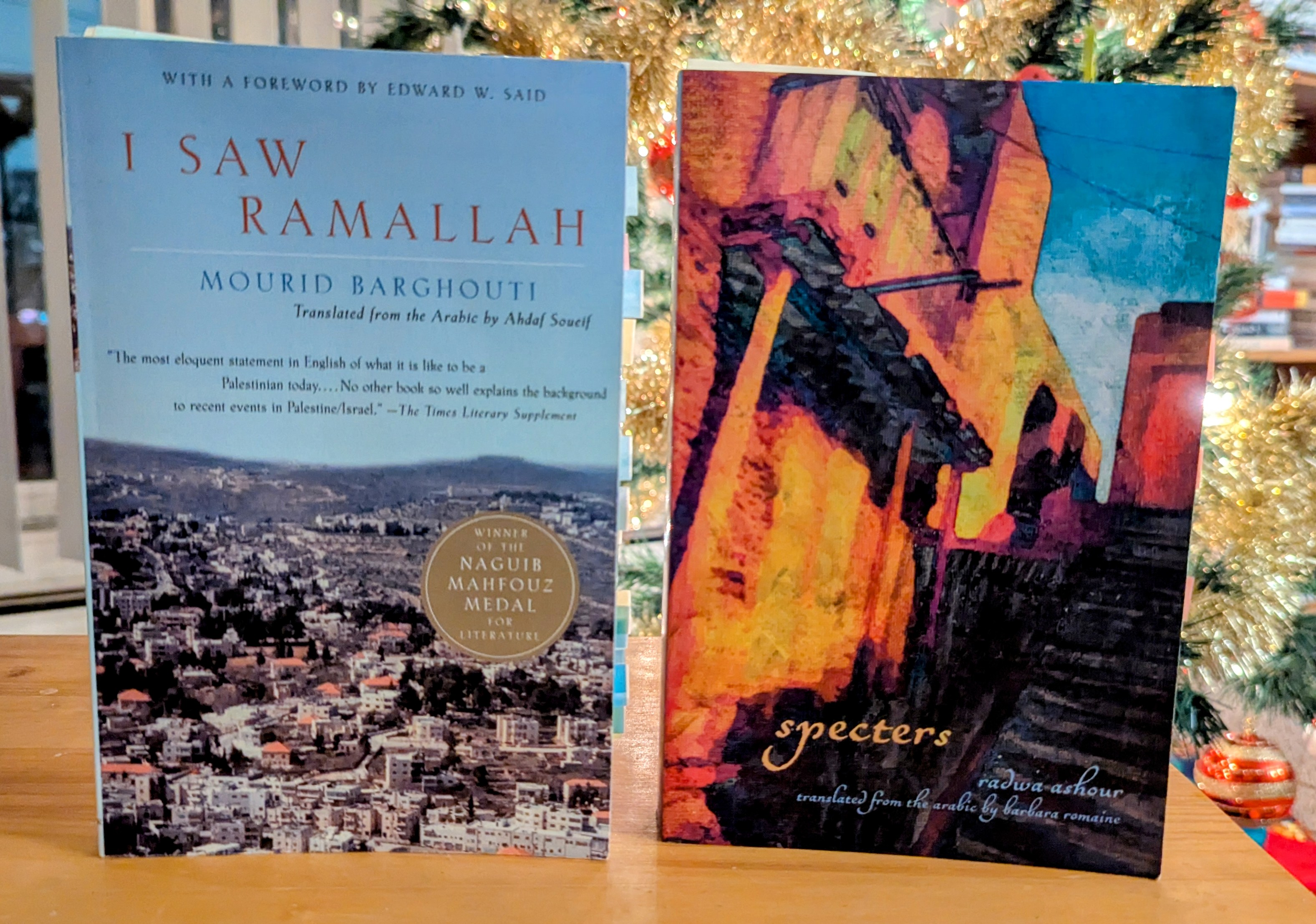
I Saw Ramallah by Mourid Barghouti (Palestinian/Arabic, translated by Ahdaf Soueif/Anchor Books) is a moving memoir detailing the author’s return to his homeland after thirty years of exile. Reading it reminded me that I had a copy of Scepters by his wife, Egyptian novelist Radwa Ashour (Arabic, translated by Barbara Romaine/Interlink Books). This ambitious work blends fiction, history, memoir, and metafiction and I absolutely loved it, but my decision to include it here, like this, rests on the memoir element which complements her husband’s in its account of the many years he was exiled from Egypt—a double exile for him—especially the years in which she travelled back and forth with their young son to visit him while he was living in Hungary.

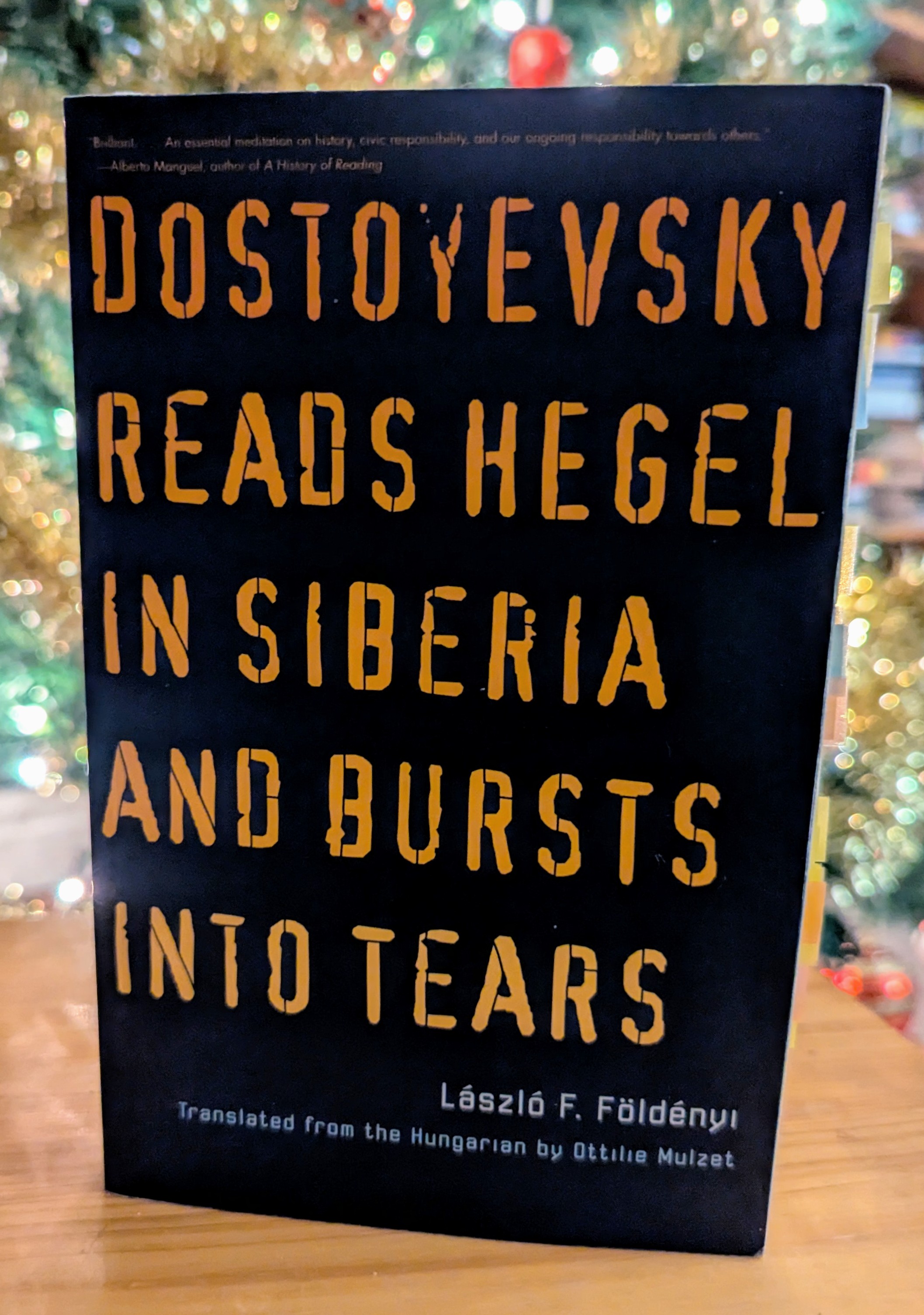
Candidate for the book with the best title, perhaps ever, Dostoyevsky Reads Hegel in Siberia and Bursts into Tears by Hungarian scholar  László Földényi (translated by Ottilie Mulzet/Yale University) was an endlessly fascinating collection of essays exploring the relationship between darkness and light (and similar dichotomies) through the ideas of a variety of writers, thinkers and artists.


Fiction:
As usual, fiction comprised the largest component of my reading and, as I’ve said, I read more relatively longer works than in the past. Normally I have a special fondness for the very spare novella and, of course, my list would not be complete without a few shorter works, including one more pair.

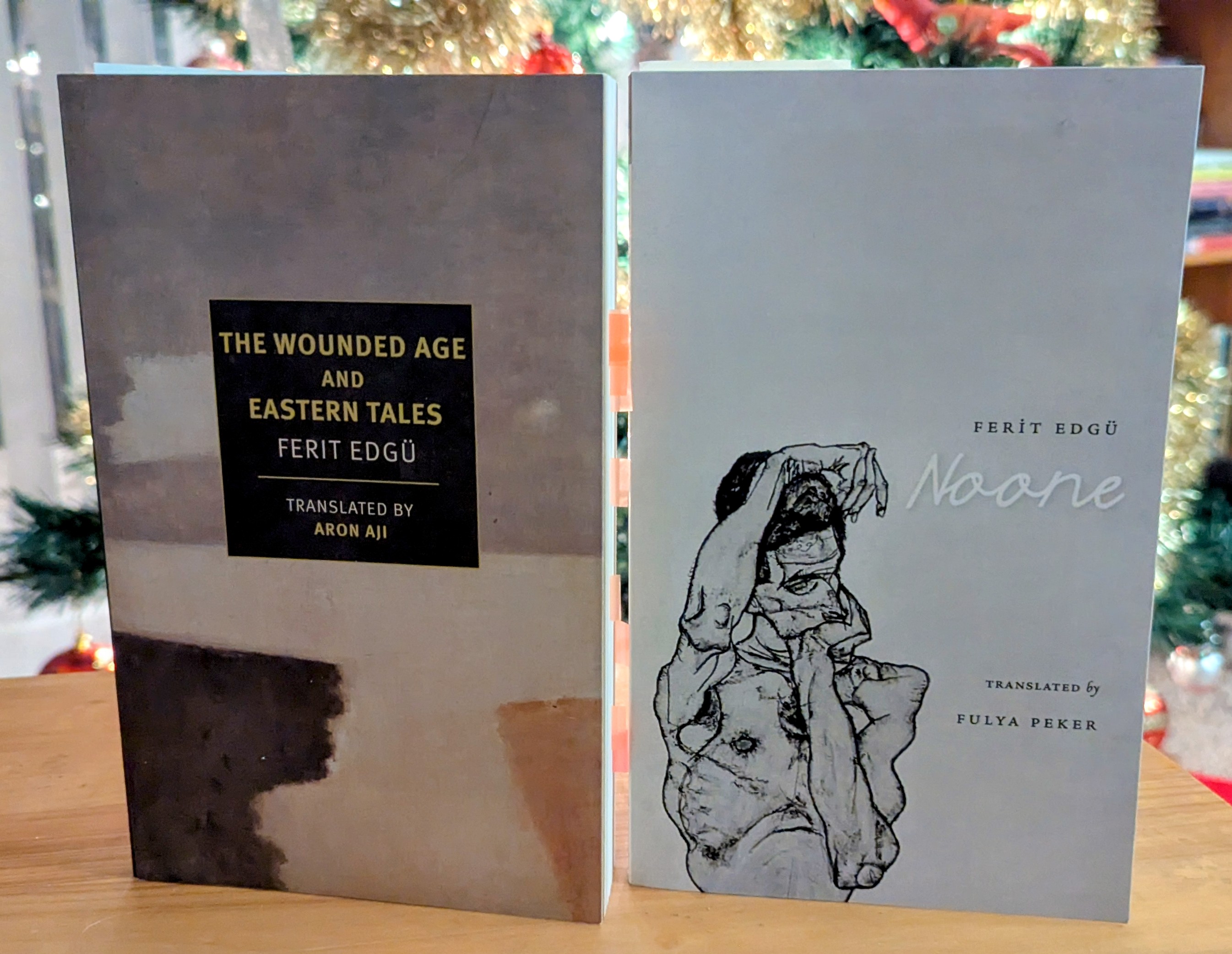
The Wounded Age and Eastern Tales  / Noone by Turkish writer Ferit Edgü—translated by Aron Aji (NYRB Classics) and Fulya Peker Cotra Mundum) respectively—who is sadly one of the writers we lost this year. His work, which draws on the time he spent teaching in the impoverished southeastern region of Turkey in lieu of military service, is filled with great compassion for the people of this troubled area. But his prose is stripped clean, bare, and remarkably powerful.

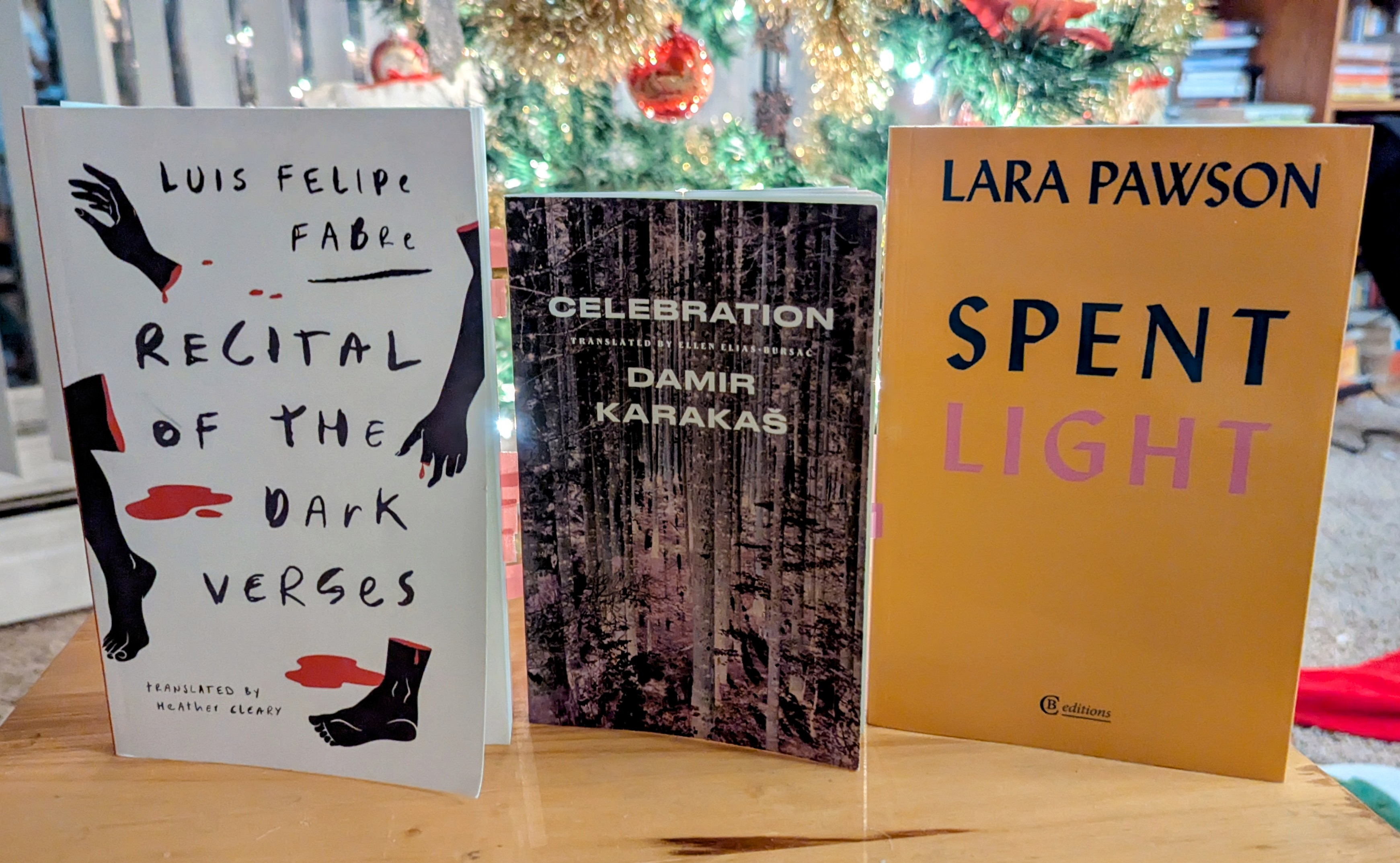
Recital of the Dark Verses by Luis Felipe Fabre (Mexico/Spanish, translated by Heather Cleary/Deep Vellum) is an award wining translation that seems to have garnered less attention than it deserves. This comic Golden Age road trip follows the misadventures of the body of John of the Cross on its clandestine voyage to Seville. Brilliant.

Celebration by Damir Karakaš (Croatian, translated by Ellen Elias-Bursać/ Two Lines Press) is an exceptionally spare, unsentimental novella about the historical forces that pulled the residents of Lika in central Croatia into World War II.

Spent Light by Lara Pawson (CB Editions) is a book I’d been anticipating since reading her This Is the Place to Be. Strange, at times disturbing, often hilarious and always thoughtful, this is one of those books that (thankfully) defies description.

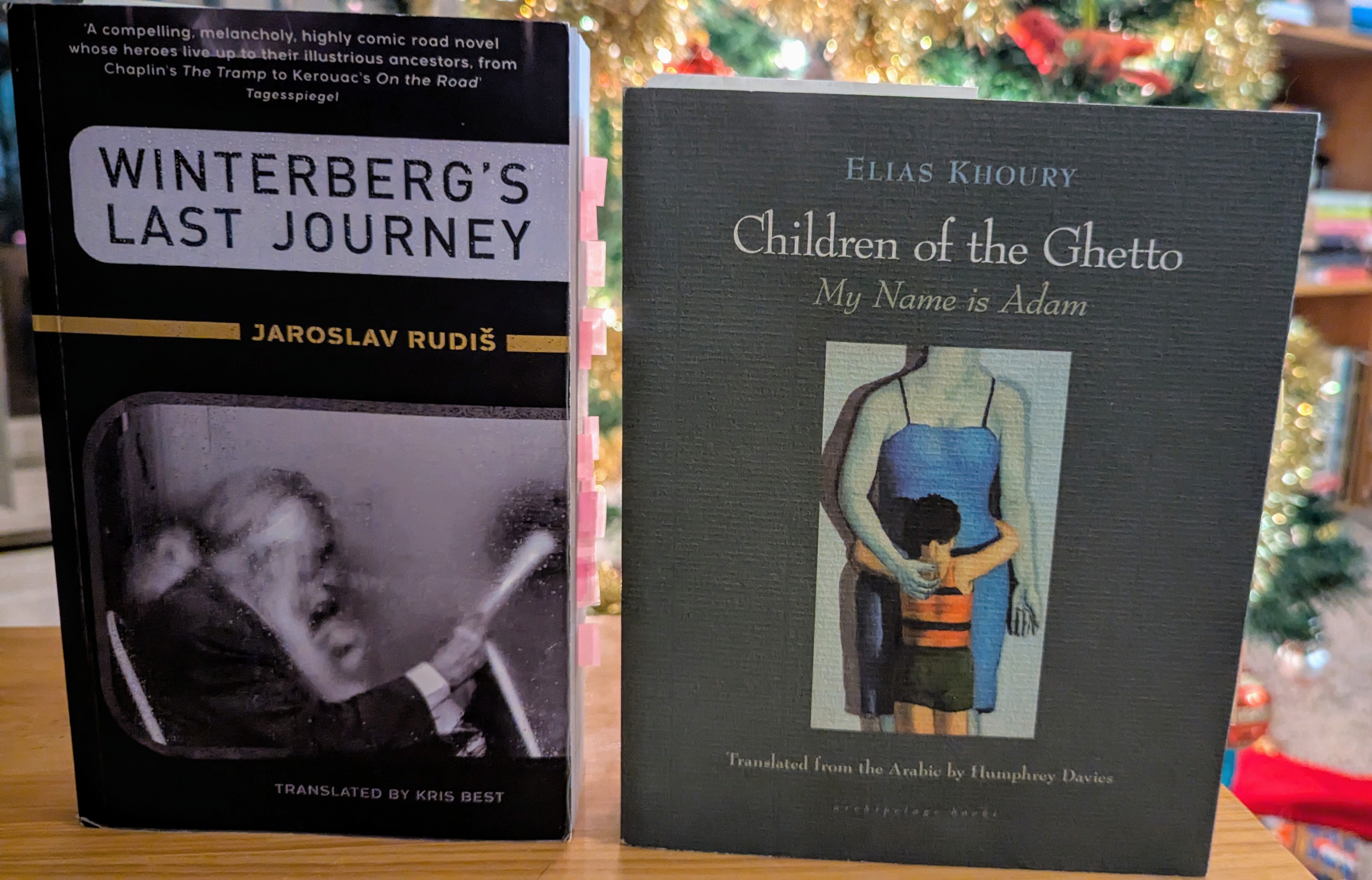
If Celebration is historical fiction at its most spare, Winterberg’s Last Journey by Czech writer Jaroslav Rudiš (German, translated by Kris Best/Jantar Publishing) is the exact opposite. Ambitious, eccentric, and filled with detail, it follows a 99 year-old man and his male nurse as they travel the railways with the aid of 1913 railway guide. What could possibly go wrong?

Children of the Ghetto I: My Name is Adam by Lebanese author Elias Khoury who also died this year (translated by Humphrey Davies/Archipelago Books) is the final Palestinian themed work on my list. This is a challenging and rewarding novel about a man born in the ghetto of Lydda during the Nakba that examines complex questions of identity.

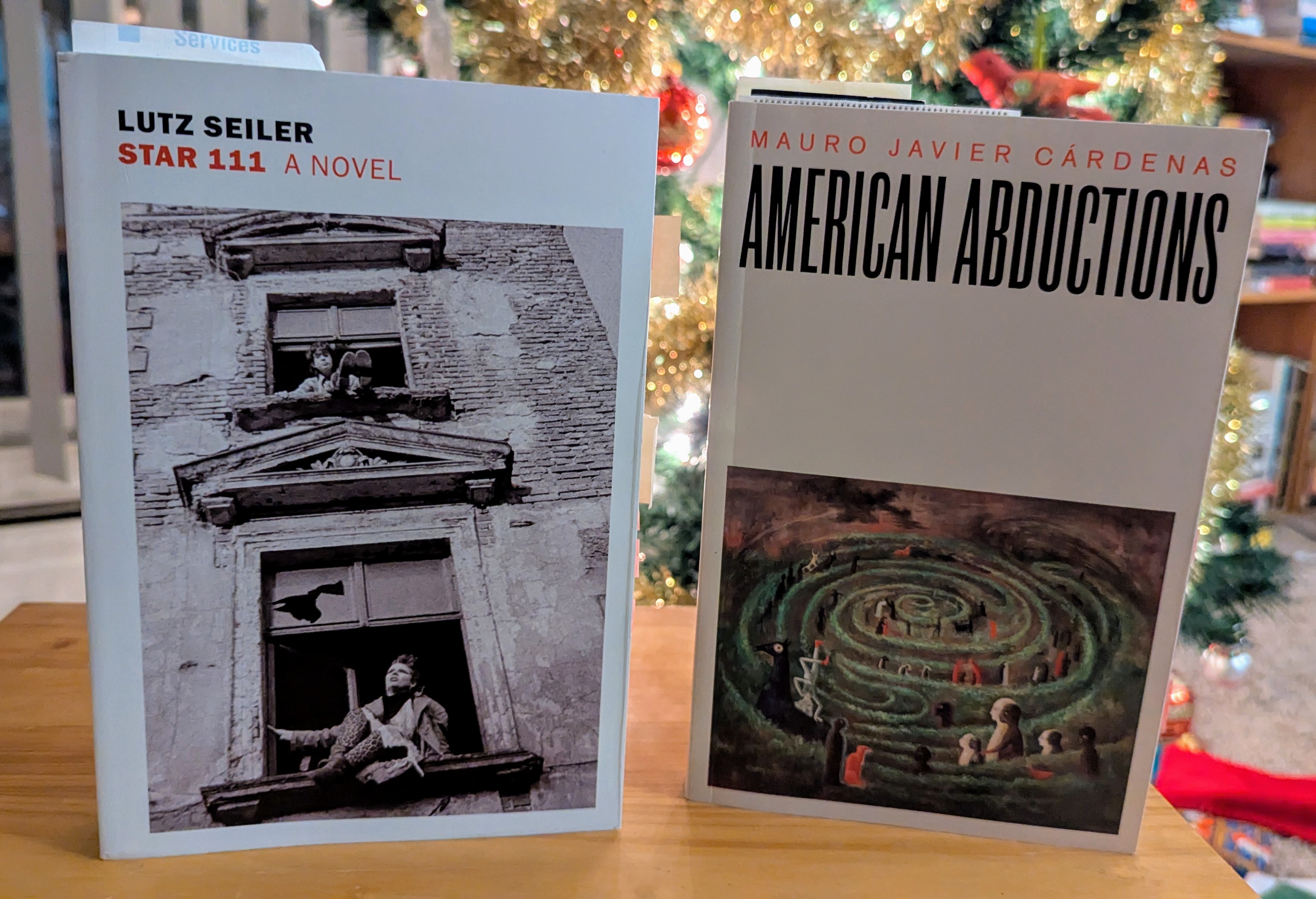
Star 111 by Lutz Seiler (German, translated by Tess Lewis/NYRB Imprints)is the autobiographically inspired story of a young East German would-be poet’s experiences among an eccentric group of idealists in Berlin in the immediate aftermath of the fall of the Wall. I was familiar with Seiler’s poetry before reading this, but I liked this novel so much that it lead me to follow up with his essays and the work of other poets important to him—the best kind of expanding reading experience.

Mauro Javier Cárdenas’ third novel American Abductions (Dalkey Archive) imagines the latest iteration of his hero Antonio in a future in which Latin American migrants are systematically sought out, separated from the children and deported. With a stream of single sentence chapters, he creates a tale that is both fun and uncomfortably too close for comfort. Quite an achievement!

Last but not least, my two favourite books this year are Hungarian:

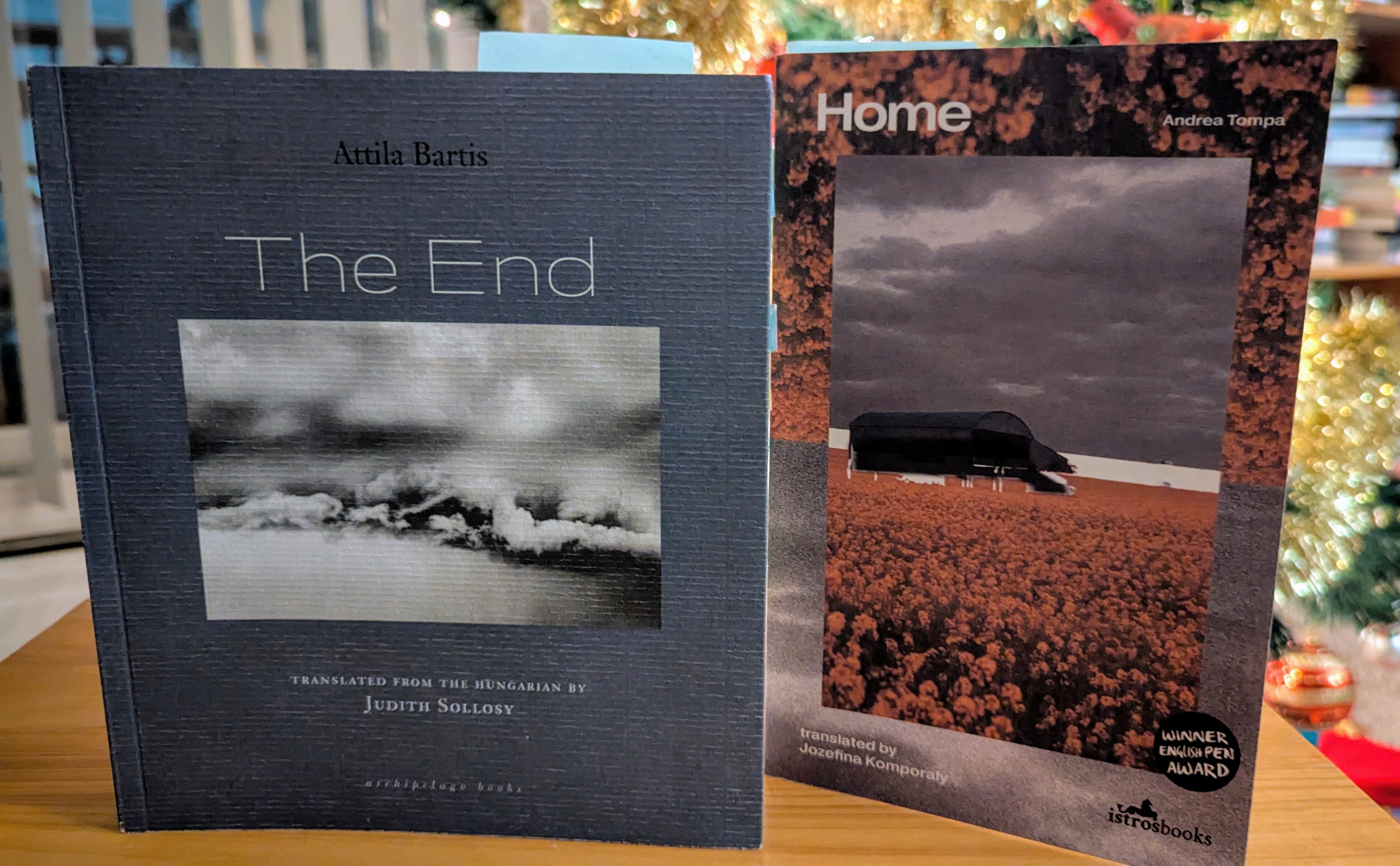
In The End by Attila Bartis (translated by Judith Sollosy/Archipelago Books), a fifty-two year old photographer looks back on his life—his successes and his failures. He reflects on his relationship with his mother, his move to Budapest with his father in the early 1960s following her death, life under Communism and the secrets held by those around him, and the role the camera played in his life. Presented in short chapters, like photographs in prose each with its “punctum,” the 600+ pages of this book just fly by.

Like Attila Bartis, Andrea Tompa also comes from the ethnically Hungarian community of Romania’s Transylvania region and now lives in Budapest. Her novel Home (translated by Jozefina Komporaly/Istros Books) follows a woman travelling to a school reunion, but it is much more. It is a novel about language, about what it means to belong, to have a home and a mother tongue. It’s probably not surprising that my two favourite novels involve protagonists in mid-life, looking at where they are and how they got there. As to why they’re both Hungarian—I suppose I’ll have to read more Hungarian literature in the new year to answer that.

So that is my 2024 wrap up. I’d like to think 2025 will be better than I fear it will, but at least I know there are countless good books to look forward to.

Happy New Year!

And we turn toward the sun once again: Winter Solstice 2024

whoever has kept the night in suspense
for light or for a star

while we were stealing words
from joy and its opposite

in this way day is torn from night
and shadow from our eyes

they open yet again
renewing the pillaged
miracle

(– Amina Saïd, tr. Peter Thompson)

These are dark times. I know that almost sounds cliché at this point after years of widespread illness, growing polarization, rising right wing sympathies, increased intolerance of differences of any nature, profit motivated denial of climate change, and the clear demonstration of a shocking capacity to either justify or look away from horrific violence and injustice, but I don’t know of too many people who can continue to pretend that maybe next year will be better. It won’t, at least not on any global scale. It is far more likely to be worse in ways we can’t even imagine.

I’m not depressed, not at the moment anyhow, but I am fundamentally pragmatic going forward.

When I first started this blog in 2014, I used to mark the solstice—winter in particular—as a sort of touch point. It originated in relation to the date when a mental health crisis reached its zenith, on the job, effectively (although I did not know it at the time) ending my career. On June 20th I was at the height of a devastating manic episode; six months later in the darkness of December, I was in a state of despair. I channeled that into a post marking the shortest day of the year, a short piece of writing that looked back at the unresolved loss and shame of becoming seriously ill at work, something that would I carry to this day without any closure. Mental illness still faces an often unsurmountable stigma. And I even worked in the disability field.

Anyhow, that first winter I was looking forward to rebuilding. The following June I turned the solstice on its head and wrote a post from South Africa where, of course, it was winter. I believed I had come full circle, one trip around the sun, and I was ready to put pen to paper and tell a story I had kept supressed for much of my life. My story. But then, about two weeks after I got home I had a cardiac arrest secondary to a pulmonary embolism and suddenly I realized that my story was being rewritten for me. As it would continue to be revised and edited over the years and through the solstices that have since come and gone. My solstice reflections, regular for the first five years or so and occasional since then, have remained a winter inspired project (considering that two June posts being related to trips to South Africa and Australia respectively were technically winter solstice as well). Here in the Northern Hemisphere there is something about the long nights, the holiday season—which for my small family is quiet—and the approaching new year that encourages a little inward-looking self-assessment.

That spark that comes with the almost immediate shift in the quality of the light as the sun begins its migration northward once more.

Looking back over my past Solstice missives I was often wistful, looking ahead with quiet optimism that the next twelve months would finally see progress toward the goals I set for myself, more travel, more writing. But as the years have passed, the pandemic, a series of disasters, natural and manmade, war in Ukraine, ongoing genocide in Gaza, rising transphobia, and the steady erosion of democratic values and principles combined, perhaps, with getting older has tempered my expectations, if not extinguished them altogether. Close to home this past year has had its difficulties, with several serious medical issues arising with loved ones, and the stresses that come along with challenging diagnoses—or worse, the lack of a clear diagnosis. And there are stresses that continue without resolution. But I have good health and a roof over my head. I’m far from the uncertainty, violence and devastation that so many people face across the globe, and I have the sanctuary of a forested trail to retreat to.

I have yet to seriously recommit myself to writing, but I did pitch and publish a piece outside this site for the first time in years with a review of Frail Riffs, the fourth and final volume of Michel Leiris’ Rules of the Game which was finally released in English this spring. It was actually a wonderful excuse for me to go back and reread volumes 2 and 3 in preparation. I also returned to editing this past summer, taking on the role of Essays Editor for Minor Literature[s], a journal that has published some of my own writing over the years, including the recent Leiris review. It feels good to be editing again, something that I like to think of as having a measure of the satisfaction of writing without having to come up with all the words! And I made my editorial debut at Minor Lit[s] with what turned out to be one of our most popular essays of the year. And for good reason. It is Haytham el-Wardany’s devastating and powerful “Labour of Listening”. It was critical and timely when we published it, and sadly it is still critical and timely now.

Closer to New Year’s Eve I will gather a list of some of the best books I read this year. Until then, stay safe and Happy Solstice.

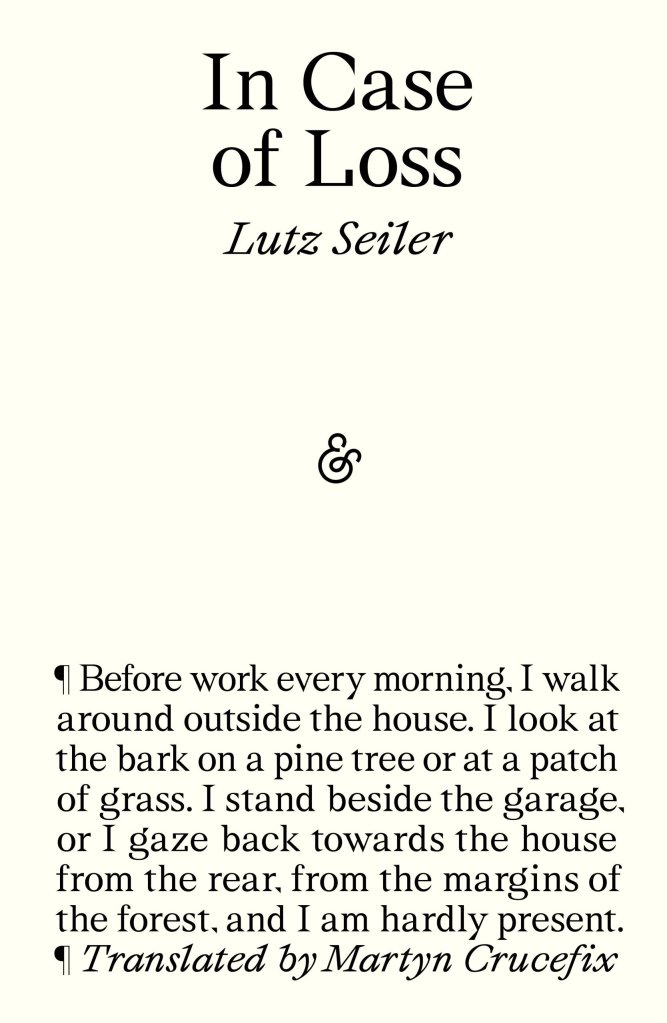
The only possible way: from In Case of Loss to Pitch & Glint by Lutz Seiler (and much more)

Some writers pass through your reading life and move on, perhaps appearing by chance now and then over the years, others ignite a clear desire to read more, if not all, that you can get hold of. That might be a small library of volumes to collect, but for those of us drawn to writers in translation—writers we often discover as a direct result of following a known or trusted translator—it can mean watching and waiting for more work to slowly emerge in English.

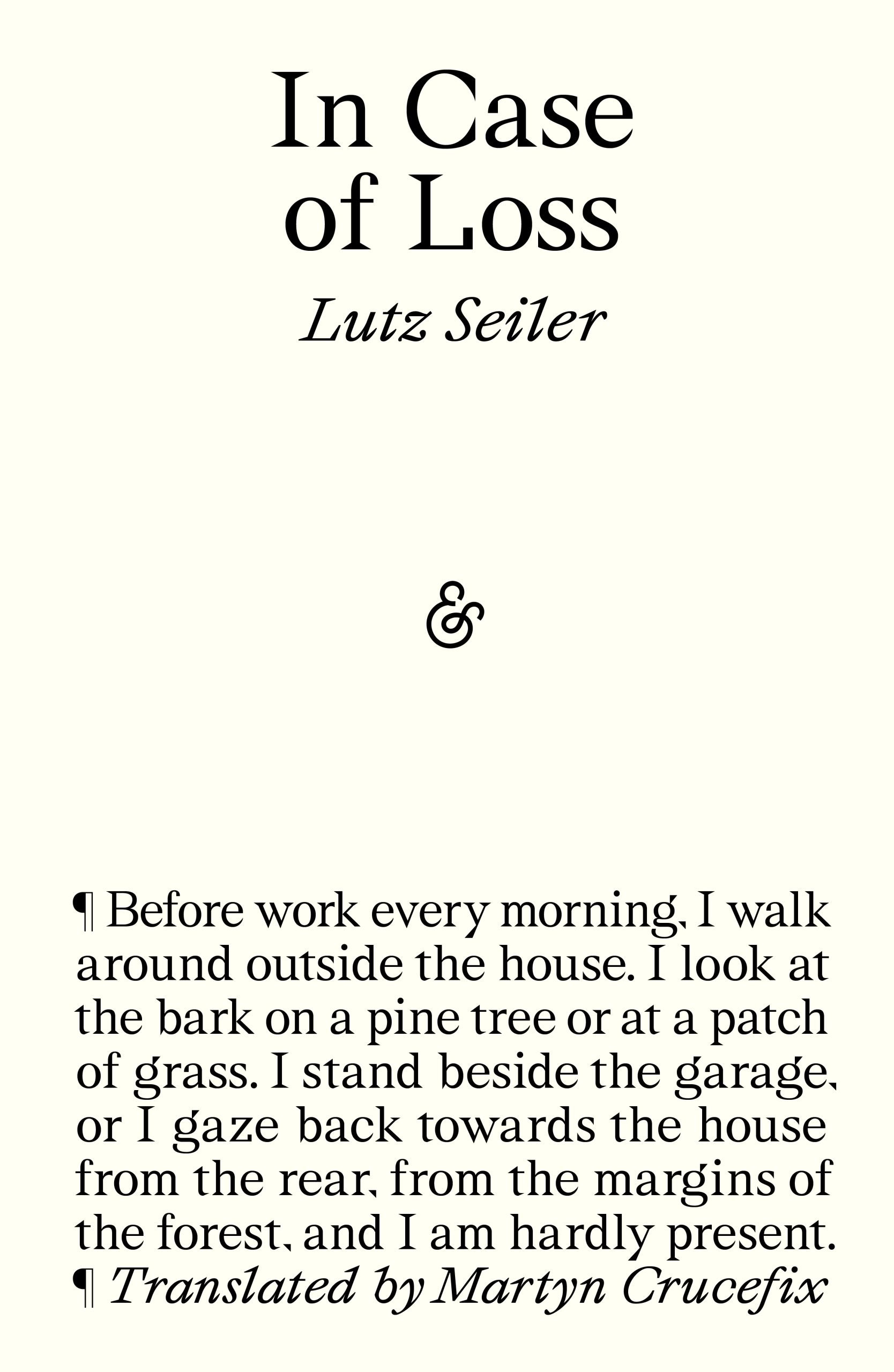
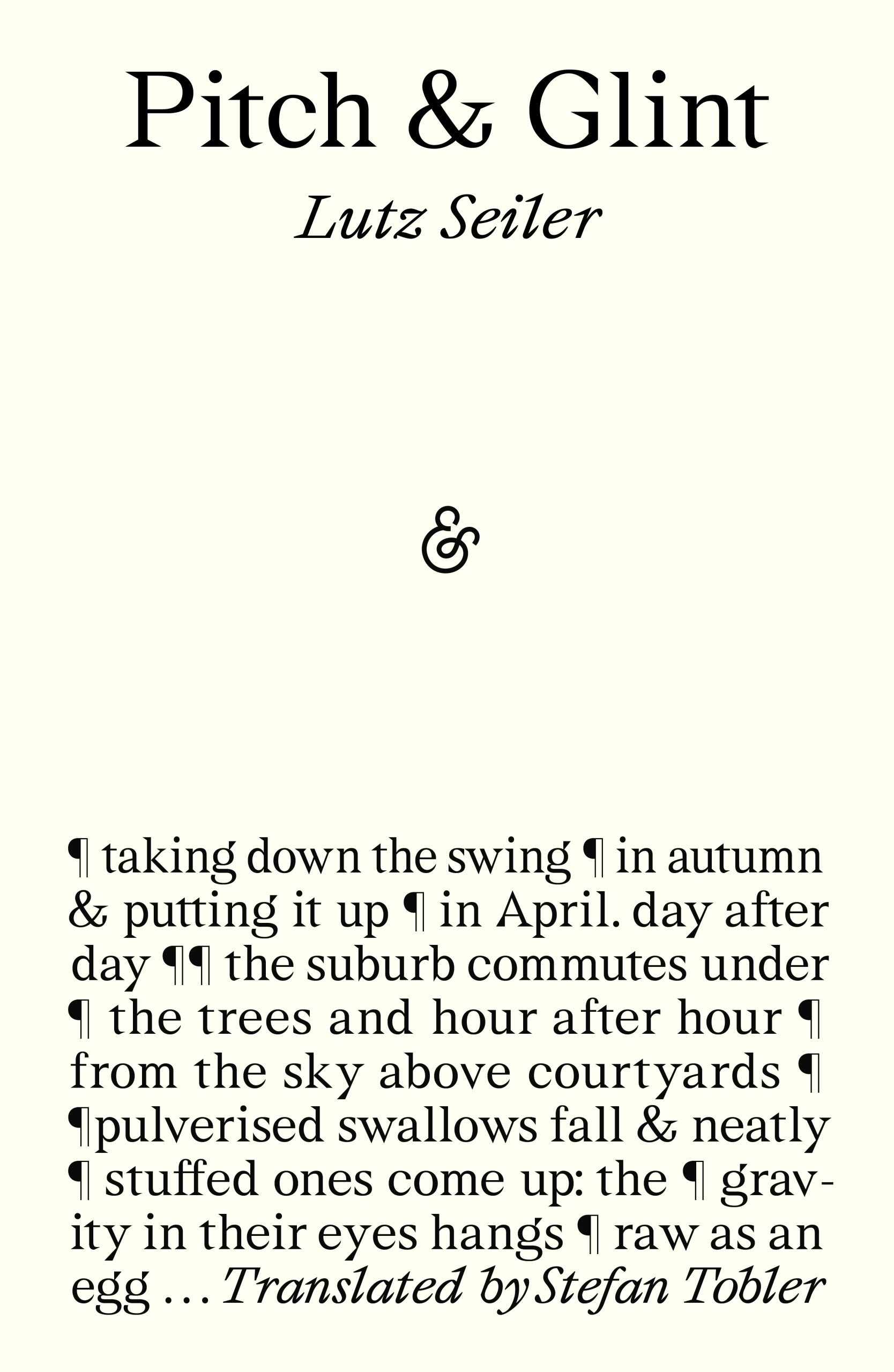
For me, one such writer is German poet, essayist and novelist Lutz Seiler. I first encountered his poetry about two and half years ago through Alexander Booth’s translation of his 2010 collection in field latin. At the time, the only other title available was his first novel Kruso which was, when I first checked, out of stock. Yet, when UK publisher And Other Stories announced they would be publishing Seiler’s debut poetry collection, Pitch & Glint, his second novel, Star 111, and a collection of essays, In Case of Loss, in late 2023, I took note. Then, when I had the opportunity to read Star 111 this year in advance of its North American release from NYRB in October, I quickly set about acquiring his other work. And, as these things go, while reading the poetry and the essays, I was inspired to add work by two of the poets Seiler writes about or honours—but more about that later.
Born in the Thuringia region of the GDR in 1963, Seiler’s poetry is rooted in the rural landscape of his childhood, scarred by years of uranium mining, sensitive to place and relationship to family, as child and as a parent. However, unlike many writers, he had no interest in books or literature when he himself was young. He did not start reading poetry until he was completing his mandatory military service in his early twenties, having already trained as a bricklayer and carpenter. He was certainly not writing, not even jotting the odd observation down, but something was brewing. As he says in his essay “Aurora: An Attempt to Answer the Question ‘Where is the Poem Going Today?’”:

Yet a good ten years later, I wrote poems that had been, in that earlier period, when poetry did not feature in my life, gathering and storing their subject matter, their materials. Doubly hidden from me at the time, clearly the poems had been, even then, making their way towards me. What is different these days is that I have become more conscious of the signs of a poem being on its way. I am aware of what situations, materials and substances it might respond to, what it is likely to ingest—for later use.

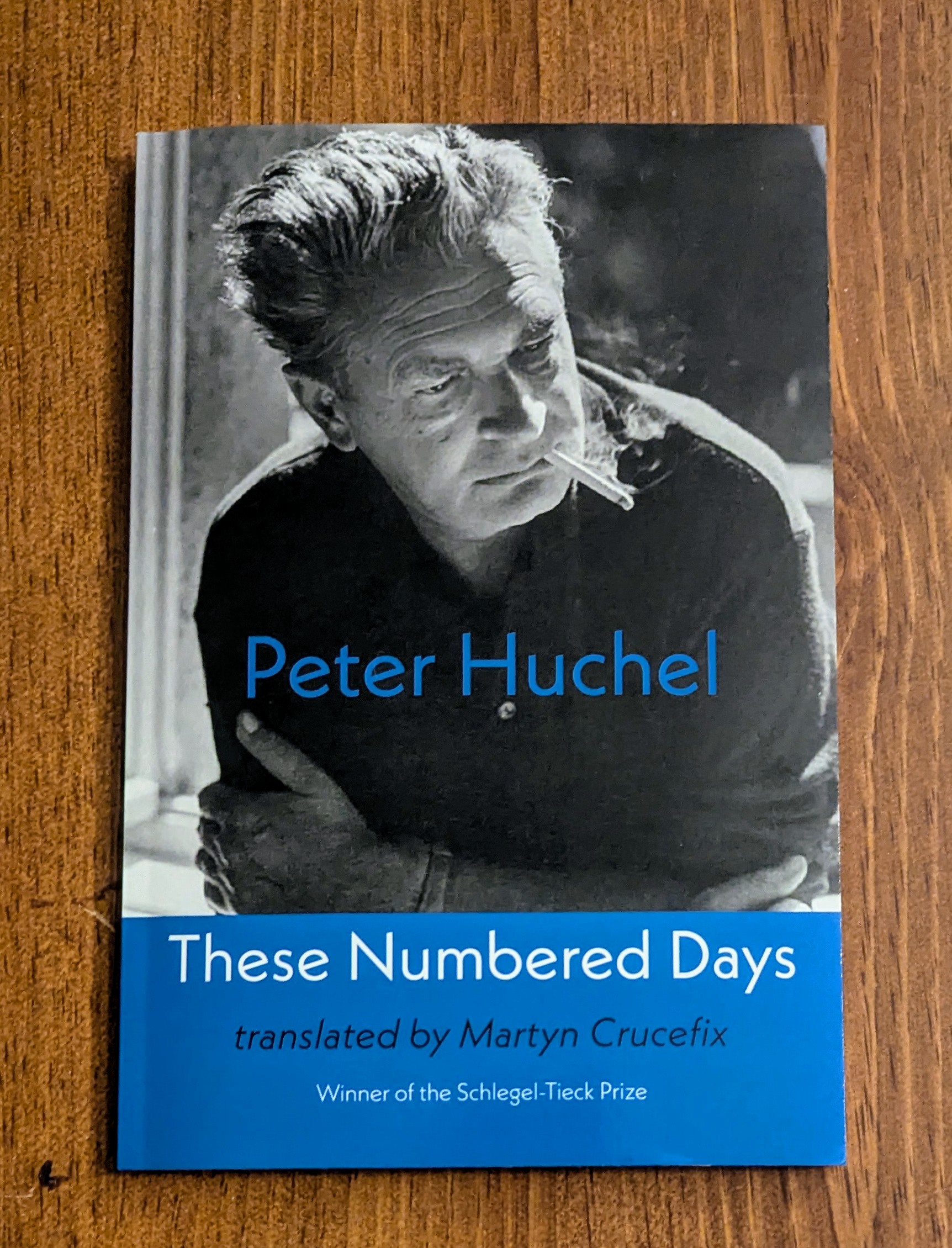
For a poet who came to literature somewhat unexpectedly, Seiler’s writing about writing, and about the poetic art and process is excellent, presumably of interest to other poets, but also, and perhaps more critically, for those of us who enjoy poetry but sometimes feel inadequate to examine a poem without a strong literary vocabulary and the requisite coursework (assumed to be) required to read and write it. In Case of Loss contains several essays about the work of other poets. One, Peter Huchel (1903–1981), was new to me. I was aware that Seiler is the custodian of the Huchel House in Wilhelmhorst near Berlin, but knew nothing of Huchel himself, one of the most an important German poets of the post-war era who ended up running afoul of the government of the GDR and was eventually allowed to migrate to the West. The title essay is an account of Seiler’s first impressions of the house itself after breaking in with Huchel’s widow’s blessing and his coming into possession of a notebook the poet kept all his life in which he recorded images, metaphors, lines, and tentative sketches, all categorized by theme. The manner in which Seiler traces some of the formative elements that will, often years later, appear as shadows or echoes in a finished piece is fascinating and a testament to the gestation period a poem can have. Of course, I wanted to read more, so I sought out These Numbered Days, Huchel’s 1972 collection, released in 2019 in an award winning English translation by Martin Crucefix (who is also the translator of In Case of Loss). His poetry often draws on the landscape of his youth for atmosphere frequently in concert with mythological, historical, and Biblical images to create crisp, even chilling poems. Although they are generally spare, one can sense that they have been carefully shaped and honed over time, each word or phrase carrying much weight, very often political—something confirmed by both Seiler’s insights, Crucefix’s notes, and Karen Leeder’s Introduction.
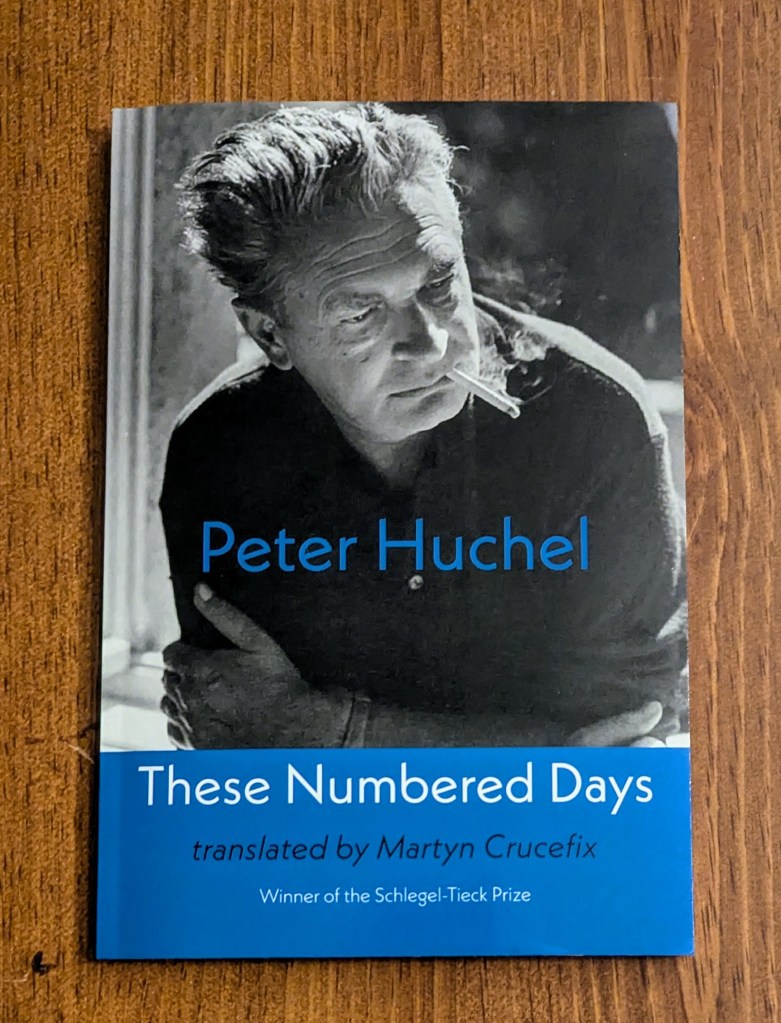
At the edge of the village the wind
flung its ton of frost
against the wall.
The moon lowered a fibrous gauze
on the wounds of the rooftops.

Slowly the emptiness of night descended,
filled with the howling of dogs.
Defeat sank
into the frozen veins of the country,
into the leather-upholstered seats
of old Kresmers in the coach sheds,
between the horse tack and grey straw
where children slept.

(Peter Huchel — from “Defeat”)

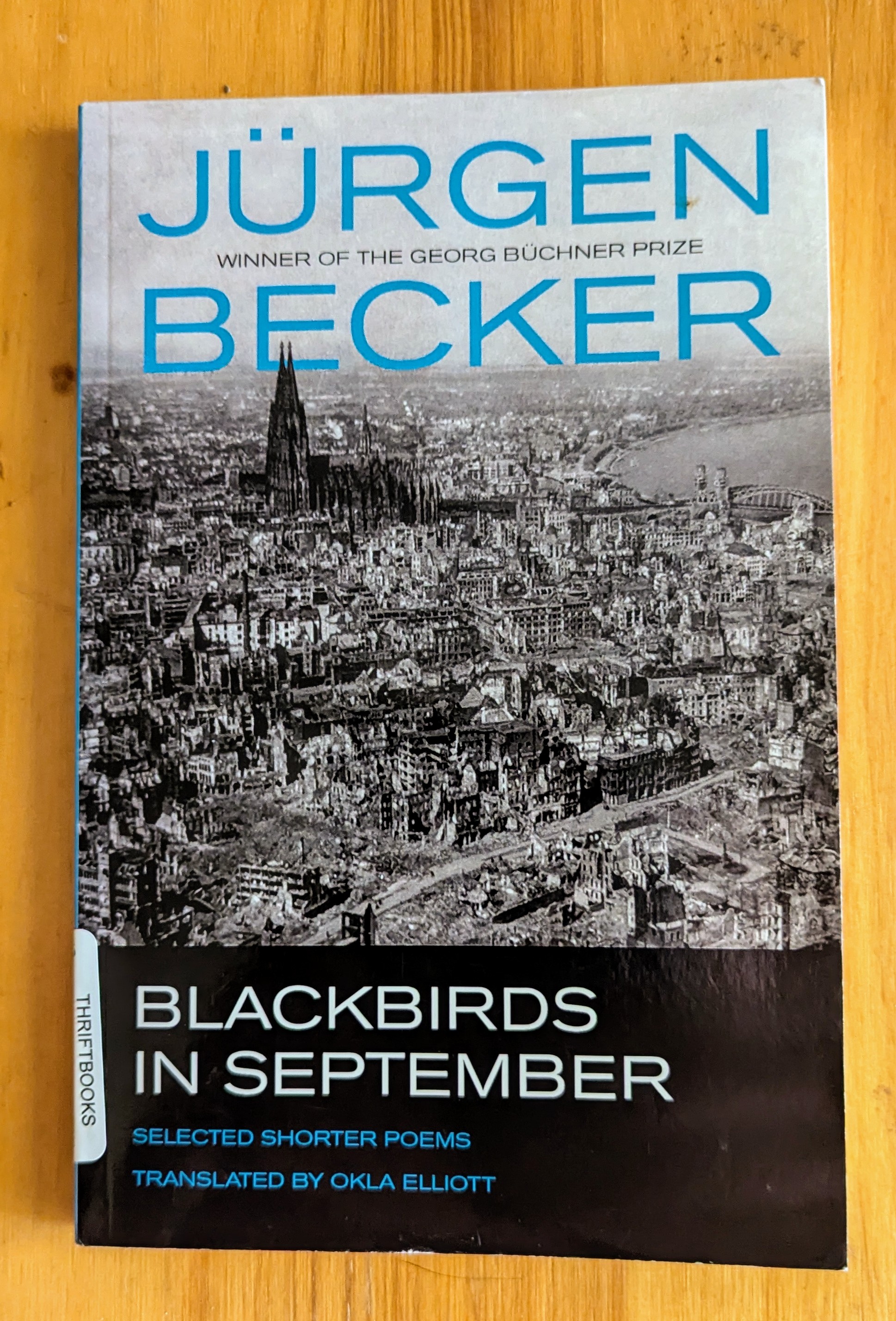
In addition to an unusual back to front reading of a book by Ernst Meister, the other poet Seiler devotes an essay to is Jürgen Becker. I had already read Becker’s fragmentary poetic novel, The Sea in the Radio, but a dedication to the poet (who very recently passed away) in Seiler’s collection Pitch & Glint, called to mind a collection of selected shorter poems, Blackbirds in September, which I was able to track down and read alongside the essay “’The Post-War Era Never Ends’: On Jürgen Becker.” Here Seiler takes a more personal approach acknowledging Becker’s influence and his own friendship with the older established poet. He traces his own process of learning to read and appreciate Becker’s poetry. Born in Cologne in 1932, Becker was a member of Group 47, the organization formed to promote young German writers after the war. He employed an experimental, open form of writing with an emphasis on landscape and the persistence of memories of the war in German land and history. His language tends to be spare and his poems have a calm, light feel, but that is only the surface.
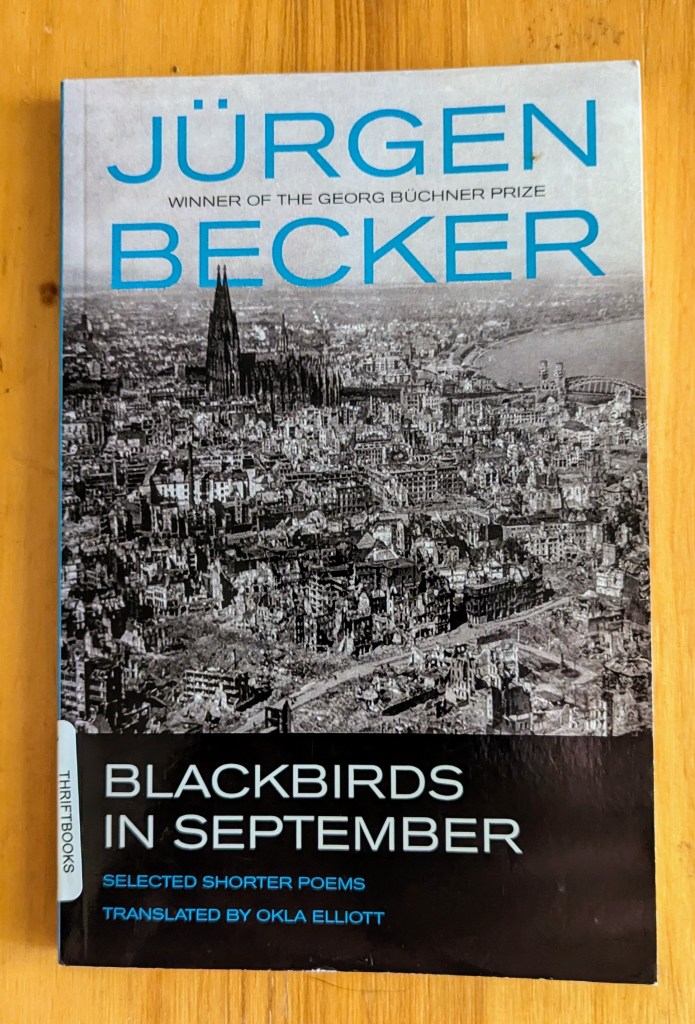
But the landscape is rather quiet.
Invisible the destruction, if in fact
there is destruction.

And the time is passed
which the subsequent, the subsequent time produced.

But you never speak of Now.

Probably in the summer. At that time of year
we remember. Fence posts follow the paths,
or turned around, all of it belonging
to the landscape . . . who owns it? The landscape
leads into landscapes, from the visible ones
to the invisible ones which await us.

(Jürgen Becker — from “A Provisional Topography”/translated by Okla Elliott)

Other essays of particular interest in this collection (which gathers a selection of Seiler’s nonfiction from across twenty-five years) include “Illegal Exit, Gera (East),” a return in memory and in more recent years to a landscape that is being transformed and remediated, and “The Tired Territory” which begins as an exploration of the history of uranium mining in his home state, but turns into a meditation on the distinct poetic sensibilities that he had to define for himself after what he describes as the difficulties encountered in his “brief  career as a doctoral student in literary studies.” The categories that hold his fascination are intangible: heaviness, absence, tiredness. Understanding this for himself is essential:

Writing poetry: a difficult way to live and, at the same time, the only possible way.

One aspect of all this is that the poem engages specifically with what cannot be verbalised. The mute and non-paraphrasable and its unique, existential origin: the particular qualities of any poem arise from these two subtly interwoven elements. The poem travels towards the unsayable, yet this is a movement without an end.

It is not only the reading and writing of poetry that slips into Seiler’s essays—to a greater or lesser extent—but the final piece tackles his slow transition to prose. “The Soggy Hems of His Soviet Trousers: Image as a Way into the Narration of the Past” chronicles the year he moved with his wife and children to Rome for a period of dedicated novel writing. He dragged along boxes and boxes of books, research and paraphernalia he had gathered in preparation for the writing of his first novel. He’d planned to draw heavily on his own experiences moving to Berlin in the aftermath of the fall of the Wall and the more he describes his intentions, the more it sounds like what would eventually become his second novel, Star 111. But it’s only 2011 and our would-be novelist is staring at an empty page day after day. It is not until he finally gets out of his room, into the city, that everything changes. A suggestion that he write a short story set in a location he had not previously considered soon conjures forth an image so strong that ten pages become 500 and he has what will ultimately become his first novel Kruso.
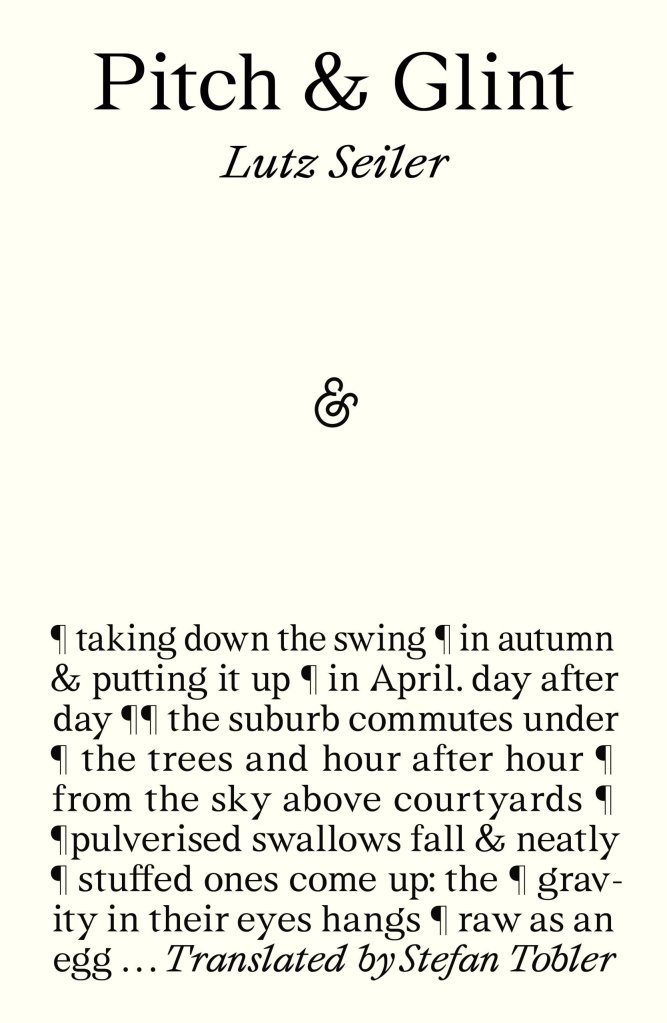
Finally, if I return now to own Seiler’s poetry, in field latin and his debut collection from 2000, Pitch & Glint, more recently released in Stefan Tobler’s translation, many of the allusions in individual poems become clearer in light of having read his essays and the autobiographically influenced novel Star 111. But neither is necessary. Seiler’s poetry has a natural appeal. I wrote about in field latin here, and this earlier work (ten years separate the two volumes) is likewise rooted in the East Germany of the poet’s youth—the wildness, the strict schools, the land with its slag heaps and detritus of mining. Yet, for Seiler, the sound and rhythm are critical, as is the construction of images that move beyond the mere biographical. Darkness, frost, echoing footsteps recur. You can feel the chill:

wind came up the border
.   dogs were rising on
their delicate branching skeletons

whistled a bewitching witless
wanderlied. the snow came in
& tore the iron

curtain of their eyes, a
blunted gaze towards the hinterland
and made plain that we do.

(— from “in the east of the land”)

Seiler’s characteristic use of lower case letters and ampersands (especially striking in German where nouns are capitalized) adds to the mood and intensity of his poetry. One of the blurbs on the back of Pitch & Glint describes it as “a real-world Stalker with line breaks.” That captures the feel well.

The beauty of reading a number of works—nonfiction, fiction and poetry— that intersect like this is that each individual experience is heightened. Seiler’s poetry and fiction easily stand on their own, but the essays add an extra dimension. To be fair, one’s enjoyment of this collection may depend on whether one is a poet, or interested in poetry and the process of poetic inspiration/creation, or familiar with his other work. Nonetheless, his essays are thoughtful with a very strong personal flow and reflect the mind and experiences of a man for whom poetry is central to his very existence—in his memories, in his specific creative pursuits, and even in the everyday act of taking his daughter to dance lessons or son to football practice.

In Case of Loss and Pitch & Glint by Lutz Seiler are translated from the German by Martin Crucefix and Stefan Tobler respectively and published by And Other Stories. These Numbered Days by Peter Huchel is translated from the German by Martin Crucefix with and Introduction by Karen Leeder and published by Shearsman Books, and Blackbirds in September by Jürgen Becker is translated from the German by Okla Elliott and published by Black Lawrence Press.

Other titles mentioned and reviewed earlier on this site are Star 111 (And Other Stories/NYRB Imprints) and in field latin (Seagull Books), both by Lutz Seiler, translated from the German by Tess Lewis and Alexander Booth respectively.
Some thoughts about living with mental illness and a few books that, in my experience, address the matter well

May is Mental Health Awareness Month, at least in Canada and the US, and this morning I awoke to find an essay in my inbox titled “The Last Great Stigma” by Pernille Yilmam. This Aeon article addresses the workplace discrimination that workers with mental illness experience  claiming that it “would be unthinkable for other health issues,” and asking if it can change. As the piece demonstrates, this issue is widespread and can take many forms. The author explores ways in which misconceptions and concerns might be addressed. For me it is far too late. Next year I will have been out of the workplace for ten years—more than ten years earlier than I ever anticipated—because even if you are open about your diagnosis, a serious breakdown on the job (no matter if dysfunction at the job itself was a significant factor) is something your career might never recover from.

I’ve been thinking about this a lot lately. And about how mental illness has shaped my life—as someone with bipolar, as the parent of an adult child living with serious anxiety and addiction, and as a former professional in the disability and mental health field. Yet, like so much in my many decades on this planet, I still don’t know how to make sense of it all. When I was first diagnosed back in my thirties I read all kinds of books about my condition (against the advice of the psychiatrist I saw just once after discharge who told me not to read anything or go to any support groups), but after a while I moved beyond books. Life was busy. I had two children and, before long, I was a single parent facing major personal changes. By the time I finally sought out peer support, I attended one group and by the next month I was co-facilitating! I ended up finding most of my real support through volunteering and in my professional positions.

Then it was suddenly over. With no closure. The subsequent years have been marked by great trauma, loss, and unexpected adventures. Also, lots of reading and, here and there, a little writing. But, truth be told, mental illness can be very isolating. It skews one’s ability to gauge social interaction—Did I say too much? Too little? Why am I so nervous?—and often makes it seem easier to avoid meeting up with others or trying to cultivate friendships. Alone is safer. And the longer one’s life becomes, the more entangled the varied threads that make us who we are become, and the more difficult it is to trace back through years and attempt to untie knots that have formed and reconnect fibres that have fallen loose along the way.

My first major episode of mania occurred in my mid-thirties. It was not disconnected from other things happening in my life at the time, so it crept up on me, gradually intensifying existing tensions and distorting my sense of reality. I was, by the time I was admitted to hospital, in full-blown psychosis. Oddly, I sensed that what I was experiencing was psychological in nature, but in true manic-depressive style I figured I could ride it out. And, of course, those around you also sense something is wrong but don’t know what to do. From the inside, your thought processes are so accelerated and obsessive that perspective is lost; it becomes a matter of survival and it can get ugly. When it’s over, some say that a kind of amnesia clears your memory, but that’s not exactly true. You are left with fragments, some very vivid, a great deal of shame, and no way of knowing how others saw you when you were at your very worst.

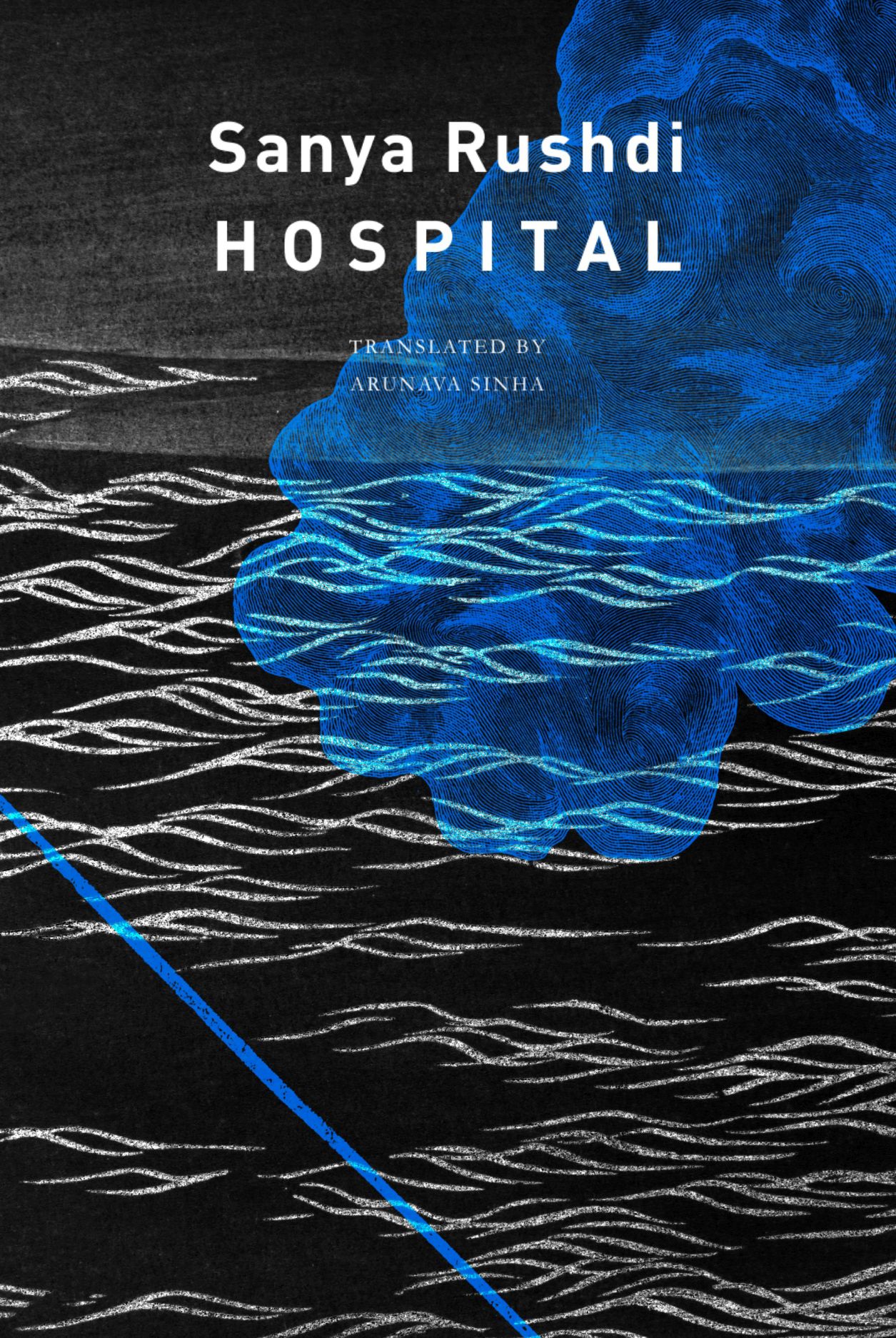
It’s a difficult thing to articulate, but this where we come to books. More than any fictionalized account of madness and psychosis, Hospital by Bengali-Australian writer Sanya Rushdi (translated by Arunava Sinha) manages to recount the experience of psychosis from the inside with a remarkable sense of self-awareness, arising, I can only imagine, from the author’s own multiple experiences with the condition. This critically acclaimed novel captures the strange internal boundaries that the protagonist (also named Sanya) tries to negotiate in a manner that resonated with me. As I noted in my review:

Sanya’s narrative is restrained and oddly lacking in affect, even when she describes her tears and outbursts. She is continually trying to observe herself and logically reason her way through whatever arises. However, her reasoning is often disjointed and confused. She is constantly seeking symbols of significance, spends a lot of time trying to figure out the secrets behind the thoughts and actions of others, questions why certain song lyrics keep coming to mind, and fitfully attempts to draw strength from her faith.

I recognize this well. The thing is, whether one is manic or depressed, psychotic or not, the tendency is to assume that whatever is happening to you is you, not a physical illness that is directly affecting your mood and your perceptions of the world.

When it comes to poetry, it is well-known that many famous poets have, over the years, struggled with mental illness, often writing from within the depths of madness and, sadly, frequently ending their own lives. I am drawn to such poetry but admit to finding much of it painfully difficult to read. Too close, too unfiltered at times, it must be read slowly. And then there is the genius of madness question that comforts some of us and angers others, but in the interest of understanding mental illness I wanted to call attention to a poetry collection I read several years ago that I think of often.

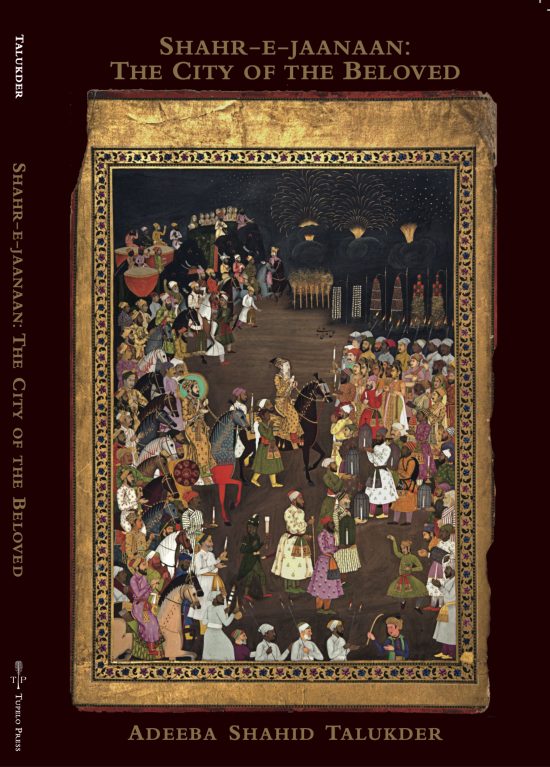
Shahr-E-Jaanaan: The City of the Beloved by Pakistani-American poet, translator and ghazal singer Adeeba Shahid Talukder was a book that came to my attention in the early months of the pandemic, a background that coloured my reading. I was intrigued by this young woman who draws inspiration from the greats of Persian and Urdu poetry and the late Kashmiri-American poet Agha Shahid Ali to explore traditional and contemporary themes alike, from the conflicts between an American raised daughter and her immigrant family to the poignant drama of Laila and Manjoon. Yet, in spite of a clear reference to a hospital in an earlier poem, it was not until I hit the title sequence, that I began to sense something more might be at play. In my review I report that the sequence begins:

At December’s end Benazir died
in a suicide attack.

.                              Men burned

tires, cars, banks,
petrol pumps and factories

Perhaps in grief.

The nights in New York
were clear, cold

and I read Faiz
in a way I never would

again. In Washington Square,
the benches were empty.

What follows is a harrowing account of the speaker’s descent into madness, accompanied in her mania, by God and her poetic saints, culminating eventually in hospitalization and echoing back to the poem I quoted above. It’s devastating, horrifying and strangely familiar, but on my first encounter I did not recognize it for what it really is.

Although I was unaware of Talukder’s own bipolar history when I first read her collection, I did have the feeling that she knew an experience I had also had. An interview with the poet confirmed it, along with her desire to address some of the misunderstanding and stigma she has faced. My response to learning this and a link to said interview can be found in my review of this excellent collection.

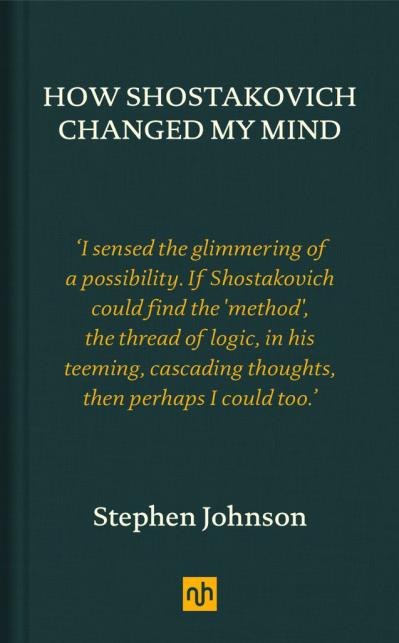
Finally, when it comes to mental health memoirs I am perhaps even more cautious than I am about fictional or poetic works. However, within Stephen Johnson’s How Shostakovich Changed My Mind, I found moments that spoke to me so clearly in relation to my own experience of mental illness before and in the long years following diagnosis. That is possibly because it is not your standard mental illness memoir. A blend of musical biography, memoir, psychology and philosophy, this fascinating book-length essay draws its greatest strength from the author’s passionate affection for and deep connection to the music of Dimitri Shostakovich. As I note in my review:

As one might imagine, given the unusual title, How Shostakovich Changed My Mind is an intimate account of the intersection of music with the personal drama, and trauma, of life lived. Johnson draws on literary, philosophical, neurological and psychological resources as he explores the connection between music and the brain, an area of growing interest and investigation, but he anchors his inquiry in the story of Shostakovich’s life and work during some of the most tumultuous events of the twentieth century—a thoroughly fascinating account in its own right—while tracing out his own particular relationship to this music and the role it played, not only in adolescence, but in his own adult challenges with bipolar disorder.

As such, Johnson’s work is not only a powerful exploration of the ability of music to provide expression and meaning in times of joy and sorrow, but a moving personal memoir of how music can serve as a means to navigate madness, especially in those times when, from inside, all one knows is that something is not right, even if one does not know why.

So, three books for Mental Health Awareness Month, or any time, because it is important to continue to work towards increasing understanding and reducing stigma around mental illness year round—and around the world.

Hospital by Sanya Rushdi is translated from the Bengali by Arunava Sinha and published by Giramondo in Australia and Seagull Books everywhere else.

Shahr-E-Jaanaan: The City of the Beloved by Adeeba Shahid Talukder is published by Tupelo Press.

How Shostakovich Changed My Mind by Stephen Johnson is published by Nottinghill Editions in the UK and distributed by NYRB in North America.

Beautiful scavenger: We the Parasites by A. V. Marraccini

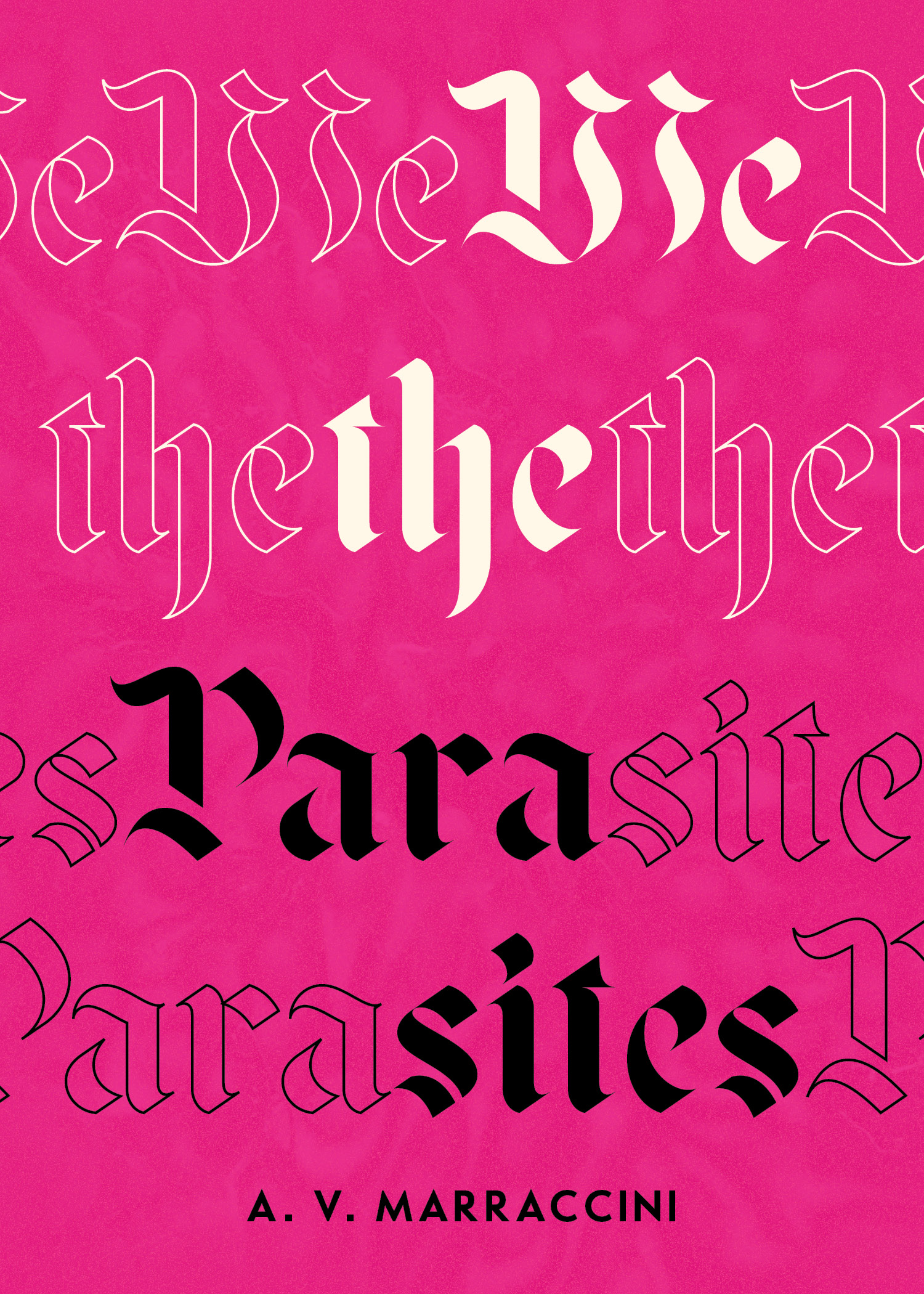
“I’m boringly good,” A. V. Marraccini confesses. “Except when I write critique, I guess.” I am also boringly good, even when I write critique—or so I thought before I read We the Parasites. Now, I’m not so sure.

What I will admit, off the top, is that I have been staring at this hot pink volume waiting patiently on one of my overcrowded bookshelves for the better part of this year. As someone who has written and edited critical essays without any of the prerequisite training many of my literary friends seem to have, I was afraid that a book about criticism would be thick with the names of all those critical theorists I have not read and likely never will, and page after page I would be smiling and nodding politely, off in the corner, with no idea what was going on. I needn’t have worried though; for the most part, none of those folk were invited to this party. However, I was still concerned that, given what I’d heard about this book, I might yet be stranded outside my comfort zone.

You see, Marraccini puts her cards on the table right at the beginning. After describing the mechanics of the relationship between the fig and the fig wasp that burrows deep into the fruit flesh in a somewhat haphazard partnership that enables the reproduction of both fruit and insect, she finds a distinct affinity, as a critic, with the latter:

The critical gaze is tearing apart, clawing into the soft, central flesh of the tree bud.

The critical gaze is also erotic; we want things, we are by a degree of separation pollinating figs with other figs by means of our wasp bodies, rubbing two novels together like children who make two dolls “have sex”, except that we’ll die inside the fruit and someone else will read it and eat it, rich with the juice of my corpse.

And although the wasp/fig process involves, to unequal ends, male and female wasps and figs, there is an element that is, for our parasitic critic, inherently queer and, thus:

Criticism, too, is queer in this way, generative outside the two-gendered model, outside the matrimonial light of day way of reproducing people, wasps, figs, or knowledge.

Okay, I think. I will need to be convinced. The idea of digging into a work appeals quite naturally. That is what I do when I write about a book, whether in a literary journal or, at least most of the time, here on this site. I inhabit the words of others in order to write, but try to stay out of my own way in my writing so that my reading experience seasons but does not obviously alter the flavour of someone else’s. And erotic? Well, that is not something that comes naturally to me, nor does queer even though I’m hard-pressed to know what I am if not queer. I have a fraught relationship with matters of sexuality and identity. It’s complicated. Yet, I am intrigued. And, as We the Parasites demonstrates, reading—or viewing, since Marraccini is an art historian—with the body can be a messy endeavour. But I’m getting ahead of myself.

Deciding to give this much-praised work the benefit of the doubt, I held my anxieties to the side, burrowed into the flesh of this curious text (I know, I know) and, my god, what an excellent read! (Please excuse the abandonment of all the niceties of proper critical reviewing and even accept an errant exclamation mark, because this book is one that invites you into the critic’s heart, mind and bed in a way that is completely, even joyously unexpected.) It is wise and funny and, best of all, it draws its references from the most unlikely places. My limited acquaintance with the stalwarts of the Western canon was no barrier to my enjoyment and, much to surprise, the two years of Classics that preceded my eventual academic journey through Biological Anthropology and Philosophy, was finally of some use. I not only have The Illiad (who doesn’t?), but I also could pull long untouched copies of Xenophon’s The Persian Expedition and Arrian’s Anabasis off my shelf and feel so clever. Not to worry, though, there’s always Google which you will need to see Twombly’s The Age of Alexander for this particular discussion, unless you have a photographic memory. But my point is, really, that you don’t need any special background to enjoy the musings that arise in this book; Marraccini writes with such enthusiasm, even about work that she views with some skepticism, that anything that is not offered within the text itself will have you happily popping online for a quick refresher.

The parasite analogy, if at first odd, sparks the author’s playful love of the dark and yet speaks with striking accuracy to the nature of the critic’s task—burrowing into and feeding off of the work of (mostly dead) writers and artists, to produce a reading or a response that brings light to the spaces darkened by time. However, if the wasp burrows into the fig, the tape worm finds it way into its animal or human host, consider the fish-louse that swims into the gills of its victim, severs the roots at the base of the tongue and eats away at the flesh until it becomes the tongue itself. This offers Marraccini an image, graphically detailed, that corresponds to the way that she has, when appropriate, stolen the tongue of Homer, or John Updike, or whomever. Strange? Maybe, but it aligns with the experience I’m often referring to when I say that I write about books to “open up” a potential reading (or readings). It’s even more relevant when one has the runway (that is, the venue and necessary word count) for an in-depth critical essay. If not stealing, we are perhaps echoing a voice, while our “I” self remains in the shadows.

In this extended essay in which the subject is criticism itself, Marracinni draws on a wide range of sources and images from classical history and mythology, to poetry, prose and, of course, art. Cy Twombly is her main man on that last front. One can move from Updike, to Centaurs, to Genet and Rilke, but it seems there’s a Twombly painting or series for almost every season and, in her explorations, she manages to carry us right down into the layers of crayon and paint. This affinity between artist and critic is so vividly rendered I wish I could have read this before my only direct encounter with his work at MOMA in San Francisco, but that would require bending time.

Our parasite, in inhabiting the works of the artists she consumes, also develops a strange relationship with the notions that arise out of that connection—a who-did-that-idea-come-fromness—that emerges in unlikely settings. Like dreams. Like when a nocturnal lecturer pontificating about the attributes of a strange painting-carpet he insists is a Twombly says No one wants queer art to be queer any more, Marraccini acknowledges, “to be clear, (that) is my brain saying that, and yet me in the dream is somehow intimidated by his prognostic authority” and she wakes up in a puddle of sweat. This is, for me, the kind of uncanny thing that only occurs when one is so deeply engaged with an idea or a book or an artwork or an artist, that the boundary between the ruminations of the sleeping self and the waking self is breeched. Blurred.

The question then is one of embodiment. Is the reader/viewer/critic inhabiting the work, or is it the other way round? Is this a risk of reading/viewing with the body? Marraccini writes about longing and desire, how they can be awoken or perhaps interfere with the engagement. Yet desire is not necessarily realized (at least not without breaking a law). And she does write about the body, her body, but typically in the most clinically frank way about the myriad way the body and its discontents can betray one. To be a parasite it one thing, to host one is something one would rather not entertain, thank you. Yet there are illnesses, physical and mental, that many of us live with and to pretend that they never mediate the way we read a poem of look at a piece of art would be an act of denial.

Finally, Marraccini is writing all of this against the backdrop of the early months of the pandemic, when London was eerily quiet and she could wander at will under the cover of darkness. (We are both naturally nocturnal creatures, it seems.) She captures the eerie otherness or suspended unknown of that period of time so well:

The whole world is so new now, there will surely be a spate of essays like this one, about The Before and After, or there will be no After and there will still be essays anyway.

I love this sentence. There surely was a spate of essays—as nonfiction editor for 3:AM Magazine, my inbox saw four or five new pandemic inspired essays arrive nearly every day. Meanwhile, a temporary medication change made it increasingly difficult for me to make my way through them as 2020 wore on, and by the end of the year I was no longer editing or entertaining the idea of pitching or writing any more essays myself. Whether there actually has been an After, as year four of Covid dawns, there are still essays, but I’m not writing them. However, reluctant queer, recalcitrant parasite that I am, perhaps I should be, duly inspired by this idiosyncratic, astute and undeniably queer essay. This is an original and very entertaining book.

We the Parasites by A. V. Marraccini is published by Sublunary Editions.

India update: Catching up with old friends, finally meeting others

Four years is a long time. Much has happened since I last visited this country. Since I last travelled anywhere as fate and pandemic would have it. Two-thirds into my stay and it feels like it has been a hectic time—not that I haven’t had free time, but I seem to find it hard to stay put on an empty day when a busy vibrant world awaits outside the door. And one doesn’t want to miss the chance to catch up with friends who are normally but a virtual prescience in one’s life. So, less reading and writing has been accomplished than I had anticipated to date.

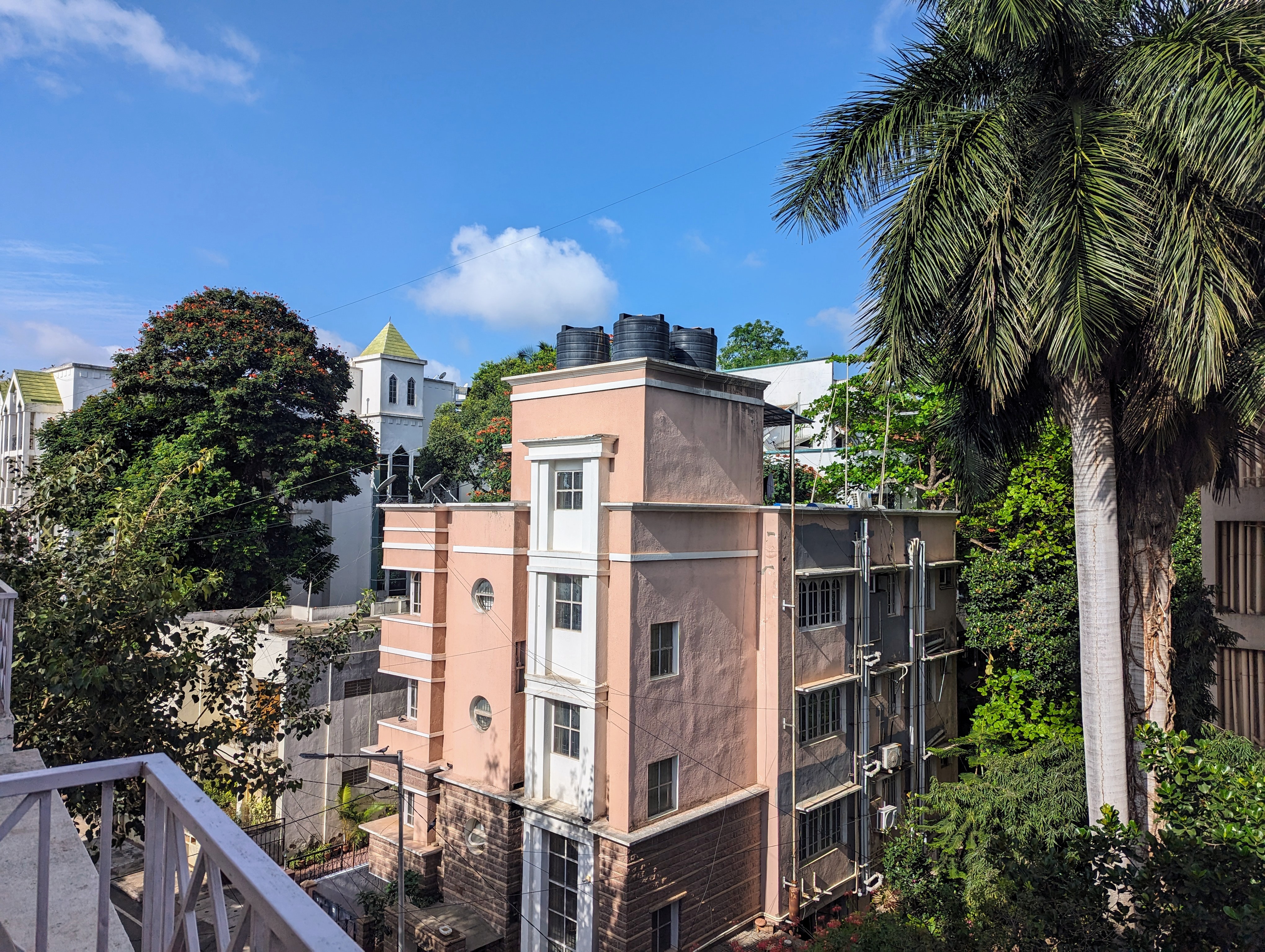
I started my trip in Bangalore, a city I will return to before flying home to stock up on books. Weight restrictions on internal flights have meant that if I buy books, I risk not being able to get to my next destination. It surprises me how just a few slim volumes will tip the scales! And it’s always a pleasure to spend time with my very dear friends here at either end of my India sojourn.

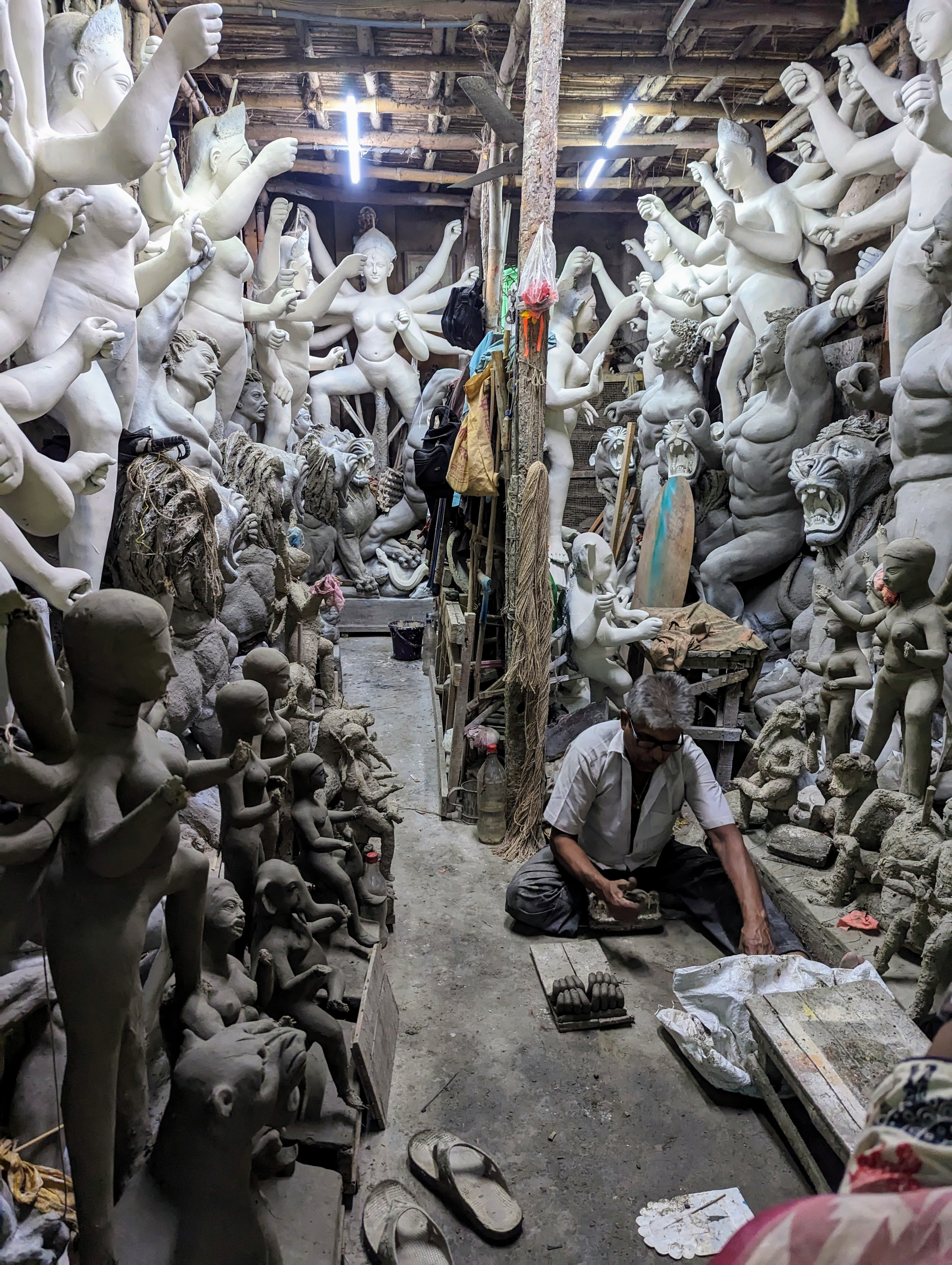
From Bangalore, I was off to the City of Joy, Calcutta or Kolkata, to the place (and the publisher) that first drew me to the subcontinent. Wet and humid beyond measure, it was my first visit outside the drier winter/spring months. But it was wonderful to see my dear friends at Seagull Books where I was able to play a small role in the creation of what will be another spectacular catalogue—this one tackling a vital theme for the times. I also had coffee with the couple who were my first tour guides in the city, this time meeting up with them in an area further south than I had been to date. I also made a pilgrimage to Kumartuli, the potters’ colony where craftsmen are busy making idols for the upcoming Durga Puja, Kolkata’s most important festival.

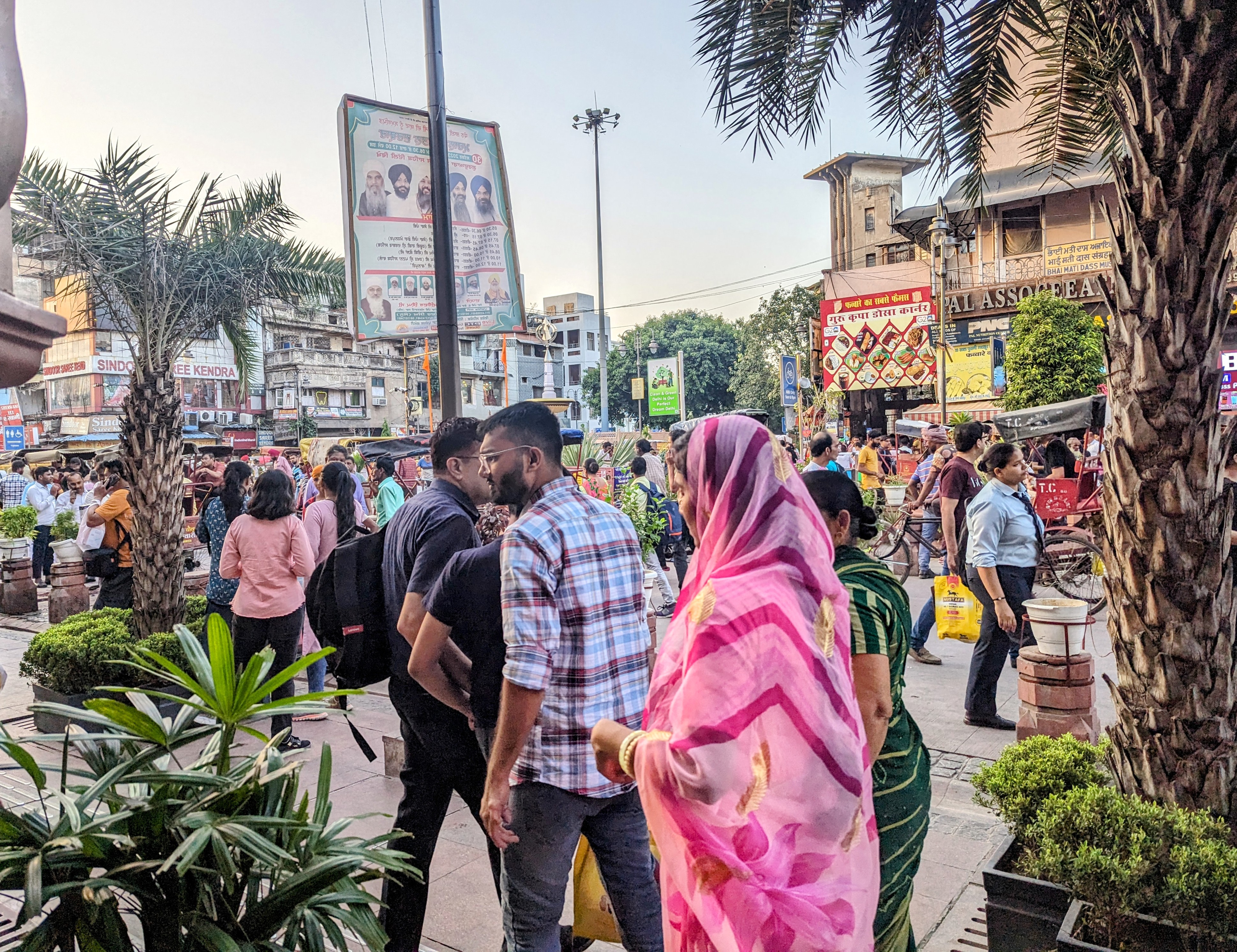
The next stop was Delhi, a short stay, but my first in the nation’s capital. I was met at the airport by a friend which was fortuitous because it proved difficult to get a cab willing to go into the congested area where I was staying. Subsequent forays in and out were facilitated by the Metro. On my first day in the city, the same friend escorted me to the university where he teaches and I gave a talk about writing book reviews. It was a very rewarding experience. The second day another friend took me into central Delhi where we had lunch, walked around, visited temples and enjoyed a most awesome lassi!

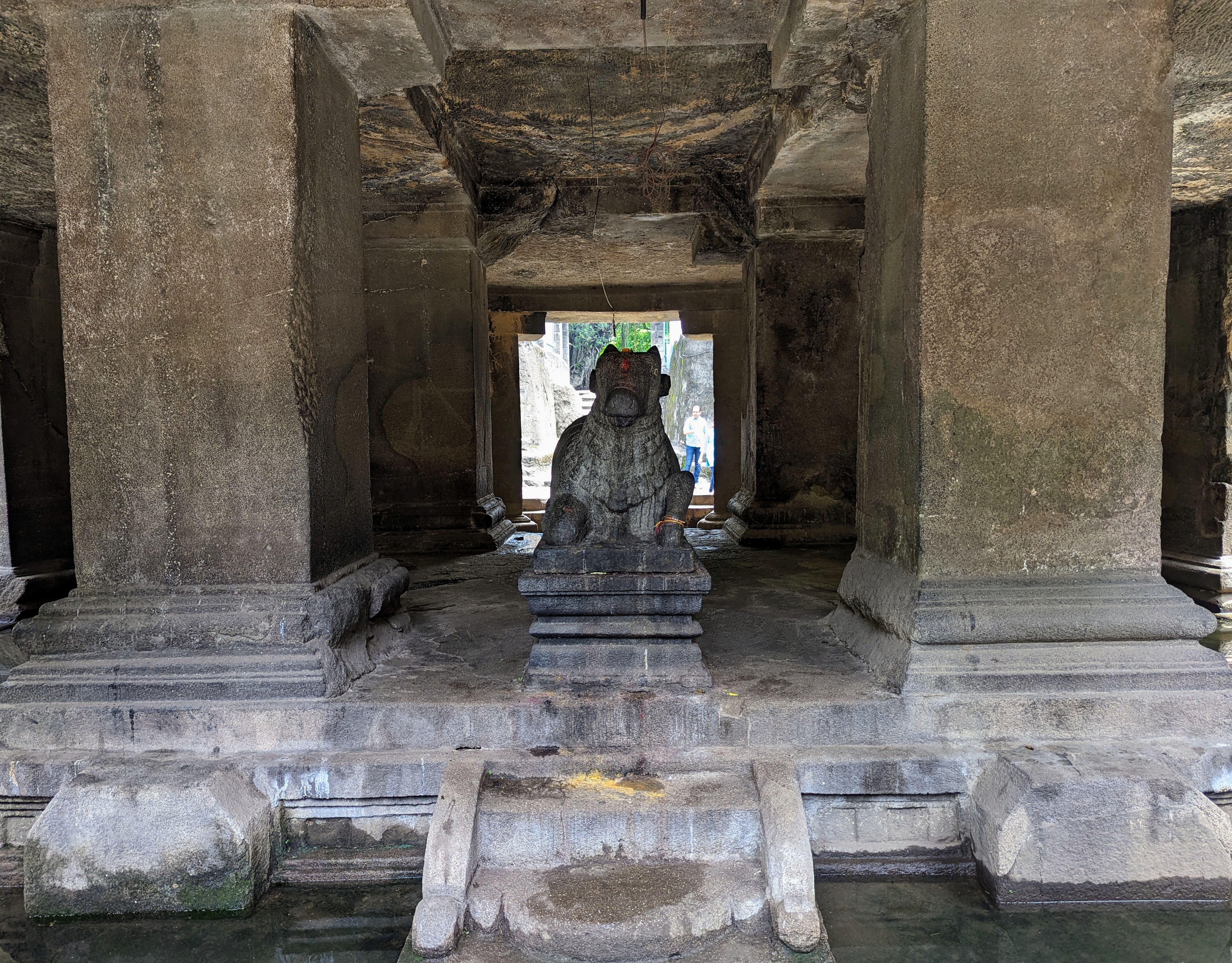
Then on to Pune, where I’m writing this on the final hour of my birthday. Here I caught up with dear literary friends and had a chance to finally meet someone whose friendship has offered solace during these long years of pandemic isolation. I also walked down to see the Pataleshwar Caves, the site of an eighth century Hindu temple carved out of the rock—a sanctuary within a busy city.

Tomorrow I fly to Mumbai for a brief stay then on to Jaipur where I hope to dry out a little after all the humidity of this extended wet season before returning to Bangalore. Whew!

It is good to be back in this hectic, vibrant country, even if I have arrived at a time of some diplomatic discord between my own country and India. I have never felt anything but welcome here.

The excellent books I’ve not been reading

As September began, with the prospect of a long-awaited trip looming, I had imagined I would have read and reviewed several new and recent releases before taking flight. Now it looks like these same books will be joining me on my way to India. I’d pictured myself only packing a few slender volumes so as to leave room to acquire more and still remain within the tighter weight restrictions of my internal flights. I should still be fine, of course, and I will still be able to fill up with even more books, so far as I can afford, before I head home from Bangalore. And, without even having to buy a second bag to get home as I have in the past.

It has been just shy of four full years since my last visit to India—in fact, since my last trip anywhere. I have spent hours sorting out flights, reserving hotels, making sure all my expenses at home are covered and making endless lists (which my toothless cat has mutilated on more than one occasion as he is inclined to do with my notebooks and sticky note reminders when I’ve recklessly left them unattended). I’ve also been invited to give a talk while I’m in India, so preparations for that have required my attention, as have an endless number of last minute errands. Considering how very busy I was prior to my last trip in 2019, it’s a wonder I got out of the door at all. Perhaps the enterprise of travel after the upheaval of the still-lingering pandemic is more precious and more precarious, and I don’t want to leave as much to chance as I did before.

Anyhow, the books I have been reading, each excellent in their own way, deserve a mention now should I not manage a proper review until I get back. I am not only a slow reader, but I’m an equally slow writer and I do hope to manage even a little personal writing while I’m away.

A Practical Guide to Levitation by José Eduardo Agualusa, translated from the Portuguese by Daniel Hahn (Archipelago) is a brilliantly fun collection of short stories set in Portugal, Brazil and Angola. For me, Agualusa’s eccentric characters and fondness for magical realism work so well in the short form.

The Box: A Novel by Bermudian writer Mandy-Suzanne Wong (Graywolf/House of Anansi Press) is a high-concept novel revolving around an enigmatic, unopenable box and the effect it has on those who come into contact with it. I’m only a couple of chapters in, but so far it makes me think of Czech writer Michal Ajvaz’s playful, intelligent postmodern fiction and I’m eager to see where it goes.

Finally, River in an Ocean: Essays on Translation, from the new Canadian publisher, trace press, is a collection of essays by poets, writers and translators from across the globe, edited by Nuzhat Abbas. These formally inventive pieces invite us, as the description advises, “to consider translation as a form of ethical and political love—one that requires attentive regard of the other—and a making an unmaking of self.” This project of decolonial feminism is a very important exploration of the intersection of language with questions of  identity, belonging, gender and sexuality, giving space to voices and perspectives that many of us might not hear or even consider otherwise. It is leading me to ask myself difficult questions about what my own interest in reading and promoting work in translation really means. And with many South Asian contributors I suspect this book would have landed in my travel bag anyhow—it seems only right.

Now, with only one day until I leave, I plan to continue to fuss over my packing, take a very long walk to celebrate the colours that will be gone by the time I get back and, with luck, get a little more reading done!